
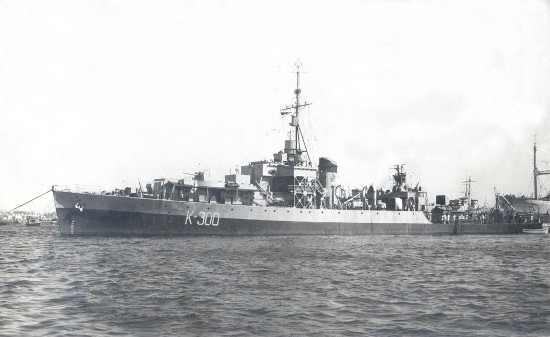
| Navy | The Royal Navy |
| Type | Frigate |
| Class | River |
| Pennant | K 300 |
| Built by | Canadian Vickers (Montreal, Canada) |
| Ordered | 6 Oct 1941 |
| Laid down | 28 May 1942 |
| Launched | 9 Nov 1942 |
| Commissioned | 4 Jun 1943 |
| End service | |
| History | Was to be built in Canada for the United States Navy but transferred to the Royal Navy under the lend-lease program. Returned to the U.S.N. 5 March 1946. |
| Former name | USS Danville (PG 105) |
Commands listed for HMS Evenlode (K 300)
Please note that we're still working on this section
and that we only list Commanding Officers for the duration of the Second World War.
| Commander | From | To | |
| 1 | T/A/Lt.Cdr. Alfred Laurence Turner, RNR | 4 Jun 1943 | 7 Mar 1944 |
| 2 | T/A/Lt.Cdr. George Bradford Medlycott, RNR | 7 Mar 1944 | 1 Jul 1944 |
| 3 | Cdr. Vivian Funge Smith, DSO, RD, RNR | 1 Jul 1944 | 28 May 1945 |
| 4 | T/A/Lt.Cdr. William Fleming McAusland, RNVR | 28 May 1945 | late 1945 |
You can help improve our commands section
Click here to Submit events/comments/updates for this vessel.
Please use this if you spot mistakes or want to improve this ships page.
Notable events involving Evenlode include:
23 Aug 1943
On the 23th August 1943 the 40th Escort Group (Cdr. Dallison), consisting of the sloops HMS Landguard, HMS Bideford, HMS Hastings and the frigates HMS Exe, HMS Moyola and HMS Waveney were deployed on a U-boat hunt off Cape Ortegal. The whole operation was covered by the British light cruiser HMS Bermuda.
On the 25th August the Canadian 5th Support Group (Cdr. Tweed), consisting of the British frigates HMS Nene, HMS Tweed and the Canadian corvettes HMCS Calgary, HMCS Edmundston and HMCS Snowberry were deployed to relieve the 40th Escort Group. While this was in progress the ships were attacked at 1415 hrs by 14 Dornier Do-217's and 7 Ju-88's. with the new German weapon, the Henschel Glider Bombs, (the "Hs293 A-1"). Designed by the German Professor Herbert Wagner. HMS Landguard and HMS Bideford were the first of the Allied and R.N. ships to be attacked and damaged by them. This being the first time of their being brought into action against Allied ships. Several sailors were injured on HMS Bideford and one sailor was killed.
Another two days later on the 27th August 1943 the Canadian 5th Support group was relieved by the 1st Support group (Cdr. Brewer) consisting of the sloops HMS Pelican, HMS Egret and the frigates HMS Jed, HMS Rother, HMS Spey and HMS Evenlode. Also the covering cruiser HMS Bermuda was relieved by the Canadian destroyer HMCS Athabaskan and the British destroyer HMS Grenville. These ships were also attacked by the Germans. This time with 18 Dornier Do-217?s also carrying Henschel Glider Bombs. HMCS Athabaskan was heavily damaged and HMS Egret was sunk with the loss of 194 of her crew. After this loss the U-boat hunt was blown off.
11 Sep 1943
HMS H 33 (Lt. D.G. Kent, RN) conducted A/S exercises off Lough Foyle with HMS Spey (Lt.Cdr. B.A. Rogers, RD, RNR), HMS Escapade (Lt.Cdr. E.C. Peake, RN), ORP Garland (Lt.Cdr. S. Biskupski) and HMS Evenlode (T/A/Lt.Cdr. A.L. Turner, RNR). (1)
17 Sep 1943
Convoy MKF 24.
This convoy departed Port Said on 17 September 1943.
It was made up of the (troop) transports; Clan Campbell (British, 9545 GRT, built 1943), Eastern Prince (British, 10926 GRT, built 1929), Staffordshire (British, 10683 GRT, built 1929) and Strathmore (British, 23428 GRT, built 1935).
The armed merchant cruiser HMS Carthage (A/Capt. U.H.R. James, RN) was also part of the convoy. She was en-route from the East Indies station to the U.K. to be decommissioned and be outfitted for her new role as troop transport.
The convoy was escorted by the escort destroyers HMS Aldenham (Lt.Cdr. H.A. Stuart-Menteth, RN), HMS Rockwood (Lt. S.R. Le H. Lombard-Hobson, RN), RHS Kanaris and RHS Miaoulis.
At 0620C/18, the Eastern Prince was detached to Alexandria.
The convoy arrived at Algiers on 22 September 1943.
------------------------------------------------------------------------------------------------------------------------------------------
On 28 September 1943 the convoy departed Algiers for the U.K.
It was now made up of the following (troop) transports; Almanzora (British, 15551 GRT, built 1914), Arundel Castle (British, 19118 GRT, built 1921), Athlone Castle (British, 25564 GRT, built 1936), Bergensfjord (Norwegian, 11015 GRT, built 1913), Cameronia (British, 16297 GRT, built 1920), Clan Campbell, Durban Castle (British, 17388 GRT, built 1938), Empress of Australia (British, 21833 GRT, built 1914), Marnix van St. Aldegonde (Dutch, 19355 GRT, built 1930), Monarch of Bermuda (British, 22424 GRT, built 1931), Otranto (British, 20026 GRT, built 1925), Ruys (Dutch, 14155 GRT, built 1937), Staffordshire, Strathmore, Tegelberg (Dutch, 14150 GRT, built 1937) and Volendam (British, 15434 GRT, built 1922).
The armed merchant cruiser HMS Carthage was still part of the convoy.
The convoy was escorted by the sloop HMS Pelican (Cdr. J.S. Dalison, DSO, RN) and the frigates HMS Evenlode (T/A/Lt.Cdr. A.L. Turner, RNR), HMS Jed (Lt.Cdr. R.C. Freaker, DSO and Bar, RD, RNR), HMS Rother (Lt.Cdr. W.R. Hickey, RNR), HMS Spey (Lt.Cdr. B.A. Rogers, RD, RNR) and HMS Wear (Cdr. E. Wheeler, RD, RNR).
At 0700A/30, the Ruys and Volendam were detached.
At 0900A/30, the Empress of Australia and Monarch of Bermuda were detached.
At 0930A/30, the (troop) transports Empire Might (British, 9209 GRT, built 1942), Highland Princess (British, 14133 GRT, built 1930) and Rochester Castle (British, 7795 GRT, built 1937) joined coming from Gibraltar.
Also the following warships joined at the same time; escort carriers HMS Attacker (Capt. W.W.P. Shirley-Rollison, RN), HMS Hunter (Capt. H.H. McWilliam, RN), HMS Stalker (Capt. H.S. Murray-Smith, RN), seaplane carrier HMS Albatross (A/Capt.(Retd.) S. Barry, RN) and the destroyers HMS Wishart (Lt. J.A. Holdsworth, RN) and HMS Witherington (Lt.Cdr. R.B.S. Tennant, RN).
At 1400A/30, the Volendam rejoined.
At 1500A/30, the AA cruiser HMS Charybdis (Capt. G.A.W. Voelcker, RN) joined coming from Gibraltar.
At 1600A/30, the Ruys rejoined.
At 0420A/1, the Bergensfjord, Highland Princess and Volendam parted company to proceed to Freetown. They took HMS Wishart and HMS Witherington with them as escorts. Also the destroyer HMS Malcolm (Lt. I.M. Clegg, RN) joined them which had came from Casablanca.
At 1300A/1, the Athone Castle was detached to proceed independently to New York.
At 0640Z/4, the light cruiser HMS Spartan (Capt. P.V. McLaughlin, RN) joined the convoy escort.
At 0635Z/5, HMS Spartan parted company with the convoy.
At 0930Z/5, HMS Charybdis and HMS Albatross parted company to proceed to Plymouth where they arrived on 6 October.
On 7 October the convoy arrived in U.K waters. The bulk of the convoy proceeded either to Greenock or to Liverpool.
16 Oct 1943
HMS Venturer (Lt. J.S. Launders, DSC, RN) conducted A/S exercises off Larne with HMS Pelican (Cdr. J.S. Dalison, DSO, RN) and HMS Evenlode (T/A/Lt.Cdr. A.L. Turner, RNR). (2)
17 Oct 1943
Combined convoy MKF 24 / XIF 2A.
This convoy departed Port Said on 17 October 1943.
It was made up of the (troop) transports; Britannic (British, 26943 GRT, built 1930), Egra (British, 5108 GRT, built 1911), Glenartney (British, 9795 GRT, built 1940), Largs Bay (British, 14182 GRT, built 1921), Martand (British, 7967 GRT, built 1925), Maloja (British, 20914 GRT, built 1923), Stirling Castle (British, 25550 GRT, built 1936), Stratheden (British, 23722 GRT, built 1937) and Tamaroa (British, 12405 GRT, built 1922).
The headquarters ship HMS Largs (Capt. H.S. Allan, RNR) was also part of the convoy.
On departure from Port Said the convoy was escorted by the escort destroyers HMS Lamerton (Lt.Cdr. C.R. Purse, DSC and Bar, RN), HMS Wilton (Lt. A.P. Northey, DSC and Bar, RN), RHS Kanaris and RHS Themistocles.
On 18 October 1943, the (troop) transports; Aronda (British, 9031 GRT, built 1941), Karoa (British, 7009 GRT, built 1915), Letitia (British, 13595 GRT, built 1925), Llandgibby Castle (British, 11951 GRT, built 1929) and Nieuw Holland (Dutch, 11066 GRT, built 1927) departed Alexandria to join the convoy which they did later the same day.
The were escorted by the AA cruiser HMS Colombo (Capt. D.H. Hall-Thompson, RN) and the escort destroyers HMS Croome (Lt. H.D.M. Slater, RN) and HMS Tetcott (Lt. A.F. Harkness, DSC, OBE, RNR).
In the morning of 21 October 1943, the convoy arrived off Augusta where the Britannic, Glenartney, Largs Bay, Maloya, Martand, Stirling Castle, Stratheden, Tamaroa, and HMS Largs were detached and entered harbour.
The Aronda, Egra, Karoa, Letitia, Llangibby Castle and Nieuw Holland and the entire convoy escort then proceeded to Taranto where they arrived early in the morning of 22 August 1943.
The convoy departed Taranto in the late afternoon to proceed to Augusta. The escort destroyer HMS Haydon (Lt.Cdr. R.C. Watkin, RN) had joined the convoy escort. The Llangibby Castle and HMS Lamerton did not sail with the convoy.
Early in the afternoon of 23 October the convoy was back off Augusta. the Nieuw Holland was then detached and entered Augusta. The convoy was rejoined by the Britannic, Glenartney, Largs Bay, Maloya, Martand, Stirling Castle, Stratheden, Tamaroa and HMS Largs which had been detached on 21 October. More (troop) transports however joined coming from Augusta, these were; Duchess of Bedford (British, 20123 GRT, built 1928), Dunnottar Castle (British, 15007 GRT, built 1936), Durban Castle (British, 17388 GRT, built 1938), Otranto (British, 20026 GRT, built 1925), Reina del Pacifico (British, 17702 GRT, built 1931) and Sibajak (Dutch, 12226 GRT, built 1927).
Late in the afternoon of 23 October the convoy was off Malta where it was joined by the damaged light cruiser HMS Cleopatra (Cdr. M.J. Ross, DSC, RN) and the landing ships HMS Prince Charles (A/Cdr. (Retd.) S.H. Dennis, DSC, RN), HMS Prince Leopold (Lt.Cdr. J.A. Lowe, DSO, DSC, RNR), HMS Princess Josephine Charlotte (Lt. J.E. Bromley, RNR) and HMS Princess Astrid (T/A/Lt.Cdr. (Retd.) C.E. Hall, RNR).
On 25 October 1943, the convoy arrived at Algiers. Part of the convoy however went on to Oran. These were the Aronda, Egra, Karoa, escorted by HMS Croome, HMS Tetcott, RHS Kanaris and RHS Themistocles.
On 27 October 1943, the convoy departed Algiers. It was now made up of the following (troop) transports; Britannic, Duchess of Bedford, Dunnottar Castle, Durban Castle, Franconia (British, 20175 GRT, built 1923), Largs Bay, Maloja, Martand, Reina del Pacifico, Samaria, Sibajak, Stirling Castle, Stratheden, Tamaroa,
The light cruiser HMS Cleopatra, headquarters ship HMS Largs and the landings ships HMS Prince Charles, HMS Prince Leopold, HMS Princess Josephine Charlotte, HMS Princess Astrid, HMS Ulster Monarch (Lt.Cdr. N.A.F. Kingscote, RNR) were also part of the concoy.
The convoy was escorted by the AA cruiser HMS Colombo, escort destroyers HMS Haydon, HMS Wilton, sloop HMS Pelican (Cdr. J.S. Dalison, DSO, RN) and the frigates HMS Jed (Lt.Cdr. R.C. Freaker, DSO and Bar, RD, RNR), HMS Rother (Lt.Cdr. W.R. Hickey, RNR) and HMS Spey (Lt.Cdr. B.A. Rogers, RD, RNR).
The frigate HMS Evenlode (T/A/Lt.Cdr. A.L. Turner, RNR) departed Algiers on the 28th to overtake and join the convoy at sea which she did on 30 October.
On 28 October 1943, the convoy passed Gibraltar and the following ships were detached from the convoy; HMS Cleopatra, HMS Prince Charles, HMS Prince Leopold, HMS Princess Josephine Charlotte, HMS Princess Astrid, HMS Colombo and HMS Haydon.
From Gibraltar the following ships joined the convoy; (troop) transports; Esperance Bay (British, 13837 GRT, built 1922), Highland Princess (British, 14133 GRT, built 1930), Moreton Bay (British, 14193 GRT, built 1921), Rangitata (British, 16737 GRT, built 1929), Saturnia (Italian, 23940 GRT, built 1927), Strathaird (British, 22281 GRT, built 1932).
The landing ship HMS Prince Albert (Lt.Cdr. H.B. Peate, RNR) also joined as did the AA ship HMCS Prince Robert (Cdr. A.M. Hope, RCN) and the destroyers HMS Beagle (Lt.Cdr. N.R. Murch, RN), HMS Boadicea (Lt.Cdr. F.C. Brodrick, RN) and HMS Bulldog (Lt.Cdr. E.J. Lee, RN).
On 30 October 1943, HMS Wilton was detached to return to Gibraltar where she arrived at following day.
On 1 November 1943, the convoy was joined by the frigate HMS Tavy (T/A/Lt.Cdr. F. Ardern, RNR).
On 4 November 1943, HMCS Prince Robert arrived at Horta, Azores after having been detached from the convoy earlier on it approaching 50°N.
On 4 November 1943, HMS Prince Albert and HMS Bulldog arrived at Plymouth after having been detached from the convoy earlier.
On 5 November 1943, the convoy arrived in U.K. waters. The bulk of the convoy proceeded to Liverpool.
15 Nov 1943
Convoy KMF 26.
This convoy departed the Clyde on 15 November 1943 and arrived at Alexandria / Port Said on 30 November 1943 / 1 December 1943.
This convoy was made up of the following transports; Arundel Castle (British, 19118 GRT, built 1921), Cameronia (British, 16297 GRT, built 1920), Chinese Prince (British, 9485 GRT, built 1943), City of Lincoln (British, 8039 GRT, built 1938), Clan Campbell (British, 9545 GRT, built 1943), Dempo (British, 17024 GRT, built 1931), Duchess of Bedford (British, 20123 GRT, built 1928), Dunnottar Castle (British, 15007 GRT, built 1936), Franconia (British, 20175 GRT, built 1923), Highland Princess (British, 14133 GRT, built 1930), Monarch of Bermuda (British, 22424 GRT, built 1931), Orion (British, 23371 GRT, built 1935), Ranchi (British, 16738 GRT, built 1925), Reina del Pacifico (British, 17702 GRT, built 1931), Samanco (British, 8336 GRT, built 1943), Samaria (British, 19597 GRT, built 1921), Sarmiento (British, 8335 GRT, built 1943) and Scythia (British, 19761 GRT, built 1920).
On departure the convoy was escorted by the light cruiser HMS Birmingham (Capt. H.W. Williams, RN) (actually joined on the 16th), sloops HMS Pelican (Cdr. J.S. Dalison, DSO, RN, S.O. of A/S escort), HMS Woodpecker (Lt.Cdr. H.L. Pryse, RNR) and the frigates HMS Evenlode (T/A/Lt.Cdr. A.L. Turner, RNR), HMS Jed (Lt.Cdr. R.C. Freaker, DSO and Bar, RD, RNR), HMS Rother (Lt.Cdr. W.R. Hickey, RNR) and HMS Spey (Lt.Cdr. B.A. Rogers, RD, RNR).
In the afternoon of 19 November, HMS Birmingham fuelled HMS Spey as the frigate had two out of four fuel tanks contaminated with seawater drastically effecting her range. With this underway refuelling she was able to continue on to Algiers.
During the morning of 20 November, the frigate HMS Rother also received some fuel from HMS Birmingham.
On passing the Straits of Gibraltar, HMS Birmingham parted company with the convoy and entered Gibraltar harbour. The AA cruiser HMS Colombo (Capt. D.H. Hall-Thompson, RN) and the destroyers HMS Anthony (Lt.Cdr. J.H. Wallace, DSC, RN) and HMS Brilliant (Lt.Cdr. J. Smallwood, RN) joined the convoy coming from Gibraltar. Also the submarine HMS Stonehenge (Lt. D.S.M. Verschoyle-Campbell, DSC and Bar, RN) joined the convoy for passage to Alexandria.
On the 25th, HMS Anthony and HMS Spey parted company with the convoy.
Off Oran / Mers-el-Kebir the transports Egra (British, 5108 GRT, built 1911), Karoa (British, 7009 GRT, built 1915) and Rohna (British, 8602 GRT, built 1926) joined the convoy. They were escorted by the destroyer escorts USS Frederick C. Davis (Lt.Cdr. O.W. Goepner, USNR), USS Herbert C. Jones (T/Lt.Cdr. A.W. Gardes, Jr., USN) and the minesweepers USS Pioneer (Lt. L.E. Rogers, Jr., USNR) and USS Portent (Lt. H.C. Plummer, USNR).
Off Algiers transport Monarch of Bermuda and the escorts HMS Brilliant, HMS Pelican, HMS Woodpecker, HMS Evenlode, HMS Jed, HMS Rother parted company with the convoy while the escort destroyers HMS Atherstone (Lt.Cdr. E.N. Wood, DSC, RNVR), HMS Catterick (Lt.Cdr. A. Tyson, RN), HMS Cleveland (Lt.Cdr. J.K. Hamilton, RN), RHS Miaoulis and ORP Slazak (Cdr. R. Nalecz-Tyminski, ORP) joined the convoy.
In the afternoon of 26 November the convoy was attacked by German aircraft and the transport Rohna was sunk by a glider bomb in position 36°56'N, 05°20'E. 1149 crew and passengers (mostly US troops) were killed in this attack.
Off Philipeville the transports Cameronia, Clan Campbell and Duchess of Bedford parted company with the convoy to proceed to that place while the transport Derbyshire joined the convoy coming from there.
On 27 November first HMS Colombo and later USS Frederick C. Davis and USS Herbert C. Jones parted company with the convoy to proceed to Bizerta.
The remainder of the convoy proceeded towards Alexandria / Port Said arriving there on 30 November / 1 December 1943.
17 Nov 1943
Combined convoy MKF 26 / XIF 4.
This convoy departed Port Said on 17 November 1943.
It was made up of the (troop) transports; Duchess of Richmond (British, 22022 GRT, built 1928), Karamea (British, 10530 GRT, built 1928), Margrethe Bakke (Norwegian, 5478 GRT, built 1938), Nieuw Holland (Dutch, 11066 GRT, built 1927) and Orduna (British, 15507 GRT, built 1914).
They were escorted by the escort vessel HMS Antwerp (Cdr. J.N. Hulse, DSC, RD, RNR) and the escort destroyer RHS Kriti.
On 18 November 1943, the (troop) transports; Cuba (British, 11420 GRT, 1923), Staffordshire (British, 10683 GRT, built 1929) and Tegelberg (Dutch, 14150 GRT, built 1937) departed Alexandria to join the convoy. They were escorted by the destroyer HMS Paladin (Lt. E.A.S. Bailey DSC, MBE, RN) and the escort destroyers HMS Beaufort (Lt. J.R.L. Moore, RN), HMS Belvoir (Lt. J.F.D. Bush, DSC and Bar, RN), RHS Kanaris and Pindos which also joined the convoy.
On 21 November 1943, the bulk of the convoy, Duchess of Richmond, Karamea, Margrethe Bakke, Nieuw Holland, Orduna and Tegelberg escorted by HMS Antwerp, HMS Paladin, HMS Belvoir and RHS Kriti arrived at Augusta. Meanwhile the Cuba and Staffordshire had been detached to Taranto where they arrived on 22 November 1943 escorted by HMS Beaufort, RHS Kriti and RHS Pindos.
The ships that had arrived at Taranto (convoy XIF 4) departed from there again on 24 November 1943 and arrived at Augusta the following day.
Convoy MKF 26 departed Augusta on 27 November. It was now made up of the following (troop) transports; Almanzora (British, 15551 GRT, built 1914), Cuba, Duchess of Richmond, Karamea, Margrethe Bakke, Nieuw Holland, Orduna, Staffordshire and Tegelberg. They were escorted by the escort vessel HMS Antwerp, escort destroyers HMS Beaufort, HMS Belvoir, RHS Kriti, RHS Kanaris and RHS Pindos. The destroyer HMS Nubian (Cdr. D.E. Holland-Martin, DSO, DSC, RN) joined coming from Malta which she had departed on the same day.
On 28 November 1943, the AA cruiser HMS Colombo (Capt. D.H. Hall-Thompson, RN) and the destroyer escorts USS Frederick C. Davis (Lt.Cdr. O.W. Goepner, USNR) and USS Herbert C. Jones (T/Lt.Cdr. A.W. Gardes, Jr., USN) joined the convoy escort coming from Bizerta while the Cuba was detached to Bizerta.
Later on the 28th, the troop transport Duchess of Bedford (British, 20123 GRT, built 1928) joined the convoy coming from Philippeville.
On 29 November 1943, the Karamea was detached to Algiers as were the following escorts; HMS Antwerp, HMS Beaufort, HMS Belvoir, RHS Kriti, RHS Kanaris and RHS Pindos.
The following (troop) transports joined the convoy coming from Algiers; Franconia (British, 20175 GRT, built 1923), Monarch of Bermuda (British, 22424 GRT, built 1931), Samaria (British, 19597 GRT, built 1921) and Scythia (British, 19761 GRT, built 1920). Also joining from Algiers were the following escorts; sloops HMS Pelican (Cdr. J.S. Dalison, DSO, RN), HMS Woodpecker (Lt.Cdr. H.L. Pryse, RNR) and the frigates HMS Evenlode (T/A/Lt.Cdr. A.L. Turner, RNR), HMS Jed (Lt.Cdr. R.C. Freaker, DSO and Bar, RD, RNR), HMS Rother (Lt.Cdr. W.R. Hickey, RNR) and HMS Spey (Lt.Cdr. B.A. Rogers, RD, RNR).
Later on the 29th, the (troop) transport Champollion (French, 12546 GRT, built 1924) joined the convoy coming from Oran / Mers-el-Kebir. Also joining from there were the USN transports USS Andromeda (T/Cdr. W.A. Fly, USN), USS Arcturus (T/Cdr. C.R. Woodson, USN), USS Barnett (T/Capt. G.E. Maynard, USN), USS Charles Carroll (T/Capt. H. Biesemeier, USN), USS Frederick Funston (T/Cdr. J.E. Murphy, USN), USS James O'Hara (T/Capt. C. Allen, USN), USS Joseph T. Dickman (Capt. R.J. Mauermann, USCG), USS Oberon (T/Cdr. D.G. Greenlee, Jr., USN), USS Procyon (T/Cdr. B.A. Hartt, USN) and USS Thomas Jefferson (T/Capt. P.P. Welch, USN).
Around 1945A/30, USS Frederick C. Davis and USS Herbert C. Jones parted company with the convoy to proceed to Algiers. HMS Nubian also parted company with the convoy on the 30th to fuel at Gibraltar and then rejoin the convoy when it passed through the Straits of Gibraltar.
Around 0445A/1, HMS Colombo was detached from the convoy to proceed to Gibraltar. Also on 1 December 1943 the following (troop) transports joined the convoy coming from Gibraltar; Aorangi (British, 17491 GRT, built 1924), City of Bristol (British, 8424 GRT, built 1943) and City of Capetown (British, 8046 GRT, built 1937). The destroyer HMS Velox (Lt. G.B. Barstow, RN) also joined the convoy off Gibraltar.
HMS Velox fuelled at Horta, Azores during 3/4 December 1943 and then rejoined the convoy.
Around 1800O/4, the light cruiser HMS Glasgow (Capt. E.M. Evans-Lombe, RN) joined the convoy. She parted company around 1800Z/6.
The Margrethe Bakke was detached in the North Atlantic and arrived at New York on 12 December 1943.
The convoy arrived in U.K. waters on 8/9 December 1943.
5 May 1944
HMS Una (Lt. C.A.J. Nicholl, RN) conducted A/S exercises off Tobermory with HMS Evenlode (T/A/Lt.Cdr. G.B. Medlycott, RNR), HMS Tintagel Castle (Lt. R. Atkinson, DSC and Bar, RNR), HMS Loch Fada (Lt.Cdr. B.A. Rogers, RD, RNR) and FFS Commandant d'Estienne d'Orves . (3)
6 May 1944
HMS Una (Lt. C.A.J. Nicholl, RN) conducted A/S exercises off Tobermory with HMS Evenlode (T/A/Lt.Cdr. G.B. Medlycott, RNR) and FFS Commandant d'Estienne d'Orves . (3)
7 May 1944
HMS Una (Lt. C.A.J. Nicholl, RN) conducted A/S exercises off Tobermory with HMS Evenlode (T/A/Lt.Cdr. G.B. Medlycott, RNR) and FFS Commandant d'Estienne d'Orves . (3)
15 May 1944
HMS Una (Lt. C.A.J. Nicholl, RN) conducted A/S exercises off Tobermory with HMS Awe (Lt.Cdr. H.P. Carse, DSC, RNVR) and HMS Evenlode (T/A/Lt.Cdr. G.B. Medlycott, RNR). (3)
16 May 1944
HMS Una (Lt. C.A.J. Nicholl, RN) conducted A/S exercises off Tobermory with HMS Evenlode (T/A/Lt.Cdr. G.B. Medlycott, RNR), HMS Loch Killin (Lt.Cdr. S. Darling, RANVR), HMS Capel (Lt. B.G. Heslop, DSC, RN) and HNoMS Tunsberg Castle. (3)
23 May 1944
Combined convoy OS 78 / KMS 52.
This combined convoy was assembled off Oversay on 23 May 1944.
It was made up of the following transports; Adviser (British, 6348 GRT, built 1939), Alex (British, 3932 GRT, built 1914), Baron Elgin (British, 3942 GRT, built 1933), Carslogie (British, 3786 GRT, built 1924), Clunepark (British, 3491 GRT, built 1928), Dago (British, 1993 GRT, built 1917), Empire Falcon (British, 4970 GRT, built 1918), Empire Wolfe (British, 2888 GRT, built 1941), Fort Churchill (British, 7129 GRT, built 1942), Godfrey B. Holt (British, 3585 GRT, built 1929), Historian (British, 5074 GRT, built 1924), Hopecrest (British, 5099 GRT, built 1935), Inverbank (British, 5149 GRT, built 1924), Lago (Norwegian, 2552 GRT, built 1929), Mathilda (Norwegian, 3650 GRT, built 1920), Nailsea Moor (British, 4926 GRT, built 1937), Northleigh (British, 5450 GRT, built 1937), Redgate (British, 4323 GRT, built 1929), Robert Morris (American, 7176 GRT, built 1942), Stanhope (British, 2337 GRT, built 1919), Stuyvesant (Dutch, 4249 GRT, built 1918), Thistleford (British, 4781 GRT, built 1928), Troilus (British, 7422 GRT, built 1921) and Yearby (British, 5666 GRT, built 1929).
The rescue ship Pinto (British, 1346 GRT, built 1928) was also with the combined convoy.
On assembly off Oversay the convoy was escorted by the escort carrier HMS Activity (Capt. C. Wauchope, DSC, RN), frigates HMS Ascension (Lt.Cdr. A. Wilkinson, RNR), HMS Evenlode (T/A/Lt.Cdr. G.B. Medlycott, RNR), HMS Exe (Cdr. C.E.E. Paterson, RN) and the corvettes HMNZS Arabis (Lt.Cdr. J.H. Seelye, RNZNVR), HMS Berkeley Castle (T/Lt. F.A. Darrah, RNVR), HMS Carisbrooke Castle (T/Lt. W.H. Forster, RNR), HMS Dumbarton Castle (T/A/Lt.Cdr. P.F. Broadhead, RNR) and HMS Hadleigh Castle (Lt. C. Sandeman, RN).
The transport Stanhope had to return to the U.K. arriving in the Clyde on 25 May 1944.
The tanker Scottish American (British (tanker), 6999 GRT, built 1920) later joined at sea having parted company with convoy MKS 49. This ship was to refuel the escorts.
Around 1030Z/27, HMS Activity, HMS Ascension, HMS Carisbroke Castle and HMS Hadleigh Castle parted company with the convoy to temporary join northbound combined convoy SL 158 / MKS 49 which they did around 1540Z/28.
Around 1505Z/29, HMS Activity, HMS Ascension, HMS Carisbroke Castle and HMS Hadleigh Castle parted company with combined convoy SL 158 / MKS 49 taking the escort oiler Scottish American (British (tanker), 6999 GRT, built 1920) with them. They rejoined combined convoy OS 78 / KMS 52 around 1650Z/30.
On 30 May 1944, HMNZS Arabis parted company with the convoy and proceeded to Bermuda arriving there on 6 June 1944.
Around 0300Z/3, HMS Activity, HMS Ascension and HMS Berkeley Castle parted company with combined convoy OS 78 / KMS 52 to join northbound combined convoy SL 159 / MKS 50 which they did around 0600Z/3. HMS Ascension and HMS Berkeley Castle then immediately parted company again to rejoin combined convoy OS 78 / KMS 52.
On 4 June 1944, the convoy split into convoy OS 78 and KMS 52.
------------------------------------------------------------------------------------------------------
Convoy OS 78, towards Freetown, was made up of the following transports; Clunepark, Godfrey B. Holt, Northleigh and Stuyvesant.
They were joined by the following transports coming from Gibraltar; Appledore (British, 5218 GRT, built 1929), Fort Glenyon (British, 7132 GRT, built 1943), Fort Thompson (British, 7134 GRT, built 1942), Ittersum (Dutch, 5199 GRT, built 1938) and Ocean Vanity (British, 7174 GRT, built 1942).
With these ships came also the new escort for this convoy which was made up of the sloop HMS Enchantress (Lt.Cdr. E.D.J. Abbot, DSC, RN), frigate HMS Ness (T/A/Lt.Cdr. R.H. Marchington, MBE, RNVR) and the patrol vessel HMS Kilbirnie (T/Lt. E.R.H. Seddon, RNVR).
Also from Casablanca the the following transports joined on the 4th or the 5th; Gabriel Guist'Hau (French, 2325 GRT, built 1918), Lodestone (British, 4877 GRT, built 1938), Samdart (British, 7219 GRT, built 1944) and Samderwent (British, 7219 GRT, built 1944).
These ships had departed Casablanca on the 4th , escorted by the patrol vessels USS PC-473 (Lt. A.W. Silverstein, USNR), USS PC-475 (Lt. W.W. Devine, Jr., USNR) and USS PC-482 (Lt. D.W. Hunter, USNR) which did not join the convoy and returned to Casablanca on the 5th.
On 11 June 1944, the transport Slesvig (British, 3098 GRT, built 1938) departed Dakar to join the convoy.
On 11 June 1944, the Clunepark, Gabriel Guist'Hau and Northleigh arrived at Dakar after having been detached from the convoy.
Convoy OS 78 arrived at Freetown on 14 June 1944. Actually only the Slesvig and Stuyvesant arrived at Freetown with the escort. The other ships proceeded to other destinations independently.
------------------------------------------------------------------------------------------------------
Convoy KMS 52 proceeded towards the Straits of Gibraltar. This convoy was made up of the transports / tanker; Adviser, Alex, Baron Elgin, Carslogie, Dago, Empire Falcon, Empire Wolfe, Fort Churchill, Historian, Hopecrest, Inverbank, Lago, Mathilda, Nailsea Moor, Pinto, Redgate, Robert Morris, Scottish American, Thistleford, Troilus and Yearby.
On 6 June 1944, the Carslogie, Empire Wolfe, Pinto, Scottish American and Thistleford arrived at Gibraltar together with the original escort of the convoy; HMS Exe, HMS Ascension, HMS Berkeley Castle, HMS Carisbrooke Castle, HMS Dumbarton Castle and HMS Hadleigh Castle.
From Gibraltar / Casablanca the transports / tanker; Benjamin Tay (British, 1814 GRT, built 1943), British Governor (British (tanker), 6840 GRT, built 1926), David Holmes (American (tanker), 7218 GRT, built 1943), Empire Dickens (British (tanker), 9819 GRT, built 1942) and Sheaf Crown (British, 4868 GRT, built 1929) joined the convoy.
Escort was now provided by the escort carriers HMS Attacker (Capt. H.B. Farncomb, DSO, MVO, RAN), HMS Hunter (Capt. H.H. McWilliam, RN), AA cruiser HMS Caledon (Capt. R.F. Nichols, RN), escort destroyer RHS Kriti, frigates HMS Evenlode (which had remained with the convoy), HMS Dart (Cdr. J.T. Jones, RD, RNR), HMS Shiel (Lt. H.P. Crail, DSC, RNR), HMS Gloxinia (Lt. D. Perry, DSC, RNR), HMS Primula (T/Lt. E.N. Wilding, RNVR), HMS Smilax (Lt. A. Branson, RNR) and A/S trawler HMS Wolborough (T/Lt. G.A. Hartnell, RNR).
On 7 June 1944, the following ships arrived at Oran Bay after having been detached from the convoy; HMS Attacker, HMS Hunter, Benjamin Tay and Sheaf Crown.
On 7 June 1944, the following transports / tanker joined coming from Oran Bay; Anglo-African (British, 5601 GRT, built 1929), Bourgogne (French (tanker), 9357 GRT, built 1937), Bret Harte (American, 7176 GRT, built 1942), Corchester (British, 2374 GRT, built 1927), Daniel H. Hill (American, 7177 GRT, built 1942), Empire Gareth (British, 2847 GRT, built 1942), Empire Wyclif (British, 6966 GRT, built 1941), Felix Grundy (American, 7176 GRT, built 1943), George G. Meade (American, 7176 GRT, built 1942), James Rumsey (American, 7181 GRT, built 1942), Josiah Bartlett (American, 7176 GRT, built 1942), Louisa M. Alcott (American, 7176 GRT, built 1943), Luther Martin (American, 7191 GRT, built 1942), Norbryn (Norwegian, 5089 GRT, built 1922), Roger Williams (American, 7177 GRT, built 1942), Sarah Orne Jewett (American, 7176 GRT, built 1944), Tobruk (Polish, 7048 GRT, built 1942), Tristram Dalton (American, 7191 GRT, built 1942) and Zacapa (American, 5013 GRT, built 1909).
Also joining from Oran Bay were the LST's USS LST-602 (Lt. J.H. Mehus, USNR) and USS LST-603 (Lt. W.B. Sweet, USN).
On 8 June 1944, the following transports were detached to Algiers; Alex, David Holmes, Empire Gareth, Hopecrest, Mathilda and Norbryn.
On 8 June 1944, the following transports joined the convoy coming from Algiers; Chateau Latour (French, 1912 GRT, built 1914), Corfell (British, 1802 GRT, built 1934), Elise (Greek, 1986 GRT, built 1919), Empire Gain (British (tanker), 3738 GRT, built 1943), Empire Strength (British, 7355 GRT, built 1942), Empire Valour (British, 1906 GRT, built 1943), Gezina (Norwegian, 1828 GRT, built 1917), Hardingham (British, 7269 GRT, built 1942), Ingertre (Norwegian, 2462 GRT, built 1921), Jennings (British, 1148 GRT, built 1943), Lucia C. (Italian, 6123 GRT, built 1922), Ocean Vulcan (British, 7174 GRT, built 1942), Odysseus (Dutch, 1057 GRT, 1922), Oregon (French, 7705 GRT, built 1929), Palermo (British, 2797 GRT, built 1938), Samaye (British, 7219 GRT, built 1943), Samuel V. Shreve (British, 1813 GRT, built 1943), Thistledale (British, 7241 GRT, built 1942) and Ulla (British, 1575 GRT, built 1930). With these ships was also the salvage vessel USS Tackle (Lt. D.V. van Sand, USNR) which also joined the convoy.
On 9 June 1944, the transport Lago arrived at Philippeville after having been detached from the convoy.
On 9 June 1944, the transports Dago, Elise, Hardingham, Ingertre, Lucia C., Samaye and Samuel V. Shreve arrived at Bone after having been detached from the convoy.
On 9 June 1944, the following transports joined coming from Bone. Beaconsfield (British, 4635 GRT, built 1938), Empire Candida (British, 2908 GRT, built 1943), Nordnes (Norwegian, 4147 GRT, built 1932), Ousel (British, 1533 GRT, built 1922) and Skagerak (Norwegian, 4244 GRT, built 1936).
On 10 June 1944, the following transports arrived at Bizerta after having parted company with the convoy; Baron Elgin, Corchester, Empire Gain, Gezina, Jennings, Sarah Orne Jewett and Zacapa.
Also HMS Caledon, RHS Kriti, USS LST-602 and USS LST-603 arrived at Bizerta the same day after having been detached from the convoy.
On 10 June 1944, the following transports / tankers joined the convoy coming from Bizerta; Andrew W. Moore (American, 7176 GRT, built 1942), British Chemist (British (tanker), 6997 GRT, built 1925), Edward Burleson (American, 7244 GRT, built 1943), Egbert Benson (American, 7176 GRT, built 1942), Empire Noble (British, 7125 GRT, built 1944), Empire Unicorn (British, 7067 GRT, built 1943), Fort Chesterfield (British, 7100 GRT, built 1943), Fort Cumberland (British, 7134 GRT, built 1943), Fort Frobisher (British, 7134 GRT, built 1943), George Leonard (American, 7176 GRT, built 1942), John W. Brown (American, 7191 GRT, built 1942), Meline (Norwegian (tanker), 6983 GRT, built 1918) and Richard Rush (American, 7180 GRT, built 1943).
On 10 June 1944, the transport Oregon arrived at Tunis after having been detached from the convoy.
On 11 June 1944, the transports Empire Falcon, Empire Strength, Palermo and Yearby arrived at Malta after having been detached from the convoy. Also the escorts HMS Evenlode and HMS Smilax arrived at Malta.
On 11 June 1944, the transports / tanker; Destro (British, 3553 GRT, built 1920), Empire Collins (British (tanker), 9796 GRT, built 1942), Fort Beausejour (British, 7151 GRT, built 1943), Fort Marin (British, 7159 GRT, built 1943), Fort Meductic (British, 7134 GRT, built 1943), Kyklades (Greek, 7157 GRT, built 1941), Marit Maersk (Greek (former Danish), 1894 GRT, built 1938), Ocean Gallant (British, 7178 GRT, built 1942), Port Melbourne (British, 9142 GRT, built 1914), Sambre (British, 7219 GRT, built 1943) and Trajanus (Dutch, 1712 GRT, built 1930) departed Augusta to join the convoy.
On 12 June 1944, the following transports / tankers arrived at Augusta after having been detached from the convoy; Andrew Moore, Anglo-African, Beaconsfield, Bourgogne, Bret Harte, Chateau Latour, Cornfell, Daniel H. Hill, Edward Burleson, Egbert Benson, Empire Dickens, Empire Valour, Empire Wyclif, Felix Grundy, Fort Frobisher, George G. Meade, George Leonard, James Rumsey, John W. Brown, Josiah Barlett, Louisa M. Alcott, Luther Martin, Nailsea Moor, Ocean Vulcan, Odysseus, Ousel, Redgate, Richard Rush, Roger Williams, Thistledale, Tobruk, Tristram Dalton and Ulla. With these ships also USS Tackle had proceeded to Augusta.
On 15 June 1944, the following transports arrived at Alexandria; Fort Beausejour, Fort Chesterfield, Fort Marin, Fort Meductic and Trajanus. With them also HMS Gloxinia, HMS Primula and HMS Wolborough arrived at Alexandria.
On 16 June 1944, the following transports / tankers arrived at Port Said; Adviser, British Chemist, British Governor, Destro, Empire Collins, Empire Noble, Empire Unicorn, Fort Churchill, Fort Cumberland, Historian, Inverbank, Kyklades, Marit Maersk, Meline, Nordnes, Ocean Gallant, Port Melbourne, Robert Morris, Sambre, Skagerak and Troilus. With them HMS Dart and HMS Shiel arrived at Port Said.
8 Jul 1944
Convoy MKS 55.
This convoy departed Port Said on 8 July 1944.
On departure from Port Said the convoy was made up of the transports / tankers; Arizonan (American, 5816 GRT, built 1920), Badarpur (British (tanker), 8079 GRT, built 1922), Clydebank (British, 5156 GRT, built 1925), Empire Mist (British, 7241 GRT, built 1941), Empire Outpost (British, 6978 GRT, built 1943), English Prince (British, 7275 GRT, built 1943), Ernebank (British, 5388 GRT, built 1937), Falkefjell (Norwegian (tanker), 7927 GRT, built 1931), Fort Connolly (British, 7133 GRT, built 1943), Fort Ellice (British, 7129 GRT, built 1942), Highland Prince (British, 7043 GRT, built 1942), Horace Mann (American, 7176 GRT, built 1942), James J. Pettigrew (American, 7176 GRT, built 1942), Ocean Pelgrim (American, 7177 GRT, built 1942), Ocean Verity (British, 7174 GRT, built 1942), President de Vogue (Norwegian (tanker), 9320 GRT, built 1935), Robert L. Hague (American, 7207 GRT, built 1944), Samguadie (British, 7210 GRT, built 1944), Samsette (British, 7219 GRT, built 1943), Samuta (British, 7219 GRT, built 1943), Samwash (British, 7219 GRT, built 1943) and Thorshavn (Norwegian (tanker), 6869 GRT, built 1930).
On departure from Port Said the convoy was escorted by the frigates HMS Evenlode (Cdr. V.F. Smith, DSO, RD, RNR), HMS Usk (Lt.Cdr. R.M. Pattinson, DSC, RD, RNR) and the corvette HMS Delphinium (T/Lt. S. Rule, RNVR).
On 9 July 1944, the transports / tankers British Power (British (tanker), 8451 GRT, built 1936), Buccinum (British (tanker), 5237 GRT, built 1910), Elise (Greek, 1986 GRT, built 1919), Empire Clarion (British, 7031 GRT, built 1942), Fort Frobisher (British, 7134 GRT, built 1943), Kyklades (Greek, 7157 GRT, built 1941), Morialta (British, 1379 GRT, built 1940) and Strategist (British, 6255 GRT, built 1937) joined the convoy coming from Alexandria. They were escorted by the corvette HMS Bergamot (A/Lt.Cdr. W. McInnes, RNR) and the A/S whaler HMSAS Southern Sea (Lt.Cdr. M.R.J. Terry-Lloyd, SANF).
On 13 July 1944, the transports / tankers; British Chemist (British (tanker), 6997 GRT, built 1925), Cromarty (British, 4974 GRT, built 1936), Empire Flame (British, 7069 GRT, built 1941), Empire Moonrise (British, 6854 GRT, built 1941), Empire Torrent (British, 7076 GRT, built 1942), F.A.C. Muhlenberg (American, 7176 GRT, built 1942), Fort Hall (British, 7157 GRT, built 1943), Framlington Court (British, 4888 GRT, built 1924), Gallia (Norwegian (tanker), 9974 GRT, built 1939), Haym Salomon (American, 7176 GRT, built 1943), Henry Dundas (British (tanker), 10448 GRT, built 1937), Henry W. Longfellow (American, 7176 GRT, built 1942), Isaac Sharpless (American, 7176 GRT, built 1943), John H. Eaton (American, 7176 GRT, built 1943), Nailsea Moor (British, 4926 GRT, built 1937), Oscar Underwood (American, 7207 GRT, built 1944)), Peter Trimble Rowe (American, 7176 GRT, built 1943), Robert M.T. Hunter (American, 7176 GRT, built 1943), Samuel V. Shreve (British, 1813 GRT, built 1943) and Steel Inventor (American, 5686 GRT, built 1920) departed Augusta to join the convoy.
On 14 July 1944, the transports / tankers; Arizonan, Badarpur, Buccinum, Empire Clarion, Empire Mist, Empire Outpost , Falkefjell, Fort Frobisher, Kyklades, Morialta, President de Vogue, Samwash and Thorshavn arrived at Augusta after having parted company with the convoy.
On 14 July 1944, the tanker British Power arrived at Malta after having been detached from the convoy.
On 15 July 1944, the transports Clydebank and Horace Mann arrived at Bizerta after having been detached from the convoy. Joining from Bizerta were the following transports Baron Herries (British, 4574 GRT, built 1940), Chateau Latour (French, 1912 GRT, built 1914), Empire Gat (British, 871 GRT, built 1941), Empire Planet (British, 4290 GRT, built 1923), Orpheus (American, 8258 GRT, built 1944) and Radmanso (Swedish, 4280 GRT, built 1914). Also joining from Bizerta was the AA cruiser HMS Caledon (Capt. R.F. Nichols, RN).
On 16 July 1944, the transports Empire Planet and Steel Inventor arrived at Bone after having been detached from the convoy while the transports Lucia C. (Italian, 6123 GRT, built 1922), Middlesex Trader (British, 7421 GRT, built 1942) and Nicolaos Michalos (Greek, 4342 GRT, built 1913) joined coming from Bone.
On 17 July 1944, the transports / tankers
Baron Herries,
British Chemist,
The following transports joined the convoy off Algiers;
Fort Colville (British, 7153 GRT, built 1943),
Glaisdale (British, 3777 GRT, built 1929),
Gouverneur General Lepine (French, 3509 GRT, built 1923),
Jobshaven (Dutch, 3528 GRT, built 1916),
Jonathan Worth (American, 7177 GRT, built 1943),
Meyer Lissner (American, 7207 GRT, built 1943)
Sidi-Brahim (British (former French, 2427 GRT, built 1910) and
Ville d'Ajaccio (French, 2444 GRT, built 1929).
On 17 July 1944, the transports
Chateau Latour,
Empire Gat,
F.A.C. Muhlenberg,
Gouverneur General Lepine,
Haym Salomon,
Henry W. Longfellow,
Isaac Sharpless,
Jobshaven,
John H. Eaton,
Jonathan Worth,
Meyer Lissner,
Peter Trimble Rowe,
Robert M.T. Hunter,
Sidi-Brahim and
Ville d'Ajaccio arrived at Oran Bay after having been detached from the convoy. The transport Merchant Prince (British, 5229 GRT, built 1939) joined the convoy from Oran Bay.
On 19 July 1944, the following transports arrived at Gibraltar;
Empire Flame,
Empire Moonrise,
Empire Torrent,
Fort Colville,
Fort Connolly,
Fort Ellice,
Framlington Court,
Glaisdale,
Nailsea Moor,
Ocean Pelgrim and
Radmanso. With them were the escort vessels HMS Evenlode, HMS Usk, HMS Bergamot, HMS Delphinium and HMSAS Southern Sea.
The remaining transports joined convoy MKS 55G for further passage to the U.K. 13 Jul 1944 This combined convoy assembled off Oversay on 13 July 1944.
It was made up of the following merchant vessels;
Adrastus (British, 7905 GRT, built 1923),
Ashbury (British, 3901 GRT, built 1924),
Astrid (Norwegian, 2861 GRT, built 1942),
Bactria (British, 2407 GRT, built 1928),
Baron Tweedmouth (British, 3357 GRT, built 1927),
Benedick (British, 6978 GRT, built 1928),
Bestik (Norwegian, 2684 GRT, built 1920),
Bornholm (British, 3177 GRT, built 1930),
Capitaine Paul Lemerle (French, 4945 GRT, built 1925),
Clan Chattan (British, 7262 GRT, built 1937),
Empire Addison (British, 7010 GRT, built 1942),
Empire Clive (British, 7069 GRT, built 1941),
Empire Derwent (British, 4026 GRT, built 1930),
Empire Fal (British, 4880 GRT, built 1914),
Empire Melody (British, 2283 GRT, built 1942),
Empire Pakeha (British, 8115 GRT, built 1910),
Empire Peacock (British, 6098 GRT, built 1919),
English Monarch (British, 4557 GRT, built 1924),
Fort Lawrence (British, 7134 GRT, built 1943),
Fresno Star (British, 7998 GRT, built 1919),
Geologist (British, 6202 GRT, built 1944),
Glaucus (British, 7596 GRT, built 1921),
Harberton (British, 4585 GRT, built 1930),
Harpalycus (British, 5629 GRT, built 1935),
Maihar (British, 7563 GRT, built 1917),
Novasli (Norwegian, 3204 GRT, built 1920),
Pacheco (British, 1405 GRT, built 1927),
Samcebu (British, 7253 GRT, built 1944),
Samfinn (British, 7253 GRT, built 1944),
Silverlarch (British, 5064 GRT, built 1924) and
Tweedbank (British, 5627 GRT, built 1930).
The rescue ship Gothland (British, 1286 GRT, built 1932) was also part of the convoy.
On assembly the convoy was escorted by the escort carrier HMS Fencer (A/Capt. W.W.R. Bentinck, OBE, RN), destroyer HMS Hesperus (Cdr. G.V. Legassick, RD, RNR), frigates HMS Cotton (Lt.Cdr. I.W.T. Beloe, RN), HMS Gardiner (A/Lt.Cdr. W.G.H. Bolton, DSC, RD, RNR), corvettes HMS Flint Castle (T/Lt. S.G. Wright, RNVR), HMS Oxford Castle (T/Lt. H.E. Holden, DSC, RNR), HMS Rushen Castle (T/A/Lt.Cdr. R.C. Warwick, DSC and Bar, RNR) and HNoMS Tunsberg Castle (?).
On assembly the Empire Fal and Tweedbank collided and the returned to port.
On 21 July 1944, the merchant vessel Empire Chamois (British, 5684 GRT, built 1918) joined the convoy coming from the Azores.
Around 0615B/22, HMS Fencer parted company with the convoy to join the combined convoy SL 164 / MKS 55 which she did around 1945B/22. She was escorted by HMS Cotton which did not join this convoy but returned to convoy OS 83/ KMS 57.
On 23 July 1944 the convoy split into convoy OS 83 bound for Freetown and convoy KMS 53 bound for the Mediterranean.
------------------------------------------------------------------------------------------------------
Convoy OS 83 was made up of the merchant vessels;
Adrastus,
Bactria,
Bornholm,
Clan Chattan,
Empire Chamois,
Empire Clive,
Empire Pakeha,
Fresno Star,
Harberton and
Silverlarch.
These were joined by the merchant vessels
Beckenham (British, 4636 GRT, built 1937),
Empire Flame (British, 7069 GRT, built 1941),
Empire Moonrise (British, 6854 GRT, built 1941),
Nailsea Moor (British, 4926 GRT, built 1937) and
Radmanso (Swedish, 4280 GRT, built 1914) coming from Gibraltar which they had departed earlier that day.
These ships had been escorted by the frigates HMS Aire
(A/Lt.Cdr. N.K. Boyd, DSC and Bar, RNR), HMS Odzani (Lt.Cdr. L.A. Sayers, RD, RNR), corvette HMS Bellwort (T/A/Lt.Cdr. L.V. Banks, RNVR) and the patrol vessel HMS Kilmington (T/Lt. D.D. Humphreys, RNVR) which now formed the escort of this convoy towards Freetown.
on 24 July 1944, the merchant vessel Samstrudy (British, 7210 GRT, built 1944) departed Casablanca to join the convoy. She was escorted by the patrol vessel / sloop Amiral Mouchez. On this ship joining the convoy, the Hamberton parted company to proceed to Casablanca escorted by the Amiral Mouchez. They arrived at Casablanca on 25 July.
On 31 July 1944, the Bactria and Empire Clive arrived at Dakar having been detached from the convoy while the merchant vessel Slesvig (British, 3098 GRT, built 1938) had joined the convoy coming from Dakar.
The convoy arrived at Freetown on 2 August 1944. Some ships of the convoy did not enter Freetown but proceed directly to other destinations.
------------------------------------------------------------------------------------------------------
Convoy KMS 57 proceeded towards the Straits of Gibraltar. This convoy was made up the merchant vessels
Ashbury,
Astrid,
Baton Tweedmouth,
Benedick,
Bestik,
Capitaine Paul Lemerle,
Empire Addison,
Empire Derwent,
Empire Derwent,
Empire Melody,
Empire Peacock,
English Monarch,
Fort Lawrence,
Geologist,
Glaucus,
Harpalycus,
Maihar,
Novasli,
Pacheco,
Samcebu and
Samfinn.
The rescue ship Gothland was also with them.
Escort was provided by the escort from combined convoy OS 83 / KMS 57.
On 25 July 1944, the Baron Tweedmouth, Benedick, Pacheco and Gothland arrived at Gibraltar together with the original escort of the convoy.
Off Gibraltar the merchant vessels
Alexandre Andre (Belgian (tanker), 5261 GRT, built 1928),
Antonio (British, 5225 GRT, built 1918),
Empire Highway (British, 7166 GRT, built 1942),
Fort Colville (British, 7153 GRT, built 1943),
Parame (French, 2337 GRT, built 1918) joined the convoy as did a new escort which was made up of the AA cruiser HMS Colombo (Capt. C.T. Jellicoe, DSO, DSC and Bar, RN), frigates HMS Evenlode (Cdr. V.F. Smith, DSO, RD, RNR), HMS Usk (Lt.Cdr. R.M. Pattinson, DSC, RD, RNR), corvettes HMS Bergamot (A/Lt.Cdr. W. McInnes, RNR), HMS Delphinium (T/Lt. S. Rule, RNVR) and the A/S whalers HMSAS Protea (Lt. A. Thomas, DSC, SANF) and HMSAS Southern Sea (Lt.Cdr. M.R.J. Terry-Lloyd, SANF).
On 26 July 1944, the Empire Derwent and Parame arrived at Oran after having been detached from the convoy while the merchant vessels
Aztec (Hunduran, 5511 GRT, built 1929),
Chateau Latour (French, 1912 GRT, built 1914),
Dromus (British (tanker), 8036 GRT, built 1938),
Elias Boldinot (American, 7191 GRT, built 1943),
James E. Howard (American, 7191 GRT, built 1943),
Joel Chandler Harris (American, 7176 GRT, built 1942),
Silverster Gardiner (American, 7176 GRT, built 1943),
Smith Thompson (American, 7176 GRT, built 1942),
William H. Wilmer (American, 7191 GRT, built 1943) and the net tender USS Pepperwood (Lt. E.F. McLaughlin, USNR) and the self propelled fuel barge USS Gauger (Lt. G.V. Davis, USNR) joined the convoy.
On 27 July 1944, the Alexandre Andre, Astrid, Capitaine Paul Lemerle, Chateau Latour, Empire Highway, Empire Melody, Fort Lawrence, Silverster Gardiner, Smith Thompson and William H. Wilmer arrived at Algiers after having been detached from the convoy while the merchant vessels
Avon Coast (British, 1036 GRT, built 1923),
Empire Tern (British, 2479 GRT, built 1919),
Fort Grahame (British, 7133 GRT, built 1943),
Fort Hall (British, 7157 GRT, built 1943) and
James J. Maguire (British (tanker), 10525 GRT, built 1939) joined the convoy.
On 28 July 1944, the Empire Tern arrived at Algiers after having been detached from the convoy while the merchant vessel Kola (British, 1538 GRT, built 1924) joined the convoy.
Around 0555B/29, HMS Colombo parted company wth the convoy and set course for Malta where she arrived around 1850B/29.
On 30 July 1944, the Antonio, Aztec, Dromus, Joel Chandler Harris and Novasli arrived at Bizerta after having been detached from the convoy while the merchant vessel George F. Patten (American, 7176 GRT, built 1943) joined the convoy.
On 30 July 1944, the Bestik arrived at Tunis after having been detached from the convoy.
On 30 July 1944, Avon Coast and Fort Colville arrived at Malta after having been detached from the convoy.
On 30 July 1944, the merchant vessels
Albert G. Brown (American (tanker), 7218 GRT, built 1943),
Destro (British, 3553 GRT, built 1920),
Evviva (Norwegian, 1597 GRT, built 1921),
Fort Clatsop (British, 7157 GRT, built 1943),
James J. Hill (American, 7181 GRT, built 1942),
Ocean Vulcan (British, 7174 GRT, built 1942),
Samconon (British, 7210 GRT, built 1944), and
Zaanstroom (Dutch, 1646 GRT, built 1920) departed Augusta to join the convoy. With them was also the frigate HMS Awe (Lt.Cdr. H.P. Carse, DSC, RNVR) which also joined the convoy.
On 31 July 1944, the
Ashbury,
Elias Boldinot,
Empire Peacock,
English Monarch,
Fort Grahame,
Fort Hall,
George F. Patten,
Harpalycus,
James E. Howard,
James J. Maguire,
Kola and
Samcebu,
Samfinn,
Silvester Gardiner and
Smith Thompson as well as USS Pepperwood and
USS Gauger all arrived at Augusta after having been detached from the convoy.
On 3 August 1944, the Fort Clatsop, James J. Hill, Ocean Vulcan and Zaanstroom arrived at Alexandria after having been detached from the convoy. With them the HMS Awe, HMS Evenlode and HMS Usk also arrived at Alexandria.
The remainder of the convoy arrived at Port Said on 4 August 1944. 25 Jul 1944 [For more info on this convoy see the event ' Combined convoy OS 83/ KMS 57 ' for 13 July 1944.] 24 Dec 1944 This convoy departed Gibraltar on 24 December 1944.
It was made up of the troop transport Johan de Witt (Dutch, 10474 GRT, built 1920) and the dock landing ship Eastway (T/A/Lt.Cdr. W.A. Fletcher, RNR).
On departure from Gibraltar the convoy was escorted by the sloop HMS Stork (Lt.Cdr. D.E. Mansfield, RN) and the frigates HMS Dart (Cdr. J.T. Jones, RD, RNR) and HMS Evenlode (Cdr. V.F. Smith, DSO, RD, RNR).
Around 0310A/28, the destroyer HrMs Tjerk Hiddes (Lt.Cdr. N.W. Sluijter, RNethN) joined coming from Plymouth.
HrMs Tjerk Hiddes parted company around 2305A/28 when the convoy was to the south of the Isle of Wight.
The convoy arrived at Portsmouth early on the 29th. 9 Feb 1945 10 Feb 1945 13 Feb 1945 14 Feb 1945 15 Feb 1945 1 Apr 1945 This convoy was assembled off Oversay on 1 April 1945.
It was made up of the following (troop) transports;
Almanzora (British, 15551 GRT, built 1914),
Aorangi (British, 17491 GRT, built 1924),
Carnarvon Castle (British, 20122 GRT, built 1926),
Empire Chieftain (British, 9904 GRT, built 1943),
Empire Pride (British, 9248 GRT, built 1941),
Highland Chieftain (British, 14135 GRT, built 1929),
Johan van Oldenbarnevelt (Dutch, 19429 GRT, built 1930),
Nieuw Holland (Dutch, 11066 GRT, built 1927),
Orduna (British, 15507 GRT, built 1914),
Potaro (British, 5410 GRT, built 1940),
Ruys (Dutch, 14155 GRT, built 1937),
Strathmore (British, 23428 GRT, built 1935),
Strathnaver (British, 22283 GRT, built 1931),
Tamaroa (British, 12405 GRT, built 1922),
Waiwera (British, 12435 GRT, built 1934) and
Winchester Castle (British, 20012 GRT, built 1930).
Also the the aircraft maintenance carrier HMS Pioneer (Capt. H.S. Murray-Smith, RN), escort carrier HMS Pursuer (Capt. T.L. Bratt, DSC, RN) and the fighter direction ship HMS Ulster Queen (A/Capt. M.H.J. Bennett, RD, RNR) were also part of the convoy.
The convoy was escorted by the frigates HMS Dart (Cdr. J.T. Jones, RD, RNR), HMS Evenlode (Cdr. V.F. Smith, DSO, RD, RNR), HMS Ness (T/A/Lt.Cdr. R.S. Steel, RNR), HMS Loch Katrine (Cdr. J.V. Waterhouse, DSO, RN) and HMS Loch Quoich (Lt.Cdr. G. MacClelland, DSC, RN).
The convoy arrived at / was dispersed off Gibraltar in the morning of 7 April 1945. Some ships had been detached in the Atlantic though. Sources ADM numbers indicate documents at the British National Archives at Kew, London.Combined convoy OS 83 / KMS 57.
The AA cruiser HMS Colombo (Capt. C.T. Jellicoe, DSO, DSC and Bar, RN), frigates HMS Evenlode (Cdr. V.F. Smith, DSO, RD, RNR), HMS Usk (Lt.Cdr. R.M. Pattinson, DSC, RD, RNR), corvettes HMS Bergamot (A/Lt.Cdr. W. McInnes, RNR), HMS Delphinium (T/Lt. S. Rule, RNVR) and the A/S whalers HMSAS Protea (Lt. A. Thomas, DSC, SANF) and HMSAS Southern Sea (Lt.Cdr. M.R.J. Terry-Lloyd, SANF) departed Gibraltar to join convoy KMS 57.
Convoy MKF 36A.
HMS Unshaken (Lt. J.S. Pearce, RNR) conducted A/S exercises off Tobermory together with HMS Jewel (???), HMS Dart (Cdr. J.T. Jones, RD, RNR), HMS Evenlode (Cdr. V.F. Smith, DSO, RD, RNR) and HMCS Saskatchewan (A/Lt.Cdr. T.C. Pullen, RCN). (4)
HMS Unshaken (Lt. J.S. Pearce, RNR) conducted A/S exercises off Tobermory together with HMS Evenlode (Cdr. V.F. Smith, DSO, RD, RNR), HMCS Saskatchewan (A/Lt.Cdr. T.C. Pullen, RCN), HMS Dart (Cdr. J.T. Jones, RD, RNR) and HMS Jewel (???). (4)
HMS Vulpine (T/Lt. P.S. Thirsk, DSC, RNR) conducted A/S exercises off Tobermory with HMS Evenlode (Cdr. V.F. Smith, DSO, RD, RNR) and HMCS Saskatchewan (A/Lt.Cdr. T.C. Pullen, RCN). (5)
HMS Vulpine (T/Lt. P.S. Thirsk, DSC, RNR) conducted A/S exercises off Tobermory with HMS Evenlode (Cdr. V.F. Smith, DSO, RD, RNR) and HMS Bideford (A/Lt.Cdr. A.H. Pierce, OBE, RNR). (5)
HMS Vulpine (T/Lt. P.S. Thirsk, DSC, RNR) conducted A/S exercises off Tobermory with HMS Evenlode (Cdr. V.F. Smith, DSO, RD, RNR) and HMS Bideford (A/Lt.Cdr. A.H. Pierce, OBE, RNR). (5)Convoy KMF 42.