
Allied Warships
HMS Caledon (D 53)
Light cruiser of the Caledon class
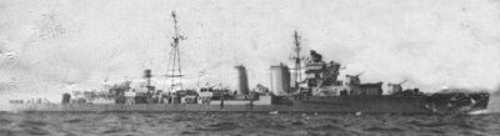
HMS Caledon after reconstruction to Anti-Aircraft cruiser
| Navy | The Royal Navy |
| Type | Light cruiser |
| Class | Caledon |
| Pennant | D 53 |
| Built by | Cammell Laird Shipyard (Birkenhead, U.K.) |
| Ordered | 8 Dec 1915 |
| Laid down | 17 Mar 1916 |
| Launched | 25 Nov 1916 |
| Commissioned | 6 Mar 1917 |
| End service | Apr 1945 |
| History | Converted to Anti-Aircraft cruiser at Chatham Dockyard between 14 September 1942 and 7 December 1943. Disarmed in April 1945 at the Chatham Dockyard. |
Commands listed for HMS Caledon (D 53)
Please note that we're still working on this section
and that we only list Commanding Officers for the duration of the Second World War.
| Commander | From | To | ||
| 1 | Capt. Charles Philip Clarke, RN | 31 Jul 1939 | 4 Mar 1941 | |
| 2 | A/Cdr. Charles Sidney Britton, RN | 4 Mar 1941 | 29 Apr 1941 | |
| 3 | A/Capt. Henry John Haynes, DSC, RN | 29 Apr 1941 | ca. Sep 42 | |
| 4 | Lt.Cdr. Eric Hart Dyke, RN | 29 Jul 1943 | 10 Dec 1943 | |
| 5 | Capt. Reginald Frederick Nichols, RN | 10 Dec 1943 | 21 Nov 1944 | |
| 6 | Capt. John Ronald Stewart Brown, RN | 21 Nov 1944 | 27 Mar 1945 | |
| 7 | A/Cdr. Eric Hart Dyke, RN | 27 Mar 1945 | 6 Apr 1945 | |
| 8 | A/Lt.Cdr. James Robert Freeman, RNR | 6 Apr 1945 | 29 Apr 1945 | |
You can help improve our commands section
Click here to Submit events/comments/updates for this vessel.
Please use this if you spot mistakes or want to improve this ships page.
Notable events involving Caledon include:
The page with the wartime history of HMS Caledon was created in March 2023.
31 Aug 1939
Around 1800A/31, the Home Fleet departed Scapa Flow to patrol between Scotland, Iceland and Norway for returning German merchant vessels.
Ships that participated in this patrol were; battleships HMS Nelson (Capt. G.J.A. Miles, RN, flying the flag of Admiral J.M. Forbes, KCB, DSO, RN), HMS Rodney (Capt. E.N. Syfret, RN), aircraft carrier HMS Ark Royal (Capt. A.J. Power, RN, flying the flag of Vice-Admiral L.V. Wells, CB, DSO, RN), light cruisers HMS Aurora (Capt. G.B. Middleton, RN, flying the flag of Rear-Admiral R.H.C. Hallifax, RN), HMS Sheffield (Capt. E. de F. Renouf, CVO, RN), HMS Belfast (Capt. G.A. Scott, DSC, RN) (from the 18th Cruiser Squadron), HMS Effingham (Capt. J.M. Howson, RN), HMS Cardiff (Capt. P.K. Enright, RN), HMS Dunedin (Capt. C.E. Lambe, CVO, RN), HMS Emerald (Capt. A.W.S. Agar, VC, DSO, RN) (from the 12th Cruiser Squadron), HMS Caledon (Capt. C.P. Clark, RN), HMS Calypso (Capt. N.J.W. William-Powlett, DSC, RN), HMS Diomede (Commodore E.B.C. Dicken, OBE, DSC, RN), HMS Dragon (Capt. R.G. Bowes-Lyon, MVO, RN) (from the 7th Cruiser Squadron. These ships were escorted by destroyers from the 8th Destroyer Flotilla; HMS Faulknor (Capt. C.S. Daniel, RN), HMS Fame (Cdr. P.N. Walter, RN), HMS Fearless (Cdr. K.L. Harkness, RN), HMS Firedrake (Lt.Cdr. S.H. Norris, RN), HMS Foresight (Lt.Cdr. G.T. Lambert, RN), HMS Forester (Lt.Cdr. E.B. Tancock, RN), HMS Fortune (Cdr. E.A. Gibbs, RN), HMS Foxhound (Lt.Cdr. P.H. Hadow, RN) and HMS Fury (Cdr. G.F. Burghard, RN).
To patrol off the Skagerrak was the battlecruiser squadron which was made up of the battlecruisers HMS Hood (Capt. I.G. Glennie, RN, flying the flag of Rear-Admiral W.J. Whitworth, CB, DSO, RN), HMS Repulse (Capt. E.J. Spooner, DSO, RN) which were escorted by destroyers from the 6th Destroyer Flotilla; HMS Somali (Capt. R.S.G. Nicholson, DSC, RN), HMS Ashanti (Cdr. W.G. Davis, RN), HMS Bedouin (Cdr. J.A. McCoy, RN), HMS Eskimo (Cdr. St. J.A. Micklethwait, RN), HMS Mashona (Cdr. P.V. McLaughlin, RN), HMS Matabele (Cdr. G.K. Whitmy-Smith, RN), HMS Punjabi (Cdr. J.T. Lean, RN) and HMS Tartar (Capt. G.H. Warner, DSC, RN). These ships departed Scapa Flow around the same time.
Some of the ships had already been at sea for exercises.
The bulk of the Fleet returned to Scapa Flow in the morning of September 6th.
Most of the cruisers had acted independently to inspect shipping. HMS Caledon, HMS Calypso, HMS Cardiff and HMS Dunedin returned to Scapa Flow in the early morning of September 5th.
HMS Aurora and HMS Sheffield returned to Scapa Flow in the evening of September 5th.
HMS Belfast returned to Scapa Flow on the 6th after having joined other ships for exercises on the 5th.
HMS Diomede, HMS Dragon, HMS Effingham and HMS Emerald returned to Scapa Flow in the morning of the 7th.
Most of the destroyer had to return to Scapa Flow once to refuel, HMS Somali and HMS Ashanti were at Scapa Flow between 0100/2 and 0400/2.
HMS Faulknor, HMS Fearless, HMS Firedrake, HMS Fortune and HMS Foxhound were at Scapa Flow between 1000A/3 and 1530A/3.
HMS Bedouin, HMS Eskimo, HMS Punjabi and HMS Tartar were at Scapa Flow between 1100A/3 and 1600A/3.
HMS Fame was detached at 2359A/3 to go to the aid of the torpedoed liner Athenia but she was not needed to pick up survivors and proceeded to the Clyde arriving in the moring of the 5th having carried out an A/S sweep en-route.
HMS Matabele was detached to Scapa Flow at 1130/5. Around 2030A/5, she grounded near the boom and damaged her propellers.
HMS Foresight, HMS Forester, HMS Fury and HMS Mashona did not refuel before they returned with the Fleet in the morning of the 6th. (1)
5 Sep 1939
Having arrived at Scapa Flow from patrol earlier in the day HMS Caledon (Capt. C.P. Clark, RN) and HMS Calypso (Capt. N.J.W. William-Powlett, DSC, RN) proceeded from Scapa Flow to Kirkwall. (2)
6 Sep 1939
HMS Caledon (Capt. C.P. Clark, RN) and HMS Calypso (Capt. N.J.W. William-Powlett, DSC, RN) departed Kirkwall for the Northern Patrol.
They were both to patrol north of the Hebrides. (2)
10 Sep 1939
HMS Caledon (Capt. C.P. Clark, RN) and HMS Calypso (Capt. N.J.W. William-Powlett, DSC, RN) both arrived at Scapa Flow from the Northern Patrol. (2)
12 Sep 1939
HMS Caledon (Capt. C.P. Clark, RN) and HMS Calypso (Capt. N.J.W. William-Powlett, DSC, RN) departed Scapa Flow for the Northern Patrol. Both were to patrol south of the Faeroer Islands / north of the Hebrides. (2)
19 Sep 1939
HMS Caledon (Capt. C.P. Clark, RN) and HMS Calypso (Capt. N.J.W. William-Powlett, DSC, RN) both arrived at Scapa Flow from the Northern Patrol. (2)
22 Sep 1939
HMS Caledon (Capt. C.P. Clark, RN) conducted gunnery exercises at Scapa Flow. (3)
24 Sep 1939
HMS Caledon (Capt. C.P. Clark, RN) departed Scapa Flow for the Northern Patrol. She is ordered to patrol south of the Faeroer Islands / north of the Hebrides. (3)
1 Oct 1939
HMS Caledon (Capt. C.P. Clark, RN) arrived at Scapa Flow from the Northern Patrol. (4)
4 Oct 1939
HMS Caledon (Capt. C.P. Clark, RN) departed Scapa Flow for the Northern Patrol. She is ordered to patrol between Iceland and the Faeroer Islands.
On leaving Scapa Flow she conducted gunnery exercises on a target that was being towed by the tug HMS Buccaneer. (4)
11 Oct 1939
HMS Caledon (Capt. C.P. Clark, RN) and HMS Calypso (Capt. N.J.W. William-Powlett, DSC, RN) both returned to Scapa Flow from the Northern Patrol. (5)
14 Oct 1939
HMS Caledon (Capt. C.P. Clark, RN) departed Scapa Flow for the Northern Patrol. She was to patrol south of the Faeroer Islands / north of the Hebrides. (4)
18 Oct 1939
HMS Caledon (Capt. C.P. Clark, RN) arrived at Kirkwall from patrol.
She departed Kirkwall for Sollum Voe later the same day. (4)
19 Oct 1939
HMS Caledon (Capt. C.P. Clark, RN) arrived at Sollum Voe from Kirkwall. (4)
25 Oct 1939
HMS Caledon (Capt. C.P. Clark, RN) departed Sullom Voe for the Northern Patrol. She is ordered to patrol south-west of the Faeroer Islands. (4)
31 Oct 1939
HMS Caledon (Capt. C.P. Clark, RN) returned to Sullum Voe from patrol. (4)
2 Nov 1939
HMS Caledon (Capt. C.P. Clark, RN) departed Sullom Voe for the Northern Patrol. She is ordered to patrol between Iceland and the Faeroer Islands. (6)
9 Nov 1939
HMS Caledon (Capt. C.P. Clark, RN) returned to Sullom Voe from the Northern Patrol. (6)
12 Nov 1939
HMS Caledon (Capt. C.P. Clark, RN) departed Sullom Voe for the Northern Patrol. She is ordered to patrol south-west of the Faeroer Islands. (6)
18 Nov 1939
HMS Caledon (Capt. C.P. Clark, RN) arrived at Loch Ewe from patrol. She had sustained some weather damage during her patrol. (6)
23 Nov 1939
HMS Caledon (Capt. C.P. Clark, RN) departed Sullom Voe for the Northern Patrol. She is ordered to patrol northwest of the Shetland Islands. (6)
23 Nov 1939
Sinking of the armed merchant cruiser HMS Rawalpindi
Around midday on 21 November 1939 the German battlecruisers Scharnhorst and Gneisenau, escorted by the light cruisers Köln and Leipzig and the destroyers Z 11 / Bernd von Arnim, Z 12 / Erich Giese and Z 20 / Karl Galster, departed Wilhelmshaven for a raid into the North Atlantic, this was to relieve the pressure of the pocket battleship Admiral Graf Spee operating in the South Atlantic. Late on the 21st the escorts left the battlecruisers.
Just after 1500A/23 the British armed merchant cruiser HMS Rawalpindi (Capt.(Retd.) E.C. Kennedy, RN) sighted the Scharnhorst. Rawalpindi was part of the British Northern Patrol and was stationed south-east of Iceland in the Iceland-Faroe gap. Captain Kennedy at first tried to get away from the German ship and report to the Admiralty that he sighted the German pocket battleship Deutschland, still believed to be operating in the North Atlantic, and so as to buy time so that other ships of the Northern patrol could come to his assistance. Just after 1600 hours, Rawalpindi came within range of the Scharnhorst and was quickly reduced to a flaming wreck. During this engagement Scharnhorst was hit by a 6in shell from Rawalpindi causing only light damage. Scharnhorst and Gneisenau together picked up 27 survivors from the Rawalpindi which finally sank around 2000 hours.
The British light cruiser HMS Newcastle (Capt J. Figgins, RN), that was also part of the Northern Patrol, picked up Rawalpindi's signal and closed the scene. She sighted the Gneisenau but the Germans managed to escape in the fog.
The Admiralty also thought the ship sighted by Rawalpindi and Newcastle was the Deutschland that was trying to return to Germany. In response to the sighting and destruction of the Rawalpindi the Admiralty took immediate action; The battleships HMS Nelson (Capt. G.J.A. Miles, RN, flying the flag of Admiral J.M. Forbes, KCB, DSO, RN) HMS Rodney (Capt. F.H.G. Dalrymple-Hamilton, RN) and the heavy cruiser HMS Devonshire (Capt. J.M. Mansfield, DSC, RN, flying the flag of Vice-Admiral J.H.D. Cunningham, CB, MVO, RN) escorted by the destroyers HMS Faulknor (Capt. C.S. Daniel, RN), HMS Fame (Cdr. P.N. Walter, RN), HMS Firedrake (Lt.Cdr. S.H. Norris, RN), HMS Foresight (Lt.Cdr. G.T. Lambert, RN), HMS Forester (Lt.Cdr. E.B. Tancock, RN), HMS Fortune (Cdr. E.A. Gibbs, RN) and HMS Fury (Cdr. G.F. Burghard, RN) departed the Clyde around 1930A/23 to patrol of Norway to cut off the way to Germany for the Deutschland.
The light cruisers HMS Southampton (Capt. F.W.H. Jeans, CVO, RN, flying the flag of Vice-Admiral G.F.B. Edward-Collins, CB, KCVO, RN), HMS Edinburgh (Capt. F.C. Bradley, RN) and HMS Aurora (Capt. G.B. Middleton, RN) escorted by the destroyers HMS Afridi (Capt. G.H. Creswell, DSC, RN), HMS Gurkha (Cdr. F.R. Parham, RN), HMS Bedouin (Cdr. J.A. McCoy, RN), HMS Kingston (Lt.Cdr. P. Somerville, RN) and HMS Isis (Cdr. J.C. Clouston, RN) departed Rosyth to patrol between the Orkney and Shetland islands.
Light cruiser HMS Sheffield (Capt. E. de F. Renouf, CVO, RN) was sent from Loch Ewe to the last known position of the German ship(s).
On northern patrol, south of the Faroes were the light cruisers HMS Caledon (Capt. C.P. Clark, RN), HMS Cardiff (Capt. P.K. Enright, RN) and HMS Colombo (Commodore R.J.R. Scott, RN). These were joined by HMS Dunedin (Capt. C.E. Lambe, CVO, RN) and HMS Diomede (Commodore E.B.C. Dicken, OBE, DSC, RN).
Of the ships of the Denmark strait patrol, the heavy cruisers HMS Suffolk (Capt. J.W. Durnford, RN) and HMS Norfolk (Capt. A.G.B. Wilson, MVO, DSO, RN) were ordered to proceed to the Bill Bailey Bank (to the south-west of the Faroe Islands).
The light cruiser HMS Glasgow (Capt. F.H. Pegram, RN) escorted by the destroyers HMS Maori (Cdr. G.N. Brewer, RN) and HMS Zulu (Cdr. J.S. Crawford, RN) were already at sea patrolling north-east of the Shetlands were to be joined by the destroyers HMS Inglefield (Capt. P. Todd, RN), HMS Imperial (Lt.Cdr. C.A.de W. Kitcat, RN), HMS Impulsive (Lt.Cdr. W.S. Thomas, RN) and HMS Imogen (Cdr. E.B.K. Stevens, RN).
The light cruisers HMS Calypso (Capt. N.J.W. William-Powlett, DSC, RN) and HMS Ceres (Capt. E.G. Abbott, AM, RN) were stationed off Kelso Light to act as a night attack striking force. The destroyers HMS Somali (Capt. R.S.G. Nicholson, DSC, RN), HMS Ashanti (Cdr. W.G. Davis, RN), HMS Mashona (Cdr. P.V. McLaughlin, RN) and HMS Punjabi (Cdr. J.T. Lean, RN) had just departed Belfast on escort duties. They were ordered to join Admiral Forbes. The ships they were escorting were ordered to return to Belfast.
The destroyers HMS Tartar (Lt.Cdr. D.E. Holland-Martin, RN), HMS Kandahar (Cdr. W.G.A. Robson, RN) and HMS Kashmir (Cdr. H.A. King, RN) departed Scapa Flow with orders to locate and shadow the German ships. HMS Tartar however had to return to Scapa Flow the next day due to a damaged rudder. The other two destroyers were ordered to join HMS Aurora which was to form a strike group of destroyers.
Despite the British effort to intercept the German ships, both German battlecruisers returned to Wilhelmshaven on the 27th.
29 Nov 1939
HMS Caledon (Capt. C.P. Clark, RN) arrived at Sullom Voe from the Northern Patrol. (6)
30 Nov 1939
HMS Caledon (Capt. C.P. Clark, RN) departed Sullom Voe for Newcastle-on-Tyne. (6)
1 Dec 1939
HMS Caledon (Capt. C.P. Clarke, RN) arrived at Newcastle-on-Tyne from Sullom Voe. She was then taken in hand for repairs and a short refit. (7)
3 Dec 1939
HMS Caledon (Capt. C.P. Clarke, RN) is docked at Wallsend Slipway & Engineering Company. (8)
14 Dec 1939
HMS Caledon (Capt. C.P. Clarke, RN) is undocked. (8)
19 Dec 1939
HMS Caledon (Capt. C.P. Clarke, RN) departed Newcastle-on-Tyne for Plymouth. She was routed around Scotland and through the Irish Sea. (8)
21 Dec 1939
HMS Caledon (Capt. C.P. Clarke, RN) arrived at Plymouth from Newcastle-on-Tyne.
She departed Plymouth for Gibraltar later the same day. She was to join the Mediterranean Fleet. (8)
24 Dec 1939
HMS Caledon (Capt. C.P. Clarke, RN) arrived at Gibraltar from Plymouth. (8)
26 Dec 1939
HMS Caledon (Capt. C.P. Clarke, RN) departed Gibraltar for Malta. (8)
28 Dec 1939
HMS Caledon (Capt. C.P. Clarke, RN) arrived at Malta from Gibraltar. (8)
31 Dec 1939
HMS Caledon (Capt. C.P. Clarke, RN) departed Malta for contraband patrol. She is ordered to patrol off the Otranto Strait. (9)
10 Jan 1940
HMS Caledon (Capt. C.P. Clarke, RN) arrived at Malta from patrol. (10)
16 Jan 1940
HMS Caledon (Capt. C.P. Clarke, RN) departed Malta for contraband patrol. She is ordered to patrol off the Otranto Strait. (10)
24 Jan 1940
HMS Caledon (Capt. C.P. Clarke, RN) arrived at Malta from patrol. (10)
29 Jan 1940
HMS Caledon (Capt. C.P. Clarke, RN) departed Malta for contraband patrol. She is ordered to patrol off the Otranto Strait. (10)
6 Feb 1940
HMS Caledon (Capt. C.P. Clarke, RN) arrived at Malta from patrol. (11)
10 Feb 1940
HMS Caledon (Capt. C.P. Clarke, RN) departed Malta for contraband patrol. She is ordered to patrol off the west coast of Greece (Gulf of Patras area). (11)
18 Feb 1940
HMS Caledon (Capt. C.P. Clarke, RN) arrived at Malta from patrol. (11)
22 Feb 1940
HMS Caledon (Capt. C.P. Clarke, RN) departed Malta for contraband patrol. She is ordered to patrol in the Aegean. (11)
1 Mar 1940
HMS Caledon (Capt. C.P. Clarke, RN) arrived at Alexandria from patrol. (12)
8 Mar 1940
HMS Caledon (Capt. C.P. Clarke, RN) conducted gunnery exercises off Alexandria. (12)
11 Mar 1940
HMS Caledon (Capt. C.P. Clarke, RN), HMS Calypso (Capt. H.A. Rowley, RN) and HMS Capetown (Capt. T.H. Back, RN) conducted exercises off Alexandria.
HMS Capetown just returned from a patrol in the Aegean. (13)
12 Mar 1940
HMS Caledon (Capt. C.P. Clarke, RN) and HMS Calypso (Capt. H.A. Rowley, RN) conducted exercises off Alexandria. (14)
13 Mar 1940
HMS Caledon (Capt. C.P. Clarke, RN), HMS Calypso (Capt. H.A. Rowley, RN) and HMS Capetown (Capt. T.H. Back, RN) conducted exercises off Alexandria. (13)
14 Mar 1940
HMS Caledon (Capt. C.P. Clarke, RN), HMS Calypso (Capt. H.A. Rowley, RN) and HMS Capetown (Capt. T.H. Back, RN) conducted exercises off Alexandria. (13)
18 Mar 1940
HMS Caledon (Capt. C.P. Clarke, RN) departed Alexandria for contraband patrol. She is ordered to patrol in the Aegean. (12)
26 Mar 1940
HMS Caledon (Capt. C.P. Clarke, RN) arrived at Alexandria from patrol. (12)
30 Mar 1940
HMS Caledon (Capt. C.P. Clarke, RN) departed Alexandria for contraband patrol. She is ordered to patrol off the west coast of Greece (Gulf of Patras area). (12)
7 Apr 1940
HMS Caledon (Capt. C.P. Clarke, RN) arrived at Malta from patrol. (15)
11 Apr 1940
HMS Caledon (Capt. C.P. Clarke, RN) departed Malta for contraband patrol. She is ordered to patrol off the west coast of Greece (Gulf of Patras area). (15)
17 Apr 1940
HMS Caledon (Capt. C.P. Clarke, RN) arrived at Malta from patrol. (15)
22 Apr 1940
HMS Caledon (Capt. C.P. Clarke, RN) departed Malta for contraband patrol. She is ordered to patrol in the Aegean. (15)
29 Apr 1940
HMS Caledon (Capt. C.P. Clarke, RN) arrived at Famagusta, Cyprus from patrol. (15)
5 May 1940
HMS Caledon (Capt. C.P. Clarke, RN) departed Famagusta for Haifa. (16)
6 May 1940
HMS Caledon (Capt. C.P. Clarke, RN) arrived at Haifa from Famagusta. (16)
8 May 1940
HMS Caledon (Capt. C.P. Clarke, RN) departed Haifa for contraband patrol. She is ordered to patrol in the Ionian Sea. (16)
16 May 1940
HMS Caledon (Capt. C.P. Clarke, RN) arrived at Port Said from patrol. (16)
20 May 1940
HMS Caledon (Capt. C.P. Clarke, RN) departed Port Said for Alexandria. (16)
21 May 1940
HMS Caledon (Capt. C.P. Clarke, RN) arrived at Alexandria from Port Said. (16)
23 May 1940
HMS Royal Sovereign (Capt. H.B. Jacomb, RN) departed Alexandria at 0700 hours, for exercises. She was escorted by the destroyers HMS Diamond (Lt.Cdr. P.A. Cartwright, RN) and HMAS Vendetta (Lt. R. Rhoades, RAN).
HMS Royal Sovereign and HMS Diamond returned to Alexandria later the same day.
HMAS Vendetta joined the transport Talma (British, 10000 GRT, built 1923) to escort her to Malta. The light cruiser HMS Caledon (Capt. C.P. Clarke, RN) also joined. coming from Port Said, and remained with HMAS Vendetta and the Talma until 0615B/24.
HMS Caledon then set course to return to Port Said.
24 May 1940
HMS Caledon (Capt. C.P. Clarke, RN) arrived at Port Said from escort duty. (16)
25 May 1940
HMS Dragon (Capt. R.G. Bowes-Lyon, MVO, RN) and HMS Caledon (Capt. C.P. Clarke, RN) passed the Suez Canal southbound and later departed Suez for Aden. They were both to join the East Indies Station but this was soon changed to the South Atlantic Station in the case of HMS Dragon while HMS Caledon was ordered to return to the Mediterranean. (17)
28 May 1940
HMS Dragon (Capt. R.G. Bowes-Lyon, MVO, RN) and HMS Caledon (Capt. C.P. Clarke, RN) arrived at Aden from Suez.
After fuelling HMS Dragon departed for Kilindini / Mombasa later the same day. (18)
30 May 1940
HMS Caledon (Capt. C.P. Clarke, RN) departed Aden for Suez. (16)
3 Jun 1940
HMS Caledon (Capt. C.P. Clarke, RN) arrived at Suez from Aden. She immediately transited the Suez Canal northbound and arrived at Port Said later the same day. (19)
11 Jun 1940
Operations in the Eastern Mediterranean, 11 to 15 June 1940.
Around 0100B/11, Cruisers of the 7th Cruiser Squadron; (HMS Orion (Capt. G.R.B. Back, RN, flying the flag of Vice Admiral J.C. Tovey, CB, DSO, RN), HMS Neptune (Capt. R.C. O'Conor, RN), HMS Gloucester (Capt. F.R. Garside, CBE, RN), HMS Liverpool (Capt. P.A. Read, RN) and HMAS Sydney (Capt. J.A. Collins, RAN) departed Alexandria.
Around 0230B/11, other ships of the Mediterranean Fleet departed Alexandria; battleships HMS Warspite (Capt. D.B. Fisher, OBE, RN flying the flag of A/Admiral Sir A.B. Cunningham, KCB, DSO and 2 Bars, RN), HMS Malaya (Capt. Sir A.F.E. Palliser, DSC, RN) and aircraft carrier HMS Eagle (Capt. A.R.M. Bridge, RN). They were escorted by the destroyers HMAS Stuart (Cdr. H.M.L. Waller, RAN), HMAS Vampire (Lt.Cdr. J.A. Walsh, RAN), HMAS Voyager (Cdr. J.C. Morrow, RAN), HMS Hasty, (Lt.Cdr. L.R.K. Tyrwhitt, RN), HMS Ilex (Lt.Cdr. P.L. Saumarez, DSC, RN), HMS Janus (Cdr. J.A.W. Tothill, RN), HMS Juno (Cdr. W.E. Wilson, RN) and HMS Nubian (Cdr. R.W. Ravenhill, RN).
The destroyers HMS Dainty (Cdr. M.S. Thomas, RN) and HMS Diamond (Lt.Cdr. P.A. Cartwright, RN) had already departed Malta on the 10th to join the Fleet at sea.
The Fleet was joined at 0845B/11, by HMS Caledon (Capt. C.P. Clarke, RN) which had departed Port Said at 2355B/10. Around 1330B/11, HMS Calypso (Capt. H.A. Rowley, RN) also joined the fleet having departed Port Said on 9 June for patrol in the Kithera Channel. Also in the afternoon destroyer HMS Mohawk (Cdr. J.W.M. Eaton, RN) joined coming from Alexandria.
In the evening, around 1845B/11, the destroyers HMS Havock (Lt.Cdr. R.E. Courage, DSO, RN), HMS Hereward (Lt.Cdr. C.W. Greening, RN), HMS Hero (Cdr. H.W. Biggs, RN), HMS Hostile (Cdr. J.P. Wright, DSO, RN), HMS Hyperion (Cdr. H.St.L. Nicholson, RN) and HMS Imperial (Lt.Cdr. C.A.deW. Kitcat, RN) also joined. These destroyers (minus HMS Hereward) had been on an A/S hunt to the west of Alexandria during 10/11 June 1940. A little over an hour later the three Australian destroyers then left the Fleet for Alexandria where they arrived on the 12th.
Around 2015B/11, HMS Caledon, HMS Calypso and HMS Dainty split off from the fleet for a sweep to the south of Crete. During this sweep HMS Calypso was torpedoed by the Italian submarine Bagnolini around 0300B/12. She sank at 0334B/12. HMS Caledon and HMS Dainty then picked up the survivors and landed them on the 13th at Alexandria.
During the night of 11/12 June 1940, HMS Orion and HMAS Sydney made a sweep of Benghazi but had no contact with the enemy. At the same time HMS Gloucester and HMS Liverpool made a sweep of Tobruk. They shelled the harbour and coast defence ship San Giorgio inside it. Also they engaged three Italian auxiliary gunboats; Palmaiola, Riccardo Grazioli Lante and Giovanni Berta. The last one was sunk during the engagement.
All British ships returned to Alexandria on 14/15 June except for HMS Diamond which returned to Malta. [The date she arrived there is currently not known to us.] (20)
13 Jun 1940
HMS Caledon (Capt. C.P. Clarke, RN) and HMS Dainty (Cdr. M.S. Thomas, RN) arrived at Alexandria with the survivors of HMS Calypso. (21)
27 Jun 1940
Operation MA 3, convoy’s from Malta and convoy AS 1 from the Dardanelles.
Convoy AS 1 from the Aegean (mostly from the Dardanelles) to Port Said.
This convoy was made up of the following ships:
From the Dardanelles: British merchants: Deebank (5060 GRT, built 1929), Destro (3553 GRT, built 1920), Eastlea (4267 GRT, 1924), Egyptian Prince (3490 GRT, 1922), Palermo (2797 GRT, built 1938), Volo (1587 GRT, built 1938) and the tug Brittania towing the small river tanker Danube Shell II (704 GRT, built 1934).
From Kalamata: British merchant Destro (3553 GRT, built 1920).
From Izmir: British merchant African Prince (4653 GRT, built 1939).
The Dutch merchant Ganymedes (2682 GRT, built 1917) also joined the convoy. Her port of origin is currently unknown to us.
These ships were escorted by the British light cruisers HMS Caledon (Capt. C.P. Clarke, RN), HMS Capetown (Capt. T.H. Back, RN, senior officer of the escort) and the destroyers HMS Nubian (Cdr. R.W. Ravenhill, RN), HMS Mohawk (Cdr. J.W.M. Eaton, RN), HMAS Vampire (Lt.Cdr. J.A. Walsh, RAN) and ORP Garland (Kpt. mar. (Lt.) A. Doroszkowski, ORP). These ships had sailed from Port Said (HMS Capetown, HMS Nubian, HMS Mohawk. These ships had sailed late in the afternoon of the 26th.) and Alexandria (HMS Caledon, HMAS Vampire and ORP Garland. These ships had sailed in the evening of the 26th).
The escort joined up with the convoy late in the morning of 28 June 1940 and then proceeded towards Port Said where it arrived on 3 July 1940. In the afternoon of 29 June 1940, when near the Doro Channel, the convoy had been bombed by Italian aircraft but no damage had been sustained. The next day, when between Gavdo Island and Crete the convoy was attacked again by the Italian air force but again no damage was sustained. Following the first air attack HMS Orion, HMS Neptune and HMAS Sydney proceeded to the convoy to provide additional protection. They were near the convoy when it was attacked for the second time and were attacked themselves by eight enemy aircraft. Heavy bombs fell close to the Orion and Neptune but no actual hits were sustained although Neptune suffered some splinter damage to her aircraft and some superficial damage to the superstructure as well. The aircraft was jettisoned due to the danger of fire. Three of her crew were injured. The three cruisers left the convoy at 0900/1. When they arrived at Alexandria in the second half of 1 July 1940, HMAS Sydney landed 44 survivors from the Espero.
Operation MA 3
On 27 June 1940, five destroyers, (Force C), HMS Decoy (Cdr. E.G. McGregor, DSO, RN), HMS Dainty (Cdr. M.S. Thomas, RN), HMS Defender (Lt.Cdr. St.J.R.J. Tyrwhitt, RN), HMS Ilex (Lt.Cdr. P.L. Saumarez, DSC, RN) and HMAS Voyager (Lt.Cdr. J.C. Morrow, RAN) departed Alexandria at 0600/27 to carry out an A/S hunt off the Anti-Kithera channel on 28 June leaving that area at 2200/28 to arrive at Malta at 1800/29 to provide escort for two groups of merchants ships that were to proceed from Malta to Alexandria. They were to sail at 2100/29 with a 13 knot convoy and a 9 knot convoy. The convoy’s were to arrive at Alexandria on 2 July and 4 July respectively. The fast convoy was to be escorted by HMS Dainty, HMS Ilex and one destroyer from Malta, HMS Diamond (Lt.Cdr. P.A. Cartwright, RN). The slow convoy was to be escorted by the other destroyers, HMS Decoy, HMS Defender and HMAS Voyager. In the end the sailing of both these convoy's was cancelled.
Also on 27 June 1940, at 1100 hours, to provide cover for the convoy’s from a position about 60 nautical miles north of their track. They were to return to Alexandria at 1800/3. Force B, made up of the battleships HMS Royal Sovereign (Capt. H.B. Jacomb, RN, flying the flag of Rear-Admiral H.D. Pridham-Whippell, CB, CVO, RN), HMS Ramillies (Capt. H.T. Baillie-Grohman, OBE, DSO, RN), aircraft carrier HMS Eagle (Capt. A.R.M. Bridge, RN) and the destroyers HMS Hyperion (Cdr. H.St.L. Nicholson, RN), HMS Hasty, (Lt.Cdr. L.R.K. Tyrwhitt, RN), HMS Havock (Lt.Cdr. R.E. Courage, DSO, RN), HMS Hereward (Lt.Cdr. C.W. Greening, RN), HMS Hero (Cdr. H.W. Biggs, RN), HMS Juno (Cdr. W.E. Wilson, RN) and HMS Janus (Cdr. J.A.W. Tothill, RN) were to leave Alexandria at 1230/28. They were to cruise to the north-west of position 35°N, 22°E from 2000/29 until the convoy had passed.
The 7th Cruiser Squadron (Force A), made up of (1st Division) HMS Orion (Capt. G.R.B. Back, RN, flying the flag of Vice Admiral J.C. Tovey, CB, DSO, RN), HMS Neptune (Capt. R.C. O'Conor, RN), HMAS Sydney (Capt. J.A. Collins, RAN), (2nd Divsion) HMS Gloucester (Capt. F.R. Garside, CBE, RN) and HMS Liverpool (Capt. P.A. Read, RN). These had departed Alexandria also at 1100/27 to provide close cover for the convoy’s coming from Malta.
On 28 June air reconnaissance reported three Italian destroyers about 75 nautical miles west-south-west of Cape Matapan and the 7th Cruiser Squadron set a course to intercept which they successfully did at 1830 hours. In a long range action one of the Italian destroyers, the Espero was sunk by HMAS Sydney. She attacked the British cruisers so that the other two destroyers had a chance to escape in which the succeeded. During the action HMS Liverpool was hit by a 4.7" shell which cut the degaussing wire. After this action it was decided the next to postpone the sailing of the convoy’s and to send HMS Gloucester and HMS Liverpool to Port Said (Bitter Lakes) to complete with ammunition. The remaining forces were ordered to cover convoy AS 1 coming from the Aegean. As said above the other three cruisers of the 7th Cruiser Squadron returned to Alexandria on 1 July. HMS Royal Sovereign, HMS Ramillies, HMS Eagle and their escorting destroyers returned to Alexandria in the first half of 2 July.
The A/S sweep by the five destroyers also proved very successful as they sank three Italian submarines. On the 27th the Console Generale Liuzzi by HMS Decoy, HMS Defender and HMS Ilex and on the 29th HMS Decoy, HMS Dainty, Defender, HMS Ilex and HMAS Voyager carried out depth charge attacks on three Italian submarines. They sank the Uebi Scebelli and damaged the Salpa. The Capitano Tarantini managed to escape. Following the sinking of the Uebi Scebelli, HMAS Voyager picked up secret Italian documents and she was ordered to proceed with these documents to Alexandria where she arrived in the second half of 30 June 1940. The destroyers HMAS Stuart (Capt. H.M.L. Waller, RAN) and HMS Hostile (Cdr. J.P. Wright, DSO, RN) proceeded to sea from Alexandria P.M. on the 29th to join the hunt for other Italian submarines of which the patrol positions were mentioned in these secret documents. On completion of their A/S hunt they joined convoy AS 1. HMS Dainty had picked up 10 officers and 72 ratings from the Liuzzi and Uebi Scebelli. The destroyers, minus HMAS Voyager continued their A/S sweep until 2000/30 but no further enemy submarines were encountered. HMAS Voyager, which had besides survivors, also recovered secret enemy documents from the water, had parted company around 1810C/30 to take these to Alexandria.
Convoy AS 1 arrived at Port Said on 2 July 1940. It's (close) escorts arrived at Alexandria also on 2 July 1940. (21)
5 Jul 1940
The light cruisers HMS Caledon (Capt. C.P. Clarke, RN), HMS Capetown (Capt. T.H. Back, RN) and the destroyers HMS Imperial (Lt.Cdr. C.A.deW. Kitcat, RN), HMS Ilex (Lt.Cdr. P.L. Saumarez, DSC, RN), HMS Janus (Cdr. J.A.W. Tothill, RN) and HMS Juno (Cdr. W.E. Wilson, RN) departed Alexandria to assist possible downed flyers from Swordfish aircraft of 813 Squadron (HMS Eagle which had taken off from the airfield at Sidi Barrani to raid Tobruk.
During the raid the Italian destroyer Zeffiro was sunk while the destroyer Euro was badly damaged with her bow blown off. She was later towed to Taranto and repaired. The Italian liner (troopship) Liguria (15354 GRT, built 1918) was damaged by bombs and beached to prevent her from sinking. She was scuttled on 22 January 1941. The Italian merchant vessels Manzoni (3955 GRT, built 1902) was sunk while the Serenitas (5171 GRT, built 1918) was badly damaged and was also beached to prevent her from sinking. Both these merchant vessels were later raised by the British. (21)
6 Jul 1940
The light cruisers HMS Caledon (Capt. C.P. Clarke, RN), HMS Capetown (Capt. T.H. Back, RN) and the destroyers HMS Imperial (Lt.Cdr. C.A.deW. Kitcat, RN), HMS Ilex (Lt.Cdr. P.L. Saumarez, DSC, RN), HMS Janus (Cdr. J.A.W. Tothill, RN) and HMS Juno (Cdr. W.E. Wilson, RN) returned to Alexandria.
On the way back they had bombarded Bardia between from 0537 and 0631 hours. The small Italian merchant vessel Axum (249 GRT, built ????) was sunk while another merchant ship was damaged. After the bombardmemnt the British ships were attacked by Italian aircraft but they sustained no damage. (21)
7 Jul 1940
Operation MA 5 and the resulting battle of Punta Stilo on 9 July 1940.
The passage of convoys MF 1 (fast) and MS 1 (slow) from Malta to Alexandria with evacuees and fleet stores.
After the cancellation of Operation MA 3 a new plan to pass the convoys from Malta to Alexandria was made.
The Mediterranean Fleet, less HMS Ramillies and the 3rd Cruiser Squadron (HMS Caledon and HMS Capetown) departed Alexandria on 7 July 1940 to carry out operation MA 5, the object being to cover convoys MF 1 (fast) and MS 1 (slow) from Malta to Alexandria with evacuees and fleet stores.
The composition of these convoys were as follows:
Convoy MF 1, the fast convoy: This convoy departed Malta on 9 July 1940 and arrived at Alexandria on 11 July 1940 and was made up of the Egyptian merchant El Nil (7775 GRT, built 1916), British merchants Knight of Malta (1553 GRT, built 1929), Rodi (3220 GRT, built 1928, former Italian).
Convoy MS 1, the slow convoy: This convoy departed Malta on 10 July 1940 and arrived at Alexandria on 14 July 1940 and was made up of the British merchant ships Kirkland (1361 GRT, built 1934), Misirah (6836 GRT, built 1919), Tweed (2697 GRT, built 1926), Zealand (2726 GRT, built 1930) and the Norwegian merchant Novasli (3194 GRT, built 1920).
Cover for these convoys was provided by ships of the Mediterranean Fleet which was divided into three groups:
Force A: Light cruisers HMS Orion (Capt. G.R.B. Back, RN, flying the flag of Vice Admiral J.C. Tovey, CB, DSO, RN), HMS Neptune (Capt. R.C. O'Conor, RN), HMS Gloucester (Capt. F.R. Garside, CBE, RN), HMS Liverpool (Capt. P.A. Read, RN) and HMAS Sydney (Capt. J.A. Collins, RAN) and the destroyer HMAS Stuart (Capt. H.M.L. Waller, RAN).
Force B: Battleship HMS Warspite (Capt. D.B. Fisher, OBE, RN flying the flag of A/Admiral Sir A.B. Cunningham, KCB, DSO and 2 Bars, RN), destroyers HMS Nubian (Cdr. R.W. Ravenhill, RN), HMS Mohawk (Cdr. J.W.M. Eaton, RN), HMS Hero (Cdr. H.W. Biggs, RN), HMS Hereward (Lt.Cdr. C.W. Greening, RN) and HMS Decoy (Cdr. E.G. McGregor, DSO, RN).
Force C: Battleships HMS Royal Sovereign (Capt. H.B. Jacomb, RN, flying the flag of Rear-Admiral H.D. Pridham-Whippell, CB, CVO, RN), HMS Malaya (Capt. Sir A.F.E. Palliser, DSC, RN), aircraft carrier HMS Eagle (Capt. A.R.M. Bridge, RN), destroyers HMS Hyperion (Cdr. H.St.L. Nicholson, RN), HMS Hasty, (Lt.Cdr. L.R.K. Tyrwhitt, RN), HMS Hostile (Cdr. J.P. Wright, DSO, RN), HMS Ilex (Lt.Cdr. P.L. Saumarez, DSC, RN), HMS Imperial (Lt.Cdr. C.A.deW. Kitcat, RN), HMS Dainty (Cdr. M.S. Thomas, RN), HMS Defender (Cdr. St.J.R.J. Tyrwhitt, RN), HMS Janus (Cdr. J.A.W. Tothill, RN), HMS Juno (Cdr. W.E. Wilson, RN), HMAS Vampire (Lt.Cdr. J.A. Walsh, RAN) and HMAS Voyager (Cdr. J.C. Morrow, RAN).
8 July 1940.
All forces were clear of the harbour by midnight during the night of 7/8 July 1940. All forces were to make rendez-vous in position 36°30’N, 17°40’E at 1400/10. HMS Liverpool, who was en-route from Port Said to Alexandria with spare 6" ammunition from the East Indies station, arrived at Alexandria at 0202 hours. She then quickly unloaded some of the 6" ammuntion and topped off with fuel. She departed Alexandria at 0520 hours to join her force at sea. HMS Imperial had to return to Alexandria with defects.
Shortly before midnight, at 2359 hours, HMS Hasty reported that she sighted a surfaced submarine at a range of 1000 yards. A full pattern depth charge attack was made an the submarine was thought to have been sunk. One hour later when about to rejoin Force C she carried out another attack on a confirmed contact. It was consided that this attack caused damage to another Italian submarine.
At 0807/8 a report was received from the submarine HMS Phoenix (Lt.Cdr. G.H. Nowell, RN) that she had sighted two enemy battleships escorted by four destroyers in position 35°23’N, 17°45’E, steering 180° at 0515/8. It was suspected that this force was covering an important enemy convoy. The Vice-Admiral, Malta, was ordered to arrange air reconnaissance to the eastward and to the Rear-Admiral, Alexandria to arrange for a flying boat to shadow this force. Two enemy submarines were sighted by A/S patrols from HMS Eagle.
The Italians were aware of the Mediterranean Fleet being at sea as the Fleet had been reported by the Italian submarine Beilul. This resulted in air attacks on the Fleet during the 8th.
Damage was done to HMS Gloucester which was hit on the compass platform causing seven officers to be killed and three wounded. Amongst the officers killed was the ships Captain. Besides the officers eleven ratings were killed and six were wounded.
At 1510/8 a flying boat reported a force of three battleships, six cruisers and seven destroyers in position 33°18’N, 19°45’E, steering 340°. At 1610 hours it was reported that this force had changed course to 070°. The flying boat that reported this force had to return to base at 1715 hours but no relief was available to continue shadowing. The Commander-in-Chief therefore, in the absence of further information, decided to continue the course of the Fleet to the north-westward in order to get between the enemy and his base. A mean line of advance of 310° at 20 knots was therefore maintained during the night.
9 July 1940.
There were no incidents during the night and at 0600 hours the Fleet was concentrated in position 36°55’N, 20°30’E. An air search by aircraft from HMS Eagle was commenced at dawn between 180° and 300°. Meanwhile a mean line of advance of 300° at 16 knots was maintained by the Fleet.
The first enemy report was received from a flying boat from Malta who reported two battleships, four cruisers and ten destroyers at 0732 hours in position 37°00’N, 17°00’E, steering 330° and subsequent reports showed that there was a further large force of cruisers and destroyers in the vicinity.
A second search by aircraft from HMS Eagle covered these positions and by 1130 hours it was considered that the enemy’s position was sufficiently well established to launch the air striking force. At this time the enemy fleet was approximately 90 miles to the westward of our forces. Unfortunately, touch with the enemy fleet was lost by the shadowing aircraft at this time and shortly afterwards it appears that the enemy turned to the southward. The striking force therefore failed to locate the enemy battlefleet, but carried out an attack on some cruisers at about 1330 hours without result.
Touch was regained with the enemy battleships at 1340 hours by a relief shadower from HMS Eagle and by a flying boat. The air striking force was flown of again at 1539 hours shortly after action was joined and they are believed to have scored one hit on a cruiser. All aircraft from HMS Eagle returned. In the meanwhile reports from shadowing aircraft show that the enemy force consisted of two battleships of the Cavour-class, twelve cruisers and twenty destroyers, and that they appeared to be keeping close to the coast of Calabria.
At 1400 hours the British Fleet as in position 38°02’N, 18°40’E. The 7th Cruiser Squadron was 8 nautical miles ahead of HMS Warspite, with HMS Royal Sovereign, HMS Eagle and HMS Malaya 10 nautical miles astern. Destroyers were screening these ships. The mean line of advance the Fleet was 270° the speed being limited by that of HMS Royal Sovereign. The Commander-in-Chief was obliged to use HMS Warspite as a battle cruiser to keep ahead of the battle Squadron, in order to support the cruisers, who being so few and lacking 8” ships, were very weak compared to the enemy’s cruiser force.
At 1510 hours the enemy, consisting of six 8” cruisers and a number of destroyers, was sighted steering about 020°. HMS Eagle and the 19th division (HMAS Stuart, HMAS Vampire and HMAS Voyager) were now detached from the 1st Battle Squadron and the damaged HMS Gloucester was ordered to join them. At 1514 hours HMS Neptune sighted the enemy battlefleet bearing 260° from HMS Warspite The ensuing action can best be described in five phases.
Phase 1.
A short action with enemy 8” and 6” cruisers in which our own cruisers were out ranged and came under a very heavy fire. HMS Warspite intervened and engaged successively two 8” and two 6” cruisers at long range, which after a few salvos turned away. One hit might have been obtained on a 8” cruiser.
Phase 2.
After a short lull, during which HMS Warspite fell back on HMS Malaya who was now proceeding ahead of HMS Royal Sovereign. HMS Warspite and HMS Malaya then engaged two battleships of the Cavour-class at 1553 hours. HMS Warspite was straddled at 26000 yards and she herself scored a hit on one of the enemy battleships (the Guilio Cesare). The enemy then turned away making smoke. HMS Malaya was outranged and by now HMS Royal Sovereign was now well astern and never got into action. The 7th Cruiser Squadron continued their action with the enemy cruisers, who appeared to be working round to the north with the intention of engaging HMS Eagle. They were driven off with the assistance of a few salvoes from HMS Warspite.
Phase 3.
Enemy destroyers moved out to attack, but half heartedly, and made a large volumes of smoke which soon obscured the larger targets. Destroyers were now ordered to counter attack the enemy destroyers, in which they were assisted by the 7th Cruiser Squadron, but before the range could be closed sufficiently to do damage to them the enemy retired behind their extensive smoke screen.
Phase 4.
The British fleet chased up the smoke but, appreciating that to pass through it would be playing the enemy’s game, and suspecting that enemy submarines might be in the vicinity, the Commander-in-Chief worked round to the northward and windward of the screen. When clear, all enemy forces were out of sight and air attacks had started. The British fleet was now (1652 hours) only 45 miles from the coast of Calabria and continued on a westerly course until within 25 miles of the Punta Stilo lighthouse.
Phase 5.
A succession of heavy bombing attacks were carried out between 1640 and 1912 hours. At least nine distinct bombing attacks were made and it is estimated that probably some 100 aircraft took part. Many attacks were made on HMS Eagle, but the fleet suffered no damage. Between 1640 and 1740 hours the fleet made good a course of 270° and from 1740 hours of 220°, this latter course being selected in the hope that the enemy would renew the fight. At 1830 hours it became clear that the enemy could not be intercepted before reaching Messina and course was altered to the south-eastward to open the land, turning back at 2115 hours to 220° for a position south of Malta.
During the action one of the aircraft from HMS Warspite was damaged by gun blast of her own gunfire and had to be jettisoned. The other aircraft was catapulted for action observation. After this mission was completed the aircraft landed at Malta. During the night there were no incidents.
10 July 1940.
At 0800 hours, the fleet was in position 35°24’N, 15°27’E, steering west, and remained cruising to the southward of Malta throughout the day while destroyers were sent there to refuel. The following fuelling programme was carried out. At 0530 hours the following destroyers arrived at Malta; HMAS Stuart, HMS Dainty, HMS Defender, HMS Hyperion, HMS Hostile, HMS Hasty, HMS Ilex and HMS Juno. After they had fuelled they sailed again at 1115 hours and rejoined the fleet at 1525 hours.
HMS Hero, HMS Hereward, HMS Decoy, HMAS Vampire and HMAS Voyager were then sent in, the last three to sail with convoy MS 1 after fuelling.
At 2030 hours, HMS Royal Sovereign with HMS Nubian, HMS Mohawk and HMS Janus were detached to refuel and to rejoin the fleet before noon the next day.
HMS Gloucester and HMAS Stuart were detached to join convoy MF 1, which had been sailed from Malta at 2300/9 escorted by HMS Jervis (Capt. P.J. Mack, DSO, RN), HMS Diamond (Lt.Cdr. P.A. Cartwright, RN) and HMAS Vendetta (Lt.Cdr. R. Rhoades RAN).
In the morning an air raid took place at Malta at 0855 hours. Three or four of the attackers were shot down. Destroyers that were fuelling at Malta were not hit.
Flying boat reconnaissance of Augusta had located three cruisers and eight destroyers in harbour and at 1850 hours a strike force was flown off from HMS Eagle to carry out a dust attack. Unfortunately the enemy forces left harbour before the attack force arrived. One flight however located a Navigatori class destroyer in a small bay to the northward, which was sunk, this was the Leone Pancaldo which was later raised and repaired. The other flight did not drop their torpedoes. All aircraft landed safely at Malta.
At 2100 hours the position of the fleet was 35°28’N, 14°30’E, steering 180°. There were no incidents during the night.
In view of the heavy bombing attacks experienced during the last three days, the Commander-in-Chief has requested the Air Officer Commander-in-Chief, Middle East, to do anything possible to occupy the Italian air forces during the passage of the fleet and the convoys to Alexandria.
11 July 1940.
At 0130 hours, the fleet altered course to 000° to be in position 35°10’N, 15°00’E at 0800 hours. HMS Royal Sovereign with HMS Hero, HMS Hereward, HMS Nubian, HMS Mohawk and HMS Janus rejoined from Malta at this time, and HMS Eagle landed on her striking force from Malta.
At 0900 hours the Commander-in-Chief in HMS Warspite, screened by HMS Nubian, HMS Mohawk, HMS Juno and HMAS Vampire, proceeded ahead to return to Alexandria at 19 knots. The Rear-Admiral, First Battle Squadron, in HMS Royal Sovereign , with HMS Malaya and HMS Eagle and the remaining destroyers, proceeded on a mean line of advance of 80° at 12 knots to cover the passage of the convoys. The 7th Cruiser Squadron had already been detached at 2000/10 to search to the eastward in the wake of convoy MF 1.
The fleet was again subjected to heavy bombing attacks. Between 1248 and 1815 hours, five attacks were made on HMS Warspite and her escorting destroyers. A total of 66 bombs were counted. Between 1112 and 1834 hours, twelve attacks were carried out on forces in company with Rear-Admiral First Battle Squadron, a total of about 120 bombs were dropped. No damage was sustained. It was noted that the fleet was shadowed by aircraft who homed in attacking aircraft.
At 1200 hours, HMAS Vampire was sighted. She reported that her Gunner had been badly wounded in an air attack made on convoy MS 1 at 1015 hours. The officer was transferred to HMS Mohawk for treatment but died aboard that ship later the same day.
At 2100 hours, HMS Warspite was in position 34°22’N, 19°17’E steering 110°.
12 July 1940.
There had been no incidents during the night. Course was altered to 070° at 0200 hours and to 100° at 0630 hours. Course was altered from time to time during the day to throw off shadowers and attacking aircraft.
At 0700 hours, Vice-Admiral (D) with the 7th Cruiser Squadron rejoined the Commander-in-Chief. Vice-Admiral (D) in HMS Orion, together with HMS Neptune was detached to join convoy MF 1.
The following bombing attacks took place during the day; Between 0850 and 1550 hours, seventeen attacks were made on HMS Warspite. About 160 bombs were dropped but none hit although there were several near misses. On the First Battle Squadron and HMS Eagle between 1110 and 1804 hours, three attacks were made, 25 bombs were dropped but none hit.
13 July 1940.
HMS Warspite, HMS Orion, HMS Neptune, HMS Liverpool, HMAS Sydney, HMS Nubian, HMS Mohawk, HMS Juno and HMAS Vampire arrived at Alexandria around 0600 hours. Convoy MF 1 and it’s escort (HMS Jervis, HMS Diamond and HMAS Vendetta) arrived during the forenoon. HMS Gloucester had detached from the convoy around 0400 hours and had already arrived at Alexandria around 0800 hours. This convoy had been unmolested during it’s passage from Malta to Alexandria.
HMS Ramillies (Capt. H.T. Baillie-Grohman, OBE, DSO, RN) then departed Alexandria to join the escort of convoy MS 1 escorted by HMS Diamond, HMS Havock (Lt.Cdr. R.E. Courage, DSO, RN), HMS Imperial and HMAS Vendetta. The two cruisers from the 3rd Cruiser Squadron, HMS Caledon (Capt. C.P. Clarke, RN) and HMS Capetown (Capt. T.H. Back, RN), had already left Alexandria on the 12th to join the escort of convoy MS 1.
14 July 1940.
The 1st Battle Squadron, HMS Eagle and their escorting destroyers arrived at Alexandria in the forenoon. They reported very heavy bombing attacks of the Libyan coast. Three enemy aircraft were reported shot down by fighters from HMS Eagle while a fourth was thought to be heavily damaged.
15 July 1940.
Convoy MS 1, HMS Ramillies, HMS Caledon, HMS Capetown, HMS Diamond, HMS Havock, HMS Imperial, HMAS Vendetta, HMS Decoy, HMAS Vampire and HMAS Voyager arrived at Alexandria before noon.
Italian forces involved in the battle of Punta Stilo.
On 6 July 1940 an important Italian troop convoy departed Naples for Benghazi, Libya. This convoy was made up of the troopship Esperia (11398 GRT, built 1920) and the transports Calitea (4013 GRT, built 1933), Marco Foscarini (6338 GRT, built 1940), Vettor Pisani (6339 GRT, built 1939). Escort was provided by the torpedo boats Orsa, Pegaso, Procione and Orione. The next day this convoy was joined by the transport Francesco Barbaro (6343 GRT, built 1940) that came from Catania and was escorted by the torpedo boats Giuseppe Cesare Abba and Rosolino Pilo. Cover for this convoy was provided by the light cruisers Giovanni Delle Bande Nere and Bartolomeo Colleoni and the destroyers Maestrale, Libeccio, Grecale and Scirocco.
This cover force was joined on 7 July by the heavy cruiser Pola and the destroyers Lanciere, Carabinieri, Corazziere and Ascari which came from Augusta.
From Messina came the heavy cruisers Zara, Fiume, Gorizia and the destroyers Vittorio Alfieri, Giosuè Carducci, Vincenzo Gioberti and Alfredo Oriani.
From Messina (these ships departed shortly after the other ships) came also the heavy cruisers Bolzano and Trento and the destroyers Artigliere, Camicia Nera, Aviere and Geniere.
From Palermo came the light cruisers Eugenio di Savoia, Emanuelle Filiberto Duca D’Aosta, Muzio Attendolo and Raimondo Montecuccoli with the destroyers Granatiere, Fuceliere, Bersagliere and Alpino.
From Taranto came the battleships Gulio Cesare (flagship) and Conte di Cavour with the dstroyers Freccia, Saetta, Dardo and Strale.
Also from Taranto came the light cruisers Giuseppe Garibaldi and Luigi di Savoia Duca delgi Abruzzi with the destroyers Folgore, Fulmine, Baleno and Lampo.
And finally, also from Taranto, came the light cruisers Armando Diaz, Luigi Cadorna, Alberto di Giussano, Alberico di Barbiano and the destroyers Antonio Pigafetta, Nicolò Zeno, Nicoloso Da Recco, Emanuelle Pessagno and Antoniotto Usodimare. Later the destroyers Ugolino Vivaldi, Antonio Da Noli and Leone Pancaldo were sent out as reinforements.
The destroyers Stale, Dardo and Antonio da Noli developed mechanical problems and had to return to port for repairs.
During the battle with the Mediterranean Fleet the following ships sustained damage; Battleship Gulio Cesare was hit by a heavy shell from HMS Warspite, heavy cruiser Bolzano sustained three medium shell hits. As stated earlier the destroyer Leone Pancaldo was sunk off Augusta by aircraft from HMS Eagle but was later raised and repaired.
The Italian convoy meanwhile had arrived at Benghazi without losses on 8 July. (21)
15 Jul 1940
HMS Ramillies (Capt. H.T. Baillie-Grohman, OBE, DSO, RN), HMS Caledon (Capt. C.P. Clarke, RN), HMS Capetown (Capt. T.H. Back, RN), HMS Imperial (Lt.Cdr. C.A.deW. Kitcat, RN), HMS Havock (Lt.Cdr. R.E. Courage, DSO, RN), HMS Decoy (Cdr. E.G. McGregor, DSO, RN), HMS Diamond (Lt.Cdr. P.A. Cartwright, RN), HMAS Vampire (Lt.Cdr. J.A. Walsh, RAN), HMAS Vendetta (Lt.Cdr. R. Rhoades RAN) and HMAS Voyager (Cdr. J.C. Morrow, RAN) arrived at Alexandria from operations. (21)
26 Jul 1940
HMS Caledon (Capt. C.P. Clarke, RN) is docked in the floating dock (AFD 5) at Alexandria. (22)
28 Jul 1940
HMS Caledon (Capt. C.P. Clarke, RN) is undocked. (22)
10 Aug 1940
HMS Caledon (Capt. C.P. Clarke, RN) departed Alexandria for Suez. (23)
11 Aug 1940
HMS Caledon (Capt. C.P. Clarke, RN) transited the Suez Canal southbound and arrived at Suez later the same day. (23)
11 Aug 1940
Convoy BS 2½ or BS 2A.
This convoy departed Suez on 11 August 1940.
It was made up of the (troop) transports; Ellenga (British, 5196 GRT, built 1911, with 484k military personnel on board) and Harpalycus (British, 5629 GRT, built 1935).
On departure from Suez the convoy was escorted by the sloop HMS Grimsby (Cdr. K.J. D'Arcy, RN).
Around 1600C/13, the light cruiser HMS Caledon (Capt. C.P. Clark, RN) joined.
Around 1900C/14, the tanker Athelstane (British (tanker), 5571 GRT, built 1918) joined coming from Port Sudan.
Around 2000C/16, HMS Grimsby parted company.
The convoy arrived at Aden on 17 August 1940. (24)
12 Aug 1940
HMS Caledon (Capt. C.P. Clark, RN) departed Suez to overtake and join convoy BS 2A.
[For more info on this convoy see the event ' Convoy BS 2A ' for 11 August 1940.] (23)
16 Aug 1940
Evacuation of Berbera.
From 16 to 19 August 1940, Allied troops from Berbera, Italian Somaliland, were evacuated to Aden.
The troops were evacatuated by the transports Akbar (4043 GRT, built 1924), Laomedon (6491 GRT, built 1912), the hospital ship Vita (4691 GRT, built 1914) as well as the armed boarding vessels HMS Chakdina (Lt.Cdr. W.R. Hickey, RNR) and HMS Chantala (Lt.Cdr.(Retd.) C.E.I. Gibbs, RN).
Cover for the evacuation was provided by the light cruisers HMAS Hobart (Capt. H.L. Howden, RAN), HMS Caledon (Capt. C.P. Clarke, RN), HMS Ceres (Capt. E.G. Abbott, AM, RN), AA -cruiser HMS Carlisle (Capt. G.M.B. Langley, OBE, RN), destroyers HMS Kandahar (Cdr. W.G.A. Robson, RN), HMS Kimberley (Lt.Cdr. J.S.M. Richardson, RN), sloops HMS Auckland (Cdr. J.G. Hewitt, DSO, RN), HMS Shoreham (Cdr. G.P. Claridge, RN), HMAS Parramatta (Lt.Cdr. J.H. Walker, MVO, RAN), HMIS Indus (Cdr. E.G.G. Hunt, RIN), HMIS Hindustan (Cdr. G.V.G. Beamish, RIN), minesweeper HMS Derby (Lt.Cdr. F.C.V. Brightman, RN) and the netlayer HMS Protector (Capt. W.Y la L. Beverley, RN).
On 17 August, HMS Ceres bombarded Italian Army targets which temporarily halted the Italian advance.
On 18 August, HMS Caledon and HMS Kandahar bombarded enemy units on the Bulhar-Berbera road.
The evacuation was completed on the 18th. Over 7000 men had been evacuated.
The last men were taken off by HMAS Hobart at Berbera early on the 19th. She left around 0845C/19 for Aden with the last of the Army personnel and the demolition parties which had demolished the harbour facilities. HMIS Indus proceeded along the coast to pick up stragglers. (25)
17 Aug 1940
HMS Caledon (Capt. C.P. Clark, RN) arrived at Aden with convoy BS 2A. (23)
18 Aug 1940
HMS Caledon (Capt. C.P. Clark, RN) departed Aden for operations near Berbera. She returned to Aden the following day.
[For more info see the event ' Evacuation of Berbera ' for 16 August 1940.] (23)
24 Aug 1940
Convoy BN 3½ or BN 3A.
This convoy departed Aden on 11 August 1940.
The convoy was made up of the following (troop) transports / tankers; California Star (British, 8300 GRT, built 1938), Captain A.F. Lucas (Panamanian (tanker), 4188 GRT, built 1904), Charlbury (British, 4836 GRT, built 1940), Dafila (British, 1940 GRT, built 1927), Ethiopia (British, 5574 GRT, built 1922), Gorjistan (British, 5888 GRT, built 1929), Harpalycus (British, 5629 GRT, built 1935), Helen Moller (British, 5259 GRT, built 1918) and Myrtlebank (British, 5150 GRT, built 1925).
On departure from Aden the convoy was escorted by the light cruiser HMS Caledon (Capt. C.P. Clarke, RN) and the sloop HMS Shoreham (Cdr. G.P. Claridge, RN). The sloop HMAS Parramatta (Lt.Cdr. J.H. Walker, MVO, RAN) joined at sea around 2235C/24 from convoy BS 3.
The convoy was dispersed on 27 August 1940. The Ethiopia and Harpalycus proceeded to Port Sudan as did all three escorts. HMS Caledon arrived at Port Sudan on the 27th as did HMAS Parramatta with the Ethiopia. HMS Shoreham with the Harpalycus arrived the following day. The remaining ships continued on to Suez unescorted and independently. (24)
28 Aug 1940
HMS Caledon (Capt. C.P. Clark, RN) departed Port Sudan for Aden. (23)
30 Aug 1940
HMS Caledon (Capt. C.P. Clark, RN) arrived at Aden from Port Sudan. (23)
3 Sep 1940
HMS Caledon (Capt. C.P. Clarke, RN) departed Aden to make rendezvous with the transport Dramatist (British, 5443 GRT, built 1920) approaching from the east. They arrived at Aden later the same day. (26)
4 Sep 1940
In the morning, HMS Caledon (Capt. C.P. Clarke, RN) departed Aden for the Perim patrol. She returned to Aden the following day, early in the afternoon. (26)
6 Sep 1940
HMS Caledon (Capt. C.P. Clarke, RN) conducted gunnery exercises on a target that was being towed by HMS Derby (Lt.Cdr. F.C.V. Brightman, RN). (26)
10 Sep 1940
Convoy BN 5.
This convoy departed Bombay on 10 September 1940.
On departure from Bombay is was made up of the following transports; Akbar (British, 4043 GRT, built 1924), Crista (British, 2590 GRT, built 1938), Jalaganga (British, 4981 GRT, built 1936), Karoa (British, 7009 GRT, built 1915), Santhia (British, 7754 GRT, built 1925) and Talma (British, 10000 GRT, built 1923).
On departure from Bombay she was escorted by the armed merchant cruisers HMS Antenor (Capt.(Retd.) D.I. McGillewie, RN) and HMS Hector (Capt.(Retd.) R.W.M. Lloyd, DSO, RN).
Around 1230D/16, the light cruiser HMS Caledon (Capt. C.P. Clarke, RN) took over the escort duties from both armed merchant cruisers which then set course to return to Bombay.
Around 0600D/18, the sloop HMS Auckland (Cdr. J.G. Hewitt, DSO, RN) joined the convoy.
On the 19th, the following merchant vessels joined coming from Aden; Alavi (British, 3566 GRT, built 1924), Ancylus (British (tanker), 8017 GRT, built 1935), Ashbury (British, 3901 GRT, built 1924), Bankura (British, 3185 GRT, built 1912), Bhima (British, 5280 GRT, built 1939), British Emperor (British (tanker), 3663 GRT, built 1916), City of Christiania (British, 4940 GRT, built 1921), Clearpool (British, 5405 GRT, built 1935), Cyclops (British, 9076 GRT, built 1906), Glenlea (British, 4252 GRT, built 1930), Guido (British, 3921 GRT, built 1920), Heron (British, 2374 GRT, built 1937), Nils Moller (British (tanker), 6907 GRT, built 1922), Ovington Court (British, 6095 GRT, built 1924), Pellicula (British (tanker), 6254 GRT, built 1936), Theseus (British, 6527 GRT, built 1908), Tomislav (Yugoslavia, 5387 GRT, built 1928), Treminnard (British, 4964 GRT, built 1922) and Westralia (British, 4568 GRT, built 1937).
The captured Italian submarine HMS X 2 (?) were also part of the convoy. With her was the salvage vessel Protector (British, 562 GRT, built 1906).
They were escorted by the light cruiser HMS Leander (from the New Zealand Division) (Capt. H.E. Horan, RN) and the sloops HMIS Indus (Cdr. E.G.G. Hunt, RIN) and HMAS Parramatta (Lt.Cdr. J.H. Walker, MVO, RAN). HMAS Parramatta had actually conducted an A/S sweep ahead of the convoy and then joined it. HMS Caledon remained with the convoy until the vicinity of Perim.
The tanker Crista was detached from the original convoy from Bombay and arrived at Aden on the 19th.
Soon after departure both engines of HMS X 2 broke down and she had to be towed back to Aden arriving on the 20th.
On 20 September 1940, the convoy was attacked by Italian aircraft but no damage was done.
On 21 September 1940, Italian aircraft again attacked and the merchant vessel Bhima was hit and had to return to Aden being towed by the merchant vessel Ashbury. HMS Caledon and the sloop HMAS Yarra (Lt.Cdr. W.H. Harrington, RAN) were sent from Aden to escort them back there.
On 23 September 1940, six ships from the convoy arrived at Port Sudan having been detached from the convoy the previous day. These were Akbar, Alavi, Bankura, British Emperor, Santhia and Talma. They had been escorted to Port Sudan by HMAS Parramatta.
On 23 September 1940, HMS Leander, HMS Auckland and HMIS Indus parted company with the convoy and sloop HMS Grimsby (Cdr. K.J. D'Arcy, RN) joined.
The eight fastest ships of the convoy arrived at Suez on 26 September 1940 escorted by HMS Grimsby, the remaining eight (slower) ships arrived the following day. They had been unescorted during the last part of their voyage. (25)
11 Sep 1940
HMS Caledon (Capt. C.P. Clarke, RN) departed Aden for the Perim patrol. (26)
14 Sep 1940
HMS Caledon (Capt. C.P. Clarke, RN) returned to Aden from patrol. (26)
15 Sep 1940
HMS Caledon (Capt. C.P. Clarke, RN) departed Aden to make rendezvous with convoy BN 5 coming from Bombay.
[For more info on this convoy see the event ' Convoy BN 5 ' for 10 September 1940.] (26)
20 Sep 1940
Around 0615C/20, HMS Caledon (Capt. C.P. Clarke, RN) returned to Aden from convoy escort duty.
Around 1250C/20, she departed again to proceed to the assistance of the damaged transport Bhima (British, 5280 GRT, built 1939) to escort her back to Aden.
Around 1430C/20, HMAS Yarra (Lt.Cdr. W.H. Harrington, RAN) also departed Aden for the same purpose.
They returned to Aden in the morning of 22 September with the damaged Bhima that was being towed by transport Ashbury (British, 3901 GRT, built 1924) (27)
26 Sep 1940
HMS Caledon (Capt. C.P. Clarke, RN) departed Aden to patrol off Djibouti. (26)
30 Sep 1940
HMS Caledon (Capt. C.P. Clarke, RN) returned to Aden from patrol. (26)
1 Oct 1940
Convoy US 5A.
This convoy departed Sydney on 1 October 1940 for Suez where it arrived on 2 November 1940.
On departure from Sydney the convoy was made up of the troopship; Johan de Witt (Dutch, 10474 GRT, built 1920).
On departure from Sydney the convoy was escorted by the light cruiser HMAS Perth (Capt. P.W. Bowyer-Smith, RN, flying the flag of Rear-Admiral J.G. Crace, RN).
On 2 October 1940 the troopship Nieuw Zeeland (Dutch, 11069 GRT, built 1928) joined the convoy in Bass Strait. This troopship came from Melbourne.
The convoy arrived at Fremantle on 7 October 1940.
The convoy departed Fremantle on 8 October 1940 still escorted by HMAS Perth.
Around 1330H/9, in approximate position 27°00'S, 109°50'E the heavy cruiser HMAS Canberra (Capt. H.B. Farncomb, RAN) joined. One hour later HMAS Perth parted company and set course for Melbourne.
The convoy arrived at Colombo on 17 October 1940.
On 21 October the convoy left Colombo for Aden escorted by the light cruiser HMS Caledon (Capt. C.P. Clarke, RN). The convoy arrived off Aden on 28 October where the merchant vessels City of Capetown (British, 8046 GRT, built 1937), Clan Campbell (British, 7255 GRT, built 1937), Ulster Prince (British, 3791 GRT, built 1930) and Varsova (British, 4701 GRT, built 1914) joined the convoy as did the following escort vessels; heavy cruiser HMS Shropshire (Capt. J.H. Edelsten, RN), AA cruiser HMS Carlisle (Capt. G.M.B. Langley, OBE, RN), destroyer HMS Kandahar (Cdr. W.G.A. Robson, RN) and the sloop HMS Flamingo (Cdr. J.H. Huntley, RN). HMS Caledon then parted company and proceeded to Aden.
On 30 October the Ulster Prince was detached to Port Sudan. She left there the next day to proceed independently to Suez.
The convoy arrived at Suez on 2 November escorted by HMS Kandahar. The other escorts had parted company on 30 October. (28)
5 Oct 1940
Around 1015C/5, HMS Caledon (Capt. C.P. Clarke, RN) departed Aden for Colombo. (29)
7 Oct 1940
Convoy WS 3 (Fast).
This convoy departed Liverpool and the Clyde on 7 October 1940. The convoy arrived at Suez on 16 November 1940.
The Liverpool section was made up of the troop transports; Duchess of York (British, 20021 GRT, built 1929), Monarch of Bermuda (British, 22424 GRT, built 1931) and Orontes (British, 20097 GRT, built 1929).
It was escorted by the destroyers HMS Douglas (Cdr.(Retd.) J.G. Crossley, RN) and HMCS St. Laurent (Lt. H.S. Rayner, RCN). HMCS St. Laurent however collided with a small merchant vessel very early on the 8th and had to return to Liverpool for repairs.
The Clyde section was made up of the transports; Capetown Castle (British, 27000 GRT, built 1938), Georgic (British, 27759 GRT, built 1932), Oronsay (British, 20043 GRT, built 1925) and Winchester Castle (British, 20012 GRT, built 1930).
It was escorted by the destroyers HMCS Ottawa (Cdr. E.R. Mainguy, RCN) and HMS Active (Lt.Cdr. E.C.L. Turner, RN).
At 0700/8, the Clyde section was joined by the destroyers HMS Arrow (Cdr. H.W. Williams, RN), HMS Achates (Lt.Cdr. Viscount Jocelyn, RN) and HMS Whitehall (Lt.Cdr. A.B. Russell, RN) which came from Londonderry.
At 1012/8, a large enemy bomber was seen to approach the Capetown Castle off the Clyde section and dropped a bomb which missed.
At 1050/8, HMCS Ottawa and HMS Active were ordered to close the Oronsay which had been damaged by air attack and needed assistance. HMS Active however misunderstood the order and remained with the convoy. Meanwhile the Oronsay had dropped out of the convoy.
At 1152/8, HMS Arrow joined the damaged Oronsay as well.
Around 1400/8, the armed merchant cruisers HMS Cheshire (Capt.(Retd.) M.R. Bernard, RN) and HMS Salopian (Capt.(Retd.) J.M. Alleyne, DSO, DSC, RN) also arrived on the scene. HMS Salopian later departed to continue her patrol. HMS Cheshire remained with Oronsay and the two destroyers.
At 1440/8, Oronsay got underway at slow speed and was able to increase speed to 9 knots.
At 1520/8, the ships that were with the Oronsay sighted the Liverpool section of the convoy which apparently had been delayed by bad weather conditions and therefore unable to have joined up with the Clyde section as had been intended. HMS Douglas, one of the escorting destroyers of the Liverpool section had been unable to keep up with it due to the weather conditions now joined the Oronsay group.
At 1900/8, the destroyers HMS Verity (Cdr. R.H. Mills, RN) and HMS Sabre (Cdr.(Retd.) B. Dean, RN) joined.
The destroyer HMS Viscount (Lt.Cdr. M.S. Townsend, OBE, DSC, RN) also joined but it is unknown when.
At 2115/8, the AA cruiser HMS Cairo (Capt. P.V. McLaughlin, RN) joined.
At 0205/9, HMS Arrow and HMCS Ottawa parted company with Oromsay and the other escorts to proceed to Londonderry.
Around 1030/9, the damaged Oronsay escorted by HMS Cairo, HMS Cheshire, HMS Douglas, HMS Verity, HMS Viscount and HMS Sabre arrived at Greenock.
Meanwhile the Clyde section had continued on escorted by HMS Whitehall, HMS Achates and HMS Active. As did the Liverpool section but apparently unescorted. They had failed to make rendezvous with each other in the heavy weather.
Around 1215/9, the Clyde section was joined by the light cruiser HMS Kenya (Capt. M.M. Denny, CB, RN). It seems that at this time the destroyers were no longer present.
At noon on the 12th the Clyde section, with HMS Kenya was finally joined by the Liverpool section of the convoy.
The convoy arrived at Freetown in the afternoon of October 18th.
------------------------------------------------------------------------------------------------------
The convoy departed Freetown on 20 October 1940 and was made up of the Capetown Castle, Duchess of York, Georgic, Monarch of Bermuda, Orontes and Winchester Castle.
The convoy was escorted by the heavy cruiser HMS Dorsetshire (Capt. B.C.S. Martin, RN).
The convoy arrived at Capetown on 28 October 1940. HMS Dorsetshire then proceeded to Simonstown where she arrived also on the same day.
------------------------------------------------------------------------------------------------------
On 30 October the convoy, now made up of the Duchess of York, Georgic, Monarch of Bermuda and Orontes departed Capetown for Suez. They were escorted by HMS Dorsetshire.
In the morning of 3 November the convoy overtook and then merged with the slow section of convoy WS 3 which was made up of the transports Dorset (British, 10624 GRT, built 1934), Erinpura (British, 5143 GRT, built 1911), Highland Brigade (British, 14134 GRT, built 1929), Khedive Ismael (British, 7290 GRT, built 1922), Oropesa (British, 14118 GRT, built 1920), Perthshire (British, 10496 GRT, built 1936) and Port Chalmers (British, 8535 GRT, built 1933) and their escort the armed merchant cruiser HMS Carthage (Capt.(Retd.) B.O. Bell-Salter, RN).
Shortly before noon the Erinpura and Khedive Ismael split off from the convoy and set course for Mombasa escorted by HMS Carthage. HMS Dorsetshire continued on with the remainder of the convoy towards Suez.
In the morning of November 11th, the light cruiser HMS Caledon (Capt. C.P. Clarke, RN) joined the convoy at the entrance to the Gulf of Aden.
The transport City of Lille (British, 6588 GRT, built 1928) and several more escort vessels, the AA cruiser HMS Carlisle (Capt. G.M.B. Langley, OBE, RN), destroyer HMS Kimberley (Lt.Cdr. J.S.M. Richardson, RN), sloops HMS Auckland (Cdr. J.G. Hewitt, DSO, RN) and HMAS Parramatta (Lt.Cdr. J.H. Walker, MVO, RAN) joined on 12 November 1940 for the passage through the Red Sea in which the Italian Navy was still active at this time.
The troopships Duchess of York and Georgic also re-joined the convoy after a brief visit to Aden. HMS Caledon also briefly left the convoy to oil at Aden before re-joining it.
Around 2130/12, the convoy entered the Perim Strait.
HMS Dorsetshire parted company with the convoy at 0915/14.
The convoy arrived at Suez on 16 November 1940. (30)
11 Oct 1940
Around 1400EF/11, HMS Caledon (Capt. C.P. Clarke, RN) arrived at Colombo from Aden. (29)
18 Oct 1940
HMS Caledon (Capt. C.P. Clarke, RN) conducted torpedo firing exercises off Colombo. (29)
21 Oct 1940
HMS Caledon (Capt. C.P. Clarke, RN) departed Colombo escorting convoy US 5A.
[For more info on this convoy see the event ' Convoy US 5A ' for 1 October 1940.] (29)
25 Oct 1940
Convoy BN 8.
This convoy departed Bombay on 25 October 1940.
The convoy was made up of the (troop) transports; Bahadur (British, 5424 GRT, built 1929, 45 troops and motor transport), Khandalla (British, 7018 GRT, built 1923, 369 troops and camels) and Rizwani (British, 5448 GRT, built 1930, 975 troops and stores).
On departure from Bombay the convoy was escorted by the armed merchant cruiser HMS Antenor (Capt.(Retd.) D.I. McGillewie, RN).
Around 1400C/31, the light cruiser HMS Caledon (Capt. C.P. Clarke, RN) joined. HMS Antenor then parted company.
Around 1530C/2, the destroyer HMS Kingston (Lt.Cdr. P. Somerville, DSO, RN) joined the convoy.
Around 0700C/3, HMS Caledon left the convoy with the Khandalla. They proceed to Aden arriving there not long afterwards.
Around the same time 26 more merchant vessels joined the convoy. These were the following; Aegeus (Greek, 4538 GRT, built 1920), Alice Moller (British, 4986 GRT, built 1914), Arena (Norwegian (tanker), 6362 GRT, built 1927), British Renown (British (tanker), 6997 GRT, built 1928), British Sailor (British (tanker), 5576 GRT, built 1918), City of Evansville (British, 6528 GRT, built 1922), Clan MacBean (British, 5000 GRT, built 1918), Daisy Moller (British, 4078 GRT, built 1911), Haraldsvang (Norwegian, 3112 GRT, built 1920), Helga Moller (British, 5546 GRT, built 1912), Iris (Swedish,1974 GRT, built 1886), Katie Moller (British, 3100 GRT, built 1919), Kawsar (British, 7778 GRT, built 1923), Khosrou (British, 4043 GRT, built 1924), Kurdistan (British, 5844 GRT, built 1928), Maliakos (Greek, 3903 GRT, built 1912), Nirvana (British, 6044 GRT, built 1914), Octavian (Norwegian, 1345 GRT, built 1938), Petros J. Goulandris (British, 4693 GRT, built 1923), Rosalie Moller (British, 3963 GRT, built 1910), Speybank (British, 5154 GRT, built 1926), Strategist (British, 6255 GRT, built 1937), Thorsholm (Norwegian (tanker), 9937 GRT, built 1937), Vacport (British (tanker), 6774 GRT, built 1930) and Zamzam (Egyptian, 8299 GRT, built 1909).
The stores ship / transport HMS Breconshire (9776 GRT, built 1939) was also part of the convoy.
With them were the light cruiser HMS Leander (from the New Zealand Division) (Capt. H.E. Horan, RN), AA cruiser HMS Carlisle (Capt. G.M.B. Langley, OBE, RN) and the sloops HMS Flamingo (Cdr. J.H. Huntley, RN) and HMIS Indus (Cdr. E.G.G. Hunt, RIN).
At 0615C/6, HMS Kingston was detached for Port Sudan taking the transports Khosrou, Nirvana and Rizwani with her. HMS Breconshire was also detached to proceed ahead to Suez.
On 7 November 1940, the escorts were detached.
The convoy continued unescorted to Suez and arrived on 10 November except for the Kurdistan with arrived the following day.
(25)
28 Oct 1940
HMS Caledon (Capt. C.P. Clarke, RN) arrived at Aden after escort duty with convoy US 5A. (29)
30 Oct 1940
Around 1145C/30, HMS Caledon (Capt. C.P. Clarke, RN) departed Aden to make rendezvous with convoy BM 8.
[For more info on this convoy see the event ' Convoy BM 8 ' for 25 October 1940.] (29)
3 Nov 1940
Around 0800C/3, HMS Caledon (Capt. C.P. Clarke, RN) arrived at Aden from escort duty. (31)
10 Nov 1940
Around 0700C/10, HMS Caledon (Capt. C.P. Clarke, RN) departed Aden to make rendezvous with convoy WS 3.
[For more info on this convoy see the event ' Convoy WS 3 (Fast) ' for 7 October 1940.] (31)
12 Nov 1940
HMS Caledon (Capt. C.P. Clarke, RN) briefly entered Aden to fuel and water before she rejoined convoy WS 3.
[For more info on this convoy see the event ' Convoy WS 3 (Fast) ' for 7 October 1940.] (31)
14 Nov 1940
Convoy US 7.
This convoy departed Sydney on 14 November 1940.
The convoy was made up of the following troopships; Batory (Polish, 14287 GRT, built 1936) and Orion (British, 23371 GRT, built 1935).
On departure from Sydney the convoy was escorted by the light cruiser HMAS Adelaide (Capt. H.A. Showers, RAN).
Around 1000K/17, the troopship Strathmore (British, 23428 GRT, built 1935) joined in Bass Strait coming from Melbourne.
Around 1600J/18, the light cruiser HMAS Perth (Capt. P.W. Bowyer-Smith, RN, flying the flag of Rear-Admiral J.G. Crace, RN) joined and took over escort from HMAS Adelaide which then parted company to proceed to Melbourne.
Around 1800J/18, the troopship Stratheden (British, 23722 GRT, built 1937) joined the convoy coming from Adelaide.
The convoy arrived at Fremantle on 21 November 1940.
Sailing of the convoy from Fremantle was then delayed due to enemy raiders being active in the Indian Ocean and the escorting cruisers being used to search for these.
The convoy finally departed Fremantle on 28 November 1940 still escorted by HMAS Perth. Later on the day of departure the convoy was joined by the heavy cruiser HMAS Canberra (Capt. H.B. Farncomb, RAN) which also came from Fremantle but departed a little later to overtake the convoy.
On 3 December 1940, HMAS Canberra was relieved by HMS Capetown (Capt. P.H.G. James, RN).
On 5 December 1940 the convoy arrived at Colombo.
The convoy and escort (still HMAS Perth and HMS Capetown) departed Colombo on 7 December to continue it's passage to Suez.
On 11 December 1940, HMAS Perth was relieved by HMS Caledon (Capt. C.P. Clarke, RN). HMAS Perth then proceeded to Aden to fuel arriving and leaving there on 12 December 1940 to rejoin the convoy. Also from Aden on the 12th additional escorts joined the convoy, these were the AA cruiser HMS Carlisle (Capt. G.M.B. Langley, OBE, RN) and the destroyers HMS Kandahar (Cdr. W.G.A. Robson, RN) and HMS Kingston (Lt.Cdr. P. Somerville, DSO, RN). HMS Capetown and HMS Caledon then parted company with the convoy.
HMS Kingston parted company with the convoy oround midnight during the night of 13/14 December and proceeded to Port Sudan to fuel.
The following morning HMAS Perth, HMS Carlisle parted company with the convoy to join southbound convoy BS 10A. US 7 then continued on to Suez escorted by HMS Kandahar. US 7 arrived at Suez on 15 December 1940.
23 Nov 1940
Convoy SW 3.
This convoy departed Suez on 23 November 1940.
It was made up of the following (troop) transports; Brisbane Star (British, 12791 GRT, built 1937), City of Capetown (British, 27002 GRT, built 1938), Duchess of York (British, 20021 GRT, built 1929), Georgic (British, 27759 GRT, built 1932), Highland Brigade (British, 14134 GRT, built 1929), Monarch of Bermuda (British, 22424 GRT, built 1931) and Orontes (British, 20097 GRT, built 1929).
On departure from Suez the convoy was escorted by the light cruiser HMS Caledon (Capt. C.P. Clarke, RN).
Around 1545C/25, the sloop HMS Flamingo (Cdr. J.H. Huntley, RN) joined the convoy escort.
Around 1705C/25, the destroyer HMS Kimberley (Lt.Cdr. J.S.M. Richardson, RN) and the sloop HMAS Parramatta (Lt.Cdr. J.H. Walker, MVO, RAN) joined the convoy escort.
On the 26th, HMAS Parramatta dropped astern being unable to keep up with the convoy. [She was overdue for a docking and her speed was brought down to the marine growth on her hull below the waterline.]
Around 1400C/27, the heavy cruiser HMS Shropshire (Capt. J.H. Edelsten, RN) joined the convoy. The Highland Brigade was detached to Aden escorted by HMS Caledon.
Around 1740C/27, HMS Flamingo was detached to Aden.
Around 1415C/27, the City of Capetown and Brisbane Star parted company and set course for Bombay and Colombo respectively.
Around 1805C/1, the Orontes parted company to proceed to Mombasa.
The convoy arrived at Durban on 5 December 1940. (25)
27 Nov 1940
Around 1650C/27, HMS Caledon (Capt. C.P. Clarke, RN) arrived at Aden with the troop transport Highland Brigade (British, 14134 GRT, built 1929). (31)
30 Nov 1940
Convoy BN 9¾ or BN 9B.
This convoy departed Aden on 30 November 1940.
It was made up of only on ship, the (troop) transport Suffolk (British, 11145 GRT, built 1939).
The convoy was escorted by the light cruiser HMS Caledon (Capt. C.P. Clarke, RN), destroyer HMS Kingston (Lt.Cdr. P. Somerville, DSO, RN) and sloop HMS Flamingo (Cdr. J.H. Huntley, RN).
The escorts parted company around noon on 2 December 1940 and joined southbound convoy BS 9½ (also known as BS 9A).
The Suffolk arrived at Suez on 4 December 1940. (32)
30 Nov 1940
Convoy BS 9½ or BS 9A.
This convoy departed Suez on 30 November 1940.
The convoy was made up of the following (troop) transports; Christiaan Huygens (Dutch, 16287 GRT, built 1927), Columbia Star (British, 8293 GRT, built 1939), Dilwara (British, 11080 GRT, built 1936), Dorset (British, 10624 GRT, built 1934), Egra (British, 5108 GRT, built 1911), Indrapoera (Dutch, 10825 GRT, built 1925), Khedive Ismael (British, 7290 GRT, built 1922), Nevasa (British, 9213 GRT, built 1913), Oropesa (British, 14118 GRT, built 1920), Port Chalmers (British, 8535 GRT, built 1933), Rajula (British, 8478 GRT, built 1926), Rohna (British, 8602 GRT, built 1926), Slamat (Dutch, 11636 GRT, built 1924), Strategist (British, 6255 GRT, built 1937) and Takliwa (British, 7936 GRT, built 1924).
On departure from Suez the convoy was not escorted.
Around noon on 2 December 1940, the light cruiser HMS Caledon (Capt. C.P. Clarke, RN), destroyer HMS Kingston (Lt.Cdr. P. Somerville, DSO, RN) and sloop HMS Flamingo (Cdr. J.H. Huntley, RN) joined the convoy having just parted company with convoy BN 9¾ (also known as BN 9B).
The Takliwa was detached to Port Sudan where she arrived on 3 December.
Around 1330C/3, the sloop HMAS Yarra (Lt.Cdr. W.H. Harrington, RAN) joined coming from Port Sudan.
Off Aden the Christiaan Huygens was detached escorted by HMS Kingston. They arrived at Aden early on the 5th.
The convoy was dispersed in the Gulf of Aden shortly before noon on the 5th after which the escorted proceeded to Aden where they arrived later the same day. (25)
2 Dec 1940
Around 1200C/2, the light cruiser HMS Caledon (Capt. C.P. Clarke, RN), destroyer HMS Kingston (Lt.Cdr. P. Somerville, DSO, RN) and sloop HMS Flamingo (Cdr. J.H. Huntley, RN) parted company with northbound convoy BN 9¾ (also known as BN 9B) and joined southbound convoy BS 9½ (also known as BS 9A).
[For more info on these convoys see the events ' Convoy BN 9¾ or BN 9B ' and ' Convoy BS 9½ or BS 9A ', both for 30 November 1940.] (33)
5 Dec 1940
Around 1200C/2, HMS Caledon (Capt. C.P. Clarke, RN), HMS Kingston (Lt.Cdr. P. Somerville, DSO, RN), HMS Flamingo (Cdr. J.H. Huntley, RN) and HMAS Yarra (Lt.Cdr. W.H. Harrington, RAN) all arrived at Aden from convoy escort duty. (25)
10 Dec 1940
Around 1140C/10, HMS Caledon (Capt. C.P. Clarke, RN) departed Aden to make rendezvous with convoy US 7.
[For more info on this convoy see the event ' Convoy US 7 ' for 14 November 1940.] (34)
12 Dec 1940
Around 2045C/12, HMS Caledon (Capt. C.P. Clarke, RN) arrived at Aden from convoy escort duty. (33)
18 Dec 1940
Convoy BN 11.
This convoy departed Aden on 18 December 1940.
This convoy was made up of the (troop) transports / tankers; Adelfotis (Greek, 5838 GRT, built 1917), Akbar (British, 4043 GRT, built 1924), Athelchief (British (tanker), 10000 GRT, built 1939), Ayamonte (British (tanker), 845 GRT, built 1899), Benalder (British, 5161 GRT, built 1919), British Energy (British (tanker), 7209 GRT, built 1931), City of Dundee (British, 5273 GRT, built 1921), City of Yokohama (British, 7341 GRT, built 1922), Crista (British, 2590 GRT, built 1938), Derwenthall (British, 4934 GRT, built 1940), Diamantis (British, 5253 GRT, built 1919), Eidsvold (Norwegian, 4184 GRT, built 1934), Empire Light (British, 6828 GRT, built 1940), Floristan (British, 5478 GRT, built 1928), Fosna (Norwegian (tanker) 8202 GRT, built 1930), Gunny (Norwegian, 2362 GRT, built 1920), Gylfe (Norwegian (tanker), 6129 GRT, built 1930), Haresfield (British, 5299 GRT, built 1919), Harpalycus (British, 5629 GRT, built 1935), Hilda Moller (British, 4622 GRT, built 1912), Homefield (British, 5324 GRT, built 1919), Jehangir (British, 3566 GRT, built 1924), Norfold (Norwegian (tanker), 6370 GRT, built 1930), Point Clear (Greek, 4839 GRT, built 1920), Prince Rupert City (British, 4749 GRT, built 1929), Rizwani (British, 5448 GRT, built 1930), Scalaria (British (tanker), 5683 GRT, built 1921), Urania (Panamanian, 1953 GRT, built 1902), Velma (Norwegian (tanker), 9720 GRT, built 1930) and Vilja (Norwegian (tanker), 6672 GRT, built 1928).
On departure from Aden the convoy was escorted by the light cruiser HMS Caledon (Capt. C.P. Clarke, RN) and the sloops HMS Flamingo (Cdr. J.H. Huntley, RN), HMS Auckland (Cdr. J.G. Hewitt, DSO, RN) and HMS Shoreham (Cdr. G.P. Claridge, RN).
On 20 December, the Gylfe arrived back Aden with engine defects.
On 21 December, the Port Sudan Section, made up of the Ayamonte, Benalder, Derwenthall, Point Clear and Rizwani parted company with the convoy. They were escorted by HMS Flamingo which rejoined the convoy after having escorted these ships to Port Sudan.
On 22 December, southbound convoy BS 11 was met and HMS Caledon, HMS Flamingo, HMS Auckland and HMS Shoreham joined this convoy while the escort of convoy BS 11, the sloops HMS Grimsby (Cdr. K.J. D'Arcy, RN) and HMIS Clive (Cdr. H.R. Inigo-Jones, RIN), joined convoy BN 11.
On 23 December, the Akbar arrived at Jeddah after having parted company with the convoy earlier.
The convoy arrived at Suez on 25 December 1940. Some ships of the convoy (stragglers) arrived later. (25)
18 Dec 1940
Convoy WS 5A and the attack by the German heavy cruiser Admiral Hipper
This convoy departed U.K. ports on 18/19 December 1940. Destination for the majority of the convoy was Suez where the convoy arrived on 16 February 1941.
On 17 December 1940 the transport Rangitiki (British, 16698 GRT, built 1929) departed Avonmouth. She was escorted by HMS Kipling (Cdr. A. St. Clair-Ford, RN) towards the rendez-vous position.
On 18 December 1940 the following troop transports / transports departed Liverpool, they formed WS 5A slow; Anselm (British, 5954 GRT, built 1935), Atreus (British, 6547 GRT, built 1911), Bhutan (British, 6104 GRT, built 1929), City of Canterbury (British, 8331 GRT, built 1922), City of London (British, 8956 GRT, built 1907), Delane (British, 6054 GRT, built 1938), Elizabethville (Belgian, 8351 GRT, built 1922), Menelaus (British, 10307 GRT, built 1923), Orbita (British, 15495 GRT, built 1915), Settler (British, 6202 GRT, built 1939) and Tamaroa (British, 12405 GRT, built 1922). They were escorted by the destroyers HMS Witherington (Lt.Cdr. J.B. Palmer, RN), HMS Witch (Lt.Cdr. J.R. Barnes, RN), sloop HMS Wellington (Cdr. I.H. Bockett-Pugh, RN) and the corvettes HMS Clematis (Cdr. Y.M. Cleeves, DSO, DSC, RD, RNR), HMS Jonquil (Lt.Cdr. R.E.H. Partington, RNR), HMS Cyclamen (Lt. H.N. Lawson, RNR) and HMS Geranium (T/Lt. A. Foxall, RNR).
On 18 December 1940 the following troop transports / transports departed from the Clyde; Costa Rica (Dutch, 8055 GRT, built 1910), Ernebank (British, 5388 GRT, built 1937), Leopoldville (Belgian, 11509 GRT, built 1929) and Neuralia (British, 9182 GRT, built 1912). Ernebank was however forced to return around 1800 hours on the 21st escorted by HMS Witch and HMS St. Mary’s. On the 22nd, HMS Wellington, was detached to take over the escort of the Ernebank. They were escorted by the anti-aircraft cruiser HMS Cairo (Capt. P.V. McLaughlin, RN) and the destroyers HMS Bath (Cdr.(Retd.) A.V. Hemming, RN), HMS St. Marys (Lt. K.H.J.L. Phibbs, RN), HMS St. Albans (Lt.Cdr.(Emgy.) S.G.C. Rawson, RN), HMS Worcester (Lt.Cdr. E.C. Coats, RN).
On 18 December 1940 the following troop transports / transports departed from Lough Foyle (Belfast); City of Derby (British, 6616 GRT, built 1921) and Stentor (British, 6148 GRT, built 1926). They were escorted by the destroyer HMS Venomous (Lt.Cdr. J.E.H. McBeath, RN).
The slow part of the convoy was met around dawn on the 19th by the light cruiser HMS Bonaventure (Capt. H.G. Egerton, RN) and the destroyers HMS Vesper (Lt.Cdr. W.F.E. Hussey, DSC, RN), HMS Harvester (Lt.Cdr. M. Thornton, RN) and HMS Highlander (Cdr. W.A. Dallmeyer, RN).
Around 2300/21 all destroyers parted company with the slow part of the convoy.
On 19 December 1940 the following troop transports / transports departed Liverpool, they formed WS 5A fast; Clan MacDonald (British, 9653 GRT, built 1939), Essex (British, 13655 GRT, built 1936) and Northern Prince (British, 10917 GRT, built 1929).
On 19 December 1940 the following troop transports / transports departed from the Clyde; Adviser (British, 6348 GRT, built 1939), Arabistan (British, 5874 GRT, built 1929), Barrister (British, 6348 GRT, built 1939), Benrinnes (5410 GRT, built 1921), Clan Cumming (British, 7264 GRT, built 1938), Empire Song (British, 9228 GRT, built 1940) and Empire Trooper (British, 14106 GRT, built 1922).
Escort for the fast section of convoy WS 5A joined around dawn on the 20th and was provided by the aircraft carrier HMS Argus (Capt. E.G.N. Rushbrooke, DSC, RN), light cruiser HMS Naiad (Capt. M.H.A. Kelsey, DSC, RN, flying the flag of Rear-Admiral E.L.S. King, CB, MVO, RNRN), destroyers HMCS Ottawa (Cdr. E.R. Mainguy, RCN), HMCS St. Laurent (Lt. H.S. Rayner, RCN) and Piorun (Cdr. E.J.S. Plawski) which came from the Clyde. And also by the destroyers HMS Highlander, HMS Harvester and FSS Le Triomphant (Cdr. P.M.J.R. Auboyneau) which came from Londonderry. The first two of these destroyers had fuelled there after escorting the slow part of the convoy for a while. Also the aircraft carrier HMS Furious (Capt. A.G. Talbot, DSO, RN) (with fighters embarked for Takoradi) and the destroyers HMS Beverley (Cdr.(Retd.) E.F. Fitzgerald, RN), HMS Kelvin (Cdr. J.H. Allison, DSO, RN) and HMS Kipling joined from Liverpool.
The destroyers of the fast portion of the convoy were detached during the night of 21/22 December 1940.
At dawn on 23 December 1940 the slow and fast part of the convoy made rendez-vous and proceeded in company.
On the 24th, HMS Naiad parted company to return to the U.K. The heavy cruiser HMS Berwick (Capt. G.L. Warren, RN) and the light cruiser HMS Dunedin (Capt. R.S. Lovatt, RN) both joined the escort of the convoy.
At dawn on the 25th the convoy was attacked by the German heavy cruiser Admiral Hipper. She had made contact with the convoy with radar the previous day and had already made a torpedo attack shortly before 0400/25 but no hits had been obtained nor had the attack been noticed by the British.
Then shortly after 0800/25 she made visual contact with the convoy and it came as a surprise to the Germans to sight HMS Berwick.
Around 0830 hours the Germans opened fire on HMS Berwick but due to the bad visibility she soon shifted target to the troopship Empire Trooper which was not in her assigned station. The troopship was slightly damaged as was the merchant vessel Arabistan.
The convoy was ordered to scatter and HMS Berwick and HMS Bonaventure both engaged the German cruiser as did the corvette Cyclamen briefly.
Meanwhile HMS Dunedin laid a smokescreen to cover the ships of the convoy. HMS Furious flew off a few aircraft but these failed to find the German cruiser in the bad visibility.
HMS Berwick was damaged by gunfire from the German cruiser but she forced, together with HMS Bonaventure, the enemy to break off the action around 0915 hours.
In the evening HMS Boneventure was detached to search for the damaged Empire Trooper.
On the 28th the convoy was reassembled at sea (minus Empire Trooper which was ordered to proceed to Gibraltar via the Azores) and continued on to Freetown where it arrived on 5 January 1941.
------------------------------------------------------------------------------------------------------
The convoy departed Freetown for South Africa on 8 January.
The convoy was now made up of the (troop) transports; Adviser, Anselm, Arabistan, Atreus, Barrister, Benrinnes, Bhutan, City of Canterbury, City of Derby, City of London, Costa Rica, Delane, Elisabethville, Empire Ability (British, 7603 GRT, built 1931), Menelaus, Neuralia, Orbita, Rangitiki, Settler, Stentor and Tamaroa.
On departure from Freetown the convoy was escorted by the aircraft carrier HMS Formidable (Capt. A.W.La T. Bisset, RN, flying the flag of Rear-Admiral W.F. Wake-Walker CB, OBE, RN), heavy cruisers HMS Dorsetshire (Capt. B.C.S. Martin, RN), HMS Hawkins (Capt. H.P.K. Oram, RN), destroyers HMS Velox (Lt.Cdr. E.G. Roper, DSC, RN), HMS Vidette (Lt. E.N. Walmsley, RN), sloops HMS Milford (Cdr. (Retd.) the Hon. V.M. Wyndham-Quin, RN), HMS Bridgewater (A/Cdr. (Retd.) H.F.G. Leftwich, RN) and the corvettes HMS Asphodel (Lt.Cdr.(Retd.) K.W. Stewart, RN) and HMS Calendula (Lt.Cdr. A.D. Bruford, RNVR).
At 0700N/9, the heavy cruiser HMS Norfolk (Capt. A.J.L. Phillips, RN) joined the convoy. She had also departed Freetown around the same time as the convoy but apparently acted independently until the time she joined the convoy.
At 0600N/10, HMS Formidable, HMS Dorsetshire, HMS Norfolk, HMS Velox and HMS Vidette parted company with the convoy. At the same time the heavy cruiser HMS Devonshire (Capt. R.D. Oliver, DSC, RN) joined.
It appears that HMS Bridgewater, HMS Milford, HMS Asphodel and HMS Calendula parted company on 12 January.
At 1000B/21, the heavy cruiser HMS Shropshire (Capt. J.H. Edelsten, RN) joined the convoy and HMS Devonshire parted company.
At 1600B/22, HMS Hawkins parted company with the convoy taking the transports Anselm and City of Canterbury to Capetown where they arrived on 23 January.
The remainder of the convoy arrived at Durban on 25 January 1941 escorted by HMS Shropshire.
------------------------------------------------------------------------------------------------------
The convoy departed Durban for Suez on 29 January 1941. It was now made up of the transports, Adviser, Anselm, Arabistan, Atreus, Barrister, Benrinnes, Bhutan, City of Canterbury, City of Derby, City of London, Costa Rica, Delane, Elisabethville, Empire Ability, Menelaus, Neuralia, Nieuw Holland (Dutch, 11066 GRT, built 1927), Orbita, Rangitiki, Settler, Stentor, Talamba (British, 8018 GRT, built 1924) and Tamaroa.
They were escorted by the heavy cruiser HMS Shropshire and the light cruiser HMS Ceres (Capt. E.G. Abbott, AM, RN).
Around 0800B/30, HMS Shropshire was relieved by the light cruiser HMS Enterprise (Capt. J.C. Annesley, DSO, RN).
In the morning of 31 January the transport Delane parted company with the convoy to return to Durban due to engine defects.
At 1000CD(-3.5)/4, HMS Ceres parted company taking the transports Nieuw Holland and Orbita with her to Kilindini / Mombasa where they arrived on 5 February.
At 1440CD/5, the armed merchant cruiser HMS Hector (Capt.(Retd.) F. Howard, DSC, RN) joined.
At 1500CD/5, the light cruiser HMS Capetown (Capt. P.H.G. James, RN) joined.
At 0430CD/6, HMS Capetown parted company with the convoy having been ordered to do so.
At 1730CD/10, HMS Enterprise parted company with the convoy to fuel at Aden. She rejoined the convoy around 2130C/11.
Around 0630C/11, the convoy was joined by the light cruiser HMS Caledon (Capt. C.P. Clarke, RN) and the sloops HMS Flamingo (Cdr. J.H. Huntley, RN) and HMIS Indus (Cdr. E.G.G. Hunt, RIN). HMS Hector then parted company with the convoy.
At 2300C/11, HMIS Indus parted company with the convoy upon being relieved by the sloop HMS Grimsby (Cdr. K.J. D'Arcy, RN).
At 1830C/13, HMS Flamingo parted company with the convoy to return to Aden and HMS Grimsby parted company with the convoy taking the transport Neuralia with her to Port Sudan.
At 0400C/14, HMS Enterprise parted company with the convoy.
The convoy escorted by HMS Caledon arrived at Suez on 16 February 1941. (35)
19 Dec 1940
Convoy BS 11.
This convoy departed Suez on 19 December 1940.
This convoy was made up of the (troop) transports / tankers; Alcides (British, 7634 GRT, built 1930), Beaconstreet (British (tanker), 7467 GRT, built 1927), British Captain (British (tanker), 6968 GRT, built 1923), British Destiny (British (tanker), 8470 GRT, built 1937), British Loyalty (British (tanker), 6993 GRT, built 1928), British Sergeant (British (tanker), 5868 GRT, built 1922), Clan MacBean (British, 5000 GRT, built 1918), Cleanthis (Greek, 4153 GRT, built 1911), Guido (British, 3921 GRT, built 1920), Hannah Moller (British, 2931 GRT, built 1911), Haraldsvang (Norwegian, 3112 GRT, built 1920), Hatarana (British, 7522 GRT, built 1917), Kurdistan (British, 5844 GRT, built 1928), Liss (Norwegian (tanker), 5932 GRT, built 1921), New Zealand Star (British, 10740 GRT, built 1935), Retriever (British (cable ship) 674 GRT, built 1909), Rhesus (British, 6530 GRT, built 1911), Talamba (British, 8018 GRT, built 1924) and Turbo (British (tanker), 4781 GRT, built 1912).
On departure from Suez the convoy was escorted by the sloops HMS Grimsby (Cdr. K.J. D'Arcy, RN) and HMIS Clive (Cdr. H.R. Inigo-Jones, RIN).
The Hatarana was detached to Safana, most likely on 20 December.
On 22 December the northbound convoy BN 11 was met. HMS Grimsby and HMIS Clive then parted company with convoy BS 11 and joined convoy BN 11. The escort of convoy BN 11, the light cruiser HMS Caledon (Capt. C.P. Clarke, RN) and the sloops HMS Flamingo (Cdr. J.H. Huntley, RN), HMS Auckland (Cdr. J.G. Hewitt, DSO, RN) and HMS Shoreham (Cdr. G.P. Claridge, RN) joined convoy BS 11.
The Retriever was detached to Port Sudan on 21 December 1940.
On 22 December 1940, the (troop) transports El Madina (British, 3962 GRT, built 1937) and Jalaputra (British, 4856 GRT, built 1906) departed Port Sudan and joined the convoy.
On 24 December 1940, the sloop HMIS Indus (Cdr. E.G.G. Hunt, RIN) joined the convoy coming from Port Sudan which she had departed on 22 December possibly escorting the above two ships.
The convoy was dispersed in the Gulf of Aden on 27 December 1940. (25)
22 Dec 1940
Around 1410C/22, HMS Caledon (Capt. C.P. Clarke, RN), HMS Flamingo (Cdr. J.H. Huntley, RN), HMS Auckland (Cdr. J.G. Hewitt, DSO, RN) and HMS Shoreham (Cdr. G.P. Claridge, RN) parted company with northbound convoy BN 11 and joined southbound convoy BS 11.
At the same time HMS Grimsby (Cdr. K.J. D'Arcy, RN) and HMIS Clive (Cdr. H.R. Inigo-Jones, RIN) parted company with southbound convoy BS 11 and joined northbound convoy BN 11.
[For more info on these convoys see the events ' Convoy BN 11 ' for 18 December 1940 and ' Convoy BS 11 ', for 19 December 1940.] (33)
27 Dec 1940
HMS Caledon (Capt. C.P. Clarke, RN), HMS Flamingo (Cdr. J.H. Huntley, RN), HMS Auckland (Cdr. J.G. Hewitt, DSO, RN), HMS Shoreham (Cdr. G.P. Claridge, RN) and HMIS Indus (Cdr. E.G.G. Hunt, RIN) all arrived at Aden from convoy escort duty. (25)
29 Dec 1940
Convoy BN 11½ or BN 11B.
This convoy departed Aden on 29 December 1940.
It was made up of the following (troop) transport / tankers; Afghanistan (British, 6992 GRT, built 1940), Athelstane (British (tanker), 5571 GRT, built 1918), Bangalore (British, 6067 GRT, built 1928), Canadian Cruiser (Canadian, 7178 GRT, built 1921), City of Karachi (British, 7140 GRT, built 1937), City of Lyons (British, 7063 GRT, built 1926), City of Windsor (British, 7218 GRT, built 1923), Empire Protector (British, 6181 GRT, built 1921), Islami (British, 5879 GRT, built 1934), Rahmani (British, 5463 GRT, built 1928), Ranee (British, 5060 GRT, built 1928), Svenor (Norwegian (tanker), 7616 GRT, built 1931) and Thelma (Norwegian (tanker), 8297 GRT, built 1937)
On departure from Aden the convoy was escorted by the light cruiser HMS Caledon (Capt. C.P. Clarke, RN) and the sloops HMS Auckland (Cdr. J.G. Hewitt, DSO, RN) and HMS Shoreham (Cdr. G.P. Claridge, RN).
Around 0800C/1, the (troop) transports Dunera (British, 11162 GRT, built 1937) and Ethiopia (British, 5574 GRT, built 1922) joined coming from Port Sudan. They were escorted by the sloop HMAS Yarra (Lt.Cdr. W.H. Harrington, RAN). They had departed Port Sudan on 31 December 1940.
HMS Caledon, HMS Auckland and HMS Shoreham then parted company and proceeded to Port Sudan where they arrived later the same day. They took the Athelstane, Canadian Cruiser and Empire Protector.
The Islami and Rahmani arrived at Jeddah on 1 January 1941 after having been detached from the convoy.
The convoy arrived at Suez on 4 January 1941.
(25)
1 Jan 1941
HMS Caledon (Capt. C.P. Clarke, RN), HMS Auckland (Cdr. J.G. Hewitt, DSO, RN) and HMS Shoreham (Cdr. G.P. Claridge, RN) arrived at Port Sudan with the ' Port Sudan Section ' of convoy BN 11½ (also known as BN 11B.).
(36)
1 Jan 1941
Convoy SW 4A.
This convoy departed Suez on 1 January 1941 for the Gulf of Aden where it was dispersed on 6 January 1941.
The convoy was made up of the following merchant vessels; Highland Monarch (British, 14139 GRT, built 1928), Memnon (British, 7506 GRT, built 1931), Stirling Castle (British, 25550 GRT, built 1936) and Zamzam (Egyptian, 8299 GRT, built 1909).
On departure from Suez the convoy was escorted by the destroyer HMS Kandahar (Cdr. W.G.A. Robson, RN).
Further escort vessels joined on 4 January, these were the light cruiser HMS Caledon (Capt. C.P. Clarke, RN) and the sloops HMS Shoreham (Cdr. G.P. Claridge, RN) and HMS Auckland (Cdr. E.G. Hewitt, DSO, RN).
The convoy was dispersed in the Gulf of Aden on 6 January. (37)
3 Jan 1941
HMS Caledon (Capt. C.P. Clarke, RN), HMS Auckland (Cdr. J.G. Hewitt, DSO, RN) and HMS Shoreham (Cdr. G.P. Claridge, RN) departed Port Sudan to join convoy SW 4A.
They joined the convoy around 0700C/3.
[For more info on this convoy see the event ' Convoy SW 4A ' for 1 January 1941.] (36)
6 Jan 1941
HMS Caledon (Capt. C.P. Clarke, RN), HMS Kandahar (Cdr. W.G.A. Robson, RN), HMS Auckland (Cdr. J.G. Hewitt, DSO, RN) and HMS Shoreham (Cdr. G.P. Claridge, RN) arrived at Aden from convoy escort duty. (36)
7 Jan 1941
Convoy WS 5B
This convoy departed U.K. ports on 7 January 1941 for variuos ports in the Far East and Mediterranean (see below).
The convoy was made up of the following troop transports; Arundel Castle (British, 19118 GRT, built 1921), Athlone Castle (25564 GRT, built 1936), Britannic (British, 26943 GRT, built 1930), Capetown Castle (British, 27002 GRT, built 1938), Duchess of Bedford (British, 20123 GRT, built 1928), Duchess of Richmond (British, 20022 GRT, built 1928), Duchess of York (British, 20021 GRT, built 1929), Durban Castle (British, 17388 GRT, built 1938), Empress of Australia (British, 21833 GRT, built 1914), Empress of Japan (British, 26032 GRT, built 1930), Franconia (British, 20175 GRT, built 1923), Highland Chieftain (British, 14131 GRT, built 1929), Highland Princess (British, 14133 GRT, built 1930), Monarch of Bermuda (British, 22424 GRT, built 1931), Nea Hellas (British, 16991 GRT, built 1922), Orbita (British, 15495 GRT, built 1915), Ormonde (British, 14982 GRT, built 1917), Pennland (Dutch, 16082 GRT, built 1922), Samaria (British, 19597 GRT, built 1921), Winchester Castle (British, 20012 GRT, built 1930) and Windsor Castle (British, 19141 GRT, built 1922).
Four of these ships departed Avonmouth on 7 January and six sailed from Liverpool. These ships anchored in Moelfre Bay for several days as the eleven ships that were to be sailed from the Clyde could not do so due to thick fog.
The Avonmouth (Bristol Channel) section of the convoy had been escorted to Moelfre Bay by the destroyer HMS Vansittart (Lt.Cdr. R.L.S. Gaisford, RN).
The Liverpool section was escorted to Moelfre Bay by the heavy cruiser HMAS Australia (Capt. R.R. Stewart, RN) and the destroyers HMS Harvester (Lt.Cdr. M. Thornton, DSC, RN), HMS Highlander (Cdr. W.A. Dallmeyer, DSO, RN) and HMS Witherington (Lt.Cdr. J.B. Palmer, RN).
The ships and their escorts anchored in Moelfre Bay from 8 to 11 January. The escorts remained there for A/S patrol and AA protection and were joined by the destroyer HMS Foresight (Lt.Cdr. G.T. Lambert, RN) which had departed Liverpool on the 8th and the light cruiser HMS Naiad (Capt. M.H.A. Kelsey, DSC, RN, flying the flag of Rear-Admiral E.L.S. King, CB, MVO, RN) which came from the Clyde.
When it became clear that the ships from the Clyde were finally able to sail the ships in Moelfre Bay sailed for Lough Foyle (near Londonderry, Northern Ireland) to take on board additional water.
The ships from Lough Foyle and the Clyde made rendez-vous at sea on 12 January and course was then set to Freetown.
The convoy was now escorted by the battleship HMS Ramillies (Capt. A.D. Read, RN), heavy cruiser HMAS Australia, light cruisers HMS Phoebe (Capt. G. Grantham, RN), HMS Naiad, destroyers HMS Jackal (Cdr. C.L. Firth, MVO, RN), HMS Harvester, HMS Highlander, HMS Fearless (Cdr. A.F. Pugsley, RN), HMS Brilliant (Lt.Cdr. F.C. Brodrick, RN), HMS Beagle (Lt.Cdr. R.H. Wright, DSC, RN), HMS Witherington, HMS Watchman (Lt.Cdr. E.C.L. Day, RN), HMS Vansittart, HMS Lincoln (Cdr. A.M. Sheffield, RN), HMS Leamington (Cdr. W.E. Banks, DSC, RN) and Léopard (Lt.Cdr. J. Evenou).
On 14 January the destroyers HMS Witherington and FFS Leopard parted company.
The light cruiser HMS Emerald (Capt. F.C. Flynn, RN) departed Plymouth on 12 January. She joined the convoy around noon on the 15th. Shortly afterwards HMS Naiad then parted company with the convoy and proceeded to Scapa Flow where she arrrived around 1430/17.
HMS Phoebe and HMS Fearless also parted company with the convoy escorting the Capetown Castle and Monarch of Bermuda to Gibraltar where they arrived in the afternoon of the 18th. On the 17th they were joined by the destroyer HMS Forester (Lt.Cdr. E.B. Tancock, RN) and on the 18th by two more destroyers; HMS Duncan (A/Capt. A.D.B. James, RN) and HMS Fury (Lt.Cdr. T.C. Robinson, RN).
At Gibraltar the two troopships took on board troops from the damaged troopship Empire Trooper. They departed Gibraltar for Freetown on 19 January being escorted by the destroyers HMS Fury, HMS Fearless and HMS Duncan until 21 January when they parted company. Both troopships arrived at Freetown on 26 January escorted by HMS Faulknor (Capt. A.F. de Salis, RN) and HMS Forester.
Meanwhile convoy WS 5B had coninued its passage southwards.
On the 16 January all remaining destroyers parted company.
HMS Ramillies parted company with the convoy on 17 January.
The troopship / liner Duchess of York was apparently detached at some point.
When approaching Freetown local A/S vessels started to join the convoy. On 21 January the corvettes HMS Asphodel (Lt.Cdr.(Retd.) K.W. Stewart, RN) and HMS Calendula (Lt.Cdr. A.D. Bruford, RNVR) joined and the next day the destroyer HMS Velox (Lt.Cdr. E.G. Roper, DSC, RN) also joined the convoy. Finally on 24 January the destroyer HMS Vidette (Lt. E.N. Walmsley, RN) also joined the convoy.
On 25 January 1941 the convoy arrived at Freetown escorted by HMAS Australia, HMS Emerald, HMS Velox, HMS Vidette, HMS Asphodel and HMS Calendula.
The convoy departed Freetown on 29 January with the addition of troop transport Cameronia (British, 16297 GRT, built 1920) still escorted by HMAS Australia and HMS Emerald. A local A/S force remained with the convoy until 1 February and was made up of the destroyers HMS Faulknor, HMS Forester, sloop HMS Milford (Capt.(Retd.) S.K. Smyth, RN) and the corvettes HMS Clematis (Cdr. Y.M. Cleeves, DSC, RD, RNR) and HMS Cyclamen (Lt. H.N. Lawson, RNR).
HMS Emerald arrived at Capetown on 8 February escorting Arundel Castle, Athlone Castle, Capetown Castle, Duchess of Bedford, Durban Castle, Empress of Australia, Empress of Japan, Monarch of Bermuda and Winchester Castle. The light cruiser then went to Simonstown.
HMAS Australia arrived at Durban on 11 February with Britannic, Cameronia, Duchess of Richmond, Franconia, Highland Chieftain, Highland Princess, Nea Hellas, Ormonde, Pennland, Samaria and Windsor Castle.
The Capetown section departed that place on 12 February and the Durban section on 15 February after which a rendez-vous of Durban was effected.
On 21 February the troopships Empress of Australia, Empress of Japan, Ormonde and Windsor Castle were detached to Kilindini / Mombasa escorted by HMS Emerald. They arrived at Kilindini / Mombasa on 22 February. In the approaches to Kilindini / Mombasa the convoy was joined by the destroyer HMS Kandahar (Cdr. W.G.A. Robson, RN).
The remainder of the convoy continued on Suez escorted by HMS Australia (until 2040D/22) and HMS Hawkins (Capt. H.P.K. Oram, RN) which joined the convoy shortly before HMS Emerald and the four troopships for Kilindini / Mombasa were detached.
Around 1200D/26, the light cruiser HMS Caledon (Capt. C.P. Clarke, RN) joined. HMS Hawkins then parted company and proceeded to Aden with the Duchess of Richmond.
On 27 August the sloops HMS Auckland (Cdr. J.G. Hewitt, DSO, RN) and HMAS Parramatta (Lt.Cdr. J.H. Walker, MVO, RAN) joined the convoy. HMS Hawkins and the Duchess of Richmond also rejoined after which HMS Caledon parted company to return to Aden.
Also on 27 August, the destroyer HMS Kingston (Lt.Cdr. P. Somerville, DSO, DSC, RN) departed Aden with the following (troop) transports; President Doumer (British, 11898 GRT, built 1935), Takliwa (British, 7936 GRT, built 1924), Varsova (British, 4701 GRT, built 1914) and Waimarama (British, 12843 GRT, built 1938).
Around daylight on 1 March, HMS Auckland was detached to proceed to Port Sudan taking the President Doumer with her.
Around 1600C/1, HMAS Parramatta was detached to return to Aden.
In the morning of 2 March, HMS Hawkins was detached to proceed to Aden.
The convoy arrived at Suez on 3 March 1941, still escorted by HMS Kingston.
The 'Kilindini / Mombasa section' meanwhile departed there on 24 February as convoy WS 5X now escorted by light cruiser HMS Enterprise (Capt. J.C. Annesley, DSO, RN). On 27 February light cruiser HMS Capetown (Capt. P.H.G. James, RN) joined this convoy as additional escort. The convoy arrived at Bombay on 3 March 1941.
Convoy WS 5BX, now made up of the troopship Aquitania (British, 44786 GRT, built 1914) and Empress of Japan, departed Bombay for Singapore on 5 March escorted by HMS Enterprise. The convoy was joined on 8 March by the light cruiser HMS Durban (Capt. J.A.S. Eccles, RN). HMS Enterprise left the convoy on 9 March. The convoy arrived at Singapore on 11 March. HMS Durban had parted company with the convoy the day before.
11 Jan 1941
HMS Caledon (Capt. C.P. Clarke, RN) departed Aden to make rendezvous with convoy BS 12¾ (also known as BS 12C).
[For more info on this convoy see the event ' Convoy BS 12¾ or BS 12C ' for 12 January 1941.] (36)
12 Jan 1941
Convoy BS 12¾ or BS 12C.
This convoy departed Port Sudan on 12 January 1941.
It was made up of the (troop) transports / tankers; Aldington Court (British, 4891 GRT, built 1929), City of Auckland (British, 8336 GRT, built 1914), Drupa (British (tanker), 8102 GRT, built 1939), Gazana (British, 5284 GRT, built 1920), Jhelum (British, 4038 GRT, built 1936) and Silvermaple (British, 5313 GRT, built 1937).
On departure from Port Sudan the convoy was escorted by the sloops HMS Flamingo (Cdr. J.H. Huntley, RN) and HMIS Hindustan (Cdr. G.V.G. Beamish, RIN).
Around 0900C/13, the light cruiser HMS Caledon (Capt. C.P. Clarke, RN) joined the convoy coming from Aden.
The convoy was dispersed in the Gulf of Aden on 15 January 1941.
The escorts arrived at Aden later the same day with the ' Aden Section ' of the convoy which was made up of the Aldington Court, Gazana and Jhelum. (37)
15 Jan 1941
During the night of 15/16 January 1941, HMS Caledon (Capt. C.P. Clarke, RN), HMS Flamingo (Cdr. J.H. Huntley, RN) and HMIS Hindustan (Cdr. G.V.G. Beamish, RIN) arrived at Aden from convoy escort duty. (38)
17 Jan 1941
Convoy BN 13.
This convoy departed Aden on 17 January 1941.
It was made up of the following (troop) transports / tankers; Ada (Norwegian, 2456 GRT, built 1921), Alcides (British, 7634 GRT, built 1930), Anna Odland (Norwegian, 4980 GRT, built 1939), Araybank (British, 7258 GRT, built 1940), Arundo (Dutch, 5163 GRT, built 1930), Ayamonte (British (tanker), 845 GRT, built 1899), Birchbank (British, 5151 GRT, built 1924), Brattdal (Norwegian, 4968 GRT, built 1935), British Science (British, 7138 GRT, built 1931), British Sovereign (British (tanker), 3657 GRT, built 1917), Cap St. Jacques (British (former French), 8009 GRT, built 1922), City of Norwich (British, 6726 GRT, built 1913), Clan Skene (British, 5214 GRT, built 1919), Cortona (British, 7093 GRT, built 1921), Daisy Moller (British, 4078 GRT, built 1911), Daronia (British (tanker), 8139 GRT, built 1939), Diomed (British, 10374 GRT, built 1922), El Segundo (Panamanian (tanker), 3664 GRT, built 1912), Goldmouth (British (tanker), 7402 GRT, built 1927), Hopecrown (British, 5180 GRT, built 1937), Ima (Norwegian (tanker), 6842 GRT, built 1930), Jalakrishna (British, 4991 GRT, built 1937), Katie Moller (British, 3100 GRT, built 1919), Katy (Norwegian, 6825 GRT, built 1931), Khosrou (British, 4043 GRT, built 1924), Kyriaki (Greek, 5528 GRT, built 1912), Lynghaug (Norwegian, 2829 GRT, built 1919), Macuba (Dutch (tanker), 8249 GRT, built 1931), Mount Olympus (Greek, 6692 GRT, built 1920), Nicolaos G. Culucundis (Greek, 3201 GRT, built 1917), Ozarda (British, 6985 GRT, built 1940), Sitoebondo (Dutch, 7049 GRT, built 1916), Spyros (Greek, 6629 GRT, built 1918), Stagpool (British, 4560 GRT, built 1930), Star of Mex (Egyptian, 1116 GRT, built 1911), Tamaha (British (tanker), 6946 GRT, built 1914), Taubate (Brazilian, 5082 GRT, built 1905), Temeraire (Norwegian, 6465 GRT, built 1927), Tuna (British, 662 GRT, built 1907), Turbo (British (tanker), 4781 GRT, built 1912) and Vacport (British (tanker), 6774 GRT, built 1930).
The salvage vessel Protector (British, 562 GRT, built 1906) was also part of the convoy.
On departure from Aden the convoy was escorted by the light cruiser HMS Caledon (Capt. C.P. Clarke, RN), destroyer HMS Kimberley (Lt.Cdr. J.S.M. Richardson, RN), sloops HMS Flamingo (Cdr. J.H. Huntley, RN), HMS Shoreham (Cdr. G.P. Claridge, RN), HMIS Indus (Cdr. E.G.G. Hunt, RIN), HMAS Parramatta (Lt.Cdr. J.H. Walker, MVO, RAN) and the river gunboat Cricket (Lt.Cdr. E.B. Carnduff, RN).
On 18 January, the Ayamonte was detached to Kamaran Island escorted by HMS Shoreham. HMS Shoreham then departed Kamaran Island for patrol the following day. The Protector and HMS Cricket had also been with them. These ships departed Kamaran Island also on the following day for Port Sudan where they arrived on 21 January.
HMS Kimberley apparently also parted company with the convoy on 18 January. She proceeded direct to Port Sudan.
On 20 January, the British Sovereign, Daronia, Khosrou, Kyriaki and Sitoebondo parted company with the convoy to proceed to Port Sudan where they arrived the following day. HMAS Parramatta went with them as escort.
On 22 January southbound convoy BS 13 was met and HMS Caledon, HMS Flamingo and HMIS Indus then parted company with convoy BN 13 and joined convoy BS 13. The original escort of convoy BS 13, the sloops HMS Grimsby (Cdr. K.J. D'Arcy, RN) and HMS Clive (Cdr. H.R. Inigo-Jones, RIN) then joined convoy BN 13.
Convoy BN 13 arrived at Suez on 24 January 1941. The Tuna had meanwhile been detached to Jeddah. (37)
19 Jan 1941
Convoy BS 13.
This convoy departed Suez on 19 January 1941.
The convoy was made up of the (troop) transports / tankers; Alpherat (Dutch, 5759 GRT, built 1928), Bucegi (British, 4501 GRT, built 1913), City of Christchurch (British, 6009 GRT, built 1915), Edward Blyden (British, 5003 GRT, built 1930), Eidsvold (Norwegian, 4184 GRT, built 1934), Gunny (Norwegian, 2362 GRT, built 1920), Hilda Moller (British, 4622 GRT, built 1912), Hoegh Hood (Norwegian (tanker), 9351 GRT, built 1936), Jeannette Skinner (British, 5800 GRT, built 1917), Jehangir (British, 3566 GRT, built 1924), Macoma (Dutch (tanker), 8069 GRT, built 1936), Norfold (Norwegian (tanker), 6370 GRT, built 1930), Nyholm (Norwegian (tanker), 5843 GRT, built 1927), Point Clear (Greek, 4839 GRT, built 1920), Pontfield (British (tanker), 8319 GRT, built 1940), President Doumer (British, 11898 GRT, built 1935), Prince Rupert City (British, 4749 GRT, built 1929), Riley (British, 4993 GRT, built 1936), Star of Suez (Egyptian, 4999 GRT, built 1926), Takliwa (British, 7936 GRT, built 1924), Talma (British, 10000 GRT, built 1923), Thorsholm (Norwegian (tanker), 9937 GRT, built 1937) and Varsova (British, 4701 GRT, built 1914).
On departure from Suez the convoy was not escorted. The sloops HMS Grimsby (Cdr. K.J. D'Arcy, RN) and HMIS Clive (Cdr. H.R. Inigo-Jones, RIN) joined on 20 January.
On 22 January 1941, the light cruiser HMS Caledon (Capt. C.P. Clarke, RN) and the sloops HMS Flamingo (Cdr. J.H. Huntley, RN) and HMIS Indus (Cdr. E.G.G. Hunt, RIN) joined after having parted company with convoy BN 13, though it seems that HMS Flamingo might have fuelled at Port Sudan around this time and joined the convoy therefore a little later. HMS Grimsby and HMIS Clive then parted company and joined that convoy.
On 22 January the transports Canadian Cruiser (Canadian, 7178 GRT, built 1921), El Amin (British, 746 GRT, built 1926), Empire Protector (British, 6181 GRT, built 1921) and Jeannette Skinner (British, 5800 GRT, built 1917) departed Port Sudan to join the convoy. They were escorted by the sloop HMAS Parramatta (Lt.Cdr. J.H. Walker, MVO, RAN). They joined the convoy early on 23 January. HMS Caledon then parted company with the City of Christchurch, Talma and Varsova. They then proceeded to Port Sudan. HMS Caledon later rejoined the convoy.
The convoy was dispersed in the Gulf of Aden on 27 January 1941. The Bucegi and Eigsvold proceeded to Aden as did the escorts. (37)
22 Jan 1941
On 22 January 1941, northbound convoy BN 13 and southbound convoy BS 13 met. The escorts of BN 13, the light cruiser HMS Caledon (Capt. C.P. Clarke, RN) and sloops HMS Flamingo (Cdr. J.H. Huntley, RN) and HMIS Indus (Cdr. E.G.G. Hunt, RIN) then joined convoy BS 13, while the escorts of convoy BS 13, the sloops HMS Grimsby (Cdr. K.J. D'Arcy, RN) and HMIS Clive (Cdr. H.R. Inigo-Jones, RIN) joined convoy BN 13.
[For more info on these convoy see the events ' Convoy BN 13 ' for 17 January 1941 and ' Convoy BS 13 ' for 19 January 1941.] (36)
27 Jan 1941
HMS Caledon (Capt. C.P. Clarke, RN), HMS Flamingo (Cdr. J.H. Huntley, RN), HMIS Indus (Cdr. E.G.G. Hunt, RIN) and HMAS Parramatta (Lt.Cdr. J.H. Walker, MVO, RAN) all arrived at Aden from escort duty. (39)
1 Feb 1941
Convoy BN 14.
This convoy departed Aden on 1 February 1941.
It was made up of the following (troop) transports / tankers; Akbar (British, 4043 GRT, built 1924), Alavi (British, 3566 GRT, built 1924), Alcyone (Dutch, 4534 GRT, built 1921), Anglo Canadian (British, 5288 GRT, built 1928), Arena (Norwegian (tanker), 6362 GRT, built 1927), Atlas (Greek, 4008 GRT, built 1919), Axios (Greek, 5289 GRT, built 1919), Captain A.F. Lucas (Panamanian (tanker), 4188 GRT, built 1904), City of Cardiff (British, 5661 GRT, built 1918), City of Leicester (British, 3351 GRT, built 1926), Comliebank (British, 5149 GRT, built 1924), Cranfield (British, 5332 GRT, built 1919), Elpis (Greek, 3651 GRT, built 1912), Espercance (British, 5072 GRT, built 1923), Fagersten (Norwegian, 2342 GRT, built 1921), Goalpara (British, 5314 GRT, built 1919), Havre (British, 2073 GRT, built 1905), Jaladuta (British, 4966 GRT, built 1927), Jalavihar (British, 5330 GRT, built 1911), Jalayamuna (British, 4981 GRT, built 1936), Julia (Greek, 4348 GRT, built 1914), Konistra (Greek, 3539 GRT, built 1907), Kronviken (British, 2363 GRT, built 1904), Mina L. Cambanis (Greek, 5227 GRT, built 1920), Nils Moller (British (tanker), 6907 GRT, built 1922), Norse Lady (Norwegian, 3489 GRT, built 1919), Nurmahal (British, 5419 GRT, built 1923), Nymphe (Greek, 4504 GRT, built 1921), Observer (British, 5881 GRT, built 1928), Petalli (British, 6565 GRT, built 1917), Queen Adelaide (British, 4933 GRT, built 1936), Rosalie Moller (British, 3963 GRT, built 1910), Saronikos (Greek, 3548 GRT, built 1912), Solheim (Norwegian (tanker), 8078 GRT, built 1934), Themoni (Greek, 5719 GRT, built 1938), Uniwaleco (British (tanker), 9755 GRT, built 1905), Woolgar (Norwegian, 3060 GRT, built 1914) and Zannis L. Cambanis (Greek, 5317 GRT, built 1920).
On departure from Aden the convoy was escorted by the light cruiser HMS Caledon (Capt. C.P. Clarke, RN), destroyer HMS Kingston (Lt.Cdr. P. Somerville, DSO, RN), sloops HMS Shoreham (Cdr. G.P. Claridge, RN), HMIS Indus (Cdr. E.G.G. Hunt, RIN) and the auxiliary patrol vessel HMIS Ratnagiri (Lt. H.M. Clark, RIN).
The convoy was dispersed on 1830C/3. HMS Caledon, HMS Kingston and HMIS Ratnagiri then proceeded to Aden arriving on 4 February except the Ratnagiri which arrived on the 5th having escorted the Alcyone, Elpis, Kronviken and Observer towards there.
The other ships of the convoy arrived at Suez between 6 and 9 February 1941. (37)
2 Feb 1941
Convoy BS 14.
This convoy departed Suez on 2 February 1941. The convoy was made up of the (troop) transports / tanker; Anghyra (Greek, 2447 GRT, built 1923), El Segundo (Panamanian (tanker), 3664 GRT, built 1912), Fram (Norwegian, 2903 GRT, built 1907), Haresfield (British, 5299 GRT, built 1919), Helga Moller (British, 5546 GRT, built 1912), Mandalay (British, 5529 GRT, built 1911) and Rizwani (British, 5448 GRT, built 1930, with 1002 POW's on board).
On departure from Suez the convoy was either unescorted or briefly escorted by the sloop HMIS Clive (Cdr. H.R. Inigo-Jones, RIN) but if this was the case she parted company with the convoy on 3 February.
The light cruiser HMS Caledon (Capt. C.P. Clarke, RN) and sloop HMS Flamingo (Cdr. J.H. Huntley, RN) departed Port Sudan on 5 February and joined the convoy the same day. The sloop HMIS Indus (Cdr. E.G.G. Hunt, RIN) also joined. The transports City of Florence (British, 6862 GRT, built 1918) and Sitoebondo (Dutch, 7049 GRT, built 1916) also joined coming from Port Sudan.
The Anghyra parted company with the convoy on 5 February and arrived at Port Sudan later the same day.
The convoy was dispersed in the Gulf of Aden on 8 February.
HMS Caledon arrived at Aden on the 9th as did HMS Flamingo very late in the evening having the City of Florence and Haresfield of the convoy with her to Aden. HMIS Indus arrived at Aden on 10 February. (37)
4 Feb 1941
HMS Caledon (Capt. C.P. Clarke, RN) and HMS Kingston (Lt.Cdr. P. Somerville, DSO, RN) arrived at Port Sudan after convoy escort duty. (40)
5 Feb 1941
HMS Caledon (Capt. C.P. Clarke, RN) and HMS Flamingo (Cdr. J.H. Huntley, RN) departed Port Sudan to join convoy BS 14.
[For more info on this convoy see the event ' Convoy BS 14 ' for 2 February 1941.] (40)
9 Feb 1941
Around 1050C/9, HMS Caledon (Capt. C.P. Clarke, RN) arrived at Aden from convoy escort duty. (40)
10 Feb 1941
HMS Caledon (Capt. C.P. Clarke, RN), HMS Flamingo (Cdr. J.H. Huntley, RN) and HMIS Indus (Cdr. E.G.G. Hunt, RIN) departed Aden to join convoy WS 5A.
[For more info on this convoy see the event ' Convoy WS 5A ' for 18 December 1940.] (39)
16 Feb 1941
HMS Caledon (Capt. C.P. Clarke, RN) arrived at Suez with convoy WS 5a. (40)
17 Feb 1941
Convoy BSF 2.
This convoy departed Suez on 17 February 1941.
This convoy was made up of the following (troop) transports; Christiaan Huygens (Dutch, 16287 GRT, built 1927, with military personnel for the U.K.), City of Bombay (British, 7140 GRT, built 1937), City of Pretoria (British, 8049 GRT, built 1937), City of Yokohama (British, 7341 GRT, built 1922), Devonshire (British, 11275 GRT, built 1939, with 1402 POW's and 95 guards), Dilwara (British, 11080 GRT, built 1936, with 1402 POW's and 98 guards), Diomed (British, 10374 GRT, built 1922), El Nil (Egyptian, 7775 GRT, built 1916), Ethiopia (British, 5574 GRT, built 1922, 144 troops), Felix Roussel (British, 17083 GRT, built 1930, with 1503 POW's and 107 guards), Indrapoera (Dutch, 10825 GRT, built 1925, with ? POW's and ? guards), Johan de Witt (Dutch, 10474 GRT, built 1920, with ? POW's and ? guards), Lanarkshire (British, 9816 GRT, built 1940), Nieuw Zeeland (Dutch, 11069 GRT, built 1928, with ? POW's and ? guards), Rajula (British, 8478 GRT, built 1926, with 1202 POW's and 84 guards), Rohna (British, 8602 GRT, built 1926, with 1702 POW's and 119 guards), Santhia (British, 7754 GRT, built 1925, with 1001 POW's and 70 guards) and Varela (British, 4651 GRT, built 1914, with 801 POW's and 56 guards. Also 173 military personnel).
On departure from Suez the convoy was escorted by the light cruiser HMS Caledon (Capt. C.P. Clarke, RN).
On 20 February the following transports joined coming from Port Sudan; Boringia (British, 5821 GRT, built 1930), Delius (British, 6065 GRT, built 1937), Shahristan (British, 6935 GRT, built 1938) and Temeraire (Norwegian, 6465 GRT, built 1927). They were escorted by the sloop HMAS Parramatta (Lt.Cdr. J.H. Walker, MVO, RAN).
The sloop HMIS Indus (Cdr. E.G.G. Hunt, RIN) also joined on that day.
The convoy was dispersed in the Gulf of Aden on 22 February 1941. HMS Caledon and HMAS Parramatta arrived at Aden later this day.
On 23 February 1941, HMIS Indus arrived with the ' Aden Section ' of the convoy which was made up of the Christiaan Huygens, City of Pretoria, El Nil, Ethiopia and Varela. (37)
22 Feb 1941
Late in the evening, HMS Caledon (Capt. C.P. Clarke, RN) and HMAS Parramatta (Lt.Cdr. J.H. Walker, MVO, RAN) both arrived at Aden from convoy escort duty. (41)
25 Feb 1941
Around 1700C/25, HMS Caledon (Capt. C.P. Clarke, RN) departed Aden to join convoy WS 5B.
[For more info on this convoy see the event ' Convoy WS 5B ' for 7 January 1941.] (40)
26 Feb 1941
Convoy US 9A.
This convoy departed Bombay on 26 February 1941.
The convoy was made up of the following (troop) transports; Cap. St.Jacques (British (former French), 8009 GRT, built 1922, 758 troops and stores), Khedive Ismael (British, 7290 GRT, built 1922, 841 troops and stores, the troops included nurses), Nevasa (British, 9213 GRT, built 1913, 1213 troops and stores), Slamat (Dutch, 11636 GRT, built 1924, 972 troops and stores) and Westernland (Dutch, 16479 GRT, built 1918, 2041 troops and stores).
On departure from Bombay the convoy was escorted by the armed merchant cruiser HMS Hector (Capt.(Retd.) F. Howard, DSC, RN).
Around 0830C/5, the sloops HMS Auckland (Cdr. E.G. Hewitt, DSO, RN) and HMAS Parramatta (Lt.Cdr. J.H. Walker, MVO, RAN) joined followed about an hour later by the light cruiser HMS Caledon (A/Cdr. C.S. Britton, RN). HMS Hector was then detached and proceed to Aden.
The auxiliary A/S whalers, HMS Syvern (?), HMS KOS XIX (?), HMS KOS XXI (T/Lt. A.R.J. Tilston, SANF(V)), HMS KOS XXII (Lt.(Retd.) H.D. Foxon, RNR) and HMS KOS XXIII (Lt.Cdr. J.J. Reid, RNVR) also joined the convoy for passage to Suez.
Around 2000C/6, HMS Kos XIX dropped astern due to engine trouble. HMAS Parramatta and HMS Kos XXI went to her assistance and the following morning they almost caught up with the convoy. They were then however ordered to proceed to Port Sudan together with the troop transport Cap St. Jacques. The four ships arrived at Port Sudan on 8 March 1941.
HMS Auckland parted company with the convoy on 7 March 1941 to return to Aden.
Around 2100C/9, HMS Caledon parted company with the convoy to return to Aden via Port Sudan.
The convoy anchored off Mahamad Gul and proceeded to Suez arriving there 15 March. The Westernland had gone ahead and had already arrived on 13 March. The three remaining A/S whalers had also gone ahead arriving at Suez on 10 / 11 March 1941. (37)
27 Feb 1941
Around 2200C/27, HMS Caledon (Capt. C.P. Clarke, RN) returned to Aden from convoy escort duty. (40)
5 Mar 1941
Around 0830C/5, the sloops HMS Auckland (Cdr. E.G. Hewitt, DSO, RN) and HMAS Parramatta (Lt.Cdr. J.H. Walker, MVO, RAN) joined followed about an hour later by the light cruiser HMS Caledon (A/Cdr. C.S. Britton, RN) departed Aden to join convoy US 9A.
[For more info on this convoy see the event ' Convoy US 9A ' for 26 February 1941.] (42)
11 Mar 1941
Around 0645C/11, HMS Caledon (A/Cdr. C.S. Britton, RN) arrived at Port Sudan from convoy escort duty.
After fuelling she departed for Aden around 1230C/11. (43)
12 Mar 1941
Around 2359C/12, HMS Caledon (A/Cdr. C.S. Britton, RN) arrived at Aden from Port Sudan. (43)
12 Mar 1941
Convoy US 9B (or 9/2).
This convoy departed Bombay on 12 March 1941 for Suez where it arrived on 23 March 1941.
The convoy was made up of the following troopships; Empress of Australia (British, 21833 GRT, built 1914), Indrapoera (Dutch, 10825 GRT, built 1925), Johan de Witt (Dutch, 10474 GRT, built 1920) and Nieuw Zeeland (Dutch, 11069 GRT, built 1928).
On departure from Bombay the convoy was escorted by HMS Capetown (Capt. P.H.G. James, RN).
Around noon on 18 March 1941, while near Aden, the sloop HMS Flamingo (Cdr. J.H. Huntley, RN) joined the convoy with two merchant vessels; Amerika (British, 10218 GRT, built 1930) and Wairangi (British, 12436 GRT, built 1935). The newbuilt Turkish minelayer Yuzbasi Hakki was also in company. [It appears HMS Flamingo remained with the convoy until 20 March 1941.]
Shortly after 1400C/18, the light cruiser HMS Caledon (A/Cdr. C.S. Britton, RN) took over from HMS Capetown which then parted company with the convoy and proceeded to Aden. The destroyer HMS Kandahar (Cdr. W.G.A. Robson, DSO, RN) also joined the convoy on this day.
HMS Kandahar and HMS Flamingo parted company with the convoy around dawn on 20 March 1941 and proceeded to Port Sudan. HMS Flamingo took the Port Sudan Section of the convoy with her. The Port Sudan Section was made up of the Amerika and Wairangi.
The convoy arrived off Suez on 22 March and entered port on 23 March 1941. (37)
14 Mar 1941
Operation 'Appearance'.
Invasion of occupied British Somaliland.
In the late afternoon of 14 March 1941 the first group of warships; the British destroyer HMS Kandahar (Cdr. W.G.A. Robson, RN), armed boarding vessels HMS Chakdina (Lt.Cdr. W.R. Hickey, RNR), HMS Chantala (Lt.Cdr.(Retd.) C.E.I. Gibbs, RN), patrol vessels HMIS Netravati (Lt. D.A. MacDonald, RIN), HMIS Parvati (Lt. H.M.S. Choudry, RIN) and the cargo ships Beaconsfield (British, 4635 GRT, built 1938) and Tuna (British, 662 GRT, built 1907), carrying troops and towing three tugs and six lighters left Aden for the coast of British Somaliland.
Shortly after leaving however there was a problem with a tow which parted and the rope ending up in a propeller. It was decided that it would take to long to clear and delays loomed. HMS Kandahar then left the tugs and lighters to be towed by the cargo ships and in the afternoon of the 15th HMS Shoreham (Cdr. G.P. Claridge, RN) was sent out to assist.
Also in the afternoon of the 15th a second group of warships left Aden, these were the light cruisers HMS Glasgow (Capt. H. Hickling, RN), HMS Caledon (A/Cdr. C.S. Britton, RN) and the destroyer HMS Kingston (Lt.Cdr. P. Somerville, DSO, DSC, RN). They were loaded with troops. They were to make rendez-vous with the first group.
By 0100/16 the forces were split up as follows; HMS Glasgow, HMS Caledon, HMS Chantala, HMS Chakdina, HMIS Netravati, HMIS Parvati were to land their troop to the west of the Berbera lighthouse while HMS Kandahar and HMS Kingston were to land commando troops to the east of the lighthouse.
At 0358 hours the gap in the reef to the western beach was found and 0417 hours HMS Glasgow opened fire with her 4" guns and pompoms after which the landing forces went in.
The gap in the reef to the eastern beach had already been found at 0330 hours and the landing zone was bombarded for 10 minutes from 0425 hours by HMS Kandahar following which the commandoes were landed by HMS Kingston.
The landing on both beaches were succesful.
The town of Berbera was captured around mid-morning of the 16th. More troops were then landed as by now the first group had now also arrived.
18 Mar 1941
Around 0700C/18, HMS Caledon (A/Cdr. C.S. Britton, RN) returned to Aden from operations off Berbera. (43)
18 Mar 1941
Around 1200C/18, HMS Caledon (A/Cdr. C.S. Britton, RN) departed Aden to join convoy convoy WS 9B.
[For more info on this convoy see the event ' Convoy WS 9B ' for 12 March 1941.] (43)
22 Mar 1941
HMS Caledon (A/Cdr. C.S. Britton, RN) arrived at Suez from convoy escort duty. (43)
24 Mar 1941
Convoy BS 21.
This convoy departed Suez on 24 March 1941.
It was made up of the following merchant vessels; Afghanistan (British, 6992 GRT, built 1940), Andreas (Greek, 6566 GRT, built 1919), Arundo (Dutch, 5163 GRT, built 1930), Benalder (British, 5161 GRT, built 1919), Bosanka (Yuguslavian, 3456 GRT, built 1905), Christos Markettos (Greek, 5209 GRT, built 1919), City of Dundee (British, 5273 GRT, built 1921), City of Leicester (British, 3351 GRT, built 1926), Condylis (Greek, 4439 GRT, built 1914), Corona (Norwegian, 3264 GRT, built 1920), Doris (Greek,4604 GRT, built 1917), Efthalia Mari (Greek, 4195 GRT, built 1919), El Segundo (Panamanian (tanker), 3664 GRT, built 1912), Empire Ability (British, 7603 GRT, built 1931), Hatasu (British, 3198 GRT, built 1921), Intrepido (Panamanian, 2130 GRT, built 1920), Irene S. Embiricos (Greek, 4164 GRT, built 1927), Leana (British, 4742 GRT, built 1914), Maliakos (Greek, 3903 GRT, built 1912), Nevasa (British, 9213 GRT, built 1913), Odysseus (British, 4577 GRT, built 1913), Rosalie Moller (British, 3963 GRT, built 1910), Spyros (Greek, 6629 GRT, built 1918), Tassia (Greek, 3034 GRT, built 1904), Vacport (British (tanker), 6774 GRT, built 1930), Wilford (Norwegian, 2158 GRT, built 1921) and Woolgar (Norwegian, 3060 GRT, built 1914).
On departure from Suez the convoy was escorted by the light cruiser HMS Caledon (A/Cdr. C.S. Britton, RN).
In the morning of the 28th, off Port Sudan, the convoy was joined by the light cruiser HMS Capetown (Capt. P.H.G. James, RN) and the sloop HMS Flamingo (Cdr. J.H. Huntley, RN).
Also at that time the convoy merged with convoy SU 3.
HMS Caledon parted company with the combined convoy on 29 March 1941 and proceeded to Port Sudan arriving there on the 30th.
On the 30th the combined convoy escort was joined by the sloop HMS Shoreham (Cdr. G.P. Claridge, RN) which then took over from HMS Capetown which then proceeded to Port Sudan arriving there on 31 March.
On 31 March the combined convoy was joined by the sloop HMIS Hindustan (Cdr. G.V.G. Beamish, RIN).
The combined convoy was dispersed on 1 April 1941.
25 Mar 1941
Convoy SU 3.
This convoy departed Suez on 25 March 1941.
it was made up of the following (troop) transports; Adviser (British, 6348 GRT, built 1939), Barrister (British, 6348 GRT, built 1939), Bhutan (British, 6104 GRT, built 1929), Clan MacAulay (British, 10492 GRT, built 1936), Durban Castle (British, 17388 GRT, built 1938), Nea Hellas (British, 16991 GRT, built 1922), Nurmahal (British, 5419 GRT, built 1923), Orbita (British, 15495 GRT, built 1915) and Westernland (Dutch, 16479 GRT, built 1918).
On departure from Aden the convoy was not escorted.
On 28 March 1941, off Port Sudan, the convoy merged with convoy BS 21. From then on the combined convoy was being escorted by the light cruisers HMS Capetown (Capt. P.H.G. James, RN), HMS Caledon (A/Cdr. C.S. Britton, RN) and the sloop HMS Flamingo (Cdr. J.H. Huntley, RN).
HMS Caledon parted company with the combined convoy on 29 March 1941 and proceeded to Port Sudan arriving there on the 30th.
On the 30th the combined convoy escort was joined by the sloop HMS Shoreham (Cdr. G.P. Claridge, RN) which then took over from HMS Capetown which then proceeded to Port Sudan arriving there on 31 March.
On 31 March the combined convoy was joined by the sloop HMIS Hindustan (Cdr. G.V.G. Beamish, RIN).
The combined convoy was dispersed on 1 April 1941. (37)
30 Mar 1941
Around 0730C/30, HMS Caledon (A/Cdr. C.S. Britton, RN) arrived at Suez from convoy escort duty. (43)
1 Apr 1941
Combined convoys Convoy BS 22 and SU 4.
Convoy BS 22 departed Suez on 1 April 1941.
It was made up of the following (troop) transports / tankers; British Ambassador (British (tanker), 6940 GRT, built 1924), British Energy (British (tanker), 7209 GRT, built 1931), British Motorist (British (tanker), 6891 GRT, built 1924), Bucegi (British, 4501 GRT, built 1913), Cap. St. Jacques (British (former French), 8009 GRT, built 1922), Chios (Greek, 5643 GRT, built 1939), City of Cardiff (British, 5661 GRT, built 1918), City of Derby (British, 6616 GRT, built 1921), City of Dundee (British, 5273 GRT, built 1921), Elisabeth Moller (British, 4353 GRT, built 1906), Esperance (British, 5072 GRT, built 1923), Lyder Sagen (Norwegian, 3944 GRT, built 1918), Mina L. Cambanis (Greek, 5227 GRT, built 1920), Neleus (British, 6685 GRT, built 1911), Nicolaos G. Culucundis (Greek, 3201 GRT, built 1917), Nils Moller (British (tanker), 6907 GRT, built 1922), Nymphe (Greek, 4504 GRT, built 1921), Queen Adelaide (British, 4933 GRT, built 1936), Rajput (British, 5521 GRT, built 1925) and Thelma (Norwegian (tanker), 8297 GRT, built 1937).
On departure from Suez the convoy was escorted by the sloop HMIS Clive (Cdr. H.R. Inigo-Jones, RIN).
On 2 April 1941, the light cruiser HMS Caledon (A/Cdr. C.S. Britton, RN) joined the convoy.
On 3 April 1941, the convoy turned back to the North due to Italian destroyers operating in the Red Sea. The destroyer HMS Kimberley (Lt.Cdr. J.S.M. Richardson, DSO, RN) temporary joined the convoy as additional escort. She parted company again the following day to join convoy SU 4 coming from the north which merged with convoy BS 22 on the 4th. Also on the 4th the now combined convoy also went southwards again as the Italian destroyers had now been dealt with.
Convoy SU 4 had departed Suez unescorted on 3 April 1941.
It was made up of the (troop) transports; Empress of Australia (British, 21833 GRT, built 1914), Indrapoera (Dutch, 10825 GRT, built 1925), Johan de Witt (Dutch, 10474 GRT, built 1920), Khedive Ismael (British, 7290 GRT, built 1922), Lossiebank (British, 5627 GRT, built 1930), Menelaus (British, 10307 GRT, built 1923), Nieuw Zeeland (Dutch, 11069 GRT, built 1928), President Doumer (British, 11898 GRT, built 1935), Slamat (Dutch, 11636 GRT, built 1924), Takliwa (British, 7936 GRT, built 1924) and Windsor Castle (British, 19141 GRT, built 1922). HMS Kimberley then parted company to proceed to Port Sudan.
Around 1100C/5, the destroyer HMS Kingston (Lt.Cdr. P. Somerville, DSO, DSC, RN) joined coming from Port Sudan. HMS Caledon then parted company to fuel at Port Sudan. She rejoined the convoy around 0900C/6.
Around 1715C/6, HMS Kimberley rejoined coming from Port Sudan and HMS Kingston parted company to return to Port Sudan.
Around 1445C/7, HMS Kimberley parted company presumably to return to Port Sudan but she was later diverted to go to the assistance of the torpedoed light cruiser HMS Capetown (Capt. P.H.G. James, RN).
The combined convoy was dispersed in the Gulf of Aden on 9 April 1941. (37)
9 Apr 1941
Around 1030C/9, HMS Caledon (A/Cdr. C.S. Britton, RN) arrived at Aden from convoy escort duty.
She departed Aden around 2000C/9, to patrol off Perim to prevent Italian ships from escaping from the Red Sea. (44)
11 Apr 1941
Around 1130C/11, HMS Caledon (A/Cdr. C.S. Britton, RN) arrived at Aden from patrol. (44)
13 Apr 1941
Around 1730C/13, HMS Caledon (A/Cdr. C.S. Britton, RN) departed Aden for Colombo where she was to refit. (45)
16 Apr 1941
Around 0745C/16, HMS Caledon (A/Cdr. C.S. Britton, RN) arrived back at Aden. While en-route to Colombo she had been recalled by the Admiralty as she is to proceed to the Mediterranean.
Around 1500C/16, after having fuelled, she departed Aden for Suez. (45)
19 Apr 1941
Around 0900C/19, HMS Caledon (A/Cdr. C.S. Britton, RN) arrived at Port Tewfik / Suez from Aden.
She now remained at Suez for a while as she had been proposed to be used as blockship during an attack on Tripoli harbour but the idea to attack Tripoli harbour was later abandoned. (44)
24 Jun 1941
Convoy US 11A.
On 24 June 1941, the troop transport Aquitania (British, 44786 GRT, built 1914) departed Wellington escorted by the light cruiser HMS Achilles (from the New Zealand Division) (Capt. H.M. Barnes, RN). They set course for Bass Strait.
On 28 June 1941, the troopship Queen Elizabeth (British, 83673 GRT, built 1939) proceeded from Sydney to Jervis Bay escorted by the light cruiser HMAS Adelaide (Capt. H.A. Showers, RAN).
On 29 June 1941, the troopship Queen Mary (British, 81235 GRT, built 1936) departed Sydney escorted by the heavy cruiser HMAS Australia (Capt. R.R. Stewart, RN).
Around 1700K/29, the Queen Mary and HMAS Australia were joined in position 35°00'S, 151°55'E by the Queen Elizabeth and HMAS Adelaide. HMAS Adelaide then parted company to proceed to Auckland.
Around 1200K/30, the Aquitania and HMS Achilles joined the convoy. HMS Achilles then parted company to return to Wellington.
On 4 July 1941, the convoy anchored in Gage Roads off Fremantle.
On 5 July 1941, HMAS Australia entered Fremantle harbour.
On 9 July 1941, the convoy departed Fremantle for Trincomalee still escorted by HMAS Australia.
On 16 July 1941, the convoy arrived at Trincomalee.
On 17 July 1941, the convoy departed Trincomalee for Suez. The convoy was still escorted by HMAS Australia.
Around 1700C/22, near Aden, the light cruiser HMS Caledon (A/Capt. H.J. Haynes, DSO, DSC, RN) took over the escort of the convoy from HMAS Australia
The convoy was later dispersed in the Red Sea. (46)
4 Jul 1941
HMS Caledon (A/Capt. H.J. Haynes, DSO, DSC, RN) conducted gunnery exercises off Suez. (47)
5 Jul 1941
HMS Caledon (A/Capt. H.J. Haynes, DSO, DSC, RN) conducted gunnery exercises off Suez. (47)
17 Jul 1941
Around 1830C/17, HMS Caledon (A/Capt. H.J. Haynes, DSO, DSC, RN) departed Suez for Aden. (47)
20 Jul 1941
Around 1500C/20, HMS Caledon (A/Capt. H.J. Haynes, DSO, DSC, RN) arrived at Aden from Suez. (47)
22 Jul 1941
Around 1200C/22, HMS Caledon (A/Capt. H.J. Haynes, DSO, DSC, RN) departed Aden to join convoy US 11A.
[For more info on this convoy see the event ' Convoy US 11 A ' for 24 June 1941.] (47)
25 Jul 1941
Around 0700C/25, HMS Caledon (A/Capt. H.J. Haynes, DSO, DSC, RN) anchored near Jubal Island at the entrance to the Gulf of Suez. (47)
30 Jul 1941
Around 1900C/30, HMS Caledon (A/Capt. H.J. Haynes, DSO, DSC, RN) departed the Jubal anchorage for Port Tewfik / Suez. (47)
31 Jul 1941
Around 0755C/31, HMS Caledon (A/Capt. H.J. Haynes, DSO, DSC, RN) arrived at Port Tewfik / Suez. (47)
4 Aug 1941
Around 1330C/4, HMS Caledon (A/Capt. H.J. Haynes, DSO, DSC, RN) departed Port Tewfik / Suez for Aden. (48)
7 Aug 1941
Around 0845C/7, HMS Caledon (A/Capt. H.J. Haynes, DSO, DSC, RN) arrived at Aden from Port Tewfik / Suez. (48)
8 Aug 1941
Around 0800C/8, HMS Caledon (A/Capt. H.J. Haynes, DSO, DSC, RN) departed Aden for Colombo where she now finally was to undergo her now long overdue refit. (48)
14 Aug 1941
Around 0945EF/14, HMS Caledon (A/Capt. H.J. Haynes, DSO, DSC, RN) arrived at Colombo from Aden. (48)
18 Aug 1941
HMS Caledon (A/Capt. H.J. Haynes, DSO, DSC, RN) is docked at Colombo. (48)
31 Aug 1941
HMS Caledon (A/Capt. H.J. Haynes, DSO, DSC, RN) is undocked. (48)
29 Sep 1941
HMS Caledon (A/Capt. H.J. Haynes, DSO, DSC, RN) is docked at Colombo. (49)
5 Oct 1941
HMS Caledon (A/Capt. H.J. Haynes, DSO, DSC, RN) is undocked. (50)
13 Oct 1941
HMS Caledon (A/Capt. H.J. Haynes, DSO, DSC, RN) is docked at Colombo. (50)
21 Oct 1941
HMS Caledon (A/Capt. H.J. Haynes, DSO, DSC, RN) is undocked. (50)
28 Oct 1941
HMS Caledon (A/Capt. H.J. Haynes, DSO, DSC, RN) conducted D/G trials, D/F calibration trials and compass adjustment trials off Colombo. (50)
1 Nov 1941
During 1/2 November 1941, HMS Caledon (A/Capt. H.J. Haynes, DSO, DSC, RN) conducted exercises off Colombo. These included gunnery, full power and night exercises. (51)
3 Nov 1941
During 3/4 November 1941, HMS Caledon (A/Capt. H.J. Haynes, DSO, DSC, RN) conducted exercises off Colombo. (51)
4 Nov 1941
Around 0630EF/4, HMS Caledon (A/Capt. H.J. Haynes, DSO, DSC, RN) departed Colombo for Bombay. (51)
7 Nov 1941
Around 0830EF/7, HMS Caledon (A/Capt. H.J. Haynes, DSO, DSC, RN) arrived at Bombay from Colombo. (51)
10 Nov 1941
HMS Caledon (A/Capt. H.J. Haynes, DSO, DSC, RN) conducted D/G trials off Bombay. (51)
14 Nov 1941
Around 0735EF/14, HMS Caledon (A/Capt. H.J. Haynes, DSO, DSC, RN) departed Bombay as a suspicious vessel had been reported near Marmagoa. She was to conduct a search of the area working together with aircraft. (52)
16 Nov 1941
Around 1200EF/16, HMS Caledon (A/Capt. H.J. Haynes, DSO, DSC, RN) returned to Bombay from patrol. Nothing had been sighted. (52)
18 Nov 1941
Around 1300EF/18, HMS Caledon (A/Capt. H.J. Haynes, DSO, DSC, RN) departed Bombay for Karachi. (52)
20 Nov 1941
Around 1015EF/20, HMS Caledon (A/Capt. H.J. Haynes, DSO, DSC, RN) departed Bombay for Karachi. (52)
22 Nov 1941
Around 1215EF/22, HMS Caledon (A/Capt. H.J. Haynes, DSO, DSC, RN) departed Karachi for Aden. She was escorting the tugs No. 1 and Hsin Rocket. (52)
30 Nov 1941
In the morning, HMS Caledon (A/Capt. H.J. Haynes, DSO, DSC, RN) and the tugs No. 1 and Hsin Rocket arrived at Aden from Karachi. (52)
9 Dec 1941
In the afternoon, HMS Caledon (A/Capt. H.J. Haynes, DSO, DSC, RN) departed Aden for Bombay. She was escorting the troop transport Empress of Russia (British, 16810 GRT, built 1913). (53)
15 Dec 1941
Around 0900EF/15, HMS Caledon (A/Capt. H.J. Haynes, DSO, DSC, RN) and the troop transport Empress of Russia (British, 16810 GRT, built 1913) arrived at Bombay from Aden. (53)
16 Dec 1941
Convoy BA 11.
This convoy departed Bombay on 16 December 1941.
It was made up of the following troop transports; Dempo (Dutch, 17024 GRT, built 1931, 1340 troops and stores), Felix Roussel (British, 17083 GRT, built 1930, 1538 troops and stores) and Westernland (Dutch, 16479 GRT, built 1918, 2094 troops and stores).
The convoy was being escorted by the light cruiser HMS Caledon (A/Capt. H.J. Haynes, DSO, DSC, RN). She had on board 1.000.000 Indian Rupees.
The convoy arrived at Aden on 21 December 1941. (37)
25 Dec 1941
Around 1700C/25, HMS Caledon (A/Capt. H.J. Haynes, DSO, DSC, RN) departed Aden for Bombay. She is escorting the (troop) transport Nevasa (British, 9213 GRT, built 1913). (53)
31 Dec 1941
Around 1100EF/31, HMS Caledon (A/Capt. H.J. Haynes, DSO, DSC, RN) and the (troop) transport Nevasa (British, 9213 GRT, built 1913) arrived at Bombay from Aden. (53)
8 Jan 1942
Convoy BM 10.
Convoy from Bombay to Singapore. Departure date: 8 January 1942. Arrival date: 25 January 1942.
This convoy was initially made up of the following ships; British passenger / cargo ships Talthybius (10224 GRT, built 1912), Rohna (8602 GRT, built 1926), Cap St. Jaques (8009 GRT, built 1922), Takliwa (7936 GRT, built 1924), Islami (5879 GRT, built 1934), Ekma (5128 GRT, built 1911), British cargo ships Subadar (5424 GRT, built 1929), Jalavihar (5330 GRT, built 1911), Ekma (5128 GRT, built 1911), Jalakrishna (4991 GRT, built 1937), Loch Ranza (4958 GRT, built 1934) and Brittany (4772 GRT, built 1928)
Escort was initially provided from 8 January to 13 January 1942 by the British light cruiser HMS Caledon (A/Capt. H.J. Haynes, DSO, DSC, RN).
On 13 January 1942, the British light cruisers HMS Enterprise (Capt. J.C. Annesley, DSO, RN) and HMS Glasgow (Capt. H. Hickling, DSO, RN) took over from HMS Caledon in position 05°41'N, 80°00'E. They had come from Colombo escorting the British transports Jalaratna (3865 GRT, built 1930) and Silverlarch (5122 GRT, built 1924) which joined the convoy.
On 14 January 1942, the Indian sloop HMIS Sutlej (Capt. P.A. Mare, RIN) joined the convoy in position 03°52'N, 83°20'E coming from Trincomalee.
On 18 January 1942, the British heavy cruiser HMS Exeter (Capt. O.L. Gordon, MVO, RN) and the British light cruiser HMS Danae (Capt. F.J. Butler, MBE, RN) joined the convoy in position 00°41'S, 95°14'E. HMS Glasgow was detached and returned to Colombo.
On 20 January 1942, the British destroyers HMS Electra (Cdr. C.W. May, RN), HMS Stronghold (Lt.Cdr.(Retd.) G.R. Pretor-Pinney, RN) and the Australian sloop HMAS Yarra (Cdr. W.H. Harrington, RAN) joined the convoy in position 05°00'S, 100°57'E.
On 22 January 1942, the convoy passed through the Sunda Strait. Early in the morning of that day the Dutch light cruiser HrMs Tromp (Cdr. J.B. de Meester, RNN) and the Dutch destroyers HrMs Piet Hein (Lt.Cdr. J.M.L.I. Chompff, RNN) and HrMs Banckert (Lt.Cdr. L.J. Goslings, RNN) departed Batavia (Jakarta), Java, Netherlands East Indies, escorting the US cargo ship Collingsworth (5101 GRT, built 1920) and the Dutch passenger / cargo ship Rochussen (2680 GRT, built 1904). These ships joined the convoy around 1100 hours. When the Dutch escorts joined the destroyers HMS Electra and HMS Stronghold left the convoy and proceeded to Batavia. Two more merchant ships joined the convoy on this day, these were the British Yuen Sang (3229 GRT, built 1923) and the Norwegian Hermelin (1683 GRT, built 1940).
On 24 January 1942, HMS Exeter parted company and proceeded to Batavia. Later the Dutch ships also parted company.
On 25 January 1942, the convoy and escort arrived at Singapore at dawn. (54)
13 Jan 1942
Around 1615F/13, HMS Caledon (A/Capt. H.J. Haynes, DSO, DSC, RN) arrived at Colombo from convoy escort duty. (55)
14 Jan 1942
Around 1515F/14, HMS Caledon (A/Capt. H.J. Haynes, DSO, DSC, RN) departed Colombo for Bombay. (55)
17 Jan 1942
Around 1230EF/17, HMS Caledon (A/Capt. H.J. Haynes, DSO, DSC, RN) arrived at Bombay from Colombo. (55)
19 Jan 1942
Convoy BM 11.
Convoy from Bombay to Singapore. Departure date: 19 January 1942. Arrival date: 28 January 1942.
This convoy was made up of the following ships; British troop ships; Duchess of Bedford (20123 GRT, built 1928), Empress of Japan (26032 GRT, built 1930)
British merchant Empire Star (13479 GRT, built 1935).
American troop ships; USS Wakefield (24289 GRT, built 1931) and USS West Piont (26454 GRT, built 1940).
Escort was initially provided from 19 January to 22 January 1942 by HMS Caledon (A/Capt. H.J. Haynes, DSO, DSC, RN).
Around 1630F/22, HMS Glasgow (Capt. H. Hickling, DSO, RN) took over from HMS Caledon in position 05°10'N, 80°09'E.
On 25 January 1942, HMS Dragon (Capt. R.J. Shaw, MBE, RN) and HMS Durban (Capt. P.G.L. Cazalet, DSC, RN) joined the convoy in the afternoon.
On 26 January 1942, HMS Electra (Cdr. C.W. May, RN) and HMS Express (Lt.Cdr. F.J. Cartwright, RN) joined the convoy around noon.
On 27 January 1942, HMS Exeter (Capt. O.L. Gordon, MVO, RN) and HMS Encounter (Lt.Cdr. E.V.St J. Morgan, RN) took over shortly after dawn from HMS Glasgow in position 06°32'S, 102°29'E. It appears that HMS Exeter parted company with the convoy on 28 January and proceeded to Batavia.
The convoy arrived at Singapore on 29 January 1940. (56)
23 Jan 1942
Around 0045F/23, HMS Caledon (A/Capt. H.J. Haynes, DSO, DSC, RN) arrived at Colombo from convoy escort duty. (55)
30 Jan 1942
Around 0800F/30, HMS Caledon (A/Capt. H.J. Haynes, DSO, DSC, RN) departed Colombo for escort duty.
Around 0955F/1, she joined the transport (ammunition ship ?) Palestinian Prince (British, 1960 GRT, built 1936) which she then escorted to the vicinity of Addu Atoll (Port T).
HMS Caledon then proceeded northwards anchoring during the night of 3/4 February in the Ari Atoll area.
Around 1020F/4, HMS Caledon joined the RAF tender Shengking (British, 2999 GRT, built 1931) to escort her to Colombo where they arrived around 2230F/5. (57)
6 Feb 1942
Around 1730F/6, HMS Caledon (A/Capt. H.J. Haynes, DSO, DSC, RN) departed Colombo for Bombay. (58)
9 Feb 1942
Around 1530EF/9, HMS Caledon (A/Capt. H.J. Haynes, DSO, DSC, RN) arrived at Bombay for Colombo. (58)
13 Feb 1942
Combined convoy BM 13 and JS 3.
Convoy BM 13 departed Bombay on 13 February 1942.
It was made up of the following (troop) transports; City of London (British, 8875 GRT, built 1907, 2271 troops and stores), City of Paris (British, 10902 GRT, built 1922, 1390 troops and stores), Eastern Prince (British, 10926 GRT, built 1929, 1277 troops and stores), Egra (British, 5109 GRT, built 1911, 926 troops and stores), Esperance Bay (British, 13837 GRT, built 1922, 1357 troops and stores) and Kosciuszko (Polish, 6598 GRT, built 1915, 254 troops and stores).
On departure from Bombay this convoy was escorted by the light cruiser HMS Caledon (A/Capt. H.J. Haynes, DSO, DSC, RN).
The convoy merged with convoy JS 3 around 0930F/17 in position 05°52'S, 77°18'E. HMS Caledon then parted company to proceed to Colombo.
Convoy JS 3 departed Colombo on 16 February 1942.
It was made up of the following (troop) transports; Empire Glade (7006 GRT, built 1941, 243 service personnel), Madras City (9040 GRT, built 1940 200 service personnel), Penrith Castle (6369 GRT, built 1929, 236 service personnel), Silverteak (6770 GRT, built 1930, 500 service personnel) and Silverwillow (6373 GRT, built 1930, 236 service personnel).
On departure from Colombo this convoy was escorted by the light cruiser HMS Glasgow (Capt. H. Hickling, DSO, RN), sloop HMS Falmouth (Cdr. U.H.R. James, RN) and the minesweeper HMAS Bathurst (Lt.Cdr. A.V. Bunyan, RANR(S)).
The combined convoy then set course for the Batavia area.
On 21 February the combined convoy was ordered to steer to the north. Later it was ordered to proceed to Colombo where it arrived on 25 February 1942.
The heavy cruiser HMS Dorsetshire (Capt. A.W.S. Agar, VC, DSO, RN) had been breefly with the convoy during the morning of 23 February 1942. (56)
17 Feb 1942
Around 1845F/17, HMS Caledon (A/Capt. H.J. Haynes, DSO, DSC, RN) arrived at Colombo from convoy escort duty. (59)
18 Feb 1942
HMS Caledon (A/Capt. H.J. Haynes, DSO, DSC, RN) and HMIS Clive (Lt.Cdr.(emgy.) R.R. Caws, RIN) departed Colombo to escort a convoy of (mostly) naval auxiliaries to Addu Atoll (Port T).
Part of this convoy was the base ship HMS Haitan (3462 GRT, built 1909), the RFA tanker Pearleaf (5911 GRT, built 1917) and the tankers Nyholm (Norwegian (tanker), 5843 GRT, built 1927) and Singu (British (tanker), 4927 GRT, built 1931).
Around 2045F/19, the Nyholm parted company to proceed to Fremantle.
The remaining ships arrived at Addu Atoll in the morning of 21 February 1942. (60)
26 Feb 1942
HMS Caledon (A/Capt. H.J. Haynes, DSO, DSC, RN) and HMIS Clive (Lt.Cdr.(emgy.) R.R. Caws, RIN) departed Addu Atoll escorting the RFA tanker Pearleaf (5911 GRT, built 1917) and the tanker Singu (British (tanker), 4927 GRT, built 1931) to Colombo.
Around 1925F/28, HMS Caledon parted company with the convoy to proceed to Trincomalee with despatch after having been ordered to do so.
The other ships arrived at Colombo on 1 March 1942. HMS Caledon arrived at Trincomalee on the same day. (58)
1 Mar 1942
Around 1600F/1, HMS Caledon (A/Capt. H.J. Haynes, DSO, DSC, RN) arrived at Trincomalee. (61)
1 Mar 1942
Operation P, minelaying near Preparis Island in the Andaman Sea.
For this operation the auxiliary minelayer HMS Teviotbank (Cdr.(Retd.) R.D. King-Harman, DSO, DSC and Bar, RN) departed Trincomalee on 1 March 1942. She was being escorted by the corvette HMS Aster (Lt.Cdr. E. Hewitt, RD, RNR).
Around 2300F/1, the light cruiser HMS Caledon (A/Capt. H.J. Haynes, DSO, DSC, RN) departed Trincomalee to overtake and join them which she did around 0730F/2.
Between 0201F/5 and 0422F/5, HMS Teviotbank laid 270 mines in the South Preparis Channel along a line extending for 20.3 nautical miles in a direction of 021° from position 14°21'2"N, 93°26'5"E.
They returned to Trincomalee around 0900F/8. (62)
10 Mar 1942
Convoy KR 1.
This convoy departed Kilindini / Mombasa on 10 March 1942.
It was made up of the following (troop) transport; Elisabethville (Belgian, 8351 GRT, built 1922), Empire Egret (British, 7169 GRT, built 1939), Empire Fulmar (British, 7775 GRT, built 1941), Khedive Ismael (British, 7290 GRT, built 1922), Llandaff Castle (British, 10799 GRT, built 1926), Narkunda (British, 16632 GRT, built 1920), Pulaski (Polish, 6345 GRT, built 1912) and Shirala (British, 7841 GRT, built 1925).
On departure from Kilindini / Mombasa the convoy was escorted by the armed merchant cruiser HMS Alaunia (Capt.(Retd.) E.N. Kershaw, RN).
Around 0210D/17, the Narkunda parted company to proceed independently to Bombay where she arrived on the 19th. She had been joined on the 18th by the sloop Falmouth.
Around 0730EF/18, rendezvous was made with the light cruiser HMS Caledon (A/Capt. H.J. Haynes, DSO, DSC, RN), corvettes HMS Marguerite (Lt.Cdr. A.N. Blundell, RNR), HMS Verbena (Lt.Cdr. D.A. Rayner, DSC, RNVR) and the (troop) transport Staffordshire (British, 10683 GRT, built 1929).
HMS Alaunia then took over the escort of the Staffordshire and thus parted company with the convoy. HMS Caladon, HMS Marguerite and HMS Verbena then joined the convoy.
The convoy arrived at Colombo on 20 March 1942. (56)
15 Mar 1942
Around 1330F/15, HMS Caledon (A/Capt. H.J. Haynes, DSO, DSC, RN) departed Trincomalee for escort duty.
The following evening she joined the (troop) transport Staffordshire (British, 10683 GRT, built 1929) and the corvettes HMS Marguerite (Lt.Cdr. A.N. Blundell, RNR) and HMS Verbena (Lt.Cdr. D.A. Rayner, DSC, RNVR) which had departed Colombo earlier on the 16th.
Around 0730EF/18, rendezvous was made with convoy KR 1. HMS Colombo, HMS Marguerite and HMS Verbena then took over the escort of this convoy while the original escort of the convoy, the armed merchant cruiser HMS Alaunia (Capt.(Retd.) E.N. Kershaw, RN) took over the escort of the Staffordshire.
[For more info on convoy KR 1 see the event ' Convoy KR 1 ' for 10 March 1942.] (63)
20 Mar 1942
HMS Caledon (A/Capt. H.J. Haynes, DSO, DSC, RN), HMS Marguerite (Lt.Cdr. A.N. Blundell, RNR) and HMS Verbena (Lt.Cdr. D.A. Rayner, DSC, RNVR) arrived at Colombo with convoy KR 1. (56)
29 Mar 1942
Operations by the Eastern Fleet from 29 March to 13 April 1942. Enemy air attacks on Colombo and later Trincomalee and the loss of HMS Dorsetshire and HMS Cornwall on 5 April 1942 and HMS Hermes, HMAS Vampire on 9 April 1942.
Dispositions of the Eastern Fleet on 29 March 1942.
On 29 March 1942 the disposition of the Eastern Fleet was as follows; At Colombo: Aircraft Carrier HMS Formidable (Capt. A.W.LaT. Bisset, RN), heavy cruisers HMS Dorsetshire (Capt. A.W.S. Agar, VC, DSO, RN) (refitting) and HMS Cornwall (Capt. P.C.W. Manwaring, RN), light cruisers HMS Enterprise (Capt. J.C.A. Annesley, DSO, RN), HMS Dragon (Capt. R.J. Shaw, MBE, RN) and HMS Caledon (A/Capt. H.J. Haynes, DSO, DSC, RN), the destroyers HMS Paladin (Cdr. A.D. Pugsley, RN), HMS Panther (Lt.Cdr. R.W. Jocelyn, RN), HMAS Nestor (Cdr. A.S. Rosenthal, DSO and Bar, RAN), HMS Hotspur (Lt. T.D. Herrick, DSC, RN), HMS Arrow (Cdr. A.M. McKillop, RN) and HMS Express (Lt.Cdr. F.J. Cartwright, RN).
At Trincomalee: The flagship of the Eastern Fleet, the battleship HMS Warspite (Capt. F.E.P. Hutton, RN, flying the flag of Vice-Admiral J.F. Somerville, KCB, KBE, DSO, RN), the aircraft carrier HMS Hermes (Capt. R.F.J. Onslow, DSC, MVO, RN), light cruisers HMS Emerald (Capt. F.C. Flynn, RN) and HrMs Jacob van Heemskerck (Cdr. E.J. van Holte, RNN), the destroyer HMAS Vampire (Cdr. W.T.A. Moran, RAN). HMS Warspite departed Trincomalee this day and arrived at Colombo in the evening. HMS Hermes and HMAS Vampire also departed Trincomalee on the 29th.
At Addu Atoll; The battleships HMS Resolution (Capt. A.R. Halfhide, CBE, RN , flying the flag of A/Vice-Admiral A.U. Willis, DSO, RN, second in command Eastern Fleet), HMS Ramillies (Capt. D.N.C. Tufnell, DSC, RN), HMS Royal Sovereign (Capt. R.H. Portal, DSC, RN), HMS Revenge (Capt. L.V. Morgan, CBE, MVO, DSC, RN) the aircraft carrier HMS Indomitable (Capt. T.H. Troubridge, RN, flying the flag of Rear-Admiral D.W. Boyd, CBE, DSC, RN) and the destroyers HMAS Napier (Capt. S.H.T. Arliss, DSO, RN), HMAS Norman (Cdr. H.M. Burrell, RAN), HMAS Nizam (Lt.Cdr. M.J. Clark, DSC, RAN), HMS Fortune (Lt.Cdr. R.D.H.S. Pankhurst, RN), HMS Foxhound (Cdr. G.H. Peters, DSC, RN), HMS Griffin (Capt. H.St.L. Nicolson, DSO, RN), HMS Decoy (Lt.Cdr. G.I.M. Balfour, RN) and HrMs Isaac Sweers (Cdr. W. Harmsen, RNN).
The Japanese had been operating in the Indian Ocean in early March and more attacks were expected in this area by the Allies. The most likely target would be the island of Ceylon and the harbours of Colombo and Trincomalee.
30 and 31 March 1942.
Planning
Admiral Somerville therefore planned to concentrate the Eastern Fleet on the late afternoon / early evening of 31 March 1942 in position 04°40’N, 81°00’E. The fleet would then be divided in two groups; Force A (the fast division) was made up of the flagships, battleship HMS Warspite, both fleet carriers, HMS Indomitable and HMS Formidable. They were escorted by the cruisers HMS Cornwall, HMS Enterprise, HMS Emerald and six destroyers; HMAS Napier, HMAS Nestor, HMS Paladin, HMS Panther, HMS Hotspur and HMS Foxhound. This force would try to intercept the enemy and deliver a night air attack on the enemy with their carriers as the main target.
Force A would be covered by the slower Force B which was made up of the battleships HMS Resolution, HMS Ramillies, HMS Royal Sovereign and the light carrier HMS Hermes. Escort to these ships was proviced by the cruisers HMS Dragon, HMS Caledon, HrMs Jacob van Heemskerck and a total of eight destroyers HMS Griffin, HMS Decoy, HMAS Norman, HMS Fortune, HrMs Isaac Sweers, HMS Arrow and one of the old destroyers that had managed to escape from the China station also joined, this was HMS Scout (Lt.Cdr.(Retd.) H. Lambton, RN). They were to remain about 20 nautical miles to the west of Force A. If Force A encountered a superior enemy force the would withdraw towards Force B.
At 1400/30 the ships mentioned earlier at the top of this article departed Colombo. HMS Hotspur and HMAS Nestor carried out an A/S sweep of the searched channel before Force A sailed.
By 1600/31 the fleet had made the pre-arranged rendez-vous and formed up. It then proceeded northwards. After dark, to avoid detection from the air by the enemy, Force A altered course to 080° and proceeded at 15 knots until about 0230 hours when it was thought they would be in the estimated position from where the enemy would fly off their aircraft for the expected attack on Ceylon. If nothing was sighted or located by 0230/1, Force A was to turn back to the south-west and to withdraw outside the enemy’s air search area. Force B was to act as a supporting force for Force A, keeping 20 miles to the west of it and confirming to the movements of Force A through the night. This procedure was carried out as planned during the night of 31 March / 1 April but nothing was seen or located.
In the late afternoon / early evening of 31 March HMS Indomitable briefly separated from the fleet for flying operations during which she was escorted by HMS Emerald. From 2100/31 to 0600/1 a search was carried out, to a depth of 120 miles from 050° to 110°, by three A.S.V. fitted Albacores from HMS Formidable. Also two Albacores fitted with long-range tanks were kept standing by for shadowing purposes if required. One of the Albacores crash landed on HMS Formidable upon return at 0340/1.
1 April 1942.
At 0940 hours HMS Decoy reported the breakdown of her main feed pumps. She was detached to Colombo to effect repairs.
Around noon several of the destroyers reported submerged contacts. HMS Scout reported sighting a periscope. The fleet took avoiding action in each case, but nothing further transpired from these contact which are now considered to be non-sub.
At 1400 hours, HMS Scout, one of the oldest destroyers of the Royal Navy with a short enducance, was detached to oil at sea from RFA Appleleaf (5892 GRT, built 1917, Master E. Mills) in position 04°00’N, 80°00’E. Upon completion of oiling HMS Scout was to proceed to position 05°40’N, 81°08’E by 0800/2. RFA Appleleaf and her escort, HMS Shoreham (Cdr. E. Hewitt, RD, RNR), were to proceed towards a new waiting position 05°00’N, 80°30’E.
In the afternoon, around 1420 hours, HMS Dorsetshire joined Force A. This cruiser had been refitting at Colombo but this refit was cut short to enable her to take part in this operation. Air searches were carried out from Ceylon as the days before but they sighted nothing of the enemy. Also from 1430/1800 hours a search was carried out by aircraft from HMS Indomitable between 142° to 207° to a depth of 215 miles. Admiral Somerville decided to carry out the same sweep to the north-east as had been done the previous night. Again nothing was seen and Force A made rendez-vous with Force B at daybreak on 2 April 1942.
2 April 1942.
At 0800 hours the destroyers HMS Fortune and HMAS Vampire were detached to fuel from RFA Appleleaf in position 05°00’N, 80°30’E. and an Albacore was ordered to search for HMS Scout and order her to rejoin the fleet. Shortly after noon the fleet sighted RFA Appleleaf, HMS Shoreham, HMS Fortune and HMAS Vampire. The last two ships then rejoined the fleet while the tanker and it’s escort were ordered to proceed towards Colombo at 1200/3.
During the day the Eastern Fleet cruised in an area about 50 miles further to the west then the previous day to avoid being detected by enemy submarines that had been reported. Throughout the day several of the escorting destroyers obtained unconfirmed echoes. Two more destroyers fuelled during the afternoon, HMAS Napier and HMS Arrow took in fuel from HMS Dorsetshire and HMS Cornwall.
As the enemy had not shown herself by 2100 hours, Admiral Somerville decided to proceed to Addu Atoll to fuel and to take on fresh water as the R-class battleships were running out of this as they had been unable to top up at Addu Atoll before they sailed.
3 April 1942.
At 0520 hours, the destroyer HMS Fortune was detached to search for survivors from the merchant vessel Glensheil (9415 GRT, built 1924) that had been torpedoed by the Japanese submarine I-7 in position 00°48’S, 78°35’E at 0230 hours. HMS Fortune picked up 88 survivors and then proceeded to Addu Atoll where she arrived at 1130/4.
As at this time Admiral Somerville felt confident that something must have held up the Japanese or that their intentions were incorrectly appreciated. At 0940 hours, he sent HMS Dorsetshire and HMS Cornwall to Colombo. The former to continue her refit and the latter to act as escort for the Australian troop convoy SU 4. HMS Hermes and the destroyer HMAS Vampire were also detached but to Trincomalee as HMS Hermes was to prepare for the upcoming operation ‘Ironclad’, the attack on Madagascar. HMS Hermes and HMAS Vampire arrived at Trincomalee on the 4th.
Late in the morning three of the destroyers of the screen oiled from the battleships; HMAS Norman from HMS Warspite, HMS Griffin from HMS Revenge and HMS Foxhound from HMS Royal Sovereign.
At 1820 hours Force A proceeded ahead to Addu Atoll at 19 knots followed by Force B at 15 knots. Force A arrived at Addu Atoll at 1200/4. Force B at 1500/4.
4 April 1942.
In the early morning hours, and while approaching Addu Atoll, a simulated air strike was carried out on Force B by aircraft from HMS Indomitable and HMS Formidable. One aircraft crashed into the sea, it’s crew was picked up by the Dutch AA-cruiser Jacob van Heemskerck. A second simulated air attack was made on Force A later in the morning.
At 1630 hours, Admiral Somerville received a report that a large enemy force was in position 00°40’N, 83°10’E at 1605/F. Enemy course was 315°. Shortly afterwards this report was confirmed by another report in which they gave an enemy course of 330°. This positioned the enemy in a position 155° from Dondra Head, 360 miles, the distance from Addu Atoll being 085°, 600 miles. There was no indication about the composition of this force.
The condition of the Eastern Fleet at Addu Atoll at that time was as follows; Owning to the limited number of oilers available, the vessels comprising Force A had taken about half their fuel and Force B had not yet commenced fuelling. In addition the ‘R’-class battleships were very short of water which had to be taken in before they could sail. This meant that Force A could sail immediately, minus HMS Emerald and HMS Enterprise. These cruisers could sail shortly after midnight. Force B could not leave until 0700 hours the following morning at the earliest.
It appeared that the enemy’s probable plan was as follows. All the evidence supported Admiral Somerville’s original appreciation that the enemy would attack Colombo (and possibly Trincomalee) with carrier borne aircraft either before dawn or shortly afterwards and would return to the carriers in a position about 150 miles south-east of Ceylon. On completion the whole force would then withdraw to the east. The enemy’s reported position made it apparent that this attack was to be made on the morning of 5 April 1942.
Admiral Somerville considered his possible courses of action were as follows: 1) Force A, less HMS Emerald and HMS Enterprise to proceed immediately at best speed to the area to the south of Ceylon and to be joined there by HMS Dorsetshire and HMS Cornwall coming from Colombo and attack any enemy force located. 2) Delay the sailing of Force A until HMS Emerald and HMS Enterprise, valuable units with their strong torpedo armament, had completed refuelling and sail about midnight. Force B could sail in the morning of the 5th and follow astern to act as a supporting force. 3) Delay the sailing of Force A until both force could leave together on the morning of the 5th. 4) Force A and Force B would remain at Addu Atoll and leave the RAF to deal with the enemy attack.
The choise Admiral Somerville made was governed by the following considerations: 1) First and foremost the total defence of the Indian Ocean and it’s vital lines of communication depend on the existence of the Eastern Fleet. The longer this fleet remained ‘in being’ the longer it would limit and check the enemy’s advances against Ceylon and further west. This major policy of retaining ‘a fleet in being’, already approved by Their Lordships, was, in Admiral Somerville’s opinion, paramount. 2) The only hope of dealing the enemy an affective blow was by means of a carrier borne air striking force preferably at night. To operate both carriers escorted by HMS Warspite out of supporting distance of the ‘R’-class battleships would offer the enemy an opportunity to cripple our only offensive weapon. Admiral Somerville considered it a cardinal point in any operation the Force A should not proceed out of the supporting distance from Force B unless it could be presumed that that enemy capital ships would not be encountered. 3) No matter what course of action Admiral Somerville would take the enemy force could not be intercepted either before or during the attack on Ceylon on the morning of the 5th. The only hope was that the air striking force from Ceylon might inflict damage to the enemy so that the Eastern Fleet could ‘finish them off’, or that the enemy attack on Ceylon would be delayed 24 hours.
Admiral Somerville therefore decided to adopt ‘plan 2’. So he sailed Force A including both E-class cruisers at midnight and ordered Force B to proceed as early as possible the following morning.
Admiral Somerville therefore instructed HMS Dorsetshire and HMS Cornwall to sail from Colombo and to make rendez-vous with Force A at 1600/5 in position 00°58’N, 77°36’E. The position of this rendez-vous was based on their expected time of departure from Colombo and estimated as being the earliest possible time at which they could cross the track of Force A, taking into consideration that HMS Dorsetshire had resumed her refit and was at extended notice. Admiral Somerville considered that the course to be steered should take them well clear of any enemy forces operating in the vicinity. Actually these instructions had been anticipated by the Deputy Commander-in-Chief, Eastern Fleet and these two cruisers, at his discretion, sailed at 2300/4 for Addu Atoll. On receipt of the signal from Admiral Somerville the Deputy Commander-in-Chief amended his instructions accordingly at 0409/5.
5 April 1942.
Force A sailed from Addu Atoll at 0015 hours and proceeded 070° at 18 knots towards a position which would bring it 250 miles south of Ceylon by dawn on the 6th. Shortly before departure the destroyer HMS Hotspur conducted an A/S search of the entrance to Addu Atoll.
During the night Admiral Somerville received reports from the Catalina reconnaissance aircraft on patrol from Ceylon of an enemy destroyer in position 01°59’N, 82°20’E, course 315°, speed 20 knots; six enemy destroyers in position 02°54’N, 82°10’E, course 325°, speed 21 knots; and at 0701 hours a report of one battleship, two cruisers an four other ships in position 195°, Dondra Head, 110 miles. Later this message was subsequently amplified to the effect that the vessels previously reported were definitely hostile and consisted of two battleships, two cruisers and destroyers.
At about 0825 hours an air raid on shipping and harbour facilities at Colombo was commenced in which some 75 aircraft were taking part. These were later reported to be mainly Navy ‘O’ fighters, armed with one bomb each. This enemy force withdrew from Colombo before 0900 hours and was seen by several merchant ships to the south-west of Ceylon probably returning to the carriers. In several cases these merchant were machine gunned.
From 0645 hours an air A/S patrol was maintained ahead of the fleet. HMS Indomitable also sent four Fulmars to commence a search to the eastward. This search covered the area between the arcs 055° to 105° to a depth of 215 miles. It proved negative except for the sighting of an enemy seaplane at 0855 hours, 076°, 150 miles from Force A. This suggested that the enemy was carrying out reconnaissance in a south-westerly direction by means of cruiser aircraft, or a seaplane carrier, in a position 70 miles of the main enemy force. There was no indication that this aircraft sighted any of our surface forces or our air search.
Between 0702 and 1145 hours, Admiral Somerville received reports of battleships in approximate positions 03°55’N, 80°40’E, steering 290° at 0648 hours, steering 120° at 0730 hours, and at 1004 hours in position 04°00’N, 80°25’E steering 282°. This suggested that the battleships were making time while the carriers recovered their aircraft. The estimated position of HMS Dorsetshire and HMS Cornwall at this time was 150 miles from the enemy and opening.
At 1327 hours a mutilated ‘Shad’ signal was received from what was thought to be Colombo but was identified half an hour later as coming from HMS Dorsetshire whose position was estimated as being 037°, 90 miles from Force A at 1400 hours. No contact could be established.
At 1344 hours an enemy air formation was detected by RD/F, 030°, 84 miles from Force A. This had faded after five minutes and it later it became clear that this was the enemy attacking the Dorsetshire and Cornwall. At 1552 hours, a reconnaissance aircraft from Force A, reported wreckage in position 02°08’N, 78°08’E.
The destroyer HMS Panther was then detached to search but was recalled about one hour later when a reconnaissance aircraft from Force A reported a force of 5 ‘unknown’ ships in position 03°38’N, 78°18’E at 100 hours. There was no indication of the course or speed of the enemy but it could be either a force previously unreported or the force previously and last reported 1004 hours.
No relief shadowers were however sent off by the Rear-Admiral aircraft carriers as soon s the report was received and Admiral Somerville omitted to obtain confirmation that this had been done. At 1700 hours, Admiral Somerville, received a report from Ceylon that there were indications of enemy aircraft carriers steering 230° at 24 knots from an unknown position at 1400 hours. This was thought to be subsequent to the attack on our 8” cruisers and Admiral Somerville’s deductions from this enemy moves were as follows. If the enemy held on this course they would at 0400 be in a position to deliver a night attack on Addu Atoll. This seemed quite a possible course of action. In any case it was necessary for Force A to keep clear to the southward and for Force B (estimated to be 135 miles astern of Force A) to steer to the southward so that Force A and B could close for supporting action at daylight the following morning (April 6th). It was also necessary for Force B to steer to the southward to keep clear of the enemy carrier force should it be proceeding to attack Addu Atoll.
At 1726 hours, therefore, Force A altered course to 210° at 18 knots and a signal was made to Vice-Admiral second-in-Command and to HMS Dorsetshire to steer south, although at this time Admiral Somerville feared about the fate of the two heavy cruisers. As he had received no signal from them that they had been attacked he thought it possible they had escaped and maintained W/T silence.
At 1800 hours Admiral Somerville received a signal from the Rear-Admiral Aircraft Carriers, stating that a reconnaissance aircraft reported the estimated enemy position as 020°, 120 miles at 1710 hours. This position was very close to the previous position reported at 1600 hours. The course of the enemy had not been given in either of these reports but the positions fitted in well with the course received earlier (230°).
At 1817 hours, a further signal was received from the Rear-Admiral Aircraft Carriers, adjusting the 1600 hours position of the enemy’s force, amplifying it to include two carriers and three unknown vessels and giving the course north-west. This was the first indication Admiral Somerville had of the enemy now proceeding to the north-west. He immediately ordered force A to alter course to 315° and instructed the Vice-Admiral, second-in-Command to conform. These movements had to object of keeping Force A within night air striking distance of the enemy force, trusting to an A.S.V. (airborne surface vessel radar) search to locate the enemy and to bring Force B within supporting distance should it be necessary to retire in that direction. A dawn rendez-vous was arranged with Force B in approximate position 03°00’N, 75°00’E.
As no news had been received of HMS Dorsetshire and HMS Cornwall it was assumed they had been sunk.
At 1930 hours a night search with A.S.V. aircraft was commenced to cover the sector 345° to 030° to a depth of 180 nautical miles. Northing was located on this search.
6 April 1942.
From 2100/5 to 0600/6 further A.S.V. searches were carried out to cover the sector 020° to 080° to a depth of 200 miles. These searches also failed to make any contact with the enemy but reported that Force B was 220°, 25 miles from Force A at 0400 hours.
At 0615 hours, Force A altered course to 135° and sighted Force B ten minutes later. By 0720 hours the Fleet was formed up and course was altered to 090°.
Whilst no furher information had been received regarding the enemy’s movements nothing had occurred to diminish the possibility of the enemy’s being in the vicinity of Addu Atoll, either to attack it by air this morning or to await the return of the Eastern Fleet.
Admiral Somerville intended to keep clear of the superior enemy forces by day. It was still his intention to get into a position to attack them with a night air striking force on their possible return from at Addu Atoll area, and also rescue the possible survivors from HMS Dorsetshire and HMS Cornwall. He therefore steered east and at 1115 hours course was altered to south-east in the direction of the wreckage that had been reported the previous evening. During the morning reports came in from merchant ships being attacked in the Bay of Bengal. There must be a second Japanese force operating there.
At 1300 hours HMS Enterprise, HMS Paladin and HMS Panther were detached to search for survivors in the vicinity of the wreckage position. Air search was provided to assist and fighter escort was sent to cover the operation. These ships were successful in picking up a total of 1122 survivors from both heavy cruisers. They rejoined the fleet at noon the following day. At 1800/6, when about 50 miles from the wreckage position course was reversed and the fleet retired to the north-west. All-round air searches were carried out to a depth of 200 miles but again nothing was seen.
At about 1400 hours a signal was received from the C-in-C, Ceylon estimating that a strong Japanese force was still somewhere between Addu Atoll and Colombo. Admiral Somerville therefore decided to keep clear of the Addu area until daylight on the 7th.
7 April 1942.
At 0200 hours the Eastern Fleet altered course to the west, 270°.
At 0427 hours, an A.S.V. aircraft located two submarines in position 02°08’N, 75°16’E and 02°46’N, 75°10’E, to the southward of the course of the Eastern Fleet. This indicated that the possibility of an enemy submarine patrol having been established to cover the eastern approaches to Addu Atoll. Admiral Somerville therefore decided to pass through Veimandu Channel to the west of the Maldives and make an unexpected approach to Addu Atoll from the west. At 0700 hours the course of the fleet was altered to 210°.
At 1335 hours, HMS Fortune was detached to investigate a ship contact made by HMS Emerald but no ship was sighted. Fortune only rejoined the fleet at about 0600/8.
At 1600 hours, HMS Enterprise, HMS Paladin and HMS Panther rejoined with the survivors they had picked up and medical stores were transferred from HMS Warspite to HMS Paladin for treatment of the wounded. Enterprise and Paladin were then detached to proceed immediately to Addu Atoll.
At 2100 hours, the Eastern Fleet altered course to 160°.
8 April 1942.
At 0700 hours aircraft were flown off from the carriers to carry out an all-round search to a depth of 175 miles. Again nothing was seen and at 1100 hours the Eastern Fleet entered Addu Atoll. Refuelling commenced immediately, Force B being refuelled first.
Admiral Somerville held a conference on board HMS Warspite with Flag and Commanding Officers in the afternoon.
Having discussed the situation Admiral Somerville decided to sent Force B to Kilindini and to proceed to Bombay with Force A. This later decision coincided with Their Lordships views as later in the day he received Their Lordships instructions that Force A was not to be sent to Colombo for the time being. Further by proceeding to Bombay the could arrange a meeting with the Commander-in-Chief, India and discuss the situation in the Far East with him.
At 1800 hours HMAS Nestor departed Addu Atoll to maintain an A/S patrol in the sector between 090° to 150° to a depth of 35 miles from the Port War Signal Station. One hour earlier HMS Resolution launched her Walrus aircraft for a ‘round the island’ A/S patrol. It returned at dusk.
9 April 1942.
Force B (less HMS Dragon sailed for Kilindini at 0200 hours where it was due to arrive on April 15th. Force A sailed at 0600 hours for Bombay shaping course to pass to the westward of the Maldives.
During the morning Admiral Somerville was informed of further Japanese attacks in the Bay of Bengal and on Trincomalee and the sinking of several ships, including HMS Hermes and HMAS Vampire but nothing could be done about this.
10 April 1942.
At 1000 hours HMS Panther closed HMS Warspite to transfer Staff Officers for passage to Colombo where they were to inform the Deputy Commander-in-Chief, Eastern Fleet of Admiral Somerville’s views and make preliminary arrangements to transfer Admiral Somerville’s administrative staff and secretariat to Kilindini.
11 April 1942.
At 0705 hours, HMS Paladin rejoined Force A bringing back the Staff Officers who had been transferred to her on 10 April and also Rear-Admiral Danckwerts, Admiral Somerville’s Chief of Staff ashore. Force A arrived at Bombay later that morning (1040 hours) and commenced oiling.
Japanese operation in the Indian Ocean in late March 1942 and April 1942.
On 26 March 1942, the 1st Japanese Carrier Fleet departed Staring Bay, Celebes, Netherlands East Indies for a raid on Ceylon. This Fleet was made up of the aircraft carriers Akagi, Hiryu, Soryu, Zuikaku, Shokaku, battlecruisers Kongo, Haruna, Hiei, Kirishima, heavy cruisers Tone, Chikuma and the destroyers Urakaze, Tanikaze, Isokaze, Hamakaze, Kasumi, Arare, Kagero, Shiranuhi and Akigumo. This force then proceeded west of Timor and to a position to the south of Java where they fuelled from oilers on April 1st.
On 27 March the Japanese submarines I-2, I-3, I-4, I-5, I-6 and I-7 departed Penang to take up positions in the Indian Ocean for the upcoming operation.
On 1 April the Japanese Mayala Force departed Mergui for operations in the Bay of Bengal. This force was made up of the heavy cruisers Chokai, Kumano, Mikuma, Mogami, Suzuya, aircraft carrier Ryujo, light cruiser Yura, and the destroyers Fubuki, Shirayuki, Hatsuyuki and Murakumo. On 4 April the estroyers were substituted for four other destroyers; Amagiri, Asagiri, Shirakumo and Yugiri.
On 5 April the Japanse 1st Carrier Fleet launched their air attack on Colombo. 53 bombers, 38 dive bombers and 36 fighters were launched. They destroyed 19 Hurricane fighters, 1 Fulmar fighter and 6 Swordfish torpedo bombers. At Colombo the harbour facilities were heavily damaged and the armed merchant cruiser HMS Hector and destroyer HMS Tenedos were sunk.
Then around noon a reconnaissance aircraft from the Tone sighted the heavy cruisers HMS Dorsetshire and HMS Cornwall. The 1st Carrier Fleet immediately launched an attack force of 53 dive bombers that sank both cruisers with the loss of 424 members of their crews (Dorsetshire 234 and Cornwall 190). The Japanese then retired to the south-east.
In the evening of 5 April the Japanese Malaya-Force was ordered to commence attacking Allied shipping along the Indian east coast. On 6 April the northern group (Kumano, Suzuya and Shirakumo destroyed 9 ships off Puri (Orissa). The central group (Chokai, Yura, Asagiri and Yugiri) sank 4 ships. The southern group (Mikuma, Mogami and Amagiri sank 3 ships and damaged 2 more. Meanwhile aircraft from the carrier Ryuju, which operated with the central group, sank 4 more ships and damaged 1 more. In all about 92000 GRT of shipping was sunk.
On 8 April 1942 a Catalina aircraft spotted the Japanese 1st Carrier Fleet proceeding for an attack on Trincomalee but the Eastern Fleet was approaching Addu Atoll to refuel and could do nothing. Shipping at Trincomalee was ordered to leave port and proceed to the southward. In the morning of the following day 91 Japanese bombers and 41 fighters attacked Trincomalee. They destoyed 9 Hurricane and Fulmar fighters and 14 aircraft on the ground. The harbour most mostly empty but they sank a merchant vessel and 4 aircraft it had on board and not unloaded yet. Also the British monitor HMS Erebus (Capt. H.F. Nalder, RN) was damged. The Japanese 1st Carrier Fleet was then attacked by 9 Blenheim bombers but they inflicted no damage for 5 of their own lost to Japanese fighter cover. Then Japanese reconnaissance aircraft from the Haruna sighted ships escaping southwards. 85 Dive bombers and 3 fighters were then launched which sank HMS Hermes and HMAS Vampire as well as the corvette HMS Hollyhock (Lt.Cdr. T.E. Davies, OBE, RNR), two tankers and a merchant ship.
By mid-April 1942 all Japanese forces had returned to their bases. (64)
14 Apr 1942
' Force B ' of the Eastern Fleet arrived at Kilindini from operations.
' Force B ' was made up of the battleships HMS Resolution (Capt. A.R. Halfhide, CBE, RN , flying the flag of A/Vice-Admiral A.U. Willis, DSO, RN, second in command Eastern Fleet), HMS Ramillies (Capt. D.N.C. Tufnell, DSC, RN), HMS Revenge (Capt. L.V. Morgan, CBE, MVO, DSC, RN), HMS Royal Sovereign (Capt. R.H. Portal, DSC, RN), light cruiser HMS Caledon (A/Capt. H.J. Haynes, DSO, DSC, RN) and the destroyers HMS Griffin (Capt. H.St.L. Nicolson, DSO, RN), HMS Hotspur (Lt. T.D. Herrick, DSC, RN), HMS Fortune (Lt.Cdr. R.D.H.S. Pankhurst, RN), HMS Foxhound (Cdr. G.H. Peters, DSC, RN), HMS Arrow (Cdr. A.M. McKillop, RN) and HrMs Isaac Sweers (Cdr. W. Harmsen, RNN). (65)
21 Apr 1942
Around 0700 hours, HMS Caledon (A/Capt. H.J. Haynes, DSO, DSC, RN), HMS Griffin (Capt. H.St.L. Nicolson, DSO, RN), HMS Arrow (Cdr. A.M. McKillop, RN), HMS Hotspur (Lt. T.D. Herrick, DSC, RN) and HrMs Isaac Sweers (Cdr. W. Harmsen, RNN) departed Mombasa for exercises. (66)
22 Apr 1942
Around 0700 hours, HMS Caledon (A/Capt. H.J. Haynes, DSO, DSC, RN), HMS Griffin (Capt. H.St.L. Nicolson, DSO, RN), HMS Arrow (Cdr. A.M. McKillop, RN), HMS Hotspur (Lt. T.D. Herrick, DSC, RN) and HrMs Isaac Sweers (Cdr. W. Harmsen, RNN) returned to Mombasa from exercises. (66)
23 Apr 1942
The battleship HMS Revenge (Capt. L.V. Morgan, CBE, MVO, DSC, RN), light cruisers HMS Dragon (Capt. R.J. Shaw, MBE, RN), HMS Caledon (A/Capt. H.J. Haynes, DSO, DSC, RN) and the destroyers HMS Griffin (Capt. H.St.L. Nicolson, DSO, RN) and HMS Hotspur (Lt. T.D. Herrick, DSC, RN) conducted exercises off Kilindini.
Around 1300(-2u45min)/23, HMS Revenge and both destroyers parted company with the cruisers and proceeded southwards.
HMS Revenge was to proceed to Durban and was escorted by the destroyers until 0001/24 whey they parted company to return to Kilindini.
The light cruisers continued exercising until returning to Kilindini in the morning of the 24th. (67)
27 Apr 1942
HMS Dragon (Capt. R.J. Shaw, MBE, RN), HMS Caledon (A/Capt. H.J. Haynes, DSO, DSC, RN) conducted exercises off Kilindini. (68)
29 Apr 1942
During 29/30 April 1942, the battleships HMS Resolution (Capt. A.R. Halfhide, CBE, RN , flying the flag of A/Vice-Admiral A.U. Willis, DSO, RN), HMS Royal Sovereign (Capt. R.H. Portal, DSC, RN). light cruisers HMS Dragon (Capt. R.J. Shaw, MBE, RN), HMS Caledon (A/Capt. H.J. Haynes, DSO, DSC, RN) and the destroyers HMS Griffin (Capt. H.St.L. Nicolson, DSO, RN), HMS Hotspur (Lt. T.D. Herrick, DSC, RN) and HMS Fortune (Lt.Cdr. R.D.H.S. Pankhurst, RN), HMS Arrow (Cdr. A.M. McKillop, RN) and HrMs Isaac Sweers (Cdr. W. Harmsen, RNN) conducted exercises off Kilindini.
Upon completion of the exercises in the morning of the 30th, HMS Royal Sovereign, HMS Arrow and HrMs Isaac Sweers returned to Kilindini.
The other ships proceeded towards the Seychelles to make rendezvous with ' Force A' of the Eastern Fleet which was coming from down from the Ceylon area. They fuelled in the Seychelles area on 2 May. (69)
4 May 1942
At 0830/4, in position 11°00'S, 56°00'E, 'Force A', made up of the battleship HMS Warspite (Capt. F.E.P. Hutton, RN, flying the flag of Vice-Admiral J.F. Somerville, KCB, KBE, DSO, RN), aircraft carrier HMS Formidable (Capt. A.W.LaT. Bisset, RN), light cruisers HMS Newcastle (Capt. P.B.R.W. William-Powlett, DSO, RN, flying the flag of Rear-Admiral W.G. Tennant, CB, MVO, RN), HMS Emerald (Capt. F.C. Flynn, RN), HMS Enterprise (Capt. J.C.A. Annesley, DSO, RN) and the destroyers HMAS Nestor (Cdr. A.S. Rosenthal, DSO and Bar, RAN), HMAS Norman (Cdr. H.M. Burrell, RAN), HMS Foxhound (Cdr. G.H. Peters, DSC, RN) and HMS Decoy (Lt.Cdr. G.I.M. Balfour, RN), made rendez-vous with 'Force B', made up of the battleship HMS Resolution (Capt. A.R. Halfhide, CBE, RN , flying the flag of A/Vice-Admiral A.U. Willis, DSO, RN), light cruisers HMS Dragon (Capt. R.J. Shaw, MBE, RN), HMS Caledon (A/Capt. H.J. Haynes, DSO, DSC, RN) and the destroyers HMS Griffin (Capt. H.St.L. Nicolson, DSO, RN), HMS Hotspur (Lt. T.D. Herrick, DSC, RN) and HMS Fortune (Lt.Cdr. R.D.H.S. Pankhurst, RN).
The whole force then proceeded to the south-east but later they proceeded to the north-west again.
At 0700/5 they reached their pre-arranged position of 220 nautial miles 070° from Diego Suarez.
It was intended that the whole force (Force A and Force B) would proceed to Kilindini on the 6th if the landings in the north of Madagascar went well. But they did not go as planned and a cover force was required in the area longer. As several ships did not have the endurance (due to shortage of fuel and water that would develop in several ships), HMS Resolution, HMS Emerald, HMS Enterprise, HMS Dragon, HMS Caledon, HMS Griffin, HMS Hotspur and HMS Fortune were detached at noon on the 6th with orders to proceed to Kilindini.
'Force A' (now less the E-class cruisers) remained in the area to provide cover for 'Operation Ironclad' until 1700/7 when they too set course to proceed to Kilindini. (56)
8 May 1942
The battleship HMS Resolution (Capt. A.R. Halfhide, CBE, RN , flying the flag of A/Vice-Admiral A.U. Willis, DSO, RN), light cruisers HMS Emerald (Capt. F.C. Flynn, RN), HMS Enterprise (Capt. J.C.A. Annesley, DSO, RN), HMS Dragon (Capt. R.J. Shaw, MBE, RN) and HMS Caledon (A/Capt. H.J. Haynes, DSO, DSC, RN) and the destroyers HMS Griffin (Capt. H.St.L. Nicolson, DSO, RN), HMS Hotspur (Lt. T.D. Herrick, DSC, RN) and HMS Fortune (Lt.Cdr. R.D.H.S. Pankhurst, RN) arrived at Kilindini from operations off Madagascar. (70)
18 May 1942
Ships from the Eastern Fleet departed Kilindini in the morning for several days of exercises, these were; light cruisers HMS Caledon (A/Capt. H.J. Haynes, DSO, DSC, RN), HMS Dragon (Capt. R.J. Shaw, MBE, RN), HMS Emerald (Capt. F.C. Flynn, RN), HMS Enterprise (Capt. J.C.A. Annesley, DSO, RN) and the destroyers HMS Decoy (Lt.Cdr. G.I.M. Balfour, RN), HMS Fortune (Lt.Cdr. R.D.H.S. Pankhurst, RN), HMS Griffin (Capt. H.St.L. Nicolson, DSO, RN), HMS Hotspur (Lt. T.D. Herrick, DSC, RN) and HMAS Norman (Cdr. H.M. Burrell, RAN).
They were joined in the afternoon by the battleships HMS Revenge (Capt. L.V. Morgan, CBE, MVO, DSC, RN, flying the flag of A/Vice-Admiral A.U. Willis, DSO, RN), HMS Warspite (Capt. F.E.P. Hutton, RN) (the C-in-C had transferred his flag to HMS Adamant temporary), light cruisers HMS Newcastle (Capt. P.B.R.W. William-Powlett, DSO, RN), HMS Birmingham (Capt. H.B. Crane, RN) and the destroyers HMAS Napier (Capt. S.H.T. Arliss, DSO, RN), HMAS Nestor (Cdr. A.S. Rosenthal, DSO and Bar, RAN) and HMS Foxhound (Cdr. G.H. Peters, DSC, RN).
Exercises continued on 19 and 20 May although several ships returned to harbour. HMS Dauntless (A/Capt. J.G. Hewitt, DSO, RN) joined the exercises on the 19th.
At dawn on the 20th the last exercises were concluded and the ships proceeded as follows;
HMS Revenge, HMS Warspite, HMS Dauntless, HMS Caledon, HMAS Napier, HMAS Nestor, HMAS Norman and HMS Foxhound proceeded to Zanzibar.
HMS Newcastle, HMS Birmingham, HMS Griffin, HMS Fortune and HMS Decoy proceeded to Tanga, returning to Kilindini the following day.
HMS Emerald and HMS Enterprise proceeded to Manza Bay.
At dawn on 21 May, HMS Caledon and HMS Dauntless departed Zanzibar for Tanga where they were to join the ships that had proceeded there on their departure from Tanga.
Around 0800 hours all the other ships left their anchorages and proceeded to sea. Some ships were to conduct gunnery exercises (including night exercises), these were; HMS Revenge, HMS Warspite, HMS Decoy and HMAS Napier. They used a target that was being towed by HMS Dragon which had come from Kilindini.
The other ships returned to Kilindini on that day.
The ships that had been involved in the gunnery exercises returned to Kilindili on 22 May. (71)
29 May 1942
From 29 to 31 May 1942, the light cruisers Danae (Capt. M.S. Slattery, RN), HMS Dauntless (A/Capt. J.G. Hewitt, DSO, RN), HMS Dragon (A/Capt. G.V.B. Faulkner, RN) and HMS Caledon (A/Capt. H.J. Haynes, DSO, DSC, RN) conducted exercises off Mombasa. During gunnery exercises they used a target that was being towed by HMS Guardian (A/Capt. H.A.C. Lane, RN). (72)
3 Jun 1942
Around 1715C/3, HMS Caledon (A/Capt. H.J. Haynes, DSO, DSC, RN) departed Kilindini / Mombasa to patrol near Pemba Island. (73)
6 Jun 1942
Around 1345C/6, HMS Caledon (A/Capt. H.J. Haynes, DSO, DSC, RN) arrived at Kilindini / Mombasa from patrol. After fuelling she departed again around 1730C/6 to resume her patrol. (73)
11 Jun 1942
Around 1400C/11, HMS Caledon (A/Capt. H.J. Haynes, DSO, DSC, RN) returned to Kilindini / Mombasa from patrol. (73)
13 Jun 1942
Around 0600C/13, HMS Caledon (A/Capt. H.J. Haynes, DSO, DSC, RN) departed Kilindini / Mombasa to patrol the approaches to that port. (73)
15 Jun 1942
Around 1500C/15, HMS Caledon (A/Capt. H.J. Haynes, DSO, DSC, RN) returned to Kilindini / Mombasa from patrol. (73)
20 Jun 1942
HMS Caledon (A/Capt. H.J. Haynes, DSO, DSC, RN) proceeded from Kilindini / Mombasa to Tanga. (73)
21 Jun 1942
HMS Caledon (A/Capt. H.J. Haynes, DSO, DSC, RN) proceeded from to Tanga to Kilindini / Mombasa. (73)
22 Jun 1942
During 22/23 June 1942, HMS Royal Sovereign (Capt. R.H. Portal, DSC, RN), HMS Frobisher (Capt. J.F.W. Mudford, RN), HMS Caledon (A/Capt. H.J. Haynes, DSO, DSC, RN), HMS Duncan (Capt. H.St.L. Nicolson, DSO, RN) and HMS Active (Lt.Cdr. M.W. Tomkinson, RN), conducted exercises off Kilindini. (74)
25 Jun 1942
During 25/26 June 1942, HMS Royal Sovereign (Capt. R.H. Portal, DSC, RN), HMS Frobisher (Capt. J.F.W. Mudford, RN), HMS Caledon (A/Capt. H.J. Haynes, DSO, DSC, RN), HMS Duncan (Capt. H.St.L. Nicolson, DSO, RN) and HMS Active (Lt.Cdr. M.W. Tomkinson, RN), conducted exercises off Kilindini.
Around 2100C/25, HMS Frobisher parted company with the other ships and set course for Durban. (74)
1 Jul 1942
HMS Caledon (A/Capt. H.J. Haynes, DSO, DSC, RN) conducted gunnery exercises off Kilindini / Mombasa. (75)
4 Jul 1942
Convoy WS 19L.
This convoy departed Capetown on 4 July 1942.
It was made up of the following (troop) transports; J.W. McAndrew (American, 7997 GRT, built 1940), Laconia (British, 19695 GRT, built 1922), Mexico (American, 5236 GRT, built 1932), Orontes (British, 20097 GRT, built 1929), Santa Elena (American, 9135 GRT, built 1933), Santa Rosa (American, 9135 GRT, built 1932) and Strathallan (British, 23722 GRT, built 1938).
They were escorted by the AA cruiser HrMs Jacob van Heemskerck (Cdr. E.J. van Holte, RNN) which had joined them off Capetown after having come from Simonstown herself.
Around 1300B/7, they were joined by the Durban section of the convoy. This was made up of the Cristobal (American, 10021 GRT, built 1939), Viceroy of India (British, 19627 GRT, built 1929) and Warwick Castle (British, 20107 GRT, built 1930) which were escorted by the light cruiser HMS Mauritius (Capt. W.D. Stephens, RN). They had departed Durban shorly before. HrMs Jacob van Heemskerck then proceeded to Durban to fuel and then rejoin the convoy which she did around 0800B/8.
Around 2359B/8, HrMs Jacob van Heemskerck parted company in approximate position 27°53'S, 47°25'E.
Around 0350D/11, the Laconia was detached as she was unable to keep up with the convoy. She was to join another (slower) convoy coming from South Africa.
Around 1600D/13, the Warwick Castle parted company with the convoy in approximate position 06°10'S, 47°03'E to proceed to Kilindini / Mombasa. She was escorted by the light cruiser HMS Caledon (A/Capt. H.J. Haynes, DSO, DSC, RN) which had come out from there for that purpose.
Around 1530D/14, HMS Mauritius parted company with the convoy which had been joined shortly before by the heavy cruiser HMS Devonshire (Capt. R.D. Oliver, CBE, DSC, RN) and the ship she had been escorting, the American USS Orizaba (American, 6937 GRT, built 1918).
The convoy arrived at Aden on 17 July. (76)
7 Jul 1942
HMS Caledon (A/Capt. H.J. Haynes, DSO, DSC, RN) proceeded from Kilindini / Mombasa to Tanga. (75)
8 Jul 1942
HMS Caledon (A/Capt. H.J. Haynes, DSO, DSC, RN) proceeded from Tanga to Kilindini / Mombasa. (75)
12 Jul 1942
Around 0745C/12, HMS Caledon (A/Capt. H.J. Haynes, DSO, DSC, RN) departed Kilindini / Mombasa to make rendezvous with convoy WS 19L and then take the troop transport Warwick Castle (British, 20107 GRT, built 1930) with her to escort her to Kilindini / Mombasa where both arrived around 1630C/14.
[For more info on this convoy see the event ' Convoy WS 19L ' for 4 July 1942.] (75)
17 Jul 1942
Around 0630C/17, HMS Caledon (A/Capt. H.J. Haynes, DSO, DSC, RN) departed Kilindini / Mombasa with the troop transport Monarch of Bermuda (British, 22424 GRT, built 1931). They were to proceed to Diego Suarez. (75)
19 Jul 1942
Around 1400C/19, HMS Caledon (A/Capt. H.J. Haynes, DSO, DSC, RN) and the troop transport Monarch of Bermuda (British, 22424 GRT, built 1931) arrived at Diego Suarez from Kilindini / Mombasa. (75)
20 Jul 1942
Convoy CM 30.
This convoy departed Durban on 20 July 1942.
It was made up of the following (troop) transports; Charles L.D. (British (former French), 5267 GRT, built 1934), Empire Trooper (British, 14106 GRT, built 1922), Empire Woodlark (British, 7793 GRT, built 1913), James McKay (American, 6762 GRT, built 1941), Sontay (British, 8917 GRT, built 1921) and Yoma (British, 8131 GRT, built 1928).
The RFA supplyship (used as distilling ship) Bacchus (3154 GRT, built 1936) and RFA tanker Easedale (8032 GRT, built 1942) were also part of the convoy.
On departure from Durban the convoy was escorted by the heavy cruiser HMS Frobisher (Capt. J.F.W. Mudford, RN) and the armed merchant cruiser HMS Ranchi (Capt.(Retd.) J.M. Alleyne, DSO, DSC, RN).
On 21 July 1942, the Sontay was detached with defects and returned to Durban.
Around 1600D/26, HMS Frobisher parted company to proceed to Mauritius.
Around 1600D/27, the light cruiser HMS Caledon (A/Capt. H.J. Haynes, DSO, DSC, RN) joined company coming from Diego Suarez.
Around 0700D/27, HMS Caledon parted company to proceed to Diego Suarez taking the Empire Woodlark and RFA Bacchus and RFA Easedale with her. They arrived at Diego Suarez on 29 July 1942.
The remainder of the convoy arrived at Bombay on 8 August 1942, escorted by HMS Ranchi.
26 Jul 1942
Around 0815C/26, HMS Caledon (A/Capt. H.J. Haynes, DSO, DSC, RN) departed Diego Suarez to make rendezvous with convoy CM 30.
[For more info on this convoy see the event ' Convoy CM 30 ' for 20 July 1942.] (75)
29 Jul 1942
Around 1000C/29, HMS Caledon (A/Capt. H.J. Haynes, DSO, DSC, RN) and the (troop) transport Empire Woodlark (British, 7793 GRT, built 1913) arrived at Diego Suarez. (75)
31 Jul 1942
Around 1400C/31, HMS Caledon (A/Capt. H.J. Haynes, DSO, DSC, RN) departed Diego Suarez for Durban.
HMS Caledon was to proceed to the U.K. where she was to be converted to an AA cruiser. (75)
5 Aug 1942
Around 0930C/5, HMS Caledon (A/Capt. H.J. Haynes, DSO, DSC, RN) arrived at Durban from Diego Suarez. (77)
6 Aug 1942
Around 1230C/6, HMS Caledon (A/Capt. H.J. Haynes, DSO, DSC, RN) departed Durban for Simonstown. (77)
8 Aug 1942
Around 1630B/8, HMS Caledon (A/Capt. H.J. Haynes, DSO, DSC, RN) arrived at Simonstown from Durban. (77)
10 Aug 1942
Around 0800B/10, HMS Caledon (A/Capt. H.J. Haynes, DSO, DSC, RN) departed Simonstown for Pointe Noire. (77)
15 Aug 1942
Around 1600A/15, HMS Caledon (A/Capt. H.J. Haynes, DSO, DSC, RN) arrived at Pointe Noire from Simonstown. (77)
18 Aug 1942
Around 0830A/18, HMS Caledon (A/Capt. H.J. Haynes, DSO, DSC, RN) departed Pointe Noire for Freetown.
In the afternoon she joined the troop transport Orontes (British, 20097 GRT, built 1929) coming from Capetown. (77)
23 Aug 1942
Around 0845Z/23, HMS Caledon (A/Capt. H.J. Haynes, DSO, DSC, RN) and the troop transport Orontes (British, 20097 GRT, built 1929) arrived at Freetown. (77)
25 Aug 1942
HMS Queen Elizabeth (A/Capt. R. Gotto, DSO, RN) departed Freetown for Norfolk, Virginia, USA. She is escorted by the destroyers HMS Pathfinder (Cdr. E.A. Gibbs, DSO and Bar, RN), HMS Quentin (Lt.Cdr. A.H.P. Noble, DSC, RN) and HMS Vimy (Lt.Cdr. H.G.D. de Chair, RN).
HMS Caledon (A/Capt. H.J. Haynes, DSO, DSC, RN) was also in company until 0945Z/26, when she parted company to proceed to Gibraltar.
Also with them were the troop transports Mooltan (British, 20952 GRT, built 1923) and Viceroy of India (British, 19627 GRT, built 1929).
At 0830N/28, the Viceroy of India parted company to proceed independently to the U.K.
At 1950N/29, the Mooltan parted company to proceed independently to New York.
On 29 / 30 August, HMS Pathfinder, HMS Quentin and HMS Vimy fuelled from the RFA tanker Abbeydale (8299 GRT, built 1937) which had departed Gibraltar on 25 August 1942 escorted by the corvettes HMS Burdock (Lt.Cdr. E.H. Lynes, RD, RNR) and HMS Armeria (Lt. M. Todd, RNR).
Around 0500O/31, the US destroyers USS Trippe (Lt.Cdr. C.M. Dalton, USN), USS Rhind (T/Cdr. H.T. Read, USN) and USS Wainwright (T/Cdr. R.H. Gibbs, USN) joined and shortly afterwards HMS Pathfinder, HMS Quentin and HMS Vimy parted company to proceed to Trinidad.
HMS Queen Elizabeth, USS Trippe, USS Rhind and USS Wainwright arrived in Hampton Roads on 5 September 1942. (78)
1 Sep 1942
HMS Caledon (A/Capt. H.J. Haynes, DSO, DSC, RN) arrived at Gibraltar from Freetown. (79)
2 Sep 1942
HMS Caledon (A/Capt. H.J. Haynes, DSO, DSC, RN) departed Gibraltar for Plymouth. (79)
5 Sep 1942
HMS Caledon (A/Capt. H.J. Haynes, DSO, DSC, RN) arrived at Plymouth from Gibraltar. (79)
6 Sep 1942
HMS Caledon (A/Capt. H.J. Haynes, DSO, DSC, RN) departed Plymouth for Sheerness. She proceeded through the Irish Sea, round the north of Scotland and then southwards along the east coast of the U.K. (79)
9 Sep 1942
HMS Caledon (A/Capt. H.J. Haynes, DSO, DSC, RN) arrived at Sheerness from Plymouth.
She then proceeded to the Chatham Dockyard where she was taken in hand for reconstruction. During her reconstruction she was in Dockyard control.
It was initially expected that the reconstruction would be completed in June 1943. (79)
7 Dec 1943
After a long delay, the reconstruction of HMS Caledon was nearing its completion so she was recommissioned from Dockyard control at the Chatham Dockyard, Capt. R.F. Nichols, RN, assuming command on 10 December 1943. (80)
23 Dec 1943
HMS Caledon (Capt. R.F. Nichols, RN) is docked in No.5 Dock at the Chatham Dockyard. (81)
24 Dec 1943
No.5 Dock at the Chatham Dockyard, with HMS Caledon (Capt. R.F. Nichols, RN) in it is flooded. She only left the dock on 28 December 1943. (81)
31 Dec 1943
HMS Caledon (Capt. R.F. Nichols, RN) proceeded from the Chatham Dockyard to Sheerness. (81)
1 Jan 1944
HMS Caledon (Capt. R.F. Nichols, RN) conducted D/G trials off Sheerness. (80)
3 Jan 1944
HMS Caledon (Capt. R.F. Nichols, RN) conducted gunnery exercises off Sheerness. (80)
5 Jan 1944
Around 0850A/5, the light cruiser HMS Nigeria (Capt. S.H. Paton, RN) and the AA cruiser HMS Caledon (Capt. R.F. Nichols, RN) departed Sheerness for Scapa Flow. They were escorted until 1715A/5 by the escort destroyer HMS Meynell (Lt. B.M.D. I'Anson, RN).
HMS Nigeria and HMS Caledon arrived at Scapa Flow around 1530A/6. (82)
11 Jan 1944
HMS Caledon (Capt. R.F. Nichols, RN) conducted gunnery exercises at Scapa Flow. (80)
12 Jan 1944
HMS Caledon (Capt. R.F. Nichols, RN) conducted gunnery exercises at Scapa Flow. (80)
13 Jan 1944
HMS Caledon (Capt. R.F. Nichols, RN) conducted gunnery exercises at Scapa Flow. (80)
14 Jan 1944
HMS Caledon (Capt. R.F. Nichols, RN) conducted D/F calibration trials at Scapa Flow. (80)
17 Jan 1944
On completion of the A/S exercises HMS Caledon (Capt. R.F. Nichols, RN) conducted gunnery exercises off Scapa Flow. (80)
17 Jan 1944
HMS Vox (Lt. J.M. Michell, RN) conducted A/S exercises at Scapa Flow with HMS Caledon (Capt. R.F. Nichols, RN), HMS Serapis (Lt.Cdr. E.L. Jones, DSC, RN), HMS Undine (Cdr. T.C. Robinson, RN), HMS Verulam (Lt.Cdr. W.S. Thomas, DSC, RN) and ORP Blyscawica (Kmdr.por. (Cdr.) K.F. Namiesniowski). (83)
19 Jan 1944
HMS Caledon (Capt. R.F. Nichols, RN) and HMS Jamaica (Capt. J. Hugh-Hallett, DSO, RN) both conducted gunnery exercises off Scapa Flow on completion of they carried out a night encounter exercise.
Both cruisers returned to Scapa Flow early the following day. (84)
20 Jan 1944
HMS Caledon (Capt. R.F. Nichols, RN) conducted gunnery exercises at Scapa Flow. (80)
23 Jan 1944
Around 1200A/23, HMS Caledon (Capt. R.F. Nichols, RN) departed Scapa Flow for Plymouth.
She is to proceed to the Mediterrean to join the Mediterrean Station. (80)
26 Jan 1944
Around 0200A/26, HMS Caledon (Capt. R.F. Nichols, RN) arrived at Plymouth from Scapa Flow.
At Plymouth she was taken in hand for post work-up repairs. (80)
11 Feb 1944
HMS Caledon (Capt. R.F. Nichols, RN) conducted D/G and compass swing trials off Plymouth. (85)
12 Feb 1944
HMS Caledon (Capt. R.F. Nichols, RN) conducted full power trials off Plymouth on completion of which she departed for Gibraltar. (85)
16 Feb 1944
Around 0900A/16, HMS Caledon (Capt. R.F. Nichols, RN) arrived at Gibraltar from Plymouth.
After having fuelled she departed for Algiers around 1800A/16. (85)
17 Feb 1944
Around 1415A/17, HMS Caledon (Capt. R.F. Nichols, RN) arrived at Algiers from Gibraltar. (85)
18 Feb 1944
Around 1715A/18, HMS Caledon (Capt. R.F. Nichols, RN) departed Algiers for Alexandria. (85)
21 Feb 1944
Around 1715A/21, HMS Caledon (Capt. R.F. Nichols, RN) arrived at Alexandria from Algiers. (85)
28 Feb 1944
HMS Caledon (Capt. R.F. Nichols, RN) and HMS Ajax (Capt. J.J. Weld, MVO, RN) conducted rangefinding and inclination exercises (RIX) off Alexandria on completion of which HMS Ajax entered harbour.
HMS Caledon then conducted RIX exercises with the escort destroyers ORP Slazak (Kmdr.ppor. (Cdr.) R. Nalecz-Tyminski) and HMS Catterick (Lt. D.P. Willan, DSC, RN). Following the RIX exercises night encounter exercises were carried out following which they all entered harbour. (86)
29 Feb 1944
HMS Caledon (Capt. R.F. Nichols, RN) conducted AA gunnery exercises off Alexandria.
These were followed by A/S exercises with the submarine Alagi (T.V.(Lt.) S. Puccini). The Alagi also made a practice attack on HMS Caledon.
Finally HMS Caledon conducted RIX (rangefinding and inclination) exercises with the escort destroyers HMS Catterick (Lt. D.P. Willan, DSC, RN) and HMS Haydon (Lt. R.G.R. Clay, RN) on completion of which they all returned to harbour. (85)
4 Mar 1944
HMS Caledon (Capt. R.F. Nichols, RN) conducted gunnery exercises off Alexandria. (87)
7 Mar 1944
HMS Caledon (Capt. R.F. Nichols, RN) conducted gunnery exercises off Alexandria. (87)
8 Mar 1944
HMS Caledon (Capt. R.F. Nichols, RN) conducted gunnery exercises off Alexandria. She also served as target during torpedo attack exercises by motor torpedo boats. (87)
14 Mar 1944
HMS Caledon (Capt. R.F. Nichols, RN) conducted gunnery exercises off Alexandria.
These were followed by RIX (rangefinding and inclination) exercises with the destroyers HMS Undine (Cdr. T.C. Robinson, RN) and HMS Active (Lt.Cdr. P.G. Merriman, DSC, RN). (87)
15 Mar 1944
HMS Caledon (Capt. R.F. Nichols, RN) and HMS Undine (Cdr. T.C. Robinson, RN) conducted exercises off Alexandria. They were briefly joined by HMS Hawkins (Capt. J.W. Josselyn, DSC, RN) which was on passage from Port Said to Alexandria. (88)
23 Mar 1944
Convoy XIF 12.
This convoy departed Port Said on 23 March 1944.
It was made up of the (troop) transports; Cameronia (British, 16297 GRT, built 1920), Circassia (British, 11136 GRT, built 1937), Derbyshire (British, 11660 GRT, built 1935), Empire Pride (British, 9248 GRT, built 1941), Franconia (British, 20175 GRT, built 1923), Strathnaver (British, 22283 GRT, built 1931) and Volendam (Dutch, 15434 GRT, built 1922).
On departure from Port Said the convoy was escorted by the escort destroyers HMS Aldenham (Cdr. J.G. Farrant, RN) and HMS Liddesdale (Lt. C.J. Bateman, RN).
On 24 March 1944, the heavy cruiser HMS Frobisher (Capt. J.F.W. Mudford, RN), AA cruiser HMS Caledon (Capt. R.F. Nichols, RN) and the escort destroyers HMS Beaufort (Lt. J.R.L. Moore, RN), HMS Croome (A/Lt.Cdr. H.D.M. Slater, RN) and RHS Miaoulis departed Alexandria to join the convoy which they did later on the 24th.
Also joining from Alexandria were the (troop) transports; Batory (Polish, 14287 GRT, built 1936), Devonshire (British, 11275 GRT, built 1939) and Takliwa (British, 7936 GRT, built 1924).
Around 0745A/25, the escort destroyer RHS Pindos joined the convoy coming from Tobruk.
Around 2230A/26, HMS Frobisher parted company with the convoy.
The convoy arrived at Taranto on 28 March 1944 minus the Circassia and Volendam which had been detached to Augusta and Naples respectively. They had been detached around 0600A/27. HMS Croome and HMS Liddesdale went with the Volendam to Napels where they arrived on the 28th.
25 Mar 1944
Convoy GUS 35.
This convoy departed Port Said on 25 March 1944.
On departure from Port Said the convoy was made up of the transports; Bellerophon (British, 9019 GRT, built 1906), Chippewa Park (British, 7138 GRT, built 1943), Clan Cameron (British, 7243 GRT, built 1937), Empire Conrad (British, 7009 GRT, built 1942), Empire Daring (British, 7059 GRT, built 1943), Eridan (French, 9928 GRT, built 1928), Fort Cumberland (British, 7134 GRT, built 1943), George Sharswood (American, 7200 GRT, built 1943), Joseph Reynolds (American, 7176 GRT, built 1943), Samcree (British, 7210 GRT, built 1943), Samnid (British, 7219 GRT, built 1943), Van Honthorst (Dutch, 6140 GRT, built 1943) and Wendell Phillips (American, 7176 GRT, built 1942).
On departure from Port Said the convoy was escorted by the corvette HMS Jonquil (T/A/Lt.Cdr. R.W. Tretheway, RNR) and the A/S whaler HMSAS HMSAS Southern Isles (Lt. J.K. Mallory, SANF).
On 26 March 1944, the following transports departed Alexandria to join the convoy; Anna Odland (Norwegian, 4980 GRT, built 1939), Atlantic City (British, 5133 GRT, built 1941), Belgian Sailor (Belgian, 7028 GRT, built 1942), Empire Beatrice (British, 7046 GRT, built 1943), Fort Erie (British, 7128 GRT, built 1943), Fort Souris (British, 7134 GRT, built 1942), Henry Gilbert Costin (American, 7200 GRT, built 1943), Henry H. Blood (American, 7176 GRT, built 1943), Ocean Glory (British, 7178 GRT, built 1942), Perak (British, 1188 GRT, built 1906), Samaritan (British, 7219 GRT, built 1943), Samphire (British, 7219 GRT, built 1943) and Temple Inn (British, 5218 GRT, built 1940).
They were escorted by the frigate HMS Usk (Lt.Cdr. R.M. Pattinson, DSC, RD, RNR), sloop HMS Fowey (A/Lt.Cdr. G.E. Newey, RNR) and the A/S whaler HMSAS Protea (Lt. A. Thomas, DSC, SANF).
On 31 March 1944, the following transports / tankers departed Augusta to join the convoy; Alexander Graham Bell (American, 7176 GRT, built 1942), Blairesk (British, 3300 GRT, built 1925), British Pride (British (tanker), 7106 GRT, built 1931), Charlton Hall (British, 5200 GRT, built 1940), City of Canterbury (British, 8331 GRT, built 1922), Cyrus W. Field (American, 7176 GRT, built 1943), David G. Farragut (American, 7191 GRT, built 1942), Djebel Aures (French, 2835 GRT, built 1929), Empire Austen (British, 7057 GRT, built 1942), Empire Capulet (British, 7044 GRT, built 1943), Empire Copperfield (British, 6013 GRT, built 1943), Empire Traveller (British (tanker), 8201 GRT, built 1943), Empire Trent (British, 5006 GRT, built 1927), Everleigh (British, 5222 GRT, built 1930), Far (Norwegian, 2475 GRT, built 1921), Frederick Banting (British, 7219 GRT, built 1943), Hugh Williamson (American, 7177 GRT, built 1942), Jacques Cartier (American, 7176 GRT, built 1943), James B. Richardson (American, 7177 GRT, built 1942), James Guthrie (American, 7176 GRT, built 1943), John Fairfield (American, 7176 GRT, built 1943), John H. Eaton (American, 7176 GRT, built 1943), John P. Holland (American, 7176 GRT, built 1942), Joseph E. Brown (American, 7176 GRT, built 1943), Joseph H. Hollister (American, 7176 GRT, built 1943), Lewant (Polish, 1942 GRT, built 1930), Mary Wilkins Freeman (American, 7176 GRT, built 1943), Novasli (Norwegian, 3204 GRT, built 1920), Robert Y. Hayne (American, 7176 GRT, built 1943), Sambay (British, 7219 GRT, built 1943), Sestriere (Italian, 7992 GRT, built 1942), Walter Forward (American, 7180 GRT, built 1943), William Cushing (American, 7181 GRT, built 1942), William Sturgis (American, 7176 GRT, built 1943) and William Thornton (American, 7176 GRT, built 1943).
These ships have been escorted to the rendezvous with the convoy by the escort destroyer HMS Wilton (Lt. G.G. Marten, DSC, RN), the torpedo boat Indomito (C.C.(Lt.Cdr.) E.F. Perucca), and the corvettes Gabbiano and Cormorano.
On the Augusta section joining the following ships of the convoy were detached to Augusta where they arrived on 1 April 1944 escorted by the ships that had brought out the Augusta section; Belgian Sailor, Empire Beatrice, Empire Conrad, Empire Daring, Fort Cumberland, Fort Erie, Fort Souris, Ocean Glory, Perak, Samcree, Samphire, Temple Inn and Van Honthorst.
On 1 April the Eridan arrived at Tripoli after having been detached from the convoy.
On 1 April 1944, the landing ship HMS Royal Scotsman (Lt.Cdr.(Emgy.) R.C. Gervers, RN) and the transport Samovar (British, 7219 grt, built 1943) departed Malta to join the convoy.
Around 1900B/2, the AA cruiser HMS Caledon (Capt. R.F. Nichols, RN) joined the convoy near Bizerta. Also from Bizerta came the transport Solarium (British, 6239 GRT, built 1936).
at 0035A/3, the minesweeper USS Seer (Lt.Cdr. H.S. Walker, Jr. USNR) joined as additional escort.
On 3 April 1944, the following transports arrived at Bizerta after having been detached from the convoy; Blairesk, City of Canterbury, Cyrus W. Field, Djebel Aurus, Hugh Williamson, Joseph H. Hollister and Mary Wilkins Freeman.
On 2 April 1944, the following transports departed Tunis to join the convoy; Caudebec (French, 1471 GRT, built 1910), Christopher Gadsen (American, 7177 GRT, built 1942), Pilar de Larrinaga (British, 7352 GRT, built 1918), Thomas R. Marshall (American, 7200 GRT, built 1943), Umberleigh (British, 4950 GRT, built 1927) and Zacapa (American, 5013 GRT, built 1909). Also with them was the boom defence vessel HMS Barova (T/Lt. J.R. Radley, RNR) and the salvage vessel USS Extricate (Lt. C.H. Rooklidge, USNR).
The Empire Trent was detached to Tunis arriving there on 3 April 1944.
On 2 April 1944, the following transports departed Bone to join the convoy; Samforth (British, 7219 GRT, built 1943) and Samothrace (British, 7219 GRT, built 1943).
On 3 April 1944, the following transports arrived at Bone after having been detached from the convoy; Alexander Graham Bell, Empire Copperfield, Everleigh, Far, Jacques Cartier, Lewant, Novasli and Robert Y. Hayne.
On 3 April 1944, the following transports departed Philippeville to join the convoy; Jeanne Schiaffino (French, 1032 GRT, built 1922) and William J. Bryan (American, 7176 GRT, built 1943).
Also on 3 April the sloop HMS Black Swan (Cdr.(Retd.) R.C.V. Thomson, DSC, RN) joined the convoy coming from Algiers.
On 4 April 1944, the following transports / tankers departed Algiers to join the convoy; British Chancellor (British (tanker), 7085 GRT, built 1921), Empire Collins (British (tanker), 9796 GRT, built 1942), Jacinth (British, 650 GRT, built 1937), James Shields (American, 7176 GRT, built 1943), John Hathorn (American, 7176 GRT, built 1942), John Morton (American, 7181 GRT, built 1942), Norsol (Norwegian (tanker), 8236 GRT, built 1941), Nuculana (British (tanker), 8179 GRT, built 1942), Pan Aruba (Norwegian, 9231 GRT, built 1931), Pan Delaware (American, 8128 GRT, built 1918), Sagittaire (French, 7706 GRT, built 1929), Samchess (British, 7219 GRT, built 1944) and Star (Norwegian, 1531 GRT, built 1922).
The following transports / tankers parted company with the convoy and arrived at Algiers on 4 April 1944; Atlantic City, British Pride, Caudebec, Clan Cameron, Empire Capulet, James Guthrie, Jeanne Schiaffino, Samaritan and William J. Bryan. HMS Royal Scotsman and USS Extricate also proceeded to Algiers.
On 5 April 1944, the following transports departed Oran to join the convoy; A.P. Hill (American, 7176 GRT, built 1942), Daniel H. Hill (American, 7177 GRT, built 1942), David L. Swain (American, 7177 GRT, built 1943), Edwin Markman (American, 7176 GRT, built 1942), Egton (British, 4363 GRT, built 1938), Empire Damsel (British (tanker), 784 GRT, built 1942), Houston Volunteers (American, 7176 GRT, built 1942), John E. Schmeltzer (American, 7176 GRT, built 1943), Joseph T. Robinson (American, 7196 GRT, built 1942), Joshua Hendy (American, 7176 GRT, built 1943), Lambert Cadwalader (American, 7196 GRT, built 1942), Norfjell (Norwegian (tanker), 8129 GRT, built 1942), Richard Jordan Gatling (American, 7181 GRT, built 1942), Robert F. Stockton (American, 7176 GRT, built 1942), Samclyde (British, 7219 GRT, built 1943), Samdon (British, 7219 GRT, built 1943), Samtweed (British, 7219 GRT, built 1943), Thomas Pinckney (American, 7177 GRT, built 1942) and William T. Barry (American, 7176 GRT, built 1943).
The following transports parted company with the convoy and arrived at Oran on 5 April 1944; Christopher Gadsen, Star and William Thornton.
Around 1400A/5, HMS Caledon parted company with the convoy to proceed to Oran.
Around 1555A/5, USS Seer parted company with the convoy to proceed to Oran.
Around 1030A/6, The USN Task Force 63 joined the convoy and took over the escort duties from the current escort which was then detached. Task Force 63 was made up of the destroyers USS Nelson (T/Cdr. T.D. McGrath, USN, with COMTASKFOR 63 also COMDESRON 17, T/Capt. A.C. Murdaugh, USN on board), USS Glennon (T/Cdr. C.A. Johnson, USN), USS Jeffers (T/Cdr. Leo William Nilon, USN), USS Butler (T/Cdr. M.D. Matthews, USN, with COMDESDIV 34, T/Capt. W.L. Benson, on board), USS Gherardi (T/Cdr. N.R. Curtin, USN), USS Herndon T/Cdr. G.A. Moore, USN), USS Shubrick (T/Cdr. W. Blenman, USN) and the escort destroyers USS Jordan (Cdr. F.C. Billing, USNR, with COMCORTDIV 52, T/Cdr. C.R. Simmers, USN), USS Newman (Lt.Cdr. W.C. Meyer, USNR), USS Liddle (T/Cdr. R.M. Hinckley, Jr., USN), USS Kephart (Cdr. I.H. Cammarn, USNR) and USS Cofer (Lt.Cdr. A.P. Chester, USNR).
On 6 April 1944, the following transports departed Gibraltar to join the convoy; John W. Mackay (British (cable laying ship, 4049 GRT, built 1922) and Largs Bay (British (damaged), 14182 GRT, built 1921).
The following transports / tanker parted company with the convoy and arrived at Gibraltar on 6 April 1944; British Chancellor, Charlton Hall, Chippewa Park, Empire Austen, Jacinth, Joshua Hendy, Pilar de Larrinaga, Solarium and Umberleigh. HMS Barova was also detached to Gibraltar.
On 6 April 1944, the following transports / tanker departed Casablanca to join the convoy. Linda (Danish, 962 GRT, built 1936) and Oregon (French, 7705 GRT, built 1929). The naval tanker USS Escalante (Cdr. C.L. Kiewert, USNR) was also with them. They joined the following day and had been escorted out of Casablanca by the patrol vessels; USS PC-471 (Lt. G.B. Calkins, USNR), USS PC-474 (Lt. H.C. Hummer, USNR), USS PC-480 (Lt.(jg) J.K. Miller, USNR) and USS PC-482 (Lt. D.W. Hunter, USNR).
The following transports were detached to Casablanca escorted by the four patrol vessel listed above; Egton, Empire Damsel, Frederick Banting, Sambay, Samchess and Samovar. They arrived at Casablanca on 8 April 1944.
On 11 April 1944, the transport James Schureman (American, 7176 GRT, built 1942) joined the convoy near Horta, Azores.
On 12 April 1944, USS Escalante fuelled all twelve escort vessels.
On 15 April 1944, the Richard Jordan Gatling straggled from the convoy. USS Jeffers was ordered to screen her. The Richard Jordan Gatling arrived at Bermuda on 21 April 1944. USS Jeffers had been relieved earlier that day by HMCS Q 090 (T/A/Lt.Cdr. A.C. Campbell, RCNVR). USS Jeffers then set course to rejoin the convoy which she did the following day shortly before the 'New York' section arrived at New York.
On 16 April 1944, USS Escalante fuelled USS Nelson and USS Newman.
On 17 April 1944, the Bellerophon and Samforth parted company with the convoy to proceed to Bermuda as the Bellerophon had engine (boiler) defects and the Samforth had uncontrollable leaks. they were escorted by USS Newman. They arrived at Bermuda on 20 April 1944. USS Newman had been relieved around dawn that day by HMCS Q 100 (T/Lt. D.A. Dobson, RCNVR). USS Newman then set course to rejoin the convoy which she did in the evening.
On 19 April 1944, USS Escalante parted company with the convoy to proceed to Bermuda. To escort her the destroyer escorts USS Dennis (Lt.Cdr. S. Hansen, USNR) and USS Eversole (T/Lt.Cdr. G.E. Marix, USN) had joined. They arrived at Bermuda on 20 April 1944.
On 21 April 1944, the convoy split into two sections. 14 ships with 4 escorts set course to proceed to Chesapeake Bay, Virginia. 35 ships with the remaining 7 escorts proceeded towards New York / Philadelphia.
The four escorts for this section were the following; USS Gherardi, USS Herndon, USS Liddle and USS Kephart.
The 'Chesapeake Bay' section arrived there on 22 April 1944.
The 'New York / Philadelphia ' section was escorted by USS Nelson, USS Glennon, USS Butler, USS Shubrick, USS Jordan, USS Newman and USS Cofer.
Around dusk the George Sharswood parted company to proceed to Philadelphia.
The remaining ships of this section arrived at New York on 22 April 1944.
29 Mar 1944
Convoy IXF 12.
This convoy departed Taranto on 29 March 1944.
It was made up of the following (troop) transports; Batory (Polish, 14287 GRT, built 1936), Cameronia (British, 16297 GRT, built 1920), Derbyshire (British, 11660 GRT, built 1935), Devonshire (British, 11275 GRT, built 1939), Empire Pride (British, 9248 GRT, built 1941), Franconia (British, 20175 GRT, built 1923), Strathnaver (British, 22283 GRT, built 1931) and Takliwa (British, 7936 GRT, built 1924).
On departure from Taranto the convoy was escorted by the AA cruiser HMS Caledon (Capt. R.F. Nichols, RN) and the escort destroyers HMS Aldenham (Cdr. J.G. Farrant, RN), HMS Beaufort (Lt. J.R.L. Moore, RN), RHS Kriti, RHS Miaoulis and RHS Pindos.
Around 1340A/30, HMS Caledon was detached. She was to proceed to Bizerta.
On 30 March 1944, the (troop) transport Princess Kathleen (British, 5875 GRT, built 1925) departed Malta to join the convoy. She was escorted by the escort destroyer HMS Belvoir (Lt. J.F.D. Bush, DSC and Bar, RN).
On 1 April 1944, RHS Miaoulis and RHS Pindos were detached to Alexandria with the Derbyshire.
The escort vessel HMS Antwerp (Cdr. J.N. Hulse, DSC, RD, RNR) and destroyer HMS Urania (Lt.Cdr. D.H.P. Gardiner, DSC, RN) joined coming from Alexandria.
The convoy arrived at Port Said on 2 April 1944.
29 Mar 1944
Combined convoy KMF 30 / NSF 19.
Convoy KMF 30.
This convoy was assembled off Oversay on 29 March 1944.
The convoy was made up of the (troop) transports; Alcantara (British, 22209 GRT, built 1922), Antenor (British, 11174 GRT, built 1925), Boissevain (Dutch, 14134 GRT, built 1937), Capetown Castle (British, 27002 GRT, built 1938), Christiaan Huygens (Dutch, 16287 GRT, built 1927), City of Calcutta (British, 8063 GRT, built 1940), Clan Campbell (British, 9545 GRT, built 1943), Duchess of Richmond (British, 20022 GRT, built 1928), Durban Castle (British, 17388 GRT, built 1938), Highland Princess (British, 14133 GRT, built 1930), Monarch of Bermuda (British, 22424 GRT, built 1931), Nieuw Holland (Dutch, 11066 GRT, built 1927), Orduna (British, 15507 GRT, built 1914), Ormonde (British, 14982 GRT, built 1917), Otranto (British, 20026 GRT, built 1925), Ranchi (British, 16738 GRT, built 1925), Silversandal (British, 6770 GRT, built 1930), Strathaird (British, 22281 GRT, built 1932) and Tegelberg (Dutch, 14150 GRT, built 1937).
The naval transports USS Andromeda (T/Cdr. W.A. Fly, USN) and USS Arcturus (T/Cdr. C.R. Woodson, USN), USS Cepheus (Capt. R.B. Hall, USCG) and USS Oberon (T/Cdr. D.G. Greenlee, USN) were also part of the convoy.
On assembly the convoy was escorted by the AA ship HMCS Prince Robert (Cdr. A.M. Hope, RCN) and the frigates HMS Bazely (Lt.Cdr. J.V. Brock, RCNVR), HMS Bentinck (Cdr. E.H. Chavasse, DSO, DSC, RN), HMS Byard (T/A/Lt.Cdr. E.M. Ferris, RNVR), HMS Calder (T/A/Lt.Cdr. E. Playne, RNVR), HMS Drury (Lt.Cdr. N.J. Parker, RN), HMS Lochy (Lt.Cdr. W.J.P. Roberts, RNR) and HMS Nadder (T/A/Lt.Cdr. P.E. Kitto, RNR).
On 30 March 1944, the troop transport Queen of Bermuda (British, 22575 GRT, built 1932) departed Plymouth to join the convoy. She was escorted by the frigate HMS Wear (T/A/Lt.Cdr. E.G.L. Hone, RNVR) which had departed Swansea also on 30 March 1944.
When approaching Gibraltar several ships of the convoy were detached for destination not in the Mediterreanean, these were the following; Antenor, Boissevain, Clan Campbell, Duchess of Richmond and Silversandal.
On 5 April 1944, the destroyers ORP Garland (Kmdr.ppor.(Cdr.) B.J. Biskupski) and HMS Isis (Lt. H.D. Durell, RN) departed Gibraltar to join the convoy which they did later the same day. Black Swan On 6 April 1944, the Nieuw Holland and Ormonde arrived at Gibraltar after having been detached from the convoy while the troop transport Sibajak (Dutch, 12226 GRT, built 1927) joined the convoy coming from Gibraltar as did the escort destroyers HMS Farndale (Cdr. G. Ransome, DSC, RN), HMS Catterick (Lt. D.P. Willan, DSC, RN) and HMS Cleveland (Lt. J.K. Hamilton, RN).
On 6 April 1944, HMCS Prince Robert parted company with the convoy and arrived at Gibraltar later the same day. HMS Byard also made a short stop at Gibraltar but rejoined the convoy.
Convoy NSF 19.
This convoy departed Oran Bay on 6 April 1944.
It was made up of the following naval transports; USS Elizabeth C. Stanton (Cdr. W.A. Wiedman, USNR), USS Florence Nightingale (T/Cdr. F.J. Nelson, USN), USS Lyon (Capt. T.C. Sorensen, USNR) and the troop transports Volendam (Dutch, 15434 GRT, built 1922) and Winchester Castle (British, 20012 GRT, built 1930).
On departure from Oran Bay the convoy was escorted by the AA cruiser HMS Caledon (Capt. R.F. Nichols, RN), escort destroyer HMS Calpe (Lt.Cdr. A.T. Morgan, RNVR) and the minesweeper USS Seer (Lt.Cdr. H.S. Walker, Jr. USNR).
Around 2000B/6, convoy NSF 19 merged with convoy KMS 30 in position 35°53'N, 00°38'W.
On convoy NSF 19 merging with convoy KMF 30 the four USN transports; USS Andromeda, USS Arcturus, USS Cepheus, USS Oberon (T/Cdr. D.G. Greenlee, USN) and the troop transports Highland Princess and Orduna parted company and proceeded to Oran / Mers-el-Kebir.
On 7 April 1944, HMS Nadder and HMS Wear arrived at Gibraltar after having parted company with the convoy.
Around 0900B/7, the 'Algiers' section of the now combined convoy joined in position 36°54'N, 03°12'E. It was made up of the troop transports Ascania (British, 14013 GRT, built 1924), Leopoldville (Belgian, 11509 GRT, built 1929) and Sobieski (Polish, 11030 GRT, built 1939). With them the escort destroyer HMS Liddesdale (Lt. C.J. Bateman, RN) which also joined the convoy.
Around 0230B/8, the 'Bone' section joined in position 37°08'N, 07°49'E. It was made up of the troop transport Almanzora (British, 15551 GRT, built 1914).
At 1200B/8, the 'Naples' section of the convoy split off. It was made up of the Almanzora, Capetown Castle, Christiaan Huygens, Durban Castle, Leopoldville, Ranchi, USS Elizabeth C. Stanton, USS Florence Nightingale and USS Lyon.
The 'Naples' section was escorted by HMS Caledon, HMS Liddesdale, HMS Bazely, HMS Bentick, HMS Byard, HMS Calder, HMS Drury, HMS Lochy and USS Seer.
The Naples' section of the convoy arrived at it's destinsation on 9 April 1944.
The remaining ships continued on to Port Said where they arrived on 12 April 1944. HMS Catterick remained with the convoy until Port Said. The Tegelberg had been detached to Alexandria where she also arrived on the 12th as did HMS Farndale, HMS Calpe and HMS Cleveland.
31 Mar 1944
Around 0730A/31, HMS Caledon (Capt. R.F. Nichols, RN) arrived at Bizerta from convoy escort duty. (87)
2 Apr 1944
Around 1750B/2, HMS Caledon (Capt. R.F. Nichols, RN) departed Bizerta to join convoy GUS 35.
[For more info on this convoy see the event ' Convoy GUS 35 ' for 25 March 1944.] (89)
5 Apr 1944
Around 1540B/5, HMS Caledon (Capt. R.F. Nichols, RN) arrived at Oran from convoy escort duty with convoy GUS 35. (89)
8 Apr 1944
Convoy MKF 30.
This convoy departed Port Said on 8 April 1944.
It was made up of the following (troop) transports; Cameronia (British, 16297 GRT, built 1920), Devonshire (British, 11275 GRT, built 1939), Franconia (British, 20175 GRT, built 1923), Lancashire (British, 9557 GRT, built 1917), Mahanada (British, 8489 GRT, built 1943), Orontes (British, 20097 GRT, built 1929), Stratheden (British, 23722 GRT, built 1937), Strathnaver (British, 22283 GRT, built 1931) and Takliwa (British, 7936 GRT, built 1924).
The landing ship Keren and dock landing ship Highway were also part of the convoy.
On departure from Port Said the convoy was escorted by the escort vessel HMS Antwerp (Cdr. J.N. Hulse, DSC, RD, RNR) and the escort destroyers HMS Belvoir ( Lt.Cdr. J.F.D. Bush, DSC and 2 Bars, RN), RHS Miaoulis and RHS Pindos.
They were later joined by the escort destroyer HMS Beaufort (Lt. J.R.L. Moore, RN) which had departed Alexandria on 8 April 1944.
On 11 April 1944, HMS Highway, Strathnaver, Takliwa and most likely also HMS Keren parted company with the convoy. HMS Highway arrived at Messina later the same day. Most likely HMS Keren was with her but the movements of this ship are not clear to us.
On 12 April 1944, the Strathnaver and Takliwa arrived at Naples.
On the above ships parting company with the convoy they were escorted by the destroyers HMS Troubridge (Capt. C.L. Firth, MVO, RN), which had departed Benghazi on 10 April and HMS Loyal (Lt.Cdr. H.E.F. Tweedie, DSC, RN) and ORP Garland (Kmdr.ppor.(Cdr.) B.J. Biskupski) which had departed Malta on 11 April. These destroyers arrived at Naples also on 12 April 1944.
Meanwhile, on 11 April 1944, the ' Napels ' section of the convoy had departed that place. It was made up of the following troop transports; Almanzora (British, 15551 GRT, built 1914), Capetown Castle (British, 27000 GRT, built 1938), Christiaan Huygens (Dutch, 16287 GRT, built 1927), Durban Castle (British, 17388 GRT, built 1938), Leopoldville (Belgian, 11509 GRT, built 1929), Ranchi (British, 16738 GRT, built 1925) and the naval transports USS Elizabeth C. Stanton (Cdr. W.A. Wiedman, USNR), USS Florence Nightingale (T/Cdr. F.J. Nelson, USN), USS Lyon (Capt. T.C. Sorensen, USNR)
The ' Napels ' section was escorted by the AA cruiser HMS Caledon (Capt. R.F. Nichols, RN) and the frigates HMS Bazely (Lt.Cdr. J.V. Brock, RCNVR), HMS Bentinck (Cdr. E.H. Chavasse, DSO, DSC, RN), HMS Byard (T/A/Lt.Cdr. E.M. Ferris, RNVR), HMS Calder (T/A/Lt.Cdr. E. Playne, RNVR), HMS Drury (Lt.Cdr. N.J. Parker, RN) and HMS Lochy (Lt.Cdr. W.J.P. Roberts, RNR).
Around 1000A/12, the minesweeper USS Speed (Lt. R.C. Dryer, USNR) joined the convoy coming from Bizerta.
On 12 April 1944, the following troop transports; Christiaan Huygens, Durban Castle and Ranchi arrived at Bone after having been detached to Bone escorted by RHS Miaoulis.
On 14 April 1944, USS Elizabeth C. Stanton, USS Florence Nightingale, USS Lyon were detached to Oran Bay as did HMS Antwerp, USS Speed and HMS Byard. HMS Byard rejoined the convoy taking the troop transport USS General A.E. Anderson (17832 GRT, built 1943, T/Capt. W.E. Miller, USN) with her.
On 14 April 1944, HMS Beaufort and HMS Calder arrived at Gibraltar.
On 15 April 1944, HMS Caledon, HMS Belvoir and RHS Pindos arrived at Gibraltar and the destroyer HMS Wishart (Lt. J.A. Holdsworth, RN) joined the convoy coming from Gibraltar. HMS Calder also rejoined the convoy.
In the Atlantic near Gibraltar the transport Troilus (British, 7422 GRT, built 1921) joined the convoy. This ship came from Rio de Janeiro.
On 20 April 1944, HMS Wishart arrived at Plymouth after having parted company with the convoy. HMCS Prince Robert arrived there the following day.
On 21 April 1944, HMS Bazely, HMS Bentick, HMS Byard, HMS Calder and HMS Drury arrived at Belfast.
On 22 April 1944, Almanzora, Cameronia, General A.E. Anderson and Leopoldville arrived in the Clyde.
On 22 April 1944, Capetown Castle, Devonshire, Franconia, Lancashire, Mahanada, Orontes, Stratheden, Troilus and HMS Lochy arrived at Liverpool.
9 Apr 1944
HMS Caledon (Capt. R.F. Nichols, RN), HMS Liddesdale (Lt. C.J. Bateman, RN), HMS Bazely (Lt.Cdr. J.V. Brock, RCNVR), HMS Bentinck (Cdr. E.H. Chavasse, DSO, DSC, RN), HMS Byard (T/A/Lt.Cdr. E.M. Ferris, RNVR), HMS Calder (T/A/Lt.Cdr. E. Playne, RNVR), HMS Drury (Lt.Cdr. N.J. Parker, RN), HMS Lochy (Lt.Cdr. W.J.P. Roberts, RNR) and USS Seer (Lt.Cdr. H.S. Walker, Jr. USNR) arrived at Naples with the 'Naples' section of the combined convoy KMF 30 / NSF 19.
11 Apr 1944
HMS Caledon (Capt. R.F. Nichols, RN), HMS Bazely (Lt.Cdr. J.V. Brock, RCNVR), HMS Bentinck (Cdr. E.H. Chavasse, DSO, DSC, RN), HMS Byard (T/A/Lt.Cdr. E.M. Ferris, RNVR), HMS Calder (T/A/Lt.Cdr. E. Playne, RNVR), HMS Drury (Lt.Cdr. N.J. Parker, RN) and HMS Lochy (Lt.Cdr. W.J.P. Roberts, RNR) departed Naples escorting the ' Napels ' section of convoy MKF 30.
[For more info on this convoy see the event ' Convoy MKF 30 ' for 8 April 1944.]
15 Apr 1944
HMS Caledon (Capt. R.F. Nichols, RN), HMS Belvoir (Lt.Cdr. J.F.D. Bush, DSC and 2 Bars, RN) and RHS Pindos arrived at Gibraltar from convoy escort duty with convoy MKF 30. (90)
16 Apr 1944
HMS Caledon (Capt. R.F. Nichols, RN), HMS Beaufort (Lt. J.R.L. Moore, RN), HMS Belvoir (Lt.Cdr. J.F.D. Bush, DSC and 2 Bars, RN) and RHS Pindos departed Gibraltar for Oran / Mers-el-Kebir where they arrived the following day. (91)
17 Apr 1944
Convoy NSF 20.
This convoy departed Oran Bay on 17 April 1944.
On departure from Oran Bay the convoy was made up of the following (troop) transports; Highland Princess (British, 14133 GRT, built 1930) and Orduna (British, 15507 GRT, built 1914).
On departure from Oran Bay the convoy was escorted by the AA cruiser HMS Caledon (Capt. R.F. Nichols, RN), destroyer escort USS Herbert C. Jones (Lt.Cdr. R.A. Soule, 3rd, USNR), escort destroyers HMS Beaufort (Lt. J.R.L. Moore, RN), HMS Belvoir (Lt.Cdr. J.F.D. Bush, DSC and 2 Bars, RN), RHS Pindos and the escort ship HMS Antwerp (Cdr. J.N. Hulse, DSC, RD, RNR).
On 18 April 1944, the (troop) transports Hai Lee (Norwegian, 3616 GRT, built 1934) and Strathnaver (British, 22283 GRT, built 1931) departed Algiers to join the convoy which they did around 0700B/18. They were escorted by HMS Black Swan (Cdr.(Retd.) R.C.V. Thomson, DSC, RN) which also joined the convoy.
On 18 April 1944, the troop transports Christiaan Huygens (Dutch, 16287 GRT, built 1927), Durban Castle (British, 17388 GRT, built 1938) and Ranchi (British, 16738 GRT, built 1925) departed Bone to join the convoy which they did around 0310B/19.
Around 0825B/19, USS Herbert C. Jones was detached to Bizerta where she arrived around 1050B/19.
Also on the 19th, the (troop) transport Takliwa (British, 7936 GRT, built 1924) joined coming from Bizerta.
The convoy arrived at Naples on 20 April 1944.
21 Apr 1944
Convoy SNF 20.
This convoy departed Naples on 21 April 1944.
It was made up of the (troop) transports; Christiaan Huygens (Dutch, 16287 GRT, built 1927), Durban Castle (British, 17388 GRT, built 1938), Hai Lee (Norwegian, 3616 GRT, built 1934), Orduna (British, 15507 GRT, built 1914), Ranchi (British, 16738 GRT, built 1925), Strathnaver (British, 22283 GRT, built 1931) and Takliwa (British, 7936 GRT, built 1924).
On departure from Naples the convoy was escorted by the AA cruiser HMS Caledon (Capt. R.F. Nichols, RN), escort destroyers HMS Beaufort (Lt. J.R.L. Moore, RN), HMS Belvoir (Lt.Cdr. J.F.D. Bush, DSC and 2 Bars, RN), RHS Pindos, RHS Themistocles and the escort ship HMS Antwerp (Cdr. J.N. Hulse, DSC, RD, RNR).
Around 1847B/21, the minesweeper USS Steady (Lt.Cdr. B. Orella, USNR) joined the convoy having departed from Palermo around 1633B/21.
Around 1010B/22, the Takliwa parted company to proceed to Bizerta briefly escorted by HMS Beaufort.
Around 1100B/22, HMS Beaufort rejoined the convoy.
Around 1635B/22, the Christiaan Huygens and Ranchi were detached to Bone.
Around 1130B/23, the Hai Lee was detached to Algiers escorted by HMS Beaufort.
Around 1630B/23, HMS Beaufort rejoined the convoy.
Around 0800B/24, HMS Caledon parted company with the convoy to proceed to Gibraltar.
On 24 April 1944, the Durban Castle, Orduna and Strathnaver arrived at Oran Bay as did HMS Antwerp, HMS Beaufort, HMS Belvoir, RHS Kriti, RHS Themistocles and USS Steady.
HMS Caledon arrived at Gibraltar around 1715B/24.
23 Apr 1944
Convoy UGS 40.
This convoy departed Hampton Roads on 23 April 1944.
It was made up of the following transports / tankers; Abangarez (American, 4538 GRT, built 1909), Abraham Lincoln (American, 7191 GRT, built 1942), Albino Perez (American, 7176 GRT, built 1943), Alexander Lillington (American, 7177 GRT, built 1942), Alfred Moore (American, 7177 GRT, built 1943), Ben F. Dickson (American, 7176 GRT, built 1943), Ben H. Miller (British, 7219 GRT, built 1943), Benjamin Huntington (American, 7176 GRT, built 1942), Carter Braxton (American, 7191 GRT, built 1942), Charles A. Dana (American, 7176 GRT, built 1943), Charles A. Wickliffe (American (tanker), 7218 GRT, built 1943), Clement Clay (American, 7176 GRT, built 1943), Colin P. Kelly Jr. (American, 7176 GRT, built 1942), Conrad Weiser (American, 7176 GRT, built 1943), Cornelius Gilliam (American, 7176 GRT, built 1942), Cornelius Harnett (American, 7177 GRT, built 1942), Dwight W. Morrow (American, 7225 GRT, built 1943), Eastgate (British, 5032 GRT, built 1940), Elijah White (American, 7176 GRT, built 1942), Empire Alliance (British (tanker), 9909 GRT, built 1943), Empire Stalwart (British, 7045 GRT, built 1943), Esso Concord (American (tanker), 7698 GRT, built 1940), Fernbrook (Norwegian, 4633 GRT, built 1932), Fort Venango (British, 7166 GRT, built 1943), Francis M. Smith (American, 7176 GRT, built 1943), George H. Dern (American, 7181 GRT, built 1943), George Matthews (American, 7176 GRT, built 1942), Henry Watterson (American, 7225 GRT, built 1943), Irvin MacDowell (American, 7181 GRT, built 1942), James Barbour (American, 7176 GRT, built 1943), James J. Pettigrew (American, 7177 GRT, built 1942), James M. Gillis (American, 7176 GRT, built 1943), James W. Fannin (American, 7244 GRT, built 1943), James Whitcomb Riley (American, 7176 GRT, built 1942), Janet Lord Roper (American, 7176 GRT, built 1943), John Banvard (American, 7191 GRT, built 1942), John Dickinson (American, 7176 GRT, built 1942), John F. Myers (American, 7176 GRT, built 1943), John Fiske (American, 7176 GRT, built 1942), John Jay (American, 7176 GRT, built 1942), John Stevens (American, 7181 GRT, built 1942), John W. Griffiths (American, 7176 GRT, built 1944), Joseph Hooker (American, 7181 GRT, built 1942), Joseph Leidy (American, 7176 GRT, built 1943), Joseph N. Teal (American, 7176 GRT, built 1942), Junecrest (British, 6945 GRT, built 1942), Kobad (French (tanker), 7329 GRT, built 1930), Laurentide Park (British, 7136 GRT, built 1942), Magdala (Dutch (tanker), 8248 GRT, built 1931), Neocardia (British (tanker), 8211 GRT, built 1943), Noah Webster (American, 7176 GRT, built 1943), Pan-Rhode Island (American (tanker), 7742 GRT, built 1941), Peter Minuit (American, 7191 GRT, built 1942), Peter Zenger (American, 7176 GRT, built 1943), Reverdy Johnson (American, 7191 GRT, built 1942), Robert H. Harrison (American, 7181 GRT, built 1942), Salamis (Norwegian (tanker), 8286 GRT, built 1939), Samdaring (British, 7219 GRT, built 1944), Samderry (British, 7219 GRT, built 1944), Samdonard (British, 7210 GRT, built 1944), Samfairy (British, 7255 GRT, built 1944), Samfield (British, 7219 GRT, built 1943), Samgallion (British, 7210 GRT, built 1944), Samharle (British, 7219 GRT, built 1943), Samkansa (British, 7219 GRT, built 1943), Samlea (British, 7210 GRT, built 1944), Sampenn (British, 7219 GRT, built 1943), Samspelga (British, 7210 GRT, built 1944), Stephen A. Douglas (American, 7219 GRT, built 1942), Thomas L. Clingman (American, 7176 GRT, built 1943), Thomas Nuttall (American, 7176 GRT, built 1943), Thomas W. Bickett (American, 7176 GRT, built 1943), Timothy Dwight (American, 7176 GRT, built 1943), Van Laer Black (American, 7176 GRT, built 1944), William B. Giles (American, 7176 GRT, built 1942), William H. Aspinwall (American, 7194 GRT, built 1943), William H. Moody (American, 7176 GRT, built 1943), William Mulholland (American, 7176 GRT, built 1942), William Patterson (American, 7191 GRT, built 1942) and Zachery Taylor (American, 7181 GRT, built 1942).
On departure from Hampton Roads, around 0430Q/23, the convoy was escorted by Task Force 61 which was made up of the cutter USCGC Campbell (Cdr. S.F. Gray, USCG, with COMTASKFOR 61, T/Capt. J.C. Sowell, USN on board), destroyers USS Dallas ( Lt.Cdr. J.W. Coolidge, USNR, with COMDESDIV 60, T/Cdr. N.C. Barker, USN, on board), USS Ellis (Lt. P. Cutler, USNR), escort destroyers USS Evarts (Lt.Cdr. T.G. Bremer, Jr., USNR, with COMCORTDIV 5, Cdr. R.A. Fitch, USNR on board), USS Wyffels (Lt. S.N. Gleis, USNR), USS Decker (Lt.Cdr. H.S. Cody, Jr., USNR), USS Dobler (Lt. E.F. Butler, USNR), USS Walter S. Brown (Lt. L.C. Burdett, USNR), USS Wilhoite (Lt.Cdr. E.B. Roth, USN), USS Cockrill (Lt.Cdr. S. Farnham, USNR), Tunesien and patrol vessel Cimeterre.
The naval tanker USS Chicopee (Cdr. C.O. Peak, USNR) was also with the convoy.
Around 1030Q/23, the escort destroyer USS Smartt (Lt. E.R. Wepman, USNR) joined.
Around 2000Q/23, the transport Eastgate suffered engine failure. She was detached to return to Hampton Roads unescorted.
Around 2302Q/23, the transport Timothy Dwight and USS Cockrill collided. Both sustained damage and were detached to return to Hampton Roads escorted by USS Dobler. USS Dobler was ordered to rejoin the convoy later.
Around 1900Q/24, the destroyer Bernadou (Lt.Cdr. W.C. Meredith, USNR) joined the convoy having been sent to replace USS Cockrill.
Around 2000Q/24, the transport Fort Venago developed engine trouble and was detached to return to Hampton Roads unescorted.
Around 1930Q/25, USS Dobler rejoined the convoy.
On 29 April 1944, USS Chicopee fuelled the following escort vessels; USCGC Campbell, USS Walter S. Brown, USS Dobler, USS Decker, USS Ellis, USS Dallas, USS Bernadou, USS Wilhoite and the Cimeterre.
On 1 May 1944, USS Chicopee fuelled the following escort vessels; USS Evarts, USS Wyfels, USS Smartt, USS Inch (Lt.Cdr. C.W. Frey, USN), USS Snowden (Lt.Cdr. N.W. Swanson, USNR), USS Frost (J.H. McWhorter, USNR), USS Huse (R.H. Wanless, USNR), USS Barber (Lt. E.T.B. Sullivan, USN). The last five of these destroyer escorts were not escorts of the convoy but members of hunter-killer group (Task Group 21.15) operating in the area.
Around 0530O/2, the transport Samdonard broke down. Repairs were expected to take four hours. USS Decker was ordered to standby the stricken ship. They rejoined around 0800N/3.
Around 1200N/3, the transports Charles A. Wickliffe and George Matthews were detached to the Azores escorted by USS Walter S. Brown until position 36°20'N, 28°37'W after which USS Walter S. Brown rejoined the convoy around 2000N/5.
Between 1515Z/7 and 1800Z/7, USS Dallas and USS Bernadou were fuelled by USS Chicopee
Around 1900Z/7, the transports George H. Dern, James Whitcomb Riley, John Stevens, Stephen A. Douglas, Thomas W. Bickett, William B. Giles and William Mulholland were detached to proceed ahead of the main convoy to Oran / Mers-el-kebir where they were to discharge personnel and then to rejoin the convoy. They were escorted by USS Dallas, USS Ellis and USS Bernadou. They arrived at their destination on 10 May 1944.
Around 1015A/8, the tanker Esso Concord and the transports Alexander Lillington, Elijah White, Henry Watterson, Irvin MacDowell and Joseph Hooker were detached to Casablanca. They were escorted by the minesweeping sloop La Boudeuse and the patrol vessels USS PC-472 (Lt.Cdr. P.A. Dallis, Jr., USNR), USS PC-473 (Lt. A.W. Silverstein, USNR) and USS PC-480 (Lt. J.K. Miller, USNR). They arrived at Casablanca the following day.
At 0800B/9, USS Dobler was detached to Gibraltar with a medical case she had taken off from James W. Fannin. She rejoined the convoy later the same day.
Also in the moning of the 9th, USS Chicopee refuelled the Cimeterre.
Around 1300B/9, the tanker Kobad was detached to Gibraltar where she arrived later the same day.
Around 1500B/9, Hengist joined the convoy as rescue tug.
Around 1515B/9, the transport Joseph N. Teal was detached to Gibraltar where she arrived later the same day. The reason was engine trouble and she was no longer able to keep up with the convoy.
At 0220B/10, the destroyer USS Benson (T/Cdr. J.B. Williams, USN) and the minesweepers USS Steady (Lt.Cdr. B. Orella, USNR) and USS Sustain (Lt. J.E. Lindeman, Jr., USNR) joined the convoy.
Around 1615B/10, the transports / tankers Alfred Moore, Dwight W. Morrow, James Barbour, John Fiske, John Jay, Joseph Leidy, Noah Webster, Pan-Rhode Island, Peter Minuit, Reverdy Johnson, Robert H. Harrison and the naval tanker USS Chicopee were detached to Oran / Mers-el-Kebir.
Around the same time the transports George H. Dern, Gezina (Norwegian, 1828 GRT, built 1917), Grenville M. Dodge (American, 7194 GRT, built 1942), James Whitcomb Riley, John Stevens, Louisa M. Alcott (American, 7176 GRT, built 1943), Samuel Moody (American, 7176 GRT, built 1942), Stephen A. Douglas, Thomas W. Bickett, William B. Giles and William Mulholland joined the convoy coming from Oran / Mers-el-Kebir.
Around 1630B/10, the AA cruiser HMS Caledon (Capt. R.F. Nichols, RN) joined the convoy coming from Oran / Mers-el-Kebir.
Aroud 1800B/10, USS Dallas, USS Ellis and USS Bernadou rejoined the convoy coming from Oran / Mers-el-Kebir.
Around 1900B/10, the destroyers USS Champlin (T/Cdr. F.E. Fleck, Jr., USN) and USS Laub (T/Cdr. A.C. Roessler, USN) joined the convoy temporarily.
Around 0200B/11, USS Champlin and USS Laub parted company with the convoy.
At 1500B/11, the transports Charles A. Dana, Colin P. Kelly Jr., Louisa M. Alcott, Samderry, Samdonard and Samfield were detached to Algiers and the transports Fort Michipicoten (British, 7152 GRT, 1943), Odysseus (Dutch, 1057 GRT, 1922), Port Melbourne (British, 9142 GRT, built 1914) and Srbin (Yugoslavian, 928 GRT, built 1913) joined coming from Algiers.
Between 2100B/11 and 2144B/11, the convoy was attacked by between 40 to 60 German aircraft but no damage was done.
Around 1730B/12, the transports Chloris (British, 1171 GRT, built 1910), Essex Trader (British, 7237 GRT, built 1943), Fort Astoria (British, 7189 GRT, built 1943), Fort La Baye (British, 7166 GRT, built 1943), Norman Monarch (British, 7005 GRT, built 1943) and Ocean Gypsy (British, 7178 GRT, built 1942) joined the convoy coming from Bone.
The transport Cap-Pinede (French, 1320 GRT, built 1938) had joined the convoy already earlier coming from Philippeville.
Around 1800B/12, HMS Hengist was detached to Bone.
Around 2200B/12, USS Benson and USS Sustain were detached to return to Oran.
Around 0157B/13, USS Evarts, USS Dobler, USS Walter S. Brown< and USS Bernadou were detached to hunt a reported submarine.
Around 0533B/13, USS Steady was detached to Bizerta.
Around 0600B/13, the U.S. escort was relieved by a British escort. The U.S. escort then proceeded to Bizerta taking the transports Empire Stalwart, Fort La Baye, Gezina, Magdala and Srbin with them to Bizerta. HMS Caledon also proceeded to Bizerta. The four escorts that had been detached earlier for the U-Boat hunt arrived at Bizerta later the same day after the hunt had been called off.
The British escort that joined was made up of the sloops HMS Pheasant (Cdr. W.E.J. Eames, DSC, RN), HMS Bideford (T/A/Lt.Cdr. H.J. Beverley, DSO, DSC, RNR) and the corvettes HMS Alisma (Lt. G. Lanning, RANVR), HMS Saxifage (T/A/Lt.Cdr. J. Renwick, DSO, RNR) and HMS Spiraea (Lt. A.H. Pierce, OBE, RNR). They had the transports Djebel Aures (French, 2835 GRT, built 1929) and Norelg (Norwegian, 6103 GRT, built 1920) with them which also joined the convoy.
On 13 May 1944, the transport Cap-Pinede arrived at Tunis after having been detached from the convoy.
On 14 May 1944, the following transports / tankers arrived at Augusta after having been detached from the convoy; James W. Fannin and Port Melbourne.
The James W. Fannin was only briefly at Malta as she later rejoined the convoy.
On 15 May 1944, the following transports / tankers arrived at Augusta after having been detached from the convoy; Abangarez, Abraham Lincoln, Ben H. Miller, Benjamin Huntington, Carter Braxton, Chloris, Conrad Weiser, Cornelius Gilliam, Djebel Aures, Empire Alliance, Essex Trader, Fort Astoria, Fort Michipicoten, George H. Dern, Grenville M. Dodge, James W. Fannin, James Whitcomb Riley, Janet Lord Roper, John Banvard, John Dickinson, John Stevens, Norman Monarch, Ocean Gipsy, Odysseus, Salamis, Samgallion, Samkansa, Samuel Moody, Stephen A. Douglas, Thomas W. Bickett, Van Laer Black, William B. Giles, William Mulholland and Zachery Taylor.
From Augusta the transports Ocean Messenger (British, 7178 GRT, built 1942) and Pronto (Norwegian, 2201 GRT, built 1920) joined the convoy.
On 18 May 1945, the Neocardia, Norelg, Ocean Messenger, Pronto, Samfairy and William H. Moody arrived at Alexandria after having been detached from the convoy. HMS Pheasant, HMS Alisma and HMS Spiraea also arrived at Alexandria.
On 19 May 1945, the Albino Perez, Ben F. Dixon, Clement Clay, Cornelius Harnett, Fernbrook, Francis M. Smith, James J. Pettigrew, James M. Gillis, John F. Myers, John W. Griffiths, Junecrest, Laurentide Park, Peter Zenger, Samdaring, Samharle, Samlea, Sampenn, Samspelga, Thomas L. Clingman, Thomas Nuttall, William H. Aspinwall and William Patterson arrived at Port Said escorted by HMS Bideford and HMS Saxifrage.
29 Apr 1944
Around 2000B/29, HMS Caledon (Capt. R.F. Nichols, RN) departed Gibraltar for Mers-el-Kebir where she arrived around 0900B/30. (89)
30 Apr 1944
Convoy NSF 21.
This convoy departed Oran Bay on 30 April 1944.
On departure from Oran Bay the convoy was made up of the following (troop) transports; Durban Castle (British, 17388 GRT, built 1938), Orduna (British, 15507 GRT, built 1914) and Strathnaver (British, 22283 GRT, built 1931).
The amphibious command ship USS Catoctin (T/Capt. C.O. Comp, USN) was also part of the convoy.
On departure from Oran Bay the convoy was escorted by the AA cruiser HMS Caledon (Capt. R.F. Nichols, RN), destroyer USS Madison (T/Cdr. D.A. Stuart, USN), escort destroyers HMS Beaufort (Lt. J.R.L. Moore, RN), HMS Belvoir (Lt.Cdr. J.F.D. Bush, DSC and 2 Bars, RN), RHS Pindos and the escort ship HMS Antwerp (Cdr. J.N. Hulse, DSC, RD, RNR).
Around 0625B/1, off the Algiers swept channel, USS Catoctin was detached and entered that port.
Around 0640B/1, the transport Hai Lee (Norwegian, 3616 GRT, built 1934) joined company coming from Algiers as did her escort, the escort destroyer RHS Miaoulis.
Around 0100B/2, the troop transports Christiaan Huygens (Dutch, 16287 GRT, built 1927) and Ranchi (British, 16738 GRT, built 1925) joined coming from Bone.
Later that day the (troop) transport Takliwa (British, 7936 GRT, built 1924) joined coming from Bizerta.
The convoy arrived at Naples on 3 May 1944.
4 May 1944
Convoy SNF 21.
This convoy departed Naples on 4 May 1944.
It was made up of the (troop) transports; Durban Castle (British, 17388 GRT, built 1938), Hai Lee (Norwegian, 3616 GRT, built 1934), Orduna (British, 15507 GRT, built 1914), Ranchi (British, 16738 GRT, built 1925), Strathnaver (British, 22283 GRT, built 1931), Takliwa (British, 7936 GRT, built 1924) and Tegelberg (Dutch, 14150 GRT, built 1937).
On departure from Algiers the convoy was escorted by AA cruiser HMS Caledon (Capt. R.F. Nichols, RN), destroyer USS Madison (T/Cdr. D.A. Stuart, USN), escort destroyers HMS Beaufort (Lt. J.R.L. Moore, RN), HMS Belvoir (Lt.Cdr. J.F.D. Bush, DSC and 2 Bars, RN), HMS Calpe (A/Lt.Cdr. N.F.R. Gill, RNR), HMS Wheatland (Lt. H.A. Corbett, DSC, RN) and the escort ship HMS Antwerp (Cdr. J.N. Hulse, DSC, RD, RNR).
Around 2026B/5, the Takliwa parted company to proceed to Bizerta.
Around 2320B/5, HMS Wheatland was detached to investigate a darkened ship which gave no reply to challenges. She rejoined the convoy around 0237B/6.
Around 0230B/6, the Durban Castle was detached to Bone escorted by HMS Beaufort. HMS Beaufort later rejoined the convoy.
Around 2318B/6, the Hai Lee and Tegelberg were detached to Algiers escorted by HMS Wheatland. They arrived at Algiers early on the 7th. HMS Wheatland did not rejoin the convoy.
The convoy arrived in Oran Bay on 7 May 1944.
HMS Antwerp continued on to Gibraltar where she arrived on 8 May 1944.
9 May 1944
Convoy MKS 49.
This convoy departed Port Said on 9 May 1944.
On departure from Port Said the convoy was made up of the transports / tankers; Benrinnes (British, 5410 GRT, built 1921), Boskoop (Dutch, 5620 GRT, built 1927), City of Norwich (British, 6726 GRT, built 1913), Elise (Norwegian (tanker), 7910 GRT, built 1931), Empire Ballad (British, 6700 GRT, built 1942), Fort Turtle (British, 7181 GRT, built 1942), Hart Crane (American, 7207 GRT, built 1944) and Modasa (British, 9070 GRT, built 1921).
On departure from Port Said the convoy was escorted by the corvettes HMS Delphinium (Cdr. V.F. Smith, DSO, RD, RNR) and HMS Hyderabad (Lt. G.H. Taylor, RNR).
At 2230C/9, the Elise and HMS Hyderabad collided between Port Said and Alexandria. HMS Hyderabad put into Alexandria but was later able to rejoin the convoy.
On 10 May 1944 the following transports departed Alexandria to join the convoy; Bialystok (Polish, 7174 GRT, built 1942), Fort Grant (British, 7133 GRT, built 1943), Gorjistan (British, 5888 GRT, built 1929), J.C. Osgood (American, 7207 GRT, built 1944), John A. Brown (British (tanker), 10455 GRT, built 1938), Nordnes (Norwegian, 4147 GRT, built 1932) and Ocean Stranger (British, 7178 GRT, built 1942).
The boom carrier HMS Kirriemoor (4970 GRT, built 1935, Cdr.(Retd.) H.M. Montague, OBE, RN) was also in company with the convoy.
Also the escort destroyer RHS Kriti, frigate HMS Usk (Lt.Cdr. R.M. Pattinson, DSC, RD, RNR), A/S whalers HMSAS Protea (Lt. A. Thomas, DSC, SANF) and HMSAS Southern Sea (Lt.Cdr. M.R.J. Terry-Lloyd, SANF) and A/S trawler HMS Bream (A/Skr.Lt. S.C. Larner, RNR) joined coming from Alexandria.
On 11 May 1944, the Empire Ballad arrived at Alexandria after having been detached due to engine trouble.
On 15 May 1944, the Also on 15 May 1944, the following transports / tankers were detached to Augusta;
Bialystok,
Boskoop,
Fort Grant,
Fort Turtle,
Hart Crane,
J.C. Osgood,
John A. Brown,
Nordnes and
while the following transports joined the convoy coming from Augusta;
Domby (British, 5582 GRT, built 1932),
Edward Livingston (American, 7176 GRT, built 1943),
Empire Beatrice (British, 7046 GRT, built 1943),
Empire Conrad (British, 7009 GRT, built 1942),
Empire Noble (British, 7125 GRT, built 1944),
Empire Wyclif (British, 6966 GRT, built 1941),
Esso Nashville (American (tanker), 7943 GRT, built 1940),
Fort de Douaumont (French, 5266 GRT, built 1918),
Fort Gaspereau (British, 7134 GRT, built 1943),
James Gordon Bennett (American, 7176 GRT, built 1942),
John B. Hood (American, 7196 GRT, built 1942),
John Sullivan (American, 7176 GRT, built 1943),
Joseph Le Conte (American, 7176 GRT, built 1943),
Ocean Gallant (British, 7178 GRT, built 1942),
Ocean Traveller (British, 7178 GRT, built 1942),
Richard Bassett (American, 7191 GRT, built 1942),
Samave (British, 7219 GRT, built 1943),
Samboston (British, 7219 GRT, built 1943),
Samnethy (British, 7210 GRT, built 1944),
Samoa (British, 7219 GRT, built 1943),
Sampan (British, 7219 GRT, built 1943),
Sampford (British, 7219 GRT, built 1943),
Samphire (British, 7219 GRT, built 1943),
Samwash (British, 7219 GRT, built 1943),
Samwye (British, 7219 GRT, built 1944),
Stancleeve (British, 5970 GRT, built 1942),
Stanwell (British, 5767 GRT, built 1914),
William Few (American, 7191 GRT, built 1942) and
William W. Campbell (American, 7176 GRT, built 1943).
On 16 May 1944, the transports Edward Livingston and Sampan were detached to Bizerta while the transports
Capitaine Paul Lemerle (French, 4945 GRT, built 1925),
Empire Derwent (British, 4026 GRT, built 1930),
Fort la Baye (British, 7162 GRT, built 1943),
Fort Lennox (British, 7149 GRT, built 1943),
Harlesden (British, 7273 GRT, built 1943),
Josiah Bartlett (American, 7176 GRT, built 1942),
Lornaston (British, 4934 GRT, built 1925),
Luther Martin (American, 7191 GRT, built 1942) and
Roger Williams (American, 7177 GRT, built 1942) joined coming from Bizerta. Also the AA cruiser HMS Caledon (Capt. R.F. Nichols, RN) and salvage vessel USS Restorer (Lt. C.M. Boyd, USNR) joined the convoy.
On 17 May 1944, the transports Capitaine Paul Lemerle, Fort Lennox, Harlesden, Ocean Traveller and Sampford were detached to Bone while the rescue tug HMS Hengist joined the convoy.
On 18 May 1944, the transports and tanker
Empire Beatrice,
Empire Noble,
Empire Wyclif,
Esso Nashville,
Fort de Douaumont,
Fort Gaspereau,
James Gordon Bennett,
John Sullivan,
Joseph le Conte,
Lornaston,
Ocean Gallant,
Richard Bassett,
Samaye,
Samboston,
Samoa,
Samphire,
Samwash,
Stancleeve,
Thelma,
William Few and
William W. Campbell as well as USS Restorer arrived at Algiers while the transports / tanker
Empire Cavalier (British (tanker), 9891 GRT, built 1942),
Grodno (British, 2458 GRT, built 1919),
Jared Ingersoll (American, 7191 GRT, built 1942),
John Sergeant (American, 7191 GRT, built 1942),
Marrakech (French, 6179 GRT, built 1914),
Silverelm (British, 4351 GRT, built 1924) and
Tabitha Brown (American, 7176 GRT, built 1942) joined the convoy.
On 19 May 1944, the transports
Empire Conrad,
Jared Ingersoll,
John Sergeant,
Josiah Bertlett,
Luther Martin,
Roger Williams,
Samaffric,
Samnethy,
Silverelm and
Tabitha Brown arrived at Oran having been detached from the Convoy. The transports / tanker
Belgian Sailor (Belgian, 7028 GRT, built 1942),
Benjamin Tay (British, 1814 GRT, built 1943),
Blackheath (British, 4637 GRT, built 1936),
Capitaine Saint Martin (French, 3441 GRT, built 1938),
Caudebec (French, 1471 GRT, built 1910),
Dartmouth (American, 9879 GRT, built 1943),
Empire Grebe (British, 5736 GRT, built 1918),
Fort Brandon (British, 7131 GRT, built 1943),
Fort la Traite (British, 7134 GRT, built 1942) and
Lookout Mountain (American (tanker), 10195 GRT, built 1943) joined the convoy coming from Oran. With them were also the LST's USS LST-197 (Lt. J.E. Neal, USNR), USS LST-326 (Lt.(jg) G.R. Ambler, USCGR) and USS LST-381 (Lt. J.P. Houlihan, Jr, USCGR).
The convoy arrived at Gibraltar on 20 May 1944. 10 May 1944 [For more info on this convoy see the event ' Convoy UGS 40 ' for 23 April 1944.] (92) 13 May 1944 16 May 1944 [For more info on this convoy see the event ' Convoy MKS 49 ' for 9 May 1944.] (92) 20 May 1944 23 May 1944 This combined convoy was assembled off Oversay on 23 May 1944.
It was made up of the following transports;
Adviser (British, 6348 GRT, built 1939),
Alex (British, 3932 GRT, built 1914),
Baron Elgin (British, 3942 GRT, built 1933),
Carslogie (British, 3786 GRT, built 1924),
Clunepark (British, 3491 GRT, built 1928),
Dago (British, 1993 GRT, built 1917),
Empire Falcon (British, 4970 GRT, built 1918),
Empire Wolfe (British, 2888 GRT, built 1941),
Fort Churchill (British, 7129 GRT, built 1942),
Godfrey B. Holt (British, 3585 GRT, built 1929),
Historian (British, 5074 GRT, built 1924),
Hopecrest (British, 5099 GRT, built 1935),
Inverbank (British, 5149 GRT, built 1924),
Lago (Norwegian, 2552 GRT, built 1929),
Mathilda (Norwegian, 3650 GRT, built 1920),
Nailsea Moor (British, 4926 GRT, built 1937),
Northleigh (British, 5450 GRT, built 1937),
Redgate (British, 4323 GRT, built 1929),
Robert Morris (American, 7176 GRT, built 1942),
Stanhope (British, 2337 GRT, built 1919),
Stuyvesant (Dutch, 4249 GRT, built 1918),
Thistleford (British, 4781 GRT, built 1928),
Troilus (British, 7422 GRT, built 1921) and
Yearby (British, 5666 GRT, built 1929).
The rescue ship Pinto (British, 1346 GRT, built 1928) was also with the combined convoy.
On assembly off Oversay the convoy was escorted by the escort carrier HMS Activity (Capt. C. Wauchope, DSC, RN), frigates HMS Ascension (Lt.Cdr. A. Wilkinson, RNR), HMS Evenlode (T/A/Lt.Cdr. G.B. Medlycott, RNR), HMS Exe (Cdr. C.E.E. Paterson, RN) and the corvettes HMNZS Arabis (Lt.Cdr. J.H. Seelye, RNZNVR), HMS Berkeley Castle (T/Lt. F.A. Darrah, RNVR), HMS Carisbrooke Castle (T/Lt. W.H. Forster, RNR), HMS Dumbarton Castle (T/A/Lt.Cdr. P.F. Broadhead, RNR) and HMS Hadleigh Castle (Lt. C. Sandeman, RN).
The transport Stanhope had to return to the U.K. arriving in the Clyde on 25 May 1944.
The tanker Scottish American (British (tanker), 6999 GRT, built 1920) later joined at sea having parted company with convoy MKS 49. This ship was to refuel the escorts.
Around 1030Z/27, HMS Activity, HMS Ascension, HMS Carisbroke Castle and HMS Hadleigh Castle parted company with the convoy to temporary join northbound combined convoy SL 158 / MKS 49 which they did around 1540Z/28.
Around 1505Z/29, HMS Activity, HMS Ascension, HMS Carisbroke Castle and HMS Hadleigh Castle parted company with combined convoy SL 158 / MKS 49 taking the escort oiler Scottish American (British (tanker), 6999 GRT, built 1920) with them. They rejoined combined convoy OS 78 / KMS 52 around 1650Z/30.
On 30 May 1944, HMNZS Arabis parted company with the convoy and proceeded to Bermuda arriving there on 6 June 1944.
Around 0300Z/3, HMS Activity, HMS Ascension and HMS Berkeley Castle parted company with combined convoy OS 78 / KMS 52 to join northbound combined convoy SL 159 / MKS 50 which they did around 0600Z/3. HMS Ascension and HMS Berkeley Castle then immediately parted company again to rejoin combined convoy OS 78 / KMS 52.
On 4 June 1944, the convoy split into convoy OS 78 and KMS 52.
------------------------------------------------------------------------------------------------------
Convoy OS 78, towards Freetown, was made up of the following transports;
Clunepark,
Godfrey B. Holt,
Northleigh and
Stuyvesant.
They were joined by the following transports coming from Gibraltar;
Appledore (British, 5218 GRT, built 1929),
Fort Glenyon (British, 7132 GRT, built 1943),
Fort Thompson (British, 7134 GRT, built 1942),
Ittersum (Dutch, 5199 GRT, built 1938) and
Ocean Vanity (British, 7174 GRT, built 1942).
With these ships came also the new escort for this convoy which was made up of the sloop HMS Enchantress (Lt.Cdr. E.D.J. Abbot, DSC, RN), frigate HMS Ness (T/A/Lt.Cdr. R.H. Marchington, MBE, RNVR) and the patrol vessel HMS Kilbirnie (T/Lt. E.R.H. Seddon, RNVR).
Also from Casablanca the the following transports joined on the 4th or the 5th;
Gabriel Guist'Hau (French, 2325 GRT, built 1918),
Lodestone (British, 4877 GRT, built 1938),
Samdart (British, 7219 GRT, built 1944) and
Samderwent (British, 7219 GRT, built 1944).
These ships had departed Casablanca on the 4th , escorted by the patrol vessels USS PC-473 (Lt. A.W. Silverstein, USNR), USS PC-475 (Lt. W.W. Devine, Jr., USNR) and USS PC-482 (Lt. D.W. Hunter, USNR) which did not join the convoy and returned to Casablanca on the 5th.
On 11 June 1944, the transport Slesvig (British, 3098 GRT, built 1938) departed Dakar to join the convoy.
On 11 June 1944, the Clunepark, Gabriel Guist'Hau and Northleigh arrived at Dakar after having been detached from the convoy.
Convoy OS 78 arrived at Freetown on 14 June 1944. Actually only the Slesvig and Stuyvesant arrived at Freetown with the escort. The other ships proceeded to other destinations independently.
------------------------------------------------------------------------------------------------------
Convoy KMS 52 proceeded towards the Straits of Gibraltar. This convoy was made up of the transports / tanker;
Adviser,
Alex,
Baron Elgin,
Carslogie,
Dago,
Empire Falcon,
Empire Wolfe,
Fort Churchill,
Historian,
Hopecrest,
Inverbank,
Lago,
Mathilda,
Nailsea Moor,
Pinto,
Redgate,
Robert Morris,
Scottish American,
Thistleford,
Troilus and
Yearby.
On 6 June 1944, the Carslogie, Empire Wolfe, Pinto, Scottish American and Thistleford arrived at Gibraltar together with the original escort of the convoy; HMS Exe, HMS Ascension, HMS Berkeley Castle, HMS Carisbrooke Castle, HMS Dumbarton Castle and HMS Hadleigh Castle.
From Gibraltar / Casablanca the transports / tanker;
Benjamin Tay (British, 1814 GRT, built 1943),
British Governor (British (tanker), 6840 GRT, built 1926),
David Holmes (American (tanker), 7218 GRT, built 1943),
Empire Dickens (British (tanker), 9819 GRT, built 1942) and
Sheaf Crown (British, 4868 GRT, built 1929) joined the convoy.
Escort was now provided by the escort carriers HMS Attacker (Capt. H.B. Farncomb, DSO, MVO, RAN), HMS Hunter (Capt. H.H. McWilliam, RN), AA cruiser HMS Caledon (Capt. R.F. Nichols, RN), escort destroyer RHS Kriti, frigates HMS Evenlode (which had remained with the convoy), HMS Dart (Cdr. J.T. Jones, RD, RNR), HMS Shiel (Lt. H.P. Crail, DSC, RNR), HMS Gloxinia (Lt. D. Perry, DSC, RNR), HMS Primula (T/Lt. E.N. Wilding, RNVR), HMS Smilax (Lt. A. Branson, RNR) and A/S trawler HMS Wolborough (T/Lt. G.A. Hartnell, RNR).
On 7 June 1944, the following ships arrived at Oran Bay after having been detached from the convoy; HMS Attacker, HMS Hunter, Benjamin Tay and Sheaf Crown.
On 7 June 1944, the following transports / tanker joined coming from Oran Bay;
Anglo-African (British, 5601 GRT, built 1929),
Bourgogne (French (tanker), 9357 GRT, built 1937),
Bret Harte (American, 7176 GRT, built 1942),
Corchester (British, 2374 GRT, built 1927),
Daniel H. Hill (American, 7177 GRT, built 1942),
Empire Gareth (British, 2847 GRT, built 1942),
Empire Wyclif (British, 6966 GRT, built 1941),
Felix Grundy (American, 7176 GRT, built 1943),
George G. Meade (American, 7176 GRT, built 1942),
James Rumsey (American, 7181 GRT, built 1942),
Josiah Bartlett (American, 7176 GRT, built 1942),
Louisa M. Alcott (American, 7176 GRT, built 1943),
Luther Martin (American, 7191 GRT, built 1942),
Norbryn (Norwegian, 5089 GRT, built 1922),
Roger Williams (American, 7177 GRT, built 1942),
Sarah Orne Jewett (American, 7176 GRT, built 1944),
Tobruk (Polish, 7048 GRT, built 1942),
Tristram Dalton (American, 7191 GRT, built 1942) and
Zacapa (American, 5013 GRT, built 1909).
Also joining from Oran Bay were the LST's USS LST-602 (Lt. J.H. Mehus, USNR) and USS LST-603 (Lt. W.B. Sweet, USN).
On 8 June 1944, the following transports were detached to Algiers;
Alex,
David Holmes,
Empire Gareth,
Hopecrest,
Mathilda and
Norbryn.
On 8 June 1944, the following transports joined the convoy coming from Algiers;
Chateau Latour (French, 1912 GRT, built 1914),
Corfell (British, 1802 GRT, built 1934),
Elise (Greek, 1986 GRT, built 1919),
Empire Gain (British (tanker), 3738 GRT, built 1943),
Empire Strength (British, 7355 GRT, built 1942),
Empire Valour (British, 1906 GRT, built 1943),
Gezina (Norwegian, 1828 GRT, built 1917),
Hardingham (British, 7269 GRT, built 1942),
Ingertre (Norwegian, 2462 GRT, built 1921),
Jennings (British, 1148 GRT, built 1943),
Lucia C. (Italian, 6123 GRT, built 1922),
Ocean Vulcan (British, 7174 GRT, built 1942),
Odysseus (Dutch, 1057 GRT, 1922),
Oregon (French, 7705 GRT, built 1929),
Palermo (British, 2797 GRT, built 1938),
Samaye (British, 7219 GRT, built 1943),
Samuel V. Shreve (British, 1813 GRT, built 1943),
Thistledale (British, 7241 GRT, built 1942) and
Ulla (British, 1575 GRT, built 1930). With these ships was also the salvage vessel USS Tackle (Lt. D.V. van Sand, USNR) which also joined the convoy.
On 9 June 1944, the transport Lago arrived at Philippeville after having been detached from the convoy.
On 9 June 1944, the transports
Dago,
Elise,
Hardingham,
Ingertre,
Lucia C.,
Samaye and
Samuel V. Shreve arrived at Bone after having been detached from the convoy.
On 9 June 1944, the following transports joined coming from Bone.
Beaconsfield (British, 4635 GRT, built 1938),
Empire Candida (British, 2908 GRT, built 1943),
Nordnes (Norwegian, 4147 GRT, built 1932),
Ousel (British, 1533 GRT, built 1922) and
Skagerak (Norwegian, 4244 GRT, built 1936).
On 10 June 1944, the following transports arrived at Bizerta after having parted company with the convoy;
Baron Elgin,
Corchester,
Empire Gain,
Gezina,
Jennings,
Sarah Orne Jewett and
Zacapa.
Also HMS Caledon, RHS Kriti, USS LST-602 and USS LST-603 arrived at Bizerta the same day after having been detached from the convoy.
On 10 June 1944, the following transports / tankers joined the convoy coming from Bizerta;
Andrew W. Moore (American, 7176 GRT, built 1942),
British Chemist (British (tanker), 6997 GRT, built 1925),
Edward Burleson (American, 7244 GRT, built 1943),
Egbert Benson (American, 7176 GRT, built 1942),
Empire Noble (British, 7125 GRT, built 1944),
Empire Unicorn (British, 7067 GRT, built 1943),
Fort Chesterfield (British, 7100 GRT, built 1943),
Fort Cumberland (British, 7134 GRT, built 1943),
Fort Frobisher (British, 7134 GRT, built 1943),
George Leonard (American, 7176 GRT, built 1942),
John W. Brown (American, 7191 GRT, built 1942),
Meline (Norwegian (tanker), 6983 GRT, built 1918) and
Richard Rush (American, 7180 GRT, built 1943).
On 10 June 1944, the transport Oregon arrived at Tunis after having been detached from the convoy.
On 11 June 1944, the transports
Empire Falcon,
Empire Strength,
Palermo and
Yearby arrived at Malta after having been detached from the convoy. Also the escorts HMS Evenlode and HMS Smilax arrived at Malta.
On 11 June 1944, the transports / tanker;
Destro (British, 3553 GRT, built 1920),
Empire Collins (British (tanker), 9796 GRT, built 1942),
Fort Beausejour (British, 7151 GRT, built 1943),
Fort Marin (British, 7159 GRT, built 1943),
Fort Meductic (British, 7134 GRT, built 1943),
Kyklades (Greek, 7157 GRT, built 1941),
Marit Maersk (Greek (former Danish), 1894 GRT, built 1938),
Ocean Gallant (British, 7178 GRT, built 1942),
Port Melbourne (British, 9142 GRT, built 1914),
Sambre (British, 7219 GRT, built 1943) and
Trajanus (Dutch, 1712 GRT, built 1930) departed Augusta to join the convoy.
On 12 June 1944, the following transports / tankers arrived at Augusta after having been detached from the convoy;
Andrew Moore,
Anglo-African,
Beaconsfield,
Bourgogne,
Bret Harte,
Chateau Latour,
Cornfell,
Daniel H. Hill,
Edward Burleson,
Egbert Benson,
Empire Dickens,
Empire Valour,
Empire Wyclif,
Felix Grundy,
Fort Frobisher,
George G. Meade,
George Leonard,
James Rumsey,
John W. Brown,
Josiah Barlett,
Louisa M. Alcott,
Luther Martin,
Nailsea Moor,
Ocean Vulcan,
Odysseus,
Ousel,
Redgate,
Richard Rush,
Roger Williams,
Thistledale,
Tobruk,
Tristram Dalton and
Ulla. With these ships also USS Tackle had proceeded to Augusta.
On 15 June 1944, the following transports arrived at Alexandria;
Fort Beausejour,
Fort Chesterfield,
Fort Marin,
Fort Meductic and
Trajanus. With them also HMS Gloxinia, HMS Primula and HMS Wolborough arrived at Alexandria.
On 16 June 1944, the following transports / tankers arrived at Port Said;
Adviser,
British Chemist,
British Governor,
Destro,
Empire Collins,
Empire Noble,
Empire Unicorn,
Fort Churchill,
Fort Cumberland,
Historian,
Inverbank,
Kyklades,
Marit Maersk,
Meline,
Nordnes,
Ocean Gallant,
Port Melbourne,
Robert Morris,
Sambre,
Skagerak and
Troilus. With them HMS Dart and HMS Shiel arrived at Port Said. 23 May 1944 24 May 1944 This convoy departed Oran Bay on 24 May 1944.
It was made up of the (troop) transports;
Ascania (British, 14013 GRT, built 1925),
Derbyshire (British, 11660 GRT, built 1935),
Hai Lee (Norwegian, 3616 GRT, built 1934) and
Samaria (British, 19597 GRT, built 1921).
On departure from Oran Bay the convoy was escorted by the AA cruiser HMS Caledon (Capt. R.F. Nichols, RN) and the escort destroyers HMS Aldenham (Cdr. J.G. Farrant, RN), HMS Catterick (Lt. D.P. Willan, DSC, RN), HMS Haydon (Lt. R.G.R. Clay, RN), HMS Atherstone (Lt. E.I. Pilditch, DSC, RN), HMS Cleveland (Lt. J.C. Lapage, RN) and HMS Brecon (Lt. N.R.H. Rodney, RN).
Around 0730B/25, the (troop) transports;
Champollion (French, 12546 GRT, built 1924),
Durban Castle (British, 17388 GRT, built 1938),
Ville d'Oran (British, 10172 GRT, built 1936) and
Winchester Castle (British, 20012 GRT, built 1930) joined the convoy coming off Algiers.
Around 0800B/26, the (troop) transport Takliwa (British, 7936 GRT, built 1924) joined the convoy coming off Benghazi.
The convoy arrived at Naples on 27 May 1944.
The Ville d'Oran had been detached to Taranto where she too arrived on 27 May 1944 escorted by HMS Atherstone 28 May 1944 This convoy departed Naples on 28 May 1944.
It was made up of the (troop) transports;
Ascania (British, 14013 GRT, built 1925),
Champollion (French, 12546 GRT, built 1924),
Derbyshire (British, 11660 GRT, built 1935),
Durban Castle (British, 17388 GRT, built 1938),
Hai Lee (Norwegian, 3616 GRT, built 1934) and
Samaria (British, 19597 GRT, built 1921),
Ville d'Oran (British, 10172 GRT, built 1936) and
Winchester Castle (British, 20012 GRT, built 1930).
On departure from Naples the convoy was escorted by AA cruiser HMS Caledon (Capt. R.F. Nichols, RN) and the escort destroyers HMS Aldenham (Cdr. J.G. Farrant, RN), HMS Haydon (Lt. R.G.R. Clay, RN), HMS Cleveland (Lt. J.C. Lapage, RN) and HMS Brecon (Lt. N.R.H. Rodney, RN).
On the same day the (troop) transport Ville d'Oran (British, 10172 GRT, built 1936) departed Taranto escorted by HMS Atherstone (Lt. E.I. Pilditch, DSC, RN). They joined the convoy the following day.
On 29 May 1944, the Hai Lee arrived at Bizerta after having been detached from the convoy.
On 30 May 1944, the Champollion and HMS Atherstone arrived at Algiers after having been detached from the convoy.
The remaining (troop) transports of the convoy arrived at Oran / Mers-el-Kebir on 31 May 1944 escorted by HMS Aldenham, HMS Cleveland and HMS Brecon.
HMS Caledon and HMS Haydon continued on to Gibraltar arriving there on 31 May 1944. 3 Jun 1944 This convoy departed Port Said on 3 June 1944.
On departure from Port Said the convoy was made up of the following transports / tankers;
Bantria (British, 2407 GRT, built 1928),
Dallington Court (British, 6889 GRT, built 1929),
Empire Brook (British, 2852 GRT, built 1941),
Esso Charleston (American (tanker), 7949 GRT, built 1938),
Fort Rouille (British, 7131 GRT, built 1943),
Fort St. Joseph (British, 7151 GRT, built 1943),
Francis M. Smith (American, 7176 GRT, built 1943),
Glacier Park (Canadian, 7137 GRT, built 1943),
Jose Marti (American, 7176 GRT, built 1943),
K.I. Luckenbach (American, 7822 GRT, built 1918),
L.H. McNelly (American, 7244 GRT, built 1943),
Louis A. Sengteller (American, 7176 GRT, built 1943),
Nathan Clifford (American, 7200 GRT, built 1943),
R.M. Williamson (American, 7244 GRT, built 1943),
Susan V. Luckenbach (American, 7435 GRT, built 1918),
Thorshavn (Norwegian (tanker), 6869 GRT, built 1930),
Vasco (British, 2878 GRT, built 1939) and
Waigstill Avery (American, 7176 GRT, built 1943).
On departure from Port Said the convoy was escorted by
frigate HMS Barle (Lt.Cdr. A.H. Davies, RNVR) and the corvette HMS Myosotis (T/Lt. R. Lugg, RNR).
On 4 June 1944, the transports
Empire Kinsman (British, 6744 GRT, built 1942),
Pronto (Norwegian, 2201 GRT, built 1920),
Samfairy (British, 7255 GRT, built 1944),
Samsylvan (British, 7219 grt, built 1943) and
William H. Moody (American, 7176 GRT, built 1943) joined the convoy coming from Alexandria. With these ships were also the corvettes HMS Bryony (T/Lt. T. Hand, RNR) and HMS Jonquil (T/A/Lt.Cdr. R.W. Tretheway, RNR).
On 8 June 1944, the following transports / tankers departed Augusta to join the convoy;
Athelvictor (British (tanker), 8320 GRT, built 1941),
Ben H. Miller (British, 7219 GRT, built 1943),
Carelia (British (tanker), 8062 GRT, built 1938),
Daniel H. Lownsdale (American, 7176 GRT, built 1942),
Daniel Huger (American, 7176 GRT, built 1942),
Elbridge Gerry (American, 7176 GRT, built 1942),
Empire Usk (British, 3229 GRT, built 1918),
F. Marion Crawford (American, 7181 GRT, built 1942),
George W. Campbell (American, 7180 GRT, built 1943),
Hannis Taylor (American, 7176 GRT, built 1943),
Harlesden (British, 7273 GRT, built 1943),
Hart Crane (American, 7207 GRT, built 1944),
Henry George (American, 7176 GRT, built 1943),
James McCosh (American, 7176 GRT, built 1943),
James Turner (American, 7177 GRT, built 1942),
John Lawson (American, 7176 GRT, built 1943),
Johns Hopkins (American, 7200 GRT, built 1943),
Joseph Hooker (American, 7200 GRT, built 1943),
King James (British, 5122 GRT, built 1925),
Levi Woodbury (American, 7191 GRT, built 1943),
Mary Lyon (American, 7176 GRT, built 1943),
Ocean Pride (Britsh, 7173 GRT, built 1942),
Roger Sherman (American, 7181 GRT, built 1942),
Samsteel (British, 7219 GRT, built 1943),
Samuel Johnston (American, 7191 GRT, built 1943),
Sun Yat-Sen (American, 7176 GRT, built 1943),
Thomas Cresap (American, 7200 GRT, built 1943),
Thomas Nelson Page (American, 7176 GRT, built 1943) and
Wellington Court (British, 4979 GRT, built 1930).
On 9 June 1944, the following transports / tankers arrived at Augusta after having parted company with the convoy;
Bantria,
Dallington Court,
Empire Brook,
Esso Charleston,
Pronto,
Samsylvan and
Vasco.
On 9 June 1944, the transports
Andrew Pickens (American, 7176 GRT, built 1943) and
Hermes (Dutch, 2739 GRT, built 1920) joined the convoy coming from Malta. Also joining for passage to Gibraltar was the submarine HMS Taurus (Lt.Cdr. M.R.G. Wingfield, DSO, DSC and Bar, RN).
On 10 June 1944, the transports / tankers
joined the convoy coming from Bizerta;
Alexander J. Dallas (American, 7180 GRT, built 1943),
British Respect (British (tanker), 8479 GRT, built 1943),
Empire Damsel (British (tanker), 784 GRT, built 1942),
G.C. Brovig (Norwegian (tanker), 9718 GRT, built 1930),
J.C. Osgood (American, 7176 GRT, built 1943),
James W. Johnson (American, 7207 GRT, built 1943),
Motia (Italian, 2336 GRT, built 1918),
Nueva Granada (Norwegian (tanker), 9968 GRT, built 1937),
Pierre Gibault (American, 7176 GRT, built 1943),
Robert H. Harrison (American, 7181 GRT, built 1942). Also the current escort, which arrived at Bizerta on 10 June 1944, was relieved by a new escort which was made up of the AA cruiser HMS Caledon (Capt. R.F. Nichols, RN), destroyer USS MacLeish (Lt.Cdr. R.P. Winkel, USNR, with COMTASKFOR 63, T/Capt. H.T. Read, USN on board), destroyer escorts USS Eisner (Lt.Cdr. D. McVickar, USNR, with COMCORTDIV 52, T/Cdr. R.P. Walker, USN on board), USS Wingfield (Lt.Cdr. H.E. Purdy, USNR), USS Thornhill (Lt. J.B. Shumway, USNR), USS Rinehart Lt. P.W. Crouch, Jr., USN), USS Roche (Lt.Cdr. R.E. Parker, USNR), USS Jordan (Lt.Cdr. D. Bontecou, USNR, with COMCORTDIV 55, T/Cdr. C.R. Simmers, USN on board), USS Liddle (T/Cdr. R.M. Hinckley, Jr., USN), USS Cofer (Lt.Cdr. A.P. Chester, USNR), USS Kephart (Cdr. I.H. Cammarn, USNR), USS Newman (Lt.Cdr. W.C. Meyer, USNR), USS Lloyd (Lt.Cdr. P.N. Gammelgard, USNR) and the minesweeper USS Pioneer (Lt.Cdr. L.E. Rogers, Jr., USNR).
On 11 June 1944, the Empire Usk and Hermes arrived at Bizerta after having been detached from the convoy.
On 11 June 1944, the Harlesden, Motia, Samsteel and Wellington Court arrived at Bone after having parted company with the convoy.
On 11 June 1944, the transports
Bialystok (Polish, 7173 GRT, built 1942),
Empire Harbour (British (tanker), 797 GRT, built 1943) and
Sinnington Court (British, 6910 GRT, built 1928) joined the convoy coming from Bone.
On 12 June 1944, the Empire Harbour, Ocean Pride, Thorshaven and HMS Caledon arrived at Algiers after having parted company with the convoy.
On 12 June 1944, the following transports / tankers joined the convoy coming from Algiers;
Cornelius Harnett (American, 7177 GRT, built 1942),
David Bushnell (American, 7181 GRT, built 1942),
Edward H. Crockett (American, 7176 GRT, built 1944),
Elijah White (American, 7176 GRT, built 1942),
Empire Emerald (British (tanker), 8032 GRT, built 1941),
Empire Foam (British, 7047 GRT, built 1941),
Empire Nerissa (British, 7096 GRT, built 1942),
Howell E. Jackson (American, 7176 GRT, built 1943),
Joseph N. Teal (American, 7176 GRT, built 1942),
Loch Dee (British, 5252 GRT, built 1937)
Malplaquet (British, 499 GRT, built 1940),
Noah Webster (American, 7176 GRT, built 1943),
Prometheus (British, 6095 GRT, built 1925),
Samuel Adams (American, 7176 GRT, built 1942),
Vacport (British (tanker), 6774 GRT, built 1930),
Walter Reed (American, 7176 GRT, built 1943) and
William Blount (American, 7176 GRT, built 1942).
On 13 June 1944, the following transports parted company with the convoy and proceeded to Oran Bay;
Alexander J. Dallas,
Empire Damsel,
Hart Crane,
Howell E. Jackson,
John Lawson,
Malplaquet,
Sinnington Court and
William Blount. USS Pioneer proceed to Mers-el-Kebir.
On 13 June 1944, the following transports / tankers joined the convoy coming from Oran / Mers-el-Kebir;
David Lubin (American, 7176 GRT, built 1943),
Empire Stalwart (British, 7045 GRT, built 1943),
G.S. Walden (British (tanker), 10627 GRT, built 1937),
John Fairfield (American, 7176 GRT, built 1943),
John P. Holland (American, 7176 GRT, built 1942),
Lambert Cadwalader (American, 7196 GRT, built 1942),
Samfield (British, 7219 GRT, built 1943),
Samgallion (British, 7210 GRT, built 1944),
Samkansa (British, 7219 GRT, built 1943),
Walt Whitman (American, 7176 GRT, built 1942) and
Walter Forward (American, 7180 GRT, built 1943).
The naval tanker (escort oiler), USS Cowanesque (Cdr. L.S. McKenzie, USNR) also joined the convoy coming from Oran / Mers-el-Kebir.
On 14 June 1944, the following transports / tankers arrived at Gibraltar;
Bialystok
Empire Foam,
Fort Rouille,
Fort St. Joseph and
King James. HMS Taurus also parted company with the convoy and entered Gibraltar.
On 14 June 1944, the tankers British Commodore (British (tanker), 6865 GRT, built 1923) and British Energy (British (tanker), 7209 GRT, built 1931) joined the convoy coming from Gibraltar. The following day the British Commodore developed engine trouble and was ordered to proceed to Casablanca but she returned to Gibraltar instead where she arrived on 16 June 1944.
On 15 June the transports;
Cape Hawke (British, 5081 GRT, built 1941),
Charles Carroll (American, 7191 GRT, built 1942),
Empire Alliance (British (tanker), 9909 GRT, built 1943),
Fort Souris (British, 7134 GRT, built 1942),
Hopepeak (British, 5179 GRT, built 1938),
John Barton Payne (American, 7176 GRT, built 1943) and
Samderry (British, 7219 GRT, built 1944) joined the convoy coming from Casablanca which they had departed on the 14th. They were escorted to the rendezvous by the minesweeping sloops La Gracieuse, Commandant Delage and the patrol vessel L'Indiscret.
On the above ships joining the convoy the transport Loch Dee parted company to proceed to Casablanca with the French escort vessels. They arrived at Casablanca later on the 15th.
Around 1730Z/16, the Pierre Gibault developed engine trouble and parted company with the convoy. USS Eisner was detached to escort her. They rejoined the convoy around 1200Z/17.
On 18 June 1944, USS Macleish, USS Liddle, USS Jordan, USS Kephart, USS Newman, USS Lloyd and USS Cofer fuelled from USS Cowanesque.
On 19 June 1944, the transport Joseph Hewes (American, 7177 GRT, built 1942) joined coming from Horta, Azores. She was escorted to the rendezvous by the A/S trawler HMS Cape Comorin (/Lt. F.K. Turner, RNVR) which did not join the convoy.
On 23 June, USS Cowanesque refuelled USS Macleish, USS Jordan, USS Kephart, USS Lloyd, USS Cofer and USS Newman.
Around 0630Q/26, USS Cowanesque was detached to Bermuda. To escort her to Bermuda the escort destroyers USS Hodges (Lt.Cdr. V.B. Staadecker, USNR, with COMCORTDIV 74, T/Cdr. C.F. Hooper, USN on board) and USS William Seiverling (Cdr. C.F. Adams, Jr., USNR) had just made rendezvous with the convoy. They arrived at Bermuda the following morning.
Around 1710Q/27, the Glacier Park was straggling and unable to regain her station was ordered to proceed to St. John, New Brunswick.
Around 1940Q/27, the ' New York ' section of the convoy of 41 ships was detached, they were escorted by USS Macleish, USS Eisner, USS Wingfield, USS Thornhill, USS Rinehart and USS Roche.
The ' Chesapeake Bay ' section of the convoy was made up of the following ships;
Ben H. Miller,
Cornelius Harnett,
Daniel H. Lownsdale,
Daniel Huger,
David Bushnell,
David Lubin,
Elbridge Gerry,
Empire Alliance,
Empire Nerissa,
Empire Stalwart,
Fort Souris,
Francis M. Smith,
G.S. Walden,
Hannis Taylor,
Henry George,
James McCosh,
James Turner,
James W. Johnson,
John P. Holland,
Joseph Hewes,
Joseph Hooker,
Joseph N. Teal,
Levi Woodbury,
Robert H. Harrison,
Samuel Adams,
Samuel Johnston,
Thomas Cresap,
Thomas Nelson Page,
Walt Whitman,
Walter Reed and
William H. Moody. They were escorted by USS Jordan, USS Newman, USS Liddle, USS Kephart, USS Cofer and USS Lloyd.
The ' Chesapeake Bay ' section arrived at its destination on 28 June 1944. The ' New York ' section arrived at its destination on 29 June 1944. 6 Jun 1944 [For more info on this convoy see the event ' Combined convoy OS 78 / KMS 52 ' for 23 May 1944.
10 Jun 1944 10 Jun 1944 [For more info on this convoy see the event ' GUS 42 ' for 3 June 1942.] 12 Jun 1944 This combined convoy was assembled off Oversay on 12 June 1944.
It was made up of the following transports;
Baharistan (British, 5479 GRT, built 1928),
Baron Fairlie (British, 6706 GRT, built 1925),
Baron Tweedmouth (British, 3357 GRT, built 1927),
Caduceus (British, 4364 GRT, built 1927),
Cap Cantin (British (former French), 3317 GRT, built 1933),
Cape Breton (British, 6044 GRT, built 1940),
City of Worcester (British, 5469 GRT, built 1927),
Clan Matheson (British, 5613 GRT, built 1919),
Deido (British, 3894 GRT, built 1928),
Empire Buckler (British, 7046 GRT, built 1942),
Empire Galahad (British, 7046 GRT, built 1942),
Empire Prospero (British, 6766 GRT, built 1943),
Empire Zephyr (British, 6327 GRT, built 1941),
Fort Chambly (British, 7130 GRT, built 1942),
Fort Columbia (British, 7155 GRT, built 1942),
Fort Kullyspell (British, 7190 GRT, built 1943),
Fort Stager (British, 7132 GRT, built 1943),
Framlington Court (British, 4888 GRT, built 1924),
Govert Flinck (Dutch, 7178 GRT, built 1942),
Hilversum (Dutch, 3717 GRT, built 1920),
Isipingo (British, 7069 GRT, built 1930),
Jenny (Norwegian, 4706 GRT, built 1928),
Keilehaven (Dutch, 2968 GRT, built 1919),
Llanberis (British, 5055 GRT, built 1928),
Ottinge (British, 2818 GRT, built 1940),
Philips Wouwerman (Dutch, 7089 GRT, built 1943),
Radmanso (Swedish, 4280 GRT, built 1914),
Sansu (British, 5446 GRT, built 1939) and
Souliotis (Greek, 4299 GRT, built 1917).
The tanker (escort oiler) Esturia (British (tanker), 6968 GRT, built 1914) was to join later at sea after having parted company with the combined convoy SL 161 / MKS 51.
The rescue ship Syrian Prince (British, 1990 GRT, built 1936) was also with the combined convoy.
On assembly off Oversay the convoy was escorted by the escort carrier HMS Searcher (Capt. G.O.C. Davies, RN), destroyer HMS Highlander (Cdr. D.A. Rayner, DSC, VRD, RNVR), frigates HMS Bayntun (Lt.Cdr. L.P. Bourke, RNZNR), HMS Foley (A/Lt.Cdr. C.A.H. Bird, RNVR), HMS Helmsdale (Cdr. C.W. McMullen, DSC, RN) and the corvettes HMS Kenilworth Castle (Lt. J.J.Allon, RNR) and HMS Portchester Castle (Lt. A.G. Scott, RNR).
On 13 June 1944, the Baron Tweedmouth arrived in the Clyde and the Jenny arrived at Liverpool after having forced to return to the U.K.
On 16 June 1944, the Caduceus arrived in the Clyde after having forced to return to the U.K.
The Empire Prosepero was detached en-route to Horta, Azores.
Around 0500Z/22, HMS Searcher, HMS Highlander and HMS Foley parted company with the convoy to join the combined convoy SL 161 / MKS 51 which they did around 0920Z/22. HMS Highlander and HMS Bayntun then parted company to rejoined the combined convoy OS 80 / KMS 54, most likely tanking the tanker (escort oiler) Esturia with them.
Also on 22 June the convoy split into convoy OS 80 and KMS 54.
------------------------------------------------------------------------------------------------------
Convoy OS 80, towards Freetown, was made up of the following transports;
Cap Cantin,
Deido,
Empire Buckle,
Empire Galahad,
Hilversum,
Ispingo,
Llanberis,
Sansu and
Souliotis.
They were joined on 22 June 1944 by the transports
Empire Foam (British, 7047 GRT, built 1941),
Empire Gale (British, 7089 GRT, built 1941),
Fort Vermillion (British, 7133 GRT, built 1942),
King James (British, 5122 GRT, built 1925) and
King Stephen (British, 5274 GRT, built 1928). These ships had departed Gibraltar on 21 June together with the new escort for convoy OS 80 which was made up of the frigates HMS Rother (Cdr. Y.M. Cleeves, DSO, DSC, RD, RNR), HMS Ballinderry (Lt.Cdr. E.F. Aikman, RNR), HMS Inver (Lt.Cdr. F.H. Gray, RNR) and the patrol vessel HMS Kilmelford (T/Lt. H. Brown, RNR).
On 23 June 1944, the transports
Agen (French, 4186 GRT, built 1921),
Argyll (British, 4897 GRT, built 1939),
Chelma (French, 4968 GRT, built 1920),
Montaigne (French, 2770 GRT, built 1920) and
Paul de Rousiers (French, 3548 GRT, built 1942) joined coming from Casablanca which they had departed the day before. They were escorted by the destroyer Trombe, minesweeping sloop La Boudeuse and the patrol vessel / sloop Amiral Mouchez. The French escort vessels did not join the convoy.
On 30 June 1944, the
Agen,
Cap Cantin,
Chelma,
Montaigne,
Paul de Rousiers and
Souliotis arrived at Dakar after having been detached from the convoy while the transports Charles Schiaffino (French, 3664 GRT, built 1930) and Hoggar (French, 5146 GRT, built 1923) joined the convoy coming from Dakar.
Convoy OS 80 arrived at Freetown on 1 July 1944 though some of the ships proceeded to other destinations independently.
------------------------------------------------------------------------------------------------------
Convoy KMS 54 proceeded towards the Straits of Gibraltar. This convoy was made up of the transports
Baharistan,
Baron Fairly,
Cape Brenton,
City of Worcester,
Clan Matheson,
Empire Zephyr,
Esturia,
Fort Chambly,
Fort Columbia,
Fort Kullyspell,
Fort Stager,
Framlington Court,
Govert Flinck,
Keilehaven,
Ottinge,
Philips Wouderman,
Radmanso and
Syrian Prince.
On 23 June 1944, the
Cape Breton,
Empire Zephyr,
Esturia and
Syrian Prince arrived at Gibraltar together with the original escort of the convoy;
HMS Highlander,
HMS Bayntun,
HMS Foley,
HMS Helmsdale,
HMS Kenilworth Castle and
HMS Portchester Castle.
From Gibraltar / Casablanca the transports / tankers
Gallia (Norwegian (tanker), 9974 GRT, built 1939),
Henry Dundas (British (tanker), 10448 GRT, built 1937),
John Howland (American, 7191 GRT, built 1943),
John Stagg (American, 7176 GRT, built 1943) and
Paul H. Harwood (American (tanker), 7192 GRT, built 1918) joined the convoy.
Escort was now provided by the sloop HMS Fleetwood (Cdr. W.B. Piggott, DSC and Bar, OBE, RD, RNR), minesweeper HMS Hazard (Lt.Cdr. L.C. Smith, RN) and the corvettes HMS Anemone (Lt. J.B. Sparkes, RNR), HMS Bergamot (A/Lt.Cdr. W. McInnes, RNR), HMS Coltsfoot (T/A/Lt.Cdr. G.W. Rayner, RNVR), HMS Convolvulus (A/Lt.Cdr. R.F.R. Yarde-Buller, RNVR) and RHS Apostolis.
On 24 June 1944, the transports Cape Brenton and John Howland arrived in Oran Bay after having parted company with the convoy while the transports / tanker Alexander J. Dallas (American, 7180 GRT, built 1943),
Darien (Panamanian, 3683 GRT, built 1924),
Fomalhaut (French, 5795 GRT, built 1936),
Garonne (Norwegian (tanker), 7113 GRT, built 1931),
George Davis (American, 7177 GRT, built 1942),
James Moore (American, 7177 GRT, built 1943),
John Trumbull (American, 7176 GRT, built 1943),
Lincoln Steffens (American, 7176 GRT, built 1942),
Sidi-Brahmin (British, 2439 GRT, built 1910) and
Tabitha Brown (American, 7176 GRT, built 1943) joined the convoy. With them came also the tug AST-76 (Army tug) and the salvage vessel USS Restorer (Lt. C.M. Boyd, USNR).
On 25 June 1944, the transports Fomalhaut, Fort Stager, Keilehaven and Sidi-Brahmin arrived at Algiers after having parted company with the convoy while the transports / tanker
Esneh (British, 1931 GRT, built 1919),
Laurent Meeus (Belgian (tanker), 6429 GRT, built 1930),
Ocean Faith (British, 7174 GRT, built 1942),
Samesk (British, 7219 GRT, built 1944) and
Sheaf Crown (British, 4868 GRT, built 1929) joined the convoy. With them the AA cruiser HMS Caledon (Capt. R.F. Nichols, RN) also joined the convoy.
USS Restorer was soon detached to Dellys.
On 26 June 1944, the transport Ottinge arrived at Philippeville after having been detached from the convoy.
On 26 June 1944, the transports
Anatina (Norwegian, 4986 GRT, built 1939) and
William M. Stalwart (American, 7176 GRT, built 1942) joined the convoy coming from Bone. With these ships the M/S trawler HMS Ruskholm (T/S.Lt. R.V. Brown, RNVR) also joined the convoy.
On 27 June 1944, the transport Darien as well as HMS Caledon and HMS Ruskholm arrived at Bizerta after having parted company with the convoy while the transports / tankers
Chloris (British, 1171 GRT, built 1910),
Corchester (British, 2374 GRT, built 1927),
David Holmes (American (tanker), 7218 GRT, built 1943),
Empire Usk (British, 3229 GRT, built 1918)),
Monte Cucco (Italian, 834 GRT, built 1943),
Norrisia (British (tanker), 8246 GRT, built 1944) and
Samual V. Shreve (British, 1813 GRT, built 1943) joined the convoy coming from Bizerta.
On 27 June 1944, the transport Radmanso arrived at Tunus (La Goulette) after having parted company with the convoy.
On 28 June 1944, the transport Monte Cucco arrived at Malta after having parted company with the convoy while the tanker Badarpur (British, 8079 GRT, built 1922) joined the convoy coming from Malta.
On 29 June 1944, the transports / tankers
Alexander J. Dallas,
Chloris,
Corchester,
Empire Usk,
Esneh,
Fort Columbia,
Fort Kullyspell,
Framlington Court,
Gallia,
George Davis,
Govert Flinck,
Henry Dundas,
James Moore,
John Stagg,
John Trumbull,
Laurent Meeus,
Lincoln Steffens,
Ocean Faith,
Paul H. Harwood,
Samesk,
Samuel V. Shreve,
Sheaf Crown,
Tabitha Brown and
William M. Stewart arrived at Augusta after having parted company with the convoy as did the tug AST-76. RHS Apostolis also proceeded to Augusta.
The following transports / tankers joined the convoy coming from Augusta;
Bantria (British, 2407 GRT, built 1928),
Empire Brook (British, 2852 GRT, built 1941),
Morialta (British, 1379 GRT, built 1940),
Ninella (British (tanker), 8134 GRT, built 1943),
Northia (British (tanker), 8211 GRT, built 1944),
President de Vogue (Norwegian (tanker), 9320 GRT, built 1935),
Samblade (British, 7219 GRT, built 1943),
Tobruk (Polish, 7048 GRT, built 1942) and
Wallace E. Pratt (American (tanker), 7991 GRT, built 1937).
On 2 July 1944, the following transports arrived at Alexandria;
Bantria,
Empire Brook and
Morialta. With these ships the escorts Fleetwood, Hazard, Anemone and Bergamot also arrived at Alexandria.
On 3 July 1944, the following transports / tankers arrived at Alexandria;
Anatina,
Badarpur,
Baharistan,
Baron Fairly,
City of Worcester,
Clan Mathesonn,
David Holmes,
Fort Chambly,
Garonne,
Ninella,
Norissia,
Northia,
Philips Wouderman,
President de Vogue,
Samblade,
Tobruk and
Wallace E. Pratt . With these ships the escorts Coltsfood and Convolvulus also arrived at Alexandria. 12 Jun 1944 20 Jun 1944 24 Jun 1944 [For more info on this convoy see the event ' Combined convoy OS 80 / KMS 54 ' for 12 June 1944.] (94) 24 Jun 1944 This convoy departed Port Said on 24 June 1944.
On departure from Port Said the convoy was made up of the following transports / tankers;
Baron Herries (British, 4574 GRT, built 1940),
British Governor (British (tanker), 6840 GRT, built 1926),
British Tradition (British (tanker), 8443 GRT, built 1942),
Cardinal Gibbons (American, 7191 GRT, built 1942),
Fernbrook (Norwegian, 4633 GRT, built 1932),
George K. Fitch (American, 7176 GRT, built 1943),
Jan Slievens (Dutch, 7178 GRT, built 1942),
John Fitch (American, 7181 GRT, built 1942),
Lewis Emery Jr. (American, 7176 GRT, built 1943),
Malvina (Dutch (tanker), 8249 GRT, built 1932),
Meonia (Danish, 5214 GRT, built 1927),
Oscar Underwood (American, 7207 GRT, built 1944),
Sampford (British, 7219 GRT, built 1943),
Sherman O Houghton (American, 7207 GRT, built 1944),
Wayne Macveach (American, 7176 GRT, built 1943) and
William M. Meredith (American, 7180 GRT, built 1943).
On departure from Port Said the convoy was escorted by the frigate HMS Shiel (Lt. H.P. Crail, DSC, RNR, with Cdr. J.T. Jones, RD, RNR, (S.O. 49th Escort Group) no board) and minesweeper HMS Sharpshooter (Lt.Cdr. W.L. O'Mara, DSC, RN).
On 25 June 1944 the following transports joined the convoy coming from Alexandria;
Empire Lionel (British, 7030 GRT, built 1942),
Fort Meductic (British, 7134 GRT, built 1943),
Nathaniel Macon (American, 7177 GRT, built 1943) and
Samphire (British, 7219 GRT, built 1943). They were escorted by the corvettes HMS Gloxinia (Lt. D. Perry, DSC, RNR) and HMS Primula (T/Lt. E.N. Wilding, RNVR) which also joined the convoy.
On 28 June 1944 the following transports / tankers departed Augusta to join the convoy;
Beaconsfield (British, 4635 GRT, built 1938),
Beckenham (British, 4636 GRT, built 1937),
Charles A. Warfield (American, 7176 GRT, built 1943),
Cistula (Dutch (tanker), 8097 GRT, built 1939),
Edward N. Hurley (American, 7191 GRT, built 1943),
Edward Richardson (American, 7176 GRT, built 1943),
Edwin L. Godkin (American, 7198 GRT, built 1943),
Empire Cobbett (British (tanker),
9811 GRT, built 1942),
Empire Harbour (British (tanker), 797 GRT, built 1943),
Empire Nugget (British (tanker), 9807 GRT, built 1942),
Empire Stength (British, 7355 GRT, built 1942),
Empire Wordsworth (British (tanker), 9891 GRT, built 1942),
Fort Clatsop (British, 7157 GRT, built 1943),
Furnifold M. Simmons (American, 7177 GRT, built 1943),
Hopestar (British, 5267 GRT, built 1936),
Houston Volunteers (American, 7176 GRT, built 1942),
Joseph T. Robinson (American, 7196 GRT, built 1943),
Kola (British, 1538 GRT, built 1924),
Louis McLane (American, 7176 GRT, built 1942),
M.M. Guhin (American, 7180 GRT, 1943),
Mactra (British (tanker), 6193 GRT, built 1936),
Madras City (British, 5080 GRT, built 1940),
Moray Coast (British, 687 GRT, built 1940),
Moses Rogers (American, 7181 GRT, built 1942),
Pronto (Norwegian, 2201 GRT, built 1920),
Regent Lion (British (tanker), 9551 GRT, built 1937),
Sun (American (tanker), 9002 GRT, built 1928),
Thomas Hart Benton (American, 7187 GRT, built 1943),
Thomas Sumter (American, 7177 GRT, built 1942),
Trondheim (Norwegian (tanker), 8258 GRT, 1939),
Walter E. Ranger (American, 7176 GRT, built 1943) and
Zaanstroom (Dutch, 1646 GRT, built 1920).
The following transports / tankers were detached to August where the arrived on 28 June 1944;
British Tradition,
Empire Lionel,
Fort Meductic,
George K. Fitch,
Jan Lievents,
Malvina,
Oscar Underwood,
Sampford and
Samphire.
On 29 June 1944, the transport Robert Newell (American, 7176 GRT, built 1943) joined the convoy coming from Malta.
On 30 June 1944, the transport Meonia arrived at Tunis after having been detached from the convoy.
On 30 June 1944, the transports
Baron Herries ,
Empire Harbour,
Furnifold M. Simmons and
Hopestar arrived at Benghazi after having been
detached from the convoy while the following transports / tankers joined the convoy coming from Benhazi;
Haakon Hauan (Norwegian (tanker), 6582 GRT, built 1935),
Jobshaven (Dutch, 3528 GRT, built 1916),
Murena (Dutch (tanker), 8252 GRT, built 1931),
Neritina (British (tanker), 8228 GRT, built 1943) and
Tarleton Brown (American, 7191 GRT, built 1943).
Also the current escort, which arrived at Bizerta on 30 June 1944, was relieved by a new escort which was made up of the AA cruiser HMS Caledon (Capt. R.F. Nichols, RN), the cutter USCGC Ingham (Cdr. K.O.A. Zittel, USCG, with COMTASKFOR 65, T/Capt. W.R. Headden, USN on board) and the escort destroyers USS Price (Lt.Cdr. J.W. Higgins, Jr., USNR, with COMCORTDIV 58, T/Cdr. E.E. Garcia, USN on board), USS Stanton (Lt.Cdr. P.J. Tiffany, USNR), USS Strickland (Lt.Cdr. A.J. Hopkins, USNR), Forster (Lt. J.N. Clayton, USNR), Stockdale (Lt.Cdr. R.W. Luther, USNR), Hissem (Lt.Cdr. W.W. Low, USNR), USS Otter (Lt.Cdr. D.M. Kerr, USNR, with COMCORTDIV 62, T/Cdr. J.F. Bowling, Jr., USN), USS Hubbard (Lt.Cdr. L.C. Mabley, USNR), USS Hayter (Lt.Cdr. H.J. Theriault, USNR), USS Varian (Lt.Cdr. C.W. Petrie, USNR), USS Scroggings (T/Lt.Cdr. H. Kriloff, USN) and USS Jack W. Wilke (T/Cdr. R.D. Lowther, USN).
Around 0037B/1, the destroyers USS Madison (T/Cdr. D.A. Stuart, USN) and USS Livermore (T/Cdr. H.E. Siedel, Jr., USN) joined for jammer duty (against German radio controlled bombs).
Around 0415B/1, the transports Beaconsfield, Kola and Pronto were detached to Bone. Later the Jobshaven was detached to Philippeville.
Around 0550B/1, the rescue tugs HMRT Mindful and HMRT Aspirant joined the convoy.
Around 0643B/2, the transports / tankers Beckenham, British Governor, Fort Clatsop and Zaanstroom as well as HMRT Mindful were detached to Algiers.
Around 0715B/2, the transports / tankers
Bourgogne (French (tanker), 9357 GRT, built 1937),
Empire Dickens (British (tanker), 9819 GRT, built 1942),
Empire Falcon (British, 4970 GRT, built 1918),
Fomalhaut (French, 5795 GRT, built 1936) and
Peribonka (British, 5673 GRT, built 1937) joined coming from Algiers.
Around 0410B/3, HMS Caledon parted company with the convoy to proceed to Gibraltar.
At 0620B/3, USS Madison and USS Livermore parted company to proceed to Oran Bay taking the transports Edward N. Hurley, Edward Richardson, Edwin L. Godkin, Joseph T. Robinson, Louis McClane, M.M. Guhin, Moses Rogers, Tarleton Brown, Thomas Hart Benton and Thomas Sumter with them. Around the same time the following transports joined from Oran Bay; Belgian Airman (Belgian, 6960 GRT, built 1942), Gulfcoast (American, 7140 GRT, built 1937) and Samhope (7210 GRT, built 1944). Also joining were the naval tanker USS Merrimack (T/Capt. R.A. MacKerracher, USN), stores ship USS Polaris (T/Cdr. C.R. Miller, USN) and the tug USS Cocopa (Lt. J.C. Hutcheson, USNR) which was towing the damaged destroyer USS Laub (T/Cdr. A.C. Roessler, USN).
Around 0815A/4, the following transports Empire Strength, Moray Coast and Peribonka were detached to Gibraltar.
At 1740A/4, the following tankers Haakon Hauan, Neritina and Trondheim were detached to Casablanca escorted by the minesweeping sloop La Boudeuse and the patrol vessels L'Eveille and USS PC-482 (Lt. D.W. Hunter, USNR).
Around the same time the transports Hopecrest (British, 5099 GRT, built 1935) and Sambanka (British, 7219 GRT, built 1944) as well as the tug USS Cherokee (Lt. L.G. Johnson, USN) which was towing the damaged destroyer escort USS Barr (Lt.Cdr. P.T. Dickie, Jr., USNR) joined coming from Casablanca. They had been escorted to the rendezvous by the same escorts that were now escorting the above listed vessels to Casablanca.
On 6 July 1944, all escorts fuelled from USS Merrimack.
Around 0400O/9, USS Menges parted company to contact the ships joining from the Azores. Around 0800O/9 she returned with the tanker Norsol (Norwegian (tanker), 8236 GRT, built 1941) as well as the tug USS Carib (Lt. A.T. Terrio, USN) which was towing the damaged destroyer escort USS Menges (Lt.Cdr. F.M. McCabe, USCG). These ships had been escorted to the rendezvous by the A/S trawler HMS Paynter (T/Lt. T.B.S. Brown, RNVR). HMS Paynter did not join the convoy.
Around 0615Q/16, when in position 35°31'N, 65°40'E, USS Merrimack parted company with the convoy to proceed to Bermuda. To escort her to that place the escort destroyers USS Jesse Rutherford (Lt.Cdr. B.M. Henry, USNR), USS Traw (Lt.Cdr. J.T. Kilbreth, Jr., USNR) and USS Leland E. Thomass (Lt.Cdr. L.E. Rosenberg, USNR) had joined. They arrived at Bermuda around 2130Q/16.
Around 1320Q/16, the three tugs with their tows were detached to Bermuda. To escort them the escort destroyers USS Price and USS Stockdale. They arrived at Bermuda around 2000Q/17. The two destroyer escorts remained out patrolling of Bermuda and arrived at Bermuda around 0600Q/18.
Around 1900Q/16, the ' Chesapeake Bay Section ' of the convoy made up of 15 transports / tankers parted company. They were escorted by the destroyer escorts USS Hubbard (which now had COMCORTDIV 62 on board), USS Hayter, USS Scroggings and USS Jack W. Wilke. The ' Chesapeake Bay Section ' entered Chesapeake Bay in the morning of the 17th. The four destroyer escorts then proceeded to New York.
Around 0800Q/17, the ' Delaware Section ' of the convoy, which was made up of thee tankers (Gulfcoast, Norsol and Sun), parted company escorted by USS Varian. Around 0348Q/18, the tankers entered the swept channel and USS Vervain parted company to proceed to New York where she arrived in the afternoon.
The bulk of the convoy arrived at New York in the morning of 18 July 1944. 24 Jun 1944 This convoy departed Hampton Roads on 24 June 1944.
It was made up of the following transports / tankers;
Albert G. Brown (American (tanker), 7218 GRT, built 1943),
Alexander Lillington (American, 7177 GRT, built 1942),
Ammla (British, 7219 GRT, built 1943),
Anson Jones (American, 7244 GRT, built 1943),
Arthur St. Clair (American, 7247 GRT, built 1944),
Benjamin D. Wilson (American, 7176 GRT, built 1943),
Benjamin H. Latrobe (American, 7176 GRT, built 1942),
Benjamin Lundy (American, 7176 GRT, built 1943),
Benjamin Williams (American, 7177 GRT, built 1942),
Charles Goodnight (American, 7244 GRT, built 1944),
Charles Goodyear (American, 7176 GRT, built 1942),
David J. Brewer (American, 7181 GRT, built 1942),
Empire Coleridge (British (tanker), 9798 GRT, built 1942),
Esso Nashville (American (tanker), 7943 GRT, built 1940),
Fitzhugh Lee (American, 7176 GRT, built 1943),
Frederick L. Dau (American, 7244 GRT, built 1943),
George Matthews (American, 7176 GRT, built 1942),
George Shiraz (American, 7200 GRT, built 1943),
Gideon Welles (American, 7176 GRT, built 1942),
Henry L. Ellsworth (American (tanker), 7218 GRT, built 1943),
Howard A. Kelly (American, 7191 GRT, built 1943),
Irvin McDowell (American, 7181 GRT, built 1942),
James E. Howard (American, 7191 GRT, built 1943),
James Harlan (American, 7176 GRT, built 1943),
James Hoban (American, 7176 GRT, built 1942),
James J. Hill (American, 7181 GRT, built 1942),
James Madison (American, 7196 GRT, built 1942),
John C. Spencer (American, 7242 GRT, built 1943),
John H. Reagan (American, 7244 GRT, built 1943),
John T. Holt (American, 7176 GRT, built 1943),
Joseph Habersham (American, 7199 GRT, built 1943),
Joseph Holt (American, 7181 GRT, built 1942),
Joyce Kilmer (American, 7176 GRT, built 1943),
Katy (Norwegian (tanker), 6826 GRT, 1931),
Kildonan Park (Canadian, 7132 GRT, built 1943),
Marshall Elliott (American, 7177 GRT, built 1942),
Memphis City (American, 5686 GRT, built 1921),
Norsol (Norwegian (tanker), 8236 GRT, built 1941),
O' Henry (American, 7181 GRT, built 1942),
R.F. Peckham (American, 7176 GRT, built 1943),
Salamis (Norwegian (tanker), 8286 GRT, built 1939),
Samavon (British, 7219 GRT, built 1943),
Samcolne (British, 7210 GRT, built 1944),
Samleven (British, 7210 GRT, built 1944),
Samlistar (British, 7210 GRT, built 1944),
Sammex (British, 7219 GRT, built 1943),
Samport (British, 7219 GRT, built 1943),
Samsoaring (British, 7210 GRT, built 1944),
Samspeed (British, 7210 GRT, built 1944),
Samstrule (British, 7210 GRT, built 1944),
Samtorch (British, 7210 GRT, built 1944),
Samtucky (British, 7219 GRT, built 1943),
Samtyne (British, 7219 GRT, built 1944),
Samuel Gorton (American, 7176 GRT, built 1943),
Samuel Livermore (American, 7176 GRT, built 1942),
Samwye (British, 7219 GRT, built 1944),
San Cipriano (British (tanker), 7966 GRT, built 1937),
Steel Engineer (American, 5687 GRT, built 1920),
Taria (Dutch (tanker), 10354 GRT, built 1939),
Thaddeus Kosciuszko (American, 7200 GRT, built 1942),
Theodore Sedgwick (American, 7176 GRT, built 1942),
Thomas Hill (American, 7176 GRT, built 1943),
Tibia (Dutch (tanker), 10356 GRT, built 1939),
Toltec (Honduran, 5527 GRT, built 1929),
Tulsa (American, 5083 GRT, built 1919),
Vernon L. Kellogg (American, 7176 GRT, built 1943),
Ward Hunt (American, 7191 GRT, built 1943),
William D. Moseley (American, 7177 GRT, built 1943),
William L. Yancey (American, 7176 GRT, built 1943) and
William Moultrie (American, 7177 GRT, built 1942).
Also part of the convoy were the LST's; USS LST-548 (Lt. J.B. Brady, USN), USS LST-550 (Lt. V.A. Meehan, USNR), USS LST-561 (Lt. V.W. Foster, USNR), 11715 655 (T/Lt. D.D. Sumrall, USN), USS LST-656 (Lt. F.T. McCahill, USNR), USS LST-664 (Lt. J.R. Burke, USNR), USS LST-665 (Lt. H.L. Jones, USNR), USS LST-690 (Lt.Cdr. E.C. Reif, USNR), USS LST-691 (Lt. J.H. Monroe, USNR), USS LST-692 (Lt. R.B. Carothers, USNR), USS LST-913 (Lt. L.C. Gwin, USNR), USS LST-914 (Lt. A.W. Meyer, USNR), USS LST-994 (Lt. R.P. Gonder, USNR), USS 995 (Lt. G.W. Chamberlain, USNR), USS LST-996 (Lt. C.A. Leach, Jr, USNR), USS LST-997 (Lt. L.R. Dhuyvetter, USNR), USS LST-1019 (Lt. N.C. Ross, USNR), USS LST-1020 (Lt. P.D. Tracy, USNR), USS LST-1021 (Lt. R.W. Erickson, USNR),
The escort carrier HMS Trouncer (Cdr. B.J. Fisher, DSO, RN) (transporting aircraft) was also part of the convoy as was the naval tanker (escort oiler) USS Mattaponi (Lt.Cdr. V.J. Banks, USNR).
On departure from Hampton Roads the convoy was escorted by Task Force 60 which was made up of the cutter USCGC Bibb (Cdr. H.T. Diehl, USCG, with COMTASKFOR 60, T/Capt. R.B. Nickerson, USN, on board) and the destroyer escorts USS Vance (Lt.Cdr. F.V. Helmer, USCG, with COMCORTDIV 45, Cdr. E.J. Roland, USCG, on board), USS Lansing (Cdr. R.F. Rea, USCG), USS Durant (Cdr. C.C. Knapp, USCG), USS Calcaterra (Lt.Cdr. E.D. Howard, USCGR), USS Chambers (Cdr. H.A. Loughlin, USCG), USS Merrill (Cdr. I.J.Stephens, USCG), USS Riley (Lt.Cdr. D.H. Johnson, USNR, with COMCORTDIV 67, T/Cdr. F.G. Gould, USN, on board), USS Leslie L.B. Knox (Lt. J.A. Moffett, USNR), USS McNulty (Lt.Cdr. W.C. Jennings, USNR), USS Metivier (Lt.Cdr. E.H. Maher, USNR), USS George A. Johnson (Lt.Cdr. A. Robinson, USNR), USS Eugene E. Elmore (T/Lt.Cdr. G.L. Conkey, USN), Somali and the sloop Dumont d'Urville.
On 26 June 1944, the transport Tulsa developed engine trouble and was detached to return to Hampton Roads unescorted.
On 28 June 1944, USS Mattaponi refuelled USS Leslie L.B. Knox, USS Riley, USS Metivier, USS Eugene E. Elmore and USS George A. Johnson.
On 3 July 1944, USS Mattaponi refuelled USCGC Bibb.
On 4 July 1944, USS Mattaponi refuelled USS Leslie L.B. Knox, USS Riley, USS Metivier, USS McNulty, USS Eugene E. Elmore and USS George A. Johnson.
At 1108O/4, the tanker Norsol was detached to Horta, Azores escorted by USS Leslie L.B. Knox. At 0419N/5, the escort of the tanker was taken over by the A/S trawler HMS Mazurka (A/Skr.Lt. J. Baxter, RNR) and USS Leslie L.B. Knox then set course to rejoin the convoy which she did around 2026N/5.
On 5 July 1944, USS Mattaponi refuelled USS Durant, USS Lansing, USS Chambers, USS Calcaterra, USS Vance and USS Merrill.
On 7 July 1944, USS Mattaponi refuelled the ships of Hunter Killer Task Group 22.5, the escort carrier USS Wake Island (T/Capt. J.R. Tague, USN) and the destroyer escorts USS Farquhar (Delton E Walter, USNR), USS Fiske (Lt. J.A. Comly, USNR), USS Hill (Lt.Cdr. P.A. Bane, USNR), USS J.R.Y. Blakely (Lt. A.S. Archie, USNR) and USS Douglas L. Howard (Lt.Cdr. W.F. Stokey, USNR). Task Group 22.5 was operating in the area also covering the passage of the convoy.
Around 1900Z/9, in position 34°23'N, 08°47'W, the transport Fort Grahame (British, 7133 GRT, built 1943) joined coming from Casablanca. She had been escorted out by the minesweeping sloops La Gracieuse, La Boudeuse and Commandant Delage.
These three French escort vessels now proceeded to Casablanca escorting HMS Trouncer and the transports / tankers Alexander Lillington, Esso Nashville, George Shiraz, Henry L. Ellsworth, John T. Holt, Joseph Habersham and Samtucky. They arrived at Casablanca on the 10th. With them was also the Dumont d'Urville.
Around 1730Z/10, the transports Socotra (British, 7840 GRT, built 1943) and Teucer (British, 9079 GRT, built 1906) joined coming from Gibraltar. With these ships the AA cruiser HMS Caledon (Capt. R.F. Nichols, RN), submarine HMS Virtue (Lt. R.D. Cairns, DSC, RN) and rescue tug HMRT Vagrant also joined the convoy.
Around 1650B/12, the destroyer USS Hilary P. Jones (T/Cdr. F.M. Stiesberg, USN) and destroyer escort USS Herbert C. Jones (Lt.Cdr. R.A. Soule, 3rd, USNR) joined the convoy.
Around 1700B/11, the following ships joined the convoy coming from Oran Bay
Edward N. Hurley (American, 7191 GRT, built 1943),
Edward Richardson (American, 7176 GRT, built 1943),
Felix Grundy (American, 7176 GRT, built 1943),
James Rumsey (American, 7181 GRT, built 1942),
John B. Hood (American, 7196 GRT, built 1943),
John Howland (American, 7191 GRT, built 1943),
Louis McLane (American, 7176 GRT, built 1942),
Luctretia Mott (American, 7176 GRT, built 1943),
Ponce de Leon (American, 7176 GRT, built 1943),
Thomas Hart Benton (American, 7187 GRT, built 1943) and
Thomas Sumter (American, 7177 GRT, built 1942) while the following ships parted company with the convoy and entered Oran Bay;
David J. Brewer,
Howard A. Kelly,
James E. Howard,
Katy,
USS LST-561,
USS LST-664,
USS LST-665,
USS LST-691,
USS LST-994,
USS LST-995 and
USS LST-1020. The LST's however later rejoined the convoy.
On 12 July 1944, USS Mattaponi refuelled USS Leslie L.B. Knox, USS Riley, USS Metivier, USS McNulty, USS Eugene E. Elmore and USS George A. Johnson.
Also on 12 July 1944, the following ships joined the convoy off Algiers;
Chertsey (British, 6001 GRT, built 1943),
Coulgorm (British, 6997 GRT, built 1942),
Empire Gain (British (tanker), 3738 GRT, built 1943),
Essex Trader (British, 7237 GRT, built 1943),
Hai Lee (Norwegian, 3616 GRT, built 1934),
Iceland (British, 1236 GRT, built 1914),
Lorraine (French (tanker), 9512 GRT, built 1937),
Middlesex Trader (British, 7421GRT, built 1942),
Ocean Pride (British, 7173 GRT, built 1942),
Pan-Maryland (American (tanker), 7701 GRT, built 1938),
Prosper Schiaffino (French, 1634 GRT, built 1931),
Samstrae (British, 7219 GRT, built 1944),
Thomas Stone (American, 7191 GRT, built 1942) and
Zaanstroom (Dutch, 1646 GRT, built 1920) with the following transports Fort Grahame and Thomas Hart Benton parted company and entered Algiers harbour.
On 13 July 1944, USS Mattaponi refuelled USCGC Bibb, USS Durant, USS Lansing, USS Vance, USS Calcaterra, USS Chambers and USS Merrill.
On 13 July 1944, the transports Chertsey and Essex Trader arrived at Bougie after having straggled from the convoy.
On 13 July 1944, the transport Middlesex Trader arrived at Bone after having been detached from the convoy.
On 14 July 1944, the tankers
Empire Harbour (British (tanker), 797 GRT, built 1943),
Suderholm (Norwegian (tanker), 4908 GRT, built 1917) and
Vittorino Zanibon (Italian (tanler), 1622 GRT, built 1943) joined the convoy coming from Bizerta. Also the new (British) escort joined the convoy, this was made up of the sloop Pheasant and the corvettes Alisma, Saxifrage and Spiraea.
When the above ships joined the convoy the following transports / tankers parted company with the convoy to proceed to Bizerta Hai Lee, Mattaponi, San Cipriano and Tibia. Also all the USN escort vessels and the naval tanker proceeded to Bizerta as did HMS Caledon and the French Somali. Also the LST's had entered Bizerta.
On 14 July 1944, the transport Thomas Stone arrived at Tunis after having been detached from the convoy. Around the same time the transport Prosper Schiaffino must also have left the convoy. She arrived at Sfax on 15 July 1944.
On 15 July 1944, the tanker Thomas F. Cunningham (American, 7218 GRT, built 1943) joined the convoy coming from Malta. HMS Virtue arrived at Malta after having been detached from the convoy.
On 15 July 1944, the transports / tankers
Algorab (Dutch, 4938 GRT, built 1921),
Fort la Prairie (British, 7138 GRT, built 1943),
Fort Venango (British, 7166 GRT, built 1943),
Joseph Goldberger (American (tanker), 7218 GRT, built 1943),
Kobad (French (tanker), 7329 GRT, built 1930),
Marit Maersk (Greek (former Danish), 1894 GRT, built 1938) and
Samesk (British, 7219 GRT, built 1944) departed Augusta to joined the convoy.
On 16 July 1944, the following transports / tankers arrived at Augusta after having parted company with the convoy;
Albert G. Brown,
Benjamin H. Latrobe,
Charles Goodyear,
Coulgorm,
Edward N. Hurley,
Edward Richardson,
Empire Gain,
Felix Grundy,
Fitzhugh Lee,
George Matthews,
Gideon Welles,
Iceland,
Irvin McDowell,
James Hoban,
James Rumsey,
John B. Hood,
John Howland,
Joseph Holt,
Joyce Kilmer,
Joseph Goldberg,
Marshall Elliott,
Memphis City,
Ocean Pride,
Pan-Maryland,
Salamis,
Samavon,
Samsoaring,
Samstrule,
Samuel Gorton,
Samuel Livermore,
Taria,
Thaddeus Kosciuszko,
Theodore Sedgwick,
Thomas Hill,
Thomas Sumter,
Toltec,
Vittorino Zanibon,
Ward Hunt,
William D. Moseley,
William L. Yancey,
William Moultrie and
Zaanstroom.
The Empire Harbour arrived at Catania on the same day.
On 19 July 1944, the following transports
Marit Maersk,
Samcolne,
Samleven,
Sammex arrived at Alexandria after having parted company with the convoy. Also HMS Alisma and HMS Saxifrage arrived at Alexandria.
On 20 July 1944, the following transport / tankers arrived at Port Said;
Algorab,
Ammla,
Anson Jones,
Arthur St. Clair,
Benjamin D. Wilson,
Benjamin Lundy,
Benjamin Williams,
Charles Goodnight,
Empire Coleridge,
Fort la Prairie,
Fort Venango,
Frederick L. Dau,
James Harlan,
James Madison,
John C. Spencer,
John H. Reagan,
Joseph Goldberger,
Kildonan Park,
Kobad,
Lorraine,
Louis McLane,
Lucretia Mott,
O'Henry,
Ponce de Leon,
R.F. Peckham,
Samesk,
Samlista,
Samport,
Samspeed,
Samstrae,
Samtorch,
Samtyne,
Samwye,
Socotra,
Steel Engineer,
Suderholm,
Teucer,
Thomas F. Cunningham and
Vernon L. Kellogg. Also HMS Pheasant and HMS Spiraea arrived at Port Said. 27 Jun 1944 30 Jun 1944 [For more info on this convoy see the event ' Convoy GUS 44 ' for 24 June 1944]. 3 Jul 1944 4 Jul 1944 This convoy departed Hampton Roads on 4 July 1944.
On departure from Hampton Roads the convoy made up of the following transport / tankers;
Abner Doubleday (American, 7176 GRT, built 1942),
Alfred Moore (American, 7177 GRT, built 1942),
American Trader (American (tanker), 8862 GRT, built 1923),
Anna Odland (Norwegian, 4980 GRT, built 1939),
Archbishop Lamy (American, 7176 GRT, built 1942),
Aztec (Hunduran, 5511 GRT, built 1929),
Backhuysen (Dutch (tanker), 8194 GRT, built 1942),
Barendrecht (Dutch (tanker), 9385 GRT, built 1938),
Booker T. Washington (American, 7176 GRT, built 1942),
Britannia (Norwegian (tanker), 9977 GRT, built 1939),
Button Gwinnett (American, 7176 GRT, built 1943),
Caleb Strong (American, 7176 GRT, built 1942),
Carter Baxton (American, 7191 GRT, built 1942),
Chung Shan (Chinese, 7176 GRT, built 1943),
Chung Tung (Chinese, 7120 GRT, built 1944),
Dromus (British (tanker), 8036 GRT, built 1938),
Edward Rutledge (American, 7177 GRT, built 1942),
Frank Springer (American, 7176 GRT, built 1943),
Granville (Norwegian, 5745 GRT, built 1930),
Henry Middleton (American, 7177 GRT, built 1942),
Hilary A. Herbert (American, 7176 GRT, built 1943),
Isaac Coles (American, 7176 GRT, built 1942),
James Barbour (American, 7176 GRT, built 1943),
James Ford Rhodes (American, 7176 GRT, built 1942),
James Gordon Bennett (American, 7176 GRT, built 1942),
James J. Maguire (British (tanker), 10525 GRT, built 1939),
Jerome K. Jones (American, 7199 GRT, built 1943),
Juaquin Miller (American, 7181 GRT, built 1942),
Joel Chandler Harris (American, 7176 GRT, built 1942),
John Chandler (American, 7176 GRT, built 1943),
John Davey (American, 7209 GRT, built 1943),
John Fiske (American, 7176 GRT, built 1942),
John Harvard (American, 7176 GRT, built 1942),
John Sullivan (American, 7176 GRT, built 1943),
John W. Davis (American, 7176 GRT, built 1943),
Jonathan Edwards (American, 7176 GRT, built 1942),
Jonathan Elmer (American, 7191 GRT, built 1942),
Jonathan Trumbull (American, 7176 GRT, built 1942),
Joseph Leidy (American, 7176 GRT, built 1943),
Joseph Augustin Chevalier (American, 7176 GRT, built 1944),
Jotunfjell (Norwegian (tanker), 8264 GRT, built 1937),
Kong Haakon VII (Norwegian, 7073 GRT, built 1942),
Leslie M. Shaw (American, 7181 GRT, built 1943),
Magdala (Dutch (tanker), 8248 GRT, built 1931),
Pan-Maine (American (tanker), 7237 GRT, built 1936),
Peter Minuit (American, 7191 GRT, built 1942),
R.S. Wilson (American, 7176 GRT, built 1944),
Reverdy Johnson (American, 7191 GRT, built 1942),
Richard Bassett (American, 7191 GRT, built 1942),
Robert Dale Owen (American, 7176 GRT, built 1943),
Samaffric (British, 7210, built 1944),
Samfaithful (British, 7210, built 1944),
Samindoro (British, 7210, built 1944),
Samlouis (British, 7219, built 1943),
Samluzon (British, 7210, built 1944),
Samnethy (British, 7210, built 1944),
Samoland (British, 7255, built 1944),
Samskern (British, 7210, built 1944),
Samtana (British, 7210, built 1944),
Samuel Blatchford (American, 7200, built 1943),
Silverster Gardiner (American, 7176, built 1943),
Timothy Dwight (American, 7176, built 1943),
Viggo Hansteen (American, 7176, built 1943),
Westmount Park (Canadian, 7133, built 1943),
William L. Smith (American, 7196, built 1943),
William P. Fessenden (American, 7176, built 1942) and
William S. Young (American, 7176, built 1943).
Also with the convoy were the naval tanker USS Escalante (Cdr. C.L. Kiewert, USNR) and the petrol carrier USS Gauger (Lt. G.V. Davis, USNR).
On departure from Hampton Roads the convoy was escorted by the cutter USCGC Campbell (Cdr. S.F. Gray, USCG, with COMTASKFOR 61, T/Capt. J.C. Sowell, USN on board) and the destroyer escorts USS Evarts (Lt.Cdr. F.A. Harding, Jr., USNR, with COMCORTDI5 5, Cdr. R.A. Fitch, USNR on board), USS Wyffels (Lt. S.N. Gleis, USNR), USS Decker (Lt.Cdr. H.S. Cody, Jr., USNR), USS Dobler (Lt.Cdr. E.F. Butler, USNR), USS Smartt (Lt. E.R. Wepman, USNR), USS Walter S. Brown (Lt. L.C. Burdett, USNR), USS Gillette (Lt.Cdr. J.W. Daniel, Jr. USNR, with COMCORTDIV 56, T/Cdr. W.L. Harmon, USN on board), USS Underhill (Lt.Cdr. S.R. Jackson, USNR), USS Henry R. Kenyon (Lt.Cdr. A.D. Berliss, Jr., USNR), USS Gunason (Cdr. H.G. White, USNR), USS Major (Lt.Cdr. O.W. Goepner, USNR) and USS Weeden (Lt.Cdr. C.F. Tillinghast, Jr., USNR).
Also with the convoy were the patrol vessels, USS PC-1140 (Lt. F.H. Beardsley, USNR), USS PC-1168 (Lt. R.R. Hart, USNR), USS PC-1169 (Lt.(jg) R.S. Mueller, USNR), USS PC-1173 (Lt. R.S. Cathcart, USNR), USS PC-1174 (Lt. W.B. Tyler, USNR), USS PC-1244 (Lt. E.W. Stacy, USNR), USS PC-1246 (Lt. W.L. Smith, USNR), USS PC-1595 (Lt.(jg) L.H. Nightengale, USNR), USS PC-1597 (Lt. R.P. Harris, USNR) and Dague which were all on passage to the Mediterranean.
Around 0542Q/7, USS Gunason parted company to proceed to Bermuda with an appendicitis patient from USS Escalante. She rejoined the convoy around 2300Q/7.
Around 0610Q/7, the patrol vessels USS PC-1593 (Lt.(jg) J.A. Foley, USNR), USS PC-1594 (Lt. G.A. Tredick, Jr., USNR) and USS PC-1596 (Lt. J.C. McKay, USNR) joined the convoy coming from Bermuda.
At 0612Q/7, the Aztec broke down. It was estimated repairs would take six hours. USS Decker was ordered to remain behind with the stricken ship. They rejoined the convoy around 0700P/8.
On 9 July 1944, USS Escalante fuelled all the patrol vessels that had been with the convoy on departure from Hampton Roads in the following order;
USS PC-1173,
Dague,
USS PC-1595,
USS PC-1174,
USS PC-1169,
USS PC-1140,
USS PC-1597,
USS PC-1244,
USS PC-1169 and
USS PC-1246.
On 10 July 1944, USS Escalante fuelled the following escort vessels;
USCGC Campbell,
USS Walter S. Brown,
USS Gillette,
USS Decker,
USS Major,
USS Wyffels,
USS Henry R. Kenyon,
USS Dobler,
USS Weeden,
USS Smartt,
USS Evans,
USS Gunason,
USS PC-1593 and
USS Underhill.
Around 1100N/14, the tanker
Var (French, 7935 GRT, built 1931) and transport Henry Baldwin (American, 7176 GRT, built 1942) joined coming from the Azores. They had been escorted to the rendezvous by the A/S trawler HMS Paynter (T/Lt. T.B.S. Brown, RNVR). HMS Paynter did not join the convoy.
Around 1030N/15, the Button Gwinnett broke down. Repairs were estimated to take about four to six hours. USS Decker was ordered to stand by. They rejoined the following morning.
During the 16th, all the escorts were fuelled by USS Escalante in the following order;
USS PC-1593,
USS PC-1169,
USS PC-1173,
USS Dague,
USS PC-1596,
USS PC-1140,
USS PC-1174,
USS PC-1597,
USS PC-1595,
USS PC-1593,
USS PC-1168,
USS PC-1246,
USS PC-1594,
USS Walter S. Brown,
USCGC Campbell,
USS PC-1244,
USS Henry R. Kenyon,
USS Wyffels,
USS Gunason,
USS Dobler,
USS Major,
USS Decker,
USS Weeden,
USS Smartt,
USS Evarts,
USS Gillette and
USS Underhill.
Around 1630A/17, the James J. Maguire broke down. USS Decker was ordered to stand by the stricken vessel. They rejoined the convoy on the 19th.
Around 1615A/18, the following transports / tankers parted company with to convoy to proceed to Casablanca;
Booker T. Washington,
Jonathan Edwards,
Pan-Maine and
Var. They were escorted by the patrol vessel / sloop Amiral Mouchez and the patrol vessels L'Ardent and Le Resolu which had departed Casablanca earlier on the 18th. The 'Casablanca section' arrived there on the 19th.
On 19 July 1944, in the Straits of Gibraltar the transport Benjamin Tay (British, 1814 GRT, built 1943) joined the convoy as did the rescue tugs HMRT St. Day and HMRT Aspirant.
Around 1600B/20, the following transports / tankers;
Aztec,
Button Gwinnett,
Dromus,
Joel Chandler Harris,
Jonathan Elmer,
Richard Bassett and
USS Gauger parted company with the convoy to proceed to Oran Bay.
Around the same time the following transports joined coming from Oran Bay;
Bernard N. Baker (American, 7191 GRT, built 1943),
Dwight W. Morrow (American, 7225 GRT, built 1943),
Ezra Cornell (American, 7176 GRT, built 1943),
Gouverneur General Lepine (French, 3509 GRT, built 1923),
Howard A. Kelly (American, 7191 GRT, built 1943),
Moses Rogers (American, 7181 GRT, built 1942),
Sidi-Brahim (British (former French), 2427 GRT, built 1910),
Theodoric Bland (American, 7176 GRT, built 1942),
Thomas R. Marshall (American, 7200 GRT, built 1943),
Ville d'Ajaccio (French, 2444 GRT, built 1929) and
Walter E. Ranger (American, 7176 GRT, built 1943).
Around 1700B/20, the AA cruiser HMS Caledon (Capt. R.F. Nichols, RN) joined the convoy coming from Algiers.
Around 1734B/20, the destroyer USS Madison (T/Cdr. D.A. Stuart, USN) joined the convoy to serve as jamming ship against possible German radio controlled bomb attacks.
Around 1415B/21, the following transports;
American Trader,
Britannia,
Gouverneur General Lepine,
Henry Baldwin,
James J. Maguire,
Kong Haakon VII,
Samoland,
Sidi-Brahim,
Silvester Gardiner,
Ville d'Ajaccio and
Walter E. Ranger parted company with the convoy to proceed to Algiers. The patrol vessel Dague was also detached to Algiers.
Around the same time the following transports / tankers joined coming from Algiers;
Chiswick (British, 6006 GRT, built 1943),
Empire Spartan (British, 7009 GRT, built 1942),
Fort Gaspereau (British, 7134 GRT, built 1943),
Fort Kootenay (British, 7133 GRT, built 1942),
Fort Pembina (British, 7134 GRT, built 1942),
Fort Richelieu (British, 7130 GRT, built 1943),
Harlesden (British, 7273 GRT, built 1943),
Ocean Gypsy (British, 7178 GRT, built 1942) and
Ocean Rider (British, 7178 GRT, built 1942).
Around 1800B/22, the transports
Egret (British, 1391 GRT, built 1937) and
Kwai Sang (British, 2320 GRT, built 1917) joined coming from Bone. The rescue tug HMRT Aspirant was detached to Bone.
Around 2200B/22, USS Madison was detached to proceed to Oran.
Around 0730B/23, a British escort group relieved the American escorts which then proceeded to Bizerta with HMS Caledon, USS Escalante and the transport Howard A. Kelly in company.
the British escorts were the following; sloop HMS Fleetwood (Cdr. W.B. Piggott, DSC and Bar, OBE, RD, RNR), minesweeper HMS Hazard (Lt.Cdr. L.C. Smith, RN) and the corvettes HMS Anemone (Lt. J.B. Sparkes, RNR) and HMS Coltsfoot (T/A/Lt.Cdr. G.W. Rayner, RNVR).
On 24 July 1944, the transport Changte (British, 4324 GRT, built 1925) joined the convoy coming from Malta.
On 24 July 1944, the following transports / tankers departed Augusta to join the convoy;
Badarpur (British (tanker), 8079 GRT, built 1922),
Buccinum (British (tanker), 5237 GRT, built 1910),
Crista (British, 2590 GRT, built 1938),
Empire Rock (British, 7061 GRT, built 1943),
Fort Drew (British, 7134 GRT, built 1943),
Morialta (British, 1379 GRT, built 1940) and
Samfaithful (British, 7210 GRT, built 1944). These ships were most likely escorted to the rendezvous with the convoy by the A/S trawler HMS Gavotte (T/Lt. W.A. Swain, RNVR) and HMS Tango (T/Lt. R.F. Giles, RNVR) and M/S trawler HMS Egilsay (T/Lt. J.F. Squires, RNVR).
On these ships joining the following transports / tankers were detached to Augusta where they arrived on 25 July 1944;
Abner Doubleday,
Alfred Moore,
Archbishop Lamy,
Backhuysen,
Barendrecht,
Benjamin Tay,
Bernard N. Baker,
Caleb Strong,
Carter Braxton,
Chiswick,
Dwight W. Morrow,
Egret,
Empire Spartan,
Ezra Cornell,
Fort Gasperea,
Fort Kootenay,
Fort Pembina,
Fort Richelieu,
Harlesden,
Hilary A. Herbert,
Isaac Coles,
James Barbour,
James Ford Rhodes,
Jerome K. Jones,
Juaquin Miller,
John Chandler,
John Fiske,
John Harvard,
John Sullivan,
Jonathan Trumbull,
Joseph Leidy,
Jotunfjell,
Kwai Sang,
Leslie M. Shaw,
Magdala,
Moses Rogers,
Ocean Gypsy,
Ocean Rider,
Peter Minuit,
Robert Dale Owen,
Samindoro,
Samluzon,
Samskern,
Samuel Blatchford,
Theodoric Bland,
Thomas R. Marshall,
Timothy Dwight,
Viggo Hansteen,
William Smith,
William P. Fessenden and
William S. Young. They were most likely escorted to Augusta by the three above mention trawlers.
On 28 July 1944 the transports / tankers;
Changte,
Crista,
Granville,
Joseph Augustin Chevalier,
Morialta,
Reverdy Johnson and
Samaffric arrived at Alexandria after having been detached from the convoy. HMS Hazard, HMS Anemone and HMS Coltsfood also arrived at Alexandria.
On 29 July 1944, the transports / tankers;
Anna Odland,
Badarpur,
Buccinum,
Chung Shan,
Chung Tung,
Edward Rutledge,
Fort Drew,
Empire Rock,
Frank Springer,
Henry Middleton,
James Gordon Bennett,
John Davey,
John W. Davis,
R.S. Wilson,
Samfaithful,
Samlouis,
Samnethy,
Samtana and
Westmount Park arrived at Port Said escorted by HMS Fleetwood. 8 Jul 1944 This convoy departed Port Said on 8 July 1944.
On departure from Port Said the convoy was made up of the transports / tankers;
Arizonan (American, 5816 GRT, built 1920),
Badarpur (British (tanker), 8079 GRT, built 1922),
Clydebank (British, 5156 GRT, built 1925),
Empire Mist (British, 7241 GRT, built 1941),
Empire Outpost (British, 6978 GRT, built 1943),
English Prince (British, 7275 GRT, built 1943),
Ernebank (British, 5388 GRT, built 1937),
Falkefjell (Norwegian (tanker), 7927 GRT, built 1931),
Fort Connolly (British, 7133 GRT, built 1943),
Fort Ellice (British, 7129 GRT, built 1942),
Highland Prince (British, 7043 GRT, built 1942),
Horace Mann (American, 7176 GRT, built 1942),
James J. Pettigrew (American, 7176 GRT, built 1942),
Ocean Pelgrim (American, 7177 GRT, built 1942),
Ocean Verity (British, 7174 GRT, built 1942),
President de Vogue (Norwegian (tanker), 9320 GRT, built 1935),
Robert L. Hague (American, 7207 GRT, built 1944),
Samguadie (British, 7210 GRT, built 1944),
Samsette (British, 7219 GRT, built 1943),
Samuta (British, 7219 GRT, built 1943),
Samwash (British, 7219 GRT, built 1943) and
Thorshavn (Norwegian (tanker), 6869 GRT, built 1930).
On departure from Port Said the convoy was escorted by the frigates HMS Evenlode (Cdr. V.F. Smith, DSO, RD, RNR), HMS Usk (Lt.Cdr. R.M. Pattinson, DSC, RD, RNR) and the corvette HMS Delphinium (T/Lt. S. Rule, RNVR).
On 9 July 1944, the transports / tankers
British Power (British (tanker), 8451 GRT, built 1936),
Buccinum (British (tanker), 5237 GRT, built 1910),
Elise (Greek, 1986 GRT, built 1919),
Empire Clarion (British, 7031 GRT, built 1942),
Fort Frobisher (British, 7134 GRT, built 1943),
Kyklades (Greek, 7157 GRT, built 1941),
Morialta (British, 1379 GRT, built 1940) and
Strategist (British, 6255 GRT, built 1937) joined the convoy coming from Alexandria. They were escorted by the corvette HMS Bergamot (A/Lt.Cdr. W. McInnes, RNR) and the A/S whaler HMSAS Southern Sea (Lt.Cdr. M.R.J. Terry-Lloyd, SANF).
On 13 July 1944, the transports / tankers;
British Chemist (British (tanker), 6997 GRT, built 1925),
Cromarty (British, 4974 GRT, built 1936),
Empire Flame (British, 7069 GRT, built 1941),
Empire Moonrise (British, 6854 GRT, built 1941),
Empire Torrent (British, 7076 GRT, built 1942),
F.A.C. Muhlenberg (American, 7176 GRT, built 1942),
Fort Hall (British, 7157 GRT, built 1943),
Framlington Court (British, 4888 GRT, built 1924),
Gallia (Norwegian (tanker), 9974 GRT, built 1939),
Haym Salomon (American, 7176 GRT, built 1943),
Henry Dundas (British (tanker), 10448 GRT, built 1937),
Henry W. Longfellow (American, 7176 GRT, built 1942),
Isaac Sharpless (American, 7176 GRT, built 1943),
John H. Eaton (American, 7176 GRT, built 1943),
Nailsea Moor (British, 4926 GRT, built 1937),
Oscar Underwood (American, 7207 GRT, built 1944)),
Peter Trimble Rowe (American, 7176 GRT, built 1943),
Robert M.T. Hunter (American, 7176 GRT, built 1943),
Samuel V. Shreve (British, 1813 GRT, built 1943) and
Steel Inventor (American, 5686 GRT, built 1920) departed Augusta to join the convoy.
On 14 July 1944, the transports / tankers;
Arizonan,
Badarpur,
Buccinum,
Empire Clarion,
Empire Mist,
Empire Outpost ,
Falkefjell,
Fort Frobisher,
Kyklades,
Morialta,
President de Vogue,
Samwash and
Thorshavn arrived at Augusta after having parted company with the convoy.
On 14 July 1944, the tanker British Power arrived at Malta after having been detached from the convoy.
On 15 July 1944, the transports
Clydebank and
Horace Mann arrived at Bizerta after having been detached from the convoy. Joining from Bizerta were the following transports
Baron Herries (British, 4574 GRT, built 1940),
Chateau Latour (French, 1912 GRT, built 1914),
Empire Gat (British, 871 GRT, built 1941),
Empire Planet (British, 4290 GRT, built 1923),
Orpheus (American, 8258 GRT, built 1944) and
Radmanso (Swedish, 4280 GRT, built 1914). Also joining from Bizerta was the AA cruiser HMS Caledon (Capt. R.F. Nichols, RN).
On 16 July 1944, the transports
Empire Planet and Steel Inventor arrived at Bone after having been detached from the convoy while the transports Lucia C. (Italian, 6123 GRT, built 1922), Middlesex Trader (British, 7421 GRT, built 1942) and Nicolaos Michalos (Greek, 4342 GRT, built 1913) joined coming from Bone.
On 17 July 1944, the transports / tankers
Baron Herries,
British Chemist,
The following transports joined the convoy off Algiers;
Fort Colville (British, 7153 GRT, built 1943),
Glaisdale (British, 3777 GRT, built 1929),
Gouverneur General Lepine (French, 3509 GRT, built 1923),
Jobshaven (Dutch, 3528 GRT, built 1916),
Jonathan Worth (American, 7177 GRT, built 1943),
Meyer Lissner (American, 7207 GRT, built 1943)
Sidi-Brahim (British (former French, 2427 GRT, built 1910) and
Ville d'Ajaccio (French, 2444 GRT, built 1929).
On 17 July 1944, the transports
Chateau Latour,
Empire Gat,
F.A.C. Muhlenberg,
Gouverneur General Lepine,
Haym Salomon,
Henry W. Longfellow,
Isaac Sharpless,
Jobshaven,
John H. Eaton,
Jonathan Worth,
Meyer Lissner,
Peter Trimble Rowe,
Robert M.T. Hunter,
Sidi-Brahim and
Ville d'Ajaccio arrived at Oran Bay after having been detached from the convoy. The transport Merchant Prince (British, 5229 GRT, built 1939) joined the convoy from Oran Bay.
On 19 July 1944, the following transports arrived at Gibraltar;
Empire Flame,
Empire Moonrise,
Empire Torrent,
Fort Colville,
Fort Connolly,
Fort Ellice,
Framlington Court,
Glaisdale,
Nailsea Moor,
Ocean Pelgrim and
Radmanso. With them were the escort vessels HMS Evenlode, HMS Usk, HMS Bergamot, HMS Delphinium and HMSAS Southern Sea.
The remaining transports joined convoy MKS 55G for further passage to the U.K. 10 Jul 1944 [For more info on this convoy see the event ' Convoy GUS 46 ' for 24 June 1944. 14 Jul 1944 15 Jul 1944 [For more info on this convoy see the event ' Convoy MKS 55 ' for 8 July 1944.] (95) 17 Jul 1944 18 Jul 1944 This convoy departed Port Said on 18 July 1944.
On departure from Port Said the convoy was made up of the transports / tankers;
Avristan (British, 7266 GRT, built 1942),
Canara (British, 7024 GRT, built 1942),
Durenda (British, 7241 GRT, built 1922),
Empire Baxter (British, 7024 GRT, built 1941),
Empire Confidence (British, 5023 GRT, built 1925),
Fort Orleans (British, 7166 GRT, built 1943),
Jersey Hart (British, 7275 GRT, built 1943),
Manchester Division (British, 6048 GRT, built 1918),
Meline (Norwegian (tanker), 6983 GRT, built 1918),
Raymond T. Baker (American, 7207 GRT, built 1944),
Samana (British, 7219 GRT, built 1943),
Sambur (British, 7219 GRT, built 1943),
Samcleve (British, 7219 GRT, built 1943),
Thistledale (British, 7241 GRT, built 1942),
Troubadour (Panamanian, 6428 GRT, built 1920),
Van der Capelle (Dutch, 7037 GRT, built 1942) and
Wanderer (British, 5079 GRT, built 1925).
The rescue tug HMRT Hesperia was also part of the convoy
On departure from Port Said the convoy was escorted by the frigates HMS Dart (Cdr. J.T. Jones, RD, RNR) and HMS Shiel (Lt. H.P. Crail, DSC, RNR).
On 19 July 1944 the convoy was joined by the transports;
Caduceus (British, 4364 GRT, built 1927),
Empire Tide (British, 6978 GRT, built 1941),
Fort Meductic (British, 7134 GRT, built 1943),
Indiana (Panamanian, 5751 GRT, built 1917),
Vasco (British, 2878 GRT, built 1939) which came from Alexandria. They were escorted by the minesweeper HMS Sharpshooter (Lt.Cdr. W.L. O'Mara, DSC, RN) and the corvettes HMS Gloxinia (Lt. D. Perry, DSC, RNR) and HMS Primula (T/Lt. E.N. Wilding, RNVR).
Around 1750B/23, the following transports / tankers departed Augusta to join the convoy which they did around 0525B/24;
Carrillo (American, 5013 GRT, built 1911),
Cotton Valley (British, 1155 GRT, built 1943),
Empire Copperfield (British, 6013 GRT, built 1943),
Empire Fay (British (tanker), 814 GRT, built 1943),
Empire Lass (British (tanker), 813 GRT, built 1941),
Esneh (British, 1931 GRT, built 1919),
Fort Dauphin (British, 7133 GRT, built 1943),
Pan-Maryland (American (tanker), 7701 GRT, built 1938),
Piere Soule (British, 7191 GRT, built 1943),
Stephen A. Douglas (British, 7219 GRT, built 1942) and
Vito (Norwegian, 5181 GRT, built 1937). They were escorted by Italian torpedoboat Ardimentoso and the corvettes Driade and Baionetta.]
Around 1600B/24, the following transports / tankers arrived at Augusta after having parted company with the convoy;
Canara,
Empire Tide,
Fort Meductic,
Jersey Hart,
Meline,
Raymond T. Baker,
Thistledale,
Van der Capelle and
Vasco. [They were most likely escorting in by the same ships that had escorted the vessels leaving Augusta.]
On 24 July 1944, the transports / tankers Antonia (Dutch (tanker), 3357 GRT, built 1938) and (British, 6044 GRT, built 1940) departed Malta to join the convoy. Also joining from Malta were the auxiliary minelayer HMS Teviotbank (Cdr.(Retd.) R.D. King-Harman, DSO, DSC and Bar, RN) and the submarine HMS Tactician (Lt.Cdr. A.F. Collett, DSC and Bar, RN).
On 25 July 1944, the Antonia, Empire Fay and HMRT Hesperia arrived at Bizerta after having been detached from the convoy while the transport Redgate (British, 4323 GRT, built 1929) joined the convoy as did the AA cruiser HMS Caledon (Capt. R.F. Nichols, RN).
On 26 July 1944, the Vito arrived at Bone after having been detached from the convoy while the transport Empire Trent (British, 5006 GRT, built 1927) joined the convoy.
On 27 July 1944, the Cotton Valley, Empire Baxter, Empire Copperfield, Empire Lass, Fort Dauphin, Indiana, Pan-Maryland, Pierre Soule and Stephen A. Douglas all arrived at Bone after having been detached from the convoy while the transports Balfe (British, 5369 GRT, built 1920), Baron Douglas (British, 3899 GRT, built 1932), Baron Herries (British, 4574 GRT, built 1940), Cromarty (British, 4974 GRT, built 1936) and Lieutenant de la Tour (French, 5844 GRT, built 1917) joined the convoy.
On 28 July 1944, the Carrillo, Esneh and Lieutenant de la Tour arrived at Oran Bay after having parted company with the convoy while the the transports Cydonia (British, 3517
GRT, built 1927) and Jobshaven (Dutch, 3528 GRT, built 1916) joined the convoy.
On 29 July 1944, the following transports arrived at Gibraltar;
Balfe,
Baron Douglas,
Baron Herries,
Caduceus,
Cape Brenton,
Cydonia,
Durenda and
Fort Orleans. With them
HMS Caledon,
HMS Tactician,
HMS Dart,
HMS Shiel,
HMS Sharpshooter,
HMS Gloxinia and
HMS Primula also arrived at Gibraltar.
The remaining transports joined convoy MKS 56G for further passage to the U.K. 20 Jul 1944 [For more info on this convoy see the event ' Convoy UGS 47 ' for 4 July 1944.] (95) 23 Jul 1944 25 Jul 1944 [For more info on this convoy see the event ' Convoy MKS 56 ' for 18 July 1944.] (95) 29 Jul 1944 31 Jul 1944 2 Aug 1944 6 Aug 1944 Operation Preface was a rehearsal for the upcoming landings in Southern France.
Task Force 88, under R.Adm. T.H. Troubridge, DSO and Bar, RN, was the Carrier Force for the upcoming landings in Southern France and was made up of the following Task Groups;
Task Group 88.1, under R.Adm. T.H. Troubridge, DSO and Bar, RN, was made up the following ships;
Light cruiser HMS Royalist (Capt. J.G. Hewitt, DSO, RN, flying the flag of R.Adm. T.H. Troubridge, DSO and Bar, RN), AA cruiser HMS Delhi (Capt. G.R. Waymouth, RN), escort carriers HMS Attacker (Capt. H.B. Farncomb, DSO, MVO, RAN), HMS Emperor (A/Capt. T.J.N. Hilken, DSO, RN), HMS Khedive (Capt.(Retd.) H.J. Haynes, DSO, DSC, RN), HMS Pursuer (A/Capt. H.R. Graham, DSO, DSC, RN), HMS Searcher (Capt. G.O.C. Davies, RN) and the destroyers HMS Troubridge (Capt. C.L. Firth, DSO, MVO, RN, Capt. D.24), HMS Teazer (Lt.Cdr. A.A.F. Talbot, DSO and Bar, RN), HMS Tenacious (Lt.Cdr. D.F. Townsend, RN), HMS Tumult (Lt.Cdr. N. Lanyon, DSC, RN), HMS Tuscan (Lt.Cdr. E.N. Wood, DSC, RNVR), HMS Tyrian (Cdr. R.H. Mills, RN) and RHS Navarinon.
Task Group 88.2, under T/R.Adm. C.T. Durgin, USN, was made up the following ships;
AA cruisers HMS Caledon (Capt. R.F. Nichols, RN), HMS Colombo (Capt. C.T. Jellicoe, DSO, DSC and Bar, RN), escort carriers USS Tulagi (T/Capt. J.C. Cronin, USN, flying the flag of T/R.Adm. C.T. Durgin, USN), USS Kasaan Bay (T/Capt. B.E. Grow, USN), HMS Hunter (Capt. H.H. McWilliam, RN), HMS Stalker (Capt. H.S. Murray-Smith, RN) and the destroyers USS Jeffers (T/Cdr. H.Q. Murray, USN, with COMDESRON 17, T/Capt. A.C. Murdauch, USN, on board), Murphy (T/Cdr. R.A. Wolverton, USN), USS Butler (T/Cdr. M.D. Matthews, USN, with COMDESDIV 34, T/Capt. W.L. Benson, on board), USS Gherardi (T/Cdr. N.R. Curtin, USN), Herndon (T/Cdr. G.A. Moore, USN) and USS Shubrick (T/Cdr. W. Blenman, USN).
Task Force 88 departed Malta on 6 August 1944 for exercises in the Tyrrhenian Sea.
Excercises commenced around 0600B/7 and were completed around 1200B/7.
Around 1438B/7, USS Jeffers, USS Murphy and USS Shubrick parted company with TG 88.2 to proceed to Naples where they arrived around 1607B/7. The remainder of Task Force 88.2, minus HMS Caledon arrived at Naples around 1710B/7.
Around 1100B/8, TG 88.1 plus HMS Caledon arrived at Malta. 12 Aug 1944 Task Force 88, under R.Adm. T.H. Troubridge, DSO and Bar, RN, was the Carrier Force for the upcoming landings in Southern France and was made up of the following Task Groups;
Task Group 88.1, under R.Adm. T.H. Troubridge, DSO and Bar, RN, was made up the following ships;
Light cruiser HMS Royalist (Capt. J.G. Hewitt, DSO, RN, flying the flag of R.Adm. T.H. Troubridge, DSO and Bar, RN), AA cruiser HMS Delhi (Capt. G.R. Waymouth, RN), escort carriers HMS Attacker (Capt. H.B. Farncomb, DSO, MVO, RAN), HMS Emperor (A/Capt. T.J.N. Hilken, DSO, RN), HMS Khedive (Capt.(Retd.) H.J. Haynes, DSO, DSC, RN), HMS Pursuer (A/Capt. H.R. Graham, DSO, DSC, RN), HMS Searcher (Capt. G.O.C. Davies, RN) and the destroyers HMS Troubridge (Capt. C.L. Firth, DSO, MVO, RN, Capt. D.24), HMS Teazer (Lt.Cdr. A.A.F. Talbot, DSO and Bar, RN), HMS Tenacious (Lt.Cdr. D.F. Townsend, RN), HMS Tumult (Lt.Cdr. N. Lanyon, DSC, RN), HMS Tuscan (Lt.Cdr. E.N. Wood, DSC, RNVR), HMS Tyrian (Cdr. R.H. Mills, RN) and RHS Navarinon.
Task Group 88.2, under T/R.Adm. C.T. Durgin, USN, was made up the following ships;
AA cruisers HMS Caledon (Capt. R.F. Nichols, RN), HMS Colombo (Capt. C.T. Jellicoe, DSO, DSC and Bar, RN), escort carriers USS Tulagi (T/Capt. J.C. Cronin, USN, flying the flag of T/R.Adm. C.T. Durgin, USN), USS Kasaan Bay (T/Capt. B.E. Grow, USN), HMS Hunter (Capt. H.H. McWilliam, RN), HMS Stalker (Capt. H.S. Murray-Smith, RN) and the destroyers USS Jeffers (T/Cdr. H.Q. Murray, USN, with COMDESRON 17, T/Capt. A.C. Murdauch, USN, on board), Murphy (T/Cdr. R.A. Wolverton, USN), USS Butler (T/Cdr. M.D. Matthews, USN, with COMDESDIV 34, T/Capt. W.L. Benson, on board), USS Gherardi (T/Cdr. N.R. Curtin, USN), Herndon (T/Cdr. G.A. Moore, USN) and USS Shubrick (T/Cdr. W. Blenman, USN).
Task Force 88 departed Malta for the operations area on 12 August 1944.
Early on the 14th, Task Force 88 arrived in the operations area and around 0700B/14, flying operations commenced.
Around 1130B/14, the escort destroyer HMS Wheatland (Lt. H.A. Corbett, DSC, RN), coming from Naples, joined TG 88.1 and relieved HMS Tumult which then proceeded to Ajaccio.
Around 0650B/16, RHS Navarinon and HMS Wheatland were detached by TG 88.1 to fuel. They rejoined around 1330B/16.
Around 1445B/16, HMS Caledon and HMS Colombo were detached to fuel at Ajaccio. After fuelling HMS Caledon rejoined TG 88.2 around 1700B/17. HMS Colombo, which had already rejoined TG 88.2 around 0745B/17, was then ordered to join Task Force 87 operating close inshore. She left TG 88.2 around 1925B/17.
Around 0700B/17, HMS Troubridge and HMS Tenacious were detached by TG 88.1 to fuel. They rejoined around 1335B/17.
Around 0700B/17, USS Butler and USS Murphy were detached from TG 88.2 to fuel at Ajaccio. They returned around 1800B/17.
Around 1700B/17, USS Shubrick was detached from TG 88.2 to fuel at Ajaccio. She returned around 0600B/18.
Around 1800B/17, HMS Delhi parted company with TG 88.1 and proceeded to the Gulf of St. Tropez. Around the same time HMS Tumult rejoined TG 88.1.
Around 0630B/19, USS Gherardi was detached from TG 88.2 to fuel at Ajaccio. She returned around 2115B/19.
Around 1900B/19, HMS Searcher and HMS Teazer were detached by TG 88.1 to proceed ahead of the main force to La Maddalena.
Around 2115B/19, USS Herndon was detached from TG 88.2 to fuel at Ajaccio. She returned around 1900B/20.
Around 1930B/19, HMS Khedive, HMS Tuscan and HMS Tyrian were detached by TG 88.1 to join TG 88.2 which they did around 0625B/20. HMS Tuscan then parted company to proceed to La Maddalena.
On 20 August, the bulk of TG 88.1 fuelled at La Maddalena and then departed again to return to the operations area.
Around 0700B/20, USS Jeffers was detached from TG 88.2 to fuel at Ajaccio. COMDESRON 17, T/Capt. A.C. Murdauch, USN, temporary transferred to USS Murphy. She returned around 0130B/21. After dawn COMDESRON 17 transferred back to her.
Around 2200B/20, HMS Khedive and HMS Tyrian parted company with TG 88.2 to proceed to La Maddalena to fuel. They arrived at La Maddalena around 1130B/21. On completion of fuelling they departed around 1800B/21 and joined TG 88.1 around 0730B/22.
Around 1130B/21, USS Jeffers parted company with TG 88.2.
On 22 August, the TG 88.2 arrived at La Maddalena from the operations area to re-fuel and re-arm. They departed to return to the operations area the next day.
Around 1445B/23, HMS Delhi joined TG 88.1.
Around 2300B/23, HMS Delhi was detached from TG 88.1 to join TG 88.2 which she did around 0745B/24.
Around noon on 24 August 1944, TG 88.1 arrived at La Maddalena.
Around 1930B/24, HMS Colombo joined TG 88.2 from having operated in the Gulf of St. Tropez. At 2000B/24, she was ordered to join TG 88.1 at La Maddalena and proceeded accordingly. She arrived at La Maddalena around 0910B/25.
Around 0730B/26, HMS Delhi parted company with TG 88.2 and proceeded to the Gulf of St. Tropez.
Around 2050B/27, HMS Hunter, HMS Stalker, HMS Caledon, USS Murphy and USS Shubrick parted company with TG 88.2 to proceed to La Maddalena where they arrived the following morning. USS Murphy and USS Shubrick did not enter the harbour though but proceeded to Ajaccio where they arrived early in the afternoon.
On 29 August 1944, the remainder of TG 88.2 arrived at Ajaccio from the operations area. 28 Aug 1944 30 Aug 1944 14 Sep 1944 28 Sep 1944 20 Oct 1944 21 Oct 1944 22 Oct 1944 24 Oct 1944 26 Oct 1944 31 Oct 1944 1 Nov 1944 11 Nov 1944 12 Nov 1944 6 Dec 1944 7 Dec 1944 8 Dec 1944 9 Dec 1944 10 Dec 1944 19 Dec 1944 20 Dec 1944 22 Dec 1944 20 Jan 1945 21 Jan 1945 22 Jan 1945 30 Jan 1945 31 Jan 1945 1 Feb 1945 5 Feb 1945 7 Feb 1945 15 Feb 1945 16 Feb 1945 17 Feb 1945 19 Feb 1945 HMS Caledon is to return to the U.K. to be reduced to reserve. (103) 21 Feb 1945 1 Mar 1945 3 Mar 1945 4 Mar 1945 8 Mar 1945 3 Apr 1945 25 Apr 1945 26 Apr 1945 28 Apr 1945 Sources ADM numbers indicate documents at the British National Archives at Kew, London.
HMS Caledon (Capt. R.F. Nichols, RN) departed Oran / Mers-el-Kebir for escort duty with convoy UGS 40.
HMS Caledon (Capt. R.F. Nichols, RN) arrived at Bizerta from convoy escort duty with convoy UGS 40. (92)
HMS Caledon (Capt. R.F. Nichols, RN) departed Bizerta to join convoy MKS 49.
HMS Caledon (Capt. R.F. Nichols, RN), RHS Kriti, frigate HMS Usk (Lt.Cdr. R.M. Pattinson, DSC, RD, RNR), HMS Delphinium (Cdr. V.F. Smith, DSO, RD, RNR), HMS Hyderabad (Lt. G.H. Taylor, RNR), HMSAS Protea (Lt. A. Thomas, DSC, SANF) and HMSAS Southern Sea (Lt.Cdr. M.R.J. Terry-Lloyd, SANF) all arrived at Gibraltar with convoy MKS 49. (93)Combined convoy OS 78 / KMS 52.
Around 1815B/23, the AA cruiser HMS Caledon (Capt. R.F. Nichols, RN) and the escort destroyers HMS Aldenham (Cdr. J.G. Farrant, RN), HMS Catterick (Lt. D.P. Willan, DSC, RN), HMS Haydon (Lt. R.G.R. Clay, RN), HMS Atherstone (Lt. E.I. Pilditch, DSC, RN), HMS Cleveland (Lt. J.C. Lapage, RN) and HMS Brecon (Lt. N.R.H. Rodney, RN) departed Gibraltar for Mers-el-Kebir where they arrived around 0915B/24.
(92)Convoy NSF 23.
Convoy SNF 23.
Convoy GUS 42.
The escort carriers HMS Attacker (Capt. H.B. Farncomb, DSO, MVO, RAN), HMS Hunter (Capt. H.H. McWilliam, RN), AA cruiser HMS Caledon (Capt. R.F. Nichols, RN), escort destroyer RHS Kriti, frigates HMS Evenlode (which had remained with the convoy), HMS Dart (Cdr. J.T. Jones, RD, RNR), HMS Shiel (Lt. H.P. Crail, DSC, RNR), HMS Gloxinia (Lt. D. Perry, DSC, RNR), HMS Primula (T/Lt. E.N. Wilding, RNVR), HMS Smilax (Lt. A. Branson, RNR) and A/S trawler HMS Wolborough (T/Lt. G.A. Hartnell, RNR) departed Gibraltar and joined convoy KMS 52 for escort duty.
HMS Caledon (Capt. R.F. Nichols, RN) and RHS Kriti arrived at Bizerta from convoy escort duty with convoy KMS 52.
The AA cruiser HMS Caledon (Capt. R.F. Nichols, RN), destroyer USS MacLeish (Lt.Cdr. R.P. Winkel, USNR, with COMTASKFOR 63, T/Capt. H.T. Read, USN on board), destroyer escorts USS Eisner (Lt.Cdr. D. McVickar, USNR, with COMCORTDIV 52, T/Cdr. R.P. Walker, USN on board), USS Wingfield (Lt.Cdr. H.E. Purdy, USNR), USS Thornhill (Lt. J.B. Shumway, USNR), USS Rinehart Lt. P.W. Crouch, Jr., USN), USS Roche (Lt.Cdr. R.E. Parker, USNR), USS Jordan (Lt.Cdr. D. Bontecou, USNR, with COMCORTDIV 55, T/Cdr. C.R. Simmers, USN on board), USS Liddle (T/Cdr. R.M. Hinckley, Jr., USN), USS Kephart (Cdr. I.H. Cammarn, USNR), USS Newman (Lt.Cdr. W.C. Meyer, USNR), USS Lloyd (Lt.Cdr. P.N. Gammelgard, USNR) and the minesweeper USS Pioneer (Lt.Cdr. L.E. Rogers, Jr., USNR) departed Bizerta to join convoy GUS 42.
Combined convoy OS 80 / KMS 54.
Around 1115B/12, HMS Caledon (Capt. R.F. Nichols, RN) arrived at Algiers from convoy escort duty with convoy GUS 42. (94)
HMS Caledon (Capt. R.F. Nichols, RN) conducted AA gunnery exercises off Algiers. (94)
Around 0800B/24, HMS Caledon (Capt. R.F. Nichols, RN) departed Algiers for AA gunnery exercises on completion of which she joined convoy KMS 54.
Convoy GUS 44.
Convoy UGS 46.
HMS Caledon (Capt. R.F. Nichols, RN) arrived at Bizerta from convoy escort duty with convoy KMS 54. (94)
The AA cruiser HMS Caledon (Capt. R.F. Nichols, RN), the cutter USCGC Ingham (Cdr. K.O.A. Zittel, USCG, with COMTASKFOR 65, T/Capt. W.R. Headden, USN on board) and the escort destroyers USS Price (Lt.Cdr. J.W. Higgins, Jr., USNR, with COMCORTDIV 58, T/Cdr. E.E. Garcia, USN on board), USS Stanton (Lt.Cdr. P.J. Tiffany, USNR), USS Strickland (Lt.Cdr. A.J. Hopkins, USNR), Forster (Lt. J.N. Clayton, USNR), Stockdale (Lt.Cdr. R.W. Luther, USNR), Hissem (Lt.Cdr. W.W. Low, USNR), USS Otter (Lt.Cdr. D.M. Kerr, USNR, with COMCORTDIV 62, T/Cdr. J.F. Bowling, Jr., USN), USS Hubbard (Lt.Cdr. L.C. Mabley, USNR), USS Hayter (Lt.Cdr. H.J. Theriault, USNR), USS Varian (Lt.Cdr. C.W. Petrie, USNR), USS Scroggings (T/Lt.Cdr. H. Kriloff, USN) and USS Jack W. Wilke (T/Cdr. R.D. Lowther, USN) departed Bizerta for escort duty with convoy GUS 44.
Around 1830B/3, HMS Caledon (Capt. R.F. Nichols, RN) arrived at Gibraltar from convoy escort duty with convoy GUS 44. (95)Convoy UGS 47.
Convoy MKS 55.
HMS Caledon (Capt. R.F. Nichols, RN), HMS Virtue (Lt. R.D. Cairns, DSC, RN) and HMRT Vagrant departed Gibraltar to join convoy UGS 46.
HMS Caledon (Capt. R.F. Nichols, RN) arrived at Bizerta from convoy escort duty with convoy UGS 46. (95)
HMS Caledon (Capt. R.F. Nichols, RN) departed Bizerta to join convoy MKS 55.
HMS Caledon (Capt. R.F. Nichols, RN) arrived at Algiers from convoy escort duty with convoy MKS 55. (95)Convoy MKS 56.
Around 0615B/20, HMS Caledon (Capt. R.F. Nichols, RN) departed Algiers to join convoy UGS 47.
HMS Caledon (Capt. R.F. Nichols, RN), USCGC Campbell (Cdr. S.F. Gray, USCG, with COMTASKFOR 61, T/Capt. J.C. Sowell, USN on board), USS Evarts (Lt.Cdr. F.A. Harding, Jr., USNR, with COMCORTDI5 5, Cdr. R.A. Fitch, USNR on board), USS Wyffels (Lt. S.N. Gleis, USNR), USS Decker (Lt.Cdr. H.S. Cody, Jr., USNR), USS Dobler (Lt.Cdr. E.F. Butler, USNR), USS Smartt (Lt. E.R. Wepman, USNR), USS Walter S. Brown (Lt. L.C. Burdett, USNR), USS Gillette (Lt.Cdr. J.W. Daniel, Jr. USNR, with COMCORTDIV 56, T/Cdr. W.L. Harmon, USN on board), USS Underhill (Lt.Cdr. S.R. Jackson, USNR), USS Henry R. Kenyon (Lt.Cdr. A.D. Berliss, Jr., USNR), USS Gunason (Cdr. H.G. White, USNR), USS Major (Lt.Cdr. O.W. Goepner, USNR), USS Weeden (Lt.Cdr. C.F. Tillinghast, Jr., USNR), USS PC-1140 (Lt. F.H. Beardsley, USNR), USS PC-1168 (Lt. R.R. Hart, USNR), USS PC-1169 (Lt.(jg) R.S. Mueller, USNR), USS PC-1173 (Lt. R.S. Cathcart, USNR), USS PC-1174 (Lt. W.B. Tyler, USNR), USS PC-1244 (Lt. E.W. Stacy, USNR), USS PC-1246 (Lt. W.L. Smith, USNR), USS PC-1593 (Lt.(jg) J.A. Foley, USNR), USS PC-1594 (Lt. G.A. Tredick, Jr., USNR), USS PC-1595 (Lt.(jg) L.H. Nightengale, USNR), USS PC-1596 (Lt. J.C. McKay, USNR) and USS PC-1597 (Lt. R.P. Harris, USNR) all arrived at Bizerta from convoy escort duty with convoy UGS 47.
Around 1530B/25, HMS Caledon (Capt. R.F. Nichols, RN) departed Bizerta to join convoy MKS 56.
Around 2000B/29, HMS Caledon (Capt. R.F. Nichols, RN) arrived at Gibraltar from convoy escort duty with convoy MKS 56. (95)
Around 1705B/31, HMS Caledon (Capt. R.F. Nichols, RN) departed Gibraltar for Malta. (95)
Around 1530B/2, HMS Caledon (Capt. R.F. Nichols, RN) arrived at Malta from Gibraltar. (96)Operations of Task Force 88 during operation Preface.
Operation Dragoon, the landings in Southern France, operations by Task Force 88, the Carrier Force.
HMS Caledon (Capt. R.F. Nichols, RN) departed La Maddalena for Gibraltar. (97)
HMS Caledon (Capt. R.F. Nichols, RN) arrived at Gibraltar from La Maddalena. At Gibraltar she was taken in hand for refit by the Dockyard. (97)
HMS Caledon (Capt. R.F. Nichols, RN) is docked in No.2 dock at the Gibraltar Dockyard. (98)
HMS Caledon (Capt. R.F. Nichols, RN) is undocked. (98)
HMS Caledon (Capt. R.F. Nichols, RN) conducted post-refit gunnery trials off Gibraltar. Trials were successful and then gunnery exercises were carried out. (99)
HMS Caledon (Capt. R.F. Nichols, RN) conducted compass swing trials off Gibraltar. (99)
HMS Caledon (Capt. R.F. Nichols, RN) conducted gunnery trials off Gibraltar on completion of which she set course to proceed to Malta. (99)
HMS Caledon (Capt. R.F. Nichols, RN) arrived at Malta from Gibraltar. After fuelling she departed for Alexandria later the same day. (99)
HMS Caledon (Capt. R.F. Nichols, RN) arrived at Alexandria from Malta. (99)
HMS Caledon (Capt. R.F. Nichols, RN) departed Alexandria for Skiathos. (99)
HMS Caledon (Capt. R.F. Nichols, RN) arrived at Skiathos from Alexandria. (100)
HMS Caledon (Capt. R.F. Nichols, RN) departed Skiathos for Taranto. (100)
HMS Caledon (Capt. R.F. Nichols, RN) arrived at Taranto from Skiathos. (100)
HMS Caledon (Capt. J.R.S. Brown, RN) departed Taranto for Malta. (101)
HMS Caledon (Capt. J.R.S. Brown, RN) arrived at Malta from Taranto. (101)
HMS Caledon (Capt. J.R.S. Brown, RN) conducted gunnery exercises off Malta on completion of which course was set to proceed to Pireaus. (101)
HMS Caledon (Capt. J.R.S. Brown, RN) arrived at Pireaus from Malta. She departed for Kavala later the same day. (101)
HMS Caledon (Capt. J.R.S. Brown, RN) arrived at Kavala from Piraeus. At Kavala she was to serve as guard ship. (101)
HMS Caledon (Capt. J.R.S. Brown, RN) departed Kavala for Thessaloniki. She was escorting several transports. (101)
HMS Caledon (Capt. J.R.S. Brown, RN) arrived at Thessaloniki from Kavala. (101)
HMS Caledon (Capt. J.R.S. Brown, RN) proceeded from Thessaloniki to Kavala. (101)
HMS Caledon (Capt. J.R.S. Brown, RN) departed Kavala for Piraeus. (102)
HMS Caledon (Capt. J.R.S. Brown, RN) arrived at Piraeus from Kavala. She departed for Alexandria later the same day. (102)
HMS Caledon (Capt. J.R.S. Brown, RN) arrived at Alexandria from Piraeus. (102)
HMS Caledon (Capt. J.R.S. Brown, RN) departed Alexandria for Chios. (102)
HMS Caledon (Capt. J.R.S. Brown, RN) arrived at Chios from Alexandria. (102)
HMS Caledon (Capt. J.R.S. Brown, RN) proceeded from Chios to Thessaloniki. (103)
HMS Caledon (Capt. J.R.S. Brown, RN) proceeded from Thessaloniki to Kavala. (103)
HMS Caledon (Capt. J.R.S. Brown, RN) proceeded Kavala to Mudros. (103)
HMS Caledon (Capt. J.R.S. Brown, RN) proceeded Mudros to Piraeus. (103)
HMS Caledon (Capt. J.R.S. Brown, RN) departed Piraeus for Alexandria. (103)
HMS Caledon (Capt. J.R.S. Brown, RN) arrived at Alexandria from Piraeus. (103)
HMS Caledon (Capt. J.R.S. Brown, RN) departed Alexandria for Malta.
HMS Caledon (Capt. J.R.S. Brown, RN) arrived at Malta from Alexandria. (103)
HMS Caledon (Capt. J.R.S. Brown, RN) departed Malta for Gibraltar. (104)
HMS Caledon (Capt. J.R.S. Brown, RN) arrived at Gibraltar from Malta. (104)
HMS Caledon (Capt. J.R.S. Brown, RN) departed Gibraltar for Sheerness. (104)
HMS Caledon (Capt. J.R.S. Brown, RN) arrived at Sheerness from Gibraltar. (104)
HMS Caledon (A/Cdr. E.H. Dyke, RN) proceeded from Sheerness to the Chatham Dockyard for disarmament. (105)
HMS Caledon (A/Lt.Cdr. J.R. Freeman, RNR) departed the Chatham Dockyard for Falmouth. (105)
HMS Caledon (A/Lt.Cdr. J.R. Freeman, RNR) arrived at Falmouth from the Chatham Dockyard. (105)
At 1800B/28, HMS Caledon (A/Lt.Cdr. J.R. Freeman, RNR) is paid off into reserve at Falmouth. (105)