Articles


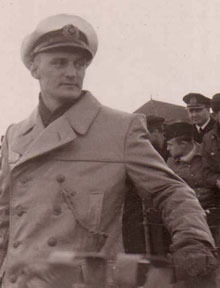
Heinz-Wilhelm Eck

Siegerjustiz and the Peleus Affair

by Dwight R. Messimer

Chapter Two

Day One

The trial opened four days later on Wednesday, October 17, 1945, in Hamburg, Germany, under the authority of a Royal Warrant issued on June 14, 1945. The Warrant empowered British military courts to try cases of "violations of the laws and usages of war committed during any war in which we have been or may have been engaged at any time after 2 September 1939."


On the left Judge Advocate Stevenson and on the right brigadeer Jones

The Judge Advocate presiding over the trial was Maj. A. Melford Stevenson, K.C.; the prosecutor was Colonel Halse of the Advocate General's Office. The members of the court, essentially the jury, were three British army officers, two Royal Navy officers and two officers of the Royal Hellenic Navy. The outcome of the trial was evident from the moment it opened.

There were several features about the case that made defending Eck and his men a daunting task. First, there was the deep seated British resentment toward the Germans' use of unrestricted submarine warfare in two back-to-back wars. In addition British dissatisfaction still lingered over the sentences handed down by the German Supreme Court in the Llandovery Castle case in 1921. More immediate than the quarter-century old trial was the Allies' reaction to the brutal excesses of the Nazis, which caused them to tar all Germans with the same brush.

On its face, the Peleus Affair seemed to justify the popular opinion that Nazi excesses were common to all Germans. The killing of shipwrecked sailors, whether deliberately or as the result of some other intended act, is atrocious. Heinous acts, however, were regularly committed by all the belligerents of World War II. In fact, war itself is atrocious. But the fact that a medical officer took part in the killing made the act even more odious. As the course of the trial demonstrated, Judge Advocate Stevenson believed the defendants were guilty before the trial even started. That opinion was probably also shared by the seven members of the court who acted as the jury.

Left: Major Lermon

The predisposition of the court toward a speedy conviction and sentencing was made clear from the beginning of the proceedings when Major Lermon, on behalf of all the defendants, requested a one week postponement so that the lawyers might have time to prepare an adequate defense. Lermon pointed out that none of the defense lawyers, including himself, had had more than three days to view documents and prepare their respective case strategies. He also noted that witnesses who were vital to the defense had not yet arrived, and there had been no time to order documents needed for the defense. Lermon also made it clear that the defense lawyers needed additional time to study legal references on military and international law, which were not yet available for such study. In fact, Dr. Pabst had received just one book on international law the night before the day the trial was set to begin. Compounding the problems of the defense, explained Lermon, none of the German attorneys were familiar with British court procedures and practices, and thus they would need time to learn them.

Despite these compelling arguments, Judge Advocate Stevenson refused the request for adjournment. Instead, he ordered the prosecutor to present his case, at the end of which the matter of witnesses for the defense could be reexamined if they had not yet arrived. The question of the documents needed by the defense was not even addressed. It was to be a speedy trial.


From left: Heinz Eck, August Hoffmann, Dr. Walter Weispfennig, Hans Lenz and Wolfgang Schwender

The charges drawn up against Eck and the others were flawed. In the charge sheet, the defendants were alleged to have ". . .sunk the steamship "Peleus" in violation of the laws and usages of war. . . ." According to that wording, they were being charged with a violation of international law as it was understood during World War I. That is, they sank the Peleus without warning in violation of the Prize Rules.

No such interpretation of the law existed during World War II, and thus as charged, the defendants were clearly innocent. The mistake might have been exploited by the defendants' lawyers. On the other hand, given the attitude of the court, letting the charge stand probably would not have helped the defense.

When the charges were read and the defendants asked to plead guilty or not guilty, Major Lermon objected, pointing out that if it was the contention that the Peleus was sunk in contravention of the laws and usages of war, it was a bad charge. The Judge Advocate and the prosecutor agreed, and the charge sheet was amended to show only one charge and not two. It was a small victory for the defense, and the only victory.

The case for the prosecution was presented in less than three hours. Colonel Halse began by introducing three affidavits signed by the three Peleus survivors, after which he called five former U-852 crewmen to the stand. Thereafter Halse introduced admiralty documents showing that the Peleus was under charter to the British, and that the men who had signed the affidavits were in fact crew members. The defense strenuously objected to admitting the affidavits because there was no opportunity for cross-examination regarding the truth of their content. The defense also strongly objected to admitting hearsay evidence contained in one of the affidavits, arguing to the court that all three Greek seamen were within the reach of the Admiralty and could be produced in court. The objection was overruled.

The Judge Advocate's ruling was a major setback, which was compounded by a lackluster cross-examination of the five German witnesses. But even the indifferent questioning produced the fact that none of the German witnesses supported the prosecution's contention that the Peleus survivors had been intentionally fired upon. At the close of the prosecution's case, the defense reopened the request for a one week adjournment. They needed witnesses, documents and time to prepare. As the discussion continued it became evident that the Judge Advocate was not interested in delaying the proceedings. Nor was he interested in having witnesses called. In fact, one witness he rejected was Konteradmiral Karl Schmidt, who had been in command of the destroyer Erich Giese on April 13, 1940.

Left: Dr. Harold Todsen

Admiral Schmidt's testimony was vital to Dr. Todsen's argument that the usages of war had changed with respect to attacks on survivors. Todsen's defense of Eck was based on "operational necessity," and thus it was critical that he demonstrate that throughout World War II, all of the belligerents had justified attacks on shipwrecked survivors on that basis.

The case of the German destroyer, Erich Giese, sunk near Narvik on April 13, 1940, is but one well-documented example. After the Erich Giese had been sunk, British destroyers fired on the 200 German survivors who were flailing about in the water and clinging to life rafts. The British had claimed the killing was an "operational necessity" to prevent the German sailors from reaching shore and joining the German troops in Narvik.

Killing shipwrecked survivors to prevent them from joining their own forces was not unique to the British. Dr. Todsen, however, was probably unaware of two other similar incidents that had occurred in the South Pacific during World War II. On January 26, 1943, the USS Wahoo, on her third war patrol, sank a Japanese troopship off the New Guinea coast. The Wahoo's skipper, LCdr. Dudley W. "Mush" Morton, surfaced to charge his batteries and, according to his own operational report, "destroy the estimated twenty troop boats now in the water." "We surfaced in a sea of Japanese," Lt. George W. Grider wrote. "They were on every piece of flotsam, every broken stick, in lifeboats everywhere." According to Lt. Richard O'Kane, the Wahoo's executive officer, the captain said to him, "I will prevent these soldiers from getting ashore. . ." O'Kane, however, was careful to avoid the accusation that the Wahoo's fire, which was "methodical. . .sweeping abeam forward like fire hoses sweeping a street," was specifically aimed at the Japanese. According to O'Kane, "Some Japanese troops were undoubtedly hit in this action. But no individual was deliberately shot in the boats or in the sea."

The second incident occurred during and after the Battle of the Bismarck Sea, March 2-5, 1943. According to Capt. Robert R. Buckley, Jr, USNR (Ret.), "thousands of Japanese troops from sunken transports were adrift in collapsible boats." On March 4, those survivors became the targets of repeated air attack, and for several days American PT boats hunted down and sank the rafts. The justification was to prevent the survivors from reaching the New Guinea coast. The explanation was so plausible that the attacks were widely reported in Newsweek and Life. The Americans, at least, made no secret that the usages of war, with regard to shipwrecked survivors, had drastically changed.

The defense attorneys continued to ask for a one week adjournment. They still needed time to prepare, and there was much to do. Bending slightly, the Judge Advocate granted them an adjournment until 215 p.m. the following day.

This article was published on 28 Mar 1998.

Heinz-Wilhelm Eck

Siegerjustiz and the Peleus Affair

Chapter One - Eck's career, U-852's only patrol and the sinking of SS Peleus and the loss of U-852 and its crew's imprisonment.

Chapter Two - The first day of the trial. The procecution and the defence prepare their cases.

Chapter Three - The second and third days of the trial.

Chapter Four - The fourth day of the trial. The execution of Eck and two of his crew members. Closing words.

Information about the book - Information on the book from which this section came from.

Go to the front page of


Operational Necessity, An

Griffin, Gwyn


Buy this title at


amazon.com
See more sellers

Books dealing with this subject include:

An Operational Necessity. Griffin, Gwyn, 1999. (transl.)
Silent Hunters. Savas, Theodore P. (editor), 1997. (transl.)
Trial of Heinz Eck, August Hoffmann, Walter Weisspfennig, Hans Richard Lenz and Wolfgang Schwender (The Peleus Trial). Cameron, John (editor), 1948.
Verdammter Atlantik. Herlin, Hans, 1994. (transl.)

Return to Articles main page