
Ingerfire
Norwegian Steam merchant
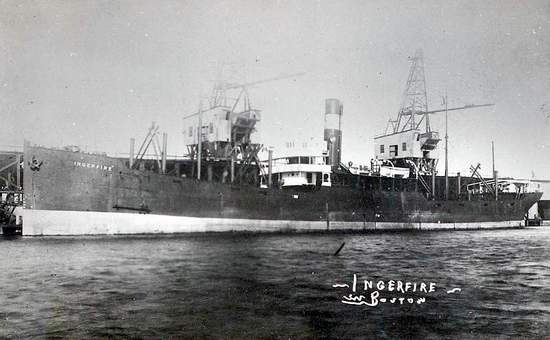
Photo Courtesy of Library of Contemporary History, Stuttgart
| Name | Ingerfire | ||
| Type: | Steam merchant | ||
| Tonnage | 3,835 tons | ||
| Completed | 1905 - Short Bros Ltd, Pallion, Sunderland | ||
| Owner | Jacob Kjøde A/S, Bergen | ||
| Homeport | Bergen | ||
| Date of attack | 11 Apr 1943 | Nationality:  Norwegian Norwegian | |
| Fate | Sunk by U-613 (Helmut Köppe) | ||
| Position | 51° 29'N, 42° 59'W - Grid AJ 9496 | ||
| Complement | 36 (8 dead and 28 survivors). | ||
| Convoy | ONS-2 (romper) | ||
| Route | Barrow - Halifax | ||
| Cargo | Ballast | ||
| History | Built as Alexandra 1924 renamed Ingerfire On 10 Apr 1940, the Ingerfire arrived in Tromsø, Norway from USA just after the German invasion of Norway and was then used to transport coal from Svalbard. On 8 June, the ship was just returning from Svalbard to Tromsø with a cargo of coal, when she was redirected to Thorshavn and then escaped to Great Britain, because Norway had capitulated. In November 1942, the Ingerfire took part in Operation Torch, the invasion of North Africa, as ammunition and supply ship. | ||
| Notes on event | At 22.28 hours on 11 April 1943 the Ingerfire was torpedoed by U-613 and sank within one minute about 400 miles east of Newfoundland. The ship had lost convoy ONS-2 in stormy weather and was proceeding as romper ahead of convoy. Six Norwegian and two British crew members were lost. The survivors were picked up by the HMCS St Croix (I 81) and the HMCS Camrose (K 154) early in the afternoon of 12 April. | ||
| On board | We have details of 35 people who were on board. | ||
If you can help us with any additional information on this vessel then please contact us.