


Otto Kretschmer
Fregattenkapitän (Crew 30)
| Successes 40 ships sunk, total tonnage 208,954 GRT 3 auxiliary warships sunk, total tonnage 46,440 GRT 1 warship sunk, total tonnage 1,375 tons 1 ship sunk, total tonnage 2,136 GRT 5 ships damaged, total tonnage 37,965 GRT 2 ships a total loss, total tonnage 15,513 GRT |
| Born | 1 May 1912 | Heidau, Liegnitz | |
| Died | 5 Aug 1998 | (86) | Straubing |
|
|
Ranks
Decorations
|

U-boat Commands
| U-boat | From | To | |
|---|---|---|---|
| U-35 | 31 Jul 1937 | 15 Aug 1937 | No war patrols |
| U-23 | 1 Oct 1937 | 1 Apr 1940 | 8 patrols (97 days) |
| U-99 | 18 Apr 1940 | 17 Mar 1941 | 8 patrols (127 days) |
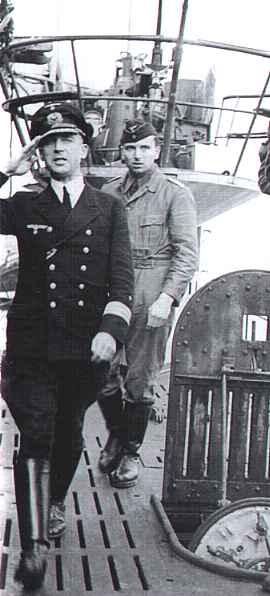 Kptlt. Kretschmer (right) on U-99 after docking at Lorient on 21 July 1940 |
Otto Kretschmer was born in Heidau über Niesse in Prussian Silesia (now Hajduki Nyskie, Poland), and was the son of a schoolmaster. Prior to joining the Reichsmarine as an officer candidate at the age of 18 he studied English and literature at Exeter University in England for eight months. After officer training he spent three months on the sailing school ship Niobe and more than a year on the light cruiser Emden.
After serving on the pocket battleship Deutschland and the light cruiser Köln 1934-35, he transferred to the U-bootwaffe (U-boat force) in January 1936. He thus received a solid pre-war training as a U-boat officer. He joined U-35 as 1st Watch Officer (IWO) on U-35 in Nov 1936, and commanded her as Kommandant in Vertretung (Commandant substitute) on one patrol in Spanish waters during the Spanish Civil War.
In September 1937 he took over command the small Type II U-23. Following the outbreak of the war he won his first successes on patrols in the North Sea off the English and Scottish east coasts.
In November 1939 he laid nine mines in Moray Firth, Scotland. The first great success for Otto Kretschmer was the sinking of the Danish tanker Danmark (10,517 tons) on 12 January 1940.
Just over a month later he sank the British destroyer HMS Daring (1,375 tons).
He left U-23 in April 1940 and in the same month commissioned U-99. While commanding U-99 Otto Kretschmer became
famous for night-time surface attacks against convoys, and it was at this time his motto
"One torpedo ... one ship" was coined.
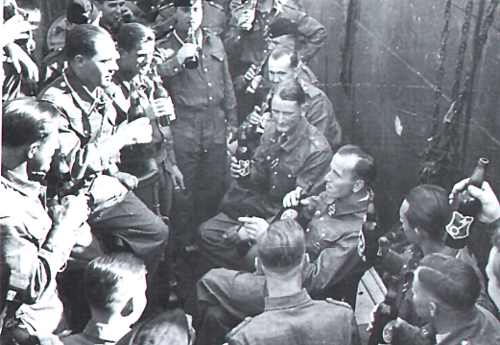
Kptlt. Kretschmer with the crew of U-99 enjoying the first bottle of beer after returning from patrol.
With the sinking of three British Armed Merchant Cruisers, Laurentic (18,724 tons), Patroclus (11,314 tons) and Forfar (16,402 tons) in November 1940, with a total of more than 46,000 tons, Silent Otto became the "Tonnage King" of U-boat commanders, never to be dethroned.
His last patrol also began successfully, but after attacking ten ships, his luck ran out. He was captured after scuttling U-99 at 0343hrs on 17 March 1941 (Schepke was lost in the same action) SE of Iceland following depth charge damage inflicted by the British destroyer HMS Walker (Niestlé, 1998). Kretschmer managed to surface the badly damaged boat and save 40 of his crew before U-99 sank. The LI (Chief Engineer) was one of three men who went down with her.
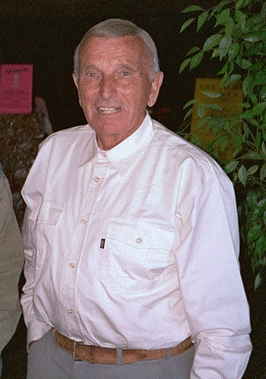 (c) 1997 Stephen Ames |
After his capture he spent more than six and a half years in Allied captivity.
His initial RN interrogation report stated that
"He gave the impression of being a quiet, deliberate man, and looked more like a student than a U-Boat Captain".
For more than four years he was a POW in Canada in Camp 30 (often referred to as Camp Bowmanville), during which time he managed to remain in contact with BdU (U-boat High Command). He returned to Germany in December 1947.
In 1955 Otto Kretschmer joined the Bundesmarine (Federal German Navy), and in 1957 became commander of the 1. Geleitgeschwader (1st Escort Squadron). In November 1958 he became commander of the Amphibische Streitkräfte (Amphibious Forces).
From 1962 he served in several staff positions before becoming Chief of Staff at NATO COMNAVBALTAP (Commander, Allied Naval Forces, Baltic Approaches) in May 1965, a position he held for four years. He retired in September 1970 with the rank of Flotillenadmiral (Admiral of the Fleet).
Otto Kretschmer died in hospital in Bavaria during the summer of 1998 following an accident while on vacation.
You can listen to Silent Otto speaking of his experiences here.
Sources
Busch, R. and Röll, H-J. (1998). German U-boat commanders of World War II.
Busch, R. and Röll, H-J. (1997). Der U-Bootkrieg 1939-1945 (Band 2).
Niestlé, A. (1998). German U-boat losses during World War II.
Rohwer, J. (1998). Axis Submarine Successes of World War Two.
Patrol info for Otto Kretschmer
| U-boat | Departure | Arrival | ||||||
|---|---|---|---|---|---|---|---|---|
| 1. | U-23 | 25 Aug 1939 | Wilhelmshaven | 4 Sep 1939 | Wilhelmshaven | Patrol 1, | 11 days | |
| 2. | U-23 | 9 Sep 1939 | Wilhelmshaven | 21 Sep 1939 | Kiel | Patrol 2, | 13 days | |
| 3. | U-23 | 29 Sep 1939 | Kiel | 30 Sep 1939 | Wilhelmshaven | 2 days | ||
| 4. | U-23 | 1 Oct 1939 | Wilhelmshaven | 16 Oct 1939 | Kiel | Patrol 3, | 16 days | |
| 5. | U-23 | 1 Nov 1939 | Kiel | 9 Nov 1939 | Kiel | Patrol 4, | 9 days | |
| 6. | U-23 | 5 Dec 1939 | Kiel | 15 Dec 1939 | Kiel | Patrol 5, | 11 days | |
| 7. | U-23 | 8 Jan 1940 | Kiel | 15 Jan 1940 | Wilhelmshaven | Patrol 6, | 8 days | |
| 8. | U-23 | 18 Jan 1940 | Wilhelmshaven | 29 Jan 1940 | Wilhelmshaven | Patrol 7, | 12 days | |
| 9. | U-23 | 9 Feb 1940 | Wilhelmshaven | 25 Feb 1940 | Wilhelmshaven | Patrol 8, | 17 days | |
| 10. | U-23 | 26 Feb 1940 | Wilhelmshaven | 28 Feb 1940 | Kiel | 3 days | ||
| 11. | U-99 | 18 Jun 1940 | Kiel | 25 Jun 1940 | Wilhelmshaven | Patrol 9, | 8 days | |
| 12. | U-99 | 27 Jun 1940 | Wilhelmshaven | 21 Jul 1940 | Lorient | Patrol 10, | 25 days | |
| 13. | U-99 | 25 Jul 1940 | Lorient | 5 Aug 1940 | Lorient | Patrol 11, | 12 days | |
| 14. | U-99 | 4 Sep 1940 | Lorient | 25 Sep 1940 | Lorient | Patrol 12, | 22 days | |
| 15. | U-99 | 13 Oct 1940 | Lorient | 22 Oct 1940 | Lorient | Patrol 13, | 10 days | |
| 16. | U-99 | 30 Oct 1940 | Lorient | 8 Nov 1940 | Lorient | Patrol 14, | 10 days | |
| 17. | U-99 | 27 Nov 1940 | Lorient | 12 Dec 1940 | Lorient | Patrol 15, | 16 days | |
| 18. | U-99 | 22 Feb 1941 | Lorient | 17 Mar 1941 | Sunk | Patrol 16, | 24 days | |
| 16 patrols, 224 days at sea | ||||||||
Ships hit by Otto Kretschmer


About ranks and decorations
Ranks shown in italics are our database inserts based on the rank dates of his crew comrades. The officers of each crew would normally have progressed through the lower ranks at the same rate.

Media links
|
|
|
|
|

As an Amazon Associate uboat.net earns a commission from qualifying purchases.