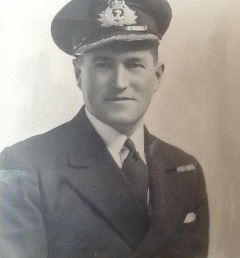
John Stuart Crawford DSO, RN
| Birth details unknown |
![]() | Ranks
Retired: 7 Jan 1950 Decorations
|
Warship Commands listed for John Stuart Crawford, RN
| Ship | Rank | Type | From | To |
| HMS Zulu (F 18) | Cdr. | Destroyer | 15 Feb 1938 | 14 Jan 1941 |
| HMS Pakenham (G 06) | Capt. | Destroyer | 1 Feb 1943 | 16 Feb 1943 |
| HMS Jervis (F 00) | Capt. | Destroyer | Apr 1943 | 16 Nov 1943 |
Career information
We currently have no career / biographical information on this officer.
Events related to this officer
Destroyer HMS Zulu (F 18)
23 Nov 1939
Sinking of the armed merchant cruiser HMS Rawalpindi;
Around midday on 21 November 1939 the German battlecruisers Scharnhorst and Gneisenau, escorted by the light cruisers Köln and Leipzig and the destroyers Z 11 / Bernd von Arnim, Z 12 / Erich Giese and Z 20 / Karl Galster, departed Wilhelmshaven for a raid into the North Atlantic, this was to relieve the pressure of the pocket battleship Admiral Graf Spee operating in the South Atlantic. Late on the 21st the escorts left the battlecruisers.
Just after 1500 hours on 23 November the British armed merchant cruiser HMS Rawalpindi (Capt. E.C. Kennedy, (retired), RN) sighted the Scharnhorst. Rawalpindi was part of the British Northern Patrol and was stationed south-east of Iceland in the Iceland-Faroer gap. Captain Kennedy tried to outrun the German ship and reported to the Admiralty that he sighted the German pocket battleship Deutschland, still believed to be operating in the North Atlantic. Just after 1600 hours, Rawalpindi came within range of the Scharnhorst and was quickly reduced to a flaming wreck. During this engagement Scharnhorst was hit by a 6” shell from Rawalpindi causing only light damage. Scharnhorst and Gneisenau together picked up 27 survivors from Rawalpindi. Rawalpindi finally sank around 2000 hours.
The British light cruiser HMS Newcastle (Capt J. Figgins, RN), that was also part of the Northern Patrol, picked up Rawalpindi’s signal and closed the scene. She sighted the Gneisenau but the Germans managed to escape in the fog.
The Admiralty also thought the ship sighted by Rawalpindi and Newcastle was the Deutschland that was trying to return to Germany. In response to the sighting and destruction of the Rawalpindi the Admiralty took immediate action; The battleships HMS Nelson (Capt. G.J.A. Miles, RN with Admiral Forbes aboard) HMS Rodney (Capt. F.H.G. Dalrymple-Hamilton, RN) and the heavy cruiser HMS Devonshire (Capt. J.M. Mansfield, DSC, RN) escorted by the destroyers HMS Faulknor (Capt. C.S. Daniel, RN), HMS Fame (Cdr. P.N. Walter, RN), HMS Firedrake (Lt.Cdr. S.H. Norris, RN), HMS Foresight (Lt.Cdr. G.T. Lambert, RN), HMS Forester (Lt.Cdr. E.B. Tancock, RN), HMS Fortune (Cdr. E.A. Gibbs, RN) and HMS Fury (Cdr. G.F. Burghard, RN) departed the Clyde to patrol of Norway to cut of the way to Germany for the Deutschland.
The light cruisers HMS Southampton (Capt. F.W.H. Jeans, CVO, RN), HMS Edinburgh (Capt. F.C. Bradley, RN) and HMS Aurora (Capt. G.B. Middleton, RN) escorted by the destroyers HMS Afridi (Capt. G.H. Creswell, DSC, RN), HMS Gurkha (Cdr. F.R. Parham, RN), HMS Bedouin (Cdr. J.A. McCoy, RN), HMS Kingston (Lt.Cdr. P. Somerville, RN) and HMS Isis (Cdr. J.C. Clouston, RN) departed Rosyth to patrol between the Orkney and Shetland islands.
Light cruiser HMS Sheffield (Capt. E. de F. Renouf, CVO, RN) was sent from Loch Ewe to the last known position of the German ship(s).
On northern patrol, south of the Faroers were the light cruisers HMS Caledon (Capt. C.P. Clark, RN), HMS Cardiff (Capt. P.K. Enright, RN) and HMS Colombo (Capt. R.J.R. Scott, RN). These were joined by HMS Dunedin (Capt. C.E. Lambe, CVO, RN) and HMS Diomede (Capt. E.B.C. Dicken, RN).
Of the ships of the Denmark strait patrol, the heavy cruisers HMS Suffolk (Capt. J.W. Durnford, RN) and HMS Norfolk (Capt. A.G.B. Wilson, MVO, DSO, RN) were ordered to proceed to the Bill Bailey Bank (to the south-west of the Faroers)
The light cruiser HMS Glasgow (Capt. F.H. Pegram, RN) escorted by the destroyers HMS Maori (Cdr. G.N. Brewer, RN) and HMS Zulu (Cdr. J.S. Crawford,RN) were already at sea patrolling north-east of the Shetlands were to be joined by the destroyers HMS Inglefield (Capt. P. Todd, RN), HMS Imperial (Lt.Cdr. C.A.de W. Kitcat, RN), HMS Impulsive (Lt.Cdr. W.S. Thomas, RN) and HMS Imogen (Cdr. E.B.K. Stevens, RN) .
Dispite the British effort to intercept the German ships, both German battlecruisers returned to Wilhelmshaven on the 27th.
Destroyer HMS Jervis (F 00)
2 Jun 1943
The Italian torpedo boat Castore (652 tons) left Taranto at 2000hours on 31 May 1943 as escort of the Italian merchants Postumia (595 GRT) and Vragnizza (1592 GRT) heading for Messina. Around 0140 hours on 2 June 1943 while off Cape Spartivento this convoy was attacked with gunfire by the British destroyer HMS Jervis (Capt. J.S. Crawford, DSO, RN) and the Greek destroyer Vasilissa Olga (Lt.Cdr. G. Blessas, DSO, RHN). The two Allied destroyers opened fire at 2000 yds and in the resulting action the Castore was sunk (around 0315 hours) and the two merchants were damaged. According to the war diaries of the Seekriegsleitung both merchant vessels are reported to have arrived in Messina at 1630 hours on 3 June. Other sources give that Postumia went ashore and was
later raised and repaired.
During the engagement Jervis and Vasilissa Olga were assisted by allied aircraft that illuminated the targets by firing flares.