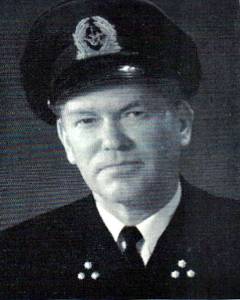


Friedrich Guggenberger
Kapitänleutnant (Crew 34)
| Successes 15 ships sunk, total tonnage 43,098 GRT 1 auxiliary warship sunk, total tonnage 1,150 GRT 1 warship sunk, total tonnage 22,600 tons 1 ship damaged, total tonnage 6,003 GRT |
| Born | 6 Mar 1915 | Munich | |
| Died | 13 May 1988 | (73) | Erlenbach am Main, Germany |
|
|
Ranks
Decorations
|
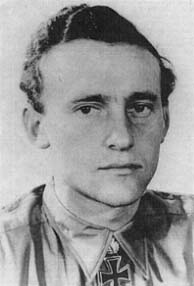
U-boat Commands
| U-boat | From | To | |
|---|---|---|---|
| U-28 | 16 Nov 1940 | 11 Feb 1941 | No war patrols |
| U-81 | 26 Apr 1941 | 24 Dec 1942 | 9 patrols (261 days) |
| U-847 | 23 Jan 1943 | 1 Feb 1943 | No war patrols |
| U-513 | 15 May 1943 | 19 Jul 1943 | 1 patrol (63 days) |
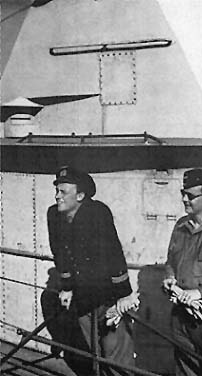 Friedrich Guggenberger with the IWO
 before patrol |
Friedrich Guggenberger began his U-boat career in October 1939 with the usual training. His first U-boat was U-28 under the command of Knights Cross holder Günther Kuhnke. During the autumn of 1940 Guggenberger took over U-28 and commanded the boat for a few months in a training flotilla.
In April 1941 he commissioned U-81. After three patrols in the Atlantic, during which he sank two ships, he took the boat into the Mediterranean in November 1941. On 13 Nov 1941, shortly after passing the Straits of Gibraltar, he torpedoed the British aircraft carrier HMS Ark Royal (22,600 tons), which sank one day later.
After six further successful patrols in the Mediterranean, Guggenberger left the boat in early 1943, and for three months was a member of Dönitz's staff.
In May 1943 he took over U-513, a type IXC U-boat, but she was sunk on his first patrol, on 19 July 1943 in Brazilian waters, by an American aircraft (Niestlé, 1998). The badly wounded Guggenberger, together with six other survivors, spent one day in a lifeboat before being picked up by the US seaplane tender USS Barnegat (AVP-10).
Following a surgical operation and a long stay in hospital he was transferred to Fort Hunt interrogation center, New York on 25 September 1943, then to the POW camp at Crossville, Tennessee later that month, finally arriving at Papago Park POW camp near Phoenix, Arizona in late January 1944.
Escape from Papago Park
On 12 February 1944 Guggenberger and four other U-boat commanders escaped from this camp. Guggenberger and his companion August Maus were recaptured in Tucson, Arizona. Guggenberger was also one of the 25 POWs who escaped from this camp during the night of 23-24 December, 1944. He and his companion on that occasion Jürgen Quaet-Faslem were recaptured on 6 January 1945, less than 10 miles from the Mexican border.
Guggenberger was transferred to Camp Shanks, New York in February 1946, then to a POW compound in the British Zone of Germany near Münster. He was released from Allied captivity in August 1946.
After the war he became an architect, before joining the Federal German Navy, the Bundesmarine, in 1956. After graduating from the Naval War College in Newport (USA), Konteradmiral Guggenberger served as Deputy Chief of Staff on NATO command AFNORTH (Allied Forces North Europe) for four years. He retired in October 1972.
On 13 May 1988 he went for a walk in the forest from which he never returned. His body was not found until two years later.
Sources
Busch, R. and Röll, H-J. (1999). German U-boat commanders of World War II.
Busch, R. and Röll, H-J. (1997). Der U-Bootkrieg 1939-1945 (Band 2).
Niestlé, A. (1998). German U-boat losses during World War II.
Patrol info for Friedrich Guggenberger
| U-boat | Departure | Arrival | ||||||
|---|---|---|---|---|---|---|---|---|
| 1. | U-81 | 21 Jun 1941 | Kiel | 3 Jul 1941 | Trondheim | 13 days | ||
| 2. | U-81 | 17 Jul 1941 | Trondheim | 7 Aug 1941 | Kirkenes | Patrol 1, | 22 days | |
| 3. | U-81 | 9 Aug 1941 | Kirkenes | 13 Aug 1941 | Trondheim | 5 days | ||
| 4. | U-81 | 27 Aug 1941 | Trondheim | 19 Sep 1941 | Brest | Patrol 2, | 24 days | |
| 5. | U-81 | 29 Oct 1941 | Brest | 31 Oct 1941 | Brest | 3 days | ||
| 6. | U-81 | 4 Nov 1941 | Brest | 10 Dec 1941 | La Spezia | Patrol 3, | 37 days | |
| 7. | U-81 | 27 Jan 1942 | La Spezia | 4 Mar 1942 | La Spezia | Patrol 4, | 37 days | |
| 8. | U-81 | 4 Apr 1942 | La Spezia | 25 Apr 1942 | Salamis | Patrol 5, | 22 days | |
| 9. | U-81 | 6 May 1942 | Salamis | 3 Jun 1942 | Salamis | Patrol 6, | 29 days | |
| 10. | U-81 | 6 Jun 1942 | Salamis | 24 Jun 1942 | La Spezia | Patrol 7, | 19 days | |
| 11. | U-81 | 5 Oct 1942 | La Spezia | 16 Nov 1942 | La Spezia | Patrol 8, | 43 days | |
| 12. | U-81 | 24 Nov 1942 | La Spezia | 21 Dec 1942 | Pola | Patrol 9, | 28 days | |
| 13. | U-513 | 18 May 1943 | Lorient | 19 Jul 1943 | Sunk | Patrol 10, | 63 days | |
| 10 patrols, 324 days at sea | ||||||||
Ships hit by Friedrich Guggenberger


About ranks and decorations
Ranks shown in italics are our database inserts based on the rank dates of his crew comrades. The officers of each crew would normally have progressed through the lower ranks at the same rate.
Media links
|
|
|
|
|
|


As an Amazon Associate uboat.net earns a commission from qualifying purchases.