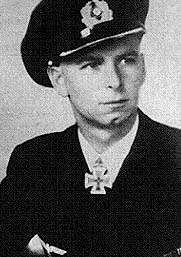


Reinhard Hardegen
Korvettenkapitän (Crew 33)
| Successes 22 ships sunk, total tonnage 113,792 GRT 1 auxiliary warship sunk, total tonnage 3,209 GRT 4 ships damaged, total tonnage 32,516 GRT 1 auxiliary warship damaged, total tonnage 13,984 GRT |
| Born | 18 Mar 1913 | Bremen | |
| Died | 9 Jun 2018 | (105) | Bremen |
|
|
Ranks
Decorations
|

U-boat Commands
| U-boat | From | To | |
|---|---|---|---|
| U-147 | 11 Dec 1940 | 4 Apr 1941 | 1 patrol (19 days) |
| U-123 | 19 May 1941 | 31 Jul 1942 | 4 patrols (221 days) |
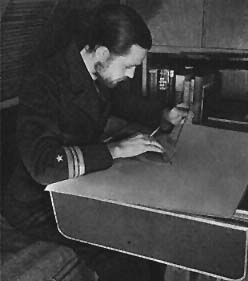
Kptlt. Hardegen at the chart table |
Reinhard Hardegen began his naval career in April 1933. After two and a half years he was transferred, together with other officers, to the Marineflieger (Naval Air Force) branch of the Kriegsmarine. He was trained as an aircraft observer and later as a pilot. Following a crash and an ensuing six months in hospital, he transferred to the U-boat force in November 1939.
He received his first operational experience on U-124, under Kptlt. Schulz. In December 1940 he was made commander of U-147. On his first patrol in her in March 1941 he sank the Norwegian steamer Augvald (4,811 tons).
On 16 May 1941 he took over U-123, a very successful boat, from Kptlt. Karl-Heinz Moehle. On his first patrol, in summer 1941 in West African waters, Hardegen sank five ships with a total of 21,507 tons. In October 1941 he torpedoed the British auxiliary cruiser HMS Aurania (13,984 tons), but the badly damaged ship was towed to harbour by two destroyers.
Hardegen's medical history then finally caught up with him. Due to injuries received in the 1936 plane crash, Hardegen had actually been classed as unfit for U-boat service. However, his papers had repeatedly arrived at each training location after he had already departed for the next. Now Dönitz learned of Hardegen's lingering injuries (including a shortened leg and chronic bleeding of the stomach which required a special diet), but rewarded Hardegen's dedication by permitting him to carry out two further patrols.
On 23 December 1941 U-123 left Lorient on a special mission. She was one of five U-boats ordered to launch an attack against the eastern coast of the United States, part of operation Paukenschlag (Drumbeat).
On 12 January 1942, before reaching the operational area, Hardegen sank the British freighter Cyclops in Canadian waters. Although this was two days before the official start of Operation Paukenschlag, the commanders had permission to sink ships on the crossing to the US coast if they were larger than 10,000 tons. The next two weeks were very successful for U-123, sinking nine ships with a total of 53,173 tons. On 20 January Dönitz sent the following radiogram:
-
An den Paukenschläger Hardegen. Bravo! Gut gepaukt. Dönitz.
(For the drum-beater Hardegen. Well done! Good beating. Dönitz. )
Three days later Hardegen received a radio message that he had been awarded the Knights Cross.
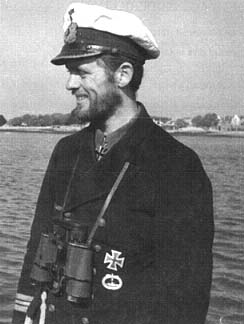 Kptlt. Reinhard Hardegen after patrol |
In March 1942 Hardegen was once more in U-123 off the US east coast. During this second Drumbeat patrol he sank ten ships with a total of 57,170 tons. For this additional outstanding patrol he was awarded the Oak Leaves to his Knights Cross while still at sea. In May 1942 Hardegen brought U-123 back to Kiel for repair.
On 31 July 1942 he left U-123 to become an instructor with the 27th (Training) Flotilla in Gotenhafen. In March 1943 Kptlt. Hardegen became chief of U-boat training at the Torpedo School at Mürwik. After then serving in the Torpedowaffenamt (torpedo technical department) for a few months, he was made a battalion commander in Marine Infanterie Regiment 6 in February 1945.
After the war Reinhard Hardegen spent more than a year in British captivity before returning home in November 1946. He built up a successful oil trading company and was a representative in the parliament of his hometown of Bremen for 20 years.
You can hear Mr. Hardegen speak of his experiences here.
Sources
Busch, R. and Röll, H-J. (1999). German U-boat commanders of World War II.
Busch, R. and Röll, H-J. (1997). Der U-Bootkrieg 1939-1945 (Band 2).
Rohwer, J. (1998). Axis Submarine Successes of World War Two.
Patrol info for Reinhard Hardegen
| U-boat | Departure | Arrival | ||||||
|---|---|---|---|---|---|---|---|---|
| 1. | U-147 | 9 Feb 1941 | Kiel | 16 Feb 1941 | Bergen | 8 days | ||
| 2. | U-147 | 22 Feb 1941 | Bergen | 12 Mar 1941 | Kiel | Patrol 1, | 19 days | |
| 3. | U-123 | 8 Jun 1941 | Lorient | 12 Jun 1941 | Lorient | 5 days | ||
| 4. | U-123 | 15 Jun 1941 | Lorient | 23 Aug 1941 | Lorient | Patrol 2, | 70 days | |
| 5. | U-123 | 14 Oct 1941 | Lorient | 22 Nov 1941 | Lorient | Patrol 3, | 40 days | |
| 6. | U-123 | 23 Dec 1941 | Lorient | 9 Feb 1942 | Lorient | Patrol 4, | 49 days | |
| 7. | U-123 | 2 Mar 1942 | Lorient | 2 May 1942 | Lorient | Patrol 5, | 62 days | |
| 8. | U-123 | 16 May 1942 | Lorient | 24 May 1942 | Bergen | 9 days | ||
| 9. | U-123 | 25 May 1942 | Bergen | 26 May 1942 | Kristiansand | 2 days | ||
| 10. | U-123 | 26 May 1942 | Kristiansand | 27 May 1942 | Aarhus | 2 days | ||
| 11. | U-123 | 28 May 1942 | Aarhus | 29 May 1942 | Kiel | 2 days | ||
| 12. | U-123 | 3 Jun 1942 | Kiel | 5 Jun 1942 | Stettin | 3 days | ||
| 5 patrols, 240 days at sea | ||||||||
Ships hit by Reinhard Hardegen


About ranks and decorations
Ranks shown in italics are our database inserts based on the rank dates of his crew comrades. The officers of each crew would normally have progressed through the lower ranks at the same rate.

Media links
|
|
|
|
As an Amazon Associate uboat.net earns a commission from qualifying purchases.