
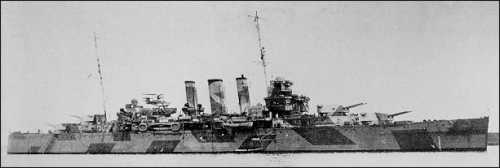
| Navy | The Royal Navy |
| Type | Heavy cruiser |
| Class | London |
| Pennant | 39 |
| Built by | Devonport Dockyard (Plymouth, U.K.): Vickers Armstrong (Newcastle-on-Tyne, U.K.) |
| Ordered | 12 Oct 1925 |
| Laid down | 16 Mar 1926 |
| Launched | 22 Oct 1927 |
| Commissioned | 18 Mar 1929 |
| End service | |
| History | Served as a training ship during 1947-1953. Sold to be broken up for scrap on 16 June 1954. Broken up by Cashmore at Newport arriving on 12 December 1954. |
Commands listed for HMS Devonshire (39)
Please note that we're still working on this section
and that we only list Commanding Officers for the duration of the Second World War.
| Commander | From | To | |
| 1 | Capt. John Maurice Mansfield, DSC, RN | 10 May 1939 | 29 Oct 1940 |
| 2 | Cdr. Hugh May Stollery Mundy, RN | 29 Oct 1940 | 13 Nov 1940 |
| 3 | Capt. Robert Don Oliver, DSC, RN | 13 Nov 1940 | 24 Nov 1942 |
| 4 | Capt. Douglas Young-Jamieson, RN | 24 Nov 1942 | 18 Jun 1943 |
| 5 | Cdr. Charles James Blake, RN | 18 Jun 1943 | 13 Jul 1943 |
| 6 | Cdr. Walter Wilmott Sitwell, RN | 13 Jul 1943 | 13 Sep 1943 |
| 7 | Cdr. John Curthoys Richards, RN | 13 Sep 1943 | 29 Feb 1944 |
| 8 | Capt. Donald Keppel Bain, DSO, RN | 29 Feb 1944 | 11 Jan 1945 |
| 9 | Capt. Gerald Maxwell Bradshaw Langley, OBE, RN | 11 Jan 1945 | 1 Jan 1946 |
You can help improve our commands section
Click here to Submit events/comments/updates for this vessel.
Please use this if you spot mistakes or want to improve this ships page.
Notable events involving Devonshire include:
The page of HMS Devonshire was last updated in June 2022.
26 Jul 1929
While engaged in firing practice in the Aegean, off the island of Skhiatos, the left gun of "X" turret misfired. The breech operator did not realize it and opened the breech block, causing the charge inside the barrel to explode and also ignite the next one inside the turret; 17 men died in the mishap.
Devonshire returned to England for repairs in August with "the turret swung 'round and the guns awry". As a result of this incident, a new interlock was fitted, which prevented the operator from opening the breech until it had been tripped by the gun firing or manually reset by another operator inside the turret.
31 Aug 1939
Several ships from the Mediterranean Fleet departed Alexandria for exercises; these were the battleships HMS Warspite (Capt. V.A.C. Crutchley, VC, DSC, RN, flying the flag of A/Admiral A.B. Cunningham, KCB, DSO and 2 Bars, RN), HMS Barham (Capt. H.T.C. Walker, RN, flying the flag of Vice Admiral G. Layton, CB, DSO, RN), HMS Malaya (Capt. I.B.B. Tower, DSC, RN), heavy cruisers HMS Devonshire (Capt. J.M. Mansfield, DSC, RN, flying the flag of Vice-Admiral J.H.D. Cunningham, CB, MVO, RN), HMS Sussex (Capt. A.R. Hammick, RN), light cruiser HMS Galatea (Capt. E.G.H. Bellars, RN, flying the flag of Vice-Admiral J.C. Tovey, CB, DSO, RN) and the destroyers HMS Grenville (Capt. G.E. Creasy, MVO, RN), HMS Gallant (Lt.Cdr. C.P.F. Brown, RN), HMS Grafton (Cdr. M.S. Thomas, RN), HMS Glowworm (Lt.Cdr. G.B. Roope, RN), HMS Greyhound (Cdr. W.R. Marshall-A'Deane, RN), HMS Cossack (Capt. D. de Pass, RN) and HMS Maori (Cdr. G.N. Brewer, RN), HMS Nubian (Cdr. R.W. Ravenhill, RN) and HMS Zulu (Cdr. J.S. Crawford, RN).
At sea they were joined by the aircraft carrier HMS Glorious (Capt. G. D’Oyly-Hughes, DSO and Bar, DSC, RN) and her attendant destroyer HMS Bulldog (Lt.Cdr. J.S.M. Richardson, RN) which had already been exercising off Alexandria since 30 August.
The Fleet returned to Alexandria in the morning of 1 September 1939. (1)
7 Sep 1939
Convoy Green 1.
The convoy departed Gibraltar on 7 September 1939. Destination of the convoy was for most ships Suez but several ships were detached for Mediterranean ports en-route.
On departure from Gibraltar the convoy was made up of the following merchant vessels; Alpera (British, 1777 GRT, built 1920), Andalusian (British, 3082 GRT, built 1918), Balmore (British, 1925 GRT, built 1920), Bandar Shahpour (British, 5236 GRT, built 1927), Blackhill (British, 2492 GRT, built 1919), Brighton (British, 5359 GRT, built 1928), British Faith (British (tanker), 6955 GRT, built 1928), City of Christchurch (British, 6009 GRT, built 1915), City of Oxford (British, 2759 GRT, built 1926), Destro (British, 3553 GRT, built 1920), Draco (British, 2018 GRT, built 1922), Dromore (British, 4096 GRT, built 1920), Elizabeth Massey (British, 4323 GRT, built 1929), Frederick S. Fales (British (tanker), 10525 GRT, built 1939), Garesfield (British, 2168 GRT, built 1924), Laomedon (British, 6491 GRT, built 1912), Kyle Glen (British, 3670 GRT, built 1917), Lassell (British, 7417 GRT, built 1922), Llandaff Castle (British, 10799 GRT, built 1926), Loch Maddy (British, 4996 GRT, built 1934), Lylepark (British, 5186 GRT, built 1929), Mardinian (British, 2434 GRT, built 1919), Marklyn (British, 3090 GRT, built 1918), Mervyn (British, 3402 GRT, built 1924), Rosewood (British (tanker), 5989 GRT, built 1931), Star of Egypt (British, 4372 GRT, built 1921) and Uskmouth (British, 2482 GRT, built 1928).
On departure from Gibraltar the convoy was escorted by the destroyers HMS Douglas (Cdr. R.F.B. Swinley, RN), HMS Velox (Cdr.(Retd.) J.C. Colvill, RN), HMS Vidette (Cdr.(Retd.) D.R. Brocklebank, RN) and HMS Vortigern (Lt.Cdr. W.J.B. Handley, RN).
Around 1600A/8, the French destroyers L'Alcyon (Lt.Cdr. V.A.M. Albertas) and Trombe (A.A.M. Lepotier) joined the convoy escort [No details available on when they left the convoy.]
Also on 8 September, the merchant vessel Marklyn arrived at Melilla after having parted company with the convoy.
On 9 September, the merchant vessel Balmore arrived at Oran.
Around 0630A/10, the destroyers HMS Cossack (Capt. D. de Pass, RN) and HMS Maori (Cdr. G.N. Brewer, RN), HMS Nubian (Cdr. R.W. Ravenhill, RN) and HMS Zulu (Cdr. J.S. Crawford, RN) joined and HMS Douglas, HMS Velox, HMS Vidette and HMS Vortigern then parted company to return to Gibraltar.
Also on the 10th, the merchant vessel Uskmouth arrived at Algiers after having been detached from the convoy.
Around 1100A/11, the merchant vessel Blackhill parted company to proceed to Bone.
Around 0400A/12, the merchant vessel Mervyn parted company to proceed to Bizerta.
Around 0845A/13, the destroyers HMS Garland (Cdr. C.A.N. Chatwin, RN), HMS Gipsy (Lt.Cdr. N.J. Crossley, RN), HMS Grenade (Cdr. R.C. Boyle, RN) and HMS Griffin (Lt.Cdr. J. Lee-Barber, RN) joined coming from Malta.
Around 0945A/13, the Malta bound ships, Andalusian, City of Oxford, Destro, Draco, Mardinian, parted company with the convoy escorted by HMS Cossack, HMS Maori, HMS Nubian and HMS Zulu.
On the 14th, the sloop HMS Aberdeen (Cdr. H.P. Currey, RN) joined the convoy.
On 16 September 1939, the merchant vessels Dromore and Rosewood arrived at Piraeus after having been detached from the convoy.
Also on 16 September 1939, HMS Garland was damaged by a depth charge explosion. A depth charge was dropped at to slow a speed and damaged the stern. Another depth charge then broke loose and exploded under the ship. She was taken in tow by HMS Griffin. They arrived at Alexandria on 17 September 1939.
On 18 September 1939, the merchant vessel Frederick S Fales arrived at Istanbul after having been detached from the convoy.
Also on 18 September 1939, the merchant vessels Alpera, Bighton I, Garesfield, Laomedon, Kyle Glen, Llandaff Castle, Lylepark and Star of Egypt arrived at Alexandria after having been detached from the convoy.
The remainder of the convoy, Bandar Shahpour, British Faith, City of Christchurch, Elizabeth Massey and Loch Maddy arrived at Port Said on the 18th.
------------------------------------------------------------------------------------------------------------------------------------------
Cover for this convoy had been provided by ships from the Mediterranean Fleet, these were the battleships HMS Warspite (Capt. V.A.C. Crutchley, VC, DSC, RN, flying the flag of A/Admiral A.B. Cunningham, KCB, DSO and 2 Bars, RN), HMS Malaya (Capt. I.B.B. Tower, DSC, RN), heavy cruisers HMS Devonshire (Capt. J.M. Mansfield, DSC, RN, flying the flag of Vice-Admiral J.H.D. Cunningham, CB, MVO, RN), HMS Sussex (Capt. A.R. Hammick, RN), light cruiser HMS Arethusa (Capt. Q.D. Graham, RN, flying the flag of Rear-Admiral H.R. Moore, CB, DSO, CVO, RN) and the destroyers HMS Afridi (Capt. G.H. Cresswell, DSC, RN), HMS Gurkha (Cdr. F.R. Parham, RN), HMS Mohawk (Cdr. R.F. Jolly, RN) and HMS Sikh (Cdr. J.A. Giffard, RN).
7 Sep 1939
HMS Salmon (Lt.Cdr. E.O. Bickford, RN) conducted exercises off Alexandria. These exercises included an A/S exercise with HMS Coral and HMS Moonstone (Lt. W.J.H. Moorman, RN). Later on the day she made a practice attack on HMS Devonshire (Capt. J.M. Mansfield, DSC, RN, flying the flag of Vice-Admiral J.H.D. Cunningham, CB, MVO, RN) who was conducting 4" gunnery exercises off Alexandria. (2)
7 Sep 1939
HMS Snapper (Lt. W.D.A. King, RN) conducted exercises off Alexandria. These exercises included an A/S exercise with HMS Bulldog (Lt.Cdr. J.S.M. Richardson, RN). Later on the day she made a practice attack on HMS Devonshire (Capt. J.M. Mansfield, DSC, RN, flying the flag of Vice-Admiral J.H.D. Cunningham, CB, MVO, RN) who was conducting 4" gunnery exercises off Alexandria. (3)
9 Sep 1939
Convoy Blue 1.
The convoy departed Port Said on 9 September 1939. Destination of the convoy was Gibraltar.
On departure from Port Said the convoy was made up of the following merchant vessels; British Engineer (British (tanker), 6993 GRT, built 1922), British Science (British (tanker), 7138 GRT, built 1931), Calchas (British, 10304 GRT, built 1921), Carelia (British (tanker), 8062 GRT, built 1938), City of Adelaide (British, 6589 GRT, built 1920), City of Dunkirk (British, 5861 GRT, built 1912), Dilwara (British, 11080 GRT, built 1936), Kioto (British, 3297 GRT, built 1918), Largs Bay (British, 14182 GRT, built 1921), Llangibby Castle (British, 11951 GRT, built 1929), Macharda (British, 7998 GRT, built 1938), Mahratta (British, 6990 GRT, built 1917), Maja (British (tanker), 8181 GRT, built 1931), Makalla (British, 6677 GRT, built 1918), Memnon (British, 7506 GRT, built 1931) and Stentor (British, 6148 GRT, built 1926).
The RFA tanker Aldersdale (8402 GRT, built 1937) was also with them.
The convoy was escorted by the destroyers HMS Hardy (Capt. B.A. Warburton-Lee, RN), HMS Hasty (Lt.Cdr. L.R.K. Tyrwhitt, RN) HMS Hereward (Lt.Cdr. C.W. Greening, RN), HMS Hero (Cdr. C.F. Tower, MVO, RN), HMS Hostile (Cdr. J.P. Wright, RN) and the sloop HMS Aberdeen (Cdr. H.P. Currey, RN).
Around 0515B/10, the merchant vessels Frances Massey (British, 4212 GRT, built 1927) and Palestinian Prince (British, 1960 GRT, built 1936) joined coming from Alexandria which they had departed around 1230B/9. The RFA tanker Abbeydale (8299 GRT, built 1937) was also with them. They were escorted by the destroyer HMS Bulldog (Lt.Cdr. J.S.M. Richardson, RN) which then returned to Alexandria.
Around 1730B/13, HMS Aberdeen parted company with the convoy.
Around 0100B/14, the Largs Bay parted company with the convoy to proceed to Malta.
Around 0845B/14, the Frances Massey with the convoy to proceed to Malta.
Around 1130B/14, the merchant vessels Estrellano (British, 1982 GRT, built 1920) and Fabian (British, 3059 GRT, built 1919) joined the convoy coming from Malta.
The convoy arrived at Gibraltar on 19 September 1939.
11 Sep 1939
Several ships from the Mediterranean Fleet conducted gunnery exercises off Alexandria; these were the battleships HMS Warspite (Capt. V.A.C. Crutchley, VC, DSC, RN, flying the flag of A/Admiral A.B. Cunningham, KCB, DSO and 2 Bars, RN), HMS Barham (Capt. H.T.C. Walker, RN, flying the flag of Vice Admiral G. Layton, CB, DSO, RN), HMS Malaya (Capt. I.B.B. Tower, DSC, RN), heavy cruisers HMS Devonshire (Capt. J.M. Mansfield, DSC, RN, flying the flag of Vice-Admiral J.H.D. Cunningham, CB, MVO, RN), HMS Sussex (Capt. A.R. Hammick, RN), light cruisers HMS Arethusa (Capt. Q.D. Graham, RN, flying the flag of Rear-Admiral H.R. Moore, CB, DSO, CVO, RN), HMS Penelope (Capt. G.D. Yates, RN) and four destroyers from the 4th Destroyer Flotilla; HMS Afridi (Capt. G.H. Cresswell, DSC, RN), HMS Gurkha (Cdr. F.R. Parham, RN), HMS Mohawk (Cdr. R.F. Jolly, RN) and HMS Sikh (Cdr. J.A. Giffard, RN).
On completion of these exercises these ships set course to take up a position to the west of Crete to provide cover for convoy Green 1 passing from west to east through the Mediterranean and Blue 1 passing from east to west through the Mediterranean. Also cover was provided for a French eastbound convoy.
HMS Barham and HMS Penelope however returned to Alexandria after the exercises had been completed while the aircraft carrier HMS Glorious (Capt. G. D’Oyly-Hughes, DSO and Bar, DSC, RN), and her attendant destroyer HMS Bulldog (Lt.Cdr. J.S.M. Richardson, RN), which had been conducting flying exercises off Alexandria, joined the other ships.
HMS Devonshire, HMS Sussex and the four Tribal class destroyers were detached for patrol as was HMS Arethusa later although HMS Arethusa rejoined on the 15th having patrolled the Kithera Channel. The patrol for HMS Sussex was apparently later cancelled and she proceeded to Malta for a docking.
The Fleet returned to Alexandria on 16 September.
[For more info on convoy Green 1, see the event ' Convoy Green 1 ' for 7 September 1939.]
[For more info on convoy Blue 1, see the event ' Convoy Blue 1 ' for 9 September 1939.]
[For the moment no info is available on the French convoy.] (4)
29 Sep 1939
HMS Devonshire (Capt. J.M. Mansfield, DSC, RN, flying the flag of Vice-Admiral J.H.D. Cunningham, CB, MVO, RN) and HMS Shropshire (Capt. A.W.LaT. Bisset, RN) conducted gunnery exercises off Alexandria. (5)
2 Oct 1939
HMS Devonshire (Capt. J.M. Mansfield, DSC, RN, flying the flag of Vice-Admiral J.H.D. Cunningham, CB, MVO, RN) conducted gunnery exercises off Alexandria. (6)
11 Oct 1939
HMS Devonshire (Capt. J.M. Mansfield, DSC, RN, flying the flag of Vice-Admiral J.H.D. Cunningham, CB, MVO, RN) departed Alexandria for Malta. (6)
13 Oct 1939
HMS Devonshire (Capt. J.M. Mansfield, DSC, RN, flying the flag of Vice-Admiral J.H.D. Cunningham, CB, MVO, RN) arrived at Malta from Alexandria.
At Malta she was almost immediately docked in No.4 Dock at the Malta Dockyard for repairs to her rudder. (6)
20 Oct 1939
HMS Devonshire (Capt. J.M. Mansfield, DSC, RN, flying the flag of Vice-Admiral J.H.D. Cunningham, CB, MVO, RN) is undocked. (6)
24 Oct 1939
HMS Devonshire (Capt. J.M. Mansfield, DSC, RN, flying the flag of Vice-Admiral J.H.D. Cunningham, CB, MVO, RN) departed Malta for Alexandria. (6)
26 Oct 1939
HMS Devonshire (Capt. J.M. Mansfield, DSC, RN, flying the flag of Vice-Admiral J.H.D. Cunningham, CB, MVO, RN) arrived at Alexandria from Malta. (6)
31 Oct 1939
HMS Devonshire (Capt. J.M. Mansfield, DSC, RN, flying the flag of Vice-Admiral J.H.D. Cunningham, CB, MVO, RN) and HMS Suffolk (Capt. J.W. Durnford, RN) conducted exercises off Alexandria. (7)
3 Nov 1939
HMS Devonshire (Capt. J.M. Mansfield, DSC, RN, flying the flag of Vice-Admiral J.H.D. Cunningham, CB, MVO, RN) and HMS Suffolk (Capt. J.W. Durnford, RN) departed Alexandria for Gibraltar.
On the 5th they were joined off Malta by HMS Norfolk (Capt. A.G.B. Wilson, MVO, DSO, RN).
HMS Devonshire, HMS Norfolk and HMS Suffolk arrived at Gibraltar on November 7th. (8)
8 Nov 1939
HMS Devonshire (Capt. J.M. Mansfield, DSC, RN, flying the flag of Vice-Admiral J.H.D. Cunningham, CB, MVO, RN), HMS Norfolk (Capt. A.G.B. Wilson, MVO, DSO, RN) and HMS Suffolk (Capt. J.W. Durnford, RN) departed Gibraltar for the U.K. They were escorted by the destroyers HMS Douglas ( Cdr. R.F.B. Swinley, RN) and HMS Keppel (Capt. F.S.W. de Winton, RN) until 0800Z/9.
Around 1015A/11, they were joined by the destroyers HMS Isis (Cdr. J.C. Clouston, RN), HMS Ilex (Lt.Cdr. P.L. Saumarez, RN), HMS Escapade (Cdr. H.R. Graham, RN) and HMS Encounter (Lt.Cdr. E.V.St.J. Morgan, RN).
At 1720A/11, the destroyers HMS Intrepid (Cdr. J.W. Josselyn, RN) and HMS Ivanhoe (Cdr. B. Jones, RN) also joined.
Around 1810A/11, HMS Devonshire, HMS Norfolk, HMS Ilex, HMS Isis, HMS Escapade and HMS Encounter parted company with HMS Suffolk, HMS Ivanhoe and HMS Intrepid. These last three ships proceeded towards Portsmouth where HMS Suffolk arrived around 1400A/12. HMS Ivanhoe and HMS Intrepid continued on to Sheerness where they arrived around 2215A/12.
Meanwhile the other ships had arrived at Plymouth around 2015A/11. (9)
12 Nov 1939
HMS Devonshire (Capt. J.M. Mansfield, DSC, RN, flying the flag of Vice-Admiral J.H.D. Cunningham, CB, MVO, RN) proceeded to the Devonport Dockyard for some urgent repairs. (10)
21 Nov 1939
HMS Devonshire (Capt. J.M. Mansfield, DSC, RN, flying the flag of Vice-Admiral J.H.D. Cunningham, CB, MVO, RN) departed Plymouth for the Clyde. (11)
22 Nov 1939
HMS Devonshire (Capt. J.M. Mansfield, DSC, RN, flying the flag of Vice-Admiral J.H.D. Cunningham, CB, MVO, RN) arrived at Greenock from Plymouth. (11)
23 Nov 1939
Sinking of the armed merchant cruiser HMS Rawalpindi
Around midday on 21 November 1939 the German battlecruisers Scharnhorst and Gneisenau, escorted by the light cruisers Köln and Leipzig and the destroyers Z 11 / Bernd von Arnim, Z 12 / Erich Giese and Z 20 / Karl Galster, departed Wilhelmshaven for a raid into the North Atlantic, this was to relieve the pressure of the pocket battleship Admiral Graf Spee operating in the South Atlantic. Late on the 21st the escorts left the battlecruisers.
Just after 1500A/23 the British armed merchant cruiser HMS Rawalpindi (Capt.(Retd.) E.C. Kennedy, RN) sighted the Scharnhorst. Rawalpindi was part of the British Northern Patrol and was stationed south-east of Iceland in the Iceland-Faroe gap. Captain Kennedy at first tried to get away from the German ship and report to the Admiralty that he sighted the German pocket battleship Deutschland, still believed to be operating in the North Atlantic, and so as to buy time so that other ships of the Northern patrol could come to his assistance. Just after 1600 hours, Rawalpindi came within range of the Scharnhorst and was quickly reduced to a flaming wreck. During this engagement Scharnhorst was hit by a 6in shell from Rawalpindi causing only light damage. Scharnhorst and Gneisenau together picked up 27 survivors from the Rawalpindi which finally sank around 2000 hours.
The British light cruiser HMS Newcastle (Capt J. Figgins, RN), that was also part of the Northern Patrol, picked up Rawalpindi's signal and closed the scene. She sighted the Gneisenau but the Germans managed to escape in the fog.
The Admiralty also thought the ship sighted by Rawalpindi and Newcastle was the Deutschland that was trying to return to Germany. In response to the sighting and destruction of the Rawalpindi the Admiralty took immediate action; The battleships HMS Nelson (Capt. G.J.A. Miles, RN, flying the flag of Admiral J.M. Forbes, KCB, DSO, RN) HMS Rodney (Capt. F.H.G. Dalrymple-Hamilton, RN) and the heavy cruiser HMS Devonshire (Capt. J.M. Mansfield, DSC, RN, flying the flag of Vice-Admiral J.H.D. Cunningham, CB, MVO, RN) escorted by the destroyers HMS Faulknor (Capt. C.S. Daniel, RN), HMS Fame (Cdr. P.N. Walter, RN), HMS Firedrake (Lt.Cdr. S.H. Norris, RN), HMS Foresight (Lt.Cdr. G.T. Lambert, RN), HMS Forester (Lt.Cdr. E.B. Tancock, RN), HMS Fortune (Cdr. E.A. Gibbs, RN) and HMS Fury (Cdr. G.F. Burghard, RN) departed the Clyde around 1930A/23 to patrol of Norway to cut off the way to Germany for the Deutschland.
The light cruisers HMS Southampton (Capt. F.W.H. Jeans, CVO, RN, flying the flag of Vice-Admiral G.F.B. Edward-Collins, CB, KCVO, RN), HMS Edinburgh (Capt. F.C. Bradley, RN) and HMS Aurora (Capt. G.B. Middleton, RN) escorted by the destroyers HMS Afridi (Capt. G.H. Creswell, DSC, RN), HMS Gurkha (Cdr. F.R. Parham, RN), HMS Bedouin (Cdr. J.A. McCoy, RN), HMS Kingston (Lt.Cdr. P. Somerville, RN) and HMS Isis (Cdr. J.C. Clouston, RN) departed Rosyth to patrol between the Orkney and Shetland islands.
Light cruiser HMS Sheffield (Capt. E. de F. Renouf, CVO, RN) was sent from Loch Ewe to the last known position of the German ship(s).
On northern patrol, south of the Faroes were the light cruisers HMS Caledon (Capt. C.P. Clark, RN), HMS Cardiff (Capt. P.K. Enright, RN) and HMS Colombo (Commodore R.J.R. Scott, RN). These were joined by HMS Dunedin (Capt. C.E. Lambe, CVO, RN) and HMS Diomede (Commodore E.B.C. Dicken, OBE, DSC, RN).
Of the ships of the Denmark strait patrol, the heavy cruisers HMS Suffolk (Capt. J.W. Durnford, RN) and HMS Norfolk (Capt. A.G.B. Wilson, MVO, DSO, RN) were ordered to proceed to the Bill Bailey Bank (to the south-west of the Faroe Islands).
The light cruiser HMS Glasgow (Capt. F.H. Pegram, RN) escorted by the destroyers HMS Maori (Cdr. G.N. Brewer, RN) and HMS Zulu (Cdr. J.S. Crawford, RN) were already at sea patrolling north-east of the Shetlands were to be joined by the destroyers HMS Inglefield (Capt. P. Todd, RN), HMS Imperial (Lt.Cdr. C.A.de W. Kitcat, RN), HMS Impulsive (Lt.Cdr. W.S. Thomas, RN) and HMS Imogen (Cdr. E.B.K. Stevens, RN).
The light cruisers HMS Calypso (Capt. N.J.W. William-Powlett, DSC, RN) and HMS Ceres (Capt. E.G. Abbott, AM, RN) were stationed off Kelso Light to act as a night attack striking force. The destroyers HMS Somali (Capt. R.S.G. Nicholson, DSC, RN), HMS Ashanti (Cdr. W.G. Davis, RN), HMS Mashona (Cdr. P.V. McLaughlin, RN) and HMS Punjabi (Cdr. J.T. Lean, RN) had just departed Belfast on escort duties. They were ordered to join Admiral Forbes. The ships they were escorting were ordered to return to Belfast.
The destroyers HMS Tartar (Lt.Cdr. D.E. Holland-Martin, RN), HMS Kandahar (Cdr. W.G.A. Robson, RN) and HMS Kashmir (Cdr. H.A. King, RN) departed Scapa Flow with orders to locate and shadow the German ships. HMS Tartar however had to return to Scapa Flow the next day due to a damaged rudder. The other two destroyers were ordered to join HMS Aurora which was to form a strike group of destroyers.
Despite the British effort to intercept the German ships, both German battlecruisers returned to Wilhelmshaven on the 27th.
1 Dec 1939
Around 1030Z/1, HMS Devonshire (Capt. J.M. Mansfield, DSC, RN, flying the flag of Vice-Admiral J.H.D. Cunningham, CB, MVO, RN) and HMS Newcastle (Capt. J. Figgins, RN) made rendezvous in approximate position 62°36'N, 03°10'E.
HMS Devonshire and HMS Newcastle parted company at 0600Z/5.
HMS Newcastle arrived at Scapa Flow around 1000Z/6.
HMS Devonshire arrived at Greenock around 1415Z/6. (12)
9 Dec 1939
HMS Devonshire (Capt. J.M. Mansfield, DSC, RN, flying the flag of Vice-Admiral J.H.D. Cunningham, CB, MVO, RN) departed Greenock for the Northern Patrol to relieve HMS Berwick (Capt. I.M. Palmer, DSC, RN). She was ordered to patrol in the Iceland - Faeroer gap.
Later she was ordered to provide cover for troop convoy TC 1 proceeding from Newfoundland to the U.K. She returned to the patrol in the Iceland - Faeroer gap on 17 December.
[For more info on this convoy see the event ' Convoy TC 1 ' for 10 December 1939.] (13)
10 Dec 1939
Convoy TC 1.
This convoy of troopships departed Halifax around 0510Q/10, for the Clyde where it arrived on 17 December 1939.
The convoy was made up of the following troopships / liners; Aquitania (British, 44786 GRT, built 1914, carrying 2638 troops), Duchess of Bedford (British, 20123 GRT, built 1928, carrying 1312 troops), Empress of Australia (British, 21833 GRT, built 1914, carrying 1235 troops), Empress of Britain (British, 42348 GRT, built 1931, carrying 1303 troops) and Monarch of Bermuda (British, 22424 GRT, built 1931, carrying 961 troops),
Close escort was provided on leaving Halifax by the battleship HMS Resolution (Capt. O. Bevir, RN) and the Canadian destroyers HMCS Fraser (Cdr. W.N. Creery, RCN), HMCS Ottawa (Capt. G.C. Jones, RCN), HMCS Restigouche (Lt.Cdr. W.B.L. Holms, RCN) and HMCS St. Laurent (Lt.Cdr. H.G. de Wolf, RCN). These Canadian destroyers remained with the convoy until 12 December 1939 when they set course to return to Halifax.
Cover for the convoy was provided by the battlecruiser HMS Repulse (Capt. E.J. Spooner, DSO, RN), aircraft carrier HMS Furious (Capt. M.L. Clarke, DSC, RN), light cruiser HMS Emerald (Capt. A.W.S. Agar, VC, DSO, RN) and the destroyers HMS Hunter (Lt.Cdr. L. de Villiers, RN) and HMS Hyperion (Cdr. H.St.L. Nicholson, RN). At dusk on the 10th both destroyers were detached to join the local escort. They returned to Halifax with the Canadian destroyers.
Early on the 15th, HMS Emerald was detached, HMS Newcastle (Capt. J. Figgins, RN) had joined the cover force in the afternoon of the 14th to take her place.
When the convoy approached the British isles, the destroyers HMS Eskimo (Cdr. St.J.A. Micklethwait, RN), HMS Bedouin (Cdr. J.A. McCoy, RN), HMS Mashona (Cdr. P.V. McLaughlin, RN), HMS Somali (Capt. R.S.G. Nicholson, DSC, RN), HMS Kandahar (Cdr. W.G.A. Robson, RN), HMS Khartoum (Cdr. D.T. Dowler, RN), HMS Kingston (Lt.Cdr. P. Somerville, RN), HMS Kashmir (Cdr. H.A. King, RN), HMS Fearless (Cdr. K.L. Harkness, RN), HMS Ilex (Lt.Cdr. P.L. Saumarez, RN) and HMS Impulsive (Lt.Cdr. W.S. Thomas, RN) departed the Clyde on the 12th to sweep ahead of the convoy. HMS Imperial (Lt.Cdr. C.A.de W. Kitcat, RN) was also to have sailed but was unable to join. HMS Matabele (Cdr. G.K. Whitmy-Smith, RN) was sailed in her place and later joined the other destroyers at sea.
After German warships had been reported in the North Sea, and concerned for the safety of convoy TC.1, Admiral Forbes, departed the Clyde on the 13th to provide additional cover with the battleships HMS Warspite (Capt. V.A.C. Crutchley, VC, DSC, RN), HMS Barham (Capt. H.T.C. Walker, RN), battlecruiser HMS Hood (Capt. I.G. Glennie, RN, flying the flag of Rear-Admiral W.J. Whitworth, CB, DSO, RN) and the destroyers HMS Inglefield (Capt. P. Todd, RN), HMS Icarus (Lt.Cdr. C.D. Maud, RN), HMS Imogen (Cdr. E.B.K. Stevens, RN), HMS Imperial, HMS Isis (Cdr. J.C. Clouston, RN) and HMS Foxhound (Lt.Cdr. P.H. Hadow, RN). The destroyers HMS Forester (Lt.Cdr. E.B. Tancock, RN) and HMS Firedrake (Lt.Cdr. S.H. Norris, RN) sailed from Loch Ewe and later joined this force at sea. Three cruisers from the Northern Patrol were ordered to patrol in position 53°55’N, 25°00’W to provide cover for the convoy. These were the heavy cruisers HMS Berwick (Capt. I.M. Palmer, DSC, RN), HMS Devonshire (Capt. J.M. Mansfield, DSC, RN, flying the flag of Vice-Admiral J.H.D. Cunningham, CB, MVO, RN) and the light cruiser HMS Glasgow (Capt. F.H. Pegram, RN).
The light cruisers HMS Southampton (Capt. F.W.H. Jeans, CVO, RN), HMS Edinburgh (Cdr. C. Wauchope, RN, temporary in command) departed Rosyth to patrol between the Shetlands and the Faroes.
The destroyers HMS Afridi (Capt. G.H. Creswell, DSC, RN), HMS Maori (Cdr. G.N. Brewer, RN) and HMS Nubian (Cdr. R.W. Ravenhill, RN) departed Rosyth and proceeded north at high speed to try to cut of the enemy warhips if they were to enter the Atlantic.
The light cruisers HMS Cardiff (Capt. P.K. Enright, RN), HMS Ceres (Capt. E.G. Abbott, AM, RN), HMS Delhi (Capt L.H.K. Hamilton, DSO, RN), HMS Diomede (Commodore E.B.C. Dicken, OBE, DSC, RN) which were on the Northern Patrol were to concentrate near the Faroes where they were joined by HMS Colombo (Commodore R.J.R. Scott, RN) and HMS Dragon (Capt. R.G. Bowes-Lyon, MVO, RN) which were on passage to their patrol stations.
Around 0430Z/17, in foggy conditions, the outward bound liner Samaria (British, 19597 GRT, built 1921) collided with both HMS Furious and the Aquitania but no major damage was done to either one of the three ships.
The convoy arrived safely in the Clyde on 17 December 1939. (14)
22 Dec 1939
Around 0845A/22, HMS Devonshire (Capt. J.M. Mansfield, DSC, RN, flying the flag of Vice-Admiral J.H.D. Cunningham, CB, MVO, RN) arrived at Scapa Flow from the Northern Patrol.
She departed again around 1800A/22 to resume patrol. (13)
27 Dec 1939
HMS Devonshire (Capt. J.M. Mansfield, DSC, RN, flying the flag of Vice-Admiral J.H.D. Cunningham, CB, MVO, RN) arrived at Greenock from the Northern Patrol. (13)
3 Jan 1940
HMS Devonshire (Capt. J.M. Mansfield, DSC, RN, flying the flag of Vice-Admiral J.H.D. Cunningham, CB, MVO, RN) departed Greenock for the Northern Patrol. She is ordered to patrol south of Iceland. (15)
10 Jan 1940
HMS Devonshire (Capt. J.M. Mansfield, DSC, RN, flying the flag of Vice-Admiral J.H.D. Cunningham, CB, MVO, RN) arrived at Rosyth from the Northern Patrol. At Rosyth degaussing equiment was fitted. (15)
18 Jan 1940
HMS Devonshire (Capt. J.M. Mansfield, DSC, RN, flying the flag of Vice-Admiral J.H.D. Cunningham, CB, MVO, RN) and HMS Berwick (Capt. I.M. Palmer, DSC, RN) departed Rosyth for Scapa Flow. (16)
19 Jan 1940
HMS Devonshire (Capt. J.M. Mansfield, DSC, RN, flying the flag of Vice-Admiral J.H.D. Cunningham, CB, MVO, RN) arrived at Scapa Flow from Rosyth. (16)
20 Jan 1940
HMS Devonshire (Capt. J.M. Mansfield, DSC, RN, flying the flag of Vice-Admiral J.H.D. Cunningham, CB, MVO, RN) departed Scapa Flow for the Northern Patrol. She is ordered to patrol in the Denmark Strait. (15)
2 Feb 1940
HMS Devonshire (Capt. J.M. Mansfield, DSC, RN, flying the flag of Vice-Admiral J.H.D. Cunningham, CB, MVO, RN) arrived at Greenock from the Northern Patrol. (17)
7 Feb 1940
HMS Devonshire (Capt. J.M. Mansfield, DSC, RN, flying the flag of Vice-Admiral J.H.D. Cunningham, CB, MVO, RN) and HMS Berwick (Capt. I.M. Palmer, DSC, RN) departed Greenock for the Northern Patrol to relieve HMS Suffolk (Capt. J.W. Durnford, RN) and HMS Norfolk (Capt. A.J.L. Phillips, RN).
HMS Devonshire was to patrol in the Iceland - Faeroer gap while HMS Berwick was to patrol in the Denmark Strait. (18)
9 Feb 1940
Around 0009Z/9, HMS Devonshire (Capt. J.M. Mansfield, DSC, RN, flying the flag of Vice-Admiral J.H.D. Cunningham, CB, MVO, RN) encountered the Norwegian merchant vessel Trafalgar (5542 GRT, built 1938) which was en-route to New York.
At 0920Z/9, a boarding party was sent over to inspect the ship for contraband. The boarding party returned around 1043Z/9 and the ship was released. (17)
20 Feb 1940
HMS Devonshire (Capt. J.M. Mansfield, DSC, RN, flying the flag of Vice-Admiral J.H.D. Cunningham, CB, MVO, RN) arrived at Greenock from the Northern Patrol. (17)
22 Feb 1940
At Greenock, Vice-Admiral J.H.D. Cunningham, CB, MVO, RN, struck his flag in HMS Devonshire (Capt. J.M. Mansfield, DSC, RN) and then hoisted it in HMS Berwick (Capt. I.M. Palmer, DSC, RN).
HMS Devonshire then departed Greenock for the Rosyth Dockyard for a short refit. (18)
23 Feb 1940
HMS Devonshire (Capt. J.M. Mansfield, DSC, RN) arrived at Rosyth from Greenock. (17)
24 Feb 1940
HMS Devonshire (Capt. J.M. Mansfield, DSC, RN) is docked in No.2 Dock at the Rosyth Dockyard.
The ship was at 36 hours notice for sea. Opportunity was taken to effect minor repairs and to blank off main deck scuttles. (17)
2 Mar 1940
Vice-Admiral J.H.D. Cunningham, CB, MVO, RN, rehoisted his flag in HMS Devonshire (Capt. J.M. Mansfield, DSC, RN). (19)
9 Mar 1940
HMS Devonshire (Capt. J.M. Mansfield, DSC, RN) is undocked. (20)
15 Mar 1940
HMS Devonshire (Capt. J.M. Mansfield, DSC, RN, flying the flag of Vice-Admiral J.H.D. Cunningham, CB, MVO, RN) departed Rosyth for the Denmark Strait patrol. (21)
28 Mar 1940
HMS Devonshire (Capt. J.M. Mansfield, DSC, RN, flying the flag of Vice-Admiral J.H.D. Cunningham, CB, MVO, RN) arrived at Greenock from patrol. (21)
2 Apr 1940
HMS Devonshire (Capt. J.M. Mansfield, DSC, RN, flying the flag of Vice-Admiral J.H.D. Cunningham, CB, MVO, RN) departed Greenock for Rosyth. (22)
3 Apr 1940
HMS Devonshire (Capt. J.M. Mansfield, DSC, RN, flying the flag of Vice-Admiral J.H.D. Cunningham, CB, MVO, RN) arrived at Rosyth from Greenock. (22)
7 Apr 1940
HMS Devonshire (Capt. J.M. Mansfield, DSC, RN, flying the flag of Vice-Admiral J.H.D. Cunningham, CB, MVO, RN), HMS Berwick (Capt. I.M. Palmer, DSC, RN), HMS York (Capt. R.H. Portal, DSC, RN) and HMS Glasgow (Capt. F.H. Pegram, RN) embarked troops at Rosyth which were to be landed at Stavanger and Bergen in upcoming operations off Norway. (19)
8 Apr 1940
After a German force of warships was sighted which the Admiralty thought to be proceeding to the North-Atlantic, HMS Devonshire (Capt. J.M. Mansfield, DSC, RN, flying the flag of Vice-Admiral J.H.D. Cunningham, CB, MVO, RN), HMS Berwick (Capt. I.M. Palmer, DSC, RN), HMS York (Capt. R.H. Portal, DSC, RN) and HMS Glasgow (Capt. F.H. Pegram, RN), disembarked their troops and set out to sea around 1300A/8 and proceed north to intercept.
In the evening, around 2100A/8, they were joined near Rattray Head by the French light cruiser Emile Bertin (Capt. R.M.J. Battet) and the large destroyers Maille Breze (Cdr. H.M.E.A. Glotin) and Tartu (Capt. J.M. Chomel).
By then it had become apparent that the Germans were proceeding to invade Norway and the cruisers were ordered to proceed towards the Home Fleet which was also at sea.
They joined the Fleet around mid-morning on the 9th. (19)
9 Apr 1940
During enemy air attacks on the fleet in the afternoon of 9 April 1940, HMS Devonshire (Capt. J.M. Mansfield, DSC, RN, flying the flag of Vice-Admiral J.H.D. Cunningham, CB, MVO, RN) and HMS Berwick (Capt. I.M. Palmer, DSC, RN) both sustained some light splinter damage due to near misses. (23)
11 Apr 1940
Around 1500A/11, in position 64°34'N, 07°31'E, the heavy cruisers HMS Devonshire (Capt. J.M. Mansfield, DSC, RN, flying the flag of Vice-Admiral J.H.D. Cunningham, CB, MVO, RN), HMS Berwick (Capt. I.M. Palmer, DSC, RN) and the destroyers HMS Inglefield (Capt. P. Todd, RN) and HMS Imogen (Cdr. C.L. Firth, MVO, RN) were detached from the Fleet to carry out a search for enemy shipping in Inner Lead between Trondheim and the Vestfjord.
Also assigned to Vice-Admiral Cunningham's Force were the destroyers HMS Ilex (Lt.Cdr. P.L. Saumarez, DSC, RN) and HMS Isis (Cdr. J.C. Clouston, RN). These destroyers at that time had been detached from the Fleet. They were then ordered, by W/T, to search Nansen Fjord, paying particular attention to Namsos and then to join Vice-Admiral Cunningham's Force in position 64°38'N, 10°10'E at 2100A/11. On doing so they reported that they had encountered no enemy shipping.
Meanwhile HMS Inglefield and HMS Imogen had been ordered to search as much of Indreleia to southward as possible before dark, entering and leaving at Buholmraasa. They were to rejoin the cruisers at the same rendezvous position as for HMS Ilex and HMS Isis. On rejoining they reported they had searched up to 64°00'N, but had encountered no enemy shipping.
The Force then proceeded to the north-west until 0100A/12 after which course was set to close the coast.
At 0500A/12, HMS Isis and HMS Imogen were detached off Kya Light in position 64°28'N, 10°13'E with orders to get pilots at Rørvik and then to examine the Indrelea as far as Åsvær Fjord (66°17'N, 12°18'E) after which they were to proceed out to sea.
Meanwhile, the cruisers and two remaining destroyers proceeded northwards.
Around 1530A/12, HMS Isis and HMS Imogen rejoined and she reported that the destroyers had been cheered by the Norwegian population and that they had encountered the Norwegian gunboat Nordkapp which reported that they had sunk the German tanker Kattegat (6031 GRT, built 1928) [she was later salvaged though].
The Force rejoined the Fleet around 0930A/13. The destroyers were soon afterwards ordered to proceed to Skjelfjord, Lofoten Islands to fuel. (24)
14 Apr 1940
Around 0700A/14, the heavy cruisers HMS Devonshire (Capt. J.M. Mansfield, DSC, RN, flying the flag of Vice-Admiral J.H.D. Cunningham, CB, MVO, RN), HMS Berwick (Capt. I.M. Palmer, DSC, RN), in position 69°30'N, 16°05'E, parted company with the fleet when the destroyers HMS Inglefield (Capt. P. Todd, RN), HMS Ilex (Lt.Cdr. P.L. Saumarez, DSC, RN), HMS Imogen (Cdr. C.L. Firth, MVO, RN) and HMS Isis (Cdr. J.C. Clouston, RN) returned from fuelling.
HMS Berwick with HMS Inglefield and HMS Imogen were then detached to investigate Andfjord, Vågsfjorden and adjacent inlets.
HMS Devonshire with HMS Ilex and HMS Isis meanwhile proceeded to examine Ringvassøy and Kvaløy Fjords where D/F bearings had showed the possible presence of an enemy vessel. At 0940A/14 the destroyers were sent into the fjords while HMS Devonshire remained at sea but she later went to Tromsø, arriving around 1500A/14. The destroyers were ordered to conduct A/S patrols in the north and south entrance to Tromsø.
The source of the D/F bearings proved to be a Norwegian seaplane. A delegation made up of the British Vice Consol, the Senior Norwegain Naval Officer, the Harbour Master and the Chief Operator of the Tromsø W/T station visited the Vice-Admiral to inform him of the local situation. Later the Vice-Admiral had a meeting with a Norwegian General.
At 2100A/14, HMS Devonshire, HMS Ilex and HMS Isis departed Tromsø for Kirkenes. HMS Berwick and her two destroyers were ordered to join them north of the North Cape around 0700A/15.
At 0100A/15, HMS Ilex and HMS Isis were detached in position 70°15'N, 20°28'E to join the aircraft carrier HMS Furious (Capt. T.H. Troubridge, RN). HMS Imogen had meanwhile been detached by HMS Berwick at 2320A/15 for the same purpose.
Around 0700A/15, HMS Devonshire was joined by HMS Berwick and HMS Inglefield. They arrived at Kirkenes around 1600A/15. The cruisers were ready to embark one battalion each of Norwegian troops but the Major in charge of the troops had been ordered to sent only battalion to Tromsø. This battalion was already embarked in the transport Dronning Maud (1505 GRT, built 1925) and their supplies and merchanical transport had already sailed in another transport escorted by an armed trawler. The British Force had sighted this ship while they were en-route to Kirkenes. A Liaison Officer from the Royal Norwegian Navy now boarded HMS Devonshire and joined the Vice-Admiral's staff. He had also with him a complete set of Norwegian charts of the area for which the Vice-Admiral had asked.
Around 1800A/15, a signal was received from the Kirkenes Coastal Wireless Station reporting the presence of two warships off Petsamo. HMS Inglefield was then sent out to investigate. The warships were found to be Russian and were guard ships of the Uragan / Shtorm class. When Inglefield started to shadow these ships she was taken under fire by Russian shore batteries.
Another transport, the Kong Haakon (874 GRT, built 1904) and the above mentioned Dronning Maud departed Kirkenes around 1800A/15. The Dronning Maud was to call at Vardø.
HMS Berwick and HMS Inglefield were ordered to provide cover for the Kong Haakon and the transport and trawler that had sailed earlier.
HMS Devonshire sailed at 2000A/15 to provide cover for the Dronning Maud for its onward voyage to Tromsø.
HMS Inglefield reported that while on her way to join HMS Berwick she had encountered a Russian submarine of the SHCH-class on the surface near Vardø. The submarine was flying her colours.
HMS Devonshire arrived at Tromsø around 1645A/16. There she found HMS Furious, which had arrived there around 0600A/16, and which had established a destroyer patrol in the northern and southern approaches to the anchorage.
The Norwegian transport arrived during the night of 16/17 April 1940.
HMS Inglefield arrived shortly after 0500A/17.
HMS Berwick arrived around 0730A/17.
At Tromsø, HMS Furious and the destroyers started fuelling from local resources but the refuelling rate was very slow. Non the less all destroyer were able to fuel to the maximum. HMS Furious was able to embark 700 tons bringing her bunkers back to 40%.
Around 0005A/18, HMS Imogen was sent to Kirkenes to escort transports with a second batallion from there to Tromsø. The convoy with HMS Imogen returned to Tromsø around 2130A/19.
Around 1200A/18, HMS Furious got underway for flying operations during which she was escorted by HMS Ilex and HMS Isis. Around 1500A/18, HMS Furious was attacked by German aircraft during which she was near missed several times and damage was sustained to her hull and turbine blades. HMS Furious and her escorts returned to the anchorage around 2115A/18.
HMS Inglefield which was on A/S patrol in the northern approaches to the achorage was ordered to proceed to pick up a wounded British aviator from HMS Furious.
Around 2200A/18, the RFA tanker War Pindari (5548 GRT, built 1920) arrived escorted by the destroyer HMS Fortune (Cdr. E.A. Gibbs, DSO, RN). HMS Berwick then embarked 400 tons of FFO. After the fuelling of HMS Berwick was completed, the oiler went alongside HMS Furious to complete her with fuel as she was to remain in the area.
Around 0800A/19, HMS Devonshire, HMS Berwick and HMS Inglefield then departed Tromsø for Scapa Flow where they arrived around 1000A/21. (24)
29 Apr 1940
Operation Klaxon, the evacuation of troops from Namsos.
Timespan: 29 April to 5 May 1940.
At 2000A/29 the French armed merchant cruisers El D’Jezair, El Kantara and El Mansour departed Scapa Flow for Namsos, Norway where they were to evacutate troops. They were escorted by the British destroyers HMS Kelly (Capt. L.F.A.V.N. Mountbatten, GCVO, RN), HMS Maori (Cdr. G.N. Brewer, RN), HMS Imperial (Lt.Cdr. C.A.de W. Kitcat, RN) and the French large destroyer Bison (Capt. J.A.R. Bouan).
A cover force departed Scapa Flow one hour later. It was made up of the British heavy cruisers HMS Devonshire (Capt. J.M. Mansfield, DSC, RN, flying the flag of Vice-Admiral J.H.D. Cunningham, CB, MVO, RN), HMS York (Capt. R.H. Portal, DSC, RN), the French light cruiser Montcalm (Capt. J.L. de Corbiere, flying the flag of Commodore (Contre-Admiral) E.L.H. Derrien) and the British destroyers HMS Grenade (Cdr. R.C. Boyle, RN) and HMS Griffin (Lt.Cdr. J. Lee-Barber, RN) and HMS Hasty (Lt.Cdr. L.R.K. Tyrwhitt, RN).
These forces were later reinforced by the British destroyers HMS Afridi (Capt. P.L. Vian, RN), HMS Nubian (Cdr. R.W. Ravenhill, RN) and the French destroyer Foudroyant Foudroyant (Cdr. P.L.A. Fontaine)
The force lead by Vice-Admiral Cunningham arrived off the Norwegian coast near Namsos on May 1st.
HMS Maori had been sent on ahead and reported fog. HMS Kelly, HMS Grenade, HMS Griffin and Bison were ordered to join her.
When entering the Namsenfjord in fog on 2 May 1940, HMS Maori is bombed and damaged from near misses. She had to retire for temporary repairs but was able to participate in the evacuation during the next night. The evacuation attempt was then postponed to the night of 2/3 May.
On 2 May the force was reinforced by the AA cruiser HMS Carlisle (Capt. G.M.B. Langley, OBE, RN).
In the evening of 2 May the force entered the Fjord to embark troops except HMS Devonshire, Montcalm, HMS Grenade, HMS Griffin, HMS Hasty and HMS Imperial which remained at sea to cover the operation.
A total of 1850 British, 2345 French, some Norwegian troops and 30 German prisoners were evacuated. The evacuation was completed around 0445A/3.
Heavy German air attacks developed when the Force was leaving the area. The attacks concentrated on the Devonshire and Montcalm but they were not hit.
The French destroyer Bison was hit at 1010 hours in position 65°42'N, 07°17'E and her forward magazine exploded blowing off the fore part of the ship.The survivors were rescued by HMS Grenade, HMS Imperial and HMS Afridi The wreck was then scuttled by HMS Afridi.
But the attacks continued and at 1400 hours HMS Afridi was hit in position 66°14'N, 05°45'E and sank around 1445 hours. Her survivors were picked up by HMS Griffin and HMS Imperial.
The destroyers with the survivors; HMS Grenade, HMS Griffin and HMS Imperial were detached to land these at Sullom Voe where they arrived around 1700A/4. They departed again around 2130A/4 for Scapa Flow where they arrived around 0730A/5.
Reinforcements had meanwhile been sent out from Sullom Voe these were the light cruiser HMS Southampton (Capt. F.W.H. Jeans, CVO, RN) and the destroyers HMS Beagle (Lt.Cdr. R.H. Wright, RN), HMS Hereward (Lt.Cdr. C.W. Greening, RN) and HMS Hyperion (Cdr. H.St.L. Nicholson, RN). They had departed Sullom Voe late in the evening of May, 2nd with orders to give support to the forces operating in the Namsos area.
Shortly before midnight during the night of 3/4 May, four more destroyers were sent out, these were; HMS Antelope (Lt.Cdr. R.T. White, DSO, RN), HMS Acheron (Lt.Cdr. R.W.F. Northcott, RN), HMS Foresight (Lt.Cdr. G.T. Lambert, RN) and HMS Fury (Cdr. E.W.B. Sim, RN).
All forces arrived at Scapa Flow in the evening of May 4th or the early hours of May 5th. (25)
5 May 1940
The British heavy cruiser HMS Devonshire (Capt. J.M. Mansfield, DSC, RN, flying the flag of Vice-Admiral J.H.D. Cunningham, CB, MVO, RN), French light cruiser Montcalm (Capt. J.L. de Corbiere, flying the flag of Commodore E.L.H. Derrien), British light cruiser HMS Southampton (Capt. F.W.H. Jeans, CVO, RN), French troopships (armed merchant cruisers) El D’Jezair, El Kantara, and the British destroyers HMS Acheron (Lt.Cdr. R.W.F. Northcott, RN), HMS Antelope (Lt.Cdr. R.T. White, DSO, RN), HMS Foresight (Lt.Cdr. G.T. Lambert, RN) and HMS Fury (Cdr. E.W.B. Sim, RN), HMS Hereward (Lt.Cdr. C.W. Greening, RN) and HMS Maori (Cdr. G.N. Brewer, RN) arrived at Scapa Flow at 0400/5th from operations off Namsos, Norway.
8 May 1940
Around 1430A/8, the heavy cruiser HMS Devonshire (Capt. J.M. Mansfield, DSC, RN, flying the flag of Vice-Admiral J.H.D. Cunningham, CB, MVO, RN) departed Scapa Flow for Northern Norway.
Around 2045A/10, she was joined by the destroyers HMS Westcott (Lt.Cdr. W.F.R. Segrave, RN) and HMS Volunteer (Lt.Cdr. N. Lanyon, RN).
HMS Devonshire and HMS Westcott arrived at Tromso around 2235A/10. HMS Volunteer remained out on A/S patrol in the northern entrance to the anchorage.
HMS Devonshire then topped off HMS Westcott with fuel after which this destroyer took over the A/S patrol from HMS Volunteer. (26)
11 May 1940
Around 1300A/11, the heavy cruiser HMS Devonshire (Capt. J.M. Mansfield, DSC, RN, flying the flag of Vice-Admiral J.H.D. Cunningham, CB, MVO, RN) departed Tromso for Kirkenes.
She was escorted by the destroyer HMS Westcott (Lt.Cdr. W.F.R. Segrave, RN).
The destroyer HMS Volunteer (Lt.Cdr. N. Lanyon, RN) was unable to sail with them due to defects and was ordered to sail as soon as she was able to.
Later in the afternoon HMS Westcott reported a hole in her Asdic dome and that she was only able to use her Asdic at very slow speed.
HMS Devonshire arrived at Kirkenes around 1215A/12. HMS Westcott remained out in the Kors Fjord on A/S patrol.
Around 1630A/12, HMS Volunteer arrived and after disembarking a contingent of Royal Marines relieved HMS Westcott on patrol in the Kors Fjord.
Around 2030A/12, HMS Westcott sailed to take over the A/S patrol from HMS Volunteer which went alongside HMS Devonshire shortly after 2100A/11, to effect more repairs and also fuel from the cruiser.
Around 0300A/13, HMS Volunteer departed to take over the A/S patrol from HMS Westcott which then returned and oiled from HMS Devonshire and proceeded on patrol again around 0830A/13.
HMS Devonshire departed Kirkenes around 0900A/13 and was then joined by the destroyers in Kors Fjord.
Around 1300A/14, they made rendezvous, in position 70°53'N, 15°47'E, with the aircraft carrier HMS Ark Royal (Capt. C.S. Holland, RN, flying the flag of Vice-Admiral L.V. Wells, CB, DSO, RN) and her destroyer screen which at that time was made up of HMS Inglefield (Capt. P. Todd, RN), HMS Encounter (Lt.Cdr. E.V.St J. Morgan, RN), HMS Sikh (Cdr. J.A. Giffard, RN) and HMS Tartar (Cdr. L.P. Skipwith, RN). HMS Westcott and HMS Volunteer then joined the carrier.
HMS Devonshire had been ordered to proceed to Tromso where she arrived around 0150A/15. She then commenced fuelling. The following day she had completed up to 75%. (26)
18 May 1940
The Walrus aircraft of HMS Devonshire (Capt. J.M. Mansfield, DSC, RN, flying the flag of Vice-Admiral J.H.D. Cunningham, CB, MVO, RN), which was still at Tromso, was shot down by a German aircraft. The pilot was killed and the other two crew members were brought back to HMS Devonshire by the Norwegians. The telegraphist / gunner however died shortly afterwards from his wounds. (19)
21 May 1940
A replacement Walrus aircraft for HMS Devonshire (Capt. J.M. Mansfield, DSC, RN, flying the flag of Vice-Admiral J.H.D. Cunningham, CB, MVO, RN), which was still at Tromso, arrived. (19)
23 May 1940
At 1950A/23, HMS Devonshire (Capt. J.M. Mansfield, DSC, RN, flying the flag of Vice-Admiral J.H.D. Cunningham, CB, MVO, RN), which was still at Tromso, was attacked by a single German aircraft. Four bombs were dropped, none hit but all were near misses. The ship was badly shaken but no damage was sustained. (19)
24 May 1940
Around 1250A/24, HMS Devonshire (Capt. J.M. Mansfield, DSC, RN, flying the flag of Vice-Admiral J.H.D. Cunningham, CB, MVO, RN) departed Tromso for Kirkenes where she arrived around 1300A/25. (26)
25 May 1940
Around 2015A/25, HMS Devonshire (Capt. J.M. Mansfield, DSC, RN, flying the flag of Vice-Admiral J.H.D. Cunningham, CB, MVO, RN) departed Kirkenes for Hammerfest where she arrived around 1650A/26. (26)
26 May 1940
Around 1930A/26, HMS Devonshire (Capt. J.M. Mansfield, DSC, RN, flying the flag of Vice-Admiral J.H.D. Cunningham, CB, MVO, RN) departed Hammerfest to patrol off the North Cape. (26)
28 May 1940
Around 0600A/28, HMS Devonshire (Capt. J.M. Mansfield, DSC, RN, flying the flag of Vice-Admiral J.H.D. Cunningham, CB, MVO, RN) arrived at Tromso from patrol. At Tromso she took in 750 tons of fuel. (26)
29 May 1940
Around 0045A/29, HMS Devonshire (Capt. J.M. Mansfield, DSC, RN, flying the flag of Vice-Admiral J.H.D. Cunningham, CB, MVO, RN) departed Tromso to patrol off the North Cape. (26)
31 May 1940
Around 0845A/31, HMS Devonshire (Capt. J.M. Mansfield, DSC, RN, flying the flag of Vice-Admiral J.H.D. Cunningham, CB, MVO, RN) arrived at Hammerfest from patrol. (26)
1 Jun 1940
Around 1145A/1, HMS Devonshire (Capt. J.M. Mansfield, DSC, RN, flying the flag of Vice-Admiral J.H.D. Cunningham, CB, MVO, RN) departed Hammerfest for Tromso where she arrived around 2030A/1.
The following day HMS Devonshire took in 680 tons of fuel. (27)
3 Jun 1940
Around 0800A/3, HMS Devonshire (Capt. J.M. Mansfield, DSC, RN, flying the flag of Vice-Admiral J.H.D. Cunningham, CB, MVO, RN) departed Tromso to patrol off the North Cape. (27)
5 Jun 1940
Around 0900A/5, HMS Devonshire (Capt. J.M. Mansfield, DSC, RN, flying the flag of Vice-Admiral J.H.D. Cunningham, CB, MVO, RN) arrived at Tromso from patrol.
Around 2000A/5, HMS Devonshire departed Tromso to patrol off the North Cape. (27)
7 Jun 1940
Around 1830A/7, HMS Devonshire (Capt. J.M. Mansfield, DSC, RN, flying the flag of Vice-Admiral J.H.D. Cunningham, CB, MVO, RN) arrived at Tromso from patrol.
There she embarked important passengers for evacuation to England, these included the Norwegian King, Crown Prince, Prime Minister, ten other ministers, diplomats and the families of some of the above as well as staff members. A total of 55 persons went aboard. On top of these several political refugees and also military personnel boarded the ship. In total 435 men and 26 women boarded HMS Devonshire for passage to England.
Around 2000A/5, HMS Devonshire then departed Tromso for the U.K. (27)
10 Jun 1940
Around 0930A/10, HMS Devonshire (Capt. J.M. Mansfield, DSC, RN, flying the flag of Vice-Admiral J.H.D. Cunningham, CB, MVO, RN) arrived at Greenock where all passengers were immediately disembarked. (27)
14 Jun 1940
Around 1800A/14, the aircraft carrier HMS Furious (Capt. T.H. Troubridge, RN) got underway from Greenock to land on her aircraft. She was escorted by the destroyers HMS Echo (Cdr. S.H.K. Spurgeon, DSO, RAN) and HMS Witherington (Lt.Cdr. J.B. Palmer, RN). HMS Furious had on board £ 18 million of gold bullion.
Around 2030A/14, the heavy cruiser HMS Devonshire (Capt. J.M. Mansfield, DSC, RN, flying the flag of Vice-Admiral J.H.D. Cunningham, CB, MVO, RN) and escort destroyer HMS Hambledon (Cdr. S.H. Carlill, RN) also departed from Greenock to join the other ships after which course was set for Halifax, Nova Scotia.
Around 2100A/15, HMS Echo, HMS Witherington and HMS Hambledon parted company to return to the U.K.
Around 1100A/17, HMS Devonshire parted company with HMS Furious which now went on to Halifax unescorted. HMS Devonshire set course to return to the U.K. (Clyde).
At 1818A/17, HMS Devonshire received Admiralty signal timed 1658A/17 ordering her to proceed to Halifax so course was reversed.
Around 0300P/19, HMS Devonshire overtook HMS Furious and now rejoined the aircraft carrier.
Around 1855P/21, HMS Furious and HMS Devonshire, which were about to enter the harbour of Halifax encountered the French light cruiser Emile Bertin (Capt. R.M.J. Battet) which just left the harbour for an unknown destination. HMS Devonshire, which had about 46% fuel remaining, had been ordered to shadow the French cruiser. HMS Furious meanwhile entered the harbour arriving around 2000P/21.
HMS Devonshire obtained contact with Emile Bertin which stated that she was en-route to Martinique.
Around 0900P/22, HMS Devonshire set course for Halifax having been ordered to do so.
HMS Devonshire arrived at Halifax around 0600P/23. (28)
1 Jul 1940
Around 0900P/1, the aircraft carrier HMS Furious (Capt. T.H. Troubridge, RN) (loaded with new aircraft for the U.K.), heavy cruiser HMS Devonshire (Capt. J.M. Mansfield, DSC, RN, flying the flag of Vice-Admiral J.H.D. Cunningham, CB, MVO, RN) and the troop transport Empress of Australia (British, 21833 GRT, built 1914) departed Halifax for the U.K. or Iceland. They were escorted by the destroyers HMCS Assiniboine (Capt. G.C. Jones, RCN) and HMCS Ottawa (Cdr. E.R. Mainguy, RCN).
Around 0600P/2, HMCS Assiniboine and HMCS Ottawa parted company to return to Halifax.
Around 2000P/3, HMS Furious was detached to proceed to the U.K. while HMS Devonshire and the Empress of Australia set course for Iceland.
Around 0900N/5, the heavy cruiser HMS Sussex (Capt. R.V. Symonds-Tayler, DSC, RN) joined HMS Furious.
Around 1230N/6, the destroyers HMS Havelock (Capt. E.B.K. Stevens, DSC, RN), HMS Harvester (Lt.Cdr. M. Thornton, RN), HMS Hesperus (Lt.Cdr. D.G.F.W. MacIntyre, RN) and HMS Highlander (Cdr. W.A. Dallmeyer, RN) joined.
Around 0300A/7, HMS Sussex parted company and proceeded to Greenock arriving there around 0730A/7.
Around 1300A/7, HMS Furious, HMS Harvester, HMS Havelock, HMS Hesperus and HMS Highlander arrived at Liverpool.
Meanwhile HMS Devonshire and the Empress of Australia had continued on towards Reykjavik. HMS Devonshire parted company with the troopship around 0945A/7. HMS Devonshire then set course for Scapa Flow where she arrived around 1930A/8. (29)
13 Jul 1940
HMS Devonshire (Capt. J.M. Mansfield, DSC, RN, flying the flag of Vice-Admiral J.H.D. Cunningham, CB, MVO, RN) conducted exercises off Scapa Flow. (30)
15 Jul 1940
HMS Devonshire (Capt. J.M. Mansfield, DSC, RN, flying the flag of Vice-Admiral J.H.D. Cunningham, CB, MVO, RN) departed Scapa Flow for Rosyth. (31)
16 Jul 1940
HMS Devonshire (Capt. J.M. Mansfield, DSC, RN, flying the flag of Vice-Admiral J.H.D. Cunningham, CB, MVO, RN) arrived at Rosyth from Scapa Flow. She was immediately docked in No.1 Dock. (31)
22 Jul 1940
HMS Devonshire (Capt. J.M. Mansfield, DSC, RN, flying the flag of Vice-Admiral J.H.D. Cunningham, CB, MVO, RN) is undocked. (31)
23 Jul 1940
HMS Devonshire (Capt. J.M. Mansfield, DSC, RN, flying the flag of Vice-Admiral J.H.D. Cunningham, CB, MVO, RN) departed Rosyth for Scapa Flow. (31)
24 Jul 1940
HMS Devonshire (Capt. J.M. Mansfield, DSC, RN, flying the flag of Vice-Admiral J.H.D. Cunningham, CB, MVO, RN) arrived at Scapa Flow from Rosyth. (31)
25 Jul 1940
The heavy cruisers HMS Devonshire (Capt. J.M. Mansfield, DSC, RN, flying the flag of Vice-Admiral J.H.D. Cunningham, CB, MVO, RN), HMS Sussex (Capt. R.V. Symonds-Tayler, DSC, RN) and HMAS Australia (Capt. R.R. Stewart, RN) conducted exercises at Scapa Flow. (32)
27 Jul 1940
In the early evening the battlecruisers HMS Renown (Capt. C.E.B. Simeon, RN, flying the flag of Vice-Admiral W.J. Whitworth, CB, DSO, RN), HMS Repulse (Capt. W.G. Tennant, CB, MVO, RN), heavy cruisers HMS Devonshire (Capt. J.M. Mansfield, DSC, RN, flying the flag of Vice-Admiral J.H.D. Cunningham, CB, MVO, RN), HMS York (Capt. R.H. Portal, DSC, RN), HMAS Australia (Capt. R.R. Stewart, RN), light cruisers HMS Sheffield (Capt. C.A.A. Larcom, RN) escorted by destroyers HMS Ashanti (Cdr. W.G. Davis, RN), HMS Mashona (Cdr. W.H. Selby, RN), HMS Punjabi (Cdr. J.T. Lean, DSO, RN), HMS Tartar (Capt. C. Caslon, RN), HMS Firedrake (Lt.Cdr. S.H. Norris, DSC, RN), HMS Fortune (Cdr. E.A. Gibbs, DSO, RN), HMS Achates (Cdr. R.J. Gardner, RN), HMS Anthony (Lt.Cdr. N.J.V. Thew, RN) and HMS Arrow (Cdr. H.W. Williams, RN) sailed from Scapa Flow in response to reports that German battlecruiser Gneisenau was proceeding from Trondheim back to Germany but in fact this German battlecruiser was at that time already nearly back in Germany having left undetected earlier and the ships reported were in fact only merchant vessels.
At 0400/28, the destroyers HMS Maori (Cdr. H.T. Armstrong, RN) and HMS Zulu (Cdr. J.S. Crawford, RN) joined the Force.
At 1800/28, HMS Devonshire was detached from the force to give cover to a convoy en-route from the Clyde to Iceland.
The force returned to Scapa Flow around 0630/29.
27 Jul 1940
The heavy cruisers HMS Devonshire (Capt. J.M. Mansfield, DSC, RN, flying the flag of Vice-Admiral J.H.D. Cunningham, CB, MVO, RN), HMS Sussex (Capt. R.V. Symonds-Tayler, DSC, RN) and HMAS Australia (Capt. R.R. Stewart, RN) conducted exercises at Scapa Flow.
On completion of the exercises HMS Sussex set course for Greenock while the other two cruisers returned to Scapa Flow. (33)
28 Jul 1940
Around 0200A/28, the heavy cruiser HMS Norfolk (Capt. A.J.L. Phillips, RN) and the destroyer HMS Watchman (Lt.Cdr. E.C.L. Day, RN) departed the Clyde for Reykjavik, Iceland. They were escorting the troopships Georgic (British, 27759 GRT, built 1932) and Koningin Emma (Dutch, 4135 GRT, built 1939).
At 0700A/28, the destroyer HMS Vortigern (Lt.Cdr. R.S. Howlett, RN) also joined coming from Belfast.
At 1630A/29, HMS Norfolk parted company with the convoy to take up a position 30 nautical miles to the North of the convoy while the heavy cruiser HMS Devonshire (Capt. J.M. Mansfield, DSC, RN, flying the flag of Vice-Admiral J.H.D. Cunningham, CB, MVO, RN) took up a position 30 nautical miles to the West of the convoy.
At 0530A/1, both cruisers closed the convoy and then parted company with it and set course to Scapa Flow where they arrived around 1700A/2.
The convoy continued on to Reykjavik where it arrived on 2 August 1940. (34)
3 Aug 1940
HMS Devonshire (Capt. J.M. Mansfield, DSC, RN, flying the flag of Vice-Admiral J.H.D. Cunningham, CB, MVO, RN) and HMS Norfolk (Capt. A.J.L. Phillips, RN) conducted 8" gunnery exercises at Scapa Flow on a towed target. (35)
6 Aug 1940
HMS Devonshire (Capt. J.M. Mansfield, DSC, RN, flying the flag of Vice-Admiral J.H.D. Cunningham, CB, MVO, RN) departed Scapa Flow for Greenock. On departed HA gunnery exercises were carried out. (36)
7 Aug 1940
HMS Devonshire (Capt. J.M. Mansfield, DSC, RN, flying the flag of Vice-Admiral J.H.D. Cunningham, CB, MVO, RN) arrived at Greenock from Scapa Flow.
She was kept at short notice to raise steam for anti-invasion duty. (36)
28 Aug 1940
Operation Menace, the attack on Dakar, 23-24 September 1940.
Part I, initial movements of the Allied naval forces
The actual attack on Dakar took place on 23 and 24 September 1940 but preparations off course started earlier.
28 August 1940.
The battleship HMS Barham (Capt G.C. Cooke, RN) departed Scapa Flow for Gibraltar. She was escorted by HMS Inglefield (Capt. P. Todd, DSO, RN), HMS Eclipse (Lt.Cdr. I.T. Clark, RN) and HMS Escapade (Cdr. H.R. Graham, DSO, RN). They were joined at sea by HMS Echo (Cdr. S.H.K. Spurgeon, DSO, RAN) which sailed later.
29 August 1940.
The transports Anadyr (British, 5321 GRT, built 1930), Casamance (French, 5817 GRT, built 1921), Fort Lamy (British, 5242 GRT, built 1919), Nevada (French, 5693 GRT, built 1918) and the tanker Ocean Coast (British, 1173 GRT, built 1935) split off in position 54’N, 18’W from convoy OB 204 (which had departed from the British east coast on 26/27 August) to proceed to Dakar. When they split off their escort towards Dakar were the Free French sloop Savorgnan de Brazza and the Free French A/S trawler President Houduce.
31 August 1940.
On this day three groups of ships departed from British ports.
From Scapa Flow the following ships sailed; troopships Ettrick (British, 11279 GRT, built 1938), Kenya (British, 9890 GRT, built 1938) and Sobieski (Polish, 11030 GRT, built 1939). These were escorted by the light cruiser HMS Fiji (Capt. W.G. Benn, RN) and the destroyers HMS Ambuscade (Lt.Cdr. R.A. Fell, RN), HMS Antelope (Lt.Cdr. R.T. White, DSO, RN), HMS Volunteer (Lt.Cdr. N. Lanyon, RN) and HMS Wanderer.
From Liverpool the following ships sailed; troopships Karanja (British, 9891 GRT, built 1931), Pennland (Dutch, 16082 GRT, built 1922) and Westernland (Dutch, 16313 GRT, built 1918) and the transport Belgravian (British, 3136 GRT, built 1937). These were escorted by the destroyers HMS Mackay (Cdr. G.H. Stokes, RN), HMS Vanoc (Lt.Cdr. J.G.W. Deneys, RN) and the corvette HMS Erica (Lt.Cdr. W.C. Riley, RNR).
From the Clyde the following warships sailed; HMS Devonshire (Capt. J.M. Mansfield, DSC, RN, flying the flag of Vice-Admiral J.H.D. Cunningham, CB, MVO, RN, the Commander of the upcoming operation), the destroyer HMS Harvester (Lt.Cdr. M. Thornton, RN) and the French sloops (minesweepers) Commandant Dominé and Commandant Duboc.
All these ships were expected to arrive at Freetown on 13 September where they would be joined by ships coming from Gibraltar and ships that were based at Freetown.
1 September 1940.
The outward passage was initially uneventful and Vice-Admiral Cunningham’s group joined up with the group that came from Liverpool at 0600/1 (zone -1). But that evening misfortune occurred when HMS Fiji was torpedoed by the German submarine U-32 when about 40 nautical miles north-northeast of Rockall in position 58°10’N, 12°55’W. She then returned to the Clyde. Her convoy then continued on escorted by the four destroyers until they met Vice-Admiral Cunningham’s force at 0900/2. The convoy was now known as ‘Convoy MP’. The place of HMS Fiji in the operation was subsequently taken over by the Australian heavy cruiser HMAS Australia (Capt. R.R. Stewart, RN).
2 September 1940.
HMS Barham (Capt G.C. Cooke, RN), HMS Inglefield (Capt. P. Todd, DSO, RN), HMS Echo (Cdr. S.H.K. Spurgeon, DSO, RAN), HMS Eclipse (Lt.Cdr. I.T. Clark, RN) and HMS Escapade (Cdr. H.R. Graham, DSO, RN) arrived at Gibraltar from Scapa Flow.
The destroyer escort for the MP convoy parted company at 1400/2 and was ordered to join HMS Revenge (Capt. E.R. Archer, RN) which was escorting Canadian troop convoy TC 7 to the Clyde.
Passage of the MP convoy southwards was relatively uneventful except for some submarine alarms and also some engine defects during which speed had to be reduced a bit.
6 September 1940.
HMS Barham (Capt G.C. Cooke, RN), HMS Inglefield (Capt. P. Todd, DSO, RN), HMS Echo (Cdr. S.H.K. Spurgeon, DSO, RAN), HMS Eclipse (Lt.Cdr. I.T. Clark, RN) and HMS Escapade (Cdr. H.R. Graham, DSO, RN) departed Gibraltar for Freetown in the evening but now accompanied by ships from Force H; the aircraft carrier HMS Ark Royal (Capt. C.S. Holland, RN), battleship HMS Resolution (Capt. O. Bevir, RN) and the destroyers HMS Faulknor (Capt. A.F. de Salis, RN), HMS Forester (Lt.Cdr. E.B. Tancock, RN), HMS Foresight (Lt.Cdr. G.T. Lambert, RN), HMS Fortune (Cdr. E.A. Gibbs, DSO, RN), HMS Fury (Lt.Cdr. T.C. Robinson, RN) and HMS Greyhound (Cdr. W.R. Marshall A'Deane, DSO, DSC, RN).
After passing between Madeira and the Canary Islands on the 8th this force, which constituted the major part of the warships involved in the upcoming operation, turned south at 0900/9. By 0800/11 the force was in position 20°18’N, 19°54’W about 1000 nautical miles south of Casablanca.
Vice-Admiral Cunningham in HMS Devonshire was then in position 16°50’N, 22°00’W, about 240 nautical miles to the south-west ward of the main force. He had just sighted the MS convoy (the five transports), escorted by Savorgnan de Brazza, some 300 nautical miles north-west of Dakar. Vice-Admiral Cunningham ordered the convoy Commodore to take the convoy into Freetown.
A signal was then received that Vichy-French warships had passed the Straits of Gibraltar and had turned south. Three light cruisers and three large destroyers were reported to have made up this force. It was not known where they were bound for but possibly Casablanca. Their appearance seriously affected the whole operation.
The Vichy-French cruiser force.
At 1850 hours on 9 September 1940, H.M. Consul General, Tangier, had informed Admiral Sir Dudley North, Flag Officer commanding North Atlantic, and repeated to the Foreign Office, that a French Squadron in the Mediterranean might try to pass through the Strait of Gibraltar within the next 72 hours. This report received confirmation the next day when the French Admiralty requested the British Naval Attaché, Madrid, to advise the Naval authorities at Gibraltar of the departure from Toulon on the 9th of three light cruisers of the Georges Leygues class and three large destroyers of the Fantasque class. They would pass through the Straits of Gibraltar on the morning of the 11th, no mention was made of their destination. This information reached the Admiralty at 2350/10 and Admiral North at 0008/11.
The Government policy with regards to Vichy warships at that time had been defined in a signal sent to all Commanders-in-Chief and Flag Officers commanding shortly after the attack on the battleship Richelieu at Dakar in July. This message, after stressing the importance of terminating the state of tension then existing between the French navy and ourselves, stated that His Majesty’s Government had decided to take no further action in regard to French ships in French colonial and North African ports, and went on to say ‘ We shall, of course, however, reserve the right to take action in regard to French warships proceeding to enemy controlled ports.’ Recent intelligence had indicated that it was highly improbable that any warships would make for the German occupied Biscay ports, and a Admiral North had not been informed of the Dakar project, he saw no reason to take any steps to interfere with the movements of the French warships.
Early on September 11th, the destroyers HMS Hotspur (Cdr. H.F.H. Layman, DSO, RN), HMS Griffin (Lt.Cdr. J. Lee-Barber, DSO, RN) and HMS Encounter (Lt.Cdr. E.V.St J. Morgan, RN), which were hunting a reported submarine to the eastward of the Strait of Gibraltar. At 0445 they sighted six French warships steaming fast to the westward and reported them. At 0617/11, Admiral North informed the Admiralty that the lights of six ships, probably warships, steering west at high speed, had been reported by HMS Hotspur at 0515 hours in position 36°03'N, 04°14'W (60 miles east of Gibraltar) and that he had ordered the destroyers to take no further action. At 0711 hours he added that he intended to keep in touch with this force by air and that he would report probable destination.
Meanwhile, Vice-Admiral Somerville, commanding Force H, on receiving the signal from HMS Hotspur had brought HMS Renown (Capt C.E.B. Simeon, RN) and the only destroyer available, HMS Vidette (Lt. E.N. Walmsley, RN), to one hour’s notice for full speed. He did not put to sea because he too, believed the Government’s policy was to avoid interference with French warships as stated in the signal of 12 July.
The French squadron passed Gibraltar to the westward shortly after 0830/11 having given it’s composition in reply to the demand as the light cruisers Georges Leygues, Gloire, Montcalm and the destroyers Le Malin, Le Fantasque and L’Audacieux. This information reached the Admiralty at 1043/11 in a signal sent by Admiral North at 0917/11.
No further action was taken during the forenoon and the situation at noon was that the French Squadron was in position 35°00'N, 06°40'W (about 75 nautical miles south-south-west of Gibraltar) steering 213° at 20 knots. They were being observed by reconnaissance aircraft from RAF 200 Sq. based at Gibraltar. The Admiralty and Air Ministery were being kept informed.
Here was a complication that might well effect the Dakar operation should Dakar be the destination of the French Squadron. It does not seem to have been viewed in this light at the Admiralty, until the 1st Sea Lord himself, who was attending a meeting in the Cabinet Offices that forenoon, telephoned orders for HMS Renown and all available destroyers to raise steam for full speed. A signal to this end was then sent to Admiral Somerville at 1239/11. This was over twelve hours after the original message from Madrid had reached the Admiralty.
Movements of Force H, 11 to 14 September 1940.
The noon position and their course indicated Casablanca as the most probable destination of the French Squadron and at 1347/11 the Admiralty ordered Admiral Somerville to sea to intercept them. Further instructions followed at 1429 hours. These was no objection with them going to Casablanca but they could not be allowed to proceed to Dakar. Shortly after 1600 hours aircraft reported that the French Squadron had entered Casablanca.
Admiral Somerville left Gibraltar at 1630 hours in the Renown escorted by the destroyers HMS Griffin, HMS Velox (Cdr.(Retd.) J.C. Colvill, RN) and HMS Vidette. At 2006 hours he was ordered by the Admiralty to establish a patrol to intercept the French Squadron if they sailed southwards from Casablanca. In the early morning hours of the 12th at 0235 hours, HMS Vidette, encountered a four-funneled French destroyer (this was Milan) in position 33°55'N, 08°31'W (west-north-west of Casablanca). She sighted a darkened ship some 6 miles on her port bow. She challenged but got no reply. A searchlight was turned on and revealed a four-funneled French destroyer. Vidette then fired two salvoes and the French destroyer, ignoring a signal to stop, then retired at high speed behind a smoke screen. Shortly afterwards Vidette was recalled from her patrol and ordered to rejoin Renown.
The French squadron was still at Casablanca at 0923/12 according to an aircraft report. At 0934 hours, Admiral Somerville turned north to meet three more destroyers coming from Gibraltar. These were; HMS Hotspur, HMS Encounter and HMS Wishart (Cdr. E.T. Cooper, RN). These were met at 1300 hours, in position 33°05'N, 09°40'W. They then turned to the south-west again. HMS Hotspur was stationed to patrol closer inshore.
At 0405/13, HMS Renown sighted three darkened ships in position 31°25'N, 11°30'W. These were thought to be the three Fantasque class destroyers. They were steaming north at 20 knots and were allowed to proceed. Admiral Somerville continued his patrol but fuel began to become an issue. The weather was to rough for the destroyers to fill up at sea and two of them will have to be detached that evening to refuel. This would much reduce the chance to intercept the French Squadron and Admiral Somerville informed the Admiralty of this. Adding tat he considered a patrol should be established off Dakar. His signal crossed one from the Admiralty stating that according to French sources the Squadron would remain only shortly at Casablanca before proceeding to Dakar.
This forecast proved correct. At 1530/13 aircraft reported that the light cruisers were no longer at Casablanca. Due to his fuel situation Admiral Somerville signalled that he would leave his patrol area for Gibraltar at 2000 hours that evening. But at 1916 hours the Admiralty ordered him to steer for Dakar at 18 knots. This was being done but Vidette and Velox were detached to Gibraltar to fuel.
At 2335/19 the Admiralty cancelled the order so at 0121/14, Renown and the four remaining destroyers set course to return to Gibraltar which they reached at 2000/14.
Patrol of Dakar by Vice-Admiral Cunningham’s forces.
To return to Vice-Admiral Cunningham. He knew that the French Squadron had left the Mediterranean at 1542/11 and that Vice-Admiral Somerville had been ordered to intercept them. Within a couple of hours he learnt that the French Squadron had entered Casablanca. The next forenoon (0947/12) he was informed that Vice-Admiral Somerville had been ordered to establish a patrol and to prevent them from proceeding to the south.
Vice-Admiral Cunningham’s forces were then approaching Freetown. At 1145/12, an aircraft from HMS Ark Royal approached HMS Devonshire to report that the Ark Royal would be in position 13°59'N, 20°08'W at 1300 hours and expected to arrive at Freetown with HMS Barham, HMS Resolution and ten destroyers at 0700/14. The next morning, 13 September, at 0820 hours an aircraft again closed HMS Devonshire. An order was then passed that four destroyers were to be detached to join HMS Devonshire and the convoy before dark. At 1008 hours HMS Devonshire left the convoy to close Ark Royal’s force, sighing it an hour later 20 nautical miles to the north-north-east. Devonshire remained in visual touch until 1700 hours when course was set to return to the convoy taking the destroyers HMS Faulknor, HMS Foresight, HMS Forester and HMS Fury with him.
Shortly after 1800/13, Vice-Admiral Cunningham was informed that the French cruisers had left Casablanca and that Vice-Admiral Somerville in the Renown had been ordered to proceed to the Dakar area.
Shortly after midnight 13th/14th, a signal came in from the Admiralty ordering Vice-Admiral Cunningham to establish a patrol immediately to prevent the French cruisers from reaching Dakar, employing every available ship. The same orders went to the Commander-in-Chief, South Atlantic. HMS Cumberland (Capt. G.H.E. Russell, RN), which had departed Freetown for the U.K. at 2000/13 was placed under Vice-Admiral Cunninham’s orders and HMS Cornwall (Capt. C.F. Hammill, RN), on her way from Simonstown to Freetown, was ordered to increase speed.
The original operation was now swallowed up in the task of intercepting the French ships. Time had become a factor of the utmost importance and without waiting for daylight, Vice-Admiral Cunningham and General Irwin, went over to see General de Gaulle on board the Westernland at 0120/14, who immediately roused Capitaine Thierry d’Argenlieu and armed him with a letter forbidding any French warship to proceed to Dakar. Within twenty minutes they were on their way back to the Dorsetshire with Capt. D’Argenlieu and the following measures were taken;
HMAS Australia which was coming from the Clyde to take the place of HMS Fiji was ordered to close HMS Devonshire, which would be steering for Dakar, then 400 nautical miles distant.
The Ark Royal was ordered to sent her six remaining destroyers; HMS Inglefield, HMS Greyhoud, HMS Fortune, HMS Echo, HMS Eclipse and HMS Escapade to Freetown to fuel and herself proceed with despatch to position 16’N, 17°40’W.
HMS Barham and HMS Resolution and the other four destroyers; HMS Faulknor, HMS Foresight, HMS Forester and HMS Fury, were to fuel at Freetown and leave for the Dakar area as soon as fuelling had been completed.
Convoy’s MP and MS were to proceed to Freetown with their French escorts.
HMS Devonshire meanwhile had altered course to the northward for Dakar at 0230/14, speed 18 knots. It was not possible to transfer General Irwin and his staff and the General thus found himself speeding northward with the orders for the landing while his troops went on to Freetown. HMAS Australia joined HMS Devonshire at 0300 hours and half an hour later the cruisers had worked up to 27 knots. HMS Cumberland and HMS Ark Royal were approaching from the south.
At 1000/14, HMS Devonshire and HMAS Australia were 200 nautical miles south of Dakar in position 11°23’N, 17°42’W, with HMS Cumberland and HMS Ark Royal respectively 45 and 100 miles astern of them. Aircraft from Ark Royal carried out reconnaissance ahead of Devonshire and Australia from this time onwards. Also flights over Dakar were carried out. That afternoon a large amount of shipping was reported in the harbour and also a submarine was sighted on the surface at 1533 in position 260°, Cape Manuel, 10 nautical miles, steering 260°. It could not be seen if the French cruisers had arrived at Dakar.
At 1900/14 the Devonshire and Australia, reduced to 17 knots on reaching the latitude of Dakar and then turned back to join Cumberland. She was met at 1940 hours and then the cruisers turned northward once more. They established a patrol line at 2320 hours, 4 miles apart, courses 270°-090°, between the meridians 17°30’W and 18°00W in latitude 16°00’N.
But they were too late. Just before midnight 14/15 September a message was received from the Admiralty that a Vichy report had announced that the cruisers had arrived safely at Dakar. The Vichy cruisers actually had arrived at Dakar at 1600/14.
Dawn air reconnaissance on the 15th failed to spot the cruisers at Dakar and by this time the three heavy cruisers were running low on fuel and at 1001 hours Vice-Admiral Cunningham sent a signal to the Admiralty to ask if he should withdraw to Freetown to refuel and prepare for operation ‘Menace’, leaving HMS Cumberland to patrol off Dakar, or to report the patrol about 0001/17 and accept indefinite delay of operation ‘Menace’. He recommended the first alternative.
At 1027 hours, however, the Ark Royal signalled that the cruisers had been located at Dakar. All ships then set course for Freetown to refuel except HMS Cumberland which was left to patrol off Dakar. The next day, the 16th, she met the Vichy French merchant vessel Poitiers (4185 GRT, built 1921) 100 miles south of Dakar and fired a salvo across her bows. Her crew then set her on fire and abandoned her. She was then sunk by gunfire from the cruiser.
Cancellation of Operation ‘Menace’.
By the evening of 15 September, Vice-Admiral Cunningham’s forces were all making once again for Freetown. A destroyer had been sent on ahead with the operation orders and two staff officers. The escape of the French cruisers, however, called for a drastic re-consideration of the original plan.
In London the War Cabinet met at 1000/16 to consider the new situation. The Prime Minister pointed out that in his view the operation had to be cancelled and at 1346/16, Vice-Admiral Cunningham received a signal that the landing of troops at Dakar in ‘Operation Menace’ was impracticable. It was proposed that General de Gaulle’s force should land at Duala with the object of consolidating his influence in the Cameroons, Equatorial Africa and the Chads. The British portion of the force was to remain at Freetown. Unless de Gaulle had any strong objection, this plan had to be put into operation forthwith.
Vice-Admiral Cunningham and General Irwin were reluctant to take this view. They replied at 1642 hours suggesting that if HMS Cornwall and HMS Cumberland would be added to their force they should be enough to deal with the French cruisers. The answer came at 2245 hours; they were left a liberty to consider the whole situation and discuss it with de Gaulle, whom they informed of the new proposal.
HMS Devonshire arrived at Freetown at 0630/17. The Vice-Admiral and the General proceeded to consult with General de Gaulle. The latter was much perturbed at the possible cancellation of the original plan and that very morning he sent a telegram to the Prime Minister desiring ‘to insist’ that the plan should be carried out and emphasising the vital importance to the Allies of gaining control of the basis in French Africa. He now urged on the Force Commanders that if the unopposed landing failed the Free French troops should attempt a landing at Rufisque. They decided to support this proposal and shortly after midnight they forwarded their recommendations to the Admiralty for consideration. The reply from H.M. Government came at 1159/18; ‘ We cannot judge relative advantages of alternative schemes from here. We give you full authority to go ahead and do what you think is best, in order to give effect to the original purpose of the expedition. Keep us informed.’
With a free hand such as is seldom enjoyed in these days of rapid communication by the leaders of an overseas expedition in unbroken touch with their Government, the Joint Commanders decided to proceed with ‘Menace’ on 22 September.
The French cruisers again, 19 to 26 September 1940.
The naval and military staffs were working hard at preparations for the landing when the next day, 19 September, French cruiser appeared again on the scene. HMAS Australia, which had left Freetown the day before to relieve HMS Cumberland on patrol, at 1019/19 in position 10°23’N, 16°54’W, north-west of Freetown, sighted the three La Galissonniere class cruisers 14 nautical miles off steering south-east. Once more the naval forces had to raise steam with all despatch. HMAS Australia and HMS Cumberland were already had on the trial. General de Gaulle again arranged for Captain Thierry d’Angenlieu to carry a message requisting the French cruisers to return to Casablanca.
General Irwin and his staff, with Admiral Cunningham’s Chief Staff Officer, Capt. P.N. Walter, were transferred to the troopship Karanja, and at 1400 hours HMS Devonshire left Freetown at 27 knots with the destroyers HMS Inglefield, HMS Greyhound and HMS Escapade. It was hoped to sight the French cruisers before dark. HMS Barham with HMS Fortune and HMS Fury made for a position to the south-east of the French. HMS Ark Royal, which had engine trouble to repair first, was to follow at 0500/20. A message came from the Admiralty that the French cruisers were not to return to Dakar.
The French cruisers turned back to the north-west and increased speed to 29 knots. Torrential rain was falling, hiding everything from view, but HMAS Australia and HMS Cumberland were able to keep in touch and at 1830/19 HMAS Australia managed to pass directions not to return to Dakar. She was then in position 09°02’N, 15°14’W, just keeping in touch while doing 31 knots. Then the French cruiser Gloire broke down and separated from the other two cruisers. The British then lost touch with these two cruisers. HMS Devonshire meanwhile was steaming to a position to cut off the way to Conakri in French Guinea. HMS Cumberland then regained touch with the two French cruisers (Georges Leygues (flag) and Montcalm) who were speeding north while HMAS Australia picked up the Gloire which was steering eastwards at reduced speed. Night had fallen when HMS Devonshire with HMS Inglefield still in company showed up. HMS Inglefield took Captain d’Argenlieu on board of the Gloire. The French captain refused to accede to his representations, but when Vice-Admiral Cunningham intervened he agreed to proceed to Casablanca. HMAS Australia escorted her until 21 September, leaving her then, on Admiralty instructions, to proceed unescorted.
HMS Cumberland meanwhile managed to keep in touch with the other two cruisers. Her attempts at parley failed, but the French signalled that ‘under no circumstances shall my cruisers pass under German control’. HMS Cumberland followed them all the way to Dakar but was unable to prevent them from entering, which they did at 0550/20.
Meanwhile, on 18 September, far away to the southward, a fourth French cruiser had been sighted escorting a naval tanker. This was the Primaguet escorting the Tarn. HMS Cornwall had departed Freetown on 16 September to meet HMS Delhi (Capt. A.S. Russell, RN) and HMS Dragon (Capt. R.J. Shaw, MBE, RN) off Cape Formosa (south Nigeria). They swept towards Fernando Po [now called Bioko] to intercept any French forces bound for the Cameroons with instructions to direct them back to Casablanca. On 17 September at 2000 hours information came that a French warship and an oiler had been in position 07°25’N, 14°40’W at 1500/15. The Cornwall proceeded to search and on the 18th her aircraft picked up the cruiser Primaguet and oiler Tarn 35 nautical miles ahead. The Commander-in-Chief, South Atlantic ordered her to be shadowed.
Her lights were sighted at 2142/18 but disappeared at 0425/19. When dawn broke the horizon was clear. She was picked up again at 1009/19. A boarding party from HMS Delhi went on board. The Captain, after making a formal protest, asked to be allowed to remain stopped until 1700/19 after which she proceeded, first westward, then northward, being shadowed by HMS Cornwall and HMS Delhi until 1830/21 when HMS Delhi had to proceed to Freetown to refuel. HMS Cornwall shadowed her alone untul the 23rd when she was rejoined by HMS Delhi. For two days they followed her close, still steaming north. On the 25th Primaguet fuelled from the Tarn. They were then off the Cape Verde Island. The next day the Admiralty approved the cruisers to return to Freetown. The Primaguet gave a promise that she would proceed to Casablanca with the Tarn where they indeed arrived in due course. The British cruisers then turned south. They had kept the Primaguet and Tarn in sight for five days. Thus two out of the four cruisers in the area had been diverted to Casablanca without the use of force. (37)
31 Aug 1940
Convoy MP.
Convoy MP was part of the upcoming Dakar operation. The convoy departed Scapa Flow on 31 August 1940 for Freetown.
The convoy was made up of the troopships Ettrick (11279 GRT, built 1938), Kenya (9890 GRT, built 1930) and Sobieski (11030 GRT, built 1939). Escort was provided by the light cruiser HMS Fiji (Capt. W.G. Benn, RN) and the destroyers HMS Ambuscade (Lt.Cdr. R.A. Fell, RN), HMS Antelope (Lt.Cdr. R.T. White, DSO, RN), HMS Volunteer (Lt.Cdr. N. Lanyon, RN) and HMS Wanderer (Cdr. J.H. Ruck-Keene, DSC, RN). The next day the convoy was joined to the north of Ireland by the heavy cruiser HMS Devonshire (Capt. J.M. Mansfield, DSC, RN), the destroyer HMS Harvester (Lt.Cdr. M. Thornton, RN) and the Free French sloops (minesweepers) Commandant Dominé and Commandant Duboc which came from the Clyde.
At 1709/1 (zone -1), HMS Fiji was hit by a torpedo fired by the German submarine U-32 when about 40 nautical miles north-northeast of Rockall in position 58°10’N, 12°55’W. She then left the convoy 10 minutes later and set course for the Clyde. She was joined by the destroyer HMS Antelope soon afterwards. The forward boiler room and five adjacent were flooded and five ratings had been killed.
Around 2030 hours HMS Fiji and HMS Antelope were joined by the destroyers HMS Ashanti (Cdr. W.G. Davis, RN), HMS Bedouin (Cdr. J.A. McCoy, DSO, RN) and HMS Volunteer. Fiji and her escort arrived at the Clyde around 1700/3. After inspection it was estimated repairs would take three to four months.
At 1930 hours on 1 September 1940 the destroyers HMS Tartar (Capt. C. Caslon, RN), HMS Punjabi (Cdr. J.T. Lean, DSO, RN), HMS Jaguar (Lt.Cdr. J.F.W. Hine, RN) and HMS Javelin (Cdr. A.F. Pugsley, RN) departed Scapa Flow to join HMS Fiji. Later they joined convoy's.
All destroyers that had been with the convoy parted company with the convoy on September 1st except for HMS Harvester which parted company with the convoy on the 3rd.
The place of HMS Fiji in the upcoming Dakar operation was taken by HMAS Australia (Capt. R.R. Stewart, RN) which departed the Clyde for Freetown on 6 September.
The convoy, escorted by the two Free French sloops (minesweepers), arrived at Freetown on 14 September 1940.
23 Sep 1940
Operations Menace, the attack on Dakar, 23-24 September 1940.
Part II, the actual attack.
General intentions.
By 20 September the attack force was assembled at Freetown. It was made up of the following warships; battleships HMS Barham (Capt G.C. Cooke, RN, flying the flag of Vice-Admiral J.H.D. Cunningham, CB, MVO, RN), HMS Resolution (Capt. O. Bevir, RN), aircraft carrier HMS Ark Royal (Capt. C.S. Holland, RN), heavy cruisers HMS Cumberland (Capt. G.H.E. Russell, RN), HMS Cornwall (Capt. C.F. Hammill, RN) (detached), HMAS Australia (Capt. R.R. Stewart, RN), HMS Devonshire (Capt. J.M. Mansfield, DSC, RN), light cruisers HMS Delhi (Capt. A.S. Russell, RN) (detached) and HMS Dragon (Capt. R.J. Shaw, MBE, RN), destroyers HMS Echo (Cdr. S.H.K. Spurgeon, DSO, RAN), HMS Eclipse (Lt.Cdr. I.T. Clark, RN) and HMS Escapade (Cdr. H.R. Graham, DSO, RN), HMS Faulknor (Capt. A.F. de Salis, RN), HMS Forester (Lt.Cdr. E.B. Tancock, RN), HMS Foresight (Lt.Cdr. G.T. Lambert, RN), HMS Fortune (Cdr. E.A. Gibbs, DSO, RN), HMS Fury (Lt.Cdr. T.C. Robinson, RN) and HMS Greyhound (Cdr. W.R. Marshall A'Deane, DSO, DSC, RN) and HMS Inglefield (Capt. P. Todd, DSO, RN), sloops HMS Bridgewater (A/Cdr.(Retd.) H.F.G. Leftwich, RN), HMS Milford, Savorgnan de Brazza (Free French, Lt.Cdr. A. Roux), Commandant Dominé (Free French, Lt. J.P.Y. de la Porte des Vaux) and Commandant Duboc (Free French, Lt.Cdr. M.A.F. Bourgine) , auxiliary patrol vessel Président Houduce (Free French, Lt. L. Deschatres) and the net tender HMS Quannet (T/Lt. C.E. Richardson, RNR).
Vice-Admiral Cunningham then transferred his flag from HMS Devonshire to HMS Barham accompanied by General Irwin and his staff. All was ready for the passage to Dakar but at General de Gaulle request the opening day was deferred to 23 September.
The task force would arrive off Dakar at dawn on 23 September. It would patrol in groups while French airmen would take off in aircraft from HMS Ark Royal and land at Ouakam airfield to endeavour to win over the French air force. British aircraft meanwhile would drop proclamations and announcements of the arrival of de Gaulle on the town of Dakar and the forts.
An hour later, Captain d’Argenlieu would land in a motor boat with a communication from General de Gaulle to the Governor requiring a reply within two hours. The Free French sloops carrying de Gaulle’s troops would approach and, if necessary, force the anti-submarine boom. Meanwhile Vice-Admiral Cunningham’s Force with fighter and anti-submarine patrols would lie off the harbour as follows.
Group A) The two French troopships, Pennland and Westernland, ten miles to the south of Cape Manuel.
Group B) HMS Barham, HMS Resolution and the cruisers, two miles to the seaward of group A.
Group C) The four British troopships, two miles to the seaward of Group B.
Group D) The other transports, six miles to the seaward of Group C.
Group E) HMS Ark Royal further to the seaward.
If there appeared to be a good chance of a favourable reception the Free French sloops would land their troops at one of the wharves while the French troopships made for the harbour.
It was hoped that the forts would be reluctant to fire on French ships and as soon as de Gaulle was firmly established the British Force would withdraw. If the forts offered serious resistance General de Gaulle would call on Vice-Admiral Cunningham to quell it with a minimum of force. If it was clear that an organised and continuous resistance would be offered and local authorities refused to parley, the Free French ships would withdraw out of range while the British force broke down resistance and landed troops to capture the town and its defences.
The possible contingencies would be referred to as situation ‘Happy’, ‘Sticky’ or ‘Nasty’ according to events. ‘Happy’ would mean a favourable reception and unopposed landing. ‘Sticky’ would mean resistance of a formal or sporadic nature. ‘Nasty’ would mean serious resistance. HM ships then would move in to engage the forts, and British troops would prepare to land.
Commencement of operations.
The forces left Freetown in three groups;
Group I consisted of the five transports escorted by HMS Bridgewater, HMS Quannet and President Houduce. It had already left Freetown on the 19th of September.
Group II consisted of the French troopships Pennland and Westernland, the food ship Belgravian and the three Free French sloops and also of the British troopships Ettrick, Karanja, Kenya and Sobieski escorted by HMS Devonshire, HMS Faulknor, HMS Forester, HMS Fury and HMS Milford (Capt.(Retd.) S.K. Smyth, RN). This group departed Freetown at 0600/21.
Group III consisted of HMS Barham, HMS Resolution, HMS Ark Royal, HMS Inglefield, HMS Greyhound, HMS Foresight, HMS Fortune, HMS Echo and HMS Escapade. This group departed Freetown at 0900/21. Early the next day this group was joined by HMS Cumberland, HMAS Australia and HMS Dragon.
The weather was fine and the sea was calm. Passage north to Dakar was uneventful. Aircraft from the Ark Royal conducted photographic reconnaissance on the 22nd.
At Dakar there were the following French warships; the uncompleted battleship Richelieu, the light cruisers Georges Leygues and Montcalm, the destroyers Le Fantasque, Le Malin, L’Audacieux and Le Hardi, three submarines Ajax, Perseé and Bévéziers (this last one was in dock) and some smaller vessels.
Zero hour for the commencement of the attack was set at 0550/23 and all ships managed to get into their assigned positions at that time. Visibility was however very poor due to mist, and was no more then 3 to 5 nautical miles. The fog was expected to clear during the day but in fact the opposite happened and visibility decreased steadily during the day. The shore was rarely sighted.
During the forenoon, the warships and transports patrolled up and down. Punctually at daybreak (0505 hours), HMS Ark Royal, then some 25 nautical miles from Dakar, flew off five aircraft most of which were manned by Free French flying officers. Two of these aircraft landed safely at Ouakam airfield at 0554 hours. Within 10 minutes a signal was displayed indicating ‘success’. This however proved to be premature. At 0608 hours a third aircraft landed on the airfield. Disembarked her three passengers and then took off without much interference. Two minutes later the ‘success’ signal was removed and a fourth aircraft broke off her attempt to land. Nothing more was heard from the Free French officers that had been landed. Two fighters were then seen to take off and they chased away the three remaining aircraft together with AA fire from the Richelieu and from the battery on Gorée Island. The attempt to win over the airfield had failed.
HMS Barham had sighted the Westernland at 0600 hours and Vice-Admiral Cunningham had sent a message of goodwill to General de Gaulle. The Free French sloop Savorgnan de Brazza was of the boom at 0555 hours and her two motor boats, with Captain d’Argenlieu and the Generals other emissaries were on their way to the boom gate at 0605 hours. The gate was open and at 0640 hours they were entering the harbour.
Visibility was poor, and the Savorgnan de Brazza took station of the boom to keep the boats in sight. The emissaries landed and encountered a hot reception. They were fired on and wounded in resisting an attempt to arrest them, but managed to re-embark and withdraw under fire. A blank round was fired at the Savorgnan de Brazza at 0745 hours followed by three salvoes, which fell astern. Just then the motor boats were sighted and at 0750 hours Captain d’Argenlieu sent a signal that he had met serious resistance. This reached Vice-Admiral Cunningham at 0807 hours. The other French sloops were to be at the boom at 0905 hours to pass it (or force it if needed) and land their troops. If the reception had been favourable the French troopships were then to enter the harbour to disembark the main body of troops. The Commandant Dominé and Commandant Duboc were actually at the boom at 0805 hours, one hour early. They encountered no opposition until they approached the mole. They were taken under fire with heavy machine guns and were ordered to stop. The Richelieu fired a blank round and then opened fire with small guns. Both sloops then turned for the gate under the cover of a smoke screen. Also the guns from the Gorée Island battery were joining in. At 0820 hours the Commandant Dominé and Commandant Duboc were sighted by the Savorgnan de Brazza which was intended to lead them in at 0905 hours. The sloops had not expected such a hostile reception and retired on the British Fleet which was sighted a 0900 hours.
Meanwhile HMS Barham at 0706 hours had turned north-north-west towards the land, and at 0740 hours Cape Manuel was in sight some 5 nautical miles away. At 0827 hours, with the land still just visible from HMS Barham Vice-Admiral Cunningham asked General de Gaulle whether he wished the British ships to close the shore and show themselves at the risk of being fired on. Five minutes later came the signal ‘proposals rejected’. At 0840 hours General de Gaulle signalled that the Richelieu and Gorée Island guns had been firing and that he had ordered his own ships to make a determined effort; if they failed he suggested that the Vice-Admiral should show himself of Dakar. Just then, one minute later, came the signal from the Savorgnan de Brazza confirming the emissary’s proposals had been rejected.
Situation deteriorates.
It was clear by this time an unfavourable situation was rapidly developing. General de Gaulle’s proposals to the Governor had been rejected and two of his emissaries had been seriously wounded, his sloops had been fired upon and the Vichy French ships in the harbour were raising steam. In spite of these manifest tokens of hostility the General apparently still hoped for a peaceful solution. At 0905 hours, however, Vice-Admiral Cunningham warned his force that the situation was developing towards ‘Sticky’.
Valuable and comprehensive reports were coming in from the British aircraft reconnoitring Dakar. Although these aircraft were fired on by all the French ships in the harbour and by machine guns on the jetty, Vice-Admiral Cunningham gave orders that a French flying boat over the fleet should not be attaked, for there still seemed to be hopeful signs that the French air force might join de Gaulle. At 0948 hours a signal arrived from HMS Ark Royal to say that one of the Gloire class cruisers had slipped. The Vice-Admiral at once instructed HMS Foresight, the northern destroyer of the anti-submarine screen, to order any French cruiser sighted to return to harbour. At 1005 hours, however, the shore batteries opened fire on HMS Foresight and the Vice-Admiral ordered her to withdraw following this with a signal to HMS Ark Royal to stand by with six aircraft to bomb Gorée Island. He also warned the French Admiral that if the fire were continued he would regretfully be compelled to return it. The French Admiral replied that if Vice-Admiral Cunningham did not wish him to fire he should remove himself more then 20 nautical miles from Dakar. Meanwhile the force had turned westwards at 1016 hours. Two minutes later Vice-Admiral Cunningham detached HMAS Australia to examine a ship reported to the north. At 1025 hours, HMAS Australia, identified two Le Fantasque class destroyers steering westwards and ordered them to return to harbour, backing up this order with a warning shot. They at once turned back and the Australia then resumed her place in line after having been fired upon by shore guns.
At 1030 hours, two La Galissonnière class cruisers were reported leaving Dakar and Vice-Admiral Cunningham at once informed the French that if their ships left the harbour he would use force to compel their return. Two French submarines were also reported to be underway and at 1050 hours Vice-Admiral Cunningham warned the French Admiral that if they left Dakar harbour he would attack them. One minute later a report came in that the submarines were passing the entrance and when a torpedo missed HMS Foresight Vice-Admiral Cunningham cancelled the order for HMS Ark Royal to bomb Gorée Island but to bomb the submarines instead. At the same time he detached HMS Inglefield and HMS Foresight to attack them and he also turned the remained of the force to close Gorée Island to support them. Almost immediately HMS Foresight came under fire and at 1051 hours she was hit forward by a shell. Thus the actual first hit was made by the French.
By 1100 hours the whole force was under fire from the guns at Cape Manuel. HMS Inglefield reported also being missed by a torpedo. Two minutes later HMS Inglefield and HMS Foresight were were engaging one of the submarines (the Perseé) on the surface to the north-westward. Events followed rapidly. HMS Inglefield was hit by a shore battery. By 1104 hours the submarine was sighted on the Barham’s port bow. She was engaged by the 6” guns from HMS Barham, HMS Resolution and HMS Dragon. She was badly hit and soon abandoned by her crew, finally sinking at 1137 hours in position 065°, Cape Manuel lighthouse, 2740 yards. Simultaneously HMS Barham fired five 15” gun salvoes at the Cape Manuel battery but accordingly to a subsequent French broadcast they caused heavy civilian casualties ashore.
When the force turned back to the south-westwards at 1107 hours, HMS Inglefield was again hit aft by a shore battery. With HMS Foresight she engaged the second submarine (the Ajax) which at once made for the harbour entrance, and Vice-Admiral Cunningham, still hoping for a peaceful solution, and in accordance with the agreement to use no more force then necessary to overcome sporadic resistance, ordered the force to cease fire.
At 1119 hours however, HMS Dragon, ordered to attack the second submarine, came under fire from the guns at Cape Manuel. The whole force at once turned west but though the land was barely visible through the mist, HMS Foresight and HMS Cumberland, which were close to HMS Barham were hit almost immediately by the shore guns. The damage to HMS Cumberland was serious. She was struck by what was thought to be an 11.2” shell (actually it was a 9.4” shell) just above the armour belt on the port side. The engine rooms became temporary untendable and she was forced to withdraw to Bathurst, taking no further part in the operation. Nothing further was to be gained by remaining close inshore and at 1135 hours the force turned to the southward.
At 1154 hours a signal from the High Commissioner, French West Africa was received stating ‘We confirm that we will oppose all landings, you have taken the initiative in causing French blood to flow’. The situation at noon was thus far from hopeful but it was decided a final attempt to land the Free French troops at Rufisque would be undertaken (operation ‘Charles’).
Situation ‘Sticky’.
Operation ‘Charles’ was to be a final attempt for a peaceful landing of the Free French troops at Rufisque Bay before beginning a systematic reduction of the Dakar defences as a preliminary to a British landing.
It was considered essential in this plan to maintain the French character of the landing as far as possible; the Free French transports were to be accompanied as far as possible by their own warships, and by two British destroyers only, HMS Inglefield and HMS Forester, which would lead them in and, if necessary, provide flanking fire.
At 1158 hours, Vice-Admiral Cunningham signalled to de Gaulle, ‘what about operation ‘Charles’ now ?’. The General replied at 1212 hours that he desired to to ahead with operation ‘Charles’ but that he required the latest reports. He was then given the latest aircraft reports, which showed no surface ships outside the boom. A zero hour for ‘Charles’ was then set at 1530 hours if the Generals ships could reach Rufisque Bay in time. A signal was sent to the entire force that the situation was now ‘Sticky’.
General de Gaulle then asked Vice-Admiral Cunningham what opposition might be expected from shore batteries and the Vice-Admiral replied that the bad visibility would help the forces taking part in ‘Operation Charles’. At 1335 hours HMS Barham proceeded westwards to endeavour to locate the General’s flagship the Westernland but she could not be found. HMS Barham then spent three hours searching for her in the mist.
A baffling phase of uncertainty followed. In the thick weather which precluded visual signalling between Barham and Westernland radio telephony and wireless communication between Vice-Admiral Cunningham and General de Gaulle, though at first satisfactory, deteriorated progressively during the afternoon. This was due to jamming of radio telephony by a heavy traffic of military signals between the Westernland herself and the Free French sloops. At the root of the trouble was the fact that General de Gaulle was in a separate ship. Everything possible had been done to improvise additional lines of communication, but these proved inadequate to meet the situation. For some three hours that afternoon all contact was lost with General de Gaulle and the French transports.
At 1358 hours Vice-Admiral Cunningham informed the Admiralty that de Gaulle was attempting a landing but at 1445 hours a signal was received from de Gaulle to say that he was awaiting instructions to which the Vice-Admiral replied at 1504 hours ‘carry out Charles, report zero hour’.
But to carry out ‘Charles’, however, HMS Inglefield and HMS Forester had to get in touch with the French transports, and despite repeated calls for their positions no one knew where they were.
An ultimatum was made ready to be sent to the authorities and people of Dakar informing them that failing to accept General de Gaulle proposals, the British fleet would open fire on the fortifications of Dakar. This was misunderstood by General de Gaulle and he thought that the ultimatum had already been delivered so he suspended ‘Operation Charles’. Troops would not be landed by the transports but only a smaller number would be landed by the French sloops. Vice-Admiral Cunningham was only informed about this after two hours.
Meanwhile further complications had arisen. Aircraft reported a French destroyer off Gorée Island (this was the L’Audacieux), threatening the approach to Rufisque Bay. HMAS Australia, HMS Fury and HMS Greyhound were detached at 1608 hours to ward her off. The French destroyer was engaged and set on fire after she had fired two torpedoes at HMAS Australia.
Around 1630 hours HMS Devonshire finally sighted the French transports some 20 nautical miles from Rufisque Bay. This meant that ‘Charles’ could not be completed before dark. These was at least one enemy submarine (possibly two) in the area. In these weather conditions it was not though possible to give sufficient protection to the transports in Rufisque Bay. On these grounds Vice-Admiral Cunningham cancelled ‘Operation Charles’ at 1642 hours.
Two minutes later an air report reached him reporting two La Galissonniere class cruisers three nautical miles north-north-east of Gorée Island which were steering towards Rufisque Bay at 17 knots. Vice-Admiral Cunningham at once turned the battleships towards Rufisque to cover the Westernland and Pennland in case they were still making for it. He held this course until 1710 hours and then altered to the southward to regain contact with the British transports. A signal timed 1635 hours from General de Gaulle that he expected to arrive at 1650 hours, which would be zero hour, reached Vice-Admiral Cunningham at 1720 hours. Actually at that moment the Free French sloops, having parted from the French transports at 1648 hours reached Rufisque Bay. It is not clear how they were missed by the Vichy cruisers, which and air report placed, together with a large destroyer, two nautical miles were of Rufisque at 1740 hours. This was the last air report, for at 1745 hours weather conditions obliged HMS Ark Royal to withdraw all reconnaissance aircraft. It did not reach Vice-Admiral Cunningham until 1835 hours.
Meanwhile at 1805 hours, General de Gaulle’s signal timed 1620 hours had at last arrived and the Vice-Admiral knew that the Free French sloops would probably be attempting a landing. He immediately sent off HMS Inglefield and HMS Forester, which found the Westernland in position 155°, Rufisque Bay, 10 nautical miles at 1835 hours.
Free French sloops at Rufisque, 23 September 1940.
As mentioned previously the Free French sloops parted company with the Westernland and Pennland at 1648 hours some 7.5 nautical miles from Rufisque to carry out ‘their mission’. There seemed to be considerable doubt as to what this mission was. It certainly was not ‘Operation Charles’ as had been intended. The landing party in each sloop consisted of about 60 ‘fusilier marines’, making it about 180 in total. They arrived off Rusfisque at 1720 hours. The Savornan de Brazza, whose draught was greater then the other two, anchored about 500 yards from the shore. The Commandant Dominé and Commandant Duboc pushed in right towards the jetty, and all three lowered their boats. Fire was almost immediately opened on the Commandant Duboc by a 4” gun in a blockhouse at Cap de Biches. She was hit and one officer was killed and three men seriously wounded. Fire was opened by the sloops and the battery was knocked out. The Commandant Duboc then retired behind a smoke screen. Two of the Savorgnan de Brazza’s motor boats towing whalers were making for the beach to the right of the jetty. When within 300 yards from the shore they met with heavy machine gun fire and stopped, while the Commandant Dominé, covering them, opened fire on the shore emplacements, but could not locate them in the failing light and mist. But then at 1758 hours a signal was received from the Westernland cancelling ‘Operation Charles’. The landing parties were then re-embarked and at 1838 hours the three Free French sloops left for their patrol line.
Situation ‘Nasty’.
The day was drawing to a close. All hopes of a friendly reception had been scattered. The ships were lying in a fog off a hostile coast with submarines in the vicinity. Vice-Admiral Cunningham and General Irwin considered landing British forces at Rufisque, but decided against it.
At 1910/23, while the Free French sloops were closing the Westernland and Pennland, Vice-Admiral Cunningham with the ‘battlefleet’; HMS Barham, HMS Resolution and HMS Devonshire, turned west to cover the transports (which were still to the southward) for the night.
Ten minutes before, at 1900 hours, the Vichy French Governor General, M. Pierre Boisson, had in a broadcast stated emphatically that Dakar would not submit. There could be no further hope of a peaceful settlement and at 2052 hours General de Gaulle was asked whether he agreed that the situation was now ‘Nasty’ and to the issue of the ultimatum. The Admiralty had been kept fully informed of the situation and at 2105 hours a personal message from the Prime Minister arrived ‘Having begun we must go on to the end, stop at nothing’.
General de Gaulle reply arrived at 22235 hours, he agreed that the situation was now ‘Nasty’ and that the ultimatum should go out. It was broadcast at 2345 hours in French and English to the Admiral, Governor General and people of Dakar. They had prevented General de Gaulle from landing. Dakar might be seized by the Germans / Italians and the Allies were bound to prevent this. Their forces were approaching. The conditions offered must be accepted by 0600/24 or the guns of the Allies would open fire.
The Governor General’s answer reached Vice-Admiral Cunningham at 0400/24. It was an unqualified refusal; ‘I shall defend Dakar to the end’. There was nothing more to be said. At dawn the battlefleet was approaching the coast to take up their bombardment stations.
The attack on Dakar, the attack opens, 24 September 1940.
HMS Ark Royal had orders to carry out a reconnaissance as early as possible backed up by bombing attacks on the Richelieu, Forts Manual and Gorée, and the two light cruisers lying off Dakar.
Visibility had greatly improved since the previous day and was six nautical miles at 0625 hours when the first striking force of six Skua’s of No. 800 Squadron, loaded with 500 lb. S.A.P. bombs, took off from HMS Ark Royal to attack the cruisers and other suitable targets.
At 0703 hours aircraft reported a destroyer damaged off Rufisque, two cruisers in the roads and three destroyers coming slowly out. It was seven minutes later when the Skuas carried out a high level bombing attack on the Richelieu and one of the destroyers. By this time the battlefleet was on its bombardment course and the Barham’s spotting aircraft was in the air. They were followed by six Swordfish of No. 820 Squadron loaded with G.P. bombs for an attack on the town of Dakar, which was to synchronise with the ships bombardment.
It had been calculated that at 0725 hours the battlefleet would be within 16000 yards of the forts and fire could be opened, but unfortunately when the moment arrived nothing could be seen of them in the prevailing mist. A long range bombardment was clearly impractical, and the fleet turned away temporarily in order to re-dispose the cruisers and destroyers for a short range attack. At the same time HMS Fortune was detached to obtain a shore fix, but she came under accurate fire from the forts and her fix proved unreliable.
The Ark Royal’s first Swordfish striking force was diverted to bomb Cape Manuel. At 0800 hours she despatched another striking force of six Swordfish of No. 810 Squadron loaded with S.A.P. bombs to attack the Richelieu. It was hoped that by the time it attacked the Richelieu the opening of the naval bombardment would provide a diversion, but this did not occur; one Swordfish was shot down and two others failed to return.
A diversion was also provided on the enemy’s side. At 0805 hours HMS Fortune, which had rejoined the battlefleet, reported a submarine contact inside the screen and dropped three depth charges. At 0831 hours the Vichy French submarine Ajax surfaced. She was unable to dive or move and surrendered. Her whole crew was rescued before she sank. The Fortune’s boarding party found six ‘tube ready’ light burning, and it was evidently only the destroyers depth charges that saved the fleet from attack.
The incident still further delayed the bombardment and it was not till 0920 hours, forty minutes after the first Swordfish striking force had attacked the Richelieu with S.A.P. bombs, that Gorée Island was sighted. At 0935 hours the shore batteries opened fire and one minute later the Barham and Resolution replied with their 15” guns, firing on the Richelieu at ranges of 13600 to 15000 yards respectively, while the cruisers HMAS Australia and HMS Devonshire engaged a destroyer of the Le Fantasque class.
The first bombardment.
As soon as the British ships opened fire a French destroyer of the Le Fantasque class steamed south laying a smoke screen to the eastward of the anchorage and Gorée Island. The French cruisers inside the boom to the northward, sheltering amongst the many merchant vessels, also made a smoke screen, which drifted slowly south and, combining with the mist and heavy smoke from the vicinity of the Richelieu, eventually obscured all targets.
Shooting became extreme difficult, for range taking was nearly impossible. There were other serious handicaps. HMS Barham, which was newly commissioned after repairs, had never carried out any bombardment practice. Neither battleship had done any concentration firing, and neither had its customary observer in the air.
After engaging the Richelieu for nine minutes the Resolution’s director training gear failed and she shifted fire to the Cape Manuel battery, on which she probably obtained a hit. The Barham’s aircraft reported several straddles across the Richelieu, which was thought to have been hit. The smoke-laying cruiser was still active, and at 0942 hours the Barham’s 6” guns engaged her without success.
Meanwhile the Devonshire and Australia had engaged and damaged a large destroyer of Rufisque which was subsequently engaged by the Inglefield, Foresight and Forester, and left burning.
The fire encountered by the fleet consisted of occasional one- and two-gun salvoes (yellow splash) from the Richelieu’s 15” guns, salvoes of 9.4” from Cape Manuel (white splash), Gorée Island, and an unseen battery, and a number of smaller rounds from the Richelieu and various shore batteries. The French fire was slow but accurate. By 1010 hours the targets were wholly obscured by smoke, and shortly afterward the fleet withdrew to the southward, leaving the Ark Royal to report the result of the bombardment.
As the fleet made to the south, Vichy Glenn-Martin bombers made high level attacks on it without success, though three bombs fell close to HMAS Australia.
At 1141 hours the Ark Royal reported the results of the bombardment; several near misses with bombs on the Richelieu; one near miss with a bomb on a destroyers; one 15” hit on the Cape Manual battery, which had ceased fire; one 15” hit and repeated straddles on the Richelieu; straddles across the cruisers in Hahn Bay, one of which was set on fire aft. No hits had been obtained on the Gorée Island battery.
The second bombardment.
At 1146 hours relief spotting aircraft for the battleships were ordered and targets for a further bombardment at 1315 hours were allocated as follows; the Barham on Richelieu; the Resolution on Goréé Island; the Devonshire on Cape Manuel; the Australia on the cruisers inside the boom. The spotting aircraft took off from HMS Ark Royal at 1220 hours and as a report reached her about this time that Vichy cruisers and destroyers were proceeding towards Rufisque, a torpedo striking force was got ready to attack them immediately after the second bombardment.
French aircraft were still busy. At 1217 hours a French bomber dropped six bombs close to HMS Barham. It was driven off by Skuas. Shortly afterwards a shadowing cruiser was sighted while the fleet was approaching Gorée Island. She was engaged from 14500 yards by the main armament from HMS Barham and HMS Resolution. She then turned away under a smoke screen. Fire was then checked. At 1248 hours, Vice-Admiral Cunningham ordered the Devonshire and Australia to engage her, but cancelled this order five minutes later when his destroyers, which were coming under an accurate fire from shore batteries, were told to take station on his disengaged side. By an unfortunate mischance the first order – to engage the cruiser – never reached the Devonshire and she interpreted Vice-Admiral Cunningham’s second signal ‘cruisers negative engage’, which referred only to the hostile cruiser, as an order to take no further part in the bombardment. Accordingly at 1300 hours she turned away to the east with HMAS Australia and neither ship took part in the subsequent bombardment.
The bombardment was reopened in the afternoon, at 1300 hours HMS Barham obtained a shore fix and turned north-west on her bombardment course. Five minutes later she engaged the Richelieu bearing 330°, range 17000 yards. HMS Resolution opened fire on Gorée Island from 16000 yards. The batteries at Cape Manuel, which had been reported hit, Gorée Island and Dakar Point at once replied. The Richelieu also opened fire with her 15” guns firing two gun salvoes with fair accuracy. She continued firing until her fire was blanked by the mole.
The French gunfire concentrated on the Barham and was heaviest between 1312 and 1320 hours. At 1315 hours an 9.4” projectile hit the Barham. At 1320 hours she was hit again and two minutes later she was hit twice.
The smoke screen tactics of the forenoon were repeated as soon as the British ships were sighted, and by 1311 hours the targets again became obscured. Although spotting aircraft reported that the Barham was straddling the Richelieu, the salvos appeared to be out for line, and apparently the Vichy French battleship was not being hit. The Resolution did not succeed in silencing the main Gorée Island battery and it is doubtful whether she was being spotted on the correct target. She was straddled by several salvoes of 5.4” and 6” shells from the shore batteries. At 1323 hours the Richelieu ceased fire. A minute later HMS Barham and HMS Resolution broke off the attack and at at 1326 hours the shore batteries also ceased firing.
The results of the bombardment were not encouraging. Despite the expenditure of nearly 400 rounds of 15” ammunition, none of the larger shore batteries had been silenced. The Richelieu was still in action, and the position of several 5.4” batteries, whose fire had proven effective against the destroyers, and would be still more so against the transports, had not even been located.
In spite of the poor visibility the fire of the shore batteries had been remarkably accurate and indicated that their fire was directed by listening devices rather then from forward observation posts, from which the battlefleet would generally had been out of sight. French air action had increased considerably since the previous day and the French will to resist appeared unimpaired. A report from HMS Ark Royal stated that the hostile attitude of the French fighters had made it hazardous for her aircraft to operate in the Dakar harbour area.
The question of a landing in force still remained. In these circumstances Vice-Admiral Cunningham decided to consult General de Gaulle and at 1400 hours the Barham withdrew to the southward to meet the Westernland before dark.
Swordfish aircraft attack the French cruisers.
Then minutes later, at 1410 hours, HMS Ark Royal’s striking force of nine Swordfish aircraft of No. 820 and 810 Squadrons took off while a fighter escort of three Skuas to attack the Vichy-French cruisers proceeding towards Rufisque. At 1440 hours the leader was forced down with engine trouble, his crew being picked up by the destroyer HMS Escapade. At 1500 hours the eight remaining Swordfish Swordfish attacked the two La Galissonnière class cruisers and a destroyer in the bay. In the prevailing haze the attack, which was made from an east-south-easterly direction, took the French by surprise. When the first sub-flight came down just outside the anti-submarine nets the three vessels were barely moving, but they immediately put their helms hard over and turned to port at full speed. The Swordfish claimed hits on one of the cruisers and the destroyer but this seemed to be doubtful. One Swordfish was forced down by AA fire on her way back to the Ark Royal. The crew was rescued by the destroyer HMS Echo.
Conference with General de Gaulle.
HMS Barham stopped at 1615 hours. General de Gaulle then came on board to confer with Vice-Admiral Cunningham and General Irwin. General de Gaulle, though deeply distressed and surprised about the nature of the defences, was still confident that the situation in French West Africa would improve as the power of his movement grew stronger. He explained that in view of the determined opposition encountered, and the probable destructive effects of the bombardment, it was imperative, from the point of view from the French opinion, that he should not be closely connected with the destruction and loss of French life, which had presumably taken place, lest his further utility to the common cause should be hopelessly compromised.
Though he would prefer not to use his troops he was prepared, if really needed, to support a British landing regardless of consequences. He considered, however, that a British landing was no longer feasible, and emphasised that a reverse would be a most serious check to the Allied cause.
He blamed himself for undue optimism in underestimating the possibility of a resolute defence, and suggested that the bombardment should be suspended at his direct request and Dakar so informed; that his forces should go to Bathurst for exercises, with a view of a possible advance upon Dakar over land; that British naval action should be taken to cover his passage and prevent the reinforcement and revictualling of Dakar.
General de Gaulle returned to the Westernland at 1800 hours. The situation was considered by Vice-Admiral Cunningham and General Irwin in the light of these proposals. A Swordfish, which had crashed near the Barham at 1830 hours, reported that one cruiser was beached and burning east of Rufisque, one buring in Gorée Bay, and two detroyers were beached in Hann Bay (this information was subsequently found to be incorrect). It was essential to immobilise the Vichy French cruisers and neutralise the main armament of the French forts before attempting a landing. It was decided that the attack on the defences must be renewed the next day if weather conditions were favourable. General de Gaulle and the Admiralty were informed accordingly and dispositions were made for a landing of British troops at Rufisque, to follow up any success obtained by the bombardment.
Final bombardment. HMS Resolution torpedoed.
The next day, 25 September 1940, broke fine and clear with extreme visibility. The Ark Royal at 1531/24 had proposed bombing Ouakam and Gorée at dawn and at 2348/24 was ordered to do so, but owning to wireless congestion, this was not received until 0200/25 when Captain Holland considered it too late. The targets allocated to the battleships and cruisers were the same as for the second bombardment; spotting aircraft, with fighter protection, were to be in position at 0900/25. At 0530 hours three reconnaissance aircraft took off from the Ark Royal, but by 0700 hours, two had been driven back by French fighter patrols. At 0754 hours, HMS Devonshire sighted a submarine submerging some eight nautical miles to the east of the battlefleet, which was then some 25 nautical miles to the south of Dakar. HMS Forester was at once detached to hunt it, leaving only two destroyers to screen the battlefleet.
At 0803 hours they were ordered to withdraw to the disengaged flank as soon as the shore batteries opened fire. The battleships were then steaming towards Gorée Island ready to open fire, with the cruisers three miles away to the east. HMS Resolution had orders to take independent avoiding action if necessary during the bombardment. At 0857 hours a circular buoy was sighted which HMS Barham fired on, suspecting it to be a sound locating device. One minute later the Richelieu opened fire on HMS Barham from a range of 23000 yards.
At 0901 hours the signal to turn to the bombarding course (050°) was hauled down in HMS Barham. It was not only the British which acted on this signal. Captain Lancelot of the Vichy submarine Bévézièrs was watching the approaching battleships though the periscope. Experience with the Royal Navy before the fall of France had taught him our manoeuvring signals. On seeing ‘Blue 7’ hoised, he waited for it to be hauled down; then fired his torpedoes at the turning point. Thus it came about that as the Resolution was turning, five torpedoes were seen approaching her port beam. Already committed to the turn she could only apply full helm in the hope of turning short and combing the tracks. In this she almost succeeded, for three torpedoes passed ahead and another narrowly missed her astern. The fifth, however, struck her on the port side amidships causing serious flooding, but fortunately no loss of life. HMS Barham avoided the three torpedoes that had missed the Resolution ahead and they passed astern, exploding harmlessly on the bottom.
HMS Resolution, which had developed a list of 12° to port, was still able to steam. At 0905 hours HMS Barham opened fire on the Richelieu from 21000 yards and also the cruisers engaged their targets, HMS Devonshire firing on Cape Manuel and HMAS Australia on the French cruisers inside the boom. Fire from the Richelieu and shore batteries was deliberate and accurate; it was concentrated on HMS Barham and frequently straddled her. The British cruisers were also under heavy fire. HMS Barham was hit once and HMAS Australia twice. HMS Resolution was badly damaged and it was necessary for her to withdraw and at 0912 hours HMS Barham turned to cover her. About this time HMS Foresight reported that she had sunk the French submarine with depth charges (but this was not the case). She and HMS Inglefield were then ordered to cover HMS Resolution with a smoke screen. The two cruisers were recalled. About 0918 hours Vichy French fighters shot down the Australia’s Walrus aircraft. HMS Forester was ordered to try to rescue the crew but she came under heavy fire from shore batteries and had to retire.
At 0921 hours, HMS Barham ceased fire and took station close astern of HMS Resolution with HMS Devonshire and HMAS Australia on each quarter. The Ark Royal was ordered to provide maximum fighter protection, and the battlefleet withdrew to the southward.
HMS Resolution was steaming at 10 knots and between 0940 and 0950 hours two high level bombing attacks were made on her, both of them were unsuccessful. The whole force now steered south-west at the best possible speed and by 1134 hours the flagship, HMS Barham had the whole force in sight.
The Vice-Admiral now had to decide whether to continue the attack on Dakar or to withdraw his force. The chance of capturing Dakar was clearly remote and in the end it was decided to discontinue the attack and to withdraw his force to Freetown without further delay. A signal to this effect was made at 1152 hours.
Withdrawal to Freetown.
Before a signal could be passed to the Admiralty a signal was received from the Prime Minister who was aware of the damage to HMS Resolution. Vice-Admiral Cunningham was ordered to abandon the enterprise against Dakar.
By 2000/25, HMS Barham was about 100 nautical miles south of Dakar steering south at 7 knots. The next day the sea was smooth as the weather was fine. HMS Resolution was taken in tow by HMS Barham. On the 27th the tow parted but was quickly secured again and the battleships were able to continue southwards at 6 knots.
HMS Cumberland rejoined the force having effected temporary repairs at Bathurst. HMS Cornwall and HMS Delhi had also joined after having chased the French cruiser Primaguet and the tanker Tarn.
At 0550/29, HMS Barham passed the boom at Freetown followed by the rest of the force. So ended a difficult operation. No British warship had been sunk but several had been damaged. HMS Cumberland was out of action for 13 days and HMS Fiji for six months. HMS Resolution was temporarily patched up at Freetown but was not fully operational. She returned to England six months later but was then sent on to the U.S.A. for full repairs. It was a full year later before she was again ready for active service. Five more ships HMS Barham, HMAS Australia, HMS Dragon, HMS Inglefield and HMS Foresight were also damaged but their fighting efficiency was not seriously impaired. (37)
29 Sep 1940
At Freetown, Vice-Admiral J.H.D. Cunningham, CB, MVO, RN, transferred his flag from HMS Barham (Capt G.C. Cooke, RN) to HMS Devonshire (Capt. J.M. Mansfield, DSC, RN). (38)
2 Oct 1940
Landing of Free French troops in the French Cameroons.
Around 1740N/2, the troopships Pennland (Dutch, 16082 GRT, built 1922) and Westernland (Dutch, 16313 GRT, built 1918) departed Freetown for either Ambas Bay or the Cameroons River estuary. They were escorted by the heavy cruiser HMS Devonshire (Capt. J.M. Mansfield, DSC, RN, flying the flag of Vice-Admiral J.H.D. Cunningham, CB, MVO, RN), destroyers HMS Faulknor (Capt. A.F. de Salis, RN), HMS Foresight (Lt.Cdr. G.T. Lambert, RN), HMS Fury (Lt.Cdr. T.C. Robinson, RN) and the sloops FFS Commandant Dominé and FFS Commandant Duboc.
Around 0001N/3, the sloop Savorgnan de Brazza departed Freetown to join the troop transport convoy. She had been delayed with engine defects. She only joined after the convoy arrival at Ambas Bay, arriving there at 1130A/7. She arrived with defects, which also required the ship to be docked for repairs.
Around 1100N/3, the destroyer HMS Forester (Lt.Cdr. E.B. Tancock, RN) departed Freetown to joined the troop transport convoy. She joined around 1200Z/5. HMS Foresight was detached at 1430Z/5 to return to Freetown with correspondence.
At 0910N/4, FFS Commandant Duboc was detached to Lagos to embark General De Gaulle and then rejoin the convoy. She rejoined the convoy after its arrival at Ambas Bay arriving there at 1300A/7.
At 2100Z/5, HMS Forester was detached to fuel at Lagos and to proceed to Ambas Bay on completion where she arrived at 1000A/7.
The troop transport convoy arrived off Victoria (now Limbe) and anchored in Ambas Bay around 0800A/7. Two of the destroyers were kept outside the bay for A/S patrol as was the A/S trawler HMS Kelt (Skr. W.McK. Smith, RNR). At Ambas Bay troops were then transferred to smaller vessels and stores to lighters. This was completed by 1800A/9.
The heavy cruiser HMS Cornwall (Capt. C.F. Hammill, RN) was also patrolling in the area.
------------------------------------------------------------------------------------------------------
At 0930N/3, a convoy of French transports [identity currently not known to us] departed Freetown for the Cameroons. The British transport Ocean Coast (1173 GRT, built 1935) was also with this convoy.
This convoy was escorted by the light cruisers HMS Delhi (Capt. A.S. Russell, RN), HMS Dragon (Capt. R.J. Shaw, MBE, RN), sloop HMS Milford (Capt.(Retd.) S.K. Smyth, RN) and the A/S trawlers HMS Turcoman (Skr. A.G. Day, RNR) and FFS President Houduce.
HMS Turcoman later had to be detached to Lagos due to engine trouble. HMS Kelt departed Ambas Bay at 1200A/8 to take over from her.
------------------------------------------------------------------------------------------------------
At 0900A/8, the sloops FFS Commandant Dominé and FFS Commandant Duboc departed Ambas Bay for Douala with General De Gaulle and 200 troops on board.
At 1300A/8, the transports Warrien (?) and Eketien (?) departed Ambas Bay with 500 troops for Douala. They were escorted by HMS Forester.
At 2100A/8, the Pennland departed Ambas Bay to return to Freetown unescorted.
At 2200A/8, the Westernland departed Ambas Bay for Pointe Noire. She had still about 400 Free French soldiers on board. She was escorted by HMS Cornwall.
At 0715A/9, the transports Dayspring (British, 1102 GRT, built 1928), Ajaza (?) and the tanker Glarona (Norwegian, 9912 GRT, built 1928) departed Ambas Bay for Douala. They were escorted by the destroyers HMS Forester and HMS Fury.
At 0815A/9, HMS Devonshire and HMS Faulknor departed Ambas Bay to provide cover for the transport convoy proceeding towards the Cameroon River estuary.
At 1105A/9, HMS Faulknor, HMS Forester and HMS Fury were ordered to proceed with despatch to Freetown, their services being urgently required in the Mediterranean.
All transports and HMS Devonshire anchored in the Cameroons River estuary in the afternoon. HMS Milford and HMS Kelt then conducted A/S patrols.
On the 10th HMS Delhi and HMS Dragon were ordered to proceed to Lagos to fuel. They arrived there on the 11th. HMS Milford also went to Lagos to dock and refit. She arrived there on the 12th.
HMS Devonshire for the moment remained at anchor off Monoka.
(19)
12 Oct 1940
HMS Devonshire (Capt. J.M. Mansfield, DSC, RN, flying the flag of Vice-Admiral J.H.D. Cunningham, CB, MVO, RN) departed Monoka to patrol the area to the north-west of Libreville. (39)
17 Oct 1940
HMS Devonshire (Capt. J.M. Mansfield, DSC, RN, flying the flag of Vice-Admiral J.H.D. Cunningham, CB, MVO, RN) arrived at Lagos from patrol. (39)
19 Oct 1940
HMS Devonshire (Capt. J.M. Mansfield, DSC, RN, flying the flag of Vice-Admiral J.H.D. Cunningham, CB, MVO, RN) departed Lagos to patrol off Libreville. (39)
20 Oct 1940
At 0715A/7, HMS Devonshire (Capt. J.M. Mansfield, DSC, RN, flying the flag of Vice-Admiral J.H.D. Cunningham, CB, MVO, RN) made rendezvous with HMS Delhi (Capt. A.S. Russell, RN). HMS Delhi was detached to Manola and HMS Devonshire took over the patrol off Libreville. (40)
23 Oct 1940
Around 1215A/23, HMS Devonshire (Capt. J.M. Mansfield, DSC, RN, flying the flag of Vice-Admiral J.H.D. Cunningham, CB, MVO, RN) arrived at Manoka having left patrol at 0001A/23. (39)
29 Oct 1940
Vice-Admiral J.H.D. Cunningham, CB, MVO, RN, transferred his flag from HMS Devonshire (Cdr. H.M.S. Mundy, RN) to HMS Delhi (Capt. A.S. Russell, RN). HMS Delhi was actually not present at the time Vice-Admiral Cunningham left HMS Devonshire but he first proceeded to Duala for a meeting and returned later after HMS Delhi had returned from patrol.
Capt. J.M. Mansfield, DSC, RN, also departed HMS Devonshire to take up an appointment in the U.K. The ships Executive Officer tanking command of the ship until the arrival of the replacement Commanding Officer.
HMS Devonshire departed Manoka around 0445A/29 to relieve HMS Delhi on the Libreville patrol. (40)
4 Nov 1940
Around 1000A/4, HMS Devonshire (Cdr. H.M.S. Mundy, RN) returned to Manoka from patrol.
Vice-Admiral J.H.D. Cunningham, CB, MVO, RN, then transferred his flag from HMS Milford (Capt.(Retd.) S.K. Smyth, RN) to HMS Devonshire. (41)
7 Nov 1940
Operations against Gabon / landings off Libreville.
During the night of 7/8 November 1940, Free French Foreign Legion troops were landed by the Free French transport Fort Lamy (5242 GRT, built 1919) at Mondah Bay (north of Libreville). The Fort Lamy had departed Monaka around 0730A/6 escorted by the Free French sloop Savorgnan de Brazza (Lt.Cdr. A.J.M. Roux). They were known as ' convoy A '. Also in company had been the transport Anadyr (5224 GRT, built 1930) but she was later detached to proceed to Pointe Noire unescorted.
Around 2100A/6, ' Convoy B ' departed Manoka to land additional Free French troops at Mondah Bay after the first landings had proven to be successful. ' Convoy B ' was made up of the transports Casamance (5187 GRT, built 1921) and Nevada (5618 GRT, built 1917). They were escorted by the Free French sloop / minesweeper FFS Commandant Dominé (Lt. J. de la Porte des Vaux) and auxiliary patrol vessel FFS President Houduce (?).
Cover for this operation by the Free French was provided by British warships, these were the heavy cruiser HMS Devonshire (Cdr. H.M.S. Mundy, RN, flying the flag of Vice-Admiral J.H.D. Cunningham, CB, MVO, RN) which departed Manoka around 0900A/6 and then first provided cover for ' Convoy A '.
The light cruiser HMS Delhi (Capt. A.S. Russell, RN) had departed Manoka around 0930A/3 to patrol off Gabon. Also patrolling off Gabon were the sloop HMS Milford (Capt.(Retd.) S.K. Smyth, RN) which had departed Manoka around 1300A/4 and the auxiliary ASW trawler HMS Turcoman (Skr. A.G. Day, RNR) which had departed Manoka around 1000A/4.
HMS Devonshire remained near ' Convoy A ' until 1800A/6 when she set course to make rendezvous with HMS Delhi. Rendesvous was effected around 0545A/7.
Meanwhile HMS Milford and HMS Turcoman were on A/S patrol north to north-east of Cap St. Lopez near Port Gentil. This was so that the Vichy French submarine Poncelet (Lt.Cdr. P.H.S.B. de Saussine du Pont de Gault) which was at Port Gentil could not proceed to Libreville to reinforce the Vichy French ships stationed there which were the sloop Bougainville (Cdr. R.J.A. Morin) and a river flotilla made up of the armed tugs Falaba, Mandji and Oviro and three fishing smacks Saint François, Le Nicot and Christiane.
At 0630A/7, HMS Devonshire launched her Walrus aircraft to search for the Vichy French submarine Poncelet. Shortly afterwards HMS Delhi was detached with orders to show herself between Cape Santa Clara and Cape Esterias (north-west of Libreville) and then rejoin HMS Devonshire at 1100A/7.
At 0745A/7, the Walrus aircraft returned and reported that the Poncelet was anchored off Port Gentil (138°, Cape Lopez, 8 nautical miles).
At 1500A/7, both cruisers parted company to show themselves off Cape Gombé (HMS Devonshire) and between Cape Santa Clara and Cape Esterias (HMS Delhi).
At 1552A/7, HMS Milford reported that the Vichy French submarine Poncelet had gotten underway. This signal was however not received by Vice-Admiral Cunningham. An amplifying report set by Milford at 1615A/7 was received at 1623A/7. It reported Poncelet zig-zagging on course 060°. HMS Milford's own course was reported as 048°, speed 16 knots. At 1636A/7, Milford's signal timed 1619A/7 was received. It gave Milford's position as 00°20'S, 08°50'E. She reported the submarine bearing 030°, steering 060°, distance 7 nautical miles.
At 1650A/7, HMS Devonshire flew off her Walrus aircraft to attack the Poncelet with the intention to either damage the submarine or force her to submerge so that HMS Milford could overtake and attack her.
At 1715A/7, HMS Milford's signal timed 1700A/7 was received. It gave the position now as 00°11'S, 08°57'E. The submarine was now steering 039°, at 16 knots. Distance between the enemy and HMS Milford was 6.5 nautical miles.
At 1739A/7, HMS Milford's signal timed 1720A/7 was received. It stated that HMS Milford was now engaging the Vichy submarine which had altered course to the west and dived. Shortly afterwards she signalled that the Poncelet had surfaced in position 00°04'S, 08°56'E.
At 1801A/7, HMS Delhi was ordered to close this position and put a prize crew on board the submarine and then escort it to Lagos.
At 1815A/7, HMS Devonshire received HMS Milford's signal timed 1805A/7. It stated that Poncelet's engines had broken down and that she had surrendered.
At 1837A/7, HMS Milford's signal timed 1820A/7 was received. It stated that the Poncelet had been scuttled by her crew and that Milford was picking up the survivors. HMS Delhi was ordered to assist in recovering the survivors. All survivors were however picked up by HMS Milford, these were a total of three officers and fifty-one ratings. The French Commanding Officers had elected to go down with his submarine. From the French it was learnt that the Poncelet had actually fired two torpedoes at HMS Milford but that one of them had got stuck in the tube and toxic gasses had entered the submarine. Also about one third of the crew of the submarine had been landed at Port Gentil to bolster the garrison there.
At 1922A/7, HMS Devonshire received HMS Delhi's signal timed 1922A/7 which stated that she was in company with HMS Milford and HMS Turcoman in position 00°01'N, 09°03'E. HMS Milford would keep the prisoners on board for the night. HMS Turcoman's Asdic dome had been punctured.
At 2346A/7, HMS Devonshire received a signal from the Savorgnan de Brazza timed 2130A/7 that the operation (landing) was proceeding satisfactorily and that she was awaiting the news from the troops which were landing up the creeks.
At 0545A/8, HMS Devonshire made rendezvous with HMS Milford to obtain a full report on the sinking of the Poncelet.
At 0700A/8, HMS Devonshire made rendezvous with HMS Delhi and HMS Turcoman after which HMS Devonshire set course to proceed to the northwards.
At 0910A/8, a signal was received from the Savorgnan de Brazza timed 0630A/8 that the troops had been landed around 0730A/8 but that they had been machine gunned by enemy aircraft. Casualties were however small. ' Convoy B ' had just arrived and was proceeding to the anchorage to disembarked their troops.
At 1500A/8, Savorgnan de Brazza's 1335A/8 was received stating that all troops and material from the Casamance had been landed and that they were now at Assimba Island but would proceed to join the troops to the north of the airfield after dark. The Nevada was disembarking her troops for landing up the Mondah River.
At 1700A/8, HMS Devonshire closed the Gabon River estuary to see of Vichy French ships were patrolling there but none were sighted.
At 1840A/8, HMS Turcoman left the area as she was short of coal and water. She was to proceed to Port Harcourt.
At 1920A/8, Savorgnan de Brazza's 1745A/8, was received by HMS Devonshire. It stated that the Commandant Dominé was patrolling from 10 miles west of Cape Santa Clara to 10 miles west of Gombé lighthouse with the Savorgnan de Brazza 5 miles to the westward. They intended to take offensive action against the Vichy-French sloop Bougainville the following morning. The transport Casamance was still at Monday Bay. The transport Fort Lamy was patrolling east of Corisco Island and the transport Nevada was patrolling north and west of Corisco Island.
At 2216A/8, the President Houduce's signal timed 2030A/8, was received, it stated that she had disembarked the governor at Assimba Island and that she would remain there throughout the night.
At 0745A/9, HMS Milford disembarked the Vichy French prisoners of the Poncelet to HMS Delhi. The Walrus aircraft of HMS Devonshire conducted an A/S patrol in the area during the transfer.
An ultimatum was sent to the Vichy French.
At 1306A/9, HMS Devonshire received a signal from the Savorgnan de Brazza timed 1150A/9 that she and the Commandant Dominé were proceeding up river towards the airfield. The Commandant Dominé was sweeping for mines ahead of the Savorgnan de Brazza.
At 1400A/9, HMS Delhi was detached to fuel at Lagos and also to land the Vichy French prisoners there. She arrived at Lagos around 1130A/10.
At 1410A/9, gunfire was heard on board HMS Devonshire coming from the direction of Libreville.
At 1457A/9, Savorgnan de Brazza's 1355A/9, was received by HMS Devonshire. It stated that she was about to attack the enemy which was trying to put to sea.
At 1622A/9, Savorgnan de Brazza's 1430A/9, was received by HMS Devonshire. It stated that the Bougainville was on fire and that the Vichy transport Cap des Palmes was picking up survivors.
At 1940A/9, Savorgnan de Brazza's 1820A/9, was received by HMS Devonshire. It stated that the Savorgnan de Brazza and Commandant Dominé was anchored off Libreville and that the Cap de Palmes was used as hospital and depot ship.
At 0044A/10, Savorgnan de Brazza's 2230A/9, was received by HMS Devonshire. It stated the the Vichy-French had accepted the terms issued to them.
At 0754A/10, Savorgnan de Brazza's 0605A/10, was received by HMS Devonshire. It stated that negotiations were proceeding and that it was hoped that Port Gentil would also be included.
At 1157A/10, a message was received which stated that at 1100A/10, Libreville was occupied by Free French naval and other military Free French forces. Negotiations were still going on with Port Gentil but there were communication difficulties.
At 1730A/11, Savorgnan de Brazza's 1505A/11, was received by HMS Devonshire. It stated that the Commandant Dominé would leave Libreville tonight and was expected to arrive at Port Gentil around 0800A/12 to arrange for a peaceful occupation by Free French troops.
At 1916A/11, Savorgnan de Brazza's 1840A/11, was received by HMS Devonshire. It stated that the President Houduce and the three transports had been ordered to join the Savorgnan de Brazza at Libreville.
At 1530A/12, HMS Delhi rejoined coming from Lagos. HMS Devonshire then departed the area for Lagos. HMS Turcoman was also enroute to return to the area to relieve HMS Milford.
At 2016A/12, a signal was received from the Commandant Dominé that negotiations were ongoing but that most likely some more force must be shown off Port Gentil.
Around 0600A/13, the Savorgnan de Brazza departed Libreville for Port Gentil followed around 1730A/13 by the transport Casamance. Free French troops occupied Port Gentil at 0830A/14. (19)
13 Nov 1940
Around 1300A/13, HMS Devonshire (Cdr. H.M.S. Mundy, RN, flying the flag of Vice-Admiral J.H.D. Cunningham, CB, MVO, RN) arrived at Lagos from operations off Gabon. (41)
15 Nov 1940
HMS Neptune (Capt. R.C. O'Conor, RN) arrived at Lagos.
The same day Vice-Admiral J.H.D. Cunningham, CB, MVO, RN, the Vice-Admiral commanding 1st Cruiser Squadron struck his flag in HMS Devonshire (Capt. R.D. Oliver, DSC, RN) and hoisted it the following morning (16th) in HMS Neptune. (42)
16 Nov 1940
HMS Devonshire (Capt. R.D. Oliver, DSC, RN) departed Lagos for Freetown. (43)
18 Nov 1940
HMS Devonshire (Capt. R.D. Oliver, DSC, RN) arrived at Freetown from Lagos. (43)
18 Nov 1940
Convoy WS 4B.
This convoy departed Liverpool / the Clyde on 17/18 November 1940 for Suez where it arrived on 28 December 1940.
The convoy was made up of the troopships; Andes (British, 25689 GRT, built 1939), Duchess of Atholl (British, 20119 GRT, built 1928), Empress of Canada (British, 21517 GRT, built 1922), Orcades (British, 23456 GRT, built 1937), Otranto (British, 20026 GRT, built 1925), Reina del Pacifico (British, 17702 GRT, built 1931), Strathaird (British, 22281 GRT, built 1932), Strathallan (British, 23722 GRT, built 1938), Strathnaver (British, 22283 GRT, built 1931) and Viceroy of India (British, 19627 GRT, built 1929).
The convoy was formed at sea at 0830/18 when the two sections made rendez-vous west of Oversay Light.
The convoy was escorted by the heavy cruiser HMS Norfolk (Capt. A.J.L. Phillips, RN), light cruiser HMS Edinburgh (Capt. C.M. Blackman, DSO, RN) and the destroyers HMS Highlander (Cdr. W.A. Dallmeyer, RN), HMCS Ottawa (Cdr. E.R. Mainguy, RCN), HMCS St. Laurent (Lt. H.S. Rayner, RCN), HMCS Saguenay (Cdr. G.R. Miles, RCN), HMCS Skeena (Lt.Cdr. J.C. Hibbard, RCN), HMS Bath (Cdr.(Retd.) A.V. Hemming, RN) and HMS St. Albans (Lt.Cdr.(Emgy.) S.G.C. Rawson, RN).
The AA cruiser HMS Cairo (Capt. P.V. McLaughlin, RN) joined at 0945/18.
An additional destroyer, HMS St. Marys (Lt. K.H.J.L. Phibbs, RN), joined the convoy in the afternoon of the 18th.
Destroyers HMS Bath, HMS St. Albans and HMS St. Marys parted company with the convoy at 1730/19 followed by HMS Cairo one hour later.
Destroyer HMS Highlander parted company with the convoy at 0900/20 followed at 1800/20 by the four Canadian destroyers.
Heavy cruiser HMS Devonshire (Capt. R.D. Oliver, DSC, RN) joined the convoy at 1300/23. HMS Norfolk parted company with the convoy at 1600/23 and proceeded to patrol east of the Azores.
The convoy arrived at Freetown on 29 November 1940 escorted by HMS Devonshire and HMS Edinburgh.
--------------------------------------------------
The convoy departed Freetown on 1 December 1940 escorted by HMS Devonshire and HMS Cumberland (Capt. G.H.E. Russell, RN).
HMS Cumberland parted company with the convoy late in the morning of December 4th having been relieved by HMS Hawkins (Capt. H.P.K. Oram, RN). HMS Cumberland then proceeded to join the South America Division.
HMS Hawkins was detached with orders to proceed to Simonstown in the morning of December 8th. After fuelling at Simonstown, she was to rejoin the convoy. She arrived at Simonstown around 1630B/9 and departed again around 2110B/9 rejoining the convoy around dawn on the 10th.
The convoy arrived at Durban on 12 December 1940 escorted by HMS Devonshire and HMS Hawkins.
--------------------------------------------------
The convoy departed Durban on 16 December 1940 escorted by HMS Devonshire and HMS Shropshire (Capt. J.H. Edelsten, RN).
At 1000/18, the light cruiser HMS Southampton (Capt. B.C.B. Brooke, RN) took over from HMS Devonshire. This last cruiser then set course to return to Durban.
The convoy arrived near Aden on 25 December 1940 but it did not enter the port. HMS Southampton was briefly detached to fuel at Aden after which she rejoined the convoy. The escort was reinforced with the AA cruiser HMS Carlisle (Capt. G.M.B. Langley, OBE, RN) and the destroyers HMS Kandahar (Cdr. W.G.A. Robson, RN) and HMS Kimberley (Lt.Cdr. J.S.M. Richardson, RN). HMS Shropshire was then detached from the convoy and entered Aden.
HMS Carlisle and HMS Kimberey parted company with the convoy on 27 December 1940 and joined a southbound convoy.
The convoy arrived at Suez on 28 December 1940 escorted by HMS Southampton and HMS Kandahar. (44)
19 Nov 1940
HMS Devonshire (Capt. R.D. Oliver, DSC, RN) departed Freetown for escort duty with convoy WS 4B.
[For more info on this convoy see the event ' Convoy WS 4B ' for 18 November 1940.] (43)
29 Nov 1940
HMS Devonshire (Capt. R.D. Oliver, DSC, RN) and HMS Edinburgh (Capt. C.M. Blackman, DSO, RN) arrived at Freetown escorting convoy WS 4B. (43)
1 Dec 1940
HMS Cumberland (Capt. G.H.E. Russell, RN) and HMS Devonshire (Capt. R.D. Oliver, DSC, RN) departed Freetown with convoy WS 4B.
[For more info on this convoy see the event ' Convoy WS 4B ' for 18 November 1941.] (45)
12 Dec 1940
Early in the afternoon HMS Devonshire (Capt. R.D. Oliver, DSC, RN) and HMS Hawkins (Capt. H.P.K. Oram, RN) arrived at Durban with convoy WS 4B. (46)
16 Dec 1940
HMS Devonshire (Capt. R.D. Oliver, DSC, RN) and HMS Shropshire (Capt. J.H. Edelsten, RN) departed Durban escorting convoy WS 4B.
[For more info on this convoy see the event ' Convoy WS 4B ' for 18 November 1940.] (47)
18 Dec 1940
Convoy WS 5A and the attack by the German heavy cruiser Admiral Hipper
This convoy departed U.K. ports on 18/19 December 1940. Destination for the majority of the convoy was Suez where the convoy arrived on 16 February 1941.
On 17 December 1940 the transport Rangitiki (British, 16698 GRT, built 1929) departed Avonmouth. She was escorted by HMS Kipling (Cdr. A. St. Clair-Ford, RN) towards the rendezvous position.
On 18 December 1940 the following troop transports / transports departed Liverpool, they formed WS 5A slow; Anselm (British, 5954 GRT, built 1935), Atreus (British, 6547 GRT, built 1911), Bhutan (British, 6104 GRT, built 1929), City of Canterbury (British, 8331 GRT, built 1922), City of London (British, 8956 GRT, built 1907), Delane (British, 6054 GRT, built 1938), Elizabethville (Belgian, 8351 GRT, built 1922), Menelaus (British, 10307 GRT, built 1923), Orbita (British, 15495 GRT, built 1915), Settler (British, 6202 GRT, built 1939) and Tamaroa (British, 12405 GRT, built 1922). They were escorted by the destroyers HMS Witherington (Lt.Cdr. J.B. Palmer, RN), HMS Witch (Lt.Cdr. J.R. Barnes, RN), sloop HMS Wellington (Cdr. I.H. Bockett-Pugh, RN) and the corvettes HMS Clematis (Cdr. Y.M. Cleeves, DSO, DSC, RD, RNR), HMS Jonquil (Lt.Cdr. R.E.H. Partington, RNR), HMS Cyclamen (Lt. H.N. Lawson, RNR) and HMS Geranium (T/Lt. A. Foxall, RNR).
On 18 December 1940 the following troop transports / transports departed from the Clyde; Costa Rica (Dutch, 8055 GRT, built 1910), Ernebank (British, 5388 GRT, built 1937), Leopoldville (Belgian, 11509 GRT, built 1929) and Neuralia (British, 9182 GRT, built 1912). Ernebank was however forced to return around 1800 hours on the 21st escorted by HMS Witch and HMS St. Mary’s. On the 22nd, HMS Wellington, was detached to take over the escort of the Ernebank. They were escorted by the anti-aircraft cruiser HMS Cairo (Capt. P.V. McLaughlin, RN) and the destroyers HMS Bath (Cdr.(Retd.) A.V. Hemming, RN), HMS St. Marys (Lt. K.H.J.L. Phibbs, RN), HMS St. Albans (Lt.Cdr.(Emgy.) S.G.C. Rawson, RN), HMS Worcester (Lt.Cdr. E.C. Coats, RN).
On 18 December 1940 the following troop transports / transports departed from Lough Foyle (Belfast); City of Derby (British, 6616 GRT, built 1921) and Stentor (British, 6148 GRT, built 1926). They were escorted by the destroyer HMS Venomous (Lt.Cdr. J.E.H. McBeath, RN).
The slow part of the convoy was met around dawn on the 19th by the light cruiser HMS Bonaventure (Capt. H.G. Egerton, RN) and the destroyers HMS Vesper (Lt.Cdr. W.F.E. Hussey, DSC, RN), HMS Harvester (Lt.Cdr. M. Thornton, RN) and HMS Highlander (Cdr. W.A. Dallmeyer, RN).
Around 2300/21 all destroyers parted company with the slow part of the convoy.
On 19 December 1940 the following troop transports / transports departed Liverpool, they formed WS 5A fast; Clan MacDonald (British, 9653 GRT, built 1939), Essex (British, 13655 GRT, built 1936) and Northern Prince (British, 10917 GRT, built 1929).
On 19 December 1940 the following troop transports / transports departed from the Clyde; Adviser (British, 6348 GRT, built 1939), Arabistan (British, 5874 GRT, built 1929), Barrister (British, 6348 GRT, built 1939), Benrinnes (5410 GRT, built 1921), Clan Cumming (British, 7264 GRT, built 1938), Empire Song (British, 9228 GRT, built 1940) and Empire Trooper (British, 14106 GRT, built 1922).
Escort for the fast section of convoy WS 5A joined around dawn on the 20th and was provided by the aircraft carrier HMS Argus (Capt. E.G.N. Rushbrooke, DSC, RN), light cruiser HMS Naiad (Capt. M.H.A. Kelsey, DSC, RN, flying the flag of Rear-Admiral E.L.S. King, CB, MVO, RNRN), destroyers HMCS Ottawa (Cdr. E.R. Mainguy, RCN), HMCS St. Laurent (Lt. H.S. Rayner, RCN) and Piorun (Cdr. E.J.S. Plawski) which came from the Clyde. And also by the destroyers HMS Highlander, HMS Harvester and FSS Le Triomphant (Cdr. P.M.J.R. Auboyneau) which came from Londonderry. The first two of these destroyers had fuelled there after escorting the slow part of the convoy for a while. Also the aircraft carrier HMS Furious (Capt. A.G. Talbot, DSO, RN) (with fighters embarked for Takoradi) and the destroyers HMS Beverley (Cdr.(Retd.) E.F. Fitzgerald, RN), HMS Kelvin (Cdr. J.H. Allison, DSO, RN) and HMS Kipling joined from Liverpool.
The destroyers of the fast portion of the convoy were detached during the night of 21/22 December 1940.
At dawn on 23 December 1940 the slow and fast part of the convoy made rendez-vous and proceeded in company.
On the 24th, HMS Naiad parted company to return to the U.K. The heavy cruiser HMS Berwick (Capt. G.L. Warren, RN) and the light cruiser HMS Dunedin (Capt. R.S. Lovatt, RN) both joined the escort of the convoy.
At dawn on the 25th the convoy was attacked by the German heavy cruiser Admiral Hipper. She had made contact with the convoy with radar the previous day and had already made a torpedo attack shortly before 0400/25 but no hits had been obtained nor had the attack been noticed by the British.
Then shortly after 0800/25 she made visual contact with the convoy and it came as a surprise to the Germans to sight HMS Berwick.
Around 0830 hours the Germans opened fire on HMS Berwick but due to the bad visibility she soon shifted target to the troopship Empire Trooper which was not in her assigned station. The troopship was slightly damaged as was the merchant vessel Arabistan.
The convoy was ordered to scatter and HMS Berwick and HMS Bonaventure both engaged the German cruiser as did the corvette Cyclamen briefly.
Meanwhile HMS Dunedin laid a smokescreen to cover the ships of the convoy. HMS Furious flew off a few aircraft but these failed to find the German cruiser in the bad visibility.
HMS Berwick was damaged by gunfire from the German cruiser but she forced, together with HMS Bonaventure, the enemy to break off the action around 0915 hours.
In the evening HMS Boneventure was detached to search for the damaged Empire Trooper.
On the 28th the convoy was reassembled at sea (minus Empire Trooper which was ordered to proceed to Gibraltar via the Azores) and continued on to Freetown where it arrived on 5 January 1941.
------------------------------------------------------------------------------------------------------
The convoy departed Freetown for South Africa on 8 January.
The convoy was now made up of the (troop) transports; Adviser, Anselm, Arabistan, Atreus, Barrister, Benrinnes, Bhutan, City of Canterbury, City of Derby, City of London, Costa Rica, Delane, Elisabethville, Empire Ability (British, 7603 GRT, built 1931), Menelaus, Neuralia, Orbita, Rangitiki, Settler, Stentor and Tamaroa.
On departure from Freetown the convoy was escorted by the aircraft carrier HMS Formidable (Capt. A.W.La T. Bisset, RN, flying the flag of Rear-Admiral W.F. Wake-Walker CB, OBE, RN), heavy cruisers HMS Dorsetshire (Capt. B.C.S. Martin, RN), HMS Hawkins (Capt. H.P.K. Oram, RN), destroyers HMS Velox (Lt.Cdr. E.G. Roper, DSC, RN), HMS Vidette (Lt. E.N. Walmsley, RN), sloops HMS Milford (Cdr. (Retd.) the Hon. V.M. Wyndham-Quin, RN), HMS Bridgewater (A/Cdr. (Retd.) H.F.G. Leftwich, RN) and the corvettes HMS Asphodel (Lt.Cdr.(Retd.) K.W. Stewart, RN) and HMS Calendula (Lt.Cdr. A.D. Bruford, RNVR).
At 0700N/9, the heavy cruiser HMS Norfolk (Capt. A.J.L. Phillips, RN) joined the convoy. She had also departed Freetown around the same time as the convoy but apparently acted independently until the time she joined the convoy.
At 0600N/10, HMS Formidable, HMS Dorsetshire, HMS Norfolk, HMS Velox and HMS Vidette parted company with the convoy. At the same time the heavy cruiser HMS Devonshire (Capt. R.D. Oliver, DSC, RN) joined.
It appears that HMS Bridgewater, HMS Milford, HMS Asphodel and HMS Calendula parted company on 12 January.
At 1000B/21, the heavy cruiser HMS Shropshire (Capt. J.H. Edelsten, RN) joined the convoy and HMS Devonshire parted company.
At 1600B/22, HMS Hawkins parted company with the convoy taking the transports Anselm and City of Canterbury to Capetown where they arrived on 23 January.
The remainder of the convoy arrived at Durban on 25 January 1941 escorted by HMS Shropshire.
------------------------------------------------------------------------------------------------------
The convoy departed Durban for Suez on 29 January 1941. It was now made up of the transports, Adviser, Anselm, Arabistan, Atreus, Barrister, Benrinnes, Bhutan, City of Canterbury, City of Derby, City of London, Costa Rica, Delane, Elisabethville, Empire Ability, Menelaus, Neuralia, Nieuw Holland (Dutch, 11066 GRT, built 1927), Orbita, Rangitiki, Settler, Stentor, Talamba (British, 8018 GRT, built 1924) and Tamaroa.
They were escorted by the heavy cruiser HMS Shropshire and the light cruiser HMS Ceres (Capt. E.G. Abbott, AM, RN).
Around 0800B/30, HMS Shropshire was relieved by the light cruiser HMS Enterprise (Capt. J.C. Annesley, DSO, RN).
In the morning of 31 January the transport Delane parted company with the convoy to return to Durban due to engine defects.
At 1000CD(-3.5)/4, HMS Ceres parted company taking the transports Nieuw Holland and Orbita with her to Kilindini / Mombasa where they arrived on 5 February.
At 1440CD/5, the armed merchant cruiser HMS Hector (Capt.(Retd.) F. Howard, DSC, RN) joined.
At 1500CD/5, the light cruiser HMS Capetown (Capt. P.H.G. James, RN) joined.
At 0430CD/6, HMS Capetown parted company with the convoy having been ordered to do so.
At 1730CD/10, HMS Enterprise parted company with the convoy to fuel at Aden. She rejoined the convoy around 2130C/11.
Around 0630C/11, the convoy was joined by the light cruiser HMS Caledon (Capt. C.P. Clarke, RN) and the sloops HMS Flamingo (Cdr. J.H. Huntley, RN) and HMIS Indus (Cdr. E.G.G. Hunt, RIN). HMS Hector then parted company with the convoy.
At 2300C/11, HMIS Indus parted company with the convoy upon being relieved by the sloop HMS Grimsby (Cdr. K.J. D'Arcy, RN).
At 1830C/13, HMS Flamingo parted company with the convoy to return to Aden and HMS Grimsby parted company with the convoy taking the transport Neuralia with her to Port Sudan.
At 0400C/14, HMS Enterprise parted company with the convoy.
The convoy escorted by HMS Caledon arrived at Suez on 16 February 1941. (44)
20 Dec 1940
HMS Devonshire (Capt. R.D. Oliver, DSC, RN) arrived at Durban from convoy escort duty. (46)
24 Dec 1940
HMS Devonshire (Capt. R.D. Oliver, DSC, RN) departed Durban for Simonstown. (46)
26 Dec 1940
HMS Devonshire (Capt. R.D. Oliver, DSC, RN) arrived at Simonstown from Durban. (46)
27 Dec 1940
HMS Devonshire (Capt. R.D. Oliver, DSC, RN) conducted exercises off Simonstown. (46)
28 Dec 1940
HMS Devonshire (Capt. R.D. Oliver, DSC, RN) conducted exercises off Simonstown. (46)
2 Jan 1941
HMS Devonshire (Capt. R.D. Oliver, DSC, RN) departed Simonstown to patrol in the South Atlantic. (48)
7 Jan 1941
HMS Devonshire (Capt. R.D. Oliver, DSC, RN) made a short call at St. Helena to fuel. She departed again to make rendezvous with convoy WS 5A.
[For more info on this convoy see the event ' Convoy WS 5A and the attack by the German heavy cruiser Admiral Hipper ' for 18 December 1940. ' (48)
21 Jan 1941
HMS Devonshire (Capt. R.D. Oliver, DSC, RN) arrived at Simonstown from convoy escort duty. (48)
22 Jan 1941
Around 0900B/22, the light cruiser HMS Dragon (Capt. R.J. Shaw, MBE, RN) departed Simonstown for St. Helena.
Around 1130B/22, the heavy cruiser HMS Devonshire (Capt. R.D. Oliver, DSC, RN) also departed Simonstown for St. Helena.
HMS Dragon was overtaken and joined by HMS Devonshire around 1600B/22. They then proceeded in company.
They parted company around 1215Z/26, when HMS Durban proceeded to St. Helena to fuel arriving there around 1530Z/26.
HMS Devonshire, which did not need to fuel then proceeded to patrol in the St. Helena / Ascension area.
On completion of fuelling, HMS Durban departed St. Helena for Ascension around 2000Z/26.
The two cruisers joined company again around 0730Z/28, when they left Ascension Island in company with the Vichy French passenger/cargo ship Mendoza (8199 GRT, built 1920) to escort her to Freetown after this ship had been intercepted in the River Plate focal area.
Around 0215Z/30, HMS Devonshire parted company to act on a raider report. (49)
3 Feb 1941
HMS Norfolk (Capt. A.J.L. Phillips, RN, flying the flag of Rear-Admiral W.F. Wake-Walker CB, OBE, RN), HMS Devonshire (Capt. R.D. Oliver, DSC, RN) and HMS Dorsetshire (Capt. B.C.S. Martin, RN) all arrived at Freetown from patrol
After fuelling they all departed Freetown for a anti-raider patrols in the mid-Atlantic. They were also to join 'Z Force' which was on passage from the U.K. to Freetown and ultimately the Middle-East.
On 7 February HMS Norfolk and HMS Devonshire were ordered to proceed to the U.K. after they had made contact with 'Z Force'. HMS Dorsetshire was to remain with 'Z Force'.
At 1330Z/12, HMS Devonshire parted company to proceed to Liverpool where she arrived around 1900A/13.
HMS Norfolk proceeded to Scapa Flow where she arrived around 1600A/13. (50)
14 Feb 1941
HMS Devonshire (Capt. R.D. Oliver, DSC, RN) entered Gladstone dock, and then commenced de-ammunitioning. (51)
16 Feb 1941
HMS Devonshire (Capt. R.D. Oliver, DSC, RN) completed de-ammunitioning. (51)
24 Feb 1941
HMS Devonshire (Capt. R.D. Oliver, DSC, RN) is docked in No.7 Dock at Birkenhead and commenced refit by the Cammell Laird shipyard. (51)
28 Apr 1941
HMS Devonshire (Capt. R.D. Oliver, DSC, RN) is undocked. She continued her refit while moored in the basin. (52)
27 May 1941
HMS Devonshire (Capt. R.D. Oliver, DSC, RN) departed Liverpool for Scapa Flow. (53)
28 May 1941
HMS Devonshire (Capt. R.D. Oliver, DSC, RN) arrived at Scapa Flow from Liverpool. She now commenced a post refit work up period. (53)
29 May 1941
HMS Devonshire (Capt. R.D. Oliver, DSC, RN) conducted D/F calibration trials at Scapa Flow. (53)
31 May 1941
Rear-Admiral W.F. Wake-Walker CB, OBE, RN, hoisted his flag in HMS Devonshire (Capt. R.D. Oliver, DSC, RN). (54)
1 Jun 1941
HMS Devonshire (Capt. R.D. Oliver, DSC, RN, flying the flag of Rear-Admiral W.F. Wake-Walker CB, OBE, RN) conducted gunnery and D/G trials at Scapa Flow. (55)
2 Jun 1941
In the morning, HMS Devonshire (Capt. R.D. Oliver, DSC, RN, flying the flag of Rear-Admiral W.F. Wake-Walker CB, OBE, RN), conducted torpedo firing exercises at Scapa Flow.
In the afternoon aircraft launching and recovering exercises were carried out on completion of which HMS Devonshire departed Scapa Flow for gunnery and night encounter exercises. She returned early the following day. (55)
5 Jun 1941
During 5/6 June 1941, HMS Devonshire (Capt. R.D. Oliver, DSC, RN, flying the flag of Rear-Admiral W.F. Wake-Walker CB, OBE, RN), conducted exercises at and off Scapa Flow. These included night exercises. (55)
6 Jun 1941
During 6/7 June 1941, HMS Devonshire (Capt. R.D. Oliver, DSC, RN, flying the flag of Rear-Admiral W.F. Wake-Walker CB, OBE, RN), conducted exercises off Scapa Flow. These included night exercises. (55)
11 Jun 1941
HMS Devonshire (Capt. R.D. Oliver, DSC, RN, flying the flag of Rear-Admiral W.F. Wake-Walker CB, OBE, RN) conducted exercises at and off Scapa Flow. (55)
13 Jun 1941
HMS Devonshire (Capt. R.D. Oliver, DSC, RN, flying the flag of Rear-Admiral W.F. Wake-Walker CB, OBE, RN) conducted exercises at and off Scapa Flow. (55)
17 Jun 1941
HMS Devonshire (Capt. R.D. Oliver, DSC, RN, flying the flag of Rear-Admiral W.F. Wake-Walker CB, OBE, RN) conducted gunnery exercises at Scapa Flow. (55)
18 Jun 1941
HMS Devonshire (Capt. R.D. Oliver, DSC, RN, flying the flag of Rear-Admiral W.F. Wake-Walker CB, OBE, RN) conducted exercises off Scapa Flow. (55)
26 Jun 1941
HMS Devonshire (Capt. R.D. Oliver, DSC, RN, flying the flag of Rear-Admiral W.F. Wake-Walker CB, OBE, RN) conducted trials and exercises off Scapa Flow. (55)
4 Jul 1941
HMS Devonshire (Capt. R.D. Oliver, DSC, RN, flying the flag of Rear-Admiral W.F. Wake-Walker CB, OBE, RN) conducted underway refuelling exercises at Scapa Flow with the RFA tanker War Diwan (5543 GRT, built 1919). These refuelling exercises were followed by gunnery exercises. (56)
5 Jul 1941
HMS Devonshire (Capt. R.D. Oliver, DSC, RN, flying the flag of Rear-Admiral W.F. Wake-Walker CB, OBE, RN) conducted aircraft launching and recovering exercises at Scapa Flow. These were followed by D/F calibration trials. (56)
9 Jul 1941
HMS Devonshire (Capt. R.D. Oliver, DSC, RN, flying the flag of Rear-Admiral W.F. Wake-Walker CB, OBE, RN) conducted gunnery exercises off Scapa Flow. On completion of these exercises course was set to proceed to Hvalfjord, Iceland. (57)
10 Jul 1941
HMS Devonshire (Capt. R.D. Oliver, DSC, RN, flying the flag of Rear-Admiral W.F. Wake-Walker CB, OBE, RN) arrived at Hvalfjord from Scapa Flow. (57)
12 Jul 1941
HMS Devonshire (Capt. R.D. Oliver, DSC, RN, flying the flag of Rear-Admiral W.F. Wake-Walker CB, OBE, RN) departed Hvalfjord for Akureyri. (57)
13 Jul 1941
HMS Devonshire (Capt. R.D. Oliver, DSC, RN, flying the flag of Rear-Admiral W.F. Wake-Walker CB, OBE, RN) arrived at Akureyri from Hvalfjord. She departed for Scapa Flow later the same day. (57)
14 Jul 1941
In the afternoon, in position 63°28'N, 07°55'W, HMS Devonshire (Capt. R.D. Oliver, DSC, RN, flying the flag of Rear-Admiral W.F. Wake-Walker CB, OBE, RN), encountered the Panamanian (Swiss owned) merchant vessel St. Cergue (4260 GRT, built 1937) which was en-route from Rotterdam to New York. A boarding party was put on board and the ship was ordered to proceed to Thorshavn, Faeroer Islands for inspection. (57)
15 Jul 1941
HMS Devonshire (Capt. R.D. Oliver, DSC, RN, flying the flag of Rear-Admiral W.F. Wake-Walker CB, OBE, RN) arrived Scapa Flow from Akureyri. (57)
18 Jul 1941
HMS Suffolk (Capt. R.M. Ellis, RN), HMS Devonshire (Capt. R.D. Oliver, DSC, RN, flying the flag of Rear-Admiral W.F. Wake-Walker CB, OBE, RN) and HMS Shropshire (Capt. J.T. Borrett, OBE, RN) all conducted gunnery exercises off Scapa Flow. (58)
21 Jul 1941
HMS Suffolk (Capt. R.M. Ellis, RN) and HMS Devonshire (Capt. R.D. Oliver, DSC, RN, flying the flag of Rear-Admiral W.F. Wake-Walker CB, OBE, RN) both conducted gunnery exercises off Scapa Flow. (59)
23 Jul 1941
Operation EF.
Air attacks by the F.A.A. on Kirkenes and Petsamo.
Timespan: 22 July 1941 to 7 August 1941.
Around 0300B/22, ' Force Q ', the refuelling force, made up of the RFA tanker Black Ranger (3417 GRT, built 1941) and the destroyers HMS Eclipse (Lt.Cdr. I.T. Clark, RN) and HMS Echo (Lt.Cdr. C.H.deB. Newby, RN) departed Scapa Flow for Seidisfjord. On arrival at Seidisfjord the destroyers fuelled from the RFA tanker War Sudra (5599 GRT, built 1920). ' Force Q ' then departed for the rendezvous position in 70°28'N, 08°00'E.
Around 0100B/23, the minelayer HMS Adventure (Capt. N.V. Grace, RN) departed Scapa Flow for Seidisfjord where she arrived around 1800B/24.
Around 2345B/23, ' Force P ' made up of the aircraft carriers HMS Victorious (Capt. H.C. Bovell, RN), HMS Furious (Capt. A.G. Talbot, DSO, RN), heavy cruisers HMS Devonshire (Capt. R.D. Oliver, DSC, RN, flying the flag of Rear-Admiral W.F. Wake-Walker CB, OBE, RN), HMS Suffolk (Capt. R.M. Ellis, RN) and the destroyers HMS Intrepid (Cdr. R.C. Gordon, DSO, RN), HMS Escapade (Lt.Cdr. E.N.V. Currey, DSC, RN), HMS Achates (Lt.Cdr. the Viscount Jocelyn, RN), HMS Active (Lt.Cdr. M.W. Tomkinson, RN), HMS Antelope (Lt.Cdr. R.B.N. Hicks, DSO, RN) and HMS Anthony (Lt.Cdr. J.M. Hodges, RN) departed Scapa Flow for Seidisfjord, Iceland where they arrived around 1530Z/25 (minus HMS Achates and HMS Anthony, see below).
At 0258Z/25, HMS Achates hit a mine in position 64°11'N, 13°00'W and was badly damaged forward. She had 65 casualties. She was towed to Seidisfjord by HMS Anthony. They arrived at Seidisfjord around midnight. When Achates hit a mine from the British Field SN 69, it became apparent that ' Force P ' was out of position. ' Force P ' therefore went to the south to get clear and later turned to the west to make landfall to get thier bearings before proceeding to Seidisfjord where they arrived much later then had been intended. The operation was therefore postponed 24 hours so as to keep to the orininally intended times during the upcoming operation. All ships were therefore able to complete with fuel.
At 1230B/25, the destroyers HMS Inglefield (Capt. P. Todd, DSO, RN) and HMS Icarus (Lt.Cdr. C.D. Maud, DSO, RN) departed Scapa Flow for Operation EF as substitutions for HMS Achates and HMS Anthony.
Around 2330B/26, HMS Victorious, HMS Furious, HMS Devonshire, HMS Suffolk, Intrepid, Escapade, Active and Antelope departed Seidisfjord for the operation.
Around 0915B/28, HMS Adventure joined coming from Iceland. She had departed Seidisfjord around 1730B/26 for Archangelsk. The destroyer HMS Anthony sailed with her and remained with her until 1630B/27 when she parted company to return to Seidisfjord. It had originally been intended to sent Adventure out unescorted but as a German submarine was reported to have been in the area the destroyer had been ordered to accompany her for 24 hours.
Around 1515B/28, ' Force Q ' was sighted 20 miles ahead and course was set to make rendezvous. With ' Force Q ' were also the destroyers HMS Inglefield and HMS Icarus which had come directly from Scapa Flow (see above).
Oiling started around 1820B/28. HMS Eclipse and HMS Echo, which had recently oiled from the Black Ranger were topped of by HMS Devonshire with 60 tons each.
HMS Suffolk oiled HMS Intrepid and HMS Escapade with 150 tons each.
The Black Ranger oiled HMS Adventure.
At 0058B/29, thick for was encountered and oiling had to cease at once. HMS Adventure being still 130 tons short. Visibility remained bad and the force got scattered for some time and the whole force was only in company again late on the 29th. HMS Active and HMS Antelope had remained behind with the Black Ranger.
At 0300B/30, HMS Adventure parted company to proceed to Archangelsk where she arrived around 0845C/1.
Around 1400B/30, HMS Victorious and HMS Furious flew off aircraft to attack Kirkeness (HMS Victorious), Petsamo (HMS Furious) and figter cover for ' Force P '. Launching position was in approximately 70°40'N, 33°00'E. HMS Victorious launched 20 Albacores and 12 Fulmars while HMS Furious launched 18 Albacores, 6 Fulmars and 4 Hurricanes. The four Hurricanes from HMS Furious and three Fulmars from HMS Victorious were kept as Combat Air Patrol over ' Force P '.
The attack was considered a failure as the ships attacked at Kirkeness sustained only minor damage. At Petsamo there had been no enemy shipping at all and the aircraft attacked land targets and wooded quays instead. Own losses were heavy and a total of 11 Albarores and 2 Fulmars were lost and 8 Albacores were damaged. Around the time the aircraft had been flown off ' Force P ' was detected by the enemy and the aircraft received a warm reception as a result.
At 1900B/30, ' Force P ' retired to the northward. A fuel shortage had now arisen in HMS Furious and as a result she had to be detached to Seidisfjord where she arrived on the 3rd. HMS Suffolk, HMS Intrepid, HMS Echo and HMS Eclipse were sent with her to escort her.
On parting company with HMS Furious and her escorts, the remaining ships remained north-north-east of Bear Island and HMS Devonshire refuelled HMS Icarus between 0915B/1 and 1234B/1 (208 tons being supplied), HMS Inglefield between 1405B/1 and 1720B/1 (182 tons being supplied) and finally HMS Escapade between 1812B/1 and 2100B/1 (210 tons being supplied).
It had meanwhile been decided that an attack on Tromso was to be mounted by three Fulmar aircraft from HMS Victorious. They were flown off at 0106B/4 and they attacked two armed trawlers off Tromso. One of the Fulmars was shot down. The other two returned at 0303B/4 and 0325B/4. HMS Victorious, HMS Devonshire, HMS Inglefield, HMS Icarus and HMS Escapade then set course to return to Seidisfjord arriving around 1830B/5. (60)
5 Aug 1941
Around 1830B/5, HMS Victorious (Capt. H.C. Bovell, RN), HMS Devonshire (Capt. R.D. Oliver, DSC, RN, flying the flag of Rear-Admiral W.F. Wake-Walker CB, OBE, RN), HMS Inglefield (Capt. P. Todd, DSO, RN), HMS Icarus (Lt.Cdr. C.D. Maud, DSO, RN) and HMS Escapade (Lt.Cdr. E.N.V. Currey, DSC, RN) arrived at Seidisfjord from operation EF.
They departed Seidísfjord around 1500B/6 for Scapa Flow where they arrived around 2300B/7. (61)
15 Aug 1941
During 15/16 August 1941, HMS Devonshire (Capt. R.D. Oliver, DSC, RN, flying the flag of Rear-Admiral W.F. Wake-Walker CB, OBE, RN) and HMS Euryalus (Capt. E.W. Bush, DSO, DSC, RN) both conducted exercises off Scapa Flow. These included night exercises. (62)
18 Aug 1941
During 18/19 August, the heavy cruisers HMS Devonshire (Capt. R.D. Oliver, DSC, RN, flying the flag of Rear-Admiral W.F. Wake-Walker CB, OBE, RN) and HMS Suffolk (Capt. R.M. Ellis, RN) conducted exercises off Scapa Flow. These included night exercises. (63)
20 Aug 1941
HMS Devonshire (Capt. R.D. Oliver, DSC, RN, flying the flag of Rear-Admiral W.F. Wake-Walker CB, OBE, RN), HMS Berwick (Capt. G.H. Faulkner, DSC, RN) and HMS Suffolk (Capt. R.M. Ellis, RN) conducted exercises off Scapa Flow. (64)
21 Aug 1941
Operation (Convoy) Dervish
Departed Hvalfjord for Northern Russia on 21 August 1941. It had been intended to proceed to Murmansk but due to German air attacks on this city the convoy was diverted to Archangelsk where it arrived on 31 August 1941.
On departure from Hvalfjord the convoy was made up of the following merchant vessels; Alchiba (Dutch, 4427 GRT, built 1920), Esneh (British, 1931 GRT, built 1919), Lancastrian Prince (British, 1914 GRT, built 1940), Llanstephan Castle (British, 11348 GRT, built 1914), New Westminster City (British, 4747 GRT, built 1929) and Trehata (British, 4817 GRT, built 1928).
The Royal Fleet Auxiliary tanker Aldersdale (8402 GRT, built 1937) was also part of the convoy.
On departure from Hvalfjord the convoy was escorted by the destroyers HMS Electra (Cdr. C.W. May, RN), HMS Impulsive (Lt.Cdr. W.S. Thomas, DSC, RN), HMS Active (Lt.Cdr. M.W. Tomkinson, RN), minesweepers HMS Harrier (Cdr. E.P. Hinton, MVO, DSO, RN), HMS Halcyon (T/A/Lt.Cdr. H. Harding, RNR), HMS Salamander (Lt.Cdr. W.A. Cooke, RN) and the M/S trawlers HMS Hamlet (T/Lt. H.H. Bolton, RNVR), HMS Macbeth (T/Lt. R.M. Thorne, RNR) and HMS Ophelia (T/Lt. S. Bennett, RNVR).
On 29 August the three destroyers and the RFA tanker were detached from the convoy to proceed to Spitsbergen.
The convoy arrived safely at Archangelsk on 31 August 1941 not having been detected by the Germans.
Distant cover for this convoy was provided by ' Force M '. This force departed Scapa Flow around 1530A/23 and was made up of the aircraft carrier HMS Victorious (Capt. H.C. Bovell, CBE, RN), heavy cruisers HMS Devonshire (Capt. R.D. Oliver, DSC, RN, flying the flag of Rear-Admiral W.F. Wake-Walker CB, OBE, RN), HMS Suffolk (Capt. R.M. Ellis, RN) and the destroyers HMS Inglefield (Capt. P. Todd, DSO, RN), HMS Escapade (Lt.Cdr. E.N.V. Currey, DSC, RN) and HMS Eclipse (Lt.Cdr. I.T. Clark, RN).
Between 1230A/26 and 1430A/26, HMS Inglefield fuelled from HMS Suffolk. Between 1500A/26 and 1605A/26, HMS Escapade fuelled from HMS Devonshire.
' Force M ' arrived at Spitsbergen to refuel from the Aldersdale around 0045A/1. ' Force M ' departed again 0200A/2 to provide cover for other operations.
23 Aug 1941
Around 1530A/23, ' Force M ', made up the aircraft carrier HMS Victorious (Capt. H.C. Bovell, CBE, RN), heavy cruisers HMS Devonshire (Capt. R.D. Oliver, DSC, RN, flying the flag of Rear-Admiral W.F. Wake-Walker CB, OBE, RN), HMS Suffolk (Capt. R.M. Ellis, RN) and the destroyers HMS Inglefield (Capt. P. Todd, DSO, RN), HMS Escapade (Lt.Cdr. E.N.V. Currey, DSC, RN) and HMS Eclipse (Lt.Cdr. I.T. Clark, RN) departed Scapa Flow to provide distant cover for the Dervish convoy to Northern Russia.
[For more info on this convoy see the event ' Operation (Convoy) Dervish ' for 21 August 1941.] (65)
30 Aug 1941
Operation Strength.
Hurricane fighters flown off to Murmansk.
Around 0800A/30, ' Force L ', made up of the aircraft carrier HMS Argus (Capt. T.O. Bulteel, RN), heavy cruiser HMS Shropshire (Capt. J.T. Borrett, OBE, RN) and the destroyers HMS Somali (Capt. D.K. Bain, RN), HMS Matabele (Cdr. A.C. Stanford, DSC, RN) and HMS Punjabi (Cdr. S.A. Buss, MVO, RN) departed Scapa Flow for Seidisfjord, Iceland. However on arrival in the area around 0500A/1 they found heavy fog and it was not possible to enter the fjord and fuel. HMS Punjabi meanwhile had lost touch. She managed to enter Seidisfjord around 1045A/1 and after fuelling departed around 1300A/1 to overtake ' Force L ' which had meanwhile proceeded to a rendezvous position with the cover force ' Force M ' (see below) in position 74°00'N, 08°00'E.
Around 0200A/2, ' Force M ', which was made up of the aircraft carrier HMS Victorious (Capt. H.C. Bovell, CBE, RN), heavy cruisers HMS Devonshire (Capt. R.D. Oliver, DSC, RN, flying the flag of Rear-Admiral W.F. Wake-Walker CB, OBE, RN), HMS Suffolk (Capt. R.M. Ellis, RN) and the destroyers HMS Inglefield (Capt. P. Todd, DSO, RN), HMS Impulsive (Lt.Cdr. W.S. Thomas, DSC, RN) and HMS Eclipse (Lt.Cdr. I.T. Clark, RN) departed Bardam Bay (Van Keulenfjord), Spitsbergen to provice cover for ' Force L '. ' Force M ' had been refuelling at Spitsbergen having arrived there around 0045A/1 from earlier operations. ' Force M ' was also to have carried out operation ' E.G.V. One ' in which German coastal traffic was to have been attacked by aircraft from HMS Victorious but the weather conditions were found unsuitable and the operation was cancelled.
Between 0920A/2 and 1230A/2, HMS Somali fuelled from HMS Shropshire followed by HMS Matabele between 1350A/2 and 1550A/2.
Around 2000A/3, HMS Punjabi rejoined.
Around 0530A/4, ' Force M ' was sighted, and at 0710A/4, HMS Punjabi, proceeded ahead with a message for the Rear-Admiral commanding the First Cruiser Squadron, temporary in HMS Victorious, leading ' Force M '. The two forces more or less proceeded in company from now on.
Between 1521A/5 and 1730A/5, HMS Punjabi fuelled from HMS Shropshire.
Between 0445A/7 and 0757A/7 four flights of Hurricanes were flown off from HMS Argus following which both forces proceeded westwards.
' Force L ' parted company with ' Force M ' around 1000A/9. ' Force L ' proceeded to Seidisfjord with the destroyers HMS Inglefield, HMS Impulsive and HMS Eclipse. HMS Suffolk temporary joined ' Force L '. In the meantime ' Force L ' had made rendezvous with the RFA tanker Oligargh (6897 GRT, built 1918) which was en-route from Spitsbergen to Iceland. Between 0340A/10 and 0445A/10, HMS Impulsive fuelled from the Oligargh followed by HMS Eclipse between 0542A/10 and 0745A/10. Next up was HMS Suffolk which started fuelling at 0900A/10. At 121A/10 the hose and towing wire parted. At 1705A/10 a new connection was established and fuel was transferred until 1828A/10 when the hose had apparently sprung leak. A new hose was connected and pumping again started at 2038A/10 and ceased at 2232A/10. HMS Suffolk parted company with ' Force L ' at 2340A/10 when she set course to rejoin ' Force M '.
' Force M ' proceeded to Low Sound, Spitsbergen to fuel from the RFA tanker Aldersdale (8402 GRT, built 1937), which was there protected by the destroyer HMS Escapade (Lt.Cdr. E.N.V. Currey, DSC, RN). HMS Somali, HMS Matabele and HMS Punjabi were now with ' Force M '.
' Force M ', made up of HMS Victorious, HMS Devonshire, HMS Somali, HMS Matabele and HMS Punjabi arrived in Low Sound, Spitsbergen around 2100A/9. They departed again around 1040A/10 for Operation ' E.G.V. Two '. HMS Suffolk rejoined them around 0800A/11.
' Force L ', made up of HMS Argus, HMS Shropshire, HMS Inglefield, HMS Impulsive and HMS Eclipse arrived at Seidisfjord around 0800A/12. (66)
10 Sep 1941
Operation E.G.V. Two.
Air attacks on enemy shipping and shore installations / factories in the Vestfjord area and near Bodø.
Around 2100A/9, ' Force M ', made up of HMS Victorious (Capt. H.C. Bovell, CBE, RN), heavy cruisers HMS Devonshire (Capt. R.D. Oliver, DSC, RN, flying the flag of Rear-Admiral W.F. Wake-Walker CB, OBE, RN) and the destroyers HMS Somali (Capt. D.K. Bain, RN), HMS Matabele (Cdr. A.C. Stanford, DSC, RN) and HMS Punjabi (Cdr. S.A. Buss, MVO, RN) arrived in Low Sound, Spitsbergen around 2100A/9. They departed again around 1040A/10 for Scapa Flow.
HMS Suffolk (Capt. R.M. Ellis, RN), which had been temporary detached, rejoined them around 0800A/11.
Aircraft from Victorious conducted the raids on the 12th but results were minor although the small Norwegian passenger vessel Barøy (424 GRT, built 1929) was sunk near Tranøy.
' Force M ' arrived at Scapa Flow around 1900A/13. (67)
13 Sep 1941
Around 1900A/13, ' Force M ', made up the aircraft carrier HMS Victorious (Capt. H.C. Bovell, CBE, RN), heavy cruisers HMS Devonshire (Capt. R.D. Oliver, DSC, RN, flying the flag of Rear-Admiral W.F. Wake-Walker CB, OBE, RN), HMS Suffolk (Capt. R.M. Ellis, RN) and the destroyers HMS Somali (Capt. D.K. Bain, RN), HMS Matabele (Cdr. A.C. Stanford, DSC, RN) and HMS Punjabi (Cdr. S.A. Buss, MVO, RN) arrived at Scapa Flow from operations. (67)
25 Sep 1941
Rear-Admiral W.F. Wake-Walker CB, OBE, RN, transferred his flag from HMS Devonshire (Capt. R.D. Oliver, DSC, RN) to HMS Norfolk (Capt. A.J.L. Phillips, RN). (68)
26 Sep 1941
HMS Devonshire (Capt. R.D. Oliver, DSC, RN) departed Scapa Flow for Greenock. (69)
27 Sep 1941
HMS Devonshire (Capt. R.D. Oliver, DSC, RN) arrived at Greenock from Scapa Flow. (69)
29 Sep 1941
Convoy WS 12
This convoy departed U.K. ports on 29 / 30 September 1941.
The convoy assembled assembled at sea near Orsay Island on 1 October 1941.
The convoy was made up of the following troop transports / transports; Almanzora (15551 GRT, built 1914), City of Paris (10902 GRT, built 1922), Clan Campbell (7255 GRT, built 1937), Clan Lamont (7250 GRT, built 1939), Dominion Monarch (27155 GRT, built 1939), Duchess of Richmond (20022 GRT, built 1928), Empire Pride (9248 GRT, built 1941), Empire Trust (8143 GRT, built 1941), Empress of Canada (21517 GRT, built 1922), Empress of Russia (16810 GRT, built 1913), Franconia (20175 GRT, built 1923), Highland Brigade (14134 GRT, built 1929), Highland Princess (14133 GRT, built 1930), Prince Badouin (3219 GRT, built 1933), Leopoldville (11509 GRT, built 1929), Mendoza (8233 GRT, built 1919), Narkunda (16632 GRT, built 1920), Ormonde (14982 GRT, built 1917), Perseus (10272 GRT, built 1923), Perthshire (10496 GRT, built 1936), HMS Royal Ulsterman (T/Cdr. H.F. Jackson, RNR) (3244 GRT, built 1936), Samaria (19597 GRT, built 1921), Sarpedon (11321 GRT, built 1923) and Strathaird (22281 GRT, built 1932).
The aircraft carrier HMS Argus (Capt. T.O. Bulteel, RN) was also with the convoy in an aircraft ferry role. She was able to operate aircraft for A/S patrol though.
On assembly off Oversay around 1200A/1, the convoy was escorted by the heavy cruiser HMS Devonshire (Capt. R.D. Oliver, DSC, RN), AA cruiser HMS Cairo (A/Capt. I.R.H. Black, RN), armed merchant cruiser, HMS Cathay (A/Capt.(Retd.) C.M. Merewether, RN), auxiliary minelayer HMS Agamemnon (Capt.(Retd.) F. Ratsey, RN), destroyers HMS Sikh (Cdr. G.H. Stokes, RN), HMCS Assiniboine (A/Lt.Cdr. J.H. Stubbs, RCN), HMCS Saguenay (Lt. P.E. Haddon, RCN), HMS Lancaster (A/Cdr. N.H. Whatley, RN), HMS Newark (Lt.Cdr. R.H.W. Atkins, RN), HMS Stanley (Lt.Cdr.(Retd.) D.B. Shaw, OBE, RN) and the escort destroyer HMS Blankney (Lt.Cdr. P.F. Powlett, DSC, RN).
The destroyer HMS Bradford (Lt.Cdr. J.N.K. Knight, RN) was also to be part of the escort. She did sail from Londonderry but had to return to that port soon after departure owning to defects.
Around 1745A/1, the destroyers HMS Verity (Cdr. R.H. Mills, RN), HMS Whitehall (Lt.Cdr. A.B. Russell, RN), HMS Witch (Lt.Cdr. C.H. Holmes, RN) joined the convoy coming from Londonderry.
Around 1715A/2, the destroyer HMS Beverley (Lt.Cdr. J. Grant, RN) joined the convoy.
Around 0940A/3, a German Focke Wolf reconnaissance aircraft was sighted to be shadowing the convoy. HMS Cairo opened fire but the aircraft, which was flying very low, kept out of range. Shadowing ceased around 1040A/2 when the convoy disappeared into a patch of fog.
Around 1800A/3, HMS Lancaster and HMS Newark were detached to proceed to Londonderry. They had reached the limit of their endurance.
Around 0100A/4, HMS Verity and HMS Witch were detached to join the battleship HMS Resolution (Capt. A.R. Halfhide, CBE, RN) which was on passage from Bermuda to the Clyde.
Around 0800A/4, HMS Whitehall parted company with the convoy to proceed to Londonderry as she had reached the limit of her endurace.
Around 0930A/4,in position 50°16'N, 26°10'W, the troop tranport Highland Princess and auxiliary minelayer HMS Agamemnon were detached to proceed to Halifax. They formed convoy CT 3. They were escorted by HMS Cathay, HMCS Assiniboine and HMCS Saguenay.
Around 1400A/4, HMS Cairo was detached. She was to overtake HMS Whitehall and then return to Londonderry in company.
In the early hours of the 5th, HMS Beverley was detached as she had not been able to fuel from HMS Devonshire as the weather conditions had prevented this. She was also unable to fuel at the Azores as she had already done so in August.
Around 1700A/5, in position 44°18'N, 27°20'W, the destroyers HMS Cossack (Capt. E.L. Berthon, DSC and Bar, RN) and HMS Zulu (Cdr. H.R. Graham, DSO, RN) were met. They then took HMS Argus and HMS Sikh with them to proceed to Gibraltar. HMS Argus maintained A/S air patrol over the convoy until 1800A/5.
Around 2030A/5, HMS Royal Ulsterman and the Prince Badouin were detached to Ponta Delgada, Azores.
Around 1255A/7, the destroyer i>HrMs Isaac Sweers (Cdr. J. Houtsmuller, RNN) joined the convoy.
Around 2000A/7, in position 35°36'N, 26°31'W, HMS Stanley and HMS Blankney were detached to Ponta Delgada, Azores.
Around 1700A/8, the destroyer HMS Gurkha (Cdr. C.N. Lentaigne, RN) joined the convoy after having failed to find it the previous day.
Around 1430A/10, HMS Royal Ulsterman and the Prince Badouin rejoined the convoy.
Around 1250A/11, in position 18°12'N, 22°25'W, the destroyer HMS Velox (Lt.Cdr. E.G. Roper, DSC, RN) joined the convoy.
Around 1600A/11, in position 17°38'N, 21°59'W, the destroyer HMS Wrestler (Lt.Cdr. E.L. Jones, DSC, RN) joined the convoy.
Around 0800Z/12, the heavy cruiser HMS Dorsetshire (Capt. A.W.S. Agar, VC, DSO, RN) joined the convoy.
Around 1120N/12, the destroyer HMS Vimy (Lt.Cdr. H.G.D. de Chair, RN) joined the convoy.
Around 1145N/13, the destroyer HMS Vansittart (Lt.Cdr. R.L.S. Gaisford, RN) and the corvettes HMS Amaranthus (T/Lt. W.S. Thomson, RNR) and HMS Armeria (T/Lt. H.N. Russell, DSC, RNR) joined the convoy.
The convoy arrived at Freetown early in the afternoon on 14 October 1941.
----------------------------------------------------------------------------
The convoy, minus the Narkunda departed Freetown for South Africa on 19 October. Escort was provided by the heavy cruiser HMS Devonshire which joined the convoy early on 20 October after having patrolled south of Freetown since 16 October.
Local A/S escort out of Freetown was provided from 19 to 21 October 1941 and consisted of the destroyers HMS Velox, HMS Wrestler and the corvettes HMS Anchusa (Lt. J.E.L. Peters, RNR), HMS Calendula (Lt.Cdr. A.D. Bruford, RNVR) and HMS Mignonette (Lt. H.H. Brown, RNR).
Around 1815Z/21, HMS Wrestler parted company with the convoy.
Around 1830Z/21, in position 02°00'N, 08°30'W, HMS Royal Ulsterman and Ulster Monarch were detached and proceeded to Takoradi. They were escorted by HMS Anchusa and HMS Calendula.
Around 1900Z/21, Prince Badouin parted company to proceed to St. Helena.
Around 1925A/22, in approximate position 02°10'S, 06°12'W, HMS Velox and HMS Mignonette parted company.
On 30 October 1941 the convoy was off Capetown and the following ships of the convoy then split off to proceed into that port; Clan Campbell, Dominion Monach, Empire Pride, Empire Trust, Empress of Canada, Leopoldville, Mendoza, Perthshire, Sarpedon and Strathaird as did HMS Devonshire which went to Simonstown.
The other ships of the convoy; Empress of Russia, Franconia, Highland Brigade, Ormonde, Perseus, Richmond and Samaria then proceeded to Durban where they arrived on 3 November escorted by the armed merchant cruiser HMS Derbyshire (Capt.(Retd.) E.A.B. Stanley, DSO, MVO, RN) which had joined them off Capetown early on 31 October.
----------------------------------------------------------------------------
On 4 November 1941 the Strathaird departed Capetown for Durban where she arrived on 7 November.
On 5 November 1941 the following ships departed Capetown to continue their passage; Dominion Monarch, Empire Pride, Empire Trust, Empress of Canada, Leopoldville, Mendoza and Perthshire. They were escorted by the armed merchant cruiser HMS Dunnottar Castle (Capt.(Retd.) C.T.A. Bunbury, RN).
On 8 November the following ships departed Durban and joined the Capetown group at sea; Almanzora, City of Paris, Clan Campbell, Clan Lamont, Duchess of Richmond, Empress of Russia, Franconia, Nieuw Amsterdam (36287 GRT, built 1938), Nova Scotia (6791 GRT, built 1926), Perseus, Samaria and Strathaird. The escort of the Capetown group HMS Dunnottar Castle was relieved by the battlecruiser HMS Repulse (Capt. W.G. Tennant, CB, MVO, RN) which escorted the convoy from then on to until 0800C/14 when she was relieved in position 08°14'S, 40°34'E, by the battleship HMS Revenge (Capt. L.V. Morgan, CBE, MVO, DSC, RN) which then escorted the convoy until it arrived off Aden on 20 November. The convoy then dispersed and all ships proceeded to Suez independently.
On 14 November the convoy was joined by the Ascania (13900 GRT, built 1925) which came from Mombasa.
Around 0900C/17, HMS Glasgow (Capt. H. Hickling, DSO, RN) made rendezvous with convoy WS 12 in approximate position 06°06'N, 50°30'E. The Dominion Monarch, Duchess of Richmond, Empress of Canada and Perseus then split off from the convoy and continued on as convoy WS 12J towards Colombo, escorted by HMS Glasgow. This convoy arrived at Colombo on 23 November.
On 24 November the Dominion Monarch and Empress of Canada departed Colombo for Singapore as convoy WS 12V. They were escorted by HMS Glasgow until 26 November when HMS Dragon (Capt. R.J. Shaw, MBE, RN) took over the escort. The convoy arrived at Singapore on 28 November 1941. (70)
16 Oct 1941
HMS Devonshire (Capt. R.D. Oliver, DSC, RN) departed Freetown to patrol to the south of that place and then join convoy WS 12 afterwards for escort duty with the convoy towards South Africa. She joined the convoy after dawn on the 20th. (71)
30 Oct 1941
HMS Devonshire (Capt. R.D. Oliver, DSC, RN) arrived at Simonstown from convoy escort duty. (71)
1 Nov 1941
Around 1000B/1, the heavy cruiser HMS Devonshire (Capt. R.D. Oliver, DSC, RN) and the armed merchant cruiser HMS Carnarvon Castle (Capt.(Retd.) H.N.M. Hardy, DSO, RN) departed Simonstown for operation Bellringer.
[For more info on this operation see the event ' Operation Bellringer ' for 2 November 1941.] (72)
2 Nov 1941
Operation Bellringer.
Interception of a Vichy-French convoy off South Africa.
Around 1800B/1, a Vichy French convoy of 5 ships and one escort was sighted in position 36°04'S, 34°44'E by the South African minesweeping whaler HMSAS Southern Barrier (T/Lt.Cdr. R.L.V. Shannon, SDF).
The Vichy French convoy, en route from Madagascar to Dakar, was then intercepted in the afternoon of the 2nd in position 37°43'S, 30°16'E by the heavy cruiser HMS Devonshire (Capt. R.D. Oliver, DSC, RN), light cruiser HMS Colombo (Capt. C.C.A. Allen, RN), armed merchant cruisers HMS Carnarvon Castle (Capt.(Retd.) H.N.M. Hardy, DSO, RN) and HMS Carthage (Capt.(Retd.) H.L.I. Kirkpatrick, OBE, RN). The convoy was made up of the merchant vessels Bangkok (8056 GRT, built 1919), Cap Padaran (8009 GRT, built 1922), Cap Touraine (8009 GRT, built 1924), Commandant Dorise (5529 GRT, built 1917) and Compiègne (9986 GRT, built 1923). They were escorted by the sloop D'Iberville.
Five more South African minesweeping whalers were also on the scene, these were the HMSAS Florida (T/Lt. J.V. Ingram, RNVR(SA)), HMSAS Nigel (T/Lt. W.D. de la Bat van Alphen, SDF), HMSAS Steenberg (T/Lt. S.B. Petzer, SDF), HMSAS Stellenberg (T/Lt. W. Taylor, SDF) and HMSAS Terje (T/Lt. H.G. Amor, SDF).
The Vichy French escort vessel refused to divert the convoy to South Africa so the merchant vessels were boarded the following morning. The Vichy French sloop then made off being unable against the more powerful British ships to prevent the seizure of the convoy.
The crew of the Bangkok set the ship on fire and then abandoned the ship. They were picked up by HMS Colombo and HMSAS Nigel.
The Cap Padaran was immobilised by her crew which sabotaged the ships engines. She was taken in tow by HMS Carthage which took her to Port Elizabeth with HMSAS Stellenberg. They arrived there on 7 November. HMS Carthage did not enter the port though, she went on to Durban arriving there on 8 November.
The Cap Touraine was escorted by HMS Devonshire and HMSAS Steenberg to Port Elizabeth where they arrived on 6 December. HMS Devonshire only briefly anchored off Port Elizabeth but quickly left to return to Durban.
The Commandant Dorise was escorted to East London by HMS Carnarvon Castle and HMSAS Florida. The Compiègne was escorted by HMS Colombo and HMSAS Nigel also to East London where they arrived on 5 November and 6 November respectively. (73)
7 Nov 1941
HMS Devonshire (Capt. R.D. Oliver, DSC, RN) arrived at Durban from operations. (74)
11 Nov 1941
HMS Devonshire (Capt. R.D. Oliver, DSC, RN) departed Durban for Simonstown. (74)
12 Nov 1941
HMS Devonshire (Capt. R.D. Oliver, DSC, RN) arrived at Simonstown from Durban. (74)
13 Nov 1941
HMS Devonshire (Capt. R.D. Oliver, DSC, RN) departed Simonstown for patrol in the South Atlantic. The patrol was to end at Freetown. (74)
21 Nov 1941
On the way home after 622 days of patrol, the German raider Atlantis (Capt. B. Rogge) made rendezvous with the U-boat U-126 to refuel her north of Ascension Island. During that operation, a lookout reported a warship that turned out to be the British heavy cruiser HMS Devonshire (Capt. R.D. Oliver, DSC, RN) (Capt. R.D. Oliver, DSC, RN) that arrived due to an intelligence report on the rendezvous (Ultra decrypt). The Atlantis was then sunk in position 04°12'S, 18°42'W. As the British suspected an enemy submarine to be present, Devonshire made off at high speed, not daring to pick up the survivors.
At 0520N/21, HMS Devonshire launched her Walrus aircraft for a reconnaissance and A/S patrol ahead of the ship. When the aircraft returned at 0710N/21 it reported that a merchant vessel had been sighted in position 04°20'S, 18°50'W. From the description given to him by the aircrew, Capt. Oliver suspected that this might well be an enemy raider that he had secretly been made aware of. He immediately altered course to close the suspicious ship at 25 knots.
At 0809N/21, in position 04°12'S, 18°42'W the masts of a ship were sighted bearing 160°. There was a moderate breeze from the south-east and a slight sea with a short slow swell. The visibility was 10 miles. HMS Devonshire at once turned to launch her aircraft which was done at 0820N/21. By this time Captain Oliver's suspicions were throughly aroused by the manoeuvres and appearance of the ship which closely resembled Raider No. 16, with the exception of movable fittings such as ventilators and samson posts. He therefore manoeuvred HMS Devonshire at 26 knots, and kept her at a range of between 12000 and 18000 yards from the unknown ship to frustrate possible torpedo attack.
Immediately after the Walrus aircraft had taken off, the stranger turned 32 points to starboard and made off in a south-easterly direction. At 0837N/21, HMS Devonshire fired two salvos spread to right and left, intended to provoke a return fire and establish the stranger's identity as a raider beyond doubt, or to induce her to abandon ship and avoid unnecessary bloodshed, especially as she probably had a number of Allied prisoners on board.
The stranger at once stopped and, turning round, transmitted by wireless at 0840N/21 the warship raider report; " RRR RRR RRR de Polyphemus 4°12'S, 18°35'W. 0940 G.M.T. ". It was noted that the R's were in groups of three and not of four and that no signal letters (secret call sign) were included. Captain Oliver could not ignore the possibility that the ship might be the genuine Polyphemus, which was a vessel of similar appearance with a counter stern. To remove all doubts a signal was sent to the Vice-Admiral commanding the South Atlantic Station asking if it was possible that this was the real Polyphemus.
While waiting for a reply the aircraft was asked what type of stern the ship had. The reply was a cruiser stern. At 0934A/21, a signal was received from the Vice-Admiral commanding the South Atlantic Station that the ship could not be the Polyphemus. One minute later HMS Devonshire opened fire from 17000 yards. Her fourth salvo hit and started a fire which, she reports, eventually spread to the enemy's magazine and blew her up. The enemy put up an efficient smoke screen, but made no attempt to return fire.
By 0939N/21, HMS Devonshire had fired 30 salvoes, and Captain Oliver checked fire and turned to the eastward to clear the enemy's smoke screen. He then tried indirect firing by RDF range, but gun blast put the RDF transmitter out of action. By 0943N/21 the enemy was again visibly and according to the aircraft was maintaining a steady 15 knots. HMS Devonshire therefore re-opened fire until 0956N/21 when the enemy was seen to be heavily on fire and down by the stern. Captain Oliver thought that she had consistently attempted to draw him to the south-eastward a d was determined to steam no further in that direction. At 1002N/21 there was a heavy explosion on the enemy ship which was followed by another one at 1014N/21 and at 1016N/21 the enemy vessel sank.
Captain Oliver's next anxiety was to recover his Walrus aircraft, which had a damaged propeller. It was picked up at 1038N/21, It reported that almost certainly an enemy submarine had been present. He was therefore unable to stop and rescue survivors without running a grave risk of being torpedoed. (75)
24 Nov 1941
HMS Devonshire (Capt. R.D. Oliver, DSC, RN) arrived at Freetown from patrol. (74)
28 Nov 1941
HMS Devonshire (Capt. R.D. Oliver, DSC, RN) departed Freetown to patrol in the mid-Atlantic. (74)
14 Dec 1941
HMS Devonshire (Capt. R.D. Oliver, DSC, RN) returned to Freetown from patrol. She had to return early due to defects. (76)
17 Dec 1941
HMS Devonshire (Capt. R.D. Oliver, DSC, RN) conducted 4" HA gunnery exercises off Freetown. These were followed by D/F and D/G calibration trials. (76)
23 Dec 1941
During 23/24 December 1941, HMS Devonshire (Capt. R.D. Oliver, DSC, RN) and HMS Velox (Lt.Cdr. E.G. Roper, DSC, RN) conducted exercises off Freetown. These included night exercises. (76)
26 Dec 1941
HMS Devonshire (Capt. R.D. Oliver, DSC, RN) departed Freetown to patrol in the mid-Atlantic. She is to make rendezvous with the armed merchant cruisers HMS Canton (A/Capt. C.A.G. Nichols, MVO, RN) and HMS Cilicia (Capt.(Retd.) V.B. Cardwell, OBE, RN) which were also to patrol in the same general area.
They made rendezvous on the morning of the 29th in approximate position 05°00'N, 35°00'W and instructions for patrol were passed from HMS Devonshire to both auxiliary cruisers. (77)
2 Jan 1942
HMS Devonshire (Capt. R.D. Oliver, DSC, RN) arrived at Pernambuco from patrol. (78)
3 Jan 1942
HMS Devonshire (Capt. R.D. Oliver, DSC, RN) departed Pernambuco to resume her patrol. (78)
12 Jan 1942
HMS Devonshire (Capt. R.D. Oliver, DSC, RN) arrived at Freetown from patrol. (78)
15 Jan 1942
HMS Devonshire (Capt. R.D. Oliver, DSC, RN) departed Freetown for Norfolk, Virginia, USA where she was to refit. (78)
24 Jan 1942
HMS Devonshire (Capt. R.D. Oliver, DSC, RN) arrived at the Norfolk Navy Yard. (78)
31 Jan 1942
At the Norfolk Navy Yard, HMS Devonshire (Capt. R.D. Oliver, DSC, RN), is taken in hand for refit of her boilers and other defects. (78)
13 Feb 1942
HMS Devonshire (Capt. R.D. Oliver, DSC, RN) is docked in No.6 Dock at the Norfolk Navy Yard. (79)
27 Feb 1942
HMS Devonshire (Capt. R.D. Oliver, DSC, RN) is undocked. (79)
5 Mar 1942
HMS Devonshire (Capt. R.D. Oliver, DSC, RN) conducted basin trials at the Norfolk Navy Yard. (80)
12 Mar 1942
HMS Devonshire (Capt. R.D. Oliver, DSC, RN) conducted trials in Chesapeake Bay. (80)
13 Mar 1942
During 13/14 March 1942, HMS Devonshire (Capt. R.D. Oliver, DSC, RN), conducted trials in Hampton Roads. (80)
15 Mar 1942
HMS Devonshire (Capt. R.D. Oliver, DSC, RN) conducted gunnery exercises in Chesapeake Bay. (80)
16 Mar 1942
HMS Devonshire (Capt. R.D. Oliver, DSC, RN) departed Norfolk Virginia for Charleston, South Carolina. (80)
17 Mar 1942
HMS Devonshire (Capt. R.D. Oliver, DSC, RN) arrived at Charleston, South Carolina from Norfolk, Virginia. (80)
19 Mar 1942
Convoy AS 2.
This convoy departed Charleston, South Carolina, USA on 19 March 1942.
The convoy was made up of the following (troop) transports; Agwileon (American, 6678 GRT, built 1907), Brazil (American, 20614 GRT, built 1929) and Mormactide (American, 7773 GRT, built 1941).
They were escorted by the heavy cruiser HMS Devonshire (Capt. R.D. Oliver, DSC, RN), escort carrier HMS Archer (Cdr. J.I. Robertson, RN) and the destroyers USS Upshur (Lt.Cdr. W.K. Romoser, USN), USS Du Pont (T/Lt.Cdr. F.M. Adamson, USN) and USS Cole (Lt.Cdr. W.L. Dyer, USN).
Around 0800Q/20, the destroyer USS Du Pont was detached to return to Charlestown.
Around 1200Q/22, HMS Devonshire was detached to St. Thomas, Virgin Islands where she arrived later the same day.
The convoy arrived at San Juan, Puerto Rico later the same day.
At 0900Q/23, the Agwileon departed San Juan for St. Thomas where she arrived later the same day to fuel. She was escorted by USS Cole.
Around 0630Q/24, the Brazil, Mormactide and HMS Archer departed San Juan. They were joined off the harbour entrance by USS Upshur who first had conducted an A/S sweep of the harbour prior to the departure of the convoy.
Around 1400Q/24, the Agwileon, HMS Devonshire and USS Cole joined the convoy coming from St. Thomas.
Around 0900P/25, the troopship Monterey (American, 148017 GRT, built 1932) and USS Du Pont joined the convoy. They had departed Charleston around 1900Q/21.
Around 0645P/26, USS Du Pont was detached from the convoy. She was to proceed to St. Thomas, Virgin Islands.
Around 0400P/27, USS Upshur was detached from the convoy. She was to proceed to St. Thomas, Virgin Islands.
Around 0600P/28, USS Cole was detached to proceed to Bermuda.
Around 1500N/1, the corvettes FFS Commandant Detroyat and HMS Hydrangea (A/Lt.Cdr. J.E. Woolfenden, RNR) joined.
Around 1400N/2, HMS Devonshire parted company with the convoy to proceed ahead of it to Freetown where she arrived around 0600Z/3.
The convoy arrived around 1430Z/3. (80)
4 Apr 1942
HMS Devonshire (Capt. R.D. Oliver, DSC, RN) departed Freetown to patrol in the mid-Atlantic. She was recalled later the same day. (81)
5 Apr 1942
HMS Devonshire (Capt. R.D. Oliver, DSC, RN) arrived at Freetown after having been recalled from patrol. (81)
7 Apr 1942
Convoy AS 2A.
This convoy departed Freetown on 7 April 1942.
It was made up of the following (troop) transports; Brazil (American, 20614 GRT, built 1929), Largs Bay (British, 14182 GRT, built 1921), Monterey (American, 148017 GRT, built 1932) and Mormactide (American, 7773 GRT, built 1941).
On departure from Freetown the convoy was escorted by the heavy cruiser HMS Devonshire (Capt. R.D. Oliver, DSC, RN) and the escort destroyers HMS Grove (Lt.Cdr. J.W. Rylands, RN) and HMS Aldenham (Lt. H.A. Stuart-Menteth, RN).
Around 1800Z/9, the escort destroyers parted company with the convoy to fuel at St. Helena and then proceed to Capetown at best speed.
Around 1500B/17, the Largs Bay parted company with the convoy to continue on to Durban independently.
Around 1445B/18, the convoy arrived at Capetown escorted only by HMS Devonshire (82)
9 Apr 1942
Convoy WS 17A.
This convoy departed Freetown on 9 April 1942 and arrived at Durban on 22 April 1942.
This convoy was made up of the following (troop) transports; Bhutan (British, 6104 GRT, built 1929), Domion Monarch (British, 27155 GRT, built 1939), Duchess of Atholl (British, 20119 GRT, built 1928), Karanja (British, 9891 GRT, built 1931), Keren (British, 9890 GRT, built 1930), Oronsay (British, 20043 GRT, built 1925), Port Wyndham (British, 11005 GRT, built 1935), Rembrandt (British, 5559 GRT, built 1941), Sobieski (Polish, 11030 GRT, built 1939), Winchester Castle (British, 20012 GRT, built 1930) and Windsor Castle (British, 19141 GRT, built 1922).
On departure from Freetown the convoy was escorted by the battleship HMS Malaya (Capt. C. Coppinger, DSC, RN, flying the flag of Rear-Admiral E.N. Syfret, CB, RN), aircraft carrier HMS Illustrious (Capt. A.G. Talbot, DSO, RN), light cruiser HMS Hermione (Capt. G.N. Oliver, DSO, RN) and the destroyers HMS Pakenham (Capt. E.B.K. Stevens, DSO, DSC, RN), HMS Laforey (Capt. R.M.J. Hutton, RN), HMS Lightning (Cdr. H.G. Walters, DSC, RN), HMS Lookout (Lt.Cdr. C.P.F. Brown, DSC and Bar, RN), HMS Javelin (Cdr. G.E. Fardell, RN), HMS Inconstant (Lt.Cdr. W.S. Clouston, RN), HMS Duncan (Lt.Cdr. A.N. Rowell, RN), HMS Active (Lt.Cdr. M.W. Tomkinson, RN) and HMS Anthony (Lt.Cdr. J.M. Hodges, RN).
At 1800/12, the Dominion Monarch was detached. She proceeded to Capetown independently arriving there on 19 April.
At 1600/13, HMS Pakenham, HMS Duncan, HMS Active and HMS Anthony were detached to fuel at St.Helena from the Royal Fleet Auxiliary tanker Abbeydale.
At 0615/14, HMS Laforey and HMS Javelin were detached to fuel at St.Helena from the Abbeydale.
At 1515/14, HMS Pakenham, HMS Duncan, HMS Active and HMS Anthony rejoined the convoy. HMS Hermione, HMS Lightning, HMS Lookout and HMS Inconstant were then detached to fuel at St.Helena from the Abbeydale.
At 1825/15, HMS Laforey and HMS Javelin rejoined the convoy.
At 1100/16, HMS Hermione, HMS Lightning, HMS Lookout and HMS Inconstant rejoined the convoy.
At 1000/18, HMS Hermione discovered missing plating near her bow. She was to be docked to repair this damage.
At 0700/19, HMS Illustrious, HMS Laforey, HMS Lightning, HMS Lookout and HMS Duncan were detached to Capetown where they arrived later the same day.
At 1000/19, HMS Devonshire (Capt. R.D. Oliver, DSC, RN) took over the escort of the convoy. HMS Malaya, HMS Pakenham, HMS Javelin, HMS Inconstant, HMS Active and HMS Anthony were then detached to Capetown where they arrived later the same day. The flag of Rear-Admiral Syfret was then transferred from HMS Malaya to HMS Illustrious.
At 0815/20, HMS Hermione arrived at Simonstown. She was then docked for repairs to her bow.
The convoy arrived at Durban on 22 April 1942 still escorted by HMS Devonshire.
19 Apr 1942
HMS Devonshire (Capt. R.D. Oliver, DSC, RN) departed Capetown for escort duty with convoy WS 17A.
[For more info on this convoy see the event ' Convoy WS 17A ' for 9 April 1942.] (81)
22 Apr 1942
HMS Devonshire (Capt. R.D. Oliver, DSC, RN) arrived at Durban escorting convoy WS 17A. (81)
28 Apr 1942
Operation Ironclad, the landing on Madagascar.
The main body of the assault forces sailed from South Africa in two convoys, these were;
Convoy Y, Slow convoy.
This convoy departed Durban on 25 April 1942.
This convoy was made up of the following troopships / transports; Empire Kingsley (British, 6996 GRT, built 1941), Mahout (British, 7921 GRT, built 1925), Martand (British, 7967 GRT, built 1925), Nairnbank (British, 5155 GRT, built 1925), Thalatta (Norwegian, 5671 GRT, built 1922) as well as the landing ship HMS Bachaquero (A/Lt.Cdr.(Retd.) A.W. McMullan, RNR) and the RFA tankers Derwentdale (8398 GRT, built 1941), Easedale (8032 GRT, built 1942).
On departure from Durban the convoy was escorted by the heavy cruiser HMS Devonshire (Capt. R.D. Oliver, CBE, DSC, RN), destroyers HMS Duncan ( Lt.Cdr. A.N. Rowell, RN), HMS Active (Lt.Cdr. M.W. Tomkinson, RN), HMS Anthony (Lt.Cdr. J.M. Hodges, RN), corvettes HMS Auricula (fitted for mineweeping) (Lt.Cdr. S.L.B. Maybury, RN), HMS Freesia (T/Lt. R.A. Cherry, RNR), HMS Fritillary (Lt.Cdr. W.H. Barker, RD, RNR), HMS Jasmine (Lt.Cdr.(Retd.) C.D.B. Coventry, RNR), HMS Nigella (fitted for minesweeping) (T/Lt. L.J. Simpson, RNR), HMS Thyme (Lt. H. Roach, RNR) and the minesweepers HMS Cromarty (Lt.Cdr. C.G. Palmer, DSC, RNZNVR), HMS Cromer (Cdr. R.H. Stephenson, DSC, RN), HMS Poole (Lt. W.L.G. Dutton, RNR) and HMS Romney (Cdr.(Retd.) R.H.V. Sivewright, RN).
The transport City of Hong Kong (British, 9678 GRT, built 1924) had been delayed and sailed on 26 April 1942 escorted by the corvettes HMS Cyclamen (Lt. A.G. Scott, RNR) and HMS Genista (Lt.Cdr. R.M. Pattinson, DSC, RNR).
Convoy Z, Fast convoy.
This convoy departed Durban on 28 April 1942.
This convoy was made up of the following troopships / transports; Duchess of Atholl (British, 20119 GRT, built 1928), Franconia (British, 20175 GRT, built 1923), HMS Karanja (British, 9891 GRT, built 1931), HMS Keren (British, 9890 GRT, built 1930), Oronsay (British, 20043 GRT, built 1925), HMS Royal Ulsterman (British, 3244 GRT, built 1936), Sobieski (Polish, 11030 GRT, built 1939) and Winchester Castle (British, 19141 GRT, built 1922).
Upon departure from Durban the convoy was escorted by the battleship HMS Ramillies (Capt. D.N.C. Tufnell, DSC, RN, flying the flag of Rear-Admiral E.N. Syfret, CB, RN), aircraft carrier HMS Illustrious (Capt. A.G. Talbot, DSO, RN), light cruiser HMS Hermione (Capt. G.N. Oliver, DSO, RN) and the destroyers HMS Pakenham (Capt. E.B.K. Stevens, DSO, DSC, RN), HMS Laforey (Capt. R.M.J. Hutton, RN), HMS Lightning (Cdr. H.G. Walters, DSC, RN), HMS Lookout (Lt.Cdr. C.P.F. Brown, DSC and Bar, RN), HMS Javelin (Cdr. G.E. Fardell, RN) and HMS Inconstant (Lt.Cdr. W.S. Clouston, RN).
The convoys met around noon on 3 May. Earlier that day the aircraft carrier HMS Indomitable (Capt. T.H. Troubridge, RN, flying the flag of Rear-Admiral D.W. Boyd, CBE, DSC, RN) and the destroyers HMS Paladin (Cdr. A.D. Pugsley, RN) and HMS Panther (Lt.Cdr. R.W. Jocelyn, RN) had joined the 'Z' convoy.
Both convoys had a good passage so far thanks also to the favourable weather conditions. From the 'Y' convoy all escorts had been able to fuel from the RFA tanker Easedale. Also HMS Hermione and the destroyers from the 'Z'-convoy were now able to fuel.
By dusk on 3 May the fast convoy had closed to within about 4 miles from the slow convoy and it maintained this position until the final approach on the following afternoon.
At noon on the 4th of May, the flagship was some 95 mils west of Courrier Bay and at 1430C/4, Group I, made of of HMS Ramillies, HMS Indomitable, HMS Illustrious, HMS Hermione and seven destroyers parted company with the convoys and steered for the covering position near Cape Amber. At 1500C/4 the signal was made to proceed in execution with the orders and Groups II to V formed up for the final approach.
The composition of these groups was as follows; II; HMS Laforey, one corvette, two minesweeping corvettes and the four minesweepers.
III; HMS Devonshire, Winchester Castle, HMS Royal Ulsterman and one destroyer.
IV; HMS Keren, HMS Karanja Sobieski, Derwentdale, HMS Bachaquero and three corvettes.
V; HMS Pakenham, two corvettes, 10 transports, store ships and auxliaries.
Final approach.
Capt. Oliver of HMS Devonshire was the senior officer. It was his task of bringing the convoy of 34 ships safely to its anchorage. It had 88 miles to go, most of it in the dark.
At 1800C/4, HMS Laforey, HMS Lightning and HMS Anthony were detached to make landfall of Nosi Amambo, and proceeded to the south-east. At 1950C/4 a suspicious vessel was reported and the division was about to attack with torpeoes at 2021C/4 when it was seen to be a distant island (sic !). Twenty minutes later shallow sounding raised doubts as to their position, but at 2100C/4 a white light was seen on Noi Anambo and at 2122 the moon rose silhouetting a tower on the island. Half an hour later the first buoy was laid (ZA) and course was shaped for Nosi Fati shoal, which was found without difficulty, both land and beakers showing up well in the moonlight.
At 2310C/4 No.1 main channel buoy was laid and HMS Lightning anchored off it. At 2340C/4, she swithched on the prearranged lights (green, white, red) to seaward. HMS Anthony then went to inform the convoy that these buoy were in place, and the Laforey went on laying the remainder in the 15-mile channel to Nosi Hara.
This was an easy task, as the channel between Nosi Hari and Nosi Anjombavola could be seen clearly in the moonlight, and after dropping the last buoy, she turned back at 0003C/5. The convoy could be seen just entering the channel. Its ships were clearly visible to the naked eye. HMS Laforey then stood to the westward. At 0026C/5, HMS Laforey reported ' Channel OK, no corss set ' to the Devonshire and Keren, then turning, took station astern of the minesweepers.
HMS Devonshire, meanwhile, with group IV and V astern, had been groping her way in. It was quite dark at 1845C/4, but star sights showed that the north-easterly set allowed for had in effect been running the other way during the afternoon carrying her some 5 miles to the south-westward of her intended position. She altered coursev without signal at 1900C/4 to correct this and her screen not immediately observing the alteration, got a long way out of station. At 2100C/4 the high land on Cape Sebastian was sighted, and a reasonably good fix was obtained by visual bearing and RDF range. More land was sighted after moonrise, and at 2150C/4 the jaged peak of Windsor Castle was identified 40 miles away and an accurate fix placed the Devonshire 298°, 18 miles from position ZB. Course was altered to 118° at 2200/4 and speed was reduced to 8.5 knots.
At 2312C/4 another good fix showed that she had been set 2.5 miles to the northward, placing her 360°, 6 miles from position ZB, and course was altered to 138° at 2318C/4. Twenty minutes later the lights displayed by HMS Lightning were sighted so navigation was no longer difficult. At 2342C/4 HMS Anthony passed close alongside and reported there was no set though the outer dan buoy had drifted to the south-westward. Course was altered to follow the minesweepers which could be seen clearly ahead and HMS Lightning was passed 6 cables abeam to starboard at 0008C/5. This showed that HMS Devonshire had passed position ZB 33 minutes ahead of time. The right hand edge of Nosi Hara selected as a leading mark was clearly visible, bearing 114°, but it was not easy to follow the passage as several of the dan buoys had broken adrift and it wa difficult to ee which minesweepers were sweeping. Actually their work had come to a sudden halt. Owing to the out dan buoy being to the south-west of it intended position, the mineweepers had gone too close to Nosi Fati shoal and all four had parted their sweepers. Nothing was known of this at the time, and it was supposed that the channel was being swept according to plan, though in fact it was not being swept at all. Fortunately no mines had been laid so far to seaward.
At 0130C/5, the ships in group III passed between Nosi Hari and Nosi Anjombavola. Before them lay Ambararata Bay. At 0154C/5 the Winchester Castle came noiselessly to an anchor, the Royal Ulsterman and HMS Lightning standing by to the north-eastward of her. The troops were all drawn up and her assault craft were lowered and manned. HMS Devonshire anchored some 3.5 cables to the eastward of Nosi Hara, ready to open fire on the enemy's batteries under Windsor Castle. She lay invisible against the background of the island. Through unlit and tortuous channels studded with rocks and shoals the ships had been brought safely to their anchorage. Silently, Groups IV and V entered and took up their berths, anchoring some 10 minutes earlier than planned.
Assault landing, 5 May 1942.
While the assault craft were being manned, HMS Romney and HMS Cromarty accurately and steadfastly led by HMS Freesia commened to sweep the 8-mile channel from the Winchester Castle's berth to position JJ. They were closely followed by HMS Laforey leading the Winchester Castle's flotilla with HMS Lightning and HMS Royal Ulsterman some distance astern. During this passage about 17 mines were cut. At 0300C/5 one detonated in the Romney's sweep, but no sign of life came from the French garrison ashore. A quarter of an hour later another mine exploded. All waited for the expected fusillade, but to their surprise the quiet of the summer night remained undisturbed. The garrison was evidently sleeping soundly, and at 0330C/5 the dispersal point (JJ) was reached and the flotilla moved off towards the 'Red' beaches, while HMS Royal Ulsterman silently anchored and commenced landing her cobles. Meanwhile the flotillas from the Keren and Karanja had left at 0253C/5 and 0319C/5 for the 'Green' and 'White' beaches respectively.
The navigation of the landing craft was as good as that of their parent ships. All made accurate landings and the assault was carried out exactly as planned. Despite the explosions of the mines, complete surprise was achieved, and all three beaches and No.7 battery were carried without loss. 'Blue' beach was then assaulted. Here opposition was experienced, but it was overcome by troops which had landed at 'White' beach, who crossed the peninsula and took the defenders in the rear.
Simultaneously with these landings, HMS Hermione was carrying out her diversion on the east coast, consisting of a demonstration with delay action smoke floats, rockets, and the firing of star shell to burst over the beach at the head of Ambodi Vahibe Bay. She then established a patrol of the entrance to Diego Suarez Bay which she maintained for the rest of the day without incident, except for a short engagement (0643C/5 to 0655C/5) with No.1 coast defence batterey, Oranjiia, which she outranged at 18000 yards.
Half an hour after the initial landing, air attacks by the FAA developed on the Vichy-French shipping in Diego Suarez harbour and on Antsirane aerodrome. The former, carried out by 18 Swordfish from HMS Illustrious armed with torpedoes, bombs and depth charges, proved very effective. The armed merchant cruiser Bougainville was hit by a torpedo, the submarine Beveziers was sunk by depth charges and the sloop D'Entrecasteaux, another submarine and AA batteries were narrowly missed by bombs. Fighter protection was provided by 8 Martlets, which demonstrated ovr the town during the attack. One Swordfish was shot down during the attack.
At the same time six Albacores from HMS Indomitable carried out a low level bombing attack on Antsirane airport. Here, again, the surprise was complete and the hangars, which were full of aircraft, were left burning. This was followed by an attack with incendiary bullets by eight sea Hurricanes.
After these main air attacks, three Swordfish dropped dummy parachutists in a valley 6 mines west-south-west of Ambodi Vahibe Bay, to strengthen the effect of the diversion by HMS Hermione. Fighter patrols were then established over the town, beaches and transports, and an A/S patol off the entrance to Diego Suarez harbour.
At 0545C/5 the ' success ' signal from No.7 battery was received and Keren, Karanja, Sobieski, Winchester Castle and Bachaquero proceeded to shift to the main anchorage off Ambararata Bay. The three former were still loading their second flight of landing craft but Winchester Castle and Bachaquero at once got under way. By that time it was broad daylight and they were seen by HMS Devonshire advancing up the swept channel. Just at that moment Capt. Oliver received a signal from HMS Romney that she had exploded two mines just north of the anchorage. Capt. Oliver therefore ordered the two ships to stop and the ordered to move was then cancelled until the new anchorage was swept.
By 0620C/5, about 2000 troops had been landed but the turn round for the landing craft was very long. Reports of a successful advance and the capture of prisoners began to come in.
At 0750C/5, group IV, followed by the remainder of the convoy, shifted berth to the main anchoragem which by that time had been swept by HMS Cromer, HMS Poole, HMS Auricula and HMS Nigella. No mines had been found in the actual anchorage, but about a mile to the north-west, HMS Cromer and HMS Auricula cut seven in quick succession and cut six more and detonated one in the same position shortly afterwards.
Conditions in the anchorage by this time were far from pleasant. The south-easterly wind had increased to force 8 and was raising a heavy sea. Ships were dropping second anchors and the handling and loading of landing craft was difficult but non the less disembarkation continued at full speed.
Sweeping was still continuing in the vicinity of position HH, when at 1138C/5, HMS Auricula struck a mine and broke her back. As she had no casualties and was in no immediate danger of sinking, she remained where she was, anchored by her sweep. By this time the minesweepers had swept up no less than 35 mines but half of them were now out of action with defects to their gear. As it was imperative to have sufficient minesweepers with the fleet to proceed into Diego Suarez after its capture it was decided to cease further minesweeping for the moment.
Landing continued throughout the day. Two or three machine-gun attacks were made on the beaches by enemy fighter aircraft, but FAA patrols provided effective protection and, thanks to the initial blow to the aerodrome no attacks were made on the transports.
At 1354C/5, an enemy post on Windsor Castle, becoming a nuisance was engaged by HMS Laforey. Shortly afterwards a white flag and signals of surrender were observed and fire was ceased. However, on advancing, the British troop wee bombed by the French with hand granades.
Considerable difficulty was experienced in finding a suitable beach for the Bachaquero but a spot close to 'Red' beach was eventually found. She had to approach it through the minefield but was swept in by HMS Cromarty who cut two mines adrift, and she landed her cargo in 14 minutes.
At sunset landing operations were suspended till sunrise, in order to avoid damage to the landing craft. Before dark destroyers and corvettes took up their stations as A/S patrols of the entrances to the harbour, and orders were given to abandon HMS Auricula for the night.
Operations of Group I, 4 to 6 May 1942.
Meanwhile, outside the harbour the night had passed without incident. Group I, made up of HMS Ramillies, HMS Indomitable, HMS Illustrious, HMS Hermione, HMS Paladin, HMS Panther, HMS Lookout, HMS Javelin, HMS Inconstant, HMS Duncan and HMS Active, after the assault landing force parted company (4th May), had continued to the north-eastwar, HMS Hermione being detached at 1700C/4 to the east coast to carry out her diversion next morning. The remainder patrolled up and down in the vicinity of position 'AA' till 2200C/4, when course was shaped towards Nosi Fati and towards midnight the ships in Group V could be seen bearing 070°, distant 11 miles, steering for position 'ZC'. At 0015C/5, land loomed up ahead and it was clear that the force was further to the south-eastward than had been aniticipated, course was altered the the north-east under the stern of the convoy at 0020C/5.
Shortly before 0300C/5, HMS Anthony was sighted. She reported that the channel had been buoyed without difficulty, that at 0015C/5 Winchester Castle was approaching position 'ZC' with the remainder of the ships closed up, and that conditions for landing were very good.
The time had come for the carriers to get to work, and at 0300C/5 they, with HMS Paladin, HMS Panther, HMS Javelin and HMS Inconstant were detached to operate independently under Rear-Admiral Boyd, some 35 miles were of Cape Amber, while HMS Ramilles with HMS Lookout, HMS Duncan and HMS Active kept within visual supporting distance.
THe carrier had barely moved off when the first news was received by the Admiral from the ships inshore. It was a signal time 0318C/5 from HMS Laforey reporting that mines had been cut near position 'JJ'. A long pause then followed. About 0440C/5 star shell was seen, which were taken to be from HMS Hermione.
At 0540C/5 another signal came in from HMS Laforey reported no sign of oppostion on the shore. Further signals from her reported No.7 battery captured with negligible opposition, native troops surrendering, and the advance continuing. No.8 battery could not be found and was apparently non-existent, and the situation was under complete control. Later it was reported that mines were delaying the move to the main anchorage.
Signals were also received from HMS Hermione and the carriers, reporting the progress of their activities. At 0836C/5, HMS Illustrious reported that there were no submarines remaining in Diego Suarez harbour and all ships were then warned that most likely two of them would be at sea in the area.
At 0719C/5, a reply on the ultimatum was received from the French stain that they would defend to the last.
By 0720C/5, the Combined Commander-in-Chief felt that the assault had made a very good start. Troops were advancing, prisoners taken, HMS Hermione diversion had proceeded satisfacorily, air attacks had been successful both on the aerodrome and on ship. On the debit side it was clear that unswept mines in Courrier Bay were causing delays in disembarkation, and the rejection of the ultimatum showed that opposition might be expected to stiffen.
During the forenoon, though news was somewhat scanty it seemed that the disembarkation was proceeding steadily, and the assault was advancing to their objectives it was evident that resistance was increasing. Rear-Admiral Boyd, confirmed that there were no submarines in harbour and that a sloop was seen undeway. She was later attacked by Swordfish aircraft from HMS Illustrious. She was hit forward and was beached but she remained in action.
At noon on the 5th, Major-General Sturges, who was on board HMS Ramillies expressed a wish to disembark, so the flagship shaped course for position 'ZB'. At 1420C/5 the General and hi staff were transferred to HMS Anthony for passage ashore. The information on board HMS Ramillies at that time was that Headquarter, No.5 Commando was east of Andrakaka village and that they were advancing with very little resistance.
HMS Ramillies then proceeded towards a position some 88 miles to the westward of Cape Amber, being joined by the carriers at sunset. A message was received that the attack on the Antsirane position was held up but that a fresh assault would be made at daylight. Air support was asked for and this was arranged.
During the night of 5/6 May 1942, Group I cruiser in the vicinity of position 12°S up to 100 miles from Cape Amber. At 0148C/6, a situation report timed 2200C/5 was received. It stated that the advance of troops had been delayed but that new attacks had been planned for the following day.
On receipt of this signal, HMS Devonshire was ordered to join HMS Hermione to the eastward of Diego Suarez to give supporting fire to upcoming assaults.
At 0400C/6, the carriers and their escort were detached to carry out flying operations, and the bombing of enemy positions south of Antsirane started at 0500C/6, followed up by machine-gun attacks by Martlets at 0530C/6. A bombing attack was also launched on the aerodrome at first light. Enemy Potez 63 bombers were engaged over the town by fighters from HMS Illustrious, which shot down two for certain, and probably a third. Fighters from HMS Indomitable attacked the sloop D'Entrecasteaux, which was firing on out troops. The sloop was set on fire.
As it was uncertain when entry into the harbour of Diego Suarez would be possible, Rear-Admiral Syfret decided to refuel HMS Ramillies and her destroyer screen after detaching the carriers. The destroyers were then to swap places with the ones escorting the carriers so that these could also refuel. They accordingly proceeded to Ambararata Baym anchoring near position ZD at 0722C/6. Twenty minutes later HMS Auricula broke in two and sank, while attempts were being made by HMS Freesia to tow her to shallow water. No life was lost.
The general situation at 0900C/6 was as follows; HMS Devonshire and HMS Hermione were concentrated east of Diego Suarez, and the minesweepers HMS Cromer, HMS Cromarty, HMS Romney, HMS Nigella had also proceeded to this area. No report had been received of the progress of the land assault on Antsirane. At 0600C/6, HMS Lightning had bombarded an enemy machine-gun nest which had been re-estalished on Windsor Castle. HMS Pakenham also fired a few rounds on this target. HMS Laforey from position 'JJ' was just opening fire on the D'Entrecasteaux, which had extinguished the fire caused by the air attack and was still flying her battle ensign.
At 1009C/6, HMS Laforey reported the sloop again on fire with ammunition exploding. She then joined HMS Lightning near 'Red' beach and with her bombarded a position south of Antsirane.
During the forenoon, 6th May, no information was forthcoming as to the progress of the assault, and it was not until 1250C/6 that the Admiral learnt that it had failed. Of the situation as it appeared that afternoon the Admiral says: At about 1400C/6 the General arrived on board. He was hot, begrimed and unhappy. Things were not going well, he said. French resistance was heavier then expected and they appeared to be well organized and equipped.
The Admiral offered the General " any and all assistance " the fleet could give. The enemy's position was outside the range of the Ramillies and cruisers guns, but aircraft bombing was promised. Then came a suggestion which had a substantial effect. The General asked if it would be possible to put 20 or 30 seamen ashore on the Antsirane Peninsula to create a diversion in the enemy's rear. It was decided to try to land 50 marines there from a destroyer. Assistance might be forthcoming from No.5 Commano which was in control of Andrakaka Peninsula, but this would depend on their finding boats to cross Port Nievre.
At was then 1430C/6and the party had to be collected, a destroyer told off and a passage of 100 miles to be accomplished. The Admiral recommended that the hour for the attack should be put off till 2030 hours. HMS Anthony was called alongside and instructions were given to her Commanding Officer, Lt.Cdr. Hodges and to Captain Price, Royal Marines who was to lead the landing party. The General then left the flagship in order to organise the night attack by the 17th Brigade. The 50 marines were embarked in HMS Anthony by 1530C/6, one hour ater the decision to make the ettempt - and at 1545C/6 she cast off. The Admiral then proceeded to sea in HMS Ramillies, keeping within 45 miles of position 'ZB' in order to facilitate wireless communication with the Army.
The impression left on Rear-Admiral Syfret after the General's visit was that the intended quick capture of Diego Suarez was a 90 per cent failure. The night attack, planned in a hurry, to be carried out by tired troops against very strong positions, had only a small chance of success. Prolonged operations, which we so much wished to avoil, was the unpleasant alternative. The Anthony' chance of success the Rear-Admiral assessed at about 50 per cent though his advisers thought only 15 per cent. They thought that the Royal Marines would not survive the night. The next few hours were not going to be happy ones they thought.
Meanwhile the landing on the beaches had continued throughout the day. By 1700C/6, 10000 men were ashore.
The capture of Antsirane, 6 May 1942.
After leaving Ambararata Bay at high speed, HMS Anthony ran into a heavy sea. Most of the marines were sick - a sorry start for the task before them.
Cape Amber was abeam at 1805C/6, course was altered to 170° a quarter of an hour later and speed was reduced to 13 knots. Thanks to echo sounding and RDF little difficulty was experienced in making the entrance to Diego Suarez Harbour, and speed was increased to 22 knots at 2001C/6 when 1 mile from the entrance. The ship was apparently unobserved till she was through Oranjia Pass and half a mile to the westward, when fire was opened by Nos. 2, 4 and 5 batteries and later by No. 1 battery. About 25 rounds were fired. HMS Anthony replied briskly with her after 4.7" guns (the two foremost would not bear), the port pom-pom and Oerlikon, and the enemy ceased fire at 2018C/6, when course was altered to 212° short of Nosi Langor.
It had been intended to go alongside the deep water quay, port side to, where it was hoped men from No.5 Commando would be waiting ti help berth the ship. They had failed, however, to find any boats to bring them across from Andrakaka, and in the darkness the jetty was overshot. HMS Anthony turned round and an attempt was made to go alongside starboard side to, but a strong off-shore wind prevented this so with supreme skill Lt.Cdr. Hodges held his stern against the jetty long enough for Captain Price to get his men ashore. Snipers were firing from the jetty and the wooded slopes from the eastward, but a constant stream of bright tracer from pom-pom, Oerlikon, Lewis and Bren guns evidently disconcerted them, and by the time the Marines disembarked the majority had ceased fire. HMS Anthony, having done her part, left at high speed. The barreries at Oronjia opened fire on her, but she was not hit, though some of the rounds fell rather close. She replied with rapid salvos from the whole gun armament. No.1 battery continued to fire till she was about 3 miles from the harbour entrance, when course was shaped to the northward to return to Ambararata Bay.
Meanwhile, Captain Price and his Marines - left entirely to their own devices, with no means of retreat - were groping their way south through the dockyard. In spite of fires still burning after the raids by FAA aircraft, it was very dark and they missed the turning to the eastward by which they had meant to enter the town. Progress was delayd by having to spread to avoid heavy casualties from rifle and machine-gun fire. For some time a high wall on their left forced them to parallel the town, but eventually they found a gap in it and Captain Price led them over a very high bank. It was a rough scramble which brought them to a wall and through a stiff wire fence into the compund of the artillery General's house. Captain Price occupied it with No.1 platoon while Lieutenant Powell, with the other platoon formed another strong point a few hundred yards down the road. Attempts to advertise the diversion by fires had little success as the houses seemed to be under construction and had nothing in them to burn.
Lieutenant Powell soon reached what proved to be the naval depot. A feeble fire was opened on his party, they replied with hand grenades, on which the defenders, headed by the Commandant of the barracks, proceeded to surrender. Lieutenant Powell had barely accepted the surrender when the drummer sounded off a call and was immediately 'overwhelmed' for his treachery by a posse of marines. The Commandant then explained that the call was the 'cease fire'. Apologies were made and accepted.
In the barracks were found three British Army officers with 50 other ranks, three FAA personnel, and a British agent who was awaiting execution next morning. Two or three thousand rifles and some heavy machine-guns were found in the artillery headquarters.
to Captain Price's astonishment crowds then appeared who wished to surrender, both from the naval headquarters as from the artillery depot. Rifle and machine-gun fire was opened on his party periodically from the right flank but this caused no appreciable inconvenience.
Meanwhile, the attack from the south by the 17th and 29th Brigades had commenced at 2030C/6. The General had finally decided to use both brigades. Firing as sporadic until the success signal from the town showed that the Marines had landed. Then the 2nd Royal Scots Fusiliers and the 2nd Royal Welsh Fusiliers pressed home their attac and by 0300C/7, Brigadier Festing was able to report that he was in complete possession of the town and its defences, and had received the personal surrender of the naval and military commanders and staffs. Rear-Admiral Syfret was of opinion that, on hearing the firing in the town, the men in the trenches made for the town to look after their homes and belongings, thus simplifying the task of our troops. Be that as it may, the town was in British hands that night, a result largely due to the success of the hazardous enterprise launched suddenly at the enemy's back door, and to the splendid leadership of both Captain Price and Lieutenant Powell as well as the fine qualities displayed by the whole landing party.
By 0800C/7, the work of sorting out the prisoners was in full swing.
Occupation of Diego Suarez, 7 May 1942.
Whilst affairs in Antsirane were taking this happy turn, Rear-Admiral Syfret was cruising to the south-west of a line 300° from Nosi Fati, while the aircraft carrier to the north-eastward were carrying out flying operations in support of the night attack. The first indication or a possible success reached the Admiral at 2129C/6, a signal from HMS Anthony reporting that she had accomplished her task successfully.
No news from the Army came in until 0103C/7, when a requist came in for ship and air support at 0900C/7 for an attack on Oronjia Peninsula by the 29th Brigade. From this it was clear that the night attack had succeeded. HMS Ramillies then shaped course to join HMS Devonshire and HMS Hermione to the eastward of te Oronjia Peninsula, in readiness to bombard.
During the night these were two submarine alarms. At 2345C/6, HMS Genista reported a contact, 285°, 4 miles from Nosi Hara, She attacked with a pattern of 10 depth-charges before losing it at 0111C/7. A search by HMS Pakenham, HMS Laforey and corvettes failed to regain contact.
At early dawn, 0504C/7, a Swordfish from HMS Illustrious sighted a submarine, which proved to be the Le Heros, on the surface off Voailava Point, the northern entrance to Courrier Bay and immediately sank her with depth charges. 6 Officers and 44 ratings were picked up by HMS Pakenham and HMS Jasmine three hours later some 4 miles west of the position of the attack.
Meanwhile HMS Ramillies had joined HMS Devonshire and HMS Hermione at 0625C/7. The squadron formed line ahead in the order Ramillies, Devonshire and Hermione. They were screened by HMS Paladin, HMS Panther, HMS Lightning and HMS Active. They were ready to open fire at 0900C/7.
Then a message came in from the Army stating that the reorganisation of units in Antsirande had necessitated a revised plan, and the 17th Brigade would commence the attack on Oranjia Peninsula at 1200C/7. Bombardment was requisted as soon as possible after 1000C/7, unless and ultimatum to surrender was accepted by the French. Orders were therefore given to open fire at 1030C/7 but at 1003C/7 came a signal that the chances of surrender seemed good and requesting a further postponement of action. The Admiral, however, was averse to keeping the Fleet steaming up and down in dangerous waters, and decided to commence a 15 minute bombardment ' to encourage the enemy to surrender'.
At 1040C/7, fire was opened accordingly from a range of 20000 to 21000 yards, in order to keep outside the maximum range (18000 yards) of the 6.6" guns of No.1 battery, which was engaged by HMS Ramillies and HMS Lightning. Spotting aircraft failed to arrive and firing was carried out under very difficult condition, against targets seen only as the crests of a gently sloping ridge of hills, but despite this hanicap out of 23 15" shells fired, six fell in the immediate vicinity of the battery and quarters.
Great difficulty was experienced in spotting te fall of HMS Lightning's shot at this long range, and she fired only a few rounds. HMS Hermione fired half a dozen rounds at a battery which she had reported the previous day, but it was in thickly wooded country, and she was unable to identify it with certainty. HMS Devonshire did not fire at all, partly owing to the interpretation placed on signals received from the Army, and partly on accoint of the Admiral's instructions to conserve ammunition during the preliminary bombardment. Ten minutes after fire was opened, a message that Oronjia Peninsula had surrendered was reeived, and the bombardment ceased.
This ended the fighting. By 1620C/7 the four minesweepers which had been standing by since the day before had swept the channel and harbour. At 1700C/7, HMS Ramillies, HMS Hermione, HMS Paladin and HMS Lightning, entered Diego Suarez harbour. A bare 60 hours had elapsed since the initial landing in Courrier Bay.
The slow convoy had already sailed from Ambararata Bay at 1600C/7 and the fast convoy followed the next morning. Both anchoring in Baie des Francais in the afternoon of the 8th. Rear-Admiral Boyd in HMS Indomitable also arrived on the morning of the 8th. When 7 miles to the eastward of Oranjia Pass she was attacked by a submarine - subsequently identified as the Monge - whose torpedo passed 50 yards ahead of the ship. HMS Active, joined later by HMS Panther, carried out two counter-attacks, which the wreckage and oil brought to the surface proved to have been successful.
HMS Illustrious and HMS Devonshire remained at sea for a further 24 hours to provide fighter and A/S protection till 0800C/9 when the joined the remainer of the force in Diego Suarez Bay. (83)
11 May 1942
Convoy WS 19.
This convoy was assembled off Oversay on 11 May 1942.
It was made up of the following (troop) transports; Akaroa (British, 15130 GRT, built 1914), Athlone Castle (British, 25565 GRT, built 1936), Borinquen (American, 7114 GRT, built 1931), Clan MacArthur (British, 10528 GRT, built 1936), Highland Brigade (British, 14134 GRT, built 1929), Highland Monarch (British, 14139 GRT, built 1928), Lanarkshire (British, 9816 GRT, built 1940), Monarch of Bermuda (British, 22424 GRT, built 1931), Mooltan (British, 20952 GRT, built 1923), Moreton Bay (British, 14193 GRT, built 1921), USS Orizaba (American, 6937 GRT, built 1918), Ormonde (British, 14982 GRT, built 1917), Pasteur (British, 29253 GRT, built 1938), Scythia (British, 19761 GRT, built 1920), Strarthaird (British, 22281 GRT, built 1932), Strathnaver (British, 22283 GRT, built 1931) and Sussex (British, 13647 GRT, built 1937).
On assembly the convoy was escorted by the light cruiser HMS Mauritius (Capt. W.D. Stephens, RN), armed merchant cruiser HMS Carnarvon Castle (Capt.(Retd.) E.W. Kitson, RN), destroyers HMS Keppel (Cdr. J.E. Broome, RN), HMS Volunteer (Lt. A.S. Pomeroy, RN), HMS Castleton (Lt.Cdr. R.H. Bristowe, DSO, RN), HMS Leamington (Lt. B.M.D. I'Anson, RN), HMS St. Marys (Lt.Cdr. K.H.J.L. Phibbs, RN) and the escort destroyers HMS Belvoir (Lt. J.F.D. Bush, DSC and Bar, RN) and HMS Hursley (Lt. W.J.P. Church, DSC, RN).
Around 0400Z/14, HMS Keppel, HMS Volunteer and HMS Leamington parted company with the convoy in approximate position 46°00'N, 21°40'W.
Around 1600Z/14, HMS Belvoir and HMS Hursley parted company in approximate position 43°40'N, 22°40'W. They were to fuel at Ponta Delgada, Azores.
Around 0100Z/15, the Akaroa was detached to proceed to Bermuda independently.
Around 2100Z/15, HMS St. Marys parted company in approximate position 37°25'N, 23°30'W.
Around 1600Z/16, HMS Castleton parted company in approximate position 33°08'N, 23°46'W.
Around 1800Z/17, HMS Belvoir and HMS Hursley rejoined in approximate position 27°43'N, 24°24'W.
Around 1030Z/19, the destroyer HMS Velox (Lt. G.B. Barstow, RN) joined in approximate position 19°45'N, 20°40'W. She came from convoy SL 110.
Around 0845Z/20, the destroyers HMS Wild Swan (Lt.Cdr. C.E.L. Sclater, RN) and HMS Boreas (Lt.Cdr. E.L. Jones, DSC, RN) joined, coming from Bathurst, in approximate position 15°27'N, 20°40'W.
The convoy arrived at Freetown on 22 May 1942.
------------------------------------------------------------------------------------------------------------------------------------------
The convoy departed Freetown on 26 May 1942.
It was now escorted by the light cruiser HMS Mauritius, armed merchant cruiser HMS Alcantara (A/Capt.(Retd.) J.D. Harvey, RN), destroyers HMS Boreas, HMS Velox, escort destroyers HMS Belvoir, HMS Hursley and the sloop HMS Milford (Cdr.(Retd.) the Hon. V.M. Wyndham-Quin, RN).
Around 1900Z/28, HMS Boreas and HMS Velox parted company in approximate position 01°07'S, 13°43'W. HMS Velox was to return to Freetown while HMS Boreas was to proceed to Takoradi taking the Highland Monarch from the convoy with her. The Highland Monarch was later to proceed to the River Plate area.
Around 0800Z/29, HMS Alcantara and HMS Milford parted company with the convoy so that the armed merchant cruiser could top off the sloop with fuel. They rejoined around 1630Z/29. HMS Alcantara then immediately left the convoy again in position 05°18'S, 10°38'W to proceed to St. Helena. HMS Belvoir and HMS Hursley went with her so that they could fuel in the lee of St. Helena from HMS Alcantara
Around 2000Z/31, HMS Alcantara, HMS Belvoir and HMS Hursley rejoined the convoy in approximate position 15°48'S, 06°02'W
Around 1600A/1, HMS Alcantara parted company with the convoy in approximate position 18°05'S, 02°20'W. She was to patrol in the South Atlantic.
Around 1230B/5, the heavy cruiser HMS Shropshire (Capt. J.T. Borrett, OBE, RN) joined the convoy in approximate position 32°25'S, 14°20'E.
Around 1700B/5, in approximate position 32°55'S, 14°59'E, HMS Shropshire parted company taking the Clan MacArthur, Moreton Bay, USS Orizaba, Ormonde, Pasteur and Strathaird with her to Durban where they arrived on 9 June. HMS Shropshire then turned back towards the Capetown area to make rendezvous with the Capetown section of the convoy and then escort it eastwards.
The remainder of the convoy proceeded to Capetown where it arrived on 6 June. HMS Mauritius then went on to Simonstown as did the A/S escorts later.
------------------------------------------------------------------------------------------------------------------------------------------
On 11 June the Athlone Castle, Borinquen, Lankashire, Monarch of Bermuda, Mooltan, Strathnaver, Sussex departed Capetown to continue their voyage. With them was now also the transport Takliwa (British, 7936 GRT, built 1924).
They were escorted by the armed merchant cruiser HMS Cheshire (A/Capt. H.G. Hopper, RN).
Around 1200B/12, HMS Shropshire joined them in approximate position 37°10'S, 19°56'E.
Around 0900C/14, the escort destroyers HMS Belvoir and HMS Hursley joined.
Around 1100C/15, HMS Cheshire parted company with the convoy off Durban.
Around 1200C/15, the Durban section of the convoy joined. They were being escorted by the light cruiser HMS Emerald (Capt. F.C. Flynn, RN). The Durban section was made up of the Clan Macarthur, Moreton Bay, USS Orizaba and Strathaird. With them were now also the Clan MacInnes (British, 4672 GRT, built 1920), Clan MacTavish (British, 7631 GRT, built 1921), Empire Trooper (British, 14106 GRT, built 1922) and Empire Woodlark (British, 7793 GRT, built 1913).
Around 1100D/18, the light cruiser HMS Mauritius joined the convoy in approximate position 27°28'S, 43°05'E. HMS Shropshire then parted company.
Around 0900C/23, the Clan MacInnes, Clan MacTavish, Empire Trooper, Empire Woodlark and Moreton Bay parted company with the convoy in approximate position 13°51'S, 53°03'E to proceed to Diego Suarez where they arrived on 24 June. They were escorted by HMS Emerald, HMS Belvoir and HMS Hursley.
Around 2000E/26, in approximate position 00°50'S, 51°25'E, the heavy cruiser HMS Devonshire (Capt. R.D. Oliver, CBE, DSC, RN) joined coming from Kilindini/Mombasa. She relieved HMS Mauritius which then parted company with the convoy to proceed to Kilindini/Mombasa.
Around 1700E/26, the armed merchant cruiser HMS Corfu (Capt.(Retd.) J.P. Landon, RN) joined the convoy in in approximate position 05°26'N, 52°16'E, The Athlone Castle, USS Orizaba and Strathaird parted company with the convoy to proceed to Bombay where they arrived on 1 July. They were escorted by HMS Devonshire.
The remainder of the convoy proceeded towards Aden escorted by HMS Corfu. They arrived off Aden on 30 June. (84)
20 May 1942
The heavy cruiser HMS Devonshire (Capt. R.D. Oliver, DSC, RN) departed Diego Suarez escorting the (troop) transports
Franconia (British, 20175 GRT, built 1923),
Mahout (British, 7921 GRT, built 1925) and
Nairnbank (British, 5155 GRT, built 1925).
A/S escort was provided until 0020D/21 by the destroyers HMS Laforey (Capt. R.M.J. Hutton, RN) and HMS Lookout (Lt.Cdr. C.P.F. Brown, DSC and Bar, RN).
The Mahout must also have parted company on 21 May as she arrived at Mombasa / Kilindini on 22 May.
At 0530D/24, the Nairnbank was detached as she could not keep up with the Franconia. The Nairnbank arrived at Bombay on 30 May.
The Franconia escorted by HMS Devonshire arrived at Bombay on 29 May. (85)
23 May 1942
Convoy WS 19W.
This ' convoy ' departed the Clyde on 23 May 1942 with troops for the Middle East.
It was made up of only one ship, the troopship Queen Mary (British, 81235 GRT, built 1936).
On departure she was escorted by the AA cruiser HMS Cairo (A/Capt. C.C. Hardy, DSO, RN) and the destroyers HMS Beagle (Cdr. R.C. Medley, RN), HMS Douglas (Lt.Cdr. R.B.S. Tennant, RN), HMS Keppel (Cdr. J.E. Broome, RN) and HMS Sardonyx (Lt.Cdr. A.F.C. Gray, RNR).
At 1330B/23, HMS Keppel fell back with steering engine defects.
At 1515B/23, HMS Sardonyx fell back as she was unable to keep up in the heavy seas.
At 1615B/23, HMS Cairo, HMS Beagle and HMS Douglas parted company.
The Queen Mary then proceeded unescorted to Freetown where she arrived on 30 May.
She departed Freetown on 31 May for Capetown where she arrived on 6 June.
She departed Capetown on 10 June for Suez. She was escorted by the light cruiser HMS Mauritius (Capt. W.D. Stephens, RN) which joined coming from Simonstown.
Around 1100D/15, the heavy cruiser HMS Devonshire (Capt. R.D. Oliver, DSC, RN) took over the escort from HMS Mauritius which then proceeded to Mauritius.
At 0400D/18, HMS Devonshire parted company with the Queen Mary.
HMS Queen Mary arrived at Suez on 22 June 1942.
31 May 1942
HMS Devonshire (Capt. R.D. Oliver, DSC, RN) departed Bombay for Kilindini / Mombasa. (85)
6 Jun 1942
HMS Devonshire (Capt. R.D. Oliver, DSC, RN) arrived at Kilindini / Mombasa from Bombay.
She departed to patrol in the northern entrance of the Mozambique Channel later the same day. (86)
9 Jun 1942
HMS Devonshire (Capt. R.D. Oliver, DSC, RN) arrived at Diego Suarez from patrol.
She departed again later the same day to patrol to the East of Madagascar. (86)
13 Jun 1942
HMS Devonshire (Capt. R.D. Oliver, DSC, RN) arrived at Diego Suarez from patrol.
She departed again later the same day to make rendezvous with convoy WS 19W coming from Capetown.
Rendezvous was effected on 15 June.
[For more info on this convoy see the event ' Convoy WS 19 W ' for 23 May 1942.] (86)
20 Jun 1942
HMS Devonshire (Capt. R.D. Oliver, DSC, RN) arrived at Kilindini / Mombasa from escort duty. (86)
20 Jun 1942
Convoy WS 20.
This convoy was formed of Oversay on 20 June 1942 and arrived at Freetown on 2 July 1942.
It departed Freetown on 6 July 1942 for Capetown / Durban.
It was made up of the troopships / transports; Abosso (British, 11330 GRT, built 1935), Adrastus (British, 7905 GRT, built 1923), Arundel Castle (British, 19118 GRT, built 1921), Awatea (British, 13482 GRT, built 1936), Banfora (British, 9472 GRT, built 1914), Batory (Polish, 14287 GRT, built 1936), Bergensfjord (Norwegian, 11015 GRT, built 1913), Cuba (British, 11420 GRT, built 1923), Duchess of Richmond (British, 20022 GRT, built 1928), Durban Castle (British, 17388 GRT, built 1938), Empire Pride (British, 9248 GRT, built 1941), Empress of Australia (British, 21833 GRT, built 1914), Empress of Russia (British, 16810 GRT, built 1913), Esperance Bay (British, 14204 GRT, built 1922), Leopoldville (Belgian, 11509 GRT, built 1929), Narkunda (British, 16632 GRT, built 1920), Nigerstroom (Dutch, 4639 GRT, built 1939), Orion (British, 23371 GRT, built 1935), Palma (British, 5419 GRT, built 1941), Stirling Castle (British, 25550 GRT, built 1936), Stratheden (British, 23722 GRT, built 1937) and Strathmore (British, 23428 GRT, built 1935).
On forming off Orsay Island the convoy was escorted by the destroyers HMS Beagle (Cdr. R.C. Medley, RN), HMS Boadicea (Lt.Cdr. F.C. Brodrick, RN), HMS Vansittart (Lt.Cdr. T. Johnston, RN), HMS Wolverine (Lt.Cdr. P.W. Gretton, OBE, DSC, RN), HMS Georgetown (Lt.Cdr. P.G. MacIver, RNR), HMS Ripley (Lt.Cdr.(Retd.) G.W.E. Castens, RN), HMS Salisbury (Lt.Cdr. H.M.R. Crichton, RN) and HNoMS St. Albans (Lt.Cdr. S.V. Storheill, RNorN).
On 24 June HMS Georgetown and HMS Salisbury were detached.
On 25 June HMS Boadicea and HMS Ripley were detached. At 0900/26, the battleship HMS Malaya (Capt. J.W.A. Waller, RN joined the convoy. She came from Gibraltar and had been escorted by the destroyers HMS Antelope (Lt.Cdr. E.N. Sinclair, RN), HMS Vidette (Lt.Cdr. E.N. Walmsley, DSC, RN) and HMS Wishart (Cdr. H.G. Scott, RN). The troopship Narkunda then parted company with the convoy proceeding to Gibraltar escorted by HMS Beagle, HMS Antelope, HMS Vidette, HMS Wishart and HMS Wolverine.
At 1230/26, HMS St.Albans parted company with the convoy to join northound convoy SL 113.
At 2015/26, the destroyer HMS Brilliant (Lt.Cdr. A.G. Poe, RN) and escort destroyer HMS Blackmore (Lt. H.T. Harrel, RN) joined the convoy.
Between 0700 and 0800/27 HMS Vansittart fuelled from HMS Malaya.
At 1620/27, HMS Vansittart parted company with the convoy to proceed to Ponta Delgada, Azores to fuel and to proceed to Gibraltar afterwards.
At 0600/28, the destroyer HMS Vimy (Lt.Cdr. H.G.D. de Chair, RN) joined the convoy.
Between 0946 and 1023/28, HMS Brilliant fuelled from HMS Malaya. HMS Blackmore was fuelled by HMS Malaya late in the afternoon of the 28th.
At 0800/1, the destroyers HMS Boreas (Lt.Cdr. E.L. Jones, DSC, RN) and HMS Wivern (Cdr. M.D.C. Meyrick, RN) joined the convoy. The were to have joined the day before but were unable to find the convoy due to the bad visibility and the convoy, poor fixes and the convoy being a bit ahead of shedule. HMS Vimy parted company with the convoy shortly after these two destroyer had joined.
At 1250/1, the destroyer HMS Velox (Lt. G.B. Barstow, RN) joined the convoy.
The convoy arrived safely at Freetown on 2 July 1942.
----------------------------------------------------
On departure from Freetown on 6 July the convoy, in the same composition as in which it had arrived, was escorted by HMS Malaya, HMS Brilliant, HMS Velox, HMS Wivern and HMS Blackmore.
At 1130/7, the troopship Batory parted company with the convoyto proceed to Takoradi escorted by HMS Blackmore. They arrived at Takoradi on 11 July. HMS Blackmore then departed Takoradi, after fuelling, later the same day to rejoin convoy WS 20.
At 1845/8, HMS Wivern was detached to fuel at Pointe Noire to fuel, then proceed to Walvis Bay to fuel there and then rejoin convoy WS 20.
At 0650/9, HMS Brilliant was detached to fuel at Pointe Noire.
At 1815/9, HMS Boreas joined the convoy coming from Takoradi. HMS Velox was then detached to Lagos.
At 1650/12, HMS Boreas was detached to Pointe Noire.
At 1720/12, HMS Blackmore rejoined coming from Takoradi.
At 1130/13, HMS Brilliant rejoined coming from Pointe Noire.
At 1650/14, HMS Brilliant was detached to Walvis Bay.
At 0715/16, HMS Brilliant and HMS Wivern joined coming from Walvis Bay.
Between 0720 to 0815/16, HMS Blackmore fuelled from HMS Malaya.
At 0705/17, HMS Brilliant and HMS Wivern were detached to Simonstown.
At 0800/17, heavy cruiser HMS Shropshire (Capt. J.T. Borrett, OBE, RN) joined the convoy to take care of the Durban section. The Capetown section then split off escorted by HMS Malaya and HMS Blackmore. The Capetown section arrived at Capetown later the same day. It was made up of the troopships / transports; Abosso, Adrastus, Banfora, Bergensfjord, Cuba, Duchess of Richmond, Empire Pride, Empress of Australia, Esperance Bay, Leopoldville and Palma.
At 0830/18 (GMT), HMS Brilliant and HMS Wivern departed Simonstown to join the Durban section of the convoy that was being escorted by HMS Shropshire.
The Durban section arrived at Durban in the moning of July, 20th. HMS Shropshire parted company to proceed to Simonstown. HMS Brilliant and HMS Wivern then patrolled off Durban until the last ships of the convoy had entered the harbour. The Durban section had been made up of the troopships / transports; Arundel Castle, Awatea, Durban Castle, Empress of Russia, Nigerstroom, Orion, Stratheden and Strathmore.
----------------------------------------------------
In the morning of 21 July 1942 the troopships / transports Abosso, Adrastus, Bergensfjord, Cuba, Duchess of Richmond, Empire Pride, Empress of Australia, Leopoldville and Palma departed Capetown to the rendez-vous point near Durban. They were escorted by the escort destroyer HMS Blackmore. Around 1600/21 they were joined by the battleship HMS Malaya which had departed Simonstown at 1215/21.
Around 0930/26 the convoy arrived off Durban where it merged with the Durban section.
The Durban section was made up of the troopships / transports; Arundel Castle, Orion, Stirling Castle and Stratheden. They were escorted by the light cruiser HMS Gambia (Capt. M.J. Mansergh, CBE, RN) and the destroyers HMS Brilliant and HMS Wivern.
HMS Malaya split off from the Capetown section to proceed to Capetown escorted by HMS Brilliant and HMS Wivern. HMS Blackmore entered Durban.
----------------------------------------------------
The convoy was now made up of the troopships / transports; Abosso, Adrastus, Arundel Castle, Bergensfjord, Cuba, Duchess of Richmond, Empire Pride, Empress of Australia, Leopoldville, Orion, Palma, Stirling Castle and Stratheden and was being escorted by HMS Gambia.
At 0900/30, the convoy, now to the east of Madagascar, was joined by the heavy cruiser HMS Frobisher (Capt. J.F.W. Mudford, RN) and the armed merchant cruiser HMS Worcestershire (A/Capt.(Retd.) E.H. Hopkinson, RN). The troopship Stirling Castle then split off to proceed to Mauritius escorted by HMS Gambia.
At 1410/31, HMS Worcestershire parted company with the convoy. Her speed had proven to be too low and she had difficulty keeping up.
At 0900/3, the heavy cruiser HMS Devonshire (Capt. R.D. Oliver, CBE, DSC, RN) joined the convoy. Shortly afterwards the convoy split up in two sections, one with the destination Aden (Perim) (WS 20A) and one with the destination Bombay (WS 20B).
25 Jun 1942
HMS Devonshire (Capt. R.D. Oliver, CBE, DSC, RN) departed Kilindini / Mombasa for exercises. On completion of these exercises course was set to make rendezvous with convoy WS 19.
[For more info on this convoy see the event ' Convoy WS 19 ' for 11 May 1942.] (86)
1 Jul 1942
HMS Devonshire (Capt. R.D. Oliver, CBE, DSC, RN) arrived at Bombay escorting the Bombay section of convoy WS 19. (87)
4 Jul 1942
Convoy WS 19L.
This convoy departed Capetown on 4 July 1942.
It was made up of the following (troop) transports; J.W. McAndrew (American, 7997 GRT, built 1940), Laconia (British, 19695 GRT, built 1922), Mexico (American, 5236 GRT, built 1932), Orontes (British, 20097 GRT, built 1929), Santa Elena (American, 9135 GRT, built 1933), Santa Rosa (American, 9135 GRT, built 1932) and Strathallan (British, 23722 GRT, built 1938).
They were escorted by the AA cruiser HrMs Jacob van Heemskerck (Cdr. E.J. van Holte, RNN) which had joined them off Capetown after having come from Simonstown herself.
Around 1300B/7, they were joined by the Durban section of the convoy. This was made up of the Cristobal (American, 10021 GRT, built 1939), Viceroy of India (British, 19627 GRT, built 1929) and Warwick Castle (British, 20107 GRT, built 1930) which were escorted by the light cruiser HMS Mauritius (Capt. W.D. Stephens, RN). They had departed Durban shorly before. HrMs Jacob van Heemskerck then proceeded to Durban to fuel and then rejoin the convoy which she did around 0800B/8.
Around 2359B/8, HrMs Jacob van Heemskerck parted company in approximate position 27°53'S, 47°25'E.
Around 0350D/11, the Laconia was detached as she was unable to keep up with the convoy. She was to join another (slower) convoy coming from South Africa.
Around 1600D/13, the Warwick Castle parted company with the convoy in approximate position 06°10'S, 47°03'E to proceed to Kilindini / Mombasa. She was escorted by the light cruiser HMS Caledon (A/Capt. H.J. Haynes, DSO, DSC, RN) which had come out from there for that purpose.
Around 1530D/14, HMS Mauritius parted company with the convoy which had been joined shortly before by the heavy cruiser HMS Devonshire (Capt. R.D. Oliver, CBE, DSC, RN) and the ship she had been escorting, the American USS Orizaba (American, 6937 GRT, built 1918).
The convoy arrived at Aden on 17 July. (84)
8 Jul 1942
HMS Devonshire (Capt. R.D. Oliver, CBE, DSC, RN) departed Bombay escorting the US transport USS Orizaba (American, 6937 GRT, built 1918) to Aden.
En-route they were to join convoy WS 19L coming from Durban which they did on the 14th.
[For more info on this convoy see the event ' Convoy WS 19L for 4 July 1942.] (87)
17 Jul 1942
HMS Devonshire (Capt. R.D. Oliver, CBE, DSC, RN) arrived at Aden with convoy WS 19L.
She departed for Kilindini/Mombasa later the same day. En-route she was to escort the transport Takliwa (British, 7936 GRT, built 1924). (87)
24 Jul 1942
HMS Devonshire (Capt. R.D. Oliver, CBE, DSC, RN) and the transport Takliwa (British, 7936 GRT, built 1924) arrived at Kilindini/Mombasa from Aden. (87)
31 Jul 1942
During 31 July / 1 August 1942, HMS Devonshire (Capt. R.D. Oliver, CBE, DSC, RN) and HMS Dauntless (A/Capt. J.G. Hewitt, DSO, RN) conducted exercises off Kilindini / Mombasa. These included night encounter exercises. During 31 July only HMS Erebus (A/Cdr. H.W. D'Arcy-Evans, RN) was also with them for exercises. (88)
2 Aug 1942
HMS Devonshire (Capt. R.D. Oliver, CBE, DSC, RN) departed Kilindini/Mombasa for escort duty with convoy WS 20 which she joined on the 3rd.
For more info on this convoy see the event ' Convoy WS 20 ' for 20 June 1942.] (89)
9 Aug 1942
HMS Devonshire (Capt. R.D. Oliver, CBE, DSC, RN) arrived at Bombay escorting the Bombay section of convoy WS 20. (89)
10 Aug 1942
HMS Devonshire (Capt. R.D. Oliver, CBE, DSC, RN) departed Bombay for Colombo. (89)
12 Aug 1942
HMS Devonshire (Capt. R.D. Oliver, CBE, DSC, RN) arrived at Colombo from Bombay. At Colombo she was to be taken in hand for a short refit. (89)
16 Aug 1942
HMS Devonshire (Capt. R.D. Oliver, CBE, DSC, RN) is docked at Colombo. (89)
23 Aug 1942
Convoys US 16 and US 17.
Convoy US 16.
Convoy US 16 departed Sydney on 23 August 1942.
It was made up of the following (troop) transports; Aronda (British, 9031 GRT, built 1941) and Devonshire (British, 11275 GRT, built 1939).
The convoy was escorted by the armed merchant cruiser HMS Kanimbla (A/Capt. W.L.G. Adams, RN).
The transport Rajula (British, 8478 GRT, built 1926) joined the convoy PM on the 27th in position 18°40'S, 140°40'E.
The convoy was joined by the light cruiser HrMs Tromp (Capt. J.B. de Meester, RNethN) at 0845H/2.
The convoy arrived at Fremantle on 3 September 1942.
------------------------------------------------------------------------------------------------------------------------------------------
Convoy US 17.
Convoy US 17 departed Sydney on 24 August 1942.
It was made up of the following (troop) transports; Ekma (British, 5108 GRT, built 1911), Felix Roussel (British, 17083 GRT, built 1930), Lilian Luckenbach (American, 6339 GRT, built 1919), Westernland (Dutch, 16479 GRT, built 1918).
The convoy was escorted by the armed merchant cruiser HMAS Manoora (A/Capt. J.M. Armstrong, RAN).
At 1415K/28, the convoy was joined by the light cruiser HMAS Adelaide (A/Capt. J.C.D. Esdaile, OBE, RAN) coming from Melbourne.
The convoy arrived at Fremantle on 4 September 1942.
------------------------------------------------------------------------------------------------------------------------------------------
The now combined convoy US 16 / US 17 departed Fremantle on 7 September. It was now escorted by the light cruisers HMAS Adelaide, HrMs Tromp, armed merchant cruisers HMS Kanimbla, HMAS Manoora and the destroyer HMAS Voyager (Lt.Cdr. R.C. Robison DSC, RAN).
Around 0700H/8, HMAS Voyager was detached to return to Fremantle.
Around 1000FG/11, the heavy cruiser HMS Devonshire (Capt. R.D. Oliver, CBE, DSC, RN) joined the convoy coming from Colombo. HMAS Adelaide and HrMs Tromp then parted company to return to Fremantle.
Around 0930FG/14, the light cruiser HMS Mauritius (Capt. W.D. Stephens, RN) joined the convoy which was then split up. HMS Mauritius and HMS Kanimbla proceeded to Colombo with convoy US 16. HMS Devonshire proceeded to Durban with convoy US 17. HMAS Manoora returned to Fremantle.
Convoy US 16 was joined by the destroyer HMS Scout (Lt.Cdr.(Retd.) H. Lambton, RN) around 0900FG/19. Later the same day HMS Scout developed rudder problems and had to be steered by her engines. She and HMS Kanimbla were then detached to proceed to Colombo in company while HMS Mauritius remained with the convoy. Both the convoy escorted by HMS Mauritius and HMS Scout in company with HMS Kanimbla arrived at Colombo on 21 September 1942.
Convoy US 16 departed Colombo for Aden on 24 September 1942 now escorted by the light cruiser HMS Mauritius, sloop HMS Shoreham (Cdr. E. Hewitt, RD, RNR) and the minelayer HrMs Willem van der Zaan (Lt.Cdr. G.P. Küller, RNethN).
Around 2000F/26, HrMs Willem van der Zaan parted company with convoy US 16 to return to Colombo where she arrived on 29 September 1942.
Around 0800F/28, HMS Shoreham parted company with convoy US 16 to proceed to Bombay where she arrived on 1 October 1942.
Around 0730E/30, the minesweeper HMS Poole (Lt. W.L.G. Dutton, RNR) joined the convoy.
Around 1500E/30, the destroyer HMS Hero (Lt. W. Scott, DSC, RN) joined the convoy.
Convoy US 16 arrived at Aden on 2 October 1942.
Convoy US 17 meanwhile had arrived at Durban on 23 September 1942.
24 Aug 1942
HMS Devonshire (Capt. R.D. Oliver, CBE, DSC, RN) is undocked. (89)
29 Aug 1942
Convoy WS 22.
This convoy was assembled off Oversay on 29 August 1942.
It was made up of the following (troop) transports; Almanzora (British, 15551 GRT, built 1914), Andes (British, 25689 GRT, built 1939), Boissevain (Dutch, 14134 GRT, built 1937), California (British, 16792 GRT, built 1923), Canara (British, 7024 GRT, built 1942), Dominion Monarch (British, 27155 GRT, built 1939), Franconia (British, 20175 GRT, built 1923), Highland Brigade (British, 14134 GRT, built 1929), Highland Chieftain (British, 14135 GRT, built 1929), Highland Princess (British, 14133 GRT, built 1930), Johan van Oldenbarnevelt (Dutch, 19429 GRT, built 1930), Leinster (British, 4303 GRT, built 1937), Mataroa (British, 12390 GRT, built 1922), Nea Hellas (British, 16991 GRT, built 1922), Nieuw Holland (Dutch, 11066 GRT, built 1927), Orcades (British, 23456 GRT, built 1937), Orduna (British, 15507 GRT, built 1914), Rangitata (British, 16737 GRT, built 1929), Ruys (Dutch, 14155 GRT, built 1937) and Suffolk (British, 11145 GRT, built 1939).
On assembly off Oversay the convoy was escorted by the light cruiser HMS Aurora (Capt. W.G. Agnew, CB, RN), armed merchant cruiser HMS Carthage (A/Capt.(Retd.) W.V.H. Harris, DSC, MVO, RN), destroyers HMS Bulldog (Cdr. M. Richmond, OBE, DSO, RN), HMS Keppel (Cdr. J.E. Broome, RN), HMS Beverley (Lt. R.A. Price, RN), HMS Chesterfield (Lt. J. Smallwood, RN), HMS Partridge (Lt.Cdr. W.A.F. Hawkins, DSC, OBE, RN), HMAS Quiberon (Cdr. H.W.S. Browning, OBE, RN), ORP Blyskawica (Lt.Cdr. L. Lichodziejewski, ORP) and the escort destroyers HMS Bicester (Lt.Cdr. S.W.F. Bennetts, RN) and HMS Zetland (Lt. J.V. Wilkinson, RN).
Around 1800Z/31, ORP Blyskawica was detached to Londonderry due to abnormal high fuel consumption.
Around 0600Z/1, HMS Bulldog, HMS Keppel and HMS Zetland were detached to return to the U.K.
Around 1315Z/1, HMS Bicester was detached to Plymouth.
Around 1520Z/1, HMS Partridge and HMAS Quiberon were detached to fuel at the Azores. They arrived there around 1600Z/2.
Around 1540Z/2, the Leinster parted company with the convoy to proceed to Gibraltar. The destroyers HMS Laforey (Capt. R.M.J. Hutton, RN) and HMS Lookout (Lt.Cdr. A.G. Forman, DSC, RN) had come from Gibraltar to escort her.
Around 0930Z/3, HMS Partridge and HMAS Quiberon rejoined from fuelling having departed Ponta Delgada around 0200Z/3. HMS Beverley and HMS Chesterfield were then detached to fuel at the Azores.
Around 1400Z/6, the destroyer HMS Antelope (Lt.Cdr. E.N. Sinclair) joined.
Around 1300Z/7, the escort destroyer RHS Pindos joined.
The convoy arrived at Freetown shortly after noon on 9 September 1942.
------------------------------------------------------------------------------------------------------------------------------------------
The convoy departed Freetown in the same composition around 0700Z/13. One additional vessel had joined the convoy, this was the transport Sibajak (Dutch, 12226 GRT, built 1927). The convoy was now escorted by the light cruiser HMS Aurora, armed merchant cruiser HMS Alcantara (A/Capt.(Retd.) J.D. Harvey, RN), destroyers HMAS Quiberon, HMS Partridge, HMS Boreas (Lt.Cdr. E.L. Jones, DSC, RN), HMS Antelope and the escort destroyers HMS Derwent (Cdr. R.H. Wright, DSC, RN) and RHS Pindos.
Around 1800Z/15, the Highland Princess was detached to Takoradi escorted by HMS Boreas. HMS Antelope was also detached to return to Freetown.
Around 1800A/16, HMS Alcantara, HMS Derwent and RHS Pindos were detached to Pointe Noire to fuel. They rejoined the convoy around 1800A/19 after which HMS Aurora, HMAS Quiberon and HMS Partidge parted company with the convoy to fuel at Pointe Noire. They did not rejoin the convoy.
Around 1015BC/24, the heavy cruiser HMS Shropshire (Capt. J.T. Borrett, OBE, RN) joined the convoy coming from Simonstown.
Around 1200BC/24, the convoy split into the Capetown section and the Durban section.
The Capetown section was made up of the Almanzora, Andes, California, Canara, Dominion Monarch, Franconia, Johan van Oldenbarnevelt, Nea Hellas, Nieuw Holland, Orduna and Ruys. The arrived at Capetown on 25 September escorted by HMS Alcantara, HMS Derwent and RHS Pindos.
The Durban section was made up of the Boissevain, Highland Brigade, Highland Chieftain, Mataroa, Orcades, Rangitata, Sibajak and Suffolk. They were escorted by HMS Shropshire.
The Durban section arrived at Durban on 29 September 1942.
------------------------------------------------------------------------------------------------------------------------------------------
On 29 September 1942, the Capetown section, now made up of the following ships; Almanzora, Dominion Monarch, Franconia, Johan van Oldenbarnevelt, Nieuw Holland and Orduna departed. They were escorted by the armed merchant cruisers HMS Alcantara and HMS Ranchi (Capt.(Retd.) J.M. Alleyne, DSO, DSC, RN).
On 3 October 1942, HMS Alcantara parted company with the convoy and entered Durban. The Durban section of the convoy then joined. It was now made up of the following ships; Boissevain, California, Canera, Ekma (British, 5108 GRT, built 1911), Felix Roussel (British, 17083 GRT, built 1930), Indrapoera (Dutch, 10825 GRT, built 1925), Rangitata and Ruys. They were escorted by the heavy cruiser HMS Devonshire (Capt. R.D. Oliver, CBE, DSC, RN).
Around 0600D/8, HMS Ranchi parted company with the convoy to fuel at Diego Suarez. She arrived there around 1730D/9. Having completed fuelling she departed again around 2330D/9 to rejoined the convoy which she did around 0600D/11.
Around 1130E/10, the 'heavy' cruiser HMS Hawkins (Capt. G.A. French, RN) joined the convoy. HMS Devonshire then parted company with the convoy to proceed to Kilindini / Mombasa taking the Almanzora and Rangitata with her. They arrived at Kilindini / Mombasa on the 12th.
Around 0710D/11, HMS Hawkins parted company taking the Bombay section of the convoy with her. The Bombay section was made up of the Boissevain, California, Canara, Dominion Monarch, Franconia, Indrapoera, Johan van Oldenbarnevelt, Nieuw Holland and Ruys. They arrived at Bombay on 17 October 1942 minus the Canera which had been detached around 1920EF/15 to Karachi where she arrived on 18 October 1942.
HMS Ranchi escorting the Aden section, made up of the Ekma, Felix Roussel and Orduna , had meanwhile arrived at Aden on 16 October 1942. (84)
1 Sep 1942
The heavy cruiser HMS Devonshire (Capt. R.D. Oliver, CBE, DSC, RN) conducted D/G and D/F trials off Colombo.
She then conducted exercises off Colombo during the night of 1/2 September with the sloop HMS Shoreham (Cdr. E. Hewitt, RD, RNR). (90)
4 Sep 1942
HMS Devonshire (Capt. R.D. Oliver, CBE, DSC, RN) departed Colombo to make rendezvous with the combined convoy US 16 / US 17 en-route from Australia to Durban.
[For more info on this combined convoy see the event ' Convoys US 16 and US 17 ' for 23 August 1942.] (90)
23 Sep 1942
HMS Devonshire (Capt. R.D. Oliver, CBE, DSC, RN) arrived at Durban with convoy US 17. (90)
3 Oct 1942
HMS Devonshire (Capt. R.D. Oliver, CBE, DSC, RN) departed Durban for escort duty with convoy WS 22.
[For more info on this convoy see the event ' Convoy WS 22 ' for 29 August 1942.] (91)
12 Oct 1942
HMS Devonshire (Capt. R.D. Oliver, CBE, DSC, RN) arrived at Kilindini / Mombasa from convoy escort duty. Before she entered harbour gunnery exercises were carried out. (91)
22 Oct 1942
During 22/23 October 1942, HMS Valiant (Capt. L.H. Ashmore, RN), HMS Devonshire (Capt. R.D. Oliver, CBE, DSC, RN), HMS Hotspur (Lt. P. Bekenn, RN) and HMS Derwent (Cdr. R.H. Wright, DSC, RN) conducted exercises off Kilindini / Mombasa. These included night exercises. (92)
24 Oct 1942
Operation Demcat.
Around 2100Z/21, the merchant vessel Karagola (British, 7053 GRT, built 1917) reported having sighted a suspicious vessel of about 20000 tons in a rain squall in position 05°20'N, 63°05'E. She reported this sighting at 1300Z/22 and from the discription given it was thought possible that this may be a (Japanese) raider.
Therefore the heavy cruiser HMS Devonshire (Capt. R.D. Oliver, CBE, DSC, RN) and the light cruisers HMS Mauritius (Capt. W.D. Stephens, RN) and HMS Enterprise (Capt. G.E.M. O’Donnell, DSO, RN) were sent from Kilindini / Mombasa to patrol in a rectangular area lying between the Equator and Latitude 06°40'N and between meridians 59°10'E and 67°00'E.
On 27 October the cruisers were to patrol the south-west quarter in conjunction with two Catalina aircraft based at the Seychelles.
On 28 October the cruisers were to patrol the north-east quarter in conjunction with two Catalina aircraft based at Addu Atoll.
On 29 October the cruisers were to patrol the north-west quarter in conjunction with two Catalina aircraft based at the Seychelles.
On 30 October the cruisers were to patrol the south-west quarter in conjunction with two Catalina aircraft based at Addu Atoll.
The cruisers were to be spread 65 miles apart and were ordered to carry out a parallel track search, commencing at 0800 hours each day. The Catalinas commenced creeping line ahead search at dawn daily to prudent limit of endurance. Thereafter the cruisers were free to employ their own aircraft to assist in the search.
HMS Enterprise departed Kilindini/Mombasa around 0630C/24. She was first to call at Port Victoria, Seychelles to fuel due to her limited range compared to the other two cruisers.
HMS Devonshire departed Kilindini / Mombasa around 1100C/24. HMS Mauritius departed around 1230C/24 and then joined HMS Devonshire.
HMS Enterprise arrived at Port Victoria around 0800E/26. She departed around 1200E/26 after having fuelled from the RFA tanker Olynthus (6888 GRT, built 1918).
Around 1800E/26, HMS Devonshire and HMS Mauritius parted company for the patrol (see above).
No suspecious vessel was encountered. At 0210Z/30 a patrolling Catalina reported in sighting a surfaced enemy submarine in position 01°36'N, 67°39'E. Upon sighting the aircraft the submarine submerged. The submarine in question must have been the Japanese I-27.
Following the patrol HMS Devonshire was able to return to Kilindini/Mombasa without refuelling. She arrived around 0900C/3.
HMS Mauritius first had to proceed to Port Victoria, Seychelles to fuel where she arrived around 1000E/1. She departed again around 1830E/1. She arrived at Kilindini / Mombasa around 1730CD/4 after having first conducted exercises before entering harbour.
HMS Enterprise also had to call at Port Victoria to fuel. She arrived there around 1245D/1 and departed around 0900D/2. She arrived at Kilindini around 1130C/4. (93)
16 Nov 1942
HMS Devonshire (Capt. R.D. Oliver, CBE, DSC, RN) conducted gunnery exercises off Kilindini / Mombasa. She then set course to make rendezvous with the troopship Mauretania (British, 35739 GRT, built 1939) coming from Suez.
Rendezvous was effected around 1030DE/20 east of Socotra. Course was then set to Colombo where they arrived on 23 November 1942. (94)
25 Nov 1942
HMS Devonshire (Capt. D. Young-Jamieson, RN) departed Colombo for Fremantle. She was escorting the troopship Mauretania (British, 35739 GRT, built 1939). (94)
3 Dec 1942
Around 0945H/3, HMS Devonshire (Capt. D. Young-Jamieson, RN) and the troopship Mauretania (British, 35739 GRT, built 1939) arrived at Fremantle from Colombo.
They had been joined around by the destroyer HrMs Tjerk Hiddes (Lt.Cdr. W.J. Kruys, RNethN) around 1400I/2 as A/S escort. (95)
11 Dec 1942
Convoy US 18.
This ' convoy ' departed Wellington, New Zealand on 11 December 1942.
It was made up of one ship only, the troopship Aquitania (British, 44786 GRT, built 1914, 5505 troops)
Escort on departure from Wellington was the light cruiser HMNZS Achilles (Capt. C.A.L. Mansergh, RN).
At 0923L/16, rendezvous was made with the light cruiser HMAS Adelaide (A/Capt. J.C.D. Esdaile, OBE, RAN) which took over from HMNZS Achilles which proceeded to Melbourne to fuel arriving there later the same day.
At 1150IK/19, the destroyer HrMs Van Galen (Lt.Cdr. F.T. Burghard, RNethN) joined as A/S escort.
Around 0730I/20, Aquitania, HMAS Adelaide and HrMS Van Galen arrived at Fremantle.
Around 2000I/21, the Aquitania departed Fremantle escorted by the heavy cruiser HMS Devonshire (Capt. D. Young-Jamieson, RN) and with HrMs Van Galen as A/S escort.
Around 2100I/22, HrMs Van Galen parted company to return to Fremantle.
Around 0500C/2, near Aden, HMS Devonshire parted company with the Aquitania which then proceeded to Suez unescorted.
The Aquitania arrived at Suez on 5 January 1943.
18 Dec 1942
During 18/19 December 1942, HMS Devonshire (Capt. D. Young-Jamieson, RN) and HrMs Jacob van Heemskerck (Capt. E.J. van Holte, RNN) conducted exercises off Fremantle. These included night exercises. (96)
21 Dec 1942
HMS Devonshire (Capt. D. Young-Jamieson, RN) departed Fremantle to escort the troopship Aquitania (British, 44786 GRT, built 1914) to Aden. (Convoy US 18).
A/S escort was provided until 2100I/22 by the destroyer HrMs Van Galen (Lt.Cdr. F.T. Burghard, RNethN) which then returned to Fremantle.
[For more info on this convoy see the event ' Convoy US 18 ' for 11 December 1942.] (95)
2 Jan 1943
Around 0500C/2, HMS Devonshire (Capt. D. Young-Jamieson, RN) parted company with the troopship Aquitania (British, 44786 GRT, built 1914) which then proceed unescorted to Suez.
HMS Devonshire arrived at Aden around 0700C/2. (97)
10 Jan 1943
Convoy MC 3.
This convoy departed Aden on 10 January 1943 and arrived at Durban on 23 January 1943.
The convoy was made up of the transports Aronda (British, 9031 GRT, built 1941), Ascanius (British, 10048 GRT, built 1910) and Felix Roussell (British, 17083 GRT, built 1930).
On departure from Aden the convoy was escorted by the heavy cruiser HMS Devonshire (Capt. D. Young-Jamieson, RN), armed merchant cruiser HMS Carthage (A/Capt.(Retd.) W.V.H. Harris, DSC, MVO, RN), destroyer RHS Panther and the minesweeper HMS Romney (Lt. W.E. Halbert, RNR).
At 1800C/11, RHS Panther parted company to return to Aden.
At 0800C/12, HMS Romney was detached to return to Aden.
Around 1300C/16, HMS Birmingham (Capt. H.B. Crane, RN) joined the convoy. HMS Devonshire then parted company to proceed to Kilindini.
Around 0345D/21 the destroyers HMS Express (Lt.Cdr. F.J. Cartwright, RN), HMS Hotspur (Lt. P. Bekenn, RN) and escort destroyer HMS Blackmore (Lt. H.T. Harrel, RN) joined the convoy escort.
Around 0345D/22, the destroyers HMS Fortune (Lt.Cdr. R.D.H.S. Pankhurst, RN) and HMS Inconstant (Lt.Cdr. W.S. Clouston, RN) joined the convoy escort.
The convoy arrived at Durban on 23 January 1943.
18 Jan 1943
HMS Devonshire (Capt. D. Young-Jamieson, RN) arrived at Kilindini / Mombasa from convoy escort duty. (97)
20 Jan 1943
From 20 to 22 January 1943, the battleships HMS Warspite (Capt. F.E.P. Hutton, RN, flying the flag of Admiral J.F. Somerville, KCB, KBE, DSO, RN, C-in-C Eastern Fleet), HMS Resolution (Capt. J.W. Durnford, RN), heavy cruisers HMS Devonshire (Capt. D. Young-Jamieson, RN), HMS Frobisher (Capt. J.F.W. Mudford, RN), light cruisers HMS Gambia (Capt. M.J. Mansergh, CBE, RN, flying the flag of Rear Admiral W.G. Tennant, CB, MVO, RN), HMS Mauritius (Capt. W.D. Stephens, RN), destroyers HMS Rotherham (Capt. F.S.W. de Winton, RN), HMAS Nizam (Cdr. M.J. Clark, DSC, RAN), HMS Foxhound (Cdr. C.J. Wynne-Edwards, DSC and Bar, RN) and the escort destroyer HMS Catterick (Lt. A. Tyson, RN) conducted exercises off Kilindini / Mombasa.
Shortly before commencement of the exercises Rear Admiral W.G. Tennant, CB, MVO, RN had hoisted his flag in HMS Gambia. (98)
28 Jan 1943
During 28/29 January 1943, the battleship HMS Revenge (A/Capt. St.J. Cronyn, DSO, RN), heavy cruisers HMS Devonshire (Capt. D. Young-Jamieson, RN), HMS Frobisher (Capt. J.F.W. Mudford, RN), light cruisers HMS Gambia (Capt. M.J. Mansergh, CBE, RN, flying the flag of Rear Admiral W.G. Tennant, CB, MVO, RN), HMS Mauritius (Capt. W.D. Stephens, RN), destroyers HMS Rotherham (Capt. F.S.W. de Winton, RN), HMAS Nizam (Cdr. C.H. Brooks, RAN) and HMS Foxhound (Cdr. C.J. Wynne-Edwards, DSC and Bar, RN) conducted exercises off Kilindini / Mombasa.
On completion of the exercises HMS Devonshire set course to Aden while the other ships returned to Kilindini / Mombasa. (99)
1 Feb 1943
'Pamphlet' convoy, Suez - Sydney, 1 February to 27 February 1943.
This convoy, made up of the troop transports Queen Mary (British, 81235 GRT, built 1936), Aquitania (British, 45647 GRT, built 1914), Ile de France (British, 43548 GRT, built 1927, former French), Nieuw Amsterdam (Dutch, 36287 GRT, built 1938) and the armed merchant cruiser HMS Queen of Bermuda (A/Capt.(Retd.) A.D. Cochrane, DSO, RN) (22575 GRT, built 1933) were transporting 30000 men of the Australian 9th Division from Suez to Melbourne and Sydney. [HMS Queen of Bermuda also served in the role of troopship.]
This convoy had departed Suez on 1 February 1943 and were escorted during their passage through the Red Sea by the destroyers HMS Pakenham (Capt. E.B.K. Stevens, DSO, DSC, RN), HMS Petard (Lt.Cdr. R.C. Egan, RN), HMS Isis (Cdr. B. Jones, DSC, RN), HMS Hero (Lt.Cdr. W. Scott, DSC and Bar, RN), RHS Vasilissa Olga (Lt.Cdr. G. Blessas, DSO, RHN) and the escort destroyer Derwent (Cdr. R.H. Wright, DSC, RN).
The convoy was joined around 1545C/4 by the heavy cruiser HMS Devonshire (Capt. D. Young-Jamieson, RN).
Around 1800E/6, HMS Hero and HMS Derwent parted company with the convoy to proceed to Aden.
Around 2000E/6, HMS Pakenham, HMS Petard, HMS Isis and RHS Vasilissa Olga parted company with the convoy to proceed to Aden.
Around 1230FG/9, the destroyers HMS Quilliam (Capt. S.H. Carlill, DSO, RN) and HMS Foxhound (Cdr. C.J. Wynne-Edwards, DSC and Bar, RN) joined the convoy.
The convoy entered Addu Atoll late in the afternoon / early in the evening of the 9th where all warships fuelled.
The convoy departed Addu Atoll to continue its passage to Australia in the afternoon of the 10th. The light cruiser HMS Gambia (Capt. M.J. Mansergh, CBE, RN, flying the flag of Rear Admiral W.G. Tennant, CB, MVO, RN) had joined the convoy escort.
Around 0030FG/11, HMS Quilliam and HMS Foxhound parted company to proceed to Addu Atoll.
Around 0840H/16, the light cruiser HrMs Tromp (Capt. J.B. de Meester, RNethN) and the destroyer HrMs Van Galen (Lt.Cdr. F.T. Burghard, RNethN) joined the convoy in approximate postion 26°06'S, 101°09'E.
Around 2000H/16, the AA cruiser HrMs Jacob van Heemskerck (Capt. E.J. van Holthe, RNethN) joined the convoy in approximate position 27°41'S, 104°35'E.
Around 2000H/17, the destroyer HrMs Tjerk Hiddes (Lt.Cdr. W.J. Kruys, RNethN) joined the convoy in approximate position 30°30'S, 112°52'E.
In the afternoon of the 18th the convoy arrived off Fremantle.
Around 1800I/20, the convoy, minus HMS Queen of Bermuda departed Fremantle now escorted by the light cruiser HMAS Adelaide (A/Capt. J.C.D. Esdaile, OBE, RAN), AA cruiser HrMs Jacob van Heemskerck and the destroyers HrMs Van Galen and HrMs Tjerk Hiddes.
Around 2300I/21, HrMs Van Galen parted company to return to Fremantle.
Around 1645KL/24, the convoy was joined by the heavy cruiser Australia (Capt. H.B. Farncomb, MVO, DSO, RAN) and the destroyers USS Henley (Lt.Cdr. E.K. van Swearingen, USN) and USS Bagley (Lt.Cdr. T.E. Chambers, USN). The New Amsterdam escorted by HMAS Adelaide, HrMs Heemskerk and HrMs Tjerk Hiddes then departed the convoy and proceeded to Port Phillip where they arrived arrived around 1000L/25. The other ships continued to Sydney.
In the afternoon of the 26th the HrMs Heemskerck rejoined the convoy. Later in the afternoon the destroyer Le Triomphant (Cdr. P.M.J.R. Auboyneau) also joined.
The convoy arrived at Sydney on the 27th.
2 Feb 1943
HMS Devonshire (Capt. D. Young-Jamieson, RN) arrived at Aden from Kilindini / Mombasa. (100)
4 Feb 1943
HMS Devonshire (Capt. D. Young-Jamieson, RN) departed Aden to join the ' Pamphlet ' convoy.
[For more info on this convoy see the event ' 'Pamphlet' convoy, Suez - Sydney, 1 February to 27 February 1943 ' for 1 February 1943.] (100)
18 Feb 1943
Around mid-afternoon, HMS Devonshire (Capt. D. Young-Jamieson, RN), HMS Gambia (Capt. M.J. Mansergh, CBE, RN, flying the flag of Rear Admiral W.G. Tennant, CB, MVO, RN), HrMs Tromp (Capt. J.B. de Meester, RNethN), HrMs Jacob van Heemskerck (Capt. E.J. van Holthe, RNethN), HrMs Van Galen (Lt.Cdr. F.T. Burghard, RNethN) en HrMs Tjerk Hiddes (Lt.Cdr. W.J. Kruys, RNethN) arrived at Fremantle with the Pamphlet convoy. (101)
20 Feb 1943
HMS Devonshire (Capt. D. Young-Jamieson, RN) and HrMs Tromp (Capt. J.B. de Meester, RNN) departed Fremantle to act as escort for the US troopship USS Monticello (Cdr. B.B. Lanier, USNR) (25661 GRT, built 1928, former Italian liner Conte Grande).
HrMs Tromp was detached to return to Fremantle around 2030I/21. (102)
1 Mar 1943
Around 0720FG/1, HMS Devonshire (Capt. D. Young-Jamieson, RN) turned over the escort for the US troopship USS Monticello (Cdr. B.B. Lanier, USNR) (25661 GRT, built 1928, former Italian liner Conte Grande) to the destroyer HMS Scout (Lt. R.G. Woodward, RN).
HMS Devonshire then entered Colombo harbour while the US troopship continued on to Bombay escorted by HMS Scout. (103)
4 Mar 1943
HMS Devonshire (Capt. D. Young-Jamieson, RN) is docked at Colombo for examination of excessive wear in ' A ' bracket bushes. (103)
9 Mar 1943
HrMs O 23 (Lt.Cdr. A.M. Valkenburg, RNN) conducted exercises off Colombo during which a practice attack was made on HMS Devonshire (Capt. D. Young-Jamieson, RN) which had just left the dry dock.
On completion of the exercises HMS Devonshire set course to proceed to the Seychelles. O 23 returned to harbour. (104)
13 Mar 1943
HMS Devonshire (Capt. D. Young-Jamieson, RN) made a short stop at Port Victoria, Seychelles before continuing on the Kilindini / Mombasa. (103)
15 Mar 1943
HMS Devonshire (Capt. D. Young-Jamieson, RN) arrived at Kilindini / Mombasa. Before she entered harbour exercises were carried out. (103)
22 Mar 1943
HMS Devonshire (Capt. D. Young-Jamieson, RN) proceeded from Kilindini / Mombasa to Manza Bay. (103)
23 Mar 1943
HMS Devonshire (Capt. D. Young-Jamieson, RN) conducted bombardment exercises at / off Manza Bay. (103)
24 Mar 1943
During 24/25 March 1943, the heavy cruiser HMS Devonshire (Capt. D. Young-Jamieson, RN) and the light cruiser HMS Gambia (Capt. M.J. Mansergh, CBE, RN, flying the flag of Rear-Admiral W.G. Tennant, CB, MVO, RN) conducted exercises off Kilindini / Mombasa. HMS Devonshire had sailed from Manza Bay, HMS Gambia from Kilindini / Mombasa. Both ships proceeded to Kilindini / Mombasa on completion of the exercises. (105)
30 Mar 1943
During 30/31 March 1943, the battleship HMS Resolution (Capt. J.W. Durnford, RN), heavy cruisers HMS Devonshire (Capt. D. Young-Jamieson, RN), HMS Hawkins (Capt. G.A. French, RN), light cruisers HMS Gambia (Capt. M.J. Mansergh, CBE, RN, flying the flag of Rear-Admiral W.G. Tennant, CB, MVO, RN), HMS Caradoc (Capt. J.W. Josselyn, DSC, RN) and the destroyers HMAS Nizam (Cdr. C.H. Brooks, RAN) and HMAS Quickmatch (Lt.Cdr. R. Rhoades, DSC, RAN) conducted exercises off Kilindini / Mombasa. These included night exercises.
On completion of the exercises HMS Resolution, HMAS Nizam and HMAS Quickmatch proceeded to Manza Bay. (106)
30 Mar 1943
Convoy MC 6.
This convoy departed Aden on 30 March 1943 for Durban via Kilindini.
On departure from Aden the convoy was made up of the (troop) transports; Arundel Castle (British, 19118 GRT, built 1921), City of Paris (British, 10902 GRT, built 1922), Maloja (British, 20914 GRT, built 1923) and Orduna (British, 15507 GRT, built 1914).
On departure from Aden the convoy was escorted by the light cruiser HMS Ceres (Capt. C.C.A. Allen, RN).
Around 1930C/4, the Arundel Castle and shortly afterwards the Maloja parted company with the convoy to proceed ahead to Kilindini.
Around 1100C/5, the Orduna parted company with the convoy to proceed to Dar es Salaam escorted by the minesweeping whaler HMS Solvra ( T/Lt. J.C. Elder, RNVR). They arrived at Dar-es-Salaam on the 6th.
HMS Ceres and the City of Paris arrived at Kilindini around 1540C/5.
The convoy departed for Durban on 6 April 1943. Now made up of the Arundel Castle, Christiaan Huygens (Dutch, 16287 GRT, built 1927), City of Paris and Maloja. The convoy was now escorted by the heavy cruiser HMS Devonshire (Capt. D. Young-Jamieson, RN).
The convoy arrived at Durban on 13 April 1943.
6 Apr 1943
HMS Devonshire (Capt. D. Young-Jamieson, RN) departed Kilindini / Mombasa to escort convoy MC 6 to Durban. HMS Devonshire is then to proceed to the U.K. to refit.
[For more info on this convoy see the event ' Convoy MC 6 ' for 30 March 1943.] (107)
13 Apr 1943
HMS Devonshire (Capt. D. Young-Jamieson, RN) arrived at Durban with convoy MC 6. (107)
17 Apr 1943
HMS Devonshire (Capt. D. Young-Jamieson, RN) departed Durban for Freetown. She was to make rendezvous west of Capetown with convoy CF 12.
[For more info on this convoy see the event ' Convoy CF 12 ' for (107)
19 Apr 1943
Convoy CF 12.
This convoy departed Capetown on 19 April 1943.
It was made up of the troop transports; Britannic (British, 26943 GRT, built 1930) and Stratheden (British, 23722 GRT, built 1937). These ships were transporting troops and POW's to the U.K.
They were escorted by the battleship HMS Warspite (Capt. H.A. Packer, RN), heavy cruiser HMS Devonshire (Capt. D. Young-Jamieson, RN) and the destroyers HMS Quilliam (Capt. S.H. Carlill, DSO, RN), HMS Quail (Lt.Cdr. R.F. Jenks, RN), HMS Quality (Lt.Cdr. G.L. Farnfield, DSO, RN) and HMS Queenborough (Cdr. E.P. Hinton, DSO and Bar, MVO, RN).
HMS Warspite had departed Durban on 16 April 1943 escorted by the destroyers HMS Foxhound (Cdr. C.J. Wynne-Edwards, DSC and Bar, RN), HMS Rotherham (Lt. J.R.L. Moore, RN) and escort destroyer HMS Catterick (Lt.Cdr. A. Tyson, RN).
HMS Devonshire had departed Durban on 17 April 1943.
The convoy assembled off Capetown in the early afternoon of 19 April 1943. HMS Rotherham, HMS Foxhound and HMS Catterick then parted company.
The convoy arrived at Freetown on 28 April 1943. En-route the destroyers had fuelled once from HMS Warspite and HMS Devonshire.
------------------------------------------------------------------------------------------------------------------------------------------
The convoy departed Freetown for the U.K. on 29 April. The convoy sailed in the same composition and with the same escort.
Around 1300Z/30, HMS Devonshire parted company to proceed independently to the U.K.
On 2 May 1943, HMS Warspite fuelled all four destroyers.
Around 1800B/9, HMS Warspite and the four destroyers parted company with the convoy to proceed to Greenock where they arrived the following morning.
The two troop transports arrived at Liverpool on 10 May. (108)
9 May 1943
HMS Devonshire (Capt. D. Young-Jamieson, RN) arrived at Greenock. (109)
12 May 1943
HMS Devonshire (Capt. D. Young-Jamieson, RN) departed Greenock for North Shields. (109)
13 May 1943
HMS Devonshire (Capt. D. Young-Jamieson, RN) arrived at North Shields, Tyne where she commenced de-ammunitioning. (109)
18 May 1943
HMS Devonshire (Capt. D. Young-Jamieson, RN) is docked in No.4 Dock at the Middle Docks & Engineering Company Ltd. at South Shields where she is then taken in hand for a major refit. During this refit ' X ' 8" turret was removed, it's place was taken by additional AA weapons. Also a complete new radar outfit was fitted. (109)
12 Mar 1944
The dock holding HMS Devonshire (Capt. D.K. Bain, DSO, RN) is flooded up for an inclination test. (110)
14 Mar 1944
HMS Devonshire (Capt. D.K. Bain, DSO, RN) is undocked at South Shields and then towed to North Shields. (110)
29 Mar 1944
HMS Devonshire (Capt. D.K. Bain, DSO, RN) proceeded from North Shields to Rosyth. (110)
31 Mar 1944
HMS Devonshire (Capt. D.K. Bain, DSO, RN) proceeded from Rosyth to Scapa Flow to commence a post-refit work-up programme. (110)
3 Apr 1944
HMS Devonshire (Capt. D.K. Bain, DSO, RN) conducted D/G trials at Scapa Flow. (111)
4 Apr 1944
HMS Devonshire (Capt. D.K. Bain, DSO, RN) conducted torpedo firing and gunnery exercises at Scapa Flow. Also compass swing trials were carried out. (111)
6 Apr 1944
HMS Devonshire (Capt. D.K. Bain, DSO, RN) conducted D/F calibration trials at Scapa Flow. These were followed by torpedo firing and gunnery exercises. (111)
7 Apr 1944
HMS Trusty (Lt. M.F.R. Ainslie, DSO, DSC, RN) conducts attack exercises with HMS Devonshire (Capt. D.K. Bain, DSO, RN) which was conducting gunnery exercises off Scapa Flow. (112)
11 Apr 1944
HMS Devonshire (Capt. D.K. Bain, DSO, RN) conducted D/G trials and torpedo firing exercises at Scapa Flow. (111)
12 Apr 1944
HMS Devonshire (Capt. D.K. Bain, DSO, RN) conducted compass adjustment trials at Scapa Flow. (111)
14 Apr 1944
During 14/15 April 1944, HMS Devonshire (Capt. D.K. Bain, DSO, RN) conducted exercises off Scapa Flow. (111)
17 Apr 1944
During 17/18 April 1944, HMS Devonshire (Capt. D.K. Bain, DSO, RN) conducted exercises off Scapa Flow. (111)
20 Apr 1944
HMS Devonshire (Capt. D.K. Bain, DSO, RN), HMS Argonaut (Capt. E.W.L. Longley-Cook, CBE, RN) and HMS Scylla (Capt. T.M. Brownrigg, CBE, RN) all conducted exercises off Scapa Flow.
HMS Devonshire returned to Scapa Flow later in the day but HMS Argonaut and HMS Scylla remained out for night encounter exercises and more exercises on 21 April 1944. (113)
25 Apr 1944
During 25/26 April 1944, HMS Devonshire (Capt. D.K. Bain, DSO, RN), conducted exercises off Scapa Flow. (111)
27 Apr 1944
HMS Devonshire (Capt. D.K. Bain, DSO, RN) conducted underway refuelling exercises at Scapa Flow with the destroyer HMS Wager (Lt.Cdr. R.C. Watkin, RN).
HMS Devonshire also conducted gunnery exercises at Scapa Flow. (111)
2 May 1944
HMS Kent (Capt. G.A.B. Hawkins, DSC, MVO, RN), HMS Berwick (Capt. N.V. Grace, RN) and HMS Devonshire (Capt. D.K. Bain, DSO, RN) conducted exercises off Scapa Flow. (114)
5 May 1944
HMS Devonshire (Capt. D.K. Bain, DSO, RN), HMS Jamaica (Capt. J. Hugh-Hallett, DSO, RN), Georges Leygues (Capt. J.E.A. Laurin) and Montcalm (Capt. L.M.J.A. Deprez) conducted exercises off Scapa Flow. (115)
9 May 1944
HMS Devonshire (Capt. D.K. Bain, DSO, RN) conducted underway refuelling exercises at Scapa Flow with the destroyer HMS Whelp (Cdr. G.A.F. Norfolk, RN).
HMS Devonshire also conducted gunnery exercises at Scapa Flow. (116)
10 May 1944
HMS Devonshire (Capt. D.K. Bain, DSO, RN) conducted exercises off Scapa Flow. (116)
12 May 1944
Operations Brawn, Proteus and Potluck.
Operation Brawn was planned as a repetition of Operation Tungsten, (the Fleet Air Arm attack on the German battleship Tirpitz in the Altenfiord in Northern Norway). Operation Proteus was a repetition of Operation Veritas (reconnaissance of a seaborne assault of the Narvik area, as part of the cover plan for the upcoming landings in Normandy (Operation Neptune). The two Operations to be carried out by the same force while the escort carrier squadron was to act a diversion to the south by attacking shipping off the Norwegian coast (Operation Potluck).
' Force 7 ', made up of the aircraft carriers HMS Victorious (Capt. M.M. Denny, CB, CBE, RN, flying the flag of Vice-Admiral H.R. Moore, KCB, DSO, CVO, RN, Second-in-Command Home Fleet), HMS Furious (Capt. G.T. Philip, DSO, DSC, RN), heavy cruisers HMS Kent (Capt. G.A.B. Hawkins, DSC, MVO, RN, flying the flag of Rear-Admiral R.R. McGrigor, CB, DSO, RN), HMS Devonshire (Capt. D.K. Bain, DSO, RN) and the destroyers HMS Milne (Capt. M. Richmond, DSO, OBE, RN), HMS Marne (Lt.Cdr. P.A.R. Withers, DSO, RN), HMS Matchless (Lt.Cdr. E.N. Walmsley, DSC and Bar, RN), HMS Musketeer (Cdr. R.L. Fisher, OBE, DSC, RN), HMS Oribi (Lt.Cdr. J.C.A. Ingram, DSC and Bar, RN), HMS Savage (Cdr. M.D.C. Meyrick, DSO, RN) and HMS Venus (Cdr. J.S.M. Richardson DSO, RN) departed Scapa Flow on 12 May and proceeded to the flying off position for Altenfiord reaching the area P.M. on the 14th. At this time it was evident that weather conditions would be unsuitable and the force stood off to the north-west until the following day.
P.M. on the 15th the weather conditions were again not favourable but the strike was flown off in the hope of an improvement in the weather conditions over the target. Unfortunately the target was covered by a thick bank of cloud with no apparent opening and the strike had no option but to return, being landed on without incident.
Having meanwhile lost the advantage of surprise, Vice-Admiral, Moore abandoned Operation Brawn and proceeded to the southward to carry out Operation Proteus the following day.
By 0900B/16 weather conditions had deteriorated sufficiently to prevent any flying operations and 'Force 7 ' again withdrew to the north-west. A weather reconnaissance was flown by two Barracudas from HMS Victorious to try and find a suitable break in the weather for Operation Proteus. One Barracuda returned and reported bad weather conditions for at least 120 miles to the south-west. The other Barracuda could not find HMS Victorious and was lost with her crew.
Operation Proteus too then had to be abandoned and ' Force 7 ' withdrew to Scapa Flow arriving there P.M. on 18 May 1944.
------------------------------------------------------------------------------------------------------------------------------------------
Meanwhile operation Potluck was carried out. This operation was planned as another strike against shipping on the Norwegian coast, between Rorvik and Frohavet, by the Escort Carrier Squadron, the main object was to create a diversion for Operation Brawn, being carried out simultaneously further north. In this it was completely successful as Vice Admiral Moore's ' Force 7 ' remained apparently undetected in their operation area for about 48 hours.
The result of Operation Potluck was damage to several merchant ships and armed trawlers. Also a fish oil factory was hit by bombs. 4 German He-115 floatplanes were shot down, a FW-200 and a Me-110 were damaged. Own losses were one aircraft.
The force involved was made up of the escort carriers HMS Emperor (A/Capt. T.J.N. Hilken, DSO, RN), HMS Striker (Capt. W.P. Carne, RN), light cruisers HMS Royalist (Capt. M.H. Evelegh, RN, flying the flag of Rear-Admiral A.W.la T. Bisset, RN), HMS Sheffield (Capt. C.T. Addis, DSO, RN) and the destroyers HMS Onslow (Capt. J.A. McCoy, DSO, RN), HMS Obedient (Lt.Cdr. H. Unwin, DSC and Bar, RN), HMS Wakeful (Lt.Cdr. G.D. Pound, DSC, RN), HMS Ursa (Cdr. D.B. Wyburd, DSC, RN), ORP Piorun (Cdr. T. Gorazdowski) and ORP Blyscawica (Cdr. K.F. Namiesniowski). It had left Scapa Flow on 12 May and proceeded towards the Norwegian coast, arriving in the flying off position around 1230B/14 by which time the force had been detected by German aircraft which were now shadowing the force. In view of the main object of the operation, see bave, this was all to the good as it had been the intention.
After withdrawing to the westward, the force was attacked by six to eight German Me-110's. Gunfire from the 5.25" turrets of HMS Royalist turned the formation away and Sea Hurricane fighters from HMS Striker caused them to jettison their bombs and make flee at high speed for home, one of them meanwhile having been damaged)
On 15th May, the force closed the Norwegian coast again and at 0425B/15 a second strike of eight bombers and seven fighters which proceeded to attack the fish oil factory at Fosnavaag and two armed coasters off the shore. The strike returned without loss and due to the unfavourable weather reports from inshore, Rear-Admiral Bisset decided not to carry out any further strikes and returned towards the west. The Force arrived back at Scapa Flow on 16 May 1944. (117)
24 May 1944
HMS Devonshire (Capt. D.K. Bain, DSO, RN) conducted underway refuelling exercises at Scapa Flow with the destroyer HMS Nubian (Lt.Cdr. T.A. Pack-Beresford, RN).
HMS Devonshire also conducted A/S and torpedo firing exercises at Scapa Flow. (116)
25 May 1944
HMS Kent (Capt. G.A.B. Hawkins, DSC, MVO, RN, flying the flag of Rear-Admiral R.R. McGrigor, CB, DSO, RN), HMS Berwick (Capt. N.V. Grace, RN) and HMS Devonshire (Capt. D.K. Bain, DSO, RN) conducted exercises off Scapa Flow. (118)
28 May 1944
Operations Tiger Claw, Cambridge and Lombard.
Operation Tiger Claw was a FAA attack on the German battleship Tirpitz. Operation Cambridge was a reconnaissance operation of the Narvik area. In the event, of both these operations being cancelled owing to weather, Operation Lombard, airstrikes on enemy shipping in the Aalesund area was planned.
Around 1300B/28, Vice-Admiral H.R. Moore, KCB, DSO, CVO, RN, struck his flag in HMS Anson (Capt. E.D.B. McCarthy, DSO and Bar, RN) and hoisted it in HMS Victorious (Capt. M.M. Denny, CB, CBE, RN).
Around 1400B/28,' Force 7 ', made up of the aircraft carriers Victorious, HMS Furious (Capt. G.T. Philip, DSO, DSC, RN), heavy cruisers HMS Berwick (Capt. N.V. Grace, RN), HMS Devonshire (Capt. D.K. Bain, DSO, RN) and the destroyers HMS Whelp (Cdr. G.A.F. Norfolk, RN), HMS Wager (Lt.Cdr. R.C. Watkin, RN), HMS Wakeful (Lt.Cdr. G.D. Pound, DSC, RN), HMS Wizard (Lt.Cdr. D.T. McBarnet, DSC, RN) and HMS Nubian (Lt.Cdr. T.A. Pack-Beresford, RN).
Around 0355B/29, the destroyers HMS Milne (Capt. M. Richmond, DSO, OBE, RN), HMS Marne (Lt.Cdr. P.A.R. Withers, DSO, RN), HMS Matchless (Lt.Cdr. E.N. Walmsley, DSC and Bar, RN), HMS Meteor (Lt.Cdr. D.J.B. Jewitt, RN) and HMS Musketeer (Cdr. R.L. Fisher, OBE, DSC, RN) joined coming from Skaalefjordl, Faeroer Islands. HMS Whelp and HMS Nubian then parted company to return to Scapa Flow.
Before reaching the flying off position for operation Tiger Claw a sighting report from an enemy U-boat was intercepted on 30 May by HMS Milne and judged to be within 30 miles. In view of this and the quite unsuitable weather reports of the target area, Vice Admiral Moore decided to abandon operations Tiger Claw and Cambridge and turned southwards to carry out Operation Lombard in the Aalesund area. The report of HMS Milne was indeed correct as the German submarine U-957 had sighted and reported ' Force 7 ' and had even fired a T-5 acoustic torpedo at it.
Meanwhile a battle force made up of the battleships HMS Duke of York (Capt. G.H.E. Russell, CBE, DSO, RN, flying the flag of Admiral B.A. Fraser, GCB, KBE, RN), HMS Anson, light cruisers HMS Bermuda (Capt. J.S. Bethell, CBE, RN), HMS Jamaica (Capt. J. Hugh-Hallett, DSO, RN), and the destroyers HMS Whelp, HMS Wessex (Lt.Cdr. R. Horncastle, RN) and HMS Nubian had departed Scapa Flow around 1745B/29 and proceeded north passing 40 nautical miles east of the Faroer Islands on 30th May in order to be sighted by the German air reconnaissance and thus create a diversion for ' Force 7 '. In this the force was successfully as it was sighted early on the 30th by an enemy aircraft which was heard to make a signal immediately afterwards. The battleforce then returned to Scapa Flow arriving there around 2115B/30.
In the evening of 1 June, ' Force 7 ' arrived in the flying off position and the weather was found to be favourable. A strikeforce of 6 Barracudas and 22 Corsairs from HMS Victorious and 10 Barracudas and 12 Seafires from HMS Furious was flown off and a convoy, reported during the afternoon by an RAF Mosquito, was found and attacked. All three merchant ships were hit by bombs and the escorting flak ships were nearly all hit by the fighters. It is believed that two merchant ships and one escort vessel subsequently sank. (The ammuniton ship Hans Leonhardt (4170 GRT, built 1938) was sunk and the Florida (5542 GRT, built 1944) and Sperrbrecher 181 (1864 GRT, built 1943) were bombed and caught fire following which they were run aground). No German aircraft were encountered either over the target or the Fleet. One Corsair from HMS Victorious and one Seafire from HMS Furious failed to return.
' Force 7 ' arrived back at Scapa Flow around 2045B/2.
Vice-Admiral H.R. Moore, KCB, DSO, CVO, RN, then struck his flag in HMS Victorious and hoisted it again in HMS Anson. (117)
7 Jun 1944
HMS Devonshire (Capt. D.K. Bain, DSO, RN) conducted gunnery and A/S exercises at Scapa Flow. (119)
10 Jun 1944
A group of six cruisers went into the North Sea with the intention to be sighted by German air reconnaissance on the 11th. Object was to create a diversion for the operations off Normandy.
The following ships were taking part, heavy cruisers HMS Kent (Capt. G.A.B. Hawkins, DSC, MVO, RN, flying the flag of Rear-Admiral R.R. McGrigor, CB, DSO, RN), HMS Berwick (Capt. N.V. Grace, RN), HMS Devonshire (Capt. D.K. Bain, DSO, RN), HMS Sheffield (Capt. C.T. Addis, DSO, RN), HMS Bermuda (Capt. J.S. Bethell, CBE, RN) and HMS Jamaica (Capt. J. Hugh-Hallett, DSO, RN).
They returned to Scapa Flow in the afternoon of the 11th. They appear not to have been sighted by the enemy. (120)
22 Jun 1944
Operation Blues.
The object of this operation was that this force was to be detected by the enemy through direction finding. Purpose was to create a diversion for the operations off Normandy.
Ships taking part in this operation were the aircraft carrier HMS Furious (Capt. G.T. Philip, DSO, DSC, RN), heavy cruisers HMS Kent (Capt. G.A.B. Hawkins, DSC, MVO, RN), HMS Devonshire (Capt. D.K. Bain, DSO, RN), light cruiser HMS Bermuda (Capt. J.S. Bethell, CBE, RN) and the destroyer HMS Matchless (Lt.Cdr. E.N. Walmsley, DSC and Bar, RN). They departed Scapa Flow in the afternoon of 22 June 1944.
It appears the enemy did not take notice of this operation.
The force returned to Scapa Flow early in the evening of 23 June 1944. (121)
27 Jun 1944
Rear-Admiral R.R. McGrigor, CB, DSO, RN, transferred his flag from HMS Kent (Capt. G.A.B. Hawkins, DSC, MVO, RN) to HMS Devonshire (Capt. D.K. Bain, DSO, RN).
HMS Kent then departed Scapa Flow for Rosyth. (122)
30 Jun 1944
HMS Trusty (Lt. L.E. Herrick, DSO, RN) conducts attack exercises off Scapa Flow for the Commanding Officer Qualifying Course with HMS Devonshire (Capt. D.K. Bain, DSO, RN, flying the flag of Rear-Admiral R.R. McGrigor, CB, DSO, RN).
Besides the exercises with the submarine HMS Devonshire also made full power runs on the measured mile as well as a rangefinding and inclination (RIX) exercise during which HMS Mermaid (Lt.Cdr. J.P. Mosse, RN) acted as target. (123)
14 Jul 1944
Operation Mascot.
Object of the operation was to cripple the German battleship Tirpitz in the Kaa Fiord by bombing attacks.
Ships taking part in the operation were the battleship HMS Duke of York (Capt. G.H.E. Russell, CBE, DSO, RN, flying the flag of Vice-Admiral H.R. Moore, KCB, CVO, DSO, RN), aircraft carriers HMS Indefatigable (Capt. Q.D. Graham, CBE, DSO, RN), HMS Formidable (Capt. P. Ruck-Keene, CBE, RN, flying the flag of Rear-Admiral R.R. McGrigor, CB, DSO, RN), HMS Furious (Capt. G.T. Philip, DSO, DSC, RN), heavy cruisers HMS Devonshire (Capt. D.K. Bain, DSO, RN), HMS Kent (Capt. G.A.B. Hawkins, DSC, MVO, RN), light cruisers HMS Jamaica (Capt. J. Hugh-Hallett, DSO, RN), HMS Bellona (Capt. C.F.W. Norris, RN), destroyers HMS Milne (Capt. M. Richmond, DSO, OBE, RN), HMS Marne (Lt.Cdr. P.A.R. Withers, DSO, RN), HMS Matchless (Lt.Cdr. E.N. Walmsley, DSC and Bar, RN), HMS Musketeer (Cdr. R.L. Fisher, OBE, DSC, RN), HMS Nubian (Lt.Cdr. T.A. Pack-Beresford, RN), HMS Scourge (Lt.Cdr. G.I.M. Balfour, RN), HMS Verulam (Lt.Cdr. W.S. Thomas, DSC, RN), HMS Vigilant (Lt.Cdr. L.W.L. Argles, RN), HMS Virago (Lt.Cdr. A.J.R. White, RN), HMS Volage (Cdr. L.G. Durlacher, OBE, RN), HMCS Algonquin (Lt.Cdr. D.W. Piers, DSC, RCN), HMCS Sioux (A/Lt.Cdr. E.E.G. Boak, RCN), HMS Bulldog (Lt.Cdr. C.G. Walker, RN) and the frigates HMS Burges (Lt.Cdr. H. Hill, DSC, RD, RNR), HMS Hoste (Lt. P.J.H. Hoare, RN) and HMS Inman (Lt.Cdr. P.S. Evans, RN).
On the 17th, 45 Barracuda bombers and 50 fighters took off from the carriers but they were detected early and on arriving in the target area thick smoke obscured the target and bombing was consequently ineffective. A destroyer was attacked and claimed to have been damaged by a single Barracuda and a tanker and gun positions were also attacked. Fighters also attacked secondary targets. According to German sources, besides Tirpitz the destroyers Z 29, Z 31, Z 33, Z 34 and Z 38 were present. Z 33 was damaged by own AA gunfire and Z 29 and Z 34 suffered some minor splinter damage.
A second strike was cancelled owing to thick fog.
One Corsair fighter made a forced landing.
The Force returned to Scapa Flow on the 19th.
On the 14th, before sailing, Rear-Admiral R.R. McGrigor, CB, DSO, RN, had transferred his flag from HMS Devonshire to HMS Formidable. On return to Scapa Flow the flag was transferred back. (124)
24 Jul 1944
Rear-Admiral R.R. McGrigor, CB, DSO, RN, transferred his flag from HMS Devonshire (Capt. D.K. Bain, DSO, RN) to HMS Kent (Capt. G.A.B. Hawkins, DSC, MVO, RN). (125)
25 Jul 1944
At / off Scapa Flow, HMS Trusty (Lt. L.E. Herrick, DSO, RN) conducts attack exercises for the Commanding Officer Qualifying Course with HMS Devonshire (Capt. D.K. Bain, DSO, RN) and HMNZS Achilles (Capt. F.J. Butler, CBE, RN).
On completion of the exercises HMS Devonshire proceeded to Loch Ewe. (126)
1 Aug 1944
HMS Devonshire (Capt. D.K. Bain, DSO, RN) proceeded from Loch Ewe to Scapa Flow. En-route full power trials were conducted. (127)
8 Aug 1944
Operation Offspring.
The object of this opertion was to force enemy shipping out of the Leads by laying air laid mines in Lepsorev and Harhamsfjiord.
' Force 4 ' departed Scapa Flow on 8 August 1944. It was made up of the aircraft carrier HMS Indefatigable (Capt. Q.D. Graham, CBE, DSO, RN, flying the flag of Rear-Admiral R.R. McGrigor, CB, DSO, RN), escort carriers HMS Nabob (Cdr. H.N. Lay, OBE, RCN), HMS Trumpeter (A/Capt. K.S. Colquhoun, RN), heavy cruisers HMS Devonshire (Capt. D.K. Bain, DSO, RN), HMS Kent (Capt. G.A.B. Hawkins, DSC, MVO, RN) and the destroyers HMS Myngs (Capt. M.L. Power, CBE, RN), HMS Verulam (Lt.Cdr. W.S. Thomas, DSC, RN), HMS Vigilant (Lt.Cdr. L.W.L. Argles, RN), HMS Virago (Lt.Cdr. A.J.R. White, RN), HMS Volage (Cdr. L.G. Durlacher, OBE, RN), HMCS Algonquin (Lt.Cdr. D.W. Piers, DSC, RCN), HMCS Sioux (A/Lt.Cdr. E.E.G. Boak, RCN) and HMS Scourge (Lt.Cdr. G.I.M. Balfour, RN).
The operation was successfully caried out, a total of 46 mines were laid, 29 in Harhamsfiord and 17 in Lepsorev. In addition 6 German Me-110's were destroyed and one damaged on the ground. Two hangers and some storehouses were left burning at Gossen and many subsidiary targets in the Lepsoy area were attacked, including 3 radar and 2 wireless stations, a dredger and gun positions, 3 armed ships of which 2 were left burning and an oil tank which was left smoking. Own losses were 1 Avenger bomber shot down in flames and 1 Firefly fighter ditched.
' Force 4 ' returned to Scapa Flow on 11 August 1944. (128)
14 Aug 1944
HMS Devonshire (Capt. D.K. Bain, DSO, RN) conducted torpedo firing and gunnery exercises at Scapa Flow. (127)
15 Aug 1944
Operation Victual passage of convoys JW 59 and RA 59A between the U.K. and Northern Russia vice versa, and Operation Goodwood, to provide cover for these convoys and to attack the German battleship Tirpitz in the Kaafjord.
Operation Victual.
Convoy JW 59.
This convoy departed Loch Ewe on 15 August 1944 for Northern Russia.
It was made up of the following merchant vessels; British Promise (British (tanker), 8443 GRT, built 1942), Charles A. McAllister (American, 7176 GRT, built 1943), Charles Dauray (American, 7176 GRT, built 1944), Clark Howell (American, 7198 GRT, built 1944), David B. Johnson (American, 7198 GRT, built 1944), Edward H. Crockett (American, 7176 GRT, built 1944), Edward L. Grant (American, 7176 GRT, built 1943), Elijah Kellogg (American, 7176 GRT, built 1944), Empire Buttress (British (crane ship), 2905 GRT, built 1943), F.T. Freylingh Uysen (American, 7176 GRT, built 1943), Fort Glenora (British, 7126 GRT, built 1943), Frank Gilbreth (American, 7176 GRT, built 1944), Herbrand (Norwegian (tanker), 9108 GRT, built 1935), John La Farge (American, 7176 GRT, built 1943), Jose Marti (American, 7176 GRT, built 1943), Josephine Shaw Lowell (American, 7176 GRT, built 1944), Leo J. Duster (American, 7176 GRT, built 1943), Luculus (British (tanker), 6546 GRT, built 1929), Nacella (British (tanker), 8196 GRT, built 1943), Oakley Wood (American, 7210 GRT, built 1944), Samannan (British, 7219 GRT, built 1944), Samcalia (British, 7219 GRT, built 1943), Samconstant (British, 7219 GRT, built 1944), Samgara (British, 7219 GRT, built 1943), Samidway (British, 7219 GRT, built 1943), Samloyal (British, 7210 GRT, built 1944), Samlyth (British, 7210 GRT, built 1944), Samsuva (British, 7219 GRT, built 1944), Samtredy (British, 7219 GRT, built 1943), Silas Weir Mitchell (American, GRT, built 1943), Thomas Donaldson (American, 7210 GRT, built 1944), Thomas H. Sumner (American, 7176 GRT, built 1944) and Warren Delano (American, 7210 GRT, built 1944).
The rescue ship Rathlin (British, 1600 GRT, built 1936) was also with the convoy.
Also with the convoy were eleven Russian patrol vessels / submarine chasers, these were BO-213 (former SC-1484), BO-214 (former SC-1480), BO-215 (former SC-1496), BO-216 (former SC-1488), BO-218 (former SC-1492), BO-219 (former SC-1475), BO-220 (former SC-1490), BO-221 (former SC-1481), BO-222 (former SC-1498), BO-223 (former SC-1476) and BO-224 (former SC-1507).
On departure from Loch Ewe the convoy was escorted by the destroyers HMS Keppel (Cdr. I.J. Tyson, DSO, DSC, RNR), HMS Whitehall (Lt.Cdr. P.J. Cowell, DSC, RN), sloops HMS Cygnet (Cdr. A.H. Thorold, DSC, OBE, RN, Senior Officer), HMS Kite (Lt.Cdr. A.N.G. Campbell, RN), HMS Mermaid (Lt.Cdr. J.P. Mosse, RN), HMS Peacock (Lt.Cdr. R.B. Stannard, VC, DSO, RNR), frigate HMS Loch Dunvegan (Cdr. E. Wheeler, RD, RNR) and the corvettes HMS Bluebell (Lt. G.H. Walker, DSC, RNVR), HMS Camellia (T/Lt. G.W. Charlton, DSC, RNR), HMS Honeysuckle (T/Lt. J.A. Wright, RNR), HMS Oxlip (T/Lt. J.K. Craig, RNVR) and HMS Charlock (T/Lt. J.E.B. Healy, RNVR).
On the 16th the escort carriers HMS Vindex (Capt. H.T.T. Bayliss, RN, flying the flag of flying the flag of Vice-Admiral F.H.G. Dalrymple-Hamilton, CB, RN), HMS Striker (Capt. W.P. Carne, RN), light cruiser HMS Jamaica (Capt. J. Hugh-Hallett, DSO, RN) and the destroyers Wrangler (Lt.Cdr. D.W. Austin, RN), Whirlwind (Cdr. W.A.F. Hawkins, DSO, DSC, OBE, RN), HMS Verulam (Lt.Cdr. W.S. Thomas, DSC, RN), HMS Virago (Lt.Cdr. A.J.R. White, RN), HMS Volage (Cdr. L.G. Durlacher, OBE, RN), HMCS Algonquin (Lt.Cdr. D.W. Piers, DSC, RCN) and HMS Scourge (Lt.Cdr. G.I.M. Balfour, RN) departed Scapa Flow. The destroyers were to proceed to Skaalefjord. They were detached around 0930B/17, when the other ships joined the convoy. The destroyers arrived at Skaalefjord later that day. They were replaced by the destroyers HMS Milne (Capt. M. Richmond, DSO, OBE, RN), HMS Marne (Lt.Cdr. P.A.R. Withers, DSO, RN), HMS Meteor (Lt.Cdr. D.J.B. Jewitt, RN), HMS Musketeer (Cdr. R.L. Fisher, OBE, DSC, RN) and HMS Caprice (Lt.Cdr. G.W. McKendrick, RN) which had departed Skaalefjord earlier on the 17th.
On 17 August 1944, the Russian battleship Archangelsk departed Scapa Flow to first rendezvous with eight Russian destroyers coming from Skaalefjord and then join the convoy. On departure from Scapa Flow the Archangelsk was escorted by the British destroyers HMS Scorpion (Cdr. W.S. Clouston, DSC, RN), HMS Serapis (Lt.Cdr. E.L. Jones, DSC, RN) and HMS Cambrian (Lt.Cdr. H.T. Harrel, RN).
On the 18th the Russian destroyers Derzkij, Dejatelnyj, Doblestnyj, Dostojnyj, Zarkij, Zguchij, Zivuchij and Zostkij, departed Skaalefjord to make rendezvous with the Archangelsk in position 62°20'N, 05°30'W. They were brought out to the rendezvous by the British destroyer HMS Cassandra (Cdr. P.F. Powlett, DSO and Bar, DSC, RN) which parted company on the Russian destroyers joining the Russian battleship. The three British destroyers that had brought out the Russian battleship from Scapa Flow then proceeded to Skaalefjord to fuel.
At 2250B/20, the Archangelsk and the eight Russian destroyers joined the convoy.
Several German U-boats attacked the convoy during its passage. The only success was, U-344 which sank the sloop Kite with two FAT torpedoes (out of three fired) on 21 August. U-344 was sunk the next day by a Swordfish from HMS Vindex and U-354 was sunk on 24 August by HMS Mermaid and HMS Loch Dunvegan.
The convoy arrived in the Kola Inlet on 25 August.
------------------------------------------------------------------------------------------------------------------------------------------
Convoy RA 59A.
This convoy departed the Kola Inlet on 28 August 1944 for the U.K.
It was made up of the following merchant vessels; Barbara Frietchie (American, 7176 GRT, built 1943), Empire Bard (British, 3114 GRT, built 1942), Empire Elgar (British, 2847 GRT, built 1942), Empire Prowess (British, 7058 GRT, built 1943), Fort Verscheres (British, 7128 GRT, built 1942), Herbrand (Norwegian (tanker), 9108 GRT, built 1935), Lacklan (British (tanker), 8670 GRT, built 1929), Luculus (British (tanker), 6546 GRT, built 1929) and W.R. Grace (American, 7176 GRT, built 1943).
On departure from the Kola Inlet the convoy was escorted by the escort carriers HMS Vindex, HMS Striker, light cruiser HMS Jamaica, destroyers HMS Milne, HMS Marne, HMS Meteor, HMS Musketeer, HMS Caprice, HMS Keppel, HMS Whitehall, sloops HMS Cygnet, HMS Mermaid, HMS Peacock, frigate HMS Loch Dunvegan and the corvettes HMS Bluebell, HMS Camellia, HMS Charlock, HMS Honeysuckle and HMS Oxlip.
On 2 September 1944, a Swordfish aircraft from HMS Vindex attacked the German U-boat U-394. The German submarine was the sunk by HMS Keppel, HMS Whitehall, HMS Mermaid and HMS Peacock.
The convoy arrived at Loch Ewe on 5 September 1944.
HMS Vindex, HMS Striker, HMS Jamaica, HMS Milne, HMS Marne, HMS Meteor, HMS Musketeer, HMS Caprice arrived at Scapa Flow in the afternoon of 5 September 1944 after having been detached from the convoy around 0200B/5.
------------------------------------------------------------------------------------------------------------------------------------------
Opertion Goodwood.
The object of this operation was to inflict sufficient damage on the German battleship Tirpitz and to put her out of action for the remainder of the war and to provide cover for the passage of convoys JW 59 and RA 59A against attack by the Tirpitz in case the air attacks on the Tirpitz failed to put her out of action. For the operation ' Force 1 ', made up of the battleship HMS Duke of York (Capt. G.H.E. Russell, RN, flying the flag of Vice-Admiral H.R. Moore, KCB, CVO, DSO, RN), aircraft carriers HMS Indefatigable (Capt. Q.D. Graham, CBE, DSO, RN, flying the flag of Rear-Admiral R.R. McGrigor, CB, DSO, RN), HMS Formidable (Capt. P. Ruck-Keene, CBE, RN), HMS Furious (Capt. G.T. Philip, DSO, DSC, RN), heavy cruisers HMS Berwick (Capt. S.H.T. Arliss, DSO, RN), HMS Devonshire (Capt. D.K. Bain, DSO, RN) and the destroyers HMS Myngs (Capt. M.L. Power, CBE, RN), HMS Zambesi (Lt.Cdr. W. Scott, DSC and Bar, RN), HMS Kempenfelt (Capt. E.G. McGregor, DSO, RN), HMS Vigilant (Lt.Cdr. L.W.L. Argles, RN), HMCS Sioux (A/Lt.Cdr. E.E.G. Boak, RCN) and HNoMS Stord (Lt.Cdr. H. Øi) departed Scapa Flow on the 18th.
' Force 1 ' sailed in company with ' Force 2 ', which was made up of the escort carriers HMS Trumpeter (A/Capt. K.S. Colquhoun, RN), HMS Nabob (Cdr. H.N. Lay, OBE, RCN), heavy cruiser HMS Kent (Capt. G.A.B. Hawkins, DSC, MVO, RN), and the frigates HMS Aylmer (Lt. A.D.P. Campbell, RN), HMS Bickerton (Cdr. D.G.F.W. MacIntyre, DSO and 2 Bars, RN), HMS Bligh (A/Lt.Cdr. J.W. Cooper, RNR), HMS Keats (T/A/Lt.Cdr. N.F. Israel, RNR) and HMS Kempthorne (Lt.Cdr. A. Brown, RD, RNR).
Also on the 18th, a tanker force, ' Force 9 ' departed Scapa Flow. It was made up of the RFA tankers Black Ranger (3417 GRT, built 1941) and Blue Ranger (3417 GRT, built 1941). They were escorted by the corvettes HMS Dianella (T/Lt. J.F. Tognola, RNR), HMS Poppy (T/Lt. D.R.C. Onslow, RNR) and HMS Starwort (T/A/Lt.Cdr. M.F. Villiers-Stuart, RNVR).
Around 1900B/18, the destroyer HMS Cassandra joined company having first escorted eight Russian destroyers to their rendezvous (see above).
At 0800B/19, HMS Kempenfelt, HMS Zambesi and HMS Cassandra were detached to return to Scapa Flow.
Also on the 19th the destroyers HMS Scorpion, HMS Scourge, HMS Serapis, HMS Verulam, HMS Virago, HMS Volage, HMCS Algonquin, HMS Whirlwind, HMS Wrangler and HMS Cambrian joined ' Force 1 '.
On 20 August the weather was found unsuitable to attack the Tirpitz.
On 21 August the destroyer HMS Nubian (Lt.Cdr. T.A. Pack-Beresford, RN) and frigate HMS Grindall (Cdr. W. Cole, RD, RNR) departed Scapa Flow to join ' Force 9 '.
On 22 August another attempt was made to attack the Tirpitz. 32 Barracudas, 24 Corsairs, 11 Fireflies, 9 Hellcats and 8 Seafires took off from the three fleet carriers. During the attacks Tirpitz was not hit. Four German BV-138, one He-115 and two Ar-196 were destroyed. The German submarine U-965 had just left Hammerfest when she was attacked by aircraft from HMS Indomitable. She sustained three dead and eight wounded among her crew and returned to Hammerfest shortly after having sailed. Three British aircraft were lost. Part of ' Force 1 ' then proceeded to a rendezvous with ' Force 9 ' to fuel.
Also on the 22nd, the German submarine U-354 managed to hit and damage HMS Nabob with a FAT torpedo. A T-5 (Gnat) torpedo was then fired to finish off the stricken ship but it hit the frigate HMS Bickerton. The stricken frigate was beyond salvage and was later scuttled by a torpedo from HMS Vigilant. The damaged HMS Nabob was escorted back to Scapa Flow arriving on 27 August together with HMS Trumpeter. On arrival at Scapa Flow they were escorted by the destroyers HMS Kempenfelt, HMS Cassandra, HMS Zest (Lt.Cdr. R.B.N. Hicks, DSO, RN), HMS Venus (Cdr. J.S.M. Richardson DSO, RN) and the frigate HMS Kempthorne. These four destroyers had departed Scapa Flow to rendezvous with the escort carriers and take over escort from the frigates HMS Aylmer, HMS Bligh and HMS Keats which arrived at the Faeroer Islands on the 27th.
On the 24th another air strike was flown off. 33 Barracudas, 24 Corsairs, 10 Hellcats, 10 Fireflies and 8 Seafires were flown off from the fleet carriers but further to the south then the previous attack so as to archive surprise by approaching undetected. This however failed and by the time the actual attack on the Tirpitz started she was completely obscured by smoke the Tirpitz. Two hits were obtained but one bomb did not explode. Also other targets were attacked and some damage was done. Six British aircraft were lost in the attack.
On 26 August part of ' Force 1 ', HMS Duke of York, HMS Devonshire, HMS Myngs, HMCS Algonquin, HMCS Sioux, HMS Scorpion, HNoMS Stord arrived at Thorshavn, Faeroer Islands to fuel. They departed to resume operations on the 27th. HMS Furious and HMS Serapis also arrived at Thorshavn on the 26th but did not departed again. They proceeded from Thorshavn to Scapa Flow on the 28th. They had been joined by the frigates HMS Aylmer, HMS Bligh and HMS Keats.
Also on the 26th, HMS Berwick and HMS Kent were detached to Scapa Flow where they arrived on the 28th.
Also on the 26th, HMS Whirlwind arrived at Scapa Flow having been detached earlier due to engine defects.
Another air attack was carried out on the 29th. 26 Barracudas, 17 Corsairs, 10 Fireflies, 7 Hellcats and 7 Seafires were flown off. Again the Tirpitz was completely covered in smoke. No direct hits were obtained on the battleship but some splinter damage was done. The 7 Seafires claimed results during an attack on Hammerfest. Two British aircraft were shot down by enemy AA fire.
HMS Indefatigable, escorted by HMS Scorpion, HMCS Algonquin and HMS Wrangler, were detached on the 29th and HMS Formidable, escorted by HNoMS Stord and HMS Volage on the 30th. HMS Indefatigable and her three escorting destroyers arrived at Scapa Flow at 0730B/1, HMS Formidable her her two escorting destroyers arrived at Scapa Flow at 0830B/2.
HMS Duke of York, HMS Devonshire, HMS Myngs, HMS Vigilant, HMS Virago, HMCS Sioux, HMS Cambrian and HMS Scourge arrived at Scapa Flow at 0700B/3. (117)
16 Aug 1944
HMS Devonshire (Capt. D.K. Bain, DSO, RN) and HMS Euryalus (Capt. R. Oliver-Bellesis, RN) conducted exercises off Scapa Flow. (129)
18 Aug 1944
Around 1215B/18, ' Force 1 ', made up of the battleship HMS Duke of York (Capt. G.H.E. Russell, CBE, DSO, RN, flying the flag of Vice-Admiral H.R. Moore, KCB, CVO, DSO, RN), aircraft carriers HMS Indefatigable (Capt. Q.D. Graham, CBE, DSO, RN, flying the flag of Rear-Admiral R.R. McGrigor, CB, DSO, RN), HMS Formidable (Capt. P. Ruck-Keene, CBE, RN), HMS Furious (Capt. G.T. Philip, DSO, DSC, RN), heavy cruisers HMS Berwick (Capt. S.H.T. Arliss, DSO, RN), HMS Devonshire (Capt. D.K. Bain, DSO, RN) and the destroyers HMS Myngs (Capt. M.L. Power, CBE, RN), HMS Zambesi (Lt.Cdr. W. Scott, DSC and Bar, RN), HMS Kempenfelt (Capt. E.G. McGregor, DSO, RN), HMS Vigilant (Lt.Cdr. L.W.L. Argles, RN), HMCS Sioux (A/Lt.Cdr. E.E.G. Boak, RCN) and HNoMS Stord (Lt.Cdr. H. Øi) departed Scapa Flow on the 18th for operation Goodwood.
' Force 1 ' sailed in company with ' Force 2 ', which was made up of the escort carriers HMS Trumpeter (A/Capt. K.S. Colquhoun, RN), HMS Nabob (Cdr. H.N. Lay, OBE, RCN), heavy cruiser HMS Kent (Capt. G.A.B. Hawkins, DSC, MVO, RN), and the frigates HMS Aylmer (Lt. A.D.P. Campbell, RN), HMS Bickerton (Cdr. D.G.F.W. MacIntyre, DSO and 2 Bars, RN), HMS Bligh (A/Lt.Cdr. J.W. Cooper, RNR), HMS Keats (T/A/Lt.Cdr. N.F. Israel, RNR) and HMS Kempthorne (Lt.Cdr. A. Brown, RD, RNR).
[For more info see the event ' Operation Victual passage of convoys JW 59 and RA 59A between the U.K. and Northern Russia, and Operation Goodwood, to provide cover for these convoys and to attack the German battleship Tirpitz in the Kaafjord ' for 15 August 1944.] (117)
3 Sep 1944
Around 0300B/3, HMS Duke of York (Capt. G.H.E. Russell, CBE, DSO, RN, flying the flag of Vice-Admiral H.R. Moore, KCB, CVO, DSO, RN), HMS Devonshire (Capt. D.K. Bain, DSO, RN), HMS Myngs (Capt. M.L. Power, CBE, RN), HMS Vigilant (Lt.Cdr. L.W.L. Argles, RN), HMS Virago (Lt.Cdr. A.J.R. White, RN), HMCS Sioux (A/Lt.Cdr. E.E.G. Boak, RCN), HMS Cambrian (Lt.Cdr. H.T. Harrel, RN) and HMS Scourge (Lt.Cdr. G.I.M. Balfour, RN) arrived at Scapa Flow from operations.
On these ship returning to Scapa Flow, Rear-Admiral R.R. McGrigor, CB, DSO, RN, transferred his flag from HMS Indefatigable (Capt. Q.D. Graham, CBE, DSO, RN) to HMS Devonshire. (130)
11 Sep 1944
Rear-Admiral R.R. McGrigor, CB, DSO, RN, transferred his flag from HMS Devonshire (Capt. D.K. Bain, DSO, RN) to HMS Indefatigable (Capt. Q.D. Graham, CBE, DSO, RN). (131)
11 Sep 1944
Operation Begonia
The object of this operation was to lay air laid mines in Aaramsund in the Stadtlandet area.
Around 1100B/11, the aircraft carrier HMS Furious (Capt. G.T. Philip, DSO, DSC, RN), heavy cruiser HMS Devonshire (Capt. D.K. Bain, DSO, RN) and the destroyers HMS Myngs (Capt. M.L. Power, CBE, RN), HMS Vigilant (Lt.Cdr. L.W.L. Argles, RN), HMCS Algonquin (Lt.Cdr. D.W. Piers, DSC, RCN), HMS Marne (Lt.Cdr. P.A.R. Withers, DSO, RN) and HMS Musketeer (Cdr. R.L. Fisher, OBE, DSC, RN) departed Scapa Flow for the operation.
Minelaying took place on the 12th. Also aircraft attacked shipping in which the patrol vessel V 5307 was sunk, while the patrol vessels V 5309 and V 5105 were damaged and beached as was the transport Ostland (5374 GRT, built 1941).
The Force returned to Scapa Flow on the 13th. This had been HMS Furious last operation as she was to be reduced to reserve. (132)
13 Sep 1944
HMS Devonshire (Capt. D.K. Bain, DSO, RN) departed Scapa Flow for Greenock. (133)
14 Sep 1944
HMS Devonshire (Capt. D.K. Bain, DSO, RN) arrived at Greenock from Scapa Flow. (133)
19 Sep 1944
HMS Devonshire (Capt. D.K. Bain, DSO, RN) departed Greenock for Milford Haven where she was to stand-by during the return trip of Prime Minister Churchill from Halifax on board the troopship Queen Mary (British, 81235 GRT, built 1936). (134)
19 Sep 1944
HMS Devonshire (Capt. D.K. Bain, DSO, RN) arrived at Milford Haven from Greenock. (133)
20 Sep 1944
Around 1100Q/20, the troopship Queen Mary (British, 81235 GRT, built 1936) with Prime Minister Churchill on board, departed New York for the U.K. Escort was provided by the destroyers USS Haynsworth (T/Cdr. R. Brodie, Jr., USN), USS Collett (T/Cdr. J.D. Collett, USN) and USS Samuel N. Moore (T/Cdr. H.A. Lincoln, USN).
Around 0930O/20, HMS Berwick (Capt. S.H.T. Arliss, DSO, RN) departed Halifax to make rendezvous with the Queen Mary. Rendezvous was effected around 1245O/21, when the US destroyers were detached.
Around 1800N/23, HMS Devonshire (Capt. D.K. Bain, DSO, RN) took over from HMS Berwick which was then detached to proceed to the Clyde where she arrived around 1500A/26. HMS Devonshire had departed Milford Haven for the rendezvous position around 0900A/21.
Around 1225A/24, the destroyers HMS Nubian (Lt.Cdr. T.A. Pack-Beresford, RN) and HMS Serapis (Lt.Cdr. E.L. Jones, DSC, RN) joined coming from Milford Haven.
Around 0845A/25, HMS Devonshire parted company and proceeded to Milford Haven arriving there around 1130A/25.
The Queen Mary, HMS Nubian and HMS Serapis arrived at Greenock later on the 25th. (135)
26 Sep 1944
HMS Devonshire (Capt. D.K. Bain, DSO, RN) departed Milford Haven for Scapa Flow. (133)
27 Sep 1944
HMS Devonshire (Capt. D.K. Bain, DSO, RN) arrived at Scapa Flow from Milford Haven. (133)
2 Oct 1944
HMS Trusty (Lt. L.E. Herrick, DSO, RN) conducts attack exercises for the Commanding Officer Qualifying Course with HMS Devonshire (Capt. D.K. Bain, DSO, RN) which was conducted exercises off Scapa Flow.
On completion of the exercises HMS Devonshire set course to proceed to Rosyth. (136)
3 Oct 1944
HMS Devonshire (Capt. D.K. Bain, DSO, RN) arrived at Rosyth from Scapa Flow. She went to the Rosyth Dockyard for minor repairs. Also leave was given to her crew. (137)
18 Oct 1944
HMS Devonshire (Capt. D.K. Bain, DSO, RN) departed Rosyth for Scapa Flow. (137)
19 Oct 1944
The heavy cruisers HMS Kent (Capt. G.A.B. Hawkins, DSC, MVO, RN, flying the flag of Rear-Admiral R.R. McGrigor, CB, DSO, RN), HMS Berwick (Capt. S.H.T. Arliss, DSO, RN), HMS Devonshire (Capt. D.K. Bain, DSO, RN) and the fast minelayer HMS Apollo (Capt. J.A. Grindle, CBE, RN) conducted exercises off Scapa Flow.
HMS Devonshire had joined coming from Rosyth. (138)
23 Oct 1944
Operation Hardy.
The object of this operation was to lay air laid mines in Lepsoyrev and Harhamsfiord (west-south-west of Molde) and then to strike enemy shipping between 62°00'N and 64°00'N.
The force for this operation was made up of the heavy cruiser HMS Devonshire (Capt. D.K. Bain, DSO, RN, Senior Officer), escort carriers HMS Trumpeter (A/Capt. K.S. Colquhoun, RN), HMS Campania (A/Capt. K.A. Short, RN), HMS Saumarez (Capt. P.G.L. Cazalet, DSC, RN), HMS Savage (Lt.Cdr. C.W. Malins, DSO, DSC and Bar, RN), HMS Scorpion (Cdr. W.S. Clouston, DSC, RN), HMS Serapis (Lt.Cdr. E.L. Jones, DSC, RN) and HMS Zambesi (Lt.Cdr. W. Scott, DSC and Bar, RN).
The mines successfully laid on the 24th. Some radio / radar stations were destroyed on the shore. Two small Norwegian ships were set on fire and they were then grounded.
No further shipping was attacked as the operation was abandoned owing to the weather conditions.
The force returned to Scapa Flow on 27 October. (139)
30 Oct 1944
HMS Devonshire (Capt. D.K. Bain, DSO, RN) conducted exercises and D/G trials at Scapa Flow. (137)
1 Nov 1944
HMS Kent (Capt. G.A.B. Hawkins, DSC, MVO, RN, flying the flag of Rear-Admiral R.R. McGrigor, CB, DSO, RN), HMS Devonshire (Capt. D.K. Bain, DSO, RN), HMS Euryalus (Capt. R. Oliver-Bellasis, RN) and HMS Bellona (Capt. C.F.W. Norris, RN) conducted exercises off Scapa Flow. (140)
8 Nov 1944
During the morning HMS Taciturn (Lt.Cdr. E.T. Stanley, DSO, DSC, RN) conducts attack exercises with HMS Devonshire (Capt. D.K. Bain, DSO, RN) at Scapa Flow. During the afternoon A/S exercises were carried out with HMS Bardsey (T/Lt. H. Fritzen, RNR). (141)
10 Nov 1944
HMS Devonshire (Capt. D.K. Bain, DSO, RN) conducted exercises off Scapa Flow. (142)
21 Nov 1944
HMS Devonshire (Capt. D.K. Bain, DSO, RN) conducted gunnery exercises at Scapa Flow. (142)
22 Nov 1944
Operation Provident.
The object of this operation was to achieve any of the following objectives;
a) Bomb and destroyer U-boat depot ships,
b) Mining of Stoff, Meloysund or Ramsoyund,
c) A fighter attack on Bardenfoss airfield,
d) Bombing of the ferry service between Banaasjoen and Rorvik,
e) Attack shipping along the coast between Lodingen and Rorvik.
Forces Taking Part:
Around 1600A/22, two forces departed Scapa Flow for operation Provident. These were; Force 7: made up of the aircraft carrier HMS Implacable (Capt. C.C. Hughes-Hallett, RN, flying the flag of Vice-Admiral H.R. Moore, KCB, CVO, DSO, RN, Commander-in-Chief Home Fleet), light cruiser HMS Dido (Capt. R.F. Elkins, OBE, RN), destroyers HMS Myngs (Capt. P.G.L. Cazalet, DSC, RN), HMS Scorpion (Cdr. C.W. McMullen, DSC, RN), HMS Scourge (Lt.Cdr. G.I.M. Balfour, RN), HMCS Algonquin (Lt.Cdr. D.W. Piers, DSC, RCN), HMCS Sioux (A/Lt.Cdr. E.E.G. Boak, RCN) and HMS Zephyr (Lt.Cdr. J.F.D. Bush, DSC and 2 Bars, RN).
And Force 8 made up of the heavy cruiser HMS Devonshire (Capt. D.K. Bain, DSO, RN), escort carriers Premier (A/Capt. R.J. Gardner, RN), HMS Pursuer (A/Capt. H.R. Graham, DSO, DSC, RN) and the destroyers HMS Saumarez (Capt. M.L. Power, CBE, DSO, RN), HMS Venus (Cdr. H.G.D. De Chair, DSC with Bar, RN), HMS Vigilant (Lt.Cdr. L.W.L. Argles, RN), HMS Volage (Cdr. L.G. Durlacher, OBE, RN) and HMS Zealous (Cdr. R.F. Jessel, DSO, DSC and Bar, RN).
Heavy weather was encountered and ' Force 8 ' abandoned the operation and returned to Scapa Flow on 25 November 1944.
On 27 November 1944 shipping was attacked successfully by aircraft from HMS Indefatigable, the German transports Rigel (3828 GRT, built 1924, former Norwegian) and Korsnes (1795 GRT, built 1936) were sunk between Rosoya and Tjotta. Heavy loss of live occured on board the Rigel was was transporting troops and POW's (mostly Soviet). Over 2500 men lost their lives in this sinking. These ships had been in convoy and had departed Bodo on 26 November. They were escorted by the patrol vessels V 6308 and NT 04 off which the former was heavily damaged.
' Force 7 ' returned to Scapa Flow on 29 November 1944. (117)
7 Dec 1944
HMS Devonshire (Capt. D.K. Bain, DSO, RN) and HMS Norfolk (Capt. J.G.Y. Loveband, RN) conducted exercises off Scapa Flow. (143)
8 Dec 1944
HMS Devonshire (Capt. D.K. Bain, DSO, RN) conducted turning trials at Scapa Flow. (144)
12 Dec 1944
Operation Lacerate.
The object of this operation was to lay air laid mines in either; a) Ramsoyund, b) Aaramsund or c) Skatestrommen.
Ships taking part in the operation were the heavy cruiser HMS Devonshire (Capt. D.K. Bain, DSO, RN), escort carriers Premier (A/Capt. R.J. Gardner, RN), HMS Trumpeter (A/Capt. K.S. Colquhoun, RN) and the destroyers HMS Zealous (Cdr. R.F. Jessel, DSO, DSC and Bar, RN), HMS Zephyr (Lt.Cdr. J.F.D. Bush, DSC and 2 Bars, RN), HMCS Algonquin (Lt.Cdr. D.W. Piers, DSC, RCN) and HMCS Sioux (A/Lt.Cdr. E.E.G. Boak, RCN).
The mines were laid in Ramsoyund on 14 December 1944. Also a number of targets in the area were strafed. Three night counter attacks were made on the force by JU 88 torpedo bombers, one of which was shot down.
The Force returned to Scapa Flow on 16 December 1944. (145)
20 Dec 1944
HMS Devonshire (Capt. D.K. Bain, DSO, RN) conducted steering trials at Scapa Flow. (144)
21 Dec 1944
R.Adm. R.R. McGrigor, CB, DSO, RN, transferred his flag from HMS Norfolk (Capt. J.G.Y. Loveband, RN) to HMS Devonshire (Capt. D.K. Bain, DSO, RN). (117)
24 Dec 1944
R.Adm. R.R. McGrigor, CB, DSO, RN, transferred his flag from HMS Devonshire (Capt. D.K. Bain, DSO, RN) to HMS Norfolk (Capt. J.G.Y. Loveband, RN). (117)
4 Jan 1945
HMS Devonshire (Capt. D.K. Bain, DSO, RN) departed Scapa Flow for Plymouth. She was to dock at the Devonport Dockyard and also her crew was to be given leave. (146)
6 Jan 1945
HMS Devonshire (Capt. D.K. Bain, DSO, RN) arrived at Plymouth from Scapa Flow. (146)
8 Jan 1945
HMS Devonshire (Capt. D.K. Bain, DSO, RN) is docked in No.9 Dock at the Devonport Dockyard. (147)
17 Jan 1945
HMS Devonshire (Capt. G.M.B. Langley, OBE, RN) is undocked. (147)
23 Jan 1945
HMS Devonshire (Capt. G.M.B. Langley, OBE, RN) departed Plymouth for Scapa Flow. (147)
25 Jan 1945
HMS Devonshire (Capt. G.M.B. Langley, OBE, RN) arrived at Scapa Flow from Plymouth. (147)
26 Jan 1945
During 26/27 January 1945, the heavy cruisers HMS Norfolk (Capt. J.G.Y. Loveband, RN, flying the flag of Rear-Admiral R.R. McGrigor, CB, DSO, RN), HMS Devonshire (Capt. G.M.B. Langley, OBE, RN), HMS Berwick (Capt. S.H.T. Arliss, DSO, RN) and the destroyers HMS Zambesi (Capt. J.H. Allison, RN, DSO and Bar, RN), HMS Zealous (Cdr. R.F. Jessel, DSO, DSC and Bar, RN), HMS Zest (Lt.Cdr. R.B.N. Hicks, DSO, RN), HMS Zodiac (Lt.Cdr. H.R. Rycroft, DSC, RN), HMS Cavalier (Lt.Cdr. D.T. McBarnet, RN), HMS Cavendish (Cdr. R.H. Maurice, DSO, RN), HMS Javelin (Lt.Cdr. J.B. Marjoribanks, RN) and HMCS Algonquin (Lt.Cdr. D.W. Piers, DSC, RCN) conducted exercises off Scapa Flow. (148)
31 Jan 1945
The heavy cruisers HMS Norfolk (Capt. J.G.Y. Loveband, RN, flying the flag of Rear-Admiral R.R. McGrigor, CB, DSO, RN), HMS Devonshire (Capt. G.M.B. Langley, OBE, RN), light cruisers HMS Diadem (Capt. E.G.A. Clifford, RN, flying the flag of Vice-Admiral F.H.G. Dalrymple-Hamilton, KCB, RN), HMS Dido (Capt. R.F. Elkins, OBE, RN), destroyer HMS Zebra (Lt.Cdr. E.C. Peake, RN) and escort destroyer HMS Blackmore (Lt. J.S. Kerans, RN) conducted exercises off Scapa Flow. (149)
6 Feb 1945
HMS Devonshire (Capt. G.M.B. Langley, OBE, RN) conducted torpedo firing and gunnery exercises at Scapa Flow. (150)
10 Feb 1945
Operation Selenium.
This operation had two objects, the first object was to destroy enemy shipping between Bud and Kvatholm. The second object was to lay air mines at Skateströmmen (near Maloy).
At 2300A/10, ' Force 1 ', made up of the heavy cruiser HMS Norfolk (Capt. J.G.Y. Loveband, RN), light cruiser HMS Dido (Capt. R.F. Elkins, OBE, RN) and the destroyers HMS Myngs (Capt. P.G.L. Cazalet, DSC, RN), HMS Scorpion (Cdr. C.W. McMullen, DSC, RN) and HMS Savage (Lt.Cdr. C.W. Malins, DSO, DSC and Bar, RN), departed Scapa Flow and proceeded east of the Orkneys and the Shetlands, aiming to reach their operation area for the first part of the operation after dark on the 11th.
at 0900A/11, ' Force 2 ', made up of the heavy cruiser HMS Devonshire (Capt. G.M.B. Langley, OBE, RN), escort carriers HMS Premier (A/Capt. R.J. Gardner, RN), HMS Puncher (Capt. R.E.S. Bidwell, RCN) and the destroyers HMS Cavendish (Cdr. R.H. Maurice, DSO, RN), HMS Cavalier (Lt.Cdr. D.T. McBarnet, RN), HMS Zebra (Lt.Cdr. E.C. Peake, RN) and HMS Scourge (Lt.Cdr. G.I.M. Balfour, RN), departed Scapa Flow. They followed the same route as ' Force 1 ', adjusting course and speed so as to make rendezvous with ' Force 1 ' after their anti-shipping sweep in position 62°23'N, 02°00' between 0500A/12 and 0700A/12, when the forces were to join under air cover from the escort carriers. Rendezvous was effected at 0700A/12 and the Commanding Officer of HMS Devonshire assumed overall command. ' Force 1 ' had encountered no enemy vessels during their anti-shipping sweep during the night of 11/12 February. At 1000A/12 the air strike was flown off in ideal weather conditions.
The air laid lay was planned for eight mines, but only seven Avengers of 856 Squadron on board HMS Premier were serviceable, and these, together with four Wildcats from the same escort carrier and a further twelve from HMS Puncher, took departure at 1017A/12 from position 62°16'N, 01°48'E. Shortly afterwards one of the Avengers was forced to return with a heavy oil leak, but the remainder made landfall on Vaagso Island and, continuing up Faa Fjord, laid five mines in the channel at Skatestrommen. One aircraft was unable to release its mine and jettisoned it later at ' safe '. Little opposition was encountered and all aircraft returned to the escort carriers, being landed on by 1151A/12. One Wildcat from HMS Premier was found to have been hit by flak and two from HMS Puncher fired two short bursts from its guns in the process by accident, causing five casualties and damaging a Barracuda parked on the starboard side of the flight deck.
When all aircraft of the strike had been recovered the combines fores retired to Scapa Flow, using the same route as on the outwards passage. HMS Norfolk and HMS Dido were detached at 1735A/12 to return at high speed unescorted. They arrived at Scapa Flow at 0330A/13. The remaining ships arrived around 1050A/13. (151)
16 Feb 1945
HMS Devonshire (Capt. G.M.B. Langley, OBE, RN) conducted underway refuelling exercises at Scapa Flow during which she fuelled HMS Verulam (Lt.Cdr. D.H.R. Bromley, DSC, RN).
Later HMS Devonshire herself fuelled from the RFA tanker Blue Ranger (3417 GRT, built 1941). (150)
20 Feb 1945
HMS Birmingham (Capt. H.W. Williams, RN, flying the flag of Vice-Admiral F.H.G. Dalrymple-Hamilton, KCB, RN) conducted a towing exercise with HMS Devonshire (Capt. G.M.B. Langley, OBE, RN). This exercise was followed by underway refuelling exercises with the RFA tanker Blue Ranger (3417 GRT, built 1941). On completion of these exercises HMS Birmingham returned to Scapa Flow where the flag of Vice-Admiral F.H.G. Dalrymple-Hamilton, KCB, RN, was transferred to HMS Dido (Capt. R.F. Elkins, OBE, RN). (152)
23 Feb 1945
HMS Berwick (Capt. S.H.T. Arliss, DSO, RN) and HMS Devonshire (Capt. G.M.B. Langley, OBE, RN) conducted exercises off Scapa Flow. (153)
6 Mar 1945
HMS Devonshire (Capt. G.M.B. Langley, OBE, RN) conducted gunnery exercises at Scapa Flow. (154)
8 Mar 1945
During 8/9 March 1945, ships from the Home Fleet conducted exercises off Scapa Flow. These included night exercises. The ships that participated in the exercises were the battleship HMS Rodney (Capt. R.O. Fitzroy, RN, flying the flag of Vice-Admiral H.R. Moore, KCB, CVO, DSO, RN, Commander-in-Chief Home Fleet), heavy cruisers HMS Berwick (Capt. S.H.T. Arliss, DSO, RN), HMS Devonshire (Capt. G.M.B. Langley, OBE, RN), HMS Norfolk (Capt. J.G.Y. Loveband, RN, flying the flag of Rear-Admiral R.R. McGrigor, CB, DSO, RN), light cruisers HMS Birmingham (Capt. H.W. Williams, RN), HMS Dido (Capt. R.F. Elkins, OBE, RN), ORP Conrad (Capt. S.T. Dzienisiewicz) and the destroyers HMS Tartar (Capt. B. Jones, DSO and Bar, DSC, RN), HMCS Haida (A/Lt.Cdr. R.P. Welland, DSC, RCN), HMS Savage (Lt.Cdr. C.W. Malins, DSO, DSC and Bar, RN), HMS Scourge (Lt.Cdr. C.G.H. Brown, DSC, RN), HMS Serapis (Lt.Cdr. E.L. Jones, DSC, RN), HNoMS Stord (Lt.Cdr. H. Øi) and HMS Carysfort (Lt.Cdr. L. St.G. Rich, DSO and Bar, RN). [It is possible more ships participated.] (155)
16 Mar 1945
HMS Devonshire (Capt. G.M.B. Langley, OBE, RN) conducted gunnery exercises off Scapa Flow. (154)
22 Mar 1945
HMS Devonshire (Capt. G.M.B. Langley, OBE, RN) conducted special radar trials off Scapa Flow. (154)
23 Mar 1945
HMS Vagabond (Lt. I.M. Stoop, DSC, RN) conducted A/S exercises at Scapa Flow with HMS Devonshire (Capt. G.M.B. Langley, OBE, RN).
24 Mar 1945
HMS Devonshire (Capt. G.M.B. Langley, OBE, RN) conducted special radar trials and 4" gunnery exercises off Scapa Flow. (154)
29 Mar 1945
HMS Devonshire (Capt. G.M.B. Langley, OBE, RN) conducted torpedo firing and gunnery exercises at Scapa Flow. (154)
5 Apr 1945
HMS Devonshire (Capt. G.M.B. Langley, OBE, RN) conducted gunnery exercises off Scapa Flow. (157)
9 Apr 1945
HMS Devonshire (Capt. G.M.B. Langley, OBE, RN) conducted radar trials off Scapa Flow. (157)
17 Apr 1945
In the morning, HMS Devonshire (Capt. G.M.B. Langley, OBE, RN), conducted underway refuelling exercises at Scapa Flow with the destroyer HMS Carysfort (Lt.Cdr. L. St.G. Rich, DSO and Bar, RN).
In the afternoon HMS Devonshire conducted gunnery exercises at Scapa Flow. (157)
20 Apr 1945
HMS Norfolk (Capt. J.G.Y. Loveband, RN, flying the flag of Vice-Admiral R.R. McGrigor, CB, DSO, RN), HMS Devonshire (Capt. G.M.B. Langley, OBE, RN) and HMS Birmingham (Capt. H.W. Williams, RN) all conducted exercises off Scapa Flow. (158)
24 Apr 1945
HMS Norfolk (CCapt. J.G.Y. Loveband, RN, flying the flag of Vice-Admiral R.R. McGrigor, CB, DSO, RN), HMS Sussex (Capt. A.F. de Salis, DSO, RN), HMS Devonshire (Capt. G.M.B. Langley, OBE, RN) and HMS Birmingham (Capt. H.W. Williams, RN) conducted exercises and trials at Scapa Flow. (159)
2 May 1945
In the morning, HMS Devonshire (Capt. G.M.B. Langley, OBE, RN), conducted underway refuelling exercises at Scapa Flow with the destroyer HMS Obdurate (Lt.Cdr. R.D. Franks, DSO, DSC, OBE, RN).
In the afternoon HMS Devonshire conducted gunnery exercises at Scapa Flow. (160)
3 May 1945
In the morning HMS Devonshire (Capt. G.M.B. Langley, OBE, RN) conducted gunnery radar calibration trials off Scapa Flow.
In the afternoon HMS Devonshire conducted full power trials off Scapa Flow. (160)
9 May 1945
Around 2120B/9, the heavy cruiser HMS Devonshire (Capt. G.M.B. Langley, OBE, RN), light cruiser HMS Diadem (Capt. A.M. Knapp, RN, flying the flag of Rear-Admiral A.E.M.B. Cunninghame-Graham, CBE, RN) and destroyer HMCS Iroquois (Capt. K.F. Adams, RCN) departed Scapa Flow for Rosyth where they arrived around 0730B/10. (161)
11 May 1945
Operation Kingdom.
The object of this operation was to transport the Norwegian Crown Prince, together with Norwegian Government officials and military commanders and also members of the Allied Shaef mission (Supreme Headquarters Allied Expeditionary Force).
For this operation the heavy cruiser HMS Devonshire (Capt. G.M.B. Langley, OBE, RN), fast minelayers HMS Apollo (Capt. J.A. Grindle, CBE, RN), HMS Ariadne (Capt. F.B. Lloyd, OBE, RN), destroyers HMCS Iroquois (Capt. K.F. Adams, RCN), HMS Savage (Lt.Cdr. C.W. Malins, DSO, DSC and Bar, RN), HMS Campbell (Lt. B.W. Meaden, RN), escort destroyer HNoMS Arendal departed Rosyth around 1630B/11. They arrived at Oslo in the afternoon of the 13th.
The were swept in by the minesweepers HMS Catherine (Cdr. Kenneth Hillam Fraser, RN), 6541 HMS Cynthia (T/A/Lt.Cdr. C.L. Chatwin, RNVR), HMS Elfreda (T/A/Lt.Cdr. L. Jolly, RNVR), HMS Grecian (T/A/Cdr. C.R. Fraser, DSC and Bar, RNR) and HMS Gazelle (Lt.Cdr. J.D. Sutcliffe, RN), HMS Maenad (Cdr. C.E. Duggan, RD, RNR), HMS Steadfast (T/A/Lt. A.H. Hall, RNVR) and HMS Tattoo (Lt.Cdr.(Retd.) F.G. Rogers, RD, RNR) which had come from Copenhagen. (162)
18 May 1945
Around 1845B/18, the heavy cruiser HMS Devonshire (Capt. G.M.B. Langley, OBE, RN) and the destroyers HMCS Iroquois (Capt. K.F. Adams, RCN) and HMS Savage (Lt.Cdr. C.W. Malins, DSO, DSC and Bar, RN) departed Oslo for Copenhagen. (160)
19 May 1945
Around 1700B/19, the heavy cruiser HMS Devonshire (Capt. G.M.B. Langley, OBE, RN) and the destroyers HMCS Iroquois (Capt. K.F. Adams, RCN) and HMS Savage (Lt.Cdr. C.W. Malins, DSO, DSC and Bar, RN) arrived at Copenhagen from Oslo.
During passage of Swedish territorial waters they had first been escorted by the Swedish destroyer Karlskrona and later by the destroyers Ehrensköld and Nordenskjöld. (160)
24 May 1945
Around 1230B/24, the heavy cruiser HMS Devonshire (Capt. G.M.B. Langley, OBE, RN), light cruiser HMS Dido (Capt. R.F. Elkins, OBE, RN) and the destroyers HMCS Iroquois (Capt. K.F. Adams, RCN) and HMS Savage (Lt.Cdr. C.W. Malins, DSO, DSC and Bar, RN) departed Copenhagen escorting the German heavy cruiser Prinz Eugen and light cruiser Nürnberg to Wilhelmshaven.
During the passage through Swedish territorial waters they were escorted by the Swedish destroyer Norrköping.
HMS Devonshire and HMS Dido parted company around 0800B/26 west of Helgoland in position 54°10'N, 07°21'E and then set course for Rosyth.
The German cruisers continued on to Wilhelmshaven escorted by HMCS Iroquois and HMS Savage. They arrived at Wilhelmshaven around 1700B/26. (163)
27 May 1945
HMS Devonshire (Capt. G.M.B. Langley, OBE, RN) and HMS Dido (Capt. R.F. Elkins, OBE, RN) arrived at Rosyth. (164)
5 Jun 1945
Operation Indestructible.
Vice-Admiral R.R. McGrigor, CB, DSO, RN, transferred his flag from HMS Norfolk (Capt. J.G.Y. Loveband, RN) to HMS Devonshire (Capt. G.M.B. Langley, OBE, RN).
His Norwegian Majesty King Haakon VII then hoisted his flag in HMS Norfolk after which she (with the entire Royal party on board, HMS Devonshire and their destroyer escort made up of HMS Onslow (Capt. H.W.S. Browning, OBE, RN), HMS Obdurate (Lt.Cdr. R.D. Franks, DSO, DSC, OBE, RN), HMS Orwell (Lt.Cdr. J.R. Gower, DSC, RN), HNoMS Stord (Lt.Cdr. H. Øi) then departed Rosyth for Oslo where they arrived on 7 June.
Vice-Admiral McGrigor then transferred his flag back to HMS Norfolk. (165)
12 Jun 1945
HMS Norfolk (Capt. J.G.Y. Loveband, RN, flying the flag of Vice-Admiral R.R. McGrigor, CB, DSO, RN), HMS Devonshire (Capt. G.M.B. Langley, OBE, RN), HMS Onslow (Capt. H.W.S. Browning, OBE, RN), HMS Obdurate (Lt.Cdr. R.D. Franks, DSO, DSC, OBE, RN), HMS Orwell (Lt.Cdr. J.R. Gower, DSC, RN) and HNoMS Stord (Lt.Cdr. H. Øi) departed Oslo to return to Rosyth.
HMS Onslow was however detached soon after departure as she was to proceed to Copenhagen, Denmark. (165)
13 Jun 1945
HMS Norfolk (Capt. J.G.Y. Loveband, RN, flying the flag of Vice-Admiral R.R. McGrigor, CB, DSO, RN), HMS Obdurate (Lt.Cdr. R.D. Franks, DSO, DSC, OBE, RN) and HMS Orwell (Lt.Cdr. J.R. Gower, DSC, RN) arrived at Rosyth from Oslo.
HMS Devonshire (Capt. G.M.B. Langley, OBE, RN) and HNoMS Stord (Lt.Cdr. H. Øi) had parted company around 1230B/13.
HNoMS Stord then proceeded to Scapa Flow arriving there later the same day.
HMS Devonshire proceeded to Plymouth arriving there on the 15th. (165)
15 Jun 1945
HMS Devonshire (Capt. G.M.B. Langley, OBE, RN) arrived at Plymouth where she is to be fitted out for trooping duties by the Devonport Dockyard. (166)
29 Jun 1945
HMS Devonshire (Capt. G.M.B. Langley, OBE, RN) departed Plymouth for Australia. (167)
5 Jul 1945
HMS Devonshire (Capt. G.M.B. Langley, OBE, RN) arrived at Port Said from Plymouth. (168)
6 Jul 1945
HMS Devonshire (Capt. G.M.B. Langley, OBE, RN) passed the Suez Canal southbound and arrived at Suez. (168)
8 Jul 1945
HMS Devonshire (Capt. G.M.B. Langley, OBE, RN) departed Suez for Aden. (168)
11 Jul 1945
HMS Devonshire (Capt. G.M.B. Langley, OBE, RN) arrived at Aden from Suez. She departed for Colombo later the same day. (168)
16 Jul 1945
HMS Devonshire (Capt. G.M.B. Langley, OBE, RN) arrived at Colombo from Aden. (168)
17 Jul 1945
HMS Devonshire (Capt. G.M.B. Langley, OBE, RN) departed Colombo for Fremantle. (168)
23 Jul 1945
HMS Devonshire (Capt. G.M.B. Langley, OBE, RN) arrived at Fremantle from Colombo. (168)
24 Jul 1945
HMS Devonshire (Capt. G.M.B. Langley, OBE, RN) departed Fremantle for Sydney. (168)
28 Jul 1945
HMS Devonshire (Capt. G.M.B. Langley, OBE, RN) arrived at Sydney from Fremantle. (168)
6 Aug 1945
HMS Devonshire (Capt. G.M.B. Langley, OBE, RN) departed Sydney to return to the U.K. First leg of the trip is to Fremantle. (169)
11 Aug 1945
HMS Devonshire (Capt. G.M.B. Langley, OBE, RN) arrived at Fremantle from Sydney. (169)
12 Aug 1945
HMS Devonshire (Capt. G.M.B. Langley, OBE, RN) departed Fremantle for Colombo. (169)
18 Aug 1945
HMS Devonshire (Capt. G.M.B. Langley, OBE, RN) arrived at Colombo from Fremantle. (169)
21 Aug 1945
HMS Devonshire (Capt. G.M.B. Langley, OBE, RN) departed Colombo for Port Said. (169)
28 Aug 1945
HMS Devonshire (Capt. G.M.B. Langley, OBE, RN) arrived at Port Said from Colombo. (169)
29 Aug 1945
HMS Devonshire (Capt. G.M.B. Langley, OBE, RN) departed Port Said for Gibraltar. (169)
2 Sep 1945
HMS Devonshire (Capt. G.M.B. Langley, OBE, RN) arrived at Gibraltar from Port Said. She departed for Plymouth later the same day. (170)
5 Sep 1945
HMS Devonshire (Capt. G.M.B. Langley, OBE, RN) arrived at Plymouth from Gibraltar.
[With the war now over HMS Devonshire continued trooping duties for a considerable time.] (170)
Sources
- ADM 53/111091 + ADM 53/111092
- ADM 53/ 108301 + ADM 173/16021
- ADM 53/108301 + ADM 173/16103
- ADM 199/389
- ADM 53/108301 + ADM 53/110606
- ADM 53/108302
- ADM 53/108302 + ADM 53/110718
- ADM 53/108303 + ADM 53/109958 + ADM 53/110718
- ADM 53/108303 + ADM 53/108361 + ADM 53/109469 + ADM 53/109958 + ADM 53/110718
- ADM 53/108303 + ADM 199/2552
- ADM 53/108303
- ADM 53/108304 + ADM 53/109923
- ADM 53/108304
- ADM 199/367 + ADM 199/393
- ADM 53/112004
- ADM 53/111558 + ADM 53/112004
- ADM 53/112005
- ADM 53/111559 + ADM 53/112005
- ADM 199/388
- ADM 53/112006
- ADM 53/112006 + ADM 199/388
- ADM 53/112007 + ADM 199/388
- ADM 53/111561 + ADM 53/112007
- ADM 53/111561 + ADM 53/112007 + ADM 199/388
- ADM 199/361
- ADM 53/112008 + ADM 199/388
- ADM 53/112009 + ADM 388
- ADM 53/112009 + ADM 53/112270 + ADM 199/388
- ADM 53/112010 + ADM 53/112270 + ADM 53/113291 + ADM 199/388
- ADM 53/112010
- ADM 53/112010 + ADM 199/388
- ADM 53/112010 + ADM 53/113292 + ADM 199/388
- ADM 53/112010 + ADM 53/113292 + ADM 199/361 + ADM 199/388
- ADM 53/112010 + ADM 53/112011 + ADM 53/112904 + ADM 53/112904 + ADM 199/361 + ADM 199/376 + ADM 199/388
- ADM 53/112011 + ADM 53/112905
- ADM 53/112011 + ADM 199/388
- ADM 234/318
- ADM 199/381 + ADM 199/388
- ADM 53/112012 + ADM 199/388
- ADM 53/111967 + ADM 53/112012 + ADM 199/388
- ADM 53/112013 + ADM 199/388
- ADM 53/112878 + ADM 199/381
- ADM 53/112013
- ADM 199/1136
- ADM 53/111891 + ADM 53/112014
- ADM 53/112014
- ADM 53/112014 + ADM 53/113234
- ADM 53/114094
- ADM 53/114094 + ADM 53/114141
- ADM 53/114095 + ADM 53/114130 + ADM 53/114807
- ADM 53/114095
- ADM 53/114097
- ADM 53/114098
- ADM 53/114098 + ADM 199/409
- ADM 53/114099
- ADM 53/114100
- ADM 53/114100 + ADM 199/409
- ADM 53/114100 + ADM 53/115075 + ADM 53/115101
- ADM 53/114100 + ADM 53/115101
- ADM 199/396 + ADM 199/399 + ADM 199/447
- ADM 53/114101 + ADM 53/115156
- ADM 53/114101 + ADM 53/114246
- ADM 53/114101 + ADM 53/115102
- ADM 53/113707 + ADM 53/114101 + ADM 53/115102
- ADM 53/114101 + ADM 53/115102 + ADM 53/115156 + ADM 199/396 + ADM 199/399 + ADM 199/409
- ADM 53/113620 + ADM 53/113621 + ADM 53/115076 + ADM 53/115077 + ADM 199/396 + ADM 199/399 + ADM 199/409 + ADM 199/447
- ADM 53/114102 + ADM 53/115103 + ADM 199/396 + ADM 199/399 + ADM 199/409
- ADM 53/114102 + ADM 53/114813 + ADM 199/409
- ADM 53/114102
- ADM 199/1138
- ADM 53/114103
- ADM 53/113845 + ADM 53/114104
- ADM 53/113845 + ADM 53/113858 + ADM 53/113963 + ADM 53/114104 + ADM 199/395 + ADM 199/2233
- ADM 53/114104
- ADM 234/324
- ADM 53/114105
- ADM 53/114105 + ADM 199/395
- ADM 53/115777
- ADM 53/115778
- ADM 53/115779
- ADM 53/115780
- ADM 53/115780 + ADM 199/647
- ADM 234/331
- ADM 199/1211
- ADM 53/115781
- ADM 53/115782
- ADM 53/115783
- ADM 53/115731 + ADM 53/115732 + ADM 53/115783 + ADM 53/115784 + ADM 199/429
- ADM 53/115784
- ADM 53/115785
- ADM 53/115786
- ADM 53/115786 + ADM 53/116730
- ADM 53/115786 + ADM 53/115787 + ADM 53/115893 + ADM 53/115894 + ADM 53/116243 + ADM 53/116244 + + ADM 199/426 + ADM 199/428 + ADM 199/2250
- ADM 53/115787
- ADM 53/115788
- ADM 53/115788 + File 2.12.03.5995 (Dutch Archives, The Hague, Netherlands)
- ADM 53/117365
- ADM 53/117365 + ADM 53/117537 + ADM 53/117561 + ADM 53/117894 + ADM 53/118438 + ADM 53/118709
- ADM 53/117365 + ADM 53/117537 + ADM 53/117561 + ADM 53/117894 + ADM 53/118460
- ADM 53/117366
- ADM 53/117366 + ADM 53/117562
- File 2.12.03.6851 (Dutch Archives, The Hague, Netherlands)
- ADM 53/117367
- ADM 53/117367 + File 2.12.03.6427 (Dutch Archives, The Hague, Netherlands)
- ADM 53/117367 + ADM 53/117563
- ADM 53/117123 + ADM 53/117367 + ADM 53/117563 + ADM 53/117619 + ADM 53/118440
- ADM 53/117368
- ADM 53/117368 + ADM 53/118712
- ADM 53/117369
- ADM 53/119248
- ADM 53/119249
- ADM 53/119249 + ADM 173/19124
- ADM 53/118876 + ADM 53/119249 + ADM 53/120449
- ADM 53/118997 + ADM 53/119250 + ADM 53/119634
- ADM 53/119250 + ADM 53/119622
- ADM 53/119250
- ADM 199/1427
- ADM 53/118997 + ADM 53/110250 + ADM 53/119634
- ADM 53/119251
- ADM 53/118987 + ADM 53/118998 + ADM 53/119251 + ADM 53/119623 + ADM 53/119635 + ADM 53/120487 + ADM 199/1427
- ADM 53/118987 + ADM 53/119251 + ADM 53/119473 + ADM 53/119635 + ADM 199/1427
- ADM 53/119251 + ADM 53/119635
- ADM 53/119251 + ADM 173/19126
- ADM 53/118976 + ADM 53/119252 + ADM 53/119295 + ADM 53/119441 + ADM 53/119474 + ADM 53/119602 + ADM 53/119624 + ADM 53/119636 + ADM 199/1427
- ADM 53/119252 + ADM 53/119636 + ADM 199/1427
- ADM 173/19127
- ADM 53/119253
- ADM 53/119253 + ADM 53/119603 + ADM 53/119637 + ADM 53/120110 + ADM 53/120646 + ADM 199/1427
- ADM 53/119253 + ADM 53/119414
- ADM 53/119254 + ADM 53/119297 + ADM 199/1427
- ADM 53/119254 + ADM 53/119604 + ADM 199/1427
- ADM 53/119254 + ADM 53/119476 + ADM 199/1427
- ADM 53/119254
- ADM 53/119254 + ADM 199/1427
- ADM 53/119001 + ADM 53/119254 + ADM 199/1427
- ADM 53/119255 + ADM 173/19130
- ADM 53/119255
- ADM 53/119002 + ADM 53/119255 + ADM 53/119636
- ADM 53/119078 + ADM 53/119255 + ADM 53/120648 + ADM 199/1427
- ADM 53/118980 + ADM 53/119256 + ADM 53/119417 + ADM 53/119640
- ADM 53/119256 + ADM 173/18917
- ADM 53/119256
- ADM 53/119257 + ADM 53/120183
- ADM 53/119257
- ADM 53/119257 + ADM 53/120291 + ADM 53/120650 + ADM 199/1427
- ADM 53/121215 + ADM 199/1440
- ADM 53/121215
- ADM 53/120993 + ADM 53/121215 + ADM 53/121928
- ADM 53/121215 + ADM 53/121226 + ADM 53/121238 + ADM 53/121928
- ADM 53/121216
- ADM 53/121216 + ADM/53121929 + ADM 53/121239 + ADM 53/122003 + ADM 53/122036 + ADM 199/1440 + ADM 234/560 + ADM 234/561
- ADM 53/121003 + ADM 53/121216 + ADM 53/121239 + ADM 199/1440
- ADM 53/120994 + ADM 53/121216
- ADM 53/121217
- ADM 53/120995 + ADM 53/121004 + ADM 53/121217 + ADM 53/121240 + ADM 53/121930 + ADM 53/122156
- ADM 53/121217 + ADM 173/20219
- ADM 53/121218
- ADM 53/121005 + ADM 53/121218 + ADM 53/121931
- ADM 53/122334
- ADM 53/121219
- ADM 53/121219 + ADM 53/121230 + ADM 199/1440
- ADM 53/121219 + ADM 199/1440
- ADM 53/121219 + ADM 53/121242 + ADM 199/1440
- ADM 53/121219 + ADM 53/121242
- ADM 53/121220 + ADM 53/121933 + ADM 199/1440
- ADM 53/121220 + ADM 199/2552
- ADM 53/121220
- ADM 53/121221
- ADM 53/121222
- ADM 53/121223
ADM numbers indicate documents at the British National Archives at Kew, London.