
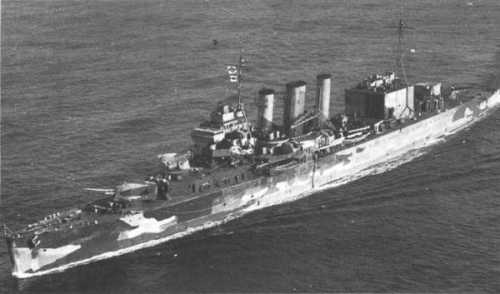
| Navy | The Royal Navy |
| Type | Heavy cruiser |
| Class | Kent |
| Pennant | 55 |
| Built by | Portsmouth Dockyard (Portsmouth, U.K.): Parsons |
| Ordered | 15 May 1924 |
| Laid down | 30 Sep 1924 |
| Launched | 16 Feb 1926 |
| Commissioned | 31 May 1928 |
| End service | |
| History | Sold to be broken up for scrap on 25 March 1948. Arrived at Newport on 24 June 1948 to be broken up by Cashmore. |
Commands listed for HMS Suffolk (55)
Please note that we're still working on this section
and that we only list Commanding Officers for the duration of the Second World War.
| Commander | From | To | |
| 1 | Capt. John Walter Durnford, RN | 24 Jul 1939 | 1 Jun 1940 |
| 2 | Cdr. Arthur David Torlesse, RN | 1 Jun 1940 | 8 Jul 1940 |
| 3 | Cdr. (retired) Denys Charles Gerald Shoppee, DSC, RN | 8 Jul 1940 | 15 Nov 1940 |
| 4 | Capt. Edward Chicheley Thornton, DSC, RN | 15 Nov 1940 | 22 Feb 1941 |
| 5 | Capt. Robert Meyrick Ellis, RN | 22 Feb 1941 | 29 Mar 1942 |
| 6 | Cdr. Ludovic Ernest Porter, RN | 29 Mar 1942 | 16 May 1942 |
| 7 | Lt.Cdr. Arthur Alfred Havers, RN | 16 May 1942 | 4 Jun 1942 |
| 8 | Cdr. Geoffrey Gowlland, RN | 4 Jun 1942 | 23 Jun 1942 |
| 9 | Capt. Richard Shelley, RN | 23 Jun 1942 | 7 Feb 1944 |
| 10 | A/Capt. William Francis Henry Crawford Rutherford, RN | 7 Feb 1944 | 10 Jun 1944 |
| 11 | Capt. David Gilmour, RN | 10 Jun 1944 | 20 Nov 1945 |
You can help improve our commands section
Click here to Submit events/comments/updates for this vessel.
Please use this if you spot mistakes or want to improve this ships page.
Notable events involving Suffolk include:
The page of HMS Suffolk was last updated in January 2022.
28 Sep 1939
HMS Suffolk (Capt. J.W. Durnford, RN) conducted D/F calibration trials off Portsmouth upon completion of her refit which had commenced at the Portsmouth Dockyard in May 1939. (1)
29 Sep 1939
HMS Suffolk (Capt. J.W. Durnford, RN) departed Spithead for Scapa Flow. (1)
1 Oct 1939
HMS Suffolk (Capt. J.W. Durnford, RN) arrived at Scapa Flow. (2)
4 Oct 1939
HMS Suffolk (Capt. J.W. Durnford, RN) conducted exercises at Scapa Flow. (2)
7 Oct 1939
HMS Suffolk (Capt. J.W. Durnford, RN) conducted gunnery exercises off Scapa Flow. (2)
8 Oct 1939
HMS Suffolk (Capt. J.W. Durnford, RN) departed Scapa Flow for Gibraltar. At sea she joined HMS Norfolk (Capt. A.G.B. Wilson, MVO, DSO, RN) which was coming from Rosyth and was also to proceed to Gibraltar. Both cruisers were to join the Mediterranean Fleet. (3)
12 Oct 1939
HMS Norfolk (Capt. A.G.B. Wilson, MVO, DSO, RN) and HMS Suffolk (Capt. J.W. Durnford, RN) arrived at Gibraltar. En-route, on October 11th, they had encountered heavy weather and HMS Norfolk had sustained damage to her aircraft facilities as well as her Walrus aircraft being washed off the catapult and lost. (3)
14 Oct 1939
HMS Norfolk (Capt. A.G.B. Wilson, MVO, DSO, RN) and HMS Suffolk (Capt. J.W. Durnford, RN) departed Gibraltar for Alexandria. (3)
18 Oct 1939
HMS Norfolk (Capt. A.G.B. Wilson, MVO, DSO, RN) and HMS Suffolk (Capt. J.W. Durnford, RN) arrived at Alexandria. (3)
25 Oct 1939
During 25/26 October 1939, HMS Suffolk (Capt. J.W. Durnford, RN), conducted exercises off Alexandria. (2)
31 Oct 1939
HMS Devonshire (Capt. J.M. Mansfield, DSC, RN, flying the flag of Vice-Admiral J.H.D. Cunningham, CB, MVO, RN) and HMS Suffolk (Capt. J.W. Durnford, RN) conducted exercises off Alexandria. (4)
2 Nov 1939
HMS Suffolk (Capt. J.W. Durnford, RN) conducted exercises off Alexandria. (5)
3 Nov 1939
HMS Devonshire (Capt. J.M. Mansfield, DSC, RN, flying the flag of Vice-Admiral J.H.D. Cunningham, CB, MVO, RN) and HMS Suffolk (Capt. J.W. Durnford, RN) departed Alexandria for Gibraltar.
On the 5th they were joined off Malta by HMS Norfolk (Capt. A.G.B. Wilson, MVO, DSO, RN).
HMS Devonshire, HMS Norfolk and HMS Suffolk arrived at Gibraltar on November 7th. (6)
8 Nov 1939
HMS Devonshire (Capt. J.M. Mansfield, DSC, RN, flying the flag of Vice-Admiral J.H.D. Cunningham, CB, MVO, RN), HMS Norfolk (Capt. A.G.B. Wilson, MVO, DSO, RN) and HMS Suffolk (Capt. J.W. Durnford, RN) departed Gibraltar for the U.K. They were escorted by the destroyers HMS Douglas ( Cdr. R.F.B. Swinley, RN) and HMS Keppel (Capt. F.S.W. de Winton, RN) until 0800Z/9.
Around 1015A/11, they were joined by the destroyers HMS Isis (Cdr. J.C. Clouston, RN), HMS Ilex (Lt.Cdr. P.L. Saumarez, RN), HMS Escapade (Cdr. H.R. Graham, RN) and HMS Encounter (Lt.Cdr. E.V.St.J. Morgan, RN).
At 1720A/11, the destroyers HMS Intrepid (Cdr. J.W. Josselyn, RN) and HMS Ivanhoe (Cdr. B. Jones, RN) also joined.
Around 1810A/11, HMS Devonshire, HMS Norfolk, HMS Ilex, HMS Isis, HMS Escapade and HMS Encounter parted company with HMS Suffolk, HMS Ivanhoe and HMS Intrepid. These last three ships proceeded towards Portsmouth where HMS Suffolk arrived around 1400A/12. HMS Ivanhoe and HMS Intrepid continued on to Sheerness where they arrived around 2215A/12.
Meanwhile the other ships had arrived at Plymouth around 2015A/11. (7)
18 Nov 1939
After some defects being made good at the Portsmouth Dockyard, HMS Suffolk (Capt. J.W. Durnford, RN), departed Portsmouth for the Clyde. (5)
19 Nov 1939
HMS Suffolk (Capt. J.W. Durnford, RN) departed arrived in the Clyde. After fuelling she departed for the Northern Patrol. She was to patrol in the Denmark Strait. (5)
23 Nov 1939
Sinking of the armed merchant cruiser HMS Rawalpindi
Around midday on 21 November 1939 the German battlecruisers Scharnhorst and Gneisenau, escorted by the light cruisers Köln and Leipzig and the destroyers Z 11 / Bernd von Arnim, Z 12 / Erich Giese and Z 20 / Karl Galster, departed Wilhelmshaven for a raid into the North Atlantic, this was to relieve the pressure of the pocket battleship Admiral Graf Spee operating in the South Atlantic. Late on the 21st the escorts left the battlecruisers.
Just after 1500A/23 the British armed merchant cruiser HMS Rawalpindi (Capt.(Retd.) E.C. Kennedy, RN) sighted the Scharnhorst. Rawalpindi was part of the British Northern Patrol and was stationed south-east of Iceland in the Iceland-Faroe gap. Captain Kennedy at first tried to get away from the German ship and report to the Admiralty that he sighted the German pocket battleship Deutschland, still believed to be operating in the North Atlantic, and so as to buy time so that other ships of the Northern patrol could come to his assistance. Just after 1600 hours, Rawalpindi came within range of the Scharnhorst and was quickly reduced to a flaming wreck. During this engagement Scharnhorst was hit by a 6in shell from Rawalpindi causing only light damage. Scharnhorst and Gneisenau together picked up 27 survivors from the Rawalpindi which finally sank around 2000 hours.
The British light cruiser HMS Newcastle (Capt J. Figgins, RN), that was also part of the Northern Patrol, picked up Rawalpindi's signal and closed the scene. She sighted the Gneisenau but the Germans managed to escape in the fog.
The Admiralty also thought the ship sighted by Rawalpindi and Newcastle was the Deutschland that was trying to return to Germany. In response to the sighting and destruction of the Rawalpindi the Admiralty took immediate action; The battleships HMS Nelson (Capt. G.J.A. Miles, RN, flying the flag of Admiral J.M. Forbes, KCB, DSO, RN) HMS Rodney (Capt. F.H.G. Dalrymple-Hamilton, RN) and the heavy cruiser HMS Devonshire (Capt. J.M. Mansfield, DSC, RN, flying the flag of Vice-Admiral J.H.D. Cunningham, CB, MVO, RN) escorted by the destroyers HMS Faulknor (Capt. C.S. Daniel, RN), HMS Fame (Cdr. P.N. Walter, RN), HMS Firedrake (Lt.Cdr. S.H. Norris, RN), HMS Foresight (Lt.Cdr. G.T. Lambert, RN), HMS Forester (Lt.Cdr. E.B. Tancock, RN), HMS Fortune (Cdr. E.A. Gibbs, RN) and HMS Fury (Cdr. G.F. Burghard, RN) departed the Clyde around 1930A/23 to patrol of Norway to cut off the way to Germany for the Deutschland.
The light cruisers HMS Southampton (Capt. F.W.H. Jeans, CVO, RN, flying the flag of Vice-Admiral G.F.B. Edward-Collins, CB, KCVO, RN), HMS Edinburgh (Capt. F.C. Bradley, RN) and HMS Aurora (Capt. G.B. Middleton, RN) escorted by the destroyers HMS Afridi (Capt. G.H. Creswell, DSC, RN), HMS Gurkha (Cdr. F.R. Parham, RN), HMS Bedouin (Cdr. J.A. McCoy, RN), HMS Kingston (Lt.Cdr. P. Somerville, RN) and HMS Isis (Cdr. J.C. Clouston, RN) departed Rosyth to patrol between the Orkney and Shetland islands.
Light cruiser HMS Sheffield (Capt. E. de F. Renouf, CVO, RN) was sent from Loch Ewe to the last known position of the German ship(s).
On northern patrol, south of the Faroes were the light cruisers HMS Caledon (Capt. C.P. Clark, RN), HMS Cardiff (Capt. P.K. Enright, RN) and HMS Colombo (Commodore R.J.R. Scott, RN). These were joined by HMS Dunedin (Capt. C.E. Lambe, CVO, RN) and HMS Diomede (Commodore E.B.C. Dicken, OBE, DSC, RN).
Of the ships of the Denmark strait patrol, the heavy cruisers HMS Suffolk (Capt. J.W. Durnford, RN) and HMS Norfolk (Capt. A.G.B. Wilson, MVO, DSO, RN) were ordered to proceed to the Bill Bailey Bank (to the south-west of the Faroe Islands).
The light cruiser HMS Glasgow (Capt. F.H. Pegram, RN) escorted by the destroyers HMS Maori (Cdr. G.N. Brewer, RN) and HMS Zulu (Cdr. J.S. Crawford, RN) were already at sea patrolling north-east of the Shetlands were to be joined by the destroyers HMS Inglefield (Capt. P. Todd, RN), HMS Imperial (Lt.Cdr. C.A.de W. Kitcat, RN), HMS Impulsive (Lt.Cdr. W.S. Thomas, RN) and HMS Imogen (Cdr. E.B.K. Stevens, RN).
The light cruisers HMS Calypso (Capt. N.J.W. William-Powlett, DSC, RN) and HMS Ceres (Capt. E.G. Abbott, AM, RN) were stationed off Kelso Light to act as a night attack striking force. The destroyers HMS Somali (Capt. R.S.G. Nicholson, DSC, RN), HMS Ashanti (Cdr. W.G. Davis, RN), HMS Mashona (Cdr. P.V. McLaughlin, RN) and HMS Punjabi (Cdr. J.T. Lean, RN) had just departed Belfast on escort duties. They were ordered to join Admiral Forbes. The ships they were escorting were ordered to return to Belfast.
The destroyers HMS Tartar (Lt.Cdr. D.E. Holland-Martin, RN), HMS Kandahar (Cdr. W.G.A. Robson, RN) and HMS Kashmir (Cdr. H.A. King, RN) departed Scapa Flow with orders to locate and shadow the German ships. HMS Tartar however had to return to Scapa Flow the next day due to a damaged rudder. The other two destroyers were ordered to join HMS Aurora which was to form a strike group of destroyers.
Despite the British effort to intercept the German ships, both German battlecruisers returned to Wilhelmshaven on the 27th.
29 Nov 1939
Around 0800Z/29, HMS Suffolk (Capt. J.W. Durnford, RN), arrived at Scapa Flow from patrol.
Having fuelled, she departed again around 1600Z/29, for convoy cover operations.
[For more information on the convoy she provided cover for see the event ' Convoy HN 3 ' for 30 November 1939.] (8)
30 Nov 1939
Convoy HN 3
This convoy was assembled in Norwegian waters near Bergen on 30 November 1939 and arrived at Methil on 3 December 1939.
The convoy was made up of the following merchant vessels; Albionic (British, 2468 GRT, built 1924), Amicus (British, 3660 GRT, built 1925), Asiatic (British, 3741 GRT, built 1923), Baltrover (British, 4916 GRT, built 1913), Bore III (Finnish, 1153 GRT, built 1915), Clarissa Radcliffe (British, 5754 GRT, built 1915), Eskdene (British, 3829 GRT, built 1934), Folda (British, 1165 GRT, built 1920), Glen Tilt (British, 871 GRT, built 1920), Kalev (Estonian, 1867 GRT, built 1917), King Edwin (British, 4536 GRT, built 1927), Majorca (British, 1126 GRT, built 1921), Mall (Estonian, 1863 GRT, built 1918), Ogmore Castle (British, 2481 GRT, built 1919), Sea Valour (British, 1950 GRT, built 1930), Stancourt (British, 965 GRT, built 1909), Thistleford (British, 4781 GRT, built 1928) and Treworlas (British, 4692 GRT, built 1922).
Escort (distant cover) was provided by the heavy cruiser HMS Suffolk (Capt. J.W. Durnford, RN) and the light cruiser HMS Southampton (Capt. F.W.H. Jeans, CVO, RN, flying the flag of Vice-Admiral G.F.B. Edward-Collins, CB, KCVO, RN). HMS Suffolk was relieved by the light cruiser HMS Glasgow (Capt. F.H. Pegram, RN) on 2 December.
Close escort (A/S) was provided by the destroyers HMS Ilex (Lt.Cdr. P.L. Saumarez, RN), HMS Icarus (Lt.Cdr. C.D. Maud, RN), HMS Eskimo (Cdr. St.J.A. Micklethwait, RN) and HMS Matabele (Cdr. G.K. Whitmy-Smith, RN).
Four of the merchant ships split off on 2 December for the west coast of the U.K. The destroyers HMS Isis (Cdr. J.C. Clouston, RN) and HMS Kandahar (Cdr. W.G.A. Robson, RN) came from Scapa Flow to escort these ships.
2 Dec 1939
Around 1430Z/2, HMS Suffolk (Capt. J.W. Durnford, RN), returned to Scapa Flow from operations. (9)
3 Dec 1939
Around 1430Z/3, HMS Suffolk (Capt. J.W. Durnford, RN), departed Scapa Flow for the Northern Patrol. She is ordered to patrol in the Denmark Strait. (9)
9 Dec 1939
The heavy cruisers HMS Berwick (Capt. I.M. Palmer, DSC, RN) and HMS Suffolk (Capt. J.W. Durnford, RN), both on patrol in the Denmark Strait were ordered to proceed to patrol to the south-east of Iceland. (10)
14 Dec 1939
Around 1900Z/14, HMS Suffolk (Capt. J.W. Durnford, RN), arrived at Greenock from the Northern Patrol. (9)
20 Dec 1939
Around 1200Z/20, HMS Suffolk (Capt. J.W. Durnford, RN), departed Greenock for the Northern Patrol. She is ordered to patrol south-west of Iceland. (9)
3 Jan 1940
Around 1630Z/3, HMS Suffolk (Capt. J.W. Durnford, RN), arrived at Greenock from the Northern Patrol. (11)
11 Jan 1940
Around 1300Z/11, HMS Suffolk (Capt. J.W. Durnford, RN), departed Greenock for the Northern Patrol. She is ordered to patrol south-west of Iceland but later went on to the Denmark Strait. (11)
25 Jan 1940
Around 1000Z/25, HMS Suffolk (Capt. J.W. Durnford, RN), arrived at Greenock from the Northern Patrol having been relieved by HMS Berwick (Capt. I.M. Palmer, DSC, RN). (11)
29 Jan 1940
Around 1500Z/29, HMS Suffolk (Capt. J.W. Durnford, RN), departed Greenock for the Northern Patrol to relieve HMS Berwick (Capt. I.M. Palmer, DSC, RN). HMS Suffolk is to patrol in the Iceland - Faeroer gap. (11)
10 Feb 1940
At 2018Z/10, HMS Suffolk (Capt. J.W. Durnford, RN), is in a collision off Little Cumbrae Island, Clyde, with the merchant vessel Masirah (British, 6578 GRT, built 1919). HMS Suffulk is damaged abreast 'B' turret and eight of her crew are killed and eight injured, three of which seriously.
HMS Suffolk anchored off Greenock around 2330Z/10. (12)
12 Feb 1940
After de-ammunitioning, HMS Suffolk (Capt. J.W. Durnford, RN) is taken to the Fairfields Shipyard at Govan to be taken in hand for repairs. She is immediately docked in No.3 Dock. (13)
15 Feb 1940
HMS Suffolk (Capt. J.W. Durnford, RN) is undocked. (13)
24 Feb 1940
HMS Suffolk (Capt. J.W. Durnford, RN) is docked again at Govan. (13)
27 Mar 1940
HMS Suffolk (Capt. J.W. Durnford, RN) is undocked. She is then towed to Shieldhall. (14)
7 Apr 1940
HMS Suffolk (Capt. J.W. Durnford, RN) proceeded from Shieldhall to Yorkhill Wharf. (15)
11 Apr 1940
With her repairs (an short refit) completed, HMS Suffolk (Capt. J.W. Durnford, RN), proceeded from Yorkhill Wharf to Greenock. (15)
12 Apr 1940
Around 1840A/12, HMS Suffolk (Capt. J.W. Durnford, RN), departed Greenock with about 250 Marines on board which were to be taken to the Faeroer Islands.
The destroyers HMS Havant (Lt.Cdr. A.F. Burnell-Nugent, RN) and HMS Hesperus (Lt.Cdr. D.G.F.W. MacIntyre, RN) had arrived at Thorshavn on this day to inform the Governor of the Faroes Islands that a garrison of Royal Marines would be garrisoned there to repel a possible German invasion. The destroyers then went out to sea to await the arrival of HMS Suffolk. They made rendezvous at 1450A/13 and arrived at Thorshavn around 1630A/13.
The armed boarding vessels HMS Northern Foam (Lt.Cdr. G.W. Houchen, RNR) and HMS Northern Sky (Lt. J.E. Bromley, RNR) which were already waiting there then went alongside HMS Suffolk to take over the Marines.
The operation was completed late in the evening of the 13th when HMS Suffolk departed for the Vestfjord area near Narvik, Norway. HMS Havant and HMS Hesperus departed for Scapa Flow arriving there around 1030A/14. HMS Northern Sky resumed duties with the Northern Patrol. HMS Northern Foam remained at Thorshavn for the moment. (16)
14 Apr 1940
At 0858A/14, HMS Suffolk (Capt. J.W. Durnford, RN), which was en-route to the Lofoten area, sighted a merchant vessel on the starboard bow which was identified at 0915A/14 as the German tanker Skagerak (6044 GRT, built 1928).
The tanker was engaged and the crew abandoned ship and scuttled her. The tanker finally sank at 1133A/14 in position 64°36'N, 02°38'E.
HMS Suffolk picked up the crew and continued to proceed to the North-East until 2115A/14 when course was chanched to return to Scapa Flow.
15 Apr 1940
Around 1800A/15, HMS Suffolk (Capt. J.W. Durnford, RN) arrived at Scapa Flow from operations. (15)
16 Apr 1940
Operation Duck.
Bombardment of the Sola airfield off Stavanger.
Timespan: 16 to 18 April 1940.
The heavy cruiser HMS Suffolk (Capt. J.W. Durnford, RN) and the destroyers HMS Hereward (Lt.Cdr. C.W. Greening, RN), HMS Janus (Cdr. J.A.W. Tothill, RN), HMS Juno (Cdr. W.E. Wilson, RN) and HMS Kipling (Cdr. A. St. Clair-Ford, RN) departed Scapa Flow around 1700A/16 for this operation.
Early on the 17th this force contacted the submarine HMS Seal (Lt.Cdr. R.P. Lonsdale, RN) which was to act as a beacon to home in the ships.
Between 0513A/17 and 0602A/17, HMS Suffolk bombarded the airfield. Following this she and the destroyers were ordered to proceeded northwards to intercept a reported group of enemy destroyers, the result was that their air cover that was provided during their retirement did not sight the ships which then came under heavy air attack from the German Luftwaffe for about seven hours from 0825A/17 onwards.
The result was that HMS Suffolk was heavily damaged. She suffered 32 dead and 41 wounded. HMS Kipling was also damaged by two near misses.
Air cover finally arrived at 1415A/17 but even then the Germans continued to attack.
The battlecruisers HMS Renown (Capt. C.E.B. Simeon, RN, flying the flag of Vice-Admiral W.J. Whitworth, CB, DSO, RN), HMS Repulse (Capt. E.J. Spooner, DSO, RN), the AA cruiser HMS Cairo (Capt. P.V. McLaughlin, RN) and the destroyers HMS Eclipse (Lt.Cdr. I.T. Clark, RN), HMS Forester (Lt.Cdr. E.B. Tancock, RN), HMS Fury (Cdr. E.W.B. Sim, RN), HMS Tartar (Cdr. L.P. Skipwith, RN), HMS Javelin (Cdr. A.F. Pugsley, RN), HMS Kimberley (Lt.Cdr. J.S.M. Richardson, RN), ORP Blyscawica (Lt.Cdr. S.M. Nahorski, ORP) and ORP Grom (Lt.Cdr. S. Hryniewiecki) rushed towards to give support. The destroyer HMS Hyperion (Cdr. H.St.L. Nicholson, RN) joined later.
HMS Suffolk limped towards Scapa Flow where she arrived with a heavy list at 0545A/18. She arrived at Scapa Flow escorted by HMS Renown, HMS Forester, HMS Fury, HMS Hereward, HMS Hyperion, HMS Janus, HMS Juno, HMS Kimberley and HMS Kipling (also damaged). Upon arrival HMS Suffolk was beached to prevent her from sinking.
5 May 1940
Around 1800A/5 the French armed merchant cruisers El D’Jezair, El Kantara, El Mansour, the French troopships Djenne, President Doumer, the British troopships Duchess of Atholl and Reina del Pacifico departed Scapa Flow for the Clyde. They made the passage together with the damaged British heavy cruiser HMS Suffolk (Capt. J.W. Durnford, RN). They were escorted by the British destroyers HMS Kelly (Capt. L.F.A.V.N. Mountbatten, GCVO, RN), HMS Grenade (Cdr. R.C. Boyle, RN) and HMS Griffin (Lt.Cdr. J. Lee-Barber, RN), HMS Imperial (Lt.Cdr. C.A.de W. Kitcat, RN), the French large destroyers Chevalier Paul (Cdr. M. L. Bonnot), Tartu (Capt. J.M. Chomel) and Milan (Cdr. L.M.E. Plumejeaud).
They arrived in the Clyde the next day.
24 May 1940
HMS Suffolk (Capt. J.W. Durnford, RN) proceeded from Greenock to Govan where she is taken in hand for repairs at the Fairfield Shipyard. She is docked in No.3 Dock. (17)
9 Jun 1940
HMS Suffolk (Capt. J.W. Durnford, RN) is undocked. (18)
25 Jun 1940
HMS Suffolk (Capt. J.W. Durnford, RN) is towed from Govan to Shieldhall (King George V Dock). (18)
29 Jun 1940
HMS Suffolk (Capt. J.W. Durnford, RN) is towed from the King George V Dock to the riverside wharf at Shieldhall. (18)
2 Jul 1940
HMS Suffolk (Capt. J.W. Durnford, RN) is towed from the riverside wharf at Shieldhall to the King George V dock. (18)
13 Oct 1940
HMS Suffolk (Cdr.(Retd.) D.C.G. Shoppee, DSC, RN) is towed the King George V dock to Fairfields Basin at Govan. (19)
28 Dec 1940
HMS Suffolk (Capt. E.C. Thornton, DSC, RN) is towed from the Fairfield Basin to the Yorkhill Basin. (20)
31 Dec 1940
HMS Suffolk (Capt. E.C. Thornton, DSC, RN) is towed from the Yorkhill Basin to Stob Cross Quay. (20)
12 Jan 1941
HMS Suffolk (Capt. E.C. Thornton, DSC, RN) is towed from Stob Cross Quay to No.3 Dock at the Fairfields Shipyard. The dock is then pumped dry. (21)
22 Jan 1941
HMS Suffolk (Capt. E.C. Thornton, DSC, RN) is undocked from No.3 Dock at the Fairfields Shipyard. She is moved to the Fairfields Basin. During the tow one propeller is damaged for which she later was docked again (5 February). (22)
5 Feb 1941
HMS Suffolk (Capt. E.C. Thornton, DSC, RN) is docked in No.3 Dock at Fairfield Shipyard. (23)
9 Feb 1941
HMS Suffolk (Capt. E.C. Thornton, DSC, RN) is undocked. (23)
10 Feb 1941
HMS Suffolk (Capt. E.C. Thornton, DSC, RN) is towed from the Fairfield Shipyard to the King George V dock at Shieldhall. (23)
14 Feb 1941
HMS Suffolk (Capt. E.C. Thornton, DSC, RN) proceeded from the King George V Dock to Greenock. (23)
15 Feb 1941
HMS Suffolk (Capt. E.C. Thornton, DSC, RN) conducted D/G trials off Greenock. (23)
26 Feb 1941
HMS Suffolk (Capt. R.M. Ellis, RN) conducted exercises in the Clyde area. (23)
18 Mar 1941
HMS Suffolk (Capt. R.M. Ellis, RN) conducted exercises in the Clyde area. (24)
19 Mar 1941
HMS Suffolk (Capt. R.M. Ellis, RN) departed Greenock for Scapa Flow. (24)
20 Mar 1941
HMS Suffolk (Capt. R.M. Ellis, RN) arrived at Scapa Flow to commence a work-up period. (24)
26 Mar 1941
HMS Suffolk (Capt. R.M. Ellis, RN) conducted full power trials off Scapa Flow. (24)
28 Mar 1941
HMS London (Capt. R.M. Servaes, CBE, RN) and HMS Suffolk (Capt. R.M. Ellis, RN) conducted exercises off Scapa Flow. (25)
31 Mar 1941
HMS Suffolk (Capt. R.M. Ellis, RN) conducted gunnery exercises at Scapa Flow. (24)
1 Apr 1941
HMS Suffolk (Capt. R.M. Ellis, RN) conducted gunnery exercises off Scapa Flow. HMS London (Capt. R.M. Servaes, CBE, RN) then joined for a range and inclination exercise. (26)
3 Apr 1941
HMS Suffolk (Capt. R.M. Ellis, RN) and HMS Exeter (Capt. O.L. Gordon, MVO, RN)conducted exercises at Scapa Flow. These included night exercises with HMAS Nestor (Cdr. G.S. Stewart, RAN) and HMS Liddesdale (Cdr. A.G. West, RN) (27)
4 Apr 1941
HMS Suffolk (Capt. R.M. Ellis, RN) conducted gunnery exercises off Scapa Flow. (28)
5 Apr 1941
Minelaying operation SN 8.
Minelaying operation by the 1st Minelaying Squadron.
At 0630A/5, the 1st Minelaying Squadron departed Port Z.A. (Loch Alsh) for minelaying operation SN 8. The 1st Minelaying Squadron was made up of the auxiliary minelayers Southern Prince (Cdr. C.L. Firth, RN, flying the flag of Rear-Admiral R.L. Burnett, OBE, RN), HMS Agamemnon (Capt.(Retd.) F. Ratsey, RN), HMS Menestheus (Capt. J.S. Crawford, DSO, RN), and HMS Port Quebec (Capt.(Retd.) E.C. Watson, RN). They were escorted by the destroyers HMS Cossack (Capt. P.L. Vian, DSO and Bar, RN), HMS Anthony (Lt.Cdr. J.M. Hodges, RN), HMS Lancaster (A/Cdr. N.H. Whatley, RN) and HMS St. Marys (Lt. K.H.J.L. Phibbs, RN).
Around 0720A/5, the light cruisers HMS Galatea (Capt. E.W.B. Sim, RN, flying the flag of Rear-Admiral A.T.B. Curteis, CB, RN) and HMS Aurora (Capt. W.G. Agnew, RN) departed Scapa Flow to join the 1st Minelaying Squadron for close cover. They made rendezvous with the 1st Minelaying Squadron around 1230A/5.
Distant cover was provided by the heavy cruisers HMS Norfolk (Capt. A.J.L. Phillips, RN, flying the flag of Rear-Admiral W.F. Wake-Walker CB, OBE, RN) and HMS Suffolk (Capt. R.M. Ellis, RN). HMS Norfolk had been on the Denmark Strait patrol since 29 March. HMS Suffolk departed Scapa Flow around 1000A/5. HMS Norfolk arrived at Hvalfjord around 0630A/8. HMS Suffolk returned to Scapa Flow around 0820A/8.
Minefield SN 8, made up of 1969 mines, was laid between 1445A/6 and 1815A/6. It was laid along a line between positions 62°38'0"N, 10°08'0"W and 63°15'0"N, 11°29'0"W.
The minelayers laid as follows; HMS Southern Prince 562 mines, HMS Agamemnon 450 mines, HMS Menestheus 410 mines and HMS Port Quebec 547 mines. HMS Agamemnon was not able to lay a full outfit of mines due to damage she had sustained during a collision in an earlier minelaying mission.
HMS Galatea and HMS Aurora parted company with the 1st Minelaying Squadron around 0001A/8. They arrived at Scapa Flow around 0640A/8.
The 1st Minelaying Squadron and their escorting destroyers returned to Port Z.A. (Loch Alsh) in the morning of the 8th. (29)
10 Apr 1941
HMS Suffolk (Capt. R.M. Ellis, RN) conducted gunnery exercises at Scapa Flow. (28)
12 Apr 1941
HMS Suffolk (Capt. R.M. Ellis, RN) conducted gunnery exercises at Scapa Flow. (28)
14 Apr 1941
HMS Suffolk (Capt. R.M. Ellis, RN) and HMS Exeter (Capt. O.L. Gordon, MVO, RN) conducted exercises off Scapa Flow.
HMS Suffolk had made several runs over the D/G range before the exercises. (30)
15 Apr 1941
HMS Suffolk (Capt. R.M. Ellis, RN) and HMS Exeter (Capt. O.L. Gordon, MVO, RN) conducted exercises off Scapa Flow. (30)
17 Apr 1941
HMS Suffolk (Capt. R.M. Ellis, RN) conducted HA gunnery exercises off Scapa Flow.
These were followed in the evening by night encounter exercises with HMS Brocklesby (Lt.Cdr. G.P. Huddart, RN). (28)
19 Apr 1941
Intelligence reported the German battleship Bismarck proceeding to sea, British movements to intercept.
In the early morning hours of 19 April 1941 the Admiralty received reports that the German battleship Bismarck was reported to have passed the Skaw together with two cruisers and three destroyers.
The battlecruiser HMS Hood (Capt. R. Kerr, CBE, RN, flying the flag of Vice-Admiral W.J. Whitworth, CB, DSO, RN) with the light cruiser HMS Kenya (Capt. M.M. Denny, CB, RN) and the destroyers HMS Cossack (Capt. P.L. Vian, DSO and Bar, RN), HMS Maori (Cdr. H.T. Armstrong, RN) and HMS Zulu (Cdr. H.R. Graham, DSO, RN) were already at sea (departed Scapa Flow around 1700/18) proceeding southwards to relieve HMS King George V (Capt. W.R. Patterson, CVO, RN, flying the flag of A/Adm. J.C. Tovey, KCB, DSO, RN) and HMS Nigeria (Capt. J.G.L. Dundas, RN) on the Bay of Biscay patrol. They were now ordered to proceed northwards to provide cover for the cruiser patrol in the Island-Faroes passage. HMS King George V and HMS Nigeria initially turned north but soon returned to their patrol area off the Bay of Biscay. Their escorting destroyers, HMS Mashona (Cdr. W.H. Selby, RN), HMS Electra (Cdr. C.W. May, RN), HMS Escapade (Lt.Cdr. E.N.V. Currey, DSC, RN) had been detached to fuel at Londonderry on the morning of the 15th. They returned from fuelling on the morning of the 20th.
For these cruiser patrols the following ships were sailed. From Iceland (Hvalfjord); heavy cruiser HMS Norfolk (Capt. A.J.L. Phillips, RN, flying the flag of Rear-Admiral W.F. Wake-Walker CB, OBE, RN), light cruisers HMS Galatea (Capt. E.W.B. Sim, RN, flying the flag of Rear-Admiral A.T.B. Curteis, CB, RN) and HMS Arethusa (Capt. Q.D. Graham, RN). From Scapa Flow; heavy cruisers HMS Suffolk (Capt. R.M. Ellis, RN), HMS Exeter (Capt. O.L. Gordon, MVO, RN), light cruiser HMS Edinburgh (Capt. C.M. Blackman, DSO, RN, flying the flag of Vice Admiral L.E. Holland, CB, RN), destroyers HMS Inglefield (Capt. P. Todd, DSO, RN), HMS Tartar (Cdr. L.P. Skipwith, RN), HMS Echo (Lt.Cdr. C.H.deB. Newby, RN), HMS Achates (Lt.Cdr. Viscount Jocelyn, RN) and HMS Anthony (Lt.Cdr. J.M. Hodges, RN).
HMS Inglefield joined the force of HMS Hood around 1045/20.
Shortly before midnight the battleship HMS Rodney (Capt. F.H.G. Dalrymple-Hamilton, RN) sailed from the Clyde escorted by ORP Piorun (Cdr. E.J.S. Plawski), ORP Garland (Lt.Cdr. K.F. Namiesniowski) and HMS Saladin (Lt.Cdr. L.J. Dover, RN). In the early hours of the 20th HMS Rodney collided with the auxiliary A/S trawler HMS Topaze (Ch.Skr. G.R. Gale, RNR) which sank with its entire crew as a result.
The reported German movements turned out to be false and most of the British forces were back in port by the early morning of 23 April 1941 at latest.
HMS Hood and her four escorting destroyers had arrived at Hvalfiord, Iceland in the morning on 21 April. HMS Kenya had been ordered to join the Iceland - Faroer Islands patrol as was HMS Edinburgh. (31)
21 Apr 1941
Around 2015A/21, HMS Suffolk (Capt. R.M. Ellis, RN), returned to Scapa Flow. (28)
24 Apr 1941
HMS Prince of Wales (Capt. J.C. Leach, MVO, RN) conducted RD/F trials off Scapa Flow. She was escorted by the destroyers HMS Somali (Capt. C. Caslon, RN), HMS Tartar (Cdr. L.P. Skipwith, RN) and HMS Bedouin (Cdr. J.A. McCoy, DSO, RN).
During the evening night exercises were carried out together with HMS Suffolk (Capt. R.M. Ellis, RN) and HMS Exeter (Capt. O.L. Gordon, MVO, RN). These cruisers had alreadt been exercising together since the afternoon. (32)
25 Apr 1941
During the night of 25/26 April 1941, HMS Suffolk (Capt. R.M. Ellis, RN) conducted gunnery exercises off Scapa Flow. (28)
26 Apr 1941
Around 1640A/26, heavy cruiser HMS Suffolk (Capt. R.M. Ellis, RN) and the destroyers HMS Active (Lt.Cdr. M.W. Tomkinson, RN) and HMS Echo (Lt.Cdr. C.H.deB. Newby, RN) departed Scapa Flow for Hvalfjord, Iceland where they arrived around 0830Z/28. (28)
28 Apr 1941
HMS Suffolk (Capt. R.M. Ellis, RN) departed Hvalfjord for the Denmark Strait patrol. (33)
5 May 1941
Around 1330Z/28, HMS Suffolk (Capt. R.M. Ellis, RN) arrived at Reykjavik from patrol. She proceeded to Hvalfjord in the evening. (34)
11 May 1941
HMS Suffolk (Capt. R.M. Ellis, RN) departed Hvalfjord tp patrol in the Denmark Strait, taking over from HMS Exeter (Capt. O.L. Gordon, MVO, RN). (34)
18 May 1941
Chase and sinking of the German battleship Bismarck, 18 to 27 May 1941.
Part I.
Departure of the Bismarck from the Baltic.
At 2130B/18 the German battleship Bismarck and the German heavy cruiser Prinz Eugen departed Gotenhafen for an anti-shipping raid in the North Atlantic. The following morning they were joined off Cape Arkona by the German destroyers Z 16 / Friedrich Eckhold and Z 23. They then proceeded through the Great Belt. The four ships were joined by a third destroyer, Z 10 / Hans Lody shortly before midnight on 19 May.
First reports of Bismarck and British dispositions 20-21 May 1941.
On 20 May 1941 two large warships with a strong escort were seen at 1500 hours northward out of the Kattegat. This information originated from the Swedish cruiser Gotland which had passed the Germans off the Swedish coast in the morning. The Naval Attaché at Stockholm received the news at 2100/20 and forwarded it to the Admiralty. At 0900/21 the Bismarck and her consorts entered Kors Fjord, near Bergen, Norway and anchored in nearby fiords. A reconnaissance aircraft flying over Bergen at 1330/21 reported having seen two Hipper class heavy cruisers there. One of these ships was later identified on a photograph as being the Bismarck. This intelligence went out at once to the Home Fleet.
The ships of the Home Fleet were at this time widely dispersed on convoy duties, patrols, etc. Some of the units were ranging as far as Gibraltar and Freetown. The Commander-in-Chief, A/Admiral Sir John Tovey, was at Scapa Flow in his flagship, HMS King George V (Capt. W.R. Patterson, CVO, RN). With him were her newly commissioned sister ship HMS Prince of Wales (Capt. J.C. Leach, MVO, RN), the battlecruiser HMS Hood (Capt. R. Kerr, CBE, RN, with Vice-Admiral L.E. Holland, CB, RN, onboard), the aircraft carrier HMS Victorious (Capt. H.C. Bovell, RN), the light cruisers HMS Galatea (Capt. E.W.B. Sim, RN, flying the flag of Rear-Admiral K.T.B. Curteis, CB, RN), HMS Aurora (Capt. W.G. Agnew, RN), HMS Kenya (Capt. M.M. Denny, CB, RN), HMS Neptune (Capt. R.C. O'Conor, RN) and the destroyers HMS Achates (Lt.Cdr. Viscount Jocelyn, RN), HMS Active (Lt.Cdr. M.W. Tomkinson, RN), HMS Antelope (Lt.Cdr. R.B.N. Hicks, DSO, RN), HMS Anthony (Lt.Cdr. J.M. Hodges, RN), HMS Echo (Lt.Cdr. C.H.deB. Newby, RN), HMS Electra (Cdr. C.W. May, RN), HMS Icarus (Lt.Cdr. C.D. Maud, DSO, RN), HMS Punjabi (Cdr. S.A. Buss, MVO, RN) and HMAS Nestor (Cdr. A.S. Rosenthal, RAN). HMS Victorious was under orders to escort troop convoy WS 8B from the Clyde to the Middle East. HMS Neptune was working up for service with the Mediterranean Fleet and was to escort convoy WS 8X from the Clyde to the Middle East on completion. She did not sail to operate against the Bismarck having only just began her post-refit work-up programme.
Rear-Admiral W.F. Wake-Walker (commanding the first Cruiser Squadron), with the heavy cruisers HMS Norfolk (Capt. A.J.L. Phillips, RN) (flag) and HMS Suffolk (Capt. R.M. Ellis, RN) was on patrol in the Denmark Straight. The light cruisers HMS Manchester (Capt. H.A. Packer, RN) and HMS Birmingham (Capt. A.C.G. Madden, RN) were patrolling between Iceland and the Faeroes. The battlecruiser HMS Repulse (Capt. W.G. Tennant, CB, MVO, RN) was at the Clyde to escort troop convoy WS 8B.
Action taken by the Commander-in-Chief, Home Fleet
Admiral Tovey took the following action when he received the news the Bismarck had been spotted at Bergen. Vice-Admiral Holland with the Hood, Prince of Wales, Achates, Antelope, Anthony, Echo, Electra and Icarus was ordered to cover Rear Admiral Wake-Walker's cruisers in the Denmark Straight. His force departed Scapa Flow around 0100/22.
HMS Arethusa (Capt. A.C. Chapman, RN), which was taking the Vice-Admiral, Orkneys and Shetlands, to Reykjavik on a visit of inspection, was ordered to remain at Hvalfiord and placed at Rear-Admiral Wake-Walkers disposal. HMS Manchester and HMS Birmingham were ordered to top off with fuel at Skaalefiord and them to resume their patrol. The other ships that remained at Scapa Flow were brought to short notice for steam.
The Free French submarine FFS Minerve (Lt. P.M. Sonneville), which was on patrol off south-west Norway was ordered to proceed to position 61°53'N, 03°15'E and HMS P 31 (Lt. J.B.de B. Kershaw, RN) was ordered to proceed to position 62°08'N, 05°08'E which is to the west of Stadtlandet.
The sailing of HMS Repulse and HMS Victorious with troop convoy WS 8B was cancelled and the ships were placed at the disposal of Admiral Tovey.
A reconnaissance aircraft flying over Bergen reported that the German ships were gone. This information reached Admiral Tovey at 2000/22. HMS Suffolk which had been fuelling at Hvalfiord was ordered to rejoin HMS Norfolk in the Denmark Strait. HMS Arethusa was ordered to join HMS Manchester and HMS Birmingham to form a patrol line between Iceland and the Faeroes. Vice-Admiral Holland, on his way to Iceland was told to cover the patrols in Denmark Strait north of 62°N. Admiral Tovey would cover the patrols south of 62°N.
Commander-in-Chief leaves Scapa Flow on 22 May 1941
The King George V, with Admiral Tovey on board, departed Scapa Flow at 2245/22. With the King George V sailed, HMS Victorious, HMS Galatea, HMS Aurora, HMS Kenya, HMS Hermione (Capt. G.N. Oliver, RN), HMS Windsor (Lt.Cdr. J.M.G. Waldegrave, DSC, RN), HMS Active, HMS Inglefield (Capt. P. Todd, DSO, RN), HMS Intrepid (Cdr. R.C. Gordon, DSO, RN), HMS Punjabi, HMS Lance (Lt.Cdr. R.W.F. Northcott, RN) and HMAS Nestor. HMS Lance however had to return to Scapa Flow due to defects.
At A.M. 23 May they were joined off the Butt of Lewis by HMS Repulse escorted by HMS Legion (Cdr. R.F. Jessel, RN), HMCS Assiniboine (A/Lt.Cdr. J.H. Stubbs, RCN) and HMCS Saguenay (Lt. P.E. Haddon, RCN) coming from the Clyde area which they departed on 22 May.
The Commander-in-Chief was 230 miles north-west of the Butt of Lewis in approximate position 60°20'N, 12°30'W when at 2032/23 a signal came in from HMS Norfolk that she had sighted the Bismarck in the Denmark Strait.
HMS Suffolk and HMS Norfolk made contact with the Bismarck in the Denmark Strait on 23 May 1941.
At 1922/23 HMS Suffolk sighted the Bismarck and Prinz Eugen in position 67°06'N, 24°50'W. They were proceeding to the south-west skirting the edge of the ice in Denmark Strait. HMS Suffolk immediately sent out an enemy report and made for the mist to the south-east. HMS Norfolk then commenced closing and sighted the enemy at 2030 hours. They were only some six nautical miles off and the Bismarck opened fire. HMS Norfolk immediately turned away, was not hit and also sent out an enemy report.
Although HMS Suffolk had sighted the enemy first and also sent the first contact report this was not received by the Commander-in-Chief. The enemy was 600 miles away to the north-westward.
Vice-Admiral Holland had picked up the signal from the Suffolk. He was at that moment about 300 nautical miles away. Course was changed to intercept and speed was increased by his force to 27 knots.
Dispositions, 23 May 1941.
At the Admiralty, when the Norfolk's signal came in, one of the first considerations was to safeguard the convoys at sea. At this time there were eleven crossing the North-Atlantic, six homeward and five outward bound. The most important convoy was troop convoy WS 8B of five ships which had left the Clyde the previous day for the Middle East. She was at this moment escorted by the heavy cruiser HMS Exeter (Capt. O.L. Gordon, MVO, RN), light cruiser (AA cruiser) HMS Cairo (A/Capt. I.R.H. Black, RN) and the destroyers HMS Cossack (Capt. P.L. Vian, DSO, RN), HMS Maori (Cdr. G.H. Stokes, DSC, RN), HMS Zulu (Cdr. H.R. Graham, DSO, RN), ORP Piorun (Kmdr.por. (Cdr.) E.J.S. Plawski), HMCS Ottawa (Cdr. E.R. Mainguy, RCN), HMCS Restigouche (Cdr. H.N. Lay, RCN) and the escort destroyer HMS Eridge (Lt.Cdr. W.F.N. Gregory-Smith, RN). HMS Repulse was also intended to have sailed with this convoy but she had joined the Commander-in-Chief instead.
Force H was sailed around 0200/24 from Gibraltar to protect this important convoy on the passage southwards. Force H was made up of the battlecruiser HMS Renown (Capt Sir R.R. McGrigor, RN), aircraft carrier HMS Ark Royal (Capt. L.E.H. Maund, RN), light cruiser HMS Sheffield (Capt. C.A.A. Larcom, RN) and the destroyers HMS Faulknor (Capt. A.F. de Salis, RN), HMS Foresight (Cdr. J.S.C. Salter, RN), HMS Forester (Lt.Cdr. E.B. Tancock, RN), HMS Foxhound (Cdr. G.H. Peters, DSC, RN), HMS Fury (Lt.Cdr. T.C. Robinson, RN) and HMS Hesperus (Lt.Cdr. A.A. Tait, RN).
HMS Norfolk and HMS Suffolk shadowing Bismarck 23 / 24 May 1941.
During the night of 23 / 24 May 1941 HMS Norfolk and HMS Suffolk hung on to the enemy, The Norfolk on their port quarter, Suffolk on their starboard quarter. All through the night they sent signals with updates on the position, course and speed of the enemy. At 0516 hours HMS Norfolk sighted smoke on her port bow and soon HMS Hood and HMS Prince of Wales came in sight.
HMS Hood and HMS Prince of Wales 23 / 24 May 1941.
At 2054/23 the four remaining escorting destroyers were ordered to follow at best speed in the heavy seas if they were unable to keep up with the capital ships which were proceeding at 27 knots. Two destroyers, HMS Antelope and HMS Anthony had been ordered to proceed to Iceland to refuel at 1400/23. The destroyers all managed to keep up for now and at 2318 hours they were ordered to form a screen ahead of both capital ships. At 0008/24 speed was reduced to 25 knots and course was altered to due north at 0017 hours. It was expected that contact with the enemy would be made at any time after 0140/24. It was just now that the cruisers lost contact with the enemy in a snowstorm and for some time no reports were coming in. At 0031 hours the Vice-Admiral signalled to the Prince of Wales that if the enemy was not in sight by 0210 hours he would probably alter course to 180° until the cruisers regained touch. He also signalled that he intended to engage the Bismarck with both capital ships and leave the Prinz Eugen to Norfolk and Suffolk.
The Prince of Wales' Walrus aircraft was ready for catapulting and it was intended to fly it off, but visibility deteriorated and in the end it was defuelled and stowed away at 0140 hours. A signal was then passed to the destroyers that when the capital ships would turn to the south they were to continue northwards searching for the enemy. Course was altered to 200° at 0203/24. As there was now little chance of engaging the enemy before daylight the crews were allowed to rest.
At 0247/24 HMS Suffolk regained touch with the enemy and by 0300 hours reports were coming in again. At 0353 hours HMS Hood increased speed to 28 knots and at 0400/24 the enemy was estimated to be 20 nautical miles to the north-west. By 0430 hours visibility had increased to 12 nautical miles. At 0440 hours orders were given to refuel the Walrus of HMS Prince of Wales but due to delays due to water in the fuel it was not ready when the action began and it was damaged by splinters and eventuelly jettisoned into the sea.
At 0535/24 hours a vessel was seen looming on the horizon to the north-west, it was the Bismarck. She was some 17 nautical miles away bearing 330°. Prinz Eugen was ahead of her but this was not immediately realised and as the silhoutte of the German ships was almost similar the leading ship was most likely thought to be the Bismarck on board HMS Hood.
Battle of the Denmark Strait, action with the Bismarck and Prinz Eugen. Loss of HMS Hood.
At 0537/24 HMS Hood and HMS Prince of Wales were turned together 40° to starboard towards the enemy. At 0549 hours course was altered to 300° and the left hand ship was designated as the target. This was a mistake as this was the Prinz Eugen and not the Bismarck. This was changed to the Bismarck just before fire was opened at 0552 hours. At 0554 hours the Bismarck and Prinz Eugen also opened fire. In the meantime Prince of Wales had also opened fire at 0053 hours. Her first salvo was over. The sixth salvo was a straddle. The Norfolk and Suffolk were too far astern of the enemy to take part in the action.
At 0555 hours Hood and Prince of Wales turned two points to port. This opened up Prince of Wales' A arcs as her ninth salvo was fired.
Shortly before 0605 hours Hood signalled that another turn of two points to port had to be executed. Bismarck had just fired her fifth salvo when the Hood was rent in two by a huge explosion rising apparently between the after funnel and the mainmast. The fore part began to sink seperately, bows up, whilst the after part remained shrouded in a pall of smoke. Three or four minutes later, the Hood had vanished between the waves leaving a vast cloud of smoke drifting away to the leeward. She sank in position 63°20'N, 31°50'W (the wreck was found in 2001 in approximate position 63°22'N, 32°17'W, the exact position has not been released to the public.)
The Prince of Wales altered course to starboard to avoid the wreckage of the Hood. The Bismarck now shifted fire from her main and secondary armament to her. Range was now 18000 yards. Within a very short time she was hit by four 15" and three 6" shells. At 0602 hours a large projectile wrecked the bridge, killing or wounding most of the personnel and about the same time the ship was holed underwater aft. It was decided temporarily to discontinue the action and at 0613 hours HMS Prince of Wales turned away behind a smoke screen. The after turret continued to fire but it soon malfunctioned and was out of action until 0825 hours. When the Prince of Wales ceased firing the range was 14500 yards. She had fired 18 salvos from the main armament and five from the secondary. The Bismarck made no attempt to follow or continue the action. She had also not escaped unscatched and had sustained two severe hits.
Such was the end of the brief engagement. The loss by an unlucky hit of HMS Hood with Vice-Admiral Holland, Captain Kerr and almost her entire ships company was a grievous blow, but a great concentration of forces was gathering behind the Commander-in-Chief, and Admiral Somerville with Force H was speeding towards him from the south.
The chase
When the Hood blew up, HMS Norfolk was 15 nautical miles to the northward coming up at 28 knots. By 0630/24 she was approaching HMS Prince of Wales and Rear-Admiral Wake-Walker, signalling his intention to keep in touch, told her to follow at best speed. The destroyers that had been with HMS Hood and HMS Prince of Wales were still to the northward. They were ordered to search for survivors but only HMS Electra found three. The Prince of Wales reported that she could do 27 knots and she was told to open out to 10 nautical miles on a bearing of 110° so that HMS Norfolk could fall back on her if she was attacked. Far off the Prinz Eugen could be seen working out to starboard of the Bismarck while the chase continued to the southward.
At 0757 hours, HMS Suffolk reported that the Bismarck had reduced speed and that she appeared to be damaged. Shortly afterwards a Sunderland that had taken off from Iceland reported that the Bismarck was leaving behind a broad track of oil. The Commander-in-Chief with HMS King George V was still a long way off, about 360 nautical miles to the eastward, and Rear-Admiral Wake-Walker on the bridge of HMS Norfolk had to make an important decision, was he to renew the action with the help of the Prince of Wales or was he to make it his business to ensure that the enemy could be intercepted and brought to action by the Commander-in-Chief. A dominant consideration in the matter was the state of the Prince of Wales. Her bridge had been wrecked, she had 400 tons of water in her stern compartments and two of her guns were unserverable and she could go no more then 27 knots. She had only been commissioned recently and barely a week had passed since Captain Leach had reported her ready for service. Her turrets were of a new and an untried model, liable for 'teething' problems and evidently suffering from them, for at the end of the morning her salvoes were falling short and wide. It was doubted if she was a match for the Bismarck in her current state and it was on these grounds that Rear-Admiral Wake-Walker decided that he would confine himself to shadowing and that he would not attempt to force on an action. Soon after 1100/24 visibility decreased and the Bismarck was lost out of sight in mist and rain.
Measures taken by the Admiralty, 24 May 1941.
After the loss of HMS Hood the following measures were taken by the Admiralty. To watch for an attempt by the enemy to return to Germany, HMS Manchester, HMS Birmingham and HMS Arethusa had been ordered at 0120/24 to patrol off the north-east point of Iceland. They were told to proceed to this location with all despatch.
HMS Rodney (Capt. F.H.G. Dalrymple-Hamilton, RN), which with four destroyers was escorting the troopship Britannic (26943 GRT, built 1930) westward, was ordered at 1022/24 to steer west on a closing course and if the Britannic could not keep up she was to leave her with one of the destroyers. Rodney was about 550 nautical miles south-east of the Bismarck. At 1200/24 she left the Britannic in position 55°15'N, 22°25'W and left HMS Eskimo (Lt.Cdr. E.G. Le Geyt, RN) with her. HMS Rodney then proceeded with HMS Somali (Capt. C. Caslon, RN), HMS Tartar (Cdr. L.P. Skipwith, RN) and HMS Mashona (Cdr. W.H. Selby, RN) westwards on a closing course.
Two other capital ships were in the Atlantic; HMS Ramillies (Capt. A.D. Read, RN) and HMS Revenge (Capt. E.R. Archer, RN). The Ramillies was escorting convoy HX 127 from Halifax and was some 900 nautical miles south of the Bismarck. She was ordered at 1144/24 to place herself to the westward of the enemy and leaving her convoy at 1212/24 in position 46°25'N, 35°24'W, she set course to the north. HMS Revenge was ordered to leave Halifax and close the enemy.
Light cruiser HMS Edinburgh (Capt. C.M. Blackman, DSO, RN) was patrolling in the Atlantic between 44°N and 46°N for German merchant shipping and was ordered at 1250/24 to close the enemy and take on relief shadower. At 1430/24 she reported her position as 44°17'N, 23°56'W and she was proceeding on course 320° at 25 knots.
Rear-Admiral Wake-Walker was ordered to continue shadowing even if he ran short of fuel so to bring the Commander-in-Chief into action.
The Bismack turns due south at 1320 hours on 24 May 1941.
In the low state of visibility, HMS Norfolk and HMS Suffolk had to be constantly on the alert against the enemy falling back and attacking them. At 1320/24 the Bismarck and Prinz Eugen altered course to the south and reduced speed. HMS Norfolk sighted them through the rain at a range of only 8 nautical miles. Norfolk had to quickly turn away under the cover of a smoke screen.
It was at 1530/24 when HMS Norfolk received a signal made by the Commander-in-Chief at 0800/24 from which it was estimated that the Commander-in-Chief would be near the enemy at 0100/25. This was later changed to 0900/25.
At 1545/24, Rear-Admiral Wake-Walker was asked by the Admiralty to answer four questions; 1) State the remaining percentage of the Bismarck's fighting efficiency. 2) What amout of ammunition had the Bismarck expended. 3) What are the reasons for the frequent alterations of course by the Bismarck. 4) What are your intentions as regards to the Prince of Wales' re-engaging the Bismarck.
The answers by Rear-Admiral Wake-Walker were as follows. 1) Uncertain but high. 2) About 100 rounds. 3) Unaccountable except as an effort to shake off HMS Norfolk and HMS Suffolk. 4) Consider it wisely for HMS Prince of Wales to not re-engage the Bismarck until other capital ships are in contact, unless interception failed. Doubtful if she has the speed to force an action.
The afternoon drew on towards evening. Still the Bismarck and Prinz Eugen held on to the south while the Norfolk, Suffolk and Prince of Wales were still keeping her in sight.
At 1711/24 in order to delay the enemy if possible, by attacking him from astern, the Prince of Wales was stationed ahead of the Norfolk. The enemy was not in sight from the Norfolk at that time, but the Suffolk was still in contact.
At 1841/24 the Bismarck opened fire on the Suffolk. Her salvoes fell short, but one or two shorts came near enough to cause some minor damage to her hull plating aft. HMS Suffolk replied with nine broadsides before turning away behind a smoke screen.
On seeing the Suffolk being attacked, HMS Norfolk turned towards and she and HMS Prince of Wales opened fire, the latter firing 12 salvoes. By 1856 hours the action was over. Two of the guns on the Prince of Wales malfuntioned again. After the action the cruisers started to zig-zag due to fear for German submarines.
British dispositions at 1800 hours on 24 May 1941.
From the Admiralty at 2025/24, there went out a signal summarising the situation at 1800/24. The position, course and speed of the Bismarck was given as 59°10'N, 36°00'W, 180°, 24 knots with HMS Norfolk, HMS Suffolk and HMS Prince of Wales still in touch. The Commander-in-Chiefs estimated position at 1800/24 was 58°N, 30°W, with HMS King George V and HMS Repulse. HMS Victorious was with the 2nd Cruiser Squadron (HMS Galatea, HMS Aurora, HMS Kenya). They had parted company with the Commander-in-Chief at 1509/24. Heavy cruiser HMS London (Capt. R.M. Servaes, CBE, RN) was in position 42°45'N, 20°10'W and had been ordered to leave her convoy and close the enemy. HMS Ramillies was in estimated position 45°45'N, 35°40'W. She had been ordered to place herself to the west of the enemy. HMS Manchester, HMS Birmingham and HMS Arethusa were returning from their position off the north-east of Iceland to refuel. HMS Revenge had left Halifax and was closing convoy HX 128. HMS Edinburgh was in approximate position 45°15'N, 25°10'W. She had been ordered to close and take over stand by shadower.
Evening of 24 May 1941.
At 2031/24 HMS Norfolk received a signal sent by the Commander-in-Chief at 1455/24 stating that aircraft from HMS Victorious might make an attack at 2200/24 and Rear-Admiral Wake-Walker now waited for an air attack which he expected at 2300 hours. By that time Bismarck had been lost from sight but at 2330/24 HMS Norfolk briefly sighted her at a distance of 13 nautical miles. At 2343/24 aircraft from HMS Victorious were seen approaching. They circled round HMS Prince of Wales and HMS Norfolk and the latter was able to direct them to the enemy. At 0009/25 heavy anti-aircraft gunfire was seen and the Bismarck was just visible as the aircraft attacked.
HMS Victorious and the 2nd Cruiser Squadron detached by the Commander-in-Chief.
At 1440/24 the Commander-in-Chief ordered the 2nd Cruiser Squadron (HMS Galatea, HMS Aurora, HMS Kenya, HMS Hermione) and HMS Victorious to a position within 100 nautical miles from Bismarck and to launch a torpedo bombing attack and maintain contact as long as possible. The object of the torpedo bombing attack was to slow the enemy down. On board the Victorious were only 12 Swordfish torpedo bombers and 6 Fulmar fighters. Victorious was only recently commissioned and her crew was still rather green. She had on board a large consignment of crated Hurricane fighters for Malta which were to be delivered to Gibraltar.
At 2208/24 HMS Victorious commenced launching 9 Swordfish in position 58°58'N, 33°17'E. Two minutes later al were on their way to find the Bismarck. The Squadron was led by Lt.Cdr.(A) E. Esmonde, RN.
HMS Victorious aircraft attack the Bismarck.
When the Swordfish took off from HMS Victorious the Bismarck was estimated to be in position 57°09'N, 36°44'W and was steering 180°, speed 24 knots. At 2330/24 they sighted the Bismarck but contact was lost in the bad weater. Shortly afterwards the Swordfish sighted HMS Prince of Wales, HMS Norfolk and HMS Suffolk. HMS Norfolk guided them to the enemy which was 14 nautical miles on her starboard bow. At 2350 hours a vessel was detected ahead and the squadron broke cloud to deliver an attack. To their surprise they found themselves over a United States Coastguard cutter. The Bismarck was 6 nautical miles to the southward and on sighting the aircraft opened up a heavy barrage fire. Lt.Cdr. Esmonde pressed home his attack, 8 of the Swordfish were able to attack, the other had lost contact in the clouds.
The 8 planes attacked with 18" torpedoes, fitted with Duplex pistols set for 31 feet. At midnight three Swordfish attacked simultaneously on the port beam. Three others made a longer approach low down attacking on the port bow a minute later. One took a longer course, attacking on the port quarter. One went round and attacked on the starboard bow a couple of minutes after midnight. At least one hit was claimed on the starboard side abreast the bridge. The Germans however state that no hit was scored but that the violent maneuvering of the ship to avoid the attack, together with the heavy firing by the Bismarck caused the leak in no.2 boiler room to open up. No.2 boiler room was already partially flooded and now had to be abandoned.
All Swordfish from the striking had returned to HMS Victorious by 0201/25. Two Fulmars launched at 2300/24 for shadowing failed to find their ship in the darkness due to the failure of Victorious' homing beacon. Their crews were in the end picked up from the chilly water.
HMS Norfolk and HMS Suffolk loose contact at 0306/25.
While the aircraft from HMS Victorious were making their attack, HMS Norfolk sighted a ship to the south-west and gave the order to open fire. HMS Prince of Wales was able to identify it in time as an American coast guard cutter, but in the movements prepartory to opening fire HMS Norfolk lost touch with the enemy for a time and it was not until 0116/25 that she suddenly sighted the Bismarck only 8 nautical miles away. There followed a brief exchange of fire. HMS Norfolk and HMS Prince of Wales turned to port to bring their guns to bear and the latter was ordered to engage. It was then 0130/25. The Prince of Wales fired two salvoes at 20000 yards by radar. The Bismarck answered with two salvoes which fell a long way short. The light was failing and the enemy was again lost to sight. HMS Suffolk, which had to most reliable RDF set was told to act independently so as to keep in touch.
Around 0306/25 the Suffolk lost touch with the Bismarck. At 0552/25 Rear-Admiral Wake-Walker asked if HMS Victorious could launch aircraft for a search at dawn.
Search measures, 25 May 1941.
With the disappearance of the Bismarck at 0306/25 the first phase of the pursuit ended. The Commander-in-Chief, in HMS King George V with HMS Repulse in company was then about 115 nautical miles to the south-east. At 0616/25, Rear-Admiral Wake-Walker signalled that it was most probable that Bismarck and Prinz Eugen made a 90° turn to the west or turned back and 'cut away' to the eastward astern of the cruisers. Suffolk was already searching to the south-west and Norfolk was waiting for daylight to do the same. Prince of Wales was ordered to join the King George V and Repulse.
Force H was still on a course to intercept the Bismarck while steaming on at 24 knots. The Rear-Admiral commanding the 2nd Cruiser Squadron in HMS Galatea had altered course at 0558/25 to 180° for the position where the enemy was last seen and the Victorious was getting 8 aircraft ready to fly off at 0730/25 for a search to the eastward. This plan however was altered on orders being recieved from the Commander-in-Chief to take the cruisers and Victorious and carry out a search to the north-west of the Bismarck's last reported position. Five Fulmars had already been up during the night, two of them had not returned to the ship. The search therefore had to be undertaken by Swordfish, the only aircraft available. At 0810/25, seven Swordfish were flown off from position 56°18'N, 36°28'W to search between 280° and 040° up to 100 nautical miles. The search was supplemented by Victorious herself as well as the cruisers from the 2nd Cruiser Squadron (Galatea, Aurora, Kenya and Hermione) which were spread some miles apart.
DF position of the Bismarck of 0852/25.
HMS King George V was still proceeding to the south-west when at 1030/25 the Commander-in-Chief recieved a signal from the Admiralty that the Bismarck's position had been obtained by DF (direction finding) and that it indicated that the Bismarck was on a course for the North Sea by the Faeroes-Iceland passage. To counter this move by the enemy the Commander-in-Chief turned round at 1047/25 and made for the Faeroes-Iceland passage at 27 knots. HMS Repulse was no longer in company with HMS King George V, she had been detached at 0906/25 for Newfoundland to refuel. Suffolk also turned to the eastward to search, her search to the south-west had been fruitless. The search by HMS Victorious, her aircraft and the 2nd Cruiser Squadron to the north-west also had no result. Six Swordfish were landed on by 1107/25, one failed to return. HMS Galatea, HMS Aurora and HMS Kenya now turned towards the DF position of the Bismarck to search in that direction. HMS Hermione had to be detached to Hvalfiord, Iceland to refuel as she was by now down to 40%. The other cruisers slowed down to 20 knots to economise their remaining fuel supply wich was also getting low. At this moment HMS King George V had about 60% remaining.
Events during 25 May 1941.
At 1100/25, HMS King George V, HMS Suffolk and HMS Prince of Wales were proceeding to the north-east in the direction of the enemy's DF signal. HMS Rodney was in position 52°34'N, 29°23'W some 280 nautical miles to the south-eastward on the route towards the Bay of Biscay. On receiving the Commander-in-Chiefs signal of 1047/25 she too proceeded to the north-east.
Meanwhile to Admiralty had come to the conclusion that the Bismarck most likely was making for Brest, France. This was signalled to the Commander-in-Chief at 1023/25 to proceed together with Force H and the 1st Cruiser Squadron on that assumption.
In the absence however of definite reports it was difficult to be certain of the position of the enemy. The DF bearings in the morning had not been very definite. At 1100/25, HMS Renown (Force H), was in position 41°30'N, 17°10'W was ordered to act on the assumption the enemy was making for Brest, France. She shaped course accordingly and prepared a comprehensive sheme of air search. At 1108/25, HMS Rodney, was told to act on the assumption that the enemy was making for the Bay of Biscay. At 1244/25 the Flag Officer Submarines ordered six submarines to take up intercepting positions about 120 nautical miles west of Brest. The submarines involved were HMS Sealion (Cdr. B. Bryant, DSC, RN), HMS Seawolf (Lt. P.L. Field, RN), HMS Sturgeon (Lt.Cdr. D. St. Clair-Ford, RN) from the 5th Submarine Flottilla at Portsmouth, HMS Pandora (Lt.Cdr. J.W. Linton, DSC, RN), which was on passage to the U.K. from the Mediterranean to refit, HMS Tigris (Lt.Cdr. H.F. Bone, DSO, DSC, RN), from the 3rd Submarine Flottilla at Holy Loch and HMS H 44 (Lt. W.N.R. Knox, DSC, RN), a training boat from the 7th Submarine Flotilla at Rothesay which happened to be at Holyhead. Seawolf, Sturgeon and Tigris were already on patrol in the Bay of Biscay, Sealion departed Portsmouth on the 25th as did H 44 but she sailed from Holyhead. Pandora was on passage to the U.K. to refit and was diverted.
At 1320/25 a good DF fix located an enemy unit within a 50 mile radius from position 55°15'N, 32°00'W. This was sent by the Admiralty to the Commander-in-Chief at 1419/25 and it was received at 1530/25. It was only in the evening that it was finally clear to all involved that Bismarck was indeed making for a French port. Air searches had failed to find her during the day. (35)
18 May 1941
Chase and sinking of the German battleship Bismarck, 18 to 27 May 1941.
Part II.
26 May 1941.
By now the question of fuel was becoming acute. For four days ships had been steaming at high speeds and the Commander-in-Chief was faced with the reality of fuel limits. HMS Repulse had already left for Newfoundland, HMS Prince of Wales had by now been sent to Iceland to refuel. HMS Victorious and HMS Suffolk had been forced to reduce speed to economise their fuel.
Coastal Command started air searches along the route towards the Bay of Biscay by long range Catalina flying boats. Lack of fuel was effecting the destroyer screens of the capital ships. There was no screen available for HMS Victorious. The 4th Destroyer Flotilla, escorting troop convoy WS 8B, was ordered at 0159/26 to join the Commander-in-Chief in HMS King George V and HMS Rodney as was HMS Jupiter (Lt.Cdr. N.V.J.P. Thew, RN) which sailed from Londonderry. Leaving the convoy the 4th D.F. proceeded to the north-east. Force H in the meantime was also approaching the immediate area of operations. These forces were to play an important part in the final stages of the chase of the Bismarck.
Force H, 26 May 1941.
HMS Renown, HMS Ark Royal and HMS Sheffield were having a rough passage north in heavy seas, high wind, rain and mist. Their escorting destroyers had already turned back towards Gibraltar at 0900/25. At dawn on the 26th there was half a gale blowing from the north-west. At 0716/26 HMS Ark Royal launched a security patrol in position 48°26'N, 19°13'W to search to the north and to the west just in case the Scharnhorst and Gneisenau had departed Brest to come to the aid of the Bismarck. At 0835/26 there followed an A/S patrol of ten Swordfish. All planes had returned by 0930. None had seen anything.
Bismarck sighted at 1030/26.
It was at 1030/26 that one of the long range Catalina's of the Coastal Command sighted the Bismarck in position 49°30'N, 21°55'W. It was received in HMS King George V at 1043 hours and in HMS Renown in 1038 hours. It placed the enemy well to the westward of the Renown. It was confirmed within the hour when two Swordfish from the Ark Royal which reported the Bismarck in position 49°19'N, 20°52'W some 25 miles east of the position given by the Catalina. The Commander-in-Chief was at that moment about 130 miles to the north of the Bismarck but it was soon clear that the Bismarck had too great a lead to permit her being overtaken unless her speed could be reduced. Nor was the question one merely of distance and speed. The Bismarck was approaching a friendly coast and could run her fuel tanks nearly dry and was sure of air protection, while the British ships would have a long journey back to base in the face of air and submarine attack. HMS Renown was ahead of the Bismarck but it was important that she did not engage the Bismarck unless the latter was already heavily engaged by the better armoured HMS King George V and HMS Rodney.
When the Catalina found the Bismarck at 1030 hours, the 4th Destroyer Flotilla was steering east to join the Commander-in-Chief. They seem to have crossed astern of the enemy's track about 0800/26. The Catalina's report reached Capt. Vian in HMS Cossack at 1054/26 and 'knowing that the Commander-in-Chief would order him to intercept the enemy' Capt. Vian altered course to the south-east.
First attack by aircraft from the Ark Royal.
At 1315/26 HMS Sheffield was detached to the southward with orders to close and shadow the enemy, who was estimated to be 40 nautical miles south-west of the Renown. The visual signal ordering this movement was not repeated to HMS Ark Royal, an omission which had serious consequenses for the aircraft that were to take off did not know that HMS Sheffield had parted company.
At 1450/26 HMS Ark Royal launched a striking force of 14 Swordfish aircraft with the orders to proceed to the south and attack the Bismarck with torpedoes. Weather and cloud conditions were bad and a radar contact was obtained on a ship some 20 nautical miles from the estimated position of the enemy that had been given to the leader shortly before takeoff. At 1550 hours they broke through the clouds and fired 11 torpedoes. Unfortunately the supposed enemy was HMS Sheffield which managed to avoid all torpedoes. The Bismarck at that time was some 15 nautical miles to the southward. The striking force then returned an all aircraft had landed on by 1720/26.
At 1740/26, HMS Sheffield, sighted the Bismarck in position 48°30'N, 17°20'W and took station about 10 nautical miles astern and commenced shadowing the enemy.
Ark Royal's second attack, 2047/26.
The first striking force on its way back sighted the 4th Destroyer Flotilla 20 nautical miles west of Force H. As soon as the aircraft from the first strike had landed they were refuelled and rearmed as fast as possible. Take off started at 1910/26, a total of 15 Swordfish were launched. Reports coming in from HMS Sheffield placed the Bismarck at 167°, 38 nautical miles from the Ark Royal. The striking force was ordered to contact HMS Sheffield who was told to use DF to guide them in.
At 1955/26 HMS Sheffield was sighted but soon lost in the bad weather conditions. She was found again at 2035 hours, she guided the Swordfish in and directed them by visual signal on the enemy bearing 110°, 12 nautical miles. The force took departure for the target in subflights in line astern at 2040/26.
At 2047/26 no.1 subflight of three Swordfish dived through the clouds and sighted the Bismarck 4 nautical miles off to the south-east. One Swordfish of no.3 subflight was with them. Approaching again just inside the cloud they made their final dive at 2053/26 on the port beam under a very intense and accurate fire from the enemy. They dropped four torpedoes of which one was seen to hit. No.2 subflight, made up of two Swordfish, lost touch with no.1 subflight in the clouds, climed to 9000 feet, then dived on a bearing obtained by radar and then attacked from the starboard beam, again under heavy and intense fire. They dropped two torpedoes for one possible hit. The third plane of this subflight had lost touch with the other two and had returned to HMS Sheffield to obtained another range and bearing to the enemy. It then flew ahead of the enemy and carried out a determined attack from his port bow under heavy fire and obtained a torpedo hit on the port side amidships.
Subflight no.4 followed subflight no.3 into the clouds but got iced up at 6600 feet. It then dived through the clouds and was joined by no.2 aircraft from subflight no.3. The Bismarck was then sighted engaging subflight no.2 to starboard. The four aircraft then went into the clouds and cicled the German battleships stern and then dived out of the clouds again and attack simultaneously from the port side firing four torpedoes. All however missed the Bismarck. They came under a very heavy and fierce fire from the enemy and one of the aircraft was heavily damaged, the pilot and air gunner being wounded.
The two aircraft of subflight no.5 lost contact with the other subflights and then with each other in the cloud. They climbed to 7000 feet where ice began to form. When coming out of the cloud at 1000 feet aircraft 4K sighted the Bismarck down wind, she then went back into the cloud under fire from the enemy. She saw a torpedo hit on the enemy's starboard side, reached a position on the starboard bow, withdrew to 5 miles, then came in just above the sea and just outside 1000 yards fired a torpedo which did not hit. The second plane of this flight lost his leader diving through the cloud, found himself on the starboard quarter and after two attempts to attack under heavy fire was forced to jettison his torpedo.
Of the two Swordfish of subflight no.6 one attacked the Bismarck on the starboard beam and dropped his torpedo at 2000 yards without success. The second plane lost the enemy, returned to the Sheffield for a new range and bearing and after searching at sea level attacked on the starboard beam but was driven off by intense fire. The attack was over by 2125/26. Thirteen torpedoes had been fired and it was thought two hits and one probable hit had been obtained. Two torpedoes were jettisoned. The severe nature and full effect of the damage done was at first not fully realised. Actually the Bismarck had received a deadly blow. The last of the shadowing aircraft to return had seen her make two complete circles. One torpedo had struck her on the port side amidships doing little damage but th other torpedo that hit was on the starboard quarter damaging her propellors, wrecking her steering gear and jambing her rudders, it was this torpedo hit that sealed her fate.
HMS Sheffield was still shadowing astern when at 2140/26 the Bismarck turned to port and fired six accurate salvoes of 15". None actually hit Sheffield but a near miss killed three men and seriously injured two. HMS Sheffield turned away and while doing so she sighted HMS Cossack and the other destroyers from the 4th DF approaching from the westward. She then gave them the approximate position of the Bismarck. At 2155/26, HMS Sheffield lost touch with the Bismarck. The destroyers continued to shadow and eventually attack. Meanwhile HMS Renown and HMS Ark Royal shaped course for the southward to keep the road clear for the Commander-in-Chief in HMS King George V and for HMS Rodney. Also in the Ark Royal aircraft were being got ready for an attack on the Bismarck at dawn.
Bismarck, 26 May 1941.
The Bismarck could no longer steer after the torpedo hit aft. The steering motor room was flooded up to the main deck and the rudders were jambed. Divers went down to the steering room and managed to centre one rudder but the other remained immovable. She was by this time urgently in need of fuel. It was hoped by the Germans that while she was nearing the French coast strong forces of aircraft and submarines would come to her assistance.
At 2242/26, Bismarck sighted the British destroyers. A heavy fire was opened on them. Their appearence greatly complicated the situation. Before their arrival however, Admiral Lütjens seems to have made up his mind as one hour earlier he had signalled to Berlin 'ship out of control. We shall fight to the last shell. Long live the Führer.'
The fourth Destroyer Flotilla makes contact, 26 May 1941.
Just as the sun was setting, Captain Vian (D.4) in HMS Cossack with HMS Maori, HMS Sikh, HMS Zulu and the Polish destroyer ORP Piorun arrived on the scene.
Shortly after 1900/26 HMS Renown and HMS Ark Royal were sighted to the northward. Ark Royal was just about to fly off the second striking force. The destroyers continued on the the south-east. At 2152/26 HMS Sheffield was sighted and from her Captain Vian obtained the approximate position of the enemy.
The destroyers were spread 2.5 nautical miles apart on a line bearing 250° - 070° in the order from north-east to south-west, Piorun, Maori, Cossack, Sikh, Zulu. During the latter stages of the approach speed was reduced and the flotilla manoeuvred so as to avoid making a high speed end-on contact.
At 2238/26, ORP Piorun on the port wing reported the Bismarck 9 nautical miles distant, bearing 145° and steering to the south-eastward.
Destroyers shadowing, late on 26 May 1941.
At the time the Piorun reported being in contact with the Bismarck the destroyers were steering 120°. All were at once ordered to take up shadowing positions. Four minutes later the Bismarck opened a heavy fire with her main and secondary armaments on the Piorun and Maori. Two attempts were made by these ships to work round to the northward of the enemy but they were silhouetted against the north-western horizon making them easy to spot. The Bismarck's fire was unpleasantly accurate, through neither destroyer was actually hit. The Commanding Officer of the Maori then decided to work round to the southward and altered course accordingly.
The Piorun closed the range and herself opened fire from 13500 yards but after firing three salvoes, she was straddled by a salvo which fell about 20 yards from the ships side. She then ceased fire and turned away to port while making smoke. During this engagement she lost touch with the other destroyers and later also with the Bismarck. She remained under fire for about one hour but was not hit. She worked round to the north-east of the Bismarck but eventually lost touch with her prey at 2355/26.
The other destroyers, meanwhile, had been working round to the southward of the enemy to take up shadowing positions to the eastward of him. Soon after the initial contact it was evident the the Bismarck's speed had been so seriously reduced that interception by the battlefleet was certain, provided that contact could be held. In these circumstances Captain Vian defined his object at firstly, to deliver the enemy to the Commander-in-Chief at the time he desired, and secondly, to sink or immoblise her with torpedoes during the night but not with to great a risk for the destroyers. Accordingly at 2248/26 as signal was made to all ordering them to shadow and this operation was carried out through the night, though torpedo attacks were carried out later under the cover of darkness.
As darkness came on, the weather deteriorated and heavy rain squalls became frequent. Visibility varied between 2.5 nautical miles and half a mile but the Bismarck, presumably using radar, frequently opened up accurate fire outside these ranges.
About half an hour after sunset, the destroyers were ordered at 2324/26 to take up stations prepartory to carrying out a synchronised torpedo attack. This was subsequently cancelled on account of the adverse weather conditions and they were ordered to attack independently as opportunity offered. At about 2300 hours the Bismarck altered course to the north-westward.
At this time HMS Zulu was in touch with her and kept her under observation from the southward. At 2342 hours the Bismarck opened fire on HMS Cossack, then about 4 miles to the south-south-west and shot away her aerials. The Cossack turned away under the cover of smoke, shortly afterwards resuming her course to the eastward.
A few minutes later, at 2350 hours, HMS Zulu came under heavy fire from the Bismarck's 15" guns. The first three salvoes straddled wounding an officer and two ratings. Drastic avoiding action was taken as a result of which Zulu lost touch. HMS Sikh, however, who had lost sight of the enemy half an hour previously, had observed her firing at HMS Cossack and now succeeded in shadowing from astern until 0020/27 when the enemy made a large alteration to port and commenced firing at her. HMS Sikh altered course to port, intending to fire torpedoes, but the view of the Torpedo Control Officer was obscured by shell splashes and Sikh then withdrew to the southward.
Destroyer night torpedo attacks, 26/27 May 1941.
HMS Zulu, after her escape at 2345/26, had steered to the northward and at 0030/27 fell in with HMS Cossack. Shortly afterwards she sighted ORP Piorun. On receipt of a signal from Captain Vian, timed 0040/27, to take any opporunity to fire torpedoes, HMS Zulu altered course to the westward,and at 0100/27 sighted the Bismarck steering 340°.
Positions of the destroyers was now as follows; to the north-eastward of the enemy, HMS Cossack was working round to the north and west. HMS Maori, since losing touch, had been making to the westward. She was now to the south-west of the Bismarck. HMS Sikh was some distance to the southward, not having received any information regarding the position of the Bismarck since 0025/27. HMS Zulu was astern of the enemy and in contact. Range was only 5000 yards. Bismarck finally spotted Zulu and at once opened fire with her main and secondary armament and straddled Zulu. She fired four torpedoes at 0121/27 but no hits were observed and they are believed to have missed ahead. Zulu then ran out to the northward in order to be clear of the other destroyers. Shortly afterwards they widnessed a successful attack by HMS Maori.
HMS Maori had seen the Bismarck opening fire on the Zulu at 0107/27. Maori then closed to 4000 yards on Bismarck's port quarter apparently undetected. When abeam of the enemy, who then appeared to be altering course to starboard Maori fired a star shell to see what he was about. Two minutes later, at 0137/27, two torpedoes were fired and course was altered towards the Bismarck with the intention of attacking again from her starboard bow once the enemy had steadied on her new course. Whilst Maori was turning a torpedo hit was observed on the enemy. A bright glow illuminated the waterline of the enemy battleship from stem to stern. Shortly afterwards there appeared between the bridge and the stem a glare that might have been a second hit. The enemy immediately opened up a very heavy fire with both main and secondairy armaments and quick firing guns. As the Maori was being straddled, she turned away, and increased to full speed. Shots continued to fall on both sides of the ship until the range had been opened up to 10000 yards. Maori was not actually hit. Meanwhile HMS Cossack had been creeping up from the north-eastward and at 0140/27, only three minutes after Maori had fired two torpedoes, Cossack launched three torpedoes from 6000 yards. Bismarck stood out plainly, silhoutted by the broadsides she was firing at the Maori. One torpedo was seen to hit. Flames blazed on the forecastle of the Bismarck after this hit but they were quickly extinguished. Probably as a consequence of the torpedo hits the Bismarck stopped dead in the water, this was reported by HMS Zulu at 0148/27. After about one hour the Bismarck got underway again. On receipt of this report, HMS Sikh, who was closing the scene of the action from the southward, made an attack. Four torpedoes were fired at 0218/27 at the stopped battleship. It is believed that one hit was obtained. After this attack Sikh remained in radar contact with the enemy until 0359/27 when contact was lost.
Around 0240/27 the Bismarck was underway again, proceeding very slowly to the north-westward. At 0335/27, HMS Cossack made another attack firing her last remaining torpedo from a range of 4000 yards. It missed. HMS Cossack then came under a heavy fire. She withdrew to the northward under the cover of smoke, altering to a westerly course shortly afterwards.
At 0400/27 all destroyers had lost touch with the enemy. HMS Cossack was then to the north-west and HMS Sikh, HMS Zulu and HMS Maori were between the south-west and south-east of the Bismarck. All destroyers now endeavoured to regain contact.
Touch with the enemy was not regained until shortly before 0600 hours. By that time ORP Piorun, which was running short of fuel, had been ordered to proceed to Plymouth.
Destroyers shadowing, morning twilight, 27 May 1941, final attack.
Touch was regained by HMS Maori at 0550/27 when she sighted the Bismarck zigzagging slowly on a base course of 340° at about 7 knots. Maori commenced shadowing until daylight. At 0625 hours, HMS Sikh was also in contact when the Bismarck emerged from a rain squal 7000 yards on her starboard bow. By then it was nearly full daylight but to the surprise of the crew of the Sikh she got away with it without being fired at.
Shortly before sunrise a final torpedo attack was carried out by HMS Maori, which fired two torpedoes at 0656/27 from 9000 yards. Both missed. The Bismarck opened fire and straddled Maori which escaped at 28 knots.
At daylight the destroyers were stationed in four sectors from which they were able to keep the enemy under continuous observation until the arrival of the Battle Fleet at 0845 hours.
Force H, 26/27 May 1941.
While the destroyers were shadowing the Bismarck, the pursuing forces were drawing steadily closer. To the north was the Commander-in-Chief with the King George V and the Rodney with the Norfolk closing on them. In the south HMS Dorsetshire (Capt. B.C.S. Martin, RN) was coming up, while Force H was waiting for the dawn. When Captain Vian's destroyers got in touch at 2251/26 the Renown and Ark Royal were north-west of the enemy. It was not possible to attack with aircraft during the night but all preparations were made to attack at dawn with 12 Swordfish. Course was shaped to the northward and then to the west for a time and at 0115/27 Force H turned south. Shortly afterwards instructions were received from the Commander-in-Chief to keep not less then 20 miles to the southward of the Bismarck so as to leave a clear approach for the Battle Fleet. Force H accordingly continued to the southward during the night. Bursts of starshell and gunfire could be seen during the night while the destroyers attacked. At 0509/27 an aircraft was flown off from HMS Ark Royal to act as a spotter for HMS King George V but it failed to find the Bismarck in the bad weather. The striking of force of 12 Swordfish was ready but due to the bad weather to strike was cancelled.
At 0810/27, HMS Maori was sighted. She reported the Bismarck 11 miles to the north of her. The made the enemy 17 miles to the north of HMS Renown so course was shaped to the south-west. At 0915/27 heavy gunfire could be heard and the striking force was flown off. They found the Bismarck at 1016/27. By then the battle was almost over, her guns were silenced and she was on fire. They saw her sink. At 1115/27 they had all landed back on HMS Ark Royal. A German Heinkel aircraft dropped a couple of bombs near HMS Ark Royal when they were landing on.
HMS Norfolk, 26/27 May 1941.
When the Catalina report (1030/26) came in, HMS Norfolk altered course to the south-west and increased speed to 27 knots. At 2130/26 the Bismarck was still some 160 nautical miles to the southward and speed was increased to 30 knots. At 2228/26 the report on the torpedo hit by the aircraft from Ark Royal came in and the Norfolk turned to the southward, continuing to close the enemy. At 0753/27 Norfolk sighted the Bismarck. She did not open fire and was lost to sight after ten minutes. At 0821/27, HMS King George V, was sighted to the westward, 12 nautical miles away. The position of the enemy was passed to the Commander-in-Chief. The action opened at 0847/27 at which time HMS Norfolk was then some 10 nautical miles from the Commander-in-Chief and due north of the Bismarck. HMS Norfolk had seen the beginning and was now to see the end.
HMS Dorsetshire, 26/27 May 1941.
On 26 May 1941, HMS Dorsetshire, was with convoy SL 74 proceeding from Freetown to the U.K. When she received the sighting report from the Catalina at 1056/26 she was some 360 nautical miles to the south of the Bismarck. She then left the protection of the convoy to the Armed Merchant Cruiser HMS Bulolo (Capt.(Retd.) R.L. Hamer, RN) and set course for the northward to take up the possible task of shadowing. By 2343/26 it became clear from reports that the Bismarck was making no ground to the eastward and that at 0230/27 she appeared to be laying stopped. Due to the heavy seas HMS Dorsetshire was forced to reduce speed to 25 knots and later even to 20 knots. At 0833/27 a destroyer was sighted ahead at a range of 8 nautical miles, it was HMS Cossack which reported the enemy at a range of 6 nautical miles. At 0850/27 the flashes of the Bismarck's guns could be seen to the westward. HMS Dorsetshire arrived at the scene of the action in the nick of time.
HMS King George V and HMS Rodney, 26/27 May 1941.
During 26 May 1941 the Commander-in-Chief in HMS King George V had been making hard to the south-east at 25 knots. He had been joined by HMS Rodney at 1806/26. They were then some 90 nautical miles north of the Bismarck. Fuel was a matter of grave anxiety. At noon on the 26th, HMS King George V, had only 32% remaining and HMS Rodney reported that she had to return at 0800/27. Speed had to be reduced on this account to 22 knots at 1705/26. In these circumstances it was no longer possible to hope to intercept the enemy, and the Commander-in-Chief decided that unless the enemy's speed had been reduced by 2400/26, he must turn at that hour. The only hope lay in the Bismarck being slowed up by the Swordfish attacking from HMS Ark Royal. A report came in that the striking force had left. Then at 2132/26, HMS Sheffield, reported that the enemy was steering 340° followed by 000° four minutes later. These reports indicated that the Bismarck was not able to hold her course and that her steering gear must have been damaged. It might still be possible to intercept her.
The Commander-in-Chief turned to the south at once hoping to make contact from the eastward in the failing light. Due to the bad weather conditions and visibility the Commander-in-Chief decided to haul off the the eastward and northward and then work round to engage from the westward at dawn. He turned eastward at 2306/26. During the night reports from Captain Vian's destroyers came in confirming the northerly course of the Bismarck. At 0236/27 the Commander-in-Chief ordered Captain Vian that the destroyers were to fire star-shell every half hour, but frequent rain squalls prevented these from being seen and they tended to attrack the enemy's fire. The Bismarck was still a formidable opponent for at 0353/27 Captain Vian reported that during the last hour she had done 8 nautical miles and that she was still capable of heavy and accurate fire. The Commander-in-Chief decided not to make a dawn approach but to wait until daylight while approaching from the west taking advantage of wind, sea and light. At 0529/27 HMS Rodney reported sighting HMS Norfolk to the eastward by DF. It was light at 0600 hours. At 0820 hours HMS Norfolk was sighted on the port bow of HMS King George V. She signalled 'enemy 130°, 16 nautical miles'. At 0843/27 looming on the starboard bow there emerges out of a rain squall the dark grey blot of a large ship. 'Enemy in sight'.
Bismarck 26/27 May 1941.
The Bismarck after altering course to the north-west had been labouring along with a jambed rudder, steering an erratic course at 8 knots. During the night the attacking destroyers were met with heavy and accurate salvoes. Sixteen torpedoes were fired at her. Early in the morning a glare of star-shell burst over her, lighting her up. Three torpedoes followed from a destroyer on the port bow (HMS Maori) of which one hit on the port side amidships. Three minutes later three more came from the starboard side (these were fired by HMS Cossack) of which one hit on the starboard bow. The damage that was sustained from these torpedo hits is not known. The Bismarck lay stopped for over one hour. At 0140/27 a message was received that a large number of Junkers bombers were coming to her aid as were U-boats but the Bismarck was beyond their help besides that the aircraft did not find her. One U-boat (U-556, which was out of torpedoes) on its way back from the Atlantic joined her and was within sight during the night. Another (U-74) arrived at 0600/27 but had been damaged in a depth charge attack and could do nothing as well. In the Bismarck the crew was exhausted and men were falling asleep at their posts. It was under these conditions that at 0840/27 two British battleships were seen to approach from the westward.
Situation before the action, 27 May 1941.
A north-westerly gale was blowing when dawn broke with a good light and clear horizon to the north-eastward. Reports received during the night indicated that, despite reduced speed and damaged rudders, Bismarck's armament was functioning effectively. Given the weather conditions the Commander-in-Chief decided to approach on a west-north-westerly bearing and, if the enemy continued his northerly course, to deploy to the southward on opposite course at a range of about 15000 yards. Further action was to be dictated by events.
Between 0600 and 0700 hours a series of enemy reports from HMS Maori which was herself located by DF bearings. This enabled HMS King George V to plot her position relatively to the Bismarck which had apparently settled down on a course of 330° at 10 knots. At 0708/27, HMS Rodney, was ordered to keep station 010° from the flagship. HMS Norfolk came in sight to the eastward at 0820/27 and provided a visual link between the Commander-in-Chief and the enemy. After the line of approach had been adjusted by two alterations of course, the Bismarck was sighted at 0843/27 bearing 118°, range about 25000 yards. Both British battleships was then steering 110° almost directly towards the enemy in line abreast formation, 8 cables apart.
Commencement of action 0847/27.
HMS Rodney opened fire at 0847/27, her first salvo sending a column of water 150 feet into the air. HMS King George V opened fire one minute later. Bismarck opened fire at 0850 hours after turning to open up A arcs. The first German salvo was short. The third and fourth salvoes straddled and nearly hit, but the Rodney manoeuvered succesfully to avoid them and the nearest fell 20 yards short. At 0854/27, HMS Norfolk joined in, but the target was not clearly visible and she opened fire without obtaining a range.
Observers state that the German gunnery was accurate at first, but commenced to deteriorate after 8 to 10 salvoes. The first hit on the Bismarck was believed to be scored by the Rodney at 0854 hours with her third salvo. Both British battleships made small alterations of course away from the enemy shortly after opening fire, the King George V to increase her distance from the Rodney and the latter to open her A arcs. From then onwards they manoeuvered independently although HMS Rodney conformed to the Flagship's general movements. The Bismarck's secondary armament came into action during this phase. HMS Rodney opened fire with her secondary armament at 0858 hours.
Run to the southward.
HMS King George V deployed to the southward at 0859/27 when the Bismarck was 16000 yards distant. HMS Rodney, 2.5 nautical miles to the northward, followed suit a minute or two later. Cordite smoke was hanging badly with the following wind and spotting was most difficult. Considerable smoke interference was therefore experienced on the southerly course which was partly overcome by radar. The Bismarck had transferred her fire to the King George V shortly after the turn but except for an occasional splash the latter hardly knew that she was under fire. At 0902/27, HMS Rodney saw a 16” shell hit the Bismarck on the upper deck forward, apparently putting the forward turrets out of action. At 0904 hours, HMS Dorsetshire joined in the firing from the eastwards from a range of 20000 yards but observation of the target was difficult and she had to check fire from 0913 to 0920 hours. Between 0910 and 0915 hours the range in King George V was more or less steady at 12000 yards.
The fate of the Bismarck was decided during this phase of the action although she did not sink until later. Around 0912 hours, the Bismarck was hit on her forward control position. During the run to the south HMS Rodney fired six torpedoes from 11000 yards and HMS Norfolk four from 16000 yards. No hits were obtained. The King George V’s secondary battery came into action at 0905 hours but this increased the smoke interference and was accordingly ordered to cease fire after two or three minutes.
Run to the northward.
At 0916/27 the Bismarck’s bearing was drawing rapidly aft and HMS Rodney turned 16 points to close and head her off. The King George V followed a minute or so later and both ships re-opened fire at ranges from 8600 and 12000 yards respectively. The Bismarck shifted her target to the Rodney about this time. A near miss damaged the sluice of her starboard torpedo tube. Most of the enemy’s guns had however been silenced at this time. Only one turret from her main armament was firing at this time as was part of her secondary armament. A fire was blazing amidships and she had a heavy list to port. During the run to the north HMS Rodney obtained a very favourable position on the Bismarck’s bow from which she poured in a heavy fire from close range. She also fired two torpedoes from 7500 yards but no hits were obtained.
HMS King George V’s position, further to leeward, was less favourable. Her view was obscured by smoke and splashes surrounding the target and her radar had temporarily broken down. Mechanical failures in the 14” turrets constituted, however, a more serious handicap at this stage. ‘A’, ‘X’ and ‘Y’ turrets were out of action for 30, 7 and a unspecified short period, respectively. This resulted in reduction of firepower of 80% for 7 minutes and 40% for 23 minutes which might have had serious effects under less favourable conditions. There were also several defects of individual guns in addition to those effecting the turrets.
At 0925/27, HMS King George V, altered outwards to 150° and reduced speed to avoid getting too far ahead of the Bismarck. She closed in again at 1005 hours, fired several salvoes from a range of only 3000 yards and then resumed her northerly course. Meanwhile HMS Rodney was zigzagging across the Bismarck’s line of advance at a range of about 4000 yards firing her main and secondary armaments. She also fired four torpedoes, one of which is thought to have hit. By 1015 hours the Bismarck was no more than a wreck. All her guns were silenced, her mast had been blown away, she was a black ruin, pouring high into the air a great cloud of smoke and flame. Men were seen jumping overboard at this time and the Captain of the King George V later remarked had he known it he would have ceased fire.
End of the action.
The Commander-in-Chief was confident that the enemy could never get back to harbour, and as both battleships were running short of fuel and as further gunfire was unlikely to hasten the Bismarck’s end, the Commander-in-Chief signalled the King George V and Rodney to steer 027° at 1015/27 in order to break off the action and return to base. At 1036/27 the Commander-in-Chief ordered HMS Dorsetshire to use her torpedoes, if she had any, on the enemy. In the meantime HMS Norfolk had been closing the target but due to the movements of the King George V and Rodney, had not fired her torpedoes until 1010 hours when she fired four torpedoes from 4000 yards and two possible hits were reported. The Dorsetshire was then approaching a mile or so to the southward, and anticipating the Commander-in-Chief’s signal at 1025 hours fired two torpedoes from 3600 yards into the enemy’s starboard side. She then steamed round the Bismarck’s bow and at 1036 hours fired another torpedo but now into her port side from 2600 yards. This was the final blow, the Bismarck heeled over quickly to port and commenced to sink by the stern. The hull turned over keel up and disappeared beneath the waves at 1040/27.
The Dorsetshire then closed and signalled to one of HMS Ark Royal’s aircraft to carry out a close A/S patrol while she was to pick up survivors assisted by HMS Maori. After 110 men had been picked up by both ships from the water both ships got underway again as a submarine was suspected to be in the area.
Damage to the Bismarck.
Survivors have told the story of terrible damage inflicted on her. The fore turrets seem to have been knocked out at 0902 hours. The fore control position was knocked out around 0912 hours. The after control position followed about 0915 hours. The after turrets were at that moment still in action. Then the aftermost gun turret was disabled by a direct hit on the left gun which burst sending a flash right through the turret. ‘C’ turret was the last one in action.
One survivor stated that around 0930 hours a shell penetrated the turbine room and another one entered a boiler room. A hit in the after dressing station killed all the medical staff and wounded that were in there at that moment. The upper deck was crowded with killed and wounded men and the seas surging in washed them overboard. Conditions below were even more terrible. Hatches and doors were jammed by concussion and blocked with wreckage. The air was thick with smoke and even more smoke was coming in from great holes in the upper deck. By 1000 hours all heavy guns were out of action and 10 minutes later the all secondary guns were also silent.
Commander-in-Chief returns.
As HMS King George V and HMS Rodney turned northwards they were joined by HMS Cossack, HMS Sikh and HMS Zulu at by 1600/28 more detroyers had joined the screen (HMS Maori, HMS Jupiter, HMS Somali, HMS Eskimo, HMS Punjabi, HMAS Nestor, HMS Inglefield, HMS Lance, HMS Vanquisher (Cdr. N.V. Dickinson, DSC, RN), HMCS St. Clair (Lt.Cdr. D.C. Wallace, RCNR), HMCS Columbia (Lt.Cdr. (Retd.) S.W. Davis, RN) and HMS Ripley (Lt.Cdr. J.A. Agnew, RN). Heavy air attacks were expected that day, but only four enemy aircraft appeared, one of which bombed the screen while another one jettisoned her bombs on being attacked by a Blenheim fighter. The destroyers HMS Mashona and HMS Tartar, 100 nautical miles to the southward, were not so furtunate. They were attacked in position 52°58’N, 11°36’W at 0955/28 by German aircraft. HMS Mashona was hit and sank at noon with the loss of 1 officer and 45 men. The Commander-in-Chief reached Loch Ewe at 1230/29. Vice-Admiral Somerville with Force H was on his way back to Gibraltar. HMS Renown, HMS Ark Royal, HMS Sheffield made rendezvous at 0800/29 with the destroyers HMS Faulknor (Capt. A.F. de Salis, RN), HMS Forester (Lt.Cdr. E.B. Tancock, DSC and Bar, RN), HMS Fury (Lt.Cdr. T.C. Robinson, RN) and HMS Wishart (Cdr. E.T. Cooper, RN). At 1605/29, HMS Forester and HMS Fury were detached to hunt a submarine further to the west. Force H, minus the two destroyers that had been detached, arrived at Gibraltar around 2030/29.
End of ‘Operation Rheinübung’.
The Bismarck’s consort, heavy cruiser Prinz Eugen, was not heard off until 4 June 1941 when aircraft reported her having arrived at Brest. After leaving the Bismarck at 1914/24, the Prinz Eugen’s primary need was to replenish her fuel stock. She set course for a rendez-vous with two tankers, the Spichern (9323 GRT, built 1935, former Norwegian Krossfonn) and the Esso Hamburg (9849 GRT, built 1939) which were position to the north-west of the Azores. All next day the German cruiser made her way southwards, and at 0906/26 , some 600 nautical miles west-north-west of the Azores she sighted the Spichern and refuelled. Two reconnaissance ships had also been ordered into this area, the Gonzenheim and the Kota Pinang. On the 28th Prinz Eugen fuelled from the Esso Hamburg. She then proceeded southwards to carry out cruiser warfare against independently routed ships in the area to the north and west of the Cape Verde Islands but an inspection of her engines the next day showed that an extensive overhaul was needed. Her Commanding Officer then decided to break off the action and course was set for Brest, France where she arrived at 2030/1 June.
A German reconnaissance ship, a supply vessel and two tankers were intercepted by Royal Navy warships and sunk by their own crew or sunk with gunfire. Also two tankers were captured. These were in chronological order; tanker Belchen (6367 GRT, built 1932, former Norwegian Sysla) by gunfire from HMS Kenya and HMS Aurora on 3 June 1941 in the Greenland area in approximate position 59°00'N, 47°00'W. On 4 June the tanker Esso Hamburg by HMS London and HMS Brilliant (Lt.Cdr. F.C. Brodrick, RN) in position 07°35'N, 31°25'W, tanker Gedania (8966 GRT, built 1920) was captured in the North Atlantic in position 43°38'N, 28°15'W by naval auxiliary (Ocean Boarding Vessel) HMS Marsdale (Lt.Cdr. D.H.F. Armstrong, RNR), she was put into service with the MOWT as Empire Garden, reconnaissance vessel Gonzenheim (4000 GRT, built 1937, former Norwegian Kongsfjord) was scuttled by her own crew after being sighted by HMS Esperance Bay ((Capt.(ret) G.S. Holden, RN) and intercepted by HMS Nelson (Capt. G.J.A. Miles, RN) and finally ordered to be boarded by HMS Neptune in position 43°29'N, 24°04'W. The next day (5 June) supply vessel Egerland (10040 GRT, built 1940) was intercepted by HMS London and HMS Brilliant in approximate position 07°00'N, 31°00'W. On 12 June, HMS Sheffield, intercepted tanker Friedrich Breme (10397 GRT, built 1936) in position 49°48'N, 22°20'W and finally on 15 June, HMS Dunedin (Capt. R.S. Lovatt, RN), captured the tanker Lothringen (10746 GRT, built 1940, former Dutch Papendrecht) in position 19°49'N, 38°30'W which had first been sighted by an aircraft from HMS Eagle (Capt. E.G.N. Rushbrooke, DSC, RN). The Lothringen was sent to Bermuda and was put into service by the MOWT as Empire Salvage. (35)
22 May 1941
Around 0315N/22, HMS Suffolk (Capt. R.M. Ellis, RN) arrived at Hvalfjord from patrol. (34)
23 May 1941
Around 0040N/23, HMS Suffolk (Capt. R.M. Ellis, RN) departed Hvalfjord to reinforce the Denmark patrol which was at that moment made up of HMS Norfolk (Capt. A.J.L. Phillips, RN, flying the flag of Rear-Admiral W.F. Wake-Walker, CB, OBE, RN) which had relieved HMS Suffolk earlier.
[For what happened next see the events ' Chase and sinking of the German battleship Bismarck, 18 to 27 May 1941, parts I and II ' for 18 May 1941.] (36)
27 May 1941
Convoy HX 129.
This convoy departed Halifax on 27 May 1941 and arrived at Liverpool on 12 June 1941.
On departure from Halifax this convoy was made up of the following ships; Agra (Swedish, 4569 GRT, built 1925), Baxtergate (British, 5531 GRT, built 1925), Boston City (British, 2870 GRT, built 1920), Braganza (Norwegian, 6327 GRT, built 1924), British Captain (British (tanker), 6968 GRT, built 1923), Chesapeake (British (tanker), 8955 GRT, built 1928), Delfshaven (Dutch, 5281 GRT, built 1930), Empire Albatross (British, 4714 GRT, built 1918), Empire Dawn (British, 7241 GRT, built 1941), Empire Ibex (British, 6990 GRT, built 1918), Empire Impala (British, 6116 GRT, built 1920), Empire Lapwing (British, 5403 GRT, built 1921), Empire Lightning (British, 6942 GRT, built 1940), Empire Panter (British, 5600 GRT, built 1919), Empire Ptarmigan (British, 6013 GRT, built 1920), Empire Zephyr (British, 6327 GRT, built 1941), Erna III (British, 1590 GRT, built 1930), Evanger (Norwegian, 3869 GRT, built 1920), Generton (British, 4797 GRT, built 1936), Glenlea (British, 4252 GRT, built 1930), Harpasa (British, 5082 GRT, built 1934), Koenjit (Dutch, 4551 GRT, built 1929), Leonidas M. (Greek, 4573 GRT, built 1929), Lyras (Greek, 5685 GRT, built 1918), Manchester Commerce (British, 5343 GRT, built 1925), Mariso (Dutch, 7659 GRT, built 1930), Mount Kassion (Greek, 7914 GRT, built 1918), Norwegian (British, 6366 GRT, built 1921), Pacific Pioneer (British, 6734 GRT, built 1928), Peterston (British, 4680 GRT, built 1925), Prins Maurits (Dutch, 1287 GRT, built 1936), Ringstad (Norwegian, 4765 GRT, built 1923), Salando (Dutch, 5272 GRT, built 1920), Saltersgate (British, 3940 GRT, built 1924), Saluta (British, 5272 GRT, built 1920), Suderoy (Norwegian (whale factory ship), 7562 GRT, built 1913), Sylvia de Larrinaga (British, 5218 GRT, built 1925), Uffington Court (British, 4976 GRT, built 1929), Wanstead (British, 5486 GRT, built 1928) and Zaglobia (Polish, 2864 GRT, built 1938).
The rescue ship Zaafaran (British, 1559 GRT, built 1929) was also part of the convoy.
On departure from Halifax convoy HX 129 was escorted by the armed merchant cruiser Chitral (Capt.(Retd.) G. Hamilton, RN) and the destroyers HMS Buxton (Lt.Cdr.(Emgy.) Earl Beattie, RN) and HMCS St Croix (Cdr. H. Kingsley, RCN).
On 28 May 1941, HMS Buxton and HMCS St. Croix were detached.
This convoy merged at sea on 31 May 1941 with convoy BHX 129 which had departed Bermuda on 25 May 1941 and was made up of the following ships; Basil (British, 4913 GRT, built 1928), Benedick (British (tanker), 6978 GRT, built 1928), British Princess (British (tanker), 7019 GRT, built 1917), Cowrie (British (tanker), 8197 GRT, built 1931), Daphnella (British (tanker), 8078 GRT, built 1938), Delhi (Swedish, 4571 GRT, built 1925), El Grillo (British (tanker), 7264 GRT, built 1922), Explorer (British, 6235 GRT, built 1935), Ferncastle (Norwegian (tanker), 9940 GRT, built 1936), Geisha (British, 5113 GRT, built 1921), Maja (British (tanker), 8181 GRT, built 1931), Malmanger (Norwegian (tanker), 7078 GRT, built 1920), Murena (Dutch (tanker), 8252 GRT, built 1931), Rapana (British (tanker), 8017 GRT, built 1935), San Alvaro (British (tanker), 7385 GRT, built 1935), San Ambrosio (British (tanker), 7410 GRT, built 1935), San Demetrio (British (tanker), 8073 GRT, built 1938), Sandanger (Norwegian (tanker), 9432 GRT, built 1938), Solsten (Norwegian (tanker), 5379 GRT, built 1929), South Africa (Norwegian (tanker), 9234 GRT, built 1930) and Trader (British, 6087 GRT, built 1940).
On departure from Bermuda convoy BHX 129 was escorted by the armed merchant cruiser HMS Ranpura (A/Capt.(Retd.) H.T.W. Pawsey, OBE, RN) which was then detached.
Also on 31 May 1941 the battlecruiser HMS Repulse (Capt. W.G. Tennant, CB, MVO, RN) joined the convoy to provide cover against attack by enemy surface ships (the German light cruiser Prinz Eugen was still at sea).
On 3 June 1941 the corvettes HMCS Chambly (A/Cdr. J.D. Prentice, RCN), HMCS Collingwood (T/Lt. W. Woods, RCNR) and HMCS Orillia (T/Lt.Cdr. W.E.S. Briggs, RCNR) joined the convoy.
On 4 June 1941, HMS Repulse parted company with the convoy having been relieved by the heavy cruiser HMS Suffolk (Capt. R.M. Ellis, RN).
On 6 June 1941, HMS Suffolk was detached after the destroyers HMS Verity (Cdr. R.H. Mills, RN), HMS Veteran (Cdr. W.T. Couchman, OBE, RN), HMS Wolverine (Lt.Cdr. J.M. Rowland, RN) and the corvettes HMS Begonia (T/Lt. T.A.R. Muir, RNR) and HMS Convolvulus (T/Lt. R.S. Connell, RNR) had joined the convoy.
On 7 June the corvettes HMCS Chambly, HMCS Collingwood and HMCS Orillia were detached.
On 8 June the destroyers HMS Chelsea (Lt.Cdr. R.D.H.S. Pankhurst, RN), HMS Lincoln (Lt. R.J. Hanson, RN), HNoMS Mansfield (Cdr. F. Ulstrup, RNorN), HMS Sabre (Lt. P.W. Gretton, DSC, RN), HMS Venomous (Cdr. H.P. Henderson, RN), corvettes HMS Alisma (A/Lt.Cdr. M.G. Rose, RANVR), HMS Kingcup (Lt. R.A.D. Cambridge, RNR), HMS Sunflower (Lt.Cdr. J.T. Jones, RNR), auxiliary A/S trawler HMS Wellard (Lt.(Retd.) R.F. Turnbull, RD, RNR) and the MAC-ship Springbank joined.
On 10 June HMS Alisma was detached.
On 11 June HMS Chelsea, HMS Lincoln, HMS Mansfield, HMS Veteran, HMS Wolverine and HMS Sunflower were detached.
The convoy arrived at Liverpool on 12 June 1941 escorted by HMS Chitral, HMS Sabre, HMS Venomous, HMS Begonia, HMS Convolvulus, HMS Kincup and HMS Wellard.
31 May 1941
Around 0520OP(+2.5)/31, HMS Suffolk (Capt. R.M. Ellis, RN) arrived at Conception Bay, Newfoundland to fuel. (34)
1 Jun 1941
Around 0515OP(+2.5)/1, HMS Suffolk (Capt. R.M. Ellis, RN) departed Conception Bay, Newfoundland to patrol in the North Atlantic to search for enemy supply vessels. From shortly before noon on the 4th she provided cover for convoy HX 129 until around 1030Z/6.
[For more info on this convoy see the event ' Convoy HX 129 ' for 27 May 1941.] (37)
9 Jun 1941
Around 0600A/9, HMS Suffolk (Capt. R.M. Ellis, RN) arrived at Scapa Flow from operations. (37)
11 Jun 1941
Around 2155A/11, HMS Suffolk (Capt. R.M. Ellis, RN) departed Scapa Flow for Hvalfjord. (37)
13 Jun 1941
Around 0845Z/13, HMS Suffolk (Capt. R.M. Ellis, RN) arrived at Hvalfjord from Scapa Flow. (37)
17 Jun 1941
Around 1930Z/17, the heavy cruiser HMS Suffolk (Capt. R.M. Ellis, RN) and the destroyer HMS Active (Lt.Cdr. M.W. Tomkinson, RN) departed Hvalfjord for the Denmark Strait patrol.
HMS Active parted company around 1235Z/20 to return to Hvalfjord.
Around 0530Z/21, HMS Suffolk was joined by the destroyer HMS Icarus (Lt.Cdr. C.D. Maud, DSC and Bar, RN). She parted company around 2045Z/21.
Around 0800Z/22, the destroyer HMS Echo (Lt.Cdr. C.H.deB. Newby, RN) joined HMS Suffolk.
HMS Suffolk and HMS Echo arrived at Hvalfjord / Reykjavik from patrol in the evening of June 24th having been relieved on patrol by the light cruiser HMS Manchester (Capt. H. Drew, DSC, RN) and the destroyer HMS Eclipse (Lt.Cdr. I.T. Clark, RN). (37)
30 Jun 1941
Around 1845Z/30, the heavy cruiser HMS Suffolk (Capt. R.M. Ellis, RN) departed Hvalfjord to relieve the light cruiser HMS Manchester (Capt. H. Drew, DSC, RN) on the Denmark Strait patrol. (38)
8 Jul 1941
Around 2230Z/8, HMS Suffolk (Capt. R.M. Ellis, RN) arrived at Hvalfjord from the Denmark Strait patrol. (39)
9 Jul 1941
Around 2030Z/9, HMS Suffolk (Capt. R.M. Ellis, RN) departed Hvalfjord for Scapa Flow. (39)
11 Jul 1941
Around 1200A/11, HMS Suffolk (Capt. R.M. Ellis, RN) arrived at Scapa Flow from Hvalfjord. (39)
15 Jul 1941
HMS Suffolk (Capt. R.M. Ellis, RN) conducted an underway refuelling exercise at Scapa Flow during which the destroyer HMS Punjabi (Cdr. S.A. Buss, MVO, RN). (39)
17 Jul 1941
HMS Suffolk (Capt. R.M. Ellis, RN) conducted HA exercises off Scapa Flow.
Later log trials were conducted at Scapa Flow. (39)
18 Jul 1941
HMS Suffolk (Capt. R.M. Ellis, RN), HMS Devonshire (Capt. R.D. Oliver, DSC, RN, flying the flag of Rear-Admiral W.F. Wake-Walker CB, OBE, RN) and HMS Shropshire (Capt. J.T. Borrett, OBE, RN) all conducted gunnery exercises off Scapa Flow. (40)
21 Jul 1941
HMS Suffolk (Capt. R.M. Ellis, RN) and HMS Devonshire (Capt. R.D. Oliver, DSC, RN, flying the flag of Rear-Admiral W.F. Wake-Walker CB, OBE, RN) both conducted gunnery exercises off Scapa Flow. (41)
23 Jul 1941
Operation EF.
Air attacks by the F.A.A. on Kirkenes and Petsamo.
Timespan: 22 July 1941 to 7 August 1941.
Around 0300B/22, ' Force Q ', the refuelling force, made up of the RFA tanker Black Ranger (3417 GRT, built 1941) and the destroyers HMS Eclipse (Lt.Cdr. I.T. Clark, RN) and HMS Echo (Lt.Cdr. C.H.deB. Newby, RN) departed Scapa Flow for Seidisfjord. On arrival at Seidisfjord the destroyers fuelled from the RFA tanker War Sudra (5599 GRT, built 1920). ' Force Q ' then departed for the rendezvous position in 70°28'N, 08°00'E.
Around 0100B/23, the minelayer HMS Adventure (Capt. N.V. Grace, RN) departed Scapa Flow for Seidisfjord where she arrived around 1800B/24.
Around 2345B/23, ' Force P ' made up of the aircraft carriers HMS Victorious (Capt. H.C. Bovell, RN), HMS Furious (Capt. A.G. Talbot, DSO, RN), heavy cruisers HMS Devonshire (Capt. R.D. Oliver, DSC, RN, flying the flag of Rear-Admiral W.F. Wake-Walker CB, OBE, RN), HMS Suffolk (Capt. R.M. Ellis, RN) and the destroyers HMS Intrepid (Cdr. R.C. Gordon, DSO, RN), HMS Escapade (Lt.Cdr. E.N.V. Currey, DSC, RN), HMS Achates (Lt.Cdr. the Viscount Jocelyn, RN), HMS Active (Lt.Cdr. M.W. Tomkinson, RN), HMS Antelope (Lt.Cdr. R.B.N. Hicks, DSO, RN) and HMS Anthony (Lt.Cdr. J.M. Hodges, RN) departed Scapa Flow for Seidisfjord, Iceland where they arrived around 1530Z/25 (minus HMS Achates and HMS Anthony, see below).
At 0258Z/25, HMS Achates hit a mine in position 64°11'N, 13°00'W and was badly damaged forward. She had 65 casualties. She was towed to Seidisfjord by HMS Anthony. They arrived at Seidisfjord around midnight. When Achates hit a mine from the British Field SN 69, it became apparent that ' Force P ' was out of position. ' Force P ' therefore went to the south to get clear and later turned to the west to make landfall to get thier bearings before proceeding to Seidisfjord where they arrived much later then had been intended. The operation was therefore postponed 24 hours so as to keep to the orininally intended times during the upcoming operation. All ships were therefore able to complete with fuel.
At 1230B/25, the destroyers HMS Inglefield (Capt. P. Todd, DSO, RN) and HMS Icarus (Lt.Cdr. C.D. Maud, DSO, RN) departed Scapa Flow for Operation EF as substitutions for HMS Achates and HMS Anthony.
Around 2330B/26, HMS Victorious, HMS Furious, HMS Devonshire, HMS Suffolk, Intrepid, Escapade, Active and Antelope departed Seidisfjord for the operation.
Around 0915B/28, HMS Adventure joined coming from Iceland. She had departed Seidisfjord around 1730B/26 for Archangelsk. The destroyer HMS Anthony sailed with her and remained with her until 1630B/27 when she parted company to return to Seidisfjord. It had originally been intended to sent Adventure out unescorted but as a German submarine was reported to have been in the area the destroyer had been ordered to accompany her for 24 hours.
Around 1515B/28, ' Force Q ' was sighted 20 miles ahead and course was set to make rendezvous. With ' Force Q ' were also the destroyers HMS Inglefield and HMS Icarus which had come directly from Scapa Flow (see above).
Oiling started around 1820B/28. HMS Eclipse and HMS Echo, which had recently oiled from the Black Ranger were topped of by HMS Devonshire with 60 tons each.
HMS Suffolk oiled HMS Intrepid and HMS Escapade with 150 tons each.
The Black Ranger oiled HMS Adventure.
At 0058B/29, thick for was encountered and oiling had to cease at once. HMS Adventure being still 130 tons short. Visibility remained bad and the force got scattered for some time and the whole force was only in company again late on the 29th. HMS Active and HMS Antelope had remained behind with the Black Ranger.
At 0300B/30, HMS Adventure parted company to proceed to Archangelsk where she arrived around 0845C/1.
Around 1400B/30, HMS Victorious and HMS Furious flew off aircraft to attack Kirkeness (HMS Victorious), Petsamo (HMS Furious) and figter cover for ' Force P '. Launching position was in approximately 70°40'N, 33°00'E. HMS Victorious launched 20 Albacores and 12 Fulmars while HMS Furious launched 18 Albacores, 6 Fulmars and 4 Hurricanes. The four Hurricanes from HMS Furious and three Fulmars from HMS Victorious were kept as Combat Air Patrol over ' Force P '.
The attack was considered a failure as the ships attacked at Kirkeness sustained only minor damage. At Petsamo there had been no enemy shipping at all and the aircraft attacked land targets and wooded quays instead. Own losses were heavy and a total of 11 Albarores and 2 Fulmars were lost and 8 Albacores were damaged. Around the time the aircraft had been flown off ' Force P ' was detected by the enemy and the aircraft received a warm reception as a result.
At 1900B/30, ' Force P ' retired to the northward. A fuel shortage had now arisen in HMS Furious and as a result she had to be detached to Seidisfjord where she arrived on the 3rd. HMS Suffolk, HMS Intrepid, HMS Echo and HMS Eclipse were sent with her to escort her.
On parting company with HMS Furious and her escorts, the remaining ships remained north-north-east of Bear Island and HMS Devonshire refuelled HMS Icarus between 0915B/1 and 1234B/1 (208 tons being supplied), HMS Inglefield between 1405B/1 and 1720B/1 (182 tons being supplied) and finally HMS Escapade between 1812B/1 and 2100B/1 (210 tons being supplied).
It had meanwhile been decided that an attack on Tromso was to be mounted by three Fulmar aircraft from HMS Victorious. They were flown off at 0106B/4 and they attacked two armed trawlers off Tromso. One of the Fulmars was shot down. The other two returned at 0303B/4 and 0325B/4. HMS Victorious, HMS Devonshire, HMS Inglefield, HMS Icarus and HMS Escapade then set course to return to Seidisfjord arriving around 1830B/5. (42)
3 Aug 1941
Around 0830B/3, HMS Furious (Capt. A.G. Talbot, DSO, RN), HMS Suffolk (Capt. R.M. Ellis, RN), HMS Intrepid (Cdr. R.C. Gordon, DSO, RN), HMS Echo (Lt.Cdr. C.H.deB. Newby, RN), and HMS Eclipse (Lt.Cdr. I.T. Clark, RN) arrived at Seidisfjord from operation EF.
They departed Seidísfjord around 2100B/3 for Scapa Flow where they arrived around 0830B/5 except for HMS Intrepid which had lost touch in the bad weasther conditions. She went to Loch Ewe to fuel and arrived at Scapa Flow only around 1115B/5. (43)
18 Aug 1941
During 18/19 August, the heavy cruisers HMS Devonshire (Capt. R.D. Oliver, DSC, RN, flying the flag of Rear-Admiral W.F. Wake-Walker CB, OBE, RN) and HMS Suffolk (Capt. R.M. Ellis, RN) conducted exercises off Scapa Flow. These included night exercises. (44)
19 Aug 1941
HMS Suffolk (Capt. R.M. Ellis, RN) conducted gunnery exercises at Scapa Flow. (45)
20 Aug 1941
HMS Devonshire (Capt. R.D. Oliver, DSC, RN, flying the flag of Rear-Admiral W.F. Wake-Walker CB, OBE, RN), HMS Berwick (Capt. G.H. Faulkner, DSC, RN) and HMS Suffolk (Capt. R.M. Ellis, RN) conducted exercises off Scapa Flow. (46)
21 Aug 1941
In the afternoon, HMS Penelope (Capt. A.D. Nicholl, RN), conducted HA gunnery exercises at Scapa Flow. She also carried out a rangefinding and inclination exercise (RIX) with HMS Suffolk (Capt. R.M. Ellis, RN) which first had also been carrying out exercises on her own. (47)
21 Aug 1941
Operation (Convoy) Dervish
Departed Hvalfjord for Northern Russia on 21 August 1941. It had been intended to proceed to Murmansk but due to German air attacks on this city the convoy was diverted to Archangelsk where it arrived on 31 August 1941.
On departure from Hvalfjord the convoy was made up of the following merchant vessels; Alchiba (Dutch, 4427 GRT, built 1920), Esneh (British, 1931 GRT, built 1919), Lancastrian Prince (British, 1914 GRT, built 1940), Llanstephan Castle (British, 11348 GRT, built 1914), New Westminster City (British, 4747 GRT, built 1929) and Trehata (British, 4817 GRT, built 1928).
The Royal Fleet Auxiliary tanker Aldersdale (8402 GRT, built 1937) was also part of the convoy.
On departure from Hvalfjord the convoy was escorted by the destroyers HMS Electra (Cdr. C.W. May, RN), HMS Impulsive (Lt.Cdr. W.S. Thomas, DSC, RN), HMS Active (Lt.Cdr. M.W. Tomkinson, RN), minesweepers HMS Harrier (Cdr. E.P. Hinton, MVO, DSO, RN), HMS Halcyon (T/A/Lt.Cdr. H. Harding, RNR), HMS Salamander (Lt.Cdr. W.A. Cooke, RN) and the M/S trawlers HMS Hamlet (T/Lt. H.H. Bolton, RNVR), HMS Macbeth (T/Lt. R.M. Thorne, RNR) and HMS Ophelia (T/Lt. S. Bennett, RNVR).
On 29 August the three destroyers and the RFA tanker were detached from the convoy to proceed to Spitsbergen.
The convoy arrived safely at Archangelsk on 31 August 1941 not having been detected by the Germans.
Distant cover for this convoy was provided by ' Force M '. This force departed Scapa Flow around 1530A/23 and was made up of the aircraft carrier HMS Victorious (Capt. H.C. Bovell, CBE, RN), heavy cruisers HMS Devonshire (Capt. R.D. Oliver, DSC, RN, flying the flag of Rear-Admiral W.F. Wake-Walker CB, OBE, RN), HMS Suffolk (Capt. R.M. Ellis, RN) and the destroyers HMS Inglefield (Capt. P. Todd, DSO, RN), HMS Escapade (Lt.Cdr. E.N.V. Currey, DSC, RN) and HMS Eclipse (Lt.Cdr. I.T. Clark, RN).
Between 1230A/26 and 1430A/26, HMS Inglefield fuelled from HMS Suffolk. Between 1500A/26 and 1605A/26, HMS Escapade fuelled from HMS Devonshire.
' Force M ' arrived at Spitsbergen to refuel from the Aldersdale around 0045A/1. ' Force M ' departed again 0200A/2 to provide cover for other operations.
23 Aug 1941
Around 1530A/23, ' Force M ', made up the aircraft carrier HMS Victorious (Capt. H.C. Bovell, CBE, RN), heavy cruisers HMS Devonshire (Capt. R.D. Oliver, DSC, RN, flying the flag of Rear-Admiral W.F. Wake-Walker CB, OBE, RN), HMS Suffolk (Capt. R.M. Ellis, RN) and the destroyers HMS Inglefield (Capt. P. Todd, DSO, RN), HMS Escapade (Lt.Cdr. E.N.V. Currey, DSC, RN) and HMS Eclipse (Lt.Cdr. I.T. Clark, RN) departed Scapa Flow to provide distant cover for the Dervish convoy to Northern Russia.
[For more info on this convoy see the event ' Operation (Convoy) Dervish ' for 21 August 1941.] (48)
30 Aug 1941
Operation Strength.
Hurricane fighters flown off to Murmansk.
Around 0800A/30, ' Force L ', made up of the aircraft carrier HMS Argus (Capt. T.O. Bulteel, RN), heavy cruiser HMS Shropshire (Capt. J.T. Borrett, OBE, RN) and the destroyers HMS Somali (Capt. D.K. Bain, RN), HMS Matabele (Cdr. A.C. Stanford, DSC, RN) and HMS Punjabi (Cdr. S.A. Buss, MVO, RN) departed Scapa Flow for Seidisfjord, Iceland. However on arrival in the area around 0500A/1 they found heavy fog and it was not possible to enter the fjord and fuel. HMS Punjabi meanwhile had lost touch. She managed to enter Seidisfjord around 1045A/1 and after fuelling departed around 1300A/1 to overtake ' Force L ' which had meanwhile proceeded to a rendezvous position with the cover force ' Force M ' (see below) in position 74°00'N, 08°00'E.
Around 0200A/2, ' Force M ', which was made up of the aircraft carrier HMS Victorious (Capt. H.C. Bovell, CBE, RN), heavy cruisers HMS Devonshire (Capt. R.D. Oliver, DSC, RN, flying the flag of Rear-Admiral W.F. Wake-Walker CB, OBE, RN), HMS Suffolk (Capt. R.M. Ellis, RN) and the destroyers HMS Inglefield (Capt. P. Todd, DSO, RN), HMS Impulsive (Lt.Cdr. W.S. Thomas, DSC, RN) and HMS Eclipse (Lt.Cdr. I.T. Clark, RN) departed Bardam Bay (Van Keulenfjord), Spitsbergen to provice cover for ' Force L '. ' Force M ' had been refuelling at Spitsbergen having arrived there around 0045A/1 from earlier operations. ' Force M ' was also to have carried out operation ' E.G.V. One ' in which German coastal traffic was to have been attacked by aircraft from HMS Victorious but the weather conditions were found unsuitable and the operation was cancelled.
Between 0920A/2 and 1230A/2, HMS Somali fuelled from HMS Shropshire followed by HMS Matabele between 1350A/2 and 1550A/2.
Around 2000A/3, HMS Punjabi rejoined.
Around 0530A/4, ' Force M ' was sighted, and at 0710A/4, HMS Punjabi, proceeded ahead with a message for the Rear-Admiral commanding the First Cruiser Squadron, temporary in HMS Victorious, leading ' Force M '. The two forces more or less proceeded in company from now on.
Between 1521A/5 and 1730A/5, HMS Punjabi fuelled from HMS Shropshire.
Between 0445A/7 and 0757A/7 four flights of Hurricanes were flown off from HMS Argus following which both forces proceeded westwards.
' Force L ' parted company with ' Force M ' around 1000A/9. ' Force L ' proceeded to Seidisfjord with the destroyers HMS Inglefield, HMS Impulsive and HMS Eclipse. HMS Suffolk temporary joined ' Force L '. In the meantime ' Force L ' had made rendezvous with the RFA tanker Oligargh (6897 GRT, built 1918) which was en-route from Spitsbergen to Iceland. Between 0340A/10 and 0445A/10, HMS Impulsive fuelled from the Oligargh followed by HMS Eclipse between 0542A/10 and 0745A/10. Next up was HMS Suffolk which started fuelling at 0900A/10. At 121A/10 the hose and towing wire parted. At 1705A/10 a new connection was established and fuel was transferred until 1828A/10 when the hose had apparently sprung leak. A new hose was connected and pumping again started at 2038A/10 and ceased at 2232A/10. HMS Suffolk parted company with ' Force L ' at 2340A/10 when she set course to rejoin ' Force M '.
' Force M ' proceeded to Low Sound, Spitsbergen to fuel from the RFA tanker Aldersdale (8402 GRT, built 1937), which was there protected by the destroyer HMS Escapade (Lt.Cdr. E.N.V. Currey, DSC, RN). HMS Somali, HMS Matabele and HMS Punjabi were now with ' Force M '.
' Force M ', made up of HMS Victorious, HMS Devonshire, HMS Somali, HMS Matabele and HMS Punjabi arrived in Low Sound, Spitsbergen around 2100A/9. They departed again around 1040A/10 for Operation ' E.G.V. Two '. HMS Suffolk rejoined them around 0800A/11.
' Force L ', made up of HMS Argus, HMS Shropshire, HMS Inglefield, HMS Impulsive and HMS Eclipse arrived at Seidisfjord around 0800A/12. (49)
10 Sep 1941
Operation E.G.V. Two.
Air attacks on enemy shipping and shore installations / factories in the Vestfjord area and near Bodø.
Around 2100A/9, ' Force M ', made up of HMS Victorious (Capt. H.C. Bovell, CBE, RN), heavy cruisers HMS Devonshire (Capt. R.D. Oliver, DSC, RN, flying the flag of Rear-Admiral W.F. Wake-Walker CB, OBE, RN) and the destroyers HMS Somali (Capt. D.K. Bain, RN), HMS Matabele (Cdr. A.C. Stanford, DSC, RN) and HMS Punjabi (Cdr. S.A. Buss, MVO, RN) arrived in Low Sound, Spitsbergen around 2100A/9. They departed again around 1040A/10 for Scapa Flow.
HMS Suffolk (Capt. R.M. Ellis, RN), which had been temporary detached, rejoined them around 0800A/11.
Aircraft from Victorious conducted the raids on the 12th but results were minor although the small Norwegian passenger vessel Barøy (424 GRT, built 1929) was sunk near Tranøy.
' Force M ' arrived at Scapa Flow around 1900A/13. (50)
13 Sep 1941
Around 1900A/13, ' Force M ', made up the aircraft carrier HMS Victorious (Capt. H.C. Bovell, CBE, RN), heavy cruisers HMS Devonshire (Capt. R.D. Oliver, DSC, RN, flying the flag of Rear-Admiral W.F. Wake-Walker CB, OBE, RN), HMS Suffolk (Capt. R.M. Ellis, RN) and the destroyers HMS Somali (Capt. D.K. Bain, RN), HMS Matabele (Cdr. A.C. Stanford, DSC, RN) and HMS Punjabi (Cdr. S.A. Buss, MVO, RN) arrived at Scapa Flow from operations. (50)
16 Sep 1941
HMS Suffolk (Capt. R.M. Ellis, RN) departed Scapa Flow for Greenock to boiler clean and give some much needed leave to the crew. (51)
17 Sep 1941
HMS Suffolk (Capt. R.M. Ellis, RN) arrived at Greenock. (51)
23 Sep 1941
HMS Suffolk (Capt. R.M. Ellis, RN) departed Greenock for Scapa Flow. (51)
24 Sep 1941
HMS Suffolk (Capt. R.M. Ellis, RN) arrived at Scapa Flow. (51)
25 Sep 1941
Around 1945A/25, the heavy cruiser HMS Suffolk (Capt. R.M. Ellis, RN) and the destroyers HMS Impulsive (Lt.Cdr. W.S. Thomas, DSC, RN), HMS Antelope (Lt.Cdr. R.B.N. Hicks, DSO, RN) and HMS Anthony (Lt.Cdr. J.M. Hodges, RN) departed Scapa Flow for Hvalfjord, Iceland. (52)
27 Sep 1941
Around 1330A/27, the heavy cruiser HMS Suffolk (Capt. R.M. Ellis, RN) and the destroyers HMS Impulsive (Lt.Cdr. W.S. Thomas, DSC, RN), HMS Antelope (Lt.Cdr. R.B.N. Hicks, DSO, RN) and HMS Anthony (Lt.Cdr. J.M. Hodges, RN) arrived at Hvalfjord, Iceland. (52)
29 Sep 1941
Convoy PQ 1.
This convoy departed Hvalfjord on 29 September 1941 for Archangelsk where it arrived on 11 October 1941.
The convoy was made up of the following merchant vessels; Atlantic (British, 5414 GRT, built 1939), Blairnevis (British, 4155 GRT, built 1930), Capira (Panamanian, 5625 GRT, built 1920), Elna II (Russian, 3221 GRT, built 1903), Gemstone (British, 4986 GRT, built 1938), Harmonic (British, 4558 GRT, built 1930), Lorca (British, 4875 GRT, built 1931), North King (British, 4934 GRT, built 1903), River Afton (British, 5479 GRT, built 1935) and Ville d'Anvers (Belgian, 7462 GRT, built 1920).
The RFA tanker Black Ranger (3417 GRT, built 1941) was also part of the convoy.
The convoy was escorted by the heavy cruiser HMS Suffolk (Capt. R.M. Ellis, RN), destroyers HMS Impulsive (Lt.Cdr. W.S. Thomas, DSC, RN), HMS Antelope (Lt.Cdr. R.B.N. Hicks, DSO, RN), HMS Anthony (Lt.Cdr. J.M. Hodges, RN) and the minesweepers HMS Britomart (Lt.Cdr. S.S. Stammwitz, RN), HMS Gossamer (Lt.Cdr. T.C. Crease, RN), HMS Hussar (Lt.Cdr. D.H.P. Gardiner, DSC, RN) and HMS Leda (Lt.Cdr. A.D.H. Jay, RN).
Around 1600A/2, the destroyer HMS Escapade (Lt.Cdr. E.N.V. Currey, DSC, RN) joined the convoy coming from Seidisfjord. The destroyer HMS Antelope then parted company and proceeded to Seidisfjord.
Between 1200A/3 and 1405A/3, HMS Anthony was fuelled by the Black Ranger.
Between 1440A/3 and 1651A/3, HMS Impulsive was fuelled by the Black Ranger.
Between 0912A/4 and 1225A/4, HMS Suffolk was fuelled by the Black Ranger.
At 1550A/4, HMS Suffolk passed mail to HMS Anthony. Presumably she left the convoy shortly afterwards escorting the Black Ranger to make rendezvous with convoy QP 1.
Between 1015A/5 and 1139A/5, HMS Leda was fuelled by HMS Suffolk.
Between 1200A/5 and 1340A/5, HMS Gossamer was fuelled by HMS Suffolk.
Between 1425A/5 and 1553A/5, HMS Britomart was fuelled by HMS Suffolk.
Between 1655A/5 and 1820A/5, HMS Hussar was fuelled by HMS Suffolk.
Around 0530C/10, the convoy was joined by the minesweeper HMS Harrier (Cdr. E.P. Hinton, MVO, DSO, RN).
The convoy arrived at Archangelsk on 11 October 1941.
19 Oct 1941
Around 1600C/19, the heavy cruiser HMS Suffolk (Capt. R.M. Ellis, DSO, RN) and the destroyers HMS Impulsive (Lt.Cdr. W.S. Thomas, DSC, RN) and HMS Escapade (Lt.Cdr. E.N.V. Currey, DSC, RN) departed Archangelsk for the U.K. via Seidisfjord, Iceland.
Between 0843C/21 and 1022C/21, HMS Impusive was fuelled by HMS Suffolk which also fuelled HMS Escapade between 1120C/21 and 1300C/21.
During the night of 21/22 October 1941 they searched off the Laksefjord and Porsangerfjord for enemy shipping but found nothing.
They arrived at Seidisfjord around 1530A/25.
They departed Seidisfjord around 0800A/26 for Scapa Flow where they arrived around 1700A/27. (53)
3 Nov 1941
Around 1730A/3, the battleship HMS King George V (Capt. W.R. Patterson, CB, CVO, RN, flying the flag of A/Admiral J.C. Tovey, KCB, KBE, DSO, RN, C-in-C Home Fleet), aircraft carrier HMS Victorious (Capt. H.C. Bovell, CBE, RN), heavy cruisers HMS Berwick (Capt. G.H. Faulkner, DSC, RN), HMS Kent (Capt. A.E.M.B. Cunninghame-Graham, RN), HMS Suffolk (Capt. R.M. Ellis, DSO, RN), and the destroyers HMS Somali (Capt. D.K. Bain, RN), HMS Ashanti (Cdr. R.G. Onslow, RN), HMS Matabele (Cdr. A.C. Stanford, DSC, RN), HMS Punjabi (Cdr. S.A. Buss, MVO, RN), HMS Offa (Lt.Cdr. R.A. Ewing, RN) and HMS Oribi (Lt.Cdr. J.E.H. McBeath, DSO, RN) departed Scapa Flow for Hvalfjord, Iceland where they arrived around 0900N/5. (54)
5 Nov 1941
Around 1745N/5, HMS Edinburgh (Capt. H.W. Faulkner, RN, flying the flag of Rear-Admiral E.N. Syfret, RN), HMS Sheffield (Capt. A.W. Clarke, RN) and HMS Suffolk (Capt. R.M. Ellis, DSO, RN) departed Hvalfiord to patrol in the Denmark Strait. They were however recalled before they arrived in their patrol areas and returned to Hvalfiord around 1015N/6. (55)
11 Nov 1941
HMS Kent (Capt. A.E.M.B. Cunninghame-Graham, RN) and HMS Suffolk (Capt. R.M. Ellis, DSO, RN) conducted exercises off Hvalfjord. On completion of these exercises HMS Kent proceeded on patrol in the Iceland-Faeroer gap while HMS Suffolk returned to Hvalfjord. (56)
14 Nov 1941
HMS Edinburgh (Capt. H.W. Faulkner, RN, flying the flag of Rear-Admiral E.N. Syfret, RN) and HMS Suffolk (Capt. R.M. Ellis, DSO, RN) departed Hvalfiord to patrol in the Denmark Strait. (57)
20 Nov 1941
HMS Suffolk (Capt. R.M. Ellis, DSO, RN) returned to Hvalfjord from patrol. (58)
26 Nov 1941
HMS Suffolk (Capt. R.M. Ellis, DSO, RN) departed Hvalfjord to patrol in the Denmark Strait. (57)
2 Dec 1941
HMS Suffolk (Capt. R.M. Ellis, DSO, RN) returned to Hvalfjord from the Denmark Strait patrol. (59)
6 Dec 1941
The battleship HMS Rodney (Capt. J.W. Rivett-Carnac, DSC, RN), heavy cruiser HMS Suffolk (Capt. R.M. Ellis, DSO, RN) and the destroyers HMS Icarus (Lt.Cdr. C.D. Maud, DSC and Bar, RN), HMS Impulsive (Lt.Cdr. W.S. Thomas, DSC, RN) and HMS Oribi (Lt.Cdr. J.E.H. McBeath, DSO, RN) conducted exercises off Hvalfiord.
On completion of the exercises HMS Suffolk departed to patrol in the Denmark Strait while to other ships returned to Hvalfjord. (60)
12 Dec 1941
HMS Suffolk (Capt. R.M. Ellis, DSO, RN) returned to Hvalfjord from the Denmark Strait patrol. (59)
13 Dec 1941
HMS Suffolk (Capt. R.M. Ellis, DSO, RN) departed Hvalfjord for Scapa Flow. (61)
16 Dec 1941
HMS Suffolk (Capt. R.M. Ellis, DSO, RN) arrived at Scapa Flow. (59)
21 Dec 1941
HMS Suffolk (Capt. R.M. Ellis, DSO, RN) proceeded from Scapa Flow to the Tyne where she will be taken in hand for repairs to her propeller shafts. (62)
26 Dec 1941
Having completed de-ammunitioning and de-fuelling the ship, HMS Suffolk (Capt. R.M. Ellis, DSO, RN), is docked at the Middle Docks & Engineering Company Ltd. at South Shields. (59)
10 Jan 1942
HMS Suffolk (Capt. R.M. Ellis, DSO, RN) is undocked. (63)
14 Jan 1942
HMS Suffolk (Capt. R.M. Ellis, DSO, RN) departed the Tyne for Scapa Flow. (63)
15 Jan 1942
HMS Suffolk (Capt. R.M. Ellis, DSO, RN) arrived at Scapa Flow from the Tyne. (63)
17 Jan 1942
Around 1630A/17, the battleships HMS King George V (Capt. W.R. Patterson, CB, CVO, RN, flying the flag of A/Admiral J.C. Tovey, KCB, KBE, DSO, RN, C-in-C Home Fleet), HMS Rodney (Capt. J.W. Rivett-Carnac, DSC, RN), aircraft carrier HMS Victorious (Capt. H.C. Bovell, CBE, RN), heavy cruiser HMS Suffolk (Capt. R.M. Ellis, DSO, RN), light cruisers HMS Sheffield (Capt. A.W. Clarke, RN, flying the flag of Rear-Admiral S.S. Bonham-Carter CB, CVO, DSO, RN), HMS Kenya (Capt. M.M. Denny, RN), HMS Nigeria (Capt. J.G.L. Dundas, CBE, RN, flying the flag of Rear-Admiral H.M. Burrough, CB, RN) and the destroyers HMS Inglefield (Capt. P. Todd, DSO, RN), HMS Faulknor (Capt. A.F. de Salis, DSO, RN), HMS Panther (Lt.Cdr. R.W. Jocelyn, RN), HMS Marne (Lt.Cdr. H.N.A. Richardson, DSC, RN), HMS Ashanti (Cdr. R.G. Onslow, RN), HMS Bedouin (Cdr. B.G. Scurfield, OBE, RN), HMS Eskimo (Cdr. E.G. Le Geyt, RN), HMS Intrepid (Lt.Cdr. J.H. Lewes, DSC, RN), HMS Echo (Lt.Cdr. C.H.deB. Newby, RN) and HMS Escapade (Lt.Cdr. E.N.V. Currey, DSC, RN) departed Scapa Flow for Hvalfiord. The German battleship Tirpitz was reported to be at sea. (64)
19 Jan 1942
Around 1230N/19, the battleships HMS King George V (Capt. W.R. Patterson, CB, CVO, RN, flying the flag of A/Admiral J.C. Tovey, KCB, KBE, DSO, RN, C-in-C Home Fleet), HMS Rodney (Capt. J.W. Rivett-Carnac, DSC, RN), aircraft carrier HMS Victorious (Capt. H.C. Bovell, CBE, RN), heavy cruiser HMS Suffolk (Capt. R.M. Ellis, DSO, RN), light cruisers HMS Sheffield (Capt. A.W. Clarke, RN, flying the flag of Rear-Admiral S.S. Bonham-Carter CB, CVO, DSO, RN), HMS Kenya (Capt. M.M. Denny, RN), HMS Nigeria (Capt. J.G.L. Dundas, CBE, RN, flying the flag of Rear-Admiral H.M. Burrough, CB, RN) and the destroyers HMS Inglefield (Capt. P. Todd, DSO, RN), HMS Faulknor (Capt. A.F. de Salis, DSO, RN), HMS Panther (Lt.Cdr. R.W. Jocelyn, RN), HMS Marne (Lt.Cdr. H.N.A. Richardson, DSC, RN), HMS Ashanti (Cdr. R.G. Onslow, RN), HMS Bedouin (Cdr. B.G. Scurfield, OBE, RN), HMS Eskimo (Cdr. E.G. Le Geyt, RN), HMS Intrepid (Lt.Cdr. J.H. Lewes, DSC, RN), HMS Echo (Lt.Cdr. C.H.deB. Newby, RN) and HMS Escapade (Lt.Cdr. E.N.V. Currey, DSC, RN) arrived at Hvalfiord. (64)
25 Jan 1942
HMS Suffolk (Capt. R.M. Ellis, DSO, RN) departed Hvalfjord to patrol in the Denmark Strait. (65)
1 Feb 1942
HMS Suffolk (Capt. R.M. Ellis, DSO, RN) returned to Hvalfjord from the Denmark Strait patrol. (66)
4 Feb 1942
On 4/5 February 1942, the battleships HMS King George V (Capt. W.R. Patterson, CB, CVO, RN, flying the flag of A/Admiral J.C. Tovey, KCB, KBE, DSO, RN, C-in-C Home Fleet), heavy cruiser HMS Suffolk (Capt. R.M. Ellis, DSO, RN) and the destroyers HMS Inglefield (Capt. P. Todd, DSO, RN), HMS Icarus (Lt.Cdr. C.D. Maud, DSC and Bar, RN) conducted exercises off Hvalfjord. These included night exercises. (67)
13 Feb 1942
HMS Suffolk (Capt. R.M. Ellis, DSO, RN) departed Hvalfjord to patrol in the Denmark Strait. (68)
20 Feb 1942
HMS Suffolk (Capt. R.M. Ellis, DSO, RN) returned to Hvalfjord from the Denmark Strait patrol. (66)
25 Feb 1942
HMS Suffolk (Capt. R.M. Ellis, DSO, RN) departed Hvalfjord to patrol in the Denmark Strait. (68)
1 Mar 1942
HMS Suffolk (Capt. R.M. Ellis, DSO, RN) returned to Hvalfjord from the Denmark Strait patrol. (69)
2 Mar 1942
HMS Suffolk (Capt. R.M. Ellis, DSO, RN) departed Hvalfjord for Scapa Flow. (70)
5 Mar 1942
HMS Suffolk (Capt. R.M. Ellis, DSO, RN) arrived at Scapa Flow from Hvalfjord. She departed for Rosyth later the same day. (69)
6 Mar 1942
HMS Suffolk (Capt. R.M. Ellis, DSO, RN) arrived at Rosyth. (69)
8 Mar 1942
HMS Suffolk (Capt. R.M. Ellis, DSO, RN) proceeded from Rosyth to the Tyne where she is to refit at the Middle Docks & Engineering Company Ltd. at South Shields. (71)
12 Mar 1942
Having completed de-ammunitioning and de-fuelling the ship, HMS Suffolk (Capt. R.M. Ellis, DSO, RN), is docked at the Middle Docks & Engineering Company Ltd. at South Shields to be taken in hand for refit. (69)
30 Jun 1942
HMS Suffolk (Capt. R. Shelley, CBE, RN) completed her refit. She is undocked and towed to North Shields. (72)
11 Jul 1942
HMS Suffolk (Capt. R. Shelley, CBE, RN) proceeded from the Tyne to Scapa Flow. En-route full power trials were carried out. (73)
15 Jul 1942
HMS Suffolk (Capt. R. Shelley, CBE, RN) conducted D/G trials at Scapa Flow. (73)
17 Jul 1942
HMS Suffolk (Capt. R. Shelley, CBE, RN) conducted aircraft launching and recovering and gunnery exercises in Scapa Flow. (73)
18 Jul 1942
HMS Suffolk (Capt. R. Shelley, CBE, RN) conducted gunnery exercises in Scapa Flow. She then departed Scapa Flow to conduct RIX (rangefinding and inclination) exercises together with HMS Scylla (Capt. I.A.P. Macintyre, CBE, RN) which was already out for exercises. (74)
24 Jul 1942
The battleship HMS Anson (Capt. H.R.G. Kinahan, CBE, RN, flying the flag of Vice-Admiral Sir B. Fraser, CB, KBE, RN), escort carrier HMS Avenger (Cdr. A.P. Colthurst, RN), heavy cruiser HMS Suffolk (Capt. R. Shelley, CBE, RN) and the destroyers HMS Onslaught (Cdr. W.H. Selby, RN), USS Rodman (T/Cdr. W.G. Michelet, USN) and USS Emmons (T/Cdr. T.C. Ragan, USN) conducted exercises off Scapa Flow. (75)
25 Jul 1942
HMS Suffolk (Capt. R. Shelley, CBE, RN) conducted exercises off Scapa Flow. (73)
28 Jul 1942
In the forenoon HMS Suffolk (Capt. R. Shelley, CBE, RN) conducted underway refueling exercises at Scapa Flow with HMS Ashanti (Cdr. R.G. Onslow, DSO, RN).
In the fornoon HMS Aurora (Capt. W.G. Agnew, CB, RN) conducted 4" gunnery exercises off Scapa Flow.
In the afternoon HMS Sussex and HMS Aurora condcuted gunnery exercises off Scapa Flow. (76)
29 Jul 1942
HMS Norfolk (Capt. E.G.H. Bellars, RN), HMS Suffolk (Capt. R. Shelley, CBE, RN) and HMS Aurora (Capt. W.G. Agnew, CB, RN) conducted exercises off Scapa Flow.
On completion of these exercises Vice-Admiral S.S. Bonham-Carter, CB, CVO, DSO, RN, hoisted his flag in HMS Norfolk, striking it in HMS Manchester (Capt. H. Drew, DSC, RN). (77)
31 Jul 1942
The battleship HMS King George V (Capt. P.J. Mack, DSO and Bar, RN, flying the flag of A/Admiral J.C. Tovey, KCB, KBE, DSO, RN, C-in-C Home Fleet), heavy cruiser HMS Suffolk (Capt. R. Shelley, CBE, RN) and some destroyers [unable to establish their identity] conducted exercises off Scapa Flow. (78)
5 Aug 1942
HMS Suffolk (Capt. R. Shelley, CBE, RN) conducted exercises off Scapa Flow. These included night exercises. She remained at sea during the night of 5/6 August. (79)
6 Aug 1942
HMS Suffolk (Capt. R. Shelley, CBE, RN), USS Tuscaloosa (Capt. L.P. Johnson, USN) and HMS Jamaica (Capt. J.L. Storey, RN) conducted exercises off Scapa Flow. (80)
7 Aug 1942
HMS Suffolk (Capt. R. Shelley, CBE, RN) conducted gunnery exercises off Scapa Flow. (79)
13 Aug 1942
During 13/14 August 1942, HMS Suffolk (Capt. R. Shelley, CBE, RN) and HMS Scylla (Capt. I.A.P. Macintyre, CBE, RN), conducted exercises off Scapa Flow. These included night encounter exercises. (81)
17 Aug 1942
During 17/18 August 1942, HMS Suffolk (Capt. R. Shelley, CBE, RN), conducted exercises off Scapa Flow. These included night exercises. (79)
20 Aug 1942
During 20/21 August 1942, HMS Suffolk (Capt. R. Shelley, CBE, RN), conducted exercises off Scapa Flow. These included night exercises. (79)
24 Aug 1942
HMS Norfolk (Capt. E.G.H. Bellars, RN, flying the flag of Vice-Admiral S.S. Bonham-Carter, CB, CVO, DSO, RN) and HMS Suffolk (Capt. R. Shelley, CBE, RN) departed Scapa Flow for Hvalfjord, Iceland. (82)
26 Aug 1942
HMS Norfolk (Capt. E.G.H. Bellars, RN, flying the flag of Vice-Admiral S.S. Bonham-Carter, CB, CVO, DSO, RN) and HMS Suffolk (Capt. R. Shelley, CBE, RN) arrived at Hvalfjord, Iceland from Scapa Flow. (82)
28 Aug 1942
HMS Norfolk (Capt. E.G.H. Bellars, RN, flying the flag of Vice-Admiral S.S. Bonham-Carter, CB, CVO, DSO, RN), HMS Cumberland (Capt. A.H. Maxwell-Hyslop, AM, RN) and HMS Suffolk (Capt. R. Shelley, CBE, RN) conducted exercises off Hvalfjord. Upon completion of the exercises HMS Cumberland set course to proceed to Scapa Flow while the other two ships returned to Hvalfjord. (83)
2 Sep 1942
Operation EV, convoy operations to and from northern Russia, convoy's PQ 18 and QP 14.
Convoy PQ 18 from Loch Ewe to the Kola Inlet and convoy QP 14 from the Kola Inlet to Loch Ewe.
Convoy PQ 18 departed Loch Ewe on 2 September 1942 and arrived in the Kola Inlet on 21 September 1942.
On departure from Loch Ewe it was made up of the following merchant vessels; Africander (Panamanian, 5441 GRT, built 1921), Atheltemplar (British (tanker), 8992 GRT, built 1930), Campfire (American, 5671 GRT, built 1919), Charles R. McCormick (American, 6027 GRT, built 1920), Dan-Y-Bryn (British, 5117 GRT, built 1940), Empire Baffin (British, 6978 GRT, built 1941), Empire Beaumont (British, 7044 GRT, built 1942), Empire Morn (British, 7092 GRT, built 1941), Empire Snow (British, 6327 GRT, built 1941), Empire Stevenson (British, 6209 GRT, built 1941), Empire Trinstram (British, 7167 GRT, built 1942), Esek Hopkins (American, 7191 GRT, built 1942), Gateway City (American, 5432 GRT, built 1920), Goolistan (British, 5851 GRT, built 1929), Hollywood (American, 5498 GRT, built 1920), John Penn II (American, 7177 GRT, built 1942), Kentucky (American, 5446 GRT, built 1921), Lafayette (Russian, 5887 GRT, built 1919), Macbeth (Panamanian, 4941 GRT, built 1920), Mary Luckenbach (American, 5049 GRT, built 1919), Meanticut (American, 6061 GRT, built 1921), Nathaniel Greene (American, 7177 GRT, built 1942), Ocean Faith (British, 7174 GRT, built 1942), Oliver Ellsworth (American, 7191 GRT, built 1942), Oregonian (American, 4862 GRT, built 1917), Oremar (American, 6854 GRT, built 1919), Patrick Henry (American, 7191 GRT, built 1941), Sahale (American, 5028 GRT, built 1919), San Zotico (British (tanker), 5582 GRT, built 1919), Schoharie (American, 4971 GRT, built 1919), St. Olaf (American, 7191 GRT, built 1942), Temple Arch (British, 5138 GRT, built 1940), Virginia Dare (American, 7177 GRT, built 1942), Wacosta (American, 5432 GRT, built 1920), White Clover (Panamanian, 5462 GRT, built 1920) and William Moultrie (American, 7177 GRT, built 1942).
The RFA (Royal Fleet Auxiliary) tankers Black Ranger (3417 GRT, built 1941) and Grey Ranger (3313 GRT, built 1941) were also part of the convoy. These ships were known as ' Force Q '.
As was the rescue ship Copeland (British, 1526 GRT, built 1923).
The merchant vessel Beauregard (American, 5976 GRT, built 1920) had also sailed with the convoy but soon returned to Loch Ewe with engine trouble.
On departure from Loch Ewe the convoy was escorted by the destroyers HMS Campbell (A/Cdr. E.C. Coats, DSO, DSC, RN), HMS Mackay ( Lt. J.B. Marjoribanks, RN), escort destroyers HNoMS Eskdale (Lt.Cdr. S. Storheill), HMS Farndale (Cdr. D.P. Trentham, RN) and the A/S trawlers HMS Arab (T/Lt. F.M. Procter, RCNVR), HMS Duncton (T/Lt. J.P. Kilbee, RNR), HMS Hugh Walpole (T/Lt. J. Mackenzie, RNR), HMS King Sol (Lt. P.A. Read, RNR) and HMS Paynter (Lt. R.H. Nossiter, RANVR).
On 6 September 1942 the escort was reinforced by the destroyers HMS Montrose (Lt.Cdr. W.J. Phipps, OBE, RN), HMS Echo (Lt.Cdr. N. Lanyon, RN) and HMS Walpole (Lt. A.S. Pomeroy, RN) which came from Hvalfjord.
On 7 September 1942 three ships which had taken passage in this convoy arrived at Reykjavik, Iceland, these were the Gateway City, Oremar and San Zotico. Also the five A/S trawlers had parted company with the convoy.
Also on this day eight more merchant vessels joined the convoy coming from Reykjavik, these were the; Andre Marti (Russian, 2352 GRT, built 1918), Exford (American, 4969 GRT, built 1919), Komiles (Russian, 3962 GRT, built 1932), Petrovski (Russian, 3771 GRT, built 1921), Richard Bassett (American, 7191 GRT, built 1942), Stalingrad (Russian, 3559 GRT, built 1931), Sukhona (Russian, 3124 GRT, built 1918) and Tblisi (Russian, 7169 GRT, built 1912).
The Richard Bassett however soon returned to Reykjavik.
Also with this section were three motor minesweepers which were to be transferred to the Russian Navy, these were MMS 90 (Skr. J. Dinwoodie, RNR), MMS 203 ( Skr. J.H. Petherbridge, DSC, RNR) and MMS 212 ( T/Lt. W.J. Walker, RNVR).
These ships were escorted by the destroyers HMS Malcolm (A/Cdr. A.B. Russell, RN), HMS Amazon (Lt.Cdr.(Emgy) Lord Teynham, RN), HMS Achates (Lt.Cdr. A.H.T. Johns, RN), minesweepers HMS Gleaner (Lt.Cdr. F.J.G. Hewitt, DSC, RN), HMS Harrier (Cdr. A.D.H. Jay, DSC, RN), corvettes HMS Bergamot (Lt. R.T. Horan, RNR), HMS Bluebell (Lt. G.H. Walker, RNVR), HMS Bryony (Lt.Cdr. J.P. Stewart, DSC, RNR), HMS Camellia (T/Lt. R.F.J. Maberley, RNVR), A/S trawlers HMS Cape Argona (T/A/Lt.Cdr. E.R. Pate, RNR), HMS Cape Mariato (T/Lt. H.T.S. Clouston, RNVR), HMS Daneman (T/Lt. G.O.T.D. Henderson, RNVR), HMS St. Kenan (Lt. J. Mackay, RNR) and the AA ships HMS Alynbank (A/Capt.(Retd.) H.F. Nash, RN) and HMS Ulster Queen (A/Capt.(Retd.) C.K. Adam, RN).
When the Reykjavik section joined the convoy the escort destroyers HNoMS Eskdale and HMS Farndale parted company and proceeded to Hvalfjord. HMS Walpole also returned to Hvalfjord with defects as did HMS Amazon. After repairs, HMS Amazon proceeded to Akureyri.
HMS Campbell and HMS Mackay arrived at Hvalfjord on the 9th, having been detached from the convoy escort. They later went on to Akureyri.
Around 0615A/8 the minesweepers HMS Sharpshooter (Lt.Cdr. W.L. O'Mara, RN) departed Seidisfjord escorting the submarines HMS P 614 (Lt. D.J. Beckley, RN) and HMS P 615 (Lt. P.E. Newstead, RN). All three ships joined the convoy shortly after noon on the 9th.
Around 2100A/8, ' Force A ', made up of the destroyers HMS Onslow (Capt H.T. Armstrong, DSC and Bar, RN), HMS Offa (Lt.Cdr. R.A. Ewing, RN), HMS Onslaught (Cdr. W.H. Selby, RN), HMS Opportune (Cdr. M.L. Power, OBE, RN), HMS Ashanti (Cdr. R.G. Onslow, DSO, RN), HMS Eskimo (Cdr. E.G. Le Geyt, RN), HMS Somali (Lt.Cdr. C.D. Maud, DSC and Bar, RN) and HMS Tartar (Cdr. St.J.R.J. Tyrwhitt, DSC, RN) departed Akureyri for Spitsbergen where they were to refuel from ' Force P ' (see below).
Around 2145A/8, ' Force B ', made up of the AA cruiser HMS Scylla (Capt. I.A.P. Macintyre, CBE, RN, flying the flag of Rear-Admiral R.L. Burnett, OBE, RN) and the destroyers HMS Milne (Capt. I.M.R. Campbell, RN), HMS Marne (Lt.Cdr. H.N.A. Richardson, DSO, DSC, RN), HMS Martin (Cdr. C.R.P. Thomson, DSO, RN), HMS Meteor (Lt.Cdr. D.J.B. Jewitt, RN), HMS Faulknor (Capt. A.K. Scott-Moncrieff, RN), HMS Fury (Lt.Cdr. C.H. Campbell, DSC and Bar, RN), HMS Impulsive (Lt.Cdr. E.G. Roper, DSC, RN), HMS Intrepid (Cdr. C.A.deW. Kitcat, RN) and the ' Carrier Force ' made up of the escort carrier HMS Avenger (Cdr. A.P. Colthurst, RN) and the escort destroyers HMS Wheatland (Lt.Cdr. R.de.L Brooke, RN) and HMS Wilton (Lt. A.P. Northey, DSC, RN) departed Seidisfjord to join the convoy which they did around 2200A/9.
Around 2230A/9, HMS Echo parted company with the convoy to return to Hvalfjord as did HMS Montrose which proceeded to Akureyri. Both destroyers arrived at their destinations on the 10th.
' Force A ', made up of the destroyers HMS Onslow, HMS Offa, HMS Onslaught, HMS Opportune, HMS Ashanti, HMS Eskimo, HMS Somali and HMS Tartar, arrived at Spitsbergen on the 11th, fuelled from ' Force P ' and departed P.M. to join convoy PQ 18 which they did in the morning of the 13th.
Meanwhile HMS Scylla, HMS Milne, HMS Marne, HMS Martin, HMS Meteor and HMS Intrepid parted company with the convoy at 1130A/11 to proceed to Spitsbergen to fuel from ' Force P '. The other destroyers / escort destroyers with the convoy fuelled from ' Force Q '.
HMS Scylla, HMS Milne, HMS Marne, HMS Martin, HMS Meteor and HMS Intrepid completed fuelling in the morning of the 13th and they rejoined the convoy around 1400A/13. The escort was complete then.
Meanwhile the convoy, had been picked up again by German aircraft on the 12th. Also at 2109A/12, the destroyer HMS Faulknor attacked a contact ahead of the convoy with depth charges in position 75°04'N, 04°49'E, this meant the end of the German submarine U-88.
On 13 September the convoy was heavily attacked by the enemy resulting in the loss of ten of the merchant vessels; by U-boat (U-408) Stalingrad and the Oliver Ellsworth and by German aircraft the Wacosta, Oregonian, Macbeth, Africander, Empire Stevenson, Empire Beaumont, John Penn and Sukhona.
On 14 September the German submarine U-457 hit the tanker Atheltemplar. The tanker burst into flames and was abandoned by her crew. HMS Harrier tried to scuttle the tanker with gunfire but failed to do so and she was last seen heavily on fire but still afloat. The capsized wreck was sunk by the German submarine U-408 in the afternoon.
Early in the afternoon the German submarine U-589 was hunted by Swordfish aircraft from HMS Avenger and she was sunk in position 75°40'N, 20°32'E with depth charges by HMS Onslow.
The German airforce also attacked the convoy on this day but concentrated initially on attacking the escort instead of the merchant ships. The HMS Avenger was heavily attacked but she was not hit though she had a lucky escape during a dive bomb attack. Torpedoes fired at her were dropped from long range due to effecive fire from her close escort, the escort destroyers HMS Wheatland and HMS Wilton and the AA ship HMS Ulster Queen which had also come to her aid.
In the afternoon the merchant vessel Mary Luckenbach was torpedoed. She exploded and completely vaporised due to her cargo of 1000 tons of TNT. There were no survivors.
On September 15th, German aircraft could not inflict damage to the convoy though some ships had narrow escapes. The U-boats could be kept at bay by the escorts.
In the early hours of the 16th, the German submarine U-457 tried to attack the convoy but she was depth charged and sunk by HMS Impulsive in position 75°05'N, 43°15'E.
Shortly before noon the destroyers HMS Offa and HMS Opportune conducted depth charge attacks on the German submarines U-255 and U-378 during which the former sustained some damage.
Around 1530A/16, HMS Scylla, HMS Avenger, Milne, Marne, Martin, Meteor, Faulknor, Fury, Impulsive, Intrepid, HMS Onslow, HMS Offa, HMS Onslaught, HMS Opportune, HMS Ashanti, HMS Eskimo, HMS Somali, HMS Tartar, HMS Wheatland, HMS Wilton, HMS Alynbank, HMS P 614 and HMS P 615 parted company with PQ 18 to join the westbound convoy QP 14 (see below) which they did the following morning. The two RFA tankers from ' Force Q ' were also with them.
On September 17th, the Russian destroyers Gremyashchiy, and Sokrushitelny joined the convoy escort.
On September 18th, the Russian destroyers Valerian Kyubishev and Uritsky joined the convoy as did the British minesweepers HMS Britomart (Lt.Cdr. S.S. Stammwitz, RN), HMS Halcyon (Lt.Cdr. C.H. Corbet-Singleton, DSC and Bar, RN), HMS Hazard (Lt.(Retd.) G.C. Hocart, RNR), HMS Salamander (Lt. W.R. Muttram, RN) joined the convoy escort. Also on this day the merchant vessel Kentucky was lost due to a German air attack.
The convoy arrived at Archangelsk on 21 September 1941. Some delay having been experienced due to heavy weather on the 19th.
------------------------------------------------------------------------------------------------------
Convoy QP 14 departed Archangelsk on 13 September 1942 and arrived at Loch Ewe on 26 September 1942.
On departure from Archangelsk it was made up of the following merchant vessels; Alcoa Banner (American, 5035 GRT, built 1919), Bellingham (American, 5345 GRT, built 1920), Benjamin Harrison (American, 2191 GRT, built 1942), Deer Lodge (American, 6187 GRT, built 1919), Empire Tide (British, 6978 GRT, built 1941), Harmatris (British, 5395 GRT, built 1932), Minotaur (American, 4554 GRT, built 1918), Ocean Freedom (British, 7173 GRT, built 1942), Ocean Voice (British, 7174 GRT, built 1941), Samuel Chase (American, 7191 GRT, built 1942), Silver Sword (British, 4937 GRT, built 1919), Tobruk (Polish, 7048 GRT, built 1942), Troubadour (Panamanian, 6428 GRT, built 1920), West Nilus (American, 5495 GRT, built 1920) and Winston Salem (American, 6223 GRT, built 1920).
The rescue vessels Rathlin (British, 1600 GRT, built 1936) and Zamalek (British, 1567 GRT, built 1921) were also part of the convoy.
On departure from Archangelsk the convoy was escorted by the (Russian) destroyer Kuibyshev, Uritski, escort destroyers HMS Blankney (Lt.Cdr. P.F. Powlett, DSO and Bar, DSC, RN), HMS Middleton (Lt.Cdr. D.C. Kinloch, RN), minesweepers Britomart, HMS Bramble (Capt. J.H.F. Crombie, DSO, RN), Halcyon, Hazard, HMS Leda (A/Cdr.(Retd.) A.H. Wynne-Edwards, RN), Salamander, HMS Seagull (Lt.Cdr. C.H. Pollock, RN), corvettes HMS Dianella (T/Lt. J.G. Rankin, RNR), HMS La Malouine (T/Lt. V.D.H. Bidwell, RNR), HMS Lotus (Lt. H.J. Hall, RNR), HMS Poppy (Lt. N.K. Boyd, RNR), A/S trawlers HMS Ayrshire (T/Lt. L.J.A. Gradwell, RNVR), HMS Lord Austin (T/Lt. O.B. Egjar, RNR), HMS Lord Middleton (T/Lt. R.H. Jameson, RNR), HMS Northern Gem (Skr.Lt. W.J.V. Mullender, DSC, RD, RNR), and the AA ships HMS Palomares (A/Capt.(rtd.) J.H. Jauncey, RN) and HMS Pozarica (A/Capt.(rtd.) E.D.W. Lawford, RN).
In the morning of the 17th, HMS Scylla, HMS Avenger, Milne, Marne, Martin, Meteor, Faulknor, Fury, Impulsive, Intrepid, HMS Onslow, HMS Offa, HMS Onslaught, HMS Opportune, HMS Ashanti, HMS Eskimo, HMS Somali, HMS Tartar, HMS Wheatland, HMS Wilton, HMS Alynbank, HMS P 614 and HMS P 615 joined the convoy. The two RFA tankers from ' Force Q ' were also with them.
Also on the 17th, the Kuibyshev, Uritski, Britomart, Halcyon, Hazard and Salamander parted company with the convoy to join the escort of convoy PQ 18 (see above).
On the 18th (or early on the 19th ?) the destroyers HMS Fury and HMS Impulsive were detached from the convoy for Spitsbergen. They rejoined the convoy around 1700A/19 having escorted the RFA tanker Oligarch from Spitsbergen to the convoy. The destroyer HMS Worcester was also with them.
On 20 September U-boats began to attack the convoy and the minesweeper HMS Leda was torpedoed and sunk around 0530A/20 by U-435 in position 76°30'N, 05°00'E. She sank around 0700A/20.
Shortly after noon, the submarines HMS P 614 and HMS P 615 also parted company with the convoy to proceed to Lerwick but they first swept astern of the convoy to try to attack shadowing enemy submarines. HMS P 614 attacked U-408 with four torpedoes thinking to have sunk the enemy but this was not the case.
Later that day the merchant vessel Silver Sword was torpedoed and sunk by U-255. The Silver Sword did not sink immediately, her wreck was scuttled by gunfire from the destroyer HMS Worcester.
And finally on the 20th, the destroyer HMS Somali was torpedoed and damaged around 1850A/20 by the U-703. The ship was taken in tow towards Akureyri or Seidisfjord by her sistership HMS Ashanti and screened by HMS Opportune, HMS Eskimo and HMS Intrepid but HMS Somali finally breaking in two around 0230A/24 when the weather conditions had worsened. Both halves sank quickly.
Also on this day, Rear-Admiral Burnett transferred his flag from HMS Scylla to HMS Milne. HMS Scylla, HMS Avenger, HMS Fury, HMS Wheatland and HMS Wilton parted company to proceed to Seidisfjord where they arrived on 22 September. The destroyer HMS Onslaught was detached to escort the staggler Troubadour. They later joined the remainder of ' Force P ' (RFA tanker Blue Ranger, destroyer HMS Windsor and the escort destroyers HMS Cowdray and HMS Oakley) which had departed Spitsbergen. On 22 September they joined HMS Somali under tow by HMS Ashanti and the escorting destroyers HMS Opportune, HMS Eskimo and HMS Intrepid.
Three German submarines were attacked by the A/S escort on 20 September, these were U-378 by a Swordfish aircraft from HMS Avenger, U-212 by HMS Ashanti and finally U-255 by HMS Eskimo. All submarines managed to escape without damage.
On 21 September a Catalina (RAF(Norwegian) 330Sq./Z) attacked the German submarine U-606 but the aircraft is shot down by the enemy.
Early on 22 September, HMS Milne detached from the convoy to proceed to Seidisfjord where she arrived in the evening.
On 22 September the German submarine U-435 again attacked the convoy and managed to sink the merchant vessels Bellingham, Ocean Voyce and the RFA tanker Grey Ranger.
On 23 September, HMS Onslow, HMS Offa, HMS Worcester and the two rescue ships, were detached to Seidisfjord arriving there later on the same day.
Also on 23 September, HMS Scylla, HMS Avenger, HMS Milne, HMS Wheatland and HMS Wilton departed Seidisfjord for Scapa Flow where they arrived on the 24th.
The staggler Troubadour was detached from ' Force P ' on the 24th to proceed to Akureyri.
On 24 September, HMS Marne was detached to proceed to Seidisfjord to land the survivors that she had picked up from the Catalina aircraft that had been shot down on 21 September by U-606. She rejoined the convoy later the same day. HMS Onslow, HMS Offa, HMS Worcester and the two rescue ship left Seidisfjord to rejoin the convoy which they did on the 25th.
On the 25th, HMS Martin was detached to escort the staggler Winston Salem while HMS Ayrshire was detached to Seidisfjord with defects.
Around 2115A/25, HMS Ashanti, HMS Intrepid, HMS Onslaught and HMS Opportune arrived at Scapa Flow. HMS Eskimo arrived around 0700A/26. Following the sinking of Somali they had detached from ' Force P ' on the 24th.
On the 26th, HMS Faulknor, HMS Onslow, HMS Offa, HMS Marne, HMS Meteor, HMS Tartar, HMS Impulsive, HMS Worcester, HMS Blankney, HMS Middleton, HMS Bramble, HMS Seagull and the tankers Oligarch and Black Ranger were detached to Scapa Flow where they arrived on the same day.
The convoy arrived at Loch Ewe on the 26th.
The staggler Winston Salem arrived at Loch Ewe the following day after which HMS Martin proceeded to Scapa Flow arriving around 1930A/27.
' Force P ', Blue Ranger escorted by HMS Windsor, HMS Cowdray and HMS Oakley arrived at Scapa Flow on the 27th.
------------------------------------------------------------------------------------------------------
To provide cover and support for this convoy four forces were deployed.
' Force P ' was the Spitsbergen refueling force. It was made up of the RFA tankers Blue Ranger (3417 GRT, built 1941) and Oligarch (6894 GRT, built 1918) and departed Scapa Flow on 3 September escorted by the destroyer HMS Windsor (Lt.Cdr. D.H.F. Hetherington, DSC, RN) and the escort destroyers HMS Bramham (Lt. E.F. Baines, RN), HMS Cowdray (Lt.Cdr. C.W. North, RN), and Oakley (Lt.Cdr. T.A. Pack-Beresford, RN).
On 4 September the destroyer HMS Worcester (Lt.Cdr. W.A. Juniper, RN), coming from Seidisfjord, Iceland, relieved HMS Bramham which then proceeded to Seidisfjord. She later went on to Akureyri.
' Force P ' arrived at Spitsbergen (Lowe Sound) on 10 September. [For futher movements of ' Force P ' see the text above and below.]
------------------------------------------------------------------------------------------------------
There was also the ' Cruiser Force ' was was to provide close cover for the convoys during their passage through the most dangerous area. Also two ships of the force were to land stores, personnel and dogs on Spitsbergen (Operation Gearbox II). It was made up of the heavy cruisers HMS Norfolk (Capt. E.G.H. Bellars, RN, flying the flag of Vice-Admiral S.S. Bonham-Carter, CB, CVO, DSO, RN), HMS London (Capt. R.M. Servaes, CBE, RN), HMS Cumberland (Capt. A.H. Maxwell-Hyslop, AM, RN), HMS Suffolk (Capt. R. Shelley, CBE, RN), light cruiser HMS Sheffield (Capt. A.W. Clarke, RN) and the destroyers HMS Echo, HMS Eclipse (Lt.Cdr. E. Mack, DSO, DSC, RN) and HMS Bulldog (Cdr. M. Richmond, OBE, DSO, RN). They departed Hvalfjord around 1145Z/14.
Around 1330A/15, they were joined in position 67°40'N, 19°55'W by HMS Amazon coming from Akureyri.
Around 1200A/16, HMS Cumberland and HMS Eclipse were detached for operation Gearbox II.
In the evening of the 16th the destroyers were fuelled by the cruisers. Due to these ships having to be available to intercept and engage German surface forces in case these would come out to attack the convoys the fuel levels in the destroyers were kept as high as possible. HMS Bulldog was fuelled by HMS Norfolk, HMS Echo was fuelled by HMS London, HMS Amazon was fuelled by HMS Suffolk.
At 0600A/17, HMS Eclipse was detached by HMS Cumberland to patrol to seaward while HMS Cumberland went on to Barentsburg. She anchored there around 1420A/17 and the first boat with stores was underway at 1445A/17. At 1900A/17, HMS Eclipse came alongside to fuel. This was completed at 2110A/17 and she got underway. At 2145A/17 weighed and departed Barentsburg to rejoin the other cruisers which she did around 0600A/18.
At 2200A/17, HMS Sheffield parted company with the other cruisers for her part in Operation Gearbox II. She anchored off Barentsburg around 1530A/18 and commenced disembarking. At 1930A/18, HMS Eclipse went alongside to fuel which was completed at 2105A/18. HMS Sheffield and HMS Eclipse departed the fjord around 2130A/18. They rejoined the other ships around 1050A/19.
Meanwhile in the late afternoon / early evening of the 17th, HMS Amazon, HMS Bulldog and HMS Echo were fuelled by ' Force P ' which had come out of the fjords. The destroyers were again topped off by ' Force P ' in the later morning / afternoon of the 18th.
The ' Cruiser Force ' returned to Hvalfjord around 1730Z/22.
------------------------------------------------------------------------------------------------------
And finally there was the ' Distant Cover / Battlefleet Force '. This force was made up of the battleships HMS Anson (Capt. H.R.G. Kinahan, CBE, RN, flying the flag of Vice-Admiral B.A. Fraser, CB, KBE, RN, 2nd in Command, Home Fleet), HMS Duke of York (Capt. G.E. Creasy, DSO, RN), light cruiser HMS Jamaica (Capt. J.L. Storey, RN), destroyers HMS Keppel (Cdr. J.E. Broome, RN), HMS Campbell, HMS Mackay, HMS Montrose and the escort destroyer HMS Bramham. They departed from Akureyri around 1700Z/11 to provide cover for convoy PQ 18. The destroyers had sailed a little earlier presumably to conduct an A/S sweep off the fjord first.
They returned to Akureyri around 0900Z/14 except for HMS Bramham which had been detached to proceed to Hvalfjord.
HMS Anson, HMS Duke of York, HMS Jamaica, HMS Keppel, HMS Campbell, HMS Mackay and HMS Montrose departed again around 0630Z/19 to provide cover for convoy QP 14. The destroyer HMS Broke (Lt.Cdr. A.F.C. Layard, RN) had meanwhile joined them at Akureyri and sailed with them. Once again the destroyers joined off the fjord presumable having conducted an A/S sweep of the fjord first.
The ' Battlefleet Force ' arrived at Hvalfjord around 2100Z/22.
14 Sep 1942
Around 1145Z/14, the heavy cruisers HMS Norfolk (Capt. E.G.H. Bellars, RN, flying the flag of Vice-Admiral S.S. Bonham-Carter, CB, CVO, DSO, RN), HMS London (Capt. R.M. Servaes, CBE, RN), HMS Cumberland (Capt. A.H. Maxwell-Hyslop, AM, RN), HMS Suffolk (Capt. R. Shelley, CBE, RN), light cruiser HMS Sheffield (Capt. A.W. Clarke, RN) and the destroyers HMS Echo (Lt.Cdr. N. Lanyon, RN), HMS Eclipse (Lt.Cdr. E. Mack, DSO, DSC, RN) and HMS Bulldog (Cdr. M. Richmond, OBE, DSO, RN) departed Hvalfjord for operations.
[For their subsequent movements and info on these operations see the event ' Convoy operations to and from northern Russia, convoy's PQ 18 and QP 14 ' for 2 September 1942. (84)
22 Sep 1942
The heavy cruisers HMS Norfolk (Capt. E.G.H. Bellars, RN, flying the flag of Vice-Admiral S.S. Bonham-Carter, CB, CVO, DSO, RN), HMS London (Capt. R.M. Servaes, CBE, RN), HMS Cumberland (Capt. A.H. Maxwell-Hyslop, AM, RN), HMS Suffolk (Capt. R. Shelley, CBE, RN), light cruiser HMS Sheffield (Capt. A.W. Clarke, RN) and the destroyers HMS Echo (Lt.Cdr. N. Lanyon, RN), HMS Eclipse (Lt.Cdr. E. Mack, DSO, DSC, RN), HMS Bulldog (Cdr. M. Richmond, OBE, DSO, RN) and HMS Amazon (Lt.Cdr.(Emgy.) Lord Teynham, RN) arrived at Hvalfjord from operations. (84)
25 Sep 1942
HMS Suffolk (Capt. R. Shelley, CBE, RN) conducted full power trials off Hvalfjord. (85)
30 Sep 1942
HMS Norfolk (Capt. E.G.H. Bellars, RN), HMS Suffolk (Capt. R. Shelley, CBE, RN) and HMS Oribi (Cdr. J.E.H. McBeath, DSO, DSC, RN) departed Hvalfjord to search for an enemy vessel reported in the Denmark Strait. (86)
3 Oct 1942
HMS Norfolk (Capt. E.G.H. Bellars, RN), HMS Suffolk (Capt. R. Shelley, CBE, RN) and HMS Oribi (Cdr. J.E.H. McBeath, DSO, DSC, RN) returned to Hvalfjord from patrol. (87)
13 Oct 1942
HMS Anson (Capt. H.R.G. Kinahan, CBE, RN), HMS Suffolk (Capt. R. Shelley, CBE, RN), HMS Onslaught (Cdr. W.H. Selby, RN), HMS Impulsive (Lt.Cdr. E.G. Roper, DSC, RN) and HMS Echo (Lt.Cdr. N. Lanyon, RN) conducted exercises off Hvalfjord. (88)
20 Oct 1942
Around 1315Z/20, the heavy cruisers HMS Berwick (Capt. G.H. Faulkner, DSC, RN) and HMS Suffolk (Capt. R. Shelley, CBE, RN) departed Hvalfjord for exercises the following day.
They were followed around 1830Z/20 by the battleship HMS Anson (Capt. H.R.G. Kinahan, CBE, RN), the destroyers HMS Faulknor (Capt. A.K. Scott-Moncrieff, RN), HMS Onslaught (Cdr. W.H. Selby, RN) and the escort destroyer HMS Middleton (Lt. C.S. Battersby, RN).
Coming from Scapa Flow was the heavy cruiser HMS London (Capt. R.M. Servaes, CBE, RN, flying the flag of Rear-Admiral L.H.K. Hamilton, DSO and Bar, RN) which was to simulate the German battleship Tirpitz trying to break out into the Atlantic.
On completion of the exercises the ships arrived at Hvalfjord in the early hours of 22 October. (89)
23 Oct 1942
HMS Suffolk (Capt. R. Shelley, CBE, RN) departed Hvalfjord for Scapa Flow. (90)
25 Oct 1942
HMS Suffolk (Capt. R. Shelley, CBE, RN) arrived at Scapa Flow from Hvalfjord. (90)
29 Oct 1942
HMS Suffolk (Capt. R. Shelley, CBE, RN) conducted exercises off Scapa Flow. (90)
3 Nov 1942
HMS Suffolk (Capt. R. Shelley, CBE, RN) conducted D/G trials at Scapa Flow followed by compass swing trials at Scapa Flow.
During the night of 3/4 November 1942 she conducted exercises off Scapa Flow. (91)
4 Nov 1942
HMS Suffolk (Capt. R. Shelley, CBE, RN) conducted exercises off Scapa Flow. (91)
7 Nov 1942
HMS Suffolk (Capt. R. Shelley, CBE, RN) departed Scapa Flow for Hvalfjord. (91)
9 Nov 1942
HMS Suffolk (Capt. R. Shelley, CBE, RN) arrived at Hvalfjord. (91)
16 Nov 1942
HMS Suffolk (Capt. R. Shelley, CBE, RN) and HMS Forester (Lt.Cdr. J.A. Burnett, DSC, RN) departed Hvalfjord for Seidisfjord. (92)
17 Nov 1942
HMS Suffolk (Capt. R. Shelley, CBE, RN) and HMS Forester (Lt.Cdr. J.A. Burnett, DSC, RN) arrived at Seidisfjord from Hvalfjord. (92)
17 Nov 1942
Convoy QP 15.
This convoy departed the Archangelsk on 17 November 1942 and arrived at Loch Ewe on 30 November 1942.
The convoy was made up the following merchant vessels; Andre Marti (Russian, 2352 GRT, built 1918), Belomorcanal (Russian, 2900 GRT, built 1936), Charles R. McCormick (American, 6027 GRT, built 1920), Dan-Y-Brin (British, 5117 GRT, built 1940), Empire Baffin (British, 6978 GRT, built 1941), Empire Morn (British, 7092 GRT, built 1941), Empire Snow (British, 6327 GRT, built 1941), Empire Tristram (British, 7167 GRT, built 1942), Esek Hopkins (American, 7191 GRT, built 1942), Exford (American, 4969 GRT, built 1919), Friedrich Engels (Russian, 3972 GRT, built 1930), Goolistan (British, 5851 GRT, built 1929), Hollywood (American, 5498 GRT, built 1920), Ironclad (American, 5685 GRT, built 1919), Komiles (Russian, 3962 GRT, built 1932), Kuznetz Lesov (Russian, 3974 GRT, built 1933), Lafayette (American, 5887 GRT, built 1919), Meanticut (American, 6061 GRT, built 1921), Nathaniel Greene (American, 7177 GRT, built 1942), Ocean Faith (British, 7174 GRT, built 1942), Patrick Henry (American, 7191 GRT, built 1941), Petrovski (Russian, 3771 GRT, built 1921), Sahale (American, 5028 GRT, built 1919), Schoharie (American, 4971 GRT, built 1919), St. Olaf (American, 7191 GRT, built 1942), Tblisi (Russian, 7169 GRT, built 1912), Temple Arch (British, 5138 GRT, built 1940), Virginia Dare (American, 7177 GRT, built 1942), White Clover (Panamanian, 5462 GRT, built 1920), William Moultrie (American, 7177 GRT, built 1942) and
The rescue vessel (British, 1526 GRT, built 1923) is also part of the convoy.
On departed from the Kola Inlet the convoy was escorted by the AA ship Ulster Queen, destroyers Baku, Sokrushitelny, minesweepers HMS Britomart (Lt.Cdr. S.S. Stammwitz, RN), HMS Halcyon (Lt.Cdr. C.H. Corbet-Singleton, DSC and Bar, RN), HMS Hazard (Lt.(Retd.) G.C. Hocart, RNR), HMS Salamander (Lt. W.R. Muttram, RN), HMS Sharpshooter (Lt.Cdr. W.L. O'Mara, RN), corvettes HMS Bergamot (Lt. R.T. Horan, RNR), HMS Bluebell (Lt. G.H. Walker, RNVR), HMS Bryony (Lt.Cdr. J.P. Stewart, DSC, RNR), HMS Camellia (T/Lt. R.F.J. Maberley, RNVR).
The merchant vessels Ironclad and Meanticut soon returned to the Kola Inlet with defects.
On 19 November 1941 the destroyers HMS Faulknor (Capt. A.K. Scott-Moncrieff, RN), HMS Echo (Lt.Cdr. N. Lanyon, RN), HMS Icarus (Lt.Cdr. E.N. Walmsley, DSC, RN), HMS Impulsive (Lt.Cdr. E.G. Roper, DSC, RN) and HMS Intrepid (Cdr. C.A.deW. Kitcat, RN) departed the Kola Inlet to overtake and join the convoy which they did the following day.
On 20 November 1941 the destroyers HMS Musketeer (Cdr. E.N.V. Currey, DSC, RN), HMS Orwell ( Lt.Cdr. N.H.G. Austen, DSO, RN) and escort destroyers HMS Ledbury (Lt. D.R.N. Murdoch, RN), HMS Middleton (Lt. C.S. Battersby, RN) and HMS Oakley (Lt.Cdr. T.A. Pack-Beresford, RN) departed Seidisfjord to join the convoy from the westward.
The Russian escort parted company with the convoy to return to the Kola Inlet, these were; Baku, Sokrushitelny. They were both damaged in the heavy weather, Baku managed to reach port with difficulty while Sokrushitelny almost broke in half. She foundered and sank on 22 November.
Due to the weather conditions the convoy got scattered.
On 23 November the staggling merchant vessels Goolistan and Kusnets Lesov were sunk by the German submarines U-625 and U-601 respectively. There were no survivors from both ships.
Also on 23 November, HMS Musketeer, HMS Orwell and the escort destroyers HMS Ledbury, HMS Middleton and HMS Oakley joined the convoy.
On 25 November, HMS Ulster Queen, HMS Icarus, HMS Bluebell and HMS Camellia arrived at Seidisfjord to fuel having parted company with the convoy the day before.
On 26 November, the Convoy Commodore with a total of nine ships set course to proceed direct to Loch Ewe. A total of seven stagglers arrived at Akureyri during the day.
Also on 26 November, HMS Faulknor, Echo, HMS Impulsive, HMS Intrepid, HMS Musketeer, HMS Orwell, HMS Ledbury and HMS Middleton arrived at Seidisfjord followed later by HMS Halcyon.
HMS Forester (Lt.Cdr. J.A. Burnett, DSC, RN) and HMS Impulsive departed Seidisfjord to go the the assistance of HMS Sharpshooter which had engine trouble and was still to the north-east of Iceland in position 68°05'N, 11°40'W.
On 27 November, a staggler escorted by HMS Oakley arrived at Seidisfjord. This ship later departed again escorted by HMS Icarus, HMS Intrepid, HMS Ledbury, HMS Middleton, HMS Bluebell and HMS Camellia to join the Convoy Commodore and his group of ships. On joining HMS Britomart, HMS Hazard, HMS Bergamot and HMS Bryony parted company with the convoy and proceeded to Seidisfjord to fuel. HMS Ulster Queen later also rejoined the convoy.
Also on 27 November nine more stagglers of the convoy arrived at Akureyri.
HMS Salamander and a staggler arrived at Seidisford as did HMS Forester with HMS Sharpshooter. HMS Impulsive remainded out on patrol off Seidisfjord reinforced by HMS Obdurate (Lt.Cdr. C.E.L. Sclater, DSO, RN). On arriving at Seidisfjord HMS Sharpshooter collided with another ship. She departed to effect repairs at Hvalfjord later the same day arriving there on 28 November.
On 28 November HMS Impulsive and HMS Obdurate abandoned their patrol proceeding to Seidisfjord and Hvalfjord (arrived 29 November) respectively.
Also on 28 November HMS Faulknor departed Seidisfjord for Scapa Flow while HMS Forester, HMS Echo, HMS Musketeer, HMS Orwell, HMS Oakley, HMS Britomart and HMS Hazard departed Seidisfjord to proceed to Akureyri to pick up the stagglers there and proceed with them to Loch Ewe. Convoy QP 15M, made up of 14 merchant ships, then departed Akureyi on the 29th. They were joined off Seidisfjord by one more merchant ship and a tanker which came out escorted by HMS Impulsive, HMS Bergamot and HMS Bryony.
On 29 November, HMS Halcyon and HMS Salamander departed Seidisfjord for Scapa Flow where they arrived on 1 December.
On 30 November, the Commodore's section of convoy QP 15 (9 ships) arrived at Loch Ewe. HMS Ulster Queen and HMS Ledbury then proceeded to the Clyde arriving later the same day. HMS Icarus, HMS Intrepid and HMS Middleton proceeded to Scapa Flow arriving later the same day. HMS Bluebell went to the Tyne arriving on 1 December and HMS Camellia went to Cardiff also arriving on 1 December.
Also on 30 November, HMS Orwell and HMS Oakley were detached from the escort for convoy QP 15M to proceed to Scapa Flow arriving on 1 December.
On 2 December, HMS Echo was detached from the escort of convoy QP 15M to proceed to the Clyde where she arrived on 3 December.
Also on 2 December, HMS Britomart and HMS Hazard were detached from convoy QP 15M with the tanker and escorted her to Scapa Flow where they arrived on 3 December.
On 3 December, HMS Forester, HMS Impulsive and HMS Musketeer were detached from convoy QP 15M to Scapa Flow where they arrived later the same day.
Convoy QP 15M (15 ships) arrived at Loch Ewe on 3 December, HMS Bergamot and HMS Bryony then went to the Tyne arriving there on 4 December.
------------------------------------------------------------------------------------------------------
To provide cover for this convoy a cruiser force was deployed.
On 14 November the destroyers HMS Onslaught (Cdr. W.H. Selby, RN) and HMS Obdurate departed Scapa Flow for Seidisfjord where they arrived on 17 November.
On 16 November the heavy cruiser HMS Suffolk (Capt. R. Shelley, CBE, RN) and destroyer HMS Forester departed Hvalfjord for Seidisdfjord where they arrived the following day.
Also on the 16th, HMS London (Capt. R.M. Servaes, CBE, RN, flying the flag of Rear-Admiral L.H.K. Hamilton, DSO and Bar, RN) departed Scapa Flow for Seidisfjord arriving on the 18th.
On the 19th HMS London, HMS Suffolk, HMS Forester, HMS Obdurate and HMS Onslaught departed Seidisford to provide distant cover for the convoy from a position to the south-west of Bear Island.
On 23 November the destroyers were sent to Seidisfjord to refuel. They arrived at Seidisfjord on the 25th. Heavy weather had been encountered so presumably it was not possible to fuel at sea.
On 25 November HMS London and HMS Suffolk discontinued their patrol. They proceeded to Scapa Flow and Hvalfjord respectively both arriving at their destinations on the 27th. HMS Suffolk arrived at Hvalfjord with some weather damage.
Also on the 25th, HMS Onslaught departed Seidisfjord for Scapa Flow arriving on the 27th.
19 Nov 1942
The heavy cruisers HMS London (Capt. R.M. Servaes, CBE, RN, flying the flag of Rear-Admiral L.H.K. Hamilton, DSO and Bar, RN), HMS Suffolk (Capt. R. Shelley, CBE, RN) and the destroyers HMS Forester (Lt.Cdr. J.A. Burnett, DSC, RN), HMS Obdurate (Lt.Cdr. C.E.L. Sclater, DSO, RN) and HMS Onslaught (Cdr. W.H. Selby, RN) departed Seidisfjord to provide cover for convoy QP 15.
[For more information on this convoy see the event ' Convoy QP 15 ' for 17 November 1942.] (93)
27 Nov 1942
HMS Suffolk (Capt. R. Shelley, CBE, RN) arrived at Hvalfjord from operations. She had sustained some weather damage. (94)
5 Dec 1942
HMS Berwick (Capt. G.H. Faulkner, DSC, RN), HMS Cumberland (Capt. A.H. Maxwell-Hyslop, AM, RN), HMS Norfolk (Capt. E.G.H. Bellars, RN), HMS Suffolk (Capt. R. Shelley, CBE, RN), HMS Fury (Lt.Cdr. C.H. Campbell, DSC and Bar, RN) and HMS Obdurate (Lt.Cdr. C.E.L. Sclater, DSO, RN) conducted exercises west of Iceland during which HMS Norfolk and HMS Cumberland represented the German cruisers Admiral Hipper and Köln trying to break out into the Atlantic.
On completion of the exercises HMS Berwick and HMS Suffolk set course to proceed to Scapa Flow. (95)
7 Dec 1942
HMS Berwick (Capt. G.H. Faulkner, DSC, RN) and HMS Suffolk (Capt. R. Shelley, CBE, RN) arrived at Scapa Flow. (96)
10 Dec 1942
HMS Suffolk (Capt. R. Shelley, CBE, RN) departed Scapa Flow for Sheerness. (97)
11 Dec 1942
HMS Suffolk (Capt. R. Shelley, CBE, RN) arrived at Sheerness. (97)
14 Dec 1942
After de-ammuntioning, HMS Suffolk (Capt. R. Shelley, CBE, RN), departed Sheerness for London where she will be docked at the Green and Silley Wear Shipyard for repairs. She was also given a refit to prepare her for service with the Eastern Fleet in the Indian Ocean. (97)
20 Dec 1942
HMS Suffolk (Capt. R. Shelley, CBE, RN) is docked at the Green and Silley Wear Shipyard in London. (97)
10 Feb 1943
HMS Suffolk (Capt. R. Shelley, CBE, RN) is undocked. She then continued to undergo her refit while afloat. (91)
5 Apr 1943
With her refit completed, HMS Suffolk (Capt. R. Shelley, CBE, RN), proceeded from London to Sheerness. (98)
8 Apr 1943
HMS Suffolk (Capt. R. Shelley, CBE, RN) proceeded from Sheerness to the Chatham Dockyard where she was immediately docked. (98)
9 Apr 1943
HMS Suffolk (Capt. R. Shelley, CBE, RN) is undocked. She then proceeded from the Chatham Dockyard to Sheerness. (98)
14 Apr 1943
HMS Suffolk (Capt. R. Shelley, CBE, RN) departed Sheerness for Scapa Flow. (98)
15 Apr 1943
HMS Suffolk (Capt. R. Shelley, CBE, RN) arrived at Scapa Flow to commence a post-refit work-up period. (98)
20 Apr 1943
HMS Suffolk (Capt. R. Shelley, CBE, RN) conducted D/F calibration and speed trials at Scapa Flow. (99)
25 Apr 1943
HMS Suffolk (Capt. R. Shelley, CBE, RN) conducted exercises at Scapa Flow. (99)
26 Apr 1943
HMS Suffolk (Capt. R. Shelley, CBE, RN) conducted AA gunnery exercises off Scapa Flow. (99)
28 Apr 1943
During 28/29 April, HMS Kent (Capt. A.E.M.B. Cunninghame-Graham, RN, flying the flag of Rear Admiral L.H.K. Hamilton, CB, DSO and Bar, RN), HMS Berwick (Capt. H.J. Egerton, RN) and HMS Suffolk (Capt. R. Shelley, CBE, RN), conducted exercises off Scapa Flow. (100)
3 May 1943
HMS Ultimatum (Lt. W.H. Kett, RNR) conducted attack exercises off Scapa Flow. Practice attacks were made on HMS Malaya (Capt. J.W.A. Waller, RN) and HMS Suffolk (Capt. R. Shelley, CBE, RN) which were both also conducting exercises in company with each other. (101)
5 May 1943
HMS Suffolk (Capt. R. Shelley, CBE, RN) conducted gunnery exercises at Scapa Flow. These were followed by underway refuelling exercises. She first fuelled the destroyer HMS Onslow (Capt. J.A. McCoy, DSO, RN) and later HMS Active (Lt.Cdr. P.G. Merriman, RN).
She then conducted an exercises with a submarine, which must have been HMS Ultimatum (Lt. W.H. Kett, RNR).
HMS Suffolk then left Scapa Flow for exercises at sea from 5 to 7 May. In the afternoon of the 6th she was joined by her sister ship HMS Berwick (Capt. H.J. Egerton, RN) and both cuisers then conducted exercises until returning to Scapa Flow in the morning of the 9th. (102)
12 May 1943
HMS Suffolk (Capt. R. Shelley, CBE, RN) conducted exercises off Scapa Flow.
In the evening she departed again for night exercises during the night of 12/13 May. (103)
16 May 1943
HMS Suffolk (Capt. R. Shelley, CBE, RN) departed Scapa Flow for Greenock. (103)
17 May 1943
HMS Suffolk (Capt. R. Shelley, CBE, RN) arrived at Greenock. (103)
19 May 1943
Combined convoy WS 30 / KMS 15.
This combined convoy was formed off Oversay on 19 May 1943. The convoy was divided into convoys WS 30 and KMS 15 at sea on 25 May 1943.
The combined convoy was made up of the following (troop) transports; Arawa (British, 14462 GRT, built 1922), Argentina (American, 20614 GRT, built 1929), Boissevain (Dutch, 14134 GRT, built 1937), Brisbane Star (British, 12791 GRT, built 1937), Deseado (British, 9641 GRT, built 1942), Duchess of York (British, 20021 GRT, built 1929), Franconia (British, 20175 GRT, built 1923), H.F. Alexander (American, 8357 GRT, built 1915), Indrapoera (Dutch, 10825 GRT, built 1925), Johan van Oldenbarnevelt (Dutch, 19429 GRT, built 1930), Letitia (British, 13595 GRT, built 1925), Mataroa (British, 12390 GRT, built 1922), Ormonde (British, 14982 GRT, built 1917), Samaria (British, 19597 GRT, built 1921), Siboney (American, 6938 GRT, built 1918), Sloterdijk (Dutch, 9230 GRT, built 1940), Staffordshire (British, 10683 GRT, built 1929) and Stirling Castle (British, 25550 GRT, built 1936).
The landing ships HMS Royal Scotsman (Lt.Cdr. J.D. Armstrong, DSC, RD, RNR) and HMS Royal Ulsterman (Lt.Cdr. W.R.K. Clark, DSC, RD RNR) were also part of the convoy.
On formation off Oversay the convoy was escorted by the aircraft carrier HMS Unicorn (Capt. Q.D. Graham, CBE, DSO, RN), heavy cruiser HMS Suffolk (Capt. R. Shelley, CBE, RN), armed merchant cruiser HMS Corfu (Capt.(Retd.) C.C. Bell, DSO, RN), destroyers HMS Sardonyx (Lt.Cdr. A.F.C. Gray, RD, RNR), HMS Active (Lt.Cdr. P.G. Merriman, RN), HMS Boadicea (Lt.Cdr. F.C. Brodrick, RN), escort destroyers HMS Cleveland (Lt. J.K. Hamilton, RN), ORP Slazak (Kmdr.ppor. (Cdr.) R. Nalecz-Tyminski), sloops HMS Lowestoft (A/Cdr.(Retd.) L.H. Phillips, RN), HMS Wellington (Lt.Cdr. J.T. Jones, RD, RNR), HMS Weston (Cdr. L.F. Durnford-Slater, RN), Cutters HMS Gorleston (Cdr.(Retd.) R.W. Keymer, RN), HMS Totland (Lt.Cdr. L.E. Woodhouse, RN) and the frigates HMS Exe (A/Cdr. M.A.O. Biddulph, DSC, RN) and HMS Ness (A/Cdr. T.G.P. Crick, DSC, RN).
The destroyer HMS Sardonyx apparently parted company on 20 May.
HMS Cleveland fuelled from HMS Suffolk during the morning of 21 May.
At 1130Z/23, HMS Active sighted a surfaced submarine in position 42°16'N, 15°40'W at a range of about 6000 yards. Shortly afterwards HMS Ness also sighted this submarine. Both ships rushed towards to attack and the submarine was seen to crash dive. When the range was down to 2900 yards HMS Active obtained contact on the target with her Asdic. At 1143Z/23, HMS Active dropped a pattern of ten depth charges set at 150 and 300 feet. At 1150Z/23, HMS Ness dropped ten depth charges (150 and 300 feet). At 1158Z/23, HMS Active came back for another pattern of ten depth charges (350 and 550 feet). At 1212Z/23, HMS Ness dropped ten depth charges (350 and 550 feet). A double explosion was then heard by the two escorts. At 1223Z/23, HMS Active dropped ten depth charges (350 and 550 feet). At 1240Z/23, a small amount of wood and cork wreckage came to the surface as well as life-jackets, coffee tins marked 'Napoli' and a pair of fresh human lungs. At 1305Z/23, HMS Ness dropped a final pattern of ten depth charges (500, 550 and 700 feet). It is believed that the Italian submarine Leonardo Da Vinci was sunk in this attack. The most succesful Italian submarine of the Second World War disappeared with all hands. Nine officers and fifty-four ratings perished.
At 0630Z/24, the transports Brisbane Star and Deseado were detached from the convoy.
Around 1530Z/24 a German Focke Wulf aircraft attacked and dropped some bombs near HMS Unicorn but no damage was done.
At 1040Z/25 the convoy split up. All escorts proceeded with convoy KMF 15 except for HMS Suffolk, HMS Corfu which went along with WS 30. Convoy KMF 15 was made up of the transports Arawa, Boissevain, Duchess of York, Franconia, Indrapoera, Johan van Oldenbarnevelt, Letitia, Ormonde, Samaria, Staffordshire and Stirling Castle. HMS Royal Scotsman and HMS Royal Ulsterman were also part of this convoy.
On the 26th, the transport Letitia proceeded to Gibraltar as did HMS Unicorn which had on board Beaufighter aircraft and aircraft spares besides two operational squadrons which she had been able to operate during the passage. The escort destroyers HMS Farndale (Cdr. D.P. Trentham, RN), HMS Haydon (Lt. R.C. Watkin, RN) and HMS Tynedale (Lt. J.J.S. Yorke, DSC, RN) had come out to escort them in although HMS Haydon was later detached to proceed to the assistance of an aircraft that had crashed into the sea. HMS Active, HMS Cleveland and ORP Slazak also put into Gibraltar.
The transports Staffordshire and Stirling Castle were detached and arrived at Oran on 26 May.
The remainder of convoy KMF 15 arrived at Algiers on 27 May.
------------------------------------------------------------------------------------------------------
Convoy WS 30 continued on to Freetown and was made up of Argentina, Brisbane Star, Deseado, H.F. Alexander, Mataroa, Siboney and Sloterdijk. Their escort of HMS Suffolk and HMS Corfu was joined by the destroyers HMS Antelope (Lt.Cdr. E.N. Sinclair, RN), HMS Foxhound (Cdr. C.J. Wynne-Edwards, DSC and Bar, RN) and the escort destroyer HMS Catterick (Lt.Cdr. A. Tyson, RN) which all came from Gibraltar. HMS Boadicea also rejoined after fuelling at Casablanca.
In the morning of May 27th, HMS Antelope fuelled from HMS Suffolk.
The convoy arrived at Freetown on 31 May 1943.
------------------------------------------------------------------------------------------------------
On 3 June 1943 the convoy departed Freetown now made up of the transports Argentina, H.F. Alexander, Mataroa, Nieuw Holland (Dutch, 11066 GRT, built 1927), Siboney and Sloterdijk.
On departure from Freetown the convoy was escorted by the heavy cruiser HMS Suffolk, armed merchant cruisers HMS Carnarvon Castle (Capt.(Retd.) E.W. Kitson, RN), HMS Corfu, destroyers HMS Wolverine (Lt. I.M. Clegg, RN), HMS Boardicea, HMS Rapid (Lt.Cdr. M.W. Tomkinson, DSC and Bar, RN) and the escort destroyer HMS Catterick.
At 1500Z/6, the transport Cuba (British, 11420 GRT, 1923) and the destroyer HMS Witch (Lt.Cdr. S.R.J. Woods, RNR) joined the convoy coming from Takoradi.
At 1950Z/6, HMS Corfu and HMS Boadicea parted company with the convoy to proceed to Takoradi.
At 1445Z/9, the destroyers HMAS Norman (Cdr. H.M. Burrell, RAN), HMS Quadrant (Lt.Cdr. W.H. Farrington, RN) and HMS Redoubt (Lt.Cdr. N.E.G. Ropner, DSO, RN) joined the convoy coming from Pointe Noire.
At 1517Z/9, HMS Witch, HMS Wolverine and HMS Rapid parted company with the convoy to proceed to Pointe Noire.
Around 0730A/13, the transports Exceller (American, 6597 GRT, built 1941) and Santa Barbara (American, 6507 GRT, built 1943) joined the convoy as did the sloop Savorgnan de Brazza which had been escorting them.
On 15 June 1943 the convoy arrived at Capetown. HMS Suffolk and HMS Carnarvon Castle then went on to Simonstown. In the approaches to Capetown the destroyer HMAS Nizam (Lt. W.F. Cook, RAN) joined the escort as an enemy submarine had been reported to be operating in the area.
------------------------------------------------------------------------------------------------------
On 16 June 1943, the convoy departed Capetown for Durban. It was now made up of the transports Argentina, Cuba, Exceller, Exiria (American, 6533 GRT, built 1941), H.F. Alexander, Mataroa, Nieuw Holland, Santa Barbara, Siboney and Sloterdijk.
The convoy was escorted by the destroyers HMAS Nizam, HMAS Norman, HMS Quadrant and HMS Redoubt.
On 18 June, the transport Sibajak (Dutch, 12226 GRT, built 1927) joined the convoy presumebly coming from Port Elizabeth or East London.
The convoy arrived at Durban on 20 June.
------------------------------------------------------------------------------------------------------
On 25 June 1943, the convoy departed Durban for Aden / Bombay, now made up of the transports Cuba, General Fleischer (Norwegian, 5138 GRT, built 1943), Karagola (British, 7053 GRT, built 1917), Nieuw Holland, Sagoland (American, 5334 GRT, built 1913), Santa Barbara and Sibajak.
The convoy was now escorted by the destroyers HMAS Norman (now commanded by Cdr. H.J. Buchanan DSO, RAN), HMAS Quickmatch (Lt.Cdr. R. Rhoades, DSC, RAN) and HMS Rotherham (Lt. J.R.L. Moore, RN).
The armed mercant cruiser HMS Canton (A/Capt. G.N. Loriston-Clarke, RN) joined the convoy around 0900C/28 having departed Kilindini around 1745C/25.
Around 2000C/29, HMAS Norman parted company with the convoy to return to Durban via Tulear, Madagascar. HMS Rotherham and HMAS Quickmatch remained with the convoy for another 150 miles and then parted company to rejoin HMAS Norman and then proceed to Tulear.
Around 0900C/1, the armed merchant cruiser HMS Alaunia (Capt. R.H.C. Crawford, OBE, RNR), which came from Kilindini / Mombasa, joined the convoy. HMS Canton then parted company with the convoy to proceed to Kilindi taking the transports Karagola and Sagoland with her. They arrived at Kilindini around 1200C/2.
At 0310C/3, the transport Santa Barbara was detached to proceed independently to Colombo.
At 1115C/4, the transports General Fleischer and Sibajak were detached to proceed independently to Aden.
The transports Cuba and Nieuw Holland and their escort, HMS Alaunia arrived at Bombay around 1000FG/9.
31 May 1943
HMS Suffolk (Capt. R. Shelley, CBE, RN), HMS Corfu (Capt.(Retd.) C.C. Bell, DSO, RN), HMS Antelope (Lt.Cdr. E.N. Sinclair, RN), HMS Boadicea (Lt.Cdr. F.C. Brodrick, RN), HMS Foxhound (Cdr. C.J. Wynne-Edwards, DSC and Bar, RN) and HMS Catterick (Lt.Cdr. A. Tyson, RN) arrived at Freetown with convoy WS 30.
3 Jun 1943
The heavy cruiser HMS Suffolk (Capt. R. Shelley, CBE, RN), armed merchant cruisers HMS Carnarvon Castle (Capt.(Retd.) E.W. Kitson, RN), HMS Corfu (Capt.(Retd.) C.C. Bell, DSO, RN), destroyers
HMS Wolverine (Lt. I.M. Clegg, RN), HMS Boadicea (Lt.Cdr. F.C. Brodrick, RN), HMS Rapid (Lt.Cdr. M.W. Tomkinson, DSC and Bar, RN) and the escort destroyer HMS Catterick (Lt.Cdr. A. Tyson, RN) departed Freetown escorting convoy WS 30.
[For more info on this convoy see the event ' Convoy WS 30 ' for 19 May 1943.]
15 Jun 1943
HMS Suffolk (Capt. R. Shelley, CBE, RN) arrived at Simonstown from convoy escort duty. (104)
16 Jun 1943
HMS Suffolk (Capt. R. Shelley, CBE, RN) departed Simonstown for Durban. (104)
19 Jun 1943
HMS Suffolk (Capt. R. Shelley, CBE, RN) arrived at Durban from Simonstown. (104)
24 Jun 1943
Operation Player.
Attempt to intercept the German supply tanker Charlotte Schliemann.
On 24 June 1943, the Admiralty suspected that a German surface ship was in position 31°00'S, 45°00'E to supply German submarines. A cruiser was to search the area.
HMS Suffolk (Capt. R. Shelley, CBE, RN) was ordered to leave Durban which she did at 1151Z/24. She had been preceeded by the destroyers HMS Relentless (Lt.Cdr. R.A. Fell, RN) and HMAS Nizam (Lt. W.F. Cook, RAN) which had sailed at 0920Z/24.
An continuous air search was arranged near position 'A' (31°00'S, 45°00'E) with Catalina aircraft from first light on 25 June until dark on 26 June with instructions to locate and shadow the suspected supply ship, but not to attack it. Submarines were to be attacked though.
HMS Suffolk and the destroyers were instructed to adjust speed to pass through position 'A' at 2200Z/25 and to arrive in position 'R' (30°40'S, 47°18'E) at 0400Z/26 and to carry out a daylight search of an area to the northward of a line drawn 081° from position 'R' for a distance of 140 nautical miles, returning through the area to the southward of this line.
Two Catalina aircraft were to rendezvous with HMS Suffolk in position 'R' to search during daylight an area 60 miles on either side of the line for a distance of 160 nautical miles from position 'R'.
It was considered that should the search on the 26th prove unfruitful the enemy might be to the southward or westward of the area already searched (near position 'A') so the following course of action was determined.
On completion of the search HMS Suffolk, HMS Relentless and HMAS Nizam were to carry out a sweep to the southward as far as position 'B' (40°00'S, 49°00'E) and then back again. HMS Suffolk was to fuel both destroyers. HMAS Nizam, whose endurance was much less then the one of HMS Relentless was to be detached after the daylight search on the 28th.
It was assumed that Suffolk's endurance would allow her to remain at sea until 2 July 1943 and it was decided therefore that the light cruiser HMS Newcastle (Capt. P.B.R.W. William-Powlett, DSO, RN, flying the flag of Rear-Admiral W.G. Tennant, CB, MVO, RN) and the destroyer HMS Racehorse (Cdr. A.F. Burnell-Nugent, DSC, RN) should sail from Kilindini on 27 June to relieve HMS Suffolk and HMS Relentless. In order to have fuel as near as possible to the scene of operations the chartered tanker British Ambassador (6940 GRT, built 1924) was ordered to proceed from Diego Suarez to Tulear at best speed.
On the search near position 'A' by surface forces and Catalina aircraft during daylight hours of the 26th having drawn blank, HMS Suffolk, HMS Relentless and HMAS Nizam proceeded to the southward. HMS Suffolk fuelled both destroyers during the afternoon.
At 0715Z/27, HMS Suffolk hit a whale damaging her Asdic dome.
The lack of success in searches carried out by air and surface forces to the southward of Madagascar as far as 40°S, and the improbability of a fuelling operation taking place further to the westward, closer to the African coast, made it possible that an area further to the eastward was being used by the enemy if such an operation was in progress. Air searches of area 'A' could be maintained from Tulear and as it was important that the area to the eastward should be searched with the least possible delay it was decided that HMS Suffolk, HMS Relentless and HMAS Nizam should continue their daylight sweep in the vicinity of position 'B', but should this be unsuccessful, HMS Suffolk and HMS Relentless should carry out a sweep to the northeastward through position 'C' (30°00'S, 60°00'E) to prudent limit of endurance, refueling HMS Relentless at sea by HMS Suffolk if this was possible, otherwise detaching her to fuel at Mauritius. This course of action would keep HMS Suffolk and HMS Relentless within reasonable distance of area 'A' on the 28th until a.m. on the 30th should enemy forces by sighted by the air reconnaissance Catalina's from Tulear.
At 1800C/27, HMS Newcastle and HMS Racehorse were sailed from Kilindini to arrive at Tulear at 1400C/30 to fuel and thence to arrive in area 'A' at daylight on 2 July. The intention being that they should search area 'A' during daylight on 2 July and act as a striking force should the enemy be sighted by our aircraft. During the night of 2/3 July withdraw to the eastward to be clear of submarine making the area from the African coast and to allow speed to be reduced to conserve fuel.
On the 28th, the daylight sweep in area 'B' proved fruitless and after dark HMS Suffolk and HMS Relentless proceeded towards position 'C'. HMAS Nizam was ordered to return to Durban where she arrived at 0737Z on 1 July.
An air search by Catalina aircraft in area 'A' again produced no results and the weather in the area showed signs of deteriorating.
On the 29th it was decided that, in view of the continued lack of sighting reports from Catalina aircraft in area 'A' and of success from surface search near position 'B', to amend the previous intentions as follows: HMS Suffolk and HMS Relentless were ordered to continue searching the vicinity of position 'C' until the limit of their endurance which was anticipated to be on 2 or 3 July and then proceed to Mauritius to fuel.
HMS Newcastle and HMS Relentless were ordered to search near position 'B' until the limit of their endurance and then proceed to Tulear to fuel.
Two Catalina's to continue daylight searches of area 'A'. This disposition of forces ensured that all three suspected enemy fuelling points were covered.
Late on the 29th a signal was received from HMS Suffolk that she and HMS Relentless had to leave patrol area 'C' on 30 June in order to arrive at Mauritius with 18% fuel remaining.
In order to access the likelihood of an enemy supply ship operating in the vicinity of position 'B', HMAS Nizam, who was now approaching Durban, was ordered to sent a weather report of the conditions she had experienced. From the reply that she sent it could be made up that the conditions in that area were unfavourable to refuel submarines.
At 0300Z/30, a signal was received from the C-in-C, South Atlantic that a reliable D/F fix of a German submarine had been obtained in position 29°00'S, 50°00'E.
In view of the unfavourable weather conditions reported by HMAS Nizam and the D/F fix of this German submarine, it was considered that fuelling was inlikely to be in progress in the southern area. The continued lack of sighting reports from area 'A' made this area also improbable.
It was decided therefore that HMS Suffolk and HMS Relentless should continue to search near position 'C' until p.m. 1 july in order to intercept an enemy supply ship which might be returning to the eastward, and that HMS Newcastle and HMS Racehorse after fuelling at Tulear should proceed towards position 'C' to arrive at daylight on 3 July. This would allow ships to proceed at moderate speed to conserve fuel for future operations.
Two long range Catalina's were ordered to leave Mombasa for Mauritius on the 1st and 3rd respectively, and two Catalina's from Tulear should carry out a daylight search in the vicinity of position 'C' on 2 July on which date HMS Suffolk and HMS Relentless would be on passage to Mauritius and HMS Newcastle and HMS Racehorse still some 300 nautical miles to the westward of position 'C'.
It was also decided to maintain a reduced daylight search in area 'A' with only one Catalina.
By this time the search over a wide area to the south and east of Madagascar having drawn blank ot was appreciated that fuelling of the German submarines might have been concluded and the supply ship withdrawn from the area.
The discontinuation of Operation Player was ordered by the Admiralty during the night of 30 June / 1 July and HMS Newcastle and HMS Racehorse were ordered to return to Kilindini. HMS Suffolk and HMS Relentless were ordered to continue their passage to Mauritius to fuel after which HMS Suffolk was to proceed to Kilindini and HMS Relentless was to return to Durban. (105)
2 Jul 1943
HMS Suffolk (Capt. R. Shelley, CBE, RN) and HMS Relentless (Lt.Cdr. R.A. Fell, RN) arrived at Port Louis, Mauritius from operations. (106)
3 Jul 1943
HMS Suffolk (Capt. R. Shelley, CBE, RN) departed Mauritius for Kilindini. (106)
6 Jul 1943
HMS Suffolk (Capt. R. Shelley, CBE, RN) arrived at Kilindini from Mauritius. (106)
12 Jul 1943
During 12/13 July 1943, HMS Newcastle (Capt. P.B.R.W. William-Powlett, DSO, RN, flying the flag of Rear-Admiral W.G. Tennant, CB, MVO, RN) and HMS Suffolk (Capt. R. Shelley, CBE, RN) conducted exercises off Kilindini. These included night exercises. (107)
17 Jul 1943
HMS Suffolk (Capt. R. Shelley, CBE, RN) conducted gunnery exercises off Kilindini. (106)
20 Jul 1943
HMS Newcastle (Capt. P.B.R.W. William-Powlett, DSO, RN, flying the flag of Rear-Admiral W.G. Tennant, CB, MVO, RN), HMS Suffolk (Capt. R. Shelley, CBE, RN), HMS Sussex (Capt. W.Y.La R. Beverley, RN) and HMS Frobisher (Capt. J.F.W. Mudford, RN) departed Kilindini for a few days of exercises. (108)
22 Jul 1943
HMS Newcastle (Capt. P.B.R.W. William-Powlett, DSO, RN, flying the flag of Rear-Admiral W.G. Tennant, CB, MVO, RN), HMS Suffolk (Capt. R. Shelley, CBE, RN), HMS Sussex (Capt. W.Y.La R. Beverley, RN) and HMS Frobisher (Capt. J.F.W. Mudford, RN) returned to Kilindini from exercises.
HMS Newcastle departed Kilindini for Colombo, via Port Victoria, Seychelles, later the same day. (108)
25 Jul 1943
HMS Suffolk (Capt. R. Shelley, CBE, RN) departed Kilindini for Diego Suarez. (109)
26 Jul 1943
Convoy CM 43.
This convoy departed Durban on 26 July 1943 and arrived at Bombay on 7 August 1943.
The convoy was made up of the troop transports; Strathaird (British, 22281 GRT, built 1932) and Strathmore (British, 23428 GRT, built 1935).
The convoy was escorted by the destroyer HMAS Nizam (Cdr. C.H. Brooks, RAN).
Around 1200D/30, the heavy cruiser HMS Suffolk (Capt. R. Shelley, CBE, RN) joined the convoy taking over the escort duties from HMAS Nizam but not before HMAS Nizam was oiled by her between 1400D/30 and 1500D/30. On parting company HMAS Nizam proceeded to the north-west to search for survivors that had been reported by patrolling aircraft.
The convoy arrived at Bombay on 7 August 1943.
27 Jul 1943
HMS Suffolk (Capt. R. Shelley, CBE, RN) arrived at Diego Suarez from Kilindini.
She departed later the same day to make rendezvous with convoy CM 43.
[See the event ' Convoy CM 43 ' for 26 July 1943 for more information on this convoy.] (109)
9 Aug 1943
HMS Suffolk (Capt. R. Shelley, CBE, RN) is docked at Bombay. (110)
14 Aug 1943
HMS Suffolk (Capt. R. Shelley, CBE, RN) is undocked. (110)
16 Aug 1943
HMS Suffolk (Capt. R. Shelley, CBE, RN) departed Bombay for Trincomalee. (110)
19 Aug 1943
HMS Suffolk (Capt. R. Shelley, CBE, RN) arrived at Trincomalee. (110)
21 Aug 1943
HMS Suffolk (Capt. R. Shelley, CBE, RN) departed Trincomalee for Fremantle. (110)
27 Aug 1943
HMS Suffolk (Capt. R. Shelley, CBE, RN) arrived at Fremantle from Trincomalee. (110)
30 Aug 1943
Convoy US 22.
This convoy departed Fremantle on 30 August 1943.
The convoy was made up of the troop transports; Brazil (American, 20614 GRT, built 1929), Hermitage (American, 23254 GRT, built 1925) and Uruguay (American, 20183 GRT, built 1928).
The convoy was escorted by the heavy cruiser HMS Suffolk (Capt. R. Shelley, CBE, RN) and the destroyers HrMs Van Galen (Lt.Cdr. F.T. Burghard, RNethN) and HrMs Tjerk Hiddes (Lt.Cdr. W.J. Kruys, RNethN).
The destroyers parted company around 1830H/31 to return to Fremantle.
The convoy arrived at Bombay on 10 September 1943.
13 Sep 1943
HMS Suffolk (Capt. R. Shelley, CBE, RN) departed Bombay for Kilindini. (111)
18 Sep 1943
HMS Suffolk (Capt. R. Shelley, CBE, RN) arrived at Kilindini from Bombay. (111)
30 Sep 1943
HMS Suffolk (Capt. R. Shelley, CBE, RN) and HMS Kenya (Capt. C.L. Robertson, RN) conducted exercises off Kilindini. (112)
1 Oct 1943
In the morning HMS Suffolk (Capt. R. Shelley, CBE, RN) and HMS Kenya (Capt. C.L. Robertson, RN) conducted an RIX (range and inclination) exercise off Kilindini.
In the afternoon, HMS Kenya conducted exercises with the submarine HMS Osiris (T/Lt. M.H. Atkinson, RNR). These were followed by gunnery exercxises.
HMS Suffolk conducted exercises with aircraft in the afternoon as well as gunnery exercises. (113)
3 Oct 1943
HMS Suffolk (Capt. R. Shelley, CBE, RN) and HMS Kenya (Capt. C.L. Robertson, RN) conducted exercises off Kilindini. On completion of the exercises, HMS Suffolk set course for Durban while HMS Kenya anchored off the harbour to await the departure of convoy KR 7 which she was to escort to Colombo. (113)
7 Oct 1943
HMS Suffolk (Capt. R. Shelley, CBE, RN) arrived at Durban from Kilindini. (114)
14 Oct 1943
HMS Suffolk (Capt. R. Shelley, CBE, RN) is docked at Durban. (114)
21 Oct 1943
HMS Suffolk (Capt. R. Shelley, CBE, RN) is undocked. (114)
24 Oct 1943
HMS Suffolk (Capt. R. Shelley, CBE, RN) departed Durban for Kilindini. (114)
27 Oct 1943
During 27/28 October 1943, HMS Newcastle (Capt. P.B.R.W. William-Powlett, DSO, RN, flying the flag of Rear-Admiral W.G. Tennant, CB, MVO, RN), HMS Hawkins (Capt. J.W. Josselyn, DSC, RN), HMS Emerald (Capt. F.J. Wylie, RN) and HMS Danae (Capt. J.R.S. Haines, RN) conducted exercises off Kilindini / Mombasa. These included night exercises. HMS Suffolk (Capt. R. Shelley, CBE, RN), which was approaching Kilindini / Mombasa coming from Durban also joined in during the night.
All cruisers returned to Kilindini / Mombasa on the 28th. (115)
28 Oct 1943
HMS Suffolk (Capt. R. Shelley, CBE, RN) arrived at Kilindini from Durban. (114)
29 Oct 1943
Around 1030C/29, HMS Newcastle (Capt. P.B.R.W. William-Powlett, DSO, RN, flying the flag of Rear-Admiral W.G. Tennant, CB, MVO, RN), HMS Suffolk (Capt. R. Shelley, CBE, RN), HMS Hawkins (Capt. J.W. Josselyn, DSC, RN), HMS Emerald (Capt. F.J. Wylie, RN) and HMS Danae (Capt. J.R.S. Haines, RN) departed Kilindini / Mombasa for Diego Suarez. (116)
1 Nov 1943
Around 0900C/1, HMS Newcastle (Capt. P.B.R.W. William-Powlett, DSO, RN, flying the flag of Rear-Admiral W.G. Tennant, CB, MVO, RN), HMS Suffolk (Capt. R. Shelley, CBE, RN), HMS Hawkins (Capt. J.W. Josselyn, DSC, RN), HMS Emerald (Capt. F.J. Wylie, RN) and HMS Danae (Capt. J.R.S. Haines, RN) arrived at Diego Suarez from Kilindini / Mombasa.
On arrival, HMS Danae is immediately docked in the graving dock. (117)
3 Nov 1943
Around 1630C/3, HMS Newcastle (Capt. P.B.R.W. William-Powlett, DSO, RN, flying the flag of Rear-Admiral W.G. Tennant, CB, MVO, RN), HMS Suffolk (Capt. R. Shelley, CBE, RN) and HMS Danae (Capt. J.R.S. Haines, RN) departed Diego Suarez for Kilindini / Mombasa.
HMS Danae was undocked shortly before departure. (118)
6 Nov 1943
Around 1300C/6, HMS Newcastle (Capt. P.B.R.W. William-Powlett, DSO, RN, flying the flag of Rear-Admiral W.G. Tennant, CB, MVO, RN), HMS Suffolk (Capt. R. Shelley, CBE, RN) and HMS Danae (Capt. J.R.S. Haines, RN) arrived at Kilindini / Mombasa. Before entering the harbour exercises were carried out. (118)
8 Nov 1943
Rear-Admiral W.G. Tennant, CB, MVO, RN transferred his flag from HMS Newcastle (Capt. P.B.R.W. William-Powlett, DSO, RN) to HMS Suffolk (Capt. R. Shelley, CBE, RN). It seems that the struck his flag the following day to return to the U.K. (119)
11 Nov 1943
During 11/12 November 1943, HMS Newcastle (Capt. P.B.R.W. William-Powlett, DSO, RN, flying the flag of Rear-Admiral A.D. Read, CB, RN) and HMS Suffolk (Capt. R. Shelley, CBE, RN, flying the flag of Rear-Admiral W.G. Tennant, CB, MVO, RN) conducted exercises off Kilindini. These included night exercises. (120)
15 Nov 1943
HMS Suffolk (Capt. R. Shelley, CBE, RN) departed Kilindini for Colombo. (121)
21 Nov 1943
HMS Suffolk (Capt. R. Shelley, CBE, RN) arrived at Colombo from Kilindini. (121)
25 Nov 1943
HMS Suffolk (Capt. R. Shelley, CBE, RN) departed Colombo for Bombay. (121)
27 Nov 1943
HMS Suffolk (Capt. R. Shelley, CBE, RN) arrived at Bombay from Colombo. (121)
29 Nov 1943
HMS Suffolk (Capt. R. Shelley, CBE, RN) conducted bombardment exercises off Bombay. (121)
1 Dec 1943
HMS Suffolk (Capt. R. Shelley, CBE, RN) conducted bombardment exercises off Bombay. (122)
2 Dec 1943
HMS Suffolk (Capt. R. Shelley, CBE, RN) departed Bombay for Colombo.
During most of 2 December she was accompanied by HMS Rotherham (Capt. F.S.W. de Winton, RN) and HMAS Norman (Cdr. H.J. Buchanan DSO, RAN) and exercises were carried out. The destroyers parted company very late on 2 December to return to Bombay. (123)
4 Dec 1943
HMS Suffolk (Capt. R. Shelley, CBE, RN) arrived at Colombo from Bombay. (122)
5 Dec 1943
HMS Suffolk (Capt. R. Shelley, CBE, RN) departed Colombo for Trincomalee. (122)
6 Dec 1943
HMS Suffolk (Capt. R. Shelley, CBE, RN) arrived at Trincomalee from Colombo. (122)
13 Dec 1943
HMS Suffolk (Capt. R. Shelley, CBE, RN) departed Trincomalee to make rendezvous with convoy US 23.
For more info on this convoy see the event ' Convoy US 23 ' for 14 December 1943.] (122)
14 Dec 1943
Convoy US 23.
This convoy departed Fremantle on 14 December 1943 and arrived at Bombay on 26 December 1943.
The convoy was made up of the (troop)transports; Hermitage (American, 23254 GRT, built 1925) and Uruguay (American, 20183 GRT, built 1928).
On departure from Fremantle the convoy was escorted by the light (AA) cruiser HrMs Jacob van Heemskerck (Capt. W. Harmsen, RNethN) and the destroyer HrMs Van Galen (Lt.Cdr. F.T. Burghard, RNethN). HrMs Van Galen parted company with the convoy around 0900H/15 to return to Fremantle.
Around 1200FG/18, they made rendezvous with the heavy cruiser HMS Suffolk (Capt. R. Shelley, CBE, RN). HrMs Jacob van Heemskerck parted company to return to Fremantle around 1330FG/18.
Around 1000FG/25, the destroyers HMS Roebuck (Cdr. J.T. Lean, DSO, RN) and HMS Rapid (Lt.Cdr. M.W. Tomkinson, DSC and Bar, RN) joined.
The convoy arrived at Bombay on 26 December 1943.
3 Jan 1944
HMS Suffolk (Capt. R. Shelley, CBE, RN) departed Bombay for Colombo. (124)
5 Jan 1944
HMS Suffolk (Capt. R. Shelley, CBE, RN) arrived at Colombo from Bombay. (124)
7 Jan 1944
HMS Suffolk (Capt. R. Shelley, CBE, RN) departed Colombo for Trincomalee. (124)
8 Jan 1944
HMS Suffolk (Capt. R. Shelley, CBE, RN) arrived at Trincomalee from Colombo. (124)
12 Jan 1944
HMS Suffolk (Rear-Admiral R. Shelley, CBE, RN), HMS Ceylon (Capt. G.B. Amery-Parkes, RN) and HMS Emerald (Capt. F.J. Wylie, RN) departed Trincomalee for exercises.
HMS Suffolk parted company with HMS Ceylon and HMS Emerald later the same day. (125)
13 Jan 1944
HMS Suffolk (Rear-Admiral R. Shelley, CBE, RN) arrived at Colombo. (124)
14 Jan 1944
HMS Newcastle (Capt. P.B.R.W. William-Powlett, DSO, RN, flying the flag of Rear-Admiral A.D. Read, CB, RN), HMS Kenya (Capt. C.L. Robertson, RN) and HMS Suffolk (Rear-Admiral R. Shelley, CBE, RN) departed Colombo for Mauritius. (126)
19 Jan 1944
Operation Thwart.
Attempt to intercept the German supply tanker Charlotte Schliemann.
The light cruiser HMS Newcastle (Capt. P.B.R.W. William-Powlett, DSO, RN, flying the flag of Rear-Admiral A.D. Read, CB, RN) and the escort carrier HMS Battler (A/Capt. F.M.R. Stephenson, RN) departed Mauritius to patrol an area roughly near position 30°00'S, 68°00'E. A German supply vessel (Charlotte Schliemann (7747 GRT, built 1928) is suspected to be operating in that area to resupply U-boats operating in the Indian Ocean.
On 21 January 1944, the heavy cruiser HMS Suffolk (Rear-Admiral R. Shelley, CBE, RN) and the frigate HMS Bann (Lt.Cdr. F.A. Shaw, RD, RNR) also departed Mauritius to join HMS Newcastle and HMS Battler.
HMS Suffolk, joined HMS Newcastle and HMS Battler around dawn on the 24th.
In the morning of the 26th HMS Suffolk fuelled HMS Bann.
Around noon on the 29th, HMS Newcastle parted company with HMS Suffolk and HMS Battler to return to Mauritius.
In the evening of the 30th, HMS Suffolk and HMS Battler set course to proceed to the westwards to pastrol their way towards Durban.
HMS Newcastle arrived at Mauritius on 31 January 1944.
HMS Bann arrived at Mauritius on 2 February 1944 [Her exact movements during this patrol are unknown to us.]
HMS Suffolk and HMS Battler arrived at Durban on 4 February 1944.
---------------------------------------------------------------------------------------------
Also on 21 January 1944, the light cruiser HMS Kenya (Capt. C.L. Robertson, RN) and the destroyer HMAS Nepal (Cdr. F.B. Morris, RAN) departed Mauritius to patrol to patrol an area roughly near position 25°00'S, 65°00'E.
HMS Nepal returned to Mauritius on 28 January 1944.
HMS Kenya returned to Mauritius on 1 February 1944.
---------------------------------------------------------------------------------------------
The armed merchant cruiser HMS Canton (Capt. J.J.E. Barclay, RNR) also departed Mauritius for the operation. She arrived at Durban from patrol around 1400C on 2 February. (127)
19 Jan 1944
HMS Newcastle (Capt. P.B.R.W. William-Powlett, DSO, RN, flying the flag of Rear-Admiral A.D. Read, CB, RN), HMS Kenya (Capt. C.L. Robertson, RN) and HMS Suffolk (Rear-Admiral R. Shelley, CBE, RN) arrived at Mauritius. (126)
24 Feb 1944
HMS Suffolk (A/Capt. W.F.H.C. Rutherford, RN) departed Durban for Mauritius. (128)
28 Feb 1944
HMS Suffolk (A/Capt. W.F.H.C. Rutherford, RN) arrived at Mauritius. (128)
5 Mar 1944
Operation Covered.
Attempt to intercept the German supply tanker Brake.
Around 0630D/5, the escort carrier HMS Battler (A/Capt. F.M.R. Stephenson, RN) departed Mauritius escorted by the destroyer HMS Quadrant (Lt.Cdr. W.H. Farrington, RN).
Around 1030D/5, the light cruiser HMS Newcastle (Capt. P.B.R.W. William-Powlett, DSO, RN, flying the flag of Rear-Admiral A.D. Read, CB, RN) and heavy cruiser HMS Suffolk (A/Capt. W.F.H.C. Rutherford, RN) departed Mauritius to overtake the escort carrier which they did around 1400D/5.
They then proceeded in company to the east-south-east to the area the German supply vessel was suspected.
Between 0815F/8 and 0943F/8, HMS Suffolk fuelled HMS Quadrant, 200 tons of fuel oil was passed.
Around 0700FG/10, the destroyer HMS Roebuck (Cdr. J.T. Lean, DSO, RN), which had departed Mauritius on 6 March, joined HMS Suffolk, which at that moment was detached from the other ships. Suffolk then attempted to fuel the destroyer but it was not possible due to the weather conditions. Later, between 1649FG/10 and 1829FG/10, another succesful attempt to fuel HMS Roebuck was made during which 210 tons of fuel oil were passed.
At 1440FG/10, a Swordfish from HMS Battler crashed into the sea. HMS Quadrant picked up the crew.
Around 0915FG/11, HMS Suffolk and HMS Roebuck joined HMS Newcastle, HMS Battler and HMS Quadrant.
Around 2200F/11, HMS Quadrant was detached for Mauritius where she arrived on the 14th.
At 1610F/12, a patrolling Swordfish from HMS Battler reported the sighting of an enemy supply vessel with two submarines alongside. This was the supply vessel Brake (9925 GRT, built 1937). Actually three German submarines were near the tanker, these were U-168, U-188 and U-532.
At 1623F/12, HMS Roebuck was detached to attack the tanker followed at 1640F/12 by HMS Newcastle which was to provide distant cover for HMS Roebuck.
HMS Roebuck sighted the enemy tanker at 1711F/12 and engaged it with torpedoes and gunfire from 15800 yards at 1726F/12. HMS Roebuck did not close too much due to the presence of the enemy submarines. She ceased fire at 1812F/12. The tanker was seen to sink shortly afterwards. It was thought three torpedo hits had been obtained.
HMS Battler meanwhile flew off aircraft to attack the submarines. One of which attacked U-168 with rockets.
The crew of the tanker was picked up by U-168 which took them to Batavia.
At 1210F/13, HMS Roebuck rejoined the other ships but HMS Suffolk then parted company followed shortly afterwards by HMS Newcastle.
HMS Suffolk arrived at Mauritius around 0800D/15 followed by HMS Newcastle around 1315D/15.
HMS Battler and HMS Roebuck arrived at Mauritius around 0730D/16. (129)
17 Mar 1944
HMS Newcastle (Capt. P.B.R.W. William-Powlett, DSO, RN, flying the flag of Rear-Admiral A.D. Read, CB, RN) and HMS Suffolk (A/Capt. W.F.H.C. Rutherford, RN) departed Mauritius for Colombo. (130)
22 Mar 1944
HMS Newcastle (Capt. P.B.R.W. William-Powlett, DSO, RN, flying the flag of Rear-Admiral A.D. Read, CB, RN) and HMS Suffolk (A/Capt. W.F.H.C. Rutherford, RN) arrived at Colombo. (130)
30 Mar 1944
HMS Suffolk (A/Capt. W.F.H.C. Rutherford, RN) departed Colombo for Fremantle. (131)
7 Apr 1944
HMS Suffolk (A/Capt. W.F.H.C. Rutherford, RN) arrived at Fremantle from Colombo. (131)
14 Apr 1944
Convoy US 24.
This convoy departed Fremantle on 14 April 1944 and was dispersed on 24 April 1944.
The convoy was made up of the (troop)transports; Athos II (French, 15276 GRT, built 1927) and Ruys (Dutch, 14155 GRT, built 1937).
The convoy was escorted by the heavy cruiser HMS Suffolk (A/Capt. W.F.H.C. Rutherford, RN).
25 Apr 1944
HMS Suffolk (A/Capt. W.F.H.C. Rutherford, RN) arrived at Trincomalee from convoy escort duty. (132)
30 Apr 1944
Task Force 67, made up of the Royal Fleet Auxiliary tankers; Eaglesdale (8032 GRT, built 1942), Echodale (8150 GRT, built 1941), Easedale (8032 GRT, built 1942), Arndale (8296 GRT, built 1937), Pearleaf (5911 GRT, built 1917), Appleleaf (5891 GRT, built 1917) and supplyship (used as distilling ship) Bacchus (3154 GRT, built 1936) and their escort made up of the heavy cruiser HMS London (Capt. R.V. Symonds-Tayler, DSC, RN), destroyers HMS Rotherham (Capt. F.S.W. de Winton, RN), HrMs Van Galen (Lt.Cdr. F.T. Burghard, RNethN) and the frigate HMS Findhorn (Lt.Cdr. J.C. Dawson, RD, RNR) departed Trincomalee.
Task Force 67 was to proceed to Exmouth Gulf, Australia.
On 1 May 1944 the heavy cruiser HMS Suffolk (A/Capt. W.F.H.C. Rutherford, RN) departed Trincomalee to overtake and join Task Force 67.
HMS Rotherham, HrMs Van Galen and HMS Findhorn parted company around 0900FG/3 to return to Trincomalee.
[For more infomation on the movements of Task Force 67 see the event ' Operation Transom ' for 6 May 1944.]
6 May 1944
Operation Transom.
Carrier raid against Surabaya by the Eastern Fleet.
On 6 May 1944 the Eastern Fleet put to sea from Trincomalee or Colombo in two task forces; Task Force 65, which was made up of the battleships HMS Queen Elizabeth (Capt. H.G. Norman, CBE, RN, flying the flag of Admiral J.F. Somerville, KCB, KBE, DSO, RN, C-in-C Eastern Fleet), HMS Valiant (Capt. G.E.M. O’Donnell, DSO, RN), Richelieu (Capt. G.M.J. Merveilleux du Vignaux), the light cruisers HMS Kenya (Capt. C.L. Robertson, RN, flying the flag of Rear-Admiral A.D. Read, CB, RN), HrMs Tromp (A/Capt. F. Stam, RNethN) and the destroyers HMS Rotherham (Capt. F.S.W. de Winton, RN), HMS Racehorse (Cdr. J.J. Casement, DSC, RN), HMS Penn (Lt.Cdr. J.H. Swain, DSO, DSC, RN), HMAS Napier (Lt.Cdr. A.H. Green, DSC, RAN, with Commodore S.H.T. Arliss, DSO, RN, on board), HMAS Nepal (Lt.Cdr. J. Plunkett-Cole, RAN), HMAS Quiberon (Cdr. G.S. Stewart, RAN), HMAS Quickmatch (Lt.Cdr. O.H. Becher, DSC, RAN) and HrMs Van Galen (Lt.Cdr. F.T. Burghard, RNethN).
Task Force 66, which was made up of the battlecruiser HMS Renown (Capt. B.C.B. Brooke, RN, flying the flag of Vice-Admiral A.J. Power, KCB, CVO, RN, second in command of the Eastern Fleet) (went to Task Force 65 the next day), the aircraft carriers HMS Illustrious (Capt. R.L.B. Cunliffe, RN, flying the flag of Rear-Admiral C. Moody, CB, RN), USS Saratoga (T/Commodore J.H. Cassady, USN), light cruisers HMS Ceylon (Capt. G.B. Amery-Parkes, RN), HMNZS Gambia (Capt. N.J.W. William-Powlett, DSC, RN) and the destroyers HMS Quilliam (Capt. R.G. Onslow, DSO and 2 Bars, RN), HMS Quadrant (Lt.Cdr. W.H. Farrington, RN), HMS Queenborough (Cdr. E.P. Hinton, DSO and Bar, MVO, RN), USS Cummings (T/Cdr. P.D. Williams, USN), USS Dunlap (T/Cdr. C. Iverson, USN) and USS Fanning (T/Cdr. J.C. Bentley, USN).
On 10 May 1944, the Dutch light cruiser Tromp and the destroyers were fuelled at sea by the capital ships and the cruisers. During fuelling from HMS Valiant the Dutch destroyer HrMs Van Galen sustained some minor damage (fractured hull plate on her port side) but the crew of the Van Galen was able to effect emergency repairs.
On 15 May 1944, task forces 65 and 66 were fuelled at Exmouth Gulf, Australia by Task Force 67 which was made up of of six Royal Fleet Auxiliary tankers; Eaglesdale (8032 GRT, built 1942), Echodale (8150 GRT, built 1941), Easedale (8032 GRT, built 1942), Arndale (8296 GRT, built 1937), Pearleaf (5911 GRT, built 1917), Appleleaf (5891 GRT, built 1917) and supplyship (used as distilling ship) Bacchus (3154 GRT, built 1936). This force had already left Trincomalee on 30 April and was escorted by the heavy cruisers HMS London (Capt. R.V. Symonds-Tayler, DSC, RN), HMS Suffolk (A/Capt. W.F.H.C. Rutherford, RN). They had also been escorted near Ceylon by a local escort for A/S purposes, this local escort had been made up of the destroyers HMS Rotherham, HrMs Van Galen and the frigate HMS Findhorn (Lt.Cdr. J.C. Dawson, RD, RNR). The local escort returned to Ceylon on 5 May 1944. The two cruisers mentioned above now joined Task Force 66. Later this day Task Forces 65 and 66 went to sea again for the actual attack on Surabaya. On leaving Exmouth Gulf the fleet was spotted by the merchant vessel Aroona. This ship was now instructed to put into Exmouth Gulf and was held there by HMAS Adelaide (A/Capt. J.C.D. Esdale, OBE, RAN) for 24 hours and to impress on the master and crew of this vessel the necessity of not disclosing any information concerning the Fleet on the arrival of their ship at Fremantle (their next port of call).
In the early morning hours of the 17th the carriers launched 45 dive bombers and 40 fighters for an attack on the harbour and oil installations (Wonokromo oil refeniry) of Surabaya, Netherlands East Indies. (USS Saratoga: 12 Avengers (1 had to return with engine trouble shortly after being launched), 18 Dauntless, 24 Hellcats; HMS Illustrious: 18 Avengers (2 of which force landed in the sea shortly after being launched), 16 Corsairs). On the ground they destroyed 12 enemy aircraft (20 were claimed). The damage to the harbour and shipping were over estimated (10 ships were thought to have been hit) as in fact only the small transport ship Shinrei Maru (987 GRT, built 1918) was sunk and patrol vessel P 36, auxiliary submarine chasers CHa-107 and CHa-108, tanker Yosei Maru (2594 GRT, built 1928, former Dutch Josefina) and cargo ships Choka Maru (???? GRT, built ????) and Tencho Maru (2716 GRT, built 1919) were damaged.
On the 18th the US ships were released. The other ships then proceeded to Exmouth Gulf where they arrived to fuel the next day before starting on the return trip to Ceylon less destroyer HMAS Quiberon which was to refit in Australia and was sent to Fremantle.
On 23 May 1944, the Dutch light cruiser Tromp and the destroyers were fuelled at sea by the capital ships and the cruisers.
The ships of Task Force 65 and 66 arrived back at Colombo or Trincomalee on the 26 or 27th.
On 1 June 1944, Task Force 67 arrived at Trincomalee from Exmouth Gulf having been escorted by HMS London and HMS Suffolk until 1700FG/31. On arrival at Trincomalee Task Force 67 had an A/S escort made up of the destroyers HMAS Nizam (Cdr. C.H. Brooks, RAN), HMAS Quickmatch, HMS Raider (Lt.Cdr. K.W. Michell, DSC, RN), HMS Roebuck (Cdr. J.T. Lean, DSO, RN) and corvette HMS Burnet (Lt. D.S. Charles, RNR). These ships had joined at 2300FG/28 (HMAS Nizam, HMS Roebuck and HMS Burnet) and 0630FG/30 (HMAS Quickmatch and HMS Raider).
During this operation several US Submarine guarded the passages to the Indian Ocean to spot a possible Japanese counter attack. The submarines deployed for this purpose were the following; In the Sunda Strait from 12 to 23 May 1944; USS Angler (T/Cdr. R. I. Olsen, USN) and USS Gunnel (T/Cdr. J.S. McCain, Jr., USN). South of Lombok Strait from 13 to 20 May 1944; USS Cabrilla (T/Cdr. W.C. Thompson, Jr., USN) and also the USS Bluefish (T/Cdr. C.M. Henderson, USN) from 13 May until the night of the 16th. South of Bali Strait from 17 to 20 May; USS Bluefish. North of Bali Strait; USS Puffer (Cdr. F.G. Selby, USN) during the night of 16/17 May.
The following US Submarines were deployed in the Surabaya area for air/sea rescue duties; USS Puffer in the Madura Strait about 40 miles to the east of Surabaya. USS Rasher (Cdr. W.R. Laughton, USN) in the Java Sea about 40 miles to the north of Surabaya. (133)
1 Jun 1944
HMS London (Capt. R.V. Symonds-Tayler, DSC, RN) and HMS Suffolk (A/Capt. W.F.H.C. Rutherford, RN) arrived at Colombo from operations / escort duty.
Later the same day HMS Suffolk departed Colombo for Durban where she is to be taken in hand for refit. (134)
9 Jun 1944
HMS Suffolk (A/Capt. W.F.H.C. Rutherford, RN) arrived at Durban from Colombo. (135)
13 Jun 1944
Having completed de-ammunitioning, HMS Suffolk (Capt. D. Gilmour, RN), is taken in hand for refit at Durban. (135)
29 Jul 1944
HMS Suffolk (Capt. D. Gilmour, RN) is docked at Durban. (136)
20 Aug 1944
HMS Suffolk (Capt. D. Gilmour, RN) is undocked. (137)
4 Sep 1944
HMS Suffolk (Capt. D. Gilmour, RN) conducted D/G trials off Durban on completion of which she departed Durban for Kilindini. (138)
8 Sep 1944
HMS Suffolk (Capt. D. Gilmour, RN) arrived at Kilindini. (138)
12 Sep 1944
During 12/13 September 1944, HMS Suffolk (Capt. D. Gilmour, RN), conducted exercises off Kilindini. These included night exercises. (138)
14 Sep 1944
HMS Suffolk (Capt. D. Gilmour, RN) conducted exercises off Kilindini. (138)
18 Sep 1944
HMS Suffolk (Capt. D. Gilmour, RN) departed Kilindini for Trincomalee. (138)
25 Sep 1944
HMS Suffolk (Capt. D. Gilmour, RN) arrived at Trincomalee from Kilindini. (138)
29 Sep 1944
During 29/30 September exercises were carried out off Trincomalee by ships from the Eastern Fleet. These included night exercises.
Ships that participated were; HMS Howe (Capt. H.W.U. McCall, DSO, RN), HMS Renown (Capt. B.C.B. Brooke, RN, flying the flag of Vice Admiral A.J. Power, KCB, CVO, RN, second in command of the Eastern Fleet), HMS Cumberland (Capt. P.K. Enright, RN), HMS London (Capt. R.V. Symonds-Tayler, DSC, RN, flying the flag of Rear-Admiral H.T.C. Walker, CB, RN), HMS Suffolk (Capt. D. Gilmour, RN), HMS Phoebe (Capt. S.M. Raw, CBE, RN), HMS Quilliam (Capt. R.G. Onslow, DSO and 2 Bars, RN), HMS Quadrant (Lt.Cdr. P.C. Hopkins, RN), HMAS Quickmatch (Lt.Cdr. O.H. Becher, DSC, RAN), HMS Wager (Lt.Cdr. R.C. Watkin, RN), HMS Wakeful (Lt.Cdr. G.D. Pound, DSC, RN) and HMS Whelp (Cdr. G.A.F. Norfolk, RN).
On completion of the exercises HMS Cumberland set course to proceed to Colombo. (139)
5 Oct 1944
HMS London (Capt. R.V. Symonds-Tayler, DSC, RN, flying the flag of Rear-Admiral H.T.C. Walker, CB, RN), HMS Suffolk (Capt. D. Gilmour, RN), HMS Phoebe (Capt. S.M. Raw, CBE, RN) and HMNZS Achilles (Capt. F.J. Butler, CBE, RN), HMS Quilliam (Capt. R.G. Onslow, DSO and 2 Bars, RN), HMAS Quickmatch (Lt.Cdr. O.H. Becher, DSC and Bar, RAN) and HMAS Norman (Cdr. H.J. Buchanan DSO, RAN) conducted exercises off Trincomalee. HMS London, HMS Phoebe and HMNZS Achilles returned to harbour on completion of their exercises. HMS Suffolk remained out for night exercises during the night of 5/6 October returning to Trincomalee in the morning of the 6th.
During the afternoon of the 5th, the destroyers also conducted A/S exercises with HMS Stygian (Lt. G.S.C. Clarabut, DSO, RN). (140)
9 Oct 1944
HMS Suffolk (Capt. D. Gilmour, RN) conducted exercises off Trincomalee. (140)
13 Oct 1944
HMS Suffolk (Capt. D. Gilmour, RN) conducted underway refuelling exercises off Trincomalee with HMS Relentless (Lt.Cdr. G.B. Barstow, RN) and HMS Raider (Lt.Cdr. J.C. Cartwright, DSC, RN). (140)
15 Oct 1944
Operation Millet.
Attack on the Nicobar Islands which was also to serve as a diversion for the American landings at Leyte.
In the morning of the 15th of October Task Force 63 departed Trincomalee, it was made up of the following units; Task Group 63.1: battlecruiser HMS Renown (Capt. B.C.B. Brooke, RN, flying the flag of Vice Admiral A.J. Power, KCB, CVO, RN, second in command of the Eastern Fleet), destroyers HMS Quilliam (Capt. R.G. Onslow, DSO and 2 Bars, RN), HMS Queenborough (Cdr. P.L. Saumarez, DSC and Bar, RN) and HMAS Quiberon (Cdr. W.H. Harrington, DSO, RAN).
Task Group 63.2: heavy cruisers HMS London (Capt. R.V. Symonds-Tayler, DSC, RN, flying the flag of Rear-Admiral H.T.C. Walker, CB, RN), HMS Cumberland (Capt. P.K. Enright, RN), HMS Suffolk (Capt. D. Gilmour, RN), destroyers HMS Raider (Lt.Cdr. J.C. Cartwright, DSC, RN), HMS Relentless (Lt.Cdr. G.B. Barstow, RN), HMAS Norman (Cdr. H.J. Buchanan DSO, RAN) and HrMs Van Galen (Cdr. F.T. Burghard, RNethN).
Task Group 63.3: aircraft carriers HMS Indomitable (Capt. J.A.S. Eccles, RN, flying the flag of Rear-Admiral C. Moody, CB, RN), HMS Victorious (Capt. M.M. Denny, CB, CBE, RN), light cruiser HMS Phoebe (Capt. S.M. Raw, CBE, RN), destroyers HMS Wager (Lt.Cdr. R.C. Watkin, RN), HMS Wakeful (Lt.Cdr. G.D. Pound, DSC, RN), HMS Wessex (Lt.Cdr. R. Horncastle, RN) and HMS Whelp (Cdr. G.A.F. Norfolk, RN).
During the morning of the 16th HMS Phoebe, HrMs Van Galen and HMAS Norman were topped off with fuel by HMS Renown. HMS Quilliam, HMS Queensborough and HMAS Quiberon were topped off by HMS London. HMS Wakeful, HMS Wager and HMS Whelp were topped off by HMS Cumberland. HMS Raider, HMS Wessex and HMS Relentless were topped off by HMS Suffolk.
In the morning of the 17th HMS Renown, HMS Cumberland, HMS London and HMS Suffolk bombarded Car Nicobar Island. Some of the destroyers also bombarded the Island. Air attacks on the island were made by the aircraft from the carriers which acted independently for flying operations.
During the night of 17/18 October HMS London, HMAS Norman and HrMs Van Galen conducted another bombardment of Car Nicobar Island. Upon completion of this bombardment these three ships proceeded to Trincomalee arriving around 1715FG(-6.5)/19.
Force 63 had retired to the south on the 18th and during the afternoon HMS Phoebe and the destroyers were once again refuelled by the capital ships. HMS Renown refuelled HMS Phoebe, HMS Wessex and HMS Queenborough. HMS Cumberland refuelled HMS Whelp, HMS Wager, HMS Quilliam and HMS Raider. HMS Suffolk refuelled HMS Wakeful, HMS Relentless and HMS Raider. [Note: HMS Raider is listed in the both the logs of HMS Cumberland and HMS Suffolk and HMAS Quiberon is not listed as having fuelled. most likely somebody made a mistake and listed the wrong destroyer as having been fuelled by either HMS Cumberland or HMS Suffolk.]
On the 19th the carriers launched an air strike against Nancowry Island while HMS Renown and HMS Suffolk bombarded Car Nicobar Island again.
The Japanese counter attacked with nine aircraftbut no damage was done except that three of the fighters that intercepted the Japanese aircraft were shot down. Seven of the Japanese aircraft were shot down.
Upon completion of the operations Force 63 set course to return to Trincomalee.
Force 63 arrived at Trincomalee in the morning of 21 October 1944 minus HMS Cumberland which had arrived on October 20th.
26 Oct 1944
During 26/27 October 1944, HMS London (Capt. R.V. Symonds-Tayler, DSC, RN, flying the flag of Rear-Admiral H.T.C. Walker, CB, RN), HMS Cumberland (Capt. P.K. Enright, RN), HMS Suffolk (Capt. D. Gilmour, RN), HMS Nigeria (Capt. H.A. King, DSO, RN, flying the flag of Rear-Admiral A.D. Read, CB, RN) and HMS Phoebe (Capt. S.M. Raw, CBE, RN) conducted exercises off Trincomalee. These included night exercises. (141)
26 Oct 1944
HMS Spirit (Lt. A.A. Catlow, RN) conducted exercises off Trincomalee with HMS Lewes (T/Lt. M.H. Grylls, SANF(V)). Also two practice attacks were made on HMS Suffolk (Capt. D. Gilmour, RN) and HMS Cumberland (Capt. P.K. Enright, RN). (142)
27 Oct 1944
HMS Suffolk (Capt. D. Gilmour, RN) departed Trincomalee for Fremantle. (140)
3 Nov 1944
HMS Suffolk (Capt. D. Gilmour, RN) arrived at Fremantle from Trincomalee. (143)
13 Nov 1944
HMS Suffolk (Capt. D. Gilmour, RN) departed Fremantle for Trincomalee. En-route she is to escort the troop transport USS General H.W. Butner which is en-route from Melbourne to Bombay. (143)
21 Nov 1944
HMS Suffolk (Capt. D. Gilmour, RN) arrived at Trincomalee after escort duty. (143)
30 Nov 1944
During 30 November / 1 December 1944, HMS Cumberland (Capt. P.K. Enright, RN), HMS Suffolk (Capt. D. Gilmour, RN) and HMS Newcastle (Capt. J.G. Roper, OBE, RN) conducted exercises off Trincomalee. These included night exercises.
During 30 November HMS London (Capt. R.V. Symonds-Tayler, DSC, RN, flying the flag of Rear-Admiral H.T.C. Walker, CB, RN) also participated in the exercises but she returned back to harbour early in the evening. (144)
5 Dec 1944
HMS Suffolk (Capt. D. Gilmour, RN) conducted bombardment exercises off Trincomalee. (145)
6 Dec 1944
HMS Suffolk (Capt. D. Gilmour, RN) conducted damage control exercises off Trincomalee. (145)
16 Dec 1944
Vice-Admiral H.T.C. Walker, CB, RN, struck his flag in HMS London (Capt. S.L. Bateson, RN) and hoisted it in HMS Suffolk (Capt. D. Gilmour, RN). (146)
20 Dec 1944
Vice-Admiral H.T.C. Walker, CB, RN, struck his flag in HMS Suffolk (Capt. D. Gilmour, RN) and hoisted it in HMS Queen Elizabeth (Capt. H.G. Norman, CBE, RN). (147)
28 Dec 1944
During 28/29 December 1944, HMS Suffolk (Capt. D. Gilmour, RN, ) and HMS Ceylon (Capt. G.B. Amery-Parkes, RN) conducted exercises off Trincomalee. These included night exercises. (148)
1 Jan 1945
Operation Lentil.
Air strikes against oil refineries at Pangkalan-Brandan (North-East Sumatra).
On 1 January 1945 a Force made up of the aircraft carriers HMS Indomitable (Capt. J.A.S. Eccles, RN, flying the flag of Rear Admiral P.L. Vian, KCB, KBE, DSO and 2 Bars, RN), HMS Victorious (Capt. M.M. Denny, CB, CBE, RN), HMS Indefatigable (Capt. Q.D. Graham, CBE, DSO, RN), heavy cruiser HMS Suffolk (Capt. D. Gilmour, RN), light cruisers HMS Argonaut (Capt. E.W.L. Longley-Cook, CBE, RN), HMS Black Prince (Capt. D.M. Lees, DSO, RN), HMS Ceylon (Capt. G.B. Amery-Parkes, RN) and the destroyers HMS Kempenfelt (Capt. E.G. McGregor, DSO, RN), HMS Wakeful (Lt.Cdr. G.D. Pound, DSC, RN), HMS Wager (Lt.Cdr. R.C. Watkin, RN), HMS Whelp (Cdr. G.A.F. Norfolk, RN), HMS Grenville (Capt. H.P. Henderson, RN), HMS Undaunted (Lt.Cdr. C.E.R. Sharp, RN), HMS Undine (Cdr. T.C. Robinson, RN), HMS Urania (Lt.Cdr. D.H.P. Gardiner, DSC, RN) and HMS Ursa (Cdr. D.B. Wyburd, DSC, RN) departed Trincomalee for an air strike on oil refineries at Pangkalan-Brandan (North-East Sumatra).
On the morning of 4 January 1945, carrier aircraft were flown off to attack the oil refineries at Pangkalan Brandan and successfully completed the operation. Photographic reconnaissance was also made of port installations at Belawan Deli, Brandan, and Soesoe.
In the afternoon of 6 January 1945, HMS Indefatigable, HMS Suffolk, HMS Kempenfelt, HMS Wakeful and HMS Uriana parted company with the remainder of the Force. These ships were to proceed to Colombo.
All ships from the force arrived at Trincomalee / Colombo on 7 January 1945. (149)
11 Jan 1945
The transport / troopship Rimutaka (British, 16576 GRT, built 1923) departed Colombo for Sydney. She had on board the Duke and Duchess of Gloucester, their children and their staff.
On departure from Colombo the heavy cruiser HMS Suffolk (Capt. D. Gilmour, RN) and the destroyers HMS Ulster (Lt.Cdr. R.J. Hanson, DSO and Bar, DSC, RN) and HMS Urania (Lt.Cdr. D.H.P. Gardiner, DSC, RN).
In the morning of January 14th, the destroyers oiled from HMS Suffolk.
Around 1200I/21, in approximate position 36°12'S, 114°33'E, the escort was relieved by the light cruiser HMNZS Achilles (Capt. F.J. Butler, CBE, RN) and the destroyers HMAS Quiberon (Cdr. W.H. Harrington, DSO, RAN) and HMAS Quickmatch (Cdr. O.H. Becher, DSC and Bar, RAN).
Rimutaka and her escort arrived at Sydney (Port Jackson) on 28 January 1945. (150)
22 Jan 1945
HMS Suffolk (Capt. D. Gilmour, RN), HMS Ulster (Lt.Cdr. R.J. Hanson, DSO and Bar, DSC, RN) and HMS Urania (Lt.Cdr. D.H.P. Gardiner, DSC, RN) arrived at Fremantle after escort duty. (151)
26 Jan 1945
HMS Suffolk (Capt. D. Gilmour, RN) departed Fremantle to make rendezvous with ships enroute from Ceylon to Australia. (151)
1 Feb 1945
Around 1200FG/1, in approximate position 08°15'S, 85°00'E, HMS Suffolk (Capt. D. Gilmour, RN), made rendezvous with the aircraft maintenance carrier HMS Unicorn (A/Capt.(Retd.) C.M. Merewether, RN) and the sloops HMS Crane (Lt.Cdr. R.G. Jenkins, DSC, RN) and HMS Redpole (Lt.Cdr. E.J. Lee, RN).
In the early afternoon of February 2nd, HMS Suffolk fuelled HMS Redpole.
Around 1330H/4, the destroyers HMS Ulster (Lt.Cdr. R.J. Hanson, DSO and Bar, DSC, RN) and HMS Urania (Lt.Cdr. D.H.P. Gardiner, DSC, RN) joined company after which HMS Crane and HMS Redpole were detached.
HMS Suffolk, HMS Unicorn, Ulster and HMS Urania arrived at Fremantle around 0900H/7. (152)
12 Feb 1945
HMS Suffolk (Capt. D. Gilmour, RN) and HMS London (Capt. S.L. Bateson, RN) departed Fremantle for Trincomalee. (153)
20 Feb 1945
HMS Suffolk (Capt. D. Gilmour, RN) and HMS London (Capt. S.L. Bateson, RN) arrived at Trincomalee from Fremantle. (153)
8 Mar 1945
HMS Suffolk (Capt. D. Gilmour, RN) conducted 8" bombardment and 4" AA gunnery exercises off Trincomalee. (154)
11 Mar 1945
HMS Suffolk (Capt. D. Gilmour, RN) departed Trincomalee for Colombo. (154)
12 Mar 1945
HMS Suffolk (Capt. D. Gilmour, RN) arrived at Colombo from Trincomalee. (154)
16 Mar 1945
HMS Suffolk (Capt. D. Gilmour, RN) departed Colombo for Akyab. (154)
19 Mar 1945
HMS Suffolk (Capt. D. Gilmour, RN) arrived at Akyab from Colombo. (154)
22 Mar 1945
HMS Suffolk (Capt. D. Gilmour, RN) shifted from Akyab to Kyaukpyu (Ramree Island). (154)
23 Mar 1945
HMS Suffolk (Capt. D. Gilmour, RN) departed Kyaukpyu for Bombay. (154)
27 Mar 1945
HMS Suffolk (Capt. D. Gilmour, RN) arrived at Bombay. (154)
31 Mar 1945
HMS Suffolk (Capt. D. Gilmour, RN) is docked in the Alexandra Dock at Bombay. (154)
4 Apr 1945
HMS Suffolk (Capt. D. Gilmour, RN) is undocked. (155)
6 Apr 1945
HMS Suffolk (Capt. D. Gilmour, RN) departed Bombay for Trincomalee. (155)
9 Apr 1945
HMS Suffolk (Capt. D. Gilmour, RN) arrived at Trincomalee from Bombay. (155)
12 Apr 1945
HMS Suffolk (Capt. D. Gilmour, RN) conducted AA gunnery exercises off Trincomalee. On completion of these she set course to proceed to Addu Atoll. (155)
14 Apr 1945
HMS Suffolk (Capt. D. Gilmour, RN) arrived at Addu Atoll. (155)
15 Apr 1945
HMS Suffolk (Capt. D. Gilmour, RN) departed Addu Atoll for Trincomalee. (155)
17 Apr 1945
HMS Suffolk (Capt. D. Gilmour, RN) arrived at Trincomalee from Addu Atoll. (155)
27 Apr 1945
Operation Bishop.
Carrier raid and surface bombardment of Car Nicobar and Port Blair and to provide cover for Operation Dracula which are amphibious landings off Rangoon, Burma.
On 27 April 1945 ships from the Eastern Fleet put to sea from Trincomalee, Ceylon for operation Bishop. These ships formed Task ' Force 63 '. This task force was, at that moment, made up of the following ships: battleships HMS Queen Elizabeth (Capt. R.M. Ellis, DSO, RN, flying the flag of Vice Admiral H.C.T. Walker, CB, RN), Richelieu (Capt. G.M.J. Merveilleux du Vignaux), escort carriers HMS Shah (Capt. W.J. Yendell, RN), HMS Empress (Capt. J.R.S. Brown, RN), heavy cruisers HMS Cumberland (Capt. P.K. Enright, RN, flying the flag of Rear-Admiral W.R. Patterson, CB, CVO, RN), HMS Suffolk (Capt. D. Gilmour, RN), light cruisers HMS Ceylon (Capt. G.B. Amery-Parkes, RN), HrMs Tromp (A/Capt. F. Stam, RNN) and the destroyers HMS Rotherham (Capt. H.W. Biggs, DSO and Bar, RN), HMS Tartar (Capt. B. Jones, DSO and Bar, DSC, RN) and HMS Penn (Lt.Cdr. A.H. Diack, DSC and Bar, RN). Two more destroyers were sent out to join this task force later; HMS Nubian (Lt.Cdr. F.C. Brodrick, RN) and HMS Verulam (Lt.Cdr. D.H.R. Bromley, DSC, RN). These two destroyers actually joined on the 29th.
An oiling force (Task Force 69), made up of the Royal Fleet Auxiliary tankers Olwen (6470 GRT, built 1917) and Easedale (8032 GRT, built 1942) escorted by the destroyer HMS Paladin (Lt. H.R. Hewlett, RN) had departed Trinomalee on the 26th. HrMs Tromp and the destroyers were fuelled from this force on the 29th.
At dawn on the 30th air attacks were carried out against Car Nicobar followed by a bombardment of the airfields At 0600/30, HMS Queen Elizabeth and HMS Cumberland opened fire on the southern and northern airfields respectively from a range of 18000 yards Both ships soon found the range and it was not possible for any aircraft to take off after the bombardment. HMS Suffolk and HMS Ceylon then bombarded enemy AA positions. Shortly after sunrise around 0700 hours the destroyers HMS Rotherham, HMS Nubian and HMS Verulam started to bombard the settlement of Malacca. Soon afterwards a large fire, thought to be petrol, was seen near the jetty and another on one the southern airfield. At 0710 hours cease fire was ordered and a fighter strike was then commenced. They dropped bombs on and then strafed the airfields. At 0735 hours, after the fighter strike was over, the battleshios HMS Queen Elizabeth and Richelieu opened fire to crater the runways. They continued to fire on the runways until 0805 and 0809 respectively. Capt. (D) 11th destroyer flotilla on board HMS Rotherham meanwhile reported that the jetty at Malacca had been severly damaged and that two steam coasters and five small vessels had been destroyed.
At 1530/30, Richelieu, HMS Cumberland and HMS Rotherham were sent ahead to bombard Port Blair while on a northerly course. At 1730 hours Richelieu opened fire on the southern airfield and Cumberland on a coastal battery. Both firings were spotted by Hellcat fighters from the escort carriers. Later HMS Rotherham also engaged coastal batteries but from a closer range. Around 1835 hours these ships completed their bombardment but then HMS Queen Elizabeth, HMS Suffolk, HrMs Tromp, HMS Tartar and HMS Penn took over. Queen Elizabeth engaged the airfields while Suffolk worked over the marine yards with the same aircraft that had spotted for Richelieu and Cumberland. The other three ships engaged shore batteries. By the time the bombardment ceased after about 40 minutes the airfields were well cratered and hits were obtained on a lot of other targets. After the bombardment HrMs Tromp reported that she had seven wounded, two seriously (they both died later) from two near misses, at least that was thought at that moment. Later investigation however showed that the explosion was caused by American manufactured defective ammunition and not by enemy fire. Both bombarding forces then retired to the south an re-joined the escort carriers which had provided them with fighter cover during their bombardments.
During the night all ships proceeded southwards so as to bombard Car Nicobar a second time at dawn. At 0720/1 HMS Queen Elizabeth and HMS Suffolk opened fire on their target. After cratering the northern airfield Queen Elizabeth shifted target to the southern airfield at 0741 hours and carried out yet another effective shoot. At 0755 hours both ships ceased fire. HMS Cumberland and HMS Ceylon then took over. The French battleship Richelieu however did not participate in the bombardment this time as she had already expended her ammunition allowance. Cumberland enganged targets at/near the northern airfield and HMS Ceylon did the same working over the southern airfield. HMS Tartar was sent ahead to bombard the jetty at and targets in the village of Malacca. At 0915 hours all ships were again in one force and course was set to the north to conduct another bombardment of Port Blair but this time approaching from the north.
At 0800/2 HMS Queen Elizabeth opened fire on the runways of the airports and HMS Suffolk on coastal batteries. Again considerable damage was done to the airports and also a large petrol fire was started at one of them. At 0845 hours Richelieu (firing 6” from her secondary armament at the marine jetty) and HMS Cumberland took over. HMS Rotherham was ordered to take out an AA battery that was firing at the spotter aircraft and in this she succeded.
In the afternoon a signal was received that the landing off Rangoon had been successful and without opposition. The force now retired to the north-east for her cover position during operation Dracula.
On 4 May rendes-vous was again made with the oiling force and all ships were fueled by the Olwen. HMS Penn then remained with the Olwen while HMS Paladin joined Task Force 64.
On 6 May bombardments and air strikes were again carried out in the Port Blair area. As of 0700/6 HMS Empress started to launch fourteen Hellcats while HMS Shah launched eight Avengers and four Hellcats. At 0800 hours, HMS Queen Elizabeth, HMS Suffolk, HrMs Tromp and HMS Paladin opened fire on AA and coastal batteries in the vicinity of Phoenix Harbour, Hopetown Island and Ross Island in order to neutralise these defences for the air strike. At 0814 hours the air strike leaded ordered cease fire and a few minutes later the aircraft started attacking shipping inside Port Blair harbour. One aircraft was hit by enemy AA fire and failed to return to it’s carrier. HMS Tartar made a search for it but was unable to locate the aircraft or it’s pilot.
At 1730/6 HMS Queen Elizabeth bombarded a 6” gun known to be at Stewart Sound. The bombardment was completed at 1809 hours. HMS Suffolk meanwhile bombarded a pillbox on Sound Island with her 4” armament and appeared to have set the target on fire.
On 7 May another air attack was made on Car Nicobar by the carriers with a total of 10 Hellcats. With this air attack over course was set to return to Trincomalee.
A part of Task Force 63 returned to Trincomalee on 7 May, these were Richelieu, HMS Cumberland, HMS Ceylon, most likely escorted by HMS Rotherham, HMS Verulam and HMS Penn.
The other ships returned on 9 May. (156)
29 May 1945
During 29/30 May 1945, HMS Suffolk (Capt. D. Gilmour, RN) and HMS Ceylon (Capt. K.L. Harkness, DSC, RN) conducted exercises between Trincomalee and Palk Strait. These included night exercises.
On completion of the exercises HMS Ceylon returned to Trincomalee while HMS Suffolk went to Palk Bay. An exercise in jumping overboard with lifebelts was cancelled due to sharks being seen around the ship. (157)
31 May 1945
HMS Suffolk (Capt. D. Gilmour, RN) conducted 4" bombardment exercises near Palk Strait. (158)
1 Jun 1945
HMS Suffolk (Capt. D. Gilmour, RN) proceeded from Palk Bay to Trincomalee. (159)
14 Jun 1945
Operation Balsam
Photographic reconnaissance of Southern Malaya and fighter strikes on airfields in Northern Sumatra.
On 14 June 1945, ' Task Force 63 ' departed Trincomalee. It was made up of the light cruiser HMS Royalist (Capt. W.G. Brittain, CBE, RN, flying the flag of Commodore G.N. Oliver, CB, DSO and 2 Bars, RN), heavy cruiser HMS Suffolk (Capt. D. Gilmour, RN), escort carriers HMS Ameer (Cdr. P.D.H.R. Pelly, DSO, RN), HMS Khedive (A/Capt. D.H. Magnay, RN), HMS Stalker (Capt. L.C. Sinker, DSC, RN) and the destroyers HMS Rotherham (Capt. H.W. Biggs, DSO and Bar, RN), HMS Racehorse (Cdr. J.J. Casement, DSC, RN), HMS Redoubt (Lt.Cdr. F.W.M. Carter, DSC, RN), HMS Relentless (Lt.Cdr. G.B. Barstow, RN) and HMS Roebuck (Cdr. C.D. Bonham-Carter, RN).
On the 16th, HMS Royalist and the destroyers were topped off with fuel. HMS Suffolk fuelling HMS Rotherham and HMS Racehorce. HMS Ameer fuelling HMS Redoubt and HMS Relentless. HMS Stalker fuelled HMS Royalist and HMS Redoubt. HMS Khedive did not fuel any of the other ships.
From flying off position in the northern approaches to the Malacca Straits, aircraft of 888 Squadron, from HMS Ameer made successful photographic reconnaissance flights over southern Malaya from 18 to 20 June.
At 2044FG/18, in position 07°15'N, 97°28'E, the submarine HMS Thrasher (Lt.Cdr. M.F.R. Ainslie, DSO, DSC, RN), which was steering 076°, sighed a darkened ship bearing 300°. The submarine then turned and commenced closing. The ship proved to be a destroyer heading south. Other destroyers were then sighted and about 2055FG/10 aircraft carriers came in sight. This was obviously ' Task Force 63 '. Thrasher then set course to open the range not wishing to make contact and flash recognition signals so close to the enemy coast. A destroyer on the port side of the screen appeared to obtain radar contact on the submarine and commenced closing. Just as Thrasher was about to identify herself the destroyer turned away at a range of about 6000 yards.
On 20 June, fighter strikes against the airfields at Lhoksemawe, Medan, and Binjai (all in Northern Sumatra) were made by aircraft of 804, 808 and 809 Squadrons. The runways at Medan and Binjai were put out of action. Attacks on grounded enemy aircraft resulted in three being destroyed, seven left burning and probably destroyed and nine was claimed to have been damaged. Aerodrome buildings, locomotives, and rolling stock were also effectively strafed. Off Medan two junks, one of which was obviously carrying oil, were attacked and set on fire.
Own losses were only one Hellcat shot down by enemy AA fire.
It looked like that ' Force 63 ' had not been detected by the enemy throughout the operation.
In the morning/early afternoon of 21 June, HMS Rotherham fuelled from HMS Ameer, HMS Racehorce, HMS Roebuck and HMS Redoubt fuelled from HMS Khedive, HMS Royalist fuelled from HMS Stalker and HMS Relentless fuelled from HMS Suffolk
At 1340GH/21, HMS Ameer, HMS Stalker, HMS Rotherham and HMS Relentless parted company with the remainder of the force.
At 1510GH/21, HMS Royalist, HMS Roebuck and HMS Racehorce parted company with HMS Khedive, HMS Suffolk and HMS Redoubt.
At 2200GH/21, HMS Ameer parted company with HMS Stalker, HMS Rotherham and HMS Relentless.
At 1200GH/22, HMS Rotherham and HMS Relentless parted company with HMS Stalker.
HMS Rotherham and HMS Relentless arrived at Trincomalee at 0700FG/23.
HMS Royalist, HMS Roebuck and HMS Racehorce arrived at Vishakhapatnam around 1115FG/23.
HMS Ameer arrived at Madras around 1600FG/23.
HMS Khedive, HMS Suffolk and HMS Redoubt arrived at Trincomalee around 1700FG/23.
And finally HMS Stalker arrived at Cochin around 1915FG/25. (160)
2 Jul 1945
HMS Suffolk (Capt. D. Gilmour, RN) departed Trincomalee for Colombo. (161)
3 Jul 1945
HMS Suffolk (Capt. D. Gilmour, RN) arrived at Colombo from Trincomalee. (161)
6 Jul 1945
HMS Suffolk (Capt. D. Gilmour, RN) departed Colombo for Aden.
HMS Suffolk is to proceed to the U.K. to refit. Later it was decided to postpone the refit and to make HMS Suffolk fit for trooping duties to overseas stations. In the end HMS Suffolk was never refitted being reduced to reserve on completion of her trooping duties. (161)
11 Jul 1945
HMS Suffolk (Capt. D. Gilmour, RN) arrived at Aden. After fuelling she departed for Port Said later the same day. (161)
14 Jul 1945
HMS Suffolk (Capt. D. Gilmour, RN) arrived at Suez. She then passed the Suez Canal northbound and arrived at Port Said later the same day. (161)
15 Jul 1945
HMS Suffolk (Capt. D. Gilmour, RN) departed Port Said for Malta. (161)
17 Jul 1945
HMS Suffolk (Capt. D. Gilmour, RN) made a short stop at Malta to embark some passengers for the U.K. After doing so she immediately departed for Gibraltar. (161)
19 Jul 1945
HMS Suffolk (Capt. D. Gilmour, RN) arrived at Gibraltar. She departed for the U.K. later the same day. (161)
22 Jul 1945
HMS Suffolk (Capt. D. Gilmour, RN) arrived at Liverpool.
When Japan announced her surrender she was still at Liverpool being prepared for trooping duties.
She departed for her fist voyage to Australia on 26 August 1945. (161)
Sources
- ADM 53/110717
- ADM 53/110718
- ADM 53/109958 + ADM 53/110718
- ADM 53/108302 + ADM 53/110718
- ADM 53/110719
- ADM 53/108303 + ADM 53/109958 + ADM 53/110718
- ADM 53/108303 + ADM 53/108361 + ADM 53/109469 + ADM 53/109958 + ADM 53/110718
- ADM 53/110719 + ADM 53/110720
- ADM 53/110720
- ADM 53/107744 + ADM 53/110720
- ADM 53/113273
- ADM 53/113274
- ADM 53/113275
- ADM 53/113276
- ADM 53/113277
- ADM 53/113277 + ADM 199/361 + ADM 199/376
- ADM 53/113278
- ADM 53/113279
- ADM 53/113283
- ADM 53/113285
- ADM 53/115095
- ADM 53/115095 + ADM 199/2571
- ADM 53/115096
- ADM 53/115097
- ADM 53/114553 + ADM 53/115097
- ADM 53/114554 + ADM 53/115098
- ADM 53/114252 + Report of proceedings of HMAS Nestor for April 1941
- ADM 53/115098
- ADM 53/113673 + ADM 53/114303 + ADM 53/114809 + ADM 53/115098 + ADM 199/409 + ADM 199/411 + ADM 234/560 + ADM 234/561
- ADM 53/114252
- ADM 199/396
- ADM 53/114887
- ADM 53/115098 + ADM 199/396 + ADM 199/409
- ADM 53/115099
- ADM 234/322
- ADM 53/115099 + ADM 199/396
- ADM 53/115100
- ADM 53/115101 + ADM 199/396
- ADM 53/115101
- ADM 53/114100 + ADM 53/115075 + ADM 53/115101
- ADM 53/114100 + ADM 53/115101
- ADM 199/396 + ADM 199/399 + ADM 199/447
- ADM 53/114293 + ADM 53/115102 + ADM 199/396 + ADM 199/399
- ADM 53/114101 + ADM 53/115102
- ADM 53/115102
- ADM 53/113707 + ADM 53/114101 + ADM 53/115102
- ADM 53/114849 + ADM 53/115102
- ADM 53/114101 + ADM 53/115102 + ADM 53/115156 + ADM 199/396 + ADM 199/399 + ADM 199/409
- ADM 53/113620 + ADM 53/113621 + ADM 53/115076 + ADM 53/115077 + ADM 199/396 + ADM 199/399 + ADM 199/409 + ADM 199/447
- ADM 53/114102 + ADM 53/115103 + ADM 199/396 + ADM 199/399 + ADM 199/409
- ADM 53/115103
- ADM 53/115103 + ADM 199/396 + ADM 199/399 + ADM 199/409
- ADM 53/115104 + ADM 199/396 + ADM 199/399 + ADM 199/409
- ADM 53/111568 + ADM 53/114468 + ADM 53/114509 + ADM 53/115105 + ADM 53/115159 + ADM 199/396 + ADM 199/399 + ADM 199/409
- ADM 53/115060 + ADM 53/115105 + ADM 199/396
- ADM 53/114486 + ADM 53/115105
- ADM 53/115105 + ADM 199/396 + ADM 199/409
- ADM 53/115105
- ADM 53/115106
- ADM 53/115033 + ADM 53/115106
- ADM 53/115106 + ADM 199/396 + ADM 199/409
- ADM 53/115106 + ADM 199/2571
- ADM 53/116669
- ADM 199/427 + ADM 199/429
- ADM 53/116669 + ADM 199/427 + ADM 199/644
- ADM 53/116670
- ADM 53/116132 + ADM 53/116670
- ADM 53/116670 + ADM 199/427 + ADM 199/644
- ADM 53/116671
- ADM 53/116671 + ADM 199/427 + ADM 199/644
- ADM 53/116671 + ADM 199/2571
- ADM 53/116674
- ADM 53/116675
- ADM 53/116616 + ADM 53/116675
- ADM 53/115322 + ADM 53/116675
- ADM 53/115405 + ADM 53/116675
- ADM 53/115405 + ADM 53/116387 + ADM 53/116676
- ADM 53/116137 + ADM 53/116675
- ADM 53/116676
- ADM 53/116096 + ADM 53/116676
- ADM 53/116617 + ADM 53/116676
- ADM 53/116388 + ADM 53/116676 + ADM 199/427 + ADM 199/644
- ADM 53/115688 + ADM 53/116388 + ADM 53/116676
- ADM 199/427 + ADM 199/429 + ADM 199/644
- ADM 53/116677
- ADM 53/116389 + ADM 53/116390 + ADM 53/116677 + ADM 53/116678 + ADM 199/427 + ADM 199/429 + ADM 199/644
- ADM 53/116390 + ADM 53/116678 + ADM 199/427 + ADM 199/429 + ADM 199/644
- ADM 53/115325 + ADM 53/116678
- ADM 53/115325 + ADM 53/115426 + ADM 53/116176 + ADM 53/116678 + ADM 199/644
- ADM 53/116678
- ADM 53/116679
- ADM 53/116679 + ADM 199/427 + ADM 199/429
- ADM 53/116177 + ADM 53/116679 + ADM 199/427 + ADM 199/429 + ADM 199/644
- ADM 53/116679 + ADM 199/644
- ADM 53/115428 + ADM 53/115692 + ADM 53/116392 + AMD 53/116680 + ADM 199/644
- ADM 53/116680 + ADM 53/116680 + ADM 199/644
- ADM 53/116680
- ADM 53/116681
- ADM 53/118581
- ADM 53/117038 + ADM 53/117692 + ADM 53/118581
- ADM 173/18316
- ADM 53/117039 + ADM 53/118582
- ADM 53/118582
- ADM 53/118583
- ADM 199/643
- ADM 53/118584
- ADM 53/118266 + ADM 53/118584
- ADM 53/117543 + ADM 53/118266 + ADM 53/118584 + ADM 53/118605
- ADM 53.118584
- ADM 53/118585
- ADM 53/118586
- ADM 53/117709 + ADM 53/118586
- ADM 53/117710 + ADM 53/118587
- ADM 53/118587
- ADM 53/117307 + ADM 53/117446 + ADM 53/117626 + ADM 53/118269 + ADM 53/118587
- ADM 53/117307 + ADM 53/117446 + ADM 53/117626 + ADM 53/118269 + ADM 199/643
- ADM 53/117308 + ADM 53/117447 + ADM 53/117627 + ADM 53/118270 + ADM 199/643
- ADM 53/117308 + ADM 53/118270 + ADM 53/118588 + ADM 199/643
- ADM 53/118270
- ADM 53/118270 + ADM 53/118587
- ADM 53/118588
- ADM 53/118589
- ADM 53/118589 + Report of proceedings of HMAS Norman for December 1943
- ADM 53/120568
- ADM 53/119110 + ADM 53/119328 + ADM 120568
- ADM 53/119642 + ADM 53/120136
- ADM 53/118946 + ADM 53/118947 + ADM 53/120136 + ADM 53/120137 + ADM 53/120568
- ADM 53/120569
- ADM 53/118948 + ADM 53/120138 + ADM 53/120570 + ADM 199/2291
- ADM 53/120138 + ADM 53/120570
- ADM 53/120570
- ADM 53/120571
- Files 2.12.03.6853 and 2.12.27.121 (Dutch Archives, The Hague, Netherlands) and WO 203 / 4767 (British National Archives, Kew, London)
- ADM 53/119803 + ADM 53/120573
- ADM 53/120573
- ADM 53/120574
- ADM 53/120575
- ADM 53/120576
- ADM 53/119176 + ADM 53/119559 + ADM 53/119806 + ADM 53/120241 + ADM 53/120576
- ADM 53/120577
- ADM 53/119177 + ADM 53/119807 + ADM 53/120169 + ADM 53/120242 + ADM 53/120577
- ADM 173/18789
- ADM 53/120578
- ADM 53/119179 + ADM 53/119809 + ADM 53/120147 + ADM 53/120579
- ADM 53/120579
- ADM 53/119809 + ADM 53/120579 + ADM 199/2574
- ADM 53/120314 + ADM 53/120579
- ADM 53/129121 + ADM 53/120579
- ADM 199/1457
- ADM 53/122321 + ADM 199/1457
- ADM 53/122321
- ADM 53/122321 + ADM 53/122424
- ADM 53/121693 + ADM 53/122322
- ADM 53/122323
- ADM 53/122324
- Files 2.12.03.6854 and 2.12.27.121 (Dutch Archives, The Hague, Netherlands) and WO 203 / 4778 and ADM 199 / 193 (British National Archives, Kew, London)
- ADM 53/121089 + ADM 53/122325
- ADM 53/122325
- ADM 53/122326
- ADM 53/120826 + ADM 53/121593 + ADM 53/122171 + ADM 53/122303 + ADM 53/122326 + ADM 53/122529 + ADM 199/1457 + ADM 199/1867
- ADM 53/122327
ADM numbers indicate documents at the British National Archives at Kew, London.