
Allied Warships
HMS Exeter (68)
Heavy cruiser of the York class
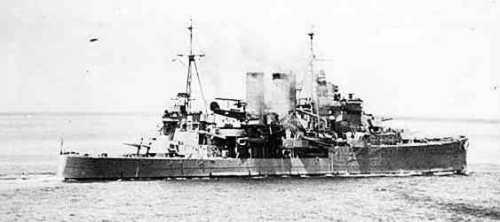
HMS Exeter firing her Anti-Aircraft guns in 1942
| Navy | The Royal Navy |
| Type | Heavy cruiser |
| Class | York |
| Pennant | 68 |
| Built by | Devonport Dockyard (Plymouth, U.K.): Parsons |
| Ordered | 15 Mar 1928 |
| Laid down | 1 Aug 1928 |
| Launched | 18 Jul 1929 |
| Commissioned | 23 Jul 1931 |
| Lost | 1 Mar 1942 |
| Loss position | 5° 00'S, 111° 00'E |
| History | During the Battle of the River Plate on 13 December 1939 HMS Exeter was badly damaged and had to withdraw to the Falkland Islands for temporary repairs. These lasted until January 1940, after which the ship returned to Devonport Dockyard for full repairs which took until March 1941 to complete. HMS Exeter (Capt. Oliver Loudon Gordon, MVO, RN) was sunk in the East Indies, north west of Surabaya in Java Sea in approximate position 05º00'S, 111º00'E, by torpedoes and 8-inch gunfire of a Japanese cruiser force. The report submitted by Capt. Gordon after the war gives very approximate position 04º38'S, 112º28'E. |
Commands listed for HMS Exeter (68)
Please note that we're still working on this section
and that we only list Commanding Officers for the duration of the Second World War.
| Commander | From | To | ||
| 1 | Capt. Frederick Secker Bell, RN | 25 Aug 1939 | 12 Apr 1940 | |
| 2 | Capt. Walter Napier Thomason Beckett, DSC, RN | 30 Nov 1940 | 10 Mar 1941 (+) | |
| 3 | Capt. Oliver Loudon Gordon, RN | 11 Mar 1941 | 1 Mar 1942 | |
You can help improve our commands section
Click here to Submit events/comments/updates for this vessel.
Please use this if you spot mistakes or want to improve this ships page.
Notable events involving Exeter include:
25 Aug 1939
HMS Exeter (Capt. F.S. Bell, RN, flying the flag of Commodore H.H. Harwood, OBE, RN) departed Plymouth for Freetown.
For the daily positions of HMS Exeter from 25 August 1939 to 7 September 1939 see the map below.
(1)
25 Aug 1939
Around 1430/25, the light cruiser HMS Dauntless (Capt. G.D. Moore, RAN) departed Portsmouth. At sea she joined the passenger/cargo ship Dunera (11162 GRT, built 1937) to escort her to Gibraltar.
Around 2000/25, the light cruiser HMS Colombo (Commodore R.J.R. Scott, RN) departed Plymouth to join HMS Dauntless and Dunera which she did around 2315/25.
Around 1800/26, they were joined by the heavy cruiser HMS Exeter (Capt. F.S. Bell, RN, flying the flag of Commodore H.H. Harwood, OBE, RN) which remained with HMS Dauntless, HMS Colombo and the Dunera until around 1330/28.
HMS Dauntless, HMS Colombo and the Dunera arrived at Gibraltar around 0630/29. (2)
1 Sep 1939
HMS Exeter (Capt. F.S. Bell, RN) arrived at Freetown. She departed Freetown for Rio de Janeiro later the same day. (3)
7 Sep 1939
HMS Exeter (Capt. F.S. Bell, RN) put into Rio de Janeiro. (3)
8 Sep 1939
HMS Exeter (Capt. F.S. Bell, RN) departed Rio de Janeiro for patrol.
For the daily positions of HMS Exeter during the period of 8 to 19 September 1939 see the map below.
(3)
19 Sep 1939
HMS Exeter (Capt. F.S. Bell, RN) put into Montevideo. (3)
20 Sep 1939
HMS Exeter (Capt. F.S. Bell, RN) departed Montevideo for patrol.
For the daily positions of HMS Exeter during the period of 20 September to 2 October 1939 see the map below.
(3)
1 Oct 1939
1 October 1939, an enemy raider reported in the South Atlantic and Indian Ocean. The chase of the German ‘pocket battleship’ Admiral Graf Spee
Movements of the German ‘pocket battleship’ Admiral Graf Spee 21 August 1939 – 13 December 1939.
Before the Second World War had started, on 21 August 1939, the German ‘pocked battleship’ Admiral Graf Spee departed Wilhelmshaven bound for the South Atlantic. On 1 September the Admiral Graf Spee was off the Canary Islands where she made rendes-vous with the supply ship Altmark and supplies were transferred.
On 11 September another rendes-vous was made with the Altmark in the South Atlantic. The Admiral Graf Spee had launched her Arado floatplane to scout in the area as supplies were transferred. The aircraft spotted the British heavy cruiser HMS Cumberland (Capt. W.H.G. Fallowfield, RN). The German ships then immediately parted company and cleared the area at high speed. Two days later, on the 13th, the ships again met and fueling was completed. The Admiral Graf Spee was still under orders to remain unseen.
On 20 September 1939 the Admiral Graf Spee and Altmark met again to fuel. On the 26th the Admiral Graf Spee was ordered to start raiding the British trade lanes. She then proceeded towards the Pernambuco area.
On 30 September 1939 the Admiral Graf Spee found her first victim, the British merchant vessel Clement (5050 GRT, built 1934) that was en-route from New York, U.S.A. to Bahia, Brasil. She then sank the ship in position 09°05’S, 34°05’W. The Admiral Graf Spee then proceeded eastwards and found three more victims between 5 and 10 October. On the 5th she captured the British merchant Newton Beech (4644 GRT, built 1925) in position 09°35’S, 06°30’W. This ship was en-route from Capetown to the U.K. via Freetown. On the 7th she sank the British merchant Ashlea (4222 GRT, built 1929) in position 09°52’S, 03°28’W. This ship was en-route from Durban to Falmouth. The crew of the Ashlea was transferred to the Newton Beech. The next day both crew were transferred to the Admiral Graf Spee and the Newton Beech was scuttled. On 10 October the Admiral Graf Spee captured the British merchant Huntsman (8196 GRT, built 1921) in position 08°30’S, 05°15’W. This ship was en-route from Calcutta to the U.K. On 15 October 1939 the Admiral Graf Spee met the Altmark again to receive supplies and fuel. On the 17th the crew of the Huntsman was transferred to the Altmark and the ship was scuttled in approximate position 16°S, 17°W. The next day the crews of the Newton Beech and Ashlea were also transferred to the Altmark and the German ships then parted company.
On 22 October 1939, the Admiral Graf Spee sank her next victim, the British merchant Trevanion (5299 GRT, built 1937) which was en-route from Port Pirie (Australia) to Swansea. This ship was sunk in position 19°40’S, 04°02’E. On 28 October 1939, near Tristan da Cunha, the Admiral Graf Spee once more refuelled from the Altmark. The Admiral Graf Spee then set course for the Indian Ocean.
On 15 November 1939 she sank the small British tanker Africa Shell (706 GRT, built 1939) in position 24°45’S, 35°00’E. This ship was in ballast and en-route from Quelimane (Portugese East Africa now called Mozambique) to Lourenco Marques (now Maputo, also in Portugese East Africa / Mozambique). Next day the Admiral Graf Spee stopped the Dutch merchant Mapia (7188 GRT, built 1923) but had to let her go as she was a neutral ship. The Admiral Graf Spee then set course to return to the South Atlantic where she met once more with the Altmark on 27 November 1939 and the next day she fuelled from her about 300 miles from Tristan da Cunha.
On 2 December 1939, the Admiral Graf Spee sank her largest victim, the British merchant Doric Star (10086 GRT, built 1921),in position 19°15’S, 05°05’E. This ship was en-route from Auckland, New Zealand to the U.K. The next morning the Admiral Graf Spee sank the British merchant Tairoa (7983 GRT, built 1920) in position 19°40’S, 04°02’E. This ship was en-route from Brisbane, Australia to London. On 6 December 1939 the Admiral Graf Spee refuelled once more from the Altmark. She then set course to the River Plate area where the British merchant traffic was the thickest. She was to sink more ships there and disrupt British shipping movements in that area before returning to Germany.
On 7 December 1939 the Admiral Graf Spee sank what was to be her last victim, the British merchant Streonshalh (3895 GRT, built 1928) in position 25°01’S, 27°50’W. This ship was en-route from Montevideo to Freetown and then onwards to the U.K.
Then in the morning of 13 December 1939, her smoke was sighted by three cruisers from the South America Division. More on this in the article ‘The Battle of the River Plate, 13 December 1939’.
British Dispositions in the South Atlantic / South America area
Shortly before the outbreak of the war the South America Division of the America and West Indies Station was transferred to the newly formed South Atlantic Station. The South America Division at that moment consisted of the heavy cruiser HMS Exeter (Capt. F.S. Bell, RN, flying the flag of Commodore H.H. Harwood, OBE, RN) and the light cruiser HMS Ajax (Capt. C.H.L. Woodhouse, RN). In late August 1939 HMS Exeter was at Devonport with her crew on foreign leave when she was recalled to South American waters. On 25 August 1939 she sailed from Devonport. HMS Exeter arrived at Freetown on 1 September 1939. Commodore Harwood then met the Commander-in-Chief South Atlantic Station, Vice-Admiral G. D’Oyly Lyon, CB, RN. Later the same day HMS Exeter sailed for Rio de Janeiro.
Meanwhile four destroyers from the 4th Destroyer Division, Mediterranean Fleet, the HMS Hotspur (Cdr. H.F.H. Layman, RN), HMS Havock (Lt.Cdr. R.E. Courage, RN), HMS Hyperion (Cdr. H.St.L. Nicholson, RN) and HMS Hunter (Lt.Cdr. L. de Villiers, RN) had left Gibraltar on 31 August 1939 for Freetown.
HMS Ajax was already on station off the coast of South America. Shortly after noon on 3 September she intercepted the German merchant vessel Olinda (4576 GRT, built 1927) in position 34°58’S, 53°32’W. This ship was en-route from Montivideo to Germany. As HMS Ajax had no prize crew available the ship was sunk by gunfire a few hours later. In the afternoon of the next day, the 4th, HMS Ajax intercepted another German ship, the Carl Fritzen (6594 GRT, built 1920) in position 33°22’S, 48°50’W. This ship was en-route from Rotterdam to Buenos Aires. This ship was also sunk with gunfire.
On 5 September two of the destroyers from the 4th Destroyer Division, HMS Hotspur and HMS Havock departed Freetown to join the South America Division. They were ordered to examine Trinidade Island on the way. On 8 September 1939 the heavy cruiser HMS Cumberland (Capt. W.H.G. Fallowfield, RN) departed Freetown to join the South America Division as well. This cruiser came from the Home Fleet and had arrived at Freetown on the 7th.
On 7 September 1939, HMS Exeter entered Rio de Janeiro where Commodore Harwood had a meeting with the Brazilian Secretary-General of Foreign Affairs and H.M. Ambassadors to Brazil and Argentine. HMS Exeter departed Rio de Janeiro the next day. Later that day Commodore Harwood was informed by the Admiralty that the German merchant ships General Artigas (11343 GRT, built 1923), Gloria (5896 GRT, built 1917) and Monte Pascoal (13870 GRT, built 1931) were assembling off the Patagonian coast. He decided to move both HMS Exeter and HMS Ajax south, and ordered the Ajax to meet him at 0800/9. They actually made rendezvous at 0700 hours. The Commodore considered it possible that the German merchant ships might embark German reservists and raid the Falkland Islands therefore he decided to sent HMS Ajax there. HMS Exeter proceeded to the Plate area to cover that important area.
On the evening of the 10th, Commodore Harwood was informed that the transportation of German reservists by the three German merchant ships was very unlikely but as it appeared probable that the German ships were converting themselves into armed raiders the Commodore decided to start short distance convoys from the Santos-Rio and Plate areas. He therefore ordered HMS Cumberland to refuel at Rio de Janeiro on her arrival there and to organize and run ‘out’ convoys in that area with HMS Havock as A/S escort. The convoys were to leave at dawn and be protected against submarines and surface raiders until dusk. The ships were then to be dispersed so that they would be far apart by dawn the next day. At the same time the Commodore ordered HMS Hotspur to join him in the Plate area after refuelling at Rio de Janeiro, so that similar convoys could be started from Montevideo. If one of the German ‘pocket battleships’ was to arrive of South America, HMS Cumberland was to abandon the convoy sheme and join HMS Exeter in the Plate area. Also on the 10th, Commodore Harwood was informed by the Admiralty that the German merchant Montevideo (6075 GRT, built 1936) was leaving Rio Grande do Sul for Florianopolis but decided not to intercept her as this would divert HMS Exeter 500 nautical miles from the Plate area.
On the night of 12 September 1939 the Commodore was informed by the British Naval Attaché, Buenos Aires, that a concentration of German reservists was taking place in southern Argentina with the Falklands as a possible objective. He therefore ordered HMS Ajax to remain in the Falklands till the situation cleared, and the Commodore then proceeded south of the Plate area to be closer to the Falklands himself and yet remain in easy reach of the Plate area. During the next few days HMS Exeter intercepted several British and neutral vessels.
In view of a report that the German merchant vessels Porto Alegré (6105 GRT, built 1936) and Monte Olivia (13750 GRT, built 1925) were leaving Santos on 15 September 1939 Commodore Harwood decided to start the short distance convoys from Montevideo as soon as possible. HMS Cumberland had meanwhile arranged a twelve-hour convoy system from Santos. Ships from Rio de Janeiro for Freetown would sail at dawn on odd numbered days, and ships for the south on even numbered days with HMS Havock as anti-submarine escort and HMS Cumberland in distant support. HMS Cumberland left Rio de Janeiro on 16 September and during the next eight days sighted 15 British and neutral ships while on patrol.
On 17 September 1939, HMS Hotspur joined HMS Exeter in the Plate area. HMS Exeter then made a visit to Montevideo and resumed her patrol off the Plate area on the 20th. Fuelling was done from the oiler RFA Olwen (6470 GRT, built 1917, Master B. Tunnard) in the mouth of the River Plate. Soon after leaving Montevideo on 20 September Commodore Harwood learned from the British Naval Attaché, Buenos Aires, that the local German authorities were endeavoring to inform German ships at sea that the British merchant Lafonia (1872 GRT, built 1911) was on her way to the Falklands with British reservists for the Falkland Islands defence force. It was also reported that on 17 September an unknown warship had passed Punta Arenas eastwards. In view of these reports and of other pointing out that German merchant ships in southern waters were being outfitted as armed raiders the Commodore ordered HMS Hotsput to escort the Laofona to Port Stanley. As the volume of trade in the Plate area was greater than in the Rio de Janeiro – Santos area, HMS Havock was ordered to proceed southwards to the Plate area.
The first local convoy outward from Montevideo sailed on 22 September 1939. It consisted of the British merchant ships Sussex (11062 GRT, built 1937), Roxby (4252 GRT, built 1923), El Ciervo (5841 GRT, built 1923) in addition to the earlier mentioned Lafonia, and was escorted by HMS Hotspur. HMS Exeter met this convoy during the forenoon and covered it throughout the day. At dusk the merchant ships were dispersed on prearranged courses while HMS Exeter remained within supporting distance and HMS Hotspur escorted the Lafonia to Port Stanley.
On 24 September 1939, Vice-Admiral Lyon (C-in-C, South Atlantic) and Commodore Harwood learned from the Naval Attaché, Buenos Aires, that ‘according to a reliable source’ arrangements had been made for a number of German ships and a submarine to meet near Ascension on 28 September 1939. HMS Cumberland was ordered to proceed there and HMS Ajax was ordered to leave the Falklands and take up her place in the Rio de Janeiro area. HMS Neptune (Capt. J.A.V. Morse, DSO, RN) was also ordered to proceed to the area off Ascension with the destroyers HMS Hyperion and HMS Hunter which departed Freetown on the 25th. No German ships were however encountered off Ascension and all ships then proceeded to Freetown where they arrived on 2 October 1939 with HMS Cumberland low on fuel.
While HMS Cumberland left the station to search for the German ships, HMS Exeter and HMS Ajax were sweeping of the Plate and Rio de Janeiro – Santos area respectively. On 27 September 1939, HMS Havock escorted a convoy made up of the British merchants Miguel de Larrinaga (5231 GRT, built 1924), Pilar de Larringa (7352 GRT, built 1918) and Sarthe (5271 GRT, built 1920) out of the Plate area. The next day another convoy, made up of the British merchants Adellen (7984 GRT, built 1930), Cressdene (4270 GRT, built 1936), Holmbury (4566 GRT, built 1925), Lord Byron (4118 GRT, built 1934), Ramillies (4553 GRT, built 1927) and Waynegate (4260 GRT, built 1931) left the Plate area escorted by HMS Havock and with cover from HMS Exeter.
At daylight on 29 September 1939 HMS Ajax was off Rio de Janeiro ready to escort ships sailing northward. She sighted none until the early afternoon when she met the Almeda Star (12848 GRT, built 1926) and a few hours later the tanker San Ubaldo (5999 GRT, built 1921). That night several neutral steamers were sighted off Rio de Janeiro and the next day the British La Pampa (4149 GRT, built 1938) was met and escorted during daylight on her way to Santos. So far on the work of the South American Division during September 1939. The ships assigned to Commodore Harwood had been busy patrolling and escorting ships near the focal areas.
A surface raider reported, 1 October 1939.
When a report that the British merchant Clement had been sunk on 30 September 1939 by a surface raider off Pernambuco was received by the Admiralty in the afternoon of October 1st, the C-in-C, South Atlantic was informed that he should retain the 4th Destroyer Division and that his command would be reinforced by the cruisers HMS Norfolk (Capt. A.G.B. Wilson, DSO, RN), HMS Capetown (Capt. T.H. Back, RN), HMS Effingham (Capt. J.M. Howson, RN), HMS Emerald (Capt. A.W.S. Agar, VC, DSO, RN) and HMS Enterprise (Capt. H.J. Egerton, RN). Also the battleships HMS Resolution (Capt. C.H. Knox-Little, RN), HMS Revenge (Capt. E.R. Archer, RN) and the aircraft carrier HMS Hermes (Capt. F.E.P. Hutton, RN) were to proceed to either Jamaica or Freetown. These dispositions however never materialised being superseded on 5 October 1939 by a more general policy (the institution of hunting groups) which cancelled them.
The institution of hunting groups, 5 October 1939.
On 5 October 1939 the Admiralty formed five hunting groups in the Atlantic and Indian Ocean of sufficient strength to destroy any ‘pocket battleship’ or Hipper-class cruiser. These were; Force F; area: North America and West Indies. HMS Berwick (Capt. I.M. Palmer, DSC, RN), HMS York (Capt. R.H. Portal, DSC, RN), Force G; area: S.E. coast of South America. HMS Cumberland, HMS Exeter Force H; area: Cape of Good Hope, South Africa. HMS Sussex (Capt. A.R. Hammick, RN), HMS Shropshire (Capt. A.W.LaT. Bisset, RN), Force I; area: Ceylon. HMS Cornwall (Capt. C.F. Hamill, RN), HMS Dorsetshire (Capt. B.S.C. Martin, RN), HMS Eagle (Capt. A.R.M. Bridge, RN), Force K; area: Pernambuco, Brazil. HMS Renown (Capt. C.E.B. Simeon, RN), HMS Ark Royal (Capt. A.J. Power, RN), Force L; area: Brest, France. Dunkerque (Capt. J.L. Nagadelle, replaced by Capt. M.J.M. Seguin on 16 October), Bearn (Capt. M.M.A. Lafargue, replaced by Capt. Y.E. Aubert on 7 October), Georges Leygues (Capt. R.L. Perot), Gloire (Capt. F.H.R. de Belot), Montcalm (Capt. P.J. Ronarc’h), Force M; area: Dakar, Senegal. Dupleix (Capt. L.L.M. Hameury), Foch (Capt. J. Mathieu), and Force N; area: West Indies. Strasbourg (Capt. J.F.E. Bouxin), HMS Hermes.
The institution of the hunting groups were not the only measures taken. The battleships HMS Resolution, HMS Revenge and the light cruisers HMS Emerald and HMS Enterprise were ordered to proceed to Halifax, Nova Scotia to escort homeward bound convoys. Light cruiser HMS Effingham was to join them later. The battleship HMS Ramillies (Capt. H.T. Baillie-Grohman, DSO, RN) left Gibraltar on 5 October for the same duty but was recalled the next day when the battleship HMS Malaya (Capt. I.B.B. Tower, DSC, RN) and the aircraft carrier HMS Glorious (Capt. G. D’Oyly-Hughes, DSO and Bar, DSC, RN) were ordered to leave the Mediterranean and proceed to the Indian Ocean where they formed an addition hunting group, Force J which was to operate in the Socotra area off the entrance to the Gulf of Aden.
Now back to the South Atlantic, on 9 October 1939 the C-in-C, South Atlantic had informed the Admiralty and Commodore Harwood that he intended to co-ordinate the movements of ‘Force G’, ‘Force H’ and ‘Force K’. As this would entail long periods of wireless silence in ‘Force G’ he proposed that Commodore Harwood should transfer his flag to HMS Ajax, leaving Capt. Fallowfield of HMS Cumberland in command of Force G. The Admiralty approved of this. Commodore Harwood stated that it was his intention to transfer his flag from HMS Exeter to HMS Ajax in the River Plate area on 27 October. He also stated that the endurance of HMS Exeter was only half the endurance of HMS Cumberland and that this would prove problematic when they were to operate together and he proposed that the Exeter would be relieved by another 10000 ton cruiser but for the moment no suitable cruiser was available to relieve her.
On 12 October 1939 the first of the hunting forces arrived on their station when HMS Renown and HMS Ark Royal reached Freetown that morning coming from the U.K. They were soon followed by three more destroyers of the H-class coming from the Mediterranean; HMS Hardy (Capt. B.A. Warburton-Lee, RN), HMS Hasty (Lt.Cdr. L.R.K. Tyrwhitt, RN) and HMS Hostile (Cdr. J.P. Wright, RN). On 13 October 1939 the cruisers HMS Sussex and HMS Shropshire arrived at Simonstown from the Mediterranean and one day later HMS Hermes arrived at Dakar from Plymouth.
The South America Division during the first half of October 1939.
When the news of an enemy raider in the South Atlantic reached the C-in-C at Freetown on 1 October 1939 he immediately suspended sailings from Pernambuco and Natal and he ordered HMS Havock and HMS Hotspur to escort British ships clear of the area. But next morning he cancelled these dispositions and ordered Commodore Harwood to concentrate HMS Exeter, HMS Ajax and the two destroyers off Rio de Janeiro. By this time, however, the raider was far away from the South American coast. On 3 October 1939 the Commodore signalled the C-in-C that he intened to concentrate the Exeter and Ajax off Rio and have the Hotspur to cover the Rio – Santos area and keep the Havock off the Plate but upon receiving the orders from the C-in-C to concentrate he ordered to destroyers to join the cruisers after fuelling but not later then 0800 hours on 4 October. Reports that the enemy raider was not a ‘pocket battleship’ however kept coming in and the Commodore decided that he could not leave the heavy traffic in the Plate area without some form of protection and he ordered HMS Havock to return there but when a report coming in from Bahia, Brazil confirmed that the Clement had been sunk by the ‘pocket battleship’ Admiral Scheer the Commodore once more ordered HMS Havock to join him. In the end HMS Ajax joined HMS Exeter at 1700/3, HMS Hotspur at 0500/4 and finally HMS Havock at 1300/4.
The Commodore was also informed by the Admiralty that the New Zealand cruiser HMS Achilles (New Zealand Division) (Capt. W.E. Parry, RN) would join his station coming from the west coast of South America. HMS Cumberland left Freetown at 1900/3 to join the Commodore in the Rio de Janeiro area as well.
Commodore Harwood’s policy against enemy raiders and a new raider report coming on on 5 October 1939.
Commodore Harwood had decided to keep his forces concentrated and as no new raider reports had come in to patrol the Rio de Janeiro area in accordance with the C-in-C, South Atlantic’s order. If he met a ‘pocket battleship’ he intended to shadow it until dusk. He would then close and attack in the dark hours. If, on the other hand, he made contact at night, his destroyers would at once close the enemy’s beam and attack her with torpedoes.
On 5 October 1939, the British merchant Martand (7967 GRT, built 1939) informed HMS Cumberland that a German armed raider had attacked an unknown ship, this unknown ship was in fact the Newton Beech that was attacked about 900 nautical miles away. This information was not acted upon by the Commanding Officer of the Cumberland. The Captain of the Cumberland assumed the raider report would have been intercepted by other ships and passed on to the C-in-C, South Atlantic. He considered it was important to keep radio silence and decided against breaking it. The Admiralty however later was of the opinion that the report should have been passed on to the Commander-in-Chief.
By 5 October 1939, the Exeter, Ajax, Havock and Hotspur were concentrated in the Rio de Janeiro area ready to engage the raider if she came south from the Pernambuco area. HMS Achilles was on her way round Cape Horn.
When HMS Ajax visited Rio de Janeiro on 7 October 1939, Commodore Harwood directed her to suggest to the Consular Shipping Advisers there, and at Santos, that, owning to the small volume of shipping leaving these ports, the local convoy systems, which had been instituted on 22 September against armed merchant raiders, should be suspended, and Allied merchant ships be routed independently.
The Commodore intended to meet HMS Cumberland at 1700/8, but at 1600/7 he received a message from the Consular Shipping Adviser at Rio de Janeiro in which he desired an escort for a 13 knot convoy that was to sail at 0430/8 and that had received much local publicity. The Commodore thought that this publicity might draw the enemy raider to the area and he therefore took his entire force back towards Rio de Janeiro and sent HMS Hotspur ahead to make contact with the convoy, while keeping his other ships in support. The convoy consisted of the British merchants Highland Chieftain (14131 GRT, built 1929), Nariva (8723 GRT, built 1920) and the French merchant Alsina (8404 GRT, built 1922).
Meanwhile the Commodore had directed HMS Cumberland to meet him at dawn on October 9th. When the convoy was dispersed at 1800/8 the Exeter and Ajax steered to meet her while the Havock was detached to fuel at Rio de Janeiro. At 2200/8 HMS Ajax was detached. HMS Cumberland made rendezvous with HMS Exeter at 0500/9. They were ordered by the C-in-C, South Atlantic to make a sweep northwards but this could not be carried out as HMS Exeter was short of fuel. The Commodore therefore decided to make a sweep southwards towards the Plate area where HMS Exeter could refuel. He also decided to keep HMS Hotspur with the two cruisers as long as possible.
On 12 October 1939, Rio Grande do Sul reported that the German merchant Rio Grande (6062 GRT, built 1939) was about to sail. The Commodore at once ordered HMS Cumberland to proceed there and intercept. She arrived off Rio Grande do Sul at 1600/13 but on finding it all quiet in the harbour she shaped course for the Plate area at nightfall. Meanwhile the Commodore had ordered HMS Hotspur to fuel at Montevideo when HMS Havock left that port early on the 14th.
about this time RFA Olwen informed the Commodore the the German merchant Bahia Laura (8611 GRT, built 1918) was leaving Montevideo at 1000 next morning and might protest if HMS Havock sailed the same day. Instead, therefore, of entering Montevideo HMS Hotspur at once fueled from the Olwen and then remained out on patrol. The Bahia Laura however, showed no signs of leaving and at 0800/14, HMS Havock put to sea. At 1200 hours HMS Hotspur entered Montevideo. Later that day HMS Exeter and HMS Cumberland fueled from the Olwen in San Borombon Bay at the southern entrance to the Plate estuary. At 1430 hours they were joined by HMS Havock. Commodore Harwood then ordered her to patrol off Montevideo to watch the Bahia Laura. When HMS Exeter finished fueling she immediately put to sea. HMS Cumberland rejoined him next morning at 0700 hours. HMS Havock was then ordered to join the cruisers. On 16 October the commodore learned that the Bahia Laura had sailed at 1015 hours the previous day. By the time the signal reached him the German ship was far out at sea well past his patrol line. But as the whole area was enveloped in dense fog the Commodore decided against trying to catch her.
The South America Division during the second half of October 1939.
Meanwhile Commodore Harwood had informed the Commander-in-Chief, South Atlantic on 13 October that as HMS Exeter required certain minor repairs he proposed to proceed to the Falklands on the17th and then return to the Plate area on the 27th. The Commander-in-Chief replied that he preferred that HMS Exeter would stay in the Plate area till the Commodore would transfer his Broad Pendant to HMS Ajax on the 27th. As HMS Achilles was due in the Plate area on this day also, she and HMS Cumberland could then operate as ‘Force G’ during the Exeter’s absence. This would mean that there would be no cruiser in the Rio de Janeiro area until HMS Exeter would return from her repairs at the Falklands. The Commodore therefore ordered HMS Havock to sail on 21 October for a four day patrol in the Rio – Santos Area, where HMS Hotspur, which could remain at sea until 2 November, would relieve her. From that date until the relief of HMS Achilles there would be no warship in this area. The Commodore therefore asked the Commander-in-Chief to allow ‘Force G’ to operate in that area from 2 to 10 November. When HMS Hotspur joined the Exeter and Cumberland from Montevideo on 17 October the Commodore ordered her to patrol off Rio Grande do Sul to intercept the German ships Rio Grande and Montevideo if they would come out, and sent HMS Havock to patrol inshore with orders to anchor the night clear of the shipping route.
This proved to be the last duty of these two destroyers with the South America Division. On 20 October the Admiralty ordered their transfer to the West Indies. Three days later the Commodore sent them into Buenos Aires to refuel, and as the distance to Trinidad, 4000 miles, was at the limit of their endurance, also obtained permission to refuel them at Pernambuco. They both left Buenos Aires on the 25th and, bidding the Commodore farewell, proceeded northwards. They sailed from Pernambuco on 1 November but on the 3rd HMS Havock was diverted to Freetown with engine trouble. The two remaining destroyers of the 4th Division, HMS Hyperion and HMS Hunter, had left Freetown with convoy SL 6 on 23 October. Off Daker their escort duty was taken over by the French light cruiser Duguay-Trouin (Capt. J.M.C. Trolley de Prevaux). The destroyers then fueled at Dakar on the 27th and sailed for Trinidad early on the 28th.
Meanwhile HMS Cumberland had entered Montevideo at 0800/26. At 0900/26 HMS Achilles joined HMS Exeter in the Plate area and after fueling from RFA Olwen sailed to meet HMS Cumberland off Lobos the next day and then patrol with her as ‘Force G’ in the Rio – Santos area. The Olwen was now nearly out of fuel and filled up HMS Ajax ,which had arrived from the Rio area on the 26th, with her remaining fuel minus 500 tons for her passage to Trinidad. In the morning of 27 October, Commodore Harwood transferred his Broad Pendant to HMS Ajax and HMS Exeter then parted company to proceed to the Falklands for repairs.
Meanwhile the newly formed ‘Force H’ and ‘Force K’ were busy on the other side of the South Atlantic. ‘Force H’, made up of HMS Sussex and HMS Shropshire had reached the Cape on 13 October. As HMS Cumberland had not passed on the report of the Martland, no news on the raider had reached the Admiralty or the Commander-in-Chief since October 1st. On 14 October ‘Force H’ sailed to search for her along the Cape – Freetown route as far as the latitude of St. Helena. That day ’Force K’ (HMS Ark Royal and HMS Renown) left Freetown with HMS Neptune, HMS Hardy, HMS Hero (Cdr. C.F. Tower, MVO, RN) and HMS Hereward (Lt.Cdr. C.W. Greening, RN) to search westwards towards St. Paul Rocks, the direction of their sweep being determined by the complete lack of any further raider information.
Finally a raider report on 22 October 1939, Sweeps by ‘Force H’ and ‘Force K’.
The three weeks old ‘mystery’ of the raiders whereabouts was partially solved on 22 October when the British merchant vessel Llanstephan Castle (11293 GRT, built 1914) intercepted a message from an unknown ship ‘Gunned in 16°S, 04°03’E’ at 1400 G.M.T. There was however no immediate confirmation of her report and the Commander-in-Chief ordered ‘Force H’ to sail after dark on the 27th to sail for the latitude of St. Helena. At noon on 31 October this Force was in 15°S, 02°51’E, the north-eastern limit of it’s patrol, when a Walrus aircraft failed to return to HMS Sussex from a reconnaissance flight. It was never found, though the two cruisers spend over three days searching for it. Being short of fuel they then returned to the Cape by the same route they had used outwards.
Sweep by ‘Force K’, 28 October – 6 November 1939.
To cover the northern end of the route from St. Helena onward, HMS Neptune and the destroyers HMS Hardy, HMS Hasty, HMS Hero and HMS Hereward had left Freetown on 28 October. HMS Neptune was to sweep independently from position 03°20’S, 01°10’W and then through 14°30’S, 16°50’W back to Freetown. On 30 October a report from Dakar stated that the German merchant Togo (5042 GRT, built 1938) had left the Congo on 26 October, that the German merchant Pionier (3254 GRT, built 1934) had sailed from Fernando Po (now called Bioko Island) on 28 October and that five German ships had left Lobito (Angola) the same day. When the Vice-Admiral, Aircraft Carriers, received this information her detached HMS Hardy and HMS Hasty to sweep north-westward for the Pioneer, while ‘Force K’ and the remaining two destroyers searched for her to the south-westward. Both searches were unsuccessful. Meanwhile a message from Lobito had stated that the five German ships that were stated to have left the harbour were still there. On 5 November the German merchant vessel Uhenfels (7603 GRT, built 1931), that had left Laurenco Marques (now called Maputo, Mozambique) on 16 October was sighted by an aircraft from HMS Ark Royal. Only energetic action from HMS Hereward saved her from being scuttled in position 06°02’N, 17°25’W. She was brought into Freetown on 7 November by HMS Herward, a few hours behind ‘Force K’.
’Force H’ and ‘Force G’, first half of November 1939.
The first half of November was relatively quiet on both sides of the South Atlantic At the start of the month ‘Force H’ and ‘Force K’ were still on the shipping lane between Sierra Leone and the Cape. On 3 November 1939 the Admiralty informed the Commander-in-Chief, South Atlantic that all German capital ships and cruisers were apparently in home waters. It appeared therefore that the pocket battleship, which was still thought to be the Admiral Scheer, had returned home and that the raider reported by the Llangstephan Castle on 22 October was nothing but an armed merchantman. Here was a good opportunity for resting the hunting groups and on 4 November the Admiralty issued orders that ‘Force G’ and ‘Force H’ should exchange areas. This exchange would not only give ‘Force G’ an opportunity of resting and refitting at the Cape, but would also provide Commodore Harwood with the hunting group of long endurance that he desired.
The Commander-in-Chief had planned that ‘Force H’ which had returned to the Cape on 7 November would then sweep towards Durban, arriving there on 16 November. However on the 11th they were ordered to sail for patrol in the Atlantic and on the evening of the 17th, while west of St. Helena, exchange patrol areas with ‘Force G’. The exchange of areas however did not take place as ‘Force G’ was delayed due to HMS Exeter being damaged while casting off from the oiler in heavy seas. Before the exchange now could take place it was cancelled.
South America Division, first half of November 1939.
After hoisting Commodore Harwood’s Broad on 27 October the HMS Ajax had swept the Plate focal area. When the Commodore received the signal of the Commander-in-Chief on the 5th regarding the changeover over patrol areas between ‘Force G’ and ‘Force H’, he ordered HMS Cumberland to proceed to the Plate at 20 knots to refuel. About this time a message reached him from Buenos Aires that the Argentinian Foreign Minister had drawn attention to cases of fueling in the Plate by HMS Exeter and HMS Ajax. Although the Argentinian Government had no apparent intention of raising the issue he decided to cut down the fuellings in the inshore waters of the Plate as much as possible. He therefore cancelled the fuelling of HMS Exeter, due to take place on 7 November from the oiler RFA Olynthus (6888 GRT, built 1918, Master L.N. Hill), which had relieved RFA Olwen. He ordered HMS Cumberland to fuel at Buenos Aires on 9 November. HMS Exeter which had arrived at the Falklands on 31 October for repairs, sailed again on 4 November to meet up with HMS Cumberland off the Plate on 10 November, but the Commodore ordered her to enter Mar del Plata for a 24-hour visit on the 9th. As this gave her some time at hand, he ordered her to cover the Plate while HMS Ajax visited Buenos Aires from 6 to 8 November during which the Commodore discussed the question of fuelling his ships in the River Plate Estuary with the Argentine naval authorities. During his visit to Buenos Aires, the Commodore discussed the matter of fuelling his ships of English Bank with the Argentinian Minister of Marine and his Chief of Naval Staff they both suggested that he should use San Borombon Bay which was most acceptable. He had in fact been using it for some time.
When HMS Ajax left Buenos Aires on 8 November she patrolled the Plate area. HMS Exeter arrived at Mar del Plata the next day but fuel could not be obtained there. She was ordered to fuel from RFA Olynthus in San Borombon Bay on the 10th and then meet up with HMS Cumberland off Lobos Island at 0600/11. On the 10th HMS Ajax also fueled from RFA Olynthus as did HMS Exeter after her while HMS Ajax was at anchor close by. However weather quickly deteriorated and the Olynthus was forced to cast off, damaging the Exeter in doing so. Besides that she was still 600 tons short of fuel. As she could not reach the Cape without a full supply the sailing of ‘Force G’ to exchange areas with ‘Force H’ was delayed. The Exeter finally finished fuelling on the 13th and sailed with HMS Cumberland for Simonstown. Before the exchange of areas could be effected, however, a raider was reported in the Indian Ocean and the order was cancelled.
Another raider report, 16 November 1939.
On 16 November 1939 the Naval Officer-in-Charge, Simonstown, reported that the small British tanker Africa Shell ( GRT, built ) had been sunk off Lourenco Marques the previous day by a raider identified as a pocket battleship. After the usual conflicting reports from eye-widnesses during the next few days, however, it was doubtful how many raiders there were or whether they were pocket battleships or heavy cruisers.
The presence of an enemy heavy ship in the Mozambique Channel called for new dispositions. When the raider report reached the Admiralty on 17 November they immediately cancelled the exchange of areas between ‘Force G’ an ‘Force H’. ‘Force H’ was ordered to return to the Cape and ‘Force G’ was ordered to return to the east coast of South America. They also ordered the dispatch of ‘Force K’ towards the Cape with instructions to go on to Diego Suarez in Madagascar. That morning a report reached the Commander-in-Chief, South Atlantic that the German merchant vessels Windhuk (16662 GRT, built 1937) and Adolph Woermann (8577 GRT, built 1922) had left Lobito. He at once ordered ‘Force H’, which was at that moment west of St. Helena in the approximate latitute of Lobito to spend three days searching for them.
Next day, 18 November 1939, ‘Force K’ left Freetown together with HMS Neptune, HMS Hardy, HMS Hero and HMS Hostile to sweep west of St. Helena through position 16°30’S, 10°W and thence on to Diego Suarez. The destroyers parted company at 2300/18 to search for the German ships. On 20 November 1939, the Commander-in-Chief ordered ‘Force H’ to return to the Cape of nothing of the German merchant vessels had been sighted. HMS Sussex and HMS Shropshire did so on 23 November.
The Adolph Woermann had not escaped. Early on 21 November 1939, the British merchant Waimarama (12843 GRT, built 1938) reported her in position 12°24’S, 03°31’W. At 1127/21, ‘Force K’ (HMS Ark Royal and HMS Renown) was in position 05°55’S, 12°26’W, altered course to close, and HMS Neptune, which was still with them, went ahead at high speed. Shortly after 0800/22 she made contact with the Adolf Woermann in position 10°37’S, 05°11’W and went alongside. Despite efforts to save her the German vessel was scuttled and when HMS Neptune returned to Freetown on 25 November 1939 she had 162 German survivors on board.
’Force H’ and ‘Force K’, second half of November 1939.
As the search for the Adolf Woermann had taken ‘Force K’ nearly 200 miles to the eastward, the Vice-Admiral, Aircraft Carriers decided to proceed to the Cape by the route east of St. Helena to save fuel. In hindsight this might have saved Altmark for being intercepted as she was waiting for the Admiral Graf Spee in the area ‘Force K’ would have otherwise passed through. On 23 November 1939, the Commander-in-Chief, South Atlantic, ordered ‘Force H’ to sail from the Cape the next day and patrol the ‘diverse routes’ as far as 33°E until 28 November.
At the northern end of the South Atlantic station HMS Neptune, HMS Hardy, HMS Hero, HMS Hostile, HMS Hasty and the submarine HMS Clyde (Cdr. W.E. Banks, RN) had established a patrol between 22 and 25 November 1939 to intercept escaping German merchant ships or raiders. No ships were however sighted and they were recalled to Freetown on 30 November.
In the meantime the Admiralty had ordered, ‘Force H’ and ‘Force K’ to conducted a combined patrol on the meridian of 20°E. The two forces met early on 1 December. The plan, according to the Commander-in-Chief, appeared to be a good one in theory but was found unsuitable in practice that on account of local weather conditions. These permitted flying off aircraft from HMS Ark Royal only once in five or six days, so that the patrol could not be extended far enough to the south to intercept a raider bent on evasion. In fact, only once, on 2 December weather was suitable for flying off aircraft.
South America Division, second half of November 1939.
After HMS Cumberland and HMS Exeter (‘Force G’) had sailed from San Borombon Bay for Simonstown on 13 November 1939, HMS Ajax patrolled the Plate area and escorted the French Massilia ( GRT, built ) that was bound for Europe from Buenos Aeres with French reservists. After parting from the Massilia she closed Rio Grande do Sul and ascertained that the German merchant vessels Rio Grande and Montevideo were still there. For the next two days she patrolled the normal peace time shipping routes.
When the Admiralty cancelled the exchange of ereas between ‘Force G’ and ‘Force H’ on 17 November, Commodore Harwood sent ‘Force G’ to cover Rio de Janeiro. He ordered HMS Achilles to fuel off the Olynthus in the Plate area on 22 November and then relieve ‘Force G’ in the Rio area as HMS Exeter would need to refuel in the Plate area again on 26 November. HMS Cumberland was to remain with the Exeter to keep ‘Force G’ together so she could refuel from the Olynthus as well. They were then to patrol the Plate area so that HMS Ajax could visit the Falklands.
On 18 November the Commodore was informed that the German merchant Ussukuma ( GRT, built ) might sail from Bahia Blanca for Montevideo at any time. He at once ordered the Olynthus to watch for her between Manos and Cape San Antonio and took the Ajax south to the same vicinity.
On 22 November 1939 HMS Achilles heard the German merchant Lahn (8498 GRT, built 1927) calling Cerrito by wireless, and when HMS Ajax arrived half an hour later a search was carried out. It was insuccessful for both cruisers but both the Lahn and another German merchant the Tacoma (8268 GRT, built 1930) reached Montevideo safely during the forenoon.
HMS Ajax and HMS Achilles then both fuelled from the Olynthus at San Borombon Bay during the next afternoon. The Achilles the sailed for the Rio de Janeiro area. She had orders to move up to Pernambuco and show herself off Cabadello and Bahia as a number of German ships in Pernambuco were reported ready to sail to Cabadello to load cotton for Germany. She was to return at once to the Rio area if any raiders were reported in the South Atlantic.
HMS Ajax left the Plate area on 25 November 1939 and sent up a seaplane to reconnoitre Bahia Blanca. The Ussukuma showed no signs of sailing so HMS Ajax proceeded to the Falklands, arriving there on the 27th. By this time HMS Cumberland and HMS Exeter were in urgent need of refits after long periods at sea, and Commodore Harwood ordered the Exeter to proceed to the Falklands forthwith. She arrived at Port Stanley on 29 November 1939 and her defects were immediately taken in hand as far as local resources permitted.
8 December 1939 was the twenty-fifth anniversary of the Battle of the Falklands, and thinking the enemy might attempt to avenge the defeat, the Commodore ordered HMS Cumberland to patrol off the Falklands as of 7 December for two days after which she too was to enter Port Stanley for rest and refit.
French Forces at Dakar in November 1939.
During November them most important event at Dakar, where the French were maintaining a number of more or less regular patrols, was the reorganisation of ‘Force X’. On 1 November 1939 the large destroyer L’Audacieux (Cdr. L.M. Clatin) sailed from Dakar to the westward to 26°W and thence south-west to search for the German merchant Togo. She returned to Dakar on 4 November having sighted nothing. That day the French light cruiser Duguay-Trouin sailed to sweep round the Cape Verde Islands and then on to St. Paul Rocks. She returned to Dakar on 10 November. The old ‘Force X’, the Strasbourg (Capt. J.F.E. Bouxin), Algerie (Capt. L.H.M. Nouvel de la Fleche) and Dupleix (Capt. L.L.M. Hameury) sailed on 7 November to sweep west of the Cape Verde Islands. It returned to Dakar on 13 November 1939. Meanwhile French submarines based at Casablanca were maintaining a continuous patrol round the Canary Islands between 25°N and 30°N.
On 18 November a new ‘Force X’ was formed, now made up of the Dupleix and her sister ship Foch (Capt. J. Mathieu) and the British aircraft carrier HMS Hermes. On 21 November the Strasbourg, Algerie and the destroyers Le Terrible (Cdr. A.E.R. Bonneau) and Le Fantasque (Capt. P.A.B. Still) left Dakar to return to France. The next day the new ‘Force X’ sailed with the destroyers Milan (Cdr. M.A.H. Favier) and Cassard (Cdr. R.A.A. Braxmeyer) to cruiser towards 08°N, 30°W. That day L’Audacieux departed Dakar with a convoy for Casablanca.
On 25 November, the Duguay-Trouin sailed to patrol the parallel of 19°N, between 25° and 30°W. Two days later the British submarine HMS Severn (Lt.Cdr. B.W. Taylor, RN) docked at Dakar. On the 30th the Dupleix and Foch returned from patrol being followed the next day by HMS Hermes and her escorts Milan and Cassard.
Dispositions of South Atlantic Forces at the beginning of December 1939.
At the beginning of December 1939, HMS Ark Royal, still flying the flag of Vice-Admiral Aircraft Carriers, and HMS Renown (‘Force K’), were patrolling the meridian of 20°E, south of the Cape together with HMS Sussex and HMS Shropshire (‘Force H’) to intercept the raider reported in the Mozambique Channel on 15 November 1939.
In the north the light cruiser HMS Neptune with the destroyers HMS Hardy, HMS Hero, HMS Hostile and HMS Hasty and the submarine HMS Clyde were returning to Freetown after patrolling between there and Cape San Roque for escaping German merchant ships or raiders. The French cruiers Dupleix and Foch and the British carrier HMS Hermes (‘Force X’) and their two escorting destroyers Milan and Cassard were approaching Dakar. The French cruiser Duguay-Trouin was patrolling the parallel of 19°N, between 25° and 30°W. The British submarine Severn was refitting at Dakar. Across the South Atlantic, Commodore Harwood, in HMS Ajax was at Port Stanley as was HMS Exeter. HMS Cumberland was patrolling of the Plate area and HMS Achilles was off Rio de Janeiro.
Forces ‘H’ and ‘K’, 1 – 13 December 1939.
No further reports have been received of the raider which had sunk the Africa Shell off Laurenco Marques on 15 November and it seemed clear that she had either gone further into the Indian Ocean or doubled back into the South Atlantic by going well south of the Cape. On 2 December 1939 the Admiralty ordered ‘Force K’ and ‘Force H’ to their patrol line south of the Cape after refueling, and the Commander-in-Chief, South Atlantic at once ordered them to proceed for the Cape ports to fuel. That day a reconnaissance aircraft of the South African Air Force reported a suspicious ship south of Cape Point at noon. HMS Sussex intercepted her but her crew set her on fire. She proved to be the German merchant Watussi (9521 GRT, built 1928). She was eventually be HMS Renown. Her survivors were taken on board HMS Sussex and were landed at Simonstown.
No news of the missing raider had been coming in since 16 November but then the mistery shrouding her whereabouts was again partially solved. At 1530/2 a raidar signal ‘R.R.R., 19°15’S, 05°05’E, gunned battleship) reached the Commander-in-Chief, South Atlantic. It came from the British merchant Doric Star. As this signal placed the raider in the South Atlantic he immediately ordered to abandon the patrol south of the Cape and ordered ‘Force H’ to cover the trade routes between the Cape and the latitude of St. Helena at 20 knots on completion of fuelling. As it was too late for ‘Force K’ to reach the Freetown-Pernambuco area in time to intercept the rainder if she was to proceed to the North Atlantic he proposed the Admiralty that ‘Force K’, after fuelling should sweep direct from the Cape to position 20°S, 15°W. This was changed at the request of the Vice-Admiral, Aircraft Carriers to place his force in a more central position for proceeding to Freetown, to the Falklands or to Rio de Janeiro. At 1030/3 a report reached the Commander-in-Chief that the pocket battleship Admiral Scheer had been in 21°20’S, 03°10’E at 0500 hours, clearly indicating that the raider was moving westwards, clear of the Cape-Sierra Leone trade route. ‘Force H’ left Simonstown at 1700 that afternoon and ‘Force K’ sailed from Capetown at 0915/4.
The Commander-in-Chief estimated that if the enemy was proceeding northwards to the North Atlantic she would cross the Freetown-Pernambuco line between 9 and 10 December. He therefore arranged that ‘Force X’ should take HMS Neptune and her destroyers under her orders and patrol the parallel of 3°N between 31° and 38°W from 10 to 13 December. ‘Force K’ would meet HMS Neptune and the destroyers on the 14th and then return with them to Freetown to refuel. The destroyers of the 3rd Division of the 2nd Destroyer Flotilla (HMS Hardy, HMS Hostile and HMS Hero) left Freetown on 6 December with the oiler RFA Cherryleaf (5896 GRT, built 1917). They had orders to meet the Dupleix, Foch, HMS Hermes and their escorting destroyers Milan and Cassard and HMS Neptune in position 03°N, 31°W on 10 December. On 7 December ‘Force X’ left Dakar for the rendez-vous. That day the submarine HMS Clyde left Freetown to patrol between 03°N, 23°W and 03°N, 28°W and thence to 05°15’N, 23°W between 9 (PM) and 13 (AM) December.
On the evening of 8 December 1939 the German merchant ship Adolf Leonhardt (2989 GRT, built 1925) sailed from Lobito for South America. ‘Force H’ which was by then between St. Helena and the west coast of Africa, was at once ordered to intercept her. The Walrus from HMS Shropshire made contact at 0952 hours next morning and alighted alongside in position 13°S, 11°44’E. At 1250 hours HMS Shropshire arrived at that position but the German ship was scuttled by her crew and could not be saved. ‘Force H’ then returned to the Cape to refuel where they arrived on 14 December.
At 0800/11 the submarine HMS Severn left Freetown for Port Stanley. She was to protect the whaling industry in South Georgio and was to intercept hostile raiders or supply ships. The cruiser HMS Dorsetshire, which arrived at Simonstown from Colombo on the 9th to finally relieve HMS Exeter in the South America Division left Simonstown on 13 December for Port Stanley. She was to call at Tristan da Cunha on the way. On that day, 13 December 1939, was fought the action between the British South America Division and the German pocket battleship Admiral Graf Spee, known as the Battle of the River Plate.
The South America Division, 1 to 13 December 1939.
At the beginning of December 1939, HMS Ajax and HMS Exeter were at Port Stanley in the Falkland Islands. HMS Cumberland was off the River Plate and HMS Achilles was patrolling the Rio de Janeiro area. On 2 December HMS Ajax left Port Stanley for the Plate area. That evening the Commodore learned that the Doric Star had been sunk by a raider to the south-east of St. Helena. Two days later the Commander-in-Chief, South Atlantic informed him that HMS Dorsetshire would arrive at Port Stanley on 23 December to relieve HMS Exeter which was then to proceed to Simonstown for a much needed refit.
Early on 5 December the British Naval Attaché at Buenos Aires reported that the German merchant Ussukuma had left Bahia Blanca at 1900 hours the previous evening. The Commodore immediately ordered HMS Cumberland which was on the way south to the Falkland Islands to search for her. Meanwhile HMS Ajax turned south and closed the Argentinian coast in case the Ussukuma, which was known to be short of fuel, should attempt to reach Montevideo inside territorial waters. At 1910/5, HMS Ajax sighted her smoke to the north-north-east but the Germans managed to scuttle their ship and despite the efforts to save her she sank during the night. At 0615/6, HMS Cumberland came up and embarked the German survivors and made off for the Falklands. HMS Ajax then refuelled at San Borombon Bay from the Olynthus.
About the same time the Brazilian authorities asked that HMS Achilles should not refuel in any Brazilian port at an interval less then three months. The Commodore, therefore, ordered her to return south and refuel at Montevideo on 8 December. HMS Achilles then joined HMS Ajax at 1000/10 in position 35°11’S, 51°13’W, 230 miles west of English Bank. At 0600/12 they were joined by HMS Exeter in position 36°54’S, 53°39’W.
Ever since the beginning of the war Commodore Harwood’s cruisers had worked off the east coast of South America either single or in pairs. The concentration of these three cruisers off the River Plate on 12 December 1939 was, however, no mere matter of chance.
Concentration of British Force in the River Plate area, 12 December 1939.
When a pocket battleship was located in position 19°15’S, 05°05’E on 2 December by the sinking of the Doris Star, her position was over 3000 miles from any of the South America focal areas. The Commodore however recognised that her next objective might be the valuable shipping off the east coast of South America. He estimated that at a cruising speed of 15 knots the enemy could reach the Rio area on 12 December the Plate area on 13 December and the Falklands on 14 December. As the Plate area was by far the most important of these three focal areas he decided to concentrate all his available ships off the Plate on 12 December.
The three cruisers then proceeded together towards position 32°N, 47°W. That evening the Commodore informed the Captains of his cruisers that it was intention that if they met a pocket battleship to attack immediately, by day or by night. By they they would act as two units, the light cruisers were to operate together and HMS Exeter was to operate diverged to permit flank marking. By night the ships were to remain in company in open order.
At 0614/13 HMS Ajax sighted smoke bearing 324° in position 34°28’S, 49°05’W and Commodore Harwood then ordered HMS Exeter to investigate it.
What then followed can be read in the article ‘The battle of the River Plate, 13 December 1939’ which can be found on the pages of HMS Ajax, HMS Exeter and HMS Achilles. (4)
2 Oct 1939
HMS Exeter (Capt. F.S. Bell, RN) fuelled from RFA Olwen (6470 GRT, built 1917, Master B. Tunnard) in San Borombon Bay. HMS Exeter continued her patrol later the same day.
For the daily positions of HMS Exeter during the period of 2 to 14 October 1939 see the map below.
(5)
14 Oct 1939
HMS Exeter (Capt. F.S. Bell, RN) fuelled from RFA Olwen (6470 GRT, built 1917, Master B. Tunnard) in San Borombon Bay. HMS Exeter continued her patrol later the same day.
For the daily positions of HMS Exeter during the period of 2 to 14 October 1939 see the map below.
(5)
23 Oct 1939
HMS Exeter (Capt. F.S. Bell, RN) fuelled from RFA Olwen (6470 GRT, built 1917, Master B. Tunnard) in San Borombon Bay. HMS Exeter continued her patrol later the same day.
For the daily positions of HMS Exeter during the period of 23 to 30 October 1939 see the map below.
(5)
27 Oct 1939
Commodore H.H. Harwood, OBE, RN transferred his flag from HMS Exeter (Capt. F.S. Bell, RN) to HMS Ajax (Capt. C.H.L. Woodhouse, RN).
HMS Exeter also fuelled from RFA Olwen (6470 GRT, built 1917, Master B. Tunnard) in San Borombon Bay. (4)
30 Oct 1939
HMS Exeter (Capt. F.S. Bell, RN) arrived at Port Stanley, Falkland Islands for much needed repairs. (5)
4 Nov 1939
HMS Exeter (Capt. F.S. Bell, RN) departed Port Stanley for patrol.
For the daily positions of HMS Exeter during the period of 4 to 29 November 1939 see the map below
(6)
9 Nov 1939
HMS Exeter (Capt. F.S. Bell, RN) arrived at Mar del Plata, Argentina. (6)
10 Nov 1939
HMS Exeter (Capt. F.S. Bell, RN) departed Mar del Plata for patrol. (6)
11 Nov 1939
HMS Exeter (Capt. F.S. Bell, RN) dropped anchor in San Borombon Bay. (6)
13 Nov 1939
HMS Exeter (Capt. F.S. Bell, RN) departed San Borombon Bay after fuelling from the RFA tanker Olynthus (6888 GRT, built 1918, Master L.N. Hill) to rejoin HMS Cumberland (Capt W.H.G. Fallowfield, RN). They then set course to proceed to Simonstown, South Africa. (6)
17 Nov 1939
Due to a new enemy raider report, HMS Cumberland (Capt W.H.G. Fallowfield, RN) and HMS Exeter (Capt. F.S. Bell, RN), are ordered not to continue their passage to Simonstown but to remain on station with the South America Division. They were ordered to proceed to the Rio de Janeiro area. (6)
26 Nov 1939
HMS Cumberland (Capt W.H.G. Fallowfield, RN) and HMS Exeter (Capt. F.S. Bell, RN) both arrive at San Borombon Bay. After fuelling HMS Exeter departed for Port Stanley, Falkland Islands later the same day after having fuelled from RFA tanker Olynthus (6888 GRT, built 1918, Master L.N. Hill).
HMS Cumberland departed the following day to patrol in the River Plate focal area. (6)
29 Nov 1939
HMS Exeter (Capt. F.S. Bell, RN) arrived at Port Stanley, Falkland Islands for much needed repairs. (6)
8 Dec 1939
HMS Exeter (Capt. F.S. Bell, RN) departed Port Stanley for patrol.
For the daily positions of HMS Exeter during the period of 8 to 16 December 1939 see the map below.
(7)
12 Dec 1939
Shortly after dawn, HMS Exeter (Capt. F.S. Bell, RN) made rendez-vous with HMS Ajax (Capt. C.H.L. Woodhouse, RN, flying the flag of Commodore H.H. Harwood, OBE, RN) and HMNZS Achilles (Capt. W.E. Parry, RN). (7)
13 Dec 1939
Battle of the River Plate, 13 December 1939.
[Continuation of the event called ‘1 October 1939, an enemy raider reported in the South Atlantic and Indian Ocean. The chase of the German ‘pocket battleship’ Admiral Graf Spee’]
The battle, first phase.
When Commodore Harwood detached HMS Exeter (Capt. F.S. Bell, RN) at 0614 hours to investigate smoke bearing 324° his squadron was in position 34°28’S, 49°05’W in single line ahead in the order HMS Ajax (Capt. C.H.L. Woodhouse, RN, flying the flag of Commodore H.H. Harwood, OBE, RN), HMNZS Achilles (Capt. W.E. Parry, RN) and HMS Exeter, events followed quickly. Two minutes later the Exeter signalled ‘I think it is a pocket battleship’ and two minutes after that the Admiral Graf Spee opened fire on her, now there was no doubt anymore.
When the Admiral Graf Spee opened fire HMS Ajax and HMNZS Achilles increased speed and turned to 340° to close the range and engage the enemy from the eastward. At the same time HMS Exeter turned westward at full speed to engage her from the southward and to carry out the Commodore’s plan off attacking simultaneously from widely different bearings.
When he commodore signaled that his policy with three cruisers in company versus one pocket battleship was to act as two units, on divergent courses to permit flank marking he apparently intended the Exeter to take station on a line bearing from the enemy at approximately right angles to the line of fire of both light cruisers.
To put this into effect HMS Exeter first intention was to engage the enemy on her port bow. Seeing that this might hamper the two light cruisers, however, she turned to 280° and at 0620 hours opened fire to starboard from 18700 yards with her foremost two 8” gun turrets. These tactics were most effective. With two or more targets to engage, an enemy will always have to choose between engaging one ship or dividing her armament amongst them, no matter what formation the target ships are in. The difficulty that enhanced in this case was the wide dispersion of targets. The enemy having to choose between leaving one of the British units disengaged with her main armament or dividing it between them. The enemy choose for the latter and opened fire with one main gun turret on HMS Exeter and with the other on HMS Ajax. The salvoes from the Exeter however soon worried the enemy and the enemy once or twice concentrated both 11” turrets on her and quickly straddled. At this time the after gun turret on HMS Exeter also opened fire on the enemy.
At 0623 hours, a 11” shell from the third salvo from the Admiral Graf Spee, bursting short amidships, killed the crew of HMS Exeter’s starboard torpedo tubes and damaged her search lights, communications, funnels and aircraft. One minute later, when HMS Exeter had fired eight salvoes, another 11” shell knocked out her ‘B’ turret. Its splinters swept the bridge, killng or wounding all the bridge personnel except Captain Bell and two others. It also wrecked the wheelhouse communications. She was no longer under control from forward and Captain Bell made his way aft. He had hardly left the bridge before her head began to swing rapidly to starboard. Although her lower conning position at once took over the steering, she was in danger of masking her after turret. The torpedo-officer, Lt.Cdr. C.J. Smith, RN, had been momentarily stunned, but recovered in time to get an order through to bring her back on a westerly course. By this time she had received two more direct hits forward and damage from shells bursting short. Her aircraft were extensively riddled. Petrol from the port machine was spraying over the after conning position. There was a serious danger of fire and both aircraft were jettisoned.
Captain Bell then arrived aft only to find communications broken down between the after conning position and the steering flat. He was obliged to pass his orders through a chain of messengers. In a ships as heavily engaged this was a task of extreme difficulty, but it was successfully accomplished till Captain Bell was forced to break off the action due to amount of damage sustained.
While the Admiral Graf Spee was fiercely engaging HMS Exeter with 11” gun salvoes she was firing alternately at HMS Ajax and HMNZS Achilles with her secondary armament. Some of her 5.9” salvoes fell very close but none actually hit. Meanwhile HMS Ajax and HMNZS Achilles were hitting back hard with ‘concentrated fire’ at a rapidly closing range. Their shooting was effective, for at 0630 hours, the Admiral Graf Spee shifted one of her main turrets to HMS Ajax, halving the heavy volume of fire against HMS Exeter. At 0631 hours three 11” salvoes straddled the Ajax and both light cruisers then turned away a point or two to confuse the enemy’s fire. Three minutes later, however HMS Ajax turned back to port to close the range. At 0637 hours she catapulted her aircraft.
Meanwhile the Exeter had fired her starboard torpedoes in local control, and at 0637 hours the Admiral Graf Spee apparently finding the British attack too hot, turned 150° to port and retired to the north-westward under cover of a smoke screen. Both light cruisers then immediately hauled round at full speed, first to the north and then to the west to close the range and regain bearing. Three minutes later HMS Exeter turned several points to starboard to bring her port tubes to bear. At 0643 hours she fired her port torpedoes. She then steered north-east to close HMS Ajax and HMNZS Achilles but at 0645 hours she turned back once more to a westerly course to keep within range. By this time she had received two more direct 11” hits, one of them on ‘A’ turret, and was showing signs of acute distress. Both her foremost turrets were out of action and she was burning fiercely amidships. Her one remaining 8” turret was in local control. Her compasses were destroyed.
Meanwhile the Admiral Graf Spee was heavily engaging the light cruisers. At 0640 hours, a 11” shell bust on the water in line with the bridge of HMNZS Achilles. It killed or seriously wounded four ratings in her director control tower, stunned the gunnery officer, Lt. R.E. Washbourn, and slightly wounded Captain Perry. Her director tower, however was undamaged and her rate of fie unaffected as she was in concentration firing. At 0646 hour her fire control wireless set broke down, and she carried on in individual control. She had great difficulty at first in finding the range and her first salvoes fell short. Reports of these salvoes were transmitted by the aircraft from HMS Ajax. The Ajax however, not knowing the the Achilles was no longer in concentration firing, accepted them as referring to her own salvoes and corrected accordingly. At this time the enemy was making a smoke screen and spotting conditions were extremely bad. As a result the salvoes from from HMS Ajax fell far beyond the enemy. The range was not found again until 0708 hours.
At 0650 hours, HMS Exeter was steering west with her remaining 8” gun turret still in action. She had a 7° list to starboard and several forward compartments flooded. At 0656 hours the light cruisers hauled round to the north-westward and for a while the Admiral Graf Spee kept altering course frequently to confuse their fire. At 0710 hours the range was still 16000 yards. To shorten it HMS Ajax and HMNZS Achilles turned westwards at full speed. At 0716 hours the enemy made a large turn to port under the cover of a smoke screen steering straight for HMS Exeter in an apparent attempt to finish her off. The light cruisers immediately turned to the rescue, firing so accurately that the enemy was set on fire amidships and was forced to turn back to the north-west to re-engage HMS Ajax which was immediately straddled at 11000 yards by three 11” salvoes although the enemy’s secondary armamanet was shooting wildly.
At 0725 hours an 11” shell knocked out Ajax’s after turrets. She at once retaliated by turning to starboard and firing four torpedoes from 9000 yards. The Admiral Graf Spee avoided them with a large turn to port but almost immediately turned back to the north-west in an apparent attempt to close the light cruisers. At 0728 hours they turned to 280° to close the range still further. At 0731 hours the aircraft from Ajax reported ‘torpedoes approaching, they will pass ahead of you’. Commodore Harwood decided to take no chances and turned south and engaged the enemy on it’s starboard side with the range still closing rapidly. One minute later the Admiral Graf Spee turned westwards under the cover of yet another smoke screen to confuse the accurate gunfire of the light cruisers. At 0736 hours the enemy turned south-west, again bringing all her guns to bear. Two minutes later one of her salvoes brought down the topmast and wireless aerial of HMS Ajax from a range of 8000 yards.
Meanwhile HMS Exeter was dropping slowly astern with her after turret still firing. At 0730 hours pressure in this turret failed. She could keep up no longer and at 0740 hours turned slowly south-east to repair some of the damage.
About this time a report reached the Commodore that only 20 percent of Ajax’s 6” ammunition remained. With HMS Exeter out of action and with both the after turrets of HMS Ajax out of action and he decided that the action had to be broken off. The enemy was still firing accurately and appeared little damaged so the Commodore decided to break off the fight until dark when there would be a better chance to get close to a range in which his lighter armament and torpedoes would be effective. At 0740 hours the light cruisers turned away to the east under the cover of smoke. Thus ended the first phase of the battle. It had laster one hour an twenty-two minutes.
The battle, second phase.
When the Ajax and Achilles turned away at 0740 hours, the Admiral Graf Spee did not follow them. After opening the range for six minutes under cover of smoke Commodore Harwood turned back to the west. The action now developed into a procession, the Admiral Graf Spee in the van steering at 22 knots straight for the River Plate with both light cruisers about 15 miles behind with HMNZS Achilles on the starboard quarter and HMS Ajax on the port quarter.
At 0800 hours, HMS Ajax was in position 34°25’S, 49°29’W. Seven minutes later and afterwards every hour the cruisers broadcasted the enemy’s position, course and speed to warn merchant vessels to keep out of danger. By 0814 hours the Exeter was out of sight and Commodore Harwood ordered the aircraft from Ajax to tell her to close. At 0910 hoursm, the aircraft informed him that the Exeter, though badly damaged, was joining him as best she could. Two minutes later HMS Ajax recovered her aircraft. The Exeter was however unable to gain contact. Captain Bell decided to slow down to allow her to be brought to an even keel and bulkheads to be shored up. He then turned westwards for the nearest land. At 0946 hours, Commodore Harwood signalled HMS Cumberland (Capt. W.H.G. Fallowfield, RN) which was still at Port Stanley to proceed towards the Plate area at full speed. This signal took some time to get through. When HMS Cumberland sailed at 1200 hours she did so at the initiative of her Commanding Officer. When the signal from the Commodore finally reached him he increased to full speed.
Shortly after 1000 hours HMNZS Achilles had closed the Admiral Graf Spee to 23000 yards, having over estimated the speed of the enemy, was taken under fire by her when the enemy suddenly turned. Her first salvo was short but the second fell almost alongside. HMNZS Achilles then turned away at full speed behind a smoke screen to resume shadowing from a safe distance and the enemy ceased fire.
The next hour was uneventful. Then at 1104 hours, HMS Ajax sighted the British merchant Shakespeare (???? GRT, built ????) laying stopped near the Admiral Graf Spee. A few minutes later the enemy asked both cruisers to pick up the lifeboats from the British steamer. When they however reached her they found her in no need of assistance.
At 1105 hours HMS Exeter signalled that though she was flooded forward and had all her turrets out of action she could still steam 18 knots. Some time later she was able to report that one of her after turret guns could be fired in local control. It was clear, however, that she had no further fighting value and at 1340 hours the Commodore ordered her to make for the Falklands so at 1510 hours she turned south.
Meanwhile the early afternoon had passed quietly for both cruisers that were shadowing the enemybut then at 1543 hours HMNZS Achilles signaled ‘enemy in sight bearing 297°. Shortly afterwards she identified this new enemy as an 8” gun cruiser. The alarm fortunately turned out to be false as both cruisers were in no condition to take on an additional enemy. At 1559 hours the approaching vessel was identified as the merchant Delane (6054 GRT, built 1938). Her streamlined funnel had given the appearance of a ‘Blücher’ class cruiser at long range.
Shadowing then continued without further incident until 1900 hours. By that time the intention of the enemy to enter the River Plate was becoming clear. At 1902 hours Commodore Harwood signalled to the Achilles that she was to follow the enemy if she went west of Lobos Island.
At 1915 hours the enemy turned and fired two salvoes at HMS Ajax from 26000 yards. The first salvo was short but the second salvo fell in her wake as she turned away behind a smoke screen. HMNZS Achilles, too, turned away on seeing the gun flashes but soon resumed her westerly course. At 2000 hours Ajax turned south to frustrate a possible attempt by the enemy to double back and shake off the shadowing cruisers. They were now in position 35°08’S, 54°49’W about 50 nautical miles east of English Bank.
For more then twelve hours the Admiral Graf Spee had been closing the Plate at a steady speed of 22 knots with the two light cruisers on her tail. As soon as she passed Lobos Island the whole duty of shadowing her developed upon HMNZS Achilles. At 2014 hours Captain Perry increased speed to close before dusk. In half an hour he had reduced the distance to 23000 yards. At sunset, 2048 hours, the enemy, apparently as a counter to the shortening of the range, turned and fired three salvoes. The first two fell short and as the Achilles turned away at full speed, the third salvo fell only just astern. Two minutes later the Achilles turned northward to keep the full advantage of the after glow, and at 2054 hours fired five salvoes which appeared to straddle. She then turned west once more and increased to 30 knots to keep in touch. Between 2130 and 2145 hours the enemy fired three final salvoes from her after turrets. All three salvoes fell short, and the Achilles, not wanting to give away her position, did not return fire.
By 2200 hours, she had closed within 5 nautical miles, but finding it increasingly difficult to see the enemy. So she altered course at 2213 hours to silhouette her against the lights of Montevideo. She continued her westerly course for another hour. Then at 2317 hours the Commodore ordered her to withdraw. Shortly after midnight the Admiral Graf Spee entered Montevideo. Thus ended the second phase of the Battle of the River Plate.
The watch on the River Plate, 14 – 17 December 1939.
When commodore Harwood recalled the Achilles at 2317 hours the intention of the Admiral Graf Spee was quite clear. She was going to enter Montevideo. The main question was how long she would stay there. It was also of the utmost importance that the British cruisers should keep to seaward of her if she came out. It was equally important that they should not be caught against the light of dawn. At 2350 hours, therefore, both cruisers withdrew temporarily from the Plate. Achilles was to patrol the northern area between the Uruguayan coast and a line of 120° from English Bank while Ajax patrolled the southern area. The night passed without incident. Both ships moved back towards Montevideo as soon as the danger of the dawn light had passed.
For the moment these two small British cruisers stood alone between the enemy and the open sea. Both had been heavily engaged the previous day and were short of fuel. They had no hope at all to destroy the enemy unless they were concentrated, nor were the geographical factors in their favour. From the River Plate estuary, which is 120 miles wide between Cape S. Antonio and Lobos Island, run three widely separated deep-water channels. The difficulties of the situation were great and the Commodore could look for little immediate assistance.
On the morning of 13 December 1939, the day of the battle, ‘Force H’ (HMS Sussex (Capt. A.R. Hammick, RN), HMS Shropshire (Capt. A.W.LaT. Bisset, RN)) were sweeping off Lobito, on the west coast of Africa, 4000 nautical miles away from the Plate Estuary. ‘Force I’ of the East Indies Station (HMS Eagle (Capt. A.R.M. Bridge, RN), HMS Cornwall (Capt. C.F. Hamill, RN) and HMS Gloucester (Capt F.R. Garside, RN)) were at Durban. ‘Force G’ (HMS Cumberland) was at the Falkland Islands, 1000 nautical miles to the South. This was the closest ship to reinforce the cruisers of the Commodore. ‘Force K’ was the most powerful force on the South Atlantic station (HMS Ark Royal (Capt. A.J. Power, RN) and HMS Renown (Capt. C.E.B. Simeon, RN)). This force was off Pernambuco, 2000 nautical miles to the north. ‘Force X’ (the French cruisers Dupleix (Capt. L.L.M. Hameury) and Foch (Capt. J. Mathieu) with the British aircraft carrier HMS Hermes (Capt. F.E.P. Hutton, RN)) were off St. Paul Rocks, even further to the north. The British light cruiser HMS Neptune (Capt. J.A.V. Morse, DSO, RN) and the British destroyers HMS Hardy (Capt. B.A. Warburton-Lee, RN), HMS Hostile (Cdr. J.P. Wright, RN) and HMS Hero (Cdr. C.F. Tower, MVO, RN) were with them. The submarine HMS Severn (Lt.Cdr. B.W. Taylor, RN) was now halfway between St. Helena and Bahia, she was on the way from Freetown to the Falkland Islands. The submarine HMS Clyde (Cdr. W.E. Banks, RN) was approaching Dakar from a patrol off St. Paul Rocks.
Throughout 14 December 1939 HMS Ajax and HMNZS Achilles kept a constant watch over the mouth of the River Plate estuary as they possibly could. That night they received a much needed reinforcement as HMS Cumberland arrived from the Falklands at 2200 hours. She had made the passage north in 34 hours. This enabled Commodore Harwood to watch all three deep water Channels throughout the night. The Cumberland was placed in the centre, Achilles to the north and Ajax to the south.
Next day the problem of refuelling had to be faced. Fortunately RFA Olynthus was at hand and the Commodore ordered her to meet HMS Ajax in San Borombon Bay. HMS Cumberland closed them to provide cover in case the Admiral Graf Spee came out to attack them. Weather was bad and the lines which hold the ships together parted but despite this HMS Ajax was able to take on board 200 tons of fuel. She then proceeded to join the Cumberland.
Shortly after this the Commodore learned that the Admiral Graf Spee, which had been hit between 60 and 70 times, and was more extensively damaged then at first thought, had been given permission to remain in Montevideo for another 72 hours to make herself seaworthy. There could be no guarantee however, that she would stay there, so the British cruisers were in no way able to relax their instant readiness for action.
Thus, when just for dawn the next morning HMS Ajax, HMNZS Achilles and HMS Cumberland were concentrated off San Antonio in the southern part of the estuary, HMS Ajax flew off her aircraft for a reconnaissance flight. It returned at 0830 hours with a report that though visibility was extremely bad it had been fired on near the whistle buoy. This indicated that the enemy might be leaving and the three cruisers went to action stations. It was a false alarm as the enemy was soon reported to be still in the harbour. The day passed without further incident. The squardron spent the night patrolling north and south 5 miles east of English Bank.
Next morning, 17 December 1939, HMS Ajax and HMS Cumberland coverered HMNZS Achilles while she refuelled from the Olynthus off Rouen Bank. The whole squardron then cruised in company throughout the afternoon ready to take up its night patrols at dusk.
British Forces close the Plate Estuary, 13-17 December 1939.
While the cruisers of the South America Division were watching the Plate between 13 and 17 December strong British forces were steadily closing in on Montevideo.
On the afternoon of 13 December 1939, the day of the battle, the Admiralty placed ‘Force I’ that was at Durban at the disposal of the Commander-in-Chief, South Atlantic. He immediately ordered them to proceed to the Cape ports with all despatch. They sailed the next morning, but the Admiralty soon placed them back under the Commander-in-Chief, East Indies for work in connection to Australian and New-Zealand troop convoys. The Commander-in-Chief, East Indies immediately ordered them to return to Durban where they arrived on the afternoon of the 15th.
On the afternoon of 13 December 1939, ‘Force H’ were on their way south from the neighbourhood of Lobito Bay towards Cape Town. They had still some 400 nautical miles to go when at 1752 hours when to Commander-in-Chief, South Atlantic ordered them to proceed with all possible speed and refuel. Next morning he instructed them to sail to Freetown when they had completed fuelling but when ‘Force I’ was ordered to return to Durban they were ordered to remain at the Cape. At 1745/15 the Admiralty ordered HMS Dorsetshire (Capt. B.S.C. Martin, RN) which had arrived at Simonstown from Colombo on 9 December to proceed with HMS Shropshire to the River Plate steaming at 20 knots as to arrive off Montevideo on 23 December. HMS Sussex proceeded from Cape Town to Simonstown that day. She was kept at short notice to sail into the South Atlantic in case the Admiral Graf Spee cleared the River Plate. HMS Dorsetshire had orders to call at Tristan da Cunha on the 16th but the Admiralty cancelled these on the 15th and ordered her and HMS Shropshire on the 17th to close the Falklands at 25 knots to counter any attempt by the Admiral Graf Spee to escape to the southward. This was later changed to proceed to the Falklands at economical speed. Shortly after that order they were placed under the orders of the (now) Rear-Admiral South America Division (Commodore Harwood had been promoted to Rear Admiral) to intercept the German merchant the Tacoma (8268 GRT, built 1930) in case she might break out of Montevideo.
’Force K’ had left Cape Town on 4 December to sweep through position 28°S, 15°W. By 13 December they were near Pernambuco en-route to meet up with HMS Neptune and her destroyers near St. Paul Rocks. As HMS Renown had barely enough fuel on board to reach the Plate estuary they were to make rendez-vous as soon as possible and then proceed to Freetown to refuel. Early next morning the Admiralty ordered ‘Force K’ to proceed to the Plate Estuary which they did at 20 knots. Later the Commander-in-Chief, South Atlantic ordered them to proceed to Rio de Janeiro to refuel, on which they increased speed to 25 knots. They reached Rio at 0600/17. HMS Ark Royal left at 1800/17, having finished fuelling, for the Plate area at 25 knots. HMS Renown and HMS Neptune, which had now also arrived with her destoyers, were ordered to follow as soon as possible. Just before midnight however the Vice-Admiral Aircraft Carriers on board the Ark Royal ordered them and the destroyers to meet him at 1800/18 in position 22°50’S, 40°W.
At 1540 hours on 17 December 1939, Rear-Admiral Harwood, learned that the Admiral Graf Spee was transferring 300 to 400 men to the German merchant vessel Tacoma. At 1720 hours he received a message that over 700 men with baggage and provisions, were being transferred and shortly after that he learned that the enemy was weighing anchor. He immediately increased speed to 25 knots and turned to close the whistle buoy and flew off the aircraft from HMS Ajax to report the enemy’s position.
The Admiral Graf Spee left the harbour at 1815 hours and was followed by the Tacoma. They steamed slowly westwards. The British cruisers were in state of instant readiness. At 2054 hours the aircraft from the Ajax reported that the enemy was in shallow water six miles south-west of Montevideo and then made the dramatic signal ‘The Admiral Graf Spee had blown herself up !’.
The British cruisers then steamed towards Montevideo, passing the burning wreck of the German warship in the darkness. It was ablaze from stem to stern with flames reaching as high as the top of the control tower, a magnificent sight. (4) 16 Dec 1939 21 Jan 1940 21 Jan 1940 29 Jan 1940 HMS Dorstershire and HMS Shropshire then proceeded on patrol in the South Atlantic still in company with each other. (8) 3 Feb 1940 6 Feb 1940 HMS Ark Royal and the destroyers parted company around 1800/9. Ark Royal was to proceed direct to the U.K. while the destroyers were to arrive at Dakar at 0900 (GMT) on the 11th.
Around dawn at 13 February 1940, HMS Renown and HMS Exeter were joined by HMS Hasty (Lt.Cdr. L.R.K. Tyrwhitt, RN) and HMS Hero (Cdr. C.F. Tower, MVO, RN).
In the morning of the 14th the destroyers HMS Whitshed (Cdr. E.R. Conder, RN), HMS Vesper (Lt.Cdr. W.F.E. Hussey, DSC, RN) and HMS Acasta (Cdr. C.E. Glasfurd, RN) joined. This was before the other destroyers (see below) joined.
Around 1030/14 four more destroyers joined, HMS Hearty (Lt.Cdr. D.G.F.W. MacIntyre, RN), HMS Ardent (Lt.Cdr. J.F. Barker, RN), HMS Wren (Cdr. H.T. Armstrong, RN) and HMS Wolverine (Cdr. R.H. Craske, RN).
Around 1645/14, HMS Whitshed, HMS Vesper and HMS Acasta parted company when the merchant vessel Sultan Star was torpedoed and sunk on the horizon.
HMS Hero was detached, most likely on the 15th to Portsmouth where she was to refit.
HMS Renown, HMS Exeter, HMS Hasty, HMS Ardent, HMS Hearty, HMS Wren and HMS Wolverine arrived at Plymouth on the 15th. (9) 15 Feb 1940 At Plymouth, at the Devonport Dockyard, HMS Exeter was taken in hand for refit and reconstruction. These took over a year to complete. The ship was paid-off into Dockyard control on 12 April 1940. (10) 10 Mar 1941 HMS Exeter was recommissioned this very same day at Plymouth by the Executive Officer. Her new Commanding Officer arrived the next day to take command. 22 Mar 1941 24 Mar 1941 HMS Kelly and HMS Kashmir parted company at midnight. (12) 26 Mar 1941 2 Apr 1941 3 Apr 1941 4 Apr 1941 7 Apr 1941 8 Apr 1941 On completion of the exercises HMAS Nestor set course to proceed to Glasgow. (15) 9 Apr 1941 10 Apr 1941 11 Apr 1941 14 Apr 1941 HMS Suffolk had made several runs over the D/G range before the exercises. (13) 15 Apr 1941 16 Apr 1941 17 Apr 1941 19 Apr 1941 In the early morning hours of 19 April 1941 the Admiralty received reports that the German battleship Bismarck was reported to have passed the Skaw together with two cruisers and three destroyers.
The battlecruiser HMS Hood (Capt. R. Kerr, CBE, RN, flying the flag of Vice-Admiral W.J. Whitworth, CB, DSO, RN) with the light cruiser HMS Kenya (Capt. M.M. Denny, CB, RN) and the destroyers HMS Cossack (Capt. P.L. Vian, DSO and Bar, RN), HMS Maori (Cdr. H.T. Armstrong, RN) and HMS Zulu (Cdr. H.R. Graham, DSO, RN) were already at sea (departed Scapa Flow around 1700/18) proceeding southwards to relieve HMS King George V (Capt. W.R. Patterson, CVO, RN, flying the flag of A/Adm. J.C. Tovey, KCB, DSO, RN) and HMS Nigeria (Capt. J.G.L. Dundas, RN) on the Bay of Biscay patrol. They were now ordered to proceed northwards to provide cover for the cruiser patrol in the Island-Faroes passage. HMS King George V and HMS Nigeria initially turned north but soon returned to their patrol area off the Bay of Biscay. Their escorting destroyers, HMS Mashona (Cdr. W.H. Selby, RN), HMS Electra (Cdr. C.W. May, RN), HMS Escapade (Lt.Cdr. E.N.V. Currey, DSC, RN) had been detached to fuel at Londonderry on the morning of the 15th. They returned from fuelling on the morning of the 20th.
For these cruiser patrols the following ships were sailed.
From Iceland (Hvalfjord); heavy cruiser HMS Norfolk (Capt. A.J.L. Phillips, RN, flying the flag of Rear-Admiral W.F. Wake-Walker CB, OBE, RN), light cruisers HMS Galatea (Capt. E.W.B. Sim, RN, flying the flag of Rear-Admiral A.T.B. Curteis, CB, RN) and HMS Arethusa (Capt. Q.D. Graham, RN).
From Scapa Flow; heavy cruisers HMS Suffolk (Capt. R.M. Ellis, RN), HMS Exeter (Capt. O.L. Gordon, MVO, RN), light cruiser HMS Edinburgh (Capt. C.M. Blackman, DSO, RN, flying the flag of Vice Admiral L.E. Holland, CB, RN), destroyers HMS Inglefield (Capt. P. Todd, DSO, RN), HMS Tartar (Cdr. L.P. Skipwith, RN), HMS Echo (Lt.Cdr. C.H.deB. Newby, RN), HMS Achates (Lt.Cdr. Viscount Jocelyn, RN) and HMS Anthony (Lt.Cdr. J.M. Hodges, RN).
HMS Inglefield joined the force of HMS Hood around 1045/20.
Shortly before midnight the battleship HMS Rodney (Capt. F.H.G. Dalrymple-Hamilton, RN) sailed from the Clyde escorted by ORP Piorun (Cdr. E.J.S. Plawski), ORP Garland (Lt.Cdr. K.F. Namiesniowski) and HMS Saladin (Lt.Cdr. L.J. Dover, RN). In the early hours of the 20th HMS Rodney collided with the auxiliary A/S trawler HMS Topaze (Ch.Skr. G.R. Gale, RNR) which sank with its entire crew as a result.
The reported German movements turned out to be false and most of the British forces were back in port by the early morning of 23 April 1941 at latest.
HMS Hood and her four escorting destroyers had arrived at Hvalfiord, Iceland in the morning on 21 April. HMS Kenya had been ordered to join the Iceland - Faroer Islands patrol as was HMS Edinburgh. (16) 21 Apr 1941 23 Apr 1941 24 Apr 1941 During the evening night exercises were carried out together with HMS Suffolk (Capt. R.M. Ellis, RN) and HMS Exeter (Capt. O.L. Gordon, MVO, RN). These cruisers had alreadt been exercising together since the afternoon. (15) 25 Apr 1941 26 Apr 1941 26 Apr 1941 4 May 1941 5 May 1941 11 May 1941 After fuelling she departed later the same day for Scapa Flow. (17) 13 May 1941 16 May 1941 18 May 1941 Part I.
Departure of the Bismarck from the Baltic.
At 2130B/18 the German battleship Bismarck and the German heavy cruiser Prinz Eugen departed Gotenhafen for an anti-shipping raid in the North Atlantic. The following morning they were joined off Cape Arkona by the German destroyers Z 16 / Friedrich Eckhold and Z 23. They then proceeded through the Great Belt. The four ships were joined by a third destroyer, Z 10 / Hans Lody shortly before midnight on 19 May.
First reports of Bismarck and British dispositions 20-21 May 1941.
On 20 May 1941 two large warships with a strong escort were seen at 1500 hours northward out of the Kattegat. This information originated from the Swedish cruiser Gotland which had passed the Germans off the Swedish coast in the morning. The Naval Attaché at Stockholm received the news at 2100/20 and forwarded it to the Admiralty. At 0900/21 the Bismarck and her consorts entered Kors Fjord, near Bergen, Norway and anchored in nearby fiords. A reconnaissance aircraft flying over Bergen at 1330/21 reported having seen two Hipper class heavy cruisers there. One of these ships was later identified on a photograph as being the Bismarck. This intelligence went out at once to the Home Fleet.
The ships of the Home Fleet were at this time widely dispersed on convoy duties, patrols, etc. Some of the units were ranging as far as Gibraltar and Freetown. The Commander-in-Chief, A/Admiral Sir John Tovey, was at Scapa Flow in his flagship, HMS King George V (Capt. W.R. Patterson, CVO, RN). With him were her newly commissioned sister ship HMS Prince of Wales (Capt. J.C. Leach, MVO, RN), the battlecruiser HMS Hood (Capt. R. Kerr, CBE, RN, with Vice-Admiral L.E. Holland, CB, RN, onboard), the aircraft carrier HMS Victorious (Capt. H.C. Bovell, RN), the light cruisers HMS Galatea (Capt. E.W.B. Sim, RN, flying the flag of Rear-Admiral K.T.B. Curteis, CB, RN), HMS Aurora (Capt. W.G. Agnew, RN), HMS Kenya (Capt. M.M. Denny, CB, RN), HMS Neptune (Capt. R.C. O'Conor, RN) and the destroyers HMS Achates (Lt.Cdr. Viscount Jocelyn, RN), HMS Active (Lt.Cdr. M.W. Tomkinson, RN), HMS Antelope (Lt.Cdr. R.B.N. Hicks, DSO, RN), HMS Anthony (Lt.Cdr. J.M. Hodges, RN), HMS Echo (Lt.Cdr. C.H.deB. Newby, RN), HMS Electra (Cdr. C.W. May, RN), HMS Icarus (Lt.Cdr. C.D. Maud, DSO, RN), HMS Punjabi (Cdr. S.A. Buss, MVO, RN) and HMAS Nestor (Cdr. A.S. Rosenthal, RAN). HMS Victorious was under orders to escort troop convoy WS 8B from the Clyde to the Middle East. HMS Neptune was working up for service with the Mediterranean Fleet and was to escort convoy WS 8X from the Clyde to the Middle East on completion. She did not sail to operate against the Bismarck having only just began her post-refit work-up programme.
Rear-Admiral W.F. Wake-Walker (commanding the first Cruiser Squadron), with the heavy cruisers HMS Norfolk (Capt. A.J.L. Phillips, RN) (flag) and HMS Suffolk (Capt. R.M. Ellis, RN) was on patrol in the Denmark Straight. The light cruisers HMS Manchester (Capt. H.A. Packer, RN) and HMS Birmingham (Capt. A.C.G. Madden, RN) were patrolling between Iceland and the Faeroes. The battlecruiser HMS Repulse (Capt. W.G. Tennant, CB, MVO, RN) was at the Clyde to escort troop convoy WS 8B.
Action taken by the Commander-in-Chief, Home Fleet
Admiral Tovey took the following action when he received the news the Bismarck had been spotted at Bergen. Vice-Admiral Holland with the Hood, Prince of Wales, Achates, Antelope, Anthony, Echo, Electra and Icarus was ordered to cover Rear Admiral Wake-Walker's cruisers in the Denmark Straight. His force departed Scapa Flow around 0100/22.
HMS Arethusa (Capt. A.C. Chapman, RN), which was taking the Vice-Admiral, Orkneys and Shetlands, to Reykjavik on a visit of inspection, was ordered to remain at Hvalfiord and placed at Rear-Admiral Wake-Walkers disposal. HMS Manchester and HMS Birmingham were ordered to top off with fuel at Skaalefiord and them to resume their patrol. The other ships that remained at Scapa Flow were brought to short notice for steam.
The Free French submarine FFS Minerve (Lt. P.M. Sonneville), which was on patrol off south-west Norway was ordered to proceed to position 61°53'N, 03°15'E and HMS P 31 (Lt. J.B.de B. Kershaw, RN) was ordered to proceed to position 62°08'N, 05°08'E which is to the west of Stadtlandet.
The sailing of HMS Repulse and HMS Victorious with troop convoy WS 8B was cancelled and the ships were placed at the disposal of Admiral Tovey.
A reconnaissance aircraft flying over Bergen reported that the German ships were gone. This information reached Admiral Tovey at 2000/22. HMS Suffolk which had been fuelling at Hvalfiord was ordered to rejoin HMS Norfolk in the Denmark Strait. HMS Arethusa was ordered to join HMS Manchester and HMS Birmingham to form a patrol line between Iceland and the Faeroes. Vice-Admiral Holland, on his way to Iceland was told to cover the patrols in Denmark Strait north of 62°N. Admiral Tovey would cover the patrols south of 62°N.
Commander-in-Chief leaves Scapa Flow on 22 May 1941
The King George V, with Admiral Tovey on board, departed Scapa Flow at 2245/22. With the King George V sailed, HMS Victorious, HMS Galatea, HMS Aurora, HMS Kenya, HMS Hermione (Capt. G.N. Oliver, RN), HMS Windsor (Lt.Cdr. J.M.G. Waldegrave, DSC, RN), HMS Active, HMS Inglefield (Capt. P. Todd, DSO, RN), HMS Intrepid (Cdr. R.C. Gordon, DSO, RN), HMS Punjabi, HMS Lance (Lt.Cdr. R.W.F. Northcott, RN) and HMAS Nestor. HMS Lance however had to return to Scapa Flow due to defects.
At A.M. 23 May they were joined off the Butt of Lewis by HMS Repulse escorted by HMS Legion (Cdr. R.F. Jessel, RN), HMCS Assiniboine (A/Lt.Cdr. J.H. Stubbs, RCN) and HMCS Saguenay (Lt. P.E. Haddon, RCN) coming from the Clyde area which they departed on 22 May.
The Commander-in-Chief was 230 miles north-west of the Butt of Lewis in approximate position 60°20'N, 12°30'W when at 2032/23 a signal came in from HMS Norfolk that she had sighted the Bismarck in the Denmark Strait.
HMS Suffolk and HMS Norfolk made contact with the Bismarck in the Denmark Strait on 23 May 1941.
At 1922/23 HMS Suffolk sighted the Bismarck and Prinz Eugen in position 67°06'N, 24°50'W. They were proceeding to the south-west skirting the edge of the ice in Denmark Strait. HMS Suffolk immediately sent out an enemy report and made for the mist to the south-east. HMS Norfolk then commenced closing and sighted the enemy at 2030 hours. They were only some six nautical miles off and the Bismarck opened fire. HMS Norfolk immediately turned away, was not hit and also sent out an enemy report.
Although HMS Suffolk had sighted the enemy first and also sent the first contact report this was not received by the Commander-in-Chief. The enemy was 600 miles away to the north-westward.
Vice-Admiral Holland had picked up the signal from the Suffolk. He was at that moment about 300 nautical miles away. Course was changed to intercept and speed was increased by his force to 27 knots.
Dispositions, 23 May 1941.
At the Admiralty, when the Norfolk's signal came in, one of the first considerations was to safeguard the convoys at sea. At this time there were eleven crossing the North-Atlantic, six homeward and five outward bound. The most important convoy was troop convoy WS 8B of five ships which had left the Clyde the previous day for the Middle East. She was at this moment escorted by the heavy cruiser HMS Exeter (Capt. O.L. Gordon, MVO, RN), light cruiser (AA cruiser) HMS Cairo (A/Capt. I.R.H. Black, RN) and the destroyers HMS Cossack (Capt. P.L. Vian, DSO, RN), HMS Maori (Cdr. G.H. Stokes, DSC, RN), HMS Zulu (Cdr. H.R. Graham, DSO, RN), ORP Piorun (Kmdr.por. (Cdr.) E.J.S. Plawski), HMCS Ottawa (Cdr. E.R. Mainguy, RCN), HMCS Restigouche (Cdr. H.N. Lay, RCN) and the escort destroyer HMS Eridge (Lt.Cdr. W.F.N. Gregory-Smith, RN). HMS Repulse was also intended to have sailed with this convoy but she had joined the Commander-in-Chief instead.
Force H was sailed around 0200/24 from Gibraltar to protect this important convoy on the passage southwards. Force H was made up of the battlecruiser HMS Renown (Capt Sir R.R. McGrigor, RN), aircraft carrier HMS Ark Royal (Capt. L.E.H. Maund, RN), light cruiser HMS Sheffield (Capt. C.A.A. Larcom, RN) and the destroyers HMS Faulknor (Capt. A.F. de Salis, RN), HMS Foresight (Cdr. J.S.C. Salter, RN), HMS Forester (Lt.Cdr. E.B. Tancock, RN), HMS Foxhound (Cdr. G.H. Peters, DSC, RN), HMS Fury (Lt.Cdr. T.C. Robinson, RN) and HMS Hesperus (Lt.Cdr. A.A. Tait, RN).
HMS Norfolk and HMS Suffolk shadowing Bismarck 23 / 24 May 1941.
During the night of 23 / 24 May 1941 HMS Norfolk and HMS Suffolk hung on to the enemy, The Norfolk on their port quarter, Suffolk on their starboard quarter. All through the night they sent signals with updates on the position, course and speed of the enemy. At 0516 hours HMS Norfolk sighted smoke on her port bow and soon HMS Hood and HMS Prince of Wales came in sight.
HMS Hood and HMS Prince of Wales 23 / 24 May 1941.
At 2054/23 the four remaining escorting destroyers were ordered to follow at best speed in the heavy seas if they were unable to keep up with the capital ships which were proceeding at 27 knots. Two destroyers, HMS Antelope and HMS Anthony had been ordered to proceed to Iceland to refuel at 1400/23. The destroyers all managed to keep up for now and at 2318 hours they were ordered to form a screen ahead of both capital ships. At 0008/24 speed was reduced to 25 knots and course was altered to due north at 0017 hours. It was expected that contact with the enemy would be made at any time after 0140/24. It was just now that the cruisers lost contact with the enemy in a snowstorm and for some time no reports were coming in. At 0031 hours the Vice-Admiral signalled to the Prince of Wales that if the enemy was not in sight by 0210 hours he would probably alter course to 180° until the cruisers regained touch. He also signalled that he intended to engage the Bismarck with both capital ships and leave the Prinz Eugen to Norfolk and Suffolk.
The Prince of Wales' Walrus aircraft was ready for catapulting and it was intended to fly it off, but visibility deteriorated and in the end it was defuelled and stowed away at 0140 hours. A signal was then passed to the destroyers that when the capital ships would turn to the south they were to continue northwards searching for the enemy. Course was altered to 200° at 0203/24. As there was now little chance of engaging the enemy before daylight the crews were allowed to rest.
At 0247/24 HMS Suffolk regained touch with the enemy and by 0300 hours reports were coming in again. At 0353 hours HMS Hood increased speed to 28 knots and at 0400/24 the enemy was estimated to be 20 nautical miles to the north-west. By 0430 hours visibility had increased to 12 nautical miles. At 0440 hours orders were given to refuel the Walrus of HMS Prince of Wales but due to delays due to water in the fuel it was not ready when the action began and it was damaged by splinters and eventuelly jettisoned into the sea.
At 0535/24 hours a vessel was seen looming on the horizon to the north-west, it was the Bismarck. She was some 17 nautical miles away bearing 330°. Prinz Eugen was ahead of her but this was not immediately realised and as the silhoutte of the German ships was almost similar the leading ship was most likely thought to be the Bismarck on board HMS Hood.
Battle of the Denmark Strait, action with the Bismarck and Prinz Eugen. Loss of HMS Hood.
At 0537/24 HMS Hood and HMS Prince of Wales were turned together 40° to starboard towards the enemy. At 0549 hours course was altered to 300° and the left hand ship was designated as the target. This was a mistake as this was the Prinz Eugen and not the Bismarck. This was changed to the Bismarck just before fire was opened at 0552 hours. At 0554 hours the Bismarck and Prinz Eugen also opened fire. In the meantime Prince of Wales had also opened fire at 0053 hours. Her first salvo was over. The sixth salvo was a straddle. The Norfolk and Suffolk were too far astern of the enemy to take part in the action.
At 0555 hours Hood and Prince of Wales turned two points to port. This opened up Prince of Wales' A arcs as her ninth salvo was fired.
Shortly before 0605 hours Hood signalled that another turn of two points to port had to be executed. Bismarck had just fired her fifth salvo when the Hood was rent in two by a huge explosion rising apparently between the after funnel and the mainmast. The fore part began to sink seperately, bows up, whilst the after part remained shrouded in a pall of smoke. Three or four minutes later, the Hood had vanished between the waves leaving a vast cloud of smoke drifting away to the leeward. She sank in position 63°20'N, 31°50'W (the wreck was found in 2001 in approximate position 63°22'N, 32°17'W, the exact position has not been released to the public.)
The Prince of Wales altered course to starboard to avoid the wreckage of the Hood. The Bismarck now shifted fire from her main and secondary armament to her. Range was now 18000 yards. Within a very short time she was hit by four 15" and three 6" shells. At 0602 hours a large projectile wrecked the bridge, killing or wounding most of the personnel and about the same time the ship was holed underwater aft. It was decided temporarily to discontinue the action and at 0613 hours HMS Prince of Wales turned away behind a smoke screen. The after turret continued to fire but it soon malfunctioned and was out of action until 0825 hours. When the Prince of Wales ceased firing the range was 14500 yards. She had fired 18 salvos from the main armament and five from the secondary. The Bismarck made no attempt to follow or continue the action. She had also not escaped unscatched and had sustained two severe hits.
Such was the end of the brief engagement. The loss by an unlucky hit of HMS Hood with Vice-Admiral Holland, Captain Kerr and almost her entire ships company was a grievous blow, but a great concentration of forces was gathering behind the Commander-in-Chief, and Admiral Somerville with Force H was speeding towards him from the south.
The chase
When the Hood blew up, HMS Norfolk was 15 nautical miles to the northward coming up at 28 knots. By 0630/24 she was approaching HMS Prince of Wales and Rear-Admiral Wake-Walker, signalling his intention to keep in touch, told her to follow at best speed. The destroyers that had been with HMS Hood and HMS Prince of Wales were still to the northward. They were ordered to search for survivors but only HMS Electra found three. The Prince of Wales reported that she could do 27 knots and she was told to open out to 10 nautical miles on a bearing of 110° so that HMS Norfolk could fall back on her if she was attacked. Far off the Prinz Eugen could be seen working out to starboard of the Bismarck while the chase continued to the southward.
At 0757 hours, HMS Suffolk reported that the Bismarck had reduced speed and that she appeared to be damaged. Shortly afterwards a Sunderland that had taken off from Iceland reported that the Bismarck was leaving behind a broad track of oil. The Commander-in-Chief with HMS King George V was still a long way off, about 360 nautical miles to the eastward, and Rear-Admiral Wake-Walker on the bridge of HMS Norfolk had to make an important decision, was he to renew the action with the help of the Prince of Wales or was he to make it his business to ensure that the enemy could be intercepted and brought to action by the Commander-in-Chief. A dominant consideration in the matter was the state of the Prince of Wales. Her bridge had been wrecked, she had 400 tons of water in her stern compartments and two of her guns were unserverable and she could go no more then 27 knots. She had only been commissioned recently and barely a week had passed since Captain Leach had reported her ready for service. Her turrets were of a new and an untried model, liable for 'teething' problems and evidently suffering from them, for at the end of the morning her salvoes were falling short and wide. It was doubted if she was a match for the Bismarck in her current state and it was on these grounds that Rear-Admiral Wake-Walker decided that he would confine himself to shadowing and that he would not attempt to force on an action. Soon after 1100/24 visibility decreased and the Bismarck was lost out of sight in mist and rain.
Measures taken by the Admiralty, 24 May 1941.
After the loss of HMS Hood the following measures were taken by the Admiralty. To watch for an attempt by the enemy to return to Germany, HMS Manchester, HMS Birmingham and HMS Arethusa had been ordered at 0120/24 to patrol off the north-east point of Iceland. They were told to proceed to this location with all despatch.
HMS Rodney (Capt. F.H.G. Dalrymple-Hamilton, RN), which with four destroyers was escorting the troopship Britannic (26943 GRT, built 1930) westward, was ordered at 1022/24 to steer west on a closing course and if the Britannic could not keep up she was to leave her with one of the destroyers. Rodney was about 550 nautical miles south-east of the Bismarck. At 1200/24 she left the Britannic in position 55°15'N, 22°25'W and left HMS Eskimo (Lt.Cdr. E.G. Le Geyt, RN) with her. HMS Rodney then proceeded with HMS Somali (Capt. C. Caslon, RN), HMS Tartar (Cdr. L.P. Skipwith, RN) and HMS Mashona (Cdr. W.H. Selby, RN) westwards on a closing course.
Two other capital ships were in the Atlantic; HMS Ramillies (Capt. A.D. Read, RN) and HMS Revenge (Capt. E.R. Archer, RN). The Ramillies was escorting convoy HX 127 from Halifax and was some 900 nautical miles south of the Bismarck. She was ordered at 1144/24 to place herself to the westward of the enemy and leaving her convoy at 1212/24 in position 46°25'N, 35°24'W, she set course to the north. HMS Revenge was ordered to leave Halifax and close the enemy.
Light cruiser HMS Edinburgh (Capt. C.M. Blackman, DSO, RN) was patrolling in the Atlantic between 44°N and 46°N for German merchant shipping and was ordered at 1250/24 to close the enemy and take on relief shadower. At 1430/24 she reported her position as 44°17'N, 23°56'W and she was proceeding on course 320° at 25 knots.
Rear-Admiral Wake-Walker was ordered to continue shadowing even if he ran short of fuel so to bring the Commander-in-Chief into action.
The Bismack turns due south at 1320 hours on 24 May 1941.
In the low state of visibility, HMS Norfolk and HMS Suffolk had to be constantly on the alert against the enemy falling back and attacking them. At 1320/24 the Bismarck and Prinz Eugen altered course to the south and reduced speed. HMS Norfolk sighted them through the rain at a range of only 8 nautical miles. Norfolk had to quickly turn away under the cover of a smoke screen.
It was at 1530/24 when HMS Norfolk received a signal made by the Commander-in-Chief at 0800/24 from which it was estimated that the Commander-in-Chief would be near the enemy at 0100/25. This was later changed to 0900/25.
At 1545/24, Rear-Admiral Wake-Walker was asked by the Admiralty to answer four questions;
1) State the remaining percentage of the Bismarck's fighting efficiency.
2) What amout of ammunition had the Bismarck expended.
3) What are the reasons for the frequent alterations of course by the Bismarck.
4) What are your intentions as regards to the Prince of Wales' re-engaging the Bismarck.
The answers by Rear-Admiral Wake-Walker were as follows.
1) Uncertain but high.
2) About 100 rounds.
3) Unaccountable except as an effort to shake off HMS Norfolk and HMS Suffolk.
4) Consider it wisely for HMS Prince of Wales to not re-engage the Bismarck until other capital ships are in contact, unless interception failed. Doubtful if she has the speed to force an action.
The afternoon drew on towards evening. Still the Bismarck and Prinz Eugen held on to the south while the Norfolk, Suffolk and Prince of Wales were still keeping her in sight.
At 1711/24 in order to delay the enemy if possible, by attacking him from astern, the Prince of Wales was stationed ahead of the Norfolk. The enemy was not in sight from the Norfolk at that time, but the Suffolk was still in contact.
At 1841/24 the Bismarck opened fire on the Suffolk. Her salvoes fell short, but one or two shorts came near enough to cause some minor damage to her hull plating aft. HMS Suffolk replied with nine broadsides before turning away behind a smoke screen.
On seeing the Suffolk being attacked, HMS Norfolk turned towards and she and HMS Prince of Wales opened fire, the latter firing 12 salvoes. By 1856 hours the action was over. Two of the guns on the Prince of Wales malfuntioned again. After the action the cruisers started to zig-zag due to fear for German submarines.
British dispositions at 1800 hours on 24 May 1941.
From the Admiralty at 2025/24, there went out a signal summarising the situation at 1800/24. The position, course and speed of the Bismarck was given as 59°10'N, 36°00'W, 180°, 24 knots with HMS Norfolk, HMS Suffolk and HMS Prince of Wales still in touch. The Commander-in-Chiefs estimated position at 1800/24 was 58°N, 30°W, with HMS King George V and HMS Repulse. HMS Victorious was with the 2nd Cruiser Squadron (HMS Galatea, HMS Aurora, HMS Kenya). They had parted company with the Commander-in-Chief at 1509/24. Heavy cruiser HMS London (Capt. R.M. Servaes, CBE, RN) was in position 42°45'N, 20°10'W and had been ordered to leave her convoy and close the enemy. HMS Ramillies was in estimated position 45°45'N, 35°40'W. She had been ordered to place herself to the west of the enemy. HMS Manchester, HMS Birmingham and HMS Arethusa were returning from their position off the north-east of Iceland to refuel. HMS Revenge had left Halifax and was closing convoy HX 128. HMS Edinburgh was in approximate position 45°15'N, 25°10'W. She had been ordered to close and take over stand by shadower.
Evening of 24 May 1941.
At 2031/24 HMS Norfolk received a signal sent by the Commander-in-Chief at 1455/24 stating that aircraft from HMS Victorious might make an attack at 2200/24 and Rear-Admiral Wake-Walker now waited for an air attack which he expected at 2300 hours. By that time Bismarck had been lost from sight but at 2330/24 HMS Norfolk briefly sighted her at a distance of 13 nautical miles. At 2343/24 aircraft from HMS Victorious were seen approaching. They circled round HMS Prince of Wales and HMS Norfolk and the latter was able to direct them to the enemy. At 0009/25 heavy anti-aircraft gunfire was seen and the Bismarck was just visible as the aircraft attacked.
HMS Victorious and the 2nd Cruiser Squadron detached by the Commander-in-Chief.
At 1440/24 the Commander-in-Chief ordered the 2nd Cruiser Squadron (HMS Galatea, HMS Aurora, HMS Kenya, HMS Hermione) and HMS Victorious to a position within 100 nautical miles from Bismarck and to launch a torpedo bombing attack and maintain contact as long as possible. The object of the torpedo bombing attack was to slow the enemy down. On board the Victorious were only 12 Swordfish torpedo bombers and 6 Fulmar fighters. Victorious was only recently commissioned and her crew was still rather green. She had on board a large consignment of crated Hurricane fighters for Malta which were to be delivered to Gibraltar.
At 2208/24 HMS Victorious commenced launching 9 Swordfish in position 58°58'N, 33°17'E. Two minutes later al were on their way to find the Bismarck. The Squadron was led by Lt.Cdr.(A) E. Esmonde, RN.
HMS Victorious aircraft attack the Bismarck.
When the Swordfish took off from HMS Victorious the Bismarck was estimated to be in position 57°09'N, 36°44'W and was steering 180°, speed 24 knots. At 2330/24 they sighted the Bismarck but contact was lost in the bad weater. Shortly afterwards the Swordfish sighted HMS Prince of Wales, HMS Norfolk and HMS Suffolk. HMS Norfolk guided them to the enemy which was 14 nautical miles on her starboard bow. At 2350 hours a vessel was detected ahead and the squadron broke cloud to deliver an attack. To their surprise they found themselves over a United States Coastguard cutter. The Bismarck was 6 nautical miles to the southward and on sighting the aircraft opened up a heavy barrage fire. Lt.Cdr. Esmonde pressed home his attack, 8 of the Swordfish were able to attack, the other had lost contact in the clouds.
The 8 planes attacked with 18" torpedoes, fitted with Duplex pistols set for 31 feet. At midnight three Swordfish attacked simultaneously on the port beam. Three others made a longer approach low down attacking on the port bow a minute later. One took a longer course, attacking on the port quarter. One went round and attacked on the starboard bow a couple of minutes after midnight. At least one hit was claimed on the starboard side abreast the bridge. The Germans however state that no hit was scored but that the violent maneuvering of the ship to avoid the attack, together with the heavy firing by the Bismarck caused the leak in no.2 boiler room to open up. No.2 boiler room was already partially flooded and now had to be abandoned.
All Swordfish from the striking had returned to HMS Victorious by 0201/25. Two Fulmars launched at 2300/24 for shadowing failed to find their ship in the darkness due to the failure of Victorious' homing beacon. Their crews were in the end picked up from the chilly water.
HMS Norfolk and HMS Suffolk loose contact at 0306/25.
While the aircraft from HMS Victorious were making their attack, HMS Norfolk sighted a ship to the south-west and gave the order to open fire. HMS Prince of Wales was able to identify it in time as an American coast guard cutter, but in the movements prepartory to opening fire HMS Norfolk lost touch with the enemy for a time and it was not until 0116/25 that she suddenly sighted the Bismarck only 8 nautical miles away. There followed a brief exchange of fire. HMS Norfolk and HMS Prince of Wales turned to port to bring their guns to bear and the latter was ordered to engage. It was then 0130/25. The Prince of Wales fired two salvoes at 20000 yards by radar. The Bismarck answered with two salvoes which fell a long way short. The light was failing and the enemy was again lost to sight. HMS Suffolk, which had to most reliable RDF set was told to act independently so as to keep in touch.
Around 0306/25 the Suffolk lost touch with the Bismarck. At 0552/25 Rear-Admiral Wake-Walker asked if HMS Victorious could launch aircraft for a search at dawn.
Search measures, 25 May 1941.
With the disappearance of the Bismarck at 0306/25 the first phase of the pursuit ended. The Commander-in-Chief, in HMS King George V with HMS Repulse in company was then about 115 nautical miles to the south-east. At 0616/25, Rear-Admiral Wake-Walker signalled that it was most probable that Bismarck and Prinz Eugen made a 90° turn to the west or turned back and 'cut away' to the eastward astern of the cruisers. Suffolk was already searching to the south-west and Norfolk was waiting for daylight to do the same. Prince of Wales was ordered to join the King George V and Repulse.
Force H was still on a course to intercept the Bismarck while steaming on at 24 knots. The Rear-Admiral commanding the 2nd Cruiser Squadron in HMS Galatea had altered course at 0558/25 to 180° for the position where the enemy was last seen and the Victorious was getting 8 aircraft ready to fly off at 0730/25 for a search to the eastward. This plan however was altered on orders being recieved from the Commander-in-Chief to take the cruisers and Victorious and carry out a search to the north-west of the Bismarck's last reported position. Five Fulmars had already been up during the night, two of them had not returned to the ship. The search therefore had to be undertaken by Swordfish, the only aircraft available. At 0810/25, seven Swordfish were flown off from position 56°18'N, 36°28'W to search between 280° and 040° up to 100 nautical miles. The search was supplemented by Victorious herself as well as the cruisers from the 2nd Cruiser Squadron (Galatea, Aurora, Kenya and Hermione) which were spread some miles apart.
DF position of the Bismarck of 0852/25.
HMS King George V was still proceeding to the south-west when at 1030/25 the Commander-in-Chief recieved a signal from the Admiralty that the Bismarck's position had been obtained by DF (direction finding) and that it indicated that the Bismarck was on a course for the North Sea by the Faeroes-Iceland passage. To counter this move by the enemy the Commander-in-Chief turned round at 1047/25 and made for the Faeroes-Iceland passage at 27 knots. HMS Repulse was no longer in company with HMS King George V, she had been detached at 0906/25 for Newfoundland to refuel. Suffolk also turned to the eastward to search, her search to the south-west had been fruitless. The search by HMS Victorious, her aircraft and the 2nd Cruiser Squadron to the north-west also had no result. Six Swordfish were landed on by 1107/25, one failed to return. HMS Galatea, HMS Aurora and HMS Kenya now turned towards the DF position of the Bismarck to search in that direction. HMS Hermione had to be detached to Hvalfiord, Iceland to refuel as she was by now down to 40%. The other cruisers slowed down to 20 knots to economise their remaining fuel supply wich was also getting low. At this moment HMS King George V had about 60% remaining.
Events during 25 May 1941.
At 1100/25, HMS King George V, HMS Suffolk and HMS Prince of Wales were proceeding to the north-east in the direction of the enemy's DF signal. HMS Rodney was in position 52°34'N, 29°23'W some 280 nautical miles to the south-eastward on the route towards the Bay of Biscay. On receiving the Commander-in-Chiefs signal of 1047/25 she too proceeded to the north-east.
Meanwhile to Admiralty had come to the conclusion that the Bismarck most likely was making for Brest, France. This was signalled to the Commander-in-Chief at 1023/25 to proceed together with Force H and the 1st Cruiser Squadron on that assumption.
In the absence however of definite reports it was difficult to be certain of the position of the enemy. The DF bearings in the morning had not been very definite. At 1100/25, HMS Renown (Force H), was in position 41°30'N, 17°10'W was ordered to act on the assumption the enemy was making for Brest, France. She shaped course accordingly and prepared a comprehensive sheme of air search. At 1108/25, HMS Rodney, was told to act on the assumption that the enemy was making for the Bay of Biscay. At 1244/25 the Flag Officer Submarines ordered six submarines to take up intercepting positions about 120 nautical miles west of Brest. The submarines involved were HMS Sealion (Cdr. B. Bryant, DSC, RN), HMS Seawolf (Lt. P.L. Field, RN), HMS Sturgeon (Lt.Cdr. D. St. Clair-Ford, RN) from the 5th Submarine Flottilla at Portsmouth, HMS Pandora (Lt.Cdr. J.W. Linton, DSC, RN), which was on passage to the U.K. from the Mediterranean to refit, HMS Tigris (Lt.Cdr. H.F. Bone, DSO, DSC, RN), from the 3rd Submarine Flottilla at Holy Loch and HMS H 44 (Lt. W.N.R. Knox, DSC, RN), a training boat from the 7th Submarine Flotilla at Rothesay which happened to be at Holyhead. Seawolf, Sturgeon and Tigris were already on patrol in the Bay of Biscay, Sealion departed Portsmouth on the 25th as did H 44 but she sailed from Holyhead. Pandora was on passage to the U.K. to refit and was diverted.
At 1320/25 a good DF fix located an enemy unit within a 50 mile radius from position 55°15'N, 32°00'W. This was sent by the Admiralty to the Commander-in-Chief at 1419/25 and it was received at 1530/25. It was only in the evening that it was finally clear to all involved that Bismarck was indeed making for a French port. Air searches had failed to find her during the day. (18) 18 May 1941 Part II.
26 May 1941.
By now the question of fuel was becoming acute. For four days ships had been steaming at high speeds and the Commander-in-Chief was faced with the reality of fuel limits. HMS Repulse had already left for Newfoundland, HMS Prince of Wales had by now been sent to Iceland to refuel. HMS Victorious and HMS Suffolk had been forced to reduce speed to economise their fuel.
Coastal Command started air searches along the route towards the Bay of Biscay by long range Catalina flying boats. Lack of fuel was effecting the destroyer screens of the capital ships. There was no screen available for HMS Victorious. The 4th Destroyer Flotilla, escorting troop convoy WS 8B, was ordered at 0159/26 to join the Commander-in-Chief in HMS King George V and HMS Rodney as was HMS Jupiter (Lt.Cdr. N.V.J.P. Thew, RN) which sailed from Londonderry. Leaving the convoy the 4th D.F. proceeded to the north-east. Force H in the meantime was also approaching the immediate area of operations. These forces were to play an important part in the final stages of the chase of the Bismarck.
Force H, 26 May 1941.
HMS Renown, HMS Ark Royal and HMS Sheffield were having a rough passage north in heavy seas, high wind, rain and mist. Their escorting destroyers had already turned back towards Gibraltar at 0900/25. At dawn on the 26th there was half a gale blowing from the north-west. At 0716/26 HMS Ark Royal launched a security patrol in position 48°26'N, 19°13'W to search to the north and to the west just in case the Scharnhorst and Gneisenau had departed Brest to come to the aid of the Bismarck. At 0835/26 there followed an A/S patrol of ten Swordfish. All planes had returned by 0930. None had seen anything.
Bismarck sighted at 1030/26.
It was at 1030/26 that one of the long range Catalina's of the Coastal Command sighted the Bismarck in position 49°30'N, 21°55'W. It was received in HMS King George V at 1043 hours and in HMS Renown in 1038 hours. It placed the enemy well to the westward of the Renown. It was confirmed within the hour when two Swordfish from the Ark Royal which reported the Bismarck in position 49°19'N, 20°52'W some 25 miles east of the position given by the Catalina. The Commander-in-Chief was at that moment about 130 miles to the north of the Bismarck but it was soon clear that the Bismarck had too great a lead to permit her being overtaken unless her speed could be reduced. Nor was the question one merely of distance and speed. The Bismarck was approaching a friendly coast and could run her fuel tanks nearly dry and was sure of air protection, while the British ships would have a long journey back to base in the face of air and submarine attack. HMS Renown was ahead of the Bismarck but it was important that she did not engage the Bismarck unless the latter was already heavily engaged by the better armoured HMS King George V and HMS Rodney.
When the Catalina found the Bismarck at 1030 hours, the 4th Destroyer Flotilla was steering east to join the Commander-in-Chief. They seem to have crossed astern of the enemy's track about 0800/26. The Catalina's report reached Capt. Vian in HMS Cossack at 1054/26 and 'knowing that the Commander-in-Chief would order him to intercept the enemy' Capt. Vian altered course to the south-east.
First attack by aircraft from the Ark Royal.
At 1315/26 HMS Sheffield was detached to the southward with orders to close and shadow the enemy, who was estimated to be 40 nautical miles south-west of the Renown. The visual signal ordering this movement was not repeated to HMS Ark Royal, an omission which had serious consequenses for the aircraft that were to take off did not know that HMS Sheffield had parted company.
At 1450/26 HMS Ark Royal launched a striking force of 14 Swordfish aircraft with the orders to proceed to the south and attack the Bismarck with torpedoes. Weather and cloud conditions were bad and a radar contact was obtained on a ship some 20 nautical miles from the estimated position of the enemy that had been given to the leader shortly before takeoff. At 1550 hours they broke through the clouds and fired 11 torpedoes. Unfortunately the supposed enemy was HMS Sheffield which managed to avoid all torpedoes. The Bismarck at that time was some 15 nautical miles to the southward. The striking force then returned an all aircraft had landed on by 1720/26.
At 1740/26, HMS Sheffield, sighted the Bismarck in position 48°30'N, 17°20'W and took station about 10 nautical miles astern and commenced shadowing the enemy.
Ark Royal's second attack, 2047/26.
The first striking force on its way back sighted the 4th Destroyer Flotilla 20 nautical miles west of Force H. As soon as the aircraft from the first strike had landed they were refuelled and rearmed as fast as possible. Take off started at 1910/26, a total of 15 Swordfish were launched. Reports coming in from HMS Sheffield placed the Bismarck at 167°, 38 nautical miles from the Ark Royal. The striking force was ordered to contact HMS Sheffield who was told to use DF to guide them in.
At 1955/26 HMS Sheffield was sighted but soon lost in the bad weather conditions. She was found again at 2035 hours, she guided the Swordfish in and directed them by visual signal on the enemy bearing 110°, 12 nautical miles. The force took departure for the target in subflights in line astern at 2040/26.
At 2047/26 no.1 subflight of three Swordfish dived through the clouds and sighted the Bismarck 4 nautical miles off to the south-east. One Swordfish of no.3 subflight was with them. Approaching again just inside the cloud they made their final dive at 2053/26 on the port beam under a very intense and accurate fire from the enemy. They dropped four torpedoes of which one was seen to hit. No.2 subflight, made up of two Swordfish, lost touch with no.1 subflight in the clouds, climed to 9000 feet, then dived on a bearing obtained by radar and then attacked from the starboard beam, again under heavy and intense fire. They dropped two torpedoes for one possible hit. The third plane of this subflight had lost touch with the other two and had returned to HMS Sheffield to obtained another range and bearing to the enemy. It then flew ahead of the enemy and carried out a determined attack from his port bow under heavy fire and obtained a torpedo hit on the port side amidships.
Subflight no.4 followed subflight no.3 into the clouds but got iced up at 6600 feet. It then dived through the clouds and was joined by no.2 aircraft from subflight no.3. The Bismarck was then sighted engaging subflight no.2 to starboard. The four aircraft then went into the clouds and cicled the German battleships stern and then dived out of the clouds again and attack simultaneously from the port side firing four torpedoes. All however missed the Bismarck. They came under a very heavy and fierce fire from the enemy and one of the aircraft was heavily damaged, the pilot and air gunner being wounded.
The two aircraft of subflight no.5 lost contact with the other subflights and then with each other in the cloud. They climbed to 7000 feet where ice began to form. When coming out of the cloud at 1000 feet aircraft 4K sighted the Bismarck down wind, she then went back into the cloud under fire from the enemy. She saw a torpedo hit on the enemy's starboard side, reached a position on the starboard bow, withdrew to 5 miles, then came in just above the sea and just outside 1000 yards fired a torpedo which did not hit. The second plane of this flight lost his leader diving through the cloud, found himself on the starboard quarter and after two attempts to attack under heavy fire was forced to jettison his torpedo.
Of the two Swordfish of subflight no.6 one attacked the Bismarck on the starboard beam and dropped his torpedo at 2000 yards without success. The second plane lost the enemy, returned to the Sheffield for a new range and bearing and after searching at sea level attacked on the starboard beam but was driven off by intense fire. The attack was over by 2125/26. Thirteen torpedoes had been fired and it was thought two hits and one probable hit had been obtained. Two torpedoes were jettisoned. The severe nature and full effect of the damage done was at first not fully realised. Actually the Bismarck had received a deadly blow. The last of the shadowing aircraft to return had seen her make two complete circles. One torpedo had struck her on the port side amidships doing little damage but th other torpedo that hit was on the starboard quarter damaging her propellors, wrecking her steering gear and jambing her rudders, it was this torpedo hit that sealed her fate.
HMS Sheffield was still shadowing astern when at 2140/26 the Bismarck turned to port and fired six accurate salvoes of 15". None actually hit Sheffield but a near miss killed three men and seriously injured two. HMS Sheffield turned away and while doing so she sighted HMS Cossack and the other destroyers from the 4th DF approaching from the westward. She then gave them the approximate position of the Bismarck. At 2155/26, HMS Sheffield lost touch with the Bismarck. The destroyers continued to shadow and eventually attack. Meanwhile HMS Renown and HMS Ark Royal shaped course for the southward to keep the road clear for the Commander-in-Chief in HMS King George V and for HMS Rodney. Also in the Ark Royal aircraft were being got ready for an attack on the Bismarck at dawn.
Bismarck, 26 May 1941.
The Bismarck could no longer steer after the torpedo hit aft. The steering motor room was flooded up to the main deck and the rudders were jambed. Divers went down to the steering room and managed to centre one rudder but the other remained immovable. She was by this time urgently in need of fuel. It was hoped by the Germans that while she was nearing the French coast strong forces of aircraft and submarines would come to her assistance.
At 2242/26, Bismarck sighted the British destroyers. A heavy fire was opened on them. Their appearence greatly complicated the situation. Before their arrival however, Admiral Lütjens seems to have made up his mind as one hour earlier he had signalled to Berlin 'ship out of control. We shall fight to the last shell. Long live the Führer.'
The fourth Destroyer Flotilla makes contact, 26 May 1941.
Just as the sun was setting, Captain Vian (D.4) in HMS Cossack with HMS Maori, HMS Sikh, HMS Zulu and the Polish destroyer ORP Piorun arrived on the scene.
Shortly after 1900/26 HMS Renown and HMS Ark Royal were sighted to the northward. Ark Royal was just about to fly off the second striking force. The destroyers continued on the the south-east. At 2152/26 HMS Sheffield was sighted and from her Captain Vian obtained the approximate position of the enemy.
The destroyers were spread 2.5 nautical miles apart on a line bearing 250° - 070° in the order from north-east to south-west, Piorun, Maori, Cossack, Sikh, Zulu. During the latter stages of the approach speed was reduced and the flotilla manoeuvred so as to avoid making a high speed end-on contact.
At 2238/26, ORP Piorun on the port wing reported the Bismarck 9 nautical miles distant, bearing 145° and steering to the south-eastward.
Destroyers shadowing, late on 26 May 1941.
At the time the Piorun reported being in contact with the Bismarck the destroyers were steering 120°. All were at once ordered to take up shadowing positions. Four minutes later the Bismarck opened a heavy fire with her main and secondary armaments on the Piorun and Maori. Two attempts were made by these ships to work round to the northward of the enemy but they were silhouetted against the north-western horizon making them easy to spot. The Bismarck's fire was unpleasantly accurate, through neither destroyer was actually hit. The Commanding Officer of the Maori then decided to work round to the southward and altered course accordingly.
The Piorun closed the range and herself opened fire from 13500 yards but after firing three salvoes, she was straddled by a salvo which fell about 20 yards from the ships side. She then ceased fire and turned away to port while making smoke. During this engagement she lost touch with the other destroyers and later also with the Bismarck. She remained under fire for about one hour but was not hit. She worked round to the north-east of the Bismarck but eventually lost touch with her prey at 2355/26.
The other destroyers, meanwhile, had been working round to the southward of the enemy to take up shadowing positions to the eastward of him. Soon after the initial contact it was evident the the Bismarck's speed had been so seriously reduced that interception by the battlefleet was certain, provided that contact could be held. In these circumstances Captain Vian defined his object at firstly, to deliver the enemy to the Commander-in-Chief at the time he desired, and secondly, to sink or immoblise her with torpedoes during the night but not with to great a risk for the destroyers. Accordingly at 2248/26 as signal was made to all ordering them to shadow and this operation was carried out through the night, though torpedo attacks were carried out later under the cover of darkness.
As darkness came on, the weather deteriorated and heavy rain squalls became frequent. Visibility varied between 2.5 nautical miles and half a mile but the Bismarck, presumably using radar, frequently opened up accurate fire outside these ranges.
About half an hour after sunset, the destroyers were ordered at 2324/26 to take up stations prepartory to carrying out a synchronised torpedo attack. This was subsequently cancelled on account of the adverse weather conditions and they were ordered to attack independently as opportunity offered. At about 2300 hours the Bismarck altered course to the north-westward.
At this time HMS Zulu was in touch with her and kept her under observation from the southward. At 2342 hours the Bismarck opened fire on HMS Cossack, then about 4 miles to the south-south-west and shot away her aerials. The Cossack turned away under the cover of smoke, shortly afterwards resuming her course to the eastward.
A few minutes later, at 2350 hours, HMS Zulu came under heavy fire from the Bismarck's 15" guns. The first three salvoes straddled wounding an officer and two ratings. Drastic avoiding action was taken as a result of which Zulu lost touch. HMS Sikh, however, who had lost sight of the enemy half an hour previously, had observed her firing at HMS Cossack and now succeeded in shadowing from astern until 0020/27 when the enemy made a large alteration to port and commenced firing at her. HMS Sikh altered course to port, intending to fire torpedoes, but the view of the Torpedo Control Officer was obscured by shell splashes and Sikh then withdrew to the southward.
Destroyer night torpedo attacks, 26/27 May 1941.
HMS Zulu, after her escape at 2345/26, had steered to the northward and at 0030/27 fell in with HMS Cossack. Shortly afterwards she sighted ORP Piorun. On receipt of a signal from Captain Vian, timed 0040/27, to take any opporunity to fire torpedoes, HMS Zulu altered course to the westward,and at 0100/27 sighted the Bismarck steering 340°.
Positions of the destroyers was now as follows; to the north-eastward of the enemy, HMS Cossack was working round to the north and west. HMS Maori, since losing touch, had been making to the westward. She was now to the south-west of the Bismarck. HMS Sikh was some distance to the southward, not having received any information regarding the position of the Bismarck since 0025/27. HMS Zulu was astern of the enemy and in contact. Range was only 5000 yards. Bismarck finally spotted Zulu and at once opened fire with her main and secondary armament and straddled Zulu. She fired four torpedoes at 0121/27 but no hits were observed and they are believed to have missed ahead. Zulu then ran out to the northward in order to be clear of the other destroyers. Shortly afterwards they widnessed a successful attack by HMS Maori.
HMS Maori had seen the Bismarck opening fire on the Zulu at 0107/27. Maori then closed to 4000 yards on Bismarck's port quarter apparently undetected. When abeam of the enemy, who then appeared to be altering course to starboard Maori fired a star shell to see what he was about. Two minutes later, at 0137/27, two torpedoes were fired and course was altered towards the Bismarck with the intention of attacking again from her starboard bow once the enemy had steadied on her new course. Whilst Maori was turning a torpedo hit was observed on the enemy. A bright glow illuminated the waterline of the enemy battleship from stem to stern. Shortly afterwards there appeared between the bridge and the stem a glare that might have been a second hit. The enemy immediately opened up a very heavy fire with both main and secondairy armaments and quick firing guns. As the Maori was being straddled, she turned away, and increased to full speed. Shots continued to fall on both sides of the ship until the range had been opened up to 10000 yards. Maori was not actually hit. Meanwhile HMS Cossack had been creeping up from the north-eastward and at 0140/27, only three minutes after Maori had fired two torpedoes, Cossack launched three torpedoes from 6000 yards. Bismarck stood out plainly, silhoutted by the broadsides she was firing at the Maori. One torpedo was seen to hit. Flames blazed on the forecastle of the Bismarck after this hit but they were quickly extinguished. Probably as a consequence of the torpedo hits the Bismarck stopped dead in the water, this was reported by HMS Zulu at 0148/27. After about one hour the Bismarck got underway again. On receipt of this report, HMS Sikh, who was closing the scene of the action from the southward, made an attack. Four torpedoes were fired at 0218/27 at the stopped battleship. It is believed that one hit was obtained. After this attack Sikh remained in radar contact with the enemy until 0359/27 when contact was lost.
Around 0240/27 the Bismarck was underway again, proceeding very slowly to the north-westward. At 0335/27, HMS Cossack made another attack firing her last remaining torpedo from a range of 4000 yards. It missed. HMS Cossack then came under a heavy fire. She withdrew to the northward under the cover of smoke, altering to a westerly course shortly afterwards.
At 0400/27 all destroyers had lost touch with the enemy. HMS Cossack was then to the north-west and HMS Sikh, HMS Zulu and HMS Maori were between the south-west and south-east of the Bismarck. All destroyers now endeavoured to regain contact.
Touch with the enemy was not regained until shortly before 0600 hours. By that time ORP Piorun, which was running short of fuel, had been ordered to proceed to Plymouth.
Destroyers shadowing, morning twilight, 27 May 1941, final attack.
Touch was regained by HMS Maori at 0550/27 when she sighted the Bismarck zigzagging slowly on a base course of 340° at about 7 knots. Maori commenced shadowing until daylight. At 0625 hours, HMS Sikh was also in contact when the Bismarck emerged from a rain squal 7000 yards on her starboard bow. By then it was nearly full daylight but to the surprise of the crew of the Sikh she got away with it without being fired at.
Shortly before sunrise a final torpedo attack was carried out by HMS Maori, which fired two torpedoes at 0656/27 from 9000 yards. Both missed. The Bismarck opened fire and straddled Maori which escaped at 28 knots.
At daylight the destroyers were stationed in four sectors from which they were able to keep the enemy under continuous observation until the arrival of the Battle Fleet at 0845 hours.
Force H, 26/27 May 1941.
While the destroyers were shadowing the Bismarck, the pursuing forces were drawing steadily closer. To the north was the Commander-in-Chief with the King George V and the Rodney with the Norfolk closing on them. In the south HMS Dorsetshire (Capt. B.C.S. Martin, RN) was coming up, while Force H was waiting for the dawn. When Captain Vian's destroyers got in touch at 2251/26 the Renown and Ark Royal were north-west of the enemy. It was not possible to attack with aircraft during the night
but all preparations were made to attack at dawn with 12 Swordfish. Course was shaped to the northward and then to the west for a time and at 0115/27 Force H turned south. Shortly afterwards instructions were received from the Commander-in-Chief to keep not less then 20 miles to the southward of the Bismarck so as to leave a clear approach for the Battle Fleet. Force H accordingly continued to the southward during the night. Bursts of starshell and gunfire could be seen during the night while the destroyers attacked. At 0509/27 an aircraft was flown off from HMS Ark Royal to act as a spotter for HMS King George V but it failed to find the Bismarck in the bad weather. The striking of force of 12 Swordfish was ready but due to the bad weather to strike was cancelled.
At 0810/27, HMS Maori was sighted. She reported the Bismarck 11 miles to the north of her. The made the enemy 17 miles to the north of HMS Renown so course was shaped to the south-west. At 0915/27 heavy gunfire could be heard and the striking force was flown off. They found the Bismarck at 1016/27. By then the battle was almost over, her guns were silenced and she was on fire. They saw her sink. At 1115/27 they had all landed back on HMS Ark Royal. A German Heinkel aircraft dropped a couple of bombs near HMS Ark Royal when they were landing on.
HMS Norfolk, 26/27 May 1941.
When the Catalina report (1030/26) came in, HMS Norfolk altered course to the south-west and increased speed to 27 knots. At 2130/26 the Bismarck was still some 160 nautical miles to the southward and speed was increased to 30 knots. At 2228/26 the report on the torpedo hit by the aircraft from Ark Royal came in and the Norfolk turned to the southward, continuing to close the enemy. At 0753/27 Norfolk sighted the Bismarck. She did not open fire and was lost to sight after ten minutes. At 0821/27, HMS King George V, was sighted to the westward, 12 nautical miles away. The position of the enemy was passed to the Commander-in-Chief. The action opened at 0847/27 at which time HMS Norfolk was then some 10 nautical miles from the Commander-in-Chief and due north of the Bismarck. HMS Norfolk had seen the beginning and was now to see the end.
HMS Dorsetshire, 26/27 May 1941.
On 26 May 1941, HMS Dorsetshire, was with convoy SL 74 proceeding from Freetown to the U.K. When she received the sighting report from the Catalina at 1056/26 she was some 360 nautical miles to the south of the Bismarck. She then left the protection of the convoy to the Armed Merchant Cruiser HMS Bulolo (Capt.(Retd.) R.L. Hamer, RN) and set course for the northward to take up the possible task of shadowing. By 2343/26 it became clear from reports that the Bismarck was making no ground to the eastward and that at 0230/27 she appeared to be laying stopped. Due to the heavy seas HMS Dorsetshire was forced to reduce speed to 25 knots and later even to 20 knots. At 0833/27 a destroyer was sighted ahead at a range of 8 nautical miles, it was HMS Cossack which reported the enemy at a range of 6 nautical miles. At 0850/27 the flashes of the Bismarck's guns could be seen to the westward. HMS Dorsetshire arrived at the scene of the action in the nick of time.
HMS King George V and HMS Rodney, 26/27 May 1941.
During 26 May 1941 the Commander-in-Chief in HMS King George V had been making hard to the south-east at 25 knots. He had been joined by HMS Rodney at 1806/26. They were then some 90 nautical miles north of the Bismarck. Fuel was a matter of grave anxiety. At noon on the 26th, HMS King George V, had only 32% remaining and HMS Rodney reported that she had to return at 0800/27. Speed had to be reduced on this account to 22 knots at 1705/26. In these circumstances it was no longer possible to hope to intercept the enemy, and the Commander-in-Chief decided that unless the enemy's speed had been reduced by 2400/26, he must turn at that hour. The only hope lay in the Bismarck being slowed up by the Swordfish attacking from HMS Ark Royal. A report came in that the striking force had left. Then at 2132/26, HMS Sheffield, reported that the enemy was steering 340° followed by 000° four minutes later. These reports indicated that the Bismarck was not able to hold her course and that her steering gear must have been damaged. It might still be possible to intercept her.
The Commander-in-Chief turned to the south at once hoping to make contact from the eastward in the failing light. Due to the bad weather conditions and visibility the Commander-in-Chief decided to haul off the the eastward and northward and then work round to engage from the westward at dawn. He turned eastward at 2306/26. During the night reports from Captain Vian's destroyers came in confirming the northerly course of the Bismarck. At 0236/27 the Commander-in-Chief ordered Captain Vian that the destroyers were to fire star-shell every half hour, but frequent rain squalls prevented these from being seen and they tended to attrack the enemy's fire. The Bismarck was still a formidable opponent for at 0353/27 Captain Vian reported that during the last hour she had done 8 nautical miles and that she was still capable of heavy and accurate fire. The Commander-in-Chief decided not to make a dawn approach but to wait until daylight while approaching from the west taking advantage of wind, sea and light. At 0529/27 HMS Rodney reported sighting HMS Norfolk to the eastward by DF. It was light at 0600 hours. At 0820 hours HMS Norfolk was sighted on the port bow of HMS King George V. She signalled 'enemy 130°, 16 nautical miles'. At 0843/27 looming on the starboard bow there emerges out of a rain squall the dark grey blot of a large ship. 'Enemy in sight'.
Bismarck 26/27 May 1941.
The Bismarck after altering course to the north-west had been labouring along with a jambed rudder, steering an erratic course at 8 knots. During the night the attacking destroyers were met with heavy and accurate salvoes. Sixteen torpedoes were fired at her. Early in the morning a glare of star-shell burst over her, lighting her up. Three torpedoes followed from a destroyer on the port bow (HMS Maori) of which one hit on the port side amidships. Three minutes later three more came from the starboard side (these were fired by HMS Cossack) of which one hit on the starboard bow. The damage that was sustained from these torpedo hits is not known. The Bismarck lay stopped for over one hour. At 0140/27 a message was received that a large number of Junkers bombers were coming to her aid as were U-boats but the Bismarck was beyond their help besides that the aircraft did not find her. One U-boat (U-556, which was out of torpedoes) on its way back from the Atlantic joined her and was within sight during the night. Another (U-74) arrived at 0600/27 but had been damaged in a depth charge attack and could do nothing as well. In the Bismarck the crew was exhausted and men were falling asleep at their posts. It was under these conditions that at 0840/27 two British battleships were seen to approach from the westward.
Situation before the action, 27 May 1941.
A north-westerly gale was blowing when dawn broke with a good light and clear horizon to the north-eastward. Reports received during the night indicated that, despite reduced speed and damaged rudders, Bismarck's armament was functioning effectively. Given the weather conditions the Commander-in-Chief decided to approach on a west-north-westerly bearing and, if the enemy continued his northerly course, to deploy to the southward on opposite course at a range of about 15000 yards. Further action was to be dictated by events.
Between 0600 and 0700 hours a series of enemy reports from HMS Maori which was herself located by DF bearings. This enabled HMS King George V to plot her position relatively to the Bismarck which had apparently settled down on a course of 330° at 10 knots. At 0708/27, HMS Rodney, was ordered to keep station 010° from the flagship. HMS Norfolk came in sight to the eastward at 0820/27 and provided a visual link between the Commander-in-Chief and the enemy. After the line of approach had been adjusted by two alterations of course, the Bismarck was sighted at 0843/27 bearing 118°, range about 25000 yards. Both British battleships was then steering 110° almost directly towards the enemy in line abreast formation, 8 cables apart.
Commencement of action 0847/27.
HMS Rodney opened fire at 0847/27, her first salvo sending a column of water 150 feet into the air. HMS King George V opened fire one minute later. Bismarck opened fire at 0850 hours after turning to open up A arcs. The first German salvo was short. The third and fourth salvoes straddled and nearly hit, but the Rodney manoeuvered succesfully to avoid them and the nearest fell 20 yards short. At 0854/27, HMS Norfolk joined in, but the target was not clearly visible and she opened fire without obtaining a range.
Observers state that the German gunnery was accurate at first, but commenced to deteriorate after 8 to 10 salvoes. The first hit on the Bismarck was believed to be scored by the Rodney at 0854 hours with her third salvo. Both British battleships made small alterations of course away from the enemy shortly after opening fire, the King George V to increase her distance from the Rodney and the latter to open her A arcs. From then onwards they manoeuvered independently although HMS Rodney conformed to the Flagship's general movements. The Bismarck's secondary armament came into action during this phase. HMS Rodney opened fire with her secondary armament at 0858 hours.
Run to the southward.
HMS King George V deployed to the southward at 0859/27 when the Bismarck was 16000 yards distant. HMS Rodney, 2.5 nautical miles to the northward, followed suit a minute or two later. Cordite smoke was hanging badly with the following wind and spotting was most difficult. Considerable smoke interference was therefore experienced on the southerly course which was partly overcome by radar. The Bismarck had transferred her fire to the King George V shortly after the turn but except for an occasional splash the latter hardly knew that she was under fire. At 0902/27, HMS Rodney saw a 16” shell hit the Bismarck on the upper deck forward, apparently putting the forward turrets out of action. At 0904 hours, HMS Dorsetshire joined in the firing from the eastwards from a range of 20000 yards but observation of the target was difficult and she had to check fire from 0913 to 0920 hours. Between 0910 and 0915 hours the range in King George V was more or less steady at 12000 yards.
The fate of the Bismarck was decided during this phase of the action although she did not sink until later. Around 0912 hours, the Bismarck was hit on her forward control position. During the run to the south HMS Rodney fired six torpedoes from 11000 yards and HMS Norfolk four from 16000 yards. No hits were obtained. The King George V’s secondary battery came into action at 0905 hours but this increased the smoke interference and was accordingly ordered to cease fire after two or three minutes.
Run to the northward.
At 0916/27 the Bismarck’s bearing was drawing rapidly aft and HMS Rodney turned 16 points to close and head her off. The King George V followed a minute or so later and both ships re-opened fire at ranges from 8600 and 12000 yards respectively. The Bismarck shifted her target to the Rodney about this time. A near miss damaged the sluice of her starboard torpedo tube. Most of the enemy’s guns had however been silenced at this time. Only one turret from her main armament was firing at this time as was part of her secondary armament. A fire was blazing amidships and she had a heavy list to port. During the run to the north HMS Rodney obtained a very favourable position on the Bismarck’s bow from which she poured in a heavy fire from close range. She also fired two torpedoes from 7500 yards but no hits were obtained.
HMS King George V’s position, further to leeward, was less favourable. Her view was obscured by smoke and splashes surrounding the target and her radar had temporarily broken down. Mechanical failures in the 14” turrets constituted, however, a more serious handicap at this stage. ‘A’, ‘X’ and ‘Y’ turrets were out of action for 30, 7 and a unspecified short period, respectively. This resulted in reduction of firepower of 80% for 7 minutes and 40% for 23 minutes which might have had serious effects under less favourable conditions. There were also several defects of individual guns in addition to those effecting the turrets.
At 0925/27, HMS King George V, altered outwards to 150° and reduced speed to avoid getting too far ahead of the Bismarck. She closed in again at 1005 hours, fired several salvoes from a range of only 3000 yards and then resumed her northerly course. Meanwhile HMS Rodney was zigzagging across the Bismarck’s line of advance at a range of about 4000 yards firing her main and secondary armaments. She also fired four torpedoes, one of which is thought to have hit. By 1015 hours the Bismarck was no more than a wreck. All her guns were silenced, her mast had been blown away, she was a black ruin, pouring high into the air a great cloud of smoke and flame. Men were seen jumping overboard at this time and the Captain of the King George V later remarked had he known it he would have ceased fire.
End of the action.
The Commander-in-Chief was confident that the enemy could never get back to harbour, and as both battleships were running short of fuel and as further gunfire was unlikely to hasten the Bismarck’s end, the Commander-in-Chief signalled the King George V and Rodney to steer 027° at 1015/27 in order to break off the action and return to base. At 1036/27 the Commander-in-Chief ordered HMS Dorsetshire to use her torpedoes, if she had any, on the enemy. In the meantime HMS Norfolk had been closing the target but due to the movements of the King George V and Rodney, had not fired her torpedoes until 1010 hours when she fired four torpedoes from 4000 yards and two possible hits were reported. The Dorsetshire was then approaching a mile or so to the southward, and anticipating the Commander-in-Chief’s signal at 1025 hours fired two torpedoes from 3600 yards into the enemy’s starboard side. She then steamed round the Bismarck’s bow and at 1036 hours fired another torpedo but now into her port side from 2600 yards. This was the final blow, the Bismarck heeled over quickly to port and commenced to sink by the stern. The hull turned over keel up and disappeared beneath the waves at 1040/27.
The Dorsetshire then closed and signalled to one of HMS Ark Royal’s aircraft to carry out a close A/S patrol while she was to pick up survivors assisted by HMS Maori. After 110 men had been picked up by both ships from the water both ships got underway again as a submarine was suspected to be in the area.
Damage to the Bismarck.
Survivors have told the story of terrible damage inflicted on her. The fore turrets seem to have been knocked out at 0902 hours. The fore control position was knocked out around 0912 hours. The after control position followed about 0915 hours. The after turrets were at that moment still in action. Then the aftermost gun turret was disabled by a direct hit on the left gun which burst sending a flash right through the turret. ‘C’ turret was the last one in action.
One survivor stated that around 0930 hours a shell penetrated the turbine room and another one entered a boiler room. A hit in the after dressing station killed all the medical staff and wounded that were in there at that moment. The upper deck was crowded with killed and wounded men and the seas surging in washed them overboard. Conditions below were even more terrible. Hatches and doors were jammed by concussion and blocked with wreckage. The air was thick with smoke and even more smoke was coming in from great holes in the upper deck. By 1000 hours all heavy guns were out of action and 10 minutes later the all secondary guns were also silent.
Commander-in-Chief returns.
As HMS King George V and HMS Rodney turned northwards they were joined by HMS Cossack, HMS Sikh and HMS Zulu at by 1600/28 more detroyers had joined the screen (HMS Maori, HMS Jupiter, HMS Somali, HMS Eskimo, HMS Punjabi, HMAS Nestor, HMS Inglefield, HMS Lance, HMS Vanquisher (Cdr. N.V. Dickinson, DSC, RN), HMCS St. Clair (Lt.Cdr. D.C. Wallace, RCNR), HMCS Columbia (Lt.Cdr. (Retd.) S.W. Davis, RN) and HMS Ripley (Lt.Cdr. J.A. Agnew, RN). Heavy air attacks were expected that day, but only four enemy aircraft appeared, one of which bombed the screen while another one jettisoned her bombs on being attacked by a Blenheim fighter. The destroyers HMS Mashona and HMS Tartar, 100 nautical miles to the southward, were not so furtunate. They were attacked in position 52°58’N, 11°36’W at 0955/28 by German aircraft. HMS Mashona was hit and sank at noon with the loss of 1 officer and 45 men. The Commander-in-Chief reached Loch Ewe at 1230/29. Vice-Admiral Somerville with Force H was on his way back to Gibraltar. HMS Renown, HMS Ark Royal, HMS Sheffield made rendezvous at 0800/29 with the destroyers HMS Faulknor (Capt. A.F. de Salis, RN), HMS Forester (Lt.Cdr. E.B. Tancock, DSC and Bar, RN), HMS Fury (Lt.Cdr. T.C. Robinson, RN) and HMS Wishart (Cdr. E.T. Cooper, RN). At 1605/29, HMS Forester and HMS Fury were detached to hunt a submarine further to the west. Force H, minus the two destroyers that had been detached, arrived at Gibraltar around 2030/29.
End of ‘Operation Rheinübung’.
The Bismarck’s consort, heavy cruiser Prinz Eugen, was not heard off until 4 June 1941 when aircraft reported her having arrived at Brest. After leaving the Bismarck at 1914/24, the Prinz Eugen’s primary need was to replenish her fuel stock. She set course for a rendez-vous with two tankers, the Spichern (9323 GRT, built 1935, former Norwegian Krossfonn) and the Esso Hamburg (9849 GRT, built 1939) which were position to the north-west of the Azores. All next day the German cruiser made her way southwards, and at 0906/26 , some 600 nautical miles west-north-west of the Azores she sighted the Spichern and refuelled. Two reconnaissance ships had also been ordered into this area, the Gonzenheim and the Kota Pinang. On the 28th Prinz Eugen fuelled from the Esso Hamburg. She then proceeded southwards to carry out cruiser warfare against independently routed ships in the area to the north and west of the Cape Verde Islands but an inspection of her engines the next day showed that an extensive overhaul was needed. Her Commanding Officer then decided to break off the action and course was set for Brest, France where she arrived at 2030/1 June.
A German reconnaissance ship, a supply vessel and two tankers were intercepted by Royal Navy warships and sunk by their own crew or sunk with gunfire. Also two tankers were captured. These were in chronological order; tanker Belchen (6367 GRT, built 1932, former Norwegian Sysla) by gunfire from HMS Kenya and HMS Aurora on 3 June 1941 in the Greenland area in approximate position 59°00'N, 47°00'W. On 4 June the tanker Esso Hamburg by HMS London and HMS Brilliant (Lt.Cdr. F.C. Brodrick, RN) in position 07°35'N, 31°25'W, tanker Gedania (8966 GRT, built 1920) was captured in the North Atlantic in position 43°38'N, 28°15'W by naval auxiliary (Ocean Boarding Vessel) HMS Marsdale (Lt.Cdr. D.H.F. Armstrong, RNR), she was put into service with the MOWT as Empire Garden, reconnaissance vessel Gonzenheim (4000 GRT, built 1937, former Norwegian Kongsfjord) was scuttled by her own crew after being sighted by HMS Esperance Bay ((Capt.(ret) G.S. Holden, RN) and intercepted by HMS Nelson (Capt. G.J.A. Miles, RN) and finally ordered to be boarded by HMS Neptune in position 43°29'N, 24°04'W. The next day (5 June) supply vessel Egerland (10040 GRT, built 1940) was intercepted by HMS London and HMS Brilliant in approximate position 07°00'N, 31°00'W. On 12 June, HMS Sheffield, intercepted tanker Friedrich Breme (10397 GRT, built 1936) in position 49°48'N, 22°20'W and finally on 15 June, HMS Dunedin (Capt. R.S. Lovatt, RN), captured the tanker Lothringen (10746 GRT, built 1940, former Dutch Papendrecht) in position 19°49'N, 38°30'W which had first been sighted by an aircraft from HMS Eagle (Capt. E.G.N. Rushbrooke, DSC, RN). The Lothringen was sent to Bermuda and was put into service by the MOWT as Empire Salvage. (18) 19 May 1941 20 May 1941 21 May 1941 22 May 1941 Convoy from the Clyde to Aden where it was dissolved.
Departure date: 22 May 1941.
Arrival date: 4 July 1941.
The following merchant ships (mostly troopships) were part of this convoy;
British:
Abosso (11330 GRT, built 1935), Almanzora (15551 GRT, built 1914),
Duchess of Richmond (20022 GRT, built 1928),
Georgic (27759 GRT, built 1932),
Martand (7967 GRT, built 1925),
Orduna (15507 GRT, built 1914).
Dutch
Christian Huygens (16287 GRT, built 1927).
The aircraft carrier HMS Argus (Capt. T.O. Bulteel, RN) was also part of the convoy. She was to proceed to Gibraltar to deliver replacement aircraft. She detached from the convoy on 27 May 1941. In the morning of 28 May 1941, she was joined by the destroyers HMS Fearless (Cdr. A.F. Pugsley, RN), HMS Foresight (Cdr. J.S.C. Salter, RN) and HMS Foxhound (Cdr. G.H. Peters, DSC, RN) which escorted her to Gibraltar.
Escort was initially provided by the following warships;
Heavy cruiser HMS Exeter (Capt. O.L. Gordon, MVO, RN), light (AA) cruiser HMS Cairo (A/Capt. I.R.H. Black, RN), HMS Cossack (Capt. P.L. Vian, DSO, RN), HMS Maori (Cdr. G.H. Stokes, DSC, RN), HMS Zulu (Cdr. H.R. Graham, DSO, RN), ORP Piorun (Cdr. E.J.S. Plawski), HMCS Ottawa (Cdr. E.R. Mainguy, RCN), HMCS Restigouche (Cdr. H.N. Lay, RCN) and the escort destroyer HMS Eridge (Lt.Cdr. W.F.N. Gregory-Smith, RN).
On 26 May 1941, all escorts were detached except HMS Exeter.
On 2 June 1941, while approaching Freetown, the destroyers HMS Boreas (Lt.Cdr. D.H. Maitland-Makgill Crichton, DSC, RN) and HMS Duncan (Lt.Cdr. A.N. Rowell, RN) joined the convoy. The next day the corvette HMS Marguerite (Lt.Cdr. A.N. Blundell, RNR) also joined.
The convoy arrived at Freetown on 4 June 1941.
The convoy, less Abosso and Christiaan Huygens, departed Freetown on 6 June. It was escorted by the Exeter and had a local escort of the destroyers HMS Duncan, HMS Boreas and HMS Highlander (Cdr. S. Boucher, RN). The destroyers were detached on 8 June.
The convoy arrived at Durban, South Africa on 20 June 1941.
The convoy departed Durban for Aden on 23 June. The Dutch Nieuw Zeeland (11069 GRT, built 1928) had joined the convoy at Durban. Escort was still provided by HMS Exeter.
The convoy was dissolved off Aden on 4 July 1941 and the ships proceeded to their destination independently. 22 May 1941 4 Jun 1941 6 Jun 1941 20 Jun 1941 23 Jun 1941 4 Jul 1941 6 Jul 1941 For the daily positions of HMS Exeter during the period of 6 to 18 July 1941 see the map below.
(20) 11 Jul 1941 13 Jul 1941 18 Jul 1941 22 Jul 1941 Convoy from Durban to Aden where it was dissolved.
Departure date: 22 July 1941.
Arrival date: 5 August 1941.
The following merchant ships (mostly troopships) were part of this convoy;
British:
City of Canterbury (8331 GRT, built 1922),
Dilwara (11080 GRT, built 1936),
Dunera (11162 GRT, built 1937),
Llandaff Castle (10799 GRT, built 1926) and
Nova Scotia (6796 GRT, built 1926)
Belgian:
Elisabethville (8351 GRT, built 1922)
Dutch:
Nieuw Holland (11066 GRT, built 1927)
Escort was provided by the British heavy cruiser HMS Exeter (Capt. O.L. Gordon, MVO, RN).
(21) 22 Jul 1941 5 Aug 1941 6 Aug 1941 10 Aug 1941 11 Aug 1941 For the daily positions of HMS Exeter during the period of 11 to 17 August 1941 see the map below.
(22) 17 Aug 1941 18 Aug 1941 For the daily positions of HMS Exeter during the period of 18 to 26 August 1941 see the map below.
(22) 26 Aug 1941 She departed for Durban later the same day after having fuelled. Also a court martial was held on board. During the passage to Durban she was escorting the troop transport Mauretania (35739 GRT, built 1939).
For the daily positions of HMS Exeter during the period of 26 August to 3 September 1941 see the map below.
(22) 3 Sep 1941 11 Sep 1941 Convoy from Durban to Aden where it was dissolved.
Departure date: 11 September 1941.
Arrival date: 23 September 1941.
The following merchant ships were part of this convoy. The five largest ships also carried troops;
British:
Diomed (10374 GRT, built 1922),
Dunera (11162 GRT, built 1937),
Indian Prince (8587 GRT, built 1926),
Manchester Port (7071 GRT, built 1935),
Nea Hellas (16991 GRT, built 1922),
Phemius (7406 GRT, built 1921) and
Rangitiki (16698 GRT, built 1929)
Dutch:
Indrapoera (10825 GRT, built 1925),
Nigerstroom (4639 GRT, built 1939) and
Volendam (15434 GRT, built 1922)
Escort was provided by the British heavy cruiser HMS Exeter (Capt. O.L. Gordon, MVO, RN).
(23) 11 Sep 1941 23 Sep 1941 26 Sep 1941 1 Oct 1941 4 Oct 1941 This convoy departed Mombasa / Kilindini on 4 October 1941.
The following merchant ships were part of this convoy;
British:
Ascanius (10048 GRT, built 1910) (joined at sea on 7 October),
Manchester Port (7071 GRT, built 1935),
Salween (7063 GRT, built 1937) and
Yoma (8131 GRT, built 1928).
The Ascanius joined the convoy at sea on 7 October 1941.
The convoy was escorted by the British heavy cruiser HMS Exeter (Capt. O.L. Gordon, MVO, RN). HMS Exeter departed Mombasa / Kilindini on 5 October 1941 and then overtook and joined the convoy.
The convoy arrived at Aden on 12 October 1941. (25) 5 Oct 1941 5 Oct 1941 5 Oct 1941 12 Oct 1941 13 Oct 1941 18 Oct 1941 22 Oct 1941 24 Oct 1941 25 Oct 1941 29 Oct 1941 3 Nov 1941 11 Nov 1941 For the daily positions of HMS Exeter during the period of 11 to 19 November 1941 see the map below.
(27) 12 Nov 1941 14 Nov 1941 16 Nov 1941 19 Nov 1941 26 Nov 1941 For the daily positions of HMS Exeter during the period of 26 November to 3 December 1941 see the map below.
(27) 3 Dec 1941 6 Dec 1941 For the daily positions of HMS Exeter during the period of 6 to 10 December 1941 see the map below.
(29) 8 Dec 1941 10 Dec 1941 11 Dec 1941 For the daily positions of HMS Exeter during the period of 11 to 17 December 1941 see the map below.
(29) 17 Dec 1941 21 Dec 1941 The Erinpura was escorted by HMS Dragon (Capt. R.J. Shaw, MBE, RN), HMS Durban (Capt. P.G.L. Cazalet, DSC, RN) and HMAS Vampire (Cdr. W.T.A. Moran, RAN) until 24 December when HMS Exeter took over. They arrived at Colombo on 27 December 1941. (29) 21 Dec 1941 30 Dec 1941 This convoy was formed at sea near Mombasa on 30 December 1941.
It arrived at Addu Atoll (Port T) on 4 January 1942 and departed from there for Singapore on 5 January 1942. The convoy arrived at Singapore on 13 January 1942.
This convoy was made up of the following ships;
American liner (troopship) Mount Vernon (24289 GRT, built 1933), British liners (troopships) Narkunda (16227 GRT, built 1920), Aorangi (17491 GRT, built 1924), British cargo vessel Sussex (11062 GRT, built 1937), Dutch passerger / cargo ship Abbekerk (7906 GRT, built 1939).
The convoy was escorted by British light cruiser HMS Emerald (Capt. F.C. Flynn, RN) until Addu Attol. From Addu Atoll onwards HMS Emerald was reinforced by the British heavy cruiser HMS Exeter (Capt. O.L. Gordon, MVO, RN) and the Indian sloop HMIS Jumna (Cdr. W.R. Shewring, RIN).
On 9 January, the British light cruiser HMS Durban (Capt. P.G.L. Cazalet, DSC, RN), joined the escort in position 04°27'N, 94°47'E.
On 10 January, the Dutch light cruiser HrMs De Ruyter (Cdr. E.E.B. Lacomblé, RNN and flagship of Rear-Admiral K.W.F.M. Doorman, RNN) joined the escort for three hours in position 05°22'N, 100°34'E. Rear-Admiral Doorman then boarded HMS Emerald to discuss the route and policy with the commanding officer. After Rear-Admiral Doorman returned to his flagship HrMs De Ruyter parted company with the convoy.
Later on 10 January 1940 the British destroyers HMS Encounter (Lt.Cdr. E.V.St J. Morgan, RN), HMS Jupiter (Lt.Cdr. N.V.J.T. Thew, RN) and the Australian destroyer HMAS Vampire (Cdr. W.T.A. Moran, RAN) joined the escort in position 05°30'S, 100°55'E.
Shortly before 1800 hours on 11 January the Dutch light cruisers HrMs De Ruyter, HrMs Tromp (Cdr. J.B. de Meester, RNN) and the Dutch destroyers HrMs Piet Hein (Lt.Cdr. J.M.L.I. Chompff, RNN) and HrMs Banckert (Lt.Cdr. L.J. Goslings, RNN) bolstered the escort of convoy DM 1. The Dutch ships remained with the convoy until 0745/13. (30) 31 Dec 1941 2 Jan 1942 8 Jan 1942 This convoy departed Bombay for Singapore on 8 January 1942.
On departure from Bombay it was made up of the following ships;
British passenger / cargo ships Talthybius (10224 GRT, built 1912), Rohna (8602 GRT, built 1926), Cap St. Jaques (8009 GRT, built 1922), Takliwa (7936 GRT, built 1924), Islami (5879 GRT, built 1934), Ekma (5128 GRT, built 1911), British cargo ships Subadar (5424 GRT, built 1929), Jalavihar (5330 GRT, built 1911), Ekma (5128 GRT, built 1911), Jalakrishna (4991 GRT, built 1937), Loch Ranza (4958 GRT, built 1934) and Brittany (4772 GRT, built 1928)
Escort was initially provided by the light cruiser HMS Caledon (A/Capt. H.J. Haynes, DSO, DSC, RN).
Around 2030F/12, the light cruisers HMS Enterprise (Capt. J.C. Annesley, DSO, RN) and HMS Glasgow (Capt. J.W. Cuthbert, RN) took over from HMS Caledon in position 05°41'N, 80°00'E. They had come from Colombo escorting the British transports Jalaratna (3865 GRT, built 1930) and Silverlarch (5122 GRT, built 1924) which joined the convoy.
Around 1045F/14, the sloop HMIS Sutlej (Capt. P.A. Mare, RIN) joined the convoy in position 03°52'N, 83°20'E coming from Trincomalee.
Around 0830FG/18, the heavy cruiser HMS Exeter (Capt. O.L. Gordon, MVO, RN) and the light cruiser HMS Danae (Capt. F.J. Butler, MBE, RN) joined the convoy in position 00°41'S, 95°14'E. HMS Glasgow was detached half an hour later and returned to Colombo.
Around 1700GH/20, the destroyers HMS Electra (Cdr. C.W. May, RN), HMS Stronghold (Lt.Cdr.(Retd.) G.R. Pretor-Pinney, RN) and the sloop HMAS Yarra (Cdr. W.H. Harrington, RAN) joined the convoy in position 05°00'S, 100°57'E.
On 22 January 1942, the convoy passed through the Sunda Strait. Early in the morning of that day the light cruiser HrMs Tromp (Cdr. J.B. de Meester, RNN) and the destroyers HrMs Piet Hein (Lt.Cdr. J.M.L.I. Chompff, RNN) and HrMs Banckert (Lt.Cdr. L.J. Goslings, RNN) departed Batavia (Jakarta), Java, Netherlands East Indies, escorting the US cargo ship Collingsworth (5101 GRT, built 1920), the Dutch passenger / cargo ship Rochussen (2680 GRT, built 1904), British cargo ship Yuen Sang (3229 GRT, built 1923) and the Norwegian cargo ship Hermelin (1683 GRT, built 1940). These ships joined the convoy around 1100GH/22. When the Dutch escorts joined the destroyers HMS Electra and HMS Stronghold left the convoy and proceeded to Batavia.
Around 1110GH/24, HMS Exeter parted company and proceeded to Batavia. Later the Dutch ships also parted company.
On 25 January 1942, the convoy and escort arrived at Singapore at dawn. (30) 13 Jan 1942 14 Jan 1942 15 Jan 1942 19 Jan 1942 This convoy departed Bombay for Singapore on 19 January 1942.
On departure from Bombay it was made up of the following ships; British troop ships; Duchess of Bedford (20123 GRT, built 1928), Empress of Japan (26032 GRT, built 1930)
British merchant Empire Star (13479 GRT, built 1935).
American troop ships;
USS Wakefield (24289 GRT, built 1931) and
USS West Piont (26454 GRT, built 1940).
Escort was initially provided from 19 January to 22 January 1942 by HMS Caledon (A/Capt. H.J. Haynes, DSO, DSC, RN).
Around 1630F/22, HMS Glasgow (Capt. J.W. Cuthbert, RN) took over from HMS Caledon in position 05°10'N, 80°09'E.
Around 1500G/25, HMS Dragon (Capt. R.J. Shaw, MBE, RN) and HMS Durban (Capt. P.G.L. Cazalet, DSC, RN) joined the convoy.
On 26 January 1942, HMS Electra (Cdr. C.W. May, RN) and HMS Express (Lt.Cdr. F.J. Cartwright, RN) joined the convoy around noon.
Around 0645GH/27, HMS Exeter (Capt. O.L. Gordon, MVO, RN) and HMS Encounter (Lt.Cdr. E.V.St J. Morgan, RN) took over from HMS Glasgow in position 06°32'S, 102°29'E. HMS Glasgow then set course to return to Colombo.
It appears that HMS Exeter parted company with the convoy on 28 January and proceeded to Batavia.
The convoy arrived at Singapore on 29 January 1940. (31) 23 Jan 1942 This convoy departed Bombay on 23 January 1942.
It was made up of the following (troop) transports;
Devonshire (British, 11275 GRT, built 1939), Empress of Asia (British 16909 GRT, built 1913), Felix Roussel (British (former French, 17083 GRT, built 1930) and Plancius (5955 GRT, built 1923).
The convoy initially proceeded unescorted.
On 26 January, the sloop HMS Falmouth (Cdr. U.H.R. James, RN) joined the convoy in position 07°53'N, 76°23'E.
On 27 January, the light cruiser HMS Emerald (Capt. F.C. Flynn, RN) joined the convoy in position 04°30'N, 78°15'E. HMS Falmouth parted company with the convoy at dusk.
On 28 January, the convoy made rendezvous with convoy DM 2 which was made up of the following (troop) transports; City of Canterbury (British, 8331 GRT, built 1922), City of Pretoria (British, 8049 GRT, built 1937), Dunera (British, 11162 GRT, built 1937), Empress of Australia (British, 21833 GRT, built 1914), Malancha (British, 8124 GRT, built 1937), Troilus (British, 7422 GRT, built 1921) and Warwick Castle (British, 20107 GRT, built 1930).
This convoy had been escorted by the armed merchant cruiser HMS Ranchi (Capt.(Retd.) J.M. Alleyne, DSO, DSC, RN) which then parted company.
Around 1630GH/31, the light cruisers HMS Danae (Capt. F.J. Butler, MBE, RN) and HrMs Java (Capt. P.B.M van Straelen, RNN) joined the convoy in position 05°05'S, 94°00'E after which HMS Emerald parted company with the convoy.
Around 1600GH/1, the sloops HMIS Sutlej (Capt. P.A. Mare, RIN) and HMAS Yarra (Cdr. W.H. Harrington, RAN) joined the convoy.
Around 0800GH/2, the heavy cruiser HMS Exeter (Capt. O.L. Gordon, MVO, RN) joined the convoy.
Around 1020GH/2, the destroyers HMS Jupiter (Lt.Cdr. N.V.J.T. Thew, RN) and HMAS Vampire (Cdr. W.T.A. Moran, RAN) joined the convoy.
Around 0645GH/3, the destroyer HMS Encounter (Lt.Cdr. E.V.St J. Morgan, RN) joined.
Around 1330GH/3, HMAS Vampire split off from the convoy with the part of the convoy that was to proceed to Batavia. These were all the ships that had been in convoy DM 2 except the City of Canterbury which went to Singapore. The Batavia section arrived there shortly after noon on 3 February.
Around 0200GH/4, HrMs Java parted company with the convoy.
Shortly before noon, at the northern end of the Banka Strait, the convoy was attacked by Japanese aircraft (high level bombers) and the Empress of Asia was straddled sustaining some minor damage.
Around 2200GH/4, HMS Exeter, HMS Jupiter and HMS Encounter parted company to intercept Japanese warships that were reported to the north of Banka Strait. HMAS Hobart (Capt. H.L. Howden, CBE, RAN), coming from Batavia, was ordered to join them there. They did not find any Japanese ships and proceeded to Batavia where they arrived on 6 February.
The convoy arrived at Singapore shortly after noon on 5 February 1942 but not before a heavy enemy air attack was carried out. The Empress of Asia was set on fire, the Felix Roussel was also hit and the City of Canterbury had her steering gear damaged. (34) 25 Jan 1942 29 Jan 1942 1 Feb 1942 After the US ships had been released the warships joined the escort of convoy BM 12.
[For more info on convoy BM 12 see the event ' Convoy BM 12 ' for 23 January 1942.] (35) 3 Feb 1942 This convoy departed Colombo on 3 February 1942 and arrived at Batavia, Netherlands East Indies on 14 February 1942.
This convoy was made up of the following ships;
British transports; Adastrus (7905 GRT, built 1923), Alice Moller (4986 GRT, built 1914), Filleigh (4856 GRT, built 1928),
Lulworth Hill (7628 GRT, built 1940),
Modasa (9070 GRT, built 1921),
Prominent (2232 GRT, built 1918) and
Yoma (8131 GRT, built 1928).
Norwegian transports Hai Lee (3616 GRT, built 1934) and Hermion (5202 GRT, built 1937).
The Alice Moller had to return to Colombo with defects.
The convoy sailed from Colombo on 3 February 1942 and was escorted initially by the British heavy cruiser HMS Cornwall (Capt. P.C.W. Manwaring, RN) and the Australian minesweepers HMAS Bathurst (Lt.Cdr. A.V. Bunyan, RANR(S)) and HMAS Lismore (Lt.Cdr. S.H. Crawford, RANR(S)).
The Australian minesweepers parted company with the convoy on 5 February. HMS Cornwall was relieved by HMAS Hobart (Capt. H.L. Howden, CBE, RAN) around 1350GH/10 in position 05°40'S, 93°00'E.
Around 2000GH/11, the British heavy cruiser HMS Exeter (Capt. O.L. Gordon, MVO, RN) joined the escort and remained with it until 13 February.
Around 1100GH/12, the British destroyer HMS Electra (Cdr. C.W. May, RN) joined the convoy followed around 1500GH/12 by the Indian sloop HMIS Jumna (Cdr. W.R. Shewring, RIN).
At 1530GH/13, the convoy was split up and the Filleigh Lulworth Hill, Yoma, Hai Lee and Hermion arrived at Oosthaven, Sumatra. They were escorted by HMAS Hobart and HMIS Jumna. HMIS Jumna remained at Oosthaven to provide A/S protection for that port together with the Australian minesweepers HMAS Goulburn (Lt. B. Paul, RANR(S)) and HMAS Burnie (T/A/Lt.Cdr. G.E. Gough, RANR(S)).
The other ships of the convoy, the Adastrus, Modasa, and Prominent arrived at Batavia on 14 February 1942 escorted by HMS Electra.
HMAS Hobart later also went on to Batavia but while en-route she was ordered to return to Oosthaven. (31) 4 Feb 1942 Rendezvous was effected around 0745GH/5 and they then proceeded to sweep to the north and east of Banka Island to search for report Japanese warships.
They are sighted to the north-east of the Sunda Strait by the Japanese submarine RO-34 which fired four torpedoes at HMS Encounter but no hits were obtained.
Around 1155GH/5, HMAS Hobart was attacked by a single aircraft. Three bombs fell close ahead.
Around 1215GH/5, a single aircraft attacked HMS Jupiter, the bombs fell astern.
Around 1320GH/5, a single aircraft attacks HMAS Hobart, four bombs fell 100 yards on the starboard beam.
Around 1700GH/5, the force passed southwards through the Gaspar Straits on their return. Later they are sighted to the north-east of the Sunda Strait by the Japanese submarine RO-34 which fired four torpedoes at HMS Encounter but no hits were obtained.
They arrived at Batavia around 0700GH/6. (36) 6 Feb 1942 After fuelling HMS Jupiter and HMS Encounter departed again to make rendezvous in the Indian Ocean with convoy MS 3. (35) 14 Feb 1942 14 Feb 1942 15 Feb 1942 Meanwhile around 1150GH/15, the first Japanese air attack on the remainder of the Allied Striking Force started. The attacks, which came in five waves, lasted until about 1745GH/15. No major damage was done to the Allied ships which had reversed course shortly after 1300GH/15. The Australian light cruiser HMAS Hobart reported some minor damage, mostly from splinters and the US destroyers USS Barker (Lt.Cdr. A.J. Miller, USN) and USS Bulmer (Lt.Cdr. D.A. Harris, USN) required repairs to their badly shaken up machinery spaces due to near misses.
The task force was then split up with HrMs De Ruyter (Cdr. E.E.B. Lacomblé, RNN and flagship of Rear-Admiral K.W.F.M. Doorman, RNN), HrMs Tromp (Cdr. J.B. de Meester, RNN), HMS Exeter (Capt. O.L. Gordon, MVO, RN), HMAS Hobart and the destroyers USS Barker and USS Bulmer proceeding to Batavia to refuel. HrMs Java (Capt. P.B.M van Straelen, RNN) and the remaining US destroyers (USS Stewart (Lt.Cdr. H.P. Smith, USN), USS John D. Edwards (Lt.Cdr. H.E. Eccles, USN), USS Pillsbury (Lt.Cdr. H.C. Pound, USN) and USS Parrott (Lt.Cdr. J.N. Hughes, USN)) proceeded to the Ratai Bay to refuel and the two remaining Dutch destroyers (HrMs Kortenaer (Lt.Cdr. A. Kroese, RNN) and HrMs Piet Hein (Lt.Cdr. J.M.L.I. Chompff, RNN)) to Oosthaven to do the same. (30) 16 Feb 1942 earlier that morning, around 0625GH/16 and during a heavy rain squall, HrMs De Ruyter and HMAS Hobart had narrowly avoided grounding on Krawang Point, and subsequent colliding with each other. (36) 20 Feb 1942 Convoy from Batavia to Colombo.
Departure date: 20 February 1942.
Dispersal date: 22 February 1942 / 1230 hours.
This convoy was made up of the following ships;
British transports; Angby (767 GRT, built 1913), Filleigh (4856 GRT, built 1928), Jalakrishna (4991 GRT, built 1937),
Lulworth Hill (7628 GRT, built 1940),
Silverlarch (5064 GRT, built 1924) and
Yoma (8131 GRT, built 1928).
Norwegian transport Hai Lee (3616 GRT, built 1934)
The convoy sailed from Batavia on 20 February 1942 and was escorted by the British heavy cruiser HMS Exeter (Capt. O.L. Gordon, MVO, RN). It appears that the convoy was also escorted for part of the way (most likely during the passage of the Sunda Strait) by the British destroyer HMS Stronghold (Lt.Cdr.(Retd.) G.R. Pretor-Pinney, RN) and the Indian sloop HMIS Jumna (Cdr. W.R. Shewring, RIN). (31) 24 Feb 1942 25 Feb 1942 HMAS Hobart (Capt. H.L. Howden, CBE, RAN) was also ordered to sail with these ships but she had not completed fuelling yet as the oiler RFA War Sirdar (5542 GRT, built 1920, (master) Cdr. M.W. Westlake, RNR) had been damaged by a bomb in a Japanese air attack that morning. She was to overtake and join the other ships later but this never materialised. (37) 26 Feb 1942 27 Feb 1942 Prelude to the battle.
Japan had opened the war in the Far East on 7 December 1941 with their surprise attack on the American naval base at Pearl Harbor. At the same time they launched attacks on the Philippines and Malaya. These attacks were followed by attacks on the Dutch East Indies.
By the end of December 1941 the Americans decided to abandon the Philippines as a naval base and on 30 January 1942, Singapore Dockyard was closed down by the British. This was followed by the British Army retiring from the Malayan penisula towards that base.
On 3 February 1942, Surabaya and Malang on the main Dutch Island of Java were bombed for the first time. By mid-February the Japanese had conquered British and Dutch Borneo and the Dutch islands of Celebes, Ceram and Ambon. These conquests gave them sea and air control over the Makassar Strait and the Molucca Passage.
The Allies soon realised that the forces at their disposal were not able to stop the Japanese advance. The only thing they could do was to delay the Japanese advance as long as possible.
Singapore and it’s naval base fell to the Japanese on 15 February 1942. That very day the Japanese landed on Sumatra and they soon also controlled the Karimata Channel and Gaspar Strait. Later they also had more or less the control over the important Sunda Strait, the main entry channel to the Java Sea.
On 25 February 1942 the Japanese captured Bali Island, to the east of Java and this gave them also control over the eastern exits of the Java Sea to the Indian Ocean. On this day also reports were received of massive Japanese shipping movements in the Celebes Sea with the apparent objective to invade Java. Also on the 25th the Japanese landed on Bawean Island, just 85 miles north of Surabaya.
Formation of the Combined Striking Force.
Given the reports of the Japanese shipping movements and their expected arrival off Java on 27 February, the Dutch Vice-Admiral Helfrich ordered that the Eastern Striking Force at Surabaya was to be reinforced by all available cruisers and destroyers that were then at Tandjong Priok (Batavia).
At that moment the Eastern Striking Force was made up of the Dutch light cruisers HrMs De Ruyter (Cdr. E.E.B. Lacomblé, RNN and flagship of Rear-Admiral K.W.F.M. Doorman, RNN) and HrMs Java (Capt. P.B.M van Straelen, RNN), the Dutch destroyers HrMs Witte de With (Lt.Cdr. P. Schotel, RNN), HrMs Kortenaer (Lt.Cdr. A. Kroese, RNN) and the US destroyers USS John D. Edwards (Lt.Cdr. H.E. Eccles, USN), USS Parrott (Lt.Cdr. J.N. Hughes, USN) and USS Pillsbury (Lt.Cdr. H.C. Pound, USN). The force had been reinforced on the 24th by the US heavy cruiser USS Houston (Capt. A.H. Rooks, USN) and the US destroyers USS Paul Jones (Lt.Cdr. J.J. Hourihan, USN), USS Alden (Lt.Cdr. L.E. Coley, USN), USS John D. Ford (Lt.Cdr. J.E. Cooper, USN) and USS Pope (Lt.Cdr. W.C. Blinn, USN) which came from Tjilatjap on Java’s south coast.
The following ships arrived at Surabaya from Tandjong Priok (Batavia) on the 26th. The British heavy cruiser HMS Exeter (Capt. O.L. Gordon, MVO, RN), the Australian light cruiser HMAS Perth (Capt. H.M.L. Waller, DSO and Bar, RAN) and the British destroyers HMS Electra (Cdr. C.W. May, RN), HMS Encounter (Lt.Cdr. E.V.St J. Morgan, RN) and HMS Jupiter (Lt.Cdr. N.V.J.P. Thew, RN). From this date the Eastern Striking Force was now called the Combined Striking Force.
Formation of the Western Striking Force.
Some ships remained in Batavia and these were formed into the Western Striking Force which comprised the Australian light cruiser HMAS Hobart (Capt. H.L. Howden, CBE, RAN), the British light cruisers HMS Dragon (Capt. R.J. Shaw, MBE, RN) and HMS Danae (Capt. F.J. Butler, MBE, RN) as well as the British destroyers HMS Scout (Lt.Cdr.(Retd.) H. Lambton, RN) and HMS Tenedos (Lt. R. Dyer, RN).
HMAS Hobart had been originally intended to join the Combined Striking Force but her fuelling was delayed owning to the tanker being damaged in an air attack and she was unable to sail with HMS Exeter and the destroyers in time and was left behind.
Orders for the Combined Stiking Force
Late in the afternoon of the 26th, Rear-Admiral Doorman, was in the operations room of the naval base at Surabaya when a signal was received from Vice-Admiral Helfrich which reported 30 enemy transports in position 04°50’S, 114°20’E, this was about 18 miles north-east of Surabaya. Enemy course was 245°, speed 10 knots. Two cruisers and four destroyers were reported to be escorting these transports. The Combined Striking Force was ordered to proceed to sea to attack the enemy after dark.
Rear-Admiral Doorman then considered to possible routes to make contact with the enemy convoy;
1) By a sweep east, along the north coast of Madura, followed by a sweep west, as far as Toeban.
2) By a sweep north, to the west of Bawean, continuing north-east wards towards the Arends Islands.
Later in the afternoon of February 26th, Rear-Admiral Doorman, called a conference of all his commanding officers, where the following decisions were taken;
1) The Combined Striking Force was to prevent, at all costs, a Japanese landing on Java or Madura.
2) The Japanese transports were to be attacked, preferably by night.
3) After the attack the Combined Trask Force was to proceed to Tandjong Priok (Batavia).
4) A formation for the night was ordered as follows; A screen of British and Dutch destroyers ahead, the five cruisers in line and four US destroyers in rear.
Also a plan for a night attack was made;
1) The British and Dutch destroyers were to carry out a torpedo attack as soon as the enemy was sighted and were to follow up their torpedo attack by an attempt to run straight into the enemy convoy and to cause as much damage as possible. The cruisers were to remain out of the convoy and were to fire on it. Finally the US destroyers were then to also make a torpedo attack.
2) If contact was made near the coast, special precautions were to be taken because Dutch mines had been laid off the north coast of Madura and also in the Toeban bight. After an attack in coastal waters the Allied ships therefore had to turn north.
3) After a possible night action the formation would be broken up and it was not considered possible to make definite plans for any subsequent action.
Departure from Surabaya.
The Combined Striking Force put to sea from Surabaya at 1830 hours. It had been decided to make a sweep to the east along the coast of Madura as far as the Sapoedi Strait and if the enemy were not sighted to sweep west and search the bight of Toeban. The Force sailed throught the western channel towards the Java Sea. The ships of the force were disposed in line ahead as follows;
1) Two Dutch destroyers, HrMs Witte de With and HrMs Kortenaer. This last ship had a speed limitation of 25 knots, due to one boiler being out of service.
2) Three British destroyers HMS Electra, HMS Encounter and HMS Jupiter.
3) The five Allied cruisers, HrMS de Ruyter, HMS Exeter, USS Houston, HMAS Perth and HrMs Java.
4) Four US destroyers, USS John D. Edwards, USS Alden, USS John D. Ford and USS Paul Jones.
Around the time the Combined Task Force sailed from Surabaya, US Army bombers found and attacked the enemy convoy in position 05°30’S, 113°00’E, which is about 25 miles north-east of Bawean Island. No report was however made to Rear-Admiral Doorman until nearly four hours later. And four hours after that another report was sent regarding this convoy. It is not known if Rear-Admiral Doorman actually received these reports.
At about 2200/26 the whole Combined Strike Force was clear of the Dutch minefields in the approaches to Surabaya and after proceeding 8 nautical miles to the north course was changed to the east, They were now in night formation and proceeding at 20 knots. They continued eastward as planned towards Sapoedi Strait as planned which they reached shortly after 0100/27. Rear-Admiral Doorman then altered course to 284° and maintained a westerly course throughout the remainder of the night.
Japanese air attack on the Combined Task Force.
At dawn on 27 February 1942, the Combined Task Force, was approximately 10 nautical miles north-west of Surabaya. They had not sighted the enemy during the night so day formation was assumed.
At 0700 hours, HMS Exeter, reported RDF contact on a group of aircraft in a south-westerly direction. Rear-Admiral Doorman hoped they were Allied aircraft but around 0800 hours he had to report to the ships in his force that the promised fighter cover would not be forthcoming. At 0855/27 aircraft were heard overhead and shortly afterwards three 100-lb bombs fell close to HMS Jupiter. Five minutes later a stick of four bombs fell about three cables on her starboard quarter. All these bombs were tumbling and at least three failed to explode. USS Houston opened fire on these aircraft which retreated behind clouds. From this time on, enemy aircraft continued to shadow the Allied force but they remained out of range.
Rear-Admiral Doorman reported this incident to Vice-Admiral Helfrich, and at 0930 hours he altered course from 270° to 115°. At 1000 hours, Vice-Admiral Helfrich signaled that Rear-Admiral Doorman had to proceed eastwards to search for and attack the enemy to which Rear-Admiral Doorman replied at 1200 hours with ‘proceeding eastwards after search from Sapoedi to Rembang. Success of action depends absolutely on receiving good reconnaissance information in time which last night failed me. Destroyers will have to refuel tomorrow.’
A Japanese force located.
At 1400/27 the Allied force was proceeding towards the Westervaarwater (northern entrance to Surabaya). The force passed through the swept channel in the minefields in the following order; the Dutch destroyers, the British destroyers, the US destroyers and then the cruisers. At 1427 hours the force was entering the harbour when Rear-Admiral Doorman received the following important information from Vice-Admiral Helfrich.
1) At 1340/27 (GH), Twenty ships with an unkown number of destroyers were in position 04.45’S, 112.15’E (approx. 65 miles north-west of Bawean), course 180°.
2) At 1345/27 (GH), one cruiser was reported in position 04°40’S, 111°07’E (approx.. 135 miles north-west of Bawean), course 220°.
3) At 1350/27 (GH), two cruisers, six destroyers and twenty-five transports were reported 20 miles west of Bawean, course south. Of this force one cruiser and four destroyers proceeded south at full speed The transports, one cruiser and two destroyers stayed behind.
The combined striking force proceeded to intercept.
Rear-Admiral Doorman immediately proceeded back to sea again with the intention to intercept the enemy force that was reported 20 miles west of Bawean. After leaving the minefield the British destroyers were ordered to proceed at full speed. The Dutch destroyers were on the port quarter of the cruiser line. The US destroyers were astern. Course was set to 315°, speed 20 knots but this was later increased to 25 knots, the maximum speed of HrMs Kortenaer.
At 1529 hours enemy aircraft appeared, they dropped a few bombs at random. USS Houston fired on the planes. Meanwhile the Allied force scrattered. By 1550 hours the force had reformed and was again on course 315°, speed was now 24 knots.
At 1600 hours, Rear-Admiral Doorman asked for fighter protection but the commander Air Defence Surabaya did not comply because he needed his eight remaining Brewster Buffalo fighters to protect the four dive-bombers in a projected dive-bombing attack on the Japanese transports.
Contact with the enemy.
Shortly after 1600/27, three float planes were sighted to the northward. Some minutes later smoke was sighted, bearing 358°. At 1612 hours, in approximate position 06°28’S, 112°26’E. The Combined Striking Force was still on course 315°. The first report, which came from HMS Electra was ‘one cruiser, unknown number of large destroyers, bearing 330°, speed 18 knots, enemy course 220°. At 1614 hours the Allied fleet, then about 30 miles north-west of Surabaya, increased speed to 26 knots and HMAS Perth reported seeing a cruiser on the starboard bow. At 1616 hours, HMS Exeter reported a cruiser and four destroyers bearing 330°, range 14 nautical miles.
At 1616 hours, the Japanese heavy cruisers Nachi and Haguro opened fire from 30000 yards. Their main targets were HMS Exeter and USS Houston. Around the same time the Japanese light cruiser Naka opened fire on the British destroyer HMS Electra which was immediately straddled. Later salvoes fell astern, short and over. She was not hit. HMS Electra and HMS Jupiter fired ranging salvoes at the western (leading) enemy force at a maximum range of 15700 yards but all fell short.
The Allied force was still on course 315° and closing the enemy when HrMs De Ruyter altered course 20° to port (to 295°) to bring the starboard broadsides to bear. This brought the Allied fleet on an almost parallel course with the enemy heavy cruisers. The Allied cruisers were still in line ahead with HMS Electra and HMS Jupiter bearing 280°, four nautical miles from HrMs De Ruyter. The US destroyers were astern of the cruiser line and the two Dutch destroyers were about two nautical miles to port of the cruiser line. The position of HMS Encounter at that moment is not mentioned in any of the reports but she appeared to have been ahead of the Dutch destoyers and abeam of HMAS Perth.
HMS Exeter opened fire at 1617 hours followed by USS Houston one minute later. Range was 26000 to 28000 yards. This range was maintained for some time so the enemy was only under fire from the two heavy cruisers in the Allied cruiser line. Shortly after the action commenced the US destroyers took station about 3000 yards on the disengaged side of HrMs Java and maintained this relative position throughout most of the action. Enemy salvoes almost continuously straddled HrMs De Ruyter and HMS Exeter. All the time three float planes were spotting for the enemy.
First Japanese torpedo attack, 1633 to 1652 hours.
At about 1625 hours, the rear enemy destroyer flotilla appeared from the Allied line to prepare to attack. HMAS Perth opened fire on the right-hand destroyer (this was the Asagumo. She was hit by the second salvo just before she launched torpedoes. Her steering was affected and she was able to fire only three torpedoes.
The first enemy torpedo attack was a coordinated attack made by the two heavy cruisers, two flotilla leaders (light cruiser) and the six destroyers from the 4th destroyer flotilla. As the attack was developing, the Allied fleet, at 1629 hours, altered course from 295° to 248°, speed 25 knots and at 1631 hours, HrMs De Ruyter was hit in the auxiliary motor room on the starboard side by an 8” shell. A petrol fire was started but it was quickly extinguished. One of the crew was killed and six were wounded.
The enemy account of the torpedo attack is as follows; About 18 minutes after starting the gun engagement, the Naka followed by the Jintsu fired torpedoes. The 9th and 2nd destroyer flotilla’s then fired in succession. About 40 minutes after the start of the engagement the Haguro fired torpedoes. The Nachi also intended to fire torpedoes but due to a failure in drill did not do so. In 19 minutes, 43 torpedoes were fired at the Allied ships but none hit.
The Japanese 4th destroyer flotilla made smoke immediately following after the torpedo attack, and after the Perth’s second salvo hit, retired behind the smoke, which also concealed the enemy heavy cruisers from view. The Perth fired several follow up salvoes into the smoke screen which became so dense that the Japanese temporarily lost sight of the Allied fleet. The Electra and Jupiter had by this time closed the US destroyers and took op a position abeam the cruiser line on the disengaged side.
At 1635 hours, HrMs De Ruyter led in again towards the enemy on course 267°. Also about this time the rear enemy heavy cruiser, the Haguro was hit, apparently in the boiler room, as she emitted billowing clouds of black smoke, though continuing to fire her guns.
As the enemy smoke screen cleared, a Japanese destroyer was seen to be on fire. This may have been the Minegumo. By then the Nachi was firing at HMS Exeter and the Haguro at the Allied air attack
Around 1645 hours, splashes of heavy bombs were seen near the enemy ships, though no hits were observed. The Nachi and Haguro were still in line ahead about half a mile apart at a range of over 26000 yards. At this range they could only be engaged by the two Allied heavy cruisers. At this time the Haguro was seen to be on fire.
Second Japanese torpedo attack, 1700 to 1714 hours.
Shortly after 1700 hours, the Japanese delivered a second torpedo attack. It was made by the two heavy cruisers, the flotilla leader (light cruiser) Jintsu and six of the eight destroyers from the 2nd destroyer flotilla.
Between 1700 and 1706 hours, the enemy heavy cruisers commenced, unobserved by the Allied ships, a second torpedo attack. At 1707 hours, the foremost enemy destroyer flotilla, the 2nd, led by the Jintsu was seen to launch a long range torpedo attack and the Allied cruisers turned away to avoid the torpedoes and no torpedoes hit.
HMS Exeter hit by enemy gunfire
The Allied cruisers had ceased firing at 1707 hours, when they had turned away to avoid the torpedoes. The enemy was still firing but his shots fell short but at 1708 hours HMS Exeter was hit by an 8” shell from the Nachi and her speed rapidly decreased. She turned away to port, hauling out of the line and the cruisers astern of her turned with her. HrMs De Ruyter continued on her course for a short time but then turned to port as well. The Dutch and US destroyers also turned to port thus taking up a position ahead of the cruisers. The new mean course of the fleet then was about 180°.
As a result of this manoeuvre the Allied fleet was in disorder. At 1714 hours, HMS Exeter came to a stop and signaled that she had been hit in the boiler rooms.
HrMs Kortenaer torpedoed.
By this time the torpedoes that had been fired during the second Japanese torpedo attack reached the area the Allied ships were in and at 1715 hours, the Dutch destroyer HrMs Kortenaer was hit and blew up in approximate position 06°25’S, 112°08’E. She was hit amidships on the starboard side and broke in two. The forepart remained afloat for about five minutes but the stern part sank immediately. Five hours later HMS Encounter came across survivors and picked up 113 of them from the water and took them to Surabaya following the battle.
Also at 1715 hours, a torpedo track passed closely by HMS Jupiter and a moment later one was seen to pass astern of HMS Exeter. The US destroyers John D. Ford and John D. Edwards both had to use helm to avoid torpedoes.
HMS Exeter ordered to Surabaya.
Shortly after having come to a halt, HMS Exeter was underway again but her speed was limited to 15 knots. Rear-Admiral Doorman ordered her to proceed to Surabaya at 1740 hours and ordered the sole remaining Dutch destroyer HrMs Witte de With to escort her to there. HMAS Perth had also closed the Exeter and covered her with smoke from her funnel and smoke floats. She soon however rejoined the cruiser line when Rear-Admiral Doorman signaled ‘All ships follow me’.
The Allied fleet reforms.
At 1720 hours, in accordance with the above mentioned signal, and under cover of smoke which the US destroyers had started to lay, the De Ruyter proceeded on a course to the south-east. Altering almost immediately to north-east, at 1725 hours, the De Ruyter led the Allied cruisers between the enemy and the Exeter presumably to cover the latter and draw the enemy’s fire, for that in effect was the result of the manoeuvre. About this time an air attack developed and bombs fell 1000 yards to port of the US destroyers and two more sticks of bombs were dropped near them a few minutes later. No damage was caused by these air attacks. The Allied cruisers then proceeded on a course to the east.
British destroyers attack the enemy, 1725 hours and subsequent sinking of HMS Electra.
It was just about 1725 hours when Rear-Admiral Doorman signaled ‘British destroyers counter-attack’, whereupon Cdr. May, RN in the Electra ordered the Jupiter and the Encounter to follow. Circumstances were not favourable, for the smoke was very thick, and visibility over the battle area was not more then half a mile. Moreover, as the British destroyers were too far apart to make a divisional attack they attacked independently. The Encounter attacked through a clearing in the smoke. It is not known if she fired torpedoes or not. The Jupiter found no suitable target for torpedoes and therefore remained in the vicinity of HMS Exeter. She was able to drive off two enemy destroyers with gunfire near her which had come out of the smoke screen with the intention of making a torpedo attack on the Exeter. When the Encounter retired from her attack she was ordered to take up a position astern of HMS Jupiter and both destroyers remained near the Exeter as a covering force. The Dutch destroyer HrMs Witte de With was also near the damaged Exeter, she exchanged gunfire with an enemy destroyer around 1745 hours at a range of 9300 yards. The enemy replied and both ships fired around eight or nine rounds. The enemy was thought to have been hit twice. The Witte de With was hit once but the only damage sustained was that it destroyed her aerial. HMS Exeter and HrMs Witte de With arrived off the Surabaya defensive minefields at 2000/27.
Meanwhile HMS Electra had attacked through the smoke astern of the Exeter. As she cleared the smoke a formation of three enemy destroyers from the 4th Destroyer Flotilla was sighted on an opposite course entering the smoke at a range of 6000 yards. HMS Electra immediately engaged them and claimed hits with four salvoes on the leading ship. She did not fire torpedoes. As the three enemy destroyers disappeared into the smoke a shell hit the Electra Two of these enemy destroyers went on through the smoke to attack the Exeter with torpedoes and must have been the ships driven off later by HMS Jupiter. The third destroyer returned to engage the Electra which had been hit on the port side in No.2 boiler room. This hit brought the Electra to a stop. When the enemy destroyer came put of the smoke she was immediately engaged b all 4.7” guns in local control as communication with the bridge was dead. The enemy hit the Electra with it’s second salvo silencing the Electra’s guns one by one and causing a fire forward and a list to port. With only ‘Y’ gun still firing the order was given to abandon ship. The enemy continued to fire and closed so that he could use his machine guns. The Electra listed heavily to port and started to settle by the bows. She then turned over and started to sink slowly until about only 6 feet of her quarter deck was out of the water. She finally sank completely around 1800 hours. At 0315/28, 54 survivors were picked up out of the water by the US submarine S 38. One of these survivors subsequently died aboard the submarine.
Allied fleet reformed and a third Japanese torpedo attack.
By 1745/27 the Allied cruisers, less HMS Exeter, had reformed in single line ahead in the order HrMs De Ruyter, HMAS Perth, USS Houston and HrMs Java and had emerged from the smoke screen on an opposite course to the Nachi and Haguro which were about 19500 yards distant.
Also in sight, having emerged from the north-west out of the smoke, on approximately a parallel course, was the Naka leading five destroyers from the 4th Destroyer Flotilla. At 1750 hours the retiring HMS Exeter fired a salvo at the Naka. At 1752 hours the five enemy destroyers were seen to move in for a torpedo attack. HMAS Perth opened fire on them as they came into view in gaps -through the smoke. They returned the gunfire and then retired through the smoke. They had fired 24 torpedoes but all missed the Allied ships.
Around this time Rear-Admiral Doorman signaled to Vice-Admiral Helfrich that HrMs Kortenaer had been sunk and that HMS Exeter was damaged and ordered to return to Surabaya under escort by HrMs Witte de With. That the fight with the Japanese was ongoing and that his position was 06°15’S, 112°17’E.
US destroyers attack.
About 1758 hours, when the Allied fleet was on course 190°, Rear-Admiral Doorman ordered the four US destroyers to counter-attack but almost immediately this ordered was cancelled and ordered the US destroyers to make smoke. While the US destroyers were doing so Rear-Admiral Doorman altered course to 090° and then signaled to the US destroyers ‘cover my retirement’. When they received this order the four US destroyers were between the Allied cruiser line and the enemy. It was getting dark and visibility was now 15 nautical miles. Commander Binford, the commander of the 58th Destroyer Division decided that the most effective way to do so was a torpedo attack. Thereupon the US destroyers altered course to starboard, in order to break clear of the smoke that they had just laid. The enemy heavy cruisers were about 20000 yards away to the north-west on a westerly course. The US destroyers closed the range to about 14000 yards and then fired their starboard torpedoes at 1814 hours. The destroyers then turned around and fired their port torpedoes five minutes later. The enemy heavy cruisers were seen to turn to the north shortly afterwards.
At 1831 hours Rear-Admiral Doorman signaled to the US destroyers ‘follow me’. The US destroyers then turned under the cover of smoke, crossed under the stern of the Allied cruiser column and took up a position on its disengaged quarter on a course between east and north-east. Commander Binford then reported to Rear-Admiral Doorman that all his destroyers torpedoes had been fired.
Around 1815 hours gunfire between the Allied cruisers and the Japanese heavy cruisers was again exchanged. It was around this time that a hit was observed on the Haguro. Shortly afterwards the enemy heavy cruisers were seen to retire westwards. This information was signaled to Vice-Admiral Helfrich. Rear-Admiral Doorman also requested information about the position of the enemy convoy of transports.
The enemy was now no longer in sight and Rear-Admiral Doorman led his force to the north-east presumably to work round the enemy escort and find the enemy convoy of transports. Speed was set to 22 knots.
By 1856 hours, the Allied fleet was on course 290° altering gradually to the north. It was a bright moonlight night.
Night action, 1927 hours.
After dark, the enemy force was augumented by two other heavy cruisers, the Mogami and Mikuma. Also the light cruiser Natori leading three destroyers of the 5th Destroyer Flotilla. The Naka and the 4th Destroyer Flotilla appears the have retired from the battle area.
At 1927 hours the Allies sighted four ships on the port beam. These were the light cruiser Jintsu and three destroyers of the 2nd Destroyer Flotilla. About the same time an enemy aircraft dropped a flare on the disengaged side of the Allied ships. Both British destroyers (HMS Jupiter and HMS Encounter) were now ahead of the cruiser line.
Fourth Japanese torpedo attack, 1936 hours.
Shortly afterwards the Japanese launched yet another torpedo attack. At 1933 hours, HMAS Perth opened fire on them with her main armament. He then fired starshell but these fell short. USS Houston also opened fire. At 1936 hours a row of explosions was seen on one of the enemy’s ships which were thought to be torpedoes being launched and HMAS Perth turned away to evade and the other ships followed. Japanese records confirmed that at this time the Jintsu indeed fired torpedoes and that the turn by HMAS Perth most likely saved Allied ships from being hit.
The Allied cruiser then again formed up in line ahead and were lead on various course by HrMs De Ruyter to intercept the enemy. Around 1945 hours the course of the Allied fleet was 170°.
Night action, 2000 hours.
The Allied cruisers continued on course 170° and at 2000 hours, Rear-Admiral Doorman, evidently unaware that HMS Electra had been sunk signalled to her, HMS Jupiter and HMS Encounter, ‘Report your position, course and speed’. At 2023 hours, what appeared to be four enemy destroyers were observed on the port bow attempting a torpedo attack and the Allied cruisers altered course to port. At 2043 hours it was again thought that destroyers had delivered another torpedo attack, this time from starboard and course was altered to 175°. Neither time torpedoes or their tracks were observed and Japanese records does not mention torpedoes being fired by destroyers around this time. Around 2100 hours the Allied ships turned west to a course of about 280°.
Shortly after 2100 hours, the US destroyer, now out of torpedoes and with fuel getting low retired towards Surabaya. They were off Surabaya when they received a signal from Admiral Doorman that they were to proceed to Batavia to fuel and receive orders where to obtain new torpedoes. Course was then set for Batavia. Off Surbaya they had ben joined by the USS Pope which had been repairing there. However it was soon decided that it would be impossible to proceed to Batavia and the five destroyers entered Sourabaya instead.
After the departure of the US destroyers the remaining ships of the Allied fleet proceeded westwards along the north coast of Java. They were in single column in the order HMS Encounter, HrMs De Ruyter, HMAS Perth, USS Houston, HrMs Java and HMS Jupiter.
HMS Jupiter sunk, 2125 hours.
At 2125 hours HMS Jupiter is reported to have been torpedoed in position 06°45.2’S, 112°05.5’E. She stopped immediately and sank in 8 fathoms of water at 0130/28 approximately in the position she was hit. The explosion killed twelve ratings and wounded seven of whom two subsequently died. Five officers and seventy-eight rating managed to land on the coast of Java. The ships Commanding Officer, one other officer and ninety-five ratings were captured by the Japanese. Four officers and sixty-six ratings were missing.
It is now known that HMS Jupiter was not hit by a torpedo but hit a mine of a Dutch minefield.
After the Jupiter had been mined the fleet proceeded more or less northwards. They were shadowed by enemy aircraft which dropped flares every time the Allied ships went on a new course.
Around this time the sole remaining destroyer, HMS Encounter lost contact with the Allied cruisers. She later, around 2330 hours, picked up 113 survivors from the water from the Dutch destroyer HrMs Kortenaer that had been torpedoed earlier in the battle. HMS Encounter then proceeded towards the west to make for Batavia but this was soon changed for Surabaya.
Fifth Japanese torpedo attack, 2245 hours.
Contact was now made again with the Japanese heavy cruisers Nachi and Haguro. These ships had not been seen after 1830 hours but the Japanese were apparently well aware of the position of the Allied ships and had been laying an ambush. Fire was now opened from both sides. Unknown to the Allies the Japanese had already launched their deadly torpedoes against the Allied cruiser line. The De Ruyter was hit by an enemy shell on the quarter deck and turned away. HMAS Perth followed as her Commanding Officer thought that the flagship was turning away to avoid torpedoes that she might have sighted. While the Allied cruiser line was halfway through the turn, at 2250 hours, the whole after part of HrMs Java, the last cruiser in the line, was seen the blew up and she stopped, heavily on fire. Shortly afterwards HrMs De Ruyter also blew up with an appalling explosion and settled aft, also heavily on fire. The two Dutch light cruisers had been torpedoed by the Japanese 5th Cruiser Division. HMAS Perth just managed to avoid the heavily damaged De Ruyter. USS Houston hauled out to starboard. The crew of the De Ruyter was seen to assemble forwards as the after part of the ship, as far as the catapult was a mass of flames. Ammunition began to explode and the ship had to be abandoned and she sank in a few minutes. The position in which the Dutch cruisers were hit was approximately 06°11’S, 112°08’E.
HMAS Perth now took the USS Houston under her orders and both cruisers now turned for Batavia, some 300 nautical miles distant, at high speed. Both cruisers were running low on ammunition. The Perth reported the sinking of both Dutch cruisers by W/T. From Surabaya the Dutch sent out the hospital ship Op ten Noord to sea to search for survivors. The Japanese however soon intercepted this ship and captured her.
After the battle.
HMAS Perth and USS Houston arrived at Batavia at 1400/28 and quickly commenced fuelling. They left at 2120 hours to try to escape through the Sunda Strait. The Dutch destroyer HrMs Evertsen was ordered to sail with them but was not ready in time and sailed about two hours later. Around midnight the Evertsen reported a sea battle going on in the Sunda Strait. Shortly afterwards she reported that she herself had been intercepted by the Japanese as well and that she had beached herself off the south coast of Sumatra.
The sea battle reported by the Evertsen was between the Perth and the Houston that had come across a Japanese landing force that were landing troops on the coast of Java in the Sunda Straits. The Allied cruisers had no chance against the Japanese forces and were soon sunk after being hit by multiple torpedoes each.
In the evening of 28 February 1942, the damaged British heavy cruiser HMS Exeter and two destroyers, the British HMS Encounter and the American USS Pope departed Surabaya to try to escape to Colombo through the Sunda Strait. After they cleared harbour they proceeded to the east along the coast of Madura for about 20 miles and then they proceeded northwards passing to the east of Bawean Island. They were then to steer north-east before making a run for the Sunda Strait. Soon after leaving Surabaya though the ships were discovered by a Japanese reconnaissance aircraft. At about 1000 hours on March 1st, HMS Exeter reported that three enemy heavy cruisers were approaching her. In fact four of them were closing her to finish her off. After about 1,5 hours the Exeter had been hit many times. She was then finished off by a torpedo from the Japanese destroyer Inazuma. HMS Encounter was also sunk by gunfire while USS Pope was brought to a stop by damage received from aircraft bomb near misses.
The only ships that had participated in the Battle of the Java Sea that managed to escape were the four US destroyer. The USS John D. Edwards, USS John D. Ford, USS Alden and USS Paul Jones left Surabaya in the late afternoon of the 28th. They went out through Madura Strait and the proceeded to the Indian Ocean though the Bali Strait. They encountered and were engaged by patrolling Japanese destroyers but managed to escape. They arrived safely at Fremantle, Australia in the afternoon of March 4th.
Two Dutch destroyers at Surabaya, HrMs Witte de With and HrMs Banckert were damaged and unable to escape. Both were scuttled by their crews.
Japanese ships involved in the battle..
In late February 1942 the Japanese set in motion movements to land troops on the island of Java, the main island of the Dutch colony of the Dutch East Indies. two landing forces went to sea, the Western invasion force and the eastern invasion force.
The western invasion force was made up of 56 transports. These ships were escorted by the 5th Japanese Destroyer Flotilla. This was made up of the light cruiser Natori (Flotilla leader) and the destroyers Asakaze, Harukaze, Hatakaze, Matsukaze (5th Destroyer Division), Satsuki, Minazuki, Fumizuki, Nagatsuki (22th Destroyer Division) and the 3th Japanese Destroyer Flotilla which was made up of the Japanese light cruiser Sendai (Flotilla leader) and the destroyers Fubuki, Hatsuyuki and Shirayuki (11th Destroyer Division), Murakumo and Shirakumo (12th Destroyer Division). Furter ships that were part of the escort force were the light cruiser Yura, the minelayer Shirataka, mineweepers W-1, W-2, W-3 and W-4 and several submarine chasers.
Cover for the western invasion force was provided by the 7th Cruiser Squadron (Rear Admiral Kurita) which was made up of the heavy cruisers Kumano, Mikuma, Mogami, Suzuya and the destroyers Isonami, Shikinami and Uranami (19th Destroyer Division). Air cover was provided by the aircraft carrier Ryujo, seaplane tender Chiyoda, auxiliary seaplane tender Kamikawa Maru and the destroyers Amagiri, Asagiri and Yugiri (20th Destroyer Division).
The eastern invasion force was made up of 41 transports. These ships were escorted by the 4th Japanese Destroyer Flotilla. This was made up of the light cruiser Naka (Flotilla leader) and the destroyers Asagumo, Minegumo, Natsugumo (9th Destroyer Division), Murasame, Harusame, Samidare, Yudachi (2nd Destroyer Division) and the Umikaze. The light cruiser Jintsu (Flotilla leader), destroyers Yukikaze, Tokitsukaze, Amatsukaze and Hatsukaze (16th Destroyer Division). Further ships that were part of the escort force were the light cruiser Kinu, minelayer Wakataka, minesweepers W 15 and W 16, submarine chasers Ch-4, Ch-5, Ch-6, Ch-16, Ch-17 and Ch-18.
Cover for the eastern invasion force was provided by the 5th Cruiser Squadron (Rear Admiral Takagi) with the heavy cruisers Nachi and Haguro and the destroyers Sazanami, Ushio, Kawakaze and Yamakaze. The 16th Cruiser Squadron with the heavy cruisers Ashigara and Myoko and the destroyers Akebono and Inazuma. Air cover was provided by land based aircraft and the seaplane tender Mizuho and the auxiliary seaplane tender Sanyo Maru.
South of Java operated the Japanese 1st Carrier fleet that had left Kendari (Celebes) and proceeded south through Stait Sape. This force consisted of the aircraft carriers Akagi, Kaga, Hiryu, Soryu, battlecruisers Kongo, Haruna, Hiei, Kirishima, heavy cruisers Chikuma, Tone, Atago, Maya, Takao, light cruiser Abukuma, destroyers Tanikaze, Isokaze, Hamakaze, Urakaze (17th Destroyer Division), Shiranuhi, Kasumi, Airake, Yugure (18th Destroyer Division), Arashi, Hayashio and Nowaki (4th Destroyer Division). (39) 28 Feb 1942 Sailing of these ships from Surabaya and course to follow.
Following the lost battle of the Java Sea Surabaya was evacuated. The damaged British heavy cruiser HMS Exeter (Capt. O.L. Gordon, MVO, RN), the British destroyer HMS Encounter (Lt.Cdr. E.V.St J. Morgan, RN) and the US destroyer USS Pope (Lt.Cdr. W.C. Blinn, USN) departed Surabaya at 1900/28 with orders to proceed to the east for 20 nautical miles, then to proceed northwards to pass to the east of Bawean Island and then to proceed to the north-west an finally to the west to try to escape to Colombo via the Sunda Strait.
The mission actually hopeless, HMS Exeter, in her damaged condition could make no more then 16 knots when she sailed from Surabaya. Repairs however were under way and while at sea speed could eventually be increased to 23 knots. The other two ships were also in need of repairs and were not 100% fit for battle. USS Pope had been unable to take part in the Battle of the Java Sea as she had been repairing at Surabaya. Besides the ships themselves their crews were also suffering from fatigue due the immense strain they had been under the past weeks. The Dutch destroyer HrMs Witte de With (Lt.Cdr. P. Schotel, RNN) was to have sailed with these ships ass well to try to escape but she remained behind with either damage to her propellers and / or an incomplete crew (shore leave had been granted, sources vary on this) and was eventually scuttled to prevent her capture by the Japanese.
The first part of the night of 28 February / 1 MArch was uneventful. The two destroyers had taken up screening positions and shortly before midnight steam was available to two more boilers in HMS Exeter and speed was increased in steps to 23 knots, which was the maximum speed that could be obtained with the four boilers now operational.
Japanese forces deployed to intercept the Allied ships trying to escape.
Unknown to the Allies at this time was that the ships had already been spotted by Japanese aircraft shortly after they had left the harbour and the Japanese deployed their forces in the eastern part of the Java Sea to intercept them.
These forces were split into two groups. One group was made up of the heavy cruisers Nachi and Haguro with the destroyers Kawakaze and Yamakaze. The other group was made up of the heavy cruisers Ashigara and Myoko and the destroyers Akebono and Inazuma.
Movements of the Allied ships during the night.
Shortly before midnight the Allied ships changed course to due north to pass to the east of Bawean Island as ordered. Speed was now 23 knots, the maximum speed of HMS Exeter. At 0200 hours, course was altered to 345 degrees.
It had been intended to alter course to 290 degrees at 0400/1 but shortly before this three ships, two large and one smaller were sighted to the westward in the light of the setting moon. Range to these ships was about 10 nautical miles. They were steering to the south-south-west and were thought to be two transports escorted by a cruiser or a destroyer. They were evaded as the ships had orders to try to escape to Colombo. The Allied ships therefore turned stern on to avoid being sighted. They then worked round to the northward and resumed their course of 345 degrees at about 0430 hours.
Around 0600 hours course was altered to 290 degrees and one hour later to 280 degrees. No enemy aircraft nor ships were seen at daybreak and visibility was extreme.
Enemy ships sighted.
At about 0750 hours the lookout in the crow's nest on board HMS Exeter reported sighting two ships nearly right ahead. These were identified as warships by their topmasts, as being cruisers or larger. The enemy ships were steering to the north-north-east. Course was immediately altered to try to evade and it was though possible that with the advantage of the light HMS Exeter had not been sighted. This hope was however short lived as the enemy ships were soon seen to turn towards though they were still well hull down.
An enemy report was therefore made. However the ememy soon resumed their original course and were out of sight shortly afterwards. Their turn towards was perhaps only for flying off operations to launch their aircraft to conduct a search.
The Allied ships worked gradually to the southward and westward eventually steering 260 degrees.
More enemy warships sighted.
It was not until about 0935 hours that the topmasts of two enemy heavy cruisers were sighted bearing about 170 degrees, steering to the westward. Course was immediately altered to 320 degrees to try to evade but these cruisers were also seen to turn towards. Very shortly afterwards an enemy destroyer was seen ahead steering towards. This destroyer was then engaged with gunfire at ranges between 20000 and 14000 yards. The destroyer eventually turned away to the westward under the cover of smoke.
Shortly afterwards two more Japanese heavy cruisers were sighted bearing approximately 330 degrees. These also turned towards at once. The Allied ships immediately altered course to the east.
On board the Exeter the ships engine room staff meanwhile had managed to repair another boiler and speed was increased around 1055 hours to 26 knots.
Enemy ships open fire.
The enemy cruisers to the north-west were the first to open fire from long range. Their fire was immediately returned by HMS Exeter. Also another enemy report was made.
Due to a malfunction in the fire control table all salvoes fired by HMS Exeter missed the enemy ships.
One pair of the enemy cruisers were approximately abeam to starboard and the other pair were on the port quarter. They closed gradually until the range was about 18000 yards.
About the time the enemy cruisers found the range, USS Pope made smoke without having received the order to do so. HMS Encounter followed suit and the resulting smoke screen proved effective. Targets were engaged by HMS Exeter whenever these were sighted through the smoke but it was seldom to fire more then four or five salvoes at a time.
At about 1100 hours, HMS Exeter fire her port tubes at he enemy cruisers on her port quarter. The enemy took avoiding action and no hits were obtained. HMS Encounter could not make a torpedo attack, she had none on board having fired all her torpedoes during the Battle of the Java Sea.
Around this time all the Allied ships also engaged Japanese destroyers with gunfire. HMS Exeter claims to have damaged one of them.
During the action the enemy had spotter aircraft overhead the Allied ships. These were engaged with AA fire whenever possible.
HMS Exeter hit and sunk.
Around 1120 hours, HMS Exeter received a vital hit in 'A' boiler room which started a large fire and the boiler room had to be evacuated. Steam pressure dropped rapidly and in the end the main engines had to be stopped. All power failed in the ship shortly afterwards, and with it the whole main armament and also the secondary armamant control.
As HMS Exeter was loosing way, HMS Encounter and USS Pope drew ahead. The enemy fire now became very effective on the almost stationary Exeter which was repeatidly straddled and hit.
Abandon ship was ordered at 1135 hours. This order was carried out in an orderly manner. HMS Exeter sank around 1150 hours.
Sinking of HMS Encounter.
Soon after HMS Exeter was brought to a halt, HMS Encounter also had to stop due to damage received in the engine rooms by splinters. HMS Encounter then tried to hide in her own smoke screen but the enemy ships soon found the range and soon all her guns, except 'B' gun, were out of action due to hits received.
Being stopped, with almost all her main armament out of action and without torpedoes, abandon ship was then ordered and HMS Encounter sank at 1210 hours.
Action continued by the sole remaining Allied ship, USS Pope.
USS Pope temporary managed to escape from the Japanese warships hiding in rain squalls. Eventually she was found and disabled and brought to a halt by damage received from aircraft from the Japanese aircraft carrier Ryujo.She was finally sunk by gunfire around 1440 hours from the Ashigara and the Myoko. (40) Sources ADM numbers indicate documents at the British National Archives at Kew, London.
The heavily damaged HMS Exeter (Capt. F.S. Bell, RN), arrived at the Port Stanley, Falkland Islands for temporary repairs. (7)
For the daily positions of HMS Exeter during the period of 21 January to 15 February 1940 see the map below.
Around 0700P/21, HMS Dorsetshire (Capt. B.C.S. Martin, RN) and HMS Shropshire (Capt. A.W.la T. Bisset, RN) departed Port Stanley with the damaged heavy cruiser HMS Exeter (Capt. F.S. Bell, CB, RN) which they were to escort to a rendez-vous position where other RN ships would take over the escort of HMS Exeter during her passage back to the U.K. for extensive repairs for the damage she had sustained during the Battle of the River Plate on 13 December 1939. (8)
Around noon HMS Dorsetshire (Capt. B.C.S. Martin, RN) and HMS Shropshire (Capt. A.W.la T. Bisset, RN) turned over the damaged heavy cruiser HMS Exeter (Capt. F.S. Bell, CB, RN) to ships of 'Force K'; HMS Renown (Capt. C.E.B. Simeon, RN), HMS Ark Royal (Capt. A.J. Power, RN, flying the flag of Vice-Admiral L.V. Wells, CB, DSO, RN), HMS Dainty (Cdr. F.M. Walton, RN) and HMS Diamond (Lt.Cdr. P.A. Cartwright, RN) in approximate position 17°21'S, 24°56'W.
HMS Renown (Capt. C.E.B. Simeon, RN), HMS Ark Royal (Capt. A.J. Power, RN, flying the flag of Vice-Admiral L.V. Wells, CB, DSO, RN), HMS Exeter (Capt. F.S. Bell, CB, RN), HMS Dainty (Cdr. F.M. Walton, RN) and HMS Diamond (Lt.Cdr. P.A. Cartwright, RN) arrived at Freetown. (9)
HMS Exeter (Capt. F.S. Bell, CB, RN), and her escorts, HMS Renown (Capt. C.E.B. Simeon, RN), HMS Ark Royal (Capt. A.J. Power, RN, flying the flag of Vice-Admiral L.V. Wells, CB, DSO, RN), HMS Dainty (Cdr. M.S. Thomas, RN) and HMS Diamond (Lt.Cdr. P.A. Cartwright, RN) departed Freetown for Plymouth.
HMS Exeter (Capt. F.S. Bell, CB, RN) and her escorts arrived at Plymouth.
While the ship was completing her refit at Plymouth, the Commanding Officer of HMS Exeter, Capt. W.N.T. Beckett, MVO, DSC, RN (offsite link), died from complications resulting from surgery.
HMS Exeter (Capt. O.L. Gordon, MVO, RN) conducted trials off Plymouth. (11)
With her refit and reconstruction completed HMS Exeter (Capt. O.L. Gordon, MVO, RN) departed Plymouth at 1915 hours for Scapa Flow. She was escorted by HMS Kelly (Capt. L.F.A.V.N. Mountbatten, GCVO, DSO, RN), HMS Kashmir (Cdr. H.A. King, RN), HMS Kelvin (Cdr. J.H. Allison, DSO, RN) and HMS Jackal (Lt.Cdr. R.McC.P. Jonas, DSC, RN).
HMS Exeter (Capt. O.L. Gordon, MVO, RN) arrived at Scapa Flow to begin a port refit work-up period. (11)
HMS Exeter (Capt. O.L. Gordon, MVO, RN) conducted exercises at Scapa Flow. (13)
HMS Suffolk (Capt. R.M. Ellis, RN) and HMS Exeter (Capt. O.L. Gordon, MVO, RN)conducted exercises at Scapa Flow. These included night exercises with HMAS Nestor (Cdr. G.S. Stewart, RAN) and HMS Liddesdale (Cdr. A.G. West, RN) (14)
HMS Exeter (Capt. O.L. Gordon, MVO, RN) conducted gunnery exercises at Scapa Flow. (13)
HMS Exeter (Capt. O.L. Gordon, MVO, RN) and HMS Arethusa (Capt. Q.D. Graham, RN) conducted RIX (rangefinding and inclination) exercises off Scapa Flow. (13)
In the early morning hours HMS Prince of Wales (Capt. J.C. Leach, MVO, RN) conducted exercises off Scapa Flow. She was escorted by the destroyers HMS Electra (Cdr. C.W. May, RN), HMS Escapade (Lt.Cdr. E.N.V. Currey, DSC, RN) and HMAS Nestor (Cdr. G.S. Stewart, RAN). The cruisers HMS Arethusa (Capt. Q.D. Graham, RN) and HMS Exeter (Capt. O.L. Gordon, MVO, RN) also participated.
HMS Exeter (Capt. O.L. Gordon, MVO, RN) conducted exercises at Scapa Flow. (13)
HMS Exeter (Capt. O.L. Gordon, MVO, RN) conducted A/S exercises at Scapa Flow with FFS Minerve (Lt. P.M. Sonneville). (13)
HMS Exeter (Capt. O.L. Gordon, MVO, RN) conducted gunnery exercises at Scapa Flow. (13)
HMS Suffolk (Capt. R.M. Ellis, RN) and HMS Exeter (Capt. O.L. Gordon, MVO, RN) conducted exercises off Scapa Flow.
HMS Suffolk (Capt. R.M. Ellis, RN) and HMS Exeter (Capt. O.L. Gordon, MVO, RN) conducted exercises off Scapa Flow. (13)
HMS Exeter (Capt. O.L. Gordon, MVO, RN) conducted HA gunnery exercises at Scapa Flow. (13)
HMS Exeter (Capt. O.L. Gordon, MVO, RN) conducted exercises at Scapa Flow. (13)Intelligence reported the German battleship Bismarck proceeding to sea, British movements to intercept.
Around 1400 hours HMS Exeter (Capt. O.L. Gordon, MVO, RN) returned to Scapa Flow escorted by HMS Anthony (Lt.Cdr. J.M. Hodges, RN). (13)
HMS Exeter (Capt. O.L. Gordon, MVO, RN) conducted exercises at Scapa Flow. (13)
HMS Prince of Wales (Capt. J.C. Leach, MVO, RN) conducted RD/F trials off Scapa Flow. She was escorted by the destroyers HMS Somali (Capt. C. Caslon, RN), HMS Tartar (Cdr. L.P. Skipwith, RN) and HMS Bedouin (Cdr. J.A. McCoy, DSO, RN).
HMS Prince of Wales (Capt. J.C. Leach, MVO, RN) conducted exercises off Scapa Flow. She was escorted by the destroyers HMS Arrow (Cdr. R.E. Hyde-Smith, RN), HMS Active (Lt.Cdr. M.W. Tomkinson, RN) and HMS Echo (Lt.Cdr. C.H.deB. Newby, RN). Prince of Wales also served briefly as target during gunnery exercises of the cruiser HMS Exeter (Capt. O.L. Gordon, MVO, RN). (15)
HMS Exeter (Capt. O.L. Gordon, MVO, RN) and HMS Nigeria (Capt. J.G.L. Dundas, RN, flying the flag of Rear-Admiral H.M. Burrough, CB, RN) departed Scapa Flow for the Northern Patrol. (13)
For the daily positions of HMS Exeter during the period of 26 April to 13 May 1941 see the map below.
HMS Exeter (Capt. O.L. Gordon, MVO, RN) arrived at Hvalfjord, Iceland. (17)
After fuelling, HMS Exeter (Capt. O.L. Gordon, MVO, RN), departed Hvalfjord for the Denmark Strait partrol. (17)
HMS Exeter (Capt. O.L. Gordon, MVO, RN) arrived at Hvalfjord, Iceland from the Denmark Strait patrol.
HMS Exeter (Capt. O.L. Gordon, MVO, RN) arrived at Scapa Flow. (17)
During the night of 16/17 May 1941, HMS Exeter (Capt. O.L. Gordon, MVO, RN), conducted exercises off Scapa Flow. (17)Chase and sinking of the German battleship Bismarck, 18 to 27 May 1941.
Chase and sinking of the German battleship Bismarck, 18 to 27 May 1941.
HMS Exeter (Capt. O.L. Gordon, MVO, RN) conducted exercises at Scapa Flow. The included A/S exercises with HMS P 31 (Lt. J.B.de B. Kershaw, RN). (17)
HMS Exeter (Capt. O.L. Gordon, MVO, RN) departed Scapa Flow for Greenock. (17)
HMS Exeter (Capt. O.L. Gordon, MVO, RN) arrived at Greenock. (17)Convoy WS 8B
For the daily positions of HMS Exeter during the period of 22 May to 4 July 1941 see the map below.
HMS Exeter (Capt. O.L. Gordon, MVO, RN) arrived at Freetown. (19)
HMS Exeter (Capt. O.L. Gordon, MVO, RN) departed Freetown still escorting convoy WS 8B. (19)
HMS Exeter (Capt. O.L. Gordon, MVO, RN) arrived at Durban, South Africa. (19)
HMS Exeter (Capt. O.L. Gordon, MVO, RN) departed Durban still escorting convoy WS 8B. (19)
HMS Exeter (Capt. O.L. Gordon, MVO, RN) arrived at Aden. (20)
HMS Exeter (Capt. O.L. Gordon, MVO, RN) departed Aden for Mombasa.
HMS Exeter (Capt. O.L. Gordon, MVO, RN) arrived at Mombasa from Aden. (20)
HMS Exeter (Capt. O.L. Gordon, MVO, RN) departed Mombasa for Durban. (20)
HMS Exeter (Capt. O.L. Gordon, MVO, RN) arrived at Durban from Mombasa. (20)Convoy CM 14.
For the daily positions of HMS Exeter during the period of 22 July 1941 to 10 August 1941 see the map below.
HMS Exeter (Capt. O.L. Gordon, MVO, RN) arrived at Aden. (22)
HMS Exeter (Capt. O.L. Gordon, MVO, RN) departed Aden for Bombay. (22)
HMS Exeter (Capt. O.L. Gordon, MVO, RN) arrived at Bombay from Aden. (22)
HMS Exeter (Capt. O.L. Gordon, MVO, RN) departed Bombay to patrol off the Persian Gulf.
HMS Exeter (Capt. O.L. Gordon, MVO, RN) returned to Bombay from patrol. (22)
HMS Exeter (Capt. O.L. Gordon, MVO, RN) departed Bombay for patrol.
HMS Exeter (Capt. O.L. Gordon, MVO, RN) arrived at Aden.
HMS Exeter (Capt. O.L. Gordon, MVO, RN) arrived at Durban. (23)Convoy CM 17.
For the daily positions of HMS Exeter during the period of 11 September to 1 October 1941 see the map below.
HMS Exeter (Capt. O.L. Gordon, MVO, RN) arrived at Aden. (23)
HMS Exeter (Capt. O.L. Gordon, MVO, RN) departed Aden for Mombasa. (23)
HMS Exeter (Capt. O.L. Gordon, MVO, RN) arrived at Mombasa. (24)Convoy MA 1.
For the daily positions of HMS Exeter during the period of 5 to 24 October 1941 see the map below.
For the daily positions of HMS Exeter during the period of 5 to 24 October 1941 see the map below.
For the daily positions of HMS Exeter during the period of 5 to 24 October 1941 see the map below.
HMS Exeter (Capt. O.L. Gordon, MVO, RN) arrived at Aden. (24)
HMS Exeter (Capt. O.L. Gordon, MVO, RN) departed Aden for Bombay. (24)
HMS Exeter (Capt. O.L. Gordon, MVO, RN) arrived at Bombay from Aden. (24)
HMS Exeter (Capt. O.L. Gordon, MVO, RN) departed Bombay for Colombo. (24)
HMS Exeter (Capt. O.L. Gordon, MVO, RN) arrived at Colombo. (24)
HMS Exeter (Capt. O.L. Gordon, MVO, RN) is docked in a graving dock at Colombo. (24)
HMS Exeter (Capt. O.L. Gordon, MVO, RN) is undocked. (24)
HMS Exeter (Capt. O.L. Gordon, MVO, RN) conducted exercises off Colombo. (26)
HMS Exeter (Capt. O.L. Gordon, MVO, RN) departed Colombo for a visit to Malé, Maldives.
HMS Exeter (Capt. O.L. Gordon, MVO, RN) anchored off Malé, Maldives. She departed later the same day for Trincomalee. (26)
HMS Exeter (Capt. O.L. Gordon, MVO, RN) arrived at Trincomalee. (26)
HMS Exeter (Capt. O.L. Gordon, MVO, RN) departed Trincomalee for Calcutta. (26)
HMS Exeter (Capt. O.L. Gordon, MVO, RN) arrived at Calcutta from Trincomalee. (26)
HMS Exeter (Capt. O.L. Gordon, MVO, RN) departed Calcutta to provide cover for two ships with troops that were to proceed from Calcutta to Rangoon. These two ships were the Karoa (7009 GRT, built 1915) and Kutsang (5847 GRT, built 1922). These ships had departed Calcutta on 26 and 27 November 1941 respectiveley. They arrived at Rangoon on 29 and 30 November 1941 respectiveley.
HMS Exeter (Capt. O.L. Gordon, MVO, RN) returned to Calcutta. (28)
HMS Exeter (Capt. O.L. Gordon, MVO, RN) departed Calcutta for Rangoon. She was to provide escort to the merchant vessel Karoa (7009 GRT, built 1915) that was to take troops and stores to Rangoon.
HMS Exeter (Capt. O.L. Gordon, MVO, RN) parted company with the merchant vessel Karoa (7009 GRT, built 1915) that she was escorting to Rangoon. HMS Exeter is ordered to proceed to Singapore with all despatch to join the two capital ships that had recently arrived there. (29)
HMS Exeter (Capt. O.L. Gordon, MVO, RN) arrived at Singapore. (29)
With both captical ships lost, HMS Exeter (Capt. O.L. Gordon, MVO, RN), departed Singapore for Colombo via the Sunda Strait.
HMS Exeter (Capt. O.L. Gordon, MVO, RN) arrived at Colombo. (29)
HMS Exeter (Capt. O.L. Gordon, MVO, RN) departed Colombo to proceed towards the Sunda Stait to make rendez-vous with the transport Erinpura (5143 GRT, built 1911) that had departed Singapore on 19 December 1941 with survivors from HMS Prince of Wales and HMS Repulse as well as women and children.
For the daily positions of HMS Exeter during the period of 21 to 27 December 1941 see the map below.
Convoy DM 1
HMS Exeter (Capt. O.L. Gordon, MVO, RN) departed Colombo to proceed to Addu Atoll (Port T) to join the escort of convoy DM 1 at sea. (29)
HMS Exeter (Capt. O.L. Gordon, MVO, RN) arrived at Addu Atoll (Port T). (31)Convoy BM 10.
HMS Exeter (Capt. O.L. Gordon, MVO, RN), HMS Emerald (Capt. F.C. Flynn, RN), HMS Durban (Capt. P.G.L. Cazalet, DSC, RN), HMAS Vampire (Cdr. W.T.A. Moran, RAN), HMS Encounter (Lt.Cdr. E.V.St J. Morgan, RN), HMS Jupiter (Lt.Cdr. N.V.J.T. Thew, RN) and HMIS Jumna (Cdr. W.R. Shewring, RIN) arrived at Singapore escorting convoy DM 1. (32)
HMS Exeter (Capt. O.L. Gordon, MVO, RN) departed Singapore for Batavia, Netherlands East Indies. (33)
HMS Exeter (Capt. O.L. Gordon, MVO, RN) arrived at Batavia, Netherlands East Indies from Singapore. She departed later the same day to make rendez-vous with convoy BM 10 at sea (see the event ' Convoy BM 10 ' for 8 January 1942). (31)Convoy BM 11.
Convoy BM 12.
Most likely, HMS Exeter (Capt. O.L. Gordon, MVO, RN), arrived at Batavia today. It appears she must have sailed later on the same day, most likely after having fuelled. She made rendez-vous with convoy BM 11 west of the Sunda Strait the next day.
Most likely, HMS Exeter (Capt. O.L. Gordon, MVO, RN), arrived at Batavia today.
Around 1500GH/1, HMS Exeter (Capt. O.L. Gordon, MVO, RN), HMS Jupiter (Lt.Cdr. N.V.J.T. Thew, RN) and HMAS Vampire (Cdr. W.T.A. Moran, RAN) departed Batavia escorting the US troop ships Wakefield (24289 GRT, built 1931) and West Point (26454 GRT, built 1940) westwards through the Sunda Strait.
Convoy JS 1.
Around 1815GH/4, HMAS Hobart (Capt. H.L. Howden, CBE, RAN) departed Batavia to make rendezvous with HMS Exeter (Capt. O.L. Gordon, MVO, RN), HMS Jupiter (Lt.Cdr. N.V.J.T. Thew, RN) and HMS Encounter (Lt.Cdr. E.V.St J. Morgan, RN) which had been detached as a striking force from convoy BM 12. [For more info on this convoy see the event ' Convoy BM 12 ' for 23 January 1942.]
Around 0700GH/6, HMS Exeter (Capt. O.L. Gordon, MVO, RN), HMAS Hobart (Capt. H.L. Howden, CBE, RAN), HMS Jupiter (Lt.Cdr. N.V.J.T. Thew, RN) and HMS Encounter (Lt.Cdr. E.V.St J. Morgan, RN) arrived at Batavia from operations.
Around 0930GH/14, HMS Exeter (Capt. O.L. Gordon, MVO, RN) arrived at Oosthaven to join the Allied Striking Force. (36)
Around 1600 hours, an Allied task force, now made up of five cruisers; the Dutch light cruisers HrMs De Ruyter (Cdr. E.E.B. Lacomblé, RNN and flagship of Rear-Admiral K.W.F.M. Doorman, RNN), HrMs Java (Capt. P.B.M van Straelen, RNN), HrMs Tromp (Cdr. J.B. de Meester, RNN), the British heavy cruiser HMS Exeter (Capt. O.L. Gordon, MVO, RN) and the Australian light cruiser HMAS Hobart (Capt. H.L. Howden, CBE, RAN). They were escorted by a total of ten destroyers, four Dutch and six American; HrMs Van Ghent (Lt.Cdr. P. Schotel, RNN), HrMs Kortenaer (Lt.Cdr. A. Kroese, RNN), HrMs Piet Hein (Lt.Cdr. J.M.L.I. Chompff, RNN), HrMs Banckert (Lt.Cdr. L.J. Goslings, RNN), USS Stewart (Lt.Cdr. H.P. Smith, USN), USS John D. Edwards (Lt.Cdr. H.E. Eccles, USN), USS Barker (Lt.Cdr. A.J. Miller, USN), USS Bulmer (Lt.Cdr. D.A. Harris, USN), USS Pillsbury (Lt.Cdr. H.C. Pound, USN) and USS Parrott (Lt.Cdr. J.N. Hughes, USN) depared Oosthaven (Bandar Lampung), Sumatra for a hit and run raid to the north of the Gaspar Straits to attack a reported Japanese convoy. (30)
Around 0315GH/15, the Allied Striking Force entered the Stolze Strait (to the east of Mendanau Island (Pulau Mendanau). The task force was clear of the strait around 0800GH/15 but not before the Dutch destroyer HrMs Van Ghent (Lt.Cdr. P. Schotel, RNN) had hit a reef around 0500GH/15 resulting in the loss of this vessel. The Dutch destroyer HrMs Banckert (Lt.Cdr. L.J. Goslings, RNN) remained behind to render assistance to her stranded sister but it was soon apparent that the ship was beyond salvage. Several valuable items of the equipment were however taken off and by 1700 hours the wreck of HrMs Van Ghent was destroyed by HrMs Banckert. The Banckert now made off for Surabaya with the crew of the Van Ghent on board.
Around 1000GH/16, HrMs De Ruyter (Cdr. E.E.B. Lacomblé, RNN and flagship of Rear-Admiral K.W.F.M. Doorman, RNN), HrMs Tromp (Cdr. J.B. de Meester, RNN), HMS Exeter (Capt. O.L. Gordon, MVO, RN), HMAS Hobart (Capt. H.L. Howden, CBE, RAN), USS Barker (Lt.Cdr. A.J. Miller, USN) and USS Bulmer (Lt.Cdr. D.A. Harris, USN) arrived off Tandjong Priok / Batavia.
Convoy SJ 5.
HMS Exeter (Capt. O.L. Gordon, MVO, RN) retuned to Batavia from escort duty with convoy SJ 5. While at Batavia, HMS Exeter, was lightly damaged during heavy Japanese air attacks. (32)
Around 1500GH/25, HMS Exeter (Capt. O.L. Gordon, MVO, RN), HMAS Perth (Capt. H.M.L. Waller, DSO and Bar, RAN), HMS Electra (Cdr. C.W. May, RN), HMS Encounter (Lt.Cdr. E.V.St J. Morgan, RN) and HMS Jupiter (Lt.Cdr. N.V.J.P. Thew, RN) departed Batavia for Surabaya where they were to join Dutch Rear-Admiral Doorman's Eastern Striking Force.
At 1600GH/26, HMS Exeter (Capt. O.L. Gordon, MVO, RN), HMAS Perth (Capt. H.M.L. Waller, DSO and Bar, RAN), HMS Electra (Cdr. C.W. May, RN), HMS Encounter (Lt.Cdr. E.V.St J. Morgan, RN) and HMS Jupiter (Lt.Cdr. N.V.J.P. Thew, RN) arrive at Surabaya from Batavia where they joined Dutch Rear-Admiral Doorman's Eastern Striking Force. (38)Battle of the Java Sea.
The sinking of HMS Exeter, HMS Encounter and USS Pope.