
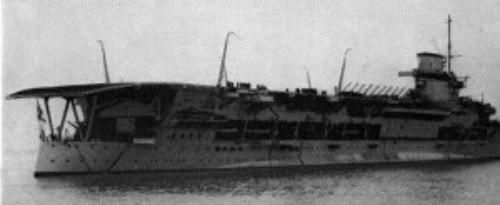
| Navy | The Royal Navy |
| Type | Aircraft Carrier |
| Class | Courageous |
| Pennant | 77 |
| Built by | Harland & Wolff Ltd. (Belfast, Northern Ireland) |
| Ordered | |
| Laid down | 1 May 1915 |
| Launched | 20 Apr 1916 |
| Commissioned | 14 Oct 1916 |
| Lost | 8 Jun 1940 |
| Loss position | 68° 45'N, 3° 50'E |
| History | Converted to aircraft carrier at Rosyth Dockyard and Devonport Dockyard from 1 February 1924 until 10 March 1930. Recommissioned on 7 January 1930, this was prior to the completion of her conversion. During the withdrawl from Norway, HMS Glorious (Capt. Guy D'Oyly-Hughes, DSO and Bar, DSC, RN) and her escorting destroyers HMS Acasta and HMS Ardent encountered the German battlecruisers Gneisenau and Scharnhorst. All three ships were then sunk with great loss of life. [For more details see the events below.] |
Commands listed for HMS Glorious (77)
Please note that we're still working on this section
and that we only list Commanding Officers for the duration of the Second World War.
| Commander | From | To | |
| 1 | Capt. Guy D'Oyly-Hughes, DSO, DSC, RN | 14 Jun 1939 | 8 Jun 1940 (+) |
You can help improve our commands section
Click here to Submit events/comments/updates for this vessel.
Please use this if you spot mistakes or want to improve this ships page.
Notable events involving Glorious include:
The page of HMS Glorious was created in April 2023.
[Note: information regarding operations by the Fleet Air Arm (FAA) aircraft of HMS Glorius is not complete on this page. Further research from first hand sources, read original documents from the National Archives, will have to be undertaken in the future.]
31 Aug 1939
Several ships from the Mediterranean Fleet departed Alexandria for exercises; these were the battleships HMS Warspite (Capt. V.A.C. Crutchley, VC, DSC, RN, flying the flag of A/Admiral A.B. Cunningham, KCB, DSO and 2 Bars, RN), HMS Barham (Capt. H.T.C. Walker, RN, flying the flag of Vice Admiral G. Layton, CB, DSO, RN), HMS Malaya (Capt. I.B.B. Tower, DSC, RN), heavy cruisers HMS Devonshire (Capt. J.M. Mansfield, DSC, RN, flying the flag of Vice-Admiral J.H.D. Cunningham, CB, MVO, RN), HMS Sussex (Capt. A.R. Hammick, RN), light cruiser HMS Galatea (Capt. E.G.H. Bellars, RN, flying the flag of Vice-Admiral J.C. Tovey, CB, DSO, RN) and the destroyers HMS Grenville (Capt. G.E. Creasy, MVO, RN), HMS Gallant (Lt.Cdr. C.P.F. Brown, RN), HMS Grafton (Cdr. M.S. Thomas, RN), HMS Glowworm (Lt.Cdr. G.B. Roope, RN), HMS Greyhound (Cdr. W.R. Marshall-A'Deane, RN), HMS Cossack (Capt. D. de Pass, RN) and HMS Maori (Cdr. G.N. Brewer, RN), HMS Nubian (Cdr. R.W. Ravenhill, RN) and HMS Zulu (Cdr. J.S. Crawford, RN).
At sea they were joined by the aircraft carrier HMS Glorious (Capt. G. D’Oyly-Hughes, DSO and Bar, DSC, RN) and her attendant destroyer HMS Bulldog (Lt.Cdr. J.S.M. Richardson, RN) which had already been exercising off Alexandria since 30 August.
The Fleet returned to Alexandria in the morning of 1 September 1939. (1)
11 Sep 1939
Several ships from the Mediterranean Fleet conducted gunnery exercises off Alexandria; these were the battleships HMS Warspite (Capt. V.A.C. Crutchley, VC, DSC, RN, flying the flag of A/Admiral A.B. Cunningham, KCB, DSO and 2 Bars, RN), HMS Barham (Capt. H.T.C. Walker, RN, flying the flag of Vice Admiral G. Layton, CB, DSO, RN), HMS Malaya (Capt. I.B.B. Tower, DSC, RN), heavy cruisers HMS Devonshire (Capt. J.M. Mansfield, DSC, RN, flying the flag of Vice-Admiral J.H.D. Cunningham, CB, MVO, RN), HMS Sussex (Capt. A.R. Hammick, RN), light cruisers HMS Arethusa (Capt. Q.D. Graham, RN, flying the flag of Rear-Admiral H.R. Moore, CB, DSO, CVO, RN), HMS Penelope (Capt. G.D. Yates, RN) and four destroyers from the 4th Destroyer Flotilla; HMS Afridi (Capt. G.H. Cresswell, DSC, RN), HMS Gurkha (Cdr. F.R. Parham, RN), HMS Mohawk (Cdr. R.F. Jolly, RN) and HMS Sikh (Cdr. J.A. Giffard, RN).
On completion of these exercises these ships set course to take up a position to the west of Crete to provide cover for convoy Green 1 passing from west to east through the Mediterranean and Blue 1 passing from east to west through the Mediterranean. Also cover was provided for a French eastbound convoy.
HMS Barham and HMS Penelope however returned to Alexandria after the exercises had been completed while the aircraft carrier HMS Glorious (Capt. G. D’Oyly-Hughes, DSO and Bar, DSC, RN), and her attendant destroyer HMS Bulldog (Lt.Cdr. J.S.M. Richardson, RN), which had been conducting flying exercises off Alexandria, joined the other ships.
HMS Devonshire, HMS Sussex and the four Tribal class destroyers were detached for patrol as was HMS Arethusa later although HMS Arethusa rejoined on the 15th having patrolled the Kithera Channel. The patrol for HMS Sussex was apparently later cancelled and she proceeded to Malta for a docking.
The Fleet returned to Alexandria on 16 September.
[For more info on convoy Green 1, see the event ' Convoy Green 1 ' for 7 September 1939.]
[For more info on convoy Blue 1, see the event ' Convoy Blue 1 ' for 9 September 1939.]
[For the moment no info is available on the French convoy.] (2)
27 Sep 1939
The battleships HMS Warspite (Capt. V.A.C. Crutchley, VC, DSC, RN, flying the flag of A/Admiral A.B. Cunningham, KCB, DSO and 2 Bars, RN), HMS Barham (Capt. H.T.C. Walker, RN, flying the flag of Vice Admiral G. Layton, CB, DSO, RN), HMS Malaya (Capt. I.B.B. Tower, DSC, RN) and the aircraft carrier HMS Glorious (Capt. G. D’Oyly-Hughes, DSO and Bar, DSC, RN) departed Alexandria for exercises. They were escorted by the destroyers HMS Gallant (Lt.Cdr. C.P.F. Brown, RN), HMS Decoy (Cdr. E.G. McGregor, RN), HMS Defender (Lt.Cdr. St.J.R.J. Tyrwhitt, RN), HMS Delight (Cdr. M. Fogg-Elliott, RN), HMS Duchess (Lt.Cdr. R.C.M. White, RN) and HMS Bulldog (Lt.Cdr. J.S.M. Richardson, RN).
HMS Warspite returned to harbour around 1800B/27. HMS Barham and HMS Malaya returned to harbour around 1630B/28. HMS Glorious returned to harbour around 1500B/29. (2)
1 Oct 1939
1 October 1939, an enemy raider reported in the South Atlantic and Indian Ocean. The chase of the German ‘pocket battleship’ Admiral Graf Spee
Movements of the German ‘pocket battleship’ Admiral Graf Spee 21 August 1939 – 13 December 1939.
Before the Second World War had started, on 21 August 1939, the German ‘pocked battleship’ Admiral Graf Spee departed Wilhelmshaven bound for the South Atlantic. On 1 September the Admiral Graf Spee was off the Canary Islands where she made rendes-vous with the supply ship Altmark and supplies were transferred.
On 11 September another rendes-vous was made with the Altmark in the South Atlantic. The Admiral Graf Spee had launched her Arado floatplane to scout in the area as supplies were transferred. The aircraft spotted the British heavy cruiser HMS Cumberland (Capt. W.H.G. Fallowfield, RN). The German ships then immediately parted company and cleared the area at high speed. Two days later, on the 13th, the ships again met and fueling was completed. The Admiral Graf Spee was still under orders to remain unseen.
On 20 September 1939 the Admiral Graf Spee and Altmark met again to fuel. On the 26th the Admiral Graf Spee was ordered to start raiding the British trade lanes. She then proceeded towards the Pernambuco area.
On 30 September 1939 the Admiral Graf Spee found her first victim, the British merchant vessel Clement (5050 GRT, built 1934) that was en-route from New York, U.S.A. to Bahia, Brasil. She then sank the ship in position 09°05’S, 34°05’W. The Admiral Graf Spee then proceeded eastwards and found three more victims between 5 and 10 October. On the 5th she captured the British merchant Newton Beech (4644 GRT, built 1925) in position 09°35’S, 06°30’W. This ship was en-route from Capetown to the U.K. via Freetown. On the 7th she sank the British merchant Ashlea (4222 GRT, built 1929) in position 09°52’S, 03°28’W. This ship was en-route from Durban to Falmouth. The crew of the Ashlea was transferred to the Newton Beech. The next day both crew were transferred to the Admiral Graf Spee and the Newton Beech was scuttled. On 10 October the Admiral Graf Spee captured the British merchant Huntsman (8196 GRT, built 1921) in position 08°30’S, 05°15’W. This ship was en-route from Calcutta to the U.K. On 15 October 1939 the Admiral Graf Spee met the Altmark again to receive supplies and fuel. On the 17th the crew of the Huntsman was transferred to the Altmark and the ship was scuttled in approximate position 16°S, 17°W. The next day the crews of the Newton Beech and Ashlea were also transferred to the Altmark and the German ships then parted company.
On 22 October 1939, the Admiral Graf Spee sank her next victim, the British merchant Trevanion (5299 GRT, built 1937) which was en-route from Port Pirie (Australia) to Swansea. This ship was sunk in position 19°40’S, 04°02’E. On 28 October 1939, near Tristan da Cunha, the Admiral Graf Spee once more refuelled from the Altmark. The Admiral Graf Spee then set course for the Indian Ocean.
On 15 November 1939 she sank the small British tanker Africa Shell (706 GRT, built 1939) in position 24°45’S, 35°00’E. This ship was in ballast and en-route from Quelimane (Portugese East Africa now called Mozambique) to Lourenco Marques (now Maputo, also in Portugese East Africa / Mozambique). Next day the Admiral Graf Spee stopped the Dutch merchant Mapia (7188 GRT, built 1923) but had to let her go as she was a neutral ship. The Admiral Graf Spee then set course to return to the South Atlantic where she met once more with the Altmark on 27 November 1939 and the next day she fuelled from her about 300 miles from Tristan da Cunha.
On 2 December 1939, the Admiral Graf Spee sank her largest victim, the British merchant Doric Star (10086 GRT, built 1921),in position 19°15’S, 05°05’E. This ship was en-route from Auckland, New Zealand to the U.K. The next morning the Admiral Graf Spee sank the British merchant Tairoa (7983 GRT, built 1920) in position 19°40’S, 04°02’E. This ship was en-route from Brisbane, Australia to London. On 6 December 1939 the Admiral Graf Spee refuelled once more from the Altmark. She then set course to the River Plate area where the British merchant traffic was the thickest. She was to sink more ships there and disrupt British shipping movements in that area before returning to Germany.
On 7 December 1939 the Admiral Graf Spee sank what was to be her last victim, the British merchant Streonshalh (3895 GRT, built 1928) in position 25°01’S, 27°50’W. This ship was en-route from Montevideo to Freetown and then onwards to the U.K.
Then in the morning of 13 December 1939, her smoke was sighted by three cruisers from the South America Division. More on this in the article ‘The Battle of the River Plate, 13 December 1939’.
British Dispositions in the South Atlantic / South America area
Shortly before the outbreak of the war the South America Division of the America and West Indies Station was transferred to the newly formed South Atlantic Station. The South America Division at that moment consisted of the heavy cruiser HMS Exeter (Capt. F.S. Bell, RN, flying the flag of Commodore H.H. Harwood, OBE, RN) and the light cruiser HMS Ajax (Capt. C.H.L. Woodhouse, RN). In late August 1939 HMS Exeter was at Devonport with her crew on foreign leave when she was recalled to South American waters. On 25 August 1939 she sailed from Devonport. HMS Exeter arrived at Freetown on 1 September 1939. Commodore Harwood then met the Commander-in-Chief South Atlantic Station, Vice-Admiral G. D’Oyly Lyon, CB, RN. Later the same day HMS Exeter sailed for Rio de Janeiro.
Meanwhile four destroyers from the 4th Destroyer Division, Mediterranean Fleet, the HMS Hotspur (Cdr. H.F.H. Layman, RN), HMS Havock (Lt.Cdr. R.E. Courage, RN), HMS Hyperion (Cdr. H.St.L. Nicholson, RN) and HMS Hunter (Lt.Cdr. L. de Villiers, RN) had left Gibraltar on 31 August 1939 for Freetown.
HMS Ajax was already on station off the coast of South America. Shortly after noon on 3 September she intercepted the German merchant vessel Olinda (4576 GRT, built 1927) in position 34°58’S, 53°32’W. This ship was en-route from Montivideo to Germany. As HMS Ajax had no prize crew available the ship was sunk by gunfire a few hours later. In the afternoon of the next day, the 4th, HMS Ajax intercepted another German ship, the Carl Fritzen (6594 GRT, built 1920) in position 33°22’S, 48°50’W. This ship was en-route from Rotterdam to Buenos Aires. This ship was also sunk with gunfire.
On 5 September two of the destroyers from the 4th Destroyer Division, HMS Hotspur and HMS Havock departed Freetown to join the South America Division. They were ordered to examine Trinidade Island on the way. On 8 September 1939 the heavy cruiser HMS Cumberland (Capt. W.H.G. Fallowfield, RN) departed Freetown to join the South America Division as well. This cruiser came from the Home Fleet and had arrived at Freetown on the 7th.
On 7 September 1939, HMS Exeter entered Rio de Janeiro where Commodore Harwood had a meeting with the Brazilian Secretary-General of Foreign Affairs and H.M. Ambassadors to Brazil and Argentine. HMS Exeter departed Rio de Janeiro the next day. Later that day Commodore Harwood was informed by the Admiralty that the German merchant ships General Artigas (11343 GRT, built 1923), Gloria (5896 GRT, built 1917) and Monte Pascoal (13870 GRT, built 1931) were assembling off the Patagonian coast. He decided to move both HMS Exeter and HMS Ajax south, and ordered the Ajax to meet him at 0800/9. They actually made rendezvous at 0700 hours. The Commodore considered it possible that the German merchant ships might embark German reservists and raid the Falkland Islands therefore he decided to sent HMS Ajax there. HMS Exeter proceeded to the Plate area to cover that important area.
On the evening of the 10th, Commodore Harwood was informed that the transportation of German reservists by the three German merchant ships was very unlikely but as it appeared probable that the German ships were converting themselves into armed raiders the Commodore decided to start short distance convoys from the Santos-Rio and Plate areas. He therefore ordered HMS Cumberland to refuel at Rio de Janeiro on her arrival there and to organize and run ‘out’ convoys in that area with HMS Havock as A/S escort. The convoys were to leave at dawn and be protected against submarines and surface raiders until dusk. The ships were then to be dispersed so that they would be far apart by dawn the next day. At the same time the Commodore ordered HMS Hotspur to join him in the Plate area after refuelling at Rio de Janeiro, so that similar convoys could be started from Montevideo. If one of the German ‘pocket battleships’ was to arrive of South America, HMS Cumberland was to abandon the convoy sheme and join HMS Exeter in the Plate area. Also on the 10th, Commodore Harwood was informed by the Admiralty that the German merchant Montevideo (6075 GRT, built 1936) was leaving Rio Grande do Sul for Florianopolis but decided not to intercept her as this would divert HMS Exeter 500 nautical miles from the Plate area.
On the night of 12 September 1939 the Commodore was informed by the British Naval Attaché, Buenos Aires, that a concentration of German reservists was taking place in southern Argentina with the Falklands as a possible objective. He therefore ordered HMS Ajax to remain in the Falklands till the situation cleared, and the Commodore then proceeded south of the Plate area to be closer to the Falklands himself and yet remain in easy reach of the Plate area. During the next few days HMS Exeter intercepted several British and neutral vessels.
In view of a report that the German merchant vessels Porto Alegré (6105 GRT, built 1936) and Monte Olivia (13750 GRT, built 1925) were leaving Santos on 15 September 1939 Commodore Harwood decided to start the short distance convoys from Montevideo as soon as possible. HMS Cumberland had meanwhile arranged a twelve-hour convoy system from Santos. Ships from Rio de Janeiro for Freetown would sail at dawn on odd numbered days, and ships for the south on even numbered days with HMS Havock as anti-submarine escort and HMS Cumberland in distant support. HMS Cumberland left Rio de Janeiro on 16 September and during the next eight days sighted 15 British and neutral ships while on patrol.
On 17 September 1939, HMS Hotspur joined HMS Exeter in the Plate area. HMS Exeter then made a visit to Montevideo and resumed her patrol off the Plate area on the 20th. Fuelling was done from the oiler RFA Olwen (6470 GRT, built 1917, Master B. Tunnard) in the mouth of the River Plate. Soon after leaving Montevideo on 20 September Commodore Harwood learned from the British Naval Attaché, Buenos Aires, that the local German authorities were endeavoring to inform German ships at sea that the British merchant Lafonia (1872 GRT, built 1911) was on her way to the Falklands with British reservists for the Falkland Islands defence force. It was also reported that on 17 September an unknown warship had passed Punta Arenas eastwards. In view of these reports and of other pointing out that German merchant ships in southern waters were being outfitted as armed raiders the Commodore ordered HMS Hotsput to escort the Laofona to Port Stanley. As the volume of trade in the Plate area was greater than in the Rio de Janeiro – Santos area, HMS Havock was ordered to proceed southwards to the Plate area.
The first local convoy outward from Montevideo sailed on 22 September 1939. It consisted of the British merchant ships Sussex (11062 GRT, built 1937), Roxby (4252 GRT, built 1923), El Ciervo (5841 GRT, built 1923) in addition to the earlier mentioned Lafonia, and was escorted by HMS Hotspur. HMS Exeter met this convoy during the forenoon and covered it throughout the day. At dusk the merchant ships were dispersed on prearranged courses while HMS Exeter remained within supporting distance and HMS Hotspur escorted the Lafonia to Port Stanley.
On 24 September 1939, Vice-Admiral Lyon (C-in-C, South Atlantic) and Commodore Harwood learned from the Naval Attaché, Buenos Aires, that ‘according to a reliable source’ arrangements had been made for a number of German ships and a submarine to meet near Ascension on 28 September 1939. HMS Cumberland was ordered to proceed there and HMS Ajax was ordered to leave the Falklands and take up her place in the Rio de Janeiro area. HMS Neptune (Capt. J.A.V. Morse, DSO, RN) was also ordered to proceed to the area off Ascension with the destroyers HMS Hyperion and HMS Hunter which departed Freetown on the 25th. No German ships were however encountered off Ascension and all ships then proceeded to Freetown where they arrived on 2 October 1939 with HMS Cumberland low on fuel.
While HMS Cumberland left the station to search for the German ships, HMS Exeter and HMS Ajax were sweeping of the Plate and Rio de Janeiro – Santos area respectively. On 27 September 1939, HMS Havock escorted a convoy made up of the British merchants Miguel de Larrinaga (5231 GRT, built 1924), Pilar de Larringa (7352 GRT, built 1918) and Sarthe (5271 GRT, built 1920) out of the Plate area. The next day another convoy, made up of the British merchants Adellen (7984 GRT, built 1930), Cressdene (4270 GRT, built 1936), Holmbury (4566 GRT, built 1925), Lord Byron (4118 GRT, built 1934), Ramillies (4553 GRT, built 1927) and Waynegate (4260 GRT, built 1931) left the Plate area escorted by HMS Havock and with cover from HMS Exeter.
At daylight on 29 September 1939 HMS Ajax was off Rio de Janeiro ready to escort ships sailing northward. She sighted none until the early afternoon when she met the Almeda Star (12848 GRT, built 1926) and a few hours later the tanker San Ubaldo (5999 GRT, built 1921). That night several neutral steamers were sighted off Rio de Janeiro and the next day the British La Pampa (4149 GRT, built 1938) was met and escorted during daylight on her way to Santos. So far on the work of the South American Division during September 1939. The ships assigned to Commodore Harwood had been busy patrolling and escorting ships near the focal areas.
A surface raider reported, 1 October 1939.
When a report that the British merchant Clement had been sunk on 30 September 1939 by a surface raider off Pernambuco was received by the Admiralty in the afternoon of October 1st, the C-in-C, South Atlantic was informed that he should retain the 4th Destroyer Division and that his command would be reinforced by the cruisers HMS Norfolk (Capt. A.G.B. Wilson, DSO, RN), HMS Capetown (Capt. T.H. Back, RN), HMS Effingham (Capt. J.M. Howson, RN), HMS Emerald (Capt. A.W.S. Agar, VC, DSO, RN) and HMS Enterprise (Capt. H.J. Egerton, RN). Also the battleships HMS Resolution (Capt. C.H. Knox-Little, RN), HMS Revenge (Capt. E.R. Archer, RN) and the aircraft carrier HMS Hermes (Capt. F.E.P. Hutton, RN) were to proceed to either Jamaica or Freetown. These dispositions however never materialised being superseded on 5 October 1939 by a more general policy (the institution of hunting groups) which cancelled them.
The institution of hunting groups, 5 October 1939.
On 5 October 1939 the Admiralty formed five hunting groups in the Atlantic and Indian Ocean of sufficient strength to destroy any ‘pocket battleship’ or Hipper-class cruiser. These were; Force F; area: North America and West Indies. HMS Berwick (Capt. I.M. Palmer, DSC, RN), HMS York (Capt. R.H. Portal, DSC, RN), Force G; area: S.E. coast of South America. HMS Cumberland, HMS Exeter Force H; area: Cape of Good Hope, South Africa. HMS Sussex (Capt. A.R. Hammick, RN), HMS Shropshire (Capt. A.W.LaT. Bisset, RN), Force I; area: Ceylon. HMS Cornwall (Capt. C.F. Hamill, RN), HMS Dorsetshire (Capt. B.S.C. Martin, RN), HMS Eagle (Capt. A.R.M. Bridge, RN), Force K; area: Pernambuco, Brazil. HMS Renown (Capt. C.E.B. Simeon, RN), HMS Ark Royal (Capt. A.J. Power, RN), Force L; area: Brest, France. Dunkerque (Capt. J.L. Nagadelle, replaced by Capt. M.J.M. Seguin on 16 October), Bearn (Capt. M.M.A. Lafargue, replaced by Capt. Y.E. Aubert on 7 October), Georges Leygues (Capt. R.L. Perot), Gloire (Capt. F.H.R. de Belot), Montcalm (Capt. P.J. Ronarc’h), Force M; area: Dakar, Senegal. Dupleix (Capt. L.L.M. Hameury), Foch (Capt. J. Mathieu), and Force N; area: West Indies. Strasbourg (Capt. J.F.E. Bouxin), HMS Hermes.
The institution of the hunting groups were not the only measures taken. The battleships HMS Resolution, HMS Revenge and the light cruisers HMS Emerald and HMS Enterprise were ordered to proceed to Halifax, Nova Scotia to escort homeward bound convoys. Light cruiser HMS Effingham was to join them later. The battleship HMS Ramillies (Capt. H.T. Baillie-Grohman, DSO, RN) left Gibraltar on 5 October for the same duty but was recalled the next day when the battleship HMS Malaya (Capt. I.B.B. Tower, DSC, RN) and the aircraft carrier HMS Glorious (Capt. G. D’Oyly-Hughes, DSO and Bar, DSC, RN) were ordered to leave the Mediterranean and proceed to the Indian Ocean where they formed an addition hunting group, Force J which was to operate in the Socotra area off the entrance to the Gulf of Aden.
Now back to the South Atlantic, on 9 October 1939 the C-in-C, South Atlantic had informed the Admiralty and Commodore Harwood that he intended to co-ordinate the movements of ‘Force G’, ‘Force H’ and ‘Force K’. As this would entail long periods of wireless silence in ‘Force G’ he proposed that Commodore Harwood should transfer his flag to HMS Ajax, leaving Capt. Fallowfield of HMS Cumberland in command of Force G. The Admiralty approved of this. Commodore Harwood stated that it was his intention to transfer his flag from HMS Exeter to HMS Ajax in the River Plate area on 27 October. He also stated that the endurance of HMS Exeter was only half the endurance of HMS Cumberland and that this would prove problematic when they were to operate together and he proposed that the Exeter would be relieved by another 10000 ton cruiser but for the moment no suitable cruiser was available to relieve her.
On 12 October 1939 the first of the hunting forces arrived on their station when HMS Renown and HMS Ark Royal reached Freetown that morning coming from the U.K. They were soon followed by three more destroyers of the H-class coming from the Mediterranean; HMS Hardy (Capt. B.A. Warburton-Lee, RN), HMS Hasty (Lt.Cdr. L.R.K. Tyrwhitt, RN) and HMS Hostile (Cdr. J.P. Wright, RN). On 13 October 1939 the cruisers HMS Sussex and HMS Shropshire arrived at Simonstown from the Mediterranean and one day later HMS Hermes arrived at Dakar from Plymouth.
The South America Division during the first half of October 1939.
When the news of an enemy raider in the South Atlantic reached the C-in-C at Freetown on 1 October 1939 he immediately suspended sailings from Pernambuco and Natal and he ordered HMS Havock and HMS Hotspur to escort British ships clear of the area. But next morning he cancelled these dispositions and ordered Commodore Harwood to concentrate HMS Exeter, HMS Ajax and the two destroyers off Rio de Janeiro. By this time, however, the raider was far away from the South American coast. On 3 October 1939 the Commodore signalled the C-in-C that he intened to concentrate the Exeter and Ajax off Rio and have the Hotspur to cover the Rio – Santos area and keep the Havock off the Plate but upon receiving the orders from the C-in-C to concentrate he ordered to destroyers to join the cruisers after fuelling but not later then 0800 hours on 4 October. Reports that the enemy raider was not a ‘pocket battleship’ however kept coming in and the Commodore decided that he could not leave the heavy traffic in the Plate area without some form of protection and he ordered HMS Havock to return there but when a report coming in from Bahia, Brazil confirmed that the Clement had been sunk by the ‘pocket battleship’ Admiral Scheer the Commodore once more ordered HMS Havock to join him. In the end HMS Ajax joined HMS Exeter at 1700/3, HMS Hotspur at 0500/4 and finally HMS Havock at 1300/4.
The Commodore was also informed by the Admiralty that the New Zealand cruiser HMS Achilles (New Zealand Division) (Capt. W.E. Parry, RN) would join his station coming from the west coast of South America. HMS Cumberland left Freetown at 1900/3 to join the Commodore in the Rio de Janeiro area as well.
Commodore Harwood’s policy against enemy raiders and a new raider report coming on on 5 October 1939.
Commodore Harwood had decided to keep his forces concentrated and as no new raider reports had come in to patrol the Rio de Janeiro area in accordance with the C-in-C, South Atlantic’s order. If he met a ‘pocket battleship’ he intended to shadow it until dusk. He would then close and attack in the dark hours. If, on the other hand, he made contact at night, his destroyers would at once close the enemy’s beam and attack her with torpedoes.
On 5 October 1939, the British merchant Martand (7967 GRT, built 1939) informed HMS Cumberland that a German armed raider had attacked an unknown ship, this unknown ship was in fact the Newton Beech that was attacked about 900 nautical miles away. This information was not acted upon by the Commanding Officer of the Cumberland. The Captain of the Cumberland assumed the raider report would have been intercepted by other ships and passed on to the C-in-C, South Atlantic. He considered it was important to keep radio silence and decided against breaking it. The Admiralty however later was of the opinion that the report should have been passed on to the Commander-in-Chief.
By 5 October 1939, the Exeter, Ajax, Havock and Hotspur were concentrated in the Rio de Janeiro area ready to engage the raider if she came south from the Pernambuco area. HMS Achilles was on her way round Cape Horn.
When HMS Ajax visited Rio de Janeiro on 7 October 1939, Commodore Harwood directed her to suggest to the Consular Shipping Advisers there, and at Santos, that, owning to the small volume of shipping leaving these ports, the local convoy systems, which had been instituted on 22 September against armed merchant raiders, should be suspended, and Allied merchant ships be routed independently.
The Commodore intended to meet HMS Cumberland at 1700/8, but at 1600/7 he received a message from the Consular Shipping Adviser at Rio de Janeiro in which he desired an escort for a 13 knot convoy that was to sail at 0430/8 and that had received much local publicity. The Commodore thought that this publicity might draw the enemy raider to the area and he therefore took his entire force back towards Rio de Janeiro and sent HMS Hotspur ahead to make contact with the convoy, while keeping his other ships in support. The convoy consisted of the British merchants Highland Chieftain (14131 GRT, built 1929), Nariva (8723 GRT, built 1920) and the French merchant Alsina (8404 GRT, built 1922).
Meanwhile the Commodore had directed HMS Cumberland to meet him at dawn on October 9th. When the convoy was dispersed at 1800/8 the Exeter and Ajax steered to meet her while the Havock was detached to fuel at Rio de Janeiro. At 2200/8 HMS Ajax was detached. HMS Cumberland made rendezvous with HMS Exeter at 0500/9. They were ordered by the C-in-C, South Atlantic to make a sweep northwards but this could not be carried out as HMS Exeter was short of fuel. The Commodore therefore decided to make a sweep southwards towards the Plate area where HMS Exeter could refuel. He also decided to keep HMS Hotspur with the two cruisers as long as possible.
On 12 October 1939, Rio Grande do Sul reported that the German merchant Rio Grande (6062 GRT, built 1939) was about to sail. The Commodore at once ordered HMS Cumberland to proceed there and intercept. She arrived off Rio Grande do Sul at 1600/13 but on finding it all quiet in the harbour she shaped course for the Plate area at nightfall. Meanwhile the Commodore had ordered HMS Hotspur to fuel at Montevideo when HMS Havock left that port early on the 14th.
about this time RFA Olwen informed the Commodore the the German merchant Bahia Laura (8611 GRT, built 1918) was leaving Montevideo at 1000 next morning and might protest if HMS Havock sailed the same day. Instead, therefore, of entering Montevideo HMS Hotspur at once fueled from the Olwen and then remained out on patrol. The Bahia Laura however, showed no signs of leaving and at 0800/14, HMS Havock put to sea. At 1200 hours HMS Hotspur entered Montevideo. Later that day HMS Exeter and HMS Cumberland fueled from the Olwen in San Borombon Bay at the southern entrance to the Plate estuary. At 1430 hours they were joined by HMS Havock. Commodore Harwood then ordered her to patrol off Montevideo to watch the Bahia Laura. When HMS Exeter finished fueling she immediately put to sea. HMS Cumberland rejoined him next morning at 0700 hours. HMS Havock was then ordered to join the cruisers. On 16 October the commodore learned that the Bahia Laura had sailed at 1015 hours the previous day. By the time the signal reached him the German ship was far out at sea well past his patrol line. But as the whole area was enveloped in dense fog the Commodore decided against trying to catch her.
The South America Division during the second half of October 1939.
Meanwhile Commodore Harwood had informed the Commander-in-Chief, South Atlantic on 13 October that as HMS Exeter required certain minor repairs he proposed to proceed to the Falklands on the17th and then return to the Plate area on the 27th. The Commander-in-Chief replied that he preferred that HMS Exeter would stay in the Plate area till the Commodore would transfer his Broad Pendant to HMS Ajax on the 27th. As HMS Achilles was due in the Plate area on this day also, she and HMS Cumberland could then operate as ‘Force G’ during the Exeter’s absence. This would mean that there would be no cruiser in the Rio de Janeiro area until HMS Exeter would return from her repairs at the Falklands. The Commodore therefore ordered HMS Havock to sail on 21 October for a four day patrol in the Rio – Santos Area, where HMS Hotspur, which could remain at sea until 2 November, would relieve her. From that date until the relief of HMS Achilles there would be no warship in this area. The Commodore therefore asked the Commander-in-Chief to allow ‘Force G’ to operate in that area from 2 to 10 November. When HMS Hotspur joined the Exeter and Cumberland from Montevideo on 17 October the Commodore ordered her to patrol off Rio Grande do Sul to intercept the German ships Rio Grande and Montevideo if they would come out, and sent HMS Havock to patrol inshore with orders to anchor the night clear of the shipping route.
This proved to be the last duty of these two destroyers with the South America Division. On 20 October the Admiralty ordered their transfer to the West Indies. Three days later the Commodore sent them into Buenos Aires to refuel, and as the distance to Trinidad, 4000 miles, was at the limit of their endurance, also obtained permission to refuel them at Pernambuco. They both left Buenos Aires on the 25th and, bidding the Commodore farewell, proceeded northwards. They sailed from Pernambuco on 1 November but on the 3rd HMS Havock was diverted to Freetown with engine trouble. The two remaining destroyers of the 4th Division, HMS Hyperion and HMS Hunter, had left Freetown with convoy SL 6 on 23 October. Off Daker their escort duty was taken over by the French light cruiser Duguay-Trouin (Capt. J.M.C. Trolley de Prevaux). The destroyers then fueled at Dakar on the 27th and sailed for Trinidad early on the 28th.
Meanwhile HMS Cumberland had entered Montevideo at 0800/26. At 0900/26 HMS Achilles joined HMS Exeter in the Plate area and after fueling from RFA Olwen sailed to meet HMS Cumberland off Lobos the next day and then patrol with her as ‘Force G’ in the Rio – Santos area. The Olwen was now nearly out of fuel and filled up HMS Ajax ,which had arrived from the Rio area on the 26th, with her remaining fuel minus 500 tons for her passage to Trinidad. In the morning of 27 October, Commodore Harwood transferred his Broad Pendant to HMS Ajax and HMS Exeter then parted company to proceed to the Falklands for repairs.
Meanwhile the newly formed ‘Force H’ and ‘Force K’ were busy on the other side of the South Atlantic. ‘Force H’, made up of HMS Sussex and HMS Shropshire had reached the Cape on 13 October. As HMS Cumberland had not passed on the report of the Martland, no news on the raider had reached the Admiralty or the Commander-in-Chief since October 1st. On 14 October ‘Force H’ sailed to search for her along the Cape – Freetown route as far as the latitude of St. Helena. That day ’Force K’ (HMS Ark Royal and HMS Renown) left Freetown with HMS Neptune, HMS Hardy, HMS Hero (Cdr. C.F. Tower, MVO, RN) and HMS Hereward (Lt.Cdr. C.W. Greening, RN) to search westwards towards St. Paul Rocks, the direction of their sweep being determined by the complete lack of any further raider information.
Finally a raider report on 22 October 1939, Sweeps by ‘Force H’ and ‘Force K’.
The three weeks old ‘mystery’ of the raiders whereabouts was partially solved on 22 October when the British merchant vessel Llanstephan Castle (11293 GRT, built 1914) intercepted a message from an unknown ship ‘Gunned in 16°S, 04°03’E’ at 1400 G.M.T. There was however no immediate confirmation of her report and the Commander-in-Chief ordered ‘Force H’ to sail after dark on the 27th to sail for the latitude of St. Helena. At noon on 31 October this Force was in 15°S, 02°51’E, the north-eastern limit of it’s patrol, when a Walrus aircraft failed to return to HMS Sussex from a reconnaissance flight. It was never found, though the two cruisers spend over three days searching for it. Being short of fuel they then returned to the Cape by the same route they had used outwards.
Sweep by ‘Force K’, 28 October – 6 November 1939.
To cover the northern end of the route from St. Helena onward, HMS Neptune and the destroyers HMS Hardy, HMS Hasty, HMS Hero and HMS Hereward had left Freetown on 28 October. HMS Neptune was to sweep independently from position 03°20’S, 01°10’W and then through 14°30’S, 16°50’W back to Freetown. On 30 October a report from Dakar stated that the German merchant Togo (5042 GRT, built 1938) had left the Congo on 26 October, that the German merchant Pionier (3254 GRT, built 1934) had sailed from Fernando Po (now called Bioko Island) on 28 October and that five German ships had left Lobito (Angola) the same day. When the Vice-Admiral, Aircraft Carriers, received this information her detached HMS Hardy and HMS Hasty to sweep north-westward for the Pioneer, while ‘Force K’ and the remaining two destroyers searched for her to the south-westward. Both searches were unsuccessful. Meanwhile a message from Lobito had stated that the five German ships that were stated to have left the harbour were still there. On 5 November the German merchant vessel Uhenfels (7603 GRT, built 1931), that had left Laurenco Marques (now called Maputo, Mozambique) on 16 October was sighted by an aircraft from HMS Ark Royal. Only energetic action from HMS Hereward saved her from being scuttled in position 06°02’N, 17°25’W. She was brought into Freetown on 7 November by HMS Herward, a few hours behind ‘Force K’.
’Force H’ and ‘Force G’, first half of November 1939.
The first half of November was relatively quiet on both sides of the South Atlantic At the start of the month ‘Force H’ and ‘Force K’ were still on the shipping lane between Sierra Leone and the Cape. On 3 November 1939 the Admiralty informed the Commander-in-Chief, South Atlantic that all German capital ships and cruisers were apparently in home waters. It appeared therefore that the pocket battleship, which was still thought to be the Admiral Scheer, had returned home and that the raider reported by the Llangstephan Castle on 22 October was nothing but an armed merchantman. Here was a good opportunity for resting the hunting groups and on 4 November the Admiralty issued orders that ‘Force G’ and ‘Force H’ should exchange areas. This exchange would not only give ‘Force G’ an opportunity of resting and refitting at the Cape, but would also provide Commodore Harwood with the hunting group of long endurance that he desired.
The Commander-in-Chief had planned that ‘Force H’ which had returned to the Cape on 7 November would then sweep towards Durban, arriving there on 16 November. However on the 11th they were ordered to sail for patrol in the Atlantic and on the evening of the 17th, while west of St. Helena, exchange patrol areas with ‘Force G’. The exchange of areas however did not take place as ‘Force G’ was delayed due to HMS Exeter being damaged while casting off from the oiler in heavy seas. Before the exchange now could take place it was cancelled.
South America Division, first half of November 1939.
After hoisting Commodore Harwood’s Broad on 27 October the HMS Ajax had swept the Plate focal area. When the Commodore received the signal of the Commander-in-Chief on the 5th regarding the changeover over patrol areas between ‘Force G’ and ‘Force H’, he ordered HMS Cumberland to proceed to the Plate at 20 knots to refuel. About this time a message reached him from Buenos Aires that the Argentinian Foreign Minister had drawn attention to cases of fueling in the Plate by HMS Exeter and HMS Ajax. Although the Argentinian Government had no apparent intention of raising the issue he decided to cut down the fuellings in the inshore waters of the Plate as much as possible. He therefore cancelled the fuelling of HMS Exeter, due to take place on 7 November from the oiler RFA Olynthus (6888 GRT, built 1918, Master L.N. Hill), which had relieved RFA Olwen. He ordered HMS Cumberland to fuel at Buenos Aires on 9 November. HMS Exeter which had arrived at the Falklands on 31 October for repairs, sailed again on 4 November to meet up with HMS Cumberland off the Plate on 10 November, but the Commodore ordered her to enter Mar del Plata for a 24-hour visit on the 9th. As this gave her some time at hand, he ordered her to cover the Plate while HMS Ajax visited Buenos Aires from 6 to 8 November during which the Commodore discussed the question of fuelling his ships in the River Plate Estuary with the Argentine naval authorities. During his visit to Buenos Aires, the Commodore discussed the matter of fuelling his ships of English Bank with the Argentinian Minister of Marine and his Chief of Naval Staff they both suggested that he should use San Borombon Bay which was most acceptable. He had in fact been using it for some time.
When HMS Ajax left Buenos Aires on 8 November she patrolled the Plate area. HMS Exeter arrived at Mar del Plata the next day but fuel could not be obtained there. She was ordered to fuel from RFA Olynthus in San Borombon Bay on the 10th and then meet up with HMS Cumberland off Lobos Island at 0600/11. On the 10th HMS Ajax also fueled from RFA Olynthus as did HMS Exeter after her while HMS Ajax was at anchor close by. However weather quickly deteriorated and the Olynthus was forced to cast off, damaging the Exeter in doing so. Besides that she was still 600 tons short of fuel. As she could not reach the Cape without a full supply the sailing of ‘Force G’ to exchange areas with ‘Force H’ was delayed. The Exeter finally finished fuelling on the 13th and sailed with HMS Cumberland for Simonstown. Before the exchange of areas could be effected, however, a raider was reported in the Indian Ocean and the order was cancelled.
Another raider report, 16 November 1939.
On 16 November 1939 the Naval Officer-in-Charge, Simonstown, reported that the small British tanker Africa Shell ( GRT, built ) had been sunk off Lourenco Marques the previous day by a raider identified as a pocket battleship. After the usual conflicting reports from eye-widnesses during the next few days, however, it was doubtful how many raiders there were or whether they were pocket battleships or heavy cruisers.
The presence of an enemy heavy ship in the Mozambique Channel called for new dispositions. When the raider report reached the Admiralty on 17 November they immediately cancelled the exchange of areas between ‘Force G’ an ‘Force H’. ‘Force H’ was ordered to return to the Cape and ‘Force G’ was ordered to return to the east coast of South America. They also ordered the dispatch of ‘Force K’ towards the Cape with instructions to go on to Diego Suarez in Madagascar. That morning a report reached the Commander-in-Chief, South Atlantic that the German merchant vessels Windhuk (16662 GRT, built 1937) and Adolph Woermann (8577 GRT, built 1922) had left Lobito. He at once ordered ‘Force H’, which was at that moment west of St. Helena in the approximate latitute of Lobito to spend three days searching for them.
Next day, 18 November 1939, ‘Force K’ left Freetown together with HMS Neptune, HMS Hardy, HMS Hero and HMS Hostile to sweep west of St. Helena through position 16°30’S, 10°W and thence on to Diego Suarez. The destroyers parted company at 2300/18 to search for the German ships. On 20 November 1939, the Commander-in-Chief ordered ‘Force H’ to return to the Cape of nothing of the German merchant vessels had been sighted. HMS Sussex and HMS Shropshire did so on 23 November.
The Adolph Woermann had not escaped. Early on 21 November 1939, the British merchant Waimarama (12843 GRT, built 1938) reported her in position 12°24’S, 03°31’W. At 1127/21, ‘Force K’ (HMS Ark Royal and HMS Renown) was in position 05°55’S, 12°26’W, altered course to close, and HMS Neptune, which was still with them, went ahead at high speed. Shortly after 0800/22 she made contact with the Adolf Woermann in position 10°37’S, 05°11’W and went alongside. Despite efforts to save her the German vessel was scuttled and when HMS Neptune returned to Freetown on 25 November 1939 she had 162 German survivors on board.
’Force H’ and ‘Force K’, second half of November 1939.
As the search for the Adolf Woermann had taken ‘Force K’ nearly 200 miles to the eastward, the Vice-Admiral, Aircraft Carriers decided to proceed to the Cape by the route east of St. Helena to save fuel. In hindsight this might have saved Altmark for being intercepted as she was waiting for the Admiral Graf Spee in the area ‘Force K’ would have otherwise passed through. On 23 November 1939, the Commander-in-Chief, South Atlantic, ordered ‘Force H’ to sail from the Cape the next day and patrol the ‘diverse routes’ as far as 33°E until 28 November.
At the northern end of the South Atlantic station HMS Neptune, HMS Hardy, HMS Hero, HMS Hostile, HMS Hasty and the submarine HMS Clyde (Cdr. W.E. Banks, RN) had established a patrol between 22 and 25 November 1939 to intercept escaping German merchant ships or raiders. No ships were however sighted and they were recalled to Freetown on 30 November.
In the meantime the Admiralty had ordered, ‘Force H’ and ‘Force K’ to conducted a combined patrol on the meridian of 20°E. The two forces met early on 1 December. The plan, according to the Commander-in-Chief, appeared to be a good one in theory but was found unsuitable in practice that on account of local weather conditions. These permitted flying off aircraft from HMS Ark Royal only once in five or six days, so that the patrol could not be extended far enough to the south to intercept a raider bent on evasion. In fact, only once, on 2 December weather was suitable for flying off aircraft.
South America Division, second half of November 1939.
After HMS Cumberland and HMS Exeter (‘Force G’) had sailed from San Borombon Bay for Simonstown on 13 November 1939, HMS Ajax patrolled the Plate area and escorted the French Massilia ( GRT, built ) that was bound for Europe from Buenos Aeres with French reservists. After parting from the Massilia she closed Rio Grande do Sul and ascertained that the German merchant vessels Rio Grande and Montevideo were still there. For the next two days she patrolled the normal peace time shipping routes.
When the Admiralty cancelled the exchange of ereas between ‘Force G’ and ‘Force H’ on 17 November, Commodore Harwood sent ‘Force G’ to cover Rio de Janeiro. He ordered HMS Achilles to fuel off the Olynthus in the Plate area on 22 November and then relieve ‘Force G’ in the Rio area as HMS Exeter would need to refuel in the Plate area again on 26 November. HMS Cumberland was to remain with the Exeter to keep ‘Force G’ together so she could refuel from the Olynthus as well. They were then to patrol the Plate area so that HMS Ajax could visit the Falklands.
On 18 November the Commodore was informed that the German merchant Ussukuma ( GRT, built ) might sail from Bahia Blanca for Montevideo at any time. He at once ordered the Olynthus to watch for her between Manos and Cape San Antonio and took the Ajax south to the same vicinity.
On 22 November 1939 HMS Achilles heard the German merchant Lahn (8498 GRT, built 1927) calling Cerrito by wireless, and when HMS Ajax arrived half an hour later a search was carried out. It was insuccessful for both cruisers but both the Lahn and another German merchant the Tacoma (8268 GRT, built 1930) reached Montevideo safely during the forenoon.
HMS Ajax and HMS Achilles then both fuelled from the Olynthus at San Borombon Bay during the next afternoon. The Achilles the sailed for the Rio de Janeiro area. She had orders to move up to Pernambuco and show herself off Cabadello and Bahia as a number of German ships in Pernambuco were reported ready to sail to Cabadello to load cotton for Germany. She was to return at once to the Rio area if any raiders were reported in the South Atlantic.
HMS Ajax left the Plate area on 25 November 1939 and sent up a seaplane to reconnoitre Bahia Blanca. The Ussukuma showed no signs of sailing so HMS Ajax proceeded to the Falklands, arriving there on the 27th. By this time HMS Cumberland and HMS Exeter were in urgent need of refits after long periods at sea, and Commodore Harwood ordered the Exeter to proceed to the Falklands forthwith. She arrived at Port Stanley on 29 November 1939 and her defects were immediately taken in hand as far as local resources permitted.
8 December 1939 was the twenty-fifth anniversary of the Battle of the Falklands, and thinking the enemy might attempt to avenge the defeat, the Commodore ordered HMS Cumberland to patrol off the Falklands as of 7 December for two days after which she too was to enter Port Stanley for rest and refit.
French Forces at Dakar in November 1939.
During November them most important event at Dakar, where the French were maintaining a number of more or less regular patrols, was the reorganisation of ‘Force X’. On 1 November 1939 the large destroyer L’Audacieux (Cdr. L.M. Clatin) sailed from Dakar to the westward to 26°W and thence south-west to search for the German merchant Togo. She returned to Dakar on 4 November having sighted nothing. That day the French light cruiser Duguay-Trouin sailed to sweep round the Cape Verde Islands and then on to St. Paul Rocks. She returned to Dakar on 10 November. The old ‘Force X’, the Strasbourg (Capt. J.F.E. Bouxin), Algerie (Capt. L.H.M. Nouvel de la Fleche) and Dupleix (Capt. L.L.M. Hameury) sailed on 7 November to sweep west of the Cape Verde Islands. It returned to Dakar on 13 November 1939. Meanwhile French submarines based at Casablanca were maintaining a continuous patrol round the Canary Islands between 25°N and 30°N.
On 18 November a new ‘Force X’ was formed, now made up of the Dupleix and her sister ship Foch (Capt. J. Mathieu) and the British aircraft carrier HMS Hermes. On 21 November the Strasbourg, Algerie and the destroyers Le Terrible (Cdr. A.E.R. Bonneau) and Le Fantasque (Capt. P.A.B. Still) left Dakar to return to France. The next day the new ‘Force X’ sailed with the destroyers Milan (Cdr. M.A.H. Favier) and Cassard (Cdr. R.A.A. Braxmeyer) to cruiser towards 08°N, 30°W. That day L’Audacieux departed Dakar with a convoy for Casablanca.
On 25 November, the Duguay-Trouin sailed to patrol the parallel of 19°N, between 25° and 30°W. Two days later the British submarine HMS Severn (Lt.Cdr. B.W. Taylor, RN) docked at Dakar. On the 30th the Dupleix and Foch returned from patrol being followed the next day by HMS Hermes and her escorts Milan and Cassard.
Dispositions of South Atlantic Forces at the beginning of December 1939.
At the beginning of December 1939, HMS Ark Royal, still flying the flag of Vice-Admiral Aircraft Carriers, and HMS Renown (‘Force K’), were patrolling the meridian of 20°E, south of the Cape together with HMS Sussex and HMS Shropshire (‘Force H’) to intercept the raider reported in the Mozambique Channel on 15 November 1939.
In the north the light cruiser HMS Neptune with the destroyers HMS Hardy, HMS Hero, HMS Hostile and HMS Hasty and the submarine HMS Clyde were returning to Freetown after patrolling between there and Cape San Roque for escaping German merchant ships or raiders. The French cruiers Dupleix and Foch and the British carrier HMS Hermes (‘Force X’) and their two escorting destroyers Milan and Cassard were approaching Dakar. The French cruiser Duguay-Trouin was patrolling the parallel of 19°N, between 25° and 30°W. The British submarine Severn was refitting at Dakar. Across the South Atlantic, Commodore Harwood, in HMS Ajax was at Port Stanley as was HMS Exeter. HMS Cumberland was patrolling of the Plate area and HMS Achilles was off Rio de Janeiro.
Forces ‘H’ and ‘K’, 1 – 13 December 1939.
No further reports have been received of the raider which had sunk the Africa Shell off Laurenco Marques on 15 November and it seemed clear that she had either gone further into the Indian Ocean or doubled back into the South Atlantic by going well south of the Cape. On 2 December 1939 the Admiralty ordered ‘Force K’ and ‘Force H’ to their patrol line south of the Cape after refueling, and the Commander-in-Chief, South Atlantic at once ordered them to proceed for the Cape ports to fuel. That day a reconnaissance aircraft of the South African Air Force reported a suspicious ship south of Cape Point at noon. HMS Sussex intercepted her but her crew set her on fire. She proved to be the German merchant Watussi (9521 GRT, built 1928). She was eventually be HMS Renown. Her survivors were taken on board HMS Sussex and were landed at Simonstown.
No news of the missing raider had been coming in since 16 November but then the mistery shrouding her whereabouts was again partially solved. At 1530/2 a raidar signal ‘R.R.R., 19°15’S, 05°05’E, gunned battleship) reached the Commander-in-Chief, South Atlantic. It came from the British merchant Doric Star. As this signal placed the raider in the South Atlantic he immediately ordered to abandon the patrol south of the Cape and ordered ‘Force H’ to cover the trade routes between the Cape and the latitude of St. Helena at 20 knots on completion of fuelling. As it was too late for ‘Force K’ to reach the Freetown-Pernambuco area in time to intercept the rainder if she was to proceed to the North Atlantic he proposed the Admiralty that ‘Force K’, after fuelling should sweep direct from the Cape to position 20°S, 15°W. This was changed at the request of the Vice-Admiral, Aircraft Carriers to place his force in a more central position for proceeding to Freetown, to the Falklands or to Rio de Janeiro. At 1030/3 a report reached the Commander-in-Chief that the pocket battleship Admiral Scheer had been in 21°20’S, 03°10’E at 0500 hours, clearly indicating that the raider was moving westwards, clear of the Cape-Sierra Leone trade route. ‘Force H’ left Simonstown at 1700 that afternoon and ‘Force K’ sailed from Capetown at 0915/4.
The Commander-in-Chief estimated that if the enemy was proceeding northwards to the North Atlantic she would cross the Freetown-Pernambuco line between 9 and 10 December. He therefore arranged that ‘Force X’ should take HMS Neptune and her destroyers under her orders and patrol the parallel of 3°N between 31° and 38°W from 10 to 13 December. ‘Force K’ would meet HMS Neptune and the destroyers on the 14th and then return with them to Freetown to refuel. The destroyers of the 3rd Division of the 2nd Destroyer Flotilla (HMS Hardy, HMS Hostile and HMS Hero) left Freetown on 6 December with the oiler RFA Cherryleaf (5896 GRT, built 1917). They had orders to meet the Dupleix, Foch, HMS Hermes and their escorting destroyers Milan and Cassard and HMS Neptune in position 03°N, 31°W on 10 December. On 7 December ‘Force X’ left Dakar for the rendez-vous. That day the submarine HMS Clyde left Freetown to patrol between 03°N, 23°W and 03°N, 28°W and thence to 05°15’N, 23°W between 9 (PM) and 13 (AM) December.
On the evening of 8 December 1939 the German merchant ship Adolf Leonhardt (2989 GRT, built 1925) sailed from Lobito for South America. ‘Force H’ which was by then between St. Helena and the west coast of Africa, was at once ordered to intercept her. The Walrus from HMS Shropshire made contact at 0952 hours next morning and alighted alongside in position 13°S, 11°44’E. At 1250 hours HMS Shropshire arrived at that position but the German ship was scuttled by her crew and could not be saved. ‘Force H’ then returned to the Cape to refuel where they arrived on 14 December.
At 0800/11 the submarine HMS Severn left Freetown for Port Stanley. She was to protect the whaling industry in South Georgio and was to intercept hostile raiders or supply ships. The cruiser HMS Dorsetshire, which arrived at Simonstown from Colombo on the 9th to finally relieve HMS Exeter in the South America Division left Simonstown on 13 December for Port Stanley. She was to call at Tristan da Cunha on the way. On that day, 13 December 1939, was fought the action between the British South America Division and the German pocket battleship Admiral Graf Spee, known as the Battle of the River Plate.
The South America Division, 1 to 13 December 1939.
At the beginning of December 1939, HMS Ajax and HMS Exeter were at Port Stanley in the Falkland Islands. HMS Cumberland was off the River Plate and HMS Achilles was patrolling the Rio de Janeiro area. On 2 December HMS Ajax left Port Stanley for the Plate area. That evening the Commodore learned that the Doric Star had been sunk by a raider to the south-east of St. Helena. Two days later the Commander-in-Chief, South Atlantic informed him that HMS Dorsetshire would arrive at Port Stanley on 23 December to relieve HMS Exeter which was then to proceed to Simonstown for a much needed refit.
Early on 5 December the British Naval Attaché at Buenos Aires reported that the German merchant Ussukuma had left Bahia Blanca at 1900 hours the previous evening. The Commodore immediately ordered HMS Cumberland which was on the way south to the Falkland Islands to search for her. Meanwhile HMS Ajax turned south and closed the Argentinian coast in case the Ussukuma, which was known to be short of fuel, should attempt to reach Montevideo inside territorial waters. At 1910/5, HMS Ajax sighted her smoke to the north-north-east but the Germans managed to scuttle their ship and despite the efforts to save her she sank during the night. At 0615/6, HMS Cumberland came up and embarked the German survivors and made off for the Falklands. HMS Ajax then refuelled at San Borombon Bay from the Olynthus.
About the same time the Brazilian authorities asked that HMS Achilles should not refuel in any Brazilian port at an interval less then three months. The Commodore, therefore, ordered her to return south and refuel at Montevideo on 8 December. HMS Achilles then joined HMS Ajax at 1000/10 in position 35°11’S, 51°13’W, 230 miles west of English Bank. At 0600/12 they were joined by HMS Exeter in position 36°54’S, 53°39’W.
Ever since the beginning of the war Commodore Harwood’s cruisers had worked off the east coast of South America either single or in pairs. The concentration of these three cruisers off the River Plate on 12 December 1939 was, however, no mere matter of chance.
Concentration of British Force in the River Plate area, 12 December 1939.
When a pocket battleship was located in position 19°15’S, 05°05’E on 2 December by the sinking of the Doris Star, her position was over 3000 miles from any of the South America focal areas. The Commodore however recognised that her next objective might be the valuable shipping off the east coast of South America. He estimated that at a cruising speed of 15 knots the enemy could reach the Rio area on 12 December the Plate area on 13 December and the Falklands on 14 December. As the Plate area was by far the most important of these three focal areas he decided to concentrate all his available ships off the Plate on 12 December.
The three cruisers then proceeded together towards position 32°N, 47°W. That evening the Commodore informed the Captains of his cruisers that it was intention that if they met a pocket battleship to attack immediately, by day or by night. By they they would act as two units, the light cruisers were to operate together and HMS Exeter was to operate diverged to permit flank marking. By night the ships were to remain in company in open order.
At 0614/13 HMS Ajax sighted smoke bearing 324° in position 34°28’S, 49°05’W and Commodore Harwood then ordered HMS Exeter to investigate it.
What then followed can be read in the article ‘The battle of the River Plate, 13 December 1939’ which can be found on the pages of HMS Ajax, HMS Exeter and HMS Achilles. (3)
9 Oct 1939
The battleships HMS Warspite (Capt. V.A.C. Crutchley, VC, DSC, RN, flying the flag of A/Admiral A.B. Cunningham, KCB, DSO and 2 Bars, RN), HMS Barham (Capt. H.T.C. Walker, RN, flying the flag of Vice Admiral G. Layton, CB, DSO, RN), HMS Malaya (Capt. I.B.B. Tower, DSC, RN), the aircraft carrier HMS Glorious (Capt. G. D’Oyly-Hughes, DSO and Bar, DSC, RN), the light cruiser HMS Penelope (Capt. G.D. Yates, RN) and the destroyers HMS Duncan (Capt. G.R.B. Back, RN), HMS Daring (Cdr. S.A. Cooper, RN), HMS Dainty (Cdr. F.M. Walton, RN), HMS Grafton (Cdr. M.S. Thomas, RN), HMS Gallant (Lt.Cdr. C.P.F. Brown, RN), HMS Gipsy (Lt.Cdr. N.J. Crossley, RN) and HMS Bulldog (Lt.Cdr. J.S.M. Richardson, RN) conducted exercises off Alexandria.
During the exercises HMS Malaya, HMS Glorious, HMS Daring and HMS Bulldog split off. They were to proceed to the Indian Ocean (Socotra area). They arrived at Port Said later the same day. (2)
10 Oct 1939
HMS Malaya (Capt. I.B.B. Tower, DSC, RN), HMS Glorious (Capt. G. D’Oyly-Hughes, DSO and Bar, DSC, RN), HMS Daring (Cdr. S.A. Cooper, RN) and HMS Bulldog (Lt.Cdr. J.S.M. Richardson, RN) transited the Suez Canal and set course for Aden. (4)
13 Oct 1939
HMS Malaya (Capt. I.B.B. Tower, DSC, RN), HMS Glorious (Capt. G. D’Oyly-Hughes, DSO and Bar, DSC, RN), HMS Daring (Cdr. S.A. Cooper, RN) and HMS Bulldog (Lt.Cdr. J.S.M. Richardson, RN) arrived at Aden from the Mediterranean. (4)
14 Oct 1939
HMS Malaya (Capt. I.B.B. Tower, DSC, RN), HMS Glorious (Capt. G. D’Oyly-Hughes, DSO and Bar, DSC, RN), HMS Daring (Cdr. S.A. Cooper, RN) and HMS Bulldog (Lt.Cdr. J.S.M. Richardson, RN) departed Aden to patrol off the Gulf of Aden (Socotra area). (4)
18 Oct 1939
HMS Daring (Cdr. S.A. Cooper, RN) fuelled at sea from HMS Malaya (Capt. I.B.B. Tower, DSC, RN).
After Daring completed fuelling, HMS Bulldog (Lt.Cdr. J.S.M. Richardson, RN) fuelled from HMS Glorious (Capt. G. D’Oyly-Hughes, DSO and Bar, DSC, RN). (5)
22 Oct 1939
HMS Malaya (Capt. I.B.B. Tower, DSC, RN), HMS Glorious (Capt. G. D’Oyly-Hughes, DSO and Bar, DSC, RN), HMS Daring (Cdr. S.A. Cooper, RN) and HMS Bulldog (Lt.Cdr. J.S.M. Richardson, RN) returned to Aden from patrol. (4)
23 Oct 1939
HMS Malaya (Capt. I.B.B. Tower, DSC, RN), HMS Glorious (Capt. G. D’Oyly-Hughes, DSO and Bar, DSC, RN) and HMS Daring (Cdr. S.A. Cooper, RN) departed Aden to patrol off the Gulf of Aden (Socotra area). (4)
30 Oct 1939
HMS Malaya (Capt. I.B.B. Tower, DSC, RN) and HMS Glorious (Capt. G. D’Oyly-Hughes, DSO and Bar, DSC, RN) and HMS Daring (Cdr. S.A. Cooper, RN) had a rendez-vous with the Royal Fleet Auxiliary tanker Plumleaf (5916 GRT, built 1917) off Socotra.
HMS Malaya and HMS Daring fuelled from Plumleaf. (4)
3 Nov 1939
HMS Malaya (Capt. I.B.B. Tower, DSC, RN) and HMS Glorious (Capt. G. D’Oyly-Hughes, DSO and Bar, DSC, RN) and HMS Daring (Cdr. S.A. Cooper, RN) were joined at sea by HMS Bulldog (Lt.Cdr. J.S.M. Richardson, RN). (6)
4 Nov 1939
HMS Daring (Cdr. S.A. Cooper, RN) fuelled at sea from HMS Malaya (Capt. I.B.B. Tower, DSC, RN).
After Daring completed fuelling, HMS Bulldog (Lt.Cdr. J.S.M. Richardson, RN) fuelled from HMS Glorious (Capt. G. D’Oyly-Hughes, DSO and Bar, DSC, RN). (7)
8 Nov 1939
HMS Malaya (Capt. I.B.B. Tower, DSC, RN) and HMS Glorious (Capt. G. D’Oyly-Hughes, DSO and Bar, DSC, RN), HMS Daring (Cdr. S.A. Cooper, RN) and HMS Bulldog (Lt.Cdr. J.S.M. Richardson, RN) arrived at Aden from patrol. (7)
10 Nov 1939
HMS Malaya (Capt. I.B.B. Tower, DSC, RN) and HMS Glorious (Capt. G. D’Oyly-Hughes, DSO and Bar, DSC, RN), HMS Daring (Cdr. S.A. Cooper, RN) and HMS Bulldog (Lt.Cdr. J.S.M. Richardson, RN) again departed Aden for patrol off Socotra. (7)
14 Nov 1939
HMS Malaya (Capt. I.B.B. Tower, DSC, RN) and HMS Glorious (Capt. G. D’Oyly-Hughes, DSO and Bar, DSC, RN), HMS Daring (Cdr. S.A. Cooper, RN) and HMS Bulldog (Lt.Cdr. J.S.M. Richardson, RN) had a rendez-vous with the Royal Fleet Auxiliary tanker Plumleaf (5916 GRT, built 1917) off Socotra.
HMS Malaya, HMS Daring and HMS Bulldog fuelled from Plumleaf. (7)
18 Nov 1939
HMS Malaya (Capt. I.B.B. Tower, DSC, RN), HMS Glorious (Capt. G. D’Oyly-Hughes, DSO and Bar, DSC, RN), HMS Daring (Cdr. S.A. Cooper, RN) and HMS Bulldog (Lt.Cdr. J.S.M. Richardson, RN) anchored off Socotra.
Here they were joined by HMS Ramillies (Capt. H.T. Baillie-Grohman, OBE, DSO, RN) and HMS Delight (Cdr. M. Fogg-Elliott, RN) coming from Aden.
HMS Daring then parted company and proceeded to Aden. (7)
21 Nov 1939
HMS Malaya (Capt. I.B.B. Tower, DSC, RN), HMS Glorious (Capt. G. D’Oyly-Hughes, DSO and Bar, DSC, RN) and HMS Bulldog (Lt.Cdr. J.S.M. Richardson, RN) anchored off Socotra.
Here they were joined by HMS Ramillies (Capt. H.T. Baillie-Grohman, OBE, DSO, RN) and HMS Delight (Cdr. M. Fogg-Elliott, RN) which had also been patrolling in the area. (7)
22 Nov 1939
After oiling, HMS Malaya (Capt. I.B.B. Tower, DSC, RN), HMS Glorious (Capt. G. D’Oyly-Hughes, DSO and Bar, DSC, RN) and HMS Bulldog (Lt.Cdr. J.S.M. Richardson, RN) departed Socotra to patrol in the area.
HMS Ramillies (Capt. H.T. Baillie-Grohman, OBE, DSO, RN) and HMS Delight (Cdr. M. Fogg-Elliott, RN) also departed Socotra with the same purpose patrol the general area off Socotra.
28 Nov 1939
Shortly after midnight HMS Malaya (Capt. I.B.B. Tower, DSC, RN), HMS Glorious (Capt. G. D’Oyly-Hughes, DSO and Bar, DSC, RN) and HMS Bulldog (Lt.Cdr. J.S.M. Richardson, RN) anchored off Socotra.
Here they were joined later that morning by HMS Ramillies (Capt. H.T. Baillie-Grohman, OBE, DSO, RN) and HMS Delight (Cdr. M. Fogg-Elliott, RN) which had also been patrolling in the area.
After oiling all ships departed again to continue their patrols, Malaya, Glorious and Bulldog departed again late on the 28th followed by Ramillies and Delight the following day. (7)
5 Dec 1939
HMS Malaya (Capt. I.B.B. Tower, DSC, RN), HMS Glorious (Capt. G. D’Oyly-Hughes, DSO and Bar, DSC, RN) and HMS Bulldog (Lt.Cdr. J.S.M. Richardson, RN) anchored off Socotra. After fuelling they departed again for patrol the next day.
Shortly after sailing they made rendez-vous with HMS Ramillies (Capt. H.T. Baillie-Grohman, OBE, DSO, RN) which then took the place of HMS Malaya which then set course for Aden. (8)
10 Dec 1939
HMS Ramillies (Capt. H.T. Baillie-Grohman, OBE, DSO, RN), HMS Glorious (Capt. G. D’Oyly-Hughes, DSO and Bar, DSC, RN) and HMS Bulldog (Lt.Cdr. J.S.M. Richardson, RN) arrived at Colombo from patrol in the Socotra area. (9)
18 Dec 1939
HMS Glorious (Capt. G. D’Oyly-Hughes, DSO and Bar, DSC, RN), Suffren (Capt. R.J.M. Dillard) and HMS Bulldog (Lt.Cdr. J.S.M. Richardson, RN) departed Colombo for exercises in the Ceylon area.
On completion of the exercises they arrived at Trincomalee on 21 December 1939. (10)
23 Dec 1939
Around 0250Z/23, the Australian light cruiser HMAS Hobart (Capt. H.L. Howden, RAN) departed Colombo to make rendezvous with the French heavy cruiser Suffren (Capt. R.J.M. Dillard).
On departure from Colombo HMAS Hobart conducted gunnery exercises on a target that was being towed by the minesweeper HMS Widnes (Lt.Cdr. R.B. Chandler, RN).
Rendezvous with the Suffren was effected around 1015Z/24 in position 07°06'N, 85°48'E.
The cruisers made rendezvous with a convoy escorted by the French sloop Savorgnan de Brazza (Cdr. A.R.D. De Badens) around 2336Z/25 (dawn on 26 December in local time). The convoy was made up of the transports; Bougainville (French, 7293 GRT, built 1914), Yalou (French, 6783 GRT, built 1915) and Si-Kiang (French, 6738 GRT, built 1915).
HMAS Hobart parted company with the convoy around 1200Z/27 and set course for Colombo where she arrived around 1235Z/28 and then completed with oil fuel.
HMAS Hobart departed Colombo on 30 December to make rendezvous with the aircraft carrier HMS Glorious (Capt. G. D’Oyly-Hughes, DSO and Bar, DSC, RN), Suffren and the destroyer HMS Bulldog (Lt.Cdr. J.S.M. Richardson, RN). Suffren had arrived at Trincomalee on 29 December 1939 and after fuelling had departed later the same day together with HMS Glorious and HMS Bulldog.
Around 1300EF/30, HMAS Hobart joined HMS Glorious and HMS Bulldog. The Suffren then parted company and entered Colombo harbour.
HMS Glorious, HMAS Hobart and HMS Bulldog then provided cover for the French convoy during its passage towards the Gulf of Aden.
Around 0235Z/6, near Socotra, in position 12°00'N, 52°05'E, HMAS Hobart parted company with HMS Glorious and HMS Bulldog and set course to return to Colombo where she arrived around 0325Z on 10 January 1940. (11)
7 Jan 1940
HMS Glorious (Capt. G. D’Oyly-Hughes, DSO and Bar, DSC, RN) and HMS Bulldog (Lt.Cdr. J.S.M. Richardson, RN) arrived at Aden. They departed for Suez later the same day. (12)
11 Jan 1940
HMS Glorious (Capt. G. D’Oyly-Hughes, DSO and Bar, DSC, RN) and HMS Bulldog (Lt.Cdr. J.S.M. Richardson, RN) arrived at Suez. They immediately commenced the passage of the Suez Canal and arrived at Port Said the following morning. (13)
12 Jan 1940
Around 1900B/12, HMS Glorious (Capt. G. D’Oyly-Hughes, DSO and Bar, DSC, RN) and HMS Bulldog (Lt.Cdr. J.S.M. Richardson, RN) departed Port Said for Alexandria where they arrived around 0630B/13. (13)
15 Jan 1940
Around 1030B/15, the aircraft carrier HMS Glorious (Capt. G. D’Oyly-Hughes, DSO and Bar, DSC, RN) departed Alexandria for Malta where she arrived around 1800B/17. She was escorted by the destroyers HMS Bulldog (Lt.Cdr. J.S.M. Richardson, RN) and HMAS Vendetta (Lt.Cdr. G.L. Cant, RAN). (14)
16 Jan 1940
During 16 and 17 January 1940, HMS Oswald (Lt.Cdr. G.M. Sladen, RN), conducted exercises off Malta.
On the 17th a practice attack was made on the aircraft carrier HMS Glorious (Capt. G. D'Oyly-Hughes, DSO, DSC, RN) and the destroyers HMS Bulldog (Lt.Cdr. J.S.M. Richardson, RN) and HMAS Vendetta (Lt.Cdr. G.L. Cant, RAN) which were approaching Malta coming from Alexandria. Also A/S exercises were carried out with the destroyers. (15)
18 Jan 1940
HMS Glorious (Capt. G. D’Oyly-Hughes, DSO and Bar, DSC, RN) commenced de-ammunitioning at Malta on completion of which she was to be taken in hand for refit at the Dockyard. (16)
5 Feb 1940
HMS Glorious (Capt. G. D’Oyly-Hughes, DSO and Bar, DSC, RN) is docked in No.4 Dock at Malta. (17)
18 Mar 1940
HMS Glorious (Capt. G. D’Oyly-Hughes, DSO and Bar, DSC, RN) is undocked. (18)
18 Mar 1940
HMS Glorious (Capt. Guy D'Oyly-Hughes, DSO and Bar, DSC, RN) and HMS Bulldog (Lt.Cdr. J.S.M. Richardson, RN) received orders to remain in the Mediterranean.
25 Mar 1940
The aircraft carrier HMS Glorious (Capt. G. D’Oyly-Hughes, DSO and Bar, DSC, RN) departed Malta for exercises. She was escorted by the destroyers HMAS Stuart (Cdr. H.M.L. Waller, RAN) and HMS Westcott (Lt.Cdr. W.F.R. Segrave, RN). (19)
26 Mar 1940
Around 2300A/26, the aircraft carrier HMS Glorious (Capt. G. D’Oyly-Hughes, DSO and Bar, DSC, RN) and the destroyers HMAS Stuart (Cdr. H.M.L. Waller, RAN) and HMS Westcott (Lt.Cdr. W.F.R. Segrave, RN), which were exercising near Malta, are ordered to proceed to approximate position 36°00'N, 15°45'E where the tanker Trocas (British, 7406 GRT, built 1927) is reported to have broken down.
They sighted the tanker around 0310A/27.
Around 0430A/27, HMAS Stuart was detached to standby the tanker while HMS Glorious and HMS Westcott continued the exercises. HMAS Stuart took the tanker, which had a broken propeller shaft, in tow towards Malta. She was later relieved by the tug HMS Respond. (19)
28 Mar 1940
Around 1730A/28, HMS Glorious (Capt. G. D’Oyly-Hughes, DSO and Bar, DSC, RN) and HMS Westcott (Lt.Cdr. W.F.R. Segrave, RN) returned to Malta from exercises. (20)
31 Mar 1940
The aircraft carriers HMS Ark Royal (Capt. A.J. Power, RN, flying the flag of Vice-Admiral L.V. Wells, CB, DSO, RN) and HMS Glorious (Capt. G. D’Oyly-Hughes, DSO and Bar, DSC, RN) departed Malta for Alexandria. They were being escorted by the destroyers HMS Bulldog (Lt.Cdr. J.S.M. Richardson, RN), HMS Westcott (Lt.Cdr. W.F.R. Segrave, RN) and HMAS Voyager (Lt.Cdr. J.C. Morrow, RAN).
En-route flying exercises were conducted.
At 0800B/2, HMS Glorious and HMS Westcott parted company to remain at sea for further flying exercises.
Around 1530B/2, HMS Ark Royal, HMS Bulldog and HMAS Voyager arrived at Alexandria.
Around 1700B/4, HMS Glorious and HMS Westcott arrived at Alexandria. (21)
8 Apr 1940
Between 0920B/8 and 0945B/8, the aircraft carriers HMS Ark Royal (Capt. A.J. Power, RN) and HMS Glorious (Capt. G. D’Oyly-Hughes, DSO and Bar, DSC, RN, flying the flag of Vice-Admiral L.V. Wells, CB, DSO, RN) [Vice-Admiral Wells had transferred his flag to Glorious for these exercises] departed Alexandria for flying exercises off Alexandria. At 0800B/8, the destroyers HMS Bulldog (Lt.Cdr. J.S.M. Richardson, RN) and HMS Westcott (Lt.Cdr. W.F.R. Segrave, RN) had departed Alexandria to escort the carriers.
Around 1700B/9, HMS Ark Royal and HMS Westcott returned to Alexandria.
Around 0200B/10, HMS Glorious and HMS Bulldog returned to Alexandria. (22)
10 Apr 1940
Around 0630B/10, the aircraft carriers HMS Ark Royal (Capt. A.J. Power, RN, flying the flag of Vice-Admiral L.V. Wells, CB, DSO, RN) and HMS Glorious (Capt. G. D’Oyly-Hughes, DSO and Bar, DSC, RN) and the destroyers HMS Bulldog (Lt.Cdr. J.S.M. Richardson, RN) and HMS Westcott (Lt.Cdr. W.F.R. Segrave, RN) departed Alexandria for the U.K.
Around 1630B/11, off Malta, the destroyers HMAS Stuart (Cdr. H.M.L. Waller, RAN) and HMAS Waterhen (Lt.Cdr. J.H. Swain, RN) joined. HMS Bulldog and HMS Westcott then went to Malta to fuel.
Around 0715A/12, HMAS Waterhen was detached to return to Malta after HMS Bulldog and HMS Westcott had returned after fuelling from Malta.
Around 1900A/13, HMS Ark Royal, HMS Glorious, HMS Bulldog, HMS Westcott and HMAS Stuart arrived at Gibraltar. (23)
14 Apr 1940
Vice-Admiral L.V. Wells, CB, DSO, RN, transferred his flag from HMS Ark Royal (Capt. A.J. Power, RN) to HMS Glorious (Capt. G. D’Oyly-Hughes, DSO and Bar, DSC, RN).
HMS Glorious then departed Gibraltar for the U.K. escorted by the destroyers HMAS Stuart (Cdr. H.M.L. Waller, RAN), HMS Velox (Cdr.(Retd.) J.C. Colvill, RN) and HMS Watchman (Lt.Cdr. E.C.L. Day, RN). The destroyers were to escort the carrier until approximate position 41°30'N, 15°00'W.
On the 15th the destroyers parted company on reaching the pre-arranged position and set course to return to Gibraltar where they arrived on the 17th.
The carrier was later joined by the destroyers HMS Walker (Lt.Cdr. A.A. Tait, RN) and HMS Walpole (Lt.Cdr. H.G. Bowerman, RN).
HMS Glorious, HMS Walker and HMS Walpole arrived in the Clyde on 18 April 1940. (24)
20 Apr 1940
Late in the evening, Vice-Admiral L.V. Wells, CB, DSO, RN, transferred his flag from HMS Glorious (Capt. G. D’Oyly-Hughes, DSO and Bar, DSC, RN) to HMS Ark Royal (Capt. A.J. Power, RN). (23)
21 Apr 1940
Around 1050A/21, the aircraft carrier HMS Glorious (Capt. G. D’Oyly-Hughes, DSO and Bar, DSC, RN) departed Greenock to land on aircraft and then proceed to Scapa Flow. She departed the Clyde around 1800A/21. She was escorted by the destroyers HMS Hyperion (Cdr. H.St.L. Nicholson, RN), HMS Hereward (Lt.Cdr. C.W. Greening, RN) and HMS Hasty (Lt.Cdr. L.R.K. Tyrwhitt, RN).
In the late afternoon and early evening of 22 April, while conducting flying operations to the east of the Orkneys, the destroyers HMS Arrow (Cdr. H.W. Williams, RN), HMS Acheron (Lt.Cdr. R.W.F. Northcott, RN) and HMS Brazen (Lt.Cdr. M. Culme-Seymour, RN) were also briefly with the carrier.
HMS Glorious, HMS Hyperion, HMS Hereward and HMS Hasty arrived at Scapa Flow around 2000A/22. (25)
23 Apr 1940
Around 1330A/23, the aircraft carriers, HMS Ark Royal (Capt. A.J. Power, RN, flying the flag of Vice-Admiral L.V. Wells, CB, DSO, RN) and HMS Glorious (Capt. G. D’Oyly-Hughes, DSO and Bar, DSC, RN) departed Scapa Flow for air operations of central Norway. On board HMS Ark Royal were 18 Skua's and 5 Rocs as well as 21 Swordfish. On board HMS Glorious were 18 Sea Gladiators and 11 Skua's. Also on board HMS Glorious were 18 RAF Gladiators which were to be flown off to Norway. The carriers were escorted by the heavy cruiser HMS Berwick (Capt. I.M. Palmer, DSC, RN), AA cruiser HMS Curlew (Capt. B.C.B. Brooke, RN) and the destroyers HMS Fearless (Cdr. K.L. Harkness, RN), HMS Fury (Cdr. E.W.B. Sim, RN), HMS Hasty (Lt.Cdr. L.R.K. Tyrwhitt, RN), HMS Hereward (Lt.Cdr. C.W. Greening, RN), HMS Hyperion (Cdr. H.St.L. Nicolson, RN) and HMS Juno (Cdr. W.E. Wilson, RN).
In the evening HMS Glorious flew off the 18 RAF Gladiators to Norway which were to be used in the air defense of the Aandalsnes and Molde area.
On the 24th air operations were carried out over Aandalsnes. All aircraft returned safely to the aircraft carriers. Two Skuas crashed landed near the carriers on their return due to lack of fuel. Their crews were rescued by destroyers.
The carrier force then proceeded to an area between Namsos and Trondheim and at 0300A/25 the carriers flew off aircraft to attack the Vaernes airfield and other enemy military targets in the Trondheim area. Both carriers lost four aircraft, some of the crews were picked up by destroyers.
At 0725A/26 the destroyer screen parted company to proceed to Sullom Voe to refuel. They arrived at Sullom Voe at 2130A/26 and departed again 0400A/27 to rejoin the force at which they did around 1800A/27. They had been relieved at 0700A/26 by a group of destroyers coming from the Narvik area, these were; HMS Grenade (Cdr. R.C. Boyle, RN), HMS Fortune (Cdr. E.A. Gibbs, DSO, RN), HMS Encounter (Lt.Cdr. E.V.St J. Morgan, RN), HMS Escort (Lt.Cdr. J. Bostock, RN), HMS Beagle (Lt.Cdr. R.H. Wright, RN) and HMS Volunteer (Lt.Cdr. N. Lanyon, RN).
During flying operations on the 26th two aircraft were lost.
During flying operations on the 27th also two aircraft were lost.
At 2100A/27, HMS Glorious parted company with the force and proceeded to Scapa Flow escorted by the destoyers HMS Hasty, HMS Grenade, HMS Fury, HMS Fortune, HMS Escort and HMS Encounter. They arrived at Scapa Flow at 1800A/28.
On the 28th, aircraft from HMS Ark Royal carried out another air raid on the Trondheim area. One aircraft was lost. During this raid the force was now made up of HMS Ark Royal, HMS Berwick, HMS Sheffield (Capt. C.A.A. Larcom, RN, flying the flag of Rear-Admiral M.L. Clarke, DSC, RN) (joined around 1200A/28), HMS Curlew (parted company around 1600A/28), HMS Fearless, HMS Hereward, HMS Hyperion and HMS Juno.
At 2100A/29, HMS Sheffield parted company.
At 0630A/30, HMS Glorious departed Scapa Flow to rejoin HMS Ark Royal at sea. Shortly after departure replacement aircraft were flown on. She was escorted by the destroyers HMS Beagle, HMS Antelope (Lt.Cdr. R.T. White, RN), HMS Acheron (Lt.Cdr. R.W.F. Northcott, RN) and HMS Volunteer. HMS Volunteer however developed defects and was soon detached to Sullom Voe arriving there at 2230A/30. Defects proved to be of such nature that she had to return to Scapa Flow for repairs. HMS Glorious and her remaining escorting destroyers joined the Ark Royal group around 1030/1.
At 0400A/30 HMS Juno was detached from the screen of HMS Ark Royal and proceeded to Sullum Voe with defects. At Sullom Voe ammunition was transferred to HMS Kimberley (Lt.Cdr. J.S.M. Richardson, RN) which then proceeded to take her place in the destroyer screen of HMS Ark Royal. HMS Juno then proceeded to Scapa Flow for repairs arriving there at 1800A/1.
Around 1100A/30, the battleship HMS Valiant (Capt. H.B. Rawlings, OBE, RN) and the destroyers HMS Fury, HMS Fortune HMS Escort and HMS Encounter joined coming from Scapa Flow which they had departed at 2100A/29.
Around 1820A/1, the force came under heavy German air attack but no damage was done.
At 2000A/1, Capt. Holland assumed command of HMS Ark Royal from Capt. Power while the ship was at sea.
At 2100A/1, HMS Hyperion and HMS Beagle were detached to Sullom Voe. HMS Hereward had already been detached around 1900A/1. HMS Hereward arrived at Sullom Voe at 1240A/2 followed aby HMS Hyperion at 2215A/2. HMS Beagle proceeded to Scapa Flow arriving there at 0630A/3.
HMS Ark Royal, HMS Glorious, HMS Valiant, HMS Berwick, HMS Acheron, HMS Antelope, HMS Encounter, HMS Escort, HMS Fearless, HMS Fortune, HMS Fury and HMS Kimberley arrived at Scapa Flow around 1030A/3. (26)
3 May 1940
Around 1600A/3, HMS Glorious (Capt. G. D’Oyly-Hughes, DSO and Bar, DSC, RN) departed Scapa Flow for Greenock where she arrived around 1630A/4. She was escorted by the destroyers HMS Ivanhoe (Cdr. P.H. Hadow, RN), HMS Impulsive (Lt.Cdr. W.S. Thomas, RN) and HMS Icarus (Lt.Cdr. C.D. Maud, RN). (27)
12 May 1940
Around 1030A/12, the aircraft carrier HMS Furious (Capt. T.H. Troubridge, RN) departed the Clyde for operations escorted by the destroyers HMS Imperial (Lt.Cdr. C.A.de W. Kitcat, RN) and HMS Viscount (Lt.Cdr. M.S. Townsend, OBE, RN).
At 1300A/12, the aircraft carrier HMS Glorious (Capt. G. D’Oyly-Hughes, DSO and Bar, DSC, RN) also departed the Clyde for operations. She was escorted by the destroyers HMS Delight (Cdr. M. Fogg-Elliott, RN), HMS Diana (Lt.Cdr. E.G. Le Geyt, RN).
Both groups were recalled to the Clyde later the same day.
14 May 1940
Around 2100A/14, the aircraft carriers HMS Furious (Capt. T.H. Troubridge, RN) and HMS Glorious (Capt. G. D’Oyly-Hughes, DSO and Bar, DSC, RN) departed the Clyde for operations off Norway. They were escorted by the destroyers HMS Diana (Lt.Cdr. E.G. Le Geyt, RN), HMS Veteran (Cdr. J.E. Broome, RN), HMS Viscount (Lt.Cdr. M.S. Townsend, OBE, RN) and HMS Witherington (Lt.Cdr. J.B. Palmer, RN). HMS Witherington was however soon replaced by HMS Amazon (Lt.Cdr. N.E.G. Roper, RN).
Around 2000A/17, HMS Amazon and HMS Viscount parted company, presumably to fuel at Harstad after which they were to rejoin. Later, presumably on the return of the first pair, HMS Diana and HMS Veteran were also detached. They rejoined around 0915A/19.
Around 1250A/20, HMS Amazon and HMS Viscount parted company, presumably to fuel again at Harstad after which they were to rejoin which they did around 1320A/21.
23 May 1940
Around 2200A/23, the aircraft carriers HMS Furious (Capt. T.H. Troubridge, RN) and HMS Glorious (Capt. G. D’Oyly-Hughes, DSO and Bar, DSC, RN) and their destroyer escort made up of HMS Diana (Lt.Cdr. E.G. Le Geyt, RN), HMS Amazon (Lt.Cdr. N.E.G. Roper, RN), HMS Veteran (Cdr. J.E. Broome, RN) and HMS Viscount (Lt.Cdr. M.S. Townsend, OBE, RN) arrived at Scapa Flow from operations off Norway.
On board HMS Glorious were still RAF Hurricanes she had been unable to fly off to a shore airfield in Norway.
24 May 1940
Around 1315A/3, the aircraft carrier HMS Glorious (Capt. G. D’Oyly-Hughes, DSO and Bar, DSC, RN) departed Scapa Flow for another attempt to fly off RAF Hurricanes to an airfield in northern Norway. She is escorted by the destroyers HMS Arrow (Cdr. H.W. Williams, RN), HMS Highlander (Cdr. W.A. Dallmeyer, RN) and HMS Wren (Cdr. H.T. Armstrong, RN).
The Hurricanes of 46 Squadron RAF were flown off to an airstrip in the Harstad area on 26 May 1940.
On the 27th, aircraft from HMS Glorious provided cover for operations in the Narvik area.
The force returned to Scapa Flow around 1600A/29 but was unable to enter due to thick fog. HMS Wren, which was low on fuel, was relieved by the destroyer HMS Electra (Lt.Cdr. S.A. Buss, MVO, RN). The force was finally able to enter Scapa Flow around 1515A/30. (27)
31 May 1940
Around 0845A/31, the aircraft carriers HMS Ark Royal (Capt. C.S. Holland, RN, flying the flag of Vice-Admiral L.V. Wells, CB, DSO, RN) and HMS Glorious (Capt. G. D’Oyly-Hughes, DSO and Bar, DSC, RN) departed Scapa Flow for operations of northern Norway. They were escorted by the destroyers HMS Highlander (Cdr. W.A. Dallmeyer, RN), HMS Diana (Lt.Cdr. E.G. Le Geyt, RN), HMS Acasta (Cdr. C.E. Glasfurd, RN), HMS Acheron (Lt.Cdr. R.W.F. Northcott, RN) and HMS Ardent (Lt.Cdr. J.F. Barker, RN).
The aircraft carriers were to provide cover for the Allied withdrawal from Norway (HMS Ark Royal) and to evacuate RAF fighters (HMS Glorious, which carried therefore a reduced aircraft complement)
On 31 May, HMS Ark Royal kept up an A/S patrol throughout the day.
On 1 June, no flying operations were carried out due to the foggy weather conditions.
At 1741A/2, HMS Acasta and HMS Ardent were detached to fuel at Harstad.
On 2 June, A/S patrols were flown, in the morning by HMS Ark Royal and in the afternoon by HMS Glorious.
At 0723A/3, HMS Glorious and HMS Highlander were detached to operate independently to the north-west so as to conserve fuel until HMS Glorious was required to embark the RAF aircraft she was to evacuate.
At 1704A/3, HMS Acasta and HMS Ardent rejoined HMS Ark Royal. HMS Diana and HMS Acheron were then detached to fuel at Harstad.
On the 3rd, some Swordfish were flown off by HMS Ark Royal in the late afternoon / early evening for patrol. Also a Swordfish was flown off for a reconnaissance and weather reporting mission of the Narvik area.
Around 1200A/4, HMS Diana and HMS Acheron rejoined.
On 4th, HMS Ark Royal maintained A/S and fighter patrols throughout the day. A/S patrol was also provided for evacuation convoys.
At 1420A/5, HMS Glorious and HMS Highlander rejoined. HMS Highlander was then detached to Harstad to fuel shortly afterwards. The carriers then remained in close company, each screened by two of the destroyers, HMS Ark Royal was screened by HMS Acasta and HMS Ardent and HMS Glorious by HMS Diana and HMS Acheron.
On 5 June, only a Walrus landed on HMS Ark Royal coming from Harstad. It was flown off later again to return to Harstad. Other flying operations were cancelled due to fog. In the evening the weather cleared and flying operation were again possible. A/S and fighter patrols were flown off as was a reconnaissance Swordfish. Flying operation continued during the night of 5/6 June.
At 0940A/6, HMS Acasta and HMS Ardent were detached to fuel at Harstad.
At 1018A/6, HMS Glorious was detached escorted by the destroyer HMS Highlander which had just returned from fuelling.
On 6 June, flying operations were conducted during the entire day these included fighter patrols, A/S patrols, reconnaissance missions as well as attack missions on land targets.
At 0028A/7, HMS Acasta and HMS Ardent returned from fuelling and rejoined HMS Ark Royal. HMS Diana and HMS Acheron were then detached to fuel at Harstad.
At 1504A/7, HMS Glorious and HMS Highlander rejoined.
At 1612A/7, HMS Diana and HMS Acheron rejoinned from fuelling.
On the 7th, flying operations were conducted during the entire day these included fighter patrols, A/S patrols, reconnaissance missions as well as attack missions on land targets.
At 0103A/8, HMS Glorious acted independently to land on the RAF Gladiators and Hurricanes for transport back to the U.K. At 0253A/8, HMS Glorious parted company to return to the U.K. She took HMS Acasta and HMS Ardent with her as escorts.
8 Jun 1940
The loss off HMS Glorious, HMS Acasta and HMS Ardent.
At 0253A/8, the aircraft carrier HMS Glorious (Capt. G. D’Oyly-Hughes, DSO and Bar, DSC, RN) parted company with the force she had been part of to return to the U.K. She was escorted by the destroyers HMS Acasta (Cdr. C.E. Glasfurd, RN) and HMS Ardent (Lt.Cdr. J.F. Barker, RN).
Around 1600A/8, ships were sighted on the horizon to the north-west and HMS Ardent was ordered to close and investigate. Also five Swordfish aircraft were ordered to be ranged on deck ready to be flown off.
Around 1620A/8, it was seen that HMS Ardent was being fired on and the two ships were identified as the German battlecruisers Gneisenau and Scharnhorst.
Around 1630A/8, the enemy battlecruiser opened fire on HMS Glorious. Already the third salvo hit the ship and a shell exploded in the upper hangar. This started a fire and the smoke of it effected the operation of the boiler rooms. More hits followed quickly. One hit was obtained on the bridge and the carriers Commanding Officer was killed. Also the engine room was hit and the carrier lost speed and began to list. Due to the steering engine being out of action she started to circle. After about 45 minutes the fire was out of control and the list was increasing. Order to abandon ship was given and the carrier sank around 1740A/8 in position 68°45'N, 04°30'E. On 11 June 1940, Norwegian fishing vessels picked up 43 survivors, over 1200 officers and men had lost their lives.
As for the destroyers, HMS Ardent, which had been closing the two ships, and after identifying them as enemy battlecruisers, commenced laying a smoke screen between the enemy and HMS Glorious. She opened fire on the enemy and also fired her torpedoed but these all missed. She was then hit and came to a halt. After more hits she rolled over and sank around 1730A/8. There were only two survivors of her crew of 155 officers and men. These two were picked up by a German floatplane on 11 June 1940.
HMS Acasta, which had remained with HMS Glorious also commenced laying smoke to try to cover the carrier but it was in vain. With her sister ship having been hit and come to a halt and the carrier on fire, HMS Acasta commenced to attack the enemy battlecruisers through her smokescreen. On emerging from it she fired half her torpedoes obtaining a hit on the Scharnhorst. Instead of making a run for it, Commander Glasfurd decided to make another torpedo attack but on emerging from the smokescreen the ship was hit amidships in the engine room and came to a halt. None the less her guns kept firing at the enemy and the last four torpedoes were fired but these did not hit. She finally sank around 1810A/8. Out of her compliment of 162 officers and men there were only two survivors which were picked up by a Norwegian merchant vessel, unfortunately one died soon after being picked up.
Media links
|

Sources
- ADM 53/111091 + ADM 53/111092
- ADM 199/389
- ADM 186/794
- ADM 53/108212
- ADM 53/107913 + ADM 53/108212
- ADM 53/107914
- ADM 53/109673
- ADM 53/109674
- ADM 53/107915 + ADM 53/108927 + ADM 53/110152 + ADM 199/382
- ADM 53/107915 + ADM 53/108927
- Report of proceedings of HMAS Hobart from 1 October 1939 to 31 March 1940
- ADM 53/111606 + ADM 53/112337 + ADM 199/382
- ADM 53/111606 + ADM 53/112337
- Report of proceedings of HMAS Vendetta for January 1940
- ADM 173/16373
- ADM 53/112337
- ADM 53/112338
- ADM 53/112339
- ADM 53/122339 + Report of proceedings of the Australian Destroyer Flotilla for March 1,940
- ADM 53/122339
- ADM 53/111431 + ADM 53/111432 + ADM 53/122339
- ADM 53/111432 + ADM 53/111963
- ADM 53/111432
- ADM 53/111432 + ADM 199/654 + Report of proceedings from HMAS Stuart
- ADM 53/111432 + ADM 199/113358 + ADM 199/361 + ADM 199/376
- ADM 199/376 (+ ADM 53/111432 and ADM 53/111433)
- ADM 199/361 + ADM 199/376
ADM numbers indicate documents at the British National Archives at Kew, London.
As an Amazon Associate uboat.net earns a commission from qualifying purchases.