
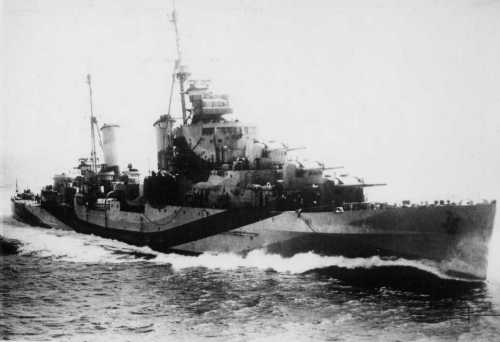
| Navy | The Royal Navy |
| Type | Light cruiser |
| Class | Dido |
| Pennant | 82 |
| Built by | Portsmouth D.Y. (Portsmouth, U.K.): Scotts Shipbuilding & Engineering Co. (Greenock, Scotland) |
| Ordered | 15 Dec 1937 |
| Laid down | 6 Apr 1938 |
| Launched | 18 Sep 1940 |
| Commissioned | 6 May 1942 |
| End service | 1949 |
| History | HMS Sirius completion was delayed by German bombing. Arrived at Blyth on 15 October 1956 to be scrapped by Hughes Bolkow. |
Commands listed for HMS Sirius (82)
Please note that we're still working on this section
and that we only list Commanding Officers for the duration of the Second World War.
| Commander | From | To | ||
| 1 | Capt. Patrick William Beresford Brooking, RN | 27 Feb 1942 | 20 May 1943 | |
| 2 | Capt. Herbert Wyndham Williams, RN | 20 May 1943 | 20 Jun 1943 | |
| 3 | Capt. Patrick William Beresford Brooking, DSO, RN | 20 Jun 1943 | 29 Oct 1943 | |
| 4 | Capt. Roderick Latimer Mackenzie Edwards, RN | 1 Feb 1944 | 21 Aug 1945 | |
| 5 | Capt. Philip Sydney Smith, RN | 21 Aug 1945 | 5 Jun 1946 | |
You can help improve our commands section
Click here to Submit events/comments/updates for this vessel.
Please use this if you spot mistakes or want to improve this ships page.
Notable events involving Sirius include:
5 Jun 1942
HMS P 222 (Lt.Cdr. A.J. MacKenzie, RN) conducted attack exercises in the Clyde area during which HMS Sirius (Capt. P.B.W. Brooking, RN) served as the target. (1)
27 Jun 1942
Convoy operations PQ 17 / QP 13
Convoys to and from Northern Russia
On 27 June 1942 Convoy PQ 17 departed Reykjavik Iceland bound for northern Russia. This convoy was made up of the following merchant ships;
American Alcoa Ranger (5116 GRT, built 1919), Bellingham (5345 GRT, built 1920), Benjamin Harrison (7191 GRT, built 1942), Carlton (5127 GRT, built 1920), Christopher Newport (7191 GRT, built 1942), Daniel Morgan (7177 GRT, built 1942), Exford (4969 GRT, built 1919), Fairfield City (5686 GRT, built 1920), Honomu (6977 GRT, built 1919), Hoosier (5060 GRT, built 1920), Ironclad (5685 GRT, built 1919), John Witherspoon (7191 GRT, built 1942), Olopana (6069 GRT, built 1920), Pan Atlantic (5411 GRT, built 1919), Pan Kraft (5644 GRT, built 1919), Peter Kerr (6476 GRT, built 1920), Richard Bland (7191 GRT, built 1942), Washington (5564 GRT, built 1919), West Gotomska (5728 GRT, built 1919), William Hooper (7177 GRT, built 1942), Winston-Salem (6223 GRT, built 1920),
British Bolton Castle (5203 GRT, built 1939), Earlston (7195 GRT, built 1941), Empire Byron (6645 GRT, built 1941), Empire Tide (6978 GRT, built 1941), Hartlebury (5082 GRT, built 1934), Navarino (4841 GRT, built 1937), Ocean Freedom (7173 GRT, built 1942), River Afton (5479 GRT, built 1935), Samuel Chase (7191 GRT, built 1942), Silver Sword (4937 GRT, built 1920),
Dutch Paulus Potter (7168 GRT, built 1942),
Panamanian El Capitan (5255 GRT, built 1917), Troubadour (6428 GRT, built 1920),
The Russian tankers Azerbaidjan (6114 GRT, built 1932), Donbass (7925 GRT, built 1935),
The British (Royal Fleet Auxiliary) tanker Grey Ranger (3313 GRT, built 1941).
Also with the convoy was a British rescue ship Zaafaran (1559 GRT, built 1921).
The US merchants Exford and West Gotomska had to return both arrived back damaged at Reykjavik on 30 June. The first one due to ice damage and the second one due to damaged engines.
Escort was provided by the minesweepers HMS Britomart (Lt.Cdr. S.S. Stammwitz, RN), HMS Halcyon (Lt.Cdr. C.H. Corbet-Singleton, DSC, RN), HMS Salamander (Lt. W.R. Muttram, RN), A/S trawlers HMS Ayrshire (T/Lt. L.J.A. Gradwell, RNVR), HMS Lord Austin (T/Lt. O.B. Egjar, RNR), HMS Lord Middleton (T/Lt. R.H. Jameson, RNR) and HMS Northern Gem (Skr.Lt. W.J.V. Mullender, DSC, RD, RNR) and the submarine HMS P 615 (Lt. P.E. Newstead, RN).
The convoy was joined at sea by a close escort force made up of the following warships; destroyers HMS Keppel (Cdr. J.E. Broome, RN / in command of the close escort of the convoy) , HMS Offa (Lt.Cdr. R.A. Ewing, RN), HMS Fury (Lt.Cdr. C.H. Campbell, DSC and Bar, RN), HMS Leamington (Lt. B.M.D. L’Anson, RN), escort destroyers HMS Ledbury (Lt.Cdr. R.P. Hill, RN), HMS Wilton (Lt. A.P. Northey, DSC, RN), corvettes HMS Lotus (Lt. H.J. Hall, RNR), HMS Poppy (Lt. N.K. Boyd, RNR), HMS Dianella (T/Lt. J.G. Rankin, RNR), HMS La Malouine (T/Lt. V.D.H. Bidwell, RNR), Auxiliary AA ships HMS Palomares (A/Capt.(rtd.) J.H. Jauncey, RN) and HMS Pozarica (A/Capt.(rtd.) E.D.W. Lawford, RN) and submarine HMS P 614 (Lt. D.J. Beckley, RN). Also two more British rescue ships sailed with this force to join the convoy at sea; Rathlin (1600 GRT, built 1936) and Zamalek (1567 GRT, built 1921).
The RFA tanker Grey Ranger, which was to fuel the escorts, was now sailing independent from the convoy, she was escorted by the destroyer HMS Douglas (Lt.Cdr. R.B.S. Tennant, RN). Another RFA tanker, the Aldersdale, had now joined the convoy. It had originally been intended that the Aldersdale would take the role the Grey Ranger was now performing but Grey Ranger had been damaged by ice to the north of Iceland so both tankers swapped roles.
Meanwhile on June 26th the Archangel section of the return convoy QP 13 had departed that port. This section was made up of 22 merchant ships;
American American Press (5131 GRT, built 1920), American Robin (5172 GRT, built 1919), Hegira (7588 GRT, built 1919), Lancaster (7516 GRT, built 1918), Massmar (5828 GRT, built 1920), Mormacrey (5946 GRT, built 1919), Yaka (5432 GRT, built 1920),
British Chulmleigh (5445 GRT, built 1938), Empire Mavis (5704 GRT, built 1919), Empire Meteor (7457 GRT, built 1940), Empire Stevenson (6209 GRT, built 1941), St. Clears (4312 GRT, built 1936),
Dutch Pieter de Hoogh (7168 GRT, built 1941),
Panamanian Capira (5625 GRT, built 1920), Mount Evans (5598 GRT, built 1919),
Russian Alma Ata (3611 GRT, built 1920), Archangel (2480 GRT, built 1929), Budenni (2482 GRT, built 1923), Komiles (3962 GRT, built 1932), Kuzbass (3109 GRT, built 1914), Petrovski (3771 GRT, built 1921), Rodina (4441 GRT, built 1922), Stary Bolshevik (3794 GRT, built 1933)
They were escorted by the destroyers HMS Intrepid (Cdr. C.A. de W. Kitcat, RN), ORP Garland (Kmdr.por. (Cdr.) H. Eibel), the corvettes HMS Starwort (Lt.Cdr. N.W. Duck, RD, RNR), HMS Honeysuckle (Lt. H.H.D. MacKillican, DSC, RNR), the auxiliary AA ship HMS Alynbank (A/Capt.(rtd.) H.F. Nash, RN) and a local escort of four minesweepers; HMS Bramble (Capt. J.H.F. Crombie, DSO, RN), HMS Seagull (Lt.Cdr. C.H. Pollock, RN), HMS Leda (A/Cdr.(rtd.) A.H. Wynne-Edwards, RN) and HMS Hazard (Lt.Cdr. J.R.A. Seymour, RN).
the next day (27th) the Murmask section of convoy QP 13 also went to sea. This was made up of 12 merchant ships;
American City of Omaha (6124 GRT, built 1920), Heffron (7611 GRT, built 1919), Hybert (6120 GRT, built 1920), John Randolph (7191 GRT, built 1941), Mauna Kea (6064 GRT, built 1919), Nemaha (6501 GRT, built 1920), Richard Henry Lee (7191 GRT, built 1941),
British Atlantic (5414 GRT, built 1939), Empire Baffin (6978 GRT, built 1941), Empire Selwyn (7167 GRT, built 1941),
Panamanian Exterminator (6115 GRT, built 1924), Michigan (6419 GRT, built 1920),
They were escorted by the destroyers HMS Inglefield (Cdr. A.G. West, RN), HMS Achates (Lt.Cdr. A.A. Tait, DSO, RN), HMS Volunteer (Lt. A.S. Pomeroy, RN), the minesweepers HMS Niger (Cdr.ret.) A.J. Cubison, DSC and Bar, RN), HMS Hussar (Lt. R.C. Biggs, DSC, RN), the corvettes HMS Hyderabad (Lt. S.C.B. Hickman, RN), FFS Roselys and the A/S trawlers Lady Madeleine (T/Lt. W.G.Ogden, RNVR) and St. Elstan (Lt. R.M. Roberts, RNR). Also three Russian destroyers (Grozniy, Gremyashchiy and Valerian Kyubishev) joined the escort of convoy QP 13 as far as 30 degrees East.
To cover these convoy operations a close cover force departed Seidisfjord, Iceland around midnight during the night of 30 June / 1 July to take up a position to the north of convoy PQ 17. This force was made up of the British heavy cruisers HMS London (Capt. R.M. Servaes, CBE, RN, flying the flag of Rear-Admiral L.H.K. Hamilton, DSO and Bar, RN), HMS Norfolk (Capt. E.G.H. Bellars, RN), as well as the American heavy cruisers USS Tuscaloosa (Capt. L.P. Johnson, USN) and USS Wichita (Capt. H.W. Hill, USN). They were escorted by the British destroyer HMS Somali (Capt. J.W.M. Eaton, DSO, DSC, RN) and the American destroyers USS Rowan (Lt.Cdr. B.R. Harrison, Jr., USN) and USS Wainwright (Lt.Cdr. R.H. Gibbs, USN).
A distant cover force had meanwhile sailed from Scapa Flow late on the 29th to take up a cover position north-east of Jan Mayen Island. This force was made up of battleships HMS Duke of York (Capt. C.H.J. Harcourt, CBE, RN, with the Commander-in-Chief Home Fleet, Admiral Sir J. Tovey, KCB, KBE, DSO, RN on board), USS Washington (Capt. H.H.J. Benson, USN, with Rear-Admiral R.C. Griffen, USN on board), aircraft carrier HMS Victorious (Capt. H.C. Bovell, CBE, RN, with Vice-Admiral Sir B. Fraser, CB, KBE, RN, second in command Home Fleet on board), heavy cruiser HMS Cumberland (Capt. A.H. Maxwell-Hyslop, AM, RN), light cruiser HMS Nigeria (Capt. S.H. Paton, RN, flying the flag of Rear-Admiral H.M. Burrough, CB, RN). They were escorted by the destroyers HMS Faulknor (Capt. A.K. Scott-Moncrieff, RN, Capt. 8th Destroyer Flotilla), HMS Escapade (Lt.Cdr. E.N.V. Currey, DSC, RN), HMS Martin (Cdr. C.R.P. Thomson, RN), HMS Marne (Lt.Cdr. H.N.A. Richardson, DSC, RN), HMS Onslaught (Cdr. W.H. Selby, RN), HMS Middleton (Lt.Cdr. D.C. Kinloch, RN), HMS Blankney (Lt.Cdr. P.F. Powlett, RN) and HMS Wheatland (Lt.Cdr. R.de.L Brooke, RN). The destroyers HMS Onslow (Capt. H.T. Armstong, DSC and Bar, RN, Capt. 17th Destroyer Flotilla), HMS Ashanti (Cdr. R.G. Onslow, RN), USS Mayrant (Cdr. C.C. Hartman, USN) and USS Rhind (Lt.Cdr. H.T. Read, USN) meanwhile arrived at Seidisfiord, Iceland from Scapa Flow to fuel before joining the Battlefleet at sea later.
Earlier on the 29th Force X, which was to act as a decoy convoy to fool the Germans (Operation ES), had departed Scapa Flow. This force was made up of; the auxiliary minelayers HMS Southern Prince (A/Capt. J. Cresswell, RN), HMS Agamemnon (Capt.(rtd.) F. Ratsey, RN) , HMS Port Quebec (A/Capt.(rtd.) V. Hammersley-Heenan, RN) , HMS Menestheus (Capt.(rtd.) R.H.F. de Salis, DSC and Bar, OBE, RN) and four merchant vessels (colliers ?). They were escorted by the light cruisers HMS Sirius (Capt. P.W.B. Brooking, RN), HMS Curacoa (Capt. J.W. Boutwood, RN), minelayer HMS Adventure (Capt. N.V. Grace, RN), destroyers HMS Brighton (Cdr.(rtd). C.W.V.T.S. Lepper, RN), HMS St. Marys (Lt.Cdr. K.H.J.L. Phibbs, RN), HMAS Nepal (Cdr. F.B. Morris, RAN), HrMs Tjerk Hiddes (Lt.Cdr. W.J. Kruys. RNethN), the escort destroyers Oakley (Lt.Cdr. T.A. Pack-Beresford, RN), Catterick (Lt. A. Tyson, RN), and 4 A/S trawlers.
On 1 July 'Force X' was divided into two parts. One part was made up of the four auxiliary minelayers, HMS Sirius, HMS Adventure, HMS Brighton, HMS St. Marys, HMAS Nepal and HrMs Tjerk Hiddes. The other part was made up of the remaining ships of 'Force X'.
'Force X' sailed eastward twice, on 30 June and 2 July, to about position 61°30’N, 01°30’E but was not spotted by the Germans. On 2 July 1942, HMAS Nepal and HrMs Tjerk Hiddes were detached from 'Force X' to proceed to Portsmouth and Liverpool respectively. There they were to undergo post work up repairs before they would join the Eastern Fleet.
First contact with the enemy occurred on 1 July 1942 when escorts from convoy PQ 17 twice attacked German submarines that were spotted on the surface several miles from the convoy. These were U-456 that was depth charged by HMS Ledbury and sustained light damage and U-657 that was depth charged by HMS Ledbury and HMS Leamington, she sustained no damage. That evening convoy PQ 17 also suffered its first attack from the air. Nine torpedo aircraft approached the convoy at about 1800 hours in position 73°30’N, 04°00’E. Some dropped torpedoes but they exploded wide of the convoy. One aircraft was shot down, most likely by the destroyer USS Rowan which was en-route from the cruiser force to the convoy to fuel from the Aldersdale.
The next night the convoy ran into for which persisted until the forenoon of the 3rd. In the afternoon of 2 July, U-255 made a torpedo attack on one of the escorts, HMS Fury, two torpedoes were fire but both missed. Fury then counter attacked with depth charges but U-255 sustained no damage. At more or less the same time U-376 was also depth charged by two or three escorts, she was not damaged. Shortly afterwards U-334 was also depth charged but she also escaped without damage.
On the 3rd several U-Boats were in contact for short periods but three were driven off by the escorts in the afternoon. When the mist cleared shadowing aircraft soon regained contact on the convoy.
By the early morning of the 4th convoy PQ 17 was about 60 nautical miles north of Bear Island where it sustained its first loss. Just before 0500 hours the new American merchant vessel Christopher Newport was torpedoed by a single aircraft. Damage was serious and the ship was finished off by the British submarine HMS P 614 which was part of the convoys escort while the rescue ship Zamalek took off the crew. The ship however remained afloat and was finally finished off by U-457.
In the evening of the 4th German aircraft made a successful attack on the convoy hitting the British merchant vessel Navarino, the American merchant William Hooper and the Russian tanker Azerbaidjan. The Azerbaidjan was able to proceed at 9 knots and in the end reached port. The other two ships had to be sunk, most of their crews were picked up by the rescue vessels. William Hooper in fact remained afloat and was finally finished off by U-334.
The situation was now as follows. Convoy PQ 17 was now about 130 nautical miles north-east of Bear Island and had just come through the heavy air attack remarkably well. The convoy discipline and shooting had been admirable and a substantial toll had been taken on the enemy. Rear-Admiral Hamilton was still covering the convoy with his cruiser force some ten miles to the north-eastward, with orders by the Admiralty to do so until ordered otherwise. Some 350 miles to the westward the main cover force was cruising in the area south-west of Spitzbergen.
Now turning to the Germans. The approval of the Führer to sail the heavy ships to attack the convoy had still not been obtained. The Tirpitz and Admiral Hipper meanwhile had joined the Admiral Scheer at the Alternfjord but noting further could be done without the Führer’s approval.
Meanwhile at the Admiralty it was known that German heavy surface units had gone to sea from Trondheim (battleships Tirpitz and heavy cruiser Admiral Hipper) and Narvik (pocket battleships Lützow and Admiral Scheer) but they had not been detected at sea. Fearing an attack on the convoy by these ships was imminent the convoy was ordered to scatter at 2123/4. Shortly before that the close cover force had been ordered to withdraw to the west as it was obviously no match for the German heavy ships.
The Admiralty decision was conveyed to Rear-Admiral Hamilton in the following three signals; Most immediate. Cruiser force withdraw to the west at high speed. (2111B/4) Most immediate. Owning to threat of surface ships, convoy is to disperse and to proceed to Russian ports. (2123B/4) Most immediate. My 2323B/4. Convoy is to scatter. (2136B/4) To Rear-Admiral Hamilton these signals could only mean that further information the admiralty had been hoping for had indeed come in and was of such a nature as to render imperative the drastic measures now ordered. Actually the reason for use of high speed by the cruisers was due to the massing of enemy submarines between 11°E and 20°E and the order to scatter was intended merely as a technical amendment of the term disperse that was used in the previous signal. This could not be known by the recipients, and the cumulative effect of these three signals – especially as the last one had a more important marking as the middle one – was to imply that pressing danger was actually upon them. As Commander Broome put it he expected to see the cruisers open fire and the enemy’s mast appear on the horizon at any moment. In this belief he decided to take the destroyers of his escort group to reinforce the cruiser force, and ordered the two submarines to stay near the convoy when it scattered and to try to attack the enemy, while the rest of the escorting ships were to proceed independently to Archangel.
At 2215/4 Commander Broome passed the signal to scatter to Commodore Dowding. The convoy was then in position 75°55’N, 27°52’E. Commander Broome then departed with the destroyers of the close screen to join the cruiser force of Rear-Admiral Hamilton.
Rear-Admiral Hamilton received the Admiralty orders at 2200/4. HMS Norfolk had just flown off her aircraft on an ice patrol. He therefore stood to the eastward for half an hour while attemps were made to recall it but these were without success and at 2230 hours the force turned to a westerly course at 25 knots steering to pass to the southward of the convoy so as to be between it and the probable direction of the enemy. An hour later they passed the merchant vessels which were now on widely divergent courses.
Rear-Admiral Hamilton was much concerned at the effect of the apparent desertion of the merchant ships had on morale. Had he been aware that the Admiralty had no further information of the enemy heavy units then he himself possessed he would have remained in a covering position until the convoy was widely dispersed.
As time went on without further developments Rear-Admiral Hamilton became more and more puzzled as to what have led to the sudden scattering of the convoy. But whatever the reason, the orders for his own force were clear, so he remained his westerly course at 25 knots. Thick fog was encountered soon after midnight, which persisted with brief intervals till 0630/5. Commander Broome, equally mystified by the course of events, soon began to feel that his place was with the merchant ships but he thought Rear-Admiral Hamilton was acting on fuller information then himself. As soon as the fog lifted sufficiently for visual signalling he informed the Rear-Admiral of his last hurried instructions to PQ 17 and requested that they should be amplified or amended as nessesary.
Actually Rear-Admiral Hamilton, who was still under the impression that enemy surface forces were in close proximity, argued that once the convoy had been scattered the enemy would leave it to their air forces and submarines to deal with it (and this was exactly what the Germans did). He feared the enemy surface forces would be ordered to deal with his force and reinforced by Commander Broome’s destroyers he felt that he could fight a delaying action, and had a good chance of leading the enemy within reach of the aircraft of HMS Victorious and possibly the heavy ships of the force of the Commander-in-Chief.
At 0700/5, while in position 75°40’N, 16°00’E, Rear-Admiral Hamilton reduced to 20 knots and at 0930 hours set course for Jan Mayen Island. It was not until that forenoon that the situation as regards the enemy heavy ships was made clear to him. Meanwhile he had to decide what to do with Commander Broome’s destroyers. Accordingly he ordered them to fuel from HMS London and HMS Norfolk. By 1630 hours the fueling of HMS Ledbury, HMS Wilton, USS Rowan and HMS Keppel had been completed. At 1740 hours a German Focke Wulf aircraft made contact and correctly reported the force in position 74°30’N, 07°40’E. Having been located, Rear-Admiral Hamilton broke wireless silence and at 1830/5 informed the Commander-in-Chief of his position, course, speed and the composition of his force. This was the first time the Commander-in-Chief was informed of the fact the Commander Broome’s destroyers with with the force of Rear-Admiral Hamilton, a fact which he regretted.
The Commander-in-Chief, having spent 4 July cruising about 150 nautical miles north-west of Bear Island, had turned to the south-westward in the early morning of the 5th, and was then on his way back to Scapa Flow some 120 nautical miles south-west of the force of Rear-Admiral Hamilton. Shortly afterwards there came news at last of the German heavy ships. The Russian submarine K-21 reported at 1700/5 the Tirpitz, Admiral Scheer and eight destroyers in position 71°25’N, 23°40’E, steering course 045°. She claimed to have hit the Tirpitz with two torpedoes. An hour or so later, at 1816 hours, a reconnoitring aircraft reported eleven strange ships in position 71°31’N, 27°10’E steering 065°, speed 10 knots. And finally HMS P 54 (Lt. C.E. Oxborrow, DSC, RN), at 2029/5 reported the Tirpitz and Admiral Hipper escorted by at least six destroyers and eight aircraft in position 71°30’N, 28°40’E steering a course of 060° at a speed of 22 knots.
Actually the cruise of the German ships was of short duration. Hitler’s permission to lauch the operation had only been obtained in the forenoon of the 5th and the executive order was given at 1137 hours. Rear-Admiral Hamilton’s cruisers were then known to be moving to the westward and Admiral Tovey’s covering force was some 450 miles away from the convoy. It seemed there would be no immediate danger for the German heavy ships provided they could approach the merchant ships unseen and engage them for a time as short as possible. But the Allied sighting reports were intercepted and the Naval Staff calculated that Admiral Tovey would be able to close sufficiently to launch an air attack before they would be able to return to port I they continued operations against the merchant ships after 0100/6. Air and U-boat attacks were meanwhile taking a heavy toll on the convoy and it did not seem that it was worth the risk. At 2132/5 orders were given to abandon the operation. At 2152 hours, while in position 71°38’N, 31°05’E the German ships reversed course and returned to Altafjord.
During the night of 5/6 July the Admiralty made three signals to the Commander-in-Chief, Home Fleet suggesting that the Tirpitz might be ‘reluctant to go as far as the convoy’ if the battlefleet was sighted steering to the eastward, and that aircraft from HMS Victorious might be able to attack her if she had ben damaged by the Russian submarines. The latter appeared to Admiral Tovey unlikely, for as it seemed certain that the Tirpitz, especially if damaged, would not be sailed down the Norwegian coast until adequate fighter cover and seaward reconnaissance were available. However, arrangements were made for the fleet to reverse its course if the approach of enemy aircraft was detected and at 0645/6 course was altered back to the north-eastward. An hour later an enemy aircraft passed over the fleet above the clouds but endeavours to attract its attention by gunfire and fighters were unsuccessful. That forenoon Rear-Admiral Hamilton’s force joined the fleet at 1040/6. Weather was unsuitable for air reconnaissance and Admiral Tovey felt that nothing was to be gained by continuing to the north-eastward. Rear-Admiral Hamilton’s cruisers and eight destroyers were detached to Seidisfjord at 1230 hours and the battlefleet turned to the southward again shortly afterwards. All ships reached harbour on the 8th.
The last news of the enemy ships came on 7 July, when a British aircraft working from Vaenga, near Murmansk, reported the Tirpitz, Admiral Scheer and Admiral Hipper and some destroyers followed by an oiler from a neighbouring fjord turning out of Lang Fjord in Arnoy (70°N, 20°30’E). By this time the Allied ships were well on their way home but an attempt to attack the enemy was once again made by submarines. Anticipating their return to Narvik, HMS Sturgeon (Lt. M.R.G. Wingfield, RN) and FFS Minerve (Lt. P.M. Sonneville) had been ordered on 6 July to leave the main patrol line and to patrol to the mouth of the Vest Fjord on the 7th and the 8th, one at a time, in case the Tirpitz should pass on the outside of the Lofoten Islands, owning to her heavy draught due to possible damage. Nothing came of this, however, nor of a further patrol carried out by HMS Sturgeon on the night of 9/10 July close inshore some 70 nautical miles north of Trondheim in case of any German ships going to that port.
Now back to the ships of convoy PQ 17. The sudden order to scatter came to Commodore Dowding as an unpleasant surprise. Like Rear-Admiral Hamilton and Commander Broome he did not doubt that it heralded the immediate appearance of enemy heavy ships, and as the escorting destroyers parted company to join the cruisers, he signalled to HMS Keppel ‘Many thanks, goodbye and good hunting’ to which Commander Broome replied ‘It’s a grim business leaving you here’. It was indeed a grim business and the gravity of the situation was clear to all. Weather attack by surface craft developed in a few minutes or by aircraft and submarines during the next few days, the plight of the individual merchant ships – deprived of mutual support of their escort - was parlous in the extreme.
The convoy scattered as laid down in the instructions, in perfect order, though it must have been apparent to the ships that had to turn to the south-west that they were heading towards where the most trouble might be expected. The merchant ships proceeded mostly alone, or in groups of two or three. The anti-aircraft ships HMS Palomares and HMS Pozarica each took charge of a group, each collecting also two or three minesweepers or corvettes to act as a screen. They joined company the next day and proceeded towards Novaya Zemlya. HMS Salamander accompanied two merchantmen and a rescue ship. HMS Daniella was escorting the submarines, HMS P 614 and HMS P 615. She stood them clear of the convoy, when they separated to patrol in its wake, while the corvette went on by itself. At first the different groups spread on courses ranging from north to east, a few steering afterwards for Archangel, most seeking shelter in Novaya Zemlya. But less than half the merchant ships reached even ‘horrid Zembla’s frozen realms’, for 17 in addition to the oiler Aldersdale and the rescue ship Zaafaran were sunk during the next three days by bombing aircraft and U-boats. The bulk of the losses took place on the 5th while the ships were still far to the north, six being sunk by bombs and six were torpedoed by submarines. One ship was bombed on the 6th. Four were torpedoed by U-boats off the south-west coast of Novaya Zemlya between the evening of the 6th and the early morning of the 8th.
By the 7th of July, most of the escort, the rescue ship Zamalek and five merchant ships, the Ocean Freedom, Hoosier, Benjamin Harrison, El Capitan and Samual Chase, had reached Matochkin Strait. Commodore Dowding, whose ship the River Afton had been sunk by a U-boat on the 5th, arrived in HMS Lotus, which had rescued him and 36 survivors, including the Master after 3.5 hours on rafts and floats. After a conference on board HMS Palomares, these merchantmen were formed into a convoy into a convoy and sailed that evening, escorted by the two AA ships, HMS Halcyon, HMS Salamander, HMS Britomart, HMS Poppy, HMS Lotus and HMS La Malouine and three A/S trawlers. The Benjamin Harrison soon got separated in fog and returned to the Matochkin Strait but the remainder were still in company when the fog temporarily cleared during the forenoon of the 8th, and course was shaped to pass east and south of Kolguyev Island. It was an anxious passage, much fog and ice was encountered and U-boats were known to be about. From time to time boatloads of survivors from other ships already sunk were encountered and picked up. A remainder of the fate that might be in store for any of them. During the night of 9-10 July some 40 bombers carried out high level attacks on this small convoy. The attacks lasted for four hours, the Hoosier and El Capitan were sunk by near misses some 60 nautical miles north of Cape Kanin. Four aircraft are believed to have been shot down. The attacks ended at 0230/10 and half an hour later two Russian flying boats appeared. The surviving ships arrived at Archangel the next day, 11 July. Three ships out of thirty-seven were now in port, not a very successful convoy so far. Things were however not that bad as Commodore Dowding thought at that moment. The rescue ship Rathlin with two merchant ships, the Donbass and the Bellingham had arrived on the 9th, having shot down an aircraft the day before, and before long the news of other ships sheltering in Novaya Zemlya came in.
At his special request, Commodore Dowding, despite all he had been through, left Archangel in HMS Poppy on 16 July, in company with HMS Lotus and HMS La Malouine, to form these merchant ships into a convoy and bring them to Archangel. After a stormy passage they arrived at Byelushya Bay on the 19th. There 12 survivors from the merchant Olopana were found. During the day the coast was searched and in the evening the Winston Salem was found agound and later the Empire Tide was found at anchor. The next morning Motochkin Strait was entered and five merchant ships were found at anchor, the Benjamin Harrison, Silver Sword, Troubadour, Ironclad and the Azerbaidjan. A Russian icebreaker (the Murman) was also there as was a Russian trawler (the Kerov). Also, one of the escorts of convoy PQ 17 was found there, the British A/S trawler Ayrshire.
Commodore Dowding wasted no time. A conference was held that forenoon and in the evening all ships sailed, the Commodore leading in the Russian icebreaker Murman. The Empire Tide, which had a lot of survivors from sunken ships aboard joined the convoy early the next day. The Winston Salem was however still aground with two Russian tugs standing by. Much fog was encountered during the passage which was uneventful except for two U-boat alarms. The escort was reinforced by HMS Pozarica, HMS Bramble, HMS Hazard, HMS Leda, HMS Dianella and two Russian destroyers on the 22th. The convoy arrived safe at Archangel on the 24th.
Four days later (on the 28th) the Winston Salem was finally refloated. She managed reached harbour as the last ship of the ill-fated PQ 17 convoy making a total of 11 survivors out of a total of 35 ships. It was realised afterwards by the Admiralty that the decision to scatter the convoy had been premature.
The disastrous passage of convoy PQ 17 tended to throw into the background the fortunes of the westbound convoy, QP 13. This convoy of 35 ships sailed in two parts from Archangel and Murmansk and joined at sea on 28 June under Commodore N.H. Gale. Thick weather prevailed during most of the passage, but the convoy was reported by enemy aircraft on 30 June while still east of Bear Island and again on 2 July. No attacks developed, the enemy focus was on the eastbound convoy. That afternoon the ill-fated convoy PQ 17 was passed.
After an uneventful passage, convoy QP 13 divided off the north-east coast of Iceland on 4 July. Commodore Gale with 16 merchant ships turned south for Loch Ewe while the remaining 9 merchant ships continued round the north coast of Iceland for Reykjavik. At 1900/5 these ships formed into a five column convoy. They were escorted by HMS Niger (SO), HMS Hussar, FFL Roselys, HMS Lady Madeleine and HMS St. Elstan. They were now approaching the north-west corner of Iceland. The weather was overcast, visibility about one mile, wind north-east, force 8, sea rough. No sights had been obtained since 1800/2 and the convoys position was considerably in doubt. At 1910/5 Commander Cubison (C.O. HMS Niger) suggested that the front of the convoy should be reduced to two columns in order to pass between Straumnes and the minefield off the north-west coast of Iceland. This was the first the convoy Commodore had heard of the existence of this minefield. Soon afterwards, Commander Cubison gave his estimated position at 2000/5 as 66°45’N, 22°22’W and suggested altering course 222° for Straumnes Point at that time. This was done. About two hours later, at 2200 hours, HMS Niger which had gone ahead to try to make landfall leaving HMS Hussar as a visual link with the convoy, sighted what she took to be North Cape bearing 150° at a range of one mile and ordered the course of the convoy to be altered to 270°. Actually what HMS Niger sighted was a large iceberg but this was not realised for some time. At 2240/5 HMS Niger blew up and sank with heavy loss of life, including Commander Cubison. Five minutes later a last signal from her, explaining her mistaken landfall and recommending a return to course 222° was handed to the convoy Commodore. But it was too late, already explosions were occurring amongst the merchant ships. The westerly course had led the convoy straight into the minefield. Considerable confusion prevailed, some thinking that a U-boat attack was in progress, other imagining a surface raider. Four ships were sunk, the Heffron, Hybert, Massmar and the Rodina and two were seriously damaged, the John Randolph and the Exterminator. Good rescue work was carried out by the escorts, especially the FFL Roselys which picked up 179 survivors from various ships. Meanwhile HMS Hussar had obtained a shore fix, led out the remaining merchant ships, which reformed on a southerly course for Reykjavik where they arrived without further misadventure.
29 Jun 1942
The auxiliary minelayers Southern Prince (A/Capt. J. Cresswell, RN), Agamemnon (Capt.(rtd.) F. Ratsey, RN) , Port Quebec (A/Capt.(rtd.) V. Hammersley-Heenan, RN) , Menestheus (Capt.(rtd.) R.H.F. de Salis, DSC and Bar, OBE, RN) and four merchant vessels (colliers ?) departed Scapa Flow to serve as a dummy convoy to fool the Germans. They were escorted by the light cruisers Sirius (Capt. P.W.B. Brooking, RN), Curacoa (Capt. J.W. Boutwood, RN), minelayer Adventure (Capt. N.V. Grace, RN), destroyers Brighton (Cdr.(rtd). C.W.V.T.S. Lepper, RN), St. Marys (Lt.Cdr. K.H.J.L. Phibbs, RN), HMAS Nepal (Cdr. F.B. Morris, RAN), HrMs Tjerk Hiddes (Lt.Cdr. W.J. Kruys. RNethN), the escort destroyers Oakley (Lt.Cdr. T.A. Pack-Beresford, RN), Catterick (Lt. A. Tyson, RN), and 4 A/S trawlers.
[For more info on this operation see the event ' Convoy operations PQ 17 / QP 13 ' for 27 June 1942.]
7 Jul 1942
HMS Orion (Capt. G.C.P. Menzies, RN), HMS Phoebe (Capt. C.P. Frend, RN), HMS Sirius (Capt. P.W.B. Brooking, RN), HMS Scylla (Capt. I.A.P. Macintyre, CBE, RN) and HMS Jamaica (Capt. J.L. Storey, RN) all conducted exercises off Scapa Flow. (2)
9 Jul 1942
The battleship HMS Anson (Capt. H.R.G. Kinahan, CBE, RN, flying the flag of Vice-Admiral Sir B. Fraser, CB, KBE, RN) and the light cruiser HMS Sirius (Capt. P.B.W. Brooking, RN) conducted exercises off Scapa Flow. During the exercises HMS Anson was screened by the destroyer HMS Tartar (Cdr. St.J.R.J. Tyrwhitt, DSC, RN) and the escorted destroyers HMS Catterick (Lt. A. Tyson, RN) and HMS Oakley (Lt.Cdr. T.A. Pack-Beresford, RN). (3)
28 Jul 1942
HMS P 511 (Lt. D.E.O. Watson, DSC, RN) participated in A/S exercises at Scapa Flow. These were first with HMS Sirius (Capt. P.W.B. Brooking, RN), then with HMS Jamaica (Capt. J.L. Storey, RN) and finally with destroyers. (4)
2 Aug 1942
Convoy WS 21S and Operation Pedestal.
Convoy WS 21S and the concentration of the escort forces
Convoy WS 21S departed the Clyde on 2 August 1942. The convoy was made up of the following ships; American freighters; Almeria Lykes (7773 GRT, built 1940), Santa Elisa (8379 GRT, built 1941), British freighters; Brisbane Star (12791 GRT, built 1937), Clan Ferguson (7347 GRT, built 1938), Deucalion (7516 GRT, built 1930), Dorset (10624 GRT, built 1934), Empire Hope (12688 GRT, built 1941), Glenorchy (8982 GRT, built 1939), Melbourne Star (11076 GRT, built 1936), Port Chalmers (8535 GRT, built 1933), Rochester Castle (7795 GRT, built 1937), Waimarama (12843 GRT, built 1938), Wairangi (12436 GRT, built 1935), and the American tanker; Ohio (9264 GRT, built 1940).
These ships were escorted by light cruisers HMS Nigeria (Capt. S.H. Paton, RN, flying the flag of the Rear-Admiral 10th C.S., H.M. Burrough, CB, DSO, RN), HMS Kenya (Capt. A.S. Russell, RN) and the destroyers HMS Wishart (Cdr. H.G. Scott, RN), HMS Venomous (Cdr. H.W. Falcon-Stewart, RN), HMS Wolverine (Lt.Cdr. P.W. Gretton, OBE, DSC, RN), HMS Malcolm (A/Cdr. A.B. Russell, RN), HMS Amazon (Lt.Cdr.(Emgy) Lord Teynham, RN), HMS Derwent (Cdr. R.H. Wright, DSC, RN) and HMS Zetland (Lt. J.V. Wilkinson, RN).
A cover force made up of departed Scapa Flow on the same day. This force was made up of the battleships HMS Nelson (Capt. H.B. Jacomb, RN, flying the flag of Vice-Admiral E.N. Syfret, CB, RN) and HMS Rodney (Capt. J.W. Rivett-Carnac, DSC, RN). They were escorted by the destroyers HMS Ashanti (Cdr. R.G. Onslow, DSO, RN), HMS Eskimo (Cdr. E.G. Le Geyt, RN), HMS Somali (Cdr. E.N.V. Currey, DSC, RN), HMS Tartar (Cdr. St.J.R.J. Tyrwhitt, DSC, RN), HMS Pathfinder (Cdr. E.A. Gibbs, DSO and Bar, RN), HMS Penn (Lt.Cdr. J.H. Swain, RN) and HMS Quentin (Lt.Cdr. A.H.P. Noble, DSC, RN). They were to rendez-vous with convoy WS 21S at sea on 3 August. HMS Penn was delayed by a defect and after topping off with fuel at Moville, Northern Ireland overtook the force and joined at sea.
The aircraft carrier HMS Victorious (Capt. H.C. Bovell, CBE, RN, flying the flag of Rear Admiral A.L.St.G. Lyster, CB, CVO, DSO, RN) and the light cruiser HMS Sirius (Capt. P.W.B. Brooking, RN) meanwhile had already left Scapa Flow on 31 July 1941 to rendez-vous with the convoy. They were escorted by the destroyers HMS Intrepid (Cdr. C.A.deW. Kitcat, RN), HMS Icarus (Lt.Cdr. C.D. Maud, DSC and Bar, RN), HMS Fury (Lt.Cdr. C.H. Campbell, DSC and Bar, RN) and HMS Foresight (Lt.Cdr. R.A. Fell, RN). These ships were joined at sea on 1 August 1942 by the aircraft carrier HMS Argus (Capt. G.T. Philip, RN), loaded with spare fighter aircraft for the operation, and her two escorts the destroyers HMS Buxton (Lt.Cdr. I.J. Tyson, RD, RNR) and HMS Sardonyx (Lt.Cdr. A.F.C. Gray, RNR). HMS Argus and her two escorting destroyers had departed the Clyde on 31 July. HMS Buxton later split off and proceeded towards Canada and HMS Sardonyx proceeded to Londonderry.
The last ships to take part in the operation to depart the U.K. (Clyde around midnight during the night of 4/5 August) were the aircraft carrier HMS Furious (Capt. T.O. Bulteel, RN), loaded with Hurricane fighters for Malta, and her escorts, the light cruiser HMS Manchester (Capt. H. Drew, DSC, RN) and the Polish destroyer ORP Blyscawica (Kpt.mar. (Lt.Cdr.) L. Lichodziejewski). They were joined at sea, around dawn, by HMS Sardonyx coming from Londonderry. The destroyers parted company around midnight during the night of 5/6 August. They arrived at Londonderry on 7 August. HMS Furious and HMS Manchester then joined convoy WS 21S around midnight of the next night but HMS Manchester parted company shortly afterwards to proceed ahead of the convoy and fuel at Gibraltar.
On 1 August 1942 the aircraft carrier HMS Indomitable (Capt. T.H. Troubridge, RN), light cruiser HMS Phoebe (Capt. C.P. Frend, RN) and the destroyers HMS Laforey (Capt. R.M.J. Hutton, RN), HMS Lightning (Cdr. H.G. Walters, DSC, RN) and HMS Lookout (Lt.Cdr. A.G. Forman, DSC, RN) departed Freetown to proceed to a rendez-vous position off the Azores.
On 5 August 1942, the aircraft carrier HMS Eagle (Capt. L.D. Mackintosh, DSC, RN), light cruiser HMS Charybdis (Capt. G.A.W. Voelcker, RN) and the the destroyers HMS Wrestler (Lt. R.W.B. Lacon, DSC, RN), HMS Westcott (Cdr. I.H. Bockett-Pugh, DSO, RN) and HMS Vansittart (Lt.Cdr. T. Johnston, RN) departed Gibraltar also to the rendezvous position off the Azores.
The convoy conducted maneuvering and AA exercises with the escorts between the Azores and Gibraltar during the period of 6 to 9 August. (Operation Berserk). Also dummy air attacks were carried out by aircraft from the carriers.
Passage of the Straits of Gibraltar and organization of escort forces.
The convoy then passed the Straits of Gibraltar during the night of 9/10 August 1942 in dense fog but despite this the convoy was detected by German and Italian spies and reported.
After passing the Straits of Gibraltar the convoy was organized as follows; The actual convoy was protected a large force of warships until the whole force would split up before entering the Sicilian narrows after which ‘Force X’ under command of Rear-Admiral Sir H.M. Burrough, CB, DSO, RN was to accompany the convoy to the approaches to Malta where they would be met by the Malta Minesweeping Flotilla, which was then to sweep the convoy into the harbour. Force X was made up of the following ships: Licht cruisers: HMS Nigeria (flagship), HMS Kenya,, HMS Manchester. AA cruiser: HMS Cairo (A/Capt. C.C. Hardy, DSO, RN). Destroyers: HMS Ashanti, HMS Fury, HMS Foresight, HMS Icarus, HMS Intrepid, HMS Pathfinder and HMS Penn. Escort destroyers: HMS Derwent, HMS Bicester (Lt.Cdr. S.W.F. Bennetts, RN), HMS Bramham (Lt. E.F. Baines, RN), HMS Ledbury (Lt.Cdr. R.P. Hill, RN) and HMS Wilton (Lt. A.P. Northey, RN). Also the rescue tug HMRT Jaunty was to be part of this force.
After the escort was to be split up cover was provided by ‘Force Z’ under Vice-Admiral E.N. Syfret, CB, RN. This force was made up of the following ships: Battleships: HMS Nelson (flagship) and HMS Rodney. Aircraft carriers: HMS Victorious, HMS Indomitable and HMS Eagle. Light cruisers: HMS Phoebe, HMS Sirius and HMS Charybdis. Destroyers: HMS Laforey, HMS Lightning, HMS Lookout, HMS Eskimo, HMS Somali, HMS Tartar, HMS Quentin, HMS Ithuriel (Lt.Cdr. D.H. Maitland-Makgill-Crichton, DSC, RN), HMS Antelope (Lt.Cdr. E.N. Sinclair), HMS Wishart and HMS Vansittart. Escort destroyer: HMS Zetland. Also attached were the aircraft carrier HMS Furious (for Operation Bellows, the launching of Hurricane fighters for Malta. HMS Furious only carried four Albacore aircraft for A/S searches after the Hurricanes had been launched) and the ‘spare’ destroyers HMS Keppel (Cdr. J.E. Broome, RN), HMS Malcolm, HMS Venomous, HMS Vidette (Lt.Cdr. E.N. Walmsley, DSC, RN), HMS Westcott, HMS Wolverine, HMS Wrestler and HMS Amazon. These ‘spare’ destroyers were to take the place of destroyers in the screen ‘Force Z’ if needed, escort HMS Furious during her return passage to Gibraltar after she had completed Operation Bellows and / or strengthen the escort of ‘Force R’.
Then there was also ‘Force R’, the fuelling force. This force was made up of the following ships: Corvettes: HMS Jonquil (Lt.Cdr. R.E.H. Partington, RD, RNR), HMS Spiraea (Lt.Cdr. R.S. Miller, DSC, RNR), HMS Geranium (T/Lt. A. Foxall, RNR) and HMS Coltsfoot (T/Lt. the Hon. W.K. Rous, RNVR). Rescue tug: HMS Salvonia. RFA tankers: RFA Brown Ranger (3417 GRT, built 1941, Master D.B.C. Ralph) and RFA Dingledale (8145 GRT, built 1941, Master R.T. Duthie).
Before we give an account of the passage of the main convoy we will now first describe the operations taking place in the Eastern Mediterranean (Operations MG 3 and MG 4), the launching of the Hurricane fighters for Malta by HMS Furious (Operation Bellows) and the return convoy from Malta (Operation Ascendant) as well as on submarine operations / dispositions.
Diversion in the Eastern Mediterranean.
As part of the plan for Operation Pedestal the Mediterranean Fleet had to carry out a diversion in the Eastern part of the Mediterranean. Before we go to the operations in the Western Mediterranean we will first give an account of the events in the Eastern Mediterranean.
It was at this time not possible to sent any supplies from Egypt to Malta as all supplies and forces were much needed for the upcoming land battle at El Alamein it was agreed that ‘a dummy convoy’ would be sent towards Malta with the object of preventing the enemy to direct the full weight of their air and naval power towards the Western Mediterranean.
In the evening of 10 August 1942 a ‘convoy’ (MG 3) of three merchant ships departed Port Said escorted by three cruisers and ten destroyers. Next morning one more merchant ship departed Haifa escorted by two cruisers and five destroyers. The two forces joined that day (the 11th) and then turned back dispersing during the night. The Italian fleet however did not go to sea to attack ‘the bait’.
The forces taking part in this operation were: From Port Said: Merchant vessels City of Edinburgh (8036 GRT, built 1938), City of Lincoln (8039 GRT, built 1938) and City of Pretoria (8049 GRT, built 1937) escorted by the light cruisers HMS Arethusa (Capt. A.C. Chapman, RN, flying the flag of Rear-Admiral I.G. Glennie, RN), HMS Euryalus (Capt. E.W. Bush, DSO, DSC, RN), the AA cruiser HMS Coventry (Capt. R.J.R. Dendy, RN) and the destroyers HMS Jervis (Capt. A.L. Poland, DSO and Bar, DSC, RN), HMS Kelvin (Cdr. M.S. Townsend, OBE, DSC and Bar, RN), HMS Pakenham (Capt. E.B.K. Stevens, DSO, DSC, RN), HMS Paladin (Cdr. A.F. Pugsley, RN) and the escort destroyers HMS Dulverton (Lt.Cdr. W.N. Petch, OBE, RN), HMS Hurworth (Lt.Cdr. J.T.B. Birch, RN), HMS Eridge (Lt.Cdr. W.F.N. Gregory-Smith, DSC, RN), HMS Hursley (Lt. W.J.P. Church, DSC, RN), HMS Beaufort (Lt.Cdr. S.O’G Roche, RN) and HMS Belvoir (Lt. J.F.D. Bush, DSC and Bar, RN).
From Haifa: Merchant vessel Ajax (7797 GRT, built 1931) escorted by the light cruisers HMS Cleopatra (Capt. G. Grantham, DSO, RN, flagship of Rear-Admiral P.L. Vian, KBE, DSO and 2 Bars, RN), HMS Dido (Capt. H.W.U. McCall, RN), the destroyers HMS Sikh (Capt. St.J. A. Micklethwait, DSO and Bar, RN), HMS Zulu (Cdr. R.T. White, DSO and Bar, RN), HMS Javelin (Cdr. G.E. Fardell, RN) and the escort destroyers HMS Tetcott (Lt. H.R. Rycroft, RN) and HMS Croome (Lt.Cdr. R.C. Egan, RN).
After dark on 11 August 1942 the force turned back and the City of Pretoria returned to Port Said escorted by HMS Eridge and HMS Hursley. The City of Edinburgh, escorted by HMS Beaufort and HMS Belvoir proceeded to Haifa. The City of Lincoln escorted by HMS Dulverton and HMS Hurworth proceeded to Beirut and finally the Ajax, escorted by HMS Tetcott and HMS Croome returned to Haifa. HMS Dido had to return to Port Said with hull defects. She was escorted by HMS Pakenham, HMS Paladin and HMS Jervis.
HMS Cleopatra, HMS Arethusa, HMS Sikh, HMS Zulu, HMS Javelin and HMS Kelvin then proceeded to carry out another diversion (Operation MG 4). They bombarded Rhodes harbour and the Alliotti Flour Mills during the night of 12/13 August but did little damage. On the way back HMS Javelin attacked a submarine contact in position 34°45’N, 31°04’E between 0654 and 0804 hours. She reported that there was no doubt that the submarine was sunk but no Axis submarines were operating in this area so the attack must have been bogus. This force returned to Haifa at 1900B/13.
Operation Bellows.
During operation Bellows, the aircraft carrier HMS Furious, started 37 Spitfire which were to proceed to Malta, when south of the Balearic Islands. The Admiralty had decided to carry out this operation at the same time as Operation Pedestal.
HMS Furious remained with the convoy until 1200B/11. She then launched the Spitfires for Malta in 5 batches between 1230 and 1515 hours. During these flying off operations she acted independently with the destroyers HMS Lookout and HMS Lightning. After having launched the last batch of Spitfires she briefly re-joined to convoy until around 1700 hours when she split off and set course for Gibraltar escorted by the destroyers HMS Malcolm, HMS Wolverine and HMS Wrestler. These were joined shortly afterwards by HMS Keppel and HMS Venomous.
Around 0100B/12, HMS Wolverine, rammed and sank the Italian submarine Dagabur which was trying to attack HMS Furious. Around 0200 hours, HMS Wolverine reported that she was stopped due to the damage she had sustained in the ramming. HMS Malcolm was detached to assist her.
At 1530B/12, the destroyer HMS Vidette joined the screen. The force then entered Gibraltar Bay around 1930B/12. The damaged HMS Wolverine arrived at Gibraltar at 1230B/13 followed by HMS Malcolm around 1530B/13.
Operation Ascendant
On 10 August 1942 the empty transports Troilus (7648 GRT, built 1921) and Orari (10107 GRT, built 1931) departed Malta after dark for Gibraltar. They were escorted by the destroyer HMS Matchless (Lt.Cdr. J. Mowlam, RN) and the escort destroyer HMS Badsworth (Lt. G.T.S. Gray, DSC, RN). They first proceeded to the south of Lampedusa, then hugged the Tunisian coast as far as Galita Island. Near Cape Bon they encountered the Italian destroyer Lanzerotto Malocello that was laying a minefield. They had a brief gunfight but this was soon ended as both sides were thinking the enemy was Vichy-French. The remained of the passage to Gibraltar was uneventful and the convoy arrived at Gibraltar shortly before noon on 14 August 1942.
Submarine operations / dispositions. Eight submarines took part in the operation; these were HMS Utmost (Lt. A.W. Langridge, RN), HMS P 31 (Lt. J.B.de B. Kershaw, DSO, RN), HMS P 34 (Lt. P.R.H. Harrison, DSC, RN), HMS P 42 (Lt. A.C.G. Mars, RN), HMS P 44 (Lt. T.E. Barlow, RN), HMS P 46 (Lt. J.S. Stevens, DSC, RN), HMS P 211 (Cdr. B. Bryant, DSC, RN), HMS P 222 (Lt.Cdr. A.J. MacKenzie, RN). Two of these were to carry out normal dived patrol to the north of Sicily, one off Palermo, the other off Milazzo which is futher to the east. The other six submarines were given alternative patrol lines south of Pantelleria, one od which they were to take up at dawn on 13 August 1942, according to the movements of enemy surface ships that might threathen the convoy from the westward. When the convoy had passed the patrol line, which it should have done by that time, the submarines were to proceed on the surface parallel to the convoy as a screen and to dive away clear of the convoy at noon. It was expressly intended that they should be seen on the surface and reported by enemy aircraft in order to deter enemy warships from attacking the convoy.
Enemy warships did go to sea but as soon as it was clear that the enemy ships could not reach the convoy the sunmarines were ordered to dive and retire. These six sumarines had no contact with the enemy. One of the the two submarines off the north coast of Sicily, HMS P 42, managed to torpedo two Italian cruisers near Stromboli on the morning of 13 August 1942.
Now we return to the main convoy to Malta.
Passage eastwards after passing the Straits of Gibraltar.
10 and 11 August 1942.
After passing through the Straits of Gibraltar in the early hours of 10 August 1942, in dense fog, the convoy was first sighted by an Italian passenger aircraft, which sighted the convoy in the afternoon of the same day. German reconnaissance aircraft started shadowing the convoy from dawn on the 11th, and thereafter they or Italian aircraft kept the convoy under continuous observation, despite the effort of the fighters from the carriers to shoot them down or drive them off. At 1315 hours, HMS Eagle, was hit an sunk by torpedoes from the German submarine U-73 which had penetrated the destroyer screen. At that moment there were thirteen destroyers in the screen, the remainder was away from the main convoy, escorting HMS Furious during the flying off operations of the Hurricane fighters for Malta or oiling from and screening ‘Force R’ which was several miles away. Between 1430B/10 and and 2030B/11 no less then three cruisers and twenty-four destroyers fuelled from the two oilers of ‘Force R’.
At the time of the torpedoing of HMS Eagle the convoy was in four columns, zigzagging at 13 knots, with the heavy ships stationed close round it and a destroyer screen ahead. HMS Eagle was on the starboard quarter of the convoy. She was hit on her starboard side by four torpedoes which had dived through the destroyer screen and the convoy columns undetected and then torpedoed and sank the Eagle in position 38°05’N, 03°02’E (Another source gives 03°12’E but this might be a typo). The carrier sank quickly in about 8 minutes, 926 of her crew, including the Commanding Officer, were rescued by the destroyers HMS Laforey and HMS Lookout and the rescue tug HMS Jaunty. At the time of her sinking, HMS Eagle had four aircraft on patrol. These landed on the other carriers. All other aircraft were lost with the ship. The survivors picked up were later transferred to the destroyers HMS Keppel, HMS Malcolm and HMS Venomous that were to escort HMS Furious back to Gibraltar. The tug HMS Jaunty that had been involved in picking up survivors was never able to rejoin the convoy due to her slow speed.
Late in the afternoon air attacks were expected so Vice-Admiral Syfret ordered the destroyer to form an all-round screen. Indeed the air attacks started around sunset, 2045 hours. The last destroyers had just returned from oiling from ‘Force R’. The enemy aircraft that were attacking were 36 German bombers and torpedo aircraft, Ju 88’s and He 111’s, most of which attacked the convoy but a few attacked ‘Force R’ to the southward. The Junkers arrived first, diving down from 8000 feet to 2000 / 3000 feet to drop their bombs. They claimed to have hit an aircraft carrier and one of the merchant ships. Then the Heinkels attacked, they claimed to have torpedoed a cruiser but during the attacks no ship was hit. The British fighter cover was unable to attack / find the enemy in the failing light. Four enemy aircraft were claimed shot down by the ships AA fire but it appears only two JU 88’s were in fact shot down.
12 August 1942
At 0915B/12 another wave of German aircraft attacked the convoy. Some twenty or more JU 88’s approached the convoy out of the sun ahead. They were intercepted by fighters about 25 miles from the convoy. About a dozen got through to the convoy, making high-level or shallow dive-bombing attacks individually but without any result. Eight German aircraft were claimed to be shot down by the fighters and two more by AA guns from the ships. The fighters meanwhile were also busy dealng with shadowers, three of which are claimed to have been shot down before the morning attack. Around this time destroyers were also busy with numerous submarine contact which were attacked by depth charges.
Around noon the enemy launched heavy air attacks from the Sardinian airfields. Seventy aircraft approached which were heavily escorted by fighters. They attacked in stages and employed new methods.
First ten Italian torpedo-bombers were each to drop some sort of circling torpedo or mine a few hundred yards ahead of the British force, while eight fighter bombers made dive-bombing and machine-gun attacks. The object at this stage was clearly to dislocate the formation of the force and to draw anti-aircraft fire, making the ships more vulnerable to a torpedo attack which soon followed with over forty aircraft. They attacked in two groups, one on either bow of the convoy. The next stage was a shallow dive-bombing attack by German aircraft, after which two Italian Reggiane 2001 fighters, each with a single heavy armour-piercing bomb were to dive bomb on one of the aircraft carriers, whilst yet another new form of attack was to be employed against the other carrier, but defects in the weapon prevented this attack from taking place.
The enemy attack went according to plan besides that the torpedo attack was only made half an our after the ‘mines’ were dropped instead of five minutes. British fighters met the minelaying aircraft, they shot down one of them as they approached. The remaining nine aircraft dropped their ‘mines’ at 1215 hours in the path of the force, which turned to avoid the danger. The mines were heard to explode several minutes later. Only three of the fighter-bombers of this stage of the attack appear to have reached as far the screen, but HMS Lightning had a narrow escape from their bombs.
The torpedo-aircraft appeared at 1245 hours. Their number were brought down a bit due to British fighters. The remaining aircraft, estimated at 25 to 30 machines, attacked from the port bow, port beam and starboard quarter. They dropped their torpedoes well outside the screen some 8000 yards from the merchant ships which they had been ordered to attack. The force turned 45° to port and then back to starboard to avoid the attack.
In the next stage, around 1318 hours, the German bombing attack, the enemy scored their one success. These aircraft were also intercepted on their way in but about a dozen of about twenty aircraft came through. They crossed the convoy from starboard to port and then dived to 3000 feet. They managed to damage the transport Deucalion which was leading the port wing column. More bombs fell close to several other ships.
Finally, at 1345 hours, the two Reggiane fighters approached HMS Victorious as if to land on. They looked like Hurricanes and HMS Victorious was at that time engaged in landing her own fighters. They managed to drop their bombs and one hit the flight deck amidships. Fortunately the bomb broke up without exploding. By the time HMS Victorious could open fire both fighters were out of range.
The Deucalion could no longer keep up with the convoy and was ordered to follow the inshore route along the Tunisian coast escorted by HMS Bramham. Two bombers found these ships late in the afternoon, but their bombs missed. At 1940 hours, however, near the Cani Rocks, two torpedo aircraft attacked and a torpedo hit the Deucalion. She caught fire and eventually blew up.
The convoy passed some 20 miles north of Galita Island and spent the afternoon avoiding enemy submarines which were known to be concentrated in these waters. There were innumerable reports of sightings and Asdic contacts and at least two submarines proved dangerous. At 1616 hours, HMS Pathfinder and HMS Zetland attacked one on the port bow of the convoy and hunted her until the convoy was out of reach. HMS Ithuriel, stationed on the quarter, then attacked, forced the enemy to surface and finally rammed her. She proved to be the Italian submarine Cobalto. Meanwhile HMS Tartar, on the starboard quarter, saw six torpedoes fired at close range at 1640 hours, and the next destroyer in the screen, HMS Lookout sighted a periscope. Together they attacked the submarine, continuing until it was no longer dangerous. There was no evidence this submarine was sunk.
At 1750 hours, HMS Ithuriel, which was on her way back to the convoy after sinking the Italian submarine Cobalto was attacked by a few dive-bombers, when still a dozen miles astern of the convoy. At this time the convoy came under attack by aircraft stationed on Sicily. This force numbered nearly 100 aircraft. Ju.87 dive-bombers as well as Ju.88’s and SM-79’s all with a strong escort of fighters. The enemy started attacking at 1835 hours, the bombers attacking from both ahead and astern which last was the direction of the sun. The torpedo aircraft came from ahead to attack on the starboard bow and beam of the convoy.
The Italian SM-79’s torpedo bombers dropped their torpedoes from ranges of about 3000 yards outside the destroyer screen, and once again the convoy turned away to avoid them. However the destroyer HMS Foresight was hit by a torpedo and disabled. The bombers chose HMS Indomitable as their main target. She was astern of HMS Rodney at the time on the port quarter of the convoy. Four Ju.88’s and eight Ju.87’s came suddenly out of the sun and dived steeply towards HMS Indomitable from astern. Some of the Ju.87 came down to 1000 feet and the carrier received three hits and her flight deck was put out of action. Her airborne fighters eventually had to land on HMS Victorious. HMS Rodney meanwhile had a narrow escape when a bomber attacked from ahead. One enemy aircraft was claimed to have been shot down by AA fire from the ships while the fighters claimed nine more although there were about twice as much enemy fighters in the air then British.
HMS Tartar took the damaged HMS Foresight in tow and proceeded westward for Gibraltar. Next day, as they were shadowed by enemy aircraft, and enemy submarines were known to be in the area, it was decided to scuttle the cripple before both ships might be lost. HMS Tartar then torpedoed HMS Foresight a few miles from Galita Island.
Passage through the narrows, 12-13 August 1942, and the loss off HMS Manchester.
These last air attacks took place about 20 nautical miles west of the Skerki Channel and at 1900 hours, when the attacks were clearly over, Vice-Admiral Syfret turned away with ‘Force Z’. It was now up to Rear-Admiral Burrough with ‘Force X’ to take the convoy to Malta.
At 2000 hours, when the convoy was changing it’s formation from four to two columns, the convoy was attacked by Italian submarines. The submarine Dessiè attacked a freighter with four torpedoes and claimed three hits. The sound of the torpedo hits was however not caused by her attack but by an attack by the Axum which hit three ships, HMS Nigeria, HMS Cairo and the tanker Ohio.
HMS Nigeria had to turn back to make for Gibraltar escorted by the escort destroyers HMS Derwent, HMS Wilton and HMS Bicester. Rear-Admiral Burrough transferred his flag to the destroyer HMS Ashanti. The stern of HMS Cairo had been blown off and she had to be sunk as she was beyond salvage with both engines also out of action. She was scuttled by HMS Pathfinder. The Ohio meanwhile managed to struggle on.
At this time the convoy was still trying to form up the the submarine attacks messed things up and right at thus time the convoy was once more attacked from the air in the growing dusk at 2030 hours. About 20 German aircraft, Ju-88’s made dive bombing and torpedo attacks, hitting the Empire Hope with a bomb and the Clan Ferguson and Brisbane Star with torpedoes. The first of these ships had to be sunk (by HMS Bramham, the second blew up but the last eventually reached Malta. Soon after this attack, at 2111 hours, HMS Kenya was torpedoed by the Italian submarine Alagi. She was able to evade three of the four torpedoes but was hit in the bow by the fouth. She was however able to remain with the convoy.
The situation was then as follows. HMS Kenya and HMS Manchester with two merchant ships, and with the minesweeping destroyers HMS Intrepid, HMS Icarus and HMS Fury sweeping ahead, had passed the Skerki Channel and were steering to pass Zembra Island on the way to Cape Bon. HMS Ashanti, with Rear-Admiral Burrough on board was fast overhauling these ships. The other two destroyers HMS Pathfinder, HMS Penn and the escort destroyer HMS Ledbury, were rounding up the remaining nine merchant ships. The escort destroyer HMS Bramham was also catching up after having escorted the single Deucalion until she sank.
On learing about the fate of HMS Nigeria and HMS Cairo, Vice-Admiral Syfret detached HMS Charybdis, HMS Eskimo and HMS Somali to reinforce Rear-Admiral Burrough. It would take these ships several hourse to catch up with the convoy.
The main body of the convoy passed Cape Bon around midnight. Fourty minutes later enemy Motor Torpedo Boats appeared and started to attack. Their first victim was HMS Manchester which was torpedoed at 0120B/13 by the Italian MS 16 or MS 22. She had to be scuttled by her own crew. Many of her ships company landed in Tunisia and were interned by the Vichy-French but about 300 were picked up by destroyers (first by HMS Pathfinder, and later by HMS Eskimo and HMS Somali. These last two destoyers then set off towards Gibraltar.)
Four and possibly five of the merchant ships were also hit by the Motor Torpedo Boats. These were the Wairangi, Rochester Castle, Almeria Lykes, Santa Elisa and probably the Glenorchy. They were attacked between 0315 and 0430 hours about 15 nautical miles south-east of Kelibia whilst taking a short cut to overhaul the main body of the convoy. Four were lost, only the Rochester Castle survived and she managed to catch up with the main body of the convoy at 0530 hours. The Glenorchy was sunk by the Italian MS 31, the other four, of which the Rochester Castle survived as mentioned earlier, were hit by the German S 30 and S 36 as well as the Italian MAS 554 and MAS 557.
Shortly before 0530 hours HMS Charybdis, HMS Eskimo and HMS Somali had joined the main body of the convoy making the force now two cruisers and seven destroyers with the transports Rochester Castle, Waimarama and Melbourne Star. The damaged tanker Ohio was slowly catching up. With her was the escort destroyer HMS Ledbury. Astern of the main body was the Port Chalmers escorted by the destroyer HMS Penn and the escort destroyer HMS Bramham. The destroyers recued the crew of the Santa Elisa when the passed by the abandoned ship which was afterwards finished off by a German bomber. The Dorset was proceeding without escort and lastly the damaged Brisbane Star was still keeping close to the Tunisian coast independently, intending to steer towards Malta after nightfall.
At 0730 hours, Rear-Admiral Burrough, sent back HMS Tartar and HMS Somali to Kelibia to assist HMS Manchester and then go to Gibraltar. When they arrived they found out that the Manchester had been scuttled several hours earlier so they rescued those of her crew that had not reached the shore yet and then made off to Gibraltar as ordered. Besides crew of the Manchester they also picked up survivors from the Almeria Lykes and Wairangi.
The next encounter with the enemy was an air attack on the main body of the convoy at 0800 hours by German bombers. About 12 Ju.88’s made a shallow diving attack coming down from 6000 feet to 2000 feet to drop their bombs. Two dived on the Waimarama hitting her several times and she blew up immediately, one of the bombers was even destroyed in the explosion. HMS Ledbury saved some of her crew out of the blazing sea. At 0925 hours, when the Ohio, Port Chalmers and Dorset where with the main body again, a few Ju.87’s escorted by Italian fighters attacked. They dived down to 1500 to 1000 feet. HMS Kenya leading the port column, and the Ohio last ship but one in the starboard column, had narrow escapes. One of the enemy aircraft crashed on board the Ohio just after having released it’s bomb after being damaged by gunfire from the Ohio and HMS Ashanti. Another aircraft was claimed to have been shot down by fighters from Malta that had been patrolling overhead since daybreak.
Arrivals at Malta 13-15 August 1942.
At 1050 hours, about 20 bombers, mostly Ju.88’s with a few Ju.87’s, came in to attack. Target was the Ohio and she received four or five near misses and her engines were disabled. At the same time the Rochester Castle in the port column was near-missed and set on fire but she continued with the convoy. The Dorset which was astern of her was hit and stopped. The convoy went on leaving the Dorset behind with the Ohio and two destroyers.
At 1125 hours the last air attack on the main body took place. Five Italian SM.79’s attacked with torpedoes and almost hit the Port Chalmers as the torpedo got stuck in the paravane. Further attacks on the main body were held of by fighters from Malta. At 1430 hours, four minesweepers from Malta joined the main body of the convoy, these were HMS Speedy (Lt.Cdr. A.E. Doran, RN, with the group’s commander A/Cdr. H.J.A.S. Jerome, RN on board), HMS Hebe, HMS Rye and HMS Heyte. Also with them were seven Motor Launches; ML 121, ML 126, ML 134, ML 135, ML 168, ML 459 and ML 462. HMS Rye and two of the ML’s were sent towards the damaged Ohio which was ‘vital for Malta’, according to A/Cdr. Jerome.
At 1600 hours, Rear-Admiral Burrough, set course to the west with his two cruisers and with five destroyers. The Port Chalmers, Melbourne Star and Rochester Castle arrived in Grand Harbour around 1800 hours with the force of A/Cdr. Jerome. The Rochester Castle was by that time very low in the water, she had just made it into port on time.
Out were still the Ohio, Dorset and the Brisbane Star. The valuable Ohio had been helpless with HMS Penn and HMS Bramham. When HMS Rye arrived at 1730 hours, HMS Penn took the Ohio in tow. Meanwhile HMS Bramham was sent to the Dorset but soon afterwards German bombers came again and the ships were attacked repeatedly until dark. Both merchantman were hit around 1900 hours and the Dorset sank.
At daylight on the 14th HMS Ledbury arrived to help bringing the Ohio to Malta. HMS Speedy also soon arrived on the scene with two ML’s. The rest of his force he had sent to search for the Brisbane Star. At 1045 hours, enemy aircraft made their last attempt, causing the parting of the tow. Fighter from Malta shot down two of the attackers. The tow was passed again and the slow procession went on and in the morning of the 15th the vital tanker finally reached Malta.
The Brisbane Star had by then also arrived. She left the Tunisian coast at dusk on the 13th. Aircraft had attacked her unsuccessfully and one of the attackers was shot down by a Beaufighter escort that had been sent from Malta. She arrived at Malta in the afternoon of the 14th.
Italian surface ships to operate against the convoy ?
The convoy had experienced the violence of the enemy in every shape except that of an attack by large surface ships. Yet Italian cruisers and destroyers had been at sea to intercept and attack it. Two light cruiser had left Cagliari in the evening of 11 August 1942 and the heavy cruisers Gorizia and Bolzano from Messina, and a light cruiser from Naples had sailed on the morning of the 12th. That evening reconnaissance aircraft reported one heavy and two light cruisers with eight destroyers about 80 nautical miles to the north of the western tip of Sicily and steering south. It would have been possible for this force to meet the convoy at dawn on the 13th so the shadowing aircraft was therefore ordered in plain language to illuminate and attack. This apparently influenced the Italians as they had limited air cover and they turned back at 0130B/13 when near Cape San Vito. At 0140 hours the aircraft reported that it had dropped its bombs but no hits had been obtained. Similar orders were signalled, in plain language, to relief shadowers and to report the position of the enemy force to the benefit of imaginary Liberator bombers in case the Italians would change their minds and turn back. They however held on to the eastward.
The submarine HMS P 42 sighted them around 0800B/13 off Stromboli and attacked with four torpedoes claiming two hits. She had in fact hit the heavy cruiser Bolzano which was able to proceed northwards and the light cruiser Muzio Attendolo which managed to reach Messina with her bows blown off. The other cruisers went to Naples. Following the attack P 42 was heavily depth charged by the destroyers but managed to escape.
In fact the following Italian ships had been at sea; heavy cruisers Gorizia, Trieste, Bolzano, light cruisers Eugenio di Savoia Raimondo Montecuccoli, Muzio Attendolo. They were escorted by eleven destroyers; Ascari, Aviere, Camicia Nera, Corsaro, Fuceliere, Geniere, Legionaro, Vincenzo Gioberti, Alfredo Oriani, Grecale and Maestrale.
The return to Gibraltar.
The British ships returning to Gibraltar had better fortune. Having left the convoy off Malta in the afternoon of the 13th, they rounded Cape Bon around 0130B/14 and from that point until past Zembra Island they successful ran the gauntled of E-boats laying in wait.
at 0450B/14, near the Fratelli Rocks, a submarine fired torpedoes at HMS Ashanti from the surface. She was nearly rammed by HMS Kenya, which was next astern of the ‘flagship’ (Rear-Admiral Burrough was still in HMS Ashanti). The inevitable shadowers arrived soon after daylight to herald their air attacks that began at 0730 hours. They lasted until around 1315 hours. German bombers came in first with three attemps by a few Ju.88’s. This was followed by a more severe attack with about 30 bombers, Ju-88’s and Ju-87’s between 1030 and 1050 hours. An hour later 15 Savoia high-level bombers attacked followed until 1315 hours by torpedo-carrying Savoia’s. Around 20 aircraft attacking single or in pairs. Also aircraft are though to be laying mines ahead. Several ships were near missed, but no further damage was sustained. After these attacks the British were left alone and in the evening they joined ‘Force Z’.
Vice-Admiral Syfret had gone as far west as 01’E where he ordered the damaged carrier HMS Indomitable to proceed to Malta with HMS Rodney and a destroyer screen made up of HMS Ithuriel, HMS Antelope, HMS Amazon, HMS Westcott, HMS Wishart and HMS Zetland. He then turned back to the east to make rendez-vous with Rear-Admiral Burrough. HMS Rodney, HMS Indomitable, HMS Ithuriel, HMS Antelope, HMS Amazon, HMS Westcott, HMS Wishart and HMS Zetland arrived at Gibraltar in the evening of the 14th.
A few hours before they arrived the damaged HMS Nigeria and her escort had also entered port, as had HMS Tartar, HMS Eskimo and HMS Somali. On her way back HMS Nigeria had been attacked by torpedo-bombers and a submarine but she had not been hit.
Conclusion.
Out of the fourteen ships that had sailed only five arrived ‘safe’ at Malta. This was not a very high score also given the very heavy escort that had been provided also taken in mind that an aircraft carrier, a light cruiser, an AA cruiser an a destroyer had been lost and two heavy cruiser had been damaged. But the convoy had to meet very heavy air attacks by over 150 bombers and 80 torpedo aircraft, all in the space of two days. Also these aircraft were protected by fighter in much greater strength that the carriers and Malta could provide. And there were also the enemy submarines and E-boats.
The spirit in which to operation was carried out appears in Vice-Admiral Syfret’s report: ‘ Tribute has been paid to the personnel of His Majesty’s Ships, both the officers and men will desire to give first place to the conduct, courage, and determination of the masters, officers, and men of the merchant ships. The steadfast manner in which these ships pressed on their way to Malta through all attacks, answering every maneuvering order like a well trained fleet unit, was a most inspiring sight. Many of these fine men and their ships were lost. But the memory of their conduct will remain an inspiration to all who were privileged to sail with them. ‘ (5)
15 Aug 1942
HMS Nelson (Capt. H.B. Jacomb, RN, flying the flag of Vice-Admiral E.N. Syfret, CB, RN), HMS Victorious (Capt. H.C. Bovell, CBE, RN, flying the flag of Rear Admiral A.L.St.G. Lyster, CB, CVO, DSO, RN), HMS Phoebe (Capt. C.P. Frend, RN), HMS Sirius (Capt. P.W.B. Brooking, RN), HMS Laforey (Capt. R.M.J. Hutton, RN), HMS Lightning (Cdr. H.G. Walters, DSC, RN), HMS Lookout (Lt.Cdr. A.G. Forman, DSC, RN), HMS Quentin (Lt.Cdr. A.H.P. Noble, DSC, RN) and HMS Vansittart (Lt.Cdr. T. Johnston, RN) arrived at Gibraltar from Operation Vigorious.
Shortly after arrival, Rear-Admiral A.J. Power, CB, CVO, RN, then hoisted his flag in HMS Sirius. (6)
16 Aug 1942
Around 1130B/16, the light cruisers HMS Sirius (Capt. P.W.B. Brooking, RN, flying the flag of Rear-Admiral A.J. Power, CB, CVO, RN), HMS Phoebe (Capt. C.P. Frend, RN) and the destroyer HMS Quentin (Lt.Cdr. A.H.P. Noble, DSC, RN) departed Gibraltar for Freetown.
Two hours later the destroyers HMS Pathfinder (Cdr. E.A. Gibbs, DSO and Bar, RN) and HMS Vansittart (Lt.Cdr. T. Johnston, RN) also departed Gibraltar to overtake and join the other ships. (7)
22 Aug 1942
Around 1045Z/22, HMS Sirius (Capt. P.W.B. Brooking, RN, flying the flag of Rear-Admiral A.J. Power, CB, CVO, RN), HMS Phoebe (Capt. C.P. Frend, RN), HMS Pathfinder (Cdr. E.A. Gibbs, DSO and Bar, RN) and HMS Quentin (Lt.Cdr. A.H.P. Noble, DSC, RN) arrived at Freetown from Gibraltar.
HMS Vansittart (Lt.Cdr. T. Johnston, RN) had meanwhile been detached to Bathurst where she had arrived on 21 August. (8)
24 Aug 1942
Around 1845Z/24, HMS Sirius (Capt. P.W.B. Brooking, RN, flying the flag of Rear-Admiral A.J. Power, CB, CVO, RN) and HMS Phoebe (Capt. C.P. Frend, RN) departed Freetown for Capetown. (8)
3 Sep 1942
Around 1100B/3, HMS Sirius (Capt. P.W.B. Brooking, RN, flying the flag of Rear-Admiral A.J. Power, CB, CVO, RN) and HMS Phoebe (Capt. C.P. Frend, RN) arrived at Capetown from Freetown. They were temporary attached to the South Atlantic station. (9)
6 Sep 1942
At Capetown, Rear-Admiral A.J. Power, CB, CVO, RN, struck his flag in HMS Sirius (Capt. P.W.B. Brooking). (10)
7 Sep 1942
Around 1510B/7, HMS Sirius (Capt. P.W.B. Brooking, RN) and HMS Phoebe (Capt. C.P. Frend, RN) departed Capetown for Port Elizabeth. Before departure they both conducted D/G trials. (11)
8 Sep 1942
Around 1700B/8, HMS Sirius (Capt. P.W.B. Brooking, RN) and HMS Phoebe (Capt. C.P. Frend, RN) arrived at Port Elizabeth from Capetown. Both cruisers then commenced boiler cleaning. (12)
16 Sep 1942
Operation Volley, part I.
Around 1630C/16, the light cruisers HMS Sirius (Capt. P.W.B. Brooking, RN) and HMS Phoebe (Capt. C.P. Frend, RN) departed Port Elizabeth to patrol to the south of South Africa to try to intercept enemy blockade breakers. Five auxiliary minesweepers from the South African navy were also deployed for this operation. These were the following; HMSAS Roodepoort, HMSAS Stellenberg, HMSAS Florida, HMSAS Southern Barrier and HMSAS Terje.
The cruisers parted company at 1000C/17 to patrol independently.
The operation was broken off on 20 September 1942 due to the bad weather conditions.
HMS Sirius arrived at Simonstown around 1500C/21.
HMS Phoebe arrived at Durban around 0945C/23. (13)
30 Sep 1942
Operation Volley, part II.
Between 0900C/30 and 1000C/30, the light cruisers HMS Sirius (Capt. P.W.B. Brooking, RN) and HMS Phoebe (Capt. C.P. Frend, RN) departed Simonstown to patrol to the south of South Africa to try to intercept the expected German blockade breaker Dresden (5567 GRT, built 1937). This ship had departed Yokohama, Japan on 20 August 1942. The enemy ship was however not sighted and arrived at Bordeaux on 3 November 1942.
The cruisers returned to Simonstown around 0900C/6. (14)
9 Oct 1942
Operation Volley, part III.
Around 1700C/9, the light cruisers HMS Sirius (Capt. P.W.B. Brooking, RN) and HMS Phoebe (Capt. C.P. Frend, RN) departed Simonstown to patrol to the south of South Africa near position 40°00'S, 15°00'E to try to intercept a suspected German blockade breaker passing through the area. This most likely was refering to the German blockade breaker Kulmerland (7363 GRT, built 1929) which had departed Dairen on 26 August 1942 and arrived at Bordeaux on 7 November 1942.
The operation was abandoned on 12 October and the cruisers returned to Simonstown around 0815C/13. (15)
18 Oct 1942
Around 2050C/18, HMS Sirius (Capt. P.W.B. Brooking, RN) and HMS Phoebe (Capt. C.P. Frend, RN) departed Simonstown for Pointe Noire. (16)
6 Nov 1942
On 6 November 1942, ' Force H ' was (re)assambled at sea to the east of Gibraltar to provide cover during the landings in North-Africa.
Around 0430Z/6, the aircraft carriers HMS Victorious (Capt. H.C. Bovell, CBE, RN, flying the flag of Rear Admiral A.L.St.G. Lyster, CB, CVO, DSO, RN), HMS Formidable (Capt. A.G. Talbot, DSO, RN), light cruiser HMS Bermuda (Capt. T.H. Back, RN), destroyers HMS Boadicea (Lt.Cdr. F.C. Brodrick, RN), HMS Brilliant (Lt.Cdr. A.G. Poe, RN) and the escort destroyers HMS Avon Vale (Lt.Cdr. P.A.R. Withers, DSO, RN), HMS Calpe (Lt.Cdr. H. Kirkwood, DSC, RN), HMS Farndale (Cdr. D.P. Trentham, RN) and HMS Puckeridge (Lt. J.C. Cartwright, DSC, RN) entered the Mediterranean.
They were then joined by ships coming from Gibraltar (Bay), these were the battleships HMS Duke of York (Capt. G.E. Creasy, DSO, RN, flying the flag of flying the flag of Vice-Admiral E.N. Syfret, CB, RN), HMS Rodney (Capt. J.W. Rivett-Carnac, DSC, RN), battlecruiser HMS Renown (Capt. C.S. Daniel, CBE, DSO, RN), light cruiser HMS Argonaut (Capt. E.W.L. Longley-Cook, RN), destroyers HMS Milne (Capt. I.M.R. Campbell, RN), HMS Martin (Cdr. C.R.P. Thomson, DSO, RN), HMS Meteor (Lt.Cdr. D.J.B. Jewitt, RN), HMS Quality (Lt.Cdr. G.L. Farnfield, DSO, RN), HMS Quentin (Lt.Cdr. A.H.P. Noble, DSC, RN), HMAS Quiberon (Cdr. H.W.S. Browning, OBE, RN), HMS Panther (Lt.Cdr. R.W. Jocelyn, RN), HMS Pathfinder (Cdr. E.A. Gibbs, DSO and Bar, RN), HMS Partridge (Lt.Cdr. W.A.F. Hawkins, DSC, OBE, RN), HMS Penn (Lt.Cdr. J.H. Swain, RN), HMS Opportune (Cdr. J. Lee-Barber, DSO and Bar, RN), HMS Lookout (Lt.Cdr. A.G. Forman, DSC, RN), HMS Ashanti (Cdr. R.G. Onslow, DSO, RN), HMS Eskimo (Capt. J.W.M. Eaton, DSO, DSC, RN), HMS Tartar (Cdr. St.J.R.J. Tyrwhitt, DSC, RN), HMS Beagle (Cdr. R.C. Medley, DSO, RN), HMS Boreas (Lt.Cdr. E.L. Jones, DSC, RN) and HMS Bulldog (Cdr. M. Richmond, OBE, DSO, RN).
HMS Boadicea, HMS Brilliant, HMS Avon Vale, HMS Calpe, HMS Farndale and HMS Puckeridge were then detached to Gibraltar where they arrived around 0615Z/6.
Around 0900Z/6, the light cruiser HMS Sirius (Capt. P.W.B. Brooking, RN) joined.
The orders for ' Force H ' were to support the Eastern (Algiers) and Centre Task Forces (Oran) and their follow-up convoys (TE and TF) agains seaborne attack by Vichy-French or Italian Mediterranean Fleets. ' Force H ' was not to proceed eastwards of 04°30'E except to engage the enemy. Unless strong enemy forces were reported to be at sea, HMS Rodney, escorted by HMS Beagle, HMS Boreas, HMS Bulldog were to join the Centre Task Force at 0600Z/8. HMS Bermuda might also be detached but to join the Eastern Task Force. ' Force H ' was to refuel from ' Force R ' at sea if necessary, but if the military situation permitted, it would withdraw to the westward to refuel, possibly at Oran about 13 November, in immediate readiness for further operations. Force R ' was made up of the RFA tankers Dingledale (8145 GRT, built 1941, master R.T. Duthie) and Brown Ranger (3417 GRT, built 1941, master D.B.C. Ralph). Escort was provided by the corvette HMS Coreopsis (Lt.Cdr. A.H. Davies, RNVR) and four A/S trawlers, HMS Arctic Ranger (Skr. J.F. Banks, RNR), HMS Imperialist (T/Lt. A.R.F. Pelling, RNR), HMS Loch Oskaig (T/Lt. G.T.S. Clampitt, RNR) and HMS St. Nectan (Lt. J.B. Osborne, RANVR).
Around 1730Z/7, ' Force H ' was attacked by enemy aircraft in position 37°46'N, 02°52'E. HMS Panther was near missed and sustained damage. She had to return to Gibraltar, first steaming only 6 knots but later this could be increased to 14 knots. En-route she sighted an enemy submarine in position 37°46'N, 02°12'E and forced it to dive. This was U-458 which fired two torpedoes but apparently these were not sighted by the British. HMS Panther arrived at Gibraltar in the afternoon of November 8th.
At 1810Z/7, HMS Rodney, HMS Beagle, HMS Boreas and HMS Bulldog parted company with ' Force H ' to join the Centre Task Force. HMS Bermuda appeared to also have parted company around this time.
' Force H ' and the fuelling force, ' Force R ', cruised in the area of Algiers until 1830Z/8 when ' Force H ' turned north. It turned back at midnight when in position 39°00'N, 02°29'E and patrolled off Algiers again during the 9th. During the night of 9/10 November it steamed eastwards at 60 miles from the North-African coast, turning back 30 miles to the east of Bougie at midnight.
Shortly before 0300Z/10 (0252Z/10 according to German sources and 0258Z/10 according to British sources) the destroyer HMS Martin was torpedoed and sunk in position 37°53'N, 03°57'E by the German submarine U-431. 161 officers and ratings lost their lives. 4 Officers and 59 ratings were picked up by HMS Quentin.
By noon on 10 November ' Force H ' was in position 37°08'N, 01°36'E, between Algiers and Tenez, with ' Force R ' close at hand. From then onwards ' Force H ' patrolled 60 miles from the coast between Algiers and Cape Tenez.
' Force H ' was joined around 0630Z/12 by HMS Rodney and her destroyer screen now made of of the escort destroyers HMS Calpe, HMS Farndale and HMS Puckeridge.
Late in the evening of the 11th the destroyers HMS Porcupine (Cdr. G.S. Stewart, RAN) and HrMs Isaac Sweers (Capt. W. Harmsen, RNN) departed Gibaltar to join ' Force H '. Before joining they fuelled from ' Force R ' in the evening of the 12th. They had been ordered to remain with ' Force R ' during the night to reinforce its escort and then join ' Force H ' after dawn on the 13th. However before the joined, HrMs Isaac Sweers was torpedoed and sunk by U-431, so only HMS Porcupine joined ' Force H ' early on the 13th.
At 0615Z/14 ' Force H ' split up to return to Gibraltar; HMS Duke of York, HMS Formidable, HMS Bermuda, HMS Argonaut, HMS Sirius, HMS Eskimo, HMS Ashanti, HMS Tartar, HMS Opportune, HMS Partridge, HMS Pathfinder, HMS Penn and HMS Porcupine arrived at Gibraltar around 0130Z/15.
HMS Rodney, HMS Renown, HMS Victorious, HMS Milne, HMS Meteor, HMS Quality, HMS Quentin, HMAS Quiberon, HMS Lookout, HMS Calpe, HMS Farndale and HMS Puckeridge formed the other group. They were joined at 0630Z/15 by HMS Scylla (Capt. I.A.P. Macintyre, CBE, RN) and HMS Charybdis (Capt. G.A.W. Voelcker, RN). They returned to Gibraltar around 1800Z/15 but HMS Rodney was not able to berth and had to steam up and down in Gibraltar Bay until late in the evening when she anchorded there. The destroyers HMS Pathfinder, HMS Penn, HMS Opportune and HMS Tartar were sent out to patrol to the seaward of the Bay.
16 Nov 1942
Around 1030Z/16, ' Force H ' departed Gibraltar for a patrol off the Balearic Islands to provide cover for the ongoing operations off the North-African Coast. ' Force H ' was now made up of the battleships Nelson HMS Nelson (Capt. H.B. Jacomb, RN, flying the flag of flying the flag of Vice-Admiral E.N. Syfret, CB, RN), HMS Rodney (Capt. J.W. Rivett-Carnac, DSC, RN), aircraft carriers HMS Formidable (Capt. A.G. Talbot, DSO, RN), HMS Furious (Capt. T.O. Bulteel, RN), light cruisers HMS Argonaut (Capt. E.W.L. Longley-Cook, RN), HMS Sirius (Capt. P.W.B. Brooking, RN) and the destroyers HMS Eskimo (Capt. J.W.M. Eaton, DSO, DSC, RN), HMS Ashanti (Cdr. R.G. Onslow, DSO, RN), HMS Tartar (Cdr. St.J.R.J. Tyrwhitt, DSC, RN), HMS Penn (Lt.Cdr. J.H. Swain, RN), HMS Pathfinder (Cdr. E.A. Gibbs, DSO and Bar, RN), HMS Partridge (Lt.Cdr. W.A.F. Hawkins, DSC, OBE, RN), HMS Porcupine (Cdr. G.S. Stewart, RAN), HMS Opportune (Cdr. J. Lee-Barber, DSO and Bar, RN), HMS Bulldog (Cdr. M. Richmond, OBE, DSO, RN) and HMS Vanoc ( A/Cdr. C.F.H. Churchill, RN).
At 1730Z/16, the destroyers HMS Meteor (Lt.Cdr. D.J.B. Jewitt, RN), HMS Lookout (Lt.Cdr. A.G. Forman, DSC, RN) and escort destroyers HMS Calpe (Lt.Cdr. H. Kirkwood, DSC, RN) and HMS Puckeridge (Lt. J.C. Cartwright, DSC, RN) departed Gibraltar to join ' Force H ' which they did at 1113Z/17.
HMS Bulldog and HMS Opportune then parted company to return to Gibratar.
At 1215Z/17, HMS Ashanti parted company to proceed to Mers-el-Kebir to arrange the berthing of ' Force H ' for the following day. HMS Ashanti rejoined at 0655Z/18.
' Force H ' arrived at Mers-el-Kebir around 1100Z/18. (17)
24 Nov 1942
Around 0700A/24, the light cruisers HMS Bermuda (Capt. T.H. Back, RN, flying the flag of Rear-Admiral C.H.J. Harcourt, CBE, RN), HMS Argonaut (Capt. E.W.L. Longley-Cook, RN), HMS Sirius (Capt. P.W.B. Brooking, RN) and the destroyers HMS Quentin (Lt.Cdr. A.H.P. Noble, DSC, RN) and HMS Ithuriel (Lt.Cdr. D.H. Maitland-Makgill-Crichton, DSO, DSC, RN) departed Mers-el-Kebir for Algiers. At sea they were joined by HMAS Quiberon (Cdr. H.W.S. Browning, OBE, RN) which had been on A/S patrol.
They arrived at Algiers around 1630A/24. The destroyers did not enter harbour though but remained out in the bay on A/S patrol. They also provided smoke cover for transports anchored in the bay. (18)
25 Nov 1942
Around 2215A/25, ' Force Q ', made up of the light cruisers HMS Bermuda (Capt. T.H. Back, RN, flying the flag of Rear-Admiral C.H.J. Harcourt, CBE, RN), HMS Argonaut (Capt. E.W.L. Longley-Cook, RN), HMS Sirius (Capt. P.W.B. Brooking, RN) departed Algiers for Bone. In the bay they were to be joined by the destroyers HMS Quentin (Lt.Cdr. A.H.P. Noble, DSC, RN), HMAS Quiberon (Cdr. H.W.S. Browning, OBE, RN) and HMS Ithuriel (Lt.Cdr. D.H. Maitland-Makgill-Crichton, DSO, DSC, RN).
However, HMS Quentin and HMS Ithuriel failed to make contact.
The cruisers and HMAS Quiberon proceeded towards Bone. Around 0300A/26, they were ordered to return to Algiers where they arrived around 0830A/26. (19)
26 Nov 1942
Around 1900A/26, ' Force Q ', made up of the light cruisers HMS Bermuda (Capt. T.H. Back, RN, flying the flag of Rear-Admiral C.H.J. Harcourt, CBE, RN), HMS Argonaut (Capt. E.W.L. Longley-Cook, RN), HMS Sirius (Capt. P.W.B. Brooking, RN) and the destroyers HMS Quentin (Lt.Cdr. A.H.P. Noble, DSC, RN), HMAS Quiberon (Cdr. H.W.S. Browning, OBE, RN) and HMS Ithuriel (Lt.Cdr. D.H. Maitland-Makgill-Crichton, DSO, DSC, RN) departed Algiers for Bone where they arrived around 0830A/27. (19)
28 Nov 1942
Around 1730A/28, ' Force Q ' made up of the light cruisers light cruisers HMS Bermuda (Capt. T.H. Back, RN, flying the flag of Rear-Admiral C.H.J. Harcourt, CBE, RN), HMS Argonaut (Capt. E.W.L. Longley-Cook, RN), HMS Sirius (Capt. P.W.B. Brooking, RN) and the destroyers HMS Quentin (Lt.Cdr. A.H.P. Noble, DSC, RN) and HMAS Quiberon (Cdr. H.W.S. Browning, OBE, RN) departed Bone to intercept a reported enemy convoy. These orders were however cancelled in the evening and they set course for Algiers where they arrived around 0730A/29. (19)
30 Nov 1942
Around 1800A/30, ' Force Q ', made up of the light cruisers HMS Aurora (Capt. W.G. Agnew, CB, RN, flying the flag of Rear-Admiral C.H.J. Harcourt, CBE, RN), HMS Argonaut (Capt. E.W.L. Longley-Cook, RN), HMS Sirius (Capt. P.W.B. Brooking, RN) and the destroyers HMS Quentin (Lt.Cdr. A.H.P. Noble, DSC, RN) and HMAS Quiberon (Cdr. H.W.S. Browning, OBE, RN) departed Algiers for Bone where they arrived around 0800A/1. (20)
2 Dec 1942
Around 1700A/2, ' Force Q ', made up of the light cruisers HMS Aurora (Capt. W.G. Agnew, CB, RN, flying the flag of Rear-Admiral C.H.J. Harcourt, CBE, RN), HMS Argonaut (Capt. E.W.L. Longley-Cook, RN), HMS Sirius (Capt. P.W.B. Brooking, RN) and the destroyer HMAS Quiberon (Cdr. H.W.S. Browning, OBE, RN) departed Bone for Algiers where they arrived around 0730A/3. (21)
7 Jan 1943
Around 0715A/8, the light cruisers HMS Dido (Capt. J. Terry, RN), HMS Sirius (Capt. P.W.B. Brooking, RN) and the fast minelayer HMS Abdiel (Capt. D. Orr-Ewing, RN) departed Algiers to proceed to Bone.
At 1500A/8, HMS Abdiel, who was to perform a minelaying mission, parted company with the cruisers which turned back to return to Algiers around 2030A/8 as the harbour at Bone was closed due to enemy mining. The cruisers arrived back at Algiers around 0515A/9. (22)
29 Jan 1943
Around 0400A/29, the light cruiser HMS Sirius (Capt. P.W.B. Brooking, RN), fast minelayer HMS Abdiel (Capt. D. Orr-Ewing, RN) and the destroyers HMS Lightning (Cdr. H.G. Walters, DSC, RN) and HMS Loyal (Lt.Cdr. H.E.F. Tweedie, DSC, RN) departed Algiers for Bone where they arrived around 1700A/29. HMS Abdiel was detached to Philippeville en-route. (23)
4 Feb 1943
HMS Sirius (Capt. P.W.B. Brooking, RN), HMS Penelope (Capt. G.D. Belben, DSC, AM, RN), HMS Lightning (Cdr. H.G. Walters, DSC, RN) and HMS Loyal (Lt.Cdr. H.E.F. Tweedie, DSC, RN) departed Algiers for Bone where they arrived later the same day. (24)
13 Feb 1943
HMS Sirius (Capt. P.W.B. Brooking, RN), HMS Penelope (Capt. G.D. Belben, DSC, AM, RN), HMS Lightning (Cdr. H.G. Walters, DSC, RN) and HMS Loyal (Lt.Cdr. H.E.F. Tweedie, DSC, RN) departed Bone for Algiers where they arrived later the same day.
On the same day HMS Aurora (Capt. W.G. Agnew, CB, RN, flying the flag of Rear-Admiral C.H.J. Harcourt, CBE, RN), HMS Dido (Capt. J. Terry, RN), HMS Laforey (Capt. R.M.J. Hutton, DSO, RN) and HMS Lookout (Lt.Cdr. A.G. Forman, DSC, RN) proceeded in the opposite direction.
Around noon, while en-route, these two forces conducted exercises for about 40 minutes. (25)
5 Mar 1943
Around 1815/5, ' Force Q ', made up of the light cruisers HMS Sirius (Capt. P.W.B. Brooking, RN), HMS Penelope (Capt. G.D. Belben, DSC, AM, RN) and the destroyers HMS Lightning (Cdr. H.G. Walters, DSC, RN) and HMS Loyal (Lt.Cdr. H.E.F. Tweedie, DSC, RN) departed Bone for a sweep to the eastward.
They returned to Bone around 0900/6 not having sighted the enemy. (26)
24 Mar 1943
HMS Sirius (Capt. P.W.B. Brooking, RN), HMS Penelope (Capt. G.D. Belben, DSC, AM, RN) departed Algiers for Bone where they arrived later the same day.
On the same day HMS Aurora (Capt. W.G. Agnew, CB, RN, flying the flag of Rear-Admiral C.H.J. Harcourt, CBE, RN), HMS Dido (Capt. J. Terry, RN), HMS Laforey (Capt. R.M.J. Hutton, DSO, RN) and ORP Blyscawica (Lt.Cdr. L. Lichodziejewski, ORP) proceeded in the opposite direction.
Around noon, while en-route, these two forces conducted exercises for about 35 minutes. Following the exercises the destroyers joined HMS Penelope and HMS Sirius to proceed with them to Bone. (27)
7 Apr 1943
HMS Sirius (Capt. P.W.B. Brooking, RN), HMS Penelope (Capt. G.D. Belben, DSC, AM, RN), HMS Laforey (Capt. R.M.J. Hutton, DSO, RN) and ORP Blyscawica (Lt.Cdr. L. Lichodziejewski, ORP) departed Bone for Algiers.
On the same day HMS Aurora (Capt. W.G. Agnew, CB, RN, flying the flag of Rear-Admiral C.H.J. Harcourt, CBE, RN), HMS Dido (Capt. J. Terry, RN), HMS Ashanti (Lt.Cdr. J.R. Barnes, RN) and HMS Tartar (Cdr. St J.R.J. Tyrwhitt, DSC, RN) proceeded in the opposite direction.
Around 1130 hours, while en-route, these two forces conducted exercises for about an hour. (28)
4 May 1943
HMS Aurora (Capt. W.G. Agnew, CB, RN, flying the flag of Rear-Admiral C.H.J. Harcourt, CBE, RN) and HMS Penelope (Capt. G.D. Belben, DSC, AM, RN) shifted from Bone for Algiers.
On the same day HMS Sirius (Capt. P.W.B. Brooking, DSO, RN) and HMS Newfoundland (Capt. W.R. Slayter, DSC, RN) proceeded in the opposite direction.
Around 1130 hours, while en-route, these cruisers conducted exercises with each other for about half an hour. (29)
18 May 1943
HMS Aurora (Capt. W.G. Agnew, CB, RN, flying the flag of Rear-Admiral C.H.J. Harcourt, CBE, RN) and HMS Penelope (Capt. G.D. Belben, DSC, AM, RN) shifted from Algiers to Bone.
On the same day HMS Sirius (Capt. P.W.B. Brooking, DSO, RN) and HMS Newfoundland (Capt. W.R. Slayter, DSC, RN) proceeded in the opposite direction.
Around 1115 hours, while en-route, these cruisers conducted exercises with each other for nearly half an hour. (29)
27 May 1943
Rear-Admiral A.J. Power, CB, CVO, RN struck his flag in HMS Cleopatra (Capt. J.F. Stevens, RN) and hoisted it in HMS Sirius (Capt. P.W.B. Brooking, DSO, RN). (30)
9 Jul 1943
Around 2030B/9, ' Force H, 3rd Division ' (also known as ' Force Z '), made up the battleships HMS King George V (Capt. T.E. Halsey, DSO, RN), HMS Howe (Capt. C.H.L. Woodhouse, CB, RN, Senior Officer) and the destroyers HMS Jervis (Capt. J.S. Crawford, DSO, RN), HMS Tyrian (Cdr. C.W. Greening, RN), HMS Pathfinder (Cdr. E.A. Gibbs, DSO and 3 Bars, RN), HMS Panther (Lt.Cdr. R.W. Jocelyn, RN), HMS Paladin (Lt.Cdr. L.St.G. Rich, DSO, RN), HMS Penn (Lt.Cdr. J.H. Swain, DSO, RN) and HMS Arrow (Lt.Cdr. W.W. Fitzroy, RN) departed Algiers for operations.
Around 1315B/10, off Bone, they were joined by the light cruisers HMS Sirius (Capt. P.B.W. Brooking, DSO, RN), HMS Dido (Capt. J. Terry, RN) and the destroyer HMS Isis (Cdr. B. Jones, DSC, RN) which had departed Bone around 1200B/10. Shortly after these ships joined, HMS Isis obtained an A/S contact and ' Force Z ' made an emergency turn.
Shortly after 1700B/10, ' Force Z ' entered the Tunisian War Channel (this started near Galita Island and then to the East of Cape Bon).
Around 1910B/10, ' Force Z ' turned back and set course for Algiers.
Around 0230B/11, HMS Sirius and HMS Dido were detached to proceed ahead to Bone where they arrived around 0615B/11.
Then at 1100B/11 a signal was received from the Commander-in-Chief that ' Operation Fracture ' was to be carried out. Course was then altered to 080° and the detached cruisers were recalled. They departed Bone again around 1335B/11 and rejoined ' Force Z ' around 1615B/11.
HMS Isis, which was unable to keep up at high speed, was detached to Bone. (31)
12 Jul 1943
Operation Fracture.
Bombardment of Levanzo Island, Trapani and Marsala.
In the evening of 11 July 1943, ' Force H, 3rd Division ' (also known as ' Force Z '), made up the battleships HMS King George V (Capt. T.E. Halsey, DSO, RN), HMS Howe (Capt. C.H.L. Woodhouse, CB, RN, Senior Officer), light cruisers HMS Sirius (Capt. P.B.W. Brooking, DSO, RN), HMS Dido (Capt. J. Terry, RN) and the destroyers HMS Jervis (Capt. J.S. Crawford, DSO, RN), HMS Tyrian (Cdr. C.W. Greening, RN), HMS Pathfinder (Cdr. E.A. Gibbs, DSO and 3 Bars, RN), HMS Panther (Lt.Cdr. R.W. Jocelyn, RN), HMS Paladin (Lt.Cdr. L.St.G. Rich, DSO, RN), HMS Penn (Lt.Cdr. J.H. Swain, DSO, RN) and HMS Arrow (Lt.Cdr. W.W. Fitzroy, RN) were at sea proceeding towards the west coast of Sicily.
At 2200B/11, HMS Sirius and HMS Dido were detached to bombard Marsala.
The battleships approach course ran through two positions; A) 37°45'N, 09°46'E and B) 38°12'N, 12°10'E. Position B was reached at 0123B/12. The destroyers HMS Jervis, HMS Paladin and HMS Arrow were placed ahead of the battleships. They were to close within 9000 yards from Levanzo Island. The other three destroyers (HMS Pathfinder, HMS Panther and HMS Penn) formed an A/S screen for the battleships.
Bombardment of Levanzo Island.
At 0139B/12, speed was reduced to 16 knots, and HMS Howe opened fire at 13500 yards with starshell at 0145B/12. HMS King George V opened fire a minute later. The targets selected were three batteries and hutments in the north-east corner of Levanzo Island, which was fringed with steep cliffs. The target area was 1500 yards in depth, height allowed 300 feet, the three batteries being calculated to be in transit when Cape Grosso bore 165°. Nine rounds per 5.25" gun with flashless propellant and HE shell were fired by the battleships. The destroyers opened direct fire very shortly after 0146B/12, with ranges based on radar information. Their salvoes were seen to burst on the cliff face and top of the hill close to the northern HA/LA battery. The ammunition expended by the destroyers was; HMS Jervis 59 rouds, HMS Paladin 40 rounds and HMS Arrow 29 rounds.
The majority of the battleships salvos appeared to burst on the left side of the hill behind Cape Grosso, probably below the battery sites. The bombardment ended at 0149B/12, when course was altered to 055°. After the destroyers had turned away, the batteries on Levanzo Island opened a spasmodic fire. Some shells fell close, but none of the ships were hit.
Bombardment of Trapani.
The second phase of the operation was the bombardment of Trapani. The target selected for the 14" guns of the battleships was Trapani town to the eastward of the harbour, an area of 3000 yards from east to west with a depth of 1000 yards. For the 5.25" guns the target was Trapani harbour including Colombaia Island.
During the approach and throughout the bombardments a large V-shaped illumination was visibly on the land near Punta Barone. This, it was conjectured may have been intended as some sort of decoy for the RAF.
After turning to the retirement course, the destroyers dropped a number of delay action devices consisting of depth chargesm smoke floats and snowflake rockets. These were intended to prolong the period of disturbance and attract the intention of any E-boats or aircraft. Apparently the first object was achieved, for both searchlights and guns continued to be active for a considerable time.
Bombardment of Marsala.
After parting company, HMS Sirius and HMS Dido proceeded towards Marsala. Flashes from an air attack in progress were observed during the approach. The bombardment course selected ran between the positions A) 37°46'N, 12°13'E and B) 37°42'N, 12°15'E, approximately on the 100 fathom line within effective range.
The zones of fires were centered as follows; HMS Sirius, 200 yards west of the railway station and HMS Dido, 400 yards north of the post office. The bombardment was carried out in indirect fire from 0148B/12 to 0207B/12, at a mean range of 21000 yards, the ships steering 157° at 18 knots. The only results observed were flashes, to tight of a large fire started by the preceding air attack, which appeared to coincide with the fall of shot.
A few enemy guns responded feebly during the latter half of the bombardment but no shells were seen to fall close to the cruisers.
At 0515B/12, the cruisers rejoined the other ships of ' Force Z ' in position 38°09'N, 10°45'E and the withdrawal was effected without incident. The destroyer HMS Isis (Cdr. B. Jones, DSC, RN) joined the screen at 0620B/12 coming from Bone.
At 1115B/12, HMS Sirius and HMS Dido were detached to Bone to arrange for the immediate fuelling of the destroyers and for all available A/S craft to patrol off the harbour during the presence of the battleships. At 1430B/12, the battleships anchored off Bone while the destroyers fuelled.
Around 2015B/12, ' Force Z ', made up of the two battleships and the seven destroyers departed Bone for Algiers where it arrived around 0715B/13. (31) 14 Jul 1943 At 0130B/15, they were joined by the light cruisers HMS Sirius (Capt. P.B.W. Brooking, DSO, RN), HMS Dido (Capt. J. Terry, RN) which came from Bone.
It then became apparent that the report of the aircraft had been false and all ships returned to Bone or Algiers later on the 15th. (32) 31 Jul 1943 Soon after departure HMS Penn developed engine trouble and returned to Bone.
HMS Euryalus parted company around 0830B/1 and proceeded to Malta where she arrived around 1930B/1.
The remainder of the ships returned to Bone arriving around 1830B/1. (33) 9 Aug 1943 Bombardment of Castellammare di Stabia, Naples, Italy and sweep towards Paola, Cosenza, Italy..
Around 1015/9, the light cruisers HMS Aurora (Commodore W.G. Agnew, CB, RN), HMS Penelope (Capt. G.D. Belben, DSC, AM, RN), HMS Dido (Capt. J. Terry, RN), HMS Sirius (Capt. P.W.B. Brooking, RN) and the destroyers HMS Jervis (Capt. J.S. Crawford, DSO, RN), HMS Paladin (Lt. E.A.S. Bailey DSC, MBE, RN), HMS Panther (Lt.Cdr. R.W. Jocelyn, RN) and HMS Pathfinder (Cdr. E.A. Gibbs, DSO and 3 Bars, RN) departed Bizerta for operation Annoyance.
At 2100/9, HMS Dido, HMS Sirius, HMS Panther and HMS Pathfinder were detached for a sweep towards Paola while the other ships proceeded to the Gulf of Naples.
HMS Aurora, HMS Penelope, HMS Jervis and HMS Paladin bombarded Castellammare di Stabia from 0050/10 to 0115/10.
Around 0730/11, both groups made rendezvous and then proceeded to return to Bizerta where they arrived around 1545/10. (34) 8 Sep 1943 Landing of troops at Taranto following the Italian armistice.
Around 1545/8, the light cruisers HMS Aurora (Commodore W.G. Agnew, CB, RN), HMS Penelope (Capt. G.D. Belben, DSC, AM, RN), HMS Dido (Capt. J. Terry, RN), HMS Sirius (Capt. P.W.B. Brooking, RN), USS Boise (T/Rear-Admiral T.H. Thebaud, USN) and the fast minelayer HMS Abdiel (Capt. D. Orr-Ewing, DSO, RN) departed Bizerta for Taranto. These cruisers and the minelayer had troops on board as well as stores and vehicles.
Around 0630/9, they joined the battleships HMS Howe (Capt. C.H.L. Woodhouse, CB, RN, flying the flag of Vice-Admiral A.J. Power, CB, CVO, RN) and HMS King George V (Capt. T.E. Halsey, DSO, RN) which had departed Malta around 2200/8 with the destroyers HMS Jervis (Capt. J.S. Crawford, DSO, RN), HMS Paladin (Lt. E.A.S. Bailey DSC, MBE, RN), HMS Panther (Lt.Cdr. R.W. Jocelyn, RN), HMS Pathfinder (Cdr. E.A. Gibbs, DSO and 3 Bars, RN), HMS Penn (Lt.Cdr. J.H. Swain, DSO, RN) and HMS Wishart (Lt. J.A. Holdsworth, RN).
Around 1315/9, the escort destroyers HMS Aldenham (Lt.Cdr. H.A. Stuart-Menteth, RN), HMS Croome (Lt. H.D.M. Slater, RN), HMS Hurworth (Cdr. R.H. Wright, DSC, RN) and RHS Kanaris joined coming from Sousse (via Malta) from where they had sailed on the 8th. They had on board a port party for Taranto.
Around 1400B/9, the Italian battleships Caio Duilio (flying the flag of Vice-Admiral Da Zara), Andrea Doria, light cruisers Luigi Cadorna, Pompeo Magno and the destroyer Nicoloso da Recco were sighted proceeding towards Malta to surrender. HMS King George V with HMS Panther, Pathfinder, HMS Penn then parted company to escort these ships to Malta.
Around 1630/9, the minesweepers HMS Hazard (Lt.Cdr. L.C. Smith, RN), HMS Hebe (Lt.Cdr. G. Mowatt, RD, RNR), HMS Sharpshooter (Lt.Cdr. W.L. O'Mara, DSC, RN) and HMS BYMS 2012 (T/A/Skr.Lt. C.J. Watson, RNR) joined. These ships had also departed Malta on the 8th.
In the evening all the other ships entered the harbour of Taranto where the troops, port party, stores and vehicles were disembarked.
Troops were then to be disembarked, however, on 10 September, shortly after midnight, HMS Abdiel was mined and sunk with heavy loss of life inside the harbour before she had been able to disembark her troops. 10 Sep 1943 Course was set to return to Bizerta where they arrived around 1100/11. (35) 4 Oct 1943 HMS Echo and HMS Tumult departed Malta around 0630/4, HMS Aurora, HMS Penelope and HMS Pathfinder departed Malta around 0830/4 and finally HMS Dido and HMS Sirius departed Malta around 1800/4 but appeared not to have proceeded in company.
At 1750/4, HMS Echo and HMS Tumult joined HMS Aurora, HMS Penelope and HMS Pathfinder.
Around 1100/5, HMS Pathfinder and HMS Tumult parted company with HMS Aurora, HMS Penelope and HMS Echo. The destroyers were to proceed to Tobruk to refuel.
Around 1245/5, HMS Penelope and HMS Echo parted company with HMS Aurora. HMS Penelope and HMS Echo were to proceed direct to Alexandria where they arrived around 2005/5.
Around 1830/5, HMS Pathfinder and HMS Tumult joined HMS Aurora.
HMS Sirius arrived at Alexandria around 0700/6. (36) 6 Oct 1943 Around 2315/6 [source log of HMS Sirius, the log of HMS Penelope gives 0100/7], HMS Eclipse was detached to return to Alexandria due to defective steering. She arrived back at Alexandria around 1415/7.
The force arrived off Leros around 0530/7 but found no sign of a German invasion. At 0630/7 they picked up an enemy sighting from the submarine HMS Unruly (Lt. J.P. Fyfe, RN). At 0800/6, they intercepted the convoy sighted by HMS Unruly and completely destroyed it. The convoy had been made up of the transport Olympos (852 GRT, built 1904), the landing barges F 308, F 327, F 336, F 494 and F 532. They were escorted by UJ 2111. F 496 was no longer with them, she had been damaged earlier by HMS Unruly and was beached on Stampalia.
HMS Penelope, HMS Sirius, HMS Faulknor and HMS Fury then set course to return to Alexandria via the Scarpanto Strait. The force came under heavy German air attacks by Ju-87's and Ju-88's.
Around 1120/7, the force was joined by the escort destroyers HMS Rockwood (Lt. S.R. Le H. Lombard-Hobson, RN) and Miaoulis which came from Casteloriso.
Around 1215/7, during an attack by Ju-87 dive bombers HMS Penelope was hit aft by a bomb but it did not explode. There were also many near missed. Two officers and twenty-two ratings were killed and twenty-nine were wounded. HMS Penelope was able to continue at 22 knots.
At 1705/8, HMS Rockwood and RHS Miaoulis parted company.
HMS Sirius and HMS Faulknor arrived at Alexandria around 0050/8 followed by HMS Penelope and HMS Fury around 0200/8. (37) 7 Oct 1943 3 Jun 1944 On the 4th, when in the St.George's Channel these ships were informed that Operation Neptune was postponed 24 hours. Course was then reversed and when off Anglesey they kept steaming up and down. Late in the evening they were ordered to continue their passage southwards.
In the morning of the 6th, HMS Westcott parted company and the escort destroyer HMS Bleasdale (Cdr. H.M.S. Mundy, RN) joined.
The ships arrived in Spithead, near Portsmouth around 1930B/6. (38) 7 Jun 1944 At 1115B/7, HMS Rodney dropped anchor in position 49°22'25"N, 00°17'5"W (off Ouistreham, ' Sword ' beach).
At 1833B/7, HMS Rodney opened fire with her 16" main battery.
At 1856B/7, HMS Rodney opened fire with her starboard 6" battery.
Several more times fire was opened before fire was ceased at 2034B/7. The targets had been elements of the 12th SS Panzer Division 'Hitlerjugend' which were in fights with the Canadians to the north-west of Caen.
At 2135B/7, HMS Rodney weighted anchor and proceeded to the ' Juno ' night anchorage where she dropped anchor at 2300B/7. (38) 5 Jul 1945 6 Jul 1945 12 Jul 1945 Sources ADM numbers indicate documents at the British National Archives at Kew, London.
Around 1220B/14, ' Force Z ', made up of the battleships HMS King George V (Capt. T.E. Halsey, DSO, RN), HMS Howe (Capt. C.H.L. Woodhouse, CB, RN, Senior Officer) and the destroyers HMS Jervis (Capt. J.S. Crawford, DSO, RN), HMS Tyrian (Cdr. C.W. Greening, RN), HMS Pathfinder (Cdr. E.A. Gibbs, DSO and 3 Bars, RN), HMS Panther (Lt.Cdr. R.W. Jocelyn, RN), HMS Paladin (Lt.Cdr. L.St.G. Rich, DSO, RN), HMS Penn (Lt.Cdr. J.H. Swain, DSO, RN) and HMS Arrow (Lt.Cdr. W.W. Fitzroy, RN) departed Algiers after a reconnaissance aircraft had reported that two Italian battleships had departed La Spezia.
Around 0730B/31 the light cruisers HMS Sirius (Capt. P.B.W. Brooking, DSO, RN), HMS Euryalus (Capt. E.W. Bush, DSO and Bar, DSC, RN), HMS Dido (Capt. J. Terry, RN) and the destroyers HMS Jervis (Capt. J.S. Crawford, DSO, RN), HMS Paladin (Lt. E.A.S. Bailey DSC, MBE, RN), HMS Panther (Lt.Cdr. R.W. Jocelyn, RN), HMS Pathfinder (Cdr. E.A. Gibbs, DSO and 3 Bars, RN) and HMS Penn (Lt.Cdr. J.H. Swain, DSO, RN) departed Bone for the Sicilian Narrows.
Operation Annoyance.
Operation Slapstick.
Around 0700/10, HMS Aurora (Commodore W.G. Agnew, CB, RN), HMS Penelope (Capt. G.D. Belben, DSC, AM, RN), HMS Dido (Capt. J. Terry, RN), HMS Sirius (Capt. P.W.B. Brooking, RN) and USS Boise (T/Rear-Admiral T.H. Thebaud, USN) departed Taranto after disembaring their troops, stores and vehicles.
On 4 October 1943, the four light cruisers of the 12th Cruiser Squadron, HMS Aurora (Commodore W.G. Agnew, CB, RN), HMS Dido (Capt. J. Terry, RN), HMS Penelope (Capt. G.D. Belben, DSC, AM, RN) and HMS Sirius (Capt. P.W.B. Brooking, RN) departed Malta. Also the destroyers HMS Echo (Lt.Cdr. R.H.C. Wyld, RN), HMS Pathfinder (Cdr. E.A. Gibbs, DSO and 3 Bars, RN) and HMS Tumult (Lt.Cdr. N. Lanyon, RN) departed Malta. These ships were temporary loaned to the Levant Station.
Around 1100/6, the light cruisers HMS Penelope (Capt. G.D. Belben, DSC, AM, RN), HMS Sirius (Capt. P.B.W. Brooking, DSO, RN, Senior Officer) and the destroyers HMS Faulknor (Capt. A.K. Scott-Moncrieff, DSO, RN), HMS Fury (Lt.Cdr. T.F. Taylor, RN) and HMS Eclipse (Lt.Cdr. E. Mack, DSO, DSC, RN) departed Alexandria to proceed to the Aegean to attack enemy forces proceeding to Leros.
The British light cruisers HMS Penelope (Capt. G.D. Belben, DSC, AM, RN) and HMS Sirius (Capt. P.B.W. Brooking, DSO, RN) and the British destroyers HMS Faulknor (Capt. A.K. Scott-Moncrieff, DSO, RN) and HMS Fury (Lt.Cdr. T.F. Taylor, RN), north of Astipalea (Stampalia) in the Dodecanese, attacked a German convoy consisting of the auxiliary submarine chaser UJ 2111 (667 tons, former Italian Tramaglio), cargo Olympus (5216 GRT) and 5 MFPs. All were sunk.
On the return leg of the mission, the British were repeatedly attacked by German planes while transiting Karpathos Strait (Scarpanto).
The battleship HMS Rodney (Capt. R.O. Fitzroy, RN) and the light cruiser HMS Sirius (Capt. R.L.M. Edwards, CBE, RN) departed the Clyde for Portsmouth. They were assigned to the Eastern Task Force for the upcoming landings in Normandy as reserve bombandment ships. They were escorted by the destroyer HMS Westcott (Cdr.(Retd.) H. Lambton, RN) and frigate Riou (Lt. F.L. Boyer, RN).
Around 0215B/7, HMS Rodney (Capt. R.O. Fitzroy, RN), HMS Sirius (Capt. R.L.M. Edwards, CBE, RN), HMS Bleasdale (Cdr. H.M.S. Mundy, RN) and Riou (Lt. F.L. Boyer, RN) departed Spithead for the beaches ('Sword' and 'Juno' beaches).
HMS Belfast (Capt. R.M. Dick, CBE, DSC, RN) conducted exercises off Malta, these included a range and inclination exercises (RIX) with HMS Sirius (Capt. R.L.M. Edwards, CBE, RN) and HMS Farndale (Cdr. E.G. Roper, DSO, DSC, RN). (39)
During 6/7 July 1945, HMS Belfast (Capt. R.M. Dick, CBE, DSC, RN) conducted exercises off Malta, these included a range and inclination exercises (RIX), night encounter (NEX), gunnery and torpedo firing exercises with HMS Sirius (Capt. R.L.M. Edwards, CBE, RN) and HMS Amethyst (Lt.Cdr. N. Scott-Elliot, DSC, RN). (39)
HMS Belfast (Capt. R.M. Dick, CBE, DSC, RN), HMS Sirius (Capt. R.L.M. Edwards, CBE, RN) and Chevron (Lt.Cdr. J.F.D. Bush, DSC and 2 Bars, RN) conducted exercises off Malta. (39)