
| Navy | The Royal Canadian Navy |
| Type | Corvette |
| Class | Flower |
| Pennant | K 231 |
| Built by | Marine Industries Ltd. (Sorel, Quebec, Canada) |
| Ordered | 20 Feb 1941 |
| Laid down | 22 Mar 1941 |
| Launched | 23 Aug 1941 |
| Commissioned | 16 Dec 1941 |
| End service | 19 Jun 1945 |
| History | Took part in operations Torch and Neptune. Decommissioned 19 June 1945. |
Commands listed for HMCS Calgary (K 231)
Please note that we're still working on this section
and that we only list Commanding Officers for the duration of the Second World War.
| Commander | From | To | |
| 1 | T/Lt. Gerald Lancaster, RCNR | 15 Nov 1941 | 19 Jun 1942 |
| 2 | T/Lt. Henry Knox Hill, RCNVR | 20 Jun 1942 | 17 Mar 1944 |
| 3 | Lt. Aubrey Alvin Randle Dykes, RCNR | 18 Mar 1944 | 15 Sep 1944 |
| 4 | T/Lt. Leonard Douglas Marne Saunders, RCNVR | 16 Sep 1944 | 25 May 1945 |
| 5 | T/Lt. George McCraney Orr, RCNVR | 26 May 1945 | 19 Jun 1945 |
You can help improve our commands section
Click here to Submit events/comments/updates for this vessel.
Please use this if you spot mistakes or want to improve this ships page.
Notable events involving Calgary include:
19 Mar 1942
HMS P 512 (Lt. J.C. Ogle, DSC, RN) and HMS P 514 (Lt. W.A. Phillimore, RN) departed New London, Connecticut, USA for Halifax, Canada. They were escorted by HMCS Calgary (T/Lt. G. Lancaster, RCNR) and HMCS Charlottetown (T/Lt. J.W. Bonner, RCNR). (1)
30 Jul 1942
HMCS Calgary (T/Lt. H.K. Hill, RCNVR) picks up 71 survivors from the British merchant Pacific Pioneer that was torpedoed and sunk by German U-boat U-132 south-west of Sable Island in position 43°30'N, 60°35'W.
2 Dec 1942
HMS H 34 (Lt. G.M. Noll, RN) conducted A/S exercises off Lough Foyle with HMS Beagle (Cdr. R.C. Medley, DSO, RN), HMS Asphodel (Lt. H.P. Carse, DSC, RNVR), HMCS Louisburg (Lt.Cdr. W.F. Campbell, RCNVR), HMCS Calgary (T/Lt. H.K. Hill, RCNVR), HMS Burnham (Lt.Cdr. T. Taylor, DSC, RN) and HMS Watchman (Lt.Cdr. J.M. Rodgers, RN). (2)
15 Apr 1943
HMS H 33 (Lt. J.A. Spender, RN) conducted A/S exercises off Lough Foyle with HMS Pelican (Cdr. G.N. Brewer, RN), HMS Jed (Lt.Cdr. R.C. Freaker, DSO, RD, RNR), HMCS Algoma (T/A/Lt.Cdr. J. Harding, RCNR), HMCS Calgary (T/Lt. H.K. Hill, RCNVR) and HMS Sunflower (A/Lt.Cdr. J. Plomer, RCNVR). (3)
24 Jun 1943
HMS H 34 (T/Lt. R.L. Willoughby, RNR) conducted A/S exercises off Lough Foyle with HMS Itchen (Lt.Cdr.(Retd.) C.E. Bridgman, DSO, RNR), HMS Nene (Cdr. J.D. Birch, RD, RNR), HMCS Calgary (T/Lt. H.K. Hill, RCNVR) and HMS Fusilier (T/Lt. F.M. Phillips, RNVR). (4)
25 Jun 1943
HMS P 511 (Lt. C.W. Taylor, RNR) conducted A/S exercises off Lough Foyle together with HMCS Calgary (T/Lt. H.K. Hill, RCNVR) and HMS Douglas (Lt.Cdr. K.H.J.L. Phibbs, RN). (5)
20 Nov 1943
German U-boat U-536 was sunk in the North Atlantic north-east of the Azores, in position 43°50'N, 19°39'W, by depth charges from the British frigate HMS Nene (Cdr. J.D. Birch, RD, RNR) and the Canadian corvettes HMCS Snowberry (T/Lt. J.A. Dunn, RCNVR) and HMCS Calgary (T/A/Lt.Cdr. H.K. Hill, RCNVR).
29 Dec 1944
German U-boat U-322 was sunk in the English Channel south of Weymouth, in position 50°25'N, 02°26'W, by depth charges from the Canadian corvette HMCS Calgary (T/Lt. L.D.M. Saunders, RCNVR).
Media links
|
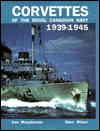
Sources
- ADM 199/1834
- ADM 173/17244
- ADM 173/17781
- ADM 173/17795
- ADM 173/17925
ADM numbers indicate documents at the British National Archives at Kew, London.
As an Amazon Associate uboat.net earns a commission from qualifying purchases.