
Allied Warships
HMS Isis (D 87)
Destroyer of the I class
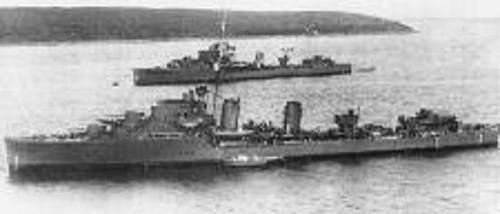
HMS Isis during the war with HMS Duncan behind
| Navy | The Royal Navy |
| Type | Destroyer |
| Class | I |
| Pennant | D 87 |
| Built by | Yarrow Shipbuilders Ltd. (Scotstoun, Scotland) |
| Ordered | 14 Nov 1935 |
| Laid down | 6 Feb 1936 |
| Launched | 12 Nov 1936 |
| Commissioned | 2 Jun 1937 |
| Lost | 20 Jul 1944 |
| Loss position | 49° 27'N, 0° 37'W |
| History | HMS Isis was being repaired / refitted at Singapore when the war in the Far East broke out. She was damaged in the Mediterranean (off Syria) in June 1941. Just before the fall of Singapore HMS Isis was towed to Java and thence to Colombo and finally Bombay for repair. HMS Isis (Lt.Cdr. Henry Dumaresq Durell, RN) was mined and sunk off Normandy, France on 20 July 1944. The wreck is in 20 meters of water about 5 miles North-East of Courseulles-sur-Mer, Normandy in position 49.27.196N, 00.36.574W. There is a memorial in Portsmouth Cathedral listing all 155 officers and men lost when the ship was sunk. |
Commands listed for HMS Isis (D 87)
Please note that we're still working on this section
and that we only list Commanding Officers for the duration of the Second World War.
| Commander | From | To | |
| 1 | Cdr. James Campbell Clouston, RN | 29 May 1937 | 3 Jun 1940 (+) |
| 2 | Lt. Eric Arthur Forbes Drought, RN | 3 Jun 1940 | 17 Jun 1940 |
| 3 | Cdr. Caspar Silas Balfour Swinley, RN | 17 Jun 1940 | Dec 41 ? |
| 4 | Lt. Lionel Robert Patrick Lawford, DSC, RN | Dec 41 ? | 6 Jul 1942 |
| 5 | Cdr. Basil Jones, DSC, RN | 6 Jul 1942 | 16 Feb 1943 |
| 6 | Lt.Cdr. David Reynolds Mitchell, RN | 16 Feb 1943 | 17 Apr 1943 |
| 7 | Cdr. Basil Jones, DSC, RN | 17 Apr 1943 | 15 Jan 1944 |
| 8 | Lt. Henry Dumaresq Durell, RN | 15 Jan 1944 | 20 Jul 1944 (+) |
You can help improve our commands section
Click here to Submit events/comments/updates for this vessel.
Please use this if you spot mistakes or want to improve this ships page.
Notable events involving Isis include:
14 Sep 1939
Around 2000A/14, the aircraft carrier HMS Hermes (Capt. F.E.P. Hutton, RN) departed Plymouth to patrol in the Western Approaches. She is escorted by the destroyers HMS Imogen (Cdr. E.B.K. Stevens, RN) and HMS Isis (Cdr. J.C. Clouston, RN).
Around 0845A/16, the destroyers HMS Imperial (Lt.Cdr. C.A.de W. Kitcat, RN) and HMS Ilex (Lt.Cdr. P.L. Saumarez, RN) joined. They had departed Plymouth around 1915A/15.
Around 1930A/18, HMS Hermes, HMS Imogen, HMS Imperial and HMS Ilex arrived at Plymouth.
HMS Isis had obtained several A/S contacts in the afternoon and evening of the 18th. She returned to Plymouth only around 1300A/19. (1)
26 Sep 1939
Convoy HG 1.
This convoy departed Gibraltar on 26 September 1939.
It was made up of the following merchant vessels; British Engineer (British (tanker), 6993 GRT, built 1922), British Science (British (tanker), 7138 GRT, built 1931), Calchas (British, 10304 GRT, built 1921), Carelia (British (tanker), 8062 GRT, built 1938), City of Adelaide (British, 6589 GRT, built 1920), City of Dunkirk (British, 5861 GRT, built 1912), Clearpool (British, 5405 GRT, built 1935), Dilwara (British, 11080 GRT, built 1936), Estrellano (British, 1982 GRT, built 1920), Fabian (British, 3059 GRT, built 1919), Gabbiano (Italian, 6567 GRT, built 1923), Ilvington Court (British, 5187 GRT, built 1919), Jurko Topic (Yugoslavian, 5202 GRT, built 1919), Kioto (British, 3297 GRT, built 1918), Largs Bay (British, 14182 GRT, built 1921), Llangibby Castle (British, 11951 GRT, built 1929), Macharda (British, 7998 GRT, built 1938), Mahratta (British, 6990 GRT, built 1917), Maja (British (tanker), 8181 GRT, built 1931), Makalla (British, 6677 GRT, built 1918), P.L.M. 22 (French, 5646 GRT, built 1921), P.L.M. 25 (French, 5461 GRT, built 1922), Palistinian Prince (British, 1960 GRT, built 1936), Stentor (British, 6148 GRT, built 1926) and Westbury (British, 4712 GRT, built 1928).
The RFA tankers Abbeydale (8299 GRT, built 1937), Aldersdale (8402 GRT, built 1937), Serbol (2668 GRT, built 1918) were also part of the convoy.
On departure from Gibraltar the convoy was escorted by the light cruiser Colombo and the destroyers HMS Grenville (Capt. G.E. Creasy, MVO, RN), HMS Gipsy (Lt.Cdr. N.J. Crossley, RN), HMS Grenade (Cdr. R.C. Boyle, RN), HMS Griffin (Lt.Cdr. J. Lee-Barber, RN) and Blyskawica (Kmdr.por. (Cdr.) W.A. Kodrebski-Poraj).
Around 2200A/26, the British destroyers parted company to return to Gibraltar.
Around 2000A/28, ORP Blyskawica was detached to proceed to Plymouth.
On 29 September, the RFA tanker Aldersdale was detached to Trinidad where she arrived on 10 October 1939. Also one of the two French ships and the Gabbiano straggled from the convoy and did not rejoin.
Around 1400A/3, the destroyers HMS Imogen (Cdr. E.B.K. Stevens, RN), i>HMS Imperial (Lt.Cdr. C.A.de W. Kitcat, RN), HMS Ilex (Lt.Cdr. P.L. Saumarez, RN) and HMS Isis (Cdr. J.C. Clouston, RN) joined the convoy.
On 4 October it was noticed that three more merchant vessels had straggled from the convoy during the night, these were the Clearpool, Ilvington Court and Westbury. The Ilvington Court however rejoined around 0900A/4.
At 1200A/4, the convoy split and the section which was to proceed up the Irish Sea towards Liverpool parted company escorted by HMS Imogen and HMS Ilex.
The remainder of the convoy set course for the English Channel.
On 5 October the Westbury rejoined the Channel section of the convoy.
Around 1400A/5, the destroyers HMS Intrepid (Cdr. J.W. Josselyn, RN) and HMS Echo (Cdr. S.H.K. Spurgeon, RAN) joined the Channel section of the convoy. HMS Colombo, HMS Imperial, HMS Isis and the RFA tanker Abbeydale were then detached to Plymouth where they arrived around 1700A/5.
The Liverpool section with HMS Imogen and HMS Ilex arrived there around 1300A/6.
The Channel section proceeded to the Downs escorted by HMS Intrepid and HMS Echo. These two destroyers arrived at Dover on 6 October 1939. (2)
29 Sep 1939
Convoy OA 12G.
This convoy departed Southend on 29 September 1939.
It was made up of the following merchant vessels; Barbara Marie (British, 4223 GRT, built 1928), Baron Cochrane (British, 3385 GRT, built 1927), Beaconstreet (British, 7467 GRT, built 1927), British Ambassador (British (tanker), 6940 GRT, built 1924), British Architect (British (tanker), 7388 GRT, built 1922), British Colony (British (tanker), 6917 GRT, built 1927), British Courage (British (tanker), 6952 GRT, built 1928), British Intigrity (British (tanker), 8412 GRT, built 1927), Castilian (British, 3067 GRT, built 1919), Fair Head (British, 1719 GRT, built 1906), Glenshiel (British, 9415 GRT, built 1924), Gretafield (British (tanker), 10191 GRT, built 1928), Gullpool (British, 4868 GRT, built 1928), Inverlane (British (tanker), 9141 GRT, built 1938), King Alfred (British, 5272 GRT, built 1919), Menin Ridge (British, 2474 GRT, built 1924), P.L.M. 26 (French, 5391 GRT, built 1922), Pozarica (British, 1893 GRT, built 1938), River Lugar (British, 5423 GRT, built 1937) and Samir (Egyptian, 3702 GRT, built 1909).
The convoy was joined around 1700A/29 off Dungeness by the destroyers HMS Imperial (Lt.Cdr. C.A.de W. Kitcat, RN) and HMS Isis (Cdr. J.C. Clouston, RN).
The convoy was joined around 0800A/1 by the light cruiser HMS Ceres (Capt. E.G. Abbott, AM, RN).
The convoy merged with convoy OB 12G coming from Liverpool in the afternoon of 2 October 1939.
2 Oct 1939
Convoy OG 1.
This convoy was formed at sea out of convoy's OA 12G and OB 12G.
On assembly the convoy was made up of the following merchant ships; Alcora (British, 1381 GRT, built 1919), Baltistan (British, 6083 GRT, built 1937), Bantria (British, 2407 GRT, built 1928), Barbara Marie (British, 4223 GRT, built 1928), Baron Cochrane (British, 3385 GRT, built 1927), Baron Forbes (British, 3061 GRT, built 1915), Beaconstreet (British, 7467 GRT, built 1927), British Ambassador (British (tanker), 6940 GRT, built 1924), British Architect (British (tanker), 7388 GRT, built 1922), British Colony (British (tanker), 6917 GRT, built 1927), British Courage (British (tanker), 6952 GRT, built 1928), British Intigrity (British (tanker), 8412 GRT, built 1927), Castalia (British, 6601 GRT, built 1906), Castilian (British, 3067 GRT, built 1919), City of Lancaster (British, 3041 GRT, built 1924), City of Marseilles (British, 8317 GRT, built 1913), Courland (British, 1325 GRT, built 1932), Dromus (British (tanker), 8036 GRT, built 1938), Fair Head (British, 1719 GRT, built 1906), Fintra (British, 2089 GRT, built 1918), Glenshiel (British, 9415 GRT, built 1924), Gretafield (British (tanker), 10191 GRT, built 1928), Gullpool (British, 4868 GRT, built 1928), Heminge (British, 2499 GRT, built 1919), Inverlane (British (tanker), 9141 GRT, built 1938), King Alfred (British, 5272 GRT, built 1919), Lesbian (British, 2370 GRT, built 1923), Menin Ridge (British, 2474 GRT, built 1924), Montauban (French, 4191 GRT, built 1920), P.L.M. 26 (French, 5391 GRT, built 1922), Palmella (British, 1578 GRT, built 1920), Peterston (British, 4680 GRT, built 1925), Pozarica (British, 1893 GRT, built 1938), River Lugar (British, 5423 GRT, built 1937), Samir (Egyptian, 3702 GRT, built 1909), Shetland (British, 1846 GRT, built 1921) and Ulea (British, 1574 GRT, built 1936).
On assembly the convoy was escorted by the light cruiser HMS Ceres (Capt. E.G. Abbott, AM, RN) and the destroyers HMS Ilex (Lt.Cdr. P.L. Saumarez, RN), HMS Imogen (Cdr. E.B.K. Stevens, RN), HMS Imperial (Lt.Cdr. C.A.de W. Kitcat, RN) and HMS Isis (Cdr. J.C. Clouston, RN).
The destroyers parted company with the convoy either late on the 2nd or early on the 3rd.
At 0530Z/8, the convoy was joined by the destroyer HMS Velox (Cdr.(Retd.) J.C. Colvill, RN).
The convoy arrived at Gibraltar later in the morning of 8 October 1939.
6 Nov 1939
HMS Warspite (Capt. V.A.C. Crutchley, VC, DSC, RN), HMS Dainty (Cdr. F.M. Walton, RN) and HMS Diana (Lt.Cdr. E.G. Le Geyt, RN) arrived at Gibraltar.
After fuelling HMS Warspite departed Gibraltar for Halifax escorted by HMS Dainty, HMS Diana, HMS Ilex (Lt.Cdr. P.L. Saumarez, RN) and HMS Isis (Cdr. J.C. Clouston, RN). (3)
7 Nov 1939
At 0815 hours, HMS Dainty (Cdr. F.M. Walton, RN) and HMS Diana (Lt.Cdr. E.G. Le Geyt, RN) parted company with HMS Warspite (Capt. V.A.C. Crutchley, VC, DSC, RN), HMS Ilex (Lt.Cdr. P.L. Saumarez, RN) and HMS Isis (Cdr. J.C. Clouston, RN).
HMS Dainty and HMS Diana then returned to Gibraltar where they arrived around 1700 hours. (3)
8 Nov 1939
HMS Devonshire (Capt. J.M. Mansfield, DSC, RN, flying the flag of Vice-Admiral J.H.D. Cunningham, CB, MVO, RN), HMS Norfolk (Capt. A.G.B. Wilson, MVO, DSO, RN) and HMS Suffolk (Capt. J.W. Durnford, RN) departed Gibraltar for the U.K. They were escorted by the destroyers HMS Douglas ( Cdr. R.F.B. Swinley, RN) and HMS Keppel (Capt. F.S.W. de Winton, RN) until 0800Z/9.
Around 1015A/11, they were joined by the destroyers HMS Isis (Cdr. J.C. Clouston, RN), HMS Ilex (Lt.Cdr. P.L. Saumarez, RN), HMS Escapade (Cdr. H.R. Graham, RN) and HMS Encounter (Lt.Cdr. E.V.St.J. Morgan, RN).
At 1720A/11, the destroyers HMS Intrepid (Cdr. J.W. Josselyn, RN) and HMS Ivanhoe (Cdr. B. Jones, RN) also joined.
Around 1810A/11, HMS Devonshire, HMS Norfolk, HMS Ilex, HMS Isis, HMS Escapade and HMS Encounter parted company with HMS Suffolk, HMS Ivanhoe and HMS Intrepid. These last three ships proceeded towards Portsmouth where HMS Suffolk arrived around 1400A/12. HMS Ivanhoe and HMS Intrepid continued on to Sheerness where they arrived around 2215A/12.
Meanwhile the other ships had arrived at Plymouth around 2015A/11. (4)
9 Nov 1939
The German merchant Leander (989 GRT) is captured off Cape Finisterre, north-west Spain by the British destroyer HMS Isis (Cdr. J.C. Clouston, RN).
16 Nov 1939
HMS Kashmir (Cdr. H.A. King, RN) and HMS Kandahar (Cdr. W.G.A. Robson, RN) are ordered to leave Scapa Flow and join the Home Fleet at sea.
HMS Kashmir was however unable to do so due to defects while HMS Kandahar was ordered to make rendez-vous with convoy HN 2 coming from Norway and then escort the west-coast section of three merchant ships together with HMS Isis (Cdr. J.C. Clouston, RN).
23 Nov 1939
Sinking of the armed merchant cruiser HMS Rawalpindi
Around midday on 21 November 1939 the German battlecruisers Scharnhorst and Gneisenau, escorted by the light cruisers Köln and Leipzig and the destroyers Z 11 / Bernd von Arnim, Z 12 / Erich Giese and Z 20 / Karl Galster, departed Wilhelmshaven for a raid into the North Atlantic, this was to relieve the pressure of the pocket battleship Admiral Graf Spee operating in the South Atlantic. Late on the 21st the escorts left the battlecruisers.
Just after 1500A/23 the British armed merchant cruiser HMS Rawalpindi (Capt.(Retd.) E.C. Kennedy, RN) sighted the Scharnhorst. Rawalpindi was part of the British Northern Patrol and was stationed south-east of Iceland in the Iceland-Faroe gap. Captain Kennedy at first tried to get away from the German ship and report to the Admiralty that he sighted the German pocket battleship Deutschland, still believed to be operating in the North Atlantic, and so as to buy time so that other ships of the Northern patrol could come to his assistance. Just after 1600 hours, Rawalpindi came within range of the Scharnhorst and was quickly reduced to a flaming wreck. During this engagement Scharnhorst was hit by a 6in shell from Rawalpindi causing only light damage. Scharnhorst and Gneisenau together picked up 27 survivors from the Rawalpindi which finally sank around 2000 hours.
The British light cruiser HMS Newcastle (Capt J. Figgins, RN), that was also part of the Northern Patrol, picked up Rawalpindi's signal and closed the scene. She sighted the Gneisenau but the Germans managed to escape in the fog.
The Admiralty also thought the ship sighted by Rawalpindi and Newcastle was the Deutschland that was trying to return to Germany. In response to the sighting and destruction of the Rawalpindi the Admiralty took immediate action; The battleships HMS Nelson (Capt. G.J.A. Miles, RN, flying the flag of Admiral J.M. Forbes, KCB, DSO, RN) HMS Rodney (Capt. F.H.G. Dalrymple-Hamilton, RN) and the heavy cruiser HMS Devonshire (Capt. J.M. Mansfield, DSC, RN, flying the flag of Vice-Admiral J.H.D. Cunningham, CB, MVO, RN) escorted by the destroyers HMS Faulknor (Capt. C.S. Daniel, RN), HMS Fame (Cdr. P.N. Walter, RN), HMS Firedrake (Lt.Cdr. S.H. Norris, RN), HMS Foresight (Lt.Cdr. G.T. Lambert, RN), HMS Forester (Lt.Cdr. E.B. Tancock, RN), HMS Fortune (Cdr. E.A. Gibbs, RN) and HMS Fury (Cdr. G.F. Burghard, RN) departed the Clyde around 1930A/23 to patrol of Norway to cut off the way to Germany for the Deutschland.
The light cruisers HMS Southampton (Capt. F.W.H. Jeans, CVO, RN, flying the flag of Vice-Admiral G.F.B. Edward-Collins, CB, KCVO, RN), HMS Edinburgh (Capt. F.C. Bradley, RN) and HMS Aurora (Capt. G.B. Middleton, RN) escorted by the destroyers HMS Afridi (Capt. G.H. Creswell, DSC, RN), HMS Gurkha (Cdr. F.R. Parham, RN), HMS Bedouin (Cdr. J.A. McCoy, RN), HMS Kingston (Lt.Cdr. P. Somerville, RN) and HMS Isis (Cdr. J.C. Clouston, RN) departed Rosyth to patrol between the Orkney and Shetland islands.
Light cruiser HMS Sheffield (Capt. E. de F. Renouf, CVO, RN) was sent from Loch Ewe to the last known position of the German ship(s).
On northern patrol, south of the Faroes were the light cruisers HMS Caledon (Capt. C.P. Clark, RN), HMS Cardiff (Capt. P.K. Enright, RN) and HMS Colombo (Commodore R.J.R. Scott, RN). These were joined by HMS Dunedin (Capt. C.E. Lambe, CVO, RN) and HMS Diomede (Commodore E.B.C. Dicken, OBE, DSC, RN).
Of the ships of the Denmark strait patrol, the heavy cruisers HMS Suffolk (Capt. J.W. Durnford, RN) and HMS Norfolk (Capt. A.G.B. Wilson, MVO, DSO, RN) were ordered to proceed to the Bill Bailey Bank (to the south-west of the Faroe Islands).
The light cruiser HMS Glasgow (Capt. F.H. Pegram, RN) escorted by the destroyers HMS Maori (Cdr. G.N. Brewer, RN) and HMS Zulu (Cdr. J.S. Crawford, RN) were already at sea patrolling north-east of the Shetlands were to be joined by the destroyers HMS Inglefield (Capt. P. Todd, RN), HMS Imperial (Lt.Cdr. C.A.de W. Kitcat, RN), HMS Impulsive (Lt.Cdr. W.S. Thomas, RN) and HMS Imogen (Cdr. E.B.K. Stevens, RN).
The light cruisers HMS Calypso (Capt. N.J.W. William-Powlett, DSC, RN) and HMS Ceres (Capt. E.G. Abbott, AM, RN) were stationed off Kelso Light to act as a night attack striking force. The destroyers HMS Somali (Capt. R.S.G. Nicholson, DSC, RN), HMS Ashanti (Cdr. W.G. Davis, RN), HMS Mashona (Cdr. P.V. McLaughlin, RN) and HMS Punjabi (Cdr. J.T. Lean, RN) had just departed Belfast on escort duties. They were ordered to join Admiral Forbes. The ships they were escorting were ordered to return to Belfast.
The destroyers HMS Tartar (Lt.Cdr. D.E. Holland-Martin, RN), HMS Kandahar (Cdr. W.G.A. Robson, RN) and HMS Kashmir (Cdr. H.A. King, RN) departed Scapa Flow with orders to locate and shadow the German ships. HMS Tartar however had to return to Scapa Flow the next day due to a damaged rudder. The other two destroyers were ordered to join HMS Aurora which was to form a strike group of destroyers.
Despite the British effort to intercept the German ships, both German battlecruisers returned to Wilhelmshaven on the 27th.
30 Nov 1939
Convoy HN 3
This convoy was assembled in Norwegian waters near Bergen on 30 November 1939 and arrived at Methil on 3 December 1939.
The convoy was made up of the following merchant vessels; Albionic (British, 2468 GRT, built 1924), Amicus (British, 3660 GRT, built 1925), Asiatic (British, 3741 GRT, built 1923), Baltrover (British, 4916 GRT, built 1913), Bore III (Finnish, 1153 GRT, built 1915), Clarissa Radcliffe (British, 5754 GRT, built 1915), Eskdene (British, 3829 GRT, built 1934), Folda (British, 1165 GRT, built 1920), Glen Tilt (British, 871 GRT, built 1920), Kalev (Estonian, 1867 GRT, built 1917), King Edwin (British, 4536 GRT, built 1927), Majorca (British, 1126 GRT, built 1921), Mall (Estonian, 1863 GRT, built 1918), Ogmore Castle (British, 2481 GRT, built 1919), Sea Valour (British, 1950 GRT, built 1930), Stancourt (British, 965 GRT, built 1909), Thistleford (British, 4781 GRT, built 1928) and Treworlas (British, 4692 GRT, built 1922).
Escort (distant cover) was provided by the heavy cruiser HMS Suffolk (Capt. J.W. Durnford, RN) and the light cruiser HMS Southampton (Capt. F.W.H. Jeans, CVO, RN, flying the flag of Vice-Admiral G.F.B. Edward-Collins, CB, KCVO, RN). HMS Suffolk was relieved by the light cruiser HMS Glasgow (Capt. F.H. Pegram, RN) on 2 December.
Close escort (A/S) was provided by the destroyers HMS Ilex (Lt.Cdr. P.L. Saumarez, RN), HMS Icarus (Lt.Cdr. C.D. Maud, RN), HMS Eskimo (Cdr. St.J.A. Micklethwait, RN) and HMS Matabele (Cdr. G.K. Whitmy-Smith, RN).
Four of the merchant ships split off on 2 December for the west coast of the U.K. The destroyers HMS Isis (Cdr. J.C. Clouston, RN) and HMS Kandahar (Cdr. W.G.A. Robson, RN) came from Scapa Flow to escort these ships.
10 Dec 1939
HMS H 34 (Lt. E.F. Balston, RN) conducted A/S exercises at Scapa Flow with HMS Isis (Cdr. J.C. Clouston, RN). (5)
10 Dec 1939
Convoy TC 1.
This convoy of troopships departed Halifax around 0510Q/10, for the Clyde where it arrived on 17 December 1939.
The convoy was made up of the following troopships / liners; Aquitania (British, 44786 GRT, built 1914, carrying 2638 troops), Duchess of Bedford (British, 20123 GRT, built 1928, carrying 1312 troops), Empress of Australia (British, 21833 GRT, built 1914, carrying 1235 troops), Empress of Britain (British, 42348 GRT, built 1931, carrying 1303 troops) and Monarch of Bermuda (British, 22424 GRT, built 1931, carrying 961 troops),
Close escort was provided on leaving Halifax by the battleship HMS Resolution (Capt. O. Bevir, RN) and the Canadian destroyers HMCS Fraser (Cdr. W.N. Creery, RCN), HMCS Ottawa (Capt. G.C. Jones, RCN), HMCS Restigouche (Lt.Cdr. W.B.L. Holms, RCN) and HMCS St. Laurent (Lt.Cdr. H.G. de Wolf, RCN). These Canadian destroyers remained with the convoy until 12 December 1939 when they set course to return to Halifax.
Cover for the convoy was provided by the battlecruiser HMS Repulse (Capt. E.J. Spooner, DSO, RN), aircraft carrier HMS Furious (Capt. M.L. Clarke, DSC, RN), light cruiser HMS Emerald (Capt. A.W.S. Agar, VC, DSO, RN) and the destroyers HMS Hunter (Lt.Cdr. L. de Villiers, RN) and HMS Hyperion (Cdr. H.St.L. Nicholson, RN). At dusk on the 10th both destroyers were detached to join the local escort. They returned to Halifax with the Canadian destroyers.
Early on the 15th, HMS Emerald was detached, HMS Newcastle (Capt. J. Figgins, RN) had joined the cover force in the afternoon of the 14th to take her place.
When the convoy approached the British isles, the destroyers HMS Eskimo (Cdr. St.J.A. Micklethwait, RN), HMS Bedouin (Cdr. J.A. McCoy, RN), HMS Mashona (Cdr. P.V. McLaughlin, RN), HMS Somali (Capt. R.S.G. Nicholson, DSC, RN), HMS Kandahar (Cdr. W.G.A. Robson, RN), HMS Khartoum (Cdr. D.T. Dowler, RN), HMS Kingston (Lt.Cdr. P. Somerville, RN), HMS Kashmir (Cdr. H.A. King, RN), HMS Fearless (Cdr. K.L. Harkness, RN), HMS Ilex (Lt.Cdr. P.L. Saumarez, RN) and HMS Impulsive (Lt.Cdr. W.S. Thomas, RN) departed the Clyde on the 12th to sweep ahead of the convoy. HMS Imperial (Lt.Cdr. C.A.de W. Kitcat, RN) was also to have sailed but was unable to join. HMS Matabele (Cdr. G.K. Whitmy-Smith, RN) was sailed in her place and later joined the other destroyers at sea.
After German warships had been reported in the North Sea, and concerned for the safety of convoy TC.1, Admiral Forbes, departed the Clyde on the 13th to provide additional cover with the battleships HMS Warspite (Capt. V.A.C. Crutchley, VC, DSC, RN), HMS Barham (Capt. H.T.C. Walker, RN), battlecruiser HMS Hood (Capt. I.G. Glennie, RN, flying the flag of Rear-Admiral W.J. Whitworth, CB, DSO, RN) and the destroyers HMS Inglefield (Capt. P. Todd, RN), HMS Icarus (Lt.Cdr. C.D. Maud, RN), HMS Imogen (Cdr. E.B.K. Stevens, RN), HMS Imperial, HMS Isis (Cdr. J.C. Clouston, RN) and HMS Foxhound (Lt.Cdr. P.H. Hadow, RN). The destroyers HMS Forester (Lt.Cdr. E.B. Tancock, RN) and HMS Firedrake (Lt.Cdr. S.H. Norris, RN) sailed from Loch Ewe and later joined this force at sea. Three cruisers from the Northern Patrol were ordered to patrol in position 53°55’N, 25°00’W to provide cover for the convoy. These were the heavy cruisers HMS Berwick (Capt. I.M. Palmer, DSC, RN), HMS Devonshire (Capt. J.M. Mansfield, DSC, RN, flying the flag of Vice-Admiral J.H.D. Cunningham, CB, MVO, RN) and the light cruiser HMS Glasgow (Capt. F.H. Pegram, RN).
The light cruisers HMS Southampton (Capt. F.W.H. Jeans, CVO, RN), HMS Edinburgh (Cdr. C. Wauchope, RN, temporary in command) departed Rosyth to patrol between the Shetlands and the Faroes.
The destroyers HMS Afridi (Capt. G.H. Creswell, DSC, RN), HMS Maori (Cdr. G.N. Brewer, RN) and HMS Nubian (Cdr. R.W. Ravenhill, RN) departed Rosyth and proceeded north at high speed to try to cut of the enemy warhips if they were to enter the Atlantic.
The light cruisers HMS Cardiff (Capt. P.K. Enright, RN), HMS Ceres (Capt. E.G. Abbott, AM, RN), HMS Delhi (Capt L.H.K. Hamilton, DSO, RN), HMS Diomede (Commodore E.B.C. Dicken, OBE, DSC, RN) which were on the Northern Patrol were to concentrate near the Faroes where they were joined by HMS Colombo (Commodore R.J.R. Scott, RN) and HMS Dragon (Capt. R.G. Bowes-Lyon, MVO, RN) which were on passage to their patrol stations.
Around 0430Z/17, in foggy conditions, the outward bound liner Samaria (British, 19597 GRT, built 1921) collided with both HMS Furious and the Aquitania but no major damage was done to either one of the three ships.
The convoy arrived safely in the Clyde on 17 December 1939. (6)
13 Dec 1939
The battleships HMS Warspite (Capt. V.A.C. Crutchley, VC, DSC, RN, flying the flag of Admiral J.M. Forbes, KCB, DSO, RN), HMS Barham (Capt. H.T.C. Walker, RN), battlecruiser HMS Hood (Capt. I.G. Glennie, RN, flying the flag of Rear-Admiral W.J. Whitworth, CB, DSO, RN) and the destroyers HMS Inglefield (Capt. P. Todd, RN), HMS Icarus (Lt.Cdr. C.D. Maud, RN), HMS Imogen (Cdr. E.B.K. Stevens, RN), HMS Imperial, HMS Isis (Cdr. J.C. Clouston, RN) and HMS Foxhound (Lt.Cdr. P.H. Hadow, RN) sailed from the Clyde to provide cover for convoy TC 1. This convoy transported Canadian troops to the U.K. The destroyers HMS Forester (Lt.Cdr. E.B. Tancock, RN) and HMS Firedrake (Lt.Cdr. S.H. Norris, RN) sailed from Loch Ewe and later joined this force at sea.
[For more info on convoy TC 1 see the event 'Convoy TC 1' for 10 December 1939.]
17 Dec 1939
The battleships HMS Warspite (Capt. V.A.C. Crutchley, VC, DSC, RN, flying the flag of Admiral J.M. Forbes, KCB, DSO, RN), HMS Barham (Capt. H.T.C. Walker, RN), battlecruiser HMS Hood (Capt. I.G. Glennie, RN, flying the flag of Rear-Admiral W.J. Whitworth, CB, DSO, RN) and the destroyers HMS Somali (Capt. R.S.G. Nicholson, DSC, RN), HMS Inglefield (Capt. P. Todd, RN), HMS Icarus (Lt.Cdr. C.D. Maud, RN), HMS Imogen (Cdr. E.B.K. Stevens, RN), HMS Imperial (Lt.Cdr. C.A.de W. Kitcat, RN), HMS Isis (Cdr. J.C. Clouston, RN) and HMS Foxhound (Lt.Cdr. P.H. Hadow, RN) arrived at the Clyde.
19 Dec 1939
HMS Barham (Capt. H.T.C. Walker, RN), HMS Repulse (Capt. E.J. Spooner, DSO, RN) escorted by HMS Inglefield (Capt. P. Todd, RN), HMS Icarus (Lt.Cdr. C.D. Maud, RN), HMS Imogen (Cdr. E.B.K. Stevens, RN), HMS Isis (Cdr. J.C. Clouston, RN) and HMS Khartoum (Cdr. D.T. Dowler, RN) departed the Clyde. They were to provide cover for convoy HN 5 (from Norway to the U.K.) and afterwards for the ships of the Northern Patrol.
At 1700 hours this day, while in position 55°30'N, 05°02'W HMS Khartoum reported that a torpedo had been fired at her and she made three A/S attacks. Also HMS Isis attacked a submarine contact. No German submarine reported attacking a destroyer and being counter attacked so the A/S contacts must have been bogus. (7)
22 Dec 1939
It was time for the destroyers to start refueling so at 2000/22 HMS Imogen (Cdr. E.B.K. Stevens, RN) and HMS Khartoum (Cdr. D.T. Dowler, RN) parted company with HMS Barham (Capt. H.T.C. Walker, RN), HMS Repulse (Capt. E.J. Spooner, DSO, RN), HMS Inglefield (Capt. P. Todd, RN), HMS Icarus (Lt.Cdr. C.D. Maud, RN) and HMS Isis (Cdr. J.C. Clouston, RN). They then proceeded to Sullom Voe to fuel and returned at 1045/24.
At 2015/24, HMS Icarus and HMS Isis parted company to proceed to Sullom Voe to fuel. They returned at 1230/26.
At 2005/26, HMS Inglefield parted company to fuel at Sullom Voe. She rejoined the force at 0855/28. (8)
28 Dec 1939
HMS Isis (Cdr. J.C. Clouston, RN) picks up 16 survivors from the armed trawler HMS Barbara Robertson that was shelled and sunk by the German U-boat U-30 about 35 miles northwest of Butt of Lewis.
2 Jan 1940
Around 0900A/2, HMS Newcastle (Capt. J. Figgins, RN) (Capt. J. Figgins, RN), departed Scapa Flow for the Northern Patrol. She is ordered to patrol south of Iceland.
At 1126Z/2, a disturbance was noticed in the water in position 59°13'N, 03°59'W which was thought to be a submarine. The destroyers HMS Fearless (Cdr. K.L. Harkness, RN), HMS Fury (Cdr. G.F. Burghard, RN) and by Walrus aircraft, searched for the supposed submarine. The destroyers HMS Impulsive (Lt.Cdr. W.S. Thomas, RN) and HMS Isis (Cdr. J.C. Clouston, RN) also joined in the hunt which was discontinued the following day. (9)
4 Jan 1940
Around 1430Z/4, the damaged battleship HMS Nelson (Capt. G.J.A. Miles, RN) departed Loch Ewe for Portsmouth where she arrived around 1045Z/8. At Porstmouth she is then taken in hand for repairs and refit.
During the passage from Loch Ewe to Portsmouth she was escorted by the destroyers HMS Faulknor (Capt. C.S. Daniel, RN), HMS Fame (Cdr. P.N. Walter, RN), HMS Foxhound (Lt.Cdr. G.H. Peters, RN), HMS Foresight (Lt.Cdr. G.T. Lambert, RN), HMS Isis (Cdr. J.C. Clouston, RN) and HMS Impulsive (Lt.Cdr. W.S. Thomas, RN).
10 Jan 1940
In the evening, the armed merchant cruiser HMS Canton (Capt. G.D. Belben, DSC, RN) grounded in bad weather conditions on the west coast of Lewis Island, Hebrides.
She was able to get off the following morning but had sustained damage and was holed forward.
Around 1100Z/11, the armed merchant cruiser HMS California (Capt. C.J. Pope, RAN) joined to render assistance. She parted company around 1325Z/11, after the destroyers HMS Isis (Cdr. J.C. Clouston, RN) and HMS Imperial (Lt.Cdr. C.A.de W. Kitcat, RN) had joined shortly before.
Around 1700Z/11, the destroyers HMS Fame (Cdr. P.N. Walter, RN) and HMS Foresight (Lt.Cdr. G.T. Lambert, RN) also joined.
Around 2015Z/11, the tug HMS Bandit arrived. Later also the HMS Englishman joined.
Around 2110Z/11, HMS Isis and HMS Imperial parted company.
Around 1115Z/12, HMS Foresight obtained an A/S contact but lost it soon afterwards, no submarines were in the area so this mist have been a non-sub contact as no enemy submarines were in the immediate area.
The destroyers HMS Faulknor (Capt. C.S. Daniel, RN), HMS Forester (Lt.Cdr. E.B. Tancock, RN), HMS Fortune (Cdr. E.A. Gibbs, DSO, RN), HMS Foxhound (Lt.Cdr. G.H. Peters, RN) and HMS Fury (Cdr. G.F. Burghard, RN) arrived in the area to cover the passage of the damaged armed merchant cruiser to the Clyde.
Around 1215Z/13, HMS Canton arrived at Greenock. (10)
15 Jan 1940
Convoy ON 8.
Convoy ON 8 departed Methill on 15 January 1940 for Norway where it was dissolved off Bergen on 19 January 1940.
It was made up of the following merchant ships; Baron Kelvin (British, 3081 GRT, built 1924), Eros (Norwegian, 974 GRT, built 1922), Fredensborg (Danish, 2094 GRT, built 1922), Glen Tilt (British, 871 GRT, built 1920), Gullpool (British, 4868 GRT, built 1928), Hague (British, 974 GRT, built 1919), Haukefjell (British, 2495 GRT, built 1921), Mathilda (Norwegian, 3650 GRT, built 1920), Oslo (Danish, 2094 GRT, built 1922) and Vienti (Finnish, 1715 GRT, built 1911).
A close escort provided for the convoy made was up of the destroyers HMS Duncan (Cdr. J.S.C. Salter, RN), HMS Imperial (Lt.Cdr. C.A.de W. Kitcat, RN), HMS Impulsive (Lt.Cdr. W.S. Thomas, RN) and HMS Isis (Cdr. J.C. Clouston, RN) and the submarine HMS Narwhal (Lt.Cdr. E.R.J. Oddie, RN).
Close cover was provided by the light cruisers HMS Edinburgh (Capt. C.M. Blackman, DSO, RN, flying the flag of Vice-Admiral G.F.B. Edward-Collins, CB, KCVO, RN) and HMS Glasgow (Capt. F.H. Pegram, RN).
The convoy arrived in Norwegian waters on 19 January 1940.
24 Jan 1940
Convoy ON 9.
This convoy was formed off Methill on 24 January 1940. It arrived in Norwegian waters near Bergen on 27 January 1940.
This convoy was made up of the following merchant vessels; Anna (Finnish, 1043 GRT, built 1897), Basel (Norwegian, 1110 GRT, built 1924), Bolette (Norwegian, 1167 GRT, built 1920), Fanefjeld (Norwegian, 1354 GRT, built 1920), Helder (Dutch, 3629 GRT, built 1920), Kalix (Swedish, 2801 GRT, built 1913), Kurikka (British, 3106 GRT, built 1918), Majorca (British, 1126 GRT, built 1921), Minorca (British, GRT, 1123 built 1921), Pollux (Finnish, 1284 GRT, built 1898), Sekstant (Norwegian, 1626 GRT, built 1919), Transport (Norwegian, 1998 GRT, built 1921) and Wanda (Finnish, 1902 GRT, built 1897).
Escort was provided by the destroyers HMS Inglefield (Capt. P. Todd, RN), HMS Isis (Cdr. J.C. Clouston, RN), HMS Tartar (Cdr. L.P. Skipwith, RN) and HMS Kashmir (Cdr. H.A. King, RN).
The submarine HMS Seal (Lt.Cdr. R.P. Lonsdale, RN) was also part of the escort.
HMS Tartar was relieved on the 25th by HMS Khartoum (Cdr. D.T. Dowler, RN) which in turn was relieved later that day by HMS Imogen (Cdr. C.L. Firth, MVO, RN).
Close cover for this convoy was provided by the light cruisers HMS Edinburgh (Capt. C.M. Blackman, DSO, RN, flying the flag of Vice-Admiral G.F.B. Edward-Collins, CB, KCVO, RN) and HMS Glasgow (Capt. F.H. Pegram, RN) which departed Scapa Flow on the 25th.
The convoy arrived safely off the Norwegian coast on the 27th.
27 Jan 1940
Convoy HN 9A.
This convoy was formed near Bergen, Norway on 27 January 1940. It arrived at Methill on 31 January 1940.
This convoy was made up of the following merchant vessels; Albert (Swedish, 1745 GRT, built 1922), Carbonia (Swedish, 1918 GRT, built 1916), Ceres (Finnish, 996 GRT, built 1889), Edna (Norwegian, 915 GRT, built 1905), Eikhaug (Norwegian, 1436 GRT, built 1903), Ergo (Finnish, 1928 GRT, built 1893), Favorit (Norwegian, 2826 GRT, built 1920), Haardrade (Norwegian, 750 GRT, built 1922), Helios (Estonian, 1309 GRT, built 1894), Inga (Finnish, 2410 GRT, built 1907), Ingaro (Swedish, 1999 GRT, built 1916), Inger (Norwegian, 1409 GRT, built 1930), Ingerfire (Norwegian, 3835 GRT, built 1905), Julia (Greek, 4352 GRT, built 1914), Juta (Estonian, 1559 GRT, built 1908), Kjell Billner (Norwegian, 1128 GRT, built 1907), Knoll (Norwegian, 1151 GRT, built 1916), Kul (Norwegian, 1310 GRT, built 1907), Lab (Norwegian, 1118 GRT, built 1912), Ledaal (Norwegian, 3076 GRT, built 1899), Leonardia (Swedish, 1583 GRT, built 1906), Louis de Geer (Swedish, 1847 GRT, built 1916), Makefjell (Norwegian, 1567 GRT, built 1932), Mammy (Norwegian, 1656 GRT, built 1911), Namdo (Swedish, 2738 GRT, built 1907), Nordia (Swedish, 1316 GRT, built 1921), Nurgis (Norwegian, 700 GRT, built 1919), Ramava (Latvian, 2141 GRT, built 1900), Rigel (Nowegian, 3828 GRT, built 1924), Skotfoss (Norwegian, 1465 GRT, built 1917), Tautra (Norwegian, 1749 GRT, built 1920), Torne (Swedish, 3792 GRT, built 1913), Torni (British, 2044 GRT, built 1918), Vaga (Norwegian, 1612 GRT, built 1924), Veni (Norwegian, 2982 GRT, built 1901), Vesla (Norwegian, 1107 GRT, built 1913) and Vestfoss (Norwegian, 1388 GRT, built 1909).
Escort was provided by the destroyers HMS Inglefield (Capt. P. Todd, RN), HMS Imogen (Cdr. C.L. Firth, MVO, RN), HMS Isis (Cdr. J.C. Clouston, RN), HMS Kashmir (Cdr. H.A. King, RN) amd the submarine HMS Seal (Lt.Cdr. R.P. Lonsdale, RN).
Close cover for this convoy was provided by the light cruisers HMS Edinburgh (Capt. C.M. Blackman, DSO, RN, flying the flag of Vice-Admiral G.F.B. Edward-Collins, CB, KCVO, RN) and HMS Glasgow (Capt. F.H. Pegram, RN).
The destroyer HMS Mohawk (Cdr. J.W.M. Eaton, RN) joined on 30 January and then split off from the convoy together with HMS Inglefield and twelve ships from the convoy to proceed to the west coast of the U.K.
The bulk of the convoy arrived safely at Methill on 31 January.
5 Feb 1940
HMS Repulse (Capt. E.J. Spooner, DSO, RN) departed the Clyde for Plymouth (Devonport Dockyard). She was escorted by the destroyers HMS Kashmir (Cdr. H.A. King, RN), HMS Khartoum (Cdr. D.T. Dowler, RN) and HMS Forester (Lt.Cdr. E.B. Tancock, RN).
At sea they were joined by HMS Isis (Cdr. J.C. Clouston, RN).
The next day they were joined by HMS Kandahar (Cdr. W.G.A. Robson, RN) which apparently took the place of HMS Forester in the screen as this destroyer returned to the Clyde that day (6 February 1940). HMS Kandahar had departed Rosyth on 4 February, having completed her repairs there. (11)
7 Feb 1940
HMS Repulse (Capt. E.J. Spooner, DSO, RN), HMS Kashmir (Cdr. H.A. King, RN), HMS Khartoum (Cdr. D.T. Dowler, RN) and HMS Kandahar (Cdr. W.G.A. Robson, RN) arrived at Plymouth.
HMS Isis (Cdr. J.C. Clouston, RN) had been detached off Falmouth where she was to refit.
HMS Repulse then commenced a short refit at Plymouth. (11)
19 Mar 1940
Around 1500A/19, the aircraft carrier HMS Ark Royal (Capt. A.J. Power, RN, flying the flag of Vice-Admiral L.V. Wells, CB, DSO, RN) departed Spithead for Portland Bay. She is being escorted by the destroyers HMS Isis (Cdr. J.C. Clouston, RN), HMS Arrow (Cdr. H.W. Williams, RN) and HMS Shikari (Lt.Cdr. H.N.A. Richardson, RN).
At 1603A/19, HMS Shikari parted company.
At 1640A/19, HMS Arrow and HMS Isis parted company.
At 1934A/19, HMS Ark Royal passed the boom into Portland Bay. (12)
20 Mar 1940
The aircraft carrier HMS Ark Royal (Capt. A.J. Power, RN, flying the flag of Vice-Admiral L.V. Wells, CB, DSO, RN) conducted flying exercises off Portland Bay. During the exercises the destroyer HMS Isis (Cdr. J.C. Clouston, RN) and two MA/SB's patrolled in the area. (12)
22 Mar 1940
At 1108A/22, the aircraft carrier HMS Ark Royal (Capt. A.J. Power, RN, flying the flag of Vice-Admiral L.V. Wells, CB, DSO, RN) passed to boom to leave Portland Bay. She is to proceed to the Mediterranean for training her aircrews.
On departure from Portland she is escorted by the destroyers HMS Isis (Cdr. J.C. Clouston, RN) and HMS Imogen (Cdr. C.L. Firth, MVO, RN).
The destroyers parted company at 1749A/23. HMS Ark Royal then proceeded unescorted.
At 1203A/25, she was joined, in position 36°02'N, 09°36'W by the destroyer HMS Bulldog (Lt.Cdr. J.S.M. Richardson, RN) and about half an hour later by the destroyer HMS Active (Lt.Cdr. E.C.L. Turner, RN). These destroyers had departed Gibraltar on the 24th.
At 1747A/25, the destroyer HMAS Voyager (Lt.Cdr. J.C. Morrow, RAN) joined in approximate position 36°00'N, 07°50'W. HMS Active then parted company to make rendezvous with a merchant vessel coming from Freetown.
Around 1100A/28, HMS Ark Royal and her two escorting destroyers arrived at Malta. (13)
25 Mar 1940
Around 1600A/25, the aircraft carrier HMS Furious (Capt. T.H. Troubridge, RN) departed Plymouth for Greenock. She is escorted by the destroyers HMS Isis (Cdr. J.C. Clouston, RN), HMS Imogen (Cdr. C.L. Firth, MVO, RN) and HMS Havock (Lt.Cdr. R.E. Courage, RN).
HMS Furious arrived at Greenock around 1930A/26.
The escorting destroyers had parted company with the aircraft carrier around 1745A/26 and then proceeded to Scapa Flow arriving there around 1545A/27. (14)
29 Mar 1940
HMS Spearfish (Lt.Cdr. J.H. Forbes, RN) conducted A/S exercises at / off Scapa Flow with the destroyers HMS Inglefield (Capt. P. Todd, RN), HMS Ilex (Lt.Cdr. P.L. Saumarez, DSC, RN), HMS Imogen (Cdr. C.L. Firth, MVO, RN), HMS Isis (Cdr. J.C. Clouston, RN), HMS Encounter (Lt.Cdr. E.V.St J. Morgan, RN) and HMS Delight (Cdr. M. Fogg-Elliot, RN). (15)
2 Apr 1940
Around 0100 hours the destroyers HMS Inglefield (Capt. P. Todd, RN), HMS Imogen (Cdr. C.L. Firth, MVO, RN), HMS Isis (Cdr. J.C. Clouston, RN) and HMS Jupiter (Cdr. D.B. Wyburd, RN) departed Scapa Flow to search for a reported damaged enemy submarine in the Moray Firth. The A/S hunt was not succesful and the destroyers returned to Scapa Flow early in the evening.
5 Apr 1940
Operation Wilfed.
Minelaying in Norwegian territorial waters and subsequent movements leading up to the First Battle of Narvik.
Three British forces were to lay mines in Norwegian territorial waters, these were;
' Force WB ': destroyers HMS Hyperion (Cdr. H.St.L. Nicolson, RN) and HMS Hero (Cdr. H.W. Biggs, RN). They were to simulate a minelay of Bud. This force departed Scapa Flow with HMS Renown at 1830/5 (see below).
' Force WS ': Auxiliary minelayer HMS Teviotbank (Cdr.(Retd.) R.D. King-Harman, DSC and Bar, RN) and the destroyers HMS Inglefield (Capt. P. Todd, RN), HMS Ilex (Lt.Cdr. P.L. Saumarez, DSC, RN), HMS Imogen (Cdr. C.L. Firth, MVO, RN) and HMS Isis (Cdr. J.C. Clouston, RN). This force was to lay mines in the Stadlandet area between Aalesund and Bergen.
' Force WV ': Minelaying destroyers: HMS Esk (Lt.Cdr. R.J.H. Couch, RN, with Capt. J.G. Bickford, DSC, RN, Capt. D.10 onboard), HMS Icarus (Lt.Cdr. C.D. Maud, RN), HMS Impulsive (Lt.Cdr. W.S. Thomas, RN) and HMS Ivanhoe (Cdr. P.H. Hadow, RN) escorted by destroyers HMS Hardy (Capt. B.A. Warburton-Lee, RN), HMS Havock (Cdr. R.E. Courage, RN), HMS Hotspur (Cdr. H.F.H. Layman, RN) and HMS Hunter (Lt.Cdr. L. de Villiers, RN). This force was to lay mines in the entrance to the Vestfiord.
To cover ' Force WS ' it had been intended to sent out the battlecruiser HMS Renown (Capt. C.E.B. Simeon, RN) and the destroyers HMS Greyhound (Cdr. W.R. Marshall-A'Deane, RN), HMS Glowworm (Lt.Cdr. G.B. Roope, RN) and the destroyers from ' Force WB '. As the Admiralty received information that all four Norwegian coast defence ships were at Narvik this was changed at the last moment and the Renown force was then ordered to cover ' Force WV ' instead. Renown and her escorting destroyers departed Scapa Flow around 1830/5.
' Force WS ' departed Scapa Flow around 1930/5. During the night the destroyers in company with HMS Renown had lost contact with her in the heavy weather. By dawn they were regaining contact when HMS Glowworm reported a man overboard at 0620/6. She was given permission shortly afterwards to search for her missing crewmember and doubled back.
' Force WV ' departed Sullom Voe around 0515/6. They were to rendezvous at sea with HMS Renown, her escorting destroyers and ' Force WB '. Rendezvous was effected at 0735/6.
HMS Hyperion and HMS Hero, were detached to refuel at Lerwick prior to their simulated minelay off Bud. They arrived at Sullom Voe around 1545/6.
When the Admiralty found out on the 7th that only HMS Greyhound was with HMS Renown the light cruiser HMS Birmingham (Capt. A.C.G. Madden, RN) and the destroyers HMS Fearless (Cdr. K.L. Harkness, RN) and HMS Hostile (Cdr. J.P. Wright, RN) were ordered to make rendezvous with HMS Renown off the Vestfiord.
In the evening of the 7th, HMS Renown signalled her intention to be in position 67°15'N, 10°40'E at 0500/8 to HMS Birmingham and HMS Glowworm. Due to the bad weather conditions HMS Birmingham and her escort failed to make the rendezvous in time.
Between 0430 and 0530/8 the' Force WS ' laid their minefield in Vestfiord. HMS Hardy, HMS Havock, HMS Hotspur and HMS Hunter then proceeded to make rendezvous with HMS Renown while HMS Esk, HMS Icarus, HMS Impulsive and HMS Ivanhoe patrolled near the minefield.
At 0759/8 HMS Glowworm, who was then in position 65°04'N, 06°04'E, and steering towards the rendezvous with HMS Renown, sighted the German destroyers Z 11 / Bernd von Arnim and Z 18 / Hans Ludemann. Immediately HMS Glowworm sent an enemy report and at then engaged Z 18 / Hans Ludemann.
At 0855/8, HMS Glowworm reported an unknown ship bearing 0°, steering 180° in position 65°06'N, 06°20'E. The German destroyers had called for assistance and drew HMS Glowworm towards the heavy cruiser Admiral Hipper which then egaged the British destroyer. Mortally wounded by the enemy's gunfire, HMS Glowworm managed to ram the German cruiser, tearing away 130 feet of the cruiser's armour belt and wrenching the emey's starboard torpedo tubes from their mountings.
At 0904/8, HMS Glowworm sent her last signal before sinking in position 64°13'N, 06°28'E. After the war Lt.Cdr. Roope, Glowworm's Commanding Officer was posthumously awarded the Victoria Cross.
Immediately after the receipt of HMS Glowworm's enemy report, HMS Renown and HMS Greyhound, then in position 67°34'N, 10°00'E turned south steering for the reported position believing that the enemy force was heading for Vestfiord and expecting to meet them around 1330/8.
At 0915/8, the C-in-C Home Fleet, detached the battlecruiser HMS Repulse (Capt. E.J. Spooner, DSO, RN), light cruiser HMS Penelope (Capt. G.D. Yates, RN) and the destroyers HMS Bedouin (Cdr. J.A. McCoy, RN), HMS Eskimo (Cdr. St.J.A. Micklethwait, DSO, RN), HMS Punjabi (Cdr. J.T. Lean, RN) and HMS Kimberley (Lt.Cdr. R.G.K. Knowling, RN) from his force to go to the aid of HMS Glowworm.
At 1045/8 the Admiralty ordered all destroyers of ' Force WV ' including those patrolling the minefield to join HMS Renown and HMS Greyhound.
At 1330/8 HMS Renown and HMS Greyhound, not having encountered the enemy, reversed course and steered to the north-east to make rendezvous with the destroyers of ' Force WV '.
At 1715/8 near the Skomvaer Lighthouse, about seventy miles west of Bodø, HMS Renown and HMS Greyhound made rendezvous with HMS Hardy, HMS Havock, HMS Hotspur, HMS Hunter, HMS Esk, HMS Icarus, HMS Impusive and HMS Ivanhoe. They then again turned to the south but sailing with gale force winds from the north-west the ships had great difficulty to keep formation and stay in company.
At 2100/8 the ' Renown ' force reversed course on to 280° to prevent the enemy from entering Narvik. This was on ordered from the Admiralty. They now had to proceed into a full north-west gale.
At 0100/ 9, the ' Renown ' force changed course to 180°.
At 0337/9, when in position 67°22'N, 09°36'E, and now steering 130°, HMS Renown, still with the destroyers in company, sighted two unknown ships, bearing 070°, distance 10 miles. They were sighted dispite a snow storm. The ships were thought to be a German battlecruiser and a heavy cruiser but were in fact the German battlecruisers Gneisenau and Scharnhorst.
At 0359/9, HMS Renown, having now positively identified the ships as German, turned on 305°, parallel to the German ships.
At 0405/9, HMS Renown fire with her main armament at a range a little over 18000 yards. Target was the Gneisenau. Renown's secondary armament, (4.5" DP) opened fire on the Scharnhorst. The destroyers also joined in with their 4.7" guns.
At 0416/8, HMS Renown received a 28cm shell hit on her foremast. Only HMS Hardy and HMS Hunter were able to keep up with HMS Renown in the gale conditions, but the other destroyers fell behind. Also at about this time HMS Renown sustained weather damage to her starboard anti torpedo bulge.
At 0417/8, HMS Renown hit Gneisenau's fire control system out of action so the German ship turned away on course 30°. The Scharnhorst then moven between her sister ship and HMS Renown to lay a smoke screen.
At 0419/9 HMS Renown scored a it on Gneisenau's 'A' turret. A further hit was also abtained. HMS Renown then shifted her main armament to the Scharnhorst but she was then hit herself in the stern. Damage was minor. The Germans then broke off the action and turned away to the north-east at best speed.
Renown tried to follew the German ships but could only do around 20 - 23 knots so as not to swamp 'A' turret in the bad weather. The German ships gradually managed to pull away.
At 0515/9, HMS Renown briefly reopened fire on the Scharnhorst as she came into range when the Germans also had to reduce speed temporarily.
At 0615/9, HMS Renown lost contact with the German ships. By now also no of her escorting destroyers was in touch with her. During the action 230 rounds of 15" and 1065 rounds of 4.5" had been fired.
At 0626/19, Vice-Admiral Whitworth ordered HMS Hardy to take all destroyers under her command and to patrol the entrance to Vestfiord.
At 0800/9, HMS Renown turned west. One hour later the Admiralty ordered HMS Renown and other units of the Home Fleet to concentrate off the Vestfiord.
Around 1400/9, HMS Renown made rendezvous with HMS Renown, HMS Penelope, HMS Bedouin, HMS Eskimo, HMS Punjabi, HMS Kimberley and HMS Hostile. HMS Penelope was then detached to patrol in the entrance to the Vestfiord while the remainder of the force moved to patrol 30 miles to the west of HMS Penelope. HMS Hostile however was apparently ordered to join the other 'H'-class destroyers under Capt. D 2 in HMS Hardy.
That leaves us with Forces ' WB ' and ' WS ', HMS Teviotbank with her destroyer escort of HMS Inglefield, HMS Ilex, HMS Imogen and HMS Isis was ordered, at 2251/7, to abort the minelay and proceed to Sullom Voe. The destroyers went ahead and arrived at 0830/9 followed by HMS Teviotbank at 1100/9. HMS Inglefield, HMS Ilex, HMS Imogen, HMS Isis, HMS Hyperion and HMS Hero departed Sullom Voe at 0300/10 to join Admiral Forbes force which they did around 1100/10.
11 Apr 1940
Around 1500A/11, in position 64°34'N, 07°31'E, the heavy cruisers HMS Devonshire (Capt. J.M. Mansfield, DSC, RN, flying the flag of Vice-Admiral J.H.D. Cunningham, CB, MVO, RN), HMS Berwick (Capt. I.M. Palmer, DSC, RN) and the destroyers HMS Inglefield (Capt. P. Todd, RN) and HMS Imogen (Cdr. C.L. Firth, MVO, RN) were detached from the Fleet to carry out a search for enemy shipping in Inner Lead between Trondheim and the Vestfjord.
Also assigned to Vice-Admiral Cunningham's Force were the destroyers HMS Ilex (Lt.Cdr. P.L. Saumarez, DSC, RN) and HMS Isis (Cdr. J.C. Clouston, RN). These destroyers at that time had been detached from the Fleet. They were then ordered, by W/T, to search Nansen Fjord, paying particular attention to Namsos and then to join Vice-Admiral Cunningham's Force in position 64°38'N, 10°10'E at 2100A/11. On doing so they reported that they had encountered no enemy shipping.
Meanwhile HMS Inglefield and HMS Imogen had been ordered to search as much of Indreleia to southward as possible before dark, entering and leaving at Buholmraasa. They were to rejoin the cruisers at the same rendezvous position as for HMS Ilex and HMS Isis. On rejoining they reported they had searched up to 64°00'N, but had encountered no enemy shipping.
The Force then proceeded to the north-west until 0100A/12 after which course was set to close the coast.
At 0500A/12, HMS Isis and HMS Imogen were detached off Kya Light in position 64°28'N, 10°13'E with orders to get pilots at Rørvik and then to examine the Indrelea as far as Åsvær Fjord (66°17'N, 12°18'E) after which they were to proceed out to sea.
Meanwhile, the cruisers and two remaining destroyers proceeded northwards.
Around 1530A/12, HMS Isis and HMS Imogen rejoined and she reported that the destroyers had been cheered by the Norwegian population and that they had encountered the Norwegian gunboat Nordkapp which reported that they had sunk the German tanker Kattegat (6031 GRT, built 1928) [she was later salvaged though].
The Force rejoined the Fleet around 0930A/13. The destroyers were soon afterwards ordered to proceed to Skjelfjord, Lofoten Islands to fuel. (16)
14 Apr 1940
Around 0700A/14, the heavy cruisers HMS Devonshire (Capt. J.M. Mansfield, DSC, RN, flying the flag of Vice-Admiral J.H.D. Cunningham, CB, MVO, RN), HMS Berwick (Capt. I.M. Palmer, DSC, RN), in position 69°30'N, 16°05'E, parted company with the fleet when the destroyers HMS Inglefield (Capt. P. Todd, RN), HMS Ilex (Lt.Cdr. P.L. Saumarez, DSC, RN), HMS Imogen (Cdr. C.L. Firth, MVO, RN) and HMS Isis (Cdr. J.C. Clouston, RN) returned from fuelling.
HMS Berwick with HMS Inglefield and HMS Imogen were then detached to investigate Andfjord, Vågsfjorden and adjacent inlets.
HMS Devonshire with HMS Ilex and HMS Isis meanwhile proceeded to examine Ringvassøy and Kvaløy Fjords where D/F bearings had showed the possible presence of an enemy vessel. At 0940A/14 the destroyers were sent into the fjords while HMS Devonshire remained at sea but she later went to Tromsø, arriving around 1500A/14. The destroyers were ordered to conduct A/S patrols in the north and south entrance to Tromsø.
The source of the D/F bearings proved to be a Norwegian seaplane. A delegation made up of the British Vice Consol, the Senior Norwegain Naval Officer, the Harbour Master and the Chief Operator of the Tromsø W/T station visited the Vice-Admiral to inform him of the local situation. Later the Vice-Admiral had a meeting with a Norwegian General.
At 2100A/14, HMS Devonshire, HMS Ilex and HMS Isis departed Tromsø for Kirkenes. HMS Berwick and her two destroyers were ordered to join them north of the North Cape around 0700A/15.
At 0100A/15, HMS Ilex and HMS Isis were detached in position 70°15'N, 20°28'E to join the aircraft carrier HMS Furious (Capt. T.H. Troubridge, RN). HMS Imogen had meanwhile been detached by HMS Berwick at 2320A/15 for the same purpose.
Around 0700A/15, HMS Devonshire was joined by HMS Berwick and HMS Inglefield. They arrived at Kirkenes around 1600A/15. The cruisers were ready to embark one battalion each of Norwegian troops but the Major in charge of the troops had been ordered to sent only battalion to Tromsø. This battalion was already embarked in the transport Dronning Maud (1505 GRT, built 1925) and their supplies and merchanical transport had already sailed in another transport escorted by an armed trawler. The British Force had sighted this ship while they were en-route to Kirkenes. A Liaison Officer from the Royal Norwegian Navy now boarded HMS Devonshire and joined the Vice-Admiral's staff. He had also with him a complete set of Norwegian charts of the area for which the Vice-Admiral had asked.
Around 1800A/15, a signal was received from the Kirkenes Coastal Wireless Station reporting the presence of two warships off Petsamo. HMS Inglefield was then sent out to investigate. The warships were found to be Russian and were guard ships of the Uragan / Shtorm class. When Inglefield started to shadow these ships she was taken under fire by Russian shore batteries.
Another transport, the Kong Haakon (874 GRT, built 1904) and the above mentioned Dronning Maud departed Kirkenes around 1800A/15. The Dronning Maud was to call at Vardø.
HMS Berwick and HMS Inglefield were ordered to provide cover for the Kong Haakon and the transport and trawler that had sailed earlier.
HMS Devonshire sailed at 2000A/15 to provide cover for the Dronning Maud for its onward voyage to Tromsø.
HMS Inglefield reported that while on her way to join HMS Berwick she had encountered a Russian submarine of the SHCH-class on the surface near Vardø. The submarine was flying her colours.
HMS Devonshire arrived at Tromsø around 1645A/16. There she found HMS Furious, which had arrived there around 0600A/16, and which had established a destroyer patrol in the northern and southern approaches to the anchorage.
The Norwegian transport arrived during the night of 16/17 April 1940.
HMS Inglefield arrived shortly after 0500A/17.
HMS Berwick arrived around 0730A/17.
At Tromsø, HMS Furious and the destroyers started fuelling from local resources but the refuelling rate was very slow. Non the less all destroyer were able to fuel to the maximum. HMS Furious was able to embark 700 tons bringing her bunkers back to 40%.
Around 0005A/18, HMS Imogen was sent to Kirkenes to escort transports with a second batallion from there to Tromsø. The convoy with HMS Imogen returned to Tromsø around 2130A/19.
Around 1200A/18, HMS Furious got underway for flying operations during which she was escorted by HMS Ilex and HMS Isis. Around 1500A/18, HMS Furious was attacked by German aircraft during which she was near missed several times and damage was sustained to her hull and turbine blades. HMS Furious and her escorts returned to the anchorage around 2115A/18.
HMS Inglefield which was on A/S patrol in the northern approaches to the achorage was ordered to proceed to pick up a wounded British aviator from HMS Furious.
Around 2200A/18, the RFA tanker War Pindari (5548 GRT, built 1920) arrived escorted by the destroyer HMS Fortune (Cdr. E.A. Gibbs, DSO, RN). HMS Berwick then embarked 400 tons of FFO. After the fuelling of HMS Berwick was completed, the oiler went alongside HMS Furious to complete her with fuel as she was to remain in the area.
Around 0800A/19, HMS Devonshire, HMS Berwick and HMS Inglefield then departed Tromsø for Scapa Flow where they arrived around 1000A/21. (16)
19 Apr 1940
Around 0900A/19, the aircraft carrier HMS Furious (Capt. T.H. Troubridge, RN) departed Tromso for flying operations north of the Lofoten. She was escorted by the destroyers HMS Isis (Cdr. J.C. Clouston, RN), HMS Ilex (Lt.Cdr. P.L. Saumarez, DSC, RN) and HMS Imogen (Cdr. C.L. Firth, MVO, RN).
Around 1328A/20, a trawlers was sighted. HMS Imogen was then detached to investigate and she subsequently captured the German trawler Rhein (254 GRT, built 1907) and brought her into Harstad.
HMS Furious, HMS Isis and HMS Ilex anchored off Harstad around 0900A/23. (17)
25 Apr 1940
Around 1000A/25, the aircraft carrier HMS Furious (Capt. T.H. Troubridge, RN) departed Harstad, Norway for the Clyde. She had to return to the U.K. as she had only six serviceable aircraft left on board and also had sustained some underwater damage limiting her speed. She was being escorted by the destroyers HMS Delight (Cdr. M. Fogg-Elliott, RN), HMS Diana (Lt.Cdr. E.G. Le Geyt, RN), HMS Ilex (Lt.Cdr. P.L. Saumarez, DSC, RN), HMS Imogen (Cdr. C.L. Firth, MVO, RN), HMS Imperial (Lt.Cdr. C.A.de W. Kitcat, RN) and HMS Isis (Cdr. J.C. Clouston, RN).
HMS Delight, HMS Diana and HMS Imperial were detached to Scapa Flow at 1800A/27.
29 Apr 1940
Around 0800A/29, the aircraft carrier HMS Furious (Capt. T.H. Troubridge, RN) arrived at Greenock.
Her escorting destroyers, HMS Isis (Cdr. J.C. Clouston, RN), HMS Ilex (Lt.Cdr. P.L. Saumarez, DSC, RN) and HMS Imogen (Cdr. C.L. Firth, MVO, RN) arrived around 1000A/29. (17)
11 May 1940
Around 2330/10, a convoy of ships departed Skjelfiord for the UK. The convoy was made up of the damaged light cruiser HMS Penelope (Capt. G.D. Yates, RN) that was being towed by the tug HMS Brigand, the damaged destroyer HMS Isis (Cdr. J.C. Clouston, RN) that was being towed by the tug HMS Buccaneer, the transport Lochee (964 GRT, built 1937) and the tanker
On departure from the Skjelfiord the convoy was escorted by the destroyers HMS Campbell (Lt.Cdr. R.M. Aubrey, RN), HMS Witch (Lt.Cdr. J.R. Barnes, RN) and the A/S trawler HMS St. Loman (T/Lt. R.C. Warwick, RNR).
The convoy was assembled off the Skjelfiord shortly after midnight during the night of 10/11 May.
Around 1015/11, the AA cruiser HMS Calcutta (Capt. D.M. Lees, DSO, RN) and destroyer HMS Zulu (Cdr. J.S. Crawford, RN) joined the escort of the convoy.
Around 1040/11, enemy aircraft attacked the convoy but no damage was sustained. Shortly afterwards the AA cruiser HMS Coventry (Capt. D. Gilmour, RN) also joined the escort of the convoy.
Around 1900/11, HMS Zulu obtained an A/S contact and attacked with depth charges.
Around 0815/12, HMS Witch obtained an A/S contact and attacked with depth charges.
Around 0900/12, HMS Coventry parted company with the convoy.
Around 1230/12, HMS Escort (Lt.Cdr. J. Bostock, RN) joined the convoy escort.
Around 1300/12, HMS Zulu obtained an A/S contact and attacked with depth charges followed by HMS Witch at 1320/12.
Around 2000/13, HMS Campbell parted company with the convoy to proceed to Sullum Voe to refuel. She arrived there around 0600/14.
Around 1600/14, HMS Campbell rejoined, having departed from Sullom Voe after refuelling there around 1030/14.
Around 2000/14, HMS Calcutta and HMS St. Loman parted company with the convoy.
Around 0430/15, HMS Witch arrived at Scapa Flow to refuel. [Unknown when she left the convoy]. She departed Scapa Flow around 0730/15 to rejoin the convoy. [Unkown when she rejoined the convoy.]
Around 0515/15, HMS Acasta (Cdr. C.E. Glasfurd, RN) joined the convoy escort. HMS Zulu was then detached.
Around 2230/15, HMS Penelope still being towed by HMS Brigand and the British Valour and escorted by HMS Acasta and HMS Escort parted company with the other ships to proceed ahead of them to the Clyde.
They arrived in the Clyde area around 2200/15. The other ships arrived in the Clyde area later during the night of 15/16 May. (18)
29 Sep 1940
HMS Isis (Cdr. C.S.B. Swinley, DSC, RN) is docked in the floating dock at Scapa Flow. (19)
1 Oct 1940
HMS Isis (Cdr. C.S.B. Swinley, DSC, RN) is undocked. (20)
12 Oct 1940
Operation DU.
Raid on enemy oil tanks and seaplane base in the Tromso area, timespan: 12 to 19 October 1940.
Around 1800A/12, 'Force D', made up of the aircraft carrier HMS Furious (Capt. T.H. Troubridge, RN), heavy cruisers HMS Berwick (Capt. G.L. Warren, RN, Senior Officer), HMS Norfolk (Capt. A.J.L. Phillips, RN) and the destroyers HMS Somali (Capt. C. Caslon, RN), HMS Eskimo (Cdr. St. J.A. Micklethwait, DSO and Bar, RN), HMS Mashona (Cdr. W.H. Selby, RN) and HMS Duncan (Cdr. A.D.B. James, RN) departed Scapa Flow for Operation DU.
The destroyers HMS Matabele (Cdr. R.St.V. Sherbrooke, DSO, RN) and HMS Punjabi (Cdr. J.T. Lean, DSO, RN) departed Skaalefjord at 0310A/13 to join the Force which they did around 0900A/13. Around 1230A/13, HMS Eskimo and HMS Duncan were detached to Scapa Flow arriving there around 0900A/14. Around 1715A/14, HMS Somali and HMS Mashona parted company for Scapa Flow arriving there around 1400A/14.
Around 1600A/15 hours the battlecruiser HMS Hood (Capt. I.G. Glennie, RN, flying the flag of Vice-Admiral W.J. Whitworth, CB, DSO, RN) departed Scapa Flow to provide cover for 'Force D' as signals had been intercepted about German surface ships possibly interfering with the operation. She was escorted by HMS Somali, HMS Mashona and HMS Eskimo.
On the 16th aircraft from HMS Furious attacked oil tanks, the seaplane base and shipping at Tromso.
At 1540A/17 the destroyers HMS Duncan (Cdr. A.D.B. James, RN), HMS Douglas (Cdr.(Retd.) J.G. Crossley, RN) and HMS Isis (Cdr. C.S.B. Swinley, DSC, RN) departed Scapa Flow to join 'Force D' which they did around 1900A/18.
A second series of attacks were cancelled on the 18th due to due to low visibility and the ships set course to return to Scapa Flow.
Destroyers HMS Douglas and HMS Isis parted company around 2000A/18, and proceeded to Skaalefjord, Faroes to pick up the RFA (Royal Fleet Auxiliary) tanker Montenol (2646 GRT, built 1917) and escort her to Scapa Flow.
HMS Hood escorted by the destroyers HMS Somali, HMS Eskimo and HMS Mashona arrived in Pentland Firth and carried out full caliber firings before arriving at Scapa Flow at 1230A/19th.
Aircraft carrier HMS Furious, heavy cruisers HMS Berwick and HMS Norfolk escorted by the destroyers HMS Duncan, HMS Matabele and HMS Punjabi arrived back at Scapa Flow at 1300A/19.
The destroyers HMS Douglas and HMS Isis arrived back at Scapa Flow at 1100A/20 escorting the RFA tanker Montenol.
23 Oct 1940
Operations DN 2 and DNU
Anti shipping raids off the Norwegian coast.
The battlecruisers HMS Hood (Capt. I.G. Glennie, RN, flying the flag of Vice-Admiral W.J. Whitworth, CB, DSO, RN), HMS Repulse (Capt. W.G. Tennant, CB, MVO, RN), light cruisers HMS Dido (Capt. H.W.U. McCall, RN), HMS Phoebe (Capt. G. Grantham, RN) escorted by the destroyers HMS Isis (Cdr. C.S.B. Swinley, DSC, RN), HMS Mashona (Cdr. W.H. Selby, RN), HMS Keppel (Lt. R.J. Hanson, RN), HMS Douglas (Cdr.(Retd.) J.G. Crossley, RN) and HMS Bulldog (Lt.Cdr. F.J.G. Hewitt, RN) departed Scapa Flow for exercises in the Pentland Firth. Upon completion of these they took op a position off Obrestad to cover operations DN 2 and DNU.
Further cover was provided by the cruisers HMS Norfolk (Capt. A.J.L. Phillips, RN), HMS Southampton (Capt. B.C.B. Brooke, RN) and HMS Arethusa (Capt. Q.D. Graham, RN) which proceeded to an area off Stadlandet.
For operation DN.2 the light cruisers HMS Bonaventure (Capt. H.J. Egerton, RN) and HMS Naiad (Capt. M.H.A. Kelsey, DSC, RN, flying the flag of Rear-Admiral E.L.S. King, CB, MVO, RN) went to sea from Rosyth.
The destroyers HMS Somali (Capt. C. Caslon, RN), HMS Matabele (Cdr. R.St.V. Sherbrooke, DSO, RN) and HMS Punjabi (Cdr. J.T. Lean, DSO, RN) had departed Sullom Voe on 22 October and were on patrol to the east of the Shetlands. They were ordered to intercept (operation DNU) a group of 20 'German' fishing vessels and a patrol vessel that were reported off Egersund.
These destroyers intercepted and sank the German weather ship WBS 5 / Adolf Vinnen (391 GRT, built 1929) west of Stadlandet in position 62°29'N, 04°23'E on 24 October 1940. This weather ship had been operating north of Iceland and was on the return trip back to Norway.
All ships arrived back at their bases on 24 October 1940. HMS Bonaventure had sustained some damage to her forecastle in the heavy weather conditions (21)
31 Oct 1940
The aircraft carrier HMS Ark Royal (Capt. C.S. Holland, RN) landed on her aircraft while underway in the Clyde area. One Fulmar crashed into the sea, it's crew being rescued by the destroyer HMS Duncan (Cdr. A.D.B. James, RN).
Around 1300A/31, HMS Ark Royal, light cruiser HMS Glasgow (Capt. H. Hickling, RN), destroyers HMS Isis (Cdr. C.S.B. Swinley, DSC, RN), HMS Foxhound (Cdr. G.H. Peters, DSC, RN), HMS Duncan and the troop transport Pasteur (British, 29253 GRT, built 1938) departed the Clyde for Gibraltar.
Around 0815A/5, they were joined by the heavy cruiser HMS Berwick (Capt. G.L. Warren, RN).
Around 0900A/5, they were joined by the destroyers HMS Wishart (Cdr. E.T. Cooper, RN) and HMS Vidette (Lt. E.N. Walmsley, RN).
Around 0930A/5, HMS Ark Royal parted company to proceed ahead of the other ships to Gibraltar escorted by HMS Wishart and HMS Vidette. They arrived at Gibraltar around 1345A/6. Vice-Admiral J.F. Somerville, KCB, DSO, RN then hoisted his flag in HMS Ark Royal.
Around 1500A/6, HMS Berwick and HMS Glasgow arrived at Gibraltar.
Around 1700A/6, the Pasteur, HMS Isis, HMS Foxhound and HMS Duncan arrived at Gibraltar. (22)
4 Nov 1940
Several operations in the Mediterranean.
Operation MB 8, convoy operations in the Eastern Mediterranean.
Operation Coat, transfer of reinforcements from the Western Mediterranean to the Eastern Mediterranean.
Operation Crack, air attack on Cagliary, Sardinia.
Operation Judgment, air attack on Taranto.
4 November 1940.
Convoy AN 6 departed Port Said / Alexandria today for Greece. The convoy was made up of the following tankers; Adinda (Dutch, 3359 GRT, built 1939), British Sergeant (5868 GRT, built 1922), Pass of Balhama (758 GRT, built 1933) and the transports Hannah Moller (2931 GRT, built 1911), Odysseus (Greek, 4577 GRT, built 1913). Several more transports (probably Greek) were also part of this convoy.
The Pass of Balhama sailed from Alexandria, the others from Port Said.
The convoy was escorted by the A/S trawlers HMS Kingston Crystal (Lt.Cdr. G.H.P. James, RNR) and HMS Kingston Cyanite (Skr. F.A. Yeomans, RNR).
HMS Ajax (Capt. E.D. McCarthy, RN) and HMAS Sydney (Capt. J.A. Collins, CB, RAN) both proceeded from Alexandria to Port Said on this day. At Port Said the were to embark troops for Crete.
Owning to breakdowns in Kingston Crystal and Kingston Cyanite, HMS Dainty (Cdr. M.S. Thomas, DSO, RN), HMS Kingston Coral (Skr. W. Kirman, RNR) and HMS Sindonis (Ch.Skr. G. Rawding, RNR) departed Alexandria late on the 4th to rendez-vous with convoy AN 6.
5 November 1940.
Convoy MW 3 departed Alexandria for Malta. This convoy was made up of the transports Devis (6054 GRT, built 1938), Rodi (3220 GRT, built 1928, former Italian), Volo (1587 GRT, built 1938), Waiwera (12435 GRT, built 1934) and the Royal Fleet Auxiliary tanker Plumleaf (5916 GRT, built 1917).
Escort was provided by the AA cruisers HMS Coventry (Capt. D. Gilmour, RN), HMS Calcutta (Capt. D.M. Lees, DSO, RN) and the destroyers HMS Diamond (Lt.Cdr. P.A. Cartwright, RN), HMAS Vampire (Capt. H.M.L. Waller, DSO, RAN), HMAS Voyager (Cdr. J.C. Morrow, DSO, RAN), HMAS Waterhen (Lt.Cdr. J.H. Swain, RN) and the minesweeper HMS Abingdon (Lt. G.A. Simmers, RNR).
Also sailing with this convoy were the transport Brisbane Star (12791 GRT, built 1937) and the Royal Fleet Auxiliary tanker (5917 GRT, built 1917), the the armed boarding vessels HMS Chakla (Cdr. L.C. Bach, RD, RNR) and HMS Fiona (Cdr. A.H.H. Griffiths, RD, RNR), net tender HMS Protector (Cdr. R.J. Gardner, RN). They were to sail with this convoy until off Crete when they were to be detached to proceed to Suda Bay.
HMS Ajax and HMAS Sydney departed Port Said for Suda Bay with Headquarters, 14th Infantery Brigade, one light and one heavy AA battery and administrative troops.
6 November 1940.
Vice-Admiral light forces, in HMS Orion (Capt. G.R.B. Back, RN, flying the flag of Vice-Admiral H.D. Pridham-Whippell, CB, CVO, RN), left Alexandria for Piraeus to consult with the Greek authorities. Also some RAF personnel was embarked for passage.
At 0600B/6, convoy AN 6 was in position 34°40’N, 22°20’E.
The Commander-in-Chief departed Alexandria with the battleships HMS Warspite (Capt. D.B. Fisher, CBE, RN, flying the flag of Admiral Sir A.B. Cunningham, KCB, DSO, RN), HMS Valiant (A/Capt. J.P.L. Reid, RN), aircraft carrier HMS Illustrious (Capt. D.W. Boyd, DSC, RN, flying the flag of Rear-Admiral A.L.St.G. Lyster, CVO, DSO, RN). They were escorted by HMS Hyperion (Cdr. H.St.L. Nicolson, DSO and Bar, RN), HMS Hasty (Lt.Cdr. L.R.K. Tyrwhitt, RN), ), HMS Havock (Cdr. R.E. Courage, DSO, DSC, RN), HMS Hero (Cdr. H.W. Biggs, DSO, RN), HMS Hereward (Lt.Cdr. C.W. Greening, RN), HMS Ilex (Lt.Cdr. P.L. Saumarez, DSC and Bar, RN), HMS Decoy (Cdr. E.G. McGregor, DSO, RN) and HMS Defender (Lt.Cdr. G.L. Farnfield, RN).
The Rear-Admiral 1st Battle Squadron sailed with HMS Malaya (Capt. A.F.E. Palliser, DSC, RN, flying the flag of A/Rear-Admiral H.B. Rawlings, OBE, RN), HMS Ramillies (Capt. A.D. Read, RN). They were escorted by HMS Jervis (Capt. P.J. Mack, DSO, RN), HMS Janus (Cdr. J.A.W. Tothill, RN), HMS Juno (Cdr. St.J.R.J. Thyrwhitt, RN), HMS Nubian (Cdr. R.W. Ravenhill, RN) and HMS Mohawk (Cdr. J.W.M. Eaton, RN). HMS Eagle had defects and was unable to proceed to sea with this group as had been originally intended. Three aircraft from Eagle were embarked on Illustrious.
The heavy cruiser HMS York (Capt. R.H. Portal, DSC, RN) and the light cruiser HMS Gloucester (Capt. H.A. Rowley, RN, flying the flag of Rear-Admiral E. de F. Renouf, CVO, RN) also departed Alexandria for these operations.
The fleet was clear of the harbour by 1300B/6, and then proceded on a mean line of advance of 310° until 1800B/6 when it was changed to 270°. At 2000B/6, course was changed to 320°.
7 November 1940.
There were no incidents during the night.
At 0800 hours, the Commander-in-Chief was in position 34°15’N, 24°47’E.
Around 1000B/7, the Vice-Admiral light forces, arrived at Piraeus in HMS Orion.
At noon, the Commander-in-Chief was in position 34°26’N, 23°43’E. At this time the mean line of advance was changed to 320°.
At 1300B/7, aircraft were flown off to search a sector 300° to 360°. Nothing was however sighted by this search.
At 1700B/7, HMAS Sydney joined the Commander-in-Chief from Suda Bay. She reported that ships for Suda Bay had all arrived according to plan and that stores and troops had all ben landed by dark on 6 November.
At 1800B/7, the position of convoy MW 3 was 35°44’N, 22°41’E and shortly afterwards the convoy altered course to 290°.
At 2000B/7, the position of the convoy was 35°48’N. 21°45’E, course was now altered to 320°.
----------------------------------------------------------------------------------------------------------------------------
At 1800A/7, ‘Force H’ departed Gibraltar for ‘Operation Coat’ and ‘Operation Crack’. ‘Force H’ was made up of the aircraft carrier HMS Ark Royal (Capt. C.S. Holland, RN, flying the flag of Vice-Admiral J.F. Somerville, KCB, DSO, RN), light cruiser HMS Sheffield (Capt. C.A.A. Larcom, RN) and the destroyers HMS Faulknor (Capt. A.F. de Salis, RN), HMS Firedrake (Lt.Cdr. S.H. Norris, DSC, RN), HMS Forester (Lt.Cdr. E.B. Tancock, RN), HMS Fortune (Cdr. E.A. Gibbs, DSO, RN), HMS Foxhound (Cdr. G.H. Peters, DSC, RN), HMS Fury (Lt.Cdr. T.C. Robinson, RN), HMS Duncan (Cdr. A.D.B. James, RN), HMS Isis (Cdr. C.S.B. Swinley, DSC, RN). Also part of this force were a group of warships that was to reinforce the Mediterranean Fleet. These were the battleship HMS Barham (Capt G.C. Cooke, RN), heavy cruiser HMS Berwick (Capt. G.L. Warren, RN), light cruiser HMS Glasgow (Capt. H. Hickling, RN) and the destroyers HMS Gallant (Lt.Cdr. C.P.F. Brown, RN), HMS Greyhound (Cdr. W.R. Marshall A'Deane, DSC, RN) and HMS Griffin (Lt.Cdr J. Lee-Barber, DSO, RN). These ships carried troops for Malta as well as three of the destroyers from ‘Force H’, HMS Faulknor, HMS Fortune, HMS Fury. A total of 2150 troops were embarked as follows; HMS Berwick 750, HMS Barham 700, HMS Glasgow 400, and the six destroyers had each 50 troops on board.
8 November 1940.
At 0001B/8, the Commander-in-Chief was in position 36°36’N, 21°08’E, the mean line of advance was 280°.
At 0400B/8, the mean line of advance was changed to 220°.
At 0645B/8, an air search was flown off to search a sector 310° to the Greek coast. It sighted nothing.
At 0900B/8, when the Commander-in-Chief was in position 36°40’N, 18°50’E course was changed to 180° to close the convoy.
At noon, the Commander-in-Chief was in position 35°57’N, 18°46’E. The convoy was at that time in position 35°46’N, 18°41’E. Also around noon he convoy was reported by an enemy aircraft and at 1230 hours one Cant. 501 was attacked by Gladiators but apparently managed to escape.
At 1400B/8, aircraft were flown off to search between 200° and 350°. Also one aircraft was flown off with messages for Malta. The air search again sighted nothing.
At 1520B/8, the fleet was reported by enemy aircraft.
At 1610B/8, three Fulmar fighters attacked a formation of seven Italian S. 79’s shooting down two of them. The remainder jettisoned their bombs and made off.
At 1700B/8, HMS Ajax joined the fleet coming from Suda Bay.
The fleet had remained in a covering position to the north of the convoy all day and at 1830B/8, when in position 35°’20’N, 17°25’E course was changed to 000°. At that time the convoy was only five nautical miles to the southward of the fleet.
At 2130B/8, the fleet altered course to 180°.
At 2230B/8, the fleet altered course to 210°.
----------------------------------------------------------------------------------------------------------------------------
At dawn A/S air patrols were flown off by HMS Ark Royal. These were maintained throughout the day.
A fighter patrol was maintained throughout the afternoon but no enemy aircraft were encountered.
The weather was fine and visibility good it was considered very likely that the force would be sighted and attacked by enemy aircraft. So it was decided at 1530 hours that HMS Ark Royal, HMS Sheffield, HMS Glasgow and six destroyers would proceed ahead to carry out the planned attack (‘Operation Crack’) on the Cagliari aerodrome. [According to the plan these destroyers should be HMS Faulknor, HMS Foretune, HMS Fury, Gallant, HMS Greyhound and HMS Griffin. It is currently not known to us if it were indeed these destroyers that with this force when they split off from the other ships.]
That evening fighters from the Ark Royal shot down an enemy aircraft.
9 November 1940.
At 0001B/9, the Commander-in-Chief was in position 35°42’N, 17°09’E, the mean line of advance was 270°.
At 0800B/9, the convoy was closed in position 34°42’N, 15°00’E.
At 0920B/9, HMS Ramillies, HMS Hyperion, HMS Hero and HMS Ilex were detached to join the convoy and escort it to Malta. The weather was overcast and squally so no air search was flown off.
The main fleet remained to the south-west of the Medina-Bank during the day. The 3rd and 7th Cruiser Squadrons being detached to search to the north.
The main fleet was being shadowed by enemy aircraft and was reported four times between 1048B/9 and 1550B/9. One Cant 506B aircraft was shot down by a Fulmar at 1640B/9.
At noon, the Commander-in-Chief was in position 34°47’N, 16°35’E.
At 1219B/9, a Swordfish A/S patrol force landed near HMS Warspite shortly after taking off. The crew was picked up by HMS Jervis. The depth charge and A/S bombs exploded close to Warspite.
At 2100B/9, when the Commander-in-Chief was in position 34°45’N, 16°10’E, course was altered to 310° to make rendez-vous with ‘Force F’, the reinforcements for the Mediterranean Fleet coming from Gibraltar.
----------------------------------------------------------------------------------------------------------------------------
At 0430B/9, HMS Ark Royal launched a strike force of nine Swordfish aircraft to bomb Cagliari aerodrome with direct and delay action bombs. On completion of flying off, course was altered to 160° for the flying on position.
At 0745B/9, a fighter section and a section of three Fulmars that were to be transferred to HMS Illustrious (via Malta) were flown off and the nine Swordfish of the strike force landed on. The fighter section for Illustrious landed at Malta at 1020 hours.
The raid on Cagliari appeared to have been quite successful. Five Swordfish attacked the aerodrome and hits were observed on two hangars an other buildings. Two fires were seen to break out and also a large explosion occurred. One Swordfish attacked a group of seaplanes moored off the jetty. Another Swordfish attacked some factories near the power station and obtained a direct hit with a 250-lb bomb and incendiaries. The remaining two aircraft were unable to locate the target and attacked AA batteries instead. Two fires were seen to start but the AA batteries continued firing.
On completion of flying on course was altered to rendez-vous with HMS Barham, HMS Berwick and the remaining five destroyers which were sighted at 0910 hours. The ships then formed up in formation and set off on an easterly course at 18 knots.
At 0930B/9 an enemy aircraft that was shadowing the fleet was picked up by RD/F at a distance of about thirty miles. After working round the fleet clockwise the aircraft was sighted by HMS Barham and then by the Fulmar fighter patrol. The aircraft, which was a large floatplane, was shot down at 1005B/9, twenty miles on the starboard beam of the fleet.
At 1048B/9, a large formation of enemy aircraft was located by RD/F about fifty miles ahead of the fleet and closing. Five minutes later a section of Skua’s was flown off.
A section of Fulmar’s intercepted the enemy as they were working their way round to the sun and forced them to turn away but ten minutes later the enemy again approached. The fleet was then bombed from a height of 13000 feet. No British ships were hit, although HMS Barham, HMS Ark Royal and HMS Duncan had been near missed. It was believed that one of the attackers was shot down.
Throughout the remainder of the day fighter patrols were kept up but no further enemy aircraft attacked the fleet.
At 1915B/9, HMS Ark Royal, HMS Sheffield, HMS Duncan, HMS Isis, HMS Firedrake, HMS Forester and HMS Foxhound turned to the west. HMS Barham, HMS Berwick, HMS Glasgow, HMS Faulknor, HMS Fortune, HMS Fury, HMS Gallant, HMS Greyhound and HMS Griffin continued to the east under the command of Capt. Warren of the Berwick, which was the senior Captain.
10 November 1940.
At 0001B/10, the Commander-in-Chief was in position 35°13’N, 15°25’E steering 300°. Shortly afterwards, at 0010 hours, two heavy explosions were felt. It appears that the fleet had been under attack at this time.
At 0700B/10, aircraft were flown off to search a sector 315° to 045°. Shortly after takeoff one Swordfish crashed into the sea. The crew was rescued by HMS Nubian.
At 0715B/10, the 3rd and 7th Cruiser Squadrons rejoined. Shortly afterwards, at 0730B/10, HMAS Vampire, HMAS Voyager, HMAS Waterhen, HMS Dainty, HMS Diamond, HMS Hyperion, HMS Havock and HMS Ilex joined the fleet. HMS Jervis, HMS Janus, HMS Juno, HMS Nubian, HMS Mohawk, HMS Decoy, HMS Defender and HMS Hasty were detached to fuel at Malta.
At 1015B/10, rendez-vous was made with ‘Force F’ which was made up of HMS Barham, HMS Berwick, HMS Glasgow, HMS Griffin, HMS Greyhound, HMS Gallant, HMS Fury, HMS Fortune and HMS Faulknor. HMS Fortune and HMS Fury joined the destroyer screen. The other ships were ordered to proceed to Malta to land troops and stores there. The course of he fleet was changed to 110° in position 36°08’N, 13°10’E around this time.
At noon, the Commander-in-Chief was in position 35°55’N, 13°30’E.
At 1330B/10, convoy ME 3 departed Malta. It consisted of the transports Memnon (7506 GRT, built 1931), Lanarkshire (11275 GRT, built 1940), Clan Macaulay (10492 GRT, built 1936) and Clan Ferguson (7347 GRT, built 1938). Escort was provided by the battleship HMS Ramillies, AA cruiser HMS Coventry and the destroyers HMS Decoy and HMS Defender.
Around 1400B/10 the monitor HMS Terror (Cdr. H.J. Haynes, DSC, RN) and the destroyer HMAS Vendetta (Lt.Cdr. R. Rhoades RAN) departed Malta for Suda Bay. Before departure HMAS Vendetta had first carried out an A/S patrol off Valetta harbour.
At 1435B/10, HMS Mohawk rejoined the fleet.
At 1450B/10, HMS Hero was detached to Malta with correspondence.
In the afternoon three Fulmars, which had been flown to Malta from HMS Ark Royal, landed on HMS Illustrious.
At 2100B/10, the Commander-in-Chief was in position 35°15’N, 14°16’E steering 090°. The 3rd and 7th Cruiser Squadrons were detached to search between 020° to 040°.
----------------------------------------------------------------------------------------------------------------------------
In the western Mediterranean all was quiet. Fighter patrols were maintained overhead during the day. Also A/S patrols were maintained all day.
11 November 1940.
At 0001B/11, the Commander-in-Chief was in position 35°18’N, 15°14’E. At 0100 hours the fleet altered course to 060°.
At 0135B/11, HMS Ramillies, which was with convoy ME 3, reported three explosions in position 34°35’N, 16°08’E. This might have been a submarine attack. [This was indeed the case as the Italian submarine Pier Capponi attacked a battleship around this time.]
At 0700B/11, an air search was launched to search between 315° and 045°. One aircraft was flown to Malta to collect photographs of Taranto harbour.
At 0800B/11, the Commander-in-Chief was in position 36°55’N, 17°36’E.
At noon, the Vice-Admiral light forces in HMS Orion coming from Piraeus, joined the fleet in position 36°10’N, 18°30’E. Correspondence was transferred to HMS Warspite via HMS Griffin.
At 1310B/11, the Vice-Admiral light forces, in HMS Orion and with HMS Ajax and HMAS Sydney, HMS Nubian and HMS Mohawk in company, parted company to carry out an anti-shipping raid into the Straits of Otranto.
At 1800B/11, HMS Illustrious, HMS York, HMS Gloucester, escorted by HMS Hyperion, HMS Hasty, HMS Havock and HMS Ilex were detached for ‘Operation Judgement’ the torpedo and dive-bombing attack on the Italian fleet in Taranto harbour.
For this operation this force proceeded to position 38°11’N, 19°30’E. Here aircraft were flown off in two waves, at 2000 and at 2100 hours.
At 2000B/11, the Commander-in-Chief was in position 37°54’N, 19°09’E. One hour later the fleet altered course to 000°.
At 2030B/11, the Vice-Admiral light forces with the cruisers passed through position 39°10’N, 19°30’E, course 340° doing 25 knots.
At 2140B/11, HMS Juno obtained an A/S contact and attacked it with depth charges.
----------------------------------------------------------------------------------------------------------------------------
In the western Mediterranean the fleet arrived back at Gibraltar around 0800A/11.
12 November 1940.
At 0700B/12, both detached groups rejoined the fleet. The attack on Taranto harbour was reported as a success. Eleven torpedoes had been dropped and hits were claimed on a Littorio-class and two Cavour-class battleships in the outer harbour. Sticks of bombs had been dropped amongst the warships in the inner harbour. Two aircraft failed to return to HMS Illustrious. [Damage was done to the battleships Littorio (three torpedo hits), Caio Duilio and Conte di Cavour (one torpedo hit each), in fact the Conti di Cavour never returned to service. Also damaged (by bombs) were the heavy cruiser Trento and the destroyer Libeccio.]
The raid into the Straits of Otranto had also been successful as an Italian convoy had been intercepted off Valona around 0115 and largely destroyed. The convoy had been made up of four merchant vessels which had all been sunk. There had been two escorts, thought to be destroyers or torpedo boats. These managed to escape. [The merchant vessels Antonio Locatelli (5691 GRT, built 1920), Capo Vado (4391 GRT, built 1906), Catalani (2429 GRT, built 1929) and Premuda (4427 GRT, built 1907) had been sunk. Their escorts had been the armed merchant cruiser Ramb III (3667 GRT, built 1938) and the torpedo boat Nicola Fabrizi. The convoy had been en-route from Vlore, Albania to Brindisi.]
At 0800B/12, the fleet was in position 37°20’N, 20°18’E.
At 0930B/12, HMS Warspite catapulted her Walrus aircraft to take massages to Suda Bay for forwarding to the Admiralty by transmission.
At noon, the fleet was in position 37°20’N, 20°08’E. Course at that time was 140°.
As it was intended to repeat ‘Operation Judgement’ tonight the fleet remained in the area. Course being altered to 340° at 1600 hours.
Fortunately the fleet was not reported at this time. Three enemy aircraft were shot down during the day but these were shot down before they had reported the fleet.
At 1800B/12, the decision was taken not to proceed with the repeat of ‘Operation Jugement’ due to the bad weather in the Gulf of Taranto. At that time the fleet was in position 37°06’N, 19°44’E. Course was set to 140° to return to Alexandria.
At 1830B/12, HMS Malaya, HMS Ajax, HMS Dainty, HMS Diamond, HMS Greyhound, HMS Griffin and HMS Gallant were detached to fuel at Suda Bay. HMS Berwick and HMS York were detached to proceed to Alexandria where they arrived in the evening of the 13th.
13 November 1940.
At 0001B/13, the Commander-in-Chief was in position 35°44’N, 20°53’E.
At 0630B/13, HMS Terror and HMAS Vendetta arrived at Suda Bay. Terror was to remain at Suda Bay as guardship.
At 1000B/13, the force with HMS Malaya arrived at Suda Bay. After fuelling the departed later the same day for Alexandria taking HMAS Vendetta with them.
Also around 1000B/13, convoy ME 3 arrived at Alexandria.
At noon, the Commander-in-Chief was in position 34°23’N, 23°43’E.
At about 1530B/13, Fulmar’s attacked an Italian shadowing aircraft which however managed to escape although damaged.
At 1600B/13, the fleet altered course to 050° when in position 33°23’N, 26°18’E. Course was altered back to 090° at 1800B/13. RD/F later detacted an enemy formation to the southward but the fleet was not sighted.
At 2000B/13, the fleet was in position 33°38’N, 27°34’E.
14 November 1940.
Around 0700B/14, the bulk of the fleet with the Commander-in-Chief arrived at Alexandria. (23)
7 Nov 1940
Around 1800A/7, ' Force H ' , made up of the aircraft carrier HMS Ark Royal (Capt. C.S. Holland, RN, flying the flag of Vice-Admiral J.F. Somerville, KCB, DSO, RN), light cruiser HMS Sheffield (Capt. C.A.A. Larcom, RN) and the destroyers HMS Faulknor (Capt. A.F. de Salis, RN), HMS Firedrake (Lt.Cdr. S.H. Norris, DSC, RN), HMS Forester (Lt.Cdr. E.B. Tancock, RN), HMS Fortune (Cdr. E.A. Gibbs, DSO, RN), HMS Foxhound (Cdr. G.H. Peters, DSC, RN), HMS Fury (Lt.Cdr. T.C. Robinson, RN), HMS Duncan (Cdr. A.D.B. James, RN), HMS Isis (Cdr. C.S.B. Swinley, DSC, RN) departed Gibraltar for operations. Also sailing with ' Force H ' were a group of warships that were to reinforce the Mediterranean Fleet. These were the battleship HMS Barham (Capt G.C. Cooke, RN), heavy cruiser HMS Berwick (Capt. G.L. Warren, RN), light cruiser HMS Glasgow (Capt. H. Hickling, RN) and the destroyers HMS Gallant (Lt.Cdr. C.P.F. Brown, RN), HMS Greyhound (Cdr. W.R. Marshall A'Deane, DSC, RN) and HMS Griffin (Lt.Cdr J. Lee-Barber, DSO, RN).
[For more info on the operations see the event ' Several operations in the Mediterranean ' for 4 November 1940 which includes info on Operation Coat, the transfer of reinforcements from the Western Mediterranean to the Eastern Mediterranean and Operation Crack, an air attack on Cagliary, Sardinia. (24)
11 Nov 1940
Shortly after 0800A/11, ' Force H ' , made up of the aircraft carrier HMS Ark Royal (Capt. C.S. Holland, RN, flying the flag of Vice-Admiral J.F. Somerville, KCB, DSO, RN), light cruiser HMS Sheffield (Capt. C.A.A. Larcom, RN) and the destroyers HMS Faulknor (Capt. A.F. de Salis, RN), HMS Firedrake (Lt.Cdr. S.H. Norris, DSC, RN), HMS Forester (Lt.Cdr. E.B. Tancock, RN), HMS Fortune (Cdr. E.A. Gibbs, DSO, RN), HMS Foxhound (Cdr. G.H. Peters, DSC, RN), HMS Fury (Lt.Cdr. T.C. Robinson, RN), HMS Duncan (Cdr. A.D.B. James, RN), HMS Isis (Cdr. C.S.B. Swinley, DSC, RN) arrived back at Gibraltar from operations. (24)
14 Dec 1940
At 0237/14 a signal was received from the Admiralty ordering ' Force H ' to sail as early as possible to the Azores.
At 1030/14, HMS Renown (Capt. C.E.B. Simeon, RN, flying the flag of Vice-Admiral J.F. Somerville, KCB, DSO, RN), HMS Ark Royal (Capt. C.S. Holland, RN), HMS Faulknor (Capt. A.F. de Salis, RN), HMS Forester (Lt.Cdr. E.B. Tancock, RN), HMS Fury (Lt.Cdr. T.C. Robinson, RN), HMS Isis (Cdr. C.S.B. Swinley, DSC, RN), HMS Encounter (Lt.Cdr. E.V.St.J. Morgan, RN) and HMS Duncan (A/Capt. A.D.B. James, RN) departed Gibraltar and proceeded westwards. Ark Royal flew off A/S patrol and also landed on aircraft from North Front.
At 1730/14, a signal from the Admiralty was received stating that the sailing of ' Force H 'was a precautionary move and that more information would follow later.
At 0730/15, a signal was received from the Admiralty timed 0216/15 stating that the RFA tanker Orangeleaf was to sail from Gibraltar to join ' Force H '.
At 0945/15, a signal was received from the Admiralty 0200/15 instructing Vice-Admiral Somerville to patrol of the Azores as a German invasion of the Azores was feared.
The dawn reconnassance report was blank. By this time a north-westerly swell had increased to such anextent that Vice-Admiral Somerville considered it advisable to cancel the afternoon reconnaissance owing to the risk of damage to aircraft.
At 1235/15 course was altered to 285° in order that the dawn reconnaissance the following day should cover the approach routes from the Bay of Biscay to the Azores.
At 1745/15, when in position 37°18'N, 15°20'E the A/S patrol sighted and reported a raft 15 miles on the starboard of HMS Renown. HMS Fury was detached to investigate and located the raft, which was found to belong to the Swedish merchant vessel Gwalia. There were no survivors.
At 2230/15, a darkened sailing ship was sighted in position 37°36'N, 17°00'E. Course was altered away and HMS Fury was detached to investigate. It proved to be a Portugese schooner which was allowed to proceed.
By dawn on 16 December the north-westerly swell had sussided slightly, and nine aircraft were flown off in position 38°15'N, 19°50'E, to carry out a reconnaissance between 200° and 335° to a depth of 140 miles. Nothing was sighted.
At 0900/16, a ship was sighted 18 miles on the starboard beam in position 38°16'N, 20°30'W. Again HMS Fury was sent to investigate and reported her to be the merchant vessel
Gunnery exercises were carried out in the afternoon.
At 1415/16, a second reconnaissance flight of nine aircraft was flown off in position 38°19'N, 21°57'W, co cover the area between 260° and 035° to a depth of 120 miles. Nothing as sighted.
At 0100/17, ' Force H ' was ordered to return to Gibraltar at best convenient speed so course was altered to 095° and speed was increased to 18 knots.
A dawn reconnaissance of nine aircraft was flown off at 0735/17 in position 38°13'N, 19°56'W, to cover the area between 000° and 160° to a depth of 130 miles. Only two British merchant vessels were sighted.
During the forenoon some exercises were carried out.
At 1400/17, the afternoon reconnaissance took off in position 38°18'N, 21°53'W, and covered the area between 035° and 170° to a depth of 150 miles. One one, Portugese, ship was sighted.
More exercises were carried out in the afternoon. Shortly after dark two destroyers were detached from the screen to carry out a night encounter exercise.
At dawn on the 18th, 12 aircraft were flown off to carry out an extensive search with the object of locating the German ship Baden which had been reported to have departed Tenerife on the night of 15/16 December.
More exercises were carried out during the day. The result of the reconnaissance was blank except that HMS Berwick was sighted proceeding to the Azores.
At 1400/18, HMS Renown, HMS Faulknor, HMS Forester and HMS Fury parted company with HMS Ark Royal, HMS Isis, HMS Encounter and HMS Duncan.
HMS Renown and her three escorting destroyers arrived at Gibraltar at 0830/19 followed by HMS Ark Royal and her three destroyers two hours later. (24)
15 Dec 1940
Operations MC 2, MC 3 and HIDE
Convoy operations in the Mediterranean (MC 2), raid by the Mediterranean fleet into the Straits of Otranto (MC 3) and the passage of two transports from Malta, HMS Malaya and five destroyers to Gibraltar (HIDE).
15 December 1940.
The Port Said section of convoy MW 5B departed today. It was made up of the transports Volo (1587 GRT, built 1938), Rodi (3220 GRT, built 1928, former Italian), tanker Pontfield (8290 GRT, built 1940) and transport Ulster Prince (3791 GRT, built 1930). They were escorted by the corvette HMS Peony (Lt.Cdr.(Retd.) M.B. Sherwood, RN).
Also on this day HMS Orion (Capt. G.R.B. Back, RN, flying the flag of Vice-Admiral H.D. Pridham-Whippell, CB, CVO, RN) departed Alexandria for Suda Bay and Piraeus.
16 December 1940.
The Alexandria section of convoy MW 5B departed today. It was made up of the transport Devis (6054 GRT, built 1938) and the tanker Hoegh Hood (9351 GRT, built 1936, Norwegian). The submarine HMS Parthian (Lt.Cdr. M.G. Rimington, DSO, RN) also took passage in this convoy to Malta. Escort for this convoy was provided by HMS Havock (Cdr. R.E. Courage, DSO, DSC, RN). This convoy sailed before noon. The corvettes HMS Salvia (Lt.Cdr. J.I. Miller, DSO, RD, RNR) and HMS Hyacinth (T/Lt. F.C. Hopkins, RNR) joined the convoy at sea coming from Suda Bay.
Another convoy for Malta also departed today, MW 5A, this convoy was made up of the faster transports Waiwera (12435 GRT, built 1934), Lanarkshire (8167 GRT, built 1940). Close escort for this convoy was made up of the battleship HMS Malaya (Capt. A.F.E. Palliser, DSC, RN) and the destroyers HMS Defender (Lt.Cdr. G.L. Farnfield, RN) and HMS Diamond (Lt.Cdr. P.A. Cartwright, RN). This convoy sailed in the afternoon.
Cover for these convoys was provided by ships from the Mediterranean fleet which for this sortie was made up of the battleships HMS Waspite (Capt. D.B. Fisher, CBE, RN, flying the flag of Admiral Sir A.B. Cunningham, KCB, DSO, RN), HMS Valiant (Capt. C.E. Morgan, DSO, RN), aircraft carrier HMS Illustrious (Capt. D.W. Boyd, DSC, RN, flying the flag of Rear-Admiral A.L.St.G. Lyster, CVO, DSO, RN), heavy cruiser HMS York (Capt. R.H. Portal, DSC, RN), light cruiser HMS Gloucester (Capt. H.A. Rowley, RN, flying the flag of Rear-Admiral E. de F. Renouf, CVO, RN) and the destroyers HMS Jervis (Capt. P.J. Mack, DSO, RN), HMS Janus (Cdr. J.A.W. Tothill, RN), HMS Juno (Cdr. St.J.R.J. Thyrwhitt, RN), HMS Mohawk (Cdr. J.W.M. Eaton, RN), HMS Greyhound (Cdr. W.R. Marshall-A’Deane, DSO, DSC, RN), HMS Dainty (Cdr. M.S. Thomas, DSO, RN), HMS Hyperion (Cdr. H.St.L. Nicolson, DSO and Bar, RN), HMS Hasty (Lt.Cdr. L.R.K. Tyrwhitt, RN), HMS Hero (Cdr. H.W. Biggs, DSO, RN), HMS Hereward (Lt.Cdr. C.W. Greening, RN) and HMS Ilex (Lt.Cdr. P.L. Saumarez, DSC and Bar, RN) . This cover force sailed from Alexandria around 0100 hours.
At 0745 hours, HMS York, HMS Gloucester, HMS Dainty and HMS Greyhound were detached to fuel at Suda Bay.
At noon the Commander-in-Chief in HMS Warspite was in position 33°36’N, 28°14’E. Course was set for the Kaso Strait which was reached at midnight.
Also on this day HMS Orion arrived at Piraeus. HMS Ajax (Capt. E.D. McCarthy, RN) and HMAS Sydney (Capt. J.A. Collins, CB, RAN) then departed that port for Suda Bay.
17 December 1940.
At 0400 hours, the Commander-in-Chief was in position 35°50’N, 25°56’E. Between 0345 and 0430 hours ten aircraft were flown off by HMS Illustrious to attack Stampalia and Rhodes. Results of these attacks were difficult to observe but several fires were seen to have been started at Stampalia. The weather over Rhodes was bad and only one aircraft was able to locate the target there.
At 0500 hours HMS York, HMS Gloucester, HMS Dainty and HMS Greyhound arrived at Suda Bay where they immediately started to fuel. They departed again at 0700 hours joined by the destroyer HMS Gallant (Lt.Cdr. C.P.F. Brown, DSC, RN). The 3rd Cruiser Squadron was to patrol off the Kithera Channel and the destroyers were to carry out an A/S patrol off the bay when the fleet was to fuel at Suda Bay.
At 0600 hours, HMS Orion arrived at Suda Bay from Piraeus. She sailed at 1130 hours to join HMS Ajax and HMAS Sydney which were patrolling to the west of Crete and had departed Suda Bay at 0300 hours today.
At 0800 hours, the Alexandria and Port Said sections of convoy MW 5B made rendez-vous in position 33°40’N, 27°10’E. Owning to the slow speed of the Hoegh Hood she was detached escorted by HMS Havock.
At 0830 hours, the fleet entered Suda Bay and the destroyers were fuelled.
At 1130 hours, the Rear-Admiral Aircraft Carriers proceeded independently with HMS Illustrious, HMS Valiant, HMS Jervis, HMS Janus, HMS Juno and HMS Mohawk. They were to make rendez-vous with the remainder of the fleet on the 18th but until then had to act independently.
At 1415 hours, the remainder of the fleet also departed. Course was set for the Anti-Kithera Channel which was passed at 1830 hours.
At 1600 hours, the destroyer HMS Griffin (Lt.Cdr. J. Lee-Barber, RN) departed Malta to join the Commander-in-Chief.
The 3rd Cruiser Squadron (York and Gloucester) and the 7th Cruiser Squadron (Orion, Ajax and Sydney) carried out a sweep to the north-west during the night.
At midnight the Commander-in-Chief was in position 34°42’N, 21°45’E.
18 December 1940.
At 0900 hours, the 3rd and 7th Cruiser Squadrons rejoined the Commander-in-Chief in position 36°45’N, 20°28’E. Also HMS Griffin joined from Malta.
At 0930 hours, the Rear-Admiral Aircraft Carriers, also joined.
During the afternoon the weather deteriorated, with high winds and bad visibility, and it appeared unlikely that the proposed bombardment of Valona could take place and that air operations were certainly out of the question.
It was however decided to proceed with the sweep into the Adriatic.
At 1600 hours therefore, a striking force made up of HMS Orion, HMS Ajax, HMAS Sydney, HMS Jervis, HMS Juno and HMS Mohawk was detached. They were ordered to cross latitude 40°25’N at 2330 hours.
At 1800 hours the air striking force, made up of HMS Illustrious, HMS York, HMS Gloucester, HMS Dainty, HMS Greyhound, HMS Gallant and HMS Griffin was also detached. They were to be in position 39°00’N, 20°00’E by 2200 hours.
At 2000 hours, the Commander-in-Chief was in position 39°19’N, 19°20’E.
19 December 1940.
At 0001 hours, the Commander-in-Chief was in position 40°15’N, 19°05’E and at that time the weather had undergone great improvement with good visibility.
It was therefore decided to go ahead with the bombardment. Course was altered to 120° at 0030 hours to close Valona. At 0110 hours, course was altered to a firing course of 140°. HMS Hasty and HMS Hereward swept ahead of HMS Warspite with T.S.D.S. (Two Speed Destroyer Sweep) but no mines were encountered.
At 0113 hours, fire was opened and ceased seven minutes later. About 100 round having been fired. The results of the firing could not be observed.
Between 0130 and 0200 hours, enemy starshell and searchlights were seen in the neighbourhood of Saseno but the bombardment appeared to be a complete surprise to the enemy.
Couse was altered to 210° at 0130 and to 170° and 0230 hours.
In the meantime the striking force had swept up to the line Bari – Durazzo but sighted nothing.
At 0800 hours, the Vice-Admiral light forces (in HMS Orion and his force rejoined the Commander-in-Chief in position 38°33’N, 19°32’E.
One hour later, the Rear-Admiral Aircraft Carriers (in HMS Illustrious and his force also rejoined the Commander-in-Chief. Course was then altered to 220°.
At noon, when in position 34°42’N, 18°44’E, the cuisers HMS Orion, HMS Ajax, HMAS Sydney, HMS Gloucester and HMS York as well as the destroyers HMS Dainty, HMS Gallant, HMS Greyhound, HMS Griffin and HMS Hasty were detached to cover the convoy’s.
At 1400 hours, one aircraft was flown off by HMS Illustrious to carry correspondence to Malta.
There were no further incidents during the day and course was altered to 180° at 1400 hours, to 240° at 2000 hours.
At midnight the Commander-in-Chief was in position 35°40’N, 16°37’E.
20 December 1940.
At 0300 hours, course was altered to 270°.
Early in the morning, convoy MW 5A and her escort of HMS Malaya, HMS Defender, HMS Diamond and now also HMS Nubian (Cdr. R.W. Ravenhill, RN) and HMS Wryneck (Lt.Cdr. R.H.D. Lane, RN) arrived at Malta. After fuelling the destroyers left Malta to join the Commander-in-Chief which they did around 0800 hours.
After these destroyers joined the Commander-in-Chief, HMS Hyperion, HMS Hero, HMS Hereward and HMS Ilex were then detached to fuel.
Meanwhile, at 0630 hours, the destroyers HMS Dainty, HMS Gallant, HMS Greyhound, HMS Griffin and HMS Hasty arrived at Malta to refuel. They had been detached by the Vice-Admiral light forces (in HMS Orion). After fuelling these five destroyers joined the Commander-in-Chief at 1000 hours.
At noon the Commander-in-Chief was in position 35°40’N, 14°10’E. HMS Warspite escorted by HMS Jervis, HMS Janus and HMS Juno then proceeded into Grand Harbour, Malta.
At 1205 hours, the first part of convoy MW 5B arrived at Malta, the other part arrived a little over an hour later except for the Hoegh Hood and her escort HMS Havock.
At 1250 hours, HMS Malaya, escorted by HMS Hyperion, HMS Hereward and HMS Ilex departed Malta to join HMS Illustrious and HMS Valiant and the remaining destroyers at sea.
At 1450 hours, convoy ME 5A sailed from Malta for the east. It was made up of the transports Clan Ferguson (7347 GRT, built 1938), Clan Macaulay (10492 GRT, built 1936), Memnon (7506 GRT, built 1931) and HMS Beconshire (9776 GRT, built 1939). They were escorted by the AA cruiser HMS Calcutta and the corvettes HMS Peony, HMS Salvia and HMS Hyacinth. The destroyer HMS Wryneck also joined.
---------------------------------------------------------------------------------------------------------------------------------
Meanwhile in the western Mediterranean ‘Force H’ was to sail from Gibraltar today to provide cover for convoy MG 1 (see below) and HMS Malaya during their passage to Gibraltar.
At 0930 hours, five destroyers; HMS Duncan (A/Capt. A.D.B. James, RN), HMS Encounter (Lt.Cdr. E.V.St.J. Morgan, RN), HMS Isis (Cdr. C.S.B. Swinley, DSC, RN), HMS Jaguar (Lt.Cdr. J.F.W. Hine, RN) and HMS Wishart (Cdr. E.T. Cooper, RN) departed Gibraltar eastward. This was done so they could sweep ahead of the fleet and that they could also economise fuel in a proportion of the destroyers so the be able to conduct another A/S sweep ahead of ‘Force H’ later in the Skerki Channel.
The remainder of ‘Force H’; battlecruiser HMS Renown (Capt. C.E.B. Simeon, RN, flying the flag of Vice-Admiral J.F. Somerville, KCB, DSO, RN), aircraft carrier HMS Ark Royal (Capt. C.S. Holland, RN), light cruiser HMS Sheffield (Capt. C.A.A. Larcom, RN) and the destroyers HMS Faulknor (Capt. A.F. de Salis, RN), HMS Firedrake (Lt.Cdr. S.H. Norris, DSO, DSC, RN), HMS Forester (Lt.Cdr. E.B. Tancock, DSC and Bar, RN), HMS Fortune (Lt.Cdr. E.N. Sinclair, RN), HMS Foxhound (Lt.Cdr. G.H. Peters, DSC, RN) and HMS Fury (Lt.Cdr. T.C. Robinson, RN), departed Gibraltar westwards at 18 knots at 1800 hours. It was then still daylight. At 1930 hours, when it was completely dark, they reversed course to pass Gibraltar eastwards and also increased speed to 23 knots.
21 December 1940.
At 0700 hours, Hoegh Hood and HMS Havock arrived at Malta.
At 0845 hours, the Vice-Admiral Light Forces which was escorting convoy ME 5, detached HMAS Sydney to Suda Bay where she was to pick up her damaged Walrus aircraft following which Sydney was to proceed to Malta for a short refit.
At 1000 hours, HMS Hyperion, HMS Hero, HMS Hereward and HMS Ilex put into Malta.
At noon, convoy MG 1 departed Malta for Gibraltar, it was made up of transports Clan Forbes (7529 GRT, built 1938) and Clan Fraser (7529 GRT, built 1939) escorted by HMS Hyperion, HMS Hasty, HMS Hero, HMS Hereward and HMS Ilex. At sea HMS Malaya also joined.
Also at noon, HMS Jervis, HMS Janus and HMS Juno departed Malta to proceed ahead of convoy MG 1 on an A/S sweep to the north-west of Pantelleria.
At 1300 hours, a reconnaissance aircraft from HMS Illustrious sighted an enemy convoy. This convoy was then attacked by nine Swordfish fitted with torpedoes. They managed to sink two Italian transports in position 34°39’N, 10°48’E. These were the Norge (6511 GRT, built 1907) and Peuceta (1926 GRT, built 1902).
---------------------------------------------------------------------------------------------------------------------------------
As dawn broke the five destroyers that had sailed earlier were sighted by ‘Force H’ and then joined the fleet. Speed was reduced to 18 knots. A/S patrol aircraft were launched by Ark Royal and a section of fighters was kept at the ready but the RD/F (radar) screens remained clear.
At 1800 hours, four destroyers; HMS Duncan, HMS Encounter, HMS Isis and HMS Jaguar went ahead at 26 knots to make the A/S sweep referred to earlier. ‘Force H’ meanwhile increased speed to 20 knots and at 1930 hours to 22.5 knots.
22 December 1940.
At 0240 hours, HMS Malaya reported that HMS Hyperion had been mined in positon 37°04’N, 11°31’E. HMS Ilex was detached to pick up survivors which she did. She then proceeded to Malta to land them there.
HMS Dainty and HMS Greyhound were detached by the Rear-Admiral Aircraft Carriers to Malta to escort HMS Warspite which was due to return to rejoin the fleet at sea. She departed Malta at 0700 hours escorted by these two destroyers as well as HMS Havock. They rejoined the fleet shortly after 1100 hours in position 35°38’N, 14°06’E
Earlier that morning HMS Illustrious had launched a total of fifteen Swordfish aircraft, in two waves, at 0515 and 0615 hours, to attack Tripoli. Fires were seen to have been started and a warehouse was seen to blew up. All aircraft returned safely.
At 0900 hours, convoy MG 1 and her escort made rendez-vous with ‘Force H’ near Galita Island and continued on the west.
At noon, the Commander-in-Chief was in position 35°34’N, 14°15’E. Course was then set for the eastward.
At 1415 hours, an air search was flown off to search between the Sicilian coast and 070°. This search sighted nothing except a hospital ship.
At 1715 hours, HMS Dainty, HMS Greyhound and HMS Ilex departed Malta to joined the Commander-in-Chief around 0900 hours the next day.
The fleet proceeded to the eastward without incident. Course being altered to 070° at 1800 hours and to 100° at 2030 hours.
At midnight the Commander-in-Chief was in position 35°17’N, 17°56’E.
---------------------------------------------------------------------------------------------------------------------------------
The moon rose at 0135 hours and visibility was high. Therefore a torpedo bomber striking force was made ready on board HMS Ark Royal as of 0200 hours.
At 0400 hours, a signal was received from HMS Malaya, that one of the destroyers in her screen, HMS Hyperion, had been mined in position 37°04’N, 11°34’E.
At 0834 hours, a signal was received that HMS Hyperion had sunk and that HMS Ilex had the survivors on board and was proceeding to Malta leaving three destroyers with HMS Malaya.
Shortly before dawn eight aircraft were flown off by HMS Ark Royal but these sighted no enemy ships. Two enemy aircraft were sighted, one by a Swordfish aircraft and one by HMS Jaguar. HMS Duncan and HMS Isis rejoined with ‘Force H’. HMS Encounter and HMS Jaguar had been detached to join HMS Malaya which made rendez-vous with ‘Force H’ at 0940 hours. They then proceeded westwards at 15 knots.
Ark Royal launched a feighter patrol at 1020 hours and this was maintained throughout the day.
At 1245 hours another air search was flown off but again they sighted no enemy ships.
Shortly afterwards, when ‘Force H’ was in position 37°49’N, 08°33’E an aircraft was detected by RD/F and Ark Royal reported that her Skua patrol had driven off an Italian aircraft.
The remainder of the day was uneventful except for sighting a Vichy-French convoy which was not molested.
23 December 1940.
At 0745 hours, an air search was flown off to search a sector between 290° and 270°.
At 0800 hours, the Commander-in-Chief was in position 35°02’N, 20°35’E. Course was 095°.
At 1315 hours, HMS Dainty, HMS Greyhound and HMS Ilex joined the fleet. They had been delayed due to a defect to the steering gear of HMS Greyhound.
At 1400 hours, HMS Defender and HMS Griffin were detached for convoy escort duty with convoy AS 9. They arrived at Suda Bay later this day.
There were no further incidents during the day.
The Vice-Admiral Light Forces in HMS Orion arrived at Alexandia today with HMS Ajax and convoy ME 5. The third cruiser squadron (HMS Gloucester and HMS York) had been detached earlier for Piraeus where they arrived on this day. They had made a short stop at Suda Bay on 22 December.
HMAS Sydney arrived at Malta for a shot refit.
---------------------------------------------------------------------------------------------------------------------------------
Meanwhile in the western Mediterranean all was quiet as well. Air patrol was kept up throughout the day but they saw no action. Some destroyers carried out exercises.
At 1700 hours, the force was split into two groups; HMS Renown, HMS Malaya and HMS Ark Royal went ahead with a screen on nine destroyers (HMS Faulknor, HMS Firedrake, HMS Forester, HMS Fortune, HMS Foxhound, HMS Fury, HMS Hasty, HMS Hero and HMS Hereward) and set course for Gibraltar at 18 knots. The merchant vessels proceeded at 13 knots escorted by HMS Sheffield and five destroyers (HMS Duncan, HMS Encounter, HMS Isis, HMS Jaguar and HMS Wishart).
24 December 1940.
At 0001 hours, the Commander-in-Chief was in position 33°34’N, 25°27’E steering 120°.
There were no incidents during the day and Alexandria was reached around 1500 hours.
’Force H’ and convoy MG 1 and it’s escort all arrived at Gibraltar today. At 0730 hours, HMS Renown and three destroyers (HMS Faulknor, HMS Forester and HMS Foxhound had increased speed to 24 knots to exercises with the defences of Gibraltar. All ships of the ‘fast group’ had entered Gibraltar by 1230 hours. The ‘slow group’ entered Gibraltar around 1500 hours. (23)
20 Dec 1940
At 0930A/20, five destroyers; HMS Duncan (A/Capt. A.D.B. James, RN), HMS Encounter (Lt.Cdr. E.V.St.J. Morgan, RN), HMS Isis (Cdr. C.S.B. Swinley, DSC, RN), HMS Jaguar (Lt.Cdr. J.F.W. Hine, RN) and HMS Wishart (Cdr. E.T. Cooper, RN) departed Gibraltar eastward for an A/S sweep.
Around 1800A/20, the remainder of ' Force H ' made up of the battlecruiser HMS Renown (Capt. C.E.B. Simeon, RN, flying the flag of Vice-Admiral J.F. Somerville, KCB, DSO, RN), aircraft carrier HMS Ark Royal (Capt. C.S. Holland, RN), light cruiser HMS Sheffield (Capt. C.A.A. Larcom, RN) and the destroyers HMS Faulknor (Capt. A.F. de Salis, RN), HMS Firedrake (Lt.Cdr. S.H. Norris, DSO, DSC, RN), HMS Forester (Lt.Cdr. E.B. Tancock, DSC and Bar, RN), HMS Fortune (Lt.Cdr. E.N. Sinclair, RN), HMS Foxhound (Lt.Cdr. G.H. Peters, DSC, RN) and HMS Fury (Lt.Cdr. T.C. Robinson, RN), departed Gibraltar westwards for operations.
' Force H ' returned to Gibraltar, in several groups, on 24 December 1940.
[For more info on these operations see the event ' Operations MC 2, MC 3 and HIDE ' for 15 December 1940.] (24)
5 Jan 1941
The aircraft carriers HMS Formidable (Capt. A.W.La T. Bisset, RN, flying the flag of Rear-Admiral W.F. Wake-Walker CB, OBE, RN), HMS Furious (Capt. A.G. Talbot, DSO, RN), heavy cruisers HMS Norfolk (Capt. A.J.L. Phillips, RN), HMS Dorsetshire (Capt. B.C.S. Martin, RN), light cruisers HMS Dunedin (Capt. R.S. Lovatt, RN), destroyers HMS Isis (Cdr. C.S.B. Swinley, DSC, RN), HMS Encounter (Lt.Cdr. E.V.St.J. Morgan, RN), sloop HMS Bridgewater (A/Cdr. (Retd.) H.F.G. Leftwich, RN) and corvette HMS Calendula (Lt.Cdr. A.D. Bruford, RNVR) all arrived at Freetown with convoy WS 5A. (25)
6 Jan 1941
Around 0830N/6, the aircraft carrier HMS Furious (Capt. A.G. Talbot, DSO, RN), light cruiser HMS Delhi (Capt. A.S. Russell, RN) and the destroyers HMS Isis (Cdr. C.S.B. Swinley, DSC, RN) and HMS Encounter (Lt.Cdr. E.V.St.J. Morgan, RN) departed Freetown for Takoradi.
The light cruiser HMS Neptune (Capt. R.C. O'Conor, RN) was to join later at sea. (26)
8 Jan 1941
Around 1000Z/8, the light cruiser HMS Neptune (Capt. R.C. O'Conor, RN) joined the aircraft carrier HMS Furious (Capt. A.G. Talbot, DSO, RN), light cruiser HMS Delhi (Capt. A.S. Russell, RN) and the destroyers HMS Isis (Cdr. C.S.B. Swinley, DSC, RN) and HMS Encounter (Lt.Cdr. E.V.St.J. Morgan, RN) in approximate position 04°30'N, 01°00'W.
During the period 8 to 10 January, HMS Furious conducted flying operations near Takoradi in which 39 Hurricanes and 9 Fulmars were flown off which were to proceed overland towards Egypt.
Durning these flying operations the other ships provided cover and A/S escort.
HMS Delhi, with RAF personnel on board, parted company around 1220Z/10 to proceed to Lagos where she arrived aroud 0915A/11.
In the afternoon of January 10th, both HMS Encounter and HMS Isis fuelled from HMS Neptune after which the four remaining ships set course to proceed to Freetown where they arrived around 1430N/12. (27)
16 Jan 1941
The aircraft carrier HMS Furious (Capt. A.G. Talbot, DSO, RN), light cruiser HMS Neptune (Capt. R.C. O'Conor, RN) and the destroyers HMS Isis (Cdr. C.S.B. Swinley, DSC, RN) and HMS Encounter (Lt.Cdr. E.V.St.J. Morgan, RN) departed Freetown to proceed to arrive at 2000A/23 in position 45°00'N, 19°00'W.
The destroyers were to be detached to Gibraltar in position 17°00'N, 26°30'W which the force was to proceed through.
However on the 18th it became apparent that HMS Furious and HMS Neptune had not enough fuel to proceed direct to the U.K. and that all four ships would proceed to Gibraltar.
In the afternoon and early evening HMS Isis and HMS Encounter fuelled from HMS Neptune.
Around 1700Z/21, the destroyers HMS Duncan (A/Capt. A.D.B. James, RN), HMS Fearless (Cdr. A.F. Pugsley, RN) and HMS Fury (Lt.Cdr. T.C. Robinson, RN) joined.
They were all to arrive at Gibraltar on 22 January but they could not enter the harbour due to the bad weather conditions.
They finally arrived at Gibraltar around 0930A/23. (28)
31 Jan 1941
Operations Picket and Result.
Operations against the Lake Omodeo Dam in central Sardinia (Picket) and the bombardment of Genoa (Result).
31 January 1941.
'Force H' departed Gibraltar for these operations. It was diverted into four groups, these were;
Group 1 was made up of the battlecruiser HMS Renown (Capt R.R. McGrigor, RN, flying the flag of Vice-Admiral J.F. Somerville, KCB, DSO, RN), battleship HMS Malaya (Capt. A.F.E. Palliser, DSC, RN), aircraft carrier HMS Ark Royal (Capt. C.S. Holland, RN) and the light cruiser HMS Sheffield (Capt. C.A.A. Larcom, RN).
Group 2 was made up of the destroyers HMS Fearless (Cdr. A.F. Pugsley, RN), HMS Firedrake (Lt.Cdr. S.H. Norris, DSO, DSC, RN), HMS Foresight (Cdr. J.S.C. Salter, RN), HMS Foxhound (Lt.Cdr. G.H. Peters, DSC, RN), HMS Fury (Lt.Cdr. T.C. Robinson, RN) and HMS Jersey (Lt.Cdr. A.F. Burnell-Nugent, DSC, RN).
Group 3 was made up of the destroyers HMS Duncan (A/Capt. A.D.B. James, RN), HMS Encounter (Lt.Cdr. E.V.St.J. Morgan, RN), HMS Isis (Cdr. C.S.B. Swinley, DSC, RN) and HMS Jupiter (Lt.Cdr. N.V.J.P. Thew, RN).
And finally Group 4 was made up of the RFA tanker Orangeleaf (5927 GRT, built 1917) escorted by the auxiliary A/S trawlers HMS Arctic Ranger (Cdr.(Retd.) J.H. Young, RN) and HMS Haarlem (T/Lt. L.B. Merrick, RNR).
On leaving harbour HMS Ark Royal flew off one aircraft for A/S patrol. This patrol was maintained throughout the day.
At 1930/31, group 2 (six destroyers) were detached in position 36°25'N, 03°24'W and were ordered to proceed at economical speed to a position to the north of the Balearics where they were to rendez-vous with the remainder of the force (minus the tanker group) during the forenoon of 2 February.
1 February 1941.
At 0845/1, when in position 37°05'N, 00°32'E, groups 1 and 3 altered course to the north-east.
From 1130/1 onwards a section of fighters from HMS Ark Royal was maintained overhead until dusk.
At 1500/1 course was altered to 084°.
By 1810/1 all aircraft had returned to HMS Ark Royal.
At 1900/1, HMS Malaya escorted by HMS Encounter and HMS Jupiter were detached and ordered to rendez-vous with the remainder of 'Force H' at 0900/2 in position 40°55'N, 06°30'E. This was to economize fuel in HMS Malaya to enable to her to retreat after the bombardment of Genoa at a higher speed.
At 1910/1, HMS Renown, HMS Ark Royal, HMS Sheffield, HMS Duncan and HMS Isis, altered course to 062° and increased speed to 24 knots to arrive in the flying off position for Operation Picket.
2 February 1941.
At 0555/2, eight Swordfish were flown off from HMS Ark Royal in position 40°07'N, 06°54'E. They were armed with torpedoes to attack the dam.
At 0730/2, two more Swordfish were flown off to locate HMS Malaya and her two escorting destroyers and direct her to a rendez-vous position of 40°34'N, 06°38'E at 1000/2.
The first of seven Swordfish that returned from the raid on the dam landed on at 0830/2. The last aircraft landed on at 0848/2. One Swordfish failed to return.
The two Swordfish that had located HMS Malaya returned at 0900/2.
The striking force had encountered rain and hail showers over the land and severe icing conditions in a cloud level of 5000 feet. Ground defences were unduly alart and after the first five miles over the land, fire was encountered from Bofors and light automatic guns apparently posted along the roads leading to Tirso. throughout the final approach fire was heavy, becoming intense in the vicinity of the dam.
One aircaft becoming lost in the cloud, never located the target and finally returned to HMS Ark Royal with his torpedo. The remaining seven aircraft made individual approaches and all except one came under heavy fire. As a result of intense opposition and icing conditions in the clouds, two aircraft jettisoned their torpedoes. Of the remaining five, one was shot down, one made a high drop, nose down, two dropped approximately correctly, and one was able to take good, steady aim. No explosions were observed. The last pilot, after his attack, flew over the dam at a height of 60 feet, machine gunning the defences. He observed no damage on the south face of the dam. It is thought that if the torpedoes failed to reach the dam their run may have been stopped by a bank of silt. Information was later received from an Italian broadcast that the crew of the Swordfish that had been shot down had been taken prisoner.
The wind was by now force 6, with a rising sea, and HMS Duncan reported damage to the gun shield of 'A' gun. Visibility was moderate but improving.
At 1005/2 course was altered to 290° and eight minutes later HMS Malaya and her two escorting destroyers were sighted.
By 1115/2 HMS Malaya, HMS Encounter and HMS Jupiter had rejoined. At noon HMS Ark Royal reported that flying conditions were becoming hazardous so the A/S patrol was abandoned. Only a section of Fulmar fighters were maintained in the air as conditions were unsuitable for Skua's. At times HMS Ark Royal was dipping her flight deck into the sea. Speed had also to be reduced to 15 knots as this was the maximum speed the destroyers could proceed without sustaining damage.
At 1530/2 HMS Malaya requisted permission to turn down wind to make repairs as her cable lockers were flooding beyond the capacity of the pumps. Course was altered and speed was reduced to 10 knots at 1540/2. The original course and 15 knots speed were resumed at 1635/2.
Four Swordfish aircraft, which had been flown off to locate the six detached destroyers reported them as bearing 285°, distance 40 nautical miles at 1615/2. Course was altered to 000° at 1730/2 to ensure contact was made before dark and one hour later the destroyers joined the screen.
The northwesterly gale which had persisted all day had prevented 'Force H' from making the nesecssary ground to the west and north. Throughout the day various destroyers had reported damage at a speed of 15 knots and by the time the rendezvous with the six detached destroyers had been effected, Vice-Admiral Somerville was left with the choice of abanadoning operastion Result or making good a speed of 20 knots thoughout the night. This latter would have been impossible with the destroyers in company and problematical without them. Consideration was given to only attack Genoa with aircraft from HMS Ark Royal but in the end it was decided to abandon the operation.
3 February 1941.
At 0400/3 course was altered to 210°. The wind was still force 6, with a short sea. HMS Fearless reported at 0530/3 tht she was beginning to bump badly and speed was reduced to 13 knots.
HMS Ark Royal flew off three Swordfish at 0745/3 to seach for shipping between Cape Tortosa and Alicante up to fifty miles from the coast. A similar search was carried out in the afternoon between Cape San Antonio and Cape Palos. It was the intention to detach destroyers to close and investigate all ships reported by the aircraft but the only ship located was already in the approaches to Valencia and therefore could not be intercepted in time before it reached that port.
During the forenoon exercises were carried out during which HMS Jersey was serving as 'target'.
Course was altered to south at 1335/3 and speed was increased to 18 knots. The wind had veered to north-north-west and was still force 6. The wind eased a little towards the end of the afternoon but then increased to force 8 by 1700/3.
At 1715/3, dive bombing exercises were carried out on the fleet by four Skua's. After the first attack one aircraft force-landed in the sea on the starboard beam of the Fleet close to the destroyer screen. The crew was picked up by HMS Jupiter. The aircraft then sank.
All flying was completed by 1815/3. After dark course was reversed for twenty minutes in preparation for a night encounter exercises with HMS Jersey and HMS Jupiter which had been detached from the screen at dusk. These two destroyers, attacking from leeward, were sighted at long range. Evasion, counter-attack, star-shell and searchlights were exercised and the practice was completed by 2038/3.
4 February 1941.
A speed of 17 knots was maintained during the night and at 0100/4 course was altered to the westward. The wind remained a steady force 6 from the north-north-west.
At 0630/4, HMS Ark Royal screened by three of the destroyers hauled out of the line and they proceeded independently for flying off Swordfish aircraft for a dawn light torpedo attack on the Fleet. This attack was well delivered.
At 0800/4 speed was increased to 18 knots and HMS Sheffield took station eleven miles on the starboard beam to act as a target for gunnery exercises by HMS Renown and HMS Malaya. On completion HMS Sheffield then carried out an exercise with the leading destroyer of the screen. Finally HMS Fearless and HMS Foresight then carried out an exercise on HMS Sheffield.
By noon the sea had moderated and the wind had dropped to force 5. During the afternoon destroyers of the screen carried out exercises.
The ships of 'Force H' entered harbour at Gibraltar between 1715 and 2000 hours. (29)
6 Feb 1941
Operation Grog.
Bombardment of Genoa.
6 February 1941.
'Force H' departed Gibraltar for this operation. It was diverted into three groups, these were;
Group 1 was made up of the battlecruiser HMS Renown (Capt R.R. McGrigor, RN, flying the flag of Vice-Admiral J.F. Somerville, KCB, DSO, RN), battleship HMS Malaya (Capt. A.F.E. Palliser, DSC, RN), aircraft carrier HMS Ark Royal (Capt. C.S. Holland, RN) and the light cruiser HMS Sheffield (Capt. C.A.A. Larcom, RN).
Group 2 was made up of the destroyers HMS Fearless (Cdr. A.F. Pugsley, RN), HMS Firedrake (Lt.Cdr. S.H. Norris, DSO, DSC, RN), HMS Foresight (Cdr. J.S.C. Salter, RN), HMS Foxhound (Lt.Cdr. G.H. Peters, DSC, RN), HMS Fury (Lt.Cdr. T.C. Robinson, RN), HMS Encounter (Lt.Cdr. E.V.St.J. Morgan, RN) and HMS Jersey (Lt.Cdr. A.F. Burnell-Nugent, DSC, RN).
Group 3 was made up of the destroyers HMS Duncan (A/Capt. A.D.B. James, RN), HMS Firedrake (Lt.Cdr. S.H. Norris, DSO, DSC, RN), HMS Isis (Cdr. C.S.B. Swinley, DSC, RN) and HMS Jupiter (Lt.Cdr. N.V.J.P. Thew, RN).
Group 2 departed Gibraltar between 1200 and 1400 hours in pairs of two. They proceeded eastwards as to be on patrol or exerising. When out of sight from land they continued on to the eastwards at economical speed to rendez-vous with groups 1 and 3 later on.
Groups 1 and 3 were clear of the harbour by 1700 hours. They then proceeded westwards as to cover convoy HG 53 which was forming up in the Strait of Gibraltar at this time.
The force was cut up into small sections and one by one they passed the Strait of Gibraltar to the eastward.
7 February 1941.
At 0300/7 all ships of groups 1 and 3 had joined company again and continued their passage eastwards.
An A/S patrol was flown off by HMS Ark Royal at 0730/7 and maintained throughout the day. Visibility was good with wind force 3 from the west. Six Skua's were flown off at 0835/7 to carry out dummy dive bombing attacks on the Fleet. Opportunity was taken to exercises all forms of AA armament.
By 1100/7 the wind had dropped to light westerly airs and there was a slight haze over the horizon which limited visibility to 10/15 miles throughout the day.
At 1155/7, in position 36°37'N, 01°21'W, HMS Firedrake investigated a contact and fired two depth charges. This contact was most likely non-sub.
All flying was completed by 1815/7. No radar contacts had been obtained all day and it seems probable that the fleet was not detected.
At 1930/7 course was altered to 035° in order to pass between Ibiza and Majorca during the dark hours.
8 February 1941.
Course was altered to 340° at 0100/8 and to 035° at 0500/8 for the passage west of the Balearics. An A/S air patrol was flown off at 0730/8 and a fighter patrol at 0930/8. These were maintained throughout the day. The six destroyers of group 2 joined at 0830/8.
During the day six aircraft were sighted but none are thought to have been enemy, almost all could be identified as being French.
During the day, a Skua and a Fulmar crashed on the deck of HMS Ark Royal when landing but no one was injured. All flying was completed by 1800 hours and ten minutes later course was altered to 090° and speed to 18 knots. At 1900/8 speed was increased to 21 knots.
At 2330/8 course was altered to the final approach course towards Genoa.
9 February 1941.
At 0400/9 HMS Ark Royal parted company escorted by HMS Duncan, HMS Encounter and HMS Isis so as the carrier could act independently to carry out air attacks on Leghorn and La Spezia.
At 0505/9, when in position 43°19'N, 08°41'E, HMS Ark Royal flew off a striking force of 14 Swordfish, followed by four Swordfish carrying magnetic mines and later by three standby spotting aircraft with an escorting section of fighters.
At 0719/9 a section of Fulmars was flown off to patrol over HMS Ark Royal.
Meanwhile the bombardment force continued on towards Genoa. At 0635/9 some unidentifiable mountain tops were just visible above the haze, silhouetted against the sky to the north-east of Rapallo, but it was not until 0649 hours that the headland of Porto Fino could be identified. It was soon seen that the Fleet was almost exactly in the position they wanted to be in.
Between 0630 and 0707 hours, HMS Sheffield and HMS Malaya catapulted their aircraft for spotting duties. HMS Renown also launched her spotting aircraft [time is not noted in the report.]
Course was altered to 290° at 0655/9 and speed was reduced to 18 knots. 13 minutes later course was altered to 270° and at 0713 back to 290°.
At 0711/9 Renown's spotting aircraft reported that no battleships were present. By 0714 hours, when fire was opened, nothing could be seen of Genoa from the ships, so the firing was carried out under direction of the spotting aircraft.
The observers in the spotting aircraft were able to indentify their targets with the greatest ease as they had been trained by using a model that had been constructed by a Commissioned Gunner of HMS Renown.
The opening salvoes from HMS Renown fell as anicipated south of Malo Principe and were quickly spotted onto the Ansaldo Works, marshalling Yards and factories on both banks of the Torrente Polcevera. Numerous explosions and considerable fires were obsevered in this area. Target was then shifted to the vicinity of the commercial basin where a big fire was caused and a merchant ship was hit. A salvo in the vicinity of the power station caused a perticularly violent explosion and an oil tank was observed to be on fire. The smoke from this and various warehouses prevented the spotting of several salvoes but a little later rounds were observed to fall in the area west of Ponte Daglio Asscreto and Ponte Caracciolo. The last salvoes fired in this area fell on the latter causing an explosion followed by a considerable fire. Target was again shifted, and the electrical works appeared to recieve a direct hit. Fire was moved up the left bank of the Torrente Polcevera and having crossed it salvoes were spotted directly on to Ansaldo Works, but smoke by then rendered observation difficult. The secondary armament engaged the area along the water front.
HMS Malaya engaged the dry docks a d targets in their vicinity throughout. Big explosions were observed in the docks and among warehouses. Several salvoes could not be spotted owing to smoke, but the last four were seen to fall among houses just north-east of the docks.
Sheffield's opening salvoes were placed short in the sea and were readily spotted. Having found range, rapid salvoes were ordered and fire was directed at the industrial installations on the left bank at the mouth of the Torrente Polcevera. Many fires and two big explosions were caused in this area. Later, as smoke was obscuring the area, fire was shifted to a tanker under way off the port and although three salvoes straddled no actual hits were observed.
The only opposition encountered by the bombarding ships was from a shore battery mounting about two 6" guns, and by the spotting aircraft from long and close range AA weapons. In both cases the fire was quite inefficient. During the bombardment two of the destroyers were ordered to make smoke to hamper gun fire from the shore battery.
The following ammunition was expended; HMS Renown 125 rounds of 15" HE and 400 rounds of 4.5" HE, HMS Malaya 148 rounds of 15" CPC and HMS Sheffield 782 rounds of 6" HE.
Whilst the main force was approaching Genoa, HMS Ark Royal's striking force of fourteen Swordfish each armed with four 250lbs. G.P. bombs and sixteen incendiaries had proceeded to attack the Azienda Oil Refinery at Leghorn. Eleven aircraft dropped their bombs on the refinery but no clear estimate could be formed of the amount of damage inflicted except that one definite explosion was observed. Surprise was evidently achieved as only one or two HA guns opened fire when the attack started. About six minutes later however, the HA fire became severe.
Two of the striking force, having mistaken their landfall, attacked alternative targets, one attacks Pisa aerodrome and the other Pisa railway junction.
One of the aircraft that attacked the refinery failed to return.
Three of the minelaying Swordfishmade a gliding approach over the town of Spezzia, two laying in the western entrance of the harbour and one in the eastern entrance. The fourth aircraft approached from the opposite direction and laid in the western entrance. There was only a partial black out of the town. Short range AA weapons of the Bofors type engaged the aircraft during their final approach and these was also some AA fire from guns round the town, but these appeared to be firing blind into the air.
Balloon barrages were noticed at Leghorn over the town and west of the Azienda Refinery along the coast and also at Genoa by the Torrente Polcevera.
By 0848 all spotting, minelaying and striking force aircraft had landed on (with the exception of the one reported missing) and HMS Ark Royal proceeded to rendez-vous with the rest of 'Force H' in position 43°48'N, 08°50'E at 0900/9. By 0919/9 the whole force was steering 180° at 22 knots.
It was evident that both the ship and air bombardment had effected complete surprise, and that no precautions had been taken by the enemy to guard against an invasion into the Gulf by 'Force H'.
Throughout the day six fighters were kept patrolling over the Fleet. At 0934/9 two aircraft were detected by RD/F bearing 060° waiting at 27 miles. Ten minutes later a Cant. flying boat was sighted low down to the north-north-east. The aircraft withdrew before the fighters could get in touch. The other aircraft also withdrew on a bearing 070°. The visibility at this time was six miles at 3000 feet and 15 miles at 15000 feet. After this the RD/F sreen remained clear until 1047 hours when a raid was detected at 40 miles closing from 070°. This turned out to be a shadower, a Cant. 506B, which was located and shot down by fighters to the north of the fleet. Course was altered to 200° at 0955/9 and to 244° at 1035/9.
At 1120/9 a raid was detected at 30 miles closing on a bearing of 350°. This raid consisted of two aircraft which appeared to be Fiat BR.20 bombers. Four bombs were dropped well astern of HMS Ark Royal and the aircraft then retired to the northward. Fighters were unable to make contact with the enemy who were at about 12000 feet.
A convoy of seven merchant vessels was encountered at noon in position 43°07'N, 08°08'E, steering 090° and HMS Foresight was detached to investigate. The convoy consisted of six French and one Turkish merchant vessels outward bound and was allowed to proceed.
A formation of aircraft was detected at 1210/9 on a bearing of 160° but it dit not close and eventually faded.
At 1300/9 the weather became very favourable to a succesful withdrawal, the visibility having decreased and the sky overcast with low cloud. A shadower was detected at 1325/9 astern of the fleet. it was located by the fighters and proved to be a Cant. Z.1007B, it was shot down at 1355/9.
Several formations were detected by RD/F to the eastward at 1412/9 but they did not close to less than about 30 miles and finally faded. At 1500/9 the fighters chased a shadower but lost him in the clouds.
Between 1615 and 1700 hours several raids were again detected to the eastward but none materialised. Thereafter the RD/F screen remained clear until 'Force H' arrived at Gibraltar.
Two aircraft were launched at 1651/9 to search for the destroyers HMS Firedrake and HMS Jupiter which had been detached to carry out a W/T diversion east of Minorca at 2345/8 to cover the approach of the force to Genoa.
Course 232°, speed 17 knots was maintained during the night.
10 February 1941.
At 0740/10 HMS Ark Royal flew off two A/S patrols and five Swordfish to carry out a search for shipping in the area between lines joining Cape San Sebastian to Minorca and Cape San Antonio to Ibiza. Five French ships and the Spanish ships were reported.
Only one ship was within range and the Spanish ship Maria (347 GRT, built 1907) was boarded (by HMS Foresight). She was bound from Barcelona to Cartagena with a general cargo and was therefore allowed to proceed.
HMS Firedrake and HMS Jupiter rejoined at 0915/10. At 1300/10 course was altered to 184°. In the afternoon four aircraft searched an area 50 miles from territorial waters between Valencia and Cartagena but only a French merchant vessel was sighted steering northwards very close to the Spanish territorial waters.
Course was altered to 222° at 1804/10 and a few minutes later HMS Ark Royal was detached with three destroyers to act independently for the remainder of the passage to Gibraltar in order to facilitate training flights. HMS Fearless and HMS Fury were detached at dusk in order to shadow the Fleet from the port quarter and to deliver a dummy attack at dawn.
11 February 1941.
Course was altered to the westward at 0230/11. At 0735/11 HMS Fearless and HMS Fury carried out an attack from the port bow, ships in the line and on the screen were using searchlights.
It had been intended to exercise dive bombing on the fleet and smoke burst target practice for destroyers but low cloud prevented this. At 1100/11 six Swordfish aircraft carried out light torpedo attacks and nine Swordfish runner attacks on the fleet. HMS Fearless and HMS Fury were again detached but now to pick up torpedoes.
On approaching the Rock a range and inclination exercise was carried out for the benefit of the shore defences, destroyers were screening the heavy ships with smoke.
'Force H' entered the harbour between 1430 and 1615 hours. (29)
9 Feb 1941
Convoy WS 6A.
This convoy departed U.K. waters on 9 February 1941 and arrived at Freetown on 1 March 1941.
The convoy was formed at in position from three sections of troopships / transports coming from Avonmouth, Liverpool and the Clyde.
The convoy was made up of the following troopships / transports; Almanzora (British, 15551 GRT, built 1914), Ascanius (British, 10048 GRT, built 1910), Bellerophon (British, 9019 GRT, built 1906), Bergensfjord (Norwegian, 11015 GRT, built 1913), Burdwan (British, 6069 GRT, built 1928), Cape Horn (British, 5643 GRT, built 1929), City of Athens (British, 6558 GRT, built 1923), City of Corinth (British, 5318 GRT, built 1918), City of Hankow (British, 7360 GRT, built 1915), City of Pittsburg (British, 7377 GRT, built 1922), Consuelo (British, 4847 GRT, built 1937), Dalesman (British, 6343 GRT, built 1940), Highland Brigade (British, 14134 GRT, built 1929), Kina II (British, 9823 GRT, built 1939), Leopoldville (Belgian, 11509 GRT, built 1929), Llandaff Castle (British, 10799 GRT, built 1926), Llangibby Castle (British, 11951 GRT, built 1929), Logician (British, 5993 GRT, built 1928), Masheer (British, 7911 GRT, built 1925), Manchester Citizen (British, 5343 GRT, built 1925), Mataroa (British, 12390 GRT, built 1922), Nova Scotia (British, 6796 GRT, built 1926), Opawa (British, 10354 GRT, built 1931), Port Alma (British, 8400 GRT, built 1928), Rangitata (British, 16737 GRT, built 1929), Ruahine (British, 10832 GRT, built 1909), Salween (British, 7063 GRT, built 1937), Scythia (British, 19761 GRT, built 1920) and Thysville (Belgian, 8351 GRT, built 1922).
Escort was initially provided by the light cruisers HMS Birmingham (Capt. A.C.G. Madden, RN), HMS Phoebe (Capt. G. Grantham, RN), armed merchant cruiser HMS Cathay (A/Capt.(Retd.) C.M. Merewether, RN), destroyers HMAS Napier (Capt. S.H.T. Arliss, RN), HMAS Nizam (Lt.Cdr. M.J. Clark, RAN), HMCS Ottawa (Cdr. E.R. Mainguy, RCN), HMCS Restigouche (Cdr. H.N. Lay, OBE, RN), HMCS St. Laurent (Lt. H.S. Rayner, RCN), HMCS Skeena (Lt.Cdr. J.C. Hibbard, RCN), HMS Legion (Cdr. R.F. Jessel, RN), Piorun (Cdr. E.J.S. Plawski), ORP Garland (Lt.Cdr. K.F. Namiesniowski, ORP), HMS Keppel (?), HMS Broadwater (Lt.Cdr. C.L.de H. Bell, RD, RNR) and the escort destroyers HMS Atherstone (Lt.Cdr. R.F. Jenks, RN) and HMS Cottesmore (Lt.Cdr. J.C.A. Ingram, RN).
Information on this convoy is difficult to find but it appears that most of the A/S escort parted company with the convoy in the early evening of 12 February (according to the logbook of HMS Birmingham) and then proceeded as follows; HMAS Napier and HMAS Nizam to Scapa Flow passing north of Rockall, HMS Keppel, HMS Atherstone and HMS Cottesmore to Londonderry, HMCS Ottawa, HMS Restigouche, HMCS St. Laurent and HMCS Skeena through area 52°N to 53°N, 23°W to 20°W and then to Greenock through position 55°N, 15°W, HMS Legion, HMS Broadwater, ORP Piorun and ORP Garland through position 57°N, 19°W and then to Greenock while passing north of Rockall. All groups were to conduct A/S sweeps on their way back.
Shortly before noon on the 15th the battleship HMS Rodney (Capt. F.H.G. Dalrymple-Hamilton, RN) was sighted which was to join the convoy.
Shortly after Rodney joined HMS Phoebe parted company with the convoy to fuel at Gibraltar.
HMS Rodney remained with the convoy until 1700/16. She then set course to join convoy HX 108.
The battlecruiser HMS Renown (Capt R.R. McGrigor, RN, flying the flag of Vice-Admiral J.F. Somerville, KCB, DSO, RN) and aircraft carrier HMS Ark Royal (Capt. C.S. Holland, RN) joined the convoy at 1000/17. They remained with the convoy until 1030/21 when they were relieved by HMS Malaya (Capt. A.F.E. Palliser, DSC, RN).
HMS Phoebe rejoined the convoy shortly before noon on 23 February 1941.
Shortly after noon on 25 February 1941 the destroyers HMS Faulknor (Capt. A.F. de Salis, RN) and HMS Forester (Lt.Cdr. E.B. Tancock, DSC and Bar, RN) joined the convoy.
At 2030/25 the armed yacht HMS Surprise (Capt.(Retd.) E.C. Stubbs, RN) also joined.
Around 0900/27 the sloop HMS Milford (Cdr.(Retd.) the Hon. V.M. Wyndham-Quin, RN) and the destroyers HMS Vidette (Lt. E.N. Walmsley, RN) and HMS Wishart (Cdr. E.T. Cooper, RN) joined the escort of the convoy.
On February 28th, HMS Malaya parted company with the convoy to proceed to Freetown taking the destroyers HMS Faulknor and HMS Forester with her. Also on this day the destroyers HMS Encounter (Lt.Cdr. E.V.St J. Morgan, RN) and HMS Isis (Cdr. C.S.B. Swinley, DSC, RN) joined the escort of the convoy.
At 1226A/1, a Walrus aircraft from HMS Birmingham force landed on the water 95° from position 09°25'N, 16°39'W. Birmingham searched for the aircraft rejoining the convoy for the night not having found the aircraft. A new search was not possible without first fuelling at Freetown.
Shortly before arrival at Freetown on 2 March 1941 the corvettes HMS Calendula (Lt.Cdr. A.D. Bruford, RNVR) and HMS Clematis (Cdr. Y.M. Cleeves, DSC, RD, RNR) joined. (30)
4 Apr 1941
Around 0800C/4, HMS Isis (Cdr. C.S.B. Swinley, DSC, RN) and HMS Encounter (Lt.Cdr. E.V.St J. Morgan, RN) arrived at Aden from Kilindini / Mombasa. (31)
5 Apr 1941
Around 1635C/5, HMS Isis (Cdr. C.S.B. Swinley, DSC, RN) and HMS Encounter (Lt.Cdr. E.V.St J. Morgan, RN) departed Aden for Suez. They had now both on board some RAF personnel embarked at Aden. (31)
13 Apr 1941
Around 1000C/13, the destroyers HMS Isis (Cdr. C.S.B. Swinley, DSC, RN) and HMAS Vampire (Cdr. J.A. Walsh, RAN) departed Alexandria for Port Said.
They arrived off Port Said around 1730C/13 and were then joined by the landing ships HMS Glenearn (Capt.(Retd.) L.B. Hill, OBE, RN) and HMS Glengyle (A/Capt.(Retd.) C.H. Petrie, RN) and course was set for Alexandria where they arrived around 0830C/14. (32)
13 Apr 1941
Convoy AN 27.
This convoy sailed in three sections.
The Haifa and Port Said sections departed on 13 April 1941.
The Haifa section was made up of the British Science (British (tanker), 7138 GRT, built 1931). She was not escorted.
The Port Said section was made up of the Aghios Markos (Greek, 4514 GRT, built 1919), Point Judith (Greek, 4810 GRT, built 1919) and Runo (British, 1858 GRT, built 1921). They too, were not escorted.
On 14 April 1941 the Alexandria section was to have sailed but these was a delay and the ships only sailed on the 15th. The Alexandria section was made up of the Comliebank (British, 5149 GRT, built 1924), Crista (British, 2590 GRT, built 1938), Custodian (British, 5881 GRT, built 1928), Dumana (British, 8427 GRT, built 1923), Levernbank (British, 5150 GRT, built 1925) and Santa Clara Valley (British, 4665 GRT, built 1928).
Around 1330C/14, the destroyer HMS Isis (Cdr. C.S.B. Swinley, DSC, RN) was sent out to make contact with the Haifa and Port Said sections which were now to make rendezvous with the Alexandria section on the 15th. Around 1605C/14 the destroyer HMAS Vampire (Cdr. J.A. Walsh, RAN) was sent out for the same purpose.
The Alexandria section finally sailed on the 15th and made rendezvous with the other sections and the destroyers.
Around 0715C/17, the convoy was joined by the AA cruiser HMS Carlisle (Capt. T.C. Hampton, RN).
Around 1015C/17, the destroyer HMAS Vendetta (Lt.Cdr. R. Rhoades, RAN) made rendezvous, coming from Tobruk, to take the merchant vessels Comliebank, Custodian, Levernbank and Santa Clara Valley with her to return to Alexandria. They were joined by the destroyer HMS Hotspur (Lt.Cdr. C.P.F. Brown, DSC, RN) at 1400C/17 which remained with this returning part of the convoy until P.M. on the 18th. The four ships arrived back in Alexandria around 1015C/19 escorted by HMAS Vendetta.
The remainder of the convoy meanwhile continued on but was attacked from the air several times. Around 1330C/18, the British Science was hit by a torpedo launched by an enemy aircraft and was holed. She was sent to Suda Bay independently but she later sank in position 36.06'N, 24.00'E, her crew being rescued by the destroyer HMS Hero (Cdr. H.W. Biggs, DSO, RN). Around the same time HMS Isis was straddled by bombs from high level bombers.
The merchant vessels Crista, Dumana and Runo were sent to Suda Bay where they arrived on 19 April.
Both Greek ships went on to Piraeus with the escort. They arrived at Piraeus also on the 19th.
At 0150C/19, HMAS Vampire had attacked an A/S contact with 20 depth charges and thought to have sunk an enemy submarine but no submarine reported being attacked at this time so the contact was probably non-sub.
19 Apr 1941
Convoy AS 26.
This convoy departed Piraeus on 19 April 1941.
It was made up of the following merchant vessels; Bantria (British, 2407 GRT, built 1928), British Lord (British (tanker), 6098 GRT, built 1922), Cleanthis (Greek, 4153 GRT, built 1911), Daisy Moller (British, 4078 GRT, built 1911), Ekaterini Coumantarou (Greek, 7777 GRT, built 1917), Ena (Dutch (tanker), 6229 GRT, built 1936), Evanthia (Greek, 3551 GRT, built 1915), Georgios Potamianos (Greek, 4044 GRT, built 1913), Helka (British (tanker), 3471 GRT, built 1912), Katie Moller (British, 3100 GRT, built 1919), Kyriaki (British, 5528 GRT, built 1912), Langleecrag (British, 4909 GRT, built 1929), Meroe (British, 3832 GRT, built 1928), Nitsa (Greek, 4732 GRT, built 1915), Point Clear (Greek, 4839 GRT, built 1920), Port Halifax (British, 5820 GRT, built 1937), Rawnsley (British, 4998 GRT, built 1940), Saronikos (Greek, 3548 GRT, built 1912), Volo (British, 1587 GRT, built 1938), Volsella (British, 2103 GRT, built 1096), Warszawa (Polish, 2487 GRT, built 1915) and Zannis L. Cambanis (Greek, 5317 GRT, built 1920).
[Apparently some of these ships were unable to sail with the convoy and sailed later to overtake.]
They were escorted by the AA cruiser HMS Carlisle (Capt. T.C. Hampton, RN) and the destroyers HMS Isis (Cdr. C.S.B. Swinley, DSC, RN) and HMAS Vampire (Cdr. J.A. Walsh, RAN).
In the morning of the 20th, HMAS Vampire was detached to search for straggles. She rejoined shortly before noon with two merchant vessels.
Around 0600C/21, more ships joined coming from Suda Bay, these included several Greek warships among them the armoured cruiser RHS Georgios Averoff. One of the ships joined coming from Suda Bay appeared to be the Desmoulea (British (tanker), 8120 GRT, built 1939).
Also the merchant ship Kyriaki was apparently detached to Suda Bay as she was sunk there on 24 April 1941.
Around 1100C/21, the convoy was attacks and four bombs exploded underneath the British Lord. She was disabled and the engine room slowly flooded. The crew was taken off by HMAS Vampire as were two of them which had been blown overboard but one of these later died. The ship was not sunk as it was hoped she could be towed to Suda Bay later. Apparently she was later taken in tow towards Alexandria by the sloop HMS Auckland (Cdr. E.G. Hewitt, DSO, RN) which was relieved on the 24th by the netlayer HMS Protector (Cdr. R.J. Gardner, RN). The tow arrived at Alexandria on the 25th.
Meanwhile the convoy had continued and was divided into a section of Alexandria and Port Said around 1830C/22.
The Alexandria section arrived there on 23 April escorted by HMS Calcutta and HMS Isis. The Alexandria section was made up of the Bantria, Ena, Georgios Potamianos, Helka, Point Clear, Port Haifax, Rawnslay, Volsella and Warszawa.
The Port Said section arrived there on 24 April. It had been escorted until dark on 22 April by HMAS Vampire but she then parted company and joined the Alexandria section.
The Port Said section was made up of the Cleanthis, Daisy Moller, Desmoulea, Ekaterini Coumantarou, Evanthia, Katie Moller, Langleecrag, Meroe, Nitsa, Saronikos, Volo and Zannis L. Cambanis.
26 Apr 1941
Operation Demon continued, more troops were to be evacuated from mainland Greece during the night of 26/27 April 1941.
From the Raphina and Raphtis area;
Landing ship HMS Glengyle (A/Capt.(Retd.) C.H. Petrie, RN) and the transport Salween (7063 GRT, built 1938). They were escorted by the AA cruiser HMS Carlisle (Capt. T.C. Hampton, RN) and the destroyers HMS Nubian (Cdr. R.W. Ravenhill, RN), HMS Decoy (Cdr. E.G. McGregor, DSO, RN) and HMS Hasty (Lt.Cdr. L.R.K. Tyrwhitt, DSC, RN).
HMS Glenearn was bombed en-route to the pick up zone. She was towed to Kissamo Bay by HMS Griffin. From there she was taken in tow to Alexandria, first by the sloop HMS Grimsby (Cdr. K.J. D'Arcy, RN) and later by the netlayer HMS Protector (Cdr. R.J. Gardner, RN).
To replace the troop carrying capacity of the landing ship HMS Glenearn, the light cruisers HMS Orion (Capt. G.R.B. Back, RN), HMAS Perth (Capt. P.W. Bowyer-Smith, RN) and destroyer HMAS Stuart (Capt. H.M.L. Waller, DSO, RAN) were disposed.
From the Nauplia and Tolon area;
landing ship HMS Glenearn (Capt.(Retd.) L.B. Hill, OBE, RN), troopships Slamat (Dutch, 11636 GRT, built 1924) and Khedive Ismael (7290 GRT, built 1922), AA cruiser HMS Calcutta (Capt. D.M. Lees, DSO, RN), and destroyers HMS Isis (Cdr. C.S.B. Swinley, DSC, RN), HMS Hotspur (Lt.Cdr. C.P.F. Brown, DSC, RN), HMS Griffin (Lt.Cdr. J. Lee-Barber, DSO, RN), HMS Diamond (Lt.Cdr. P.A. Cartwright, RN) and HMS Havock (Lt. G.R.G. Watkins, RN).
Slamat was late in leaving Nauplia in the early morning and delayed the convoy's sailing. Slamat was then bombed and wrecked south of the Argolic Gulf in position 37°01'N, 23°10'E shortly after 0700 hours. Destroyer HMS Diamond was then left behind to rescue the survivors which she did. At 0925 hours HMS Diamond signalled that she had picked up most of the survivors and that she had set course for Suda Bay. She had also fired a torpedo into the blazing wreck and Slamat sank shortly afterwards.
The destroyers HMS Wryneck (Cdr.(Retd.) R.H.D. Lane, RN), HMAS Vendetta (Lt.Cdr. R. Rhoades, RAN) and HMAS Waterhen (Lt.Cdr. J.H. Swain, RN) were then sent out to assist the Nauplia group. Of these HMS Wryneck was ordered to assist HMS Diamond. Wryneck arrived just as Slamat capsized. Both destroyers were then attacked and sunk in the early afternoon by German aircraft (9 German aircraft Ju.88, probably of I./KG.51 (Hpt. Heinrich Hahn)) with heavy loss of life. Only 27 survivors (another source gives 24 survivors) were picked up the next day by HMS Griffin. HMS Diamond was lost with 7 officers and 141 ratings while HMS Wryneck was lost with 7 officers and 98 ratings.
From the Kalamata area;
Transports City of London (British, 8956 GRT, built 1907), Costa Rica (Dutch, 8055 GRT, built 1910), Dilwara (British, 11080 GRT, built 1936). These were escorted by the light cruiser HMS Phoebe (Capt. G. Grantham, RN), destroyers HMS Defender (Lt.Cdr. G.L. Farnfield, RN), HMS Hero (Cdr. H.W. Biggs, DSO, RN) and HMS Hereward (Lt. W.J. Munn, RN) and the sloop HMS Flamingo (Cdr. R.J.O. Otway-Ruthven, RN).
HMS Defender had also embarked the Yugoslav crown jewels for transport to Alexandria.
The destroyers HMS Kandahar (Cdr. W.G.A. Robson, DSO, RN) and HMS Kingston (Lt.Cdr. P. Somerville, DSO, DSC, RN) were also operating in the Aegean area but their exact whereabouts are for the moment unknown to us.] (33)
28 Apr 1941
Operation Demon continued, more troops were to be evacuated from Greece during the night of 28/29 April 1941.
From Kithera; About 750 RAF and other personnel were taken off by the sloop HMS Auckland (Cdr. E.G. Hewitt, DSO, RN) and the corvettes HMS Hyacinth (T/A/Lt.Cdr. F.C. Hopkins, DSC, RNR) and HMS Salvia (Lt.Cdr. J.I. Miller, DSO, RN, RNR).
From Monemvasia; About 4320 troops were evacuated by the light cruiser HMS Ajax (Capt. E.D.B. McCarthy, RN) and the destroyers HMS Griffin (Lt.Cdr. J. Lee-Barber, DSO, RN), HMS Havock (Lt. G.R.G. Watkins, RN), HMS Hotspur (Lt.Cdr. C.P.F. Brown, DSC, RN) and HMS Isis (Cdr. C.S.B. Swinley, DSC, RN).
From Kalamata; 450 troops were taken off, more was not possible as Kalamata was already in enemy hands, by the light cruisers HMAS Perth (Capt. P.W. Bowyer-Smith, RN), HMS Phoebe (Capt. G. Grantham, RN) and the destroyers HMS Decoy (Cdr. E.G. McGregor, DSO, RN), HMS Defender (Lt.Cdr. G.L. Farnfield, RN), HMS Hereward (Lt. W.J. Munn, RN), HMS Hero (Cdr. H.W. Biggs, DSO, RN), HMS Nubian (Cdr. R.W. Ravenhill, RN), HMS Kandahar (Cdr. W.G.A. Robson, DSO, RN), HMS Kimberley (Lt.Cdr. J.S.M. Richardson, DSO, RN) and HMS Kingston (Lt.Cdr. P. Somerville, DSO, DSC, RN). (33)
2 May 1941
Around 1650C/2, HMS Phoebe (Capt. G. Grantham, RN), HMS Hero (Cdr. H.W. Biggs, DSO, RN), HMS Isis (Cdr. C.S.B. Swinley, DSC, RN) and HMS Kimberley (Lt.Cdr. J.S.M. Richardson, DSO, RN) arrived at Port Said from operations. (34)
5 May 1941
Operation Tiger, supply convoy from Gibraltar to Alexandria and reinforcements for the Mediterranean Fleet and Operation MD 4, supply convoy from Alexandria to Malta and taking up the reinforcements for the Mediterranean Fleet.
Timespan: 5 to 12 May 1941.
5 May 1941.
Western Mediterranean.
Part of Convoy WS 8A was approaching Gibraltar from the west. This part of convoy WS 8A was to proceed to Malta during operation ‘Tiger’.
It was made up of five transports; Clan Campbell (7255 GRT, built 1937), Clan Chattan (7262 GRT, built 1937), Clan Lamont (7250 GRT, built 1939), Empire Song (9228 GRT, built 1940) and New Zealand Star (10740 GRT, built 1935). During the passage from the U.K. it had been escorted by the battlecruiser HMS Repulse (Capt. W.G. Tennant, CB, MVO, RN), light cruiser HMS Naiad (Capt. M.H.A. Kelsey, DSC, RN, flying the flag of Rear-Admiral E.L.S. King, CB, MVO, RN) and the destroyers HMS Harvester (Lt.Cdr. M. Thornton, DSC, RN), HMS Havelock (Cdr. E.H. Thomas, DSC, RN) and HMS Hesperus (Lt.Cdr. A.A. Tait, RN) (with the additional local escorts when still close to the U.K.)
Around 0700A/5, HMS Repulse, HMS Harvester, HMS Havelock and HMS Hesperus were relieved from the escort by the battleship HMS Queen Elizabeth (Capt. C.B. Barry, DSO, RN) and the destroyers HMS Fearless (Cdr. A.F. Pugsley, RN) , HMS Foresight (Cdr. J.S.C. Salter, RN) , HMS Fortune (Lt.Cdr. E.N. Sinclair, RN) and HMS Velox (Lt.Cdr. E.G. Roper, DSC, RN). The Repulse and the three H-class destroyers then proceeded to Gibraltar to refuel where they arrived shortly before 1800 hours. It had originally been intended to include Repulse in the upcoming operation but she was left at Gibraltar due to her inadequate anti-aircraft armament.
HMS Naiad had already arrived at Gibraltar around 0900/4, having been relieved shortly after noon on the 2nd of May by HMS Mauritius (Capt. W.D. Stephens, RN). Around the same time HMS Naiad arrived at Gibraltar the cruiser HMS Fiji (Capt. P.B.R.W. William-Powlett, RN) arrived, she had been part of the escort of convoy SL 72.
Around 0930A/5, the battlecruiser HMS Renown (Capt. R.R. McGrigor, RN, flying the flag of Vice-Admiral J.F. Somerville, KCB, DSO, RN), aircraft carrier HMS Ark Royal (Capt. L.E.H. Maund, RN), light cruisers HMS Sheffield (Capt. C.A.A. Larcom, RN), HMS Fiji and the destroyers HMS Kashmir (Cdr. H.A. King, RN), HMS Kipling (Cdr. A. St. Clair-Ford, RN) and HMS Wrestler (Lt. E.L. Jones, DSC, RN). Kashmir and Kipling had departed a little earlier and carried out an A/S sweep in Gibraltar Bay first.
For the upcoming operation two groups were formed; The cover force which was formed on Renown was group I, the close escort, which was to remain with the transports was group II. When they arrived near the convoy at 1800A/5, group I was formed and was made up of Renown, Queen Elizabeth, Ark Royal, Sheffield, Fiji, Kashmir and Kipling. Group II remained with the convoy and was (for the moment) made up of Fearless, Foresight, Fortune, Velox and Wrestler. Group II and the convoy proceeded towards the Straits of Gibraltar at 13 knots while Group I proceeded to the south until 2130 hours when course was changed to 074°. At 1930 hours, Group I, had been joined by HMS Naiad. This cruiser had sailed from Gibraltar at 1300 hours.
Eastern Mediterranean.
Convoy MW 7B departed Alexandria for Malta this day. It was made up of the Norwegian tankers Hoegh Hood (9351 GRT, built 1936) and Svenor (7616 GRT, built 1931). These tankers were able to proceed at 10 knots. Escort was provided by the AA-cruisers HMS Carlisle (Capt. T.C. Hampton, RN), HMS Coventry (Capt. D. Gilmour, RN), destroyers HMS Defender (Lt.Cdr. G.L. Farnfield, RN), HMS HMS Greyhound (Cdr. W.A. Marshall-A’Deane, DSO, DSC, RN) and HMS Hasty (Lt.Cdr. L.R.K. Tyrwhitt, DSC, RN). Also part of the escort of this convoy was the corvette HMS Gloxinia (Lt.Cdr. A.J.C. Pomeroy, RNVR) which was to serve as minesweeper at Malta and the whaler HMS Swona which was to be outfitted as minesweeper (LL-sweep) at the Malta Dockyard.
6 May 1941.
Western Mediterranean.
The convoy with Group II passed through the Straits of Gibraltar between 0130 and 0330 hours followed by Group I between 0300 and 0430 hours. Although the moon did not set until 0314 hours the sky was completely overcast and visibility was low.
At 0330 hours, HMS Faulknor (Capt. A.F. de Salis, RN), HMS Forester (Lt.Cdr. E.B. Tancock, DSC and Bar, RN), HMS Fury (Lt.Cdr. T.C. Robinson, RN), HMS Harvester, HMS Havelock and HMS Hesperus departed Gibraltar followed at 0420 hours by HMS Gloucester (Capt. H.A. Rowley, RN) which had completed her repairs and undocking shortly before.
By 0550 hours, Group I was about 32 miles to the east of Gibraltar with the convoy and Group II 10 miles to the north. At this time Faulknor, Forester and Fury joined Group I. At 0615 hours Queen Elizabeth with Kashmir and Kelvin was detached to join Group II, followed thirty minutes later by Naiad.
At 0625 hours, Gloucester joined Group I and speed was then increased to 24 knots to draw well ahead of the convoy. During the day Group I steered 060°. Group II was steering parallel to the Spanish coast at 13 knots. Velox and Wrestler were detached from Group II to arrive at Gibraltar after dark to avoid being sighted returning from the East.
At 1740 hours Renown, in position 37°05’N, 00°21’W sighted a French merchant ship most likely en-route to Oran. On sighting the British ships she immediately steered clear to the westward. Shorty afterwards Group I reduced speed to 17 knots as to not get too far ahead of Group II and the convoy.
By midnight Group I was about 150 nautical miles east-north-east of Group II.
Eastern Mediterranean.
The Mediterranean Fleet departed Alexandria in the forenoon, it was made up of the battleships HMS Warspite (Capt. D.B. Fisher, CBE, RN, flying the flag of Admiral Sir A.B. Cunningham, GCB, DSO and 2 Bars, RN), HMS Barham (Capt. G.C. Cooke, RN), HMS Valiant (Capt. C.E. Morgan, DSO, RN), aircraft carrier HMS Formidable (Capt. A.W.la T. Bisset, RN), light cruisers HMS Orion (Capt. G.R.B. Back, RN, flying the flag of Vice-Admiral H.D. Pridham-Whippell, CB, CVO, RN), HMS Ajax (Capt. E.D.B. McCarthy, RN), HMAS Perth (Capt. P.W. Bowyer-Smith, RN), destroyers (D.14) HMS Jervis (Capt. P.J. Mack, DSO, RN), HMS Jaguar (Lt.Cdr. J.F.W. Hine, RN), HMS Juno (Cdr. St. J.R.J. Tyrwhitt, RN), HMS Kandahar (Cdr. W.G.A. Robson, DSO, RN), HMS Kimberley (Lt.Cdr. J.S.M. Richardson, DSO, RN), HMS Kingston (Lt.Cdr. P. Somerville, DSO, DSC, RN), (D.7) HMAS Napier (Capt. S.H.T. Arliss, RN), HMAS Nizam (Lt.Cdr. M.J. Clark, RAN), HMS Imperial (Lt.Cdr. C.A.de W. Kitcat, RN), HMS Havock (Lt. G.R.G. Watkins, RN), HMS Hotspur (Lt.Cdr. C.P.F. Brown, DSC, RN) and HMS Griffin (Lt.Cdr. J. Lee-Barber, DSO, RN). The fast minesweeper HMS Abdiel (Capt. E. Pleydell-Bouverie, MVO, RN) and the naval transport HMS Breconshire (9776 GRT, built 1939) also sailed with the Fleet. HMS Abdiel was to lay a minefield off Lampedusa. HMS Breconshire had on board oil and petrol for Malta as well as oil to supply this to destroyers at sea. Abdiel took station in the destroyer screen while Breconshire took station in the battleship line. After sailing the fleet proceeded to the northwest. No aircraft were flown off by HMS Formidable due to a dust storm and very limited visibility.
After the Fleet sailed, convoy MW 7A departed Alexandria. It was made up of four transport vessels; Amerika (10218 GRT, built 1930), Settler (6202 GRT, built 1939), Talabot (6798 GRT, built 1936) and Thermopylae (6655 GRT, built 1930). These were able to proceed at 14 knots. Escort was provided by the light cruisers HMS Dido (Capt. H.W.U. McCall, RN), HMS Phoebe (Capt. G. Grantham, RN), AA-cruiser HMS Calcutta (Capt. D.M. Lees, DSO, RN) and the destroyers (D.2) HMS Ilex (Capt. H.St.L. Nicholson, DSO and Bar, RN), HMS Isis (Cdr. C.S.B. Swinley, DSC, RN), HMS Hereward (Lt. W.J. Munn, RN) and HMS Hero (Cdr. H.W. Biggs, DSO, RN).
One of the destroyers from the escort of convoy MW 7B, HMS Defender, that had sailed on the 5th had to return to Alexandria due to condenser problems.
7 May 1941.
Western Mediterranean.
At 0400 hours, Group II, which was approximately 30 nautical miles east of Cape Palos, altered course to the south for about two hours before turning eastwards for the run to Malta.
Group I meanwhile had altered course to the northward at 0130 hours to pass between Ibiza and Majorca in order to carry out a diversion to the north of the Baleares during the day should this appear desirable.
By 0715 hours there was no indication that Group I had been sighted, and as visibility varied from poor to moderate, course was altered to pass again between Ibiza and Majorca to reach a position well ahead of Group II so as to divert any attention of any enemy aircraft from Group II and the convoy.
At 1000 hours, when 33 nautical miles south-west of Malta, Group I encountered a small Spanish fishing vessel which was seen to proceed towards Palma de Majorca.
At noon, Group I altered course to 140°. At 1630 hours course was altered to 100° to keep about 40 nautical miles to the eastward of Group II. Group I streamed paravanes at 1800 hours.
At 1945 hours, two Sunderland flying boats flying east passed north of the force and did not identify themselves till challenged. At the same time smoke was sighted astern and shortly afterwards a fighter aircraft reported that it was the convoy at a distance of 26 nautical miles.
At 2100 hours, Group I altered course to the north-east until dark in order to mislead any hostile aircraft. The sky had been overcast all day but towards the evening the visibility improved considerably and the convoy was clearly visible to the southwestward making a great deal of smoke.
At 2225 hours, RD/F in Fiji detected a group of aircraft bearing 170°, range 30 miles. The bearing changed to 154° and the range opened to 40 miles until the echo faded at 2230 hours. Group I altered course to 080° at 2300 hours.
Eastern Mediterranean.
All forces continued on their way during the day without incident. Destroyers were being fuelled from Breconshire one at a time.
The submarine HMS Triumph reported three transports proceeding towards Benghazi. Accordingly HMS Ajax, HMS Havock, HMS Hotspur and HMS Imperial were detached to attack Benghazi during the night of 7/8 May.
The Vice-Admiral Malta reported that the harbour had been mined and that the destroyers based at Malta were therefore unable to leave the harbour and participate in the convoy operations.
8 May 1941.
Western Mediterranean.
Soon after midnight Group I had to alter course to avoid being sighted by a lighted merchant ship steering a course of 110°.
At 0535 hours, HMS Ark Royal launched three reconnaissance A.S.V. aircraft in position 38°06’N, 06°26’E to search to the eastward south of Sardinia. At 0700 hours a fourth aircraft was flown off to search to the west of Sardinia. These aircraft returned at 0800 hours and had nothing to report. They had covered 140 miles to the eastward and 50 miles to the westward. Group I then proceeded to join the convoy. The first fighter patrol was flown off by Ark Royal at 0830 hours.
By 1000 hours, Group I had joined the convoy, which was proceeding on a course of 085° at 14 knots. This was the Clan Campbell’s best speed. Renown and Ark Royal took station on the starboard side of the convoy in order to facilitate flying operations and at the same time provide AA protection for the convoy. Queen Elizabeth took station astern of Ark Royal to provide AA protection for this vulnerable ship. Gloucester and Fiji formed on the transport ships.
At 1115 hours an enemy signal was intercepted that our forces had been sighted at 0800 hours. Naiad detected an enemy aircraft approaching at 1133 hours and three minutes later a large float-plane emerged from the clouds ahead of the convoy. Naiad opened fire and the aircraft retreated into the clouds. Fighters were sent in pursuit but failed to intercept. At noon a full and accurate report was made by this float-plane on the composition of our forces.
The sky cleared to some extent at noon, it had been overcast all morning. Visibility continued to improve all day although considerable cloud prevailed until the evening.
At 1345 hours, eight aircraft were seen approaching very low, fine on the starboard bow. These were engaged as they approached, but the AA fire appeared to be not very well directed. Torpedoes were dropped from outside the destroyer screen, which was roughly 3000 yards ahead of the convoy and extended to starboard to cover Renown, Ark Royal and Queen Elizabeth. The four Fulmar fighters on patrol at this time were engaging CR. 42 fighters that had accompanied these torpedo aircraft.
Torpedoes were evidently aimed at Renown and Ark Royal but by very skilful handling by the Commanding Officers of these two ships all tracks were combed or avoided. Two torpedoes passed close to Renown. A third which was being successfully combed made a sudden alteration of 60° towards Renown and a hit forward seemed inevitable when the torpedo reached the end of it’s run and sank. Two torpedoes passed to port and two to starboard of Ark Royal.
Of the eight aircraft which attacked one was brought down during the approach, probably by AA fire from the destroyers. Two others were seen to fall from the sky during their retirement. The destroyers were disappointingly slow in opening fire on the approaching torpedo-bombers and a full barrage never developed. During the action between the Fulmar’s and the CR. 42’s one Fulmar was brought down and the crew of two was lost.
At 1400 hours a few bomb splashes were observed on the horizon to the northwestward.
At 1525 hours, two sections of Fulmar’s attacked and shot down in flames an S.79 shadower. On returning from this attack one Fulmar had to make a forced landing on the water about 9 nautical miles from the fleet. HMS Foresight closed the position and was able to pick up the crew of two. At this time the fleet was about 28 nautical miles north of Galita Island.
At 1600 hours, as the wind had backed from south of east to north of east. The starboard column; Renown, Ark Royal and Queen Elizabeth, was moved over to the port quarter of the convoy and the destroyer screen was readjusted accordingly. This allowed freedom of manoeuvre for flying operations and enabled the column to increase speed and snake the line whenever a bombing attack developed, in order to hamper the bombers and at the same time remain in a position to afford full AA support of the convoy.
The first high level bombing attack of the day developed at 1622 hours when three S.79’s approached from astern at about 5000 feet, i.e. just under the cloud level. One, diverted by AA fire, jettisoned his bombs and subsequently crashed astern of the Fleet. The other two dropped twelve bombs close ahead of Ark Royal and escaped into the clouds. It is probable that both of these were hit by the concentrated AA fire with which they were met. About 10 minutes later a single aircraft approached from astern and encountering heavy AA fire turned across the stern of the Fleet, dropping its bombs well clear.
At 1710 hours, another S.79 shadower was shot down in flames on the port quarter of the Fleet by a Fulmar fighter. Twenty minutes later five S.79’s attacked the fleet from south to north. Two broke formation under gunfire and the remainder delivered a poor attack, bombs falling near the destroyer screen. A similar attack by three S.79’s took place at 1800 hours, when bombs were again dropped near the destroyer screen.
The provision a adequate fighter protection for the Fleet was a difficult problem with the small numbers of fighters available. Aircraft returned to the carrier at various times with damage and failure of undercarriage, and every opportunity was taken, whenever the RD/F screen cleared to land on, refuel and rearm the Fulmars, sometimes singly and sometimes two or three at a time. There were occasions when no more then two fighters were in the air, but whenever an attack appeared to be impending every fighter that could be made serviceable was sent up.
At 1910 hours enemy aircraft were detected at a range of 70 miles approaching from Sicily. At this time only seven Fulmars remained serviceable of which only three were in the air. The other four were immediately flown off. The total number of hostile aircraft is uncertain, but the Fulmars sighted three separate formations of sixteen Ju.87’s, twelve Ju.87’s and six Me.110’s. One formation was seen from Renown for a short time at 1933 hours in a patch of clear sky. RD/F indicated several formations circling to the northwest of the Fleet for nearly one hour and several bomb splashes were seen well away to the northward and northwestward. During this period Fulmars intercepted the enemy and, although greatly outnumbered, fought several vigorous and gallant actions, resulting in the certain destruction of one Ju.87 and damage to several others, including at least one Me.110. These attacks disorganised the enemy and forced them to the northward with the result that they probably missed sighting the Fleet. They then entered thick cloud and it is possible that the groups became separated and all cohesion in the attack disappeared. Whatever the reason RD/F showed these groups retiring to the northward and no attack on the Fleet developed.
The Fleet reached the entrance to the Skerki Channel at 2015 hours. ‘Force B’ then turned westwards. It was made up of Renown, Ark Royal, Sheffield, Harvester, Havelock and Hesperus. Queen Elizabeth was ordered to join ‘Force F’.
The turn to the west was just being completed when ‘Force B’ was attacked at 2030 hours by three torpedo-bombers which came from right ahead. The destroyers were still manoeuvering to take up their screening positions and did not sight the enemy aircraft in time to put up a barrage of AA fire. This attack was pressed home by the enemy with great determination. All three aircraft were heavily engaged and two were seen to be hit. Renown combed the torpedo tracks, two passing close down the port side and one down the starboard side.
During this attack No. P (port) 3, 4.5” gun turret in Renown malfunctioned and fired two round into the back of No. P 2 gun turret. This resulted in five ratings killed, five seriously wounded of which one later died and one officer and twenty-five ratings wounded.
Speed was increased to 24 knots at 2038 hours and a westerly course was maintained throughout the night.
As a result of the day’s air attacks, seven enemy aircraft were destroyed, two probably destroyed and at least three, probably more, damaged. Of the seven destroyed AA fire accounted for four and feighters for three. No hits, either by bomb or torpedo were obtained on our ships, nor were there any casualties besides than caused by the accident in Renown. Two Fulmars were lost, the crew of one of them was saved.
Meanwhile the convoy continued eastwards escorted now by HMS Queen Elizabeth, HMS Naiad, HMS Gloucester, HMS Fiji, HMS Faulknor, HMS Fearless, HMS Foresight, HMS Forester, HMS Fortune, HMS Fury, HMS Kashmir and HMS Kipling.
Eastern Mediterranean.
Visibility was still poor with patches of heavy rain. This helped the Fleet and convoy from being detected by the enemy and attacked by aircraft. On the other hand it resulted in the loss of two Albacore aircraft. One Fulmar was lost in combat with enemy aircraft.
HMS Ajax, HMS Havock, HMS Hotspur and HMS Imperial rejoined the Fleet at 1700 hours. Their attack on Benghazi had been successful although there was little shipping in the harbour two transports were intercepted after the bombardment. The largest blew up, and the other was ran aground and was left on fire after several explosions. These were the Italian Tenace (1142 GRT, built 1881) and Capitano A. Cecchi (2321 GRT, built 1933).
The Fleet remained with convoy MW 7A during the day and at dark moved to the southward. HMS Dido, HMS Phoebe, HMS Calcutta, HMS Carlisle and HMS Coventry were detached from their convoy’s to join the Tiger convoy coming from Gibraltar.
Both MW convoy’s made direct for Malta escorted by HMS Hotspur, HMS Havock and HMS Imperial. All other destroyers had been oiled from Breconshire during the past two days.
9 May 1941.
Western Mediterranean.
Further torpedo-bomber attacks were expected and a screen made up of Sheffield and the three destroyers was stationed ahead, astern and on either beam of Renown and Ark Royal at 5000 yards. The night was however uneventful and at 0800 hours speed was reduced to 20 knots and screening diagram no.4 was resumed by the escorts.
A shadower was detected, bearing 115°, range 12 nautical miles at 1027 hours. Two fighters were flown off but failed to intercept the enemy. An enemy sighting report was intercepted in Renown.
At 1100 hours a merchant vessel was sighted in position 37°54’N, 03°30’E about 8 nautical miles to the northward. At the same time Ark Royal reported that a periscope had been sighted about 4000 yards away. No further action was taken as detaching a single destroyer to search for the submarine was thought to be of little use and it was not thought wise to detach more then one destroyer as there were only three present.
At 1300 hours course was altered to 145° and speed reduced to 16 knots to conserve fuel in the destroyers.
At 1700 hours five search aircraft were flown off from position 37°27’N, 01°29’E to search between bearings 045° and 340° from Oran and south of parallel 38°45’N. Nothingwas sighted except for a merchant vessel. A Fulmar was also flown off to carry out a reconnaissance of Oran. This aircraft took photographs and reported the battlecruiser Dunkerque in her usual position at Mers-el-Kebir surrounded by nets, with lighters alongside and a pontoon gangway to the shore. One large and two small destroyers were sighted inside Oran harbour and probably six or seven submarines.
The six destroyers from the 8th Destroyer Flotilla which had taken part in getting the ‘Tiger’ convoy to as far as Malta sailed from there at 2000B/9 for their return passage to Gibraltar. HMS Foresight however had to return to Malta with an engine problem.
At 2200 hours ‘Force B’ altered course to the eastward as to be in a position to support the destroyers during their passage west at daylight the next day when they were passing south of Sardinia.
The Tiger convoy and it’s escort.
Shortly after midnight the transport Empire Song was mined and damaged. Initially she was able to remain with the convoy but around 0140 hours she was slowly sinking having also been on fire. The destroyers HMS Foresight and HMS Fortune were detached to stand by her. In the end Empire Song blew up during which Foresight was damaged.
The transport New Zealand Star was also damaged but she was able to remain with the convoy as her speed was not affected.
The convoy was attacked by torpedo-bombers early in the night but no damage was done by them. One torpedo passed very close to HMS Queen Elizabeth.
Around 0700 hours the Tiger convoy was joined by HMS Dido and HMS Phoebe. An hour later HMS Calcutta, HMS Carlisle and HMS Coventry also joined.
At 1515 hours the Tiger convoy made rendez-vous with the Mediterreanean Fleet about 50 nautical miles south of Malta.
Eastern Mediterranean.
Convoy’s MW 7A and MW 7B both arrived safely at Malta. Both were swept in by HMS Gloxinia who succeeded in exploding a number of mines. The 5th Destroyer Flotilla was then also able to leave the harbour and they joined the Mediterranean Fleet; these were HMS Kelly (Capt. L.F.A.V.N. Mountbatten, GCVO, DSO, RN), HMS Kelvin (Cdr. J.H. Allison, DSO, RN) , HMS Jackal (Lt.Cdr. R.McC.P. Jonas, DSC, RN) and HMS Janus (Cdr. J.A.W. Tothill, RN)
Also Breconshire arrived at Malta where she fuelled HMS Hotspur, HMS Havock and HMS Imperial.
As said above, at 1515 hours the Tiger convoy made rendez-vous with the Mediterreanean Fleet about 50 nautical miles south of Malta. HMS Queen Elizabeth then joined the battleship column. The Fleet then turned eastward but remained near the convoy for the remainder of the day. During the night he Fleet covered the convoy from a position to the north-eastward of it.
10 May 1941.
Western Mediterranean.
At 0700 hours, when in position 37°35’N, 03°02’E, course was altered to the westward at 15 knots. This being the most comfortable speed for the destroyers in the rising westerly gale.
At 1000 hours, the Capt. (D) 8th Destroyer Flotilla, reported he was in position 37°18’N, 08°45’E steering 275° at 28 knots. He also reported hat his ships were being shadowed by enemy aircraft. The enemy aircraft report was intercepted at 1025 hours. Course was then altered by ‘Force B’ to the eastward to reduce the distance between the two forces.
At 1100 hours, the Capt. (D) 8th Destroyer Flotilla, reported he was in position 37°22’N, 07°54’E, still steering 275° at 28 knots. The destroyers were still being shadowed.
At noon ‘Force B’ altered course to the westward. The wind was by then force 8 with a rising sea. Ten minutes later the enemy aircraft was again heard to report the position of the 8th Destroyer Flotilla and it’s course and speed.
At 1300 hours, the Capt. (D) 8th Destroyer Flotilla, reported he was in position 37°25’N, 07°01’E, steering 270° at 28 knots and that his ships were still being shadowed. At this time ‘Force B’ was 134 nautical miles to the westward and they could only maintain 13 knots in the sea without suffering damage. In view of the weather conditions and the fact that HMS Ark Royal had now only four serviceable fighters available it was not possible to afford the 8th Destroyer Flotilla any fighter protection without hazarding Ark Royal unduly. It was hoped that if an attack would develop the destroyers were able to avoid damage by high speed manoeuvring.
At 1430 hours a signal was received that the 8th Destroyer Flotilla was being bombed in position 37°25’N, 06°18’E and that HMS Fortune had been hit and her speed had been reduced to 8 knots. ‘Force B’ immediately altered course to the eastward and ran before the sea at 24 knots the maximum safe speed for the destroyers in the prevailing weather conditions.
An unidentified aircraft that had been detected by RD/F overtook the force at 1530 hours and was fired at by HMS Sheffield. The aircraft retired to the northward before resuming it’s easterly course. A reconnaissance of three aircraft was flown off at 1600 hours to cover the area to the northward and eastward of the 8th Destroyer Flotilla to maximum depth, in case enemy surface units were out in pursuit. These aircraft reported having sighted nothing on their return.
At 1750 hours a signal was received that the 8th Destroyer Flotilla had been subjected to another bombing attack but that no damage had been done. ‘Force B’ continued eastwards to provide close support in case of more air attacks.
At 1820 hours rendes-vous was made with the 8th Destroyer Flotilla and all ships proceeded westwards steering 280° at 12 knots. This was the best course and speed HMS Fortune could maintain. By this time this destroyer was down by the stern with seas breaking continually over her quarterdeck.
Five search aircraft were flown off by Ark Royal to search to maximum depth between 025° and 090°. Nothing was sighted except for one enemy aircraft. By 2030 hours all aircraft had returned.
As a speed of 12 knots subjected Fortune’s bulkhead to undue strain, HMS Fury was ordered to escort Fortune and proceed at 8 knots for the night. The remainder of the force zig-zagged, clear of these two destroyers, at higher speed.
It became also clear that Fortune had not received a direct hit but that five near misses had bent one shaft and caused flooding in several compartments aft, and minor flooding in the engine room.
Eastern Mediterranean.
The Battlefleet remained near the convoy for the entire day. Visibility improved throughout the day although conditions were still difficult for the enemy to attack from the air. One Ju.88 aircraft was shot down and another one was damaged. One Fulmar was lost when taking off from Formidable.
No enemy air attacks developed until dark when a number of aircraft, probably torpedo bombers, endeavoured to attack the convoy and battlefleet. A very heavy blind barrage of AA fire however kept them off and no torpedoes were seen.
At 1700 hours, Capt. D.5 in HMS Kelly was detached with the ships of the 5th Destroyer Flotilla (besides Kelly these were Kashmir, Kelvin, Kipling and Jackal) to bombard Benghazi before returning to Malta. The bombardment was carried out successfully. Following the bombardment they were dive bombed by German aircraft and all but Kipling were near missed. The Flotilla reached Malta p.m. on the 11th.
11 May 1941.
Western Mediterranean.
At 0532 hours, Vice-Admiral Somerville sent a signal to the Vice-Admiral commanding the North Atlantic station at Gibraltar reporting the position, course and speed of his forces. He also requested a tug to be sent for the assistance of HMS Fortune.
The wind eased considerably during the morning and at daylight Fortune and Fury were sighted about 4 nautical miles in advance of the Fleet and making good about 10 knots.
A reconnaissance of six aircraft were flown off at 0700 hours. These searched for a depth of about 140 miles between 030° and 085°. Visibility was reported as being 10 to 20 miles. Also a search was conducted for a depth of about 100 miles between 085° and 110° with a visibility of 3 to 5 miles. Only a few French merchant vessels were sighted.
Nothing happened during the day.
At 1700 hours a reconnaissance was flown of from position 36°54’N, 01°11’E to a depth of 180 nautical miles between north and east and to a depth of 90 nautical miles between north and 290°. The visibility was reported as being 10 to 15 nautical miles. Nothing was sighted.
The Fleet turned to the eastward for an hour before dark to take up a position well astern of Fortune and Fury during the night.
Eastern Mediterranean.
The Tiger convoy and the Fleet continued eastwards. Enemy aircraft were in the vicinity all day but no attacks developed. One Ju.88 was shot down and another one was damaged, one Fulmar was lost. At dark the cruisers were detached to proceed to Alexandria and the Fleet went on ahead of the convoy.
12 May 1941.
Western Mediterranean.
Just before daylight contact was made by the Fleet with Fortune and Fury. At dawn the tug HMS St. Day and four ML’s arrived from Gibraltar.
HMS Sheffield, HMS Harvester, HMS Hesperus and the four ML’s then remained with HMS Fortune and HMS Fury. Fortune was now able to make 12 knots.
HMS Renown and HMS Ark Royal, screened by HMS Faulknor, HMS Fearless, HMS Forester, HMS Foresight and HMS Havelock, then proceeded ahead to conduct flying exercises east of Gibraltar before entering harbour.
A reconnaissance was flown off at 0800 hours to search to the east but nothing was sighted. On their return these aircraft made a practice attack on Renown and Ark Royal. More exercises were carried out during the day.
The Fleet arrived at Gibraltar at 1800 hours. Renown berthed in no.1 dock to enable her damaged 4.5” gun turret to be hoised out.
HMS Sheffield entered harbour at 2030 hours followed shortly afterwards by the damaged Fortune and her escorts.
Eastern Mediterranean.
The bulk of the Fleet arrived at Alexandria around 1000 hours. The convoy arrived later, around 1300 hours. Some ships had been detached from the fleet to arrive early, fuel and then depart again for escort duties. (35)
11 May 1941
Convoy ANF 30.
This convoy departed Alexandria around 1900C/11.
It was made up of the following transports; Dalesman (British, 6343 GRT, built 1940), Logician (British, 5993 GRT, built 1928), Nieuw Zeeland (Dutch, 11069 GRT, built 1928) and Volo (British, 1587 GRT, built 1938).
On departure from Alexandria the convoy was escorted by the destroyers HMAS Stuart (Capt. H.M.L. Waller, DSO, RAN) and HMAS Vendetta (Lt.Cdr. R. Rhoades, RAN).
Around 2200C/12, the light cruiser HMS Dido (Capt. H.W.U. McCall, RN) and the destroyer HMS Isis (Cdr. C.S.B. Swinley, DSC, RN) joined the convoy.
Around 0130C/13, the AA cruiser HMS Calcutta (Capt. D.M. Lees, DSO, RN) and the destroyer HMS Janus (Cdr. J.A.W. Tothill, RN) joined the convoy.
Around 0245C/14, the convoy arrived at Suda Bay. (36)
14 May 1941
Around 0430C/14, the light cruiser HMS Dido (Capt. H.W.U. McCall, RN) and the destroyers HMAS Stuart (Capt. H.M.L. Waller, DSO, RAN), HMAS Vendetta (Lt.Cdr. R. Rhoades, RAN) and HMS Isis (Cdr. C.S.B. Swinley, DSC, RN) departed Suda Bay to patrol off the Bay.
Around 0800C/14, HMAS Vendetta parted company and returned to Suda Bay to fuel. She rejoined the other ships off the Bay around 1100C/14.
Around 1445C/14, HMAS Vendetta was detached to search for two missing MTB's to the south-west of Crete.
HMS Dido, HMAS Stuart and HMS Isis later joined the escort of convoy AS 31 when it left Suda Bay. (37)
14 May 1941
Convoy AS 31.
This convoy departed Suda Bay at dusk on 14 May 1941.
It was made up of the following transports; Lossiebank (British, 5627 GRT, built 1930) and Nieuw Zeeland (Dutch, 11069 GRT, built 1928).
On departure from Suda Bay the convoy was escorted by the light cruiser HMS Dido (Capt. H.W.U. McCall, RN) and the destroyers HMAS Stuart (Capt. H.M.L. Waller, DSO, RAN) and HMS Isis (Cdr. C.S.B. Swinley, DSC, RN).
Around 0445C/15, the Lossiebank broke down. she got underway again on one engine. HMAS Stuart then went ahead with the Nieuw Zeeland. They were joined shortly afterwards by the AA cruiser HMS Calcutta (Capt. D.M. Lees, DSO, RN).
Around 0700C/15, HMS Calcutta, HMAS Stuart and the Nieuw Zeeland were joined by the destroyer HMAS Vendetta (Lt.Cdr. R. Rhoades, RAN) but she was sent to join HMS Dido and HMS Isis which were standing by the Lossiebank. She joined them at 0745C/15.
After dark on the 15th, HMS Calcutta parted company with HMAS Stuart and the Nieuw Zeeland and HMS Dido parted company with the Lossiebank, HMS Isis and HMAS Vendetta.
At 1200C/16, HMAS Stuart was relieved from escorting the Nieuw Zeeland to Port Said by a Greek destroyer. HMAS Stuart then set course for Alexandria where she arrived around 1640C/16.
Meanwhile around 1125C/16, the Lossiebank had been attacked from the air and sustained several near misses.
At 0635C/16, the Greek destroyers joined the Lossiebank group. HMS Isis and HMAS Vendetta then parted company and proceeded to Alexandria where they arrived around 0950C/16.
The Nieuw Zeeland and Lossiebank both arrived at Port Said escorted by the Greek destroyers on the 16th. (37)
18 May 1941
Force A 1, made up of the battleships HMS Warspite (Capt. D.B. Fisher, CBE, RN, flying the flag of Rear-Admiral H.B. Rawlings, OBE, RN), HMS Valiant (Capt. C.E. Morgan, DSO, RN), light cruiser HMS Ajax (Capt. E.D.B. McCarthy, RN), destroyers HMAS Napier (Capt. S.H.T. Arliss, RN), HMS Kimberley (Lt.Cdr. J.S.M. Richardson, DSO, RN), HMS Janus (Cdr. J.A.W. Tothill, RN), HMS Isis (Cdr. C.S.B. Swinley, DSC, RN), HMS Hereward (Lt. W.J. Munn, RN), HMS Hero (Cdr. H.W. Biggs, DSO, RN), HMS Griffin (Lt.Cdr. J. Lee-Barber, DSO, RN) and HMS Decoy (Cdr. E.G. McGregor, DSO, RN) departed Alexandria to take up a position to the west of Crete. (33)
20 May 1941
Battle for Crete.
Timespan: 20 May to 1 June 1941.
Opening of the German airborn attack on Crete, 20 May 1941.
At 0915 hours, 20 May 1941, just three weeks after the British withdrawal from Greece, the German attack on Crete commenced. This took the form of intense bombing of Maleme airfield and Suda Bay areas, closely followed by the landing of troops by parachute, gliders and troop carrying aircraft. The enemy’s main objective appeared to be Maleme airfield but in the afternoon similar attacks developed at Heraklion and Retimo.
Fierce hand to hand fighting took place throughout the day on the Maleme airfield. At nightfall the situation appeared to be in hand, though about 1200 of the 3000 enemy who had landed by air appeared to be unaccounted for.
The naval situation at dawn, 20 May 1941.
The position of British (Allied) naval forces at sea at daylight on the 20th of May was as follows;
Force A 1 was about 100 nautical miles to the west of Crete. It was made up of the following warships; battleships HMS Warspite (Capt. D.B. Fisher, CBE, RN, flying the flag of Rear-Admiral H.B. Rawlings, OBE, RN), HMS Valiant (Capt. C.E. Morgan, DSO, RN), light cruiser HMS Ajax (Capt. E.D.B. McCarthy, RN), destroyers HMAS Napier (Capt. S.H.T. Arliss, RN), HMS Kimberley (Lt.Cdr. J.S.M. Richardson, DSO, RN), HMS Janus (Cdr. J.A.W. Tothill, RN), HMS Imperial (Lt.Cdr. C.A.de W. Kitcat, RN), HMS Isis (Cdr. C.S.B. Swinley, DSC, RN), HMS Hereward (Lt. W.J. Munn, RN), HMS Hero (Cdr. H.W. Biggs, DSO, RN), HMS Hotspur (Lt.Cdr. C.P.F. Brown, DSC, RN), HMS Griffin (Lt.Cdr. J. Lee-Barber, DSO, RN) and HMS Decoy (Cdr. E.G. McGregor, DSO, RN).
Force B was enroute from Alexandria to join force A 1 and consisted of the light cruisers HMS Gloucester (Capt. H.A. Rowley, RN also in command of this force as senior Captain) and HMS Fiji (Capt. P.B.R.W. William-Powlett, RN).
Force C was to the south of the Kaso Strait and was made up of the light cruisers HMS Naiad (Capt. M.H.A. Kelsey, DSC, RN, flying the flag of Rear-Admiral E.L.S. King, CB, MVO, RN), HMAS Perth (Capt. P.W. Bowyer-Smith, RN), destroyers HMS Kandahar (Cdr. W.G.A. Robson, DSO, RN), HMS Kingston (Lt.Cdr. P. Somerville, DSO, DSC, RN), HMS Juno (St.J.R.J. Tyrwhitt, RN) and HMS Nubian (Cdr. R.W. Ravenhill, RN).
Force D had reached the Antikithera Channel during the night and was now steering to join Force A 1. Force D was made up of the light cruisers HMS Orion (Capt. G.R.B. Back, RN, flying the flag of the Rear-Admiral (D) [D = Destroyers] I.G. Glennie, RN) and HMS Dido (Capt. H.W.U. McCall, RN).
The Commander-in-Chief’s intentions, 20-21 May 1941.
On learning that the attack on Crete had started, the Commander-in-Chief, Mediterranean at once ordered the forces at sea to move up towards the island but to keep out of sight of land. In the course of the forenoon he signalled his intentions for the night.
Force B was ordered to pass close to Cape Matapan at 0400/21 and then rendezvous with Force A 1 about 50 miles west of Crete at 0700/21.
Force D, augmented by HMS Ajax and the destroyers HMS Isis HMS Imperial, HMS ar and HMS Kimberley was to pass through the Antikithera Channel to sweep the area Cape Malea (36°26’N, 23°12’E), Hydra (37°21’N, 23°35’E), Phalconera (36°50’N, 23°54’E) and to be off Canea at 0700/21.
Force C was to pass through the Kaso Strait and sweep round Stampalia (75 miles north of Kaso) arriving off Heraklion at 0700/21.
Later in the day air reconnaissance reported caiques in the Aegean, and these two sweeps were cancelled as it was feared that they might miss south-bound convoys in the darkness. Instead forces C and D were ordered to establish patrols to the east and west of Longtitude 25°E respectively. A new force of destroyers (Force E) made up of HMS Jervis (Capt. P.J. Mack, DSO, RN), HMS Ilex (Capt. H.St.L. Nicolson, DSO and Bar, RN) and HMAS Nizam (Lt.Cdr. M.J. Clark, RAN) was to bombard the Italian airfield at Scarpanto (50 miles to the east of Crete), withdrawing to the southward before daylight.
Night operations, 20-21 May 1941.
Scarpanto airfield was bombarded at 0245/21. The result could not be observed, but intelligence reports later indicated that two Do.17 aircraft were damaged. After examining Pegadia Bay (six miles to the northward of the airfield on the east coast of Scarpanto), and finding it empty, Force E retired to the southward.
The other operations ordered by the Commander-in-Chief were duly carried out but no convoys were sighted. Force C was attacked by torpedo-carrying aircraft with approaching the Kaso Strait at 2040/20. All torpedoes could be avoided. An hour later six MAS boats were encountered. Juno, Kandahar and Naiad engaged them and they retired after four of them had been damaged.
Naval situation at dawn, 21 May 1941.
At daylight, 21 May, Force A 1 (Warspite, Valiant, HMAS Napier, HMS Hereward, HMS Hero, HMS Hotspur, HMS Griffin and HMS Decoy) was 60 miles west of the Antikithera Channel, steering to the south-east to meet Force D (HMS Orion, HMS Ajax, HMS Dido, HMS Isis, HMS Imperial, HMS Janus and HMS Kimberley), which sighted nothing during the night and was now to the northward of Canea Bay and withdrawing towards the Antikithera Channel.
Force B (HMS Gloucester and HMS Fiji) was closing Force A 1 after an uneventful sweep between Cape Matapan and Cape Elophonesi (the south-west point of Crete).
The minelayer HMS Abdiel (Capt. E. Peydell-Bouverie, MVO, RN) was returning to Alexandria after laying mines off Cephalonia.
At the eastern end of Crete Force C (HMS Naiad, HMAS Perth, HMS Kandahar, HMS Kingston, HMS Juno and HMS Nubian) was joined at 0600 hours by the AA cruiser HMS Calcutta (Capt. D.M. Lees, DSO, RN). This force was now retiring from the Aegean through the Kaso Strait.
Force E (HMS Jervis, HMS Ilex and HMAS Nizam) was to the southward of Scarpanto and operating under the orders of Rear-Admiral King (Force C) as was the AA cruiser HMS Carlisle (Capt. T.C. Hampton, RN) which was on passage from Alexandria.
Operations during 21 May 1941. Loss of HMS Juno.
During 21 May, Force A 1, B and D remained to the south-west of Kithera. Every opportunity, between air attacks, being taken to refuel destroyers from the battleships. Force C cruiser to the southward of the Kaso Strait where HMS Carlisle joined him in the afternoon. Force E was recalled to Alexandria.
Throughout the day various forces were subjected to heavy air attacks. Force C in particular suffered attacks from daylight onwards, and after withdrawing through the Kaso Strait, was bombed continuously from 0950 to 1350 hours.
At 1249 hours, HMS Juno was hit and sank in two minutes. Six officers and ninety-one ratings were rescued by Kandahar, Kingston and Nubian. During the attacks one enemy aircraft was shot down and two, maybe more, were damaged.
To the west of Crete Force D was located at daylight and heavily bombed while withdrawing towards Force A 1. HMS Orion and HMS Ajax both suffered damage from near misses.
Force A 1 was attacked once during the forenoon and for two and a half hours during the afternoon. This later bombing was shared by Forces B and D which were then in company. Two enemy aircraft were probably shot down.
No seaborne landing has as yet taken place but during the afternoon air reconnaissance reported groups of small craft, escorted by destroyers, moving towards Crete from Milos (80 miles north of Retimo). Forces B, C and D were therefore ordered into the Aegean to prevent landings during the night. If there were no developments Forces C and D, in the eastern and western areas respectively, were to commence working northwards on a wide zigzag at 0530/22, to locate convoys.
Force A followed Force D well into the Antikithera Channel as AA support, turning to the westward at sunset to patrol for the night in the supporting area. As the two forces parted company a sharp attack by four Ju.88’s was made on Force D which shot down three of them.
Force D breaks up a troop convoy, night of 21/22 May 1941.
At 2330/21 when some 18 miles north of Canea, Rear-Admiral Glennie with Force D which now consisted of HMS Dido, HMS Orion, HMS Ajax, HMS Janus, HMS Kimberley, HMS Hasty (Lt.Cdr. L.R.K. Tyrwhitt, DSC, RN) and HMS Hereward, encountered an enemy convoy composed mainly of caiques escorted by a torpedo boat. The caiques which were crowded with German troops were engaged for two and a half hours. In all, at least a dozen caiques, two or three steamers and a steam yacht were sunk or left burning. It was estimated that about 4000 German troops were accounted for [an over-estimate, the real number was about 800 of which some were rescued later]. In addition the Italian torpedo-boat Lupo, after firing torpedoes at the cruisers, was damaged by a broadside from HMS Ajax.
After taking a further sweep to the east and north, Rear-Admiral Glennie decided that, in view of serious shortage of AA ammunition (AA ammunition remaining; Orion 38%, Ajax 42%, Dido 30%) and the scale of air attack to be anticipated the next day, he was not justified in keeping his force in the Aegean to carry out the intended sweep to the northward at daylight. He accordingly turned to the westward at 0330/22. His ships which had become considerably scattered during the action were given a rendezvous some 30 miles west of Crete. This decision, together with the result of his attack on the convoy, he reported to the Commander-in-Chief who ordered Force D to return to Alexandria with all dispatch.
Meanwhile Force B (Gloucester, Fiji, HMS Greyhound (Cdr. W.A. Marshall-A’Deane, DSO, DSC, RN) and Griffin) had been ordered by the Commander-in-Chief to leave their patrol off Cape Matapan and to proceed with dispatch to Heraklion where part of the town and harbour were reported to be in enemy hands. These orders reached Capt. Rowley in the Gloucester too late to be carried out, but the force entered the Aegean and at daylight was about 25 miles north of Canea. Nothing was sighted, and they retired to the westward towards Force A 1. Force B was attacked almost continuously by dive bombers for an hour and a half from 0630/22 onwards but escaped with slight damage only to each cruiser. They joined Force A 1 at 0830/22.
Naval situation at dawn, 22 May 1941.
At daylight on 22 May 1941, the position of the naval forces at sea was as follows. Rear-Admiral Rawlings with Force A 1 (HMS Warspite, HMS Valiant. HMAS Napier, HMS Imperial, HMS Isis, HMS Hero, HMS Hotspur and HMS Decoy) was about 45 miles south-west of Kithera, steering to the north-westward and shortly to be joined by the forces D and B from the Aegean.
The 5th Destroyer Flottilla had meanwhile (21 May) sailed from Malta the previous evening and was on passage to join Rear-Admiral Rawlings around 1000/22. This Flotilla was made up of five destroyers; HMS Kelly (Capt. L.F.A.V.N. Mountbatten, DSO, RN), HMS Kashmir (Cdr. H.A. King, RN), HMS Kelvin (Cdr. J.H. Alliston, RN), HMS Kipling (Cdr. A. St.Clair-Ford, RN) and HMS Jackal (Lt.Cdr. R.McC.P. Jonas, DSC, RN).
HMAS Stuart (Capt. H.M.L. Waller, DSO, RAN), HMAS Vendetta (Lt.Cdr. R. Rhoades, RAN) and HMAS Voyager (Cdr. J.C. Morrow, DSO, RAN) from the 10th Destroyer Flotilla as well as HMS Jervis, HMS Ilex and HMAS Nizam from the 14th Destroyer Flotilla were on passage from Alexandria to join Rear-Admiral Rawlings (Force A 1) and Rear-Admiral King (Force C) respectively.
Force C (HMS Naiad, HMAS Perth, HMS Calcutta, HMS Carlisle, HMS Kandahar, HMS Kingston and HMS Nubian) was off Heraklion about to sweep to the north-westward in search of enemy troop convoys.
The 22nd of May was to prove an expensive day for the British naval forces costing them two cruisers and a destroyer sunk, and leading directly to the situation which occasioned the loss of a further two destroyers the next morning. Also two battleships and two cruisers were damaged.
On the other hand the enemy was prevented from making a seaborne landing, and that so effectively as to deter him from any further attempts to do so, until the fall of Crete had been decided by his airborne troops.
Force C’s encounter with an enemy troop convoy, AM 22nd May.
Rear-Admiral King’s Force C had spent the night of 21/22 May patrolling of Heraklion. Nothing was sighted and at dawn the force formed up to carry out the sweep to the northward as ordered by the Commander-in-Chief. Air attacks on Force C commenced at 0700/22 and were continued without intermission. At 0830 hours a single caique carrying German troops was sighted. This caique was sunk by HMAS Perth, and as she was being heavily attacks by enemy aircraft, HMS Naiad turned back to support her. A small merchant vessel, reported by HMS Calcutta at 0909 hours was dealt with by the destroyers.
At 1000/22 Force C was 25 miles south of Milo (90 miles north of Retimo), HMAS Perth had rejoined the rest of the force but HMS Naiad was being heavily attacked and was still some way astern. Ten minutes later an enemy torpedo-boat (the Italian Saggitario) with four or five small sailing vessels was sighted to the northward. The destroyers gave chase, while the Perth and Naiad engaged the torpedo boat, causing her to retire behind smoke. HMS Kingston then engaged another destroyer, who was laying a smoke screen, at 7000 yards range, claiming two hits. She also reported a large number of caiques behind the smoke.
Force C was running short of AA ammunition. Air attacks were incessant and the force had to be kept together for mutual support. Its speed was limited as HMS Carlisle was unable to do more than 21 knots due to a bomb hit by enemy aircraft. During the same attack HMAS Perth had been near-missed but her speed was not effected.
For these reasons, Rear-Admiral King considered that he would jeopadise his whole force if he proceeded any further to the northward. He therefore decided to withdraw to the westward and ordered his destroyers to abandon the chase. A signal from the Commander-in-Chief (timed 0941 hour), which showed that this convoy was of considerable size, was not seen by him until 1100 hours. The brief action did, however, cause the enemy to turn back, and the troops, if they ever reached Crete at all, were not in time to influence the battle.
During its withdrawal to the westward, Force C, was continuously bombed for three and a half hours. HMS Naiad due to avoiding action had been unable to overtake the remainder of the force had two 5.25” turrets out of action. Several compartments were flooded by near misses, and at 1125 hours, her speed being reduced to 16-19 knots, the remainder of the force was ordered back to her support. Over a period of two hours, 181 bombs had been counted as being aimed at HMS Naiad.
HMS Carlisle was hit, and although not seriously damaged her Commanding Officer was killed. Torpedo bombers attacked the force at 1258 and 1315 hours but all torpedoes were avoided. At 1321 hours Force C sighted Force A 1 coming up the Kithera Channel from the westward.
The junction of Force A 1 with Force C, 22 May 1941.
On learning that Rear-Admiral King would be withdrawing through the Kithera Channel, Rear-Admiral Rawlings had decided that he would meet him in that neighbourhood. Accordingly, after being joined by Forces B and D he spent the forenoon patrolling between 20 and 30 miles west of the channel. The ammunition situation was causing anxiety, and rigid economy was ordered.
At 1225 hours, Rear-Admiral Rawlings heard from Rear-Admiral King that HMS Naiad was badly damaged and in need of support. He immediately decided to enter the Aegean and steered for the Kithera Channel at 23 knots. AA shell bursts from Force C were sighted at 1312 hours and a few minutes afterwards a large caique was seen between Pori and Antikithera Islands, to the south of the channel. HMS Greyhound was ordered to sink it.
At 1332 hours, just as forces A 1/B/D and C were meeting HMS Warspite was attacked by three Me 109’s equipped with bombs. A bomb hit and wrecked the starboard 4” and 6” batteries and damaged number three boiler room fan intakes, thereby reducing the ship’s speed. Both forces then withdrew to the south-westward, air attacks continuing intermittently for most of the afternoon.
The loss of HMS Greyhound, HMS Gloucester, HMS Fiji, 22 May 1941.
HMS Greyhound meanwhile, after sinking the caique, was returning to her place in Force A 1’s screen when at 1351 hours she was struck by two bombs and sank stern first 15 minutes later. HMS Kandahar and HMS Kingston were detached from Force C to pick up survivors and shortly after 1400 hours, Rear-Admiral King (who was the senior officer of all the forces present) ordered HMS Gloucester and HMS Fiji to give them AA support and to stand by the sinking Greyhound. These rescuing ships, and the men swimming in the water were subjected to almost continuous bombing and machine gun attacks. HMS Kingston was damaged by three near misses.
At 1413 hours, Rear-Admiral King asked Rear-Admiral Rawlings for close support as Force C by that time had practically no AA ammunition left. Force A 1 closed at the Warspite’s best speed (18 knots), and Rear-Admiral Rawlings, who was feeling uneasy about the orders given to Gloucester and Fiji informed Rear-Admiral King about the depleted state of their AA ammunition stocks of which the latter was not aware. At 1457 hours, Rear-Admiral King therefore ordered the rescuing ships to withdraw at their discretion, leaving boats and rafts if air attack prevented the rescue of survivors from Greyhound.
At 1530 hours, HMS Gloucester and HMS Fiji were coming up astern of HMS Warspite at high speed, engaging enemy aircraft. At 1550 hours, HMS Gloucester was hit by several bombs and came to a full stop. She was badly on fire and her upper deck was a shambles. In view of the intensity of the air attacks the Captain of HMS Fiji reluctantly decided that he could offer no assistance to her. All available boats and floats were dropped and the Fiji proceeded to the southward with Kandahar and Kingston still being hotly attacked by enemy aircraft.
At 1710 hours, HMS Fiji reported that she was in position 24 miles, 305°, Cape Elophonesi (the south-west point of Crete), steering 175° at 27 knots, a position 30 miles due east of Forces A 1 and C which were steering 215°.
At 1845 hours, after having survived about 20 bombing attacks by aircraft formations during the last four hours she fell victim to a single Me. 109. The machine flew out of the clouds in a shallow dive and dropped its bomb very close to the port side amidships. The ship took up a heavy list, but was able to steam at 17 knots until half an hour later when another single machine dropped three bombs which hit above ‘A’ boiler room. The list increased and at 2015 hours she rolled right over and sank in position 34°45’N, 23°12’E. She had expended all her 4” ammunition except for six star shell.
HMS Kandahar and HMS Kingston dropped boats and floats and then withdrew to the southward to avoid almost certain damage from air attacks if they had stayed in the area. They returned after dark and were able to rescue 523 officers and men. It was during this rescue work that Cdr. W.R. Marshall-A’Deane the Commanding Officer of HMS Greyhound, who had been picked up by HMS Kandahar earlier in the day when his own ship was sunk, jumped overboard to help a men in distress. He was lost out of sight in the darkness and was never seen again.
HMS Kandahar and HMS Kingston had been subjected to 22 air attacks between 1445 and 1920 hours and were now running short of fuel. At 2245 hours they left the scene of the loss of HMS Fiji and shaped course to rendezvous with Rear-Admiral King’s forces to the southward of Crete.
Night operations, 22-23 May 1941
Meanwhile, Rear-Admiral King, with Forces C and A 1 had been steering to the south-westward. Spasmodic air attacks continued till dusk. At 1645 hours HMS Valiant was hit by two medium bombs but no serious damage was done to her. Course was altered to the southward at 1800 hours and to the eastward at 2100 hours
Captain Lord Louis Mountbatten with his five destroyers; HMS Kelly, HMS Kashmir, HMS Kelvin, HMS Kipling and HMS Jackal had been delayed on his passage from Malta by a promising A/S hunt and only effected his junction with Force A 1 at 1600/22. At 2030 hours Kelly, Kashmir and Kipling were detached to search for survivors from Fiji and half an hour later Kelvin and Jackal were also detached to try to search for survivors from Gloucester. Subsequently these searches for survivors were cancelled and the destroyers were ordered to patrol inside Kisamo and Canea Bays.
On arrival at the Antikithera Channel HMS Kipling developed a steering defect and was detached to join Force A 1. Later on as the defect was remedied, her Commanding Officer decided to remain to the south-west of Crete where he anticipated he was able to make rendezvous with the other destroyer on their return. To this fortunate decision Capt. D.5 and over 250 of his officers and men in all probability were to owe their lives.
Continuing into Canea Bay Kelly and Kashmir fell in with a troop carrying caique, which they damaged badly with gunfire. They then carried out a short bombardment at Maleme and, whilst withdrawing, they engaged and set on fire another caique.
The Naval Officer in Command Suda had meanwhile reported some lights in Canea Bay. These lights the Kelvin and Jackal, who were operating in Kissamo Bay, were ordered to investigate, and finding them to be shore lights, proceeded independently for Alexandria informing the Commander-in-Chief of this intention at 0300/23.
Towards the eastern end of Crete, Force E, consisting of HMS Jervis, HMAS Nizam, HMS Ilex and HMS Havock (Lt. G.R.G. Watkins, RN) maintained a patrol off Heraklion without incident. They set course to return to Alexandria in the morning. On the way there were bombed for five hours, Ilex and Havock being damaged by near misses.
During the night HMS Decoy and HMS Hero embarked the Greek King, members of the government and other prominent Greeks at Agriarumeli on the south coast of Crete after which the two destroyers sailed to join Rear-Admiral King forces to the southward.
In the meantime Forces C and A 1 were some 75 miles to the southward of Crete steering 110°. At 0100/23 ‘Force C’ parted company and proceeded for Alexandria. Some hours previously Rear-Admiral Rawlings had signalled to the Commander-in-Chief that a rallying point further to the east would be better than one to the southwest of Kithera. If this was approved it was suggested that the 5th Destroyer Flotilla should make it’s withdrawal from Canea Bay to the eastward and that the Commander-in-Chief should issue orders accordingly, to all forces. Force A 1 therefore continued steering 110° until 0400/23, when, no reply having been received from the Commander-in-Chief, course was altered to the south-westward. Rear-Admiral Rawlings was about to signal a rendezvous to the southwest of Cape Elophonesi when a message was received ordering the withdrawal of all force to Alexandria. He accordingly set course for Alexandria at 15 knots, informing scattered units of his position, course and speed at 0530/23.
The Commander-in-Chief orders withdrawal to Alexandria, 23 May 1941.
At 2230/22, the Commander-in-Chief had received a ‘Most Immediate’ message from Rear-Admiral Rawlings reporting the loss of HMS Gloucester and HMS Fiji, and giving details of the ammunition situation. Owning to an error at Alexandria this signal made it appear that the battleships of Force A 1 had no pompon ammunition left. Therefore at 0408/23 orders were given to all forces to retire to the eastward.
In actual fact, the battleships had plenty of ammunition. Had the Commander-in-Chief been aware of this, they would not have been ordered to Alexandria, and would have been available as a support and rallying point for the 5th Destroyer Flotilla in the morning of the 23rd.
Naval situation at dawn, 23 May 1941.
Dawn on 23 May 1941 found the naval forces in the waters around Crete considerably scattered. To the eastward Capt. Mack with Force E was north of Crete, returning to Alexandria through the Kaso Strait.
Rear-Admiral Glennie in HMS Dido was just arriving at Alexandria with HMS Orion and HMS Ajax some distance astern of him.
The transport HMS Glenroy (Capt.(Retd.) J.F. Paget, RN), with reinforcements on board and escorted by HMS Coventry (A/Capt. W.P. Carne, RN), HMS Auckland (A/Capt. E.G. Hewitt, RN) and HMS Flamingo (Cdr. R.J.O. Otway-Ruthven, RN) had left Alexandria the previous afternoon and was 130 miles out making for Tymbaki.on the south coast of Crete.
Forces A 1 and C were about 25 miles apart to the south of Crete and were returning to Alexandria. The destroyers HMS Kandahar and HMS Kingston, with survivors from HMS Fiji on board were about to join Force C. The destroyers HMS Decoy and HMS Hero, with the King of Greece on board, were to the northward of Force A 1 which they joined at 0745/23.
Further to the west, a bit to the south of Gavdos Island, was Capt. Waller in HMAS Stuart, HMAS Vendetta and HMAS Voyager, who had been ordered around 2330C/22, by Rear-Admiral Rawlings to search for survivors from HMS Fiji. The Australian destroyers searched until around 0600C/23 and joined Force A 1 around 1000C/23. Also in that area were the destroyers HMS Jaguar (Lt.Cdr. J.F.W. Hine, RN) and HMS Defender (Lt.Cdr. G.L. Farnfield, RN) which had left Alexandria the day before with munitions for the army.
HMS Kelvin and HMS Jackal were to the south-west of Crete and returning to Alexandria where they arrived on May, 24th. HMS Kipling was also in that vicinity and was hoping to join HMS Kelly and HMS Kashmir, who had cleared Canea Bay and were retiring close to the west coast of Crete.
Loss off HMS Kelly and HMS Kashmir, 23 May 1941.
Captain Lord Louis Mountbatten had been withdrawing at full speed since dawn. At 0755 hours, after surviving two air attacks without suffering damage, he was about 13 nautical miles to the southward of Gavdos Island when his ships were attacked by a force of 24 Ju.87 dive bombers. The Kashmir was hit and sunk in 2 minutes. A large bomb struck the Kelly while she was doing 30 knots under full starboard rudder. She turned turtle to port with considerable way on, and after floating upside down for about half an hour, finally sank. In accordance with earlier practice the dive bombers then machine-gunned the survivors in the water, killing and wounding several.
The attack was witnessed by HMS Kipling, who was some 7 to 8 miles to the southward. She immediately closed and succeeded in picking up 281 officers and men from the water including the Commanding Officers of both destroyers. She left the scene of the sinking for Alexandria at 1100/23. She was considerably hampered in this rescue work by six high level bombing attacks and it was subsequently estimated that between 0820 and 1300 hours no less then 40 aircraft attacked her, dropping 83 bombs, though she emerged from the ordeal unscathed.
Return of the British naval forces to Alexandria, 23 May 1941.
In the meantime Force C had been joined by HMS Kandahar and HMS Kingston with survivors from HMS Fiji on board at 0630/23. Both destroyers were very low on fuel. Force A 1 was only 25 miles to the north-west. Force C then closed Force A 1 and both destroyers were able to fuel from the battleships. Shortly after 0800 hours, a signal was received from HMS Kipling reporting the loss of HMS Kelly and HMS Kashmir. Rear-Admiral King reluctantly decided that he could sent no help from Forces A 1 and C.
HMS Decoy and HMS Hero, with the Greek Royal party on board, had joined Force A 1 about the same time, and in course of the forenoon all the scattered destroyer joined up except for HMS Kipling. Later in the day HMS Jaguar and HMS Defender were detached to land ammunition at Suda Bay. The remained of the force proceeded to Alexandria where they arrived in the early hours of the 24th.
The fighting in Crete, 21 -24 May 1941.
On shore, meanwhile, the situation deteriorated. During the 21st although Maleme airfield remained no-man’s land under fire from Italian guns manned by New Zealand gunners, enemy troop carriers landed there regardless of losses. Parachute reinforcements also arrived, and the Germans concentrated between Aliakanou and Canea, and immediately west of Meleme. The savage air bombardment of the British positions continued.
Early on the 22nd, a British counter attack reached Maleme airfield, but heavy dive bombing, and machine gun fire from air and ground rendered further progress impossible. Fighting continued throughout the day, but enemy troop carriers with reinforcements were arriving at a rate of more than 20 each hour, and the withdrawal of British troops to a new line further east was commenced.
The steady flow of German reinforcements, and very heavy air attacks on the British troops continued throughout the 23rd. On this day, the five Motor Torpedo Boats of the 10th M.T.B. Flotilla in Suda Bay (MTB 67, MTB 213, MTB 214, MTB 216 and MTB 217) were all sunk by air attacks. During their operations off the Cretan coast and in harbour they accounted for two aircraft shot down for sure and another two probably shot down.
By the 24th the AA defences of Suda had been seriously reduced and losses to small craft in port were heavy. Severe bombing of Canea compelled the withdrawal of the Army Headquarters to the Naval Headquarters at Suda.
At Heraklion, in the meantime, the Germans had been unable to make much headway. Successful counter attacks were carried out by British troops, in conjunction with Greek and Cretan forces on the 21st, and the situation remained will in hand the next day. 20 to 30 German troop carrying aircraft were destroyed by AA fire. On the 23rd an ultimatum from the Germans calling for the surrender of Heraklion was rejected by the British and Greek commanders, though by this time the Greeks were running short of ammunition.
Reinforcements and supplies to the Army in Crete.
Throughout the Battle of Crete, frequent attempts were made to throw reinforcements and supplies into the island, with varying success.
All disembarkation had to planned to take place at night, owning to the German command of the air. Attempts were made to use HMS Glenroy and merchant vessels for this purpose, but it was found in practice that only warships were able to get through.
On the night of the 23rd – 24th of May, HMS Jaguar and HMS Defender landed stores and ammunition at Suda between midnight and 0200 hours. They returned to Alexandria with officers and men not required in Crete as well as some wounded.
HMS Glenroy embarked 900 men from the Queens Royal Regiment, H.Q. staff of the 16th Infantry Brigade and 18 vehicles at Alexandria. She then sailed for Tymbaki on the afternoon of the 22nd escorted by HMS Coventry, HMS Auckland and HMS Flamingo. These ships were recalled at 1127/23 due to the heavy air attacks sustained by the Fleet.
The following day, HMS Isis, HMS Hero and HMAS Nizam sailed from Alexandria with the Headquarters and two battalions of special service troops, known as ‘Layforce’. These were to be landed on the south-west coast of Crete at Selinos Kastelli. The weather conditions however did not permitted a landing and it had to be cancelled.
During the night of 24 – 25 May, the fast minelayer HMS Abdiel landed about 200 personnel of ‘Layforce’ and about 80 tons of stores at Suda. She returned with about 50 wounded and 4 Greek Cabinet Ministers. A dive bombing attack by 4 Ju.88’s at 1300/25 was successfully avoided.
On arrival at Alexandria in the evening of the 25th, HMS Abdiel embarked Brigadier Laycock with 400 men and 100 tons of stores. She left again early on the 26th accompanied by HMS Hero and HMAS Nizam. These ships landed about 750 troops and stores at Suda during the night of 26 – 27 May. These were the last reinforcements landed in Crete.
About 930 men no longer required there were then embarked and taken back to Alexandria in HMS Abdiel. Air attacks commenced at daylight, just north-west of the Kaso Strait, and continued intermittently till 1130/27. No damage was sustained except by HMS Hero whose speed was reduced to 28 knots by a near miss at 0700 hours.
Meanwhile the Glenroy with a battalion of the Queen’s Regiment on board, had sailed from Alexandria for Tymbaki during the evening of the 25th. She was being escorted by HMS Coventry, HMAS Stuart and HMS Jaguar. The force was subjected to bombing attacks by enemy reconnaissance aircraft during the forenoon. At 1820/26 there were heavy dive bombing attacks. Glenroy was slightly damaged sustained some casualties owing to near misses and machine gun attacks. Three of her landing craft were holed and a large dump of cased petrol on the upper deck caught fire, which necessitated steering down wind until the fire was put out. With 800 troops on board and with a large cargo of petrol it was a nasty situation. By 1950 hours the fire was under control and course was resumed to the northward. A final attack by torpedo bombers at 2050 hours caused no further damage. The torpedoes were being successfully evaded. The Glenroy was now about three hours behind schedule and wither landing craft capacity down by about a third and the weather forecast in mind it was decided to cancel the operation and the force was ordered to return to Alexandria.
One other attempt was made to transport some supplies to Crete. Convoy AN 31 of three Greek merchant ships escorted by HMS Auckland left Alexandria at 0500/26. One of the merchant vessels soon had to turn back due to engine trouble. The convoy escort was later reinforced by HMS Calcutta and HMS Defender. Early the next forenoon it was realised that under the existing conditions they would not have a chance of reaching the island and they too were recalled. Shortly after turning back the convoy was attacked by about 9 Ju.88’s but no damage was sustained. One of the attacking aircraft was seen to be hit by AA fire.
Naval situation at dawn, 24 May 1941.
At daylight on the 24th, the only naval forces at sea were HMS Jaguar and HMS Defender, which were about to pass through the Kaso Strait on passage from Suda Bay to Alexandria and HMS Abdiel which had left Alexandria during the night and was on passage to Suda Bay with more stores for the Army.
HMS Kipling with the survivors from HMS Kelly and HMS Kashmir on board was about 70 miles from Alexandria, practically out of fuel. HMS Protector (Cdr. R.J. Gardner, RN) had been sent out to meet her.
It was on this day that the Commander-in-Chief, well aware under which strain his ships were working, signalled to his Fleet. ‘The Army is just holding its own against constant reinforcement of airborne enemy troops. We must NOT let them down. At whatever cost to ourselves, we must land reinforcements for them and keep the enemy from using the sea. There are indications that the enemy resources are stretched to the limit. We can and must outlast them. STICK IT OUT.’
The Commander-in-Chief’s appreciation, 24 May 1941.
Four days had now elapsed since the opening of the attack on Crete and in reply to a request from the Chiefs-of-Staff for an appreciation, the Commander-in-Chief, Mediterranean, informed them that the scale of air attack now made it no longer possible for the Navy to operate in the Aegean or vicinity of Crete by day. The Navy could not guarantee to prevent seaborne landings without suffering losses which, added to those already sustained, would very seriously prejudice our command of the Eastern Mediterranean.
The Chiefs-of-Staff replied that the Fleet and Royal Air Force were to accept whatever risk was entailed in preventing any considerable enemy reinforcement from reaching Crete. If enemy convoys were reported north of Crete, the Fleet would have to operate in that area by day, although considerable losses might be expected. Experience would show for how long this situation could be maintained.
To this the Commander-in-Chief replied on the 26th that the determining factor in operating in the Aegean was not the fear of sustaining losses but the need to avoid crippling the Fleet. He added that the enemy, so far, had apparently not succeeded in landing any appreciable reinforcements by sea.
As how long the situation could be maintained, he pointed out that in three days two cruisers and four destroyers had been sunk, one battleship had been put out of action for several months, and two cruisers and four destroyers had been considerably damaged. He also referred to the strain both to personnel and machinery in the light craft, who had been operating to the limits of their endurance since February.
Captain McCarthy’s Force , 24-26 May 1941.
There had been indications that a landing might take place in the east of Crete at Sitia on the night of 24-25 May. To deal with this threat a Force consisting of the cruisers HMS Ajax (Senior Officer), HMS Dido, destroyers HMS Hotspur, HMS Imperial and HMS Kimberley left Alexandria at 0800/24 and passing through the Kaso Strait swept the north coast of Crete during the night. Nothing was sighted and the Force withdrew to the southward of Kaso before daylight. Here they remained during the 25th, repeating the sweep north of Crete the next night. Again nothing was sighted.
F.A.A. attack on Scarpanto airfield, 26 May 1941.
It was known that Scarpanto airfield was being extensively used by the enemy in his operations against Crete, and it was therefore decided to attack it with Fleet Air Arm aircraft from HMS Formidable (Capt. A.W.la T. Bisset, RN, flying the flag of A/Rear-Admiral D.W. Boyd, CBE, DSC, RN), who had now built up her fighter strength to 12 Fulmars.
Vice-Admiral Pridham-Whippel left Alexandria on the 25th with Force A which was made up of the battleships HMS Queen Elizabeth (Capt. C.B. Barry, DSO, RN, flying the flag of Vice-Admiral H.D. Pridham-Whippell, CB, CVO, RN), HMS Barham (Capt. G.C. Cooke, RN), aircraft carrier HMS Formidable and the destroyers HMS Jervis, HMS Janus, HMS Kandahar, HMS Nubian, HMS Hasty, HMS Hereward, HMAS Voyager and HMAS Vendetta.
At 0330/26 this Force was about 100 miles to the south-south-west of Scarpanto. Four Albacores and later five Fulmars were flown off from HMS Formidable to attack the airfield. The Albacores achieved complete surprise. They destroyed two enemy aircraft and damaged several others while the Fulmars damaged a number of Cr.42’s and Ju.87’s. All aircraft had returned to Formidable by 0700 hours. By now the Force headed by HMS Ajax had also joined coming from the Kaso Strait. ‘Force A’ now set course to the southward.
Operations of ‘Force A’, HMS Formidable and HMS Nubian damaged, 26 May 1941.
During the forenoon of the 26th May, enemy aircraft were continually being detected. The eight remaining serviceable aircraft, four of which were fighters, made 24 flights, during which there were 20 combats. Two enemy aircraft were shot down and two more were probably destroyed. One Fulmar was lost.
At 1320 hours, when about 150 miles south of the Kaso Strait ‘Force A’ was attacked by about 20 dive bombers which approached from the African coast. HMS Formidable was hit twice, her starboard side was blown out between numbers 17 and 24 bulkheads and ‘X’ turret and cable and accelerator gear were put out of action.
During the same attack, HMS Nubian, was hit right aft and had her stern blown off. She was still able to steam 20 knots. She was then detached to Alexandria with HMS Jackal where she arrived under her own steam that night.
Force A than shaped course to the eastward and after dark HMS Formidable escorted by HMS Hereward, HMAS Vendetta and HMAS Voyager parted company and set course for Alexandria where they arrived around 0715C/27. The remainder of the Force operated to the north-eastward of Alexandria during the night.
Naval situation at dawn, 27 May 1941.
At daylight, 27 May 1941, ‘Force A’, now consisted of the battleships HMS Queen Elizabeth, HMS Barham and escorted by the destroyers HMS Jervis, HMS Janus, HMS Kandahar, HMS Kelvin, HMAS Napier and HMS Hasty were about 250 nautical miles south-east of Kaso, steering to the north-westward. In the Kaso Strait HMS Abdiel, HMS Hero and HMAS Nizam were returning from Suda Bay.
Some 90 nautical miles to the north-west of Force A, HMS Glenroy and her escorting destroyers; HMAS Stuart and HMS Jaguar were steering for Alexandria after their abortive attempt to land troops and supplies at Tymbaki. About half way between these two forces was convoy AN 31 heading for Crete. This convoy was recalled soon afterwards.
Operations of ‘Force A’, HMS Barham damaged, 27 May 1941.
Vice-Admiral Pridham-Whippel with Force A had been steering since daylight for the Kaso Strait to cover the withdrawal of HMS Abdiel, HMS Hero and HMAS Nizam. At 0859 hours, 15 Ju.88’s and He.111’s attacked from the direction of the sun. HMS Barham was hit on ‘Y’ turret and two of her bulges were flooded by near misses. A fire was started, which necessitated steering down wind to the south until it was extinguished two hours later. Two enemy aircraft were shot down and one was seen to be damaged.
At 1230 hours, on receipt of instructions from the Commander-in-Chief, Force A shaped course for Alexandria, arriving there at 1900 hours that evening.
The collapse in the Suda-Maleme area, 26 May 1941.
While these operation had been in progress at sea, the battle on shore had continued with unabated bitterness. Sunday, May 25th, the sixth day of the enemy attack was critical for the Australian and New Zealand troops in the Maleme area. After continuous bombing of their positions all day, a strong enemy attack took Galatos. British light tanks and New Zealand troops retook it at the point of the bayonet. This was described by General Fryberg as ‘one of the great efforts in the defence of Crete’. The position could not be held, however, and with Maleme no longer under fire, enemy troop carriers poured in reinforcements. Late that night the new line formed in the Maleme-Canea sector was broken by the Germans, after several attacks had been repulsed.
The next day (May 26th) further attacks compelled the tired New Zealand and Australian troops to withdraw still further towards Suda. They had fought for six days without respite; more then 20 fiece bayonet counter attacks had been carried out, and throughout the whole period they had been subjected to air attacks on unprecedented scale. That night the line collapsed and the retreat commenced.
So suddenly did the collapse come at the last, that there had been no time to organise the retirement and though the infantry which withdrew from the front line did so in good order, the movements of the rest of the force were uncontrolled, and much congestion on the route resulted.
The withdrawal, which was directed towards Sphakia continued during the 27th. By this time a rearguard had been organised which was able to cover the retirement of the bulk of the remainder to Sphakia.
Meanwhile in the Heraklion sector the British troops were holding out. On the 26th, the Argyll and Sutherland Highlanders, and two of the ‘I’ tanks landed at Tymbaki on the 19th, succeeded in breaking through from the south and joining them. With the Suda-Maleme area in the hands of the enemy, however, the position of the troops at Heraklion was clearly untenable and it appeared to be only a matter of time before the enemy would launch a major attack on them.
The work of the Royal Air Force.
Throughout the battle, the Royal Air Force, working from Egypt, did all that was possible to afford relief to our troop in Crete; but the distance was too great to maintain a scale of attack on the Germans that could affect the issue.
Enemy positions and aircraft were attacked at Maleme by Blenheims and Marylands (of the S.A.A.F.) at intervals on the 23rd, 25th, 26th and 27th of May. In these raids at least 40 enemy aircraft of various types were destroyed and many others damaged. Nine Ju.52’s carrying troops were destroyed by Hurricanes on the 23rd and 26th. Wellingtons bombed Maleme on the nights of the 23rd, 25th, 26th, 27th and 29th. They also attacked Scarpanto on the nights of the 25th, 27th, 28th and 29th and Heraklion on the 30th at 31st of May and 1st of June.
All these attacks caused fires and explosions but the extent of the damage is not known. During the battle the R.A.F. lost 38 aircraft, 33 of them in the air.
The decision to evacuate Crete, 27 May 1941.
Messages received from the G.O.C. Troops in Crete and the N.O.I.C. Suda Bay made it clear that our line defending Suda had collapsed with great suddenness.
In a message times 0824/27, General Wavell informed the Prime Minister that he feared we must recognise that Crete was no longer tenable, and that, so far as possible, the troops must be withdrawn. In reply to this message, the Chiefs-of-Staff ordered Crete to be evacuated forthwith.
Evacuation from Sphakia, 1st night, 28-29 May 1941.
At 0600/28, less then 24 hours after the decision to evacuate Crete had been taken, Force B, consisting of the light cruisers HMS Orion, HMS Ajax, HMS Dido and the destroyers HMS Decoy, HMS Hereward, HMS Hotspur, HMS Imperial, HMS Jackal and HMS Kimberley departed Alexandria to evacuate the Heraklion garrison. Rear-Admiral Rawlings, flying his flag in Orion was given charge of this operation.
Two hours later, Force C, under Capt. Arliss, left Alexandria for Sphakia. It was made up of HMAS Napier, HMAS Nizam, HMS Kandahar and HMS Kelvin. Force C had an uneventful passage and commenced embarkation at 0030/29. The operation was completed by 0300/29 by which time the four destroyers had taken on board nearly 700 troops and had landed badly needed rations for 15000.
On the return passage, the force was attacked by four Ju.88’s at about 0900 hours, HMAS Nizam suffered minor damage from a near miss. Fighter protection had been arranged from 0545 hours and at 0940 hours a crashed enemy aircraft was sighted, probably shot down by our fighters. Force C arrived at Alexandria at 1700/29 without much enemy interference.
Evacuation of the Heraklion garrison, 1st night, 28-29 May 1941.
Rear-Admiral Rawlings, meanwhile, had been having a much more different experience. At 1700/28 Force B was about 90 miles from Scarpanto and from then until dark was subjected to a series of air attacks. High level, dive bombing and torpedo.
At 1920 hours, HMS Imperial was near missed but appeared to be undamaged and 50 minutes later a near miss caused slight damage and some casualties in HMS Ajax which was then detached to Alexandria.
On arrival of the force at Heraklion at 2330/28 the destroyers immediately entered harbour, embarked troops from the jetties and ferried them to the cruisers outside. By 0245/29 the ferrying was complete and a quarter of an hour later HMS Kimberley and HMS Imperial had embarked the rearguard.
At 032 hours the force proceeded to sea at 29 knots with the whole of the Heraklion garrison on board, some 4000 troops. All went well until 0345 hours when HMS Imperial’s steering gear failed and she nearly collided with HMS Orion and HMS Dido. Her rudder was jammed and repairs could not be made. Delaying the force would mean more air attacks and it was vital to be as far away as possible from the enemy airfields before daylight. It was therefore decided to take off the troops from HMS Imperial and then sink her. At 0445 hours this was successfully done by HMS Hotspur which had now 900 troops on board. By now Force B was about 1,5 hours late and it was only at sunrise that they arrived off the Kaso Strait. The German air force was already waiting.
Air attacks commenced at 0600 hours and continued at intervals to 1500 hours when the force was within 100 miles from Alexandria.
At 0625 hours, HMS Hereward was hit by a bomb which forced her to reduce speed and fall away from her position in the screen. The force was then in the middle of the Kaso Strait and once more Rear-Admiral Rawlings had to decide whether to endanger his whole force and the troops on board for the sake of a single ship, or to leave her for a certain destruction. HMS Hereward was last seen making slowly towards Crete which was only five miles distant with her guns engaging enemy aircraft.
Twenty minutes later HMS Decoy suffered damage to her machinery as the result of a near miss and the speed of the force had to be reduced to 25 knots. A further reduction to 21 knots was needed after HMS Orion had been near-missed at 0730 hours.
With 4000 troops on board, the speed reduced to 21 knots, and no fighter support, things were beginning to look ugly. The Commander-in-Chief realised from Rear-Admiral Rawlings signals that our fighters had not appeared and every endeavour was made to rectify this but the fighters only appeared at noon.
By this time Force B had suffered badly. Shortly after 0730 hours Capt. Back, the Flag captain of HMS Orion was wounded and died two hours later. His place was taken by Cdr. Wynne.
At 0815 hours, HMS Dido was hit on ‘B’ turret and the Orion on ‘A’ turret at 0900 hours, both by bombs from Ju.87 dive bombers. In each case the turrets were put out of action.
At 1045 hours, HMS Orion was again attacked by Ju.87’s and a bomb passed through her bridge, putting the lower conning tower out of action. Force B was then 100 miles south of Kaso and this was the last attack made by dive bombers.
The Orion had nearly 1100 troops on board and the casualties on the crowded mess decks were very heavy. It is believed that a total of 260 were killed and 280 were wounded. In addition three of the engineer officers were killed. All normal communication between the bridge and the engine room was destroyed, the steering gear was put out of action, and three boiler rooms were damaged. Also there were fires in the foremost 6” and 4” magazines.
Fortunately there was a lull in the air attacks until 1300/29 when a high level bombing attack developed, followed by another one at 1330 hours and a final one at 1500 hours.
Force B arrived at Alexandria at 2000/29. HMS Orion only having 10 tons of fuel and two rounds of 6” HE remaining.
Feasibility of further evacuation considered, 29-30 May 1941.
This disastrous commencement of the evacuation placed the Commander-in-Chief in a most unpleasant predicament. Of the 4000 troops embarked in Force B, no less then 800 had been killed or captured (those on the Hereward) after leaving Crete. If this was to be the scale of the casualties, it appeared that quite apart from prospective naval losses of ships and men, who could be ill spared, our efforts to rescue the army from capture might only lead to destruction of a large portion of the troops.
Particular anxiety was feld for the transport HMS Glengyle (A/Capt.(Retd.) C.H. Petrie, RN) which was already at sea and was due to embark 3000 troops the next night (29-30 May).
It was only after long and anxious consideration, and consultation with the Admiralty, as well as with the military authorities, that the decision to continue the evacuation could be taken.
Once taken this decision was amply justified. The remainder of the evacuation proceeded almost without casualties to personnel. Fighter protection became steadily more effective, and the enemy less enterprising. His failure to interfere with the nightly embarkations at Sphakia was most surprising.
The original intention to send ships to Plaka Bay to take off the Retimo garrison was abandoned, as it was not known whether the troops had received the message ordering them to retire there. Moreover it was doubtful that they would be able to reach the coast, since they had no supplies. 1200 rations were dropped by air at Plaka, in case any should get there, but it was decided to send ships to Sphakia only.
From messages received from Crete during the night of 28-29 May, it was thought that the next night was going to be the last night of the evacuation but in the course of the day it became clear that the situation was not so desperate as it had appeared and the Commander-in-Chief decided to send four destroyers to embark men on the night of 30-31 May.
Evacuation from Sphakia, 2nd night, 29-30 May 1941.
Meanwhile Rear-Admiral King, wearing his flag in HMS Phoebe (Capt. G. Grantham, RN, flying the flag of Rear-Admiral E.L.S. King, CB, MVO, RN) had left Alexandria in the evening of the 28th with the light cruiser HMAS Perth, AA cruisers HMS Calcutta, HMS Coventry, transport HMS Glengyle, destroyers HMS Jervis, HMS Janus and HMS Hasty (Force D). Detination was Sphakia and their passage was uneventful except for one attack by one Ju.88 which dropped a stick of bombs near HMAS Perth but no damage was caused.
The cruisers and the Glengyle anchored off Sphakia at 2330/29 and the destroyers closed in one at a time to embark their quota. The troops were ferried from the beach in the landing craft from Glengyle assisted by two assault craft carried in HMAS Perth. The beach was too small for ships boats to be used in addition.
By 0320/30 a total of 6000 men had been embarked and Force D sailed for Alexandria, leaving three motor landing craft behind for use on subsequent nights. During the passage there were three air attacks on the force which had been joined by the destroyers HMAS Stuart, HMS Defender and HMS Jaguar at 0645 hours.
In the fist of these attacks, at 0930 hours, HMAS Perth was hit and her foremost boiler room was put out of action. The second and third attacks achieved no result although bombs fell close to HMAS Perth and HMS Jaguar. Fighter cover was able to drive off quite a number of enemy aircraft. The force returned to Alexandria during the night of 30 / 31 May.
Evacuation from Sphakia, 3rd night, 30-31 May 1941.
At 0915/30, Force C, consisting of the destroyers HMAS Napier, HMAS Nizam, HMS Kandahar and HMS Kelvin again left Alexandria for Sphakia. After a few hours Kandahar developed a mechanical defect and had to return to Alexandria.
At 1530 hours, three Ju.88’s carried out an unseen dive from astern. Bombs were dropped and HMS Kelvin was near missed. The result was that her speed had to be reduced to 20 knots and she too was detached to Alexandria.
Captain Arliss now continued on with only the two Australian destroyers and arrived at Sphakia at 0030/31. By 0300 hours, each destroyer had embarked over 700 troops, using the three motor landing craft that had been left behind the previous night, supplemented by the ships boats.
On the return passage to Alexandria the two Australian destroyers were attacked by 12 Ju.88’s between 0815 and 0915 hours. Both destroyers were damaged by near misses and HMAS Napier had her speed reduced to 23 knots. One Ju.88 was shot down while three others were seen to be hit.
Fighter cover was able to shoot down three Ju.88’s and one Cant 1007 during the day. The remainder of the passage was without incident and HMAS Napier and HMAS Nizam arrived at Alexandria in the evening with a total of 1510 troop on board.
The final evacuation, Sphakia, 31 May – 1 June 1941.
A final evacuation of about 3000 men was required, which was more then previously was estimated. It was therefore decided to sent over one more Force to evacuate these men during the night of 31 May – 1 June.
So at 0600/31, Vice Admiral King departed Alexandria with the light cruiser HMS Phoebe (Flag), fast minelayer HMS Abdiel, destroyers HMS Hotspur, HMS Jackal and HMS Kimberley to carry out this final evacuation (Force D).
That forenoon the Commander-in-Chief received a signal from Capt. Arliss, who was then on his way back from Sphakia, which indicated that there was then some 6500 men to come off Crete. Vice-Admiral King was then authorized to increase the total number he was allowed to embark to 3500 men. This was later changed to ‘fill up to maximum capacity’.
In the evening of the 31st the force was attacked three times by enemy aircraft. None of the bombs fell very close and one Ju.88 was believed to be damaged by AA fire. Many bombs were seen to be jettisoned on the horizon indicating several successful combats by our fighters.
Force D arrived at 2320/31. Three fully loaded landing craft, the ones left behind, immediately went alongside. The embarkation went so quickly that for a time the beach was empty of troops. This was unfortunate as it led to a last minute rush, which could not be dealt with in the time available and some troops had to be left behind. Some medical stores were landed and finally the three motor landing craft were destroyed or sunk.
The force departed at 0300/1 having embarked nearly 4000 troops and arrived at Alexandria at 1700 hours that day. The return passage was uneventful.
The loss off HMS Calcutta.
Yet one more loss was suffered by the Fleet. In order to provide additional protection for Force D the AA cruisers HMS Calcutta and HMS Coventry were sailed from Alexandria early on the 1st of June. When only about 100 nautical miles out, they were attacked by two Ju.88’s, who dived from the direction of the sun. HMS Coventry was narrowly missed by the first but two bombs from the second hit HMS Calcutta and she sank within a few minutes at 0920/1. HMS Coventry then picked up 23 officers and 232 ratings. She then immediately returned to Alexandria. (38)
6 Jun 1941
The Syrian campaign.
6 June 1941.
At 1415C/6, the destroyer HMS Hero (Cdr. H.W. Biggs, DSO, RN) had departed Port Said for Haifa. On board were 2 officers and a small beach party. HMS Hero arrived at Haifa around 2130C/6. Cdr. Biggs and the two officers then met the Naval Officer in Charge Haifa to arrange a reconnaisance of the landing beaches. The NOIC Haifa then put the patrol vessel Cadwell (a 50 foot fast motor boat) at their disposal.
At 2355C/6, the Cadwell departed Haifa with the two officers and the small beach party. Twenty minutes later HMS Hero followed to give support for the reconnaisance.
7 June 1941.
During the night, the Cadwell conducted reconnaisance to the north of mouth of the Litani river. HMS Hero patrolled 7 miles from the shore in case Cadwell needed assistance. The reconnaisance party encountered a heavy surf. Cadwell and HMS Hero retired from the area at first light and returned to Haifa around 0600C/7 after which the results of the reconnaisance were discussed. Conclusion was that it would be impracticable to land under the current weather conditions. It was expected that this would be the case for at least two days.
Around 1145C/7, 'Force B', the cover force, made up of the light cruisers HMS Phoebe (Capt. G. Grantham, RN, flying the flag of Rear-Admiral E.L.S. King, CB, MVO, RN), HMS Ajax (Capt. E.D.B. McCarthy, RN) and the destroyers HMS Kandahar (Cdr. W.G.A. Robson, DSO, RN), HMS Kimberley (Lt.Cdr. J.S.M. Richardson, DSO, RN), HMS Jackal (Lt.Cdr. R.McC.P. Jonas, DSC, RN) and HMS Janus (Cdr. J.A.W. Tothill, RN) departed Alexandria so to be off the Syrian coast at dawn the following day for their role supporting the Army during Operation Exporter, the Allied attack on the Vichy-French colony of Syria.
Around 1200C/7, ' Force C ', the landing force, departed Port Said for Syria. Force C was made up of the transport HMS Glengyle (A/Capt.(Retd.) C.H. Petrie, RN), AA cruiser HMS Coventry (A/Capt. W.P. Carne, RN) and the destroyers HMS Ilex (Capt. H.St.L. Nicholson, DSO and Bar, RN), HMS Isis (Cdr. C.S.B. Swinley, DSC, RN) and HMS Hotspur (Lt.Cdr. C.P.F. Brown, DSC, RN). On board HMS Glengyle were troops (27 officers and 456 men).
Around 1500C/7, HMS Hero departed Haifa to join Force C which she did around 1850C/7 in position 32°21'N, 34°01'E.
8 June 1941.
At 0038C/8, HMS Glengyle arrived in position 270° - mouth of the Litani river - 4 miles. She had lowered her boats by 0100C/8. It was then that the Cadwell approached and it was stated that landing the troops would be impossible due to the surf. The attempt was then abandoned at 0115C/8. ' Force C ' then set course to return to Port Said.
At 0600C/8, HMS Coventry, HMS Isis and HMS Hotspur from Force C joined Force B.
At 0645C/8, Force B closed the coast to the southward of Tyrus and HMS Hotspur was detached to try to make contact with the Naval Liaison Officer with the Army ashore. It proved very difficult to determine the progress of the army. A land mine was seen to explode three miles north of the border at 0700C/8. It apparently had destroyed a considerable stretch of the road and as a result the Allied motor transport was being held up.
At 1230C/8, HMS Kimberley was also sent inshore but no definite news could be obtained until 1530C/8 when it seemed fairly certain that the Allied troops had taken Tyrus. Owing to the uncertainty of the situation, no supporting fire was given or asker for until 2200C/8 when HMS Kimberley was able to bombard some French positions near Khan bridge for half an hour, after which Force B retired to seaward for the night. HMS Isis and HMS Hotspur were detached with orders to join HMS Glengyle, HMS Ilex and HMS Hero for another attempt at landing the troops.
At 1430C/8, HMS Glengyle, HMS Ilex and HMS Hero arrived back at Port Said.
At 1615C/8, HMS Glengyle, HMS Ilex and HMS Hero departed Port Said for a further attempt of landing the troops.
9 June 1941.
At 0100C/9, when near Haifa, HMS Glengyle, HMS Ilex and HMS Hero were joined by HMS Isis and HMS Hotspur. HMS Glengyle was now able to land the special service troops around 0430C/9 after which she returned immediately to Haifa arriving there around 0615C/9 escorted by HMS Isis and HMS Hotspur. Her landing craft later proceeded to Haida under their own power where they had all arrived around 1145C/9 escorted by HMS Ilex and HMS Hero. During the landings around 0530C/9, French shore batteries had opened fire after which HMS Ilex and HMS Hero closed their position and carried out a bombardment which was ceased after five minutes as the positions of the special service troops were not known.
Around 0310C/7, HMS Phoebe was attacked but missed ahead by the Vichy-French submarine Caiman. HMS Kandahar and HMS Kimberley were detached to hunt the attacker but they failed to obtain contact. Shortly afterwards, around 0400C/7, Force B commenced to close the coast again to give support for the landings by Force C. As the presence of Vichy Submarines was now proven no destroyers could be spared for inshore support as they were required to screen the cruisers. At 0845C/9, Force B retired to the westward.
At 1005C/9, a report was received from the Naval Liaison Officer with the Army that two Vichy-French destroyers were shelling the Allied positions near Khan Bridge. These were the Guepard and Valmy. HMS Coventry was detached to Haifa while the remainder of Force B closed the coast at full speed but noting was seen of the French ships which had meanwhile retired to the north. Their raid had lasted half an hour and was well timed from their point of view.
At 1045C/9, HMS Isis and HMS Hotspur which had just returned after having oiled at Haifa, which they had left at 0930C/9, were sent inshore to give fire support to the Army. However the situation on land was too confused to permit immediate supporting fire.
At 1225C/9, HMS Phoebe, HMS Ajax, HMS Kandahar and HMS Kimberley left the area to proceed to Haifa so that more destroyers would be available for close (inshore) support. HMS Janus and HMS Jackal therefore joined HMS Isis and HMS Hotspur. This was considered a strong enough force to deal with the two French destroyers in case they would come out again.
At 1240C/9, HMS Janus was ordered by the Commanding Officer of HMS Isis (Senior Officer) to take HMS Jackal and HMS Hotspur under his command and conduct an A/S sweep until 1600C/9. HMS Isis would meanwhile patrol inshore.
At 1240C/9, HMS Glengyle, HMS Ilex and HMS Hero departed Haifa for Alexandria where they arrived around 2350C/9.
At 1335C/9, while in position 33°30'N, 35°12'E, HMS Janus sighted two destroyers on the horizon, bearing 040°. They were steering to the south-west. Immediately an enemy report was made, speed was increased and course was altered towards. HMS Janus ordered HMS Jackal and HMS Hotspur to form single line ahead on the most advance ship and proceed at 30 knots. It was consided important to advance as fast as possible and not to wait until the line was properly formed up.
At 1339C/9, the two French destroyers (Guepard and Valmy) opened fire from a range of about 17000 yards.
At 1340C/9, HMS Phoebe received the contact report from HMS Janus which reported she was in contact with the two French destroyers, HMS Phoebe, HMS Ajax, HMS Kandahar and HMS Kimberley immediately turned back at full speed.
At 1342C/9, HMS Janus opened fire on the leading French destroyer from 15000 yards. At that time HMS Jackal was about 8 cables on the starboard quarter. HMS Hotspur had been unable to keep up and was at least a mile astern.
At 1347C/9, when the range was about 10000 yards HMS Janus was hit on the bridge, in the foremost boiler room and aft. The hit on the bridge killed or wounded all the bridge personnel except the Commanding Officer, and cut all fire-control leads. The hit in No.1 boiler room stopped the ship and cut off all electric high power. The hit aft did not affect the fighting efficiency of the ship. While stopped the ship was hit twice, again in No.1 boiler room, and an unexploded shell ended up in the seamen's bathroom.
Fire was continued in local conttrol and quarters firing by all gins, until A and B guns would no longer bear. X gun continued in action as long as the enemy were in range, and whenever they were in sight.
HMS Janus finally stopped, with the enemy fine on the port quarter, and the wind on the starboard beam. Smoke floats were lit and launched over the stern and, as the ship drifter to leeward proved effective. HMS Jackal passed between HMS Janus and the enemy making smoke.
HMS Jackal and HMS Hotspur continued to engage the enemy and as a result the French did not close the range to finish off the damaged HMS Janus. At 1406C/7, HMS Jackal fired three torpedoes towards the French destroyers.
Meanwhile HMS Isis also come north at full speed ans as soon as she opened fire the French made smoke and withdrew around 1412C/7, chased by the three British destroyer, HMS Jackal in the lead. Afterwards the French destroyers briefly turned and engaged the British several times. Last action between HMS Jackal and the two French destroyers was at 1445C/9 after which the three British destroyers turned to the south while the French retired to Beirut. HMS Jackal sustained some minor damage from a shell hit during the action.
At 1450C/9, HMS Phoebe, HMS Ajax, HMS Kandahar and HMS Kimberley passed the disabled HMS Janus. HMS Ajax, HMS Kandahar and HMS Kimberley were ordered to stand by the stricken destroyer while HMS Phoebe proceeded on to join and give support to HMS Isis, HMS Hotspur and HMS Jackal. 10 Minutes later HMS Phoebe saw the three destroyers returning southwards after their action with the French destroyers which now had retired back into the port of Beirut.
Shortly afterwards, while HMS Kimberley was taking HMS Janus in tow the force was bombed by Vichy aircraft but no damage was sustained.
By 1545C/9, HMS Kimberley had HMS Janus in tow at a speed of 10 knots towards Haifa escorted by the remainder of the force minus HMS Ajax which had been ordered to proceed ahead to Haifa independently. She arrived at Haifa around 1730C/9.
At 1600C/9, a British and French fighter aircraft collided with each other. Both pilots survived and were picked up by HMS Kandahar.
At 1820C/9, when the tow was off Ras Nakura (Naqoura), HMS Phoebe, HMS Isis and HMS Hotspur parted company and returned to the coast. They were later joined by HMS Jackal.
Between 2036C/9 and 2051C/9, HMS Phoebe, on requist of the Naval Liaison Officer with the Army, bombarded enemy positions on the northern side of Khan Bridge, after which HMS Phoebe, HMS Isis, HMS Hotspur and HMS Jackal retired to seaward for the night.
PM on this day,
HMAS Stuart (Capt. H.M.L. Waller, DSO, RAN), HMS Jaguar (Lt.Cdr. J.F.W. Hine RN), HMS Griffin (Lt.Cdr. J. Lee-Barber, DSO, RN) and Defender (Lt.Cdr. G.L. Farnfield, RN) departed Alexandria for the operations area of the Syrian Coast.
10 June 1941.
At 0400C/10, HMS Ilex and HMS Hero departed Port Said to return to the operations area of the Syrian Coast. They were to join HMAS Stuart, HMS Jaguar, HMS Griffin and Defender coming from Alexandria also for the operations area of the Syrian Coast.
At dawn on the 10th, HMS Phoebe, HMS Isis, HMS Hotspur and HMS Jackal were to the west of Beirut to cut off the French destroyers in case they had come out for another sweep but when a French reconnaissance aircraft was seen at 0702C/10 it became apparent that this would not materialise.
Around dawn HMS Kandahar and HMS Kimberley had left Haifa to give close inshore support to the Army. They did good work and destroyed French tucks, tanks and ammunition depots north of Khan Bridge.
Around 1130C/10, HMS Ajax departed Haifa. She was joined shortly afterwards by HMAS Stuart, HMS Hero, HMS Griffin and HMS Defender.
Around 1315C/10, HMS Phoebe then left the area for Haifa escorted by HMS Ilex, HMS Hotspur and HMS Jackal. HMS Isis and HMS Jaguar were ordered inshore to reinforce HMS Kandahar and HMS Kimberley.
Around 1620C/10, HMS Phoebe, HMS Ilex, HMS Hotspur and HMS Jackal arrived at Haifa.
At 1640C/10, the four 'inshore' destroyers were attacked by 5 Potez bombers but no damage was done.
11 June 1941.
At 0625C/11, HMS Coventry, HMS Ilex and HMS Jackal left Haifa to relieve HMAS Stuart, HMS Kandahar and HMS Isis which subsequently arrived at Haifa around 1000C/11. HMS Ilex took over from HMS Isis as leading destroyer of the inshore squadron. During the day the 'Inshore Squadron' bombarded visible targets north of a line indicated by the Army.
At 1800C/11, HMS Janus left Haifa in tow of HMS Protector (Cdr. R.J. Gardner, RN) and escorted by HMS Flamingo (Cdr. R.J.O. Otway-Ruthven, RN).
12 June 1941.
An air raid on Haifa, during which minedropping was suspected, delayed HMS Phoebe, HMAS Stuart, HMS Kandahar, HMS Isis and HMS Hotspur from sailing until 0830C/12. Around 1215C/12, they relieved HMS Ajax, HMS Griffin, HMS Defender, HMS Jaguar and HMS Kimberley which then set course to Haifa where they arrived around 1500C/12.
During the day HMS Ilex, HMS Kandahar, HMS Isis and HMS Jackal formed the 'Inshore Squadron' which carried out further shore bombardments which assisted the Army advance to a position on the Zahrani River. Close support to the 'Inshore Squadron' was provided by HMS Phoebe, HMS Coventry screened by HMAS Stuart, HMS Hero and HMS Hotspur.
By 1630C/12, the Army had advanced to within two miles of Sidon where stiff resistance was met and the advance halted. At 1950C/12, a request was received to bombard Sidon but this was declined as Rear-Admiral King had no authority to open fire on non-military targets.
At dusk, HMS Jackal picked up an agent with his boat at Tyre and landed him close to Beirut. HMS Ilex, HMS Kandahar and HMS Isis gave close support for this operation. The remainder of the force gave cover to the northward.
13 June 1941.
The coast was closed at dawn and the 'Inshore Squadron' began their bombardment around 0800C/13. Main target was the wooden areas south of Sidon where the Vichy-French had strong defensive positions.
HMS Griffin, HMS Kimberley and HMS Defender joined from Haifa at 1040C/13 and relieved HMS Ilex, HMS Hero and HMS Jackal which then returned to Haifa with HMS Coventry. They arrived at Haifa around 1500C/13.
Around 1200C/13, the light cruiser HMS Leander (New Zealand Division, Capt. R.H. Bevan, RN) and the destroyers HMS Jervis (Capt. P.J. Mack, DSO, RN) and HMS Hasty (Lt.Cdr. L.R.K. Tyrwhitt, DSC, RN) joined coming from Alexandria which they had departed around 1800C/12.
On these ships joining, HMS Isis and HMS Kimberley were sent inshore with HMS Phoebe, HMS Leander, HMS Jervis, HMS Griffin, HMS Hasty and HMS Defender providing cover.
Around 1245C/13, HMS Ajax and HMS Jaguar departed Haifa for Alexandria. They were joined at sea by HMAS Stuart, HMS Kandahar and HMS Hotspur. They arrived at Alexandria around 0700C/14.
Warnings were received that German air attack might be expected and French bombers were noticeably more in evidence in attacking onshore. On receipt therefore of information from the NOIC Haifa that for the future it would not be possible to do more than maintain fighters at call for the protection of ships off the coast, Rear-Admiral King reported that it was most desirable that extra fighters should be made available, since fighters at call could not arrive in time to prevent attack.
At 1530C/13, eight JU 88's attacked the force without causing damage. Allied fighters were on their way out for a routine patrol, shot down three and damaged two after the attack.
After dark, as the Army was still held up and did not want fire support during the night, the force withdrew and patrolled north of Beirut.
14 June 1941.
Bombardment was continued at dawn by HMS Isis and HMS Kimberley which were relieved inshore at 0640C/14 by HMS Jervis and HMS Griffin.
At 0719C/14, a message was sent for fighters to deal with a formation of aircraft closing from the westward. No attack took place and it is possible that the aircraft were French reinforcements flying to Syria. The fighters took 36 minutes to arrive. The NOIC Haifa reported that they had left the ground 16 minutes after receipt of the message at the W/T station but he hoped to speed up communications. Later it was noticed that the time needed had been halved.
At 1020C/14, HMS Coventry and HMS Hero joined coming from Haifa and half an hour later HMS Phoebe and HMS Isis left for Haifa where they arrived around 1345C/14. HMS Ilex and HMS Jackal were delayed in their departure from Haida due to the later arrival of ammunition. They eventually relieved HMS Jervis and HMS Hasty around 1600C/14 which then proceeded to Haifa.
At 1620C/14, HMS Griffin sighted the French destroyers Guepard and Valmy which had again come out of Beirut harbour.
The possibility that the French intended to mine the coast north of Saida threatened to hamper the work of the destroyers inshore.
15 June 1941.
Around 0800C/15, HMS Phoebe, HMS Jervis, HMS Isis and HMS Hasty departed Haifa and joined HMS Leander and her escorting destroyers around 1100C/15. It was decided to keep the whole force together, except for the 'Inshore Squadron' as a Cassard-class destroyers was reported to be to the north of Cyprus proceeding towards Syria. [This was the Vichy French destroyer Chevalier Paul.]
The 'Inshore Squadron' for this day was made up of HMS Jervis, HMS Hasty and HMS Defender.
During the day Sidon surrendered as reported by the Naval Liaison Officer with the Army in his report received at 1730C/15. He also reported that gunfire from the destroyers had destroyed 12 75mm guns as well as several tanks.
At 1703C/15, eight JU 88's attacked and a near miss caused severe damage HMS Isis to the machinery spaces and boiler rooms off the ship. Three fighters were in the area and drove off half the bombers before they completed their attack, bringing down one. HMS Coventry and HMS Defender were ordered to escort HMS Isis to Haifa.
At 1908C/15, another air attack was made by a number of Vichy French aircraft. Their number was estimated between 14 and 18. At 1915C/15, HMS Ilex was badly damaged by a near miss and had to be towed back to Haifa by HMS Hasty. No fighters were present during this attack. [The report by HMS Ilex on this attack however stated that the bombs that caused the damage were dropped by a JU 88 aircraft so if that is correct the attacker must have been German.] The boiler rooms were damaged but the ship managed to get underway again by 1935C/15 but she came to a stop at 1950C/15 due to the fuel oil being contaminated with water.
After having escorted HMS Isis to Haifa, HMS Coventry was ordered to Port Said to make good engine defects and HMS Defender was ordered to escort the transport Rodi (British (former Italian), 3220 GRT, built 1928) on the first part of her voyage from Famagusta to Port Said.
The remainder of Force B patrolled to the north of Beirut during the night with the object of intercepting the Cassard-class destroyer and engaging the two other French destroyers if they came out of Beirut.
16 June 1941.
At 0415C/16, HMS Kimberley sighted the Guepard and Valmy close inshore off Beirut. In the brief engagement which followed, before the enemy made smoke and retired under the protection of the shore batteries, HMS Kimberley and HMS Jervis both claimed to have seen hits on the second destroyer.
Around 0500C/16, the damaged HMS Ilex arrived at Haifa still in tow of HMS Hasty.
At 0800C/16, after a report from 815 Squadron (FAA) that they had hit the Cassard-class destroyer, north of Rouad Island Rear-Admiral King turned his force to the northward to close the position but on further consideration decided that he was not justified in risking the ships against air attack north of Beirut for a destroyer which there was a small chance of intercepting before she reached Tripoli (Syria) even if still afloat which was doubtful. He therefore turned back to the southward and in the middle of the turn torpedo tracks were sighted by HMS Kimberley. While following up, HMS Kimberley was attacked by two bombers and fired on by shore batteries. She was therefore ordered to rejoin the other ships.
At 1025C/16, a signal was received from the C-in-C Mediterranean ordering Force B to return to Haifa. The C-in-C had decided not to operate off Syria in daylight unless full fighter protection was available. Force B arrived at Haifa around 1500C/16.
17 June 1941.
During the forenoon, the light cruiser HMS Naiad (Capt. M.H.A. Kelsey, DSC, RN) and the destroyers HMS Kingston (Lt.Cdr. P. Somerville, DSO, DSC, RN) and HMS Jaguar (Lt.Cdr. M.J. Clark, RAN) arrived from Alexandria which they had departed around 1800C/16.
HMAS Nizam arrived later in the day as she had departed Alexandria after the other ships which had arrived earlier.
Around 1800C/17, HMS Griffin and HMS Defender departed Haifa for Alexandria.
During the day, Rear-Admiral King visited the General Officer Commanding of the Army and the Air Officer Commanding of the RAF, in Jerusalem to discuss the situation, and the question of fighter protection in particular. It became clear that unless required from bombardment purposes no or little fighter protection could be provided for Force B. The little fighter protection that could be provided would be able to give three hours of fighter protection if need for a bombardment arose.
At 1815C/17, the Naval Liaison Officer reported a French destroyer, later reported to be a 'gun boat' which fired a few rounds before retiring back to Beirut having done no damage.
At 1830C/17, Rear-Admiral King transferred his flag from HMS Phoebe to HMS Naiad.
At 1900C/17, HMS Phoebe, HMS Jackal, HMS Jaguar, HMS Nizam and HMS Kingston departed Haifa with the object of destroying the Cassard-class destroyer if it had managed to reach Tripoli (Syria). While at sea it was learned that this ship had in fact been sunk and so a sweep between Beirut and Tripoli was carried out instead.
18 June 1941.
At 0715C/18, HMS Phoebe, HMS Jackal, HMS Jaguar, HMS Nizam and HMS Kingston returned to Haifa after a blank patrol.
At 1945C/18, HMS Phoebe departed Haifa for Alexandria where she arrived around 1315C/19.
At 1900C/18, HMS Naiad, HMS Jervis, HMS Kimberley, HMS Jaguar and HMS Kingston departed Haifa for a patrol off Syria. With them the minesweeper HMS Harrow (Lt.(Retd.) G.C. Hocart, RNR) also sailed to carry out a searching sweep of area QB 44 for enemy mines but no mines were found. Force B also provided cover for her.
19 June 1941.
At dawn Force B closed the coast and HMS Jervis and HMS Kingston were detached and carried out a 40 minute bombardment of enemy positions at El Atiqua just south of Damur. On completion they rejoined Force B with subsequently returned to Haifa arriving there around 0835C/19.
HMS Coventry arrived from Port Said.
Around 1900C/19, HMS Leander, HMS Hero, HMS Hasty, HMS Jackal and HMAS Nizam sailed and carried out a search north of Beirut during which nothing was sighed.
20 June 1941.
Around 0920C/20, HMS Leander, HMS Hero, HMS Hasty, HMS Jackal and HMAS Nizam returned to Haifa. At dawn, HMS Hero and HMS Jackal had carried out a short bombardment during which they came under some light return fire from the shore but they sustained no damage.
Around 1945C/20, HMS Naiad, HMS Leander, HMS Jervis, HMS Kimberley, HMS Kingston, HMS Jaguar, HMS Jackal, HMAS Nizam, HMS Hero and HMS Hasty departed Haifa with the object of intercepting another Cassard-class destroyer reported to be arriving at Beirut at daylight the following morning. This was the Vauquelin.
At 2130C/20, HMS Jervis, HMS Hasty, HMS Jaguar, HMS Kingston and HMAS Nizam were detached as a searching force while the cruisers and the other three destroyers formed a striking force.
At 2353C/20, HMS Jervis sighted a submarine but she failed to gain contact after it had dived. The operation continued as planned.
21 June 1941.
The search was carried out to a point 60 miles north of Beirut at 0320C/21 but nothing was seen of the enemy. At 0530C/21, the two French destroyers already based at Beirut, Guepard and Valmy, were sighted close to the harbour entrance at a range of 26000 yards.
The Army did not desire a dawn bombardment and on return to Haifa around 0930C/21, reconnaissance reports were received which showed that the Vauquelin had waited till daylight before making the coast and was being escorted to Beirut by 20 aircraft.
That morning the destroyers HMS Decoy (Lt.Cdr. J.M. Alliston, RN), HMS Havock (Lt. G.R.G. Watkins, RN) and HMS Hotspur arrived from Alexandria. HMS Hero, HMS Kimberley and HMS Jackal then departed for Alexandria [It seems likely these destroyers did not enter Haifa on their return with Force B and set course direct for Alexandria on Force B entering harbour around 0930C/21.]
Around 1915C/21, HMS Naiad, HMS Decoy, HMS Hotspur and HMS Havock departed Haifa to intercept the Vichy-French hospital ship Canada (9684 GRT, built 1912). HMS Hero had detached HMS Jackal at 1600C/21 to search and at 2245C/21, a report was received that she was escorting the Canada towards Haifa.
22 June 1941.
The Canada was sighed by Force B at 0030C/22 and escorted to Haifa while HMS Jackal was detached to continue her passage to Alexandria. Force B arrived at Haifa around 0630C/22. HMS Decoy had been detached to escort the Canada arrived a little later that morning with the French hospital ship. The Canada was examined and, nothing irregular being found, was allowed to proceed to Beirut latter in the forenoon.
Information was received from the Naval Liaison Officer of the three days programme of naval supporting fire that would be required when the coastal advance was resumed, the date for which could not then be given.
Around 1915C/22, Force B departed Haifa for a sweep to the northward of Beirut while HMS Jervis, HMS Havock, HMS Hotspur and HMS Decoy were ordered to carry out an A/S patrol to seaward while HMS Naiad, HMS Leander, HMS Jaguar, HMS Kingston and HMAS Nizam swept close inshore to look for the French destroyers.
23 June 1941.
At 0148C/23, when about 10 miles north of Beirut on a southerly course HMS Naiad sighted first one and then a second French destroyer on the port bow, on a northerly course close inshore and at a range of 5000 yards.
The French destroyers turned away making smoke and retired under the coast defence battery of Nahr el Kelb which opened fire. They were engaged by the cruisers and their escorting destroyers for about eleven minutes and several hits were observed on both.
It is probable that two torpedoes fired by HMS Jaguar and four by HMS Leander ran ashore in approximate position 34°05'N, 35°38'E. Owing to the nature of the coast it was considered almost certain they will have exploded on grounding and HMS Kingston (rear ship) reported hearing underwater explosions at the time.
The Army had no specific bombardment requirements and Force B returned to Haifa around 0615C/23.
The submarine HMS Parthian (Cdr. M.G. Rimington, DSO, RN) arrived on patrol off Beirut during the afternoon.
Around 1930C/23, HMS Harrow sailed to carry out another searching sweep of QB 44. She was covered during the night by HMS Leander, HMS Hasty, HMS Jaguar and HMAS Nizam. No mines were found.
24 June 1941.
The Leander's force closed the coast at dawn and HMS Leander, HMS Hasty and HMS Jaguar bombarded enemy positions until 0600C/24 when all ships set course for Haifa where they arrived around 0845C/24. During the bombardment they came under some light fire from batteries on shore.
The Air Officer Commanding, visited Rear-Admiral King during the day and the fighter situation was discussed. It was reported that improvements had been made but the escort for any extended period could only be undertaken at the expense of other tasks such as attacking French aerodromes. It was decided not to take the fighters of these other tasks.
Around 2030C/24, HMS Naiad, HMS Jervis, HMS Kingston and HMS Hotspur departed Haifa to carry out a sweep to the northwestward during the nigh. Nothing was seen. Dawn bombardment was not required.
In an air raid on Haifa during the nigh a bomb was dropped fairly close to HMS Leander but did no damage.
25 June 1941.
Around 0500C/25, HMS Hasty and HMS Jaguar departed Haifa for Alexandria.
Around 0630C/25, HMS Naiad, HMS Jervis, HMS Kingston and HMS Hotspur returned to Haifa from their night patrol.
At 1248C/25, HMS Parthian sank a French Requin-class submarine between Damur and Beirut.
Around 2030C/25, HMS Leander, HMS Decoy, HMAS Nizam and HMS Havock departed Haifa to carry out a sweep to the northwestward. Nothing was seen.
26 June 1941.
The Leander's force closed the coast at dawn and bombarded enemy positions between 0518 and 0555C/26. Course was then set for Haifa where they arrived around 0850C/26. HMS Leander did not enter harbour but was joined by HMS Coventry which had departed Haifa around 0645C/26. The cruisers then set course for Alexandria.
Around 1000C/26, the light cruisers HMAS Perth (Capt. P.W. Bowyer-Smith, RN) and HMS Carlisle (A/Cdr. W. Pope, RN) arrived from Alexandria.
Around 2030C/26, HMS Naiad, HMS Jervis, HMS Kingston and HMS Hotspur departed Haifa for a sweep to the northwestward during the night.
27 June 1941.
The Naiad's force closed the coast at dawn and HMS Jervis and HMS Hotspur bombarded shore targets between 0500 and 0600C/27. Shore batteries replied.
At 0545C/27, four bombers and at 0615C/27, one bomber attacked Force B but no damage was done. Allied fighters were in the vicinity but failed to intercept owing to cloud conditions and the brief warning received of the attack. The incident however showed that the dawn bombardments were becoming too much a matter of routine.
On recovering paravanes, HMS Naiad port wire was found to be cut and it was decided to carry out another searching sweep of QB 44.
Around 0600C/27, HMS Kandahar and HMS Griffin arrived at Haifa from Alexandria.
Around 0830C/27, HMS Naiad, HMS Jervis, HMS Kingston and HMS Hotspur returned to Haifa.
Around 1915C/27, HMS Kandahar, HMS Griffin and HMS Havock departed Haifa for a T.S.D.S. (this is minesweeping gear fitted on destroyers) search of QB 44. HMAS Perth also sailed to support the destroyers if required. No mines were found.
28 June 1941.
Around 0550C/28, HMAS Perth, HMS Kandahar, HMS Griffin and HMS Havock returned to Haifa.
At the Army's requist six hours of fighter protection was arranged and at 1215C/28, HMAS Perth, HMS Carlisle, HMS Jervis, HMS Kingston, HMAS Nizam, HMS Decoy and HMS Hotspur departed Haifa. They arrived off Damur around 1530C/28. HMS Jervis and HMS Kingston bombarded various targets while HMAS Perth opened fire on and silenced the Khalde battery. They returned to Haifa around 1930C/28.
Around 2000C/28, the damaged HMS Ilex left for Port Said in tow of HMS Decoy and escorted by HMS Carlisle, HMAS Nizam and HMS Hotspur.
29 June 1941.
Around 1800C/29, HMS Jervis departed Haifa for Alexandria.
Around 2045C/29, HMS Carlisle, HMS Decoy and HMS Hotspur returned to Haifa from escorting / towing HMS Ilex. HMAS Nizam did not return to Haifa but proceeded to Alexandria instead.
Around 2030C/29, HMS Naiad, HMS Kandahar and HMS Griffin sailed to carry out a night bombardment of targets in the Damur area.
30 June 1941.
The Naiad's force closed the coast around 0030C/30. HMS Naiad illuminated the targets with starshell while HMS Kandahar carried out a short bombardment. This was done mainly for its nuisance value. The 5.25" star shell proved to have considerable incendiary effect. The force returned to Haifa around 0620C/30.
Around 2030C/30, HMAS Perth, HMS Kingston, HMS Havock and HMS Hotspur departed Haifa to carry out a sweep during the night.
1 July 1941.
Around 0615C/1, HMAS Perth, HMS Kingston, HMS Havock and HMS Hotspur returned to Haifa from patrol.
Around 0900C/1, HMS Parthian arrived at Haifa from patrol.
Around 2030C/1, HMS Naiad, HMS Kandahar, HMS Decoy and HMS Havock departed Haifa for patrol.
2 July 1941.
Around 0600C/2, HM MTB 68 and HM MTB 215 arrived at Haifa from Famagusta. Their tender HMS Vulcan followed around 1330C/2.
Around 0615C/2, HMS Naiad, HMS Kandahar, HMS Decoy and HMS Havock returned to Haifa from patrol.
Around 1015C/2, HMS Naiad, HMAS Perth, HMS Kandahar, HMS Kingston, HMS Havock and HMS Griffin departed Haifa and subsequently carried out a bombardment of the Damur area. HMAS Perth managed the destroy four guns from a battery at Abey also an ammunition dump was blown up.
Around 1500C/2, Force B was bombed by Allied aircraft by mistake but no damage was sustained. Rear-Admiral King decided to remain at sea during the night to intercept possible Vichy French freighters with reinforcements which have been reported to be on their way to Syria.
Around 1600C/2, HMS Parthian departed Haifa to patrol off Tripoli.
3 July 1941.
Around 0650C/3, HMS Naiad, HMAS Perth, HMS Kandahar, HMS Kingston, HMS Havock and HMS Griffin returned to Haifa from patrol. The destroyers HMS Jaguar (with Capt. S.H.T. Arliss, RN, on board) and HMS Hasty had arrived from Alexandria. The Yugoslav motor torpedo boats Kajmak?alan and Durmitor also arrived from Alexandria.
Around 1500C/3, HMS Ajax (flying the flag of Rear-Admiral H.B. Rawlings, OBE, RN), HMS Phoebe, HMAS Nizam and HMS Kimberley arrived at Haifa from Alexandria.
Around 2030C/3, HMAS Perth, HMS Phoebe, HMS Kingston, HMS Hotspur and HMS Griffin departed Haifa for a night sweep.
Also on this day HMS Decoy and HMS Kandahar departed Haifa for Alexandria.
4 July 1941.
Around 0630C/4, HMAS Perth, HMS Phoebe, HMS Kingston, HMS Hotspur and HMS Griffin returned to Haifa.
Around 0930C/4, HMS Naiad, HMS Ajax, HMS Jackal, HMAS Nizam, HMS Kimberley, HMS Havock and HMS Hasty departed Haifa to carry out a bombardment in the Damur area. The destroyers found and plastered their targets but the shoot by HMS Ajax was less successful. The force returned to Haifa around 1730C/4.
Around 2030C/4, HMS Naiad, HMS Phoebe, HMS Kimberley and HMS Hasty departed Haifa for a night search keeping clear of the area HMS Parthian was patrolling. Nothing was seen though.
5 July 1941.
Around 0630C/5, HMS Naiad, HMS Phoebe, HMS Kimberley and HMS Hasty returned to Haifa from their patrol.
Around 1100C/5, HMS Ajax, HMAS Perth, HMS Carlisle, HMS Jackal, HMS Kingston, HMAS Nizam, HMS Griffin, HMS Havock and HMS Hotspur departed Haifa to carry out another bombardment in the Damur area. HMS Ajax, HMAS Perth, HMS Kingston and HMAS Nizam were the ships which carried out bombardments. The force returned to Haifa around 1800C/5.
Around 2030C/5, HMAS Perth, HMS Carlisle, HMAS Nizam and HMS Havock departed Haifa for a nigth sweep again keeping clear of HMS Parthian who had been ordered to leave patrol P.M. and was returning the Haifa.
6 July 1941.
At 0045C/6, HMS Ajax, HMS Jackal, HMS Griffin, HMS Kingston and HMS Hotspur departed Haifa to join Perth's force at 0500C/6 off Damur. The Army advance over the Damur river began at dawn and throughout the day Force B gave support to the coastal column. Force B returned to Haifa around 2015C/6.
Around 0930C/6, HMS Parthian arrived at Haifa from patrol.
Around 1945C/6, HMS Naiad, HMS Phoebe, HMS Kimberley and HMS Hasty departed Haifa for a night sweep during which nothing was sighed.
7 July 1941.
Around 0620C/7, HMS Naiad, HMS Phoebe, HMS Kimberley and HMS Hasty returned to Haifa from their sweep. They did not enter harbour but anchored off the breakwater entering only around 1000C/7.
Between 0930C/7 and 1000C/7, HMS Ajax, HMAS Perth, HMS Carlisle, HMS Jackal, HMS Hotspur, HMAS Nizam, HMS Kimberley, HMS Havock and HMS Hasty departed Haifa to support Army operations. They returned to Haifa around 1830C/7. They had carried out no bombardments due to the confusing situation on land and the poor visibility.
A strong force of Vichy-French bombers approached the bombarding force during the afternoon but were driven off by the fighter escort. The fighters reported having shot down a JU 88 which was most likely a German reconnaissance aircraft.
From air reconnaissance reports during the day of the three Vichy-French destroyers (Guepard, Valmy and Vauquelin) on the Turkish coast it appeared possible that they might attempt to reach Beirut during the night. At 1815C/7, HMS Naiad and HMS Phoebe departed Haifa to look for them. HMS Jackal, HMS Hotspur, HMAS Nizam and HMS Havock joined them on leaving harbour having been detached from the Ajax's force.
At the same time the four MTB's (MTB 68, MTB 215, Kajmak?alan and Durmitor) departed Haifa to operate of Beirut during the night. MTB 68 actually entered the harbour but on finding it very difficult to attack merchant vessels with torpedoes due to the limited space and therefore firing only one torpedo which missed. She dropped depth charges instead alongside two of the merchant vessels.
around 2330C/7, it became apparent that the French destroyers were not proceeding towards Beirut this night and HMS Naiad, HMS Phoebe, HMS Jackal, HMS Hotspur, HMAS Nizam and HMS Havock turned southwards and set course to return to Haifa.
8 July 1941.
On their arrival off Haifa HMS Naiad, HMS Phoebe, HMS Jackal, HMS Hotspur, HMAS Nizam and HMS Havock found the port closed due to enemy air laid mines having been dropped in the harbour. They therefore patrolled to seaward throughout the day and then proceeded on a normal night sweep at sunset. In the port mines had been dropped close to HMS Carlisle which was towed out of the danger area.
9 July 1941.
Around 0600C/9, HMS Naiad, HMS Phoebe, HMS Jackal, HMS Hotspur, HMAS Nizam and HMS Havock returned to Haifa from patrol.
A report was received that the French had asked for an armistice and this was later confirmed.
Around 1800C/9, HMS Parthian departed Haifa for Alexandria.
Around 2030C/9, HMS Ajax, HMAS Perth, HMS Griffin, HMS Hasty, HMS Kimberley and HMS Kingston departed Haifa for a regular night sweep.
10 July 1941.
Around 0620C/10, HMS Ajax, HMAS Perth, HMS Griffin, HMS Hasty, HMS Kimberley and HMS Kingston returned to Haifa.
Reconnaissance during the day reported two large merchant vessels at Banias, two between Rouad Island and the coast and one north of Tripoli harbour. The reports were not trusted but at 1618C/10, a signal was received from the Commander-in-Chief Mediterranean that these ships were to be captured so at 2015C/10, HMS Ajax, HMAS Perth, HMS Jackal, HMS Griffin, HMS Hasty, HMS Kimberley and HMS Kingston departed Haifa to do so. Boarding parties had been sent by the cruisers which remained in harbour to the destroyers.
No merchant ships were found in the reported places and off the coast.
11 July 1941.
Around 0635C/11, HMAS Nizam, HMS Havock and HMS Hotspur departed Haifa to join HMS Ajax's force (possibly for exercises ?).
Around 0805C/11, HMS Jackal arrived at Haifa after having been detached.
Around 0930C/11, HMS Ajax, HMAS Perth, HMS Griffin, HMS Hasty, HMS Kimberley, HMS Kingston, HMAS Nizam, HMS Havock and HMS Hotspur returned to Haifa.
Around 2030C/11, HMS Naiad, HMAS Perth, HMS Griffin, HMAS Nizam and HMS Kingston departed Haifa for a night sweep.
12 July 1941.
Information was received during the night that hostilities would cease at 0001C/12 and that armistice delegates would meet at 1100C/12 at Acre.
Around 0620C/12, HMS Naiad, HMAS Perth, HMS Griffin, HMAS Nizam and HMS Kingston returned to Haifa from patrol.
Around 2030C/12, HMS Naiad, HMAS Perth, HMS Kimberley, HMS Hasty and HMS Hotspur departed Haifa for a night sweep and also to avoid congestion in the harbour.
13 July 1941.
Around 0625C/13, HMS Naiad, HMAS Perth, HMS Kimberley, HMS Hasty and HMS Hotspur returned to Haifa from patrol.
Around 2030C/12, HMS Ajax, HMS Phoebe, HMS Jackal, HMS Kingston and HMS Havock departed Haifa for a night sweep and also to avoid congestion in the harbour.
14 July 1941.
Around 0630C/14, HMS Ajax, HMS Phoebe, HMS Jackal, HMS Kingston and HMS Havock returned to Haifa from patrol.
Around 1800C/14, HMS Naiad, HMS Phoebe, HMAS Perth, HMS Kimberley, HMS Griffin, HMS Havock and HMS Hotspur departed Haifa for Alexandria.
15 July 1941.
Around 1400C/15, HMS Moy departed Haifa for Beirut.
Around 1900C/15, HMS Harrow and HMS Lydiard (Lt. D.M. Gibb, RNR) departed Haifa for Beirut.
Around 2000C/15, HMS Carlisle departed Haifa for Beirut.
All the above ships were due to arrive at Beirut around 0530C/16.
Around 2000C/15, HMS Hasty and HMAS Nizam departed Haifa to carry out an A/S sweep from 5 to 15 miles from Beirut. The search was negative.
16 July 1941.
Around 0800C/16, HMS Hasty and HMAS Nizam returned to Haifa.
Around 1145C/16, HMS Leander arrived at Haifa from Alexandria. She had been delayed by a reduction of speed at 21 knots due to excessive vibration.
17 July 1941.
Around 0800C/17, HMS Jervis arrived at Haifa from Alexandria.
Around 2000C/17, HMS Jackal, HMAS Nizam and HMS Hasty departed Haifa for Alexandria. Off Alexandria they were to join the Fleet for exercises.
Around 2030C/17, HMS Ajax, HMS Jervis and HMS Kingston departed Haifa to provide cover for convoy LE 25 which they did until 0500C/18.
18 July 1941.
Around 0800C/18, HMS Ajax and HMS Kingston returned to Haifa.
Around 0930C/18, HMS Leander departed Haifa for full power trials after divers had removed wire fouling her inner port propeller. The full power trial was satisfactory though there was still some vibration aft but this may also be due to a foul bottom as her last undocking had been on 26 December 1940. She returned to Haifa around 1120C/18.
Around 1130C/18, HMS Jervis returned to Haifa having conducted D/F trials before entering harbour. (39)
7 Jun 1941
Around 1145C/7, 'Force B', made up of the light cruisers HMS Phoebe (Capt. G. Grantham, RN, flying the flag of Rear-Admiral E.L.S. King, CB, MVO, RN), HMS Ajax (Capt. E.D.B. McCarthy, RN) and the destroyers HMS Kandahar (Cdr. W.G.A. Robson, DSO, RN), HMS Kimberley (Lt.Cdr. J.S.M. Richardson, DSO, RN), HMS Jackal (Lt.Cdr. R.McC.P. Jonas, DSC, RN) and HMS Janus (Cdr. J.A.W. Tothill, RN) departed Alexandria so to be off the Syrian coast at dawn the following day for their role supporting the Army during Operation Exporter, the Allied attack on the Vichy-French colony of Syria.
Around 0600C/8, they were joined by the AA cruiser HMS Coventry (A/Capt. W.P. Carne, RN) and the destroyers HMS Isis (Cdr. C.S.B. Swinley, DSC, RN) and HMS Hotspur (Lt.Cdr. C.P.F. Brown, DSC, RN) which came from Port Said.
[For more information on the attack on the Vichy-French colony of Syria and subsequent movements see the event ' The Syrian campaign ' for 6 June 1941.] (40)
7 Jun 1941
Around 1200C/7, ' Force C ', the landing force, departed Port Said for Syria. Force C was made up of the transport HMS Glengyle (A/Capt.(Retd.) C.H. Petrie, RN), AA cruiser HMS Coventry (A/Capt. W.P. Carne, RN) and the destroyers HMS Ilex (Capt. H.St.L. Nicholson, DSO and Bar, RN), HMS Isis (Cdr. C.S.B. Swinley, DSC, RN) and HMS Hotspur (Lt.Cdr. C.P.F. Brown, DSC, RN). On board HMS Glengyle were troops (27 officers and 456 men).
[For more information on the attack on the Vichy-French colony of Syria and subsequent momevents see the event ' The Syrian campaign ' for 6 June 1941.] (39)
10 Jan 1942
Convoy MS 1.
This convoy departed Melbourne on 10 January 1942.
The ' Melbourne section ' of the convoy was made up of the following transports; City of Manchester (British, 8917 GRT, built 1935), Derrymore (British, 4799 GRT, built 1938), Java (Dutch, 9250 GRT, built 1939), Peisander (British, 6225 GRT, built 1925), Phrontis (Dutch, 6616 GRT, built 1926), Tjikandi (Dutch, 7979 GRT, built 1921) and Tjikarang (Dutch, 9505 GRT, built 1922).
On departure from Melbourne, around 1300K/10, the convoy was escorted by the armed merchant cruiser HMS Kanimbla (A/Capt. W.L.G. Adams, RN).
Around 0730I/20, the ' Fremantle section ' of the convoy departed Fremantle. It was made up of the following transport / tanker; Enggano (Dutch, 6364 GRT, built 1920) and Pan Europe (Norwegian (tanker), 9468 GRT, built 1931). The RFA tanker War Sirdar (5542 GRT, built 1920).
It was escorted by the light cruiser HMAS Hobart (Capt. H.L. Howden, CBE, RAN). The ' Fremantle section ' made rendezvous with the ' Melbourne section ' around 1300I/21 and course was set for Singapore.
Around 0945I/22, the transport Gorgon (British, 3533 GRT, built 1933) joined coming from Geraldton.
Around 1100H/28, the destroyers HMS Stronghold (Lt.Cdr.(Retd.) G.R. Pretor-Pinney, RN) and HMS Tenedos (Lt. R. Dyer, RN) joined the convoy in position 08°31'S, 104°08'E.
Around 1400H/28, HMS Kanimbla was detached to return to Australia.
Around 0645H/29, the ships destined for Oosthaven / Batavia parted company, these were the Enggano and Java.
Around 1500H/29, the transport Anglo-Indian (British, 5609 GRT, built 1938) joined the convoy.
Around 0950H/30, the convoy entered the Banka Strait.
Around 2130H/30, HMS Tenedos was detached to go to the assitance of HMS Encounter (Lt.Cdr. E.V.St J. Morgan, RN) which was towing HMS Isis (Lt. L.R.P. Lawford, DSC, RN) from Singapore to Batavia.
Also on 30 January the tanker Pan Europe was detached to Pladjoe (Palembang).
Around 0040H/31, HMS Tenedos rejoined the convoy as her assitance was no longer needs as HMS Electra (Cdr. C.W. May, RN) had been detailed to do so.
The convoy arrived at Singapore around 0500H/1. (41)
12 Feb 1942
Convoy SJ 1
This convoy departed Batavia, Netherlands East Indies on 12 February 1942. Destination for the majority of the convoy was Colombo where the convoy arrived on 21 February 1942
The convoy was made up of the following ships; British; Anglo-Indian (5609 GRT, built 1938), City of Canterbury (8331 GRT, built 1922), City of Pretoria (8049 GRT, built 1937), Clan Alpine (5442 GRT, built 1918), Halizones (3298 GRT, built 1920), Madura (9032 GRT, built 1921), Malancha (8124 GRT, built 1937), Yuen Sang (3229 GRT, built 1923), Dutch; Batavia (1279 GRT, built 1938), Van der Capellen (2073 GRT, built 1940) and Van Swoll (2147 GRT, built 1930).
Two damaged British warships were towed by two of the merchant vessels of the convoy. Both these warships had been damaged in 1941 while in action in the Mediterranean and had been sent to Singapore for repairs and refit. These were not completed when the Japanese attacked. Both ships had been towed from Singapore to Batavia. The warships were the destroyer HMS Isis (Lt. L.R.P. Lawford, DSC, RN) and the submarine HMS Rover (Lt.Cdr. G.H. Reynolds, RN). They were towed by the Malancha and the City of Pretoria respectively.
Escort was provided by the destroyer HMS Express (Lt.Cdr. F.J. Cartwright, RN) and the sloop HMIS Sutlej (Capt. P.A. Mare, RIN). On 14 February 1942 the heavy cruiser HMS Dorsetshire (Capt. A.W.S. Agar, VC, DSC, RN) joined until the 17th when she parted company with the convoy. On the 20th the convoy was joined by sloop HMS Falmouth (Cdr. U.H.R. James, RN). The Malancha with HMS Isis in tow and the City of Pretoria with HMS Rover in tow then parted company with the convoy and proceeded to Trincomalee where they arrived on 21 February 1942 escorted by HMIS Sutlej. The remained of the convoy arrived at Colombo, also on the 21th, they were escorted by HMS Express and HMS Falmouth. HMS Express had suffered from a fire in the no.1 boiler room which could not be repaired at Singapore / Batavia / Surabaya so the was sent to Colombo for repairs.
30 Mar 1942
HMS Isis (Lt. L.R.P. Lawford, DSC, RN) is docked in the Duncan Dry Dock at the Bombay Dockyard. (42)
15 Apr 1942
HMS Isis (Lt. L.R.P. Lawford, DSC, RN) is undocked. (43)
1 Feb 1943
'Pamphlet' convoy, Suez - Sydney, 1 February to 27 February 1943.
This convoy, made up of the troop transports Queen Mary (British, 81235 GRT, built 1936), Aquitania (British, 45647 GRT, built 1914), Ile de France (British, 43548 GRT, built 1927, former French), Nieuw Amsterdam (Dutch, 36287 GRT, built 1938) and the armed merchant cruiser HMS Queen of Bermuda (A/Capt.(Retd.) A.D. Cochrane, DSO, RN) (22575 GRT, built 1933) were transporting 30000 men of the Australian 9th Division from Suez to Melbourne and Sydney. [HMS Queen of Bermuda also served in the role of troopship.]
This convoy had departed Suez on 1 February 1943 and were escorted during their passage through the Red Sea by the destroyers HMS Pakenham (Capt. E.B.K. Stevens, DSO, DSC, RN), HMS Petard (Lt.Cdr. R.C. Egan, RN), HMS Isis (Cdr. B. Jones, DSC, RN), HMS Hero (Lt.Cdr. W. Scott, DSC and Bar, RN), RHS Vasilissa Olga (Lt.Cdr. G. Blessas, DSO, RHN) and the escort destroyer Derwent (Cdr. R.H. Wright, DSC, RN).
The convoy was joined around 1545C/4 by the heavy cruiser HMS Devonshire (Capt. D. Young-Jamieson, RN).
Around 1800E/6, HMS Hero and HMS Derwent parted company with the convoy to proceed to Aden.
Around 2000E/6, HMS Pakenham, HMS Petard, HMS Isis and RHS Vasilissa Olga parted company with the convoy to proceed to Aden.
Around 1230FG/9, the destroyers HMS Quilliam (Capt. S.H. Carlill, DSO, RN) and HMS Foxhound (Cdr. C.J. Wynne-Edwards, DSC and Bar, RN) joined the convoy.
The convoy entered Addu Atoll late in the afternoon / early in the evening of the 9th where all warships fuelled.
The convoy departed Addu Atoll to continue its passage to Australia in the afternoon of the 10th. The light cruiser HMS Gambia (Capt. M.J. Mansergh, CBE, RN, flying the flag of Rear Admiral W.G. Tennant, CB, MVO, RN) had joined the convoy escort.
Around 0030FG/11, HMS Quilliam and HMS Foxhound parted company to proceed to Addu Atoll.
Around 0840H/16, the light cruiser HrMs Tromp (Capt. J.B. de Meester, RNethN) and the destroyer HrMs Van Galen (Lt.Cdr. F.T. Burghard, RNethN) joined the convoy in approximate postion 26°06'S, 101°09'E.
Around 2000H/16, the AA cruiser HrMs Jacob van Heemskerck (Capt. E.J. van Holthe, RNethN) joined the convoy in approximate position 27°41'S, 104°35'E.
Around 2000H/17, the destroyer HrMs Tjerk Hiddes (Lt.Cdr. W.J. Kruys, RNethN) joined the convoy in approximate position 30°30'S, 112°52'E.
In the afternoon of the 18th the convoy arrived off Fremantle.
Around 1800I/20, the convoy, minus HMS Queen of Bermuda departed Fremantle now escorted by the light cruiser HMAS Adelaide (A/Capt. J.C.D. Esdaile, OBE, RAN), AA cruiser HrMs Jacob van Heemskerck and the destroyers HrMs Van Galen and HrMs Tjerk Hiddes.
Around 2300I/21, HrMs Van Galen parted company to return to Fremantle.
Around 1645KL/24, the convoy was joined by the heavy cruiser Australia (Capt. H.B. Farncomb, MVO, DSO, RAN) and the destroyers USS Henley (Lt.Cdr. E.K. van Swearingen, USN) and USS Bagley (Lt.Cdr. T.E. Chambers, USN). The New Amsterdam escorted by HMAS Adelaide, HrMs Heemskerk and HrMs Tjerk Hiddes then departed the convoy and proceeded to Port Phillip where they arrived arrived around 1000L/25. The other ships continued to Sydney.
In the afternoon of the 26th the HrMs Heemskerck rejoined the convoy. Later in the afternoon the destroyer Le Triomphant (Cdr. P.M.J.R. Auboyneau) also joined.
The convoy arrived at Sydney on the 27th.
19 Feb 1943
German U-boat U-562 was sunk in the Mediterranean north-east of Benghazi, in position 32°57'N, 20°54'E, by depth charges from the British destroyer HMS Isis (Lt.Cdr. D.R. Mitchell, RN) and the British escort destroyer HMS Hursley (Lt.Cdr. W.J.P. Church, DSC, RN), after being located by a British Wellington aircraft (38 Sqn RAF/S).
24 Mar 1943
Convoy XT 8.
This convoy departed Alexandria on 24 March 1943 and arrived at Tripoli on 28 March 1943.
This convoy was made up of the following ships; Egra (British, 5108 GRT, built 1911), Karoa (British, 7009 GRT, built 1915) and Neuralia (British, 9182 GRT, built 1912).
The convoy was escorted by the destroyers HMS Jervis (Capt. A.F. Pugsley, RN), HMS Javelin (Lt.Cdr. J.M. Alliston, DSC, RN), HMS Kelvin (Lt.Cdr. J.T.B. Birch, DSO, DSC, RN), HMS Nubian (Cdr. D.E. Holland-Martin, DSC, RN) and HMS Isis (Lt.Cdr. D.R. Mitchell, RN).
28 Mar 1943
Convoy TX 5.
This convoy departed Tripoli on 28 March 1943 and arrived at Malta on 29 March 1943.
This convoy was made up of the following ships; Egra (British, 5108 GRT, built 1911), Karoa (British, 7009 GRT, built 1915) and Neuralia (British, 9182 GRT, built 1912).
The convoy was escorted by the destroyers HMS Jervis (Capt. A.F. Pugsley, RN), HMS Javelin (Lt.Cdr. J.M. Alliston, DSC, RN), HMS Kelvin (Lt.Cdr. J.T.B. Birch, DSO, DSC, RN), HMS Nubian (Cdr. D.E. Holland-Martin, DSC, RN) and HMS Isis (Lt.Cdr. D.R. Mitchell, RN).
[These ships had arrived at Tripoli earlier this day as convoy XT 8, they must have discharged their cargo, or part of their cargo, rather quickly ?!.]
30 Mar 1943
Convoy ME 21.
This convoy departed Malta on 30 March 1943 and arrived at Alexandria on 3 April 1943.
This convoy was made up of the following ships; Egra (British, 5108 GRT, built 1911), Karoa (British, 7009 GRT, built 1915) and Neuralia (British, 9182 GRT, built 1912).
The convoy was escorted on depature from Malta by the destroyers HMS Jervis (Capt. A.F. Pugsley, RN), HMS Javelin (Lt.Cdr. J.M. Alliston, DSC, RN), HMS Kelvin (Lt.Cdr. J.T.B. Birch, DSO, DSC, RN), HMS Nubian (Cdr. D.E. Holland-Martin, DSC, RN) and HMS Isis (Lt.Cdr. D.R. Mitchell, RN).
During the passage the destroyers HMS Nubian and HMS Kelvin were detached to Benghazi where they arrived on April, 1st.
29 Apr 1943
Convoy MW 27 (+ convoy XT 12)
This convoy departed Alexandria on 29 April 1943 and arrived at Malta on 4 May 1943.
Several ships of the convoy split off on 3 May 1943 forming convoy XT 12 destined for Tripoli where they arrived later on the same day.
On departure from Alexandria this combined convoy was made up of the following ships; Algorab (Dutch, 4938 GRT, built 1921), British Trust (British (tanker), 8466 GRT, built 1939), City of Rangoon (British, 6635 GRT, built 1914), Destro (British, 3553 GRT, built 1920), Ensis (British, 6207 GRT, built 1937), Erinpura (British, 5143 GRT, built 1911), Fort Cataraqui (British, 7130 GRT, built 1942), Fort Chambly (British, 7130 GRT, built 1942), Fort St.James (British, 7128 GRT, built 1942), Glaucus (British, 7596 GRT, built 1921), Karoa (British, 7009 GRT, built 1915), Macuba (Dutch (tanker), 8249 GRT, built 1931), Ocean Vesper (British, 7174 GRT, built 1942), Pronto (Norwegian, 2201 GRT, built 1920), Samuel Parker (American, 7176 GRT, built 1942), Saparoea (Dutch, 6668 GRT, built 1920), Safola (British, 1031 GRT, built 1937), Stirlingville (British, 1995 GRT, built 1937), Suiyang (British, 2590 GRT, built 1917) and Toronto (British, 5018 GRT, built 1928).
On departure from Alexandria the convoy was escorted by the destroyers HMS Isis (Cdr. B. Jones, DSC, RN), HMS Javelin (Lt.Cdr. J.M. Alliston, DSC, RN), HMS Kelvin (Lt.Cdr. J.T.B. Birch, DSO, DSC, RN), RHS Vasilissa Olga (Lt.Cdr. G. Blessas), escort destroyers HMS Easton (Lt.Cdr. C.W. Malins, DSC, RN), HMS Hurworth (Cdr. R.H. Wright, DSC, RN), HMS Rockwood (Lt. S.R. Le H. Lombard-Hobson, RN), RHS Adrias, RHS Kanaris, Corvette RHS Sakhtouris and the auxiliary MS whalers HMS Sahra (T/A/Skr.Lt. E.G. Gurney, RNR) and HMS Santa (T/A/Skr.Lt. G. Noble, RNR). [The last three ships apparently returned to Alexandria rather soon.]
On 1 May 1943 the British Trust and Erinpura were sunk by enemy aircraft in position 32°40'N, 19°53'E. On board the Erinpura 657 persons lost their lives.
On 3 May the convoy was split up, Convoy XT 12 proceeded to Tripoli and arrived there later the same day. It was made up of the; City of Rangoon, Destro, Ensis, Fort Chambly, Fort St.James, Karoa, Pronto, Samuel Parker, Saparoea, Sofala, Stirlingville, Suiyang and Toronto. They were escorted by HMS Javelin and HMS Kelvin.
Convoy MW 27 continued on to Malta with the; Algorab, Fort Cataraqui, Glaucus, Macuba and Ocean Vesper. They were escorted by HMS Isis, RHS Queen Olga, HMS Easton, HMS Hurworth, HMS Rockwood, RHS Adrias and RHS Kanaris.
9 Jul 1943
Around 2030B/9, ' Force H, 3rd Division ' (also known as ' Force Z '), made up the battleships HMS King George V (Capt. T.E. Halsey, DSO, RN), HMS Howe (Capt. C.H.L. Woodhouse, CB, RN, Senior Officer) and the destroyers HMS Jervis (Capt. J.S. Crawford, DSO, RN), HMS Tyrian (Cdr. C.W. Greening, RN), HMS Pathfinder (Cdr. E.A. Gibbs, DSO and 3 Bars, RN), HMS Panther (Lt.Cdr. R.W. Jocelyn, RN), HMS Paladin (Lt.Cdr. L.St.G. Rich, DSO, RN), HMS Penn (Lt.Cdr. J.H. Swain, DSO, RN) and HMS Arrow (Lt.Cdr. W.W. Fitzroy, RN) departed Algiers for operations.
Around 1315B/10, off Bone, they were joined by the light cruisers HMS Sirius (Capt. P.B.W. Brooking, DSO, RN), HMS Dido (Capt. J. Terry, RN) and the destroyer HMS Isis (Cdr. B. Jones, DSC, RN) which had departed Bone around 1200B/10. Shortly after these ships joined, HMS Isis obtained an A/S contact and ' Force Z ' made an emergency turn.
Shortly after 1700B/10, ' Force Z ' entered the Tunisian War Channel (this started near Galita Island and then to the East of Cape Bon).
Around 1910B/10, ' Force Z ' turned back and set course for Algiers.
Around 0230B/11, HMS Sirius and HMS Dido were detached to proceed ahead to Bone where they arrived around 0615B/11.
Then at 1100B/11 a signal was received from the Commander-in-Chief that ' Operation Fracture ' was to be carried out. Course was then altered to 080° and the detached cruisers were recalled. They departed Bone again around 1335B/11 and rejoined ' Force Z ' around 1615B/11.
HMS Isis, which was unable to keep up at high speed, was detached to Bone. (44)
12 Jul 1943
Operation Fracture.
Bombardment of Levanzo Island, Trapani and Marsala.
In the evening of 11 July 1943, ' Force H, 3rd Division ' (also known as ' Force Z '), made up the battleships HMS King George V (Capt. T.E. Halsey, DSO, RN), HMS Howe (Capt. C.H.L. Woodhouse, CB, RN, Senior Officer), light cruisers HMS Sirius (Capt. P.B.W. Brooking, DSO, RN), HMS Dido (Capt. J. Terry, RN) and the destroyers HMS Jervis (Capt. J.S. Crawford, DSO, RN), HMS Tyrian (Cdr. C.W. Greening, RN), HMS Pathfinder (Cdr. E.A. Gibbs, DSO and 3 Bars, RN), HMS Panther (Lt.Cdr. R.W. Jocelyn, RN), HMS Paladin (Lt.Cdr. L.St.G. Rich, DSO, RN), HMS Penn (Lt.Cdr. J.H. Swain, DSO, RN) and HMS Arrow (Lt.Cdr. W.W. Fitzroy, RN) were at sea proceeding towards the west coast of Sicily.
At 2200B/11, HMS Sirius and HMS Dido were detached to bombard Marsala.
The battleships approach course ran through two positions; A) 37°45'N, 09°46'E and B) 38°12'N, 12°10'E. Position B was reached at 0123B/12. The destroyers HMS Jervis, HMS Paladin and HMS Arrow were placed ahead of the battleships. They were to close within 9000 yards from Levanzo Island. The other three destroyers (HMS Pathfinder, HMS Panther and HMS Penn) formed an A/S screen for the battleships.
Bombardment of Levanzo Island.
At 0139B/12, speed was reduced to 16 knots, and HMS Howe opened fire at 13500 yards with starshell at 0145B/12. HMS King George V opened fire a minute later. The targets selected were three batteries and hutments in the north-east corner of Levanzo Island, which was fringed with steep cliffs. The target area was 1500 yards in depth, height allowed 300 feet, the three batteries being calculated to be in transit when Cape Grosso bore 165°. Nine rounds per 5.25" gun with flashless propellant and HE shell were fired by the battleships. The destroyers opened direct fire very shortly after 0146B/12, with ranges based on radar information. Their salvoes were seen to burst on the cliff face and top of the hill close to the northern HA/LA battery. The ammunition expended by the destroyers was; HMS Jervis 59 rouds, HMS Paladin 40 rounds and HMS Arrow 29 rounds.
The majority of the battleships salvos appeared to burst on the left side of the hill behind Cape Grosso, probably below the battery sites. The bombardment ended at 0149B/12, when course was altered to 055°. After the destroyers had turned away, the batteries on Levanzo Island opened a spasmodic fire. Some shells fell close, but none of the ships were hit.
Bombardment of Trapani.
The second phase of the operation was the bombardment of Trapani. The target selected for the 14" guns of the battleships was Trapani town to the eastward of the harbour, an area of 3000 yards from east to west with a depth of 1000 yards. For the 5.25" guns the target was Trapani harbour including Colombaia Island.
During the approach and throughout the bombardments a large V-shaped illumination was visibly on the land near Punta Barone. This, it was conjectured may have been intended as some sort of decoy for the RAF.
After turning to the retirement course, the destroyers dropped a number of delay action devices consisting of depth chargesm smoke floats and snowflake rockets. These were intended to prolong the period of disturbance and attract the intention of any E-boats or aircraft. Apparently the first object was achieved, for both searchlights and guns continued to be active for a considerable time.
Bombardment of Marsala.
After parting company, HMS Sirius and HMS Dido proceeded towards Marsala. Flashes from an air attack in progress were observed during the approach. The bombardment course selected ran between the positions A) 37°46'N, 12°13'E and B) 37°42'N, 12°15'E, approximately on the 100 fathom line within effective range.
The zones of fires were centered as follows; HMS Sirius, 200 yards west of the railway station and HMS Dido, 400 yards north of the post office. The bombardment was carried out in indirect fire from 0148B/12 to 0207B/12, at a mean range of 21000 yards, the ships steering 157° at 18 knots. The only results observed were flashes, to tight of a large fire started by the preceding air attack, which appeared to coincide with the fall of shot.
A few enemy guns responded feebly during the latter half of the bombardment but no shells were seen to fall close to the cruisers.
At 0515B/12, the cruisers rejoined the other ships of ' Force Z ' in position 38°09'N, 10°45'E and the withdrawal was effected without incident. The destroyer HMS Isis (Cdr. B. Jones, DSC, RN) joined the screen at 0620B/12 coming from Bone.
At 1115B/12, HMS Sirius and HMS Dido were detached to Bone to arrange for the immediate fuelling of the destroyers and for all available A/S craft to patrol off the harbour during the presence of the battleships. At 1430B/12, the battleships anchored off Bone while the destroyers fuelled.
Around 2015B/12, ' Force Z ', made up of the two battleships and the seven destroyers departed Bone for Algiers where it arrived around 0715B/13. (44) 19 Jul 1943 This convoy was assembled off Oversay on 19 July 1943.
On assembly it was made up of the transports;
Amberton (British, 5377 GRT, built 1928),
Antilochus (British, 9082 GRT, built 1906),
Avristan (British, 7266 GRT, built 1942),
Baron Haig (British, 3391 GRT, built 1926),
Barrgrove (British, 5222 GRT, built 1918),
Borgholm (Norwegian, 1557 GRT, built 1922),
Bothnia (British, 2407 GRT, built 1928),
City of Lyons (British, 7063 GRT, built 1926),
Clan MacBrayne (British, 4818 GRT, built 1916),
Contractor (British, 6004 GRT, built 1930),
Cordillera (British, 6865 GRT, built 1920),
Deido (British, 3894 GRT, built 1928),
El Argentino (British, 9501 GRT, built 1928),
Empire Brutus (British, 7233 GRT, built 1943),
Empire Carpenter (British, 7025 GRT, built 1943),
Empire Celia (British, 7025 GRT, built 1943),
Empire Glen (British, 6327 GRT, built 1941),
Empire Heath (British, 6643 GRT, built 1941),
Empire Highway (British, 7166 GRT, built 1942),
Empire Kingsley (British, 6996 GRT, built 1941),
Empire Mountain (British, 2906 GRT, built 1943),
Empire Samson (British (tug), 261 GRT, built 1943),
Empire Voice (British, 6828 GRT, built 1940),
Fernhill (British, 4116 GRT, built 1926),
Finland (British, 1375 GRT, built 1939),
Flimston (British, 4674 GRT, built 1925),
Forresbank (British, 5155 GRT, built 1925),
Fort Brule (British, 7133 GRT, built 1942),
Fort Buffalo (British, 7100 GRT, built 1943),
Fort Chesterfield (British, 7100 GRT, built 1943),
Fort Enterprise (British, 7126 GRT, built 1943),
Fort Longueuil (British, 7128 GRT, built 1942),
Fort Nakasley (British, 7132 GRT, built 1943),
Fort Wringley (British, 7128 GRT, built 1943),
Glaisdale (British, 3777 GRT, built 1929),
Governor (British, 5571 GRT, built 1918),
Grodno (British, 2458 GRT, built 1919),
Halizones (British, 3298 GRT, built 1920),
Hallfried (Norwegian, 2968 GRT, built 1918),
Henri Jaspar (Belgian, 5760 GRT, built 1929),
Highwear (British, 1173 GRT, built 1936),
Hopecrest (British, 5099 GRT, built 1935),
Hughli (British, 6589 GRT, built 1943),
Jenny (Norwegian, 4706 GRT, built 1928),
Kana (British, 2783 GRT, built 1929),
Kofresi (British, 4934 GRT, built 1920),
Kyklades (Greek, 7157 GRT, built 1941),
Levernbank (British, 5150 GRT, built 1925),
Lwow (Polish, 1409 GRT, built 1932),
Magician (British, 5105 GRT, built 1925),
Madalay (British, 5529 GRT, built 1911),
Mary Kingsley (British, 5021 GRT, built 1930),
Masirah (British, 6578 GRT, built 1919),
Nurani (British, 5414 GRT, built 1941),
Nurjehan (British, 5424 GRT, built 1923),
Ocean Vigour (British, 7174 GRT, built 1942),
Ottinge (British, 2870 GRT, built 1940),
Parklaan (Dutch, 3807 GRT, built 1911),
Pegu (British, 7838 GRT, built 1943),
Recorder (British, 2276 GRT, built 1902),
Silvermaple (British, 5313 GRT, built 1937),
Sobo (British, 5353 GRT, built 1937),
Spero (British, 1589 GRT, built 1922),
Spurt (Norwegian, 2061 GRT, built 1918),
Temple Arch (British, 5138 GRT, built 1940),
Themistocles (British, 11231 GRT, built 1911),
Thomas Holt (British, 3585 GRT, built 1929) and
Wellington Court (British, 4979 GRT, built 1930).
The convoy was escorted by the sloop HMS Fowey (Cdr.(Retd.) L.B.A. Majendie, RN), frigate HMS Berry (Lt.Cdr. G.V. Legassick, RD, RNR) and the corvettes HMS Campion (Lt.Cdr. A. Brown, RNR), HMS Jonquil (T/Lt. R.W. Tretheway, RNR), HMS Mallow (T/A/Lt.Cdr. H.T.S. Clouston, RNVR), HMS Myosotis (T/Lt. R. Lugg, RNR) and HrMs Friso (Lt.Cdr. P.L.M. van Geen, RNN).
Later the escort was reinforced with the corvette HMS Stonecrop (Lt.Cdr. J.P. Smythe, RNR) which departed Liverpool on 24 July 1942 to overtake the convoy. She proceeded via the south of Ireland.
The merchant vessels Antilochus and Highwear were forced to return due to defects.
On 26 July 1943, the convoy was attack by German Focke-Wulf reconnaissance aircraft which managed to sink the El Argentino in position 39°50'N, 13°36'W. The Empire Brutus was damaged shortly afterwards and was taken in tow by the tug Empire Samson towards Lisbon. They were escorted by HMS Jonquil. They arrived at Lisbon on 30 July.
On 27 July 1943, the convoy was again attacked by German aircraft and the Halizone was damaged in position 38°04'N, 12°59'W. She finally sank on 30 July in position 37°22'N, 13°03'W. HMS Berry had been standing by her for a short period but as she could not be spared from the A/S screen she was soon ordered to rejoin the convoy. From Gibraltar the destroyer HMS Wanderer (Lt.Cdr. R.F. Whinney, RN) and tug Prosperous was sent out. She found the ship on 30 July but she sank soon afterwards.
On 26 July 1943, the Gibraltar section of convoy OS 52 [see below for the ships in this section] had departed Gibraltar to make rendezvous with the combined convoy. They were escorted by the destroyer HMS Isis (Cdr. B. Jones, DSC, RN), corvettes HMS Bergamot (Lt. R.T. Horan, RNR), HMS Bryony (T/Lt. T. Hand, RNR), minesweepers Shippigan (Cdr. M.H. Brown, DSC, RN), Tadoussac (T/Lt. J.P. Davies, RNR), A/S trawlers HMS Haarlem (T/Lt. J.R.T. Broom, RNVR), HMS Lady Hogarth (T/Lt. S.G. Barnes, RNR), HMS St. Nectan (T/A/Lt.Cdr. T.F. Broadhead, RNR) and the A/S whaler HMS Southern Pride (T/Lt. G.B. Angus, DSC, RNVR).
They made rendezvous with the combined convoy on 27 July which then split up. The ships coming from Gibraltar then joined the ships continuing on towards West Africa. They were escorted by the ships of the original escort. HMS Southern Pride joined them as she was to join the West Africa Command.
The ships making up convoy KMS 21G set course for Gibraltar.
------------------------------------------------------------------------------------------------------------------------------------------
Convoy KMS 21G was now made up of the following transports;
Avristan,
City of Lyons,
Clan MacBrayne,
Contractor,
Empire Carpenter,
Empire Celia,
Empire Glen,
Empire Heath,
Empire Kingsley,
Empire Mountain,
Empire Voice,
Finland,
Forresbank,
Fort Brule,
Fort Buffalo,
Fort Enterprise,
Fort Longueuil,
Fort Wringley,
Glaisdale,
Grondo,
Hallfried,
Highwear,
Hughli,
Kana,
Kofresi,
Levernbank,
Lwow,
Magician,
Mandalay,
Masirah,
Nurani,
Nurjehan,
Ocean Valour,
Ottinge,
Parklaan,
Pegu,
Recorder,
Spero and
Temple Arch.
They were escorted by HMS Isis, HMS Bergamot, HMS Bryony, HMS Shippigan, HMS Tadoussac, HMS Haarlem, HMS Lady Hogarth and HMS St.Nectan.
The AA cruiser HMS Charybdis (Capt. G.A.W. Voelcker, RN) joined them late in the evening of the 27th.
The convoy arrived at/ off Gibraltar on 29 July 1943.
------------------------------------------------------------------------------------------------------------------------------------------
Convoy OS 52 continued on towards the south. It was made up of the following transports;
Amberton,
Barrgrove,
Bothnia,
Cordillera,
Deido,
Empire Highway,
Flimston,
Fort Chesterfield,
Fort Nakasley,
Governor,
Henri Jaspar,
Hopecrest,
Jenny,
Kyklades,
Mary Kingsley,
Silvermaple,
Sobo,
Themistocles,
Thomas Holt and
Wellington Court.
They were escorted by the sloop HMS Fowey, frigate HMS Berry, corvettes HMS Campion, HMS Mallow, HMS Myosotis, HMS Stonecrop, HMS Friso and the A/S whaler HMS Southern Pride.
As the convoy split they were joined by the Gibraltar section made up of the following transports;
Anglo-Indian (British, 5609 GRT, built 1938),
Beaconsfield (British, 4635 GRT, built 1938),
Belgian Airmen (Belgian, 6959 GRT, built 1942),
Charlton Hall (British, 5200 GRT, built 1940),
Cromarty (British, 4974 GRT, built 1936),
Empire Stalwart (British, 7045 GRT, built 1943),
Fort Abitibi (British, 7122 GRT, built 1942),
Iddesleigh (British, 5205 GRT, built 1927),
Kristianiafjord (British, 6759 GRT, built 1921),
Nyanza (British, 4974 GRT, built 1928) and
Ocean Gallant (British, 7178 GRT, built 1942).
Later the following transport joined coming from Casablanca;
Alsace (French, 2000 GRT, built 1939),
Canada (French, 9684 GRT, built 1912),
Fort Vercheres (British, 7128 GRT, built 1942),
La Pampa (British, 4149 GRT, built 1938),
Nivose (British, 9200 GRT, built 1932) and
Silverteak (British, 6770 GRT, built 1930).
These ships were escorted out by the patrol vessels USS PC-471 (Lt. G. Washburn, USNR), USS PC-474 (Lt. A.D. Weekes, Jr., USNR) and USS PC-480 (Lt.(jg) F.W. Meyers, Jr., USNR).
The following ships were detached to Casablanca;
Fort Chesterfield and
Fort Nakasley. They were escorted by the three USN patrol vessels listed above.
HMS Berry, HMS Mallow and HMS Stonecrop from the escort fuelled at Casablanca before rejoining the convoy. HMS Berry departed Casablanca at 1500A/29, HMS Mallow at 1700A/29 and HMS Stonecrop at 0500A/30.
Later the following transport joined coming from Dakar;
Agen (French, 4186 GRT, built 1921),
Fort Lac La Ronge (British, 7131 GRT, built 1942) and
Schiaffino Freres (French, 3314 GRT, built 1910).
The following ships were detached to Dakar;
Alsace,
Canada,
Fort Vercheres,
Henri Jaspar,
Nivose and
Thomas Holt.
Detached to Bathurst was the Bothnia.
The convoy arrived at Freetown on 7 August 1943. 9 Aug 1943 This combined convoy was assembled off Oversay on 9 August 1943.
It was made up of the following merchant vessels;
Alresford (British, 2472 GRT, built 1922),
Antilochus (British, 9082 GRT, built 1906),
Avon Coast (British, 1036 GRT, built 1923),
Baron Fairlie (British, 6706 GRT, built 1925),
Baron Forbes (British, 3061 GRT, built 1915),
Botlea (British, 5119 GRT, built 1917),
British Engineer (British (tanker), 6993 GRT, built 1922),
Chloris (British, 1171 GRT, built 1910),
Elizabeth Massey (British, 4323 GRT, built 1929),
Empire Bardolph (British, 7063 GRT, built 1943),
Empire Bombardier (British (tanker), 8202 GRT, built 1943),
Empire Cabot (British, 6715 GRT, built 1941),
Empire Capulet (British, 7044 GRT, built 1943),
Empire Chamois (British, 5684 GRT, built 1918),
Empire Clarion (British, 7031 GRT, built 1942),
Empire Deed (British, 6766 GRT, built 1943),
Empire Flame (British, 7069 GRT, built 1941),
Empire Porpoise (British, 7592 GRT, built 1918),
Empire Prince (British, 7030 GRT, built 1942),
Empire Prowess (British, 7058 GRT, built 1943),
Empire Rain (British, 7290 GRT, built 1941),
Empire Shearwater (British, 4970 GRT, built 1920),
English Monarch (British, 4557 GRT, built 1924),
Euryades (British, 5801 GRT, built 1913),
Facto (Norwegian, 1522 GRT, 1921),
Fenad Head (British, 5038 GRT, built 1941),
Filleigh (British, 4856 GRT, built 1928),
Fort Albany (British, 7131 GRT, built 1943),
Fort Ash (British, 7131 GRT, built 1943),
Fort Assiniboine (British, 7128 GRT, built 1943),
Fort Caribou (British, 7132 GRT, built 1943),
Fort Carillon (British, 7129 GRT, built 1943),
Fort Connolly (British, 7133 GRT, built 1943),
Fort Drew (British, 7134 GRT, built 1943),
Fort Fraser (British, 7126 GRT, built 1942),
Fort Glenlyon (British, 7132 GRT, built 1943),
Fort McLeod (British, 7127 GRT, built 1942),
Fort St. Paul (British, 7137 GRT, built 1943),
Fort Ville Marie (British, 7122 GRT, built 1941),
Greathope (British, 2297 GRT, built 1926),
Hilversum (Dutch, 3717 GRT, built 1920),
Itinda (British, 6619 GRT, built 1938),
Lanrick (British, 1276 GRT, built 1920),
Leighton (British, 7412 GRT, built 1921),
Lowlander (British, 8059 GRT, built 1925),
MacGregor Laird (British, 4992 GRT, built 1930),
Neleus (British, 6685 GRT, built 1911),
New Brooklyn (British, 6546 GRT, built 1920),
Norjerv (Norwegian, 5582 GRT, 1919),
Northleigh (British, 5450 GRT, built 1937),
Ocean Faith (British, 7174 GRT, built 1942),
Ocean Valentine (British, 7174 GRT, built 1942),
Penshurst (British, 1454 GRT, built 1921),
Peterston (British, 4680 GRT, built 1925),
Portsea (British, 1583 GRT, 1938),
Selvik (Norwegian, 1557 GRT, built 1920),
Solarium (British, 6239 GRT, built 1936),
St. Rosado (British, 4312 GRT, built 1937),
Tigre (Norwegian, 5498 GRT, built 1926),
Trojan Star (British, 9037 GRT, built 1936),
Tynemouth (British, 3168 GRT, built 1940),
Warfield (British, 6070 GRT, built 1917) and
Wayfarer (British, 5068 GRT, built 1925).
The rescue vessel Rathlin (British, 1600 GRT, built 1936) was also part of the convoy.
Also part of the convoy were the boom defence vessels HMS Barndale (T/Lt. R.L. Jones, RNR) and HMS Barnehurst (T/Lt. T. Robb, RNR).
On assembly the convoy was escorted by the frigates HMS Blackwood (Lt.Cdr. L.T. Sly, RD, RNR, with Cdr. E.H. Chavasse, DSC, RN on board as Senior Officer of the Escort Group), HMS Bazely (Lt.Cdr. J.V. Brock, RCNVR), HMS Drury (Lt.Cdr. N.J. Parker, RN), HMS Fal (Lt.Cdr. M.G. Rose, RANVR), HMS Test (Lt.Cdr.(Retd.) F.B. Collinson, RD, RNR), HMS Trent (T/A/Lt.Cdr. J.G. Rankin, DSC, RNR), HrMs Johan Maurits van Nassau (Cdr. A. de Booy, RNethN) and the M/S trawlers (for passage to the Mediterranean) HMS Staffa (T/Lt. R.L. Roat, RNVR) and HMS Unst (T/Lt. F.M. Cornall, RNVR).
On 11 August 1943, the sloops HMS Stork (Cdr.(Retd.) G.W.E. Castens, RN) and HMS Redpole (Lt.Cdr. I.M. Carrs, RN) joined the convoy coming from Londonderry and Milford Haven respectively which they had departed on 10 August.
around 0845B/13 the light cruiser HMS Bermuda (Capt. T.H. Back, RN) was near the convoy to provide cover. She left the following day after the AA cruiser HMS Scylla (Capt. I.A.P. Macintyre, CBE, DSO, RN) had joined around 0815B/14.
Around 1945B/15, the convoy was attacked by (16 ?) German FW 200 aircraft from 1./KG.40 in position 38°59'N, 12°58'W. The Warfield was heavily damaged and later sank while the Baron Fairlie and Ocean Faith were both damaged. The Baron Fairlie was making water in the engine room. HMS Bazeley remained behind to assist these ships but she later rejoined the convoy. She sank the wreck of the Warfield which was beyond salvage.
Around 2245B/16, HMS Scylla parted company with the convoy to proceed to Gibraltar where she arrived around 0830B/17.
Around 1015B/17, the convoy split into convoy OS 53 and KMS 23. HMS Test and HMS Trent parted company to proceed to Casablanca where they arrived later on the 17th. They departed on the 18th to rejoin the convoy (OS 53).
------------------------------------------------------------------------------------------------------
Convoy OS 53, towards Freetown, was made up of the following merchant vessels;
Antilochus,
Botlea,
British Engineer,
Empire Bardolph,
Empire Bombardier,
Empire Cabot,
Empire Porpoise,
Empire Prowess,
English Monarch,
Hilversum,
Leighton,
MacGregor Laird,
Neleus,
New Brooklyn,
Norjerv,
Peterston,
Solarium,
St. Rosario,
Trojan Star and
Tynemouth.
They were joined by the merchant vessels;
Dalcross (British, 4557 GRT, built 1930),
Dumfries (British, 5149 GRT, built 1935),
Fort Alexandria (British, 7127 GRT, built 1942),
Fort Chesterfield (British, 7100 GRT, built 1943),
Fort Kootenay (British, 7133 GRT, built 1942),
Glaucus (British, 7596 GRT, built 1921),
Glenpark (British, 5136 GRT, built 1939),
Pentridge Hill (British, 7579 GRT, built 1941),
Richmond Hill (British, 7579 GRT, built 1940),
Stad Maassluis (Dutch, 6541 GRT, built 1918),
Trevaylor (British, 5257 GRT, built 1940) and the boom defence vessel HMS Barbette (Skr.Lt. F. Parsons, RNR) and the rescue tug HMRT Antic which came from Gibraltar which they had departed on the 15th escorted by the destroyers HMS Isis (Cdr. B. Jones, DSO, DSC, RN), HMS Anthony (Lt.Cdr. J.H. Wallace, DSC, RN) and the trawler HMS St. Nectan (T/A/Lt.Cdr. T.F. Broadhead, RNR).
The convoy was escorted by HMS Blackwood, HMS Bazeley, HMS Drury, HMS Fal and HMS Johan Maurits van Nassau. HMS Test and HMS Trent rejoined later from Casablanca.
On 17 August 1943, the convoy was joined by the following merchant vessels coming from Casablanca which they had departed the previous day;
El-Biar (French, 4678 GRT, built 1927),
Finistere (French, 1158 GRT, built 1909),
Fort Nakasley (British, 7132 GRT, built 1943) and
Montaigne (French, 2770 GRT, built 1920). They were escorted by the patrol vessels USS PC-471 (Lt. G. Washburn, USNR), USS PC-473 (Lt. D.F. Welch, USNR) and USS PC-474 (Lt. A.D. Weekes, Jr., USNR). These patrol vessels did not join the convoy but returned to Casablanca arriving there on the 18th. They had taken the merchant vessel Empire Prowess with them.
Around 1000Z/22, the sloops HMS Enchantress (Cdr. A.E.T. Christie, OBE, DSC, RN), HMS Leith (Lt.Cdr.(Retd.) A.W. Preston, RN), HMS Sandwich (T/A/Lt.Cdr. A.J. Clemence, RNR) and the corvette HMS Anchusa (T/Lt. R.A. Baker, RNVR) joined the convoy. HMS Blackwood, HMS Bazeley, HMS Drury and HMS Johan Maurits van Nassau then parted company to proceed to Dakar where they arrived the following day.
On 23 August 1943, the El-Biar, Finistere and Montaigne arrived at Dakar after having been detached from the convoy. The merchant vessels
Fort Vercheres (British, 7128 GRT, 1942) and Thomas Holt (British, 3585 GRT, built 1929) joined the convoy coming from Dakar.
On 24 August 1943, the British Engineer and Empire Bombardier arrived at Bathurst after having been detached from the convoy. The merchant vessel Lida (Polish, 1387 GRT, built 1938) joined the convoy the following day coming from Bathurst.
The convoy arrived at Freetown on 27 August 1943. Not all merchant ships entered Freetown but continued on to their destination independently.
------------------------------------------------------------------------------------------------------
Convoy KMS 23, towards the Mediterranean, was made up of the following merchant vessels;
Arlesford,
Avon Coast,
Baron Fairlie,
Baron Forbes,
Chloris,
Elizabeth Massey,
Empire Capulet,
Empire Chamois,
Empire Clarion,
Empire Deed,
Empire Flame,
Empire Prince,
Empire Rain,
Empire Shearwater,
Euryades,
Facto,
Fenad Head,
Filleigh,
Fort Albany,
Fort Ash,
Fort Assiniboine,
Fort Caribou,
Fort Carillon,
Fort Connolly,
Fort Drew,
Fort Fraser,
Fort Glenyon,
Fort McLeod,
Fort St. Paul,
Fort Ville Marie,
Greathope,
Itinda,
Lanrick,
Lowlander,
North Leigh,
Ocean Faith,
Ocean Valentine,
Penshurst,
Portsea,
Selvik,
Tigre and
Wayfarer.
The rescue vessel Rathlin and the boomb defence vessels HMS Barndale and HMS Barnehurst were also with the convoy.
They were escorted by the destroyers HMS Isis, HMS Anthony, sloops HMS Stork, HMS Redpole, A/S trawler HMS St. Nectan and the M/S trawlers HMS Staffa and HMS Unst. Also joining on the split up of the combined convoy was the Mediterranean escort of the convoy. It had departed Gibraltar on 16 August 1943 and was made up of the sloop HMS Shoreham (Cdr. E. Hewitt, RD, RNR) and the minesweepers HMS Hythe (Lt.Cdr. L.B. Miller, RN), HMS Romney (Lt. W.E. Halbert, RNR), HMS Rye (A/Lt.Cdr. J.A. Pearson, DSC and Bar, RNR), HMS Whitehaven (Lt.Cdr.(Retd.) G.W.A.T. Irvine, DSC, RNR), HMAS Gawler (Lt.Cdr.(Emgy.) W.J. Seymour, RAN), HMAS Ipswich (T/Lt.Cdr. J.S. McBryde, RANR(S)), HMAS Lismore (T/Lt. L.C.G. Lever, RANR(S)) and HMAS Maryborough (T/Lt. J.C.P. Boyle, RANR(S)).
On 18 August 1943, the Arlesford, Baron Forbes, Ocean Faith, Selvik, Rathlin, HMS Barndale and HMS Barnehurst arrived at Gibraltar after having been detached from the convoy. From the escort, HMS Isis, HMS Anthony, HMS Stork, HMS Redpole, HMS St. Nectan, HMS Staffa and HMS Unst also arrived at Gibraltar.
On 18 August 1943 the following merchant vessels joined the convoy off Gibraltar;
A.C. Bedford (British (tanker), 9485 GRT, built 1918),
Balteako (British, 1328 GRT, built 1920),
Belnor (Norwegian, 2871 GRT, built 1926),
Gulf of Venezuela (American, 6910 GRT, 1919) and
Toorak (British (tanker), 8627 GRT, built 1927).
Around 1700B/19, the AA cruiser HMS Carlisle (Capt. H.F. Nalder, RN) joined the convoy coming from Gibraltar which she had departed around 1200B/19. She parted company with the convoy around 0725B/20 to return to Gibraltar where she arrived around 1915B/20.
On 20 August 1943, the Cloris, Elizabeth Massay, Greathope and Gulf of Venezuela arrived at Oran after having been detached from the convoy while the following merchant vessels joined the convoy off Oran;
Edward Richardson (American, 7176 GRT, built 1943),
Eildon (British, 1447 GRT, built 1936),
Grand Quevilly (French, 2844 GRT, built 1914) and
Horace Binney (American, 7191 GRT, built 1942).
Also joining from Oran were the LST's USS LST 17 (Lt. H.B. Gallagher, USCGR),
USS LST 21 (Lt. C.M. Brookfield, USCGR),
USS LST 25 (Lt. J.P. Houlinan, USCGR),
USS LST 72 (Lt. H.A Kaye, USNR), USS LST 73 (Lt. W.K. Bradbury, USNR), USS LST 175 (Lt. E.J. Fitzgerald, USNR),
USS LST 176 (Lt.(jg) J.A. Salt, USNR),
USS LST 208 (Lt. R.W. Emmons, USNR),
USS LST 209 (Lt. F.J. Oberg, USNR) and
USS LST 261 (Lt. L.I. Reilley, USCG).
On 21 August 1943, the Avon Coast, Baron Fairlie, Empire Chamois, Empire Flame, Empire Prince, Empire Rain, Facto, Filleigh, Fort Fraser, Grand Quevilly, Lanrick and Penshurst arrived at Algiers after having been detached from the convoy while the following merchant vessels joined the convoy off Algiers;
Almenara (British, 1851 GRT, built 1922),
Benedict (British, 4949 GRT, built 1930),
Cape Sable (British, 4398 GRT, built 1936),
Empire Cato (British, 7039 GRT, built 1942),
Empire Commerce (British, 3722 GRT, built 1943),
Empire Salvage (British (tanker) 10746 GRT, built 1940),
Jade (British, 930 GRT, built 1938),
Kingsborough (British, 3368 GRT, built 1928),
Miriam (British, 1903 GRT, built 1912),
Ravens Point (British, 1708 GRT, built 1918) and
Ville de Djidjelli (French, 1132 GRT, built 1907).
The submarines HMS Templar (Lt. D.J. Beckley, DSO, RN) and HMS Torbay (Lt. R.J. Clutterbuck, RN) also joined the convoy off Algiers for passage to Malta.
On 22 August 1943, the Fort Ash arrived at Bougie after having been detached from the convoy.
On 22 August 1943, the Benedict, Empire Cato, Fort Albany, Northleigh and Ville de Djidjelli arrived at Philippeville after having been detached from the convoy.
On 22 August 1943, the Empire Clarion, Empire Commerce, Empire Deed, Fenad Head, Fort Caribou, Fort Carillon, Fort Ville Marie and Ravens Point arrived at Philippeville after having been detached from the convoy.
Around 1800B/22, the AA cruiser Colombo joined coming from Bizerta which she had departed around 1000B/22.
On 23 August 1943, the A.C. Bedford, Armenara, Balteako, Edward Richardson, Eildon, Empire Salvage, Horace Binney, Kingsborough, Toorak and all the LST's arrived at Bizerta after having been detached from the convoy.
On 23 August 1943, the Cape Sable arrived at Tunis after having been detached from the convoy.
On 24 August 1943, the Belnor, Empire Shearwater, Fort Connolly, Fort Drew, Fort St. Paul, Jade, Miriam and Ocean Valentine arrived at Tunis after having been detached from the convoy while the following merchant vessels joined the convoy off Algiers;
Beacon (American (tanker), 10388 GRT, built 1921),
British Vigour (British (tanker), 5844 GRT, built 1943),
Good Gulf (Panamanian (tanker), 7805 GRT, built 1938),
Meroe (British, 3832 GRT, built 1928),
Ovula (Dutch (tanker), 6256 GRT, built 1938),
Rancher (British, 5882 GRT, built 1927) and
Shirrabank (British, 7274 GRT, built 1940).
The two submarines were detached to Malta.
Around 2230C/26, HMS Colombo parted company with the convoy to proceed to Benghazi.
On 27 August 1943 the merchant vessels
Egret (British, 1391 GRT, built 1937) and Trajanus (Dutch, 1712 GRT, built 1930) joined the convoy coming from Benghazi.
On 29 August 1943, the British Vigour, Egret, Euryades, Fort Assiniboine, Lowlander, Meroe, Ovula , Shirrabank and Trajanus arrived at Alexandria after having been detached from the convoy. They were escorted by HMS Shoreham, HMS Hythe, HMS Romney, HMS Whitehaven and HMAS Gawler.
HMAS Lismore proceeded to Haifa where she arrived on 30 August 1943.
The remainder of the convoy arrived at Port Said on 30 August 1943. 7 Oct 1943 23 Nov 1943 On the 25th HMS Echo was detached to Malta.
Around 1100/26, HMS Renown, HMS Grenville, HMS Ulster and HMS Rocket, arrived at Algiers.
Around 0030/27, HMS Renown departed Algiers for Gibraltar. She was now escorted by the destroyers HMS Grenville, HMS Ulster and HMS Isis (Cdr. B. Jones, DSO, DSC, RN). They arrived at Gibraltar around 2100/27.
HMS Renown departed Gibraltar for Rosyth around 2245/27 now escorted by HMS Rocket, HMS Tumult (Lt.Cdr. N. Lanyon, RN) and HMS Ulster.
Around 1445/29, HMS Rocket, HMS Tumult and HMS Ulster parted company after HMS Janus (Lt.Cdr. W.B.R. Morrison, RN) and HMCS Athabascan (Lt.Cdr. J.H. Stubbs, RCN) had joined.
Around 1115/1, HMS Janus and HMCS Athabascan parted company.
Around 2000/2, HMS Meteor (Lt.Cdr. D.J.B. Jewitt, RN) and HMS Opportune (Cdr. J. Lee-Barber, DSO and Bar, RN) joined.
HMS Renown, HMS Meteor and HMS Opportune arrived at Rosyth around 1200/3. (46) 4 Jan 1944 This left the frigates HMS Berry (T/A/Lt.Cdr. C.S. Pirie, RNVR), HMS Blackwood (Lt.Cdr. L.T. Sly, RD, RNR), HMS Cooke (Lt.Cdr. L.C. Hill, OBE, RD, RNR), HMS Domett (T/A/Lt.Cdr. S. Gordon, RNVR) and HMS Parrett (Lt.Cdr.(Retd.) T. Hood, RNR) to escort the carriers HMS Illustrious (Capt. R.L.B. Cunliffe, RN, flying the flag of Rear-Admiral C. Moody, CB, RN) and HMS Unicorn (Capt. H.L.St.J. Fancourt, DSO, RN).
Also on this day the destroyers HMS Active (Lt.Cdr. P.G. Merriman, DSC, RN), HMS Anthony (Lt.Cdr. J.H. Wallace, DSC, RN), HMS Brilliant (Lt.Cdr. J. Smallwood, RN), HMS Inglefield (Cdr. C.F.H. Churchill, DSC, RN), HMS Isis (Cdr. B. Jones, DSO, DSC, RN) and HMS Urchin (Lt.Cdr. J.T.B. Birch, DSO, DSC, RN) departed Gibraltar to make rendezvous with the carriers and take over the escort from the frigates so that there too could proceed to Gibraltar to fuel. (47) 5 Jan 1944 The battleship group, made up of HMS Queen Elizabeth (Capt. H.G. Norman, CBE, RN), HMS Valiant (Capt. G.E.M. O’Donnell, DSO, RN), HMS Renown (Capt. B.C.B. Brooke, RN, flying the flag of Vice Admiral A.J. Power, KCB, CVO, RN, second in command of the Eastern Fleet) and escorted by the destoyers HMS Termagant (Lt.Cdr. J.P. Scatchard, DSC, RN), HMS Tenacious (Lt.Cdr. D.F. Townsend, RN), HMS Kempenfelt (Lt.Cdr. J.B. Marjoribanks, RN) and the frigates HMS Duckworth (Cdr. R.G. Mills, DSO, DSC and Bar, RN) and HMS Essington (A/Lt.Cdr. W. Lambert, RNVR) arrived at Gibraltar around 2130A/5 and all ships commenced fuelling. (48) 6 Jan 1944 Around 0800A/6, they joined HMS Illustrious (Capt. R.L.B. Cunliffe, RN, flying the flag of Rear-Admiral C. Moody, CB, RN) and HMS Unicorn (Capt. H.L.St.J. Fancourt, DSO, RN), HMS Active (Lt.Cdr. P.G. Merriman, DSC, RN), HMS Anthony (Lt.Cdr. J.H. Wallace, DSC, RN), HMS Brilliant (Lt.Cdr. J. Smallwood, RN), HMS Inglefield (Cdr. C.F.H. Churchill, DSC, RN), HMS Isis (Cdr. B. Jones, DSO, DSC, RN) and HMS Urchin (Lt.Cdr. J.T.B. Birch, DSO, DSC, RN) which had just passed the Straits of Gibraltar eastbound.
After fuelling the frigates HMS Berry (T/A/Lt.Cdr. C.S. Pirie, RNVR), HMS Blackwood (Lt.Cdr. L.T. Sly, RD, RNR), HMS Cooke (Lt.Cdr. L.C. Hill, OBE, RD, RNR), HMS Domett (T/A/Lt.Cdr. S. Gordon, RNVR) departed Gibraltar later in the day to overtake the force. (48) 7 Jan 1944 HMS Active, HMS Anthony, HMS Brilliant and HMS Isis were then detached. Shortly after doing so they were detached to hunt an enemy submarine [this was U-343].
Late in the evening HMS Termagant, HMS Tenacious and HMS Kempenfelt were detached to fuel at Bizerta. (49) 21 Feb 1944 This convoy was assembled in the North Channel on 21 February 1944.
It was made up of the (troop) transports;
Almanzora (British, 15551 GRT, built 1914),
Antenor (British, 11174 GRT, built 1925),
Aorangi (British, 17491 GRT, built 1924),
Boissevain (Dutch, 14134 GRT, built 1937),
Capetown Castle (British, 27002 GRT, built 1938),
Dempo (Dutch, 17024 GRT, built 1931),
Duchess of Richmond (British, 22022 GRT, built 1928),
Franconia (British, 20175 GRT, built 1923),
Leopoldville (Belgian, 11509 GRT, built 1929),
Morarch of Bermuda (British, 22424 GRT, built 1931),
Monowai (New Zealand, 10852 GRT, built 1925),
New Zealand Star (British, 10740 GRT, built 1935),
Ormonde (British, 14982 GRT, built 1917),
Orontes (British, 20097 GRT, built 1929),
Reina del Pacifico (British, 17702 GRT, built 1931),
Sibajak (Dutch, 12226 GRT, built 1927),
Stratheden (British, 23722 GRT, built 1937),
Tegelberg (Dutch, 14150 GRT, built 1937) and
Volendam (Dutch, 15434 GRT, built 1922).
On assembly the convoy was escorted by the escort carrier HMS Fencer (A/Capt. W.W.R. Bentinck, OBE, RN), AA ship Prince HMCS Prince Robert (Cdr. A.M. Hope, RCN), destroyers HMS Terpsichore (Cdr. A.C. Behague, DSC, OBE, RN), HMS Urania (Lt.Cdr. D.H.P. Gardiner, DSC, RN) and the frigates HMS Bentinck (Cdr. E.H. Chavasse, DSO, DSC, RN, HMS Burges (Lt.Cdr. H. Hill, DSC, RD, RNR), HMS Byard (T/A/Lt.Cdr. E.M. Ferris, RNVR), HMS Calder (T/A/Lt.Cdr. E. Playne, RNVR), HMS Curzon (Lt.Cdr. A.A. Diggins, DSC, RN) and HMS Drury (Lt. N.J. Parker, RN).
On 26 February 1944, the New Zealand Star arrived at Fayal after having been detached from the convoy. She later continued on independently towards the River Plate area.
Around 1200N/26, HMS Fencer parted company with the convoy to join northbound combined convoy SL 149 / MKS 40.
Around 0900Z/27, the destroyers USS Kendick (T/Cdr. A.M. Boyd, Jr., USN) and USS Mackenzie (T/Cdr. B.N. Rittenhouse, Jr., USN) joined the convoy.
Also on 27 February, the Antenor and Sibajak were detached to Horta, Azores where they arrived later the same day. They were escorted by HMS Terpsichore and HMS Urania. These ships departed for Gibraltar the next day. They all arrived at Gibraltar on 29 February 1944.
On 28 February 1944, the destroyers HMS Undine (Cdr. T.C. Robinson, RN) and HMS Vanoc (Lt.Cdr. P.R. Ward, RN) joined coming from Gibraltar which they had departed on the 27th. These two destroyers, with HMCS Prince Robert and the two American destroyers were detached on passing the Straits of Gibraltar and returned there on 29 February 1944.
On passing Gibraltar the escort was reinforced by the AA cruiser HMS Colombo (Capt. H.W. Williams, RN), escort vessel HMS Antwerp (Cdr. J.N. Hulse, DSC, RD, RNR), destroyer HMS Isis (Lt. H.D. Durell, RN) and the escort destroyers HMS Beaufort (Lt. J.R.L. Moore, RN), HMS Blankney (Lt.Cdr. D.H.R. Bromley, RN), HMS Farndale (Cdr. G. Ransome, DSC, RN), RHS Kanaris and Pindos.
During the night of 29 February / 1 March 1944, the convoy passed Oran. The Dempo and Volendam were detached to that place while the (troop) transports
Champollion (French, 12546 GRT, built 1924),
Circassia (British, 11136 GRT, built 1937),
Highland Chieftain (British, 14135 GRT, built 1929),
Lancashire (British, 9557 GRT, built 1917),
Letitia (British, 13595 GRT, built 1925),
Llangibby Castle (British, 11951 GRT, built 1929) and the AA cruiser HrMs Jacob van Heemskerck (Capt. W. Harmsen, RNethN) joined the convoy.
On 1 March 1944, the Capetown Castle and Ormonde were detached to Algiers while the (troop) transports
Hai Lee (Norwegian, 3616 GRT, built 1934) and
Winchester Castle (British, 20012 GRT, built 1930) joined.
Around 2105A/1, the Monarch of Bermuda parted company to proceed to Palermo where she arrived the following day. She was escorted by HMS Blankney which subsequently arrived at Augusta on 3 March.
Around 1100A/2, the Naples section of the convoy parted company. This was made up of the following (troop) transports;
Almanzora,
Boissevain,
Champollion,
Circassia,
Hai Lee,
Highland Chieftain,
Letitia,
Llangibby Castle,
Leopoldville,
Tegelberg,
Winchester Castle. Escort for the Naples section was provided by HMS Colombo, HMS Bentinck, HMS Burges, HMS Byard, HMS Calder, HMS Curzon and HMS Drury. The Naples section arrived at its destination on 3 March 1944.
On 3 March 1944, HMS Isis arrived at Bizerta after having been detached from the convoy.
Later on 3 March 1944, the Aorangi and HrMs Heemskerck arrived at Malta after having been detached from the convoy while the (troop) transport Princess Kathleen (British, 5875 GRT, built 1925) and the netlayer HMS Guardian (Capt.(Retd.) H.A.C. Lane, OBE, RN) joined the convoy coming from Malta.
Also on 3 March 1944, the Duchess of Richmond was detached to August as was HMS Farndale as escort.
On 4 March 1944, RHS Kanaris arrived at Tobruk after having been detached from the convoy. She departed again later the same day and rejoined the convoy.
On 5 March 1944, HMS Antwerp and RHS Pindos arrived at Alexandria after having been detached from the convoy.
The remainder of the convoy,
Franconia,
Lancashire,
Monowai,
Orontes,
Princess Kathleen,
Reina del Pacifico,
Stratheden escorted by
HMS Beaufort, RHS Kanaris and HMS Guardian arrived at Port Said on 6 March 1944.
29 Mar 1944 This convoy was assembled off Oversay on 29 March 1944.
The convoy was made up of the (troop) transports;
Alcantara (British, 22209 GRT, built 1922),
Antenor (British, 11174 GRT, built 1925),
Boissevain (Dutch, 14134 GRT, built 1937),
Capetown Castle (British, 27002 GRT, built 1938),
Christiaan Huygens (Dutch, 16287 GRT, built 1927),
City of Calcutta (British, 8063 GRT, built 1940),
Clan Campbell (British, 9545 GRT, built 1943),
Duchess of Richmond (British, 20022 GRT, built 1928),
Durban Castle (British, 17388 GRT, built 1938),
Highland Princess (British, 14133 GRT, built 1930),
Monarch of Bermuda (British, 22424 GRT, built 1931),
Nieuw Holland (Dutch, 11066 GRT, built 1927),
Orduna (British, 15507 GRT, built 1914),
Ormonde (British, 14982 GRT, built 1917),
Otranto (British, 20026 GRT, built 1925),
Ranchi (British, 16738 GRT, built 1925),
Silversandal (British, 6770 GRT, built 1930),
Strathaird (British, 22281 GRT, built 1932) and
Tegelberg (Dutch, 14150 GRT, built 1937).
The naval transports USS Andromeda (T/Cdr. W.A. Fly, USN) and USS Arcturus (T/Cdr. C.R. Woodson, USN), USS Cepheus (Capt. R.B. Hall, USCG) and USS Oberon (T/Cdr. D.G. Greenlee, USN) were also part of the convoy.
On assembly the convoy was escorted by the AA ship HMCS Prince Robert (Cdr. A.M. Hope, RCN) and the frigates HMS Bazely (Lt.Cdr. J.V. Brock, RCNVR), HMS Bentinck (Cdr. E.H. Chavasse, DSO, DSC, RN), HMS Byard (T/A/Lt.Cdr. E.M. Ferris, RNVR), HMS Calder (T/A/Lt.Cdr. E. Playne, RNVR), HMS Drury (Lt.Cdr. N.J. Parker, RN), HMS Lochy (Lt.Cdr. W.J.P. Roberts, RNR) and HMS Nadder (T/A/Lt.Cdr. P.E. Kitto, RNR).
On 30 March 1944, the troop transport Queen of Bermuda (British, 22575 GRT, built 1932) departed Plymouth to join the convoy. She was escorted by the frigate HMS Wear (T/A/Lt.Cdr. E.G.L. Hone, RNVR) which had departed Swansea also on 30 March 1944.
When approaching Gibraltar several ships of the convoy were detached for destination not in the Mediterreanean, these were the following;
Antenor,
Boissevain,
Clan Campbell,
Duchess of Richmond and
Silversandal.
On 5 April 1944, the destroyers ORP Garland (Kmdr.ppor.(Cdr.) B.J. Biskupski) and HMS Isis (Lt. H.D. Durell, RN) departed Gibraltar to join the convoy which they did later the same day.
Black Swan
On 6 April 1944, the
Nieuw Holland and
Ormonde arrived at Gibraltar after having been detached from the convoy while the troop transport Sibajak (Dutch, 12226 GRT, built 1927) joined the convoy coming from Gibraltar as did the escort destroyers HMS Farndale (Cdr. G. Ransome, DSC, RN), HMS Catterick (Lt. D.P. Willan, DSC, RN) and HMS Cleveland (Lt. J.K. Hamilton, RN).
On 6 April 1944, HMCS Prince Robert parted company with the convoy and arrived at Gibraltar later the same day. HMS Byard also made a short stop at Gibraltar but rejoined the convoy.
This convoy departed Oran Bay on 6 April 1944.
It was made up of the following naval transports;
USS Elizabeth C. Stanton (Cdr. W.A. Wiedman, USNR),
USS Florence Nightingale (T/Cdr. F.J. Nelson, USN),
USS Lyon (Capt. T.C. Sorensen, USNR) and the troop transports
Volendam (Dutch, 15434 GRT, built 1922) and
Winchester Castle (British, 20012 GRT, built 1930).
On departure from Oran Bay the convoy was escorted by the AA cruiser HMS Caledon (Capt. R.F. Nichols, RN), escort destroyer HMS Calpe (Lt.Cdr. A.T. Morgan, RNVR) and the minesweeper USS Seer (Lt.Cdr. H.S. Walker, Jr. USNR).
Around 2000B/6, convoy NSF 19 merged with convoy KMS 30 in position 35°53'N, 00°38'W.
On convoy NSF 19 merging with convoy KMF 30 the four USN transports; USS Andromeda, USS Arcturus, USS Cepheus, USS Oberon (T/Cdr. D.G. Greenlee, USN) and the troop transports Highland Princess and Orduna parted company and proceeded to Oran / Mers-el-Kebir.
On 7 April 1944, HMS Nadder and HMS Wear arrived at Gibraltar after having parted company with the convoy.
Around 0900B/7, the 'Algiers' section of the now combined convoy joined in position 36°54'N, 03°12'E. It was made up of the troop transports Ascania (British, 14013 GRT, built 1924), Leopoldville (Belgian, 11509 GRT, built 1929) and Sobieski (Polish, 11030 GRT, built 1939). With them the escort destroyer HMS Liddesdale (Lt. C.J. Bateman, RN) which also joined the convoy.
Around 0230B/8, the 'Bone' section joined in position 37°08'N, 07°49'E. It was made up of the troop transport Almanzora (British, 15551 GRT, built 1914).
At 1200B/8, the 'Naples' section of the convoy split off. It was made up of the
Almanzora,
Capetown Castle,
Christiaan Huygens,
Durban Castle,
Leopoldville,
Ranchi,
USS Elizabeth C. Stanton,
USS Florence Nightingale and
USS Lyon.
The 'Naples' section was escorted by HMS Caledon, HMS Liddesdale, HMS Bazely, HMS Bentick, HMS Byard, HMS Calder, HMS Drury, HMS Lochy and USS Seer.
The Naples' section of the convoy arrived at it's destinsation on 9 April 1944.
The remaining ships continued on to Port Said where they arrived on 12 April 1944. HMS Catterick remained with the convoy until Port Said. The Tegelberg had been detached to Alexandria where she also arrived on the 12th as did HMS Farndale, HMS Calpe and HMS Cleveland. Sources ADM numbers indicate documents at the British National Archives at Kew, London.Combined convoy OS 52 / KMS 21G.
Combined convoy OS 53 / KMS 23.
HMS Untiring (Lt. R. Boyd, DSC, RN) conducted exercises off Gibraltar with HMS Isis (Cdr. B. Jones, DSO, DSC, RN). (45)
Around 1645/23, HMS Renown (Capt. W.E. Parry, CB, RN), departed Alexandria to return to the UK. On departure from Alexandria she was escorted by the destroyers HMS Grenville (Lt.Cdr. R.P. Hill, DSO, RN), HMS Ulster (Lt.Cdr. W.S. Donald, DSC, RN), HMS Rocket (Lt.Cdr. H.B. Acworth, OBE, RN) and HMS Echo (Lt.Cdr. R.H.C. Wyld, RN).
Around 1630Z/4, HMS Queen Elizabeth (Capt. H.G. Norman, CBE, RN), HMS Valiant (Capt. G.E.M. O’Donnell, DSO, RN), HMS Renown (Capt. B.C.B. Brooke, RN, flying the flag of Vice Admiral A.J. Power, KCB, CVO, RN, second in command of the Eastern Fleet) parted company with the carriers to proceed ahead of them to Gibraltar to fuel. They took the destroyers HMS Termagant (Lt.Cdr. J.P. Scatchard, DSC, RN), HMS Tenacious (Lt.Cdr. D.F. Townsend, RN), HMS Kempenfelt (Lt.Cdr. J.B. Marjoribanks, RN) and the frigates HMS Duckworth (Cdr. R.G. Mills, DSO, DSC and Bar, RN) and HMS Essington (A/Lt.Cdr. W. Lambert, RNVR) with them as escorts.
Around 0900Z/5, the destroyers HMS Active (Lt.Cdr. P.G. Merriman, DSC, RN), HMS Anthony (Lt.Cdr. J.H. Wallace, DSC, RN), HMS Brilliant (Lt.Cdr. J. Smallwood, RN), HMS Inglefield (Cdr. C.F.H. Churchill, DSC, RN), HMS Isis (Cdr. B. Jones, DSO, DSC, RN) and HMS Urchin (Lt.Cdr. J.T.B. Birch, DSO, DSC, RN), joined HMS Illustrious (Capt. R.L.B. Cunliffe, RN, flying the flag of Rear-Admiral C. Moody, CB, RN) and HMS Unicorn (Capt. H.L.St.J. Fancourt, DSO, RN). The carriers escort made up of the frigates HMS Berry (T/A/Lt.Cdr. C.S. Pirie, RNVR), HMS Blackwood (Lt.Cdr. L.T. Sly, RD, RNR), HMS Cooke (Lt.Cdr. L.C. Hill, OBE, RD, RNR), HMS Domett (T/A/Lt.Cdr. S. Gordon, RNVR) and HMS Parrett (Lt.Cdr.(Retd.) T. Hood, RNR) then parted company to proceed ahead of the carriers to fuel at Gibraltar.
Around 0430A/6, HMS Queen Elizabeth (Capt. H.G. Norman, CBE, RN), HMS Valiant (Capt. G.E.M. O’Donnell, DSO, RN), HMS Renown (Capt. B.C.B. Brooke, RN, flying the flag of Vice Admiral A.J. Power, KCB, CVO, RN, second in command of the Eastern Fleet), HMS Termagant (Lt.Cdr. J.P. Scatchard, DSC, RN), HMS Tenacious (Lt.Cdr. D.F. Townsend, RN), HMS Kempenfelt (Lt.Cdr. J.B. Marjoribanks, RN), HMS Duckworth (Cdr. R.G. Mills, DSO, DSC and Bar, RN) and HMS Essington (A/Lt.Cdr. W. Lambert, RNVR), departed Gibraltar.
Around 0900A/7, the frigates HMS Berry (T/A/Lt.Cdr. C.S. Pirie, RNVR), HMS Blackwood (Lt.Cdr. L.T. Sly, RD, RNR), HMS Cooke (Lt.Cdr. L.C. Hill, OBE, RD, RNR), HMS Domett (T/A/Lt.Cdr. S. Gordon, RNVR) joined the force made up of HMS Queen Elizabeth (Capt. H.G. Norman, CBE, RN), HMS Valiant (Capt. G.E.M. O’Donnell, DSO, RN), HMS Renown (Capt. B.C.B. Brooke, RN, flying the flag of Vice Admiral A.J. Power, KCB, CVO, RN, second in command of the Eastern Fleet), HMS Illustrious (Capt. R.L.B. Cunliffe, RN, flying the flag of Rear-Admiral C. Moody, CB, RN) and HMS Unicorn (Capt. H.L.St.J. Fancourt, DSO, RN), HMS Active (Lt.Cdr. P.G. Merriman, DSC, RN), HMS Anthony (Lt.Cdr. J.H. Wallace, DSC, RN), HMS Brilliant (Lt.Cdr. J. Smallwood, RN), HMS Inglefield (Cdr. C.F.H. Churchill, DSC, RN), HMS Isis (Cdr. B. Jones, DSO, DSC, RN), HMS Termagant (Lt.Cdr. J.P. Scatchard, DSC, RN), HMS Tenacious (Lt.Cdr. D.F. Townsend, RN), HMS Kempenfelt (Lt.Cdr. J.B. Marjoribanks, RN), HMS Urchin (Lt.Cdr. J.T.B. Birch, DSO, DSC, RN), HMS Duckworth (Cdr. R.G. Mills, DSO, DSC and Bar, RN) and HMS Essington (A/Lt.Cdr. W. Lambert, RNVR).
Convoy KMF 29.
Combined convoy KMF 30 / NSF 19.
Convoy KMF 30.
Convoy NSF 19.
Media links
British destroyers & frigates
Norman Friedman
Destroyers of World War Two
Whitley, M. J.
As an Amazon Associate uboat.net earns a commission from qualifying purchases.