


Herbert Schultze
Korvettenkapitän (Crew 30)
| Successes 26 ships sunk, total tonnage 169,709 GRT 1 ship damaged, total tonnage 9,456 GRT |
| Born | 24 Jul 1909 | Kiel | |
| Died | 3 Jun 1987 | (77) | London, England |
|
|
Ranks
Decorations
|
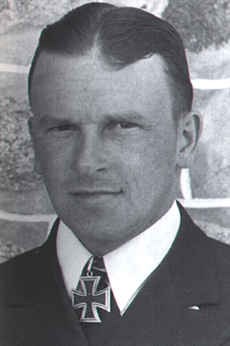
U-boat Commands
| U-boat | From | To | |
|---|---|---|---|
| U-2 | 31 Jan 1938 | 16 Mar 1939 | No war patrols |
| U-48 | 22 Apr 1939 | 20 May 1940 | 5 patrols (135 days) |
| U-48 | 17 Dec 1940 | 27 Jul 1941 | 3 patrols (92 days) |
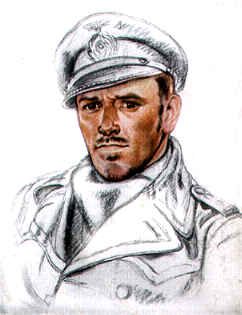
Herbert Schultze after patrol |
Herbert Schultze joined the Reichsmarine in April 1930. He served on the light cruisers Leipzig and Karlsruhe (together with Merten and Lehmann-Willenbrock).
In May 1937 he transferred to the U-boat force, taking command of the type IIA U-boat U-2 in January 1938.
Fifteen months later he commissioned U-48, the U-boat which later became the most successful submarine of the war.
Shultze's first patrol in September 1939 was successful, resulting in three ships sunk with a total of 14,777 tons. During this patrol he became famous for the radio message he sent in plain language after sinking the Firby on 11 September:
"cq - cq- cq - transmit to Mr. Churchill. I have sunk the British steamer "Firby". Posit 59.40 North and 13.50 West. Save the crew, if you please.
German submarine."
A US journalist gave a good description of Herbert Schultze in this report filed in 1939:
Berlin, September 29
At midnight tonight I did a microphone interview with Germany's ace submarine skipper, Captain Herbert Schultze. It turned out much better than I expected. During the afternoon and evening I had had many doubts and a big headache. With the help of some naval officer friends, I cornered Schultze in the Admiralty this afternoon. He was just back from his first "killing". He turned out to be a clean-cut fellow of thirty, hard as nails and full of that bluff self-confidence which you get, I suppose, when you gamble daily with your own life and the lives of others.
He was a little afraid of his English, he said, and after listening to a specimen, I was too. In fact, I couldn't understand a word he said and we had to converse in German. Someone suggested that his English would improve during the afternoon, that he was merely a little rusty. This offered hope, and I cabled New York that the interview was on for tonight. I put my questions to him and the captain sat down to write out answers in German. When he had finished a page, I dictated an English translation to an Admiralty secretary who for some reason wrote English faultlessly but had great difficulty in understanding it when spoken. We sweated away all afternoon - four hours - and finally achieved a fifteen-minute script.
There were two points in the script, the very ones which made it most interesting, which added to my own perception. The captain told a story of how he had torpedoed the British ship Royal Sceptre, but, at the risk of his own skin, had arranged rescue of those aboard by another British vessel, the Browning. Now, a few days before, I remembered, London had reported that the Royal Sceptre had been torpedoed without warning and that the crew and passengers, numbering sixty, had presumably perished. I wondered who was right.
Captain Schultze, as we worked out our interview, also mentioned that he was the U-boat commander who had sent a saucy radio message to Mr. Winston Churchill advising him of the location of a British ship which he had just sunk so that the First Lord might save the crew. But only a day or two before, Mr. Churchill had told the House of Commons that the German submarine commander who had sent him that message had been captured and was now a prisoner of His Majesty's government.
I reminded the captain of that, and asked him if he could give me the text of his message. His logbook was at Kiel, but we telephoned there and had the message read back to us. That made me feel a little better. Shortly before the broadcast this evening something else happened which made me feel better still. As we were leaving the Admiralty, an officer brought us a Reuter dispatch saying that the Browning had just landed at Bahia, Brazil, with the crew and passengers of the Royal Sceptre all safe.
One good break followed another. To my surprise, as our broadcast got under way, the captain's English did indeed improve, just as predicted. His accent was terrific, but in some way his words poured out very distinctly. You could understand every syllable. Most men of his type, I've found, when put before a microphone, read their lines mechanically. But to my delight he proved to be a natural speaker, talking as though we had never written a line.
(Later the British Admiralty confirmed his version of both the Royal Sceptre episode and the saucy message to Mr. Churchill, including the fact that Schultze had not been captured). *
The following three patrols were also very successful and as a result, in March 1940, Herbert Schultze became the second U-boat officer to be awarded the Knights Cross. In May 1940 he turned over command of U-48 to Hans Rudolf Rösing and spent five months in hospital suffering from a stomach and kidney disorder. From October to December 1940 he was deputy commander of the 7th Flotilla in St Nazaire.
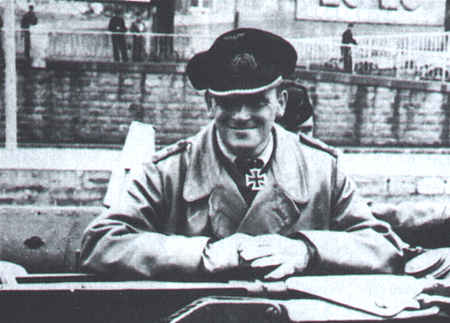
Kapitänleutnant in a typical mood in 1941, St. Nazaire
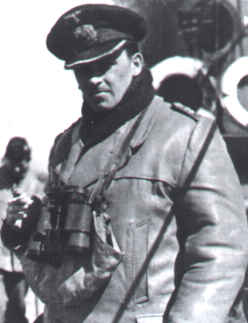 Herbert Schultze on board |
In December 1940 Schultze resumed command of U-48, taking over from Heinrich Bleichrodt. The next three patrols were so successful that he was decorated with the Knights Cross with Oak Leaves in June 1941.
He was called "Vaddi" (Daddy) Schultze because he took very good care his crew.
In July 1942 he left U-48 and became commander of the 3rd Flotilla in La Rochelle. In March 1942 he was attached as the Asto (admiral staff officer) for U-boats to the staff of the "Marinegruppe Nord". In December 1942 he joined Dönitz's staff. In March 1944 he left the BdU staff and became a department leader in the Marinekriegsschule Mürwik (naval war college), where he served to the end of the war.
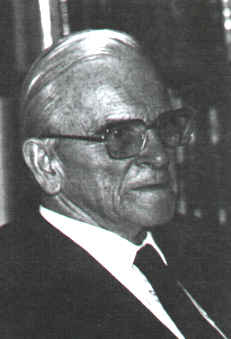
Herbert Schultze in his seventies. |
In 1956 Herbert Schultze joined the Bundesmarine and served in several staff positions, including another two years at the now renamed Marineschule Mürwik. He retired in September 1968 as Kapitän zur See.
During Schultze's funeral in 1987, Otto Kretschmer spoke for the old U-boat comrades:
"Hochgeachtet von Freund und Feind, verehrt von seiner Besatzung, war Herbert Schultze ein vorbildlicher Seeoffizier bester Tradition."Otto Kretschmer
(Deeply respected by friend and foe, revered by his crew, Herbert Schultze was an exemplary naval officer in the best tradition.)
* Shirer, William L. : Berlin Diary 1934 - 1941.
Sources
Busch, R. and Röll, H-J. (1999). German U-boat commanders of World War II.
Busch, R. and Röll, H-J. (1997). Der U-Bootkrieg 1939-1945 (Band 2).
Niestlé, A. (1998). German U-boat losses during World War II.
Rohwer, J. (1998). Axis Submarine Successes of World War Two.
Patrol info for Herbert Schultze
| U-boat | Departure | Arrival | ||||||
|---|---|---|---|---|---|---|---|---|
| 1. | U-48 | 19 Aug 1939 | Kiel | 17 Sep 1939 | Kiel | Patrol 1, | 30 days | |
| 2. | U-48 | 4 Oct 1939 | Kiel | 25 Oct 1939 | Kiel | Patrol 2, | 22 days | |
| 3. | U-48 | 20 Nov 1939 | Kiel | 20 Dec 1939 | Kiel | Patrol 3, | 31 days | |
| 4. | U-48 | 24 Jan 1940 | Kiel | 26 Feb 1940 | Kiel | Patrol 4, | 34 days | |
| 5. | U-48 | 3 Apr 1940 | Kiel | 20 Apr 1940 | Kiel | Patrol 5, | 18 days | |
| 6. | U-48 | 20 Jan 1941 | Kiel | 27 Feb 1941 | St. Nazaire | Patrol 6, | 39 days | |
| 7. | U-48 | 17 Mar 1941 | St. Nazaire | 8 Apr 1941 | St. Nazaire | Patrol 7, | 23 days | |
| 8. | U-48 | 22 May 1941 | St. Nazaire | 17 Jun 1941 | Bergen | Patrol 8, | 27 days | |
| 9. | U-48 | 19 Jun 1941 | Bergen | 21 Jun 1941 | Kiel | Patrol 8, | 3 days | |
| 8 patrols, 227 days at sea | ||||||||
Ships hit by Herbert Schultze


About ranks and decorations
Ranks shown in italics are our database inserts based on the rank dates of his crew comrades. The officers of each crew would normally have progressed through the lower ranks at the same rate.

Media links
|
|
|


As an Amazon Associate uboat.net earns a commission from qualifying purchases.